Page 1 of 50
Health and Safety
Executive
Keeping electrical switchgear
safe
Health and Safety
Executive
Keeping electrical switchgear
safe
HSG230 (2nd edition)
Published 2015
HSE Books
Failure of electrical switchgear can cause death, serious injury and major damage.
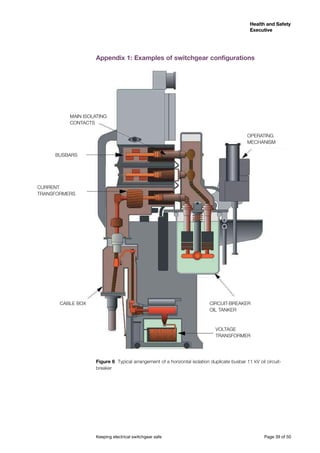
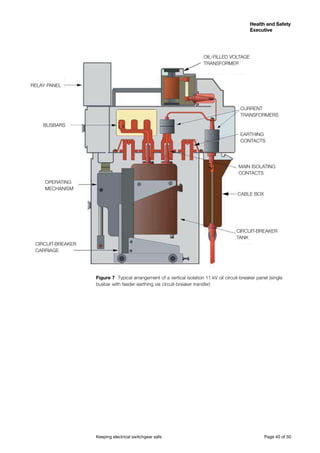
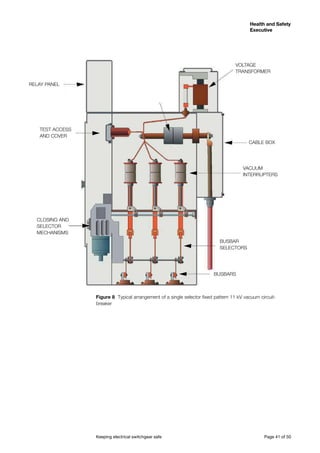
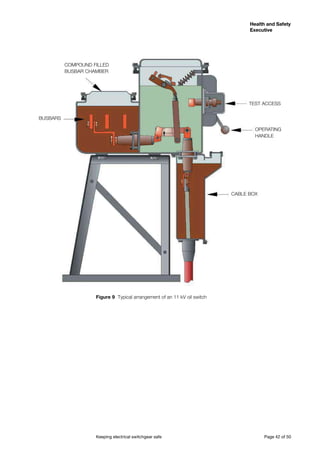
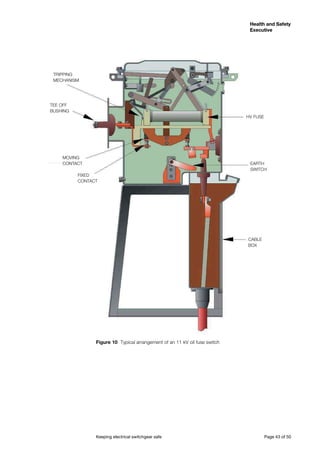
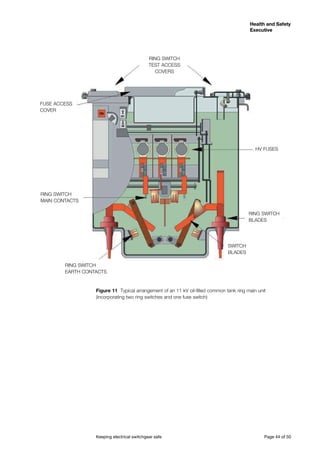
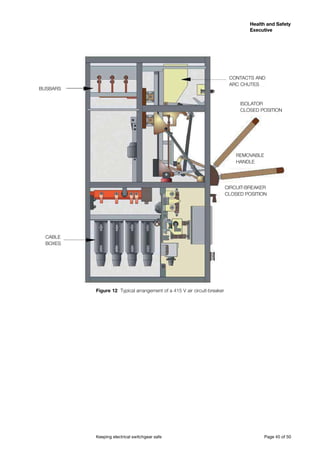
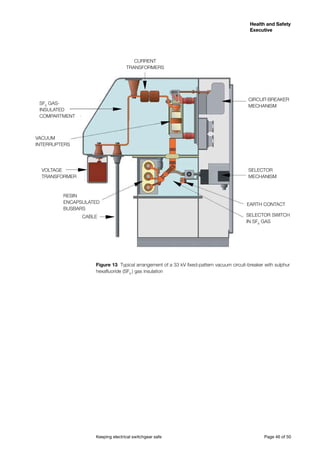
If you own or operate this type of equipment in industrial or commercial
organisations, this book is mainly aimed at you. It should help you to select, use
and maintain switchgear safely and reduce the risk of accidents.
Keeping electrical switchgear safe	 Page 2 of 50
Health and Safety
Executive
Health and Safety
Executive
© Crown copyright 2015
First published 2002
Second edition 2015
ISBN 978 0 7176 6557 0
You may reuse this information (excluding logos) free of charge in any format or
medium, under the terms of the Open Government Licence. To view the licence
visit www.nationalarchives.gov.uk/doc/open-government-licence/, write to the
Information Policy Team, The National Archives, Kew, London TW9 4DU, or email
psi@nationalarchives.gsi.gov.uk.
Some images and illustrations may not be owned by the Crown so cannot be
reproduced without permission of the copyright owner. Enquiries should be sent to
copyright@hse.gsi.gov.uk.
This guidance is issued by the Health and Safety Executive. Following the guidance
is not compulsory, unless specifically stated, and you are free to take other action.
But if you do follow the guidance you will normally be doing enough to comply with
the law. Health and safety inspectors seek to secure compliance with the law and
may refer to this guidance.
Keeping electrical switchgear safe	 Page 3 of 50
Health and Safety
Executive
Contents
Introduction  5
Scope  5
Background  5
What does the law require?  5
Switchgear safety  6
Understand your system  6
Maintenance  7
Design rating and system modifications  8
Design modifications and limitations on use  8
Dependent manual operating mechanisms  8
Anti-reflex handles  9
Management of switchgear  9
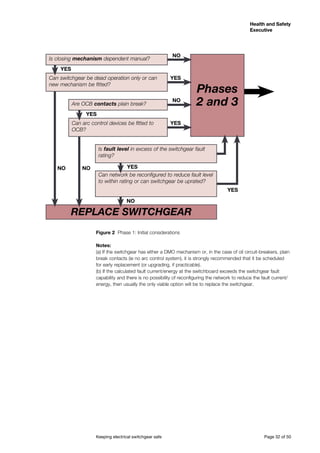
Management systems  9
Training and competence  10
Operational safety documents  11
Network diagram  12
Maintenance systems and asset registers  12
Maintenance records  13
Operation of switchgear  13
Fault level and ratings  13
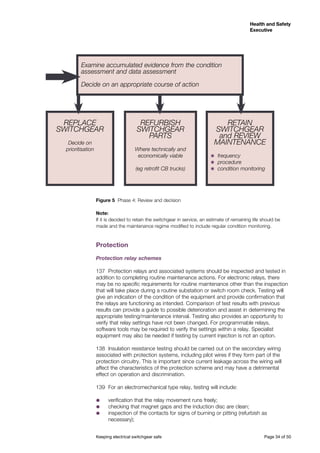
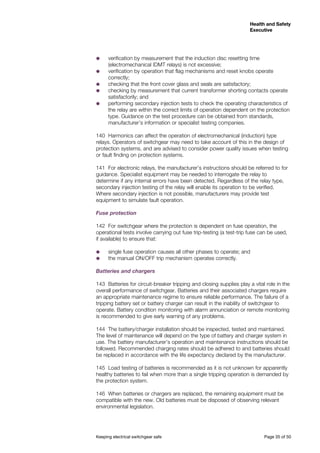
Effect of on-site generation and other large rotating machines  14
Reducing the risk of switchgear failure  14
Overstressed switchgear  14
Dependent manually operated (DMO) switchgear  15
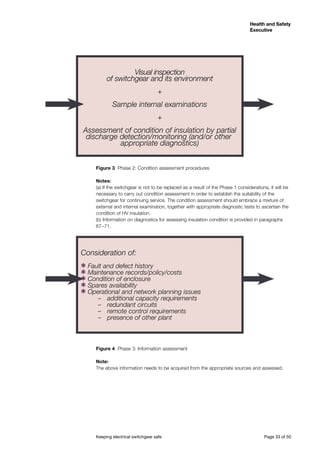
Fault clearance  16
Care and maintenance of HV switchgear: Common
requirements  16
Time-based preventive maintenance  16
Condition-based maintenance  17
Reliability-centred maintenance (RCM)  18
Switchgear availability  18
Trip-testing  18
Protection testing  19
Tests to be undertaken following maintenance  19
Routine inspection of substations and switch rooms  19
Signs of abnormal conditions  19
Equipment environment  20
Visual examination of switchgear  20
General services  20
Circuit-breakers subject to special duty  21
Disposal issues, post-maintenance  21
Care and maintenance of oil-filled switchgear  21
Maintenance procedures  22
Frequency of maintenance  23
Keeping electrical switchgear safe	 Page 4 of 50
Health and Safety
Executive
Health and Safety
Executive
Cleaning and inspection of oil-filled switchgear  23
Tank cleaning techniques  24
Insulating oil  24
Post-fault maintenance of oil-filled switchgear  25
Care and maintenance of non-oil filled switchgear  25
General guidance  25
Maintenance procedures: Vacuum swiitchgear  26
Maintenance procedures: Air-brake switchgear  27
Maintenance procedures: SF6
switchgear  27
SF6
gas handling and safety precautions  28
Release of SF6
  28
Hazards  28
Sampling  29
Care and maintenance of ancillary equipment  29
Test probes  29
Earthing equipment  30
Assessment of aged switchgear  31
Protection  34
Protection relay schemes  34
Fuse protection  35
Batteries and chargers  35
Selection of new, replacement or refurbished switchgear  36
General advice  36
Retrofit circuit-breakers for withdrawable switchgear  37
Second-hand equipment  37
Measures to limit fires  37
Compartmentation  37
Control and extinction  37
Detection  37
Safety issues  38
Appendix 1: Examples of switchgear configurations  39
References and further reading  47
Glossary  49
Further information  50
Keeping electrical switchgear safe	 Page 5 of 50
Health and Safety
Executive
Health and Safety
Executive
Introduction
1	 This guidance is aimed at owners and operators of electrical switchgear in
industrial and commercial organisations. It may also be useful to others. It will help
managers, engineers and others to understand their responsibilities and duties in
the selection, use, operation and maintenance of high-voltage switchgear. Some
knowledge of electrical switchgear and distribution systems is necessary to gain
most benefit from this document. Owners and operators of electrical switchgear
with little electrical knowledge or expertise should refer to Electrical switchgear
safety: A guide for owners and users.1
Scope
2	 Guidance is given on the selection, use, operation and maintenance of three-
phase electrical switchgear with voltage ratings from 1 kV alternating current (AC)
up to and including 33 kV AC. This includes circuit-breakers, switches, switch
fuses, isolators and high-voltage (HV) contactors that use oil, air, sulphur
hexafluoride (SF6
) or vacuum as the interrupting medium. Guidance is also provided
on assessing risks associated with aged switchgear and the actions necessary
when considering replacement or refurbishment of switchgear. Low-voltage (ie
below 1 kV) equipment is out of the scope of this guidance, although some
references are made to low-voltage (LV) equipment where it is an essential part of
an HV system.
3	 This guidance does not address direct current (DC) switchgear, switchgear
used on single-phase AC traction systems, or power electronic switching devices
used at high voltage such as inverters, cyclo-converters and rectifiers.
Background
4	 Switchgear failures are rare, but when they do occur, the results can be
catastrophic. In the case of oil-filled switchgear, burning oil and gas can be ejected,
causing death or serious injury to people who may be nearby, and major damage
to equipment and buildings. Switchgear using SF6
gas or vacuum as the insulating
medium presents other risks that need to be controlled and managed.
5	 Failures are most likely to occur during, or shortly after, switchgear operation.
The way switchgear is operated, its condition and the conditions in the electrical
system at the time it operates will largely determine whether it will function safely.
What does the law require?
6	 The Health and Safety at Work etc Act 1974 (the HSW Act),2
the Management
of Health and Safety at Work Regulations 1999 (the Management Regulations)3
and
the Electricity at Work Regulations 1989 (EAWR)4
are applicable to the selection,
use, operation and maintenance of high-voltage switchgear. The HSW Act also
places duties on the manufacturers of switchgear.
7	 Older switchgear may contain parts that were manufactured from asbestos or
asbestos-containing materials (ACMs). The Control of Asbestos Regulations 20125
place a duty on those who have responsibility for the maintenance and repair of
equipment to manage the risks from the potential for exposure to asbestos. This
includes the responsibility to determine if asbestos is present so that others can be
made aware of the hazard and take appropriate action. Advice should be sought
from the original equipment supplier or a specialist maintenance provider on the
likelihood of asbestos or ACMs being present in switchgear.
Keeping electrical switchgear safe	 Page 6 of 50
Health and Safety
Executive
Health and Safety
Executive
8	 The HSW Act requires employers to ensure, so far as is reasonably practicable
(see paragraph 11), the safety of employees and other people who may be affected
by their activities. Similarly, self-employed people while at work must ensure that
they do not expose themselves to risks to their own health and safety, and that
they do not affect the health and safety of others.
9	 The Management Regulations require an employer or self-employed person to
make an assessment of the risks to employees and others. To do this, they should
consider what might cause harm to people and decide whether they are doing
enough to prevent that. For more information on risk assessment, see Risk
assessment: A brief guide to controlling risks in the workplace.6
10	 The EAWR requires electrical equipment, which includes switchgear, for use at
work to be constructed, maintained and operated in such a way as to prevent, so
far as is reasonably practicable, danger. Electrical equipment, including switchgear,
must not be used where its strength or capability may be exceeded, unless it is
used in such a way that nobody could be exposed to danger. This includes
protection against the effects of excess current and exposure to the physical
environment in which the switchgear is located. People who work on or near to
electrical equipment, and those responsible for managing such work activities,
must be suitably competent for the activity to be undertaken (ie they must have the
appropriate level of technical knowledge or experience). Alternatively, those working
on switchgear must be suitably supervised.
11	 ‘So far as is reasonably practicable’ means balancing the level of risk against the
measures needed to control the real risk in terms of money, time or trouble.
However, you do not need to take action if it would be grossly disproportionate to
the level of risk. In the context of HV switchgear, the procedures to select and
maintain suitable equipment and to ensure the safety of those working on or near it
are well established. These are supported by existing standards, guidance and
training qualifications. Many organisations successfully apply these measures to the
management of their switchgear. For certain work activities on switchgear, there can
be a risk of death, and this must be taken into account when considering the
measures needed to ensure safety when such tasks are completed. For more
information, see Risk assessment: A brief guide to controlling risks in the workplace.
Switchgear safety
12	 The use, maintenance and operation of high-voltage switchgear must be
managed to prevent both the equipment giving rise to danger and to ensure the
safety of the people who use it. Allowing equipment to become unsafe and, as a
result, exposing people to danger during its use is likely to breach the law. Oil-filled
switchgear presents particular issues not encountered with other types of
equipment.
Understand your system
13	 Switchgear varies in size, age and appearance. Examples are shown in
Appendix 1. Different types of switchgear such as switches, isolators, switch fuses,
contactors and circuit-breakers have different switching and fault-handling
capabilities. It is important to be able to recognise the different types of switchgear
and understand the differences in their capability. Failure to do so can result in
switchgear being used incorrectly, which may be dangerous for the operator.
14	 Some switchgear may appear to be of robust construction due to its size.
Despite appearances, it may have limited operational capability and be restricted in
Keeping electrical switchgear safe	 Page 7 of 50
Health and Safety
Executive
Health and Safety
Executive
the way it should be used. Any limitations or restrictions must be understood by
those who operate or maintain the equipment.
15	 HV switchgear may be located close to machinery controlled by it. People who
have access to the switchgear may not be electrically competent, but must be
made aware of its presence and the potential hazards associated with it. They
should know what to do if they notice anything unusual or wrong with the
switchgear.
16	 In certain industries, the location of switchgear in relation to the process activity
is important. For example, for explosives manufacture and storage, HV equipment
should be sited outdoors, see Explosives Regulations 2014: Safety provisions.
Guidance on Regulations.7
It is important that the location of HV switchgear is
considered if the use of a premises changes.
17	 Switchgear must only be operated by people who are competent to do so.
Being competent means having sufficient knowledge or experience to prevent
danger or injury; or being under such degree of supervision as may be appropriate
for the nature of the work. Switchgear operated incorrectly can result in danger
both to those operating it and others. Experience will include an understanding of
the operation of the switchgear and knowledge of the arrangement of the system in
which it is installed. People who are required to operate older switchgear must be
specifically trained and experienced in its use. They must be aware of its limitations.
People trained only on more modern equipment may not have such knowledge.
18	 People with the necessary competence to operate switchgear are often
referred to as ‘authorised persons’. A system should be in place to assess and
appoint the people who can operate switchgear (authorised persons), record who
they are, what training they have received, what experience they have, what items
of switchgear they are permitted to operate, and what duties they are authorised to
undertake. If no one within an organisation has the necessary competence to make
the assessments to appoint people or to operate switchgear, someone should be
developed to fulfil this role, or it must be given to an independent organisation with
the necessary competence. It may be necessary to consider arrangements for
support outside normal working hours. Even if the operation and maintenance of
switchgear is contracted to an external provider, the owner of the switchgear
retains a legal responsibility for its safe operation and maintenance.
19 A number of organisations (eg electricity distribution companies or specialist
training organisations) can provide training. Attending a training course alone is
unlikely to demonstrate that an individual has adequate technical knowledge or
experience to satisfy the legal requirement for competence. Depending on the work
to be undertaken, it is likely that specific experience of the switchgear to be
operated and an understanding of the system in which it is installed will be
necessary to prevent danger.
Maintenance 	
20	 A system must be in place to ensure that switchgear is maintained
appropriately by people competent to do so, at an appropriate frequency to
provide assurance that it remains in a safe condition. Oversights, lack of
knowledge, lack of the necessary skills, or concerns over the impact of a loss of
power are common reasons for failing to maintain HV switchgear. Failure to carry
out maintenance may result in the switchgear not operating when required to do
so. This can place unnecessary stress on switchgear elsewhere within a system
and result in more extensive damage if faults do occur. The switchgear may also
become dangerous to operate.
Keeping electrical switchgear safe	 Page 8 of 50
Health and Safety
Executive
Health and Safety
Executive
Design rating and system modifications
21	 Switchgear is described as being ‘overstressed’ when it is operated beyond its
design rating. This could be due to excess load or where the fault energy (the
energy that the switchgear would need to carry, make or interrupt in the event of
an electrical fault) exceeds the capability of the switchgear. If required to operate
under these conditions, overstressed switchgear may not cope with the electrical,
magnetic and thermal stresses imposed upon it. This can result in it failing
catastrophically with the potential to cause injury. Switchgear must not be used
where its strength and capability may be exceeded, unless it is used in such a way
that nobody could be exposed to danger.
22	 When originally installed, switchgear should have been adequately rated for the
duty it was intended to perform. Changes to an electrical system can result in
switchgear becoming overstressed. Careful consideration must be given to system
modifications to ensure that dangerous conditions are not created. Changing the
configuration of a system through switching operations that put transformers into
parallel operation can result in an increase in fault energy. Such arrangements may
result from a response to abnormal system conditions or be necessary during
planned maintenance work. Interlock systems should be used to prevent
overstressing in such circumstances. Where it is not possible to use interlocks,
clear operating instructions must be provided to prevent configurations that have
the potential to overstress switchgear.
Design modifications and limitations on use	
23	 During the life of switchgear, defects with the original design or manufacturing
process may become apparent. Manufacturers may recommend modifications, some
of which may be required for the continued safe operation of the switchgear. While
manufacturers must inform the original purchaser of modifications required to prevent
danger, it is the current owner and operator of the switchgear who has the legal duty
to ensure it remains safe. Audits at appropriate intervals can be helpful to identify
switchgear that may require modification. These could involve either the switchgear
manufacturer or specialist maintenance providers. Modifications essential for safety
must be completed. If defects relating to safety are identified and result in restrictions
on the use of switchgear, the people who operate or maintain the equipment must
be made aware of the restrictions so that they can perform their work safely.
Dependent manual operating mechanisms
24	 Dependent manual operating (DMO) mechanisms used to be fitted to both HV
and LV switchgear. Although no longer made, they may still be in use on some
systems. In switchgear fitted with DMO mechanisms, the operator opens and
closes the contacts within the switchgear solely by manual effort. Movement of the
contacts is dependent on the speed and actions of the operator. Hesitancy can
lead to failure of the switchgear with potentially fatal consequences. Under some
circumstances, such as operation during fault conditions, it may be physically
impossible to close a DMO switch due to the electromagnetic forces involved.
Attempting to operate switchgear under fault conditions can cause it to fail.
25	 Where DMO switchgear is in service, it must only be used by people who have
been trained specifically in its use and are aware of the potential danger associated
with its operation. In general, the switchgear should only be operated after first
being made dead by the operation of other switchgear which is suitably rated and
does not have a DMO mechanism. Similarly, it should only be put back into service
through the operation of such switchgear. See paragraphs 56−59 for further
information on DMO switchgear.
Health and Safety
Executive
Health and Safety
Executive
Keeping electrical switchgear safe	 Page 9 of 50
26	 There is a foreseeable risk associated with the use of DMO switchgear. It is
foreseeable that such equipment present within an electrical system may at some
time be used. It is a legal requirement that all systems shall at all times be of such
construction as to prevent, so far as is reasonably practicable, danger. It is highly
recommended that DMO switchgear is replaced.
Anti-reflex handles
27	 Oil switches, such as those incorporated within ring main units, may be rated
to close onto a fault but not to interrupt fault current (sometimes referred to as fault
make, load break switches). Where switchgear using oil switches is also fitted with
integral earthing, incidents have resulted when a failure to check the position of the
selector mechanism has led to operators switching from OFF to EARTH instead of
from OFF to ON. This action has the potential to put an earth fault onto the HV
system. This is not necessarily a dangerous situation as oil switches are designed
to close onto a fault, but danger arises if the operator, realising that a mistake has
been made, instinctively reacts and attempts to open the switch. Oil switches are
not rated to interrupt fault current, and where this has occurred, switches have
failed, causing serious injury to the operator.
28	 To address this problem, manufacturers supply ‘anti-reflex’ handles. These are
handles that have to be removed and re-inserted before they can be used to reverse
the operation of an oil switch. They are provided to ensure that if a mistake is made,
it is not possible to immediately reverse a switching action. This may allow sufficient
time for circuit protection to operate, clearing a fault by operating a circuit breaker or
other device designed to break fault current, or it will provide thinking time for an
operator before making the conscious decision to reverse a switching action.
29	 A review of oil switches and oil switch fuses present on a system should be
undertaken to determine if anti-reflex handles have been provided. If not, it is
advisable to replace standard handles with anti-reflex handles.
Management of switchgear
Management systems
30	 Establishing and implementing a formal system for the management and
control of an electrical distribution system is an effective and practical way of
demonstrating compliance with a number of legal requirements. When correctly
implemented, a management system can help address the safety issues identified
with the operation, use and maintenance of HV switchgear. A management system
for a distribution system need not be complex; the requirements should be
proportionate to the complexity of the system.
31	 Record keeping is an important part of a management system, in terms of
having both adequate information about the equipment on a system, and
information about the competency and responsibilities of those authorised to work
on it. A management system for HV switchgear may include:
˜˜ policies and procedures for the installation, commissioning, operation and
maintenance of HV switchgear. These should include the arrangements for
authorising people to work on the switchgear and the training, experience and
development requirements to be satisfied before people are authorised to
operate switchgear. Procedures should include safe systems of work which are
likely to include the use of safety documents such as permit-to-work systems
(see Electricity at work: Safe working practices);8
Keeping electrical switchgear safe	 Page 10 of 50
Health and Safety
Executive
Health and Safety
Executive
˜˜ manufacturers’ operating instructions for each item of switchgear and
associated ancillary equipment (such as battery chargers, protection relays and
fire detection systems). This should include access to any safety bulletins
issued by the equipment manufacturers;
˜˜ drawings (such as a network diagram – see paragraph 41) and technical
information (such as protection type, grading and fault level studies);
˜˜ definition of responsibilities and training records for people who have been
authorised to use or work on the equipment;
˜˜ maintenance and operating records; recording the results of maintenance
activities, repairs, modifications and any significant faults that may have
occurred for each item of equipment; and
˜˜ systems for auditing the effectiveness of the management system, records of
the audits completed and the actions taken to rectify any deficiencies found.
32	 Policies and procedures should be developed by people who have an
understanding of the risks associated with HV switchgear and the specific system
in which it is installed. Competent staff should implement the policies and
procedures and review the effectiveness of the management system. If the
expertise necessary to do this is not available in-house, someone should be
developed to obtain this expertise, or assistance should be sought from others.
Assistance may be obtained from:
˜˜ distribution network operators;
˜˜ electricity generators;
˜˜ switchgear manufacturers;
˜˜ switchgear maintenance providers;
˜˜ consulting organisations specialising in switchgear and HV training; and
˜˜ technical services companies.
33	 The British Electrotechnical and Allied Manufacturers Association (BEAMA) can
provide up-to-date details of manufacturers (see www.beama.org.uk).
Training and competence
34	 People who are required to operate or maintain switchgear must be competent
to do so. Being competent means having sufficient knowledge or experience to
prevent danger or injury, or to be under such degree of supervision as may be
appropriate for the nature of the work. Appropriate training must be given to enable
such people to carry out their duties safely and without risk to health. It is also
important that they understand the limits of what they are able to do, including
tasks they must not undertake unless appropriately supervised. It is unlikely that
attending a training course on its own will enable someone to demonstrate
competence in all circumstances. Appropriate supervision may also be necessary.
A number of organisations offer training courses, from general appreciation of site
access and responsibilities through to detailed courses on operation, safety and
maintenance practice etc. Training providers include:
˜˜ 	distribution network operators;
˜˜ 	switchgear manufacturers; and
˜˜ 	technical services companies.
35	 To ensure that the different types of activity necessary when operating and
maintaining switchgear are performed safely, it is useful to define levels of
authorisation for people. This will enable a clear definition of the duties that are
expected to be documented. It will also help the people who carry out work to
understand the limitations of what they are authorised to do and what they should
not do. For example, someone trained to close a circuit breaker as part of an
Keeping electrical switchgear safe	 Page 11 of 50
Health and Safety
Executive
Health and Safety
Executive
isolation procedure may not be authorised to close the same circuit breaker if it has
operated due to the detection of a fault condition.
36	 Typically, there will be a designated competent person or persons (also known in
some industries as an ‘authorised person’ or ‘senior authorised person’, depending
on their level of responsibility). The description ‘competent person’ (or ‘authorised
person’) in the context of someone appointed to operate switchgear implies:
˜˜ a person appointed by the employer, preferably in writing, to undertake certain
specific responsibilities and duties, which may include the issue and/or receipt
of safety documents such as permits-to-work. The person must be competent
by way of training, qualifications and/or experience and knowledge of the
system to be worked on.
Operational safety documents
37	 The implementation of a safety document scheme, generally referred to as a
permit-to-work system, is recommended as part of a safe system of work for the
use, care and maintenance of high-voltage switchgear. The naming of documents
may vary between organisations, but most schemes will include three types of
control document:
˜˜ limitation of access – issued to define the physical limits within which a work
activity may be carried out, specifying any precautions necessary and hazards
that may be present within the work area;
˜˜ permit-to-work – when issued, clearly identifies the equipment to be worked
on, the work to be carried out and the actions taken to achieve the conditions
which safeguard people working from the dangers which are inherent in an HV
system. A permit-to-work should never be issued on equipment that is still live;
it should only be issued when the measures required for safety have been
completed; and
˜˜ sanction for test – issued to allow specified HV equipment to be tested,
identifying the conditions under which the testing is to be carried out and the
actions taken to safeguard the people performing the test, and anyone else
who may have access to the area. A sanction for test may allow temporary
earth connections applied as part of the protective measures specified for a
work activity to be removed for the purposes of testing.
38	 HV permits-to-work should not be used for general work control purposes.
Further guidance on their use can be found in Electricity at work: Safe working
practices and BS 6626.9
39	 Everyone who is reliant on operational safety documents for their safety should
be familiarised with the relevant procedures and made aware of their responsibilities.
A permit-to-work should only be issued by someone who is competent and
authorised to do so. Permits-to-work should only be given to people capable of
understanding the precautions and limitations of the activity described on the permit.
Ideally, a permit should be issued at the work location and the task clearly explained
to the recipient before the permit is handed over. The recipient of a permit is
responsible for ensuring that the safety precautions identified are adhered to, and
that only the permitted work is completed, confined to the area defined in the
permit. It is important that the recipient understands these responsibilities and is, to
the best of their knowledge, satisfied that the precautions are adequate for the work
they or their work group are about to complete when the permit is received. When
work is to be carried out on HV switchgear or equipment, it is likely that those doing
the work will need to be designated ‘competent persons’.
Keeping electrical switchgear safe	 Page 12 of 50
Health and Safety
Executive
Health and Safety
Executive
40	 Working alone should be avoided whenever possible. If the person issuing the
permit will also be doing the work, it is strongly recommended that someone else
makes an independent check of the control measures. It is important that the
person doing the work follows the process of issuing and receiving the permit in
full, even though it is their signature on both parts of the document. Following this
process reinforces the requirement to consider the risks associated with the task
and the identification of the safety precautions required. It also helps to confirm that
the necessary precautions have been put in place before work begins. Accidents
have occurred when experienced people have failed to implement the requirements
of permit systems.
Network diagram
41	 A network diagram (also referred to as a single line diagram) is a schematic
representation of an electrical network identifying the interconnection of an electrical
distribution system from the supply intake point(s) to the loads that it feeds. It
provides an overview of the system and identifies all the switchgear and its location
within the network. A network diagram is an important reference document for the
operation and maintenance of an HV system.
42	 The network diagram should include prospective fault current/energy values
and information about the capability of switchgear. It is a useful way to record and
communicate operational restrictions such as those created by the presence of
overstressed equipment or DMO switchgear. It can also be used to identify the
interaction of the LV system with the HV system, which is important if there are
alternative sources of energy on the LV network.
43	 A network diagram can be used to identify network configurations that may
increase fault levels or other operations that need to be avoided to prevent danger.
It can be used for the development of safe operating procedures. It can also help
to identify the different types of equipment present on a network for which training
may be required.
44	 For all but the most simple distribution system, a network diagram is an important
reference document for the planning, coordination and control of work activities. It
should be accurate and up-to-date. Providing an up-to-date copy in each substation
on a site with multiple substations can provide a useful reference, particularly during
abnormal system conditions. In this situation, diagrams should be controlled through
an appropriate management system to ensure they stay up-to-date.
Maintenance systems and asset registers
45	 Many businesses use maintenance management systems for the scheduling and
recording of maintenance work. Corporate requirements are likely to determine the
choice of system used. Most maintenance systems will incorporate an asset register
to identify all items of equipment that require maintenance. Asset registers can
usefully be used to store and reference records relating to switchgear. A maintenance
system can drive inspections and preventative maintenance processes based on the
equipment identified in the asset register, ensuring that equipment is not overlooked.
Some form of hierarchical structure is useful within an asset register to enable
referencing on larger systems. Such structures need not be complex. There are legal
requirements to maintain equipment so that it does not give rise to danger. Typical
information in an asset register for an item of switchgear may include:
˜˜ physical location;
˜˜ manufacturer and type reference, including the standard to which the
equipment was manufactured;
Keeping electrical switchgear safe	 Page 13 of 50
Health and Safety
Executive
Health and Safety
Executive
˜˜ serial number and year of manufacture;
˜˜ date of installation;
˜˜ voltage rating, current rating, fault rating;
˜˜ type of operating mechanism (dependent manual, independent manual,
dependent power, independent power and stored energy);
˜˜ details of any modifications, eg fitted anti-reflex handles;
˜˜ type of electrical protection installed and details of the settings;
˜˜ references to the location of manufacturer’s data sheets, drawings and
operating and maintenance instructions; and
˜˜ references to the location of maintenance records and other history associated
with the operation and use of the equipment.
Maintenance records
46	 Records are a key part of an effective maintenance system. Keeping records
provides confidence that maintenance has been completed and, when used with
an asset register, can be used to verify that the maintenance of switchgear has not
been missed. Measurements recorded during maintenance inspections are useful
in determining switchgear performance, as trends in recorded values are often
more valuable than specific, one-off measurements. Trends and historical data may
be used to assess the effectiveness of a maintenance programme or justify chosen
maintenance frequencies.
47	 A maintenance record for an item of switchgear will typically include:
˜˜ the date on which the work was performed and confirmation of the item
worked on;
˜˜ who performed the work and a schedule confirming what was done;
˜˜ any observations or comments made during the maintenance, including any
recommendations for further work;
˜˜ the results of any tests or measurements taken, including a record of functional
checks when completed; and
˜˜ a means of raising urgent or important findings that may mean intervention is
required before the next scheduled maintenance period.
Operation of switchgear
Fault level and ratings
48	 Electrical equipment must not be used where its strength and capability may
be exceeded, unless it is used in such a way that nobody could be exposed to
danger. Before operating any switchgear, you have to determine if the switchgear
is capable of performing the duties expected of it. British Standards or other
standards (see ‘Further reading’) relevant to the manufacture of switchgear may
provide information about fault-handling capability. Details may also be found on
the rating plate of the switchgear itself. System studies are likely to be required to
determine the fault current/energy level at the specific point in a system where the
switchgear is installed, although this may not be necessary if the rating of the
equipment cannot be exceeded. Where switchgear was designed to now obsolete
British Standards, reassessment of the rating by the original manufacturer or
switchgear specialists may be necessary.
49	 To determine the fault current/energy at each point in a network, it may be
necessary to include the fault energy contribution from rotating plant such as
large induction motors, synchronous motors and generators. Where practical, for
more complex networks, fault current/energy calculations should be performed
Keeping electrical switchgear safe	 Page 14 of 50
Health and Safety
Executive
Health and Safety
Executive
for all possible configurations of the network, as fault levels are likely to vary
depending on the network configuration. The distribution network operator (DNO)
responsible for the supply from the public supply network has a legal obligation
to provide, on request, the maximum short-circuit current at the incoming supply
terminals (see the Electricity Safety, Quality and Continuity Regulations 2002,
regulation 28).10
50	 The calculation of fault current/energy is a specialist topic, and is likely to
require support from people experienced in undertaking and interpreting such
calculations. Many specialists use software modelling of electrical networks to
determine fault levels.
51	 The information from a fault current/energy study can be recorded on a
network diagram and referenced against the known ratings of the switchgear. In
this way, it is possible to identify and communicate the presence of overstressed
switchgear and identify any network configurations that may lead to equipment
becoming overstressed.
Effect of on-site generation and other large rotating machines
52	 On-site generation and large rotating machines can have an impact on the duty
required of switchgear. Both contribute to fault current/energy, and this must be
taken into account when determining if switchgear is adequately rated. Where a
network includes large machines, the following actions should be taken:
˜˜ check that the fault current/energy at the circuit-breaker(s) controlling
generators and other large rotating machines is within the capability of the
circuit-breaker(s), paying particular attention to older switchgear. If the
capability of the switchgear is exceeded, then treat the circuit-breaker(s) as
overstressed;
˜˜ provide equipment to ensure that generators and synchronous motors are
synchronised before it is possible to close the controlling circuit-breaker(s).
Attempting to close a generator or synchronous motor circuit-breaker or switch
onto networks that are not synchronised can lead to overstressing and damage
to the driven plant;
˜˜ estimate the effects of transient voltages that may be created in a network
when clearing a fault being fed by a generator or by the inertia of large, rotating
machines. If this exceeds the rating of the circuit-breaker(s), treat the circuit-
breaker(s) as overstressed; and
˜˜ confirm whether the protection settings in use are appropriate for the situations
when the generator is operating and when it is not operating. For guidance,
refer to the Energy Network Association publication ER G59/3.11
Reducing the risk of switchgear failure
Overstressed switchgear
53	 Where switchgear has been identified as being overstressed, immediate
precautions must be implemented for safety. These may include:
˜˜ preventing people gaining access to the area containing the switchgear while it
is live (blast protection may be needed if access into the immediate area such
as combined HV/LV rooms cannot be prevented);
˜˜ prohibiting operation of the switchgear unless it has been made dead;
˜˜ disabling automatic tripping of the switchgear. Protection elsewhere may need
to be adjusted to ensure adequate levels of fault protection for the system; and
Keeping electrical switchgear safe	 Page 15 of 50
Health and Safety
Executive
Health and Safety
Executive
˜˜ reducing the fault current/energy, eg by operating transformers as single
feeders rather than in parallel.
54	 The immediate precautions are intended as short-term measures to be
implemented for safety on determining that switchgear is overstressed. Unless the
situation can be remedied, the switchgear must be replaced. Fault current/energy
may be reduced by the installation of reactors or reconfiguration of the network.
Where network configuration is critical to the safe operation of switchgear,
interlocking should ideally be fitted to prevent overstressing. Being aware that
equipment is overstressed, and failing to take action to prevent danger, is likely to
be a breach of the law.
55	 Where overstressed switchgear has to remain connected to a network while
arrangements are made to resolve the issue, it is important to have confidence that
the switchgear is in good condition. If there is doubt about its condition, it should
be maintained in accordance with the manufacturer’s instructions. While this action
will not remedy the situation, it may lessen the risk of catastrophic failure while the
switchgear is in use. In making the switchgear available for maintenance, the
guidance given in paragraphs 53−54 should be followed and the switchgear must
not be operated unless it has been made dead.
Dependent manually operated (DMO) switchgear
56	 DMO mechanisms are generally found only on older types of oil and air circuit-
breakers. The risks associated with the use of this type of switchgear have been
described in paragraphs 24−26. Even in situations where the equipment is known to
be in good condition and its use is restricted to appropriately trained people, its live
operation creates a foreseeable risk of injury. Safety is dependent on the physical
actions of the operator. Its presence on a live system makes it foreseeable that it may
be operated live, despite procedures that may be in place intended to prevent its
use. It is a requirement in law that all systems shall be constructed at all times so as
to prevent, so far as is reasonably practicable, danger. In HSE’s view, the presence
of this type of equipment on a system is likely to lead to a breach of the law. DMO
switchgear has not been manufactured for many years, and the dangers associated
with its use have been widely publicised. It is HSE’s opinion that this equipment
should have been replaced with switchgear that does not have a DMO mechanism.
57	 For some DMO switchgear, it may be possible to fit a power closing
mechanism. Only power closing mechanisms specifically designed and approved
by the original equipment manufacturer should be used. The equipment then
ceases to have a DMO mechanism. Where power closing mechanisms can be or
have been fitted, it is essential that the owner of the switchgear is able to determine
the fault-handling capability of the modified equipment to ensure that the modified
switchgear is not overstressed. The determination of the fault-handling capability of
DMO switchgear manufactured before the 1960s is likely to be difficult to achieve.
The fitting of power closing mechanisms to equipment of this age is unlikely to
resolve all of the issues associated with its safe use, and it should be replaced.
58	 If DMO switchgear is found to be present in a system, its operation and
maintenance must be restricted to specifically trained people. There are few
circumstances where it is acceptable to operate such equipment live. Even in such
cases, it is advisable to operate the equipment only after it has been made dead.
When DMO switchgear is to be closed, the recommended method of operation is:
˜˜ make the system dead upstream using a suitably rated switch or circuit-breaker;
˜˜ check, where practicable, the system beyond the DMO switchgear to ensure
that it is fault-free;
Keeping electrical switchgear safe	 Page 16 of 50
Health and Safety
Executive
Health and Safety
Executive
˜˜ close the DMO switchgear to ON (while dead); and
˜˜ energise the system from the remote point, ensuring that no people are in the
vicinity of the DMO switchgear.
59	 Provided the DMO switchgear is not overstressed and the risks from its
operation whilst live are reduced then, in the following circumstances only, live
operation of the switchgear may take place subject to risk control measures being
carried out:
˜˜ bus-section and bus-coupler circuit-breakers on a fully energised system (ie live
both sides);
˜˜ circuit-breakers controlling circuits which have been tested immediately before
closure; and
˜˜ where the DMO switchgear has recently been operated for the purpose of
routine isolation, it may be reclosed manually, providing the electrical circuit it
feeds has not been disturbed.
Fault clearance
60	 Circuit-breakers should be inspected after clearing a fault before being put back
into service. In some situations, such as auto-reclosing systems for overhead power
line protection, a number of reclose operations may be permitted before the circuit-
breaker is locked out. Following inspection, if a circuit-breaker shows any signs of
distress, it must be maintained before being put back into use. Signs of distress
include a smell of burning or ozone on entering the substation, the ejection of oil
from the circuit-breaker if it is oil-filled, distortion of the tank or enclosure, signs of
soot or sounds of electrical discharge or arcing. Where possible, the reason for the
circuit-breaker tripping should be identified and dealt with before any attempt is
made to reclose.
Care and maintenance of HV switchgear: Common
requirements
61	 HV switchgear must be maintained to prevent danger. Maintenance of high-
voltage equipment is practical to achieve. Detailed guidance on the maintenance of
HV electrical switchgear can be found in BS 6626.
62	 The frequency and type of maintenance needed can be determined from an
assessment of the risks, knowledge of the equipment, how frequently it is likely to
operate, and the expectation for the reliability and availability required from the
system. Typically, maintenance programmes will be time-based, condition-based,
reliability-centred or use a combination of all three techniques. Whatever approach
is used, it is important to investigate and learn from instances of equipment failure.
An analysis of switchgear failures and the results of maintenance inspections can
be used to determine if the chosen maintenance regime is delivering the required
results, and can allow changes to be made based on evidence obtained.
Time-based preventive maintenance
63	 The rigorous application of time-based schedules for switchgear maintenance
has provided high levels of reliability, particularly with equipment used in
distribution networks. Oil-filled switchgear was designed and introduced at a time
when the predominant maintenance philosophy consisted of equipment overhauls
at fixed time intervals. Manufacturers’ recommendations typically formed the basis
of a maintenance programme. This approach is suitable for all types of switchgear
and not just oil-filled switchgear, but the operating requirements of the equipment
Keeping electrical switchgear safe	 Page 17 of 50
Health and Safety
Executive
Health and Safety
Executive
must also be considered. Where it is known that switchgear will be subjected to
variable operating conditions or frequent duty, eg frequent motor starting,
maintenance at fixed time intervals may not be adequate, and other techniques
may be more appropriate. Evidence from the investigation of switchgear failures or
the findings from equipment overhauls can be used to determine if a time-based
approach is appropriate.
Condition-based maintenance
64	 Condition-based monitoring using predictive maintenance methods can be
used to determine when maintenance of switchgear is required. Careful
assessment of the parameters to be monitored, the techniques for acquiring the
condition data and, most importantly, an understanding of the degradation
mechanisms affecting the switchgear are needed to justify the criteria on which the
decisions to take action are based.
65	 When considering moving to a condition-based maintenance approach, the
options available should be carefully assessed. This should be done with the
assistance of organisations with experience in this area, since the performance of
switchgear is influenced by the electrical and environmental conditions under which
it operates. Applying techniques and criteria from one industry sector to another, or
even another area of a site, may not be appropriate as conditions may vary.
66	 Diagnostic tests, both intrusive and non-intrusive, can be applied to switchgear.
Tests may be undertaken during commissioning in order to establish a baseline for
future comparison. Examples of diagnostic testing include partial discharge
detection measurements, thermographic surveys, trip mechanism timing profiles,
insulation resistance measurements, polarisation index calculations, partial
discharge and loss angle/tan delta testing.
Partial discharge detection
67	 Partial discharge (PD) measurements can enable an assessment of the
condition of the insulation in high-voltage plant to be made. Non-intrusive
techniques for performing PD measurements using portable instruments include:
˜˜ measurement of transient earth voltages (TEVs);
˜˜ ultrasonic detection; and
˜˜ radio frequency interference (RFI) detection.
68	 Some surface discharges are better detected using ultrasonic detection
equipment. In practice, a combination of ‘TEV’ and ultrasonics is generally used on
indoor, metal-clad switchgear. RFI can be used to detect some advanced partial
discharge activity, but the technique is limited in application. On strategically
important switchboards, permanent partial discharge monitoring can be installed
based on the TEV principle. It is important that, if reliance is being placed on these
types of measurement, the people making the measurements understand how to
correctly use the instruments and the correct interpretation is made from the
measurements taken. There are a number of specialist service companies who can
take PD measurements and provide interpretative guidance on the significance of
the results.
Thermographic surveys
69	 Thermographic surveys to identify the surface temperature of components can
be undertaken using infra-red thermal imaging equipment or non-contact
thermometers. One of the strengths of this technique is the ability to monitor
equipment while in use. The techniques are useful for detecting overheating
conductors, connections and hot fuses or circuit-breakers, but only in
Keeping electrical switchgear safe	 Page 18 of 50
Health and Safety
Executive
Health and Safety
Executive
circumstances where it is possible to safely gain access to make the
measurements. Quartz glass viewing windows may be incorporated into equipment
to allow external temperature measurement, although such modifications may
affect the explosion containment capability of the enclosure in which they are
installed. This technique has limitations with high-voltage, metal-clad switchboards
where the risks associated with opening compartments and the potential for
exposure to live parts must be carefully evaluated against the benefits and
reasonableness of such actions. In most cases, if a hot component is detected, the
equipment should be isolated to make a repair. Consideration must be given to
undertaking inspections, with equipment isolated in the first place if risks are
created by taking measurements live. Industry guidance is available on completing
thermographic surveys.12
Mechanism timing tests
70	 Many problems with circuit-breakers are attributable to damage of the
mechanical parts or ‘stiction’ in the tripping mechanism. This results in a failure of
the circuit-breaker to open or close, or be slow opening. Detection of a problem in
a mechanism may not be possible through invasive maintenance, but potentially
can be detected by timing tests. Trip-profile measurements provide a detailed
assessment of mechanism performance and are a valuable, additional test that can
be incorporated into the routine trip-testing procedure. When used immediately
before intrusive maintenance, trip testing can give an indication of the adequacy of
the maintenance frequency.
71	 A number of instruments for performing mechanical timing tests are available
on the market, and specialist switchgear maintenance providers can offer a testing
and assessment service.
Reliability-centred maintenance (RCM)
72	 RCM can assist in the process of determining a maintenance strategy by
analysing the maintenance tasks in a structured way to determine the maintenance
requirements of an item of switchgear in its operating environment. It does so by
taking account of plant usage and condition, the causes and consequences of
failure, and the required performance standards of the organisation.
Switchgear availability
73	 It can be difficult for HV switchgear to be made available for maintenance. If
there are scheduled shut-down or closure periods, maintenance may become time-
based, with the interval for maintenance determined by the shut-down frequency.
Provided the intervals between maintenance are no greater than the manufacturer’s
recommended maintenance intervals, or the interval determined through an
assessment of the duty of the equipment, this situation should be acceptable.
Predictive techniques may be used to determine the extent of work required and
minimise outage time. For organisations where a loss of power cannot be tolerated,
redundant configurations of switchgear need to be employed to enable
maintenance to take place. The potential difficulty of arranging for equipment to be
made available for maintenance is not a justification for a failure to complete
adequate maintenance.
Trip-testing
74	 Trip-testing of circuit-breakers (taking action to make a circuit-breaker trip) is a
simple operational test that ‘exercises’ the mechanism of the breaker and gives
confidence that it will operate when required to do so. Annual trip-testing is
undertaken by many users and, when combined with tripping via the protection
Keeping electrical switchgear safe	 Page 19 of 50
Health and Safety
Executive
Health and Safety
Executive
scheme, should confirm the satisfactory (or otherwise) operation of the tripping
circuit. Careful movement of the disc in mechanical relays or specific command
inputs into electronic relays can be used to simulate a trip condition and make a
circuit-breaker trip.
Protection testing
75	 Periodic testing of the protection relay scheme is a separate requirement to the
maintenance of switchgear, and is needed to ensure the integrity of a system. It is
not always carried out when the switchgear is maintained and requires specialist
knowledge and equipment to complete. The type of testing required and frequency
with which it is completed will depend largely on the type of protection equipment
installed, the purpose of the testing and the consequences of protection failure.
Electronic relays often incorporate self-diagnostic features and may be configured
to generate alarms if faults are detected. Further guidance is provided in
paragraphs 137−142.
Tests to be undertaken following maintenance
76	 Before being returned to service, switchgear should be subjected to an
operational check to ensure as a minimum correct close and open operations.
Reference should be made to the manufacturer’s instructions. Testing should also
include checking that interlocks, position indicators, indicator lamps, local (and
remote, if applicable) trip indications, trip counters and other associated devices are
working correctly.
77	 Automatic circuit-breakers should be tripped using the protection system to
test the complete tripping circuit and verify that the reclosing mechanism is
functioning correctly.
Routine inspection of substations and switch rooms
78	 Switchgear is generally located in substations or switch rooms that may be
visited infrequently. Depending on the risk, access should be restricted to specific
people such as designated competent or authorised persons. One way to achieve
this is by keeping doors locked and controlling access to the keys. Routine
inspection is necessary to ensure deterioration has not occurred to the switchgear,
any ancillary equipment or the building fabric which may have an adverse effect on
the switchgear environment. Where defects are found which have the potential to
give rise to danger, they must be dealt with. Minor defects should also be rectified
to prevent dangerous situations from developing. Recording visits and any actions
taken is a useful way to ensure that inspections are being completed and to identify
trends. When undertaking an inspection, you should be aware of any signs of
abnormal conditions that may give rise to danger.
Signs of abnormal conditions
79	 A check for abnormal conditions should be carried out immediately on entering
a substation or switch room. Persons authorised to enter a substation or switch
room must have an understanding of what to look for. If any danger is suspected,
the inspection should be aborted and an investigation carried out by someone who
has the necessary knowledge and experience to be able to determine what actions
may be necessary. Typical warning signs are:
˜˜ high temperature in the building;
˜˜ presence of smoke;
˜˜ smell of ‘hot’ substances (oil, compound etc);
Keeping electrical switchgear safe	 Page 20 of 50
Health and Safety
Executive
Health and Safety
Executive
˜˜ audible discharges or arcing;
˜˜ smell of ozone;
˜˜ nauseous odour (potentially indicative of a release of SF6
);
˜˜ signs of leaked oil in the vicinity of oil-filled equipment;
˜˜ signs of fresh compound leaks; and
˜˜ distortion of, or evidence of soot on enclosures.
80	 The use of hand-held partial discharge equipment may be considered for use
as an additional safety measure during a routine inspection or when entering a
substation. The detection of the early onset of potential faults through the use of
such equipment can reduce the risks to people who perform inspections by
providing a warning that something may be wrong.
Equipment environment
81	 During a routine inspection, the fabric of the substation or switchroom building
should be examined to confirm that:
˜˜ there are no signs of water ingress;
˜˜ the building is clean, tidy and not being used as storage space;
˜˜ services such as lighting and telephones are working;
˜˜ doors and windows are secure and, where required, locked;
˜˜ there are no signs of damage or unwanted interference with the equipment or
building;
˜˜ the building is not overgrown with vegetation, and access is acceptable; and
˜˜ there are no signs of rodent activity.
82	 Routine inspection of outdoor switchgear compounds is also necessary to
identify deterioration, damage or unauthorised access.
Visual examination of switchgear
83	 During routine inspections of switch rooms and substations, switchgear should
be examined to check:
˜˜ for signs of corrosion, oil leaks, or leaking compound;
˜˜ for the presence of earthing connections and other copper connections that
may have been removed without affecting the immediate operation of the
equipment;
˜˜ for evidence of water ingress into the equipment enclosures;
˜˜ that signs that ammeters, voltmeters, operation indicators, protection
equipment indicators or flags, oil level or gas pressure (where sight glasses or
gauges are fitted) appear to be operating and are displaying acceptable
values;
˜˜ that protection equipment indicators or flags have not dropped to indicate
warnings; and
˜˜ that labelling, padlocks and key exchange interlocks are present.
General services
84	 Inspections should be carried out of substation lighting, including emergency
lighting, tripping batteries, heaters, battery chargers, control panels, fire detection
and extinguishing systems, and the telephone line, if fitted for emergency purposes.
It is also useful to check for the presence of an up-to-date network diagram,
substation log book and tools such as winding handles, circuit breaker lifting
trolleys, test spouts or earthing equipment. Some of these items may also require a
more formalised inspection (see paragraphs 131−135).
Keeping electrical switchgear safe	 Page 21 of 50
Health and Safety
Executive
Health and Safety
Executive
85	 Battery systems may be fitted with test facilities to indicate battery condition.
Where fitted, they should be used to test battery condition. Some protection
devices may provide information regarding unusual conditions which have occurred
on the network but not resulted in a trip. Recording this information can be useful,
particularly where condition-based maintenance is being used.
Circuit-breakers subject to special duty
86	 Circuit-breakers that regularly interrupt large load currents such as those
controlling arc furnaces or frequently operated motors will require more frequent
maintenance than circuit-breakers on normal distribution duty. The degree of
maintenance will depend on the nature of the duty being performed in relation to
the rated capability (electrical and mechanical) of the circuit-breakers and the
frequency with which they operate. Recording information from the operation
counter can be useful in assessing this. Particular attention should be paid to
monitoring the rate of contact/arc control device deterioration, oil carbonisation
and, where applicable, mechanism wear.
87	 Where circuit-breakers operate frequently, it is possible that the rating of the
circuit-breaker may be reduced after completing a number of operations. Guidance
should be sought from the manufacturer of the equipment. Where frequent
switching operations are likely to be required, the use of contactors rather than
circuit-breakers is likely to reduce the requirements for maintenance, although such
devices may not provide a suitable means of isolation.
Disposal issues, post-maintenance
88	 Anyone who produces, treats, keeps, stores, transports or disposes of waste,
including insulating oil and equipment that may be contaminated with SF6
gas,
must comply with the relevant requirements for the disposal of such waste. In
England this is regulated by the Environment Agency, in Scotland by the Scottish
Environment Protection Agency and in Wales by Natural Resources Wales.
89	 Some capacitors and transformers may contain polychlorinated biphenyls
(PCBs). The disposal of this type of equipment or oil that may be contaminated
must only be carried out having taken into account the harmful effects and the legal
requirements for the disposal of these potentially hazardous materials or
substances. Advice should be sought from companies who have the necessary
experience and facilities to be able to deal with these types of materials.
Care and maintenance of oil-filled switchgear
90	 Examples of the arrangements of oil-filled switchgear are shown in Appendix 1
Figures 6, 7, 9, 10 and 11. If oil-filled switchgear fails, it has the potential to cause
an explosion that may cause extensive damage to the switchgear and surrounding
buildings, and serious injury or death to people, if present. The main failure modes
for oil switchgear are:
˜˜ faults within oil compartments;
˜˜ failure of oil circuit-breaker to trip (which may result in an extended
disconnection time due to fault clearance by upstream equipment); and
˜˜ solid insulation faults (external to oil compartments).
91	 Faults within the oil compartment can result from:
˜˜ contaminated insulating oil;
Keeping electrical switchgear safe	 Page 22 of 50
Health and Safety
Executive
Health and Safety
Executive
˜˜ poor maintenance of the arc interruption system (contacts and arc control
devices);
˜˜ breakdown of solid insulation;
˜˜ making or breaking fault current above the rated capability (in the case of a
circuit-breaker); or
˜˜ internal component failure.
92	 Actions that should be taken to minimise the risk of catastrophic failure include:
˜˜ external inspection (non-intrusive) to identify signs of abnormal condition
detectable by sight, smell and sound to a person familiar with the appearance
and expected condition of an item of switchgear;
˜˜ maintenance (intrusive) – a detailed inspection and examination requiring
dismantling of the equipment to identify possible mechanism defects, insulating oil
contamination and deterioration, erosion of contacts and arc control devices; and
˜˜ condition monitoring and assessment by partial discharge techniques – the
detection and location of deterioration of solid insulation through the use of a
partial discharge measuring device. Such devices can record electrical
discharge activity, which gives an indication of insulation condition from the
outside of live, high voltage equipment.
Maintenance procedures
93	 Maintenance of oil-filled switchgear should include a thorough internal
examination of circuit-breakers and switches. Maintenance should include:
˜˜ examination and cleaning of the tank interior, internal mechanism, contacts, arc
control devices, bushings, phase barriers and tank lining;
˜˜ dressing, refurbishing or replacing main/arcing contacts if found to be necessary;
˜˜ assessment of contact alignment using the circuit-breaker slow-close facility;
˜˜ cleaning of arc control devices, or replacement if burnt or worn beyond
acceptable tolerances (cross-jet pots, turbulators etc);
˜˜ replacement of insulating oil with new, reclaimed or reconditioned oil (it is often
more efficient to plan for oil replacement during maintenance than to undertake
oil analysis to confirm the suitability of the insulating oil during the inspection);
˜˜ lubrication of operating mechanism and adjustment where required;
˜˜ replacement of seals and gaskets as recommended in the manufacturer’s
maintenance instructions, clearing vents and checking indicator windows;
˜˜ examination of primary isolating contacts for damage, burning and corrosion –
cleaning and refurbishing (as necessary);
˜˜ checking and lubrication of the oil circuit-breaker isolating mechanism;
˜˜ checking correct function of position indicators and interlocks;
˜˜ checking shutter operating mechanisms as appropriate and where safe to do so;
˜˜ examining inside of cable termination chambers and current transformer
chambers, as appropriate;
˜˜ examining and checking voltage transformer (as required and where safe to
withdraw);
˜˜ secondary injection testing on circuit-breaker protection system, or, if this is not
scheduled, carry out manual trip-test;
˜˜ on fuse switches/switch fuses, trip-testing with an appropriate fuse trip-testing
device;
˜˜ examination of secondary contacts, wiring and auxiliary switches; and
˜˜ checking the truck goes fully into position and switchgear is level as appropriate
when putting back into service.
94	 Only remove tank covers for the minimum time necessary when maintaining oil
switches, fuse switches and ring main units, and replace immediately after the work
Keeping electrical switchgear safe	 Page 23 of 50
Health and Safety
Executive
Health and Safety
Executive
is completed. This will minimise the risk of contamination of the tank interior by
moisture, airborne particulates, dust, insects and vegetation (if outdoors). Care
should be exercised when emptying and replenishing oil to minimise the risk of
contamination of the new with the old.
Frequency of maintenance 	
95	 Carrying out intrusive maintenance on oil-filled switchgear can introduce risks.
Undertaking maintenance more often than is necessary can increase exposure to
those risks. The risks associated with completing maintenance must be balanced
against the legal requirement to maintain equipment so that it remains safe, and
the need for maintenance for operational reasons. In doing so, it must be
considered that:
˜˜ errors can be made during maintenance, leaving the equipment at greater risk
of failure than if the maintenance had not been carried out; and
˜˜ switching is required to release the equipment for maintenance – the risk of a
failure for switchgear is greatest during a switching operation.
Cleaning and inspection of oil-filled chambers
96	 Oil-filled chambers should only be cleaned using proprietary wipes or synthetic
sponges. It is extremely important that wipes should not release fibres, as failures
have occurred due to the contamination of oil by fibres. Suppliers of cleaning
products and switchgear manufacturers can provide advice on appropriate types of
wipes and their performance.
97	 Care is needed to avoid tearing sponges, which can allow small fragments to
be introduced into chambers. Using disposable gloves and overalls can minimise
the potential for fibre contamination.
98	 Trace contaminants in insulating oil, such as acids, peroxides and moisture,
can cause the switchgear plating metals (eg zinc and cadmium) to form metal salts
and soaps, resulting in the degradation of both the plating surfaces and the oil.
99	 Zinc and tin platings can degrade and form a large number of small
‘whiskers’. For switchgear with tin- and/or zinc-plated components, particular
care should be taken to check components for whiskers immediately following
the removal of the oil. Remove any whiskers with an oil-soaked wipe, and then
dispose of the wipe.
100	 The phosphated coatings of steel components in switchgear are known to
degrade in service, resulting in the presence of loose, phosphorous-rich particles
contaminating the oil and coming to rest on the horizontal surfaces of the tank and
other components, including bushings and insulators. Switches that contain
phosphated components should be rigorously cleaned to remove contamination
from insulating surfaces. Coated components should also be thoroughly cleaned to
reduce the rate of recontamination of the oil.
101	 Cadmium from the plating of mechanism metalwork can react with oil and
moisture to form a cadmium soap, leading to the degradation of the plating
surfaces and the oil. Cadmium soaps on the surface of solid insulation may lead to
electrical degradation of the insulation. To prevent degradation, insulator surfaces
should be cleaned with an appropriate solvent. Cadmium and cadmium
compounds are highly toxic substances and need to be handled safely. For more
information, see Cadmium and you: Working with cadmium. Are you at risk? 13
Keeping electrical switchgear safe	 Page 24 of 50
Health and Safety
Executive
Health and Safety
Executive
102	 Where oil is particularly contaminated, all components which have been in
contact with the oil should be rigorously inspected to check for signs of corrosion,
tracking, delamination or other degradation. Degraded components should be
replaced. Densified wood laminate and pressboard are most susceptible to
degradation if water has been present in the oil. Examination of these components
may not reveal if they have a high moisture content, and insulation resistance
measurements are recommended to establish their fitness for continued service.
Guidance from the manufacturer may need to be sought to establish a suitable test
method and determine the acceptable pass levels for insulation resistance
measurements.
103	 Fungal growth can occur in insulating oil that contains free water. The growth
occurs at the interface between water from below and the carbon compounds from
above. While it is rare to find fungal growth in insulating oil, any occurrence needs
to be dealt with because, as the fungus grows, the oil is degraded, producing more
water, various volatiles and acidic conditions that can cause corrosion. The
production of water and resultant corrosion of materials in contact with the oil will
also reduce the insulating properties of the oil.
104	 The most common fungal growth in insulating oil is Cladosporium Resinae,
whose spores can be airborne. They can lay dormant for periods of time and
germinate when adequate moisture becomes available. Growth of the fungus from
germinated spores can occur in a temperature range of -25 ºC to +40 ºC. Biocides
can be used to kill the spores, and it is important to eradicate them because, if
they are not destroyed, the fungal growth is likely to reoccur.
Tank cleaning techniques
105	 To clean inside the tanks associated with oil-filled switchgear, once the old oil
is removed, all accessible parts should be sprayed with clean oil under pressure.
This now dirty oil should then be removed using a liquid vacuum cleaner, and the
process repeated after examining the interior of the tank to determine if all the
contamination has been removed.
106	 Spraying is likely to create an oil mist, so suitable personal protective
equipment must be worn to prevent the inhalation of oil. It is possible that the
residual oil or sludge in a tank will contain cadmium as a result of the degradation
of plated components which have been immersed in the oil. This presents a
particular health risk to those cleaning the tank. In addition to respiratory
protection, oil-resistant, disposable overalls, gloves and fitted safety goggles
should be used. Workers need to be made aware of the hazards of ingestion of
cadmium, and that good personal hygiene is needed after handling dirty oil and
before eating.
107	 Separate pumps and hoses should be used for removing and refilling
equipment with oil to avoid contamination. Pumps and hoses used for clean oil
should be dedicated to this purpose.
Insulating oil
108	 The reliable performance of oil-filled switchgear depends on the characteristics
of mineral insulating oil. Oil must be tested before being introduced into equipment,
even if new, to ensure that it meets the required level of performance.
109	 Laboratory assessments of oil samples taken from switchgear can provide
information on the condition of both the switchgear and the oil. The results can be
used to assess the effectiveness of a maintenance programme. Guidance on the
Keeping electrical switchgear safe	 Page 25 of 50
Health and Safety
Executive
Health and Safety
Executive
monitoring and maintenance for mineral insulating oils in electrical equipment is
provided in BS EN 60422:2013.14
110	 Oil taken from HV electrical equipment can be reclaimed. Oil companies have
quality assurance/quality control procedures, which are intended to maintain
acceptable quality and performance of reclaimed oil when it is supplied back to
users. Switchgear oil may contain polychlorinated biphenyls (PCBs), so the
procedures for handling used oil must take account of the procedures for PCB-
contaminated materials or substances. For more information, see:
˜˜ EU Directive 96/59/EC The Disposal of Polychlorinated Biphenyls and
Polychlorinated Triphenyls;15
˜˜ Statutory Instrument SI 2000 No 1043 The Environmental Protection (Disposal
of Polychlorinated Biphenyls and other Dangerous Substances) (England and
Wales) Regulations 2000;16
˜˜ The Environmental Protection (Disposal of Polychlorinated Biphenyls and other
Dangerous Substances) (Scotland) Regulations 2000.17
111 	In the UK, there are statutory requirements for the disposal of waste products.
These make the holder of the waste responsible for its fate even after it has left
their premises. In cases of doubt, consult the Environment Agency in England, the
Scottish Environment Protection Agency in Scotland or Natural Resources Wales in
Wales. These waste products include the oil removed from the switchgear (which
may contain cadmium or cadmium sludge), and any new oil or solvent used to
clean the components within the tank. All wipes, gloves or clothing which have
come into contact with the cadmium should be collected and sealed in suitable
containers labelled as special waste.
Post-fault maintenance of oil-filled circuit-breakers
112	 Oil-filled circuit-breakers should be maintained as soon as possible after they
have either been closed onto a fault or have operated automatically to disconnect a
fault. Some organisations will inhibit the automatic tripping of a circuit-breaker after
three operations on fault until maintenance has been completed. Care should be
taken to distinguish tripping due to mal-operation of protection systems or inter-
tripping for safety reasons from fault clearance so as not to force unnecessary
maintenance of equipment. Post-fault maintenance should consist of:
˜˜ inspection and cleaning of all insulation within the tank to eliminate carbon,
metal vapour/particle contamination;
˜˜ restoration of the contacts and arc control devices to an acceptable condition
(including a check on contact alignment by slow-closing the oil circuit-breaker);
˜˜ replacement of the insulating oil; and
˜˜ inspection of the tank, tank gaskets and tank internal mechanism for signs of
damage or distortion.
113	 Where provision is made in the design for venting, this should be checked to
ensure that the vents are not obstructed and any seals are intact and functioning.
Care and maintenance of non-oil switchgear
General guidance
114	 Non-oil switchgear makes use of air, sulphur hexafluoride (SF6
) or vacuum as
the interrupting medium. In some designs, vacuum interrupter bottles are housed
within SF6
chambers. An example of an arrangement of a vacuum circuit-breaker is
Keeping electrical switchgear safe	 Page 26 of 50
Health and Safety
Executive
Health and Safety
Executive
given in Appendix 1 Figure 8, an SF6
insulated vacuum circuit-breaker is in Appendix
1 Figure 13, and an air circuit-breaker is in Appendix 1 Figure 12.
115	 The sealed envelopes of SF6
and vacuum switchgear improve reliability by
removing the potential degradation of the interrupting medium due to adverse
environments such as those containing dust, moisture etc. This has led to the
introduction of the terms ‘low maintenance’ or ‘reduced maintenance’ for such
switchgear. This does not mean that this equipment is maintenance-free; failures
do occur, and inspection and maintenance procedures are required.
Maintenance procedures: Vacuum switchgear
116	 Vacuum bottles may need re-certification or replacement after a specified
operating life. Typically, the design life expectancy quoted by manufacturers is
20 years, although vacuum equipment of this age and older can be found in use.
Testing during maintenance may identify a failed vacuum bottle, but is unlikely to
provide information about the continued fitness for purpose of a bottle that does
not fail the test. It is possible for a bottle which has lost vacuum while in use to
remain in service under normal load conditions with no obvious signs of defect.
Failure is likely only if the device is switched or required to break a heavy load or
fault current. Failure is likely to be catastrophic.
117	 Owners of vacuum switchgear should be aware of the design life expectancy
of their equipment. While the equipment does have a high level of reliability, it
cannot be assumed that this level of performance will be maintained indefinitely, or
that extension to life is justifiable solely on failure rates experienced while operating
the equipment within the manufacturer’s design life expectancy. There must be a
strategy in place to manage the risks associated with the potential for loss of
vacuum when equipment reaches the limit of its design life expectancy.
118	 X-rays may be generated when the open contact gap of vacuum switchgear is
stressed at high voltage. High-voltage tests can be used to verify that vacuum is
present, there being no other indication of the presence of vacuum within a bottle.
There are no harmful emissions at normal service voltage. If a high-voltage pressure
test is carried out with the switchgear in an open position, X-rays may be generated.
Guidance should be sought from the applicable standards and the manufacturer.
119	 Maintenance activities for vacuum switchgear should be based on
manufacturers’ recommendations, but are likely to include:
˜˜ inspection of the external condition;
˜˜ verification of the design life expectancy of the vacuum bottles and a check to
determine the age of the equipment being maintained (note design life
expectancy);
˜˜ measurement of contact wear where a measurement method is available;
˜˜ measurement of contact resistance when closed;
˜˜ a check on the vacuum integrity, eg by a high-voltage pressure test (X-ray risk);
˜˜ inspection, adjustment and lubrication of mechanisms, including shutters,
where appropriate;
˜˜ on withdrawable equipment, examination of primary isolating contacts for
damage, burning or corrosion – cleaning and refurbishing (as necessary);
˜˜ on withdrawable equipment, checking and lubrication of circuit-breaker
isolating mechanism;
˜˜ checking correct function of position indicators and interlocks;
˜˜ examining the inside of cable termination chambers and other chambers as
appropriate – removal of surface contamination from accessible solid
insulation (where applicable);
Keeping electrical switchgear safe	 Page 27 of 50
Health and Safety
Executive
Health and Safety
Executive
˜˜ checking the operation and integrity of any automatic earthing facility, where
applicable;
˜˜ examining and checking the voltage transformer, as required;
˜˜ secondary injection testing on circuit-breaker protection systems or the use of
proprietary electronic simulation devices (or, if this is not scheduled, carry out
manual trip-test); and
˜˜ examination of secondary contacts, wiring and auxiliary switches.
Maintenance procedures: Air-break switchgear
120	 Maintenance work should be based on manufacturers’ recommendations, but
is likely to include:
˜˜ inspection of the external condition;
˜˜ examination of main/arcing contacts for excessive burning/damage.
Recondition or renew as required, taking account of manufacturer’s
requirements for different contact construction and materials;
˜˜ checking/adjusting spring contact force and contact alignment, as required;
˜˜ removal, examination and cleaning of the arc chutes – renew if damaged or
eroded;
˜˜ inspection, adjustment and lubrication of mechanisms, including shutters,
where appropriate;
˜˜ on withdrawable equipment, examination of primary isolating contacts for
damage, burning or corrosion – cleaning and refurbishing (as required);
˜˜ on withdrawable equipment, checking and lubrication of circuit-breaker
isolating mechanism;
˜˜ checking correct function of position indicators and interlocks;
˜˜ examining inside of cable termination chambers and other chambers as
appropriate – removal of surface contamination from accessible solid
insulation (where applicable);
˜˜ examining and checking voltage transformer (as required);
˜˜ secondary injection testing on the circuit-breaker protection system (or, if this
is not scheduled, carry out manual trip-test); and
˜˜ examination of secondary contacts, wiring and auxiliary switches.
Maintenance procedures: SF6
switchgear
121	 With SF6
switchgear, a significant proportion of known problems are
associated with loss of gas through defective/worn seals. Maintenance activities
should be based on manufacturers’ recommendations, and are likely to include:
˜˜ inspection of the external condition;
˜˜ checking of gas pressure;
˜˜ if ‘topping up’ of the gas is necessary, then refer to precautions in the
following section;
˜˜ inspection, adjustment and lubrication of mechanisms (including shutters,
where appropriate);
˜˜ on withdrawable equipment, examination of primary isolating contacts for
damage, burning or corrosion – cleaning and refurbishing (as required);
˜˜ on withdrawable equipment, checking and lubrication of circuit-breaker
isolating mechanism;
˜˜ checking correct function of position indicators and interlocks;
˜˜ examining the inside of cable termination chambers and other chambers as
appropriate, with removal of surface contamination from accessible solid
insulation (where applicable);
˜˜ examining and checking the voltage transformer (as required);
Keeping electrical switchgear safe	 Page 28 of 50
Health and Safety
Executive
Health and Safety
Executive
˜˜ secondary injection testing on the circuit-breaker protection system (or, if this
is not scheduled, carry out manual trip-test); and
˜˜ examination of secondary contacts, wiring and auxiliary switches.
SF6
gas handling and safety precautions
122	 Under normal conditions, SF6
gas remains inside switchgear, and any
decomposition products formed during interruptions are neutralised by molecular
sieves and natural recombination processes. SF6
can be released at all stages of
the equipment life cycle, and procedures for dealing with the effects of a release
are required. A warning notice must be posted inside the substation clearly stating
this.
123	 During maintenance, refilling, condition testing and end-of-life disposal of the
gas, precautions must be taken to minimise the risk of releasing gas to the
environment and prevent exposure to potentially harmful substances that may form
within switchgear. Procedures for dealing with accidental release due to equipment
failure must be in place. Advice, training and support can be obtained from
equipment manufacturers, SF6
gas suppliers, and other organisations with
experience of operating and maintaining this type of equipment.
Release of SF6
124	SF6
is a greenhouse gas and control over its use is essential. It must not be
deliberately released into the atmosphere:
˜˜ SF6
should be recycled and re-used to the maximum possible extent;
˜˜ losses of SF6
from electrical equipment must be minimised;
˜˜ all new SF6
equipment should allow for recycling; and
˜˜ recycling procedures should be formulated.
Hazards
125	 Procedures for safe handling of SF6
are available from a number of sources,
including BS EN 62271-4:2013,18
ENA Engineering Recommendation G6919
and
manufacturers.
126	SF6
in its pure state is inert, colourless, tasteless, non-flammable and non-
toxic. It is heavier than air, and can accumulate in cable trenches, pits and tunnels.
A volume greater than 19% in the air may cause asphyxiation. An appropriate risk
assessment should be undertaken in order to determine if cable trenches/tunnels
are classified as confined spaces, in which case appropriate control measures for
access must be implemented.
127	 By-products are generated by the decomposition of SF6
when exposed to an
electric arc. Decomposition may lead to the presence of a white powder. This
powder is irritating to the skin, eyes and respiratory mucous membranes. Users of
switchgear containing SF6
must be aware of the risks and have in place procedures
to cover:
˜˜ emergency situations – release of SF6
gas;
˜˜ scheduled maintenance of contaminated SF6 equipment involving access to
the SF6
compartment;
˜˜ testing SF6
gas and filling procedures;
˜˜ possible contamination in areas surrounding the switchgear; and
˜˜ storage, transport and disposal of contaminated gas.
Keeping electrical switchgear safe	 Page 29 of 50
Health and Safety
Executive
Health and Safety
Executive
128	 The presence of small quantities of decomposition products is accompanied
by a pungent and unpleasant odour. Irritation occurs within seconds, well in
advance of any dangers arising from poisoning.
129	 Where work is necessary which involves contact with equipment
contaminated through contact with SF6
or its decomposition products, the following
precautions should be taken:
˜˜ use disposable protective overalls;
˜˜ maintain a high standard of personal hygiene;
˜˜ do not eat, drink or smoke;
˜˜ avoid cleaning nose, eyes or face other than with clean paper tissues;
˜˜ clean off any decomposition products from the work area, clothing and
equipment;
˜˜ dispose of protective overalls in an approved manner; and
˜˜ wash all exposed parts of the body as soon as possible after leaving the
working area.
Sampling
130	 The majority of switchgear up to 33 kV uses sealed containment with the SF6
gas at a small, positive gauge pressure (typically 0-1 bar gauge). The equipment is
assembled, filled with SF6
and tested in the factory, and no further handling of the
gas is expected during its operating life. There may be occasions where sampling
and testing of the gas is required. Gas removed from switchgear for sampling
should be treated as contaminated. Guidelines for assessing the quality of SF6
gas
are available in BS EN 60376:2005.20
This also provides guidance on the quality of
gas to be used for topping up switchgear.
Care and maintenance of ancillary equipment
Test probes
131	 Serious incidents have occurred involving failings with portable test probes.
These items must be included in an inspection and maintenance programme.
Incorporating them into an asset register so that routine inspection is scheduled and
recorded should ensure that they are not overlooked. Use of a safety colour-coding
procedure or some other method to indicate the current period of use will ensure
that probes that have not been maintained are not inadvertently used. Test probes
should be stored in clean, dry containers when not in use. Checks should include:
˜˜ inspection of general condition, damage and deterioration;
˜˜ inspection for correct and legible identification;
˜˜ cleaning to remove oil films and loose dirt (using wipes that do not release
fibres);
˜˜ inspection of contacts for wear, burning or other signs of abnormal condition,
and to ensure they are securely attached;
˜˜ inspection of bushings for cracks, damage, burning etc;
˜˜ inspection of any guide pins, interlocking tabs and locking bolts to ensure they
and any other parts are securely attached;
˜˜ measurement of the insulation resistance using an insulation tester, and
comparison against an agreed pass figure;
˜˜ for those probes which are shown to be in satisfactory condition, mark with
the correct code for the current period of use; and
˜˜ removal of any damaged or defective probes from use, and initiation of repair
or replacement.
Keeping electrical switchgear safe	 Page 30 of 50
Health and Safety
Executive
Health and Safety
Executive
Earthing equipment
132	 Earthing equipment for switchgear can be categorised as:
˜˜ integral – part of the permanent operating mechanism of the switchgear;
˜˜ extensible – a system of probes that can be attached to a circuit-breaker
truck which is then racked into an earth position; or
˜˜ portable – a system of probes for insertion into the switchgear and leads for
connection to a suitable earth point by flexible cables and clamps.
133	 The following recommendations are applicable to the care and maintenance
of extensible and portable earthing equipment. The maintenance of integral earthing
systems should be incorporated as part of the maintenance regime of the
switchgear itself.
134	 Portable and extensible earthing equipment are vital pieces of safety
equipment. Like test probes, they should be inspected on a regular basis and
included in an asset register. The use of a safety colour-coding procedure or other
system to indicate the current period for use will help ensure that equipment which
is outside that period is not inadvertently used.
135	 Checks should include:
˜˜ inspection of general condition, specifically to identify damage or deterioration;
˜˜ inspection for correct and legible identification;
˜˜ cleaning as required;
˜˜ inspection of contacts, connections and leads for wear, burning or other signs
of abnormal condition, and to ensure they are securely attached;
˜˜ inspection of all insulation components for damage;
˜˜ inspection of any guide pins, interlocking tabs and locking bolts to ensure they
are present, functional and secure;
˜˜ for earthing equipment which is shown to be in satisfactory condition, mark
with the correct colour code for the current period of use; and
˜˜ removal of any damaged or defective earthing equipment from use, and
initiation of repair or replacement.
Keeping electrical switchgear safe	 Page 31 of 50
Health and Safety
Executive
Health and Safety
Executive
Assessment of aged switchgear
136	 Since the risk of catastrophic failure increases with age (especially oil
switchgear), a process of assessment should be used to decide on the appropriate
action for dealing with aged switchgear in service. Such an approach should
incorporate condition assessment. This will enable decisions to be made on
whether to retain, refurbish or replace aged switchgear and allow investment to be
directed to best effect. Decisions should be made on the basis of condition and on
the potential risk of leaving individual switchboards in service. The decision-making
process follows the assessment actions displayed in Figures 1–5.
Figure 1 Assessment process overview
Notes:
(a) If the switchgear has either a DMO mechanism or, in the case of oil circuit-breakers, plain
break contacts (ie no arc control system), it should be scheduled for replacement (or
upgrading, if practicable).
(b) If the calculated fault current/energy at the switchboard exceeds the switchgear capability
and there is no possibility of reconfiguring the network to reduce the fault current/energy,
usually the only viable option will be to replace the switchgear.
Phase 3
Information assessment
Phase 4
Review and decision
Phase 2
Condition assessment
Phase 1
Initial considerations
Keeping electrical switchgear safe	 Page 32 of 50
Health and Safety
Executive
Health and Safety
Executive
Figure 2 Phase 1: Initial considerations
Notes:
(a) If the switchgear has either a DMO mechanism or, in the case of oil circuit-breakers, plain
break contacts (ie no arc control system), it is strongly recommended that it be scheduled
for early replacement (or upgrading, if practicable).
(b) If the calculated fault current/energy at the switchboard exceeds the switchgear fault
capability and there is no possibility of reconfiguring the network to reduce the fault current/
energy, then usually the only viable option will be to replace the switchgear.
Is closing mechanism dependent manual?
Can switchgear be dead operation only or can
new mechanism be fitted?
Are OCB contacts plain break?
Can arc control devices be fitted to
OCB?
Is fault level in excess of the switchgear fault
rating?
Can network be reconfigured to reduce fault level
to within rating or can switchgear be uprated?
Phases
2 and 3
YES
REPLACE SWITCHGEAR
Keeping electrical switchgear safe	 Page 33 of 50
Health and Safety
Executive
Health and Safety
Executive
Figure 3 Phase 2: Condition assessment procedures
Notes:
(a) If the switchgear is not to be replaced as a result of the Phase 1 considerations, it will be
necessary to carry out condition assessment in order to establish the suitability of the
switchgear for continuing service. The condition assessment should embrace a mixture of
external and internal examination, together with appropriate diagnostic tests to ascertain the
condition of HV insulation.
(b) Information on diagnostics for assessing insulation condition is provided in paragraphs
67−71.
Figure 4 Phase 3: Information assessment
Note:
The above information needs to be acquired from the appropriate sources and assessed.
of switchgear and its environment
+
Sample internal examinations
+
Assessment of condition of insulation by partial
discharge detection/monitoring (and/or other
appropriate diagnostics)
Visual inspection
Consideration of:
Maintenance records/policy/costs
Condition of enclosure
Spares availability
Operational and network planning issues
– additional capacity requirements
– redundant circuits
– remote control requirements
– presence of other plant
Fault and defect history
Keeping electrical switchgear safe	 Page 34 of 50
Health and Safety
Executive
Health and Safety
Executive
Figure 5 Phase 4: Review and decision
Note:
If it is decided to retain the switchgear in service, an estimate of remaining life should be
made and the maintenance regime modified to include regular condition monitoring.
Protection
Protection relay schemes
137	 Protection relays and associated systems should be inspected and tested in
addition to completing routine maintenance actions. For electronic relays, there
may be no specific requirements for routine maintenance other than the inspection
that will take place during a routine substation or switch room check. Testing will
give an indication of the condition of the equipment and provide confirmation that
the relays are functioning as intended. Comparison of test results with previous
results can provide a guide to possible deterioration and assist in determining the
appropriate testing/maintenance interval. Testing also provides an opportunity to
verify that relay settings have not been changed. For programmable relays,
software tools may be required to verify the settings within a relay. Specialist
equipment may also be needed if testing by current injection is not an option.
138	 Insulation resistance testing should be carried out on the secondary wiring
associated with protection systems, including pilot wires if they form part of the
protection circuitry. This is important since current leakage across the wiring will
affect the characteristics of the protection scheme and may have a detrimental
effect on operation and discrimination.
139	 For an electromechanical type relay, testing will include:
˜˜ verification that the relay movement runs freely;
˜˜ checking that magnet gaps and the induction disc are clean;
˜˜ inspection of the contacts for signs of burning or pitting (refurbish as
necessary);
Examine accumulated evidence from the condition
assessment and data assessment
Decide on an appropriate course of action
REPLACE
SWITCHGEAR
Decide on
prioritisation
REFURBISH
SWITCHGEAR
Where technically and
economically viable
(eg retrofit CB trucks)
SWITCHGEAR
and REVIEW
MAINTENANCE
frequency
procedure
condition monitoring
PARTS
RETAIN
Keeping electrical switchgear safe	 Page 35 of 50
Health and Safety
Executive
Health and Safety
Executive
˜˜ verification by measurement that the induction disc resetting time
(electromechanical IDMT relays) is not excessive;
˜˜ verification by operation that flag mechanisms and reset knobs operate
correctly;
˜˜ checking that the front cover glass and seals are satisfactory;
˜˜ checking by measurement that current transformer shorting contacts operate
satisfactorily; and
˜˜ performing secondary injection tests to check the operating characteristics of
the relay are within the correct limits of operation dependent on the protection
type. Guidance on the test procedure can be obtained from standards,
manufacturer’s information or specialist testing companies.
140	 Harmonics can affect the operation of electromechanical (induction) type
relays. Operators of switchgear may need to take account of this in the design of
protection systems, and are advised to consider power quality issues when testing
or fault finding on protection systems.
141	 For electronic relays, the manufacturer’s instructions should be referred to for
guidance. Specialist equipment may be needed to interrogate the relay to
determine if any internal errors have been detected. Regardless of the relay type,
secondary injection testing of the relay will enable its operation to be verified.
Where secondary injection is not possible, manufacturers may provide test
equipment to simulate fault operation.
Fuse protection
142	 For switchgear where the protection is dependent on fuse operation, the
operational tests involve carrying out fuse trip-testing (a test-trip fuse can be used,
if available) to ensure that:
˜˜ single fuse operation causes all other phases to operate; and
˜˜ the manual ON/OFF trip mechanism operates correctly.
Batteries and chargers
143	 Batteries for circuit-breaker tripping and closing supplies play a vital role in the
overall performance of switchgear. Batteries and their associated chargers require
an appropriate maintenance regime to ensure reliable performance. The failure of a
tripping battery set or battery charger can result in the inability of switchgear to
operate. Battery condition monitoring with alarm annunciation or remote monitoring
is recommended to give early warning of any problems.
144	 The battery/charger installation should be inspected, tested and maintained.
The level of maintenance will depend on the type of battery and charger system in
use. The battery manufacturer’s operation and maintenance instructions should be
followed. Recommended charging rates should be adhered to and batteries should
be replaced in accordance with the life expectancy declared by the manufacturer.
145	 Load testing of batteries is recommended as it is not unknown for apparently
healthy batteries to fail when more than a single tripping operation is demanded by
the protection system.
146	 When batteries or chargers are replaced, the remaining equipment must be
compatible with the new. Old batteries must be disposed of observing relevant
environmental legislation.
Keeping electrical switchgear safe	 Page 36 of 50
Health and Safety
Executive
Health and Safety
Executive
Selection of new, replacement or refurbished switchgear
General advice
147	 A number of options are available when considering the replacement or
refurbishment of switchgear:
˜˜ replace the switchboard in its entirety;
˜˜ replace individual switchgear units (moving and fixed pattern);
˜˜ refurbish the switchboards or individual switchgear units; and
˜˜ retrofit new circuit breakers into existing switchgear.
148	 Where the decision is made to install a complete new switchboard, the
opportunity exists to consider whether direct replacement is necessary or whether
the switchboard arrangement can be reconfigured and simplified. It may be
opportune to include provision of spare capacity, since new equipment is likely to
require less space than the equipment it replaces. New equipment is likely to
incorporate improved safety features such as interlocking, and may also provide the
opportunity to benefit from the additional functionality available with programmable
protection systems. The provision of remote operating facilities should be
considered in order to minimise the risks to personnel operating the equipment. The
decision to install new equipment may also lead to a reduction in maintenance
requirements.
149	 Where only individual switchgear panels are to be replaced, the decision is
one of like-for-like replacement, if the switchgear is still available, or the selection of
an equivalent from the same manufacturer. If switchgear from a different supplier is
to be used, consideration must be given to the connection of the busbar systems to
ensure that the rating of both the existing and new equipment is not compromised.
150	 The retention or replacement of the existing cables should also be considered.
Paper insulated cables can be internally damaged by significant disturbance, and
appropriate measures such as through-jointing the cables should be considered if
the cables are re-used.
151	 A major consideration in the decision to retain existing equipment is the level
of confidence that the insulation components associated with the busbar system,
transformer chambers and terminations have adequate remaining life to justify
anticipated expenditure saving. An overall assessment of the switchgear should be
carried out before evaluating the economics of refurbishment/retrofit against
replacement. This may include condition assessment of the HV insulation using
partial discharge measurement techniques.
152	 The load rating and the short-circuit rating of any items of original equipment
which are to be retained in a retrofit or refurbishment scheme must be carefully
considered. If there is a difference between the replaced/refurbished equipment
and the existing equipment, the lowest load and short-circuit rating must apply.
Consequently, although new switchgear may have been installed with an increased
rating, it may not be possible to use the equipment to its full rating due to the
limiting effects of the remaining components. Current transformer ratings for
protection relays are an example where ratings must be carefully reviewed.
153	 Where the replacement of circuit-breakers within existing enclosures is
intended, the following should be considered:
˜˜ the condition of the secondary wiring, protection and control equipment;
˜˜ interlocking and earthing arrangements in relation to current safety standards;
Keeping electrical switchgear safe	 Page 37 of 50
Health and Safety
Executive
Health and Safety
Executive
˜˜ short-circuit ratings; and
˜˜ venting arrangements (where appropriate).
Retrofit circuit-breakers for withdrawable switchgear
154	 Retrofitting usually involves updating the existing moving portions of switchgear
generally to incorporate vacuum or SF6
technology. Two options can be considered:
˜˜ replacing a complete circuit-breaker truck; or
˜˜ modifying an existing truck.
155	 Retrofit systems can be obtained either from switchgear manufacturers or
specialist suppliers. When selecting a system, particular attention should be paid to
the mechanical compatibility between the fixed portion and the new moving
portion. Such problems can be minimised by close liaison between the user and
supplier at all stages of a retrofit operation.
Second-hand equipment
156	 Second-hand switchgear may be purchased from companies specialising in
its recovery and refurbishment. If second-hand switchgear is being considered, it is
important to only deal with reputable and experienced organisations. Make sure the
equipment is suitable for the intended use. It may be necessary to employ an
independent consultant to oversee the selection, installation and commissioning of
second-hand equipment if sufficient knowledge or expertise is not available
in-house.
Measures to limit fires
157	 Failure of switchgear can lead to fires, and with oil-filled switchgear, this can
result in a major incident. This not only poses potential fire and smoke risks to
people in the vicinity and to the building fabric, but may also affect other plant, thus
escalating the primary event. There are a number of techniques that can be used
singularly or in combination to mitigate the effects of a fire and limit smoke spread.
Compartmentation 	
158	 Substation plant items can be separated by fire-resisting barriers to limit the
extent of any fire to the item of fire origin. There may be contradictory requirements
between fire safety and explosion safety. Compartmentation needs to be carefully
designed so that it can contain a fire but not inhibit any venting required for
explosion control.
Control and extinction
159	 Fire-extinguishing systems using extinguishing mediums such as fire-
suppressant gases, water or water mist and carbon dioxide (CO2
) can be installed.
160	 Portable fire-extinguishers should be provided, and procedures for checking
these and any permanent systems should be carried out during the routine
inspection of the switchroom or substation building.
Detection
161	 The use of an appropriate automatic fire detection system can provide the
electrical plant room or area with early fire detection and alarm features which
Keeping electrical switchgear safe	 Page 38 of 50
Health and Safety
Executive
Health and Safety
Executive
could also be linked with a control/extinction system to provide fast response fire
suppression or control.
Safety issues
162	 Where automatic fire protection systems are installed, there may be risks to
people in the protected area when the system operates. These include:
˜˜ asphyxiation by the gases or chemical extinguishants used;
˜˜ poisoning if extinguishants are toxic;
˜˜ physical injury (falling, striking objects etc) due to poor visibility after release of
the gases or chemical extinguishants; and
˜˜ effect of low temperature due to release of the gases or chemical
extinguishants.
163	 Entry procedures must be communicated if people are to enter an area fitted
with automatic fire protection equipment. These include:
˜˜ the automatic control to be rendered inoperative before entry;
˜˜ caution notices indicating that the control is on ‘non-automatic’ to be fitted to
the automatic/non-automatic selector;
˜˜ precautions taken to render the automatic control inoperative to be noted in
any safety documents issued for work in the protected area; and
˜˜ instructions issued to staff to ensure that the system is restored to automatic
control as soon as all staff have withdrawn from the area.
164	 Notices requiring the above actions should be prominently displayed at the
point(s) of access to the area.
Keeping electrical switchgear safe	 Page 39 of 50
Health and Safety
Executive
Health and Safety
Executive
Appendix 1: Examples of switchgear configurations
Figure 6 Typical arrangement of a horizontal isolation duplicate busbar 11 kV oil circuit-
breaker
BUSBARS
CURRENT
TRANSFORMERS
CABLE BOX
TRANSFORMER
MECHANISM
VOLTAGE
CIRCUIT-BREAKER
OIL TANKER
MAIN ISOLATING
CONTACTS
OPERATING
Keeping electrical switchgear safe	 Page 40 of 50
Health and Safety
Executive
Health and Safety
Executive
Figure 7 Typical arrangement of a vertical isolation 11 kV oil circuit-breaker panel (single
busbar with feeder earthing via circuit-breaker transfer)
CURRENT
TRANSFORMERS
TRANSFORMER
CARRIAGE
CIRCUIT-BREAKER
TANK
EARTHING
CONTACTS
MAIN ISOLATING
CONTACTS
OIL-FILLED VOLTAGE
CIRCUIT-BREAKER
Keeping electrical switchgear safe	 Page 41 of 50
Health and Safety
Executive
Health and Safety
Executive
Figure 8 Typical arrangement of a single selector fixed pattern 11 kV vacuum circuit-
breaker
Appendix C4: Typical arrangement of an 11 kV oil switch
VOLTAGE
TRANSFORMER
RELAY PANEL
TEST ACCESS
AND COVER
CABLE BOX
VACUUM
INTERRUPTERS
CLOSING AND
SELECTOR
MECHANISMS
Keeping electrical switchgear safe	 Page 42 of 50
Health and Safety
Executive
Health and Safety
Executive
Figure 9 Typical arrangement of an 11 kV oil switch
COMPOUND FILLED
BUSBAR CHAMBER
TEST ACCESS
HANDLE
CABLE BOX
OPERATING
Keeping electrical switchgear safe	 Page 43 of 50
Health and Safety
Executive
Health and Safety
Executive
Figure 10 Typical arrangement of an 11 kV oil fuse switch
TEE OFF
BUSHING
MOVING
FIXED
CABLE
BOX
SWITCH
HV FUSE
CONTACT
CONTACT
EARTH
Keeping electrical switchgear safe	 Page 44 of 50
Health and Safety
Executive
Health and Safety
Executive
Figure 11 Typical arrangement of an 11 kV oil-filled common tank ring main unit
(incorporating two ring switches and one fuse switch)
RING SWITCH
TEST ACCESS
COVERS
FUSE ACCESS
COVER
HV FUSES
RING SWITCH
MAIN CONTACTS
RING SWITCH
BLADES
SWITCH
BLADES
RING SWITCH
EARTH CONTACTS
Keeping electrical switchgear safe	 Page 45 of 50
Health and Safety
Executive
Health and Safety
Executive
Figure 12 Typical arrangement of a 415 V air circuit-breaker
ARC CHUTES
CLOSED POSITION
HANDLE
CLOSED POSITION
CONTACTS AND
ISOLATOR
REMOVABLE
CIRCUIT-BREAKER
Keeping electrical switchgear safe	 Page 46 of 50
Health and Safety
Executive
Health and Safety
Executive
Figure 13 Typical arrangement of a 33 kV fixed-pattern vacuum circuit-breaker with sulphur
hexafluoride (SF6
) gas insulation
CURRENT
TRANSFORMERS
MECHANISM
SELECTOR
MECHANISM
SELECTOR SWITCH
IN SF6
GAS
INTERRUPTERS
TRANSFORMER
RESIN
BUSBARS
CIRCUIT-BREAKER
VACUUM
VOLTAGE
ENCAPSULATED
Keeping electrical switchgear safe	 Page 47 of 50
Health and Safety
Executive
Health and Safety
Executive
References and further reading
References
1	 Electrical switchgear safety: A guide for owners and users Leaflet
INDG372(rev1) HSE Books 2013 www.hse.gov.uk/pubns/indg372.htm
2	 Health and Safety at Work etc Act 1974 (c37) The Stationery Office 1974
www.legislation.gov.uk
3	 The Management of Health and Safety at Work Regulations 1999 SI1999/3242
The Stationery Office www.legislation.gov.uk
4	 The Electricity at Work Regulations 1989. Guidance on Regulations HSR25
(Third edition) HSE Books 2015 www.hse.gov.uk/pubns/hsr25.htm
5	 Managing and working with asbestos: Control of Asbestos Regulations 2012.
Approved Code of Practice and guidance L143 (Second edition) HSE Books 2013
www.hse.gov.uk/pubns/books/l143.htm
6	 Risk assessment: A brief guide to controlling risks in the workplace Leaflet
INDG163(rev4) HSE Books 2014 www.hse.gov.uk/pubns/indg163.htm
7	 Explosives Regulations 2014: Safety provisions. Guidance on Regulations L150
HSE Books 2014 www.hse.gov.uk/pubns/books/l150.htm
8	 Electricity at work: Safe working practices HSG85 (Third edition)
HSE Books 2013 www.hse.gov.uk/pubns/books/hsg85.htm
9	 BS 6626:2010 Maintenance of electrical switchgear and controlgear for
voltages above 1 kV and up to and including 36 kV. Code of Practice
British Standards Institution
10 	The Electricity Safety, Quality and Continuity Regulations 2002 SI 2002/2665
The Stationery Office www.legislation.gov.uk
11	 Recommendations for the connection of generating plant to the distribution
systems of licensed distribution network operators G59/3
Energy Networks Association 2014 www.energynetworks.org
12	 Guidance and the standard specification for thermal imaging of LV electrical
installations FMS 5/99 www.bsria.co.uk
13	 Cadmium and you: Working with cadmium. Are you at risk? Leaflet
INDG391(rev1) HSE Books 2010 www.hse.gov.uk/pubns/indg391.htm
14	 BS EN 60422:2013 Mineral insulating oils in electrical equipment. Supervision
and maintenance guidance British Standards Institution
15	 EU Directive 96/59/EC The Disposal of Polychlorinated Biphenyls and
Polychorinated Triphenyls http://eur-lex.europa.eu
16	 The Environmental Protection (Disposal of Polychlorinated Biphenyls and other
Dangerous Substances) (England and Wales) Regulations 2000 SI 2000/1043
The Stationery Office www.legislation.gov.uk
Keeping electrical switchgear safe	 Page 48 of 50
Health and Safety
Executive
Health and Safety
Executive
17	 The Environmental Protection (Disposal of Polychlorinated Biphenyls and other
Dangerous Substances) (Scotland) Regulations 2000 SSI 2000/95
The Stationery Office www.legislation.gov.uk
18	 BS EN 62271-4:2013 High-voltage switchgear and controlgear. Handling
procedures of sulphur hexafluoride (SF6
) gas and its mixtures
British Standards Institution
19	 Guidance on working with sulphur hexafluoride ER G69
Energy Networks Association 2013 www.energynetworks.org
20	 BS EN 60376:2005 Specification of technical grade sulphur hexafluoride (SF6
)
for use in electrical equipment British Standards Institution
Further reading
General advice (including HSE publications)
Managing for health and safety www.hse.gov.uk/managing
Workplace exposure limits: Containing the list of workplace exposure limits for use
with the Control of Substances Hazardous to Health Regulations 2002
(as amended) EH40 HSE Books www.hse.gov.uk/pubns/books/eh40.htm
British Standards relating to switchgear
BS EN 62271-103:2011 High-voltage switchgear and controlgear. Switches for
rated voltages above 1 kV up to and including 52 kV British Standards Institution
BS EN 62271-200:2012 High-voltage switchgear and controlgear. AC metal-
enclosed switchgear and controlgear for rated voltages above 1 kV and up to and
including 52 kV British Standards Institution
BS EN 62271-106:2011 High-voltage switchgear and controlgear. Alternating
current contactors, contactor-based controllers and motor-starters
British Standards Institution
BS EN 62271-102:2002+A2:2013 High-voltage switchgear and controlgear.
Alternating current disconnectors and earthing switches British Standards Institution
BS EN 60947 (Series) Low-voltage switchgear and controlgear. General
requirements and circuit-breakers British Standards Institution
British Standards relating to oil for switchgear
BS 148:2009 Reclaimed mineral insulating oil for transformers and switchgear.
Specification British Standards Institution
Disposal of hazardous materials
Classify different types of waste
www.gov.uk/how-to-classify-different-types-of-waste
Keeping electrical switchgear safe	 Page 49 of 50
Health and Safety
Executive
Health and Safety
Executive
Glossary
Circuit-breaker A mechanical switching device capable of making, carrying and
breaking currents under normal circuit conditions, and also making, carrying for a
specified time and breaking currents under abnormal circuit conditions such as
those of a short-circuit.
Contactor A mechanical switching device (IEV Definition 441-14-33) having only
one position of rest, operated otherwise than by hand, capable of making, carrying
and breaking currents under normal circuit conditions, including operating overload
conditions.
Dependent manual operation (of a mechanical switching device) (IEV Definition
441-16-13). An operation solely by means of directly applied manual energy such
that the speed and force of the operation are dependent upon the action of the
operator.
Dependent power operation (of a mechanical switching device) (IEV Definition
441-16-14). An operation by means of energy other than manual, where the
completion of the operation is dependent upon the continuity of the power supply
(to solenoids, electric or pneumatic motors etc).
Fuse switch A switch in which a fuse link or fuse carrier forms the moving
contact.
High voltage Normally exceeding low voltage (see below).
Independent manual operation (of a mechanical switching device) (IEV Definition
441-16-16). A stored energy operation where the energy originates from manual
power, stored and released in one continuous operation, such that the speed and
force of the operation are independent of the action of the operator.
Isolator A mechanical switching device which provides in the open position an
isolating distance in accordance with specified requirements. Also called a
disconnector. An isolator is capable of opening and closing a circuit either when
negligible current is broken or made, or when no significant change in the voltage
across the terminals of each of the poles of the isolator occurs.
Low voltage Normally exceeding 50 V AC or 120 V DC, but not exceeding
1000 V AC or 1500 V DC between conductors, or 600 V AC or 900 V DC between
conductors and earth.
Stored energy operation (of a mechanical switching device) (IEV Definition 441–
16–15). An operation by means of energy stored in the mechanism itself prior to
the completion of the operation and sufficient to complete it under predetermined
conditions. This kind of operation may be subdivided according to:
˜˜ the manner of storing the energy (spring, weight etc);
˜˜ the origin of the energy (manual, electric etc); and
˜˜ the manner of releasing the energy (manual, electric etc).
Switch A mechanical switching device capable of making, carrying and breaking
currents under normal circuit conditions, and also making and carrying for a
specified time currents under abnormal circuit conditions such as those of a short-
circuit. A switch cannot be used to break current under abnormal circuit conditions.
Health and Safety
Executive
Published by the Health and Safety Executive 09/15 HSG230	 Page 50 of 50
Switch fuse A switch in which one or more poles has a fuse connected in series
in a composite unit.
Switchgear A combination of one or more switching devices together with
associated control, measuring, signal, protective and regulating equipment etc
completely assembled under the responsibility of the manufacturer with all the
internal electrical and mechanical interconnections and structural parts.
Further information
For information about health and safety, or to report inconsistencies or inaccuracies
in this guidance, visit www.hse.gov.uk/. You can view HSE guidance online and
order priced publications from the website. HSE priced publications are also
available from bookshops.
British Standards can be obtained in PDF or hard copy formats from
BSI: http://shop.bsigroup.com or by contacting BSI Customer Services for hard
copies only Tel: 0845 086 9001 email: cservices@bsigroup.com.
The Stationery Office publications are available from The Stationery Office,
PO Box 29, Norwich NR3 1GN Tel: 0870 600 5522 Fax: 0870 600 5533
email: customer.services@tso.co.uk Website: www.tsoshop.co.uk. (They are also
available from bookshops.) Statutory Instruments can be viewed free of charge at
www.legislation.gov.uk where you can also search for changes to legislation.

HSE Keeping Electrical Switchgear Safe At Work

  • 1.
    Page 1 of50 Health and Safety Executive Keeping electrical switchgear safe Health and Safety Executive Keeping electrical switchgear safe HSG230 (2nd edition) Published 2015 HSE Books Failure of electrical switchgear can cause death, serious injury and major damage. If you own or operate this type of equipment in industrial or commercial organisations, this book is mainly aimed at you. It should help you to select, use and maintain switchgear safely and reduce the risk of accidents.
  • 2.
    Keeping electrical switchgearsafe Page 2 of 50 Health and Safety Executive Health and Safety Executive © Crown copyright 2015 First published 2002 Second edition 2015 ISBN 978 0 7176 6557 0 You may reuse this information (excluding logos) free of charge in any format or medium, under the terms of the Open Government Licence. To view the licence visit www.nationalarchives.gov.uk/doc/open-government-licence/, write to the Information Policy Team, The National Archives, Kew, London TW9 4DU, or email psi@nationalarchives.gsi.gov.uk. Some images and illustrations may not be owned by the Crown so cannot be reproduced without permission of the copyright owner. Enquiries should be sent to copyright@hse.gsi.gov.uk. This guidance is issued by the Health and Safety Executive. Following the guidance is not compulsory, unless specifically stated, and you are free to take other action. But if you do follow the guidance you will normally be doing enough to comply with the law. Health and safety inspectors seek to secure compliance with the law and may refer to this guidance.
  • 3.
    Keeping electrical switchgearsafe Page 3 of 50 Health and Safety Executive Contents Introduction  5 Scope  5 Background  5 What does the law require?  5 Switchgear safety  6 Understand your system  6 Maintenance  7 Design rating and system modifications  8 Design modifications and limitations on use  8 Dependent manual operating mechanisms  8 Anti-reflex handles  9 Management of switchgear  9 Management systems  9 Training and competence  10 Operational safety documents  11 Network diagram  12 Maintenance systems and asset registers  12 Maintenance records  13 Operation of switchgear  13 Fault level and ratings  13 Effect of on-site generation and other large rotating machines  14 Reducing the risk of switchgear failure  14 Overstressed switchgear  14 Dependent manually operated (DMO) switchgear  15 Fault clearance  16 Care and maintenance of HV switchgear: Common requirements  16 Time-based preventive maintenance  16 Condition-based maintenance  17 Reliability-centred maintenance (RCM)  18 Switchgear availability  18 Trip-testing  18 Protection testing  19 Tests to be undertaken following maintenance  19 Routine inspection of substations and switch rooms  19 Signs of abnormal conditions  19 Equipment environment  20 Visual examination of switchgear  20 General services  20 Circuit-breakers subject to special duty  21 Disposal issues, post-maintenance  21 Care and maintenance of oil-filled switchgear  21 Maintenance procedures  22 Frequency of maintenance  23
  • 4.
    Keeping electrical switchgearsafe Page 4 of 50 Health and Safety Executive Health and Safety Executive Cleaning and inspection of oil-filled switchgear  23 Tank cleaning techniques  24 Insulating oil  24 Post-fault maintenance of oil-filled switchgear  25 Care and maintenance of non-oil filled switchgear  25 General guidance  25 Maintenance procedures: Vacuum swiitchgear  26 Maintenance procedures: Air-brake switchgear  27 Maintenance procedures: SF6 switchgear  27 SF6 gas handling and safety precautions  28 Release of SF6   28 Hazards  28 Sampling  29 Care and maintenance of ancillary equipment  29 Test probes  29 Earthing equipment  30 Assessment of aged switchgear  31 Protection  34 Protection relay schemes  34 Fuse protection  35 Batteries and chargers  35 Selection of new, replacement or refurbished switchgear  36 General advice  36 Retrofit circuit-breakers for withdrawable switchgear  37 Second-hand equipment  37 Measures to limit fires  37 Compartmentation  37 Control and extinction  37 Detection  37 Safety issues  38 Appendix 1: Examples of switchgear configurations  39 References and further reading  47 Glossary  49 Further information  50
  • 5.
    Keeping electrical switchgearsafe Page 5 of 50 Health and Safety Executive Health and Safety Executive Introduction 1 This guidance is aimed at owners and operators of electrical switchgear in industrial and commercial organisations. It may also be useful to others. It will help managers, engineers and others to understand their responsibilities and duties in the selection, use, operation and maintenance of high-voltage switchgear. Some knowledge of electrical switchgear and distribution systems is necessary to gain most benefit from this document. Owners and operators of electrical switchgear with little electrical knowledge or expertise should refer to Electrical switchgear safety: A guide for owners and users.1 Scope 2 Guidance is given on the selection, use, operation and maintenance of three- phase electrical switchgear with voltage ratings from 1 kV alternating current (AC) up to and including 33 kV AC. This includes circuit-breakers, switches, switch fuses, isolators and high-voltage (HV) contactors that use oil, air, sulphur hexafluoride (SF6 ) or vacuum as the interrupting medium. Guidance is also provided on assessing risks associated with aged switchgear and the actions necessary when considering replacement or refurbishment of switchgear. Low-voltage (ie below 1 kV) equipment is out of the scope of this guidance, although some references are made to low-voltage (LV) equipment where it is an essential part of an HV system. 3 This guidance does not address direct current (DC) switchgear, switchgear used on single-phase AC traction systems, or power electronic switching devices used at high voltage such as inverters, cyclo-converters and rectifiers. Background 4 Switchgear failures are rare, but when they do occur, the results can be catastrophic. In the case of oil-filled switchgear, burning oil and gas can be ejected, causing death or serious injury to people who may be nearby, and major damage to equipment and buildings. Switchgear using SF6 gas or vacuum as the insulating medium presents other risks that need to be controlled and managed. 5 Failures are most likely to occur during, or shortly after, switchgear operation. The way switchgear is operated, its condition and the conditions in the electrical system at the time it operates will largely determine whether it will function safely. What does the law require? 6 The Health and Safety at Work etc Act 1974 (the HSW Act),2 the Management of Health and Safety at Work Regulations 1999 (the Management Regulations)3 and the Electricity at Work Regulations 1989 (EAWR)4 are applicable to the selection, use, operation and maintenance of high-voltage switchgear. The HSW Act also places duties on the manufacturers of switchgear. 7 Older switchgear may contain parts that were manufactured from asbestos or asbestos-containing materials (ACMs). The Control of Asbestos Regulations 20125 place a duty on those who have responsibility for the maintenance and repair of equipment to manage the risks from the potential for exposure to asbestos. This includes the responsibility to determine if asbestos is present so that others can be made aware of the hazard and take appropriate action. Advice should be sought from the original equipment supplier or a specialist maintenance provider on the likelihood of asbestos or ACMs being present in switchgear.
  • 6.
    Keeping electrical switchgearsafe Page 6 of 50 Health and Safety Executive Health and Safety Executive 8 The HSW Act requires employers to ensure, so far as is reasonably practicable (see paragraph 11), the safety of employees and other people who may be affected by their activities. Similarly, self-employed people while at work must ensure that they do not expose themselves to risks to their own health and safety, and that they do not affect the health and safety of others. 9 The Management Regulations require an employer or self-employed person to make an assessment of the risks to employees and others. To do this, they should consider what might cause harm to people and decide whether they are doing enough to prevent that. For more information on risk assessment, see Risk assessment: A brief guide to controlling risks in the workplace.6 10 The EAWR requires electrical equipment, which includes switchgear, for use at work to be constructed, maintained and operated in such a way as to prevent, so far as is reasonably practicable, danger. Electrical equipment, including switchgear, must not be used where its strength or capability may be exceeded, unless it is used in such a way that nobody could be exposed to danger. This includes protection against the effects of excess current and exposure to the physical environment in which the switchgear is located. People who work on or near to electrical equipment, and those responsible for managing such work activities, must be suitably competent for the activity to be undertaken (ie they must have the appropriate level of technical knowledge or experience). Alternatively, those working on switchgear must be suitably supervised. 11 ‘So far as is reasonably practicable’ means balancing the level of risk against the measures needed to control the real risk in terms of money, time or trouble. However, you do not need to take action if it would be grossly disproportionate to the level of risk. In the context of HV switchgear, the procedures to select and maintain suitable equipment and to ensure the safety of those working on or near it are well established. These are supported by existing standards, guidance and training qualifications. Many organisations successfully apply these measures to the management of their switchgear. For certain work activities on switchgear, there can be a risk of death, and this must be taken into account when considering the measures needed to ensure safety when such tasks are completed. For more information, see Risk assessment: A brief guide to controlling risks in the workplace. Switchgear safety 12 The use, maintenance and operation of high-voltage switchgear must be managed to prevent both the equipment giving rise to danger and to ensure the safety of the people who use it. Allowing equipment to become unsafe and, as a result, exposing people to danger during its use is likely to breach the law. Oil-filled switchgear presents particular issues not encountered with other types of equipment. Understand your system 13 Switchgear varies in size, age and appearance. Examples are shown in Appendix 1. Different types of switchgear such as switches, isolators, switch fuses, contactors and circuit-breakers have different switching and fault-handling capabilities. It is important to be able to recognise the different types of switchgear and understand the differences in their capability. Failure to do so can result in switchgear being used incorrectly, which may be dangerous for the operator. 14 Some switchgear may appear to be of robust construction due to its size. Despite appearances, it may have limited operational capability and be restricted in
  • 7.
    Keeping electrical switchgearsafe Page 7 of 50 Health and Safety Executive Health and Safety Executive the way it should be used. Any limitations or restrictions must be understood by those who operate or maintain the equipment. 15 HV switchgear may be located close to machinery controlled by it. People who have access to the switchgear may not be electrically competent, but must be made aware of its presence and the potential hazards associated with it. They should know what to do if they notice anything unusual or wrong with the switchgear. 16 In certain industries, the location of switchgear in relation to the process activity is important. For example, for explosives manufacture and storage, HV equipment should be sited outdoors, see Explosives Regulations 2014: Safety provisions. Guidance on Regulations.7 It is important that the location of HV switchgear is considered if the use of a premises changes. 17 Switchgear must only be operated by people who are competent to do so. Being competent means having sufficient knowledge or experience to prevent danger or injury; or being under such degree of supervision as may be appropriate for the nature of the work. Switchgear operated incorrectly can result in danger both to those operating it and others. Experience will include an understanding of the operation of the switchgear and knowledge of the arrangement of the system in which it is installed. People who are required to operate older switchgear must be specifically trained and experienced in its use. They must be aware of its limitations. People trained only on more modern equipment may not have such knowledge. 18 People with the necessary competence to operate switchgear are often referred to as ‘authorised persons’. A system should be in place to assess and appoint the people who can operate switchgear (authorised persons), record who they are, what training they have received, what experience they have, what items of switchgear they are permitted to operate, and what duties they are authorised to undertake. If no one within an organisation has the necessary competence to make the assessments to appoint people or to operate switchgear, someone should be developed to fulfil this role, or it must be given to an independent organisation with the necessary competence. It may be necessary to consider arrangements for support outside normal working hours. Even if the operation and maintenance of switchgear is contracted to an external provider, the owner of the switchgear retains a legal responsibility for its safe operation and maintenance. 19 A number of organisations (eg electricity distribution companies or specialist training organisations) can provide training. Attending a training course alone is unlikely to demonstrate that an individual has adequate technical knowledge or experience to satisfy the legal requirement for competence. Depending on the work to be undertaken, it is likely that specific experience of the switchgear to be operated and an understanding of the system in which it is installed will be necessary to prevent danger. Maintenance 20 A system must be in place to ensure that switchgear is maintained appropriately by people competent to do so, at an appropriate frequency to provide assurance that it remains in a safe condition. Oversights, lack of knowledge, lack of the necessary skills, or concerns over the impact of a loss of power are common reasons for failing to maintain HV switchgear. Failure to carry out maintenance may result in the switchgear not operating when required to do so. This can place unnecessary stress on switchgear elsewhere within a system and result in more extensive damage if faults do occur. The switchgear may also become dangerous to operate.
  • 8.
    Keeping electrical switchgearsafe Page 8 of 50 Health and Safety Executive Health and Safety Executive Design rating and system modifications 21 Switchgear is described as being ‘overstressed’ when it is operated beyond its design rating. This could be due to excess load or where the fault energy (the energy that the switchgear would need to carry, make or interrupt in the event of an electrical fault) exceeds the capability of the switchgear. If required to operate under these conditions, overstressed switchgear may not cope with the electrical, magnetic and thermal stresses imposed upon it. This can result in it failing catastrophically with the potential to cause injury. Switchgear must not be used where its strength and capability may be exceeded, unless it is used in such a way that nobody could be exposed to danger. 22 When originally installed, switchgear should have been adequately rated for the duty it was intended to perform. Changes to an electrical system can result in switchgear becoming overstressed. Careful consideration must be given to system modifications to ensure that dangerous conditions are not created. Changing the configuration of a system through switching operations that put transformers into parallel operation can result in an increase in fault energy. Such arrangements may result from a response to abnormal system conditions or be necessary during planned maintenance work. Interlock systems should be used to prevent overstressing in such circumstances. Where it is not possible to use interlocks, clear operating instructions must be provided to prevent configurations that have the potential to overstress switchgear. Design modifications and limitations on use 23 During the life of switchgear, defects with the original design or manufacturing process may become apparent. Manufacturers may recommend modifications, some of which may be required for the continued safe operation of the switchgear. While manufacturers must inform the original purchaser of modifications required to prevent danger, it is the current owner and operator of the switchgear who has the legal duty to ensure it remains safe. Audits at appropriate intervals can be helpful to identify switchgear that may require modification. These could involve either the switchgear manufacturer or specialist maintenance providers. Modifications essential for safety must be completed. If defects relating to safety are identified and result in restrictions on the use of switchgear, the people who operate or maintain the equipment must be made aware of the restrictions so that they can perform their work safely. Dependent manual operating mechanisms 24 Dependent manual operating (DMO) mechanisms used to be fitted to both HV and LV switchgear. Although no longer made, they may still be in use on some systems. In switchgear fitted with DMO mechanisms, the operator opens and closes the contacts within the switchgear solely by manual effort. Movement of the contacts is dependent on the speed and actions of the operator. Hesitancy can lead to failure of the switchgear with potentially fatal consequences. Under some circumstances, such as operation during fault conditions, it may be physically impossible to close a DMO switch due to the electromagnetic forces involved. Attempting to operate switchgear under fault conditions can cause it to fail. 25 Where DMO switchgear is in service, it must only be used by people who have been trained specifically in its use and are aware of the potential danger associated with its operation. In general, the switchgear should only be operated after first being made dead by the operation of other switchgear which is suitably rated and does not have a DMO mechanism. Similarly, it should only be put back into service through the operation of such switchgear. See paragraphs 56−59 for further information on DMO switchgear.
  • 9.
    Health and Safety Executive Healthand Safety Executive Keeping electrical switchgear safe Page 9 of 50 26 There is a foreseeable risk associated with the use of DMO switchgear. It is foreseeable that such equipment present within an electrical system may at some time be used. It is a legal requirement that all systems shall at all times be of such construction as to prevent, so far as is reasonably practicable, danger. It is highly recommended that DMO switchgear is replaced. Anti-reflex handles 27 Oil switches, such as those incorporated within ring main units, may be rated to close onto a fault but not to interrupt fault current (sometimes referred to as fault make, load break switches). Where switchgear using oil switches is also fitted with integral earthing, incidents have resulted when a failure to check the position of the selector mechanism has led to operators switching from OFF to EARTH instead of from OFF to ON. This action has the potential to put an earth fault onto the HV system. This is not necessarily a dangerous situation as oil switches are designed to close onto a fault, but danger arises if the operator, realising that a mistake has been made, instinctively reacts and attempts to open the switch. Oil switches are not rated to interrupt fault current, and where this has occurred, switches have failed, causing serious injury to the operator. 28 To address this problem, manufacturers supply ‘anti-reflex’ handles. These are handles that have to be removed and re-inserted before they can be used to reverse the operation of an oil switch. They are provided to ensure that if a mistake is made, it is not possible to immediately reverse a switching action. This may allow sufficient time for circuit protection to operate, clearing a fault by operating a circuit breaker or other device designed to break fault current, or it will provide thinking time for an operator before making the conscious decision to reverse a switching action. 29 A review of oil switches and oil switch fuses present on a system should be undertaken to determine if anti-reflex handles have been provided. If not, it is advisable to replace standard handles with anti-reflex handles. Management of switchgear Management systems 30 Establishing and implementing a formal system for the management and control of an electrical distribution system is an effective and practical way of demonstrating compliance with a number of legal requirements. When correctly implemented, a management system can help address the safety issues identified with the operation, use and maintenance of HV switchgear. A management system for a distribution system need not be complex; the requirements should be proportionate to the complexity of the system. 31 Record keeping is an important part of a management system, in terms of having both adequate information about the equipment on a system, and information about the competency and responsibilities of those authorised to work on it. A management system for HV switchgear may include: ˜˜ policies and procedures for the installation, commissioning, operation and maintenance of HV switchgear. These should include the arrangements for authorising people to work on the switchgear and the training, experience and development requirements to be satisfied before people are authorised to operate switchgear. Procedures should include safe systems of work which are likely to include the use of safety documents such as permit-to-work systems (see Electricity at work: Safe working practices);8
  • 10.
    Keeping electrical switchgearsafe Page 10 of 50 Health and Safety Executive Health and Safety Executive ˜˜ manufacturers’ operating instructions for each item of switchgear and associated ancillary equipment (such as battery chargers, protection relays and fire detection systems). This should include access to any safety bulletins issued by the equipment manufacturers; ˜˜ drawings (such as a network diagram – see paragraph 41) and technical information (such as protection type, grading and fault level studies); ˜˜ definition of responsibilities and training records for people who have been authorised to use or work on the equipment; ˜˜ maintenance and operating records; recording the results of maintenance activities, repairs, modifications and any significant faults that may have occurred for each item of equipment; and ˜˜ systems for auditing the effectiveness of the management system, records of the audits completed and the actions taken to rectify any deficiencies found. 32 Policies and procedures should be developed by people who have an understanding of the risks associated with HV switchgear and the specific system in which it is installed. Competent staff should implement the policies and procedures and review the effectiveness of the management system. If the expertise necessary to do this is not available in-house, someone should be developed to obtain this expertise, or assistance should be sought from others. Assistance may be obtained from: ˜˜ distribution network operators; ˜˜ electricity generators; ˜˜ switchgear manufacturers; ˜˜ switchgear maintenance providers; ˜˜ consulting organisations specialising in switchgear and HV training; and ˜˜ technical services companies. 33 The British Electrotechnical and Allied Manufacturers Association (BEAMA) can provide up-to-date details of manufacturers (see www.beama.org.uk). Training and competence 34 People who are required to operate or maintain switchgear must be competent to do so. Being competent means having sufficient knowledge or experience to prevent danger or injury, or to be under such degree of supervision as may be appropriate for the nature of the work. Appropriate training must be given to enable such people to carry out their duties safely and without risk to health. It is also important that they understand the limits of what they are able to do, including tasks they must not undertake unless appropriately supervised. It is unlikely that attending a training course on its own will enable someone to demonstrate competence in all circumstances. Appropriate supervision may also be necessary. A number of organisations offer training courses, from general appreciation of site access and responsibilities through to detailed courses on operation, safety and maintenance practice etc. Training providers include: ˜˜ distribution network operators; ˜˜ switchgear manufacturers; and ˜˜ technical services companies. 35 To ensure that the different types of activity necessary when operating and maintaining switchgear are performed safely, it is useful to define levels of authorisation for people. This will enable a clear definition of the duties that are expected to be documented. It will also help the people who carry out work to understand the limitations of what they are authorised to do and what they should not do. For example, someone trained to close a circuit breaker as part of an
  • 11.
    Keeping electrical switchgearsafe Page 11 of 50 Health and Safety Executive Health and Safety Executive isolation procedure may not be authorised to close the same circuit breaker if it has operated due to the detection of a fault condition. 36 Typically, there will be a designated competent person or persons (also known in some industries as an ‘authorised person’ or ‘senior authorised person’, depending on their level of responsibility). The description ‘competent person’ (or ‘authorised person’) in the context of someone appointed to operate switchgear implies: ˜˜ a person appointed by the employer, preferably in writing, to undertake certain specific responsibilities and duties, which may include the issue and/or receipt of safety documents such as permits-to-work. The person must be competent by way of training, qualifications and/or experience and knowledge of the system to be worked on. Operational safety documents 37 The implementation of a safety document scheme, generally referred to as a permit-to-work system, is recommended as part of a safe system of work for the use, care and maintenance of high-voltage switchgear. The naming of documents may vary between organisations, but most schemes will include three types of control document: ˜˜ limitation of access – issued to define the physical limits within which a work activity may be carried out, specifying any precautions necessary and hazards that may be present within the work area; ˜˜ permit-to-work – when issued, clearly identifies the equipment to be worked on, the work to be carried out and the actions taken to achieve the conditions which safeguard people working from the dangers which are inherent in an HV system. A permit-to-work should never be issued on equipment that is still live; it should only be issued when the measures required for safety have been completed; and ˜˜ sanction for test – issued to allow specified HV equipment to be tested, identifying the conditions under which the testing is to be carried out and the actions taken to safeguard the people performing the test, and anyone else who may have access to the area. A sanction for test may allow temporary earth connections applied as part of the protective measures specified for a work activity to be removed for the purposes of testing. 38 HV permits-to-work should not be used for general work control purposes. Further guidance on their use can be found in Electricity at work: Safe working practices and BS 6626.9 39 Everyone who is reliant on operational safety documents for their safety should be familiarised with the relevant procedures and made aware of their responsibilities. A permit-to-work should only be issued by someone who is competent and authorised to do so. Permits-to-work should only be given to people capable of understanding the precautions and limitations of the activity described on the permit. Ideally, a permit should be issued at the work location and the task clearly explained to the recipient before the permit is handed over. The recipient of a permit is responsible for ensuring that the safety precautions identified are adhered to, and that only the permitted work is completed, confined to the area defined in the permit. It is important that the recipient understands these responsibilities and is, to the best of their knowledge, satisfied that the precautions are adequate for the work they or their work group are about to complete when the permit is received. When work is to be carried out on HV switchgear or equipment, it is likely that those doing the work will need to be designated ‘competent persons’.
  • 12.
    Keeping electrical switchgearsafe Page 12 of 50 Health and Safety Executive Health and Safety Executive 40 Working alone should be avoided whenever possible. If the person issuing the permit will also be doing the work, it is strongly recommended that someone else makes an independent check of the control measures. It is important that the person doing the work follows the process of issuing and receiving the permit in full, even though it is their signature on both parts of the document. Following this process reinforces the requirement to consider the risks associated with the task and the identification of the safety precautions required. It also helps to confirm that the necessary precautions have been put in place before work begins. Accidents have occurred when experienced people have failed to implement the requirements of permit systems. Network diagram 41 A network diagram (also referred to as a single line diagram) is a schematic representation of an electrical network identifying the interconnection of an electrical distribution system from the supply intake point(s) to the loads that it feeds. It provides an overview of the system and identifies all the switchgear and its location within the network. A network diagram is an important reference document for the operation and maintenance of an HV system. 42 The network diagram should include prospective fault current/energy values and information about the capability of switchgear. It is a useful way to record and communicate operational restrictions such as those created by the presence of overstressed equipment or DMO switchgear. It can also be used to identify the interaction of the LV system with the HV system, which is important if there are alternative sources of energy on the LV network. 43 A network diagram can be used to identify network configurations that may increase fault levels or other operations that need to be avoided to prevent danger. It can be used for the development of safe operating procedures. It can also help to identify the different types of equipment present on a network for which training may be required. 44 For all but the most simple distribution system, a network diagram is an important reference document for the planning, coordination and control of work activities. It should be accurate and up-to-date. Providing an up-to-date copy in each substation on a site with multiple substations can provide a useful reference, particularly during abnormal system conditions. In this situation, diagrams should be controlled through an appropriate management system to ensure they stay up-to-date. Maintenance systems and asset registers 45 Many businesses use maintenance management systems for the scheduling and recording of maintenance work. Corporate requirements are likely to determine the choice of system used. Most maintenance systems will incorporate an asset register to identify all items of equipment that require maintenance. Asset registers can usefully be used to store and reference records relating to switchgear. A maintenance system can drive inspections and preventative maintenance processes based on the equipment identified in the asset register, ensuring that equipment is not overlooked. Some form of hierarchical structure is useful within an asset register to enable referencing on larger systems. Such structures need not be complex. There are legal requirements to maintain equipment so that it does not give rise to danger. Typical information in an asset register for an item of switchgear may include: ˜˜ physical location; ˜˜ manufacturer and type reference, including the standard to which the equipment was manufactured;
  • 13.
    Keeping electrical switchgearsafe Page 13 of 50 Health and Safety Executive Health and Safety Executive ˜˜ serial number and year of manufacture; ˜˜ date of installation; ˜˜ voltage rating, current rating, fault rating; ˜˜ type of operating mechanism (dependent manual, independent manual, dependent power, independent power and stored energy); ˜˜ details of any modifications, eg fitted anti-reflex handles; ˜˜ type of electrical protection installed and details of the settings; ˜˜ references to the location of manufacturer’s data sheets, drawings and operating and maintenance instructions; and ˜˜ references to the location of maintenance records and other history associated with the operation and use of the equipment. Maintenance records 46 Records are a key part of an effective maintenance system. Keeping records provides confidence that maintenance has been completed and, when used with an asset register, can be used to verify that the maintenance of switchgear has not been missed. Measurements recorded during maintenance inspections are useful in determining switchgear performance, as trends in recorded values are often more valuable than specific, one-off measurements. Trends and historical data may be used to assess the effectiveness of a maintenance programme or justify chosen maintenance frequencies. 47 A maintenance record for an item of switchgear will typically include: ˜˜ the date on which the work was performed and confirmation of the item worked on; ˜˜ who performed the work and a schedule confirming what was done; ˜˜ any observations or comments made during the maintenance, including any recommendations for further work; ˜˜ the results of any tests or measurements taken, including a record of functional checks when completed; and ˜˜ a means of raising urgent or important findings that may mean intervention is required before the next scheduled maintenance period. Operation of switchgear Fault level and ratings 48 Electrical equipment must not be used where its strength and capability may be exceeded, unless it is used in such a way that nobody could be exposed to danger. Before operating any switchgear, you have to determine if the switchgear is capable of performing the duties expected of it. British Standards or other standards (see ‘Further reading’) relevant to the manufacture of switchgear may provide information about fault-handling capability. Details may also be found on the rating plate of the switchgear itself. System studies are likely to be required to determine the fault current/energy level at the specific point in a system where the switchgear is installed, although this may not be necessary if the rating of the equipment cannot be exceeded. Where switchgear was designed to now obsolete British Standards, reassessment of the rating by the original manufacturer or switchgear specialists may be necessary. 49 To determine the fault current/energy at each point in a network, it may be necessary to include the fault energy contribution from rotating plant such as large induction motors, synchronous motors and generators. Where practical, for more complex networks, fault current/energy calculations should be performed
  • 14.
    Keeping electrical switchgearsafe Page 14 of 50 Health and Safety Executive Health and Safety Executive for all possible configurations of the network, as fault levels are likely to vary depending on the network configuration. The distribution network operator (DNO) responsible for the supply from the public supply network has a legal obligation to provide, on request, the maximum short-circuit current at the incoming supply terminals (see the Electricity Safety, Quality and Continuity Regulations 2002, regulation 28).10 50 The calculation of fault current/energy is a specialist topic, and is likely to require support from people experienced in undertaking and interpreting such calculations. Many specialists use software modelling of electrical networks to determine fault levels. 51 The information from a fault current/energy study can be recorded on a network diagram and referenced against the known ratings of the switchgear. In this way, it is possible to identify and communicate the presence of overstressed switchgear and identify any network configurations that may lead to equipment becoming overstressed. Effect of on-site generation and other large rotating machines 52 On-site generation and large rotating machines can have an impact on the duty required of switchgear. Both contribute to fault current/energy, and this must be taken into account when determining if switchgear is adequately rated. Where a network includes large machines, the following actions should be taken: ˜˜ check that the fault current/energy at the circuit-breaker(s) controlling generators and other large rotating machines is within the capability of the circuit-breaker(s), paying particular attention to older switchgear. If the capability of the switchgear is exceeded, then treat the circuit-breaker(s) as overstressed; ˜˜ provide equipment to ensure that generators and synchronous motors are synchronised before it is possible to close the controlling circuit-breaker(s). Attempting to close a generator or synchronous motor circuit-breaker or switch onto networks that are not synchronised can lead to overstressing and damage to the driven plant; ˜˜ estimate the effects of transient voltages that may be created in a network when clearing a fault being fed by a generator or by the inertia of large, rotating machines. If this exceeds the rating of the circuit-breaker(s), treat the circuit- breaker(s) as overstressed; and ˜˜ confirm whether the protection settings in use are appropriate for the situations when the generator is operating and when it is not operating. For guidance, refer to the Energy Network Association publication ER G59/3.11 Reducing the risk of switchgear failure Overstressed switchgear 53 Where switchgear has been identified as being overstressed, immediate precautions must be implemented for safety. These may include: ˜˜ preventing people gaining access to the area containing the switchgear while it is live (blast protection may be needed if access into the immediate area such as combined HV/LV rooms cannot be prevented); ˜˜ prohibiting operation of the switchgear unless it has been made dead; ˜˜ disabling automatic tripping of the switchgear. Protection elsewhere may need to be adjusted to ensure adequate levels of fault protection for the system; and
  • 15.
    Keeping electrical switchgearsafe Page 15 of 50 Health and Safety Executive Health and Safety Executive ˜˜ reducing the fault current/energy, eg by operating transformers as single feeders rather than in parallel. 54 The immediate precautions are intended as short-term measures to be implemented for safety on determining that switchgear is overstressed. Unless the situation can be remedied, the switchgear must be replaced. Fault current/energy may be reduced by the installation of reactors or reconfiguration of the network. Where network configuration is critical to the safe operation of switchgear, interlocking should ideally be fitted to prevent overstressing. Being aware that equipment is overstressed, and failing to take action to prevent danger, is likely to be a breach of the law. 55 Where overstressed switchgear has to remain connected to a network while arrangements are made to resolve the issue, it is important to have confidence that the switchgear is in good condition. If there is doubt about its condition, it should be maintained in accordance with the manufacturer’s instructions. While this action will not remedy the situation, it may lessen the risk of catastrophic failure while the switchgear is in use. In making the switchgear available for maintenance, the guidance given in paragraphs 53−54 should be followed and the switchgear must not be operated unless it has been made dead. Dependent manually operated (DMO) switchgear 56 DMO mechanisms are generally found only on older types of oil and air circuit- breakers. The risks associated with the use of this type of switchgear have been described in paragraphs 24−26. Even in situations where the equipment is known to be in good condition and its use is restricted to appropriately trained people, its live operation creates a foreseeable risk of injury. Safety is dependent on the physical actions of the operator. Its presence on a live system makes it foreseeable that it may be operated live, despite procedures that may be in place intended to prevent its use. It is a requirement in law that all systems shall be constructed at all times so as to prevent, so far as is reasonably practicable, danger. In HSE’s view, the presence of this type of equipment on a system is likely to lead to a breach of the law. DMO switchgear has not been manufactured for many years, and the dangers associated with its use have been widely publicised. It is HSE’s opinion that this equipment should have been replaced with switchgear that does not have a DMO mechanism. 57 For some DMO switchgear, it may be possible to fit a power closing mechanism. Only power closing mechanisms specifically designed and approved by the original equipment manufacturer should be used. The equipment then ceases to have a DMO mechanism. Where power closing mechanisms can be or have been fitted, it is essential that the owner of the switchgear is able to determine the fault-handling capability of the modified equipment to ensure that the modified switchgear is not overstressed. The determination of the fault-handling capability of DMO switchgear manufactured before the 1960s is likely to be difficult to achieve. The fitting of power closing mechanisms to equipment of this age is unlikely to resolve all of the issues associated with its safe use, and it should be replaced. 58 If DMO switchgear is found to be present in a system, its operation and maintenance must be restricted to specifically trained people. There are few circumstances where it is acceptable to operate such equipment live. Even in such cases, it is advisable to operate the equipment only after it has been made dead. When DMO switchgear is to be closed, the recommended method of operation is: ˜˜ make the system dead upstream using a suitably rated switch or circuit-breaker; ˜˜ check, where practicable, the system beyond the DMO switchgear to ensure that it is fault-free;
  • 16.
    Keeping electrical switchgearsafe Page 16 of 50 Health and Safety Executive Health and Safety Executive ˜˜ close the DMO switchgear to ON (while dead); and ˜˜ energise the system from the remote point, ensuring that no people are in the vicinity of the DMO switchgear. 59 Provided the DMO switchgear is not overstressed and the risks from its operation whilst live are reduced then, in the following circumstances only, live operation of the switchgear may take place subject to risk control measures being carried out: ˜˜ bus-section and bus-coupler circuit-breakers on a fully energised system (ie live both sides); ˜˜ circuit-breakers controlling circuits which have been tested immediately before closure; and ˜˜ where the DMO switchgear has recently been operated for the purpose of routine isolation, it may be reclosed manually, providing the electrical circuit it feeds has not been disturbed. Fault clearance 60 Circuit-breakers should be inspected after clearing a fault before being put back into service. In some situations, such as auto-reclosing systems for overhead power line protection, a number of reclose operations may be permitted before the circuit- breaker is locked out. Following inspection, if a circuit-breaker shows any signs of distress, it must be maintained before being put back into use. Signs of distress include a smell of burning or ozone on entering the substation, the ejection of oil from the circuit-breaker if it is oil-filled, distortion of the tank or enclosure, signs of soot or sounds of electrical discharge or arcing. Where possible, the reason for the circuit-breaker tripping should be identified and dealt with before any attempt is made to reclose. Care and maintenance of HV switchgear: Common requirements 61 HV switchgear must be maintained to prevent danger. Maintenance of high- voltage equipment is practical to achieve. Detailed guidance on the maintenance of HV electrical switchgear can be found in BS 6626. 62 The frequency and type of maintenance needed can be determined from an assessment of the risks, knowledge of the equipment, how frequently it is likely to operate, and the expectation for the reliability and availability required from the system. Typically, maintenance programmes will be time-based, condition-based, reliability-centred or use a combination of all three techniques. Whatever approach is used, it is important to investigate and learn from instances of equipment failure. An analysis of switchgear failures and the results of maintenance inspections can be used to determine if the chosen maintenance regime is delivering the required results, and can allow changes to be made based on evidence obtained. Time-based preventive maintenance 63 The rigorous application of time-based schedules for switchgear maintenance has provided high levels of reliability, particularly with equipment used in distribution networks. Oil-filled switchgear was designed and introduced at a time when the predominant maintenance philosophy consisted of equipment overhauls at fixed time intervals. Manufacturers’ recommendations typically formed the basis of a maintenance programme. This approach is suitable for all types of switchgear and not just oil-filled switchgear, but the operating requirements of the equipment
  • 17.
    Keeping electrical switchgearsafe Page 17 of 50 Health and Safety Executive Health and Safety Executive must also be considered. Where it is known that switchgear will be subjected to variable operating conditions or frequent duty, eg frequent motor starting, maintenance at fixed time intervals may not be adequate, and other techniques may be more appropriate. Evidence from the investigation of switchgear failures or the findings from equipment overhauls can be used to determine if a time-based approach is appropriate. Condition-based maintenance 64 Condition-based monitoring using predictive maintenance methods can be used to determine when maintenance of switchgear is required. Careful assessment of the parameters to be monitored, the techniques for acquiring the condition data and, most importantly, an understanding of the degradation mechanisms affecting the switchgear are needed to justify the criteria on which the decisions to take action are based. 65 When considering moving to a condition-based maintenance approach, the options available should be carefully assessed. This should be done with the assistance of organisations with experience in this area, since the performance of switchgear is influenced by the electrical and environmental conditions under which it operates. Applying techniques and criteria from one industry sector to another, or even another area of a site, may not be appropriate as conditions may vary. 66 Diagnostic tests, both intrusive and non-intrusive, can be applied to switchgear. Tests may be undertaken during commissioning in order to establish a baseline for future comparison. Examples of diagnostic testing include partial discharge detection measurements, thermographic surveys, trip mechanism timing profiles, insulation resistance measurements, polarisation index calculations, partial discharge and loss angle/tan delta testing. Partial discharge detection 67 Partial discharge (PD) measurements can enable an assessment of the condition of the insulation in high-voltage plant to be made. Non-intrusive techniques for performing PD measurements using portable instruments include: ˜˜ measurement of transient earth voltages (TEVs); ˜˜ ultrasonic detection; and ˜˜ radio frequency interference (RFI) detection. 68 Some surface discharges are better detected using ultrasonic detection equipment. In practice, a combination of ‘TEV’ and ultrasonics is generally used on indoor, metal-clad switchgear. RFI can be used to detect some advanced partial discharge activity, but the technique is limited in application. On strategically important switchboards, permanent partial discharge monitoring can be installed based on the TEV principle. It is important that, if reliance is being placed on these types of measurement, the people making the measurements understand how to correctly use the instruments and the correct interpretation is made from the measurements taken. There are a number of specialist service companies who can take PD measurements and provide interpretative guidance on the significance of the results. Thermographic surveys 69 Thermographic surveys to identify the surface temperature of components can be undertaken using infra-red thermal imaging equipment or non-contact thermometers. One of the strengths of this technique is the ability to monitor equipment while in use. The techniques are useful for detecting overheating conductors, connections and hot fuses or circuit-breakers, but only in
  • 18.
    Keeping electrical switchgearsafe Page 18 of 50 Health and Safety Executive Health and Safety Executive circumstances where it is possible to safely gain access to make the measurements. Quartz glass viewing windows may be incorporated into equipment to allow external temperature measurement, although such modifications may affect the explosion containment capability of the enclosure in which they are installed. This technique has limitations with high-voltage, metal-clad switchboards where the risks associated with opening compartments and the potential for exposure to live parts must be carefully evaluated against the benefits and reasonableness of such actions. In most cases, if a hot component is detected, the equipment should be isolated to make a repair. Consideration must be given to undertaking inspections, with equipment isolated in the first place if risks are created by taking measurements live. Industry guidance is available on completing thermographic surveys.12 Mechanism timing tests 70 Many problems with circuit-breakers are attributable to damage of the mechanical parts or ‘stiction’ in the tripping mechanism. This results in a failure of the circuit-breaker to open or close, or be slow opening. Detection of a problem in a mechanism may not be possible through invasive maintenance, but potentially can be detected by timing tests. Trip-profile measurements provide a detailed assessment of mechanism performance and are a valuable, additional test that can be incorporated into the routine trip-testing procedure. When used immediately before intrusive maintenance, trip testing can give an indication of the adequacy of the maintenance frequency. 71 A number of instruments for performing mechanical timing tests are available on the market, and specialist switchgear maintenance providers can offer a testing and assessment service. Reliability-centred maintenance (RCM) 72 RCM can assist in the process of determining a maintenance strategy by analysing the maintenance tasks in a structured way to determine the maintenance requirements of an item of switchgear in its operating environment. It does so by taking account of plant usage and condition, the causes and consequences of failure, and the required performance standards of the organisation. Switchgear availability 73 It can be difficult for HV switchgear to be made available for maintenance. If there are scheduled shut-down or closure periods, maintenance may become time- based, with the interval for maintenance determined by the shut-down frequency. Provided the intervals between maintenance are no greater than the manufacturer’s recommended maintenance intervals, or the interval determined through an assessment of the duty of the equipment, this situation should be acceptable. Predictive techniques may be used to determine the extent of work required and minimise outage time. For organisations where a loss of power cannot be tolerated, redundant configurations of switchgear need to be employed to enable maintenance to take place. The potential difficulty of arranging for equipment to be made available for maintenance is not a justification for a failure to complete adequate maintenance. Trip-testing 74 Trip-testing of circuit-breakers (taking action to make a circuit-breaker trip) is a simple operational test that ‘exercises’ the mechanism of the breaker and gives confidence that it will operate when required to do so. Annual trip-testing is undertaken by many users and, when combined with tripping via the protection
  • 19.
    Keeping electrical switchgearsafe Page 19 of 50 Health and Safety Executive Health and Safety Executive scheme, should confirm the satisfactory (or otherwise) operation of the tripping circuit. Careful movement of the disc in mechanical relays or specific command inputs into electronic relays can be used to simulate a trip condition and make a circuit-breaker trip. Protection testing 75 Periodic testing of the protection relay scheme is a separate requirement to the maintenance of switchgear, and is needed to ensure the integrity of a system. It is not always carried out when the switchgear is maintained and requires specialist knowledge and equipment to complete. The type of testing required and frequency with which it is completed will depend largely on the type of protection equipment installed, the purpose of the testing and the consequences of protection failure. Electronic relays often incorporate self-diagnostic features and may be configured to generate alarms if faults are detected. Further guidance is provided in paragraphs 137−142. Tests to be undertaken following maintenance 76 Before being returned to service, switchgear should be subjected to an operational check to ensure as a minimum correct close and open operations. Reference should be made to the manufacturer’s instructions. Testing should also include checking that interlocks, position indicators, indicator lamps, local (and remote, if applicable) trip indications, trip counters and other associated devices are working correctly. 77 Automatic circuit-breakers should be tripped using the protection system to test the complete tripping circuit and verify that the reclosing mechanism is functioning correctly. Routine inspection of substations and switch rooms 78 Switchgear is generally located in substations or switch rooms that may be visited infrequently. Depending on the risk, access should be restricted to specific people such as designated competent or authorised persons. One way to achieve this is by keeping doors locked and controlling access to the keys. Routine inspection is necessary to ensure deterioration has not occurred to the switchgear, any ancillary equipment or the building fabric which may have an adverse effect on the switchgear environment. Where defects are found which have the potential to give rise to danger, they must be dealt with. Minor defects should also be rectified to prevent dangerous situations from developing. Recording visits and any actions taken is a useful way to ensure that inspections are being completed and to identify trends. When undertaking an inspection, you should be aware of any signs of abnormal conditions that may give rise to danger. Signs of abnormal conditions 79 A check for abnormal conditions should be carried out immediately on entering a substation or switch room. Persons authorised to enter a substation or switch room must have an understanding of what to look for. If any danger is suspected, the inspection should be aborted and an investigation carried out by someone who has the necessary knowledge and experience to be able to determine what actions may be necessary. Typical warning signs are: ˜˜ high temperature in the building; ˜˜ presence of smoke; ˜˜ smell of ‘hot’ substances (oil, compound etc);
  • 20.
    Keeping electrical switchgearsafe Page 20 of 50 Health and Safety Executive Health and Safety Executive ˜˜ audible discharges or arcing; ˜˜ smell of ozone; ˜˜ nauseous odour (potentially indicative of a release of SF6 ); ˜˜ signs of leaked oil in the vicinity of oil-filled equipment; ˜˜ signs of fresh compound leaks; and ˜˜ distortion of, or evidence of soot on enclosures. 80 The use of hand-held partial discharge equipment may be considered for use as an additional safety measure during a routine inspection or when entering a substation. The detection of the early onset of potential faults through the use of such equipment can reduce the risks to people who perform inspections by providing a warning that something may be wrong. Equipment environment 81 During a routine inspection, the fabric of the substation or switchroom building should be examined to confirm that: ˜˜ there are no signs of water ingress; ˜˜ the building is clean, tidy and not being used as storage space; ˜˜ services such as lighting and telephones are working; ˜˜ doors and windows are secure and, where required, locked; ˜˜ there are no signs of damage or unwanted interference with the equipment or building; ˜˜ the building is not overgrown with vegetation, and access is acceptable; and ˜˜ there are no signs of rodent activity. 82 Routine inspection of outdoor switchgear compounds is also necessary to identify deterioration, damage or unauthorised access. Visual examination of switchgear 83 During routine inspections of switch rooms and substations, switchgear should be examined to check: ˜˜ for signs of corrosion, oil leaks, or leaking compound; ˜˜ for the presence of earthing connections and other copper connections that may have been removed without affecting the immediate operation of the equipment; ˜˜ for evidence of water ingress into the equipment enclosures; ˜˜ that signs that ammeters, voltmeters, operation indicators, protection equipment indicators or flags, oil level or gas pressure (where sight glasses or gauges are fitted) appear to be operating and are displaying acceptable values; ˜˜ that protection equipment indicators or flags have not dropped to indicate warnings; and ˜˜ that labelling, padlocks and key exchange interlocks are present. General services 84 Inspections should be carried out of substation lighting, including emergency lighting, tripping batteries, heaters, battery chargers, control panels, fire detection and extinguishing systems, and the telephone line, if fitted for emergency purposes. It is also useful to check for the presence of an up-to-date network diagram, substation log book and tools such as winding handles, circuit breaker lifting trolleys, test spouts or earthing equipment. Some of these items may also require a more formalised inspection (see paragraphs 131−135).
  • 21.
    Keeping electrical switchgearsafe Page 21 of 50 Health and Safety Executive Health and Safety Executive 85 Battery systems may be fitted with test facilities to indicate battery condition. Where fitted, they should be used to test battery condition. Some protection devices may provide information regarding unusual conditions which have occurred on the network but not resulted in a trip. Recording this information can be useful, particularly where condition-based maintenance is being used. Circuit-breakers subject to special duty 86 Circuit-breakers that regularly interrupt large load currents such as those controlling arc furnaces or frequently operated motors will require more frequent maintenance than circuit-breakers on normal distribution duty. The degree of maintenance will depend on the nature of the duty being performed in relation to the rated capability (electrical and mechanical) of the circuit-breakers and the frequency with which they operate. Recording information from the operation counter can be useful in assessing this. Particular attention should be paid to monitoring the rate of contact/arc control device deterioration, oil carbonisation and, where applicable, mechanism wear. 87 Where circuit-breakers operate frequently, it is possible that the rating of the circuit-breaker may be reduced after completing a number of operations. Guidance should be sought from the manufacturer of the equipment. Where frequent switching operations are likely to be required, the use of contactors rather than circuit-breakers is likely to reduce the requirements for maintenance, although such devices may not provide a suitable means of isolation. Disposal issues, post-maintenance 88 Anyone who produces, treats, keeps, stores, transports or disposes of waste, including insulating oil and equipment that may be contaminated with SF6 gas, must comply with the relevant requirements for the disposal of such waste. In England this is regulated by the Environment Agency, in Scotland by the Scottish Environment Protection Agency and in Wales by Natural Resources Wales. 89 Some capacitors and transformers may contain polychlorinated biphenyls (PCBs). The disposal of this type of equipment or oil that may be contaminated must only be carried out having taken into account the harmful effects and the legal requirements for the disposal of these potentially hazardous materials or substances. Advice should be sought from companies who have the necessary experience and facilities to be able to deal with these types of materials. Care and maintenance of oil-filled switchgear 90 Examples of the arrangements of oil-filled switchgear are shown in Appendix 1 Figures 6, 7, 9, 10 and 11. If oil-filled switchgear fails, it has the potential to cause an explosion that may cause extensive damage to the switchgear and surrounding buildings, and serious injury or death to people, if present. The main failure modes for oil switchgear are: ˜˜ faults within oil compartments; ˜˜ failure of oil circuit-breaker to trip (which may result in an extended disconnection time due to fault clearance by upstream equipment); and ˜˜ solid insulation faults (external to oil compartments). 91 Faults within the oil compartment can result from: ˜˜ contaminated insulating oil;
  • 22.
    Keeping electrical switchgearsafe Page 22 of 50 Health and Safety Executive Health and Safety Executive ˜˜ poor maintenance of the arc interruption system (contacts and arc control devices); ˜˜ breakdown of solid insulation; ˜˜ making or breaking fault current above the rated capability (in the case of a circuit-breaker); or ˜˜ internal component failure. 92 Actions that should be taken to minimise the risk of catastrophic failure include: ˜˜ external inspection (non-intrusive) to identify signs of abnormal condition detectable by sight, smell and sound to a person familiar with the appearance and expected condition of an item of switchgear; ˜˜ maintenance (intrusive) – a detailed inspection and examination requiring dismantling of the equipment to identify possible mechanism defects, insulating oil contamination and deterioration, erosion of contacts and arc control devices; and ˜˜ condition monitoring and assessment by partial discharge techniques – the detection and location of deterioration of solid insulation through the use of a partial discharge measuring device. Such devices can record electrical discharge activity, which gives an indication of insulation condition from the outside of live, high voltage equipment. Maintenance procedures 93 Maintenance of oil-filled switchgear should include a thorough internal examination of circuit-breakers and switches. Maintenance should include: ˜˜ examination and cleaning of the tank interior, internal mechanism, contacts, arc control devices, bushings, phase barriers and tank lining; ˜˜ dressing, refurbishing or replacing main/arcing contacts if found to be necessary; ˜˜ assessment of contact alignment using the circuit-breaker slow-close facility; ˜˜ cleaning of arc control devices, or replacement if burnt or worn beyond acceptable tolerances (cross-jet pots, turbulators etc); ˜˜ replacement of insulating oil with new, reclaimed or reconditioned oil (it is often more efficient to plan for oil replacement during maintenance than to undertake oil analysis to confirm the suitability of the insulating oil during the inspection); ˜˜ lubrication of operating mechanism and adjustment where required; ˜˜ replacement of seals and gaskets as recommended in the manufacturer’s maintenance instructions, clearing vents and checking indicator windows; ˜˜ examination of primary isolating contacts for damage, burning and corrosion – cleaning and refurbishing (as necessary); ˜˜ checking and lubrication of the oil circuit-breaker isolating mechanism; ˜˜ checking correct function of position indicators and interlocks; ˜˜ checking shutter operating mechanisms as appropriate and where safe to do so; ˜˜ examining inside of cable termination chambers and current transformer chambers, as appropriate; ˜˜ examining and checking voltage transformer (as required and where safe to withdraw); ˜˜ secondary injection testing on circuit-breaker protection system, or, if this is not scheduled, carry out manual trip-test; ˜˜ on fuse switches/switch fuses, trip-testing with an appropriate fuse trip-testing device; ˜˜ examination of secondary contacts, wiring and auxiliary switches; and ˜˜ checking the truck goes fully into position and switchgear is level as appropriate when putting back into service. 94 Only remove tank covers for the minimum time necessary when maintaining oil switches, fuse switches and ring main units, and replace immediately after the work
  • 23.
    Keeping electrical switchgearsafe Page 23 of 50 Health and Safety Executive Health and Safety Executive is completed. This will minimise the risk of contamination of the tank interior by moisture, airborne particulates, dust, insects and vegetation (if outdoors). Care should be exercised when emptying and replenishing oil to minimise the risk of contamination of the new with the old. Frequency of maintenance 95 Carrying out intrusive maintenance on oil-filled switchgear can introduce risks. Undertaking maintenance more often than is necessary can increase exposure to those risks. The risks associated with completing maintenance must be balanced against the legal requirement to maintain equipment so that it remains safe, and the need for maintenance for operational reasons. In doing so, it must be considered that: ˜˜ errors can be made during maintenance, leaving the equipment at greater risk of failure than if the maintenance had not been carried out; and ˜˜ switching is required to release the equipment for maintenance – the risk of a failure for switchgear is greatest during a switching operation. Cleaning and inspection of oil-filled chambers 96 Oil-filled chambers should only be cleaned using proprietary wipes or synthetic sponges. It is extremely important that wipes should not release fibres, as failures have occurred due to the contamination of oil by fibres. Suppliers of cleaning products and switchgear manufacturers can provide advice on appropriate types of wipes and their performance. 97 Care is needed to avoid tearing sponges, which can allow small fragments to be introduced into chambers. Using disposable gloves and overalls can minimise the potential for fibre contamination. 98 Trace contaminants in insulating oil, such as acids, peroxides and moisture, can cause the switchgear plating metals (eg zinc and cadmium) to form metal salts and soaps, resulting in the degradation of both the plating surfaces and the oil. 99 Zinc and tin platings can degrade and form a large number of small ‘whiskers’. For switchgear with tin- and/or zinc-plated components, particular care should be taken to check components for whiskers immediately following the removal of the oil. Remove any whiskers with an oil-soaked wipe, and then dispose of the wipe. 100 The phosphated coatings of steel components in switchgear are known to degrade in service, resulting in the presence of loose, phosphorous-rich particles contaminating the oil and coming to rest on the horizontal surfaces of the tank and other components, including bushings and insulators. Switches that contain phosphated components should be rigorously cleaned to remove contamination from insulating surfaces. Coated components should also be thoroughly cleaned to reduce the rate of recontamination of the oil. 101 Cadmium from the plating of mechanism metalwork can react with oil and moisture to form a cadmium soap, leading to the degradation of the plating surfaces and the oil. Cadmium soaps on the surface of solid insulation may lead to electrical degradation of the insulation. To prevent degradation, insulator surfaces should be cleaned with an appropriate solvent. Cadmium and cadmium compounds are highly toxic substances and need to be handled safely. For more information, see Cadmium and you: Working with cadmium. Are you at risk? 13
  • 24.
    Keeping electrical switchgearsafe Page 24 of 50 Health and Safety Executive Health and Safety Executive 102 Where oil is particularly contaminated, all components which have been in contact with the oil should be rigorously inspected to check for signs of corrosion, tracking, delamination or other degradation. Degraded components should be replaced. Densified wood laminate and pressboard are most susceptible to degradation if water has been present in the oil. Examination of these components may not reveal if they have a high moisture content, and insulation resistance measurements are recommended to establish their fitness for continued service. Guidance from the manufacturer may need to be sought to establish a suitable test method and determine the acceptable pass levels for insulation resistance measurements. 103 Fungal growth can occur in insulating oil that contains free water. The growth occurs at the interface between water from below and the carbon compounds from above. While it is rare to find fungal growth in insulating oil, any occurrence needs to be dealt with because, as the fungus grows, the oil is degraded, producing more water, various volatiles and acidic conditions that can cause corrosion. The production of water and resultant corrosion of materials in contact with the oil will also reduce the insulating properties of the oil. 104 The most common fungal growth in insulating oil is Cladosporium Resinae, whose spores can be airborne. They can lay dormant for periods of time and germinate when adequate moisture becomes available. Growth of the fungus from germinated spores can occur in a temperature range of -25 ºC to +40 ºC. Biocides can be used to kill the spores, and it is important to eradicate them because, if they are not destroyed, the fungal growth is likely to reoccur. Tank cleaning techniques 105 To clean inside the tanks associated with oil-filled switchgear, once the old oil is removed, all accessible parts should be sprayed with clean oil under pressure. This now dirty oil should then be removed using a liquid vacuum cleaner, and the process repeated after examining the interior of the tank to determine if all the contamination has been removed. 106 Spraying is likely to create an oil mist, so suitable personal protective equipment must be worn to prevent the inhalation of oil. It is possible that the residual oil or sludge in a tank will contain cadmium as a result of the degradation of plated components which have been immersed in the oil. This presents a particular health risk to those cleaning the tank. In addition to respiratory protection, oil-resistant, disposable overalls, gloves and fitted safety goggles should be used. Workers need to be made aware of the hazards of ingestion of cadmium, and that good personal hygiene is needed after handling dirty oil and before eating. 107 Separate pumps and hoses should be used for removing and refilling equipment with oil to avoid contamination. Pumps and hoses used for clean oil should be dedicated to this purpose. Insulating oil 108 The reliable performance of oil-filled switchgear depends on the characteristics of mineral insulating oil. Oil must be tested before being introduced into equipment, even if new, to ensure that it meets the required level of performance. 109 Laboratory assessments of oil samples taken from switchgear can provide information on the condition of both the switchgear and the oil. The results can be used to assess the effectiveness of a maintenance programme. Guidance on the
  • 25.
    Keeping electrical switchgearsafe Page 25 of 50 Health and Safety Executive Health and Safety Executive monitoring and maintenance for mineral insulating oils in electrical equipment is provided in BS EN 60422:2013.14 110 Oil taken from HV electrical equipment can be reclaimed. Oil companies have quality assurance/quality control procedures, which are intended to maintain acceptable quality and performance of reclaimed oil when it is supplied back to users. Switchgear oil may contain polychlorinated biphenyls (PCBs), so the procedures for handling used oil must take account of the procedures for PCB- contaminated materials or substances. For more information, see: ˜˜ EU Directive 96/59/EC The Disposal of Polychlorinated Biphenyls and Polychlorinated Triphenyls;15 ˜˜ Statutory Instrument SI 2000 No 1043 The Environmental Protection (Disposal of Polychlorinated Biphenyls and other Dangerous Substances) (England and Wales) Regulations 2000;16 ˜˜ The Environmental Protection (Disposal of Polychlorinated Biphenyls and other Dangerous Substances) (Scotland) Regulations 2000.17 111 In the UK, there are statutory requirements for the disposal of waste products. These make the holder of the waste responsible for its fate even after it has left their premises. In cases of doubt, consult the Environment Agency in England, the Scottish Environment Protection Agency in Scotland or Natural Resources Wales in Wales. These waste products include the oil removed from the switchgear (which may contain cadmium or cadmium sludge), and any new oil or solvent used to clean the components within the tank. All wipes, gloves or clothing which have come into contact with the cadmium should be collected and sealed in suitable containers labelled as special waste. Post-fault maintenance of oil-filled circuit-breakers 112 Oil-filled circuit-breakers should be maintained as soon as possible after they have either been closed onto a fault or have operated automatically to disconnect a fault. Some organisations will inhibit the automatic tripping of a circuit-breaker after three operations on fault until maintenance has been completed. Care should be taken to distinguish tripping due to mal-operation of protection systems or inter- tripping for safety reasons from fault clearance so as not to force unnecessary maintenance of equipment. Post-fault maintenance should consist of: ˜˜ inspection and cleaning of all insulation within the tank to eliminate carbon, metal vapour/particle contamination; ˜˜ restoration of the contacts and arc control devices to an acceptable condition (including a check on contact alignment by slow-closing the oil circuit-breaker); ˜˜ replacement of the insulating oil; and ˜˜ inspection of the tank, tank gaskets and tank internal mechanism for signs of damage or distortion. 113 Where provision is made in the design for venting, this should be checked to ensure that the vents are not obstructed and any seals are intact and functioning. Care and maintenance of non-oil switchgear General guidance 114 Non-oil switchgear makes use of air, sulphur hexafluoride (SF6 ) or vacuum as the interrupting medium. In some designs, vacuum interrupter bottles are housed within SF6 chambers. An example of an arrangement of a vacuum circuit-breaker is
  • 26.
    Keeping electrical switchgearsafe Page 26 of 50 Health and Safety Executive Health and Safety Executive given in Appendix 1 Figure 8, an SF6 insulated vacuum circuit-breaker is in Appendix 1 Figure 13, and an air circuit-breaker is in Appendix 1 Figure 12. 115 The sealed envelopes of SF6 and vacuum switchgear improve reliability by removing the potential degradation of the interrupting medium due to adverse environments such as those containing dust, moisture etc. This has led to the introduction of the terms ‘low maintenance’ or ‘reduced maintenance’ for such switchgear. This does not mean that this equipment is maintenance-free; failures do occur, and inspection and maintenance procedures are required. Maintenance procedures: Vacuum switchgear 116 Vacuum bottles may need re-certification or replacement after a specified operating life. Typically, the design life expectancy quoted by manufacturers is 20 years, although vacuum equipment of this age and older can be found in use. Testing during maintenance may identify a failed vacuum bottle, but is unlikely to provide information about the continued fitness for purpose of a bottle that does not fail the test. It is possible for a bottle which has lost vacuum while in use to remain in service under normal load conditions with no obvious signs of defect. Failure is likely only if the device is switched or required to break a heavy load or fault current. Failure is likely to be catastrophic. 117 Owners of vacuum switchgear should be aware of the design life expectancy of their equipment. While the equipment does have a high level of reliability, it cannot be assumed that this level of performance will be maintained indefinitely, or that extension to life is justifiable solely on failure rates experienced while operating the equipment within the manufacturer’s design life expectancy. There must be a strategy in place to manage the risks associated with the potential for loss of vacuum when equipment reaches the limit of its design life expectancy. 118 X-rays may be generated when the open contact gap of vacuum switchgear is stressed at high voltage. High-voltage tests can be used to verify that vacuum is present, there being no other indication of the presence of vacuum within a bottle. There are no harmful emissions at normal service voltage. If a high-voltage pressure test is carried out with the switchgear in an open position, X-rays may be generated. Guidance should be sought from the applicable standards and the manufacturer. 119 Maintenance activities for vacuum switchgear should be based on manufacturers’ recommendations, but are likely to include: ˜˜ inspection of the external condition; ˜˜ verification of the design life expectancy of the vacuum bottles and a check to determine the age of the equipment being maintained (note design life expectancy); ˜˜ measurement of contact wear where a measurement method is available; ˜˜ measurement of contact resistance when closed; ˜˜ a check on the vacuum integrity, eg by a high-voltage pressure test (X-ray risk); ˜˜ inspection, adjustment and lubrication of mechanisms, including shutters, where appropriate; ˜˜ on withdrawable equipment, examination of primary isolating contacts for damage, burning or corrosion – cleaning and refurbishing (as necessary); ˜˜ on withdrawable equipment, checking and lubrication of circuit-breaker isolating mechanism; ˜˜ checking correct function of position indicators and interlocks; ˜˜ examining the inside of cable termination chambers and other chambers as appropriate – removal of surface contamination from accessible solid insulation (where applicable);
  • 27.
    Keeping electrical switchgearsafe Page 27 of 50 Health and Safety Executive Health and Safety Executive ˜˜ checking the operation and integrity of any automatic earthing facility, where applicable; ˜˜ examining and checking the voltage transformer, as required; ˜˜ secondary injection testing on circuit-breaker protection systems or the use of proprietary electronic simulation devices (or, if this is not scheduled, carry out manual trip-test); and ˜˜ examination of secondary contacts, wiring and auxiliary switches. Maintenance procedures: Air-break switchgear 120 Maintenance work should be based on manufacturers’ recommendations, but is likely to include: ˜˜ inspection of the external condition; ˜˜ examination of main/arcing contacts for excessive burning/damage. Recondition or renew as required, taking account of manufacturer’s requirements for different contact construction and materials; ˜˜ checking/adjusting spring contact force and contact alignment, as required; ˜˜ removal, examination and cleaning of the arc chutes – renew if damaged or eroded; ˜˜ inspection, adjustment and lubrication of mechanisms, including shutters, where appropriate; ˜˜ on withdrawable equipment, examination of primary isolating contacts for damage, burning or corrosion – cleaning and refurbishing (as required); ˜˜ on withdrawable equipment, checking and lubrication of circuit-breaker isolating mechanism; ˜˜ checking correct function of position indicators and interlocks; ˜˜ examining inside of cable termination chambers and other chambers as appropriate – removal of surface contamination from accessible solid insulation (where applicable); ˜˜ examining and checking voltage transformer (as required); ˜˜ secondary injection testing on the circuit-breaker protection system (or, if this is not scheduled, carry out manual trip-test); and ˜˜ examination of secondary contacts, wiring and auxiliary switches. Maintenance procedures: SF6 switchgear 121 With SF6 switchgear, a significant proportion of known problems are associated with loss of gas through defective/worn seals. Maintenance activities should be based on manufacturers’ recommendations, and are likely to include: ˜˜ inspection of the external condition; ˜˜ checking of gas pressure; ˜˜ if ‘topping up’ of the gas is necessary, then refer to precautions in the following section; ˜˜ inspection, adjustment and lubrication of mechanisms (including shutters, where appropriate); ˜˜ on withdrawable equipment, examination of primary isolating contacts for damage, burning or corrosion – cleaning and refurbishing (as required); ˜˜ on withdrawable equipment, checking and lubrication of circuit-breaker isolating mechanism; ˜˜ checking correct function of position indicators and interlocks; ˜˜ examining the inside of cable termination chambers and other chambers as appropriate, with removal of surface contamination from accessible solid insulation (where applicable); ˜˜ examining and checking the voltage transformer (as required);
  • 28.
    Keeping electrical switchgearsafe Page 28 of 50 Health and Safety Executive Health and Safety Executive ˜˜ secondary injection testing on the circuit-breaker protection system (or, if this is not scheduled, carry out manual trip-test); and ˜˜ examination of secondary contacts, wiring and auxiliary switches. SF6 gas handling and safety precautions 122 Under normal conditions, SF6 gas remains inside switchgear, and any decomposition products formed during interruptions are neutralised by molecular sieves and natural recombination processes. SF6 can be released at all stages of the equipment life cycle, and procedures for dealing with the effects of a release are required. A warning notice must be posted inside the substation clearly stating this. 123 During maintenance, refilling, condition testing and end-of-life disposal of the gas, precautions must be taken to minimise the risk of releasing gas to the environment and prevent exposure to potentially harmful substances that may form within switchgear. Procedures for dealing with accidental release due to equipment failure must be in place. Advice, training and support can be obtained from equipment manufacturers, SF6 gas suppliers, and other organisations with experience of operating and maintaining this type of equipment. Release of SF6 124 SF6 is a greenhouse gas and control over its use is essential. It must not be deliberately released into the atmosphere: ˜˜ SF6 should be recycled and re-used to the maximum possible extent; ˜˜ losses of SF6 from electrical equipment must be minimised; ˜˜ all new SF6 equipment should allow for recycling; and ˜˜ recycling procedures should be formulated. Hazards 125 Procedures for safe handling of SF6 are available from a number of sources, including BS EN 62271-4:2013,18 ENA Engineering Recommendation G6919 and manufacturers. 126 SF6 in its pure state is inert, colourless, tasteless, non-flammable and non- toxic. It is heavier than air, and can accumulate in cable trenches, pits and tunnels. A volume greater than 19% in the air may cause asphyxiation. An appropriate risk assessment should be undertaken in order to determine if cable trenches/tunnels are classified as confined spaces, in which case appropriate control measures for access must be implemented. 127 By-products are generated by the decomposition of SF6 when exposed to an electric arc. Decomposition may lead to the presence of a white powder. This powder is irritating to the skin, eyes and respiratory mucous membranes. Users of switchgear containing SF6 must be aware of the risks and have in place procedures to cover: ˜˜ emergency situations – release of SF6 gas; ˜˜ scheduled maintenance of contaminated SF6 equipment involving access to the SF6 compartment; ˜˜ testing SF6 gas and filling procedures; ˜˜ possible contamination in areas surrounding the switchgear; and ˜˜ storage, transport and disposal of contaminated gas.
  • 29.
    Keeping electrical switchgearsafe Page 29 of 50 Health and Safety Executive Health and Safety Executive 128 The presence of small quantities of decomposition products is accompanied by a pungent and unpleasant odour. Irritation occurs within seconds, well in advance of any dangers arising from poisoning. 129 Where work is necessary which involves contact with equipment contaminated through contact with SF6 or its decomposition products, the following precautions should be taken: ˜˜ use disposable protective overalls; ˜˜ maintain a high standard of personal hygiene; ˜˜ do not eat, drink or smoke; ˜˜ avoid cleaning nose, eyes or face other than with clean paper tissues; ˜˜ clean off any decomposition products from the work area, clothing and equipment; ˜˜ dispose of protective overalls in an approved manner; and ˜˜ wash all exposed parts of the body as soon as possible after leaving the working area. Sampling 130 The majority of switchgear up to 33 kV uses sealed containment with the SF6 gas at a small, positive gauge pressure (typically 0-1 bar gauge). The equipment is assembled, filled with SF6 and tested in the factory, and no further handling of the gas is expected during its operating life. There may be occasions where sampling and testing of the gas is required. Gas removed from switchgear for sampling should be treated as contaminated. Guidelines for assessing the quality of SF6 gas are available in BS EN 60376:2005.20 This also provides guidance on the quality of gas to be used for topping up switchgear. Care and maintenance of ancillary equipment Test probes 131 Serious incidents have occurred involving failings with portable test probes. These items must be included in an inspection and maintenance programme. Incorporating them into an asset register so that routine inspection is scheduled and recorded should ensure that they are not overlooked. Use of a safety colour-coding procedure or some other method to indicate the current period of use will ensure that probes that have not been maintained are not inadvertently used. Test probes should be stored in clean, dry containers when not in use. Checks should include: ˜˜ inspection of general condition, damage and deterioration; ˜˜ inspection for correct and legible identification; ˜˜ cleaning to remove oil films and loose dirt (using wipes that do not release fibres); ˜˜ inspection of contacts for wear, burning or other signs of abnormal condition, and to ensure they are securely attached; ˜˜ inspection of bushings for cracks, damage, burning etc; ˜˜ inspection of any guide pins, interlocking tabs and locking bolts to ensure they and any other parts are securely attached; ˜˜ measurement of the insulation resistance using an insulation tester, and comparison against an agreed pass figure; ˜˜ for those probes which are shown to be in satisfactory condition, mark with the correct code for the current period of use; and ˜˜ removal of any damaged or defective probes from use, and initiation of repair or replacement.
  • 30.
    Keeping electrical switchgearsafe Page 30 of 50 Health and Safety Executive Health and Safety Executive Earthing equipment 132 Earthing equipment for switchgear can be categorised as: ˜˜ integral – part of the permanent operating mechanism of the switchgear; ˜˜ extensible – a system of probes that can be attached to a circuit-breaker truck which is then racked into an earth position; or ˜˜ portable – a system of probes for insertion into the switchgear and leads for connection to a suitable earth point by flexible cables and clamps. 133 The following recommendations are applicable to the care and maintenance of extensible and portable earthing equipment. The maintenance of integral earthing systems should be incorporated as part of the maintenance regime of the switchgear itself. 134 Portable and extensible earthing equipment are vital pieces of safety equipment. Like test probes, they should be inspected on a regular basis and included in an asset register. The use of a safety colour-coding procedure or other system to indicate the current period for use will help ensure that equipment which is outside that period is not inadvertently used. 135 Checks should include: ˜˜ inspection of general condition, specifically to identify damage or deterioration; ˜˜ inspection for correct and legible identification; ˜˜ cleaning as required; ˜˜ inspection of contacts, connections and leads for wear, burning or other signs of abnormal condition, and to ensure they are securely attached; ˜˜ inspection of all insulation components for damage; ˜˜ inspection of any guide pins, interlocking tabs and locking bolts to ensure they are present, functional and secure; ˜˜ for earthing equipment which is shown to be in satisfactory condition, mark with the correct colour code for the current period of use; and ˜˜ removal of any damaged or defective earthing equipment from use, and initiation of repair or replacement.
  • 31.
    Keeping electrical switchgearsafe Page 31 of 50 Health and Safety Executive Health and Safety Executive Assessment of aged switchgear 136 Since the risk of catastrophic failure increases with age (especially oil switchgear), a process of assessment should be used to decide on the appropriate action for dealing with aged switchgear in service. Such an approach should incorporate condition assessment. This will enable decisions to be made on whether to retain, refurbish or replace aged switchgear and allow investment to be directed to best effect. Decisions should be made on the basis of condition and on the potential risk of leaving individual switchboards in service. The decision-making process follows the assessment actions displayed in Figures 1–5. Figure 1 Assessment process overview Notes: (a) If the switchgear has either a DMO mechanism or, in the case of oil circuit-breakers, plain break contacts (ie no arc control system), it should be scheduled for replacement (or upgrading, if practicable). (b) If the calculated fault current/energy at the switchboard exceeds the switchgear capability and there is no possibility of reconfiguring the network to reduce the fault current/energy, usually the only viable option will be to replace the switchgear. Phase 3 Information assessment Phase 4 Review and decision Phase 2 Condition assessment Phase 1 Initial considerations
  • 32.
    Keeping electrical switchgearsafe Page 32 of 50 Health and Safety Executive Health and Safety Executive Figure 2 Phase 1: Initial considerations Notes: (a) If the switchgear has either a DMO mechanism or, in the case of oil circuit-breakers, plain break contacts (ie no arc control system), it is strongly recommended that it be scheduled for early replacement (or upgrading, if practicable). (b) If the calculated fault current/energy at the switchboard exceeds the switchgear fault capability and there is no possibility of reconfiguring the network to reduce the fault current/ energy, then usually the only viable option will be to replace the switchgear. Is closing mechanism dependent manual? Can switchgear be dead operation only or can new mechanism be fitted? Are OCB contacts plain break? Can arc control devices be fitted to OCB? Is fault level in excess of the switchgear fault rating? Can network be reconfigured to reduce fault level to within rating or can switchgear be uprated? Phases 2 and 3 YES REPLACE SWITCHGEAR
  • 33.
    Keeping electrical switchgearsafe Page 33 of 50 Health and Safety Executive Health and Safety Executive Figure 3 Phase 2: Condition assessment procedures Notes: (a) If the switchgear is not to be replaced as a result of the Phase 1 considerations, it will be necessary to carry out condition assessment in order to establish the suitability of the switchgear for continuing service. The condition assessment should embrace a mixture of external and internal examination, together with appropriate diagnostic tests to ascertain the condition of HV insulation. (b) Information on diagnostics for assessing insulation condition is provided in paragraphs 67−71. Figure 4 Phase 3: Information assessment Note: The above information needs to be acquired from the appropriate sources and assessed. of switchgear and its environment + Sample internal examinations + Assessment of condition of insulation by partial discharge detection/monitoring (and/or other appropriate diagnostics) Visual inspection Consideration of: Maintenance records/policy/costs Condition of enclosure Spares availability Operational and network planning issues – additional capacity requirements – redundant circuits – remote control requirements – presence of other plant Fault and defect history
  • 34.
    Keeping electrical switchgearsafe Page 34 of 50 Health and Safety Executive Health and Safety Executive Figure 5 Phase 4: Review and decision Note: If it is decided to retain the switchgear in service, an estimate of remaining life should be made and the maintenance regime modified to include regular condition monitoring. Protection Protection relay schemes 137 Protection relays and associated systems should be inspected and tested in addition to completing routine maintenance actions. For electronic relays, there may be no specific requirements for routine maintenance other than the inspection that will take place during a routine substation or switch room check. Testing will give an indication of the condition of the equipment and provide confirmation that the relays are functioning as intended. Comparison of test results with previous results can provide a guide to possible deterioration and assist in determining the appropriate testing/maintenance interval. Testing also provides an opportunity to verify that relay settings have not been changed. For programmable relays, software tools may be required to verify the settings within a relay. Specialist equipment may also be needed if testing by current injection is not an option. 138 Insulation resistance testing should be carried out on the secondary wiring associated with protection systems, including pilot wires if they form part of the protection circuitry. This is important since current leakage across the wiring will affect the characteristics of the protection scheme and may have a detrimental effect on operation and discrimination. 139 For an electromechanical type relay, testing will include: ˜˜ verification that the relay movement runs freely; ˜˜ checking that magnet gaps and the induction disc are clean; ˜˜ inspection of the contacts for signs of burning or pitting (refurbish as necessary); Examine accumulated evidence from the condition assessment and data assessment Decide on an appropriate course of action REPLACE SWITCHGEAR Decide on prioritisation REFURBISH SWITCHGEAR Where technically and economically viable (eg retrofit CB trucks) SWITCHGEAR and REVIEW MAINTENANCE frequency procedure condition monitoring PARTS RETAIN
  • 35.
    Keeping electrical switchgearsafe Page 35 of 50 Health and Safety Executive Health and Safety Executive ˜˜ verification by measurement that the induction disc resetting time (electromechanical IDMT relays) is not excessive; ˜˜ verification by operation that flag mechanisms and reset knobs operate correctly; ˜˜ checking that the front cover glass and seals are satisfactory; ˜˜ checking by measurement that current transformer shorting contacts operate satisfactorily; and ˜˜ performing secondary injection tests to check the operating characteristics of the relay are within the correct limits of operation dependent on the protection type. Guidance on the test procedure can be obtained from standards, manufacturer’s information or specialist testing companies. 140 Harmonics can affect the operation of electromechanical (induction) type relays. Operators of switchgear may need to take account of this in the design of protection systems, and are advised to consider power quality issues when testing or fault finding on protection systems. 141 For electronic relays, the manufacturer’s instructions should be referred to for guidance. Specialist equipment may be needed to interrogate the relay to determine if any internal errors have been detected. Regardless of the relay type, secondary injection testing of the relay will enable its operation to be verified. Where secondary injection is not possible, manufacturers may provide test equipment to simulate fault operation. Fuse protection 142 For switchgear where the protection is dependent on fuse operation, the operational tests involve carrying out fuse trip-testing (a test-trip fuse can be used, if available) to ensure that: ˜˜ single fuse operation causes all other phases to operate; and ˜˜ the manual ON/OFF trip mechanism operates correctly. Batteries and chargers 143 Batteries for circuit-breaker tripping and closing supplies play a vital role in the overall performance of switchgear. Batteries and their associated chargers require an appropriate maintenance regime to ensure reliable performance. The failure of a tripping battery set or battery charger can result in the inability of switchgear to operate. Battery condition monitoring with alarm annunciation or remote monitoring is recommended to give early warning of any problems. 144 The battery/charger installation should be inspected, tested and maintained. The level of maintenance will depend on the type of battery and charger system in use. The battery manufacturer’s operation and maintenance instructions should be followed. Recommended charging rates should be adhered to and batteries should be replaced in accordance with the life expectancy declared by the manufacturer. 145 Load testing of batteries is recommended as it is not unknown for apparently healthy batteries to fail when more than a single tripping operation is demanded by the protection system. 146 When batteries or chargers are replaced, the remaining equipment must be compatible with the new. Old batteries must be disposed of observing relevant environmental legislation.
  • 36.
    Keeping electrical switchgearsafe Page 36 of 50 Health and Safety Executive Health and Safety Executive Selection of new, replacement or refurbished switchgear General advice 147 A number of options are available when considering the replacement or refurbishment of switchgear: ˜˜ replace the switchboard in its entirety; ˜˜ replace individual switchgear units (moving and fixed pattern); ˜˜ refurbish the switchboards or individual switchgear units; and ˜˜ retrofit new circuit breakers into existing switchgear. 148 Where the decision is made to install a complete new switchboard, the opportunity exists to consider whether direct replacement is necessary or whether the switchboard arrangement can be reconfigured and simplified. It may be opportune to include provision of spare capacity, since new equipment is likely to require less space than the equipment it replaces. New equipment is likely to incorporate improved safety features such as interlocking, and may also provide the opportunity to benefit from the additional functionality available with programmable protection systems. The provision of remote operating facilities should be considered in order to minimise the risks to personnel operating the equipment. The decision to install new equipment may also lead to a reduction in maintenance requirements. 149 Where only individual switchgear panels are to be replaced, the decision is one of like-for-like replacement, if the switchgear is still available, or the selection of an equivalent from the same manufacturer. If switchgear from a different supplier is to be used, consideration must be given to the connection of the busbar systems to ensure that the rating of both the existing and new equipment is not compromised. 150 The retention or replacement of the existing cables should also be considered. Paper insulated cables can be internally damaged by significant disturbance, and appropriate measures such as through-jointing the cables should be considered if the cables are re-used. 151 A major consideration in the decision to retain existing equipment is the level of confidence that the insulation components associated with the busbar system, transformer chambers and terminations have adequate remaining life to justify anticipated expenditure saving. An overall assessment of the switchgear should be carried out before evaluating the economics of refurbishment/retrofit against replacement. This may include condition assessment of the HV insulation using partial discharge measurement techniques. 152 The load rating and the short-circuit rating of any items of original equipment which are to be retained in a retrofit or refurbishment scheme must be carefully considered. If there is a difference between the replaced/refurbished equipment and the existing equipment, the lowest load and short-circuit rating must apply. Consequently, although new switchgear may have been installed with an increased rating, it may not be possible to use the equipment to its full rating due to the limiting effects of the remaining components. Current transformer ratings for protection relays are an example where ratings must be carefully reviewed. 153 Where the replacement of circuit-breakers within existing enclosures is intended, the following should be considered: ˜˜ the condition of the secondary wiring, protection and control equipment; ˜˜ interlocking and earthing arrangements in relation to current safety standards;
  • 37.
    Keeping electrical switchgearsafe Page 37 of 50 Health and Safety Executive Health and Safety Executive ˜˜ short-circuit ratings; and ˜˜ venting arrangements (where appropriate). Retrofit circuit-breakers for withdrawable switchgear 154 Retrofitting usually involves updating the existing moving portions of switchgear generally to incorporate vacuum or SF6 technology. Two options can be considered: ˜˜ replacing a complete circuit-breaker truck; or ˜˜ modifying an existing truck. 155 Retrofit systems can be obtained either from switchgear manufacturers or specialist suppliers. When selecting a system, particular attention should be paid to the mechanical compatibility between the fixed portion and the new moving portion. Such problems can be minimised by close liaison between the user and supplier at all stages of a retrofit operation. Second-hand equipment 156 Second-hand switchgear may be purchased from companies specialising in its recovery and refurbishment. If second-hand switchgear is being considered, it is important to only deal with reputable and experienced organisations. Make sure the equipment is suitable for the intended use. It may be necessary to employ an independent consultant to oversee the selection, installation and commissioning of second-hand equipment if sufficient knowledge or expertise is not available in-house. Measures to limit fires 157 Failure of switchgear can lead to fires, and with oil-filled switchgear, this can result in a major incident. This not only poses potential fire and smoke risks to people in the vicinity and to the building fabric, but may also affect other plant, thus escalating the primary event. There are a number of techniques that can be used singularly or in combination to mitigate the effects of a fire and limit smoke spread. Compartmentation 158 Substation plant items can be separated by fire-resisting barriers to limit the extent of any fire to the item of fire origin. There may be contradictory requirements between fire safety and explosion safety. Compartmentation needs to be carefully designed so that it can contain a fire but not inhibit any venting required for explosion control. Control and extinction 159 Fire-extinguishing systems using extinguishing mediums such as fire- suppressant gases, water or water mist and carbon dioxide (CO2 ) can be installed. 160 Portable fire-extinguishers should be provided, and procedures for checking these and any permanent systems should be carried out during the routine inspection of the switchroom or substation building. Detection 161 The use of an appropriate automatic fire detection system can provide the electrical plant room or area with early fire detection and alarm features which
  • 38.
    Keeping electrical switchgearsafe Page 38 of 50 Health and Safety Executive Health and Safety Executive could also be linked with a control/extinction system to provide fast response fire suppression or control. Safety issues 162 Where automatic fire protection systems are installed, there may be risks to people in the protected area when the system operates. These include: ˜˜ asphyxiation by the gases or chemical extinguishants used; ˜˜ poisoning if extinguishants are toxic; ˜˜ physical injury (falling, striking objects etc) due to poor visibility after release of the gases or chemical extinguishants; and ˜˜ effect of low temperature due to release of the gases or chemical extinguishants. 163 Entry procedures must be communicated if people are to enter an area fitted with automatic fire protection equipment. These include: ˜˜ the automatic control to be rendered inoperative before entry; ˜˜ caution notices indicating that the control is on ‘non-automatic’ to be fitted to the automatic/non-automatic selector; ˜˜ precautions taken to render the automatic control inoperative to be noted in any safety documents issued for work in the protected area; and ˜˜ instructions issued to staff to ensure that the system is restored to automatic control as soon as all staff have withdrawn from the area. 164 Notices requiring the above actions should be prominently displayed at the point(s) of access to the area.
  • 39.
    Keeping electrical switchgearsafe Page 39 of 50 Health and Safety Executive Health and Safety Executive Appendix 1: Examples of switchgear configurations Figure 6 Typical arrangement of a horizontal isolation duplicate busbar 11 kV oil circuit- breaker BUSBARS CURRENT TRANSFORMERS CABLE BOX TRANSFORMER MECHANISM VOLTAGE CIRCUIT-BREAKER OIL TANKER MAIN ISOLATING CONTACTS OPERATING
  • 40.
    Keeping electrical switchgearsafe Page 40 of 50 Health and Safety Executive Health and Safety Executive Figure 7 Typical arrangement of a vertical isolation 11 kV oil circuit-breaker panel (single busbar with feeder earthing via circuit-breaker transfer) CURRENT TRANSFORMERS TRANSFORMER CARRIAGE CIRCUIT-BREAKER TANK EARTHING CONTACTS MAIN ISOLATING CONTACTS OIL-FILLED VOLTAGE CIRCUIT-BREAKER
  • 41.
    Keeping electrical switchgearsafe Page 41 of 50 Health and Safety Executive Health and Safety Executive Figure 8 Typical arrangement of a single selector fixed pattern 11 kV vacuum circuit- breaker Appendix C4: Typical arrangement of an 11 kV oil switch VOLTAGE TRANSFORMER RELAY PANEL TEST ACCESS AND COVER CABLE BOX VACUUM INTERRUPTERS CLOSING AND SELECTOR MECHANISMS
  • 42.
    Keeping electrical switchgearsafe Page 42 of 50 Health and Safety Executive Health and Safety Executive Figure 9 Typical arrangement of an 11 kV oil switch COMPOUND FILLED BUSBAR CHAMBER TEST ACCESS HANDLE CABLE BOX OPERATING
  • 43.
    Keeping electrical switchgearsafe Page 43 of 50 Health and Safety Executive Health and Safety Executive Figure 10 Typical arrangement of an 11 kV oil fuse switch TEE OFF BUSHING MOVING FIXED CABLE BOX SWITCH HV FUSE CONTACT CONTACT EARTH
  • 44.
    Keeping electrical switchgearsafe Page 44 of 50 Health and Safety Executive Health and Safety Executive Figure 11 Typical arrangement of an 11 kV oil-filled common tank ring main unit (incorporating two ring switches and one fuse switch) RING SWITCH TEST ACCESS COVERS FUSE ACCESS COVER HV FUSES RING SWITCH MAIN CONTACTS RING SWITCH BLADES SWITCH BLADES RING SWITCH EARTH CONTACTS
  • 45.
    Keeping electrical switchgearsafe Page 45 of 50 Health and Safety Executive Health and Safety Executive Figure 12 Typical arrangement of a 415 V air circuit-breaker ARC CHUTES CLOSED POSITION HANDLE CLOSED POSITION CONTACTS AND ISOLATOR REMOVABLE CIRCUIT-BREAKER
  • 46.
    Keeping electrical switchgearsafe Page 46 of 50 Health and Safety Executive Health and Safety Executive Figure 13 Typical arrangement of a 33 kV fixed-pattern vacuum circuit-breaker with sulphur hexafluoride (SF6 ) gas insulation CURRENT TRANSFORMERS MECHANISM SELECTOR MECHANISM SELECTOR SWITCH IN SF6 GAS INTERRUPTERS TRANSFORMER RESIN BUSBARS CIRCUIT-BREAKER VACUUM VOLTAGE ENCAPSULATED
  • 47.
    Keeping electrical switchgearsafe Page 47 of 50 Health and Safety Executive Health and Safety Executive References and further reading References 1 Electrical switchgear safety: A guide for owners and users Leaflet INDG372(rev1) HSE Books 2013 www.hse.gov.uk/pubns/indg372.htm 2 Health and Safety at Work etc Act 1974 (c37) The Stationery Office 1974 www.legislation.gov.uk 3 The Management of Health and Safety at Work Regulations 1999 SI1999/3242 The Stationery Office www.legislation.gov.uk 4 The Electricity at Work Regulations 1989. Guidance on Regulations HSR25 (Third edition) HSE Books 2015 www.hse.gov.uk/pubns/hsr25.htm 5 Managing and working with asbestos: Control of Asbestos Regulations 2012. Approved Code of Practice and guidance L143 (Second edition) HSE Books 2013 www.hse.gov.uk/pubns/books/l143.htm 6 Risk assessment: A brief guide to controlling risks in the workplace Leaflet INDG163(rev4) HSE Books 2014 www.hse.gov.uk/pubns/indg163.htm 7 Explosives Regulations 2014: Safety provisions. Guidance on Regulations L150 HSE Books 2014 www.hse.gov.uk/pubns/books/l150.htm 8 Electricity at work: Safe working practices HSG85 (Third edition) HSE Books 2013 www.hse.gov.uk/pubns/books/hsg85.htm 9 BS 6626:2010 Maintenance of electrical switchgear and controlgear for voltages above 1 kV and up to and including 36 kV. Code of Practice British Standards Institution 10 The Electricity Safety, Quality and Continuity Regulations 2002 SI 2002/2665 The Stationery Office www.legislation.gov.uk 11 Recommendations for the connection of generating plant to the distribution systems of licensed distribution network operators G59/3 Energy Networks Association 2014 www.energynetworks.org 12 Guidance and the standard specification for thermal imaging of LV electrical installations FMS 5/99 www.bsria.co.uk 13 Cadmium and you: Working with cadmium. Are you at risk? Leaflet INDG391(rev1) HSE Books 2010 www.hse.gov.uk/pubns/indg391.htm 14 BS EN 60422:2013 Mineral insulating oils in electrical equipment. Supervision and maintenance guidance British Standards Institution 15 EU Directive 96/59/EC The Disposal of Polychlorinated Biphenyls and Polychorinated Triphenyls http://eur-lex.europa.eu 16 The Environmental Protection (Disposal of Polychlorinated Biphenyls and other Dangerous Substances) (England and Wales) Regulations 2000 SI 2000/1043 The Stationery Office www.legislation.gov.uk
  • 48.
    Keeping electrical switchgearsafe Page 48 of 50 Health and Safety Executive Health and Safety Executive 17 The Environmental Protection (Disposal of Polychlorinated Biphenyls and other Dangerous Substances) (Scotland) Regulations 2000 SSI 2000/95 The Stationery Office www.legislation.gov.uk 18 BS EN 62271-4:2013 High-voltage switchgear and controlgear. Handling procedures of sulphur hexafluoride (SF6 ) gas and its mixtures British Standards Institution 19 Guidance on working with sulphur hexafluoride ER G69 Energy Networks Association 2013 www.energynetworks.org 20 BS EN 60376:2005 Specification of technical grade sulphur hexafluoride (SF6 ) for use in electrical equipment British Standards Institution Further reading General advice (including HSE publications) Managing for health and safety www.hse.gov.uk/managing Workplace exposure limits: Containing the list of workplace exposure limits for use with the Control of Substances Hazardous to Health Regulations 2002 (as amended) EH40 HSE Books www.hse.gov.uk/pubns/books/eh40.htm British Standards relating to switchgear BS EN 62271-103:2011 High-voltage switchgear and controlgear. Switches for rated voltages above 1 kV up to and including 52 kV British Standards Institution BS EN 62271-200:2012 High-voltage switchgear and controlgear. AC metal- enclosed switchgear and controlgear for rated voltages above 1 kV and up to and including 52 kV British Standards Institution BS EN 62271-106:2011 High-voltage switchgear and controlgear. Alternating current contactors, contactor-based controllers and motor-starters British Standards Institution BS EN 62271-102:2002+A2:2013 High-voltage switchgear and controlgear. Alternating current disconnectors and earthing switches British Standards Institution BS EN 60947 (Series) Low-voltage switchgear and controlgear. General requirements and circuit-breakers British Standards Institution British Standards relating to oil for switchgear BS 148:2009 Reclaimed mineral insulating oil for transformers and switchgear. Specification British Standards Institution Disposal of hazardous materials Classify different types of waste www.gov.uk/how-to-classify-different-types-of-waste
  • 49.
    Keeping electrical switchgearsafe Page 49 of 50 Health and Safety Executive Health and Safety Executive Glossary Circuit-breaker A mechanical switching device capable of making, carrying and breaking currents under normal circuit conditions, and also making, carrying for a specified time and breaking currents under abnormal circuit conditions such as those of a short-circuit. Contactor A mechanical switching device (IEV Definition 441-14-33) having only one position of rest, operated otherwise than by hand, capable of making, carrying and breaking currents under normal circuit conditions, including operating overload conditions. Dependent manual operation (of a mechanical switching device) (IEV Definition 441-16-13). An operation solely by means of directly applied manual energy such that the speed and force of the operation are dependent upon the action of the operator. Dependent power operation (of a mechanical switching device) (IEV Definition 441-16-14). An operation by means of energy other than manual, where the completion of the operation is dependent upon the continuity of the power supply (to solenoids, electric or pneumatic motors etc). Fuse switch A switch in which a fuse link or fuse carrier forms the moving contact. High voltage Normally exceeding low voltage (see below). Independent manual operation (of a mechanical switching device) (IEV Definition 441-16-16). A stored energy operation where the energy originates from manual power, stored and released in one continuous operation, such that the speed and force of the operation are independent of the action of the operator. Isolator A mechanical switching device which provides in the open position an isolating distance in accordance with specified requirements. Also called a disconnector. An isolator is capable of opening and closing a circuit either when negligible current is broken or made, or when no significant change in the voltage across the terminals of each of the poles of the isolator occurs. Low voltage Normally exceeding 50 V AC or 120 V DC, but not exceeding 1000 V AC or 1500 V DC between conductors, or 600 V AC or 900 V DC between conductors and earth. Stored energy operation (of a mechanical switching device) (IEV Definition 441– 16–15). An operation by means of energy stored in the mechanism itself prior to the completion of the operation and sufficient to complete it under predetermined conditions. This kind of operation may be subdivided according to: ˜˜ the manner of storing the energy (spring, weight etc); ˜˜ the origin of the energy (manual, electric etc); and ˜˜ the manner of releasing the energy (manual, electric etc). Switch A mechanical switching device capable of making, carrying and breaking currents under normal circuit conditions, and also making and carrying for a specified time currents under abnormal circuit conditions such as those of a short- circuit. A switch cannot be used to break current under abnormal circuit conditions.
  • 50.
    Health and Safety Executive Publishedby the Health and Safety Executive 09/15 HSG230 Page 50 of 50 Switch fuse A switch in which one or more poles has a fuse connected in series in a composite unit. Switchgear A combination of one or more switching devices together with associated control, measuring, signal, protective and regulating equipment etc completely assembled under the responsibility of the manufacturer with all the internal electrical and mechanical interconnections and structural parts. Further information For information about health and safety, or to report inconsistencies or inaccuracies in this guidance, visit www.hse.gov.uk/. You can view HSE guidance online and order priced publications from the website. HSE priced publications are also available from bookshops. British Standards can be obtained in PDF or hard copy formats from BSI: http://shop.bsigroup.com or by contacting BSI Customer Services for hard copies only Tel: 0845 086 9001 email: cservices@bsigroup.com. The Stationery Office publications are available from The Stationery Office, PO Box 29, Norwich NR3 1GN Tel: 0870 600 5522 Fax: 0870 600 5533 email: customer.services@tso.co.uk Website: www.tsoshop.co.uk. (They are also available from bookshops.) Statutory Instruments can be viewed free of charge at www.legislation.gov.uk where you can also search for changes to legislation.