
TRAINING AND DEVELOPMENT IN
T C S
Submitted by :-
PUJA KESHRI (13202154)
Submitted to :-
Prof. Debjani Ghosh
COMPANY PROFILE
History: TCS was established in 1968 as a division
of Tata Sons Limited. TCS Ltd. got incorporated as a
separate entity on January 19, 1995.
Workforce: TCS has over 276,000 of the world’s
best-trained IT consultants in 44 countries.
Financial Information: Revenue of $11.6 billion; up
13.7% over prior year; operating margin of 27% and
net income at $2.6B; up 15.6% (fiscal year ending
March 31, 2013).
N Chandrasekaran, CEO & MD, TCS
TRAINING AND
DEVELOPMMENT
Training and development refers to the imparting of
specific skills, abilities and knowledge to an employee .
It helps to improve current or future employee
performance.
It changes employee attitude and increases their skills
and knowledge
Need for training and development (gap analysis) =
standard performance –actual performance
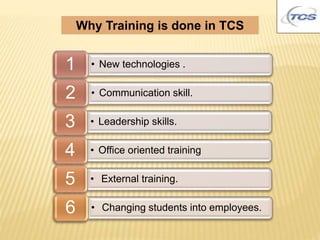
Why Training is done in TCS
• New technologies .1
• Communication skill.2
• Leadership skills.3
• Office oriented training4
• External training.5
• Changing students into employees.6
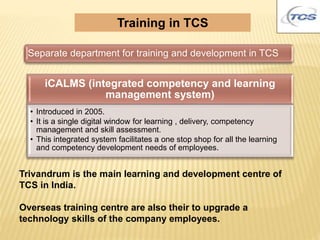
Training in TCS
Trivandrum is the main learning and development centre of
TCS in India.
Overseas training centre are also their to upgrade a
technology skills of the company employees.
Separate department for training and development in TCS
iCALMS (integrated competency and learning
management system)
• Introduced in 2005.
• It is a single digital window for learning , delivery, competency
management and skill assessment.
• This integrated system facilitates a one stop shop for all the learning
and competency development needs of employees.
Types of training in TCS
Initial Learning
Program (ILP)
Continuous
Learning
Program (CLP)
Leadership
Development
Program (LDP)
Foreign
Language
Initiative (FLI)
Workplace
Learning
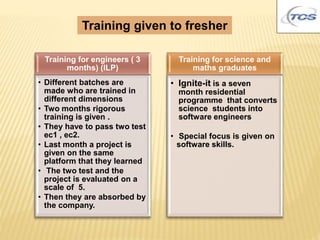
Training given to fresher
Training for engineers ( 3
months) (ILP)
• Different batches are
made who are trained in
different dimensions
• Two months rigorous
training is given .
• They have to pass two test
ec1 , ec2.
• Last month a project is
given on the same
platform that they learned
• The two test and the
project is evaluated on a
scale of 5.
• Then they are absorbed by
the company.
Training for science and
maths graduates
• Ignite-it is a seven
month residential
programme that converts
science students into
software engineers
• Special focus is given on
software skills.
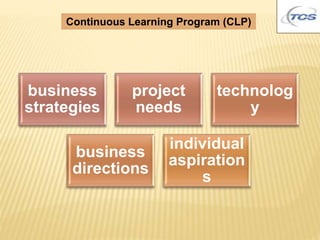
business
strategies
project
needs
technolog
y
business
directions
individual
aspiration
s
Continuous Learning Program (CLP)
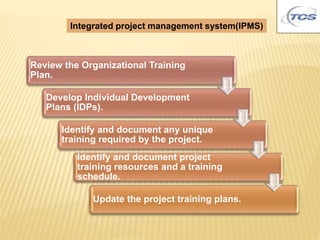
Integrated project management system(IPMS)
Review the Organizational Training
Plan.
Develop Individual Development
Plans (IDPs).
Identify and document any unique
training required by the project.
Identify and document project
training resources and a training
schedule.
Update the project training plans.
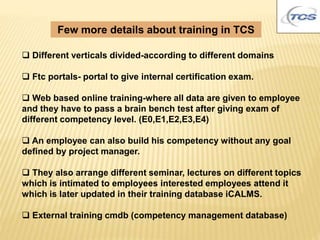
Few more details about training in TCS
 Different verticals divided-according to different domains
 Ftc portals- portal to give internal certification exam.
 Web based online training-where all data are given to employee
and they have to pass a brain bench test after giving exam of
different competency level. (E0,E1,E2,E3,E4)
 An employee can also build his competency without any goal
defined by project manager.
 They also arrange different seminar, lectures on different topics
which is intimated to employees interested employees attend it
which is later updated in their training database iCALMS.
 External training cmdb (competency management database)
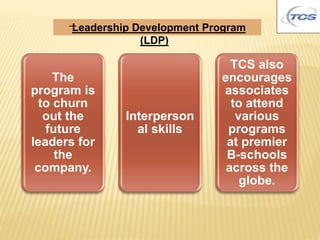
—Leadership Development Program
(LDP)
The
program is
to churn
out the
future
leaders for
the
company.
Interperson
al skills
TCS also
encourages
associates
to attend
various
programs
at premier
B-schools
across the
globe.
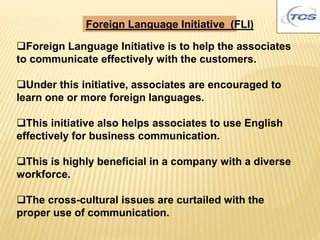
Foreign Language Initiative is to help the associates
to communicate effectively with the customers.
Under this initiative, associates are encouraged to
learn one or more foreign languages.
This initiative also helps associates to use English
effectively for business communication.
This is highly beneficial in a company with a diverse
workforce.
The cross-cultural issues are curtailed with the
proper use of communication.
Foreign Language Initiative (FLI)
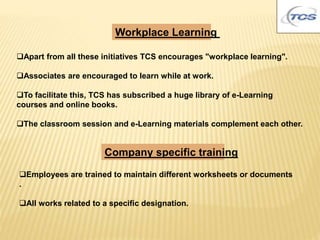
Apart from all these initiatives TCS encourages "workplace learning".
Associates are encouraged to learn while at work.
To facilitate this, TCS has subscribed a huge library of e-Learning
courses and online books.
The classroom session and e-Learning materials complement each other.
Employees are trained to maintain different worksheets or documents
.
All works related to a specific designation.
Workplace Learning
Company specific training
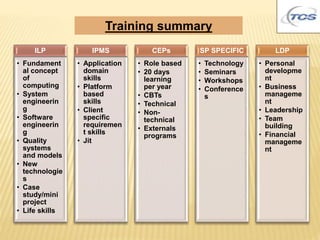
ILP
• Fundament
al concept
of
computing
• System
engineerin
g
• Software
engineerin
g
• Quality
systems
and models
• New
technologie
s
• Case
study/mini
project
• Life skills
IPMS
• Application
domain
skills
• Platform
based
skills
• Client
specific
requiremen
t skills
• Jit
CEPs
• Role based
• 20 days
learning
per year
• CBTs
• Technical
• Non-
technical
• Externals
programs
SP SPECIFIC
• Technology
• Seminars
• Workshops
• Conference
s
LDP
• Personal
developme
nt
• Business
manageme
nt
• Leadership
• Team
building
• Financial
manageme
nt
Training summary
Hrm tcs ppt

Hrm tcs ppt

  • 1.
    TRAINING AND DEVELOPMENTIN T C S Submitted by :- PUJA KESHRI (13202154) Submitted to :- Prof. Debjani Ghosh
  • 2.
    COMPANY PROFILE History: TCSwas established in 1968 as a division of Tata Sons Limited. TCS Ltd. got incorporated as a separate entity on January 19, 1995. Workforce: TCS has over 276,000 of the world’s best-trained IT consultants in 44 countries. Financial Information: Revenue of $11.6 billion; up 13.7% over prior year; operating margin of 27% and net income at $2.6B; up 15.6% (fiscal year ending March 31, 2013). N Chandrasekaran, CEO & MD, TCS
  • 3.
    TRAINING AND DEVELOPMMENT Training anddevelopment refers to the imparting of specific skills, abilities and knowledge to an employee . It helps to improve current or future employee performance. It changes employee attitude and increases their skills and knowledge Need for training and development (gap analysis) = standard performance –actual performance
  • 4.
    Why Training isdone in TCS • New technologies .1 • Communication skill.2 • Leadership skills.3 • Office oriented training4 • External training.5 • Changing students into employees.6
  • 5.
    Training in TCS Trivandrumis the main learning and development centre of TCS in India. Overseas training centre are also their to upgrade a technology skills of the company employees. Separate department for training and development in TCS iCALMS (integrated competency and learning management system) • Introduced in 2005. • It is a single digital window for learning , delivery, competency management and skill assessment. • This integrated system facilitates a one stop shop for all the learning and competency development needs of employees.
  • 6.
    Types of trainingin TCS Initial Learning Program (ILP) Continuous Learning Program (CLP) Leadership Development Program (LDP) Foreign Language Initiative (FLI) Workplace Learning
  • 7.
    Training given tofresher Training for engineers ( 3 months) (ILP) • Different batches are made who are trained in different dimensions • Two months rigorous training is given . • They have to pass two test ec1 , ec2. • Last month a project is given on the same platform that they learned • The two test and the project is evaluated on a scale of 5. • Then they are absorbed by the company. Training for science and maths graduates • Ignite-it is a seven month residential programme that converts science students into software engineers • Special focus is given on software skills.
  • 8.
  • 9.
    Integrated project managementsystem(IPMS) Review the Organizational Training Plan. Develop Individual Development Plans (IDPs). Identify and document any unique training required by the project. Identify and document project training resources and a training schedule. Update the project training plans.
  • 10.
    Few more detailsabout training in TCS  Different verticals divided-according to different domains  Ftc portals- portal to give internal certification exam.  Web based online training-where all data are given to employee and they have to pass a brain bench test after giving exam of different competency level. (E0,E1,E2,E3,E4)  An employee can also build his competency without any goal defined by project manager.  They also arrange different seminar, lectures on different topics which is intimated to employees interested employees attend it which is later updated in their training database iCALMS.  External training cmdb (competency management database)
  • 11.
    —Leadership Development Program (LDP) The programis to churn out the future leaders for the company. Interperson al skills TCS also encourages associates to attend various programs at premier B-schools across the globe.
  • 12.
    Foreign Language Initiativeis to help the associates to communicate effectively with the customers. Under this initiative, associates are encouraged to learn one or more foreign languages. This initiative also helps associates to use English effectively for business communication. This is highly beneficial in a company with a diverse workforce. The cross-cultural issues are curtailed with the proper use of communication. Foreign Language Initiative (FLI)
  • 13.
    Apart from allthese initiatives TCS encourages "workplace learning". Associates are encouraged to learn while at work. To facilitate this, TCS has subscribed a huge library of e-Learning courses and online books. The classroom session and e-Learning materials complement each other. Employees are trained to maintain different worksheets or documents . All works related to a specific designation. Workplace Learning Company specific training
  • 14.
    ILP • Fundament al concept of computing •System engineerin g • Software engineerin g • Quality systems and models • New technologie s • Case study/mini project • Life skills IPMS • Application domain skills • Platform based skills • Client specific requiremen t skills • Jit CEPs • Role based • 20 days learning per year • CBTs • Technical • Non- technical • Externals programs SP SPECIFIC • Technology • Seminars • Workshops • Conference s LDP • Personal developme nt • Business manageme nt • Leadership • Team building • Financial manageme nt Training summary