1
UNIT-II
RECRUITMENT & SELECTION
Recruitment & selection is one of the important aspects of human resource planning. Human
resource planning ensures that right kind and right quality of employees are employed so as to
achieve the organizational goals.
Recruitment:
Recruitmentmeansannouncingjobopportunities to the public and stimulating them in such a way
so that a good number of suitable people will apply for them. Recruitment is the process of
discovering the potential for actual or anticipated organizational vacancies.
It is a process of accumulation of human resources for the vacant positions of the organization.
Recruitmentreferstothe processof attracting,screening,andselectingqualified people for a job at
an organization or firm.
DEFINITION:
According to Edward Flippo, “Recruitment is a process of searching prospective employees and
stimulating them to apply for jobs.”
Accordingto Dale Yoder, “Recruitmentisaprocess to discoverthe sources of manpowertomeetthe
requirements of the staffing schedule and to employ effective measures for attracting that
manpower in adequate numbers to facilitate effective selection of an efficient working force.”
Recruitment Process
Recruitment is a process of finding and attracting the potential resources for filling up the vacant
positions in an organization. It sources the candidates with the abilities and attitude, which are
required for achieving the objectives of an organization.
Recruitment process is a process of identifying the jobs vacancy, analyzing the job requirements,
reviewing applications, screening, shortlisting and selecting the right candidate.
2
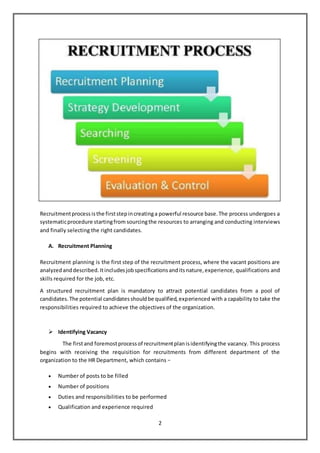
Recruitmentprocessisthe firststepincreatinga powerful resource base.The process undergoes a
systematicprocedure startingfrom sourcingthe resources to arranging and conducting interviews
and finally selecting the right candidates.
A. Recruitment Planning
Recruitment planning is the first step of the recruitment process, where the vacant positions are
analyzedanddescribed.Itincludesjobspecificationsanditsnature,experience, qualifications and
skills required for the job, etc.
A structured recruitment plan is mandatory to attract potential candidates from a pool of
candidates.The potential candidatesshouldbe qualified,experienced with a capability to take the
responsibilities required to achieve the objectives of the organization.
 Identifying Vacancy
The firstand foremostprocessof recruitmentplanisidentifyingthe vacancy. This process
begins with receiving the requisition for recruitments from different department of the
organization to the HR Department, which contains −
 Number of posts to be filled
 Number of positions
 Duties and responsibilities to be performed
 Qualification and experience required
3
Whena vacancy is identified,itthe responsibilityof the sourcingmanagertoascertain whether the
positionisrequiredornot,permanentortemporary,full-time or part-time, etc. These parameters
shouldbe evaluatedbefore commencingrecruitment. Proper identifying, planning and evaluating
leads to hiring of the right resource for the team and the organization.
 Job Analysis
Jobanalysisisa processof identifying,analyzing,anddeterminingthe duties,responsibilities,skills,
abilities, and work environment of a specific job. These factors help in identifying what a job
demands and what an employee must possess in performing a job productively.
Jobanalysishelpsinunderstandingwhattasksare importantandhow to performthem.Itspurpose
is to establish and document the job relatedness of employment procedures such as selection,
training, compensation, and performance appraisal.
The following steps are important in analyzing a job −
 Recording and collecting job information
 Accuracy in checking the job information
 Generating job description based on the information
 Determining the skills, knowledge and skills, which are required for the job
The immediate products of job analysis are job descriptions and job specifications.
Job Description
Job description is an important document, which is descriptive in nature and contains the final
statement of the job analysis. This description is very important for a successful recruitment
process.
Job description provides information about the scope of job roles, responsibilities and the
positioningof the jobinthe organization. And this data gives the employer and the organization a
clear idea of what an employee must do to meet the requirement of his job responsibilities.
Job description is generated for fulfilling the following processes −
 Classification and ranking of jobs
 Placing and orientation of new resources
 Promotions and transfers
 Describing the career path
 Future development of work standards
A job description provides information on the following elements −
 Job Title / Job Identification / Organization Position
 Job Location
 Summary of Job
 Job Duties
4
 Machines, Materials and Equipment
 Process of Supervision
 Working Conditions
 Health Hazards
Job Specification
Jobspecificationfocusesonthe specificationsof the candidate,whomthe HRteam is going to hire.
The firststepin jobspecificationispreparingthe listof all jobsinthe organizationand its locations.
The second step is to generate the information of each job.
This information about each job in an organization is as follows −
 Physical specifications
 Mental specifications
 Physical features
 Emotional specifications
 Behavioral specifications
A job specification document provides information on the following elements −
 Qualification
 Experiences
 Training and development
 Skills requirements
 Work responsibilities
 Emotional characteristics
 Planning of career
 Job Evaluation
Job evaluation is a comparative process of analyzing, assessing, and determining the relative
value/worth of a job in relation to the other jobs in an organization.
The main objective of jobevaluation is to analyze and determine which job commands how much
pay.There are several methodssuchas job grading, job classifications, job ranking, etc., which are
involved in job evaluation. Job evaluation forms the basis for salary and wage negotiations.
B. Recruitment Strategy
Recruitment strategy is the second step of the recruitment process, where a strategy is prepared
for hiringthe resources.Aftercompletingthe preparationof jobdescriptionsandjobspecifications,
the next step is to decide which strategy to adopt for recruiting the potential candidates for the
organization.
5
While preparing a recruitment strategy, the HR team considers the following points −
 Make or buy employees
 Types of recruitment
 Geographical area
 Recruitment sources
The development of a recruitment strategy is a long process, but having a right strategy is
mandatoryto attract the rightcandidates.The stepsinvolvedin developing a recruitment strategy
include −
 Setting up a board team
 Analyzing HR strategy
 Collection of available data
 Analyzing the collected data
 Setting the recruitment strategy
C. Searching the Right Candidates
Searching is the process of recruitment where the resources are sourced depending upon the
requirementof the job.Afterthe recruitmentstrategy is done, the searching of candidates will be
initialized. This process consists of two steps −
 Source activation − Once the line manager verifies and permits the existence of the
vacancy, the search for candidates starts.
 Selling − Here, the organization selects the media through which the communication of
vacancies reaches the prospective candidates.
Searchinginvolvesattractingthe jobseekerstothe vacancies.The sources are broadly divided into
two categories: Internal Sources and External Sources.
Internal Sources
Internal sources of recruitment refer to hiring employees within the organization through −
 Promotions
 Transfers
 Former Employees
 Internal Advertisements (Job Posting)
 Employee Referrals
 Previous Applicants
External Sources
External sources of recruitment refer to hiring employees outside the organization through −
6
 Direct Recruitment
 Employment Exchanges
 Employment Agencies
 Advertisements
 Professional Associations
 Campus Recruitment
 Word of Mouth
D. Screening / Shortlisting
Screening starts after completion of the process of sourcing the candidates. Screening is the
process of filtering the applications of the candidates for further selection process.
Screeningis anintegral partof recruitmentprocessthathelpsinremovingunqualified or irrelevant
candidates,whichwere receivedthroughsourcing.The screeningprocessof recruitmentconsistsof
three steps −
Reviewing of Resumes and Cover Letters
Reviewingis the first step of screening candidates. In this process, the resumes of the candidates
are reviewedandcheckedforthe candidates’education,workexperience, and overall background
matching the requirement of the job
While reviewingthe resumes, an HR executive must keep the following points in mind, to ensure
better screening of the potential candidates −
 Reason for change of job
 Longevity with each organization
 Long gaps in employment
 Job-hopping
 Lack of career progression
Conducting Telephonic or Video Interview
Conducting telephonic or video interviews is the second step of screening candidates. In this
process,afterthe resumes are screened, the candidates are contacted through phone or video by
the hiring manager. This screening process has two outcomes −
 It helps in verifying the candidates, whether they are active and available.
 It also helps in giving a quick insight about the candidate’s attitude, ability to answer
interview questions, and communication skills.
Identifying the top candidates
Identifyingthe topcandidatesisthe final stepof screeningthe resumes/candidates.Inthis process,
the cream/toplayerof resumesare shortlisted,whichmakes it easy for the hiring manager to take
a decision. This process has the following three outcomes −
7
 Shortlisting 5 to 10 resumes for review by the hiring managers
 Providing insights and recommendations to the hiring manager
 Helps the hiring managers to take a decision in hiring the right candidate
E. Evaluation and Control
Evaluation and control is the last stage in the process of recruitment. In this process, the
effectiveness and the validity of the process and methods are assessed. Recruitment is a costly
process, hence it is important that the performance of the recruitment process is thoroughly
evaluated.
The costs incurredinthe recruitmentprocessare to be evaluatedandcontrolledeffectively. These
include the following −
 Salaries to the Recruiters
 Advertisements cost and other costs incurred in recruitment methods, i.e., agency fees.
 Administrative expenses and Recruitment overheads
 Overtime and Outstanding costs, while the vacancies remain unfilled
 Cost incurred in recruiting suitable candidates for the final selection process
 Time spent by the Management and the Professionals in preparing job description, job
specifications, and conducting interviews.
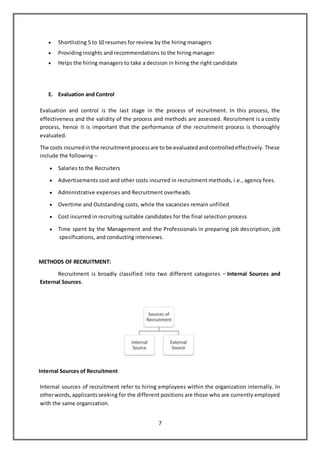
METHODS OF RECRUITMENT:
Recruitment is broadly classified into two different categories − Internal Sources and
External Sources.
Internal Sources of Recruitment
Internal sources of recruitment refer to hiring employees within the organization internally. In
otherwords,applicantsseeking for the different positions are those who are currently employed
with the same organization.
8
At the time recruitmentof employees,the initialconsiderationshouldbe giventothose employees
who are currently working within the organization. This is an important source of recruitment,
which provides the opportunities for the development and utilization of the existing resources
within the organization.
Internal sources of recruitment are the best and the easiest way of selecting resources as
performance of their work is already known to the organization. Let us now discuss more on the
various internal sources of recruitment.
Promotions
Promotionreferstoupgradingthe cadre of the employees by evaluating their performance in the
organization. It is the process of shifting an employee from a lower position to a higher position
withmore responsibilities, remuneration, facilities, and status. Many organizations fill the higher
vacant positions with the process of promotions, internally.
Transfers
Transferreferstothe process of interchanging from one job to another without any change in the
rank and responsibilities.Itcanalso be the shiftingof employees from one department to another
departmentorone locationtoanotherlocation,depending upon the requirement of the position.
Let’stake an example to understand how it works. Assume there is a finance company called ABC
Ltd. Havingtwo branches, Branch-A and Branch-B, and an employee from Branch-A resigned from
his job responsibilities. Hence, this position has to be filled for the continuation of the project in
Branch-A.
In this scenario, instead of searching or sourcing new candidates, which is time consuming and
expensive, there is a possibility of shifting an employee from Branch-B to Branch-A, depending
upon the project requirements and the capabilities of that respective employee. This internal
shifting of an employee from one branch to another branch is called as Transfer.
Recruiting Former Employees
Recruiting former employees is a process of internal sources of recruitment, wherein the
exemployees are called back depending upon the requirement of the position. This process is
costeffective andsavesplenty of time. The other major benefit of recruiting former employees is
that they are very well versed with the roles and responsibilities of the job and the organization
needs to spend less on their training and development.
Internal Advertisements (Job Posting)
Internal Advertisements is a process of posting/advertising jobs within the organization. This job
postingisan openinvitationtoall the employeesinside the organization, where they can apply for
the vacant positions. It provides equal opportunities to all the employees working in the
organization.Hence,the recruitmentwill be done fromwithinthe organization and it saves a lot of
cost.
Employee Referrals
Employee referrals is an effective way of sourcing the right candidates at a low cost. It is the
processof hiring new resources through the references of employees, who are currently working
9
withthe organization.In this process, the present employees can refer their friends and relatives
for filling up the vacant positions.
Organizations encourage employee referrals, because it is cost effective and saves time as
compared to hiring candidates from external sources. Most organizations, in order to motivate
their employees, go ahead and reward them with a referral bonus for a successful hire.
Previous Applicants
Here,the hiringteamchecksthe profilesof previousapplicantsfromthe organizationalrecruitment
database.These applicantsare those whohave appliedforjobsinthe past. These resources can be
easilyapproachedand the response will be positive in most of the cases. It is also an inexpensive
way of filling up the vacant positions.
Pros and Cons of Internal Sources of Recruitment
Internal sources of recruitment, i.e., hiring employees within the organization, has its own set of
advantages and disadvantages. The advantages are as follows −
 It is simple, easy, quick, and cost effective.
 No need of induction and training, as the candidates already know their job and
responsibilities.
 It motivates the employees to work hard, and increases the work relationship within the
organization.
 It helps in developing employee loyalty towards the organization.
The drawbacks of hiring candidates through internal sources are as follows −
 It prevents new hiring of potential resources. Sometimes, new resources bring innovative
ideas and new thinking onto the table.
 It has limited scope because all the vacant positions cannot be filled.
 There could be issues in between the employees, who are promoted and who are not.
 If an internal resource is promoted or transferred, then that position will remain vacant.
 Employees, who are not promoted, may end up being unhappy and demotivated.
External Sources of Recruitment
External sources of recruitment refer to hiring employees outside the organization externally. In
otherwords,the applicantsseekingjobopportunitiesinthiscase are those who are external to the
organization.
External employees bring innovativeness and fresh thoughts to the organization. Although hiring
through external sources is a bit expensive and tough, it has tremendous potential of driving the
organizationforwardinachievingitsgoals.Letusnow discussindetail the variousexternal sources
of recruitment.
Direct Recruitment
10
Directrecruitmentreferstothe external source of recruitment where the recruitment of qualified
candidates are done by placing a notice of vacancy on the notice board in the organization. This
method of sourcing is also called as factory gate recruitment, as the blue-collar and technical
workers are hired through this process.
Employment Exchanges
As per the law, for certain job vacancies, it is mandatory that the organization provides details to
the employmentexchange.Employmentexchangeisagovernmententity,where the details of the
job seekers are stored and given to the employers for filling the vacant positions. This external
recruitment is helpful in hiring for unskilled, semi-skilled, and skilled workers.
Employment Agencies
Employmentagenciesare agood external source of recruitment. Employment agencies are run by
various sectors like private, public, or government. It provides unskilled, semi-skilled and skilled
resourcesasper the requirementsof the organization.These agencieshold a database of qualified
candidates and organizations can use their services at a cost.
Advertisements
Advertisements are the most popular and very much preferred source of external source of
recruitment. The job vacancy is announced through various print and electronic media with a
specific job description and specifications of the requirements. Using advertisements is the best
wayto source candidatesinashort spanand it offersanefficient way of screening the candidates’
specific requirements.
Let’s take an example. Assume that there is a Sales Company called XYZ Ltd which has got a new
projectof sellingaproductin a shortspan of time,asthe competition is very high. In this scenario,
choosingthe specificrecruitmentplaysavital role.Here the ideal type of recruitmentwhichshould
be chosen is Advertisement.
Advertisementisthe bestsuitable practice for this kind of hiring, because a large volume of hiring
ina shortspan can be done throughAdvertisementonly.Advertisementis one of the costliest way
to recruit candidates, but when time and number are important, then advertisement is the best
source of recruitment.
Professional Associations
Professionalassociationscanhelpanorganizationinhiringprofessional, technical, and managerial
personnel,howevertheyspecialize insourcing mid-level and top-level resources. There are many
professional associations that act as a bridge between the organizations and the job-seekers.
Campus Recruitment
Campusrecruitmentisanexternal source of recruitment, where the educational institutions such
as colleges and universities offers opportunities for hiring students. In this process, the
organizations visit technical, management, and professional institutions for recruiting students
directly for the new positions.
11
Word of Mouth Advertising
Word of mouth is an intangible way of sourcing the candidates for filling up the vacant positions.
There are many reputed organizations with good image in the market. Such organizations only
needa word-of-mouthadvertisingregardinga job vacancy to attract a large number of candidates.
Pros and Cons of External Sources of Recruitment
External sourcesof recruitment,i.e.,hiringemployeesoutside anorganization,hasbothitsbenefits
and drawbacks. The benefits are as follows −
 It encourages new opportunities for job seekers.
 Organization branding increases through external sources.
 There will be no biasing or partiality between the employees.
 The scope for selectingthe rightcandidate ismore,because of the large number candidates
appearing.
The disadvantages of recruiting through external sources are as follows −
 This process consumes more time, as the selection process is very lengthy.
 The cost incurred is very high when compared to recruiting through internal sources.
 External candidates demand more remuneration and benefits.
To conclude,the HR departmentshouldbe flexible enoughtochoose between internal or external
methods of recruitment, depending upon the requirement of the organization.
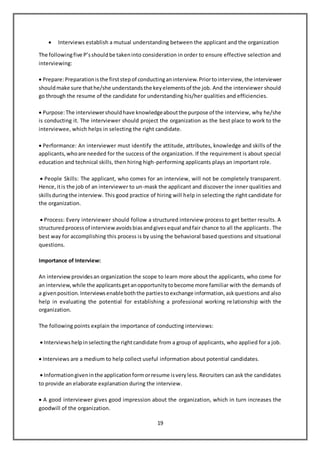
SELECTION:
Selectionisthe processof choosing the mostsuitable candidates from those who apply for the job.
It isa processof offeringjobstodesiredcandidates. Once the potential applicantsare identified,the
next step is to evaluate their qualification, qualities, experience, capabilities, etc. & make the
selection. It is the process of offering jobs to the desired applicants.
Selection means choosing a few from those who apply. It is picking up of applicants or candidates
with requisite qualifications and qualities to fill jobs in the organization.
Definition of Selection
Accordingto HaroldKoontz,“Selectionis the process of choosing from the candidates, from within
the organizationorfrom outside,the mostsuitable personfor the current position or for the future
positions.”
Dale Yoder said, “Selection is the process by which candidates for employment are divided into
classes those who will be offered employment and those who will not.”
David and Robbins said, “Selection process is a managerial decision-making process as to predict
which job applicants will be successful if hired.”
12
Accordingto R.M. Hodgetts,“Selectionisthe processin which an enterprise chooses the applicants
who best meet the criteria for the available positions.”
Steps in Selection Process
The selectionprocesstypicallybeginswiththe preliminaryinterview;next,candidates complete the
application for employment.
They progress through a series of selection tests, the employment interview, and reference and
background checks. The successful applicant receives a company physical examination and is
employed if the results are satisfactory.
Several external andinternal factorsimpactthe selectionprocess,and the manager must take them
into account in making selection decisions.
1. Initial Screening
The selection processoftenbeginswithaninitial screeningof applicants to remove individuals who
obviously do not meet the position requirements.
At thisstage,a fewstraightforwardquestionsare asked.Anapplicantmayobviouslybe unqualified
to fill the advertised position, but be well qualified to work in other open positions.
The Purpose of Screening is to decrease the number of applicants being considered for selection.
13
Sources utilized in the screening effort
Personal Resume presentedwiththe job application is considered a source of information that can
be used for the initial screening process. It mainly includes information in the following areas:
 Employment & education history.
 Evaluation of character.
 Evaluation of job performance.
Advantages of Successful Screening
If the screening effort is successful, those applicants that do not meet the minimum required
qualificationswill notmove tothe nextstage inthe selectionprocess.Companiesutilizingexpensive
selection procedures put more effort into screening to reduce costs.
2. Completion of the Application Form
ApplicationBlankisaformal recordof an individual’s application for employment. The next step in
the selection process may involve having the prospective employee complete an application for
employment.
This may be as brief as requiring only an applicant’s name, address, and telephone number. In
general terms,the applicationformgivesajob-performance-relatedsynopsisof applicants’life,skills
and accomplishments.
The specific type of information may vary from firm to firm and even by job type within an
organization. Application forms are a good way to quickly collect verifiable and fairly accurate
historical data from the candidate.
3. Employment Tests
Personnel testing is a valuable way to measure individual characteristics.
Hundreds of tests have been developed to measure various dimensions of behavior. The tests
measure mental abilities, knowledge, physical abilities, personality, interest, temperament, and
other attitudes and behaviors.
Evidence suggests that the use of tests is becoming more prevalent for assessing an applicant’s
qualificationsandpotential forsuccess.Tests are used more in the public sector than in the private
sector and in medium-sized and large companies than in small companies.
Large organizations are likely to have trained specialists to run their testing programs.
14
Advantages of using tests
Selectiontestingcanbe a reliable andaccurate meansof selecting qualified candidates from a pool
of applicants.
As with all selection procedures, it is important to identify the essential functions of each job and
determine the skills needed to perform them.
Potential Problems using Selection tests
Selection tests may accurately predict an applicant’s ability to perform the job, but they are less
successful in indicating the extent to which the individual will want to perform it.
Anotherpotential problem,relatedprimarilytopersonalitytestsand interest inventories, has to do
with applicants honesty. Also, there is the problem of test anxiety.
Applicantsoftenbecome quite anxious when confronting yet another hurdle that might eliminate
them from consideration.
4. Job Interview
An interview is a goal-oriented conversation in which the interviewer and applicant exchange
information.The employment interview is especially significant because the applicants who reach
this stage are considered to be the most promising candidates.
Interview Planning
Interview planning is essential to effective employment interviews.
The physical locationof the interviewshouldbe bothpleasantandprivate,providing for a minimum
of interruptions.The interviewershould possess a pleasant personality, empathy and the ability to
listen and communicate effectively.
He or she shouldbecome familiarwiththe applicant’squalificationsbyreviewing the data collected
fromotherselectiontools.Inpreparingforthe interview,ajobprofile shouldbe developedbasedon
the job description.
Content of the Interview
The specificcontentof employmentinterviewsvariesgreatlybyanorganizationand the level of the
job concerned.
1. Occupational experience: Exploring an individual’s occupational experience requires determining
the applicant’s skills, abilities, and willingness to handle responsibility.
15
2. Academic achievement: In the absence of significant work experience, a person’s academic
background takes on greater importance.
3. Interpersonal skills:If an individualcannotworkwell withotheremployees, chances for success are
slim. This is especially true in today’s world with increasing emphasis being placed on the use of
teams.
4. Personal qualities: Personal qualities normally observed during the interview include physical
appearance, speaking ability, vocabulary, poise, adaptability, and assertiveness.
5. Organizational fit: A hiring criterion that is not prominently mentioned in the literature is
organizational fit. Organizational fit is ill-defined but refers to management’s perception of the
degree towhich the prospective employee will fit in with, for example, the firm’s culture or value
system.
5. Conditional Job Offer
Conditional joboffermeans a tentative job offer that becomes permanent after certain conditions
are met.
If a job applicant has passed each step of the selection process so far, a conditional job offer is
usually made.
In essence,the conditionaljobofferimpliesthat if everything checks out – such as passing a certain
medical,physical orsubstance abuse test – the conditional nature of the job offer will be removed
and the offer will be permanent.
6. Background Investigation
Background Investigation is intended to verify that information on the application form is correct
and accurate.
This step is used to check the accuracy of application form through former employers and
references.Verificationof educationandlegal status to work, credit history and criminal record are
also made.
Personal reference checks may provide additional insight into the information furnished by the
applicant and allow verification of its accuracy.
Past behavioristhe bestpredictorof future behavior.Itis important to gain as much information as
possible about past behavior to understand what kinds of behavior one can expect in the future.
Knowledgeaboutattendance problems,insubordinationissues,theft,or other behavioral problems
can certainly help one avoid hiring someone who is likely to repeat those behaviors.
16
Backgroundinvestigationsprimarily seek data from references supplied by the applicant including
hisor her previous employers. The intensity of background investigations depends on the level of
responsibility inherent in the position to be filled.
Common sources of background information include:
 References are provided by the applicant and are usually very positive.
 Former employers should be called to confirm the candidate’s work record and to obtain their
performance appraisal.
 Educational accomplishments can be verified by asking for transcripts.
 Legal status to work.
 Credit references, if job-related.
 Criminal records can be checked by third-party investigators.
 Background checks are conducted by third-party investigators.
 Online searches as simple as “Google” search of a candidate can turn up information on press
releases or news items about a candidate that was left off the application or resume.
7. Medical/Physical Examination
After the decision has been made to extend a job offer, the next phase of the selection process
involves the completion of a medical/physical examination.
This is an examination to determine an applicant’s physical fitness for essential job performance.
Typically, a job offer is contingent on successfully passing this examination.
For example,firefightersmustperformactivitiesthatrequire acertainphysical condition.Whetherit
is climbing a ladder, lugging a water-filled four-inch hose or carrying an injured victim, these
individuals must demonstrate that they are fit for the job.
8. Permanent Job Offer
Individualswhoperformsuccessfullyin the preceding steps are now considered eligible to receive
the employmentoffer.The actual hiringdecisionshouldbe made bythe managerinthe department
where the vacancy exists.
Notification to Candidates
17
The selectionprocessresultsshouldbe made knowntocandidates—successfulandunsuccessful—as
soon as possible.
Any delay may result in the firm losing a prime candidate, as top prospects often have other
employmentoptions.Asamatter of courtesyand goodpublicrelations,the unsuccessful candidates
should also be promptly notified.
Conclusion
The objectivesof the selectionprocessare toselectthe candidateswhosesuccess probability in the
job is the highest and motivate right candidates to opt for the vacancy by a proper presentation of
the organization to the potential candidates.
In many HR departments, recruiting and selection are combined and called the employment
function.Inlarge HR departments,the employmentfunctionisthe responsibility of the HR Director.
In smaller departments, HR managers handle these duties.
The selection process relies on three helpful inputs. Job analysis information provides the
descriptionof the jobs,the humanspecificationsand the performance standards each job requires.
Human resource plans tell HR managers what job openings are likely to occur. These plans allow
selection to proceed in a logical manner.
Finally,recruitsare necessary so that the HR manager has a group of people from which to choose.
These three inputs largely determine the effectiveness of the selection process.
The selection process is a series of steps through which applicants pass.
For example,acandidate whofailstoqualifyforaparticularstepis noteligiblefor appearing for the
subsequentstep.The resultof eachstepiscrucial.Failure of anystepdisqualifiesthe candidate from
attempting the next step.
18
INTERVIEW
An interview is a purposeful exchange of ideas, the answering of questions and communication
betweentwoormore persons.Generally,aninterview isaprocessof private meeting conversation
between people, where questions are asked and answered, for obtaining information about
qualities,attitudes,prospectusetc.Aninterview referstoa conversation with one or more persons
actingas the role of an interviewer who ask questions and the person who answers the questions
acts as the role of an interviewee. The primary purpose of an interview is to transfer information
from interviewee to interviewer. Interviews can be either formal or informal, structured or
unstructured. Interviews can be carried out one-to-one or in groups; they can be conducted over
telephone or via video conferencing.
Interviews have some basic objectives, which are as follows:
 Through interviews, recruiters can verify the information obtained through application
forms and tests.
 Recruiters canobtainadditional informationaboutthe candidateswhichare notmentioned
in the application forms or resumes
 Interviewsprovidesanapplicantthe informationandthe necessaryfacts about the job and
the organization.
19
 Interviews establish a mutual understanding between the applicant and the organization
The followingfive P’sshouldbe takeninto consideration in order to ensure effective selection and
interviewing:
 Prepare:Preparationisthe firststepof conductinganinterview.Priortointerview,the interviewer
shouldmake sure thathe/she understandsthe keyelementsof the job. And the interviewer should
go through the resume of the candidate for understanding his/her qualities and efficiencies.
 Purpose:The interviewershouldhave knowledgeaboutthe purpose of the interview, why he/she
is conducting it. The interviewer should project the organization as the best place to work to the
interviewee, which helps in selecting the right candidate.
 Performance: An interviewer must identify the attitude, attributes, knowledge and skills of the
applicants,whoare needed for the success of the organization. If the requirement is about special
education and technical skills, then hiring high-performing applicants plays an important role.
 People Skills: The applicant, who comes for an interview, will not be completely transparent.
Hence,itis the job of an interviewer to un-mask the applicant and discover the inner qualities and
skillsduringthe interview. This good practice of hiring will help in selecting the right candidate for
the organization.
 Process: Every interviewer should follow a structured interview process to get better results. A
structuredprocessof interview avoidsbiasandgivesequal andfair chance to all the applicants. The
best way for accomplishing this process is by using the behavioral based questions and situational
questions.
Importance of Interview:
An interviewprovidesan organization the scope to learn more about the applicants, who come for
an interview,while the applicantsgetanopportunitytobecome more familiar with the demands of
a givenposition.Interviewsenableboththe partiestoexchange information,askquestions and also
help in evaluating the potential for establishing a professional working relationship with the
organization.
The following points explain the importance of conducting interviews:
 Interviewshelpinselectingthe rightcandidate from a group of applicants, who applied for a job.
 Interviews are a medium to help collect useful information about potential candidates.
 Informationgiveninthe applicationformorresume isveryless.Recruiters can ask the candidates
to provide an elaborate explanation during the interview.
 A good interviewer gives good impression about the organization, which in turn increases the
goodwill of the organization.
20
 Interviewsalsohelpinpromotionsandtransfersof the candidates,asperthe requirements of the
organization.
Interview Process
Interviewingcandidatesisthe final stage inthe recruitmentprocess.Hence,tofindthe right person
for a specificposition,there shouldbe aproperprocess,thathas to be followedforthe rightresults.
An ideal interview process for selecting the right candidates is as follows:
 Determine the requirements of the job. Conduct a thorough job analysis.
 Prepare a specific job description and a job specification.
 Make a plan − how and where to find qualified candidates.
 Collect and review applications and resumes and from them, select the most potential and
qualified candidates for further proceedings.
 Interview the shortlisted candidates based upon the job description and specification.
 Verify the candidates’ background with the references provided by them.
Following such an interview process, the HR department can hire the best possible
candidates for a vacant job position.
Types of Interviews
Dependingupthe requirements,situations,locationsandtime,the interviewsare broadly classified
intotendifferentcategories.Recruitersshouldbe knowledgeableenoughtounderstand which type
of interview should be used when. The ten different types of interviews are as follows:
1. Structured Interview:Inthistype,the interviewisdesignedanddetailedinadvance. A structured
interview is pre-planned, accurate, and consistent in hiring the candidates.
2. Unstructured Interview: This type of interview is an unplanned one, where the interview
questionnaire is not prepared. Here, the effectiveness of the interview is very less and there is a
tremendous waste of time and effort of both the interviewer and the interviewee.
3. Group Interview: In this type of interview, all the candidates or a group of candidates are
interviewedtogether.Groupinterviewsare conductedtosave time whenthere is a large number of
applications for a few job vacancies. A topic will be given to discuss among the candidates and the
interviewer judges the innovativeness and behaviour of each candidate in the group.
4. Depth Interview: Depth interview is a semi-structured interview, where the candidates have to
give a detailed information about their education background, work experience, special interests,
etc.And the interviewertakesadepthinterviewandtries in finding the expertise of the candidate.
21
5. StressInterview:Stressinterviewsare conductedtodiscoverhow acandidate behavesinstressful
conditions.Inthistype of interview, the interviewer will come to know whether the candidate can
handle the demandsof a complex job. The candidate who maintains his composure during a stress
interview is normally the right person to handle a stressful job.
6. Individual Interview:Inan individualinterview,the interview takes place one-on-one i.e., there
will be a verbal anda visual interactionbetweentwopeople,aninterviewer and a candidate. This is
a two-way communication interview, which helps in finding the right candidate for a vacant job
position.
7. Informal Interview:Such interviewsare conducted in an informal way, i.e., the interview will be
fixedwithoutanywrittencommunicationandcanbe arranged at any place.There isnoprocedure of
asking questions in this type of interview, hence it will be a friendly kind of interview.
8. Formal Interview: A formal interview held in a formal way, i.e., the candidate will be intimated
about the interview well in advance and the interviewer plans and prepares questions for the
interview. This is also called as a planned interview.
9.Panel Interview:Panel interview,asthe name indicates,isbeing conducted by a group of people.
In thistype of interview,three tofive membersof the selectioncommittee will be asking questions
to the candidates on different aspects. The final decision will be taken by all the members of the
panel collectively.
10. Exit Interview: Exit interviews are conducted for those employees who want to leave the
organization.The importance of the exitinterview istodiscoverwhyanemployee wantstoleave his
job.
Example :Suppose there is a software company Global Systems, which has an executive
requirementforthe positionCEO.Thiskind of position cannot be fulfilled in a short span. This kind
of requirements need a keen observation and a lot of planning. There are different types of
interviews,whichare explainedinthe above list.The besttype of interview suitable for hiring a CEO
would be a “Structured Interview”. Hiring a CEO for an organization is a big task and it can only be
fulfilledwithlotsof planning.Hence the interview process needs to be well structured and it has to
be executed in a perfect way.
TESTS
Individuals differ in many respects including job-related abilities and skills. In order to select a
rightpersonfor the job,individual differencesin terms of abilities and skills need to be adequately
and accurately measured for comparison.
This is done through a device called ‘selection test’. Selection test is a device that uncovers the
informationaboutthe candidate whichisnotknownthroughapplicationblankandinterview.In this
way, selection test is an adjunct to a selection method.
22
Definition:
MiltonM. Blumhasdefinedtestas“a sample of an aspectof an individual’sbehaviour,performance
and attitude”.
Types of Tests:
1. Written tests: Written tests historically have served as significant input into the selection
decisions. There has been renewed interest in written tests, since those that have been validated
can aid significantly in the acquisition of efficient and effective workers.
2. Achievement tests: To verify how he can achieve the target. Past experience can help the
employees to satisfy the recruiters.
3. Intelligent tests: The employee’s intelligent level is determined here.
4. Performance tests: Whether the employees perform well or not.
5. Honestyor polygraph (lie detector) tests:The use of lie detectorforverifying information on the
application form can only be used for specific jobs, such as police officer, finance managers etc.
6. Aptitude tests: Whether the employee is interested in the job or not can be determined by this
test.
7. Psychological tests: The psychology of the employee is determined. The employees who are
psychologically strong and do not get nervous do well.
8. Graphology (Handwriting analysis) tests: It has been said that an individual’s handwriting can
suggest the degree of energy, inhibitions, and spontaneity to be found in the writer, disclosing
idiosyncrasiesandelementsof balance andcontrol fromwhichmanypersonality- characteristics can
be inferred.
9. Physical tests: To examine whether the candidate is physically fit for the job.
10. Personality tests: Through these tests a mental and behavioral quality i.e. personality level is
measures.
11. Trainability Tests: For jobs in which training is necessary due to the skill level of the job
applicants or the changing nature of the job, trainability tests are useful. Essentially, the goal is to
determine the trainability of the candidate.
12. Work Sample:Work Sample testsmeasure the ability to do something rather than the ability to
knowsomething.These testsmaymeasure motorskillsorverbal skills,Motorskillsinclude physically
manipulatingvariousjobrelatedequipmentandverbal skills include problem solving and language
skills.
23
UNIT-III
TRAINING & DEVELOPMENT
Training and Development is one of the main functions of the human resource management
department. Training refers to a systematic setup where employees are instructed and taught
mattersof technical knowledge related to their jobs. It focuses on teaching employees how to use
particular machines or how to do specific tasks to increase efficiency.
Whereas,Developmentreferstothe overall holisticandeducational growth and maturity of people
inmanagerial positions.The processof developmentisinrelationtoinsights,attitudes,adaptability,
leadership and human relations
DEFINITION:
TrainingisdefinedbyWayne Cascioas“trainingconsistsof planedprogramsundertakento improve
employee knowledge, skills, attitude, and social behavior so that the performance of the
organization improves considerably.”
Trainingisnormallyviewedasashort process.It is applied to technical staff, lower, middle, senior
level management.Whenappliedtolowerandmiddle management staff it is called as training and
for senior level it is called managerial development program/executive development
program/development program.
Objectives/purpose/goals of training and development
The purpose of training and development can be explained as follows.
1. Improving quality of work force :- Training and development help companies to improve the
qualityof workdone bytheiremployees.Trainingprograms concentrate on specific areas. There by
improving the quality of work in that area.
2. Enhance employee growth:- Everyemployee whotakesdevelopmentprogrambecomesbetter at
his job. Training provides perfection and required practice, therefore employee’s area able to
develop them professionally.
3. Preventsobsolescence:- Throughtraininganddevelopmentthe employee is up to date with new
technology and the fear of being thrown out of the job is reduced.
4. Assisting new comer :- Training and development programs greatly help new employees to get
accustomed to new methods of working, new technology, the work culture of the company etc.
5. Bridging the gap between planning and implementation :- Plans made by companies expect
people to achieve certain targets within certain time limit with certain quality for this employee
performance has to be accurate and perfect. Training helps in achieving accuracy and perfection.
6. Health and safety measures :- Training and development program clearly identifies and teaches
employeesabout the different risk involved in their job, the different problems that can arise and
24
how to prevent such problems. This helps to improve the health and safety measures in the
company.
Process/procedure of training
1. Determining training needs of employee :- In the very 1st step of training procedure, the HR
department, identifies the number of people required training, specific area in which they need
training,the age groupof employee,the level inorganization etc. in some cases the employee may
be totally new to the organization. Here the general introduction training is required. Some
employees may have problems in specific areas; here the training must be specific. This entire
information is collected by HR department.
2. Selecting target group :- Based on information collected in step 1 the HR department divides
employee into groups based on the following. Age group i. The area of training ii. Level in the
organization iii. The intensity of training etc.
3. Preparing trainers :- Once the employees have been divided into groups, the HR department
arranges for trainers. Trainers can be in house trainers or specialized trainers from outside. The
trainersare givendetailsbyHRdepartment,like numberof peoplein group, their age, their level in
organization, the result desired at the end of training, the area of training, the number of days of
training, the training budget, facilities available etc.
4. Preparing training packages :- Basedonthe informationprovided by trainers, he prepares entire
trainingschedule i.e.number of days, number of sessions each day, topics to be handled each day,
depth of which the subject should be covered, the methodology for each session, the test to be
given foe each session, handout/printed material to be given in each session.
5. Presentation :- On the first day of training program the trainer introduces himself and specifies
the need and objective of the program and then actually stars the program. The performance of
each employee is tracked by the trained and necessary feedback is provided.
6. Performance :- At the end of training program the participants reports back to their office or
branches.Theyprepare reportonthe entire trainingprogramandwhat theyhave learned. They the
start using whatever they have learned during their training. Their progress and performance is
constantlytrackedandsuitable incentivesare givenif the participantis able to use whatever he has
learned in training.
7. Follow up :- Based on the em0ployee performance, after training, the HR department is able to
identify what is exactly wrong with training program and suitable correction is made.
25
Methods of training operating personnel/factory workers
There are different methods of training for operating personnel (factory workers).
Trainingthese workersbecomesimportantbecausetheyhandleequipment worth crores of rupees.
1. On the job training method :- In this method workers who have to be trained are taken to the
factory,dividedintogroupsandone superior is allotted to every group. This superior or supervisor
first demonstrates how the equipment must be handled, and then the worker is asked to repe at
whatever he has observed in the presence of the supervisor. This method makes it easy for the
employeetolearnthe detailsaboutspecificequipment.Once the workerstudiesthe firstequipment
thoroughly the supervisor moveson to the next equipment and so on.
2. Apprenticeship training :- In this method both theory and practical session are conducted. The
employee is paid a stipend until he completes training. The theory sessions give theoretical
informationaboutthe plantlayout,the differentmachines,theirpartsand safety measures etc. The
practical sessionsgive practical traininginhandling the equipment. The apprentice may or may not
be continued on the job after training.
3. Vestibule training:- In thismethodof traininganatmosphere which is very similar to the real job
atmosphere iscreated.The surroundings,equipment,noise levelwill be similartothe real situation.
When an employee is trained under such conditions he gets an idea about what the real job
situationwill be like.Similarlywhenhe actuallystartsdoingthe jobhe will notfeel out of place. This
method is used to train pilots and astronauts. In some places graphics are also used to create the
artificial surroundings. This method involves heavy investment.
4. Job rotation :- In this method the person is transferred from one equipment to the other for a
fixedamountof time until he iscomfortable withall the equipments. At the end of the training the
employee becomes comfortable with all the equipment. He is then assigned a specific task.
5. Classroommethod :- In thismethodthe trainingisgiveninthe classroom.Video,clippings,slides,
charts, diagrams and artificial modules etc are used to give training.
Methods of training for managers/methods of development/managerial development/executive
development
Various methods are used to train personnel for managerial level jobs in the company.
These methods can be explained as follows.
On the job method:- On the job method refers to training given to personnel inside the company.
There are different methods of on the job training.
1. Job rotation :- Thismethodenablesthe company to train managerial personnel in departmental
work. They are taught everything about the department. Starting from the lowest level job in the
department to the highest level job. This helps when the person takes over as a manager and is
required to check whether his juniors are doing the job properly or not. Every minute detail is
studied.
2. Plannedprogression:- In thismethodjuniorsare assignedacertainjobof their senior in addition
to theirownjob.The methodallowsthe employee toslowlylearnthe jobof his senior so that when
26
he is promotedtohis senior job it becomes very easy for him to adjust to the new situation. It also
provides a chance to learn higher level jobs.
3. Coaching and counseling :- Coaching refers to actually teaching a job to a junior. The senior
person who is the coach actually teaches his junior regarding how the work must be handled and
howdecisionsmust be taken, the different techniques that can be used on the job, how to handle
pressure. There is active participation from the senior. Counseling refers to advising the junior
employee as and when he faces problems. The counselor superior plays an advisory role and does
not actively teach employees.
4. Under study :- In this method of training a junior is deputed to work under a senior. He takes
orders from the senior, observes the senior, attends meetings with him, learns about decision
makingandhandlingof day to dayproblems.The methodisusedwhenthe senior is on the verge of
retirement and the job will be taken over by the junior.
5. Junior board :- In this method a group of junior level managers are identified and they work
togetherina groupcalledjuniorboard. They function just like the board of directors. They identify
certain problem, they have to study the problem and provide suggestions. This method improves
teamwork anddecisionmakingability.It gives an idea about the intensity of problem faced by the
company. Only promising and capable junior level managers are selected for this method.
Off the job training method :- Off the job training refers to method of training given outside the
company. The different methods adopted here are
1. Classroommethod :- The classroommethodisusedwhenagroup of managershave to be trained
in theoretical aspects. The training involves using lectures, audio visuals, case study, role play
method, group discussions etc. The method is interactive and provides very good results.
2. Simulation :- Simulation involves creating atmosphere which is very similar to the original work
environment. The method helps to train manager handling stress, taking immediate decisions,
handling pressure on the jobs etc. An actual feel of the real job environment is given here.
3. Businessgames:- Thismethodinvolvesproviding a market situation to the trainee manager and
asking him to provide solutions. If there are many people to be trained they can be divided into
groups and each group becomes a separate team and play against each other.
4. Committee :- A committee referstoa groupof people who are officially appointed to look into a
problem and provide solution. Trainee managers are put in the committee to identify how they
study a problem and what they learn from it.
5. Conference :- Conferencesare conductedbyvariouscompaniesto have elaborate discussions on
specific topics. The company which organizes the conference invites trainee manager and calls for
expertsindifferentfieldstogive presentation or lecture. The trainee manager can ask their doubts
to these experts and understand how problems can be solved on the job.
6. Readings:- This methodinvolvesencouragingthe trainee managertoincrease hisreadingrelated
to hissubjectandthenask himto make a presentation on what he has learned. Information can be
collected by trainee manager from books, magazines and internet etc.
27
7. In basket training:- In thismethod the training is given to the manager to handle files coming in
and to finishhisworkandtake decisionswithinaspecifiedtimelimit.The trainee manager is taught
how to prioritize his work, the activities which are important for his job and how to take decisions
within limited time limit.
Evaluation of training program
Effectiveness of training programs are constantly evaluate by the company to find if the money,
they have invested has been spend properly or not. Training programs can be evaluated by asking
following questions.
 Has change occurred after training?
 Is the change due to training?
 Is the change positive or negative?
 Will the change continue with every training program?
A training program should give following resulting changes.
1. Reaction :- Reaction refers to attitude of employee about the training, whether the employee
considerstrainingtobe +ve or –ve one. If reaction are +ve then people have accepted the program
and changes will be possible.
2. Learning:- Anothermethodof judgingeffectivenessistoidentifylevelsof learning i.e. how much
the people have learntduringthe training.This can be found out by trainers mark sheet, the report
submitted by the employee, and actual performance.
3. Behaviour:- The HR departmentneedstounderstandbehavior of the employees, to understand
the effectiveness of training. The behavioral change can be seen in how the person interacts with
juniors, peer groups and seniors. They mark change in behavior and inform the HR department of
the success of training program.
4. Result :- Results provided by employee in monetary terms also determines effectiveness of
trainingprogrami.e.employee success in handling the project, the group performance before and
after training etc.
5. Effectiveness: Effectiveness of training program must lead to
 Increase in efficiency of worker
 Reduction in labour turnover
 Increase in discipline
 Reduction in wastage and therefore cost of production
 Proper care of tools and equipments
 Employee development in career terms
 Overall efficiency in the company
28
Advantages of training programs/training
The following are the advantages of training program to the company
1. Increase in efficiencyofworker:- Trainingprogramscan helpworkerstoincrease their efficiency
levels, improve quality and thereby increase sales for the company.
2. Reduced supervision :- When workers have been formally trained they need not be supervised
constantly. This reduces the work load on the supervisor and allows him to concentrate on other
activities in the factory.
3. Reduction in wastage :- The amount of material wasted by a trained worker is negligible as
compared to the amount of material wasted by an untrained worker. Due to this the company is
able to reduce its cost its cost of production.
4. Less turnover of labour :- One of the advantages of the training program is that it increases the
confidence of employeesandprovidesthemwithbettercareeropportunities.Due to this employee
generally do not leave the company. There by reducing labour turnover.
5. Training helpsnewemployees:- A person,whois totally new to the company, has no idea about
itsworking.Traininghelpshim to understand what is required from him and helps him to adjust to
the new environment.
6. Unionmanagementrelations:- Whenemployeesare trainedandgetbettercareeropportunities.
The unionstarts havinga possible attitude aboutthe management. They feel that the management
is genuinely interested in workers development. This improves union management relations.
The following are the advantages of training program to the employee
1. Bettercareer opportunities:- Training programs provide the latest information, develops talent
and due to this the employee is in a position to get better jobs in the same company or other
companies.
2. High rewards :- Effective trainingprograms result in improved performance. When performance
appraisal isdone excellentperformancefromthe employee isrewardedbygivinghimincentivesand
bonus.
3.Increased motivation :- Employees who have been trained are generally more confident as
comparedto others.Since theireffortswill be rewarded in future they are very much interested in
improving their performance. Therefore we can say that their motivation levels are very high.
4. Group efforts :- Training programs are not only technical programs but are also conducted in
areas like conflict management, group dynamics (formal and informal groups), behavioral skills,
stressmanagementetc.thisenablesemployeestoput in group effort without facing problems that
groups normally face. In other words training teaches people to work in a group.
5. Promotion:- People whoattendtrainingprogramslearnfrom them and improve themselves are
generally considered for promotion. Thus training increases chances of promotion.
29
CAREER DEVELOPMENT
Career development involves those personal improvements that a person undertakes to
achieve a personal career plan. Career management is the process of designing and implementing
goals, plans and strategies to enable the organisation, to satisfy employee needs while allowing
individuals to achieve their career goals.
The career development involves the process of conversion of personal career plan into
action in order to achieve career goals. There are three key heroes who share responsibility for an
employee’s career development- the employee, the organisation, and the manager.
Need for Employees Career Development in an Organisation:
The need for effective employees’ career development are for following reasons:
i. Making Available Needed Talent:
Career development is a natural extension of strategic and employee training.
Identifying staff requirements over the intermediate and long-term is necessary when a firm sets
long-term goals and objectives. Career development will help organizations in putting the right
people in the right job.
ii. Attracting and Retaining Talents:
There is always a scarcity for talented people and there is competition to secure their services.
Talented people always prefer to work in organizations which care for their future concern and
exhibit greater loyalty and commitment to organizations where there is career advancement. As
30
careerdevelopmentisanimportantaspectof work life aswell aspersonal life, people prefer to join
firms which offer challenges, responsibility and opportunities for advancement.
iii. Reduced Employee Frustration:
Alongwitheducational level andknowledge, the aspirational level of occupations is also increasing.
Whenthese levelsare not met due to economic stagnation frustration sets in. When organizations
downsize to cut costs, employee career paths, career tracks and career ladders tend to collapse
resultinginaggravation of frustration. Career counseling comes a long way in reducing frustration.
iv. Enhancing Cultural Diversity:
Fast changing scenarios in globalization reflects a varied combination of workforce representing
differenttypesof races, nationalities, religious faiths, ages and values in the workplaces. Effective
career development programmes provide access to all levels of employees.
v. Improving Organizational Goodwill:
It isquite natural that if employees think their organizations care about their long-term well-being
throughcareer developmentthey are likely to respond in kind by projecting positive images about
theirorganizations. Careerdevelopment does help organization in impressing image and goodwill.
Steps for Career Development
The steps in career development are:
Step # 1. Identifying Career Needs:
Some large organizations have assessment centres or conduct career development workshops
wherein a group of employees are brought together to undergo psychological testing, simulation
exercises, and depth interviews. This process helps the employee to make a decision regarding
careergoalsand the stepsto be takentoput effortstoattainthese goals.The HR manager alsoplays
an important role of providing information and assistance in making decisions about the career
needs of the employee.
Step # 2. Developing Career Opportunities:
Careeropportunitiesare identifiedthroughjobanalysis.The managershouldidentifycareerpathfor
employeesinthe organization.He/sheshoulddiscusswiththe employeeswhat jobs are available in
the organizational hierarchyandatthe same time findwhere the employee would want to go up in
the organization in future. The employees should be provided information regarding job postings
that are available inthe organizationand,forfuture reference,whatrequirements they will have to
fulfill to achieve the promotion which they aspire.
Step # 3. Integration of Employee Needs with Career Opportunities:
It isnecessarytoalignthe needsandaspirationsof the employeeswithcareeropportunitiesinorder
to ensure right people will be available to meet the organizational manpower requirements.
Therefore, emphasis is placed on the training, on- and off-the-job, counselling and coaching by
supervisor, and planned rotation in positions of varying functions and in different locations. The
processispursuedfurtherwiththe helpof periodicperformance appraisals.Trainingandcounselling
will be a wasteful exercise if the employee does not make progress along his/her career path.
31
The two important techniques in this stage of career development are:
(a) Management by objectives
(b) Career counselling.
Under ‘managementbyobjectives’,the employeesetshis/herdevelopmentgoalsandalso an action
plan to achieve those goals. Steps are taken by the line managers to integrate personal goals with
the organizational goals.
In the case of counselling, the manager discusses the strengths and weaknesses of the employee.
Thishelpsthe employee toidentifyareasof developmentsothathe/she canmeetfuture challenges
of his/her job.
Step # 4. Regular Monitoring:
It is necessary to regularly monitor the progress of the employee towards his/her career
developmentplansandsee thatthe supportis beingprovidedtodevelopthose careerplans.If there
is a discrepancy, steps should be taken to reassign work as necessary to ensure that career
development plans are met. In situations where career opportunities are not available due to
influenceof technologyandeconomicfactors,the organizationshouldredesign jobs or make career
shifts.
.
Benefits of a Career Development System to Organization:
 Once organization hasa fairideaabout employee’s strengths and weaknesses, attitude and
behaviour, valuesandfuture aspirations andskillsandcompetencies, they are able to make
better use of employee skills and put them at the right place.
 The organization candisseminate all importantdetails and information at all organizational
levels inordertoensure effective communication at all levels. It fosters and lays emphasis
on better communication within the organization as a whole.
 It alsohelpsorganization retainvaluedemployees byproviding them what they want. Since
the organization isable tocollectall necessary information aboutaspecificindividual, it can
make efforts to retain them.
 It establishes a reputation of the organization in the market. More and more working
professionals see it as a people developer and get attracted towards it.
Benefits of a Career Development System to Employees:
 The major benefit of career development system to employees is that they get helpful
assistance and guidance with their career decisions. They get to know about their own
aspirations, objectives and desires and understand how to shape their career.
 By usingthissystem, they cansetmore realisticgoalsandobjectives that are feasible to be
accomplished over the span of one’s life.
 It fosters better communication between the employee and the manager as well as at all
levels of the organization.
 The bestpart isthat they can getfeedback ontheir performance. This helps them improve
their working style and compels them to upgrade their skills.
 The process leads to job enrichment and enhanced job satisfaction.
32
Benefits of a Career Development System to Managers/Supervisors:
 A careerdevelopmentsystemhelpsmanagersand supervisors in improving and upgrading
theirskillsinordertomanage theirowncareer. Eventhey getto where they are heading to
and what their aspirations are.
 It fosters better communication between managers and employees.
 It helps them in retaining valued employees as they get to know about their skills and
competencies and future aspirations as well.
 It helps in discussing productive performance appraisal of employees and planning their
promotions as well as their career graph.
 It leadsto greaterunderstandingof the organization as a whole and cultivate a supportive
and conducive culture in the organization.
 It helps managers in understanding the hidden aspects of employees and guides them to
allocate employees the right job that matches to their skills and competencies.
Problems /Challenges in Career Development
Despite planning the career, employees face certain career problems which are as follows:
1. Dual Career Families:
With the increase in career orientation among women, number of female employees is on the
increase. Withthisthe dual careerfamilies have alsobeenonthe increase. Consequently one of the
family members might face the problem of transfer. This has become a complicated problem to
organisations. Consequently other employees may be at a disadvantage.
2. Changing Family Needs:
Interaction of career issues with the issues of life stages of the employee and his family, changing
needs of employee throughout his life cycle complicate the career issues.
3. Low Ceiling Careers:
Some careers do nothave scope for much advancement. Employees cannot get promotions despite
their career plans and development in such jobs.
4. Declining Career Opportunities:
Careeropportunities for certain categories might reach the declining stage due to the influence of
the technological or economic factors. Solution for such a problem is career shift. For example,
career opportunities for ‘Statisticians’ declined due to computerisation. The existing statisticians
could overcome this problem by acquiring skills in computer operations.
Role of HR to Manage Career Development Problems:
In order to handle and manage the above stated problems the HR function of any organization has
to play an instrumental role.
This could be achieved by the following strategies, namely:
i. Improving Manpower planning and forecasting systems
ii. Improving dissemination of career option information
iii. Initiating career counselling programs on regular basis
iv. Developing effective internal and external Assessment Centres
33
v. Supporting educational and training programs on regular basis (e.g.- Learning and Development
Cells in organizations like Dell)
vi. Introducing more flexible reward and promotional systems
EMPLOYEE COUNSELLING
Employee Counselling is the most important tool of a supervisor who wants to improve
the performance and behavior of employee. If performance problems persist even after feedback
and coaching which are other two important tools with a manager, one may need to proceed to
counselling.
Counsellingfocuses onthe problem, notthe employee, andis positive and constructive.
Counselling is a formal straight, face-to-face conversation between a supervisor and an employee
concerning conduct, and performance. It is an efficient means for a supervisor to have a positive
effect on employee performance.
Employee Counselling is based on the premise that employee performance can be
enhanced if the employee is properly counselled by skilled managers. Employee Counselling is
defined asworkingtohelppoororunderperforming employees improve and therefore it is vital to
have an effectiveand well-documented counselling for two important reasons – firstly to improve
performance andsecondly toserve assupportandpossible evidence for subsequent termination if
the employee fails to improve.
Employee Counselling -Concept
Counselling is a two-way process in which a counsellor provides help to the workers by
way of advice and guidance. There are many occasions in work situations when a worker feels the
needforguidance and counselling. The term ‘counselling’ refers to the help given by a superior to
his subordinate in improving the latter’s performance.
It is a process of helping the employees to achieve better adjustment with his work
environmenttobehave asa psychologically mature individual, andhelpinachieving a better under-
standingwithothers sothat hisdealings withthemcanbe effective and purposeful. Thus, the basic
objective of counselling is overall development of the employee.
Objectives of Employee Counselling:
(i) Counselling is an exchange of ideas and feelings between two persons.
(ii) It is concerned with both personal and work problems.
(iii) Counselling may be performed by both professionals and non-professionals.
(iv) Counselling is usually confidential so as to have free talk and discussion.
(v) It tries to improve organisational performance by helping the employees to cope with their
problems.
TYPES OF EMPLOYEE COUNSELLING
 Directive Counselling:
It is full counselling. It is the process of listening to an employee’s problem, deciding with the
employee what should be done and telling and motivating the employee to do it. This type of
34
counsellingmostly doesthe function of advice, reassurance andcommunication. Itmayalsoperform
other functions of counselling. It centers on the counsellor. The counsellor, after hearing the
problems of anemployee, decides what should be done and gives advice and suggestion to him to
resolve the problem. But directive counselling seldom succeeds, as people do not wish to take up
advice normally, no matter how good it might be.
 Non-Directive Counselling:
It isthe process of skilfully listeningtothe emotional problems of anemployee, understand him/her
and determine the course of action to be adopted to resolve his problem. It focuses on the
counselee hence itiscalled‘clientcentered’ counselling. Professional counsellors usually adopt this
method of counselling. The unique advantage of this type of counselling is its ability to cause the
employees reorientation. The main stress is to ‘change’ the person instead of dealing with his
immediate problem only.
The non-directive counsellor deals with respect the person so affected. He takes the
person as best to solve his own problems and he facilitates the person to reach his goal.In non-
directive counselling, the employee is permitted to have maximum freedom in determining the
course of the interview. Itisthe process of skilfully listeningandencouraginga counselee to explain
troublesome problems, understand themanddetermine appropriate solutions. Fundamentally, the
approach is to listen, with understanding and without criticism or appraisal, to the problem as it is
described by the employee.
 Cooperative Counselling:
Is the process in which both the councillor and client mutually cooperate to solve the problems of
the client. Itisnot neitherwholly client centered nor wholly counsellor centered but it is centered
both councillor and client equally. It is defined as mutual discussion of an employee’s emotional
problem to set up conditions and plans of actions that will remedy it. This form of counselling
appears to be more suitable to managerial attitude and temperament in our country.
More frequently, however, the problem cannot be solved easily because of
frustrations orconflicts thatare accompanied bystrongfeelings suchasfear, confusion, or hostility.
A manager, therefore, needstolearn to use whatever approach appears to be suitable at the time.
Flexibility is a key component of the employee counselling process.
 Participative Counselling:
Both directive and non-directive methods suffer from limitations. While the former is often not
acceptedbyindependentemployees, the latterneeds professionals to operate and hence is costly.
Hence, the counsellingusedinmostsituations isinbetween these two. Thismiddle pathisknown as
participative counselling.
Participative isacounsellor-counselee relationshipthatestablishes a cooperative exchange of ideas
to helpsolve anemployee’s problems. Itisneitherwhollycounsellorcentered norwholly counselee-
centered. Counsellor and counselee mutually apply their different knowledge, perceptions, skills,
perspectives and values to problem into the problems and find solutions.
 Desensitization:
According to Desensitization, once an individual is shocked in a particular situation, he/she gives
himself/herself no chance for the situation to recur. This method can be used to overcome
avoidance reactions, soasto improve the emotionalweakspots. If an employee is once shocked by
the behavior, approach or action of his superior, he would continue to avoid that superior.
35
It is difficultforsuchsuperiors tobe effective counsellors, unless such superiors prove
otherwise throughtheirbehaviororaction on the contrary. Similarly, once an employee is shocked
by a particular situation, he can be brought back to that situation only if he will be convinced
through desensitization that the shock will not to take place further. Counsellor can make use of
desensitization in such situations
.
 Catharsis:
Discharge of emotional tensions can be called catharsis. A Catharsis is an emotional discharge
throughwhichone can achieve a state of moral or spiritual renewal or achieve a state of liberation
from anxiety and stress. Catharsis is a Greek word and it means cleansing.
Emotional tensions can be discharged by talking them out or by relieving of the
painful experience whichengendered them. Itisanimportanttechnique as a means of reducing the
tensions associated withanxiety, fear, hostility, orguilt. Catharsis helpstogain insight into the ways
an emotional trauma has been affecting the behaviour.
 Insight:
Founded by Sigmund Freud, psychoanalysis or insight delves deep into an employee’s past and
bringsto lightpastexperiences andcurrentunconscious thoughts and behaviours of the employee,
that are believed tobe the cause of their current problems. Specifically, it targets how inner drives
such as the id, superego, and ego conflict with outside pressures such as cultural or religious
obligations.
Insight is the ability to acquire a new accurate awareness or comprehension about a
thing or person. Insight therapy is a type of therapy that helps the employee to understand how
eventsinthe past are negatively influencing the current thoughts, emotions, and behaviours. This
type of treatment can be quite empowering for employees, because it is identifying the source of
theirproblems. Identifyingthe reasons forlow self-esteem, insecurity, depression, anxiety, etc., is
the first step towards resolving those conflicts and issues.
 Developing the New Patterns:
Developing new patterns becomes very often necessary when other methods to deal with weak
spots remain ineffective. In order to develop new, more satisfying emotional reactions, the
individual needs to expose himself to situations where he can experience positive feelings. The
manager who deals with such individuals may motivate or instigate them to put themselves into
such situations, so that their self-confidence may increase.
Every counsellor must concentrate his/her full attention on two aspects viz., using of assessment
tools, andutilizingcounsellingmethods, choice of which differs from person to person, situation to
situation, and from case to case.
MANAGEMENT DEVELOPMENT
“Executive or management development is a planned process of learning and growth
designed to bring behavioural change among the executives.”
It is continuous process of learning. Itimpliesthatthere will be achange inknowledge
and behaviorof the individuals undergoingdevelopmentprogramme. The employee will be able to
perform his present job better and will increase his potential for future work.
36
Managers develop themselves byparticipatinginformal trainingcourses organised by
the organisation. They also make use of actual job experience in learning new behavior and the
organisation must provide opportunities for development of its managers. But an equal, but more
important, counterpart to the efforts of the organisation is those of the individuals. Self-
development is an important concept in the whole programme of executive development.
Aim:
“A conscious and systematic process to control the development of managerial resources in the
organisation for the achievement of goals and strategies.
However, the need for management development can be ascertained from the following:
1. Social Obligation:
Organizationisapart of society.Societyhasexpectations,demandsforitsgrowthand development
from societal members including organization/s functioning in the society. Organization can fulfil
societal demands / requirement if managers are capable enough to analyse social obligations to
presentcasesas spokespersonof the societytothe company,todevelopabridge betweencompany
thinkingandsocietal expectations, to make the society aware of Contributions Company made for
amelioration and well-being of the members of the society.
Hence, management development is needed to prepare capable and effective managers.
2. Effect of Globalization:
Because of globalization,multinationalcorporations(MNCs) and trans-national corporations (TNCs)
have entered in the market resulting in, stiff competition amongst the market players. In such a
situation,itbecomesdifficultforthe domesticcompanies to survive in the context of quality goods
they supply and the price they fix for the customers.
It is, therefore, imperative need for the companies to have world class workers for production of
worldclassproduct at reasonable cost;andthe companiescanhave such dynamicworkforce if,they
have highly skilled, committed, dynamic pool of management personnel who can prepare the
workers’communityaccordingtoneed,requirement of the companies. So, here is the necessity of
management development to face the challenges emanated from the globalization.
3. Effective Functioning of Line Management:
Line management/technocrats are well conversant with technicalities of production
activitiesbut,theymaylackadequate skill,abilitiesinhumanrelationsdevelopment and conceptual
areas of the company.For effectivefunctioningof theirworktheyneedimprovement,development
of their skills in those areas where they lack.,Hence, management development programmes are
required to be conducted to promote enhancement of human skill and conceptual skill of
technocrats, line managers of organizations so that, they can perform their job better in terms of
need, requirement of the companies.
37
4. Excellent Quality of Work of Non-Technical Higher Management:
Technical skill is required for excellent performance by nontechnical managers.
Requirementof technical skill of managementpersonnel variesindegree consideringgrade/strataof
the managementtowhichtheybelong.Higherlevel managementmayneedsome knowledge/skillin
technical areas and so, for better functioning they need to acquire skill in this area. Management
development programme designed to impart technical skill to such non-technical higher
management personnel may facilitate to deliver excellent quality of work by them.
5. Use of Latest Technologies:
Every organization needs to use latest technologies in its operational and service
activities so that, quality goods at minimum cost can be produced to face competition with the
market players but, these latest technologies cannot be effectively used if, the managers are not
given proper training to have acquaintances with technologies, its operative areas, use,
effectiveness, probable problems, etc.
6. Change in Economic Policy:
Change in economic policy creates a new business climate and work culture in
organization where re-inventing of management practices appears to be of much necessity. New
areas are required to be explored for expansion and diversification of business; continuous
improvement of quality in services and products needs to be emphasised; issues like retention of
customers and search for new customer be prioritized.
For all these, executives need an enrichment of knowledge, specific thought pattern,
creative thinking, analytical ability, meaningful vision and foresightedness, and this is possible
throughorganizingtailor-madedevelopmentprogrammeswhichmayenable highermanagement to
explore new areas and to practice in the company to confront changes.
7. Smooth and Effective Functioning of Business Activities:
Workersperformbusinessandindustrialactivities under the guidance and supervision
of management. Management personnel play the role of guide, coach, motivator, leader of the
people atwork.Workerscan be effective if the decisions, directions, guidance of the management
are proper, perfect and accurate.
So,for smooth,effective and uninterruptedfunctioningof businessactivities managers should have
leadershipqualities,properknowledge,skill in decision making and also should introduce schemes
like employee involvement, empowerment and participation in organization. For all this,
management development programme should be of much use.
EVALUATING EMPLOYEE PERFORMANCE
Employee performance should be evaluated regularly. Employees want feedback—they want to
know what their supervisors think about their work. Regular performance evaluations not only
provide feedback to employees, but also provide employees with an opportunity to correct
deficiencies. Evaluations or reviews also help in making key personnel decisions, such as the
following:
38
 Justifying promotions, transfers, and terminations
 Identifying training needs
 Providing feedback to employees on their performance
 Determining necessary pay adjustments
Most organizations utilize employee evaluation systems; one such system is known as
a performance appraisal.
Performance appraisal plays an important role in every organization. Performance
appraisal maybe define asa structure formal interactionbetweenasubordinateandasupervisor
, that usually take the form of a periodic interview , annual or semi-annual, in which the work
performance of subordinate isexaminedanddiscussed,withaview to identifying weakness and
strength as well as opportunity for improvement and skill development.
It isa systematicevaluationof presentpotential capabilitiesof personnel andemployees
by theirsuperiors,superior’sora professionalfromoutside,itisa process of estimating or thing.
It is a process of collecting, analyzing and evaluating data relative to job behavior and result of
individuals. The appraisal system is organized on the principle of goal and management by
objectives.
Definition:-
According to Flippo “performance appraisal is the systematic, periodic and an impartial
rating of an employee’s excellence in matters pertaining to his present job and his potential for a
better job”.
Methods of Performance appraisal system:
A numberof differentPerformance appraisal MethodsorTechniquesare available forevaluatingthe
Performance of the employees. These Methods try to explain how
TRADITIONAL METHODS MODERN METHODS
STRAIGHT RANKING METHOD ASSESSING CENTRE METHOD
MAN TO MAN COMPARISION HUMAN RESOURCE ACCOUNTING
GRAPHIC RATING SCALES BEHAVIORALLY ACCOUNTING SCALES
FORCED CHOICE METHOD 360 DEGREE APPRAISAL
CHECK LIST METHOD MANAGEMENT BY OBJECTIVE
CRITICAL INCIDENTS METHOD PSYCHOLOGICAL APPRAISAL
FIELD REVIEW METHOD
39
m
eans to
measur
e, and
evaluat
e the
Perform
ance of
employee.EveryMethodsuffersfromcertain drawbacksinspite of some merits.These methodscan
be broadly divided into Traditional and Modern or Non-Traditional Methods.
These Methods are the Oldest Methods of Performance Appraisal based on personal
Qualities like Knowledge, Capacity, Judgment, Initiative, Loyalty, Attitude, Leadership etc.
Modern Methods:-
Modern Methods are an improvement over the Traditional Methods.
ModernMethodsare an attemptto remove defectsfromOldMethods.ModernMethodsof judging
the performance of employees are developed.
The Modern &Traditional methods are discussed below
Traditional Methods:-
These Methodsare the Oldest Methods of Performance Appraisal based on personal Qualities like
Knowledge,Capacity,Judgment, Initiative, Loyalty, Attitude, Leadership etc. The following are the
Traditional Methods of Performance appraisal system
1) Straight Ranking Method:-
This Method is also called “Order of Merit Method” This is the Oldest and Simplest Method of
Appraisal.In this technique, the evaluator assigns relative ranks to all employees in same working
unitdoingthe same job.Employees are ranked from the Best to the Poorest on the basis of certain
Traits and characteristics.
The “Whole manis comparedwiththe Whole man” without Performance. The relative position of
an employee is reflected in his Numerical Rank. For instance, if five persons A, B, C, D and E are to
be ranked, the ranking may be as follows.
EMPLOYEE RANK
A 2
B 1
GROUP APPRAISAL METHOD
CONFIDENTIAL METHOD
FREE ESSAY METHOD
GRADING METHOD
UNSTRUCTURED METHOD
PAIRED COMPARISION METHOD
40
C 5
D 4
E 3
2) Man-Man Comparison Method:-
Under thismethod,certainfactorsare selectedforanalysis.The factorsinclude leadershipqualities,
initiativeetc.The appraiserdevelopsscale foreach factor. The standards are very concrete because
these are neithernumbersnoralphabetsnordescriptiveadjectivesbutare personsof varyingability
whom the rater has selected and ranked in the ability under consideration. Thus a scale of men is
created for each trait. In rating other persons the simply likes over this scale compares them with
the persons on the scale.
Thismethodisalsoknownas factor comparisonmethod. It was used during World War I by
American army. The defect of this method is that the developing a scale is quite tough and
complicated task.
3) Graphic Rating Scales:-
This method is the Oldest and widely used method. This method is also known as “Linker
Rating Scale”. In this method, a printed Appraisal form is used for each employee to be rated.
The form contains several Characteristics relating to the Personality and Performance of
employee’s Intelligence, Quality of Work Leadership Skills, judgment etc. are some of these
characteristics. The Rater records his judgment on the employee’s Trait on the Scale.
The numerical points given to an employee are added up to find out his overall
Performance standing in the group. Numbers as 5, 4, 3, 2, and 1 may express the numerical points
addedup.These numberscanalso be expressedintermsof descriptions like Excellent, Very, Good,
Average, Poor and very Poor, Good or Bad and so on.
4) Forced Choice Method:-
Thismethod contains a series of group of statements and the rarer cheeks how effectively
the statement describe each individual being evaluated. There may be some variations in the
methodsandstatementsused.However,the most common method of Forced Choice contains two
statements, both of which may be positive or negative.
Thoughboth of themdescribe the characteristicsof anemployee,the Raterisforced to take
only one statement, which appears to be more descriptive of the employee. Out of these two
statements, only one statement is considered for analysis of rating.
5) Checklist Method:-
The checklist is a simple rating technique. A Checklist is a list of statement or words that
describes the characteristics and Performance of employees on the job. The Rater checks each
statement to indicate if the behavior of an employee is positive or not. The Performance of an
employee is rated based on number of positive checks.
41
6) Critical Incidents Method:-
In this method, the supervisor keeps a written record of critical events, either good or bad
and howdifferentemployees behaved during such events. The rating of an employee depends on
his positive or negative behavior during these events
Critical incidentsare identifiedafterthrough study of the job and discussion with the staff.
For example afire,asuddenbreakdownof machinery,aseriousaccidentmaybe identifiedascritical
incidents for the working of a factor.
7) Field Review Method:-
In this method, a trained officer from the Human Resource department interviews line
supervisors to evaluate their respective subordinates. The interviewer prepares in advantage the
questions to be asked.
By answeringthese questions, asupervisorgiveshisopinionsaboutthe levelof Performance
of his subordinate, the subordinate’s work progress, his strengths and weaknesses, promotion
potential etc. The Evaluator takes detailed notes on the answers, which are then approved by the
concerned supervisor. These are then placed in employee’s personal service file.
This system relieves the supervisors of the need for filling in active involvement of the
evaluator.The ratingare usuallyclassifiedintothee categories,namelyOutstanding,satisfactoryand
Unsatisfactory.Thismethodishoweveratime consuming.The successof thismethoddependsupon
the competence and sincerity of the interviewer.
8) Group Appraisal Reports:-
Under this method, a group of evaluators assesses employees. This group consists of the
immediate supervisor of the employee’s work Head of the Department and Personal Expert. This
group determines the standards of Performance for the job, measures actual Performance of an
employee, analysis the causes of poor Performance and offers suggestions for improvement in
future.
9) Confidential Reports:-
Assessing the employee’s performance confidentially is a Traditional Method of
performance management system. Under this method, superior appraises the performance of his
subordinatesbasedonhisObservations,JudgmentandIntuitions. The superior keeps his judgment
and report confidentially.
In other words, the superior does not allow the employee to know the report and his
performance. Superior writes the report about his subordinate’s Strengths, Weaknesses,
Intelligence, and Attitude to Work Sincerity, Commitment, Punctuality, Attendance, Conduct,
Character, and Friendliness etc.
10) Free Essay Method:-
42
Under this method, no quantitative approach is undertaken. It is open-ended appraisal of
employees. Evaluator describes in his own words what he perceives about the employee’s
performance.While preparingthe essayonthe employee,the raterconsidersthe following factors:-
a) Job knowledge and potential of the employee
b) Employee is undertaking of the company’s programmers Policies, objectives, etc.
c) The employee’s relations with co-worker and superiors.
d) The employee is general planning, organizing and controlling ability.
e) The attitudes and perceptions of the employee in general.
The descriptionis expected to be as factual and concrete as possible. An essay can provide
at good deal of informationaboutthe employeeespeciallyif the evaluatorisaskedtogive examples
of each one of his judgments.
11) Grading Method:-
Under thistechnique of performance evaluation,certaincategoriesof worthare determined
in advance and they are carefully defined. These selected and well-defined categories include:
Grade ‘A’ for outstanding
Grade ‘A’ for very good
Grade ‘B’ for satisfactory
Grade ‘C’ for unsatisfactory
The grades are based on certain selected features of employees such as knowledge,
judgment, analytical, ability. Leadership qualities, self expression etc. the actual performance of
employees is compared with the above grades and employees are allotted grades that speak for
their performance.
12) Unstructured Method:-
Under thismethod,the appraiserhastodescribe hisimpression about the employee under
appraisal inan unstructuredmanner.Thisisa simple methodof performance management system.
The rater has to list his comments specifically on qualities, abilities, attitudes, aptitude and other
personal traits of the employees. This makes the method highly subjective in nature.
13) Paired Comparison Method:-
This method is a modified form of Man-To-Man Raking. In this method, each employee is
compared with all the others in pairs, one at a time. Usually only one Trait, over all suitability to
perform the job is containing a pair of names.
The Rater puts a Tick markagainstthe personwhomhe considers the better of the two and
final ranking is determined by the number of times that person is judgment than others.
43
Modern Methods:-
Modern Methods are an improvement over the Traditional Methods. Modern Methods are
an attemptto remove defectsfromOld Method. The Modern methods of judging the performance
of employees are developed. The Modern Methods are discussed below.
1) Assessment Centre Method:-
This method of appraising was first applied in Germany Army in 1930. Later, business and
industrial houses started using this method. This is not a technique of performance appraisal by
itself. In fact it is a system or organization, where assessment of several individuals is done by
various experts by using various techniques.
Observers rank the performance of each and every participant in order of merit. They use
simulationtechniqueslike role-playing, business games and in- to assess work motivation, career-
orientation and dependence on others. Paper and pencil tests are used to measure intellectual
capacity.
2) Human Resource Accounting Method:-
Under this method, performance is judged in terms of costs and contribution of employees.
Costs of human resources consist of expenditure on human resources planning, recruitment,
selection,induction,training;compensationetc.contribution of human resources is the money
value of labor productivity or human resources. Difference between cost and contribution will
reflect the performance of employees.
3) Behaviorally Anchored Rating Scales:-
Under thismethod combines graphic rating scales with critical incidents method. BARS are
descriptionof variousdegreesof behavior relating to specific performance dimensions. Critical
areas of job performance and the most effect behavior for getting results are determined in
advance. The rater records the observable job behavior of an employee and compares the
observation with BARS. In this way an employee’s actual job behavior is judged against the
desire behavior.
4) 360 Degree Appraisal:-
When superiors, peers, subordinates and clients, make appraisal it is called the 360-degree
systemof appraisal.Inthe 360-degree method,besides assessingperformance, other attributes
of the assessed,suchastalents,behavior,values,ethical standards,tempersandLoyaltyare also
appraised.
a) Appraisal by Superior:-
b) Appraisal by Peers:-
c) Appraisal by Subordinates:-
d) Appraisal by Clients:-
5) Appraisal by Results or MBO:-
44
Peter F. Ducker developed the concept of “management of objectives in 1954. it was describes
onlyrecentlyasthe “Large range”in performance appraisal.MBOisa process whereby the superior
and subordinate mangers of an organization jointly identify its common goals defined each
individual’smajorareasof responsibilityintermsof resultsexpectedof him, anduse these measures
for operating the unit and assessing the contribution of its members.
Thus,MBO focusesattentiononparticipative setsgoalsthatare tangible,verifiable andmeasurable.
Generally, the MBO process is under taken alone the following lines:
The subordinate andsuperiorjointlydetermine goalstobe accomplishedduringthe appraisal period
and what level of performance is necessary for that subordinate to satisfactory achieve specific
goals.
Duringthe appraisal periodthe superiorandsubordinate updateandaltergoals as necessary due to
change in the business environment.
Both superior and subordinate jointly discuss whether the subordinate achieve the goals or not. If
not, they should identify the reasons for deviation like strike or lockout or market change, etc. in
MBO each person will have different set of goals of non-comparable complexity and degree of
accomplishment. However, goal-setting approach to appraise is more accomplishment for
managerial, technical and supervisory personnel than for blue-collar workers.
6) Psychological Appraisal:-
Psychological appraisalisconductedtoassessthe employeepotential. They consist of (a) in
depthinterviews,(b) Psychological tests(c) consultationsanddiscussionswiththe employee (d)
discussion with the superiors, subordinates, and peers and (e) review of other evaluation.
Evaluation is conduct areas of; a) employees intellectual abilities b) emotional stability c)
motivational responses d) reasoning and analytical abilities e) sociability f) interpretation and
judgment skills and g) ability to foresee in the future. The psychological results are useful for
decisionmakingaboutthe employeesplacement,careerplanninganddevelopmentandtraining
and development.
45
UNIT-IV
COMPENSATION
In verysimple terms, compensationisthe results or rewards that the employees receive in return
for their work.
Compensationincludespayments like bonuses, profit sharing, overtime pay, recognition rewards
and sales commission, etc.
Compensation can also include non-monetary perks like a company-paid car, company-paid
housing and stock opportunities. Compensation is a vital part of human resource management,
which helps in encouraging the employees and improving organizational effectiveness.
Objectives of Compensation Policy
The objectives of compensation policy are as follows −
 Keep qualified personnel.
 Developrewardstructuresthatare equitable withlogical andfairpayrelationshipsbetween
differently valued jobs.
 Manage pay structures to mirror inflationary effects.
 Assure that rewards and salary costs handle changes in market rates or organizational
change.
 Appraise performance, duty, and loyalty, and provide for progression.
 Abide with legal requirements.
 Maintain compensation levels and differentials under review and control salary or wage
costs.
Clearly, managing a firm's compensation policy is a complex task as it facilitates systematically
administered and equitable salaries, reconciles employees' career aspirations with respect to
earnings,alignsemployees'personal objectiveswiththose of the organization,andkeepsthe firm's
costs under control.
Importance of Compensation Management
A goodcompensationisamust foreverybusinessorganization,asitgivesan employee a reason to
stick to the company.
An organization gains from a structured compensation management in the following ways −
46
 It tries to give proper refund to the employees for their contributions to the organization.
 It discovers a positive control on the efficiency of employees and motivates them to
perform better and achieve the specific standards.
 It creates a base for happiness and satisfaction of the workforce that limits the labor
turnover and confers a stable organization.
 It enhancesthe jobevaluationprocess,whichinreturnhelpsinsettingupmore realisticand
achievable standards.
 It is designed to abide with the various labor acts and thus does not result in conflicts
between the employee union and the management. This creates a peaceful relationship
between the employer and the employees.
 It excites an environment of morale, efficiency and cooperation among the workers and
ensures satisfaction to the workers.
In short,we can say that compensationmanagementisrequiredasitencouragesthe employees to
performbetterandshowtheirexcellence as well as provides growth and development options to
the deserving employees.
Principles of Employee Compensation
 Principle of survival & subsistence
 Principle of performance & productivity
 Principle of Equity
 Principle of motivation & morale’
 Principle of attraction
 Principle of profitability
 Principle of participation & ownership
 Principle of organization development
 Principle of sustainability
Factors Affecting Employee Compensation
The Compensation is the monetary and non-monetary rewards given to the employees in
returnfor theirworkdone for the organization.Basically,the compensationisinthe form of salaries
and wages.There are several internal andexternal factorsaffectingemployee compensation, which
are discussed in detail below.
Internal factors: The internal factorsexistwithinthe organizationandinfluencesthe paystructure of
the company. These are as follows:
1. Ability to Pay:
47
The prosperousorbigcompaniescanpay highercompensationas compared to the competing
firms whereas the smaller companies can afford to maintain their pay scale up to the level of
competing firm or sometimes even below the industry standards.
2. Business Strategy:
The organization’s strategy also influences the employee compensation. In case the
company wants the skilled workers, so as to outshine the competitor, will offer more pay as
compared to the others. Whereas, if the company wants to go smooth and is managing with the
available workers, will give relatively less pay or equivalent to what others are paying.
3. Job Evaluation and Performance Appraisal:
The job evaluation helps to have a satisfactory differential pays for the different jobs. The
performance Appraisal helps an employee to earn extra on the basis of his performance.
4. Employee:
The employee or a worker himself influences the compensation in one of the following ways.
Performance:
The better performance fetches more pay to the employee, and thus with the increased
compensation, they get motivated and perform their job more efficiently.
Experience:
As the employeesdevotehisyearsinthe organization,expects to get an increased pay for his
experience.
Potential:
The potential is worthless if it gets unnoticed. Therefore, companies do pay extra to the
employees having better potential as compared to others.
External Factors: The factors that exist out of the organization but do affect the employee
compensation in one or the other way. These factors are as follows:
1. Labor Market:
The demand for and supply of labor also influences the employee compensation. The low
wage is given, in case, the demand is less than the supply of labor. On the other hand, high pay is
fixed, in case, the demand is more than the supply of labor.
2. Going Rate:
The compensationisdecidedonthe basisof the rate that isprevailinginthe industry, i.e. the
amount the other firms are paying for the same kind of work.
48
3. Productivity:
The compensation increases with the increase in the production. Thus, to earn more, the
workersneedtoworkon theirefficienciesthatcanbe improvedbywayof factors which are beyond
their control. The introduction of new technology, new mds, better management techniques are
some of the factors that may result in the better employee performance, thereby resulting in the
enhanced productivity.
4. Cost of Living:
The cost of living index also influences the employee compensation, in a way, that with the
increase or fall in the general price level and the consumer price index, the wage or salary is to be
varied accordingly.
5. Labour Unions:
The powerful labourunionsinfluence the compensationplanof the company.The laborunions
are generally formed in the case, where the demand is more, and the labor supply is less or are
involvedinthe dangerous work and, therefore, demands more money for endangering their lives.
The non-unionized companies or factories enjoy more freedom with respect to the fixation of the
compensation plan.
6. Labour laws: There are several laws passed by the Government to safeguard the workers from the
exploitation of employers. The payment of wages Act 1936, The Minimum wages act 1948,
The payment of Bonus Act 1965, Equal Remuneration Act 1976, Payment of Gratuity Act 1972 are
some of the acts passed in the welfare of the labor, and all the employers must abide by these.
Thus,there are several internal andexternal factorsthatdecide the amountof compensation to be
given to the workers for the amount of work done by them.
DESIGNING OF COMPENSATION SYSTEM
49
Types of Compensations/Methods of payment
We have learnt about what compensation and its importance is. However, when it comes to an
organization, be it private or public, compensations are further divided into the following −
Direct Compensation
It is naturally made up of salary payments and health benefits. The creation of salary ranges and
pay scales for different positions within an organization are the central responsibility of
compensation management staff.
Direct compensation that is in line with the industry standards facilitates employees with the
assurance that they are getting paid fairly. This helps the employer not to worry about the costly
loss of trained staff to a competitor.
Indirect Compensation
It focusesonthe personal encouragementsof eachindividualtowork. Although salary is essential,
people are most productive in jobs where they share the company's values and priorities.
These benefits can include things like free staff development courses, subsidized day care, the
chances for promotion or transfer within the company, public recognition, the ability to effect
change or bring some changes in the workplace, and service to others.
These are the twotypesof compensation that need to be managed and have its own contribution
inthe developmentof the organization.Movingforward, we will see the different components of
compensation.
50
Components of Compensation
Compensationasawhole ismade upof differentcomponents that work as an aid for an employee
after retirement or in case of some accident or injury. Now we shall see the key elements or
components that make compensation.
Wages and Salary
Wages mark hourly rates of pay, and salary marks the monthly rate of pay of an employee. It is
irrelevantof the numberof hours put in by an employee working in the firm. These are subject to
annual increase.
Allowances
Allowances can be defined as the amount of something that is allowed, especially within a set of
rules and regulations or for a specified purpose. Various allowances are paid in addition to basic
pay.
Some of these allowances are as follows −
 DearnessAllowance − Thisallowance isgiventoprotectreal income of an employee against
price rise. Dearness allowance (DA) is paid as a percentage of basic pay.
 House Rent Allowance − Companies who do not provide living accommodation to their
employeespayhouse rentallowance (HRA) toemployees.This allowance is calculated as a
percentage of salary.
 City CompensatoryAllowance − Thisallowance ispaidbasicallytoemployeesinmetrosand
other big cities where cost of living is comparatively more. City compensatory allowance
(CCA) is normally a fixed amount per month, like 30 per cent of basic pay in case of
government employees.
 Transport Allowance/Conveyance Allowance − Some companies pay transport allowance
(TA) that accommodatestravel fromthe employee’shouse to the office. A fixed amount is
paid every month to cover a part of traveling expenses.
Incentives and Performance Based Pay
Incentive compensation is performance-related remuneration paid with a view to encourage
employees to work hard and do better.
Both individual incentives and group incentives are applicable in most cases. Bonus, gain-sharing,
commissions on sales are some examples of incentive compensation.
Fringe Benefits/Perquisites
Fringe benefitsinclude employeebenefitslikemedical care,hospitalization, accident relief, health
and group insurance, canteen, uniform, recreation and the likes.
In recent years, a great deal of attention has been directed to the development of compensation
systems that go beyond just money. We can say that all the components of compensation
management play a very important role in the life of an employee.
51
In particular, there has been a marked increase in the use of pay-for-performance (PrP) for
management and professional employees, especially for executive management and senior
managers. Compensation is a primary motivation for most employees.
CURREN TIRENDS IN COMPENSATION
Compensation means the basic returns that an employee obtains from his/her work. Every
organization offers a good compensation to attract and retain the ablest employees on the actual
work floor.
Compensationin presentdaysto be studied is a need for achieving competent employees to bring
effectivenessindaytoday operationof the organization.Itmustbe complete andatthe satisfactory
level of employees. Many studies have been taking place in recent few past years regarding
compensation. Those current issues about compensation management are
Skill-based pay:
Compensation to employees is made on the basis of skills. Skill makes the person competent to
perform the job. The basis of the job is moving away from job base to competency based.
Competencyisaperson’sskills, knowledge, and behavior that enable performance. Job-based pay
considers the value of current job based on job title. Under this method, skilled, semi-skilled and
unskilledemployeesare groupedandcompensationismade tothemaffordingtotheircompetency.
Broad banding:
Reduced number of ranges of salary into a low number of the range is called broad banding.
Generally, several grades are divided into three bands like clerical bands, professional bands, and
managerial bands. It provides flexibility for employee’s assignment.
Comparable worth or pricing method:
Pricingjobisan equitypay.The brand of compensatingemployeesis to be on the basis of the value
of jobwhichgetsthe certainprice. The main objective of developing this trend is to overthrow the
inequity between male and female with respect to their compensation. It avoids races and class
discriminationtotheir compensation. Under this method, the weight of each job is determined by
considering its factors and certain value is given and on the basis of value, compensation is
determined.
Cafeteria approach:
52
The important current trend in compensating employees is cafeteria approach that consists of pay
plusbenefitsandservices.The employee picksbenefitsandservicesasperneeds within the limit of
the pay package.
Variable pay plans
Variable pay plans are also a current issue in compensation management. The use of variable pay
system is increasing. This system is based on improving production and sharing of prosperity.
INCENTIVE
The main purpose of incentiveistotie employees’rewardscloselyto their achievements. This tie is
done by providing more compensation for better performance. Individual will generally strive for
additional rewardsbyhigherproductionandtheirperformance depends upon higher efforts. Some
people may prefer some extra time off rather than more money.An incentive provides additional
compensation forthose employees whoperformwell. Itattemptstotie additional compensation as
directly as possible to employee productivity.
Furtherincentives are monetary benefits paidtoworkmen inrecognition of their outstanding
performance. They are defined as “variable reward granted according to variations in the
achievement of specific results”.
The international labouroffice referstoincentives aspaymentbyresults. Butitis appropriate to call
themIncentive systems of payment’. ‘Emphasizingthe motivation i.e., the impartingof incentives to
workers for higher production and productivity’.
IMPORTANCE OF INCENTIVE:
The importance of incentives are given below:
 1The primary advantage of incentive isthe inducementandmotivation of workers forhigher
efficiency and greater output,
 Fixed remuneration removes fearof insecurity inthe minds of employees (as incentive as a
part of total remuneration)
 Earnings of employees would be enhance due to incentive.
 Reduction in the total as well as unit cost of production through incentives (because of
higher productivity)
 Production capacity is also likely to increase.
 Incentive payments reduce supervision, better utilization of equipment, reduce scrap,
reduce loss time, and reduce absenteeism and turnover.
53
Types of Incentives:
Organisations performuse a combination of incentive system. This incentive plans can be setup as
individual, group or organisational in nature. Performance can be measured un-productivity, cost
effective, and superiors rating.
Type # 1. Individual Incentives:
Individual incentive systems may have to be tailored to individual desires for instant salary plus
commission basis, only commission or worker wants additional time up instead of additional take
home pay.
An individual incentive systemmayalsobe usedasa meansof measuringindividual capabilities and
initiatives.
Type # 2. Peace Rate Systems:
The most basic individual incentive system is the Peace Rate System. Under the State Peace Work
system wages are determined by multiplying the number of units produce by the Peace Rate for 1
unit.
Type # 3. Differential Peace Rate:
The differential Peace Rate System pays employees at one peace rate, if they produce less than a
standard output and at a higher peace rate if they produce more than the standard, developed by
Frederick Taylor in the late 1800s. The system is to design to stimulate employees to achieve or
exceed established standard of production.
Peace Rate System is difficult to use, because of determination standards.
Incentives for Employees:
The following are the different incentives for employees which the company can use:
a. Financial Incentives:
The various financial incentives are:
(i) Pay and allowances
(ii) Productivity linked wage incentive
(iii) Bonus
(iv) Co-partnership/stock option
(v) Retirement benefits
(vi) Perquisites
b. Non-Financial Incentives:
The various non-financial incentives are:
(i) Employee recognition programmes
(ii) Employee empowerment
(iii) Job security
(iv) Status
(v) Employee participation
(vi) Organisational climate
54
Classification of Incentive Plans
Incentives can be short-term and/or long-term, which can be tied up with the performance of an
individualemployee oragroup/unit’s productivity. Performance throughincentives may be defined
as cost saving, quantity produced, standards metorqualityimproved, revenue generated, return on
investment or increased profit. This means that there are endless possibilities.
1. Long-Term Incentives:
Long-term incentives are focused on an employee’s efforts on multi-layered results, such as
innovations, strategicsuggestions to increase the return on investments and increasing the market
share or multi-layeredcontributions todevelop the organization’s competitiveness. These could be
indirect financial support to tax payee employees, social security plans, pension plans, stock
ownership, etc.
2. Short-Term Incentives:
They are in addition to the basic pay provided within the current operating year which could be
supplemented to pay cheques or a separate amount on a monthly, half yearly or yearly basis. This
added income relates to the employee’s achievement or special performance to benefit the
organization, such as 100% attendance, overtime, reduction in cost, suggestion for improvement,
long-term association with the organization, etc.
These could be classified as:
(a) Individual Bonus:
Punctuality, specialized contribution affecting quality or productivity, increasing productivity and
reducingcostwithmodified suggestions are generally coveredhere, which encourages an individual
to earn more, and the organization is benefited by the increased productivity and profit.
(b) Length of Service Award:
In a competitive environment, the retention of knowledgeable workers or knowledge bank has
become essential and the recognition of long service may also make an employee feel proud. The
organization may also feel pride in the retention of the competent employee.
They, therefore, offers service awards such as 10 years service awards, 20 years service awards, 25
yearsservice awards, etc. annually andgive recognitiontothe employee in annual functions. These
incentives could be in cash or kind.
(c) Referral Award:
Sometimes whenthe labourmarketistight and the management prefers to have loyal and reliable
employees, by seeking referrals from old employees, they would like to pay a cash award to that
employeeasithas helped the organization tohave a reliable and loyal employee through him/her.
(d) Suggestion Award:
Thisis the mostcommon andsimple incentive plantomotivate the employees touse theircreativity
and earn recognition.
(e) Intellectual Contribution Award:
Thisis more applicable tothe executive classwhichcan be motivated to contribute intellectually in
suggesting or implementing creative strategies, and to improve the performance or excellence in
performingajob. The awards can be calculated based on the total financial improvement achieved
55
by the company and the share can be worked out according to the proportion of the individual
contribution.
(f) Special Achievement Award:
This is also very common to boost up the morale of the executives to get recognition in achieving
something special by taking initiatives and putting in more efforts.
(g) Special Behavioural Award:
In discharging duties, behaviour plays an important role. Behavioural theory also indicates that an
employee’s performance is dependent on wage/salary acceptance and satisfaction of worth. To
encourage the employees to change their behaviour as desired, this incentive has been found
advantageous.
However, the management, dependinguponthe size, type, financial strength and business nature,
may have different values or types of these awards.
(h) Productivity Bonus:
It isa very commonincentive inany organization aspayfor performance. Itisthe mainmotto. There
are various productivity bonus awards applicable in all the organizations.
REWARDS AND RECOGNITION
Employee rewards and recognition system is not just a positive action towards employees. If it is
implementedeffectively,itprovestobe an efficienttool inencouragingthe employeestocreate and
bring business for the company.
Recognizingthe effortsof employeesandencouragingtheirmorale resultsinincreasedproductivity
and decreasedattritionrate. It is a documented fact that an encouraged and dedicated workforce
can change the fate of a company.
Establishing and executing a reward system needs careful analysis of the company policies and
procedures. Deciding how to recognize employees’ efforts and what to provide them needs
thorough analysis of duties and risks involved in a particular job.
Types of Rewards
Reward system of a company should also be in alignment with its goals, objectives, mission and
vision. On the basis of the job profile, both monetary and non-monetary rewards can motivate
employees to contribute more to the organization.
56
Monetary Rewards
A hike insalary,incentives,movie tickets,vacationtrips,monetaryallowancesonspecial occasions,
redeemablecoupons,cashbonuses,giftcertificates,stockawards,free ordiscountedhealth check-
ups for the complete family and school/tuition fees for employees’ children come under this
category.
Non-monetary Rewards
Non-monetary rewards include awards, certificates, letters of appreciation, dinner with boss,
redecorationof employeecabin, membershipof recreationclubs, perks, use of company facilities,
suggestion awards, tie-pins, brooches, diaries, promotion, a say in management, etc.
A mixture of monetary and non-monetary rewards works wonders and drive employees to act
competently continuously. A proper and efficient employee reward and recognition program
creates harmonious relationships between employees and the employer.
Flexible Pay
The practice of relating pay to performance has been around for a while. However, what’s new is
that the percentage of pay that is related to performance and the way in which the same is
structured around different elements of performance.
One of the keyelementsof thisflexible payplanisthe strategyof relatingpayto performance. This
strategyhas beenfollowedbymanymultinational companiesworldwideandconsistsof the overall
pay structure being broken down into elements.
The variable pay would be paid out as a percentage of the complete package, subject to the
performance of the employee. For instance, if the employee gets a grade of 3 on a scale of 1 to 5
(with1 as the highestand5 and the lowestgrade),the variablepaywouldbe 60-70% of the eligible
amountand if the employee gets a grade of 2, the variable pay would be 110-120% of the eligible
amount.The variable component of the salary is determined according to the performance of the
employee.
The international practice is to increase the element of the variable pay more than the hierarchy.
Thiswouldstate that at seniorlevelsof the employeehierarchy, the variable component can be as
high as 50-60% of the overall pay.
57
UNIT-V
MANAGING INDUSTRIAL RELATIONS
Introduction:
The term ‘Industrial Relations’ comprises ‘Industry’ and ‘relations’. Industry means any productive
activityinwhich an individual isengaged.Itincludes- (a) primaryactivitieslike agriculture, fisheries,
plantation, forestry, horticulture, mining etc. etc. and (b) Secondary activities like manufacturing,
construction, trade, transport, commerce, banking, communication etc.
‘Relations’means‘therelationsthatexistinthe industrybetweenthe employerandhis work-force.
Meaning of Industrial Relations:
Industrial relations may be defined as the relations and interactions in the industry particularly
between the labour and management as a result of their composite attitudes and approaches in
regard to the management of the affairs of the industry, for the betterment of not only the
management and the workers but also of the industry and the economy as a whole.
The term industrial relations explains the relationship between employees and management which
stem directly or indirectly from union-employer relationship.
IndustriaI relations include four types of relations:
 Labour relations i.e., relations between union- management (also known as labour
management relations);
 Group relations i.e., relations between various groups of workmen i.e., workmen,
supervisors, technical persons, etc.
 Employer-employee relations i.e., relations between the management and employees. It
denotes all management employer relations except the union- management relations;
 Community or Public relations i.e., relations between the industry and the society.
Participants of Industrial Relations
There are – 3 Main Participants in Industrial Unit.in an industrial unit, different people are
performing the different tasks.
We can have three parties or participants or actors in an industrial unit:
1. The workers and their unions,
2. Employees and their associations, and
3. Government.
1. Workers and their Unions:
The total work plays an important role in industrial relations. The total work includes working age,
educational background, family background, Psychological factors, social background, culture, skills,
attitude towards other work, etc. Workers organisation prominently in trade union activities.
The main purpose of trade unions is to protect the workers economic interest through collective
bargainingandby bringingpressure onmanagementthrougheconomicandpolitical practices. Trade
union factors include leadership, financial, activities, etc.
58
2. Managers and their Associations:
The prominentrole isof work group, the differences in their sizes, constitutions and the degree of
specialization they press upon. Of course, there is the necessary provision for mutual
communications for the structure of status and authority and for such other organisation as trade
unions and employer’s associations.
3. Government:
Governmentplaysabalancingrole asa custodian of the nation; government exerts its influence on
industrial relations throughitslabour policy, industrial relations policy, implementing labour laws,
the processof conciliation andadjudication byplayingthe role of amediator, etc. It tries to regulate
the activities and behaviour of both employee’s organisations and employer organisations.
Thus the three groupsof employees, employers andthe governmentwork withinthe
social and economic environment that prevails at a particular time. Whatever industrial relations
systemmaybe in vogue, ithasin itsframework the intricate rulesandregulations whichenforce the
workplace and the working community.
Strategic Issues in Labour Management Relation
With the changing business environment, industrial relations have undergone a sea change.
Developing and maintaining good labour relations has become a part of organisational strategy.
In this section, we shall discuss some of the strategic issues involved in labour-management
relations which are:
1. Developing Healthy Labour-Management Relations:
The following conditions facilitate healthy labour-management relations:
i.A well-organisedanddemocraticemployee unionthatcan protectemployeeinterestsbyproviding
job security and ensuring proper wages and benefits.
ii. A well-organised employers union that can promote and maintain uniform personnel policies.
They should protect the interests of the weaker employers.
iii.Mutual negotiations andconsultations betweenthe employees andthe employers. Itisimportant
to develop the collective bargainingapproach, aprocess throughwhichemployee issues are settled
through mutual discussions.
2. Maintaining Industrial Peace:
Industrial peace is essential to increase production and ensure healthy relations between the
workers and employers.
The following measures help attain industrial peace:
i.Industrial disputes canbe settled withthe helpof legislative enactment such as The Trade Unions
Act, The Industrial Disputes Act and Work Committees and by Joint Management Councils.
ii. The Government should be empowered to refer disputes to adjudication, specially when the
situation gets out of hand. Government intervention is required during frequent stoppage of
production due to long strikes or lockouts.
iii.Forums based on the code of discipline in industry, the code of conduct, the code of efficiency,
etc. can be set up to settle disputes.
3. Developing Industrial Democracy:
59
Industrial democracy canbe established whenlabourisgiventhe righttobe associated with various
activities of the industry.
Industrial democracy can be attained by:
i.Establishingshopcouncils and joint management councils at the floor and plant level to improve
the working and living conditions of the workers, enhance productivity, and encourage feedback
fromthem. These councils serve as channels of communication between the management and the
workers.
ii. Recognising human rights in the industry by viewing employees as human resources, not as
commodities.
iii.Increasinglabourproductivity bymotivatingemployees toperformbetterandhelpthemimprove
their efforts and skills.
iv. Providing proper work environment to help workers adapt to work.
Roles and Responsibilities of the Labour Union and Management:
The rolesand responsibilities of unions andmanagementhave undergoneasignificantchange inthe
past few years. Earlier, unions used political pressure to force the management to accept their
demands. The management looked at unions as negative forces that did more harm than good.
The changed roles and responsibilities of unions are:
i. To provide job security to workers
ii. To safeguard the interests and protect the rights of workers
iii. To encourage and enable worker participation in management
iv. To help employees develop their skills
v. To co-operate with management at times of crises
vi. To negotiate with management on industrial conflicts
The roles and responsibilities of management are:
i. To get things done on time
ii. To co-operate with the unions and satisfy their needs
iii. To maximise productivity by enabling participation
iv. To guarantee rights to workers
v. To treat unions as a strength, not as a liability
vi. To help workers adapt to changes
vii. To involve workers in decision-making
3. Building Consensus:
Unionsand managementcanbuild consensus bylisteningtoeachotherand gettinginvolved in each
other’s activities.
Consensus can be built by:
i. Establishing goals
ii. Developing strategies and tactics to achieve goals
iii. Measuring the results
iv. Identifying the problem
4. Conflict Management:
60
Conflictsatthe workplace affectthe physical andmental healthof the people. This has a bearing on
organisational performance. Therefore, it is important to recognise, understand, and resolve
conflicts in labour relations.
Some methods to manage conflicts are:
i.Findsolutions thatare acceptable toconflicting parties with the help of bargaining- a negotiation
technique used to ensure that the conflicting parties reach an agreement and settle the issue.
Involve a neutral third party to resolve the conflict.
ii.Use the problem-solvingapproachhelps toidentify problems anddevise waysandmeans to solve
the problem.
5. Effective Negotiations:
Negotiation isapeaceful way of resolvingdisputes. Managementandunions can develop strategies
to ensure that the negotiations are effective.
i. Management Strategies:
a. Determining the compensation package that the company intends to offer the union
b. Collecting statistical data that is likely to be used during negotiations
c. Collectingandcompilinginformation onissues thatare likely to be discussed during negotiations
d. Strategic Issues in Employee Safety, Health and Labour Relations
e. Analysing various trade union acts and their use in other companies
ii. Union Strategies:
Collecting information regarding:
a. The financial health of the company and its ability to pay employees
b. Negotiations handled by the company in the past
c. Negotiation strategies adopted by similar companies
d. The desires, preferences and interests of employees regarding their work
e. Preparing a questionnaire to finalise the demands to be discussed during the negotiation
f. Persuading members of the union not to resort to violence during the process of negotiation
6. Interpersonal Communications:
Communication is essential for unions to convey their grievances to the management, and for the
management to convey its opinions to the union. Effective communication helps remove
misunderstandings between the conflicting parties.
The different forms of interpersonal communication used in labour relations are:
i. Oral Communication
ii. Written communication
The managementuses oral communication during negotiations, discussions, and interactions with
the union. Managementandunions use written communication in the form of memos, letters, and
reports.
7. Trust and Co-Operation:
Trust and co-operation are essential in labour relations. They help build a partnership between
workers andemployers and both groups to work together. Lack of trust and co-operation between
the two groupscan resultinconflicts, disputes and strikes. That slows down the productivity of the
organisation.
61
The Steel Authority of India Limited (SAIL), is well- known for its culture of mutual trust and co-
operation between the workers and the management. SAIL has not had a strike after the 1969
negotiations between the management and the trade union. The 1994 collective agreement made
by The National Joint Committee for Steel Industry (NJCS) and SAIL identified areas to improve
organisational performance.
Some of them are:
i. Reducing wastage by handling raw materials efficiently
ii. Reducing operational costs and procuring material at economic prices
iii. Improving quality in all operations
iv. Making necessary improvements in the working conditions
v. Reducing unauthorised absenteeism
vi. Optimising capacity utilisation in each steel plant
vii. Improving house-keeping, customer service, and delivery
viii. Making effective use of all resources, including human resources.
vii. Benefits of Labour-management co-operation
TRADE UNIONS
A trade union is an association of workers formed with the object of improving the conditions of
workers.Itis formedforprotectingthe interestsof workers.Workers have little bargaining capacity
when they are unorganized. In fact, trade union movement began against the exploitation of
workers by certain managements under the capitalist system.
DEFINITION:
According to Indian Trade Union Act 1926“Any combination whether temporary or permanent
formedprimarilyforthe purpose of regulatingthe relationsbetweenthe workmenand employers”.
Objectives:
Following are the objectives of trade unions:
1. Ensure Security of Workers:
Thisinvolvescontinuedemploymentof workers,preventretrenchment,layoff or lock-outs. Restrict
application of “fire” or dismissal or discharge and VRS.
2. Obtain Better Economic Returns:
This involves wages hike at periodic intervals, bonus at higher rate, other admissible allowances,
subsidized canteen and transport facilities.
3. Secure Power To Influence Management:
This involves workers’ participation in management, decision making, role of union in policy
decisions affecting workers, and staff members.
4. Secure Power to Influence Government:
62
Thisinvolvesinfluence ongovernmenttopasslabourlegislationwhichimprovesworkingconditions,
safety,welfare,securityandretirementbenefitsof workersandtheirdependents, seek redressal of
grievances as and when needed.
Functions of a Trade Union:
The important basic functions of unions listed by National Commission on labour are:
(i) To secure fair wages to workers.
(ii) To safeguard security of tenure and improve conditions of service.
(iii) To enlarge opportunities for promotion and training.
(iv) To improve working and living conditions.
(v) To provide for educational, cultural and recreational facilities.
(vi) To co-operate in and facilitate technological advance by broadening the understanding of
workers on its underlying issues.
(vii) To promote identity of interests of workers with their industry.
(viii) Toofferresponsiveco-operationinimprovinglevels of production and productivity, discipline
and high standards of quality and
(ix) To promote individual and collective welfare.
Trade Union as an Organisation:
Most of the workers are members of any one of the trade unions.
There are many reasons of membership and some of which are given below:
(a) Security of employment and protection against calamity of accident, death and secure social
security cover after retirement.
(b) Meeting companionship and affiliation need and improve one’s influence with management.
(c) To get a common platform—to air one’s views, aims ideas and feelings and obtain recognition
and status among fellow workers.
(d) Make use of the “principle of unity” for the purpose of securing good working conditions, high
economic compensations, better career prospects and welfare needs.
(e) Restrict management actions which are against the interest of workers.
Trade Union Formation:
Trade unions are formed on different criteria.
63
Some of the criteria are:
(1) Craft basis, (2) Industrial Unions, (3) General grouping based on place and (4) Federations.
1. Craft Unions:
In this organisation the labour class is grouped based on particular trade or occupation. This
category is mainly amongst the white collared employees. The measures are mostly in horizontal
system and craft conscious rather than class conscious.
This will have lot of commonality in thinking and approach to problems resolution. The bank
employees’ union, doctors’ union, lawyers’ association, teachers’ association come under this
category.
2. Industrial Unions:
A particularcategoryof industrywill have theirown unions. All crafts and trades coming under that
industry are part of the union. Textile mill unions, steel industry unions, mill mazdoor sangh, grini
kamgar unions are some of the examples of industrial unions in India.
Theyforma strongforce in collective bargaining.Theycover all welfareof similarindustryworkersin
a city or industrial town. Industrial unions are more vocal, volatile and indulge in agitation and
strikes. Similarly these industries face more lockouts and arbitration for disputes redressal.
3. General Union:
This is a conglomerate group of different industry employees forming a union. This happens
normally in industrial towns, ancillary units, and SSI units in a city or suburb. Examples are Peenya
industrial workers’ union, Thane industry employees’ unions and Jamshedpur labour union.
4. Federations:
These are apex bodies at national level. All trade unions like craft union, industrial unions and
general union become members of federations to have bigger identity. Central trade unions as
federations help smaller unions and support at national level to address their cause.
Table 8.1 : Important Central Trade Unions of India
SI. No. Name Year Approx.
members(lakhs)
1. AITUC-A11 India Trade Union Congress 1920 30
2. INTUC-Indian National Trade Union
Congress
1947 55
3. HMS-Hind Mazdur Sabha 1948 45
64
4. BMS-Bharathiya Mazdur Sabha 1955 41
5. HMKP-Hind Muzdur Kisan Parishat 1962 16
6. CITU-Center oflndian Trade Union 1970 24
7. UTUC-United Trade Union Congress 1971 8
In additiontoabove there are unionslike All IndiaBankEmployees’Association, National
Federation of Indian Railway- men, All India Port and Dock Workers’ Federations, National
Federationof Post&TelegraphWorkers,All IndiaMine WorkersFederationandIndianFederationof
Working Journalists.
Rights and Liabilities of Registered Trade Unions:
1. Objects on Which General Funds May Be Spent:
The general funds of a registered trade union shall not be spent on any other objects than the
paymentof salaries,allowancesandexpensestothe office bearersof the trade unions;expensesfor
the administrationof the trade union;the presentationordefianceof anylegal proceeding to which
the trade unionof anymember thereof is a party; the conduct of trade disputes and compensation
of membersforlossarisingoutof trade disputes;provisionof education,social or religious benefits
for members; upkeep of a periodical published.
2. Constitution of a Separate Fund for Political Purposes:
A registeredtrade unionmayconstituteaseparate fund,fromcontributionsseparately levied for or
made to that fund, from which payments may be made for the promotion of the civic and political
interestsof itsmembers,infurtherance of any of the objects such as the payment of any expenses
incurred, either directly or indirectly; the holding of any meeting or the distribution of any
literature/documentsinsupportof any such candidate; the registration of electors of the selection
of a candidate forany legislative body constituted under or for any local authority; the registration
of electorsorthe selectionof acandidate foranylegislative bodyconstituted under/or for any local
authority; holding of political meetings of any kind.
3. Criminal Conspiracy in Trade Disputes:
No office bearer or member of a registered trade union shall be liable to punishment under sub-
section (2) of Section 120 B of the Indian Penal Code, 1860 in respect of any agreement made
between the members for the purpose of furthering any such object of the trade union as is
specified in section its unless the agreement is an agreement to commit an offence.
4. Immunity from Civil Suit in Certain Cases:
(i) No suit or other legal proceeding shall be maintainable in any civil court against any registered
trade unionor any office bearer or member thereof in respect of any act done in contemplation or
furtherance of a trade dispute to which a member of the trade union is a party on the ground only
that such act induces some other person to break a contract of employment, or that is in
65
interference withthe trade,businessoremploymentof some otherpersonorwiththe rightof some
other person to dispose of his capital or of his labour as he wills.
A registeredtrade unionshallnot be liable in any suit or other legal proceeding in any civil court in
respectof any fortuitousactdone incontemplationorfurtherance of a trade dispute by an agent of
the trade union if it is proved that such person acted without the knowledge of, or contrary to
express instructions given by the executive of the trade unions.
5. Enforceability of Agreements:
Notwithstanding anything contained in any other law for the time being in force, an agreement
betweenthe membersof aregisteredtrade unionshall notbe void or voidable merely by reason of
the fact that any to the subjects of the agreement are in restraint of the trade.
6. Right to Inspect Books of Trade Unions:
The account books of a registered trade union and the list of members thereof shall be open to
inspectionbyanoffice bearerormemberof the trade unionat such timesas may be provided for in
the rules of the trade union.
7. Right of Minors to Membership of Trade Unions:
Any person who has attained the age of 18 years may be a member of a registered trade union
subject to any rules of the trade union to the contrary, and may subject as aforesaid, enjoy all the
rightsof a memberandexecute all instruments and give all acquittances necessary to be executed
or given under the rules.
8. Effects of Change of Name and of Amalgamation:
The change in the name of a registered trade union shall not affect any rights or obligations of the
trade union or render defective any legal proceeding by or against the trade union. An
amalgamationof 2 or more registeredtrade unionsshall notprejudice anyright of any of such trade
unions or any right of a creditor of any of them.
Shortcomings of Trade Unions:
Trade union movement in our country suffers from the following weaknesses:
1. Uneven Growth:
Trade unions are concentrated in large scale industry sector and in big industrial centers. There is
very little trade union activity in small sector, agricultural labour and domestic sector. Trade
unionism has touched only a portion of the working class in India.
2. Small Size:
Most of the unionshave lowmembershipthoughthe number of unions and union membership are
increasing, average membership is inadequate.
3. Weak Financial Position:
The average yearlyincome of unionsisverylow andinadequate.The subscription rates are low and
many members do not pay the subscription in time. Due to their financial weakness, most of the
unions are not in a position to undertake welfare programmes for workers.
66
4. Political Leadership:
Trade unions are under the leadership and control of political parties and outsiders. Politicians
exploitunionsandworkersfortheirpersonal andpolitical gains.Thus,the political leadershipis very
harmful to the trade union movement in India.
5. Multiplicity of Unions:
There existseveral unionsinthe same establishmentor industry. The existence of rival unions with
conflictingideologyisgreatlyresponsible for unhealthy growth of trade union movement. In some
cases employers encourage split in unions to undermine their bargaining power.
6. Problem of Recognition:
Employers are under no obligation to give recognition to any union.
7. Absence of Paid Office-Bearers:
Most of the unions do not have Hill-time paid office-bearers. Union activists working on honorary
basis devote only limited time and energy to union activities. Union officers lack adequate
knowledge and skill due to lack of proper training, weak financial position and political leadership
are the main reasons for this state of affairs.
8. Apathy of Members:
Majority of workers do not take keen interest in union activities. The attendance at the general
meetings of unions is very poor.
9. Opposition from Employers:
Trade unionsinIndiahave toface oppositionfrom employers. Many employers try to intimidate or
victimise labour leaders, start rival union and bribe union officials.
10. Inter-Union Rivalry:
Multiple unionscreate rivalry.Unionstrytoplaydown each other in order to gain greater influence
amongworkers.Employers take advantage of infighting. Inter-union rivalry weakens the power of
collective bargaining and reduces the effectiveness of workers in securing their legitimate rights.
Benefits of Trade Union:
Workers join trade union because of a number of reasons as given below:
1. A worker feels very weak when he is alone. Union provides him an opportunity to achieve his
objectives with the support of his fellow colleagues.
2. Union protects the economic interest of the workers and ensures a reasonable wage rates and
wage plans for them.
3. Union helps the workers in getting certain amenities for them in addition to higher wages.
4. Union also provides in certain cases cash assistance at the time of sickness or some other
emergencies.
67
5. Union organize negotiation between workers and management and are instruments for
settlement of disputes.
6. Trade union is also beneficial to employer as it organizes the workers under one banner and
encourages them follow to peaceful means for getting their demands accepted.
7. Trade unionimpartsself-confidence tothe workers and they feel that they are an important part
of the organization.
8. It provides for promotion and training and also helps the workers to go to higher positions.
9. It ensuresstable employmentforthe workersandopposesthe motive of management to replace
the workers by automatic machines.
10. Workers get an opportunity to take part in the management and oppose any decision which
adversely effects them.
EMPLOYEE PARTICIPATION SCHEME/ WORKERS PARTICIPATION SCHEME
Workers’ participation in Management in India was given importance only after
Independence.Industrial DisputesAct,1947was the firststepinthisdirection, which recommended
for the setting up of works committees. The joint management councils were established in 1950
whichincreasedthe labourparticipation in management. Since July 1975 the two-tier participation
called shop councils at shop level and Joint councils were introduced. Workers’participation in
Management Bill, 1990 was introduced in Parliament which provided scope for up liftment of
workers.
Reasons for failure of Workers participation Movement in India:
1. Employersresist the participation of workers in decision-making. This is because they feel that
workers are not competent enough to take decisions.
2. Workers’ representatives who participate in management have to perform the dual roles of
workers’ spokesman and a co-manager. Very few representatives are competent enough to
assume the two incompatible roles.
3. Generally Trade Unions’ leaders who represent workers are also active members of various
political parties. While participating in management they tend to give priority to political
interests rather than the workers’ cause.
4. Schemes of workers’ participation have been initiated and sponsored by the
Government.However, there has been a lack of interest and initiative on the part of both the
trade unions and employers.
5. In India,labourlawsregulate virtuallyall termsandconditionsof employment at the workplace.
Workers do not feel the urge to participate in management, having an innate feeling that they
are born to serve and not to rule.
6. The focus has always been on participation at the higher levels, lower levels have never been
allowed to participate much in the decision-making in the organizations.
7. The unwillingness of the employer to share powers with the workers’ representatives, the
disinterestof the workersandthe perfunctoryattitude of the government towards participation
in management act as stumbling blocks in the way of promotion of participative management.
68
Measures for making Participation effective:
1. Employer should adopt a progressive outlook. They should consider the industry as a joint
endeavor in which workers have an equal say. Workers should be provided and enlightened
about the benefits of their participation in the management.
2. Employers and workers should agree on the objectives of the industry. They should recognize
and respect the rights of each other.
3. Workersand theirrepresentativesshould be provided education and training in the philosophy
and process of participative management. Workers should be made aware of the benefits of
participative management.
4. There should be effective communication between workers and management and effective
consultation of workers by the management in decisions that have an impact on them.
5. Participation should be a continuous process. To begin with, participation should start at the
operating level of management.
6. A mutual co-operation and commitment to participation must be developed by both
management and labour.
Modernscholars are of the mind that the old adage “a worker is a worker, a manager is a manager;
never the twain shall meet” should be replaced by “managers and workers are partners in the
progress of business”
Forms of Workers Participation in Management in India
Forms of workers’ participation in management
The various forms of workers’ participation in management currently prevalent in the country are:
1. Suggestionschemes:Participationof workerscantake place through suggestion scheme. Under
thismethodworkersare invitedandencouragedtooffer suggestions for improving the working
of the enterprise.A suggestionbox isinstalledandanyworkercanwrite hissuggestionsanddrop
theminthe box.Periodicallyall the suggestions are scrutinized by the suggestion committee or
suggestionscreeningcommittee.The committeeisconstitutedbyequal representation from the
management and the workers. The committee screens various suggestions received from the
workers.Good suggestionsare acceptedforimplementationandsuitable awardsare giventothe
concerned workers. Suggestion schemes encourage workers’ interest in the functioning of an
enterprise.
2. Works committee:Underthe Industrial Disputes Act, 1947, every establishment employing 100
or more workersisrequiredtoconstitute aworkscommittee.Suchacommittee consistsof equal
number of representatives from the employer and the employees. The main purpose of this
committee istoprovide measuresforsecuringandpreservingamityandgoodrelationsbetween
the employer and the employees.
Functions:Works committee dealswithmattersof day-to-dayfunctioningatthe shopfloorlevel.
Works committees are concerned with:
o Conditions of work such as ventilation, lighting and sanitation.
o Amenities such as drinking water,canteens, dining rooms, medical and health services.
o Educational and recreational activities.
o Safety measures, accident prevention mechanisms etc.
69
o Works committees function actively in some organizations like Tata Steel, HLL, etc but the
progress of Works Committees in many organizations has not been very satisfactory due to
the following reasons:
o Lack of competence and interest on the part of workers’ representatives.
o Employees consider it below their dignity and status to sit alongside blue-collar workers.
o Lack of feedback on performance of Works Committee.
o Undue delay and problems in implementation due to advisory nature of recommendations.
3. Joint Management Councils: Under this system Joint Management Councils are constituted at
the plant level. These councils were setup as early as 1958. These councils consist of equal
numberof representativesof the employersandemployees,notexceeding 12 at the plant level.
The plant should employ at least500 workers. The council discusses various matters relating to
the working of the industry. This council is entrusted with the responsibility of administering
welfare measures, supervision of safety and health schemes, scheduling of working hours,
rewards for suggestions etc.
Wages, bonus, personal problems of the workers are outside the scope of Joint management
councils. The council is to take up issues related to accident prevention, management of
canteens,water,meals,revisionof workrules,absenteeism, indiscipline etc. the performance of
Joint Management Councils have not been satisfactory due to the following reasons:
o Workers’representativesfeel dissatisfied as the council’s functions are concerned with only
the welfare activities.
o Trade unionsfear that these councils will weaken their strength as workers come under the
direct influence of these councils.
4. Work directors: Under this method, one or two representatives of workers are nominated or
elected to the Board of Directors. This is the full-fledged and highest form of workers’
participation in management. The basic idea behind this method is that the representation of
workers at the top-level would usher Industrial Democracy, congenial employee-employer
relationsandsafeguardthe workers’interests. The Governmentof India introduced this scheme
inseveral publicsector enterprises such as Hindustan Antibiotics, Hindustan Organic Chemicals
Ltd etc. However the scheme of appointment of such a director from among the employees
failed miserably and the scheme was subsequently dropped.
5. Co-partnership: Co-partnership involves employees’ participation in the share capital of a
companyinwhichtheyare employed.By virtue of their being shareholders, they have the right
to participate in the management of the company. Shares of the company can be acquired by
workers making cash payment or by way of stock options scheme. The basic objective of stock
options is not to pass on control in the hands of employees but providing better financial
incentivesforindustrial productivity.Butindevelopedcountries,WPMthroughco-partnership is
limited.
6. Joint Councils: The joint councils are constituted for the whole unit, in every Industrial Unit
employing 500 or more workers; there should be a Joint Council for the whole unit. Only such
persons who are actually engaged in the unit shall be the members of Joint Council. A joint
council shall meet at least once in a quarter. The chief executive of the unit shall be the
chairpersonof the jointcouncil.The vice-chairman of the joint council will be nominated by the
70
worker members of the council. The decisions of the Joint Council shall be based on the
consensus and not on the basis of voting.
In 1977 the above scheme was extended to the PSUs like commercial and service sector
organizations employing 100 or more persons. The organizations include hotels, hospitals,
railway and road transport, post and telegraph offices, state electricity boards.
7. Shop councils: Government of India on the 30th of October 1975 announced a new scheme in
WPM. In every Industrial establishment employing 500 or more workmen, the employer shall
constitute a shop council. Shop council represents each department or a shop in a unit. Each
shopcouncil consistsof an equal numberof representativesfrom bothemployerandemployees.
The employers’ representatives will be nominated by the management and must consist of
personswithinthe establishment.The workers’representativeswill be from among the workers
of the department or shop concerned. The total number of employees may not exceed 12.
Functions of Shop Councils:
1. Assist management in achieving monthly production targets.
2. Improve production and efficiency, including elimination of wastage of man power.
3. Study absenteeism in the shop or department and recommend steps to reduce it.
4. Suggest health, safety and welfare measures to be adopted for smooth functioning of staff.
5. Look after physical conditions of working such as lighting, ventilation, noise and dust.
6. Ensure properflowof adequate twowaycommunicationbetweenmanagementandworkers.
Methods/Ways of Participation of Employees in Decision-Making
Participationof workersindecision-makingprocesshasresultedinsuccessful value creationinmany
organizations.Thoughthe extenttowhich employees should participate in organizational decision
making is still a matter of debate. Some say that workers’ union should participate with
management as equal partners while some believe in restricted or bounded participation, that is,
participation of employees or workers to a limited extent. However, there are a number of ways
through which employees can participate in decision-making process of any organization.
 Participation at the Board Level: Representation of employees at the board level is known
as industrial democracy. This can play an important role in protecting the interests of
employees.The representative canputall the problemsandissuesof the employeesinfront
of management and guide the board members to invest in employee benefit schemes.
 Participation through Ownership: The other way of ensuring workers’ participation in
organizational decisionmakingismakingthemshareholdersof the company. Inducing them
to buy equity shares, advancing loans, giving financial assistance to enable them to buy
equity shares are some of the ways to keep them involved in decision-making.
 Participation through Collective Bargaining: This refers to the participation of workers
throughcollective agreementsandby deciding and following certain rules and regulations.
Thisis consideredasanideal wayto ensure employeeparticipationinmanagerial processes.
It should be well controlled otherwise each party tries to take an advantage of the other.
 Participation through Suggestion Schemes: Encouraging your employees to come up with
unique ideas can work wonders especially on matters such as cost cutting, waste
management,safetymeasures,rewardsystem,etc.Developingafull-fledged procedure can
71
add value to the organizational functions and create a healthy environment and work
culture. For instance, Satyam is known to have introduced an amazing country-wide
suggestion scheme, the Idea Junction. It receives over 5,000 ideas per year from its
employees and company accepts almost one-fifth of them.
 Participation through Complete Control: This is called the system of self management
where workersunionactsas management.Throughelectedboards,theyacquirefull control
of the management. In this style, workers directly deal with all aspects of management or
industrial issues through their representatives.
 Participation through Job Enrichment: Expanding the job content and adding additional
motivatorsandrewardsto the existingjobprofile is a fine way to keep workers involved in
managerial decision-making. Job enrichment offers freedom to employees to exploit their
wisdom and use their judgment while handling day-to-day business problems.
 Participation through QualityCircles: A qualitycircle isa groupof five totenpeople whoare
experts in a particular work area. They meet regularly to identify, analyze and solve the
problemsarisingintheirareaof operation.Anyone,fromthe organization, who is an expert
of that particular field, can become its member. It is an ideal way to identify the problem
areas and work upon them to improve working conditions of the organization.
COLLECTIVE BARGAINING
Collective bargaining is concerned with the relations between trade unions (representatives of
workers) and the management (representatives of employers). Bargaining is collective because
chosen representatives of labour and management act as bargaining agents.
Both partiessitat the bargainingtable where theydeliberate, persuade, try to influence,
argue and haggle. Eventually they reach at an agreement which they record in the form of labour
management contract.
Definition:
According to Edwin B. Flippo, “Collective bargaining is a process in which the representatives of
labourorganisationandthe representativesof businessorganisationmeetandattemptto negotiate
a contract or agreementwhichspecifiesthe nature of the employer-employee union relationship.”
Features of Collective Bargaining:
The essential features of collective bargaining are as follows:
1. Group and Collective Action:
It is a collective process in two ways. First, the workers collectively bargain for their common
interestsandbenefits.Secondly,the workersandmanagementjointlyarrive atanamicable solution
through negotiations.
2. Strength:
It isan industrial democracyatwork.Acrossthe table,both parties bargain from a position of equal
strength. In collective bargaining, the bargaining strength of both the parties is equal.
72
3. Continuous Process:
It isa continuousprocess.Itestablishesregularandstable relationshipbetweenthe partiesinvolved.
It involve not only the negotiation of the contract but also fee administration or application of the
contract also. It means that bargaining is a day to day process.
4. Flexible:
It is flexible and the parties have to adopt a flexible attitude throughout the process of bargaining
since noparty can affordto be rigidandinflexible.The special feature of collectivebargaining is that
both the parties concerned start negotiations with completely divergent views but finally reach a
middle point acceptable to both. It is, therefore, not a one way street but a give and take process.
5. Voluntary:
Collective bargaining is a voluntary process on the part of the management and workers. Both the
parties come to the bargaining table in order to have a meaningful dialogue on various troubling
issues. The implementation of the agreement reached is also a voluntary process.
6. Dynamic:
Collective bargaining is a relatively new concept and is growing, expanding and changing. The way
agreementsare arrivedatthe way theyare implemented,the mental makeupof the partieskeepon
changing. In the past, the concept used to be emotional, turbulent and sentimental, but now it is
scientific, factual and systematic. Its coverage and style have changed.
7. Power Relationship:
Collective bargaining involves a power relationship. Workers want to gain the maximum from the
management and management wants to extract the maximum from workers by paying as little as
possible.To reach a solution, both have to retreat from their positions and accept less than what is
askedforand give more that whatis an offer.Bydoingsomanagementwantstoretainitscontrol on
workersandwork place matters and unions attempt to strengthen thus hold over workers without
any serious dilution of their powers.
8. Bipartite Process:
The managementandthe workersnegotiate the issuesdirectlyface toface across the table.There is
no third party intervention.
9. Two-Party Process:
It isa mutual give andtake ratherthan a take-it-or-leave-itmethodof arrivingatthe settlement of a
dispute. As two parties are involved in it, it can succeed only when both labour and management
want it to succeed.
Objectives of Collective Bargaining:
The main objectives of collective bargaining are as follows:
1. To maintain cordial relations between the management and the workers.
2. To settle disputes/conflicts relating to wages and working conditions.
73
3. To protectthe interestsof the workers through collective action and to prevent unilateral action
on the part of the employers.
4. To ensure the participation of trade unions in industry.
5. To resolve the differencesbetweenworkersandmanagementthroughvoluntary negotiationsand
arrive at a consensus.
6. To avoid the need for Government intervention as it is a voluntary process.
Types of Collective Bargaining
1. Conjunctive or Distributive Bargaining: In thisformof collective bargaining,boththe partiesviz.The
employeeandthe employertryto maximize theirrespective gains. It is based on the principle, “my
gain is your loss, and your gain is my loss” i.e. one party wins over the other.
The economic issues such as wages, bonus, other benefits are discussed, where the employee
wishes to have an increased wage or bonus for his work done, whereas the employer wishes to
increase the workload and reduce the wages.
2. Co-operative or Integrative Bargaining: Boththe employee andthe employersittogether and try to
resolve the problems of their common interest and reach to an amicable solution. In the case of
economic crisis, such as recession, which is beyond the control of either party, may enter into a
mutual agreement with respect to the working terms.
For example,the workersmayagree forthe low wages or the management may agree to adopt the
modernized methods, so as to have an increased production.
3. ProductivityBargaining: Thistype of bargainingisdone bythe management,where the workers are
given the incentives or the bonus for the increased productivity. The workers get encouraged and
work very hard to reach beyond the standard level of productivity to gain the additional
benefits.Throughthisformof collectivebargaining,boththe employer and the employee enjoy the
benefits in the form of increased production and the increased pay respectively.
4. Composite Bargaining: In this type of collective bargaining, along with the demand for increased
wagesthe workersalsoexpresstheirconcernoverthe workingconditions, recruitment and training
policies, environmental issues, mergers and amalgamations with other firms, pricing policies, etc.
with the intention to safeguard their interest and protect the dilution of their powers.
Thus, the purpose of the Collective Bargaining is to reach a mutual agreement between the
employee and the employer with respect to the employment terms and enjoy a long term
relationship with each other.
Need and Importance of Collective Bargaining:
1. It is a democratic method for the regulation of the conditions of employment of those who are
directly concerned about them. It is a voluntary process without any third party intervention.
74
2. It resultsinbetterunderstandingbetweenworkersandmanagement.The employergainsabetter
insight into the problems and aspirations of workers and the workers become better aware of the
economic and technical problems of the industry.
3. It providesaflexible meansforthe adjustmentof wagesandemploymentconditions to economic
and technological changes in the industry, as a result of which the chances of conflict are reduced.
4. It helpsinestablishingacode that definesthe rightsandobligationsof eachparty.Basic standards
are fixed and management cannot take arbitrary actions to exploit workers. It creates a sort of
“industrial jurisprudence”.
5. It providesasolutiontothe problemof industrial sicknessinindustryandensuresoldage pension
benefits and other fringe benefits.
6. It facilitatesbetterimplementationof decisionsdue tothe directinvolvementof both the parties.
7. It is the most important and significant aspect of labour management relations and extends the
democratic principle from the political to the industrial field.
8. It is a measure to distribute equitably the benefits derived from industry among all the
participantsincludingthe employees,the unions,suppliersthe management,the customers,andthe
public.
MARKETING KNOWLEDGE WORKERS
Knowledge workers,alternativelytermedknowledge entrepreneurs, free agents, or human
capital,constitute the fastestgrowingsectorof the workforce in the world. Knowledge workers are
those who acquire, manipulate, interpret, and apply information in order to perform
multidisciplinary,complex andunpredictablework.Theyanalyze informationand apply expertise in
a variety of areas to solve problems, generate ideas, or create new products and services.
Definition:
According to Peter Drucker the term knowledge worker, defines these individuals as "high level
employeeswhoapplytheoreticaland analytical knowledge, acquired through formal education, to
develop new products or services".
Examplesof knowledge workersinclude professionals,scientists,educators,andinformationsystem
designers. Knowledge work is characterized by the use of information, by unique work situations,
and by creativity and autonomy.
Knowledge workers make decisions rather than physical items and work with ideas rather
than with objects. Their work focuses on mental rather than muscle power and is characterized by
non-repetitive tasks.Knowledge workers use different methods and techniques to solve problems
and have the authority to decide what work methods to use in order to complete their varying job
tasks.
75
Categorizationof Knowledge Worker
Knowledgeworkerscanbe grouped into various categories, based on the amount of time spent on
individualtasksor on the type of information or skills possessed. The fact that knowledge workers
can be classified in different ways is indicative of the variety of jobs they hold.
Knowledgeworkerscan be categorized according to the amount of time engaged in routine versus
innovative behaviors.
 On one endof the scale, workers perform tasks that are primarily repetitive and routine in
nature but occasionallyuse complex informationtomake independentdecisions,often with
regardto customerservice issues.Employeesatthe spectrum'sopposite end spend most of
their time accessing information and making independent decisions with regard to that
information.
 A second way to categorize those whose work focuses on information and ideas is as
follows: specialty knowledge workers, portable knowledge workers, and creation of
knowledge workers. Specialty knowledge workers possess a significant amount of
knowledge related to a specific company's products or services. These individuals can be
thought of as housing vital corporate assets in their heads. Portable knowledge workers
possessinformationof wide andimmediateutility.Theyare familiar with knowledge that is
indemandby a varietyof organizations.Software programmers,librarians,andpersonswith
business degrees are examples of portable knowledge workers. Creation of knowledge
workersfocusesthe majorityof theireffortsoninnovativebehaviors,suchasproduct design
and development. Examples of creation of knowledge workers include scientists and
information systems designers.
Knowledge WorkerCharacteristics
Knowledgeworkiscomplex,and those who perform it require certain skills and abilities as well as
familiaritywithactual andtheoretical knowledge.These personsmustbe able to find, access, recall,
and applyinformation,interact well with others, and possess the ability and motivation to acquire
and improve these skills. The following are the characteristics of knowledge worker .
 Possessing Factual & Theoretical Knowledge
Knowledgeworkersare conversantwithspecificfactual andtheoretical information.Schoolteachers
possessinformationregardingspecializedsubjectmatter,teaching strategies,andlearning theories.
The sales representative commands factual knowledge concerning the product he or she sells and
theoretical knowledge about how to interest customers in that product. Prospective knowledge
workersmayneedyearsof formal educationtomasterthe informationneeded to enter a particular
fieldof work. Because knowledge is always being created, this type of employee will be acquiring
additional information on a continual basis.
76
 Finding & Accessing Information.
At a time whenthe operationsof today'sinformationsociety depends on knowledge that is
continually growing and changing, distribution of information within organizations has become
problematicdue tothe massive amount of information with which employees need to be familiar.
Knowledge workers must therefore know how to independently identify and find such material.
Such employees need to know which sources provide the information they need and how to use
these sources in order to locate information successfully.
 Ability to Apply Information.
Knowledge workers use information to answer questions, solve problems, complete writing
assignments, and generate ideas. Use of analogical reasoning and relevance judgment enables
employees to address successfully personal and customer service-related issues. Analogical
reasoningisa knowledge-based problem-solving process in which persons apply information from
precedents to new situations. Relevance judgment is the process by which individuals decide
whether or not a precedent is applicable to the problem at hand. The non-repetitive nature of
knowledge workers' jobs makes crucial the ability to apply information to new situations.
 Communication Skills.
Knowledge work is characterized by close contact with customers, supervisors, subordinates, and
teammates.Successful knowledge workerspresentclearly,inspokenandwrittenword,bothfactual
and theoretical information. These employees listen with understanding and ask for clarification
when they do not understand what is being said to them.
Knowledgeworkersmustbe able tospeak,read,write,andlisteninone-on-one and group settings.
Emphasis on quality customer service and customization of goods and services to meet individual
customerneedsandwants brings knowledge workers into close contact with customers. The goals
of organizational effectiveness and continual improvement of products, together with the need to
continuallyconsidernewinformationinordertoaccomplishwork,require communication between
supervisor and supervised and among team mates or colleagues. Knowledge workers possess
communicationsskillsthatenable them to collaborate with one another for goal-setting, decision-
making, and idea generating purposes.
 Motivation.
The nature of knowledge work requires continual growth, in terms of mastery of information and
skill development,onthe partof those whodo thistype of work. Knowledge workers must become
and remaininterestedinfindinginformation, memorizing that information, and applying it to their
work.Because newtechnological developmentscall on knowledge workers to change continuously
the way theyaccomplishtheirwork,these individuals must maintain a desire to apply their talents
toward incorporating new information and new technologies into their work.
 Intellectual Capabilities.
Knowledgeworkersmusthave the intellectualcapabilitiestoacquire the skillsdiscussedabove.Such
intellectual capacities include those concerned with the understanding, recall, processing and
77
application of specialized information. Persons who perform knowledge work must possess the
abilitiesneeded to acquire appropriate communication skills and to learn how to figure out where
and howinformationcanbe located.Knowledge workers are able to learn how to read and write at
postsecondarylevelsandtoperform abstract reasoning. They also have the intellectual capacity to
understandthe value of acquiring and maintaining the knowledge and skills needed to accomplish
their work.

Hrm notes for merge

  • 1.
    1 UNIT-II RECRUITMENT & SELECTION Recruitment& selection is one of the important aspects of human resource planning. Human resource planning ensures that right kind and right quality of employees are employed so as to achieve the organizational goals. Recruitment: Recruitmentmeansannouncingjobopportunities to the public and stimulating them in such a way so that a good number of suitable people will apply for them. Recruitment is the process of discovering the potential for actual or anticipated organizational vacancies. It is a process of accumulation of human resources for the vacant positions of the organization. Recruitmentreferstothe processof attracting,screening,andselectingqualified people for a job at an organization or firm. DEFINITION: According to Edward Flippo, “Recruitment is a process of searching prospective employees and stimulating them to apply for jobs.” Accordingto Dale Yoder, “Recruitmentisaprocess to discoverthe sources of manpowertomeetthe requirements of the staffing schedule and to employ effective measures for attracting that manpower in adequate numbers to facilitate effective selection of an efficient working force.” Recruitment Process Recruitment is a process of finding and attracting the potential resources for filling up the vacant positions in an organization. It sources the candidates with the abilities and attitude, which are required for achieving the objectives of an organization. Recruitment process is a process of identifying the jobs vacancy, analyzing the job requirements, reviewing applications, screening, shortlisting and selecting the right candidate.
  • 2.
    2 Recruitmentprocessisthe firststepincreatinga powerfulresource base.The process undergoes a systematicprocedure startingfrom sourcingthe resources to arranging and conducting interviews and finally selecting the right candidates. A. Recruitment Planning Recruitment planning is the first step of the recruitment process, where the vacant positions are analyzedanddescribed.Itincludesjobspecificationsanditsnature,experience, qualifications and skills required for the job, etc. A structured recruitment plan is mandatory to attract potential candidates from a pool of candidates.The potential candidatesshouldbe qualified,experienced with a capability to take the responsibilities required to achieve the objectives of the organization.  Identifying Vacancy The firstand foremostprocessof recruitmentplanisidentifyingthe vacancy. This process begins with receiving the requisition for recruitments from different department of the organization to the HR Department, which contains −  Number of posts to be filled  Number of positions  Duties and responsibilities to be performed  Qualification and experience required
  • 3.
    3 Whena vacancy isidentified,itthe responsibilityof the sourcingmanagertoascertain whether the positionisrequiredornot,permanentortemporary,full-time or part-time, etc. These parameters shouldbe evaluatedbefore commencingrecruitment. Proper identifying, planning and evaluating leads to hiring of the right resource for the team and the organization.  Job Analysis Jobanalysisisa processof identifying,analyzing,anddeterminingthe duties,responsibilities,skills, abilities, and work environment of a specific job. These factors help in identifying what a job demands and what an employee must possess in performing a job productively. Jobanalysishelpsinunderstandingwhattasksare importantandhow to performthem.Itspurpose is to establish and document the job relatedness of employment procedures such as selection, training, compensation, and performance appraisal. The following steps are important in analyzing a job −  Recording and collecting job information  Accuracy in checking the job information  Generating job description based on the information  Determining the skills, knowledge and skills, which are required for the job The immediate products of job analysis are job descriptions and job specifications. Job Description Job description is an important document, which is descriptive in nature and contains the final statement of the job analysis. This description is very important for a successful recruitment process. Job description provides information about the scope of job roles, responsibilities and the positioningof the jobinthe organization. And this data gives the employer and the organization a clear idea of what an employee must do to meet the requirement of his job responsibilities. Job description is generated for fulfilling the following processes −  Classification and ranking of jobs  Placing and orientation of new resources  Promotions and transfers  Describing the career path  Future development of work standards A job description provides information on the following elements −  Job Title / Job Identification / Organization Position  Job Location  Summary of Job  Job Duties
  • 4.
    4  Machines, Materialsand Equipment  Process of Supervision  Working Conditions  Health Hazards Job Specification Jobspecificationfocusesonthe specificationsof the candidate,whomthe HRteam is going to hire. The firststepin jobspecificationispreparingthe listof all jobsinthe organizationand its locations. The second step is to generate the information of each job. This information about each job in an organization is as follows −  Physical specifications  Mental specifications  Physical features  Emotional specifications  Behavioral specifications A job specification document provides information on the following elements −  Qualification  Experiences  Training and development  Skills requirements  Work responsibilities  Emotional characteristics  Planning of career  Job Evaluation Job evaluation is a comparative process of analyzing, assessing, and determining the relative value/worth of a job in relation to the other jobs in an organization. The main objective of jobevaluation is to analyze and determine which job commands how much pay.There are several methodssuchas job grading, job classifications, job ranking, etc., which are involved in job evaluation. Job evaluation forms the basis for salary and wage negotiations. B. Recruitment Strategy Recruitment strategy is the second step of the recruitment process, where a strategy is prepared for hiringthe resources.Aftercompletingthe preparationof jobdescriptionsandjobspecifications, the next step is to decide which strategy to adopt for recruiting the potential candidates for the organization.
  • 5.
    5 While preparing arecruitment strategy, the HR team considers the following points −  Make or buy employees  Types of recruitment  Geographical area  Recruitment sources The development of a recruitment strategy is a long process, but having a right strategy is mandatoryto attract the rightcandidates.The stepsinvolvedin developing a recruitment strategy include −  Setting up a board team  Analyzing HR strategy  Collection of available data  Analyzing the collected data  Setting the recruitment strategy C. Searching the Right Candidates Searching is the process of recruitment where the resources are sourced depending upon the requirementof the job.Afterthe recruitmentstrategy is done, the searching of candidates will be initialized. This process consists of two steps −  Source activation − Once the line manager verifies and permits the existence of the vacancy, the search for candidates starts.  Selling − Here, the organization selects the media through which the communication of vacancies reaches the prospective candidates. Searchinginvolvesattractingthe jobseekerstothe vacancies.The sources are broadly divided into two categories: Internal Sources and External Sources. Internal Sources Internal sources of recruitment refer to hiring employees within the organization through −  Promotions  Transfers  Former Employees  Internal Advertisements (Job Posting)  Employee Referrals  Previous Applicants External Sources External sources of recruitment refer to hiring employees outside the organization through −
  • 6.
    6  Direct Recruitment Employment Exchanges  Employment Agencies  Advertisements  Professional Associations  Campus Recruitment  Word of Mouth D. Screening / Shortlisting Screening starts after completion of the process of sourcing the candidates. Screening is the process of filtering the applications of the candidates for further selection process. Screeningis anintegral partof recruitmentprocessthathelpsinremovingunqualified or irrelevant candidates,whichwere receivedthroughsourcing.The screeningprocessof recruitmentconsistsof three steps − Reviewing of Resumes and Cover Letters Reviewingis the first step of screening candidates. In this process, the resumes of the candidates are reviewedandcheckedforthe candidates’education,workexperience, and overall background matching the requirement of the job While reviewingthe resumes, an HR executive must keep the following points in mind, to ensure better screening of the potential candidates −  Reason for change of job  Longevity with each organization  Long gaps in employment  Job-hopping  Lack of career progression Conducting Telephonic or Video Interview Conducting telephonic or video interviews is the second step of screening candidates. In this process,afterthe resumes are screened, the candidates are contacted through phone or video by the hiring manager. This screening process has two outcomes −  It helps in verifying the candidates, whether they are active and available.  It also helps in giving a quick insight about the candidate’s attitude, ability to answer interview questions, and communication skills. Identifying the top candidates Identifyingthe topcandidatesisthe final stepof screeningthe resumes/candidates.Inthis process, the cream/toplayerof resumesare shortlisted,whichmakes it easy for the hiring manager to take a decision. This process has the following three outcomes −
  • 7.
    7  Shortlisting 5to 10 resumes for review by the hiring managers  Providing insights and recommendations to the hiring manager  Helps the hiring managers to take a decision in hiring the right candidate E. Evaluation and Control Evaluation and control is the last stage in the process of recruitment. In this process, the effectiveness and the validity of the process and methods are assessed. Recruitment is a costly process, hence it is important that the performance of the recruitment process is thoroughly evaluated. The costs incurredinthe recruitmentprocessare to be evaluatedandcontrolledeffectively. These include the following −  Salaries to the Recruiters  Advertisements cost and other costs incurred in recruitment methods, i.e., agency fees.  Administrative expenses and Recruitment overheads  Overtime and Outstanding costs, while the vacancies remain unfilled  Cost incurred in recruiting suitable candidates for the final selection process  Time spent by the Management and the Professionals in preparing job description, job specifications, and conducting interviews. METHODS OF RECRUITMENT: Recruitment is broadly classified into two different categories − Internal Sources and External Sources. Internal Sources of Recruitment Internal sources of recruitment refer to hiring employees within the organization internally. In otherwords,applicantsseeking for the different positions are those who are currently employed with the same organization.
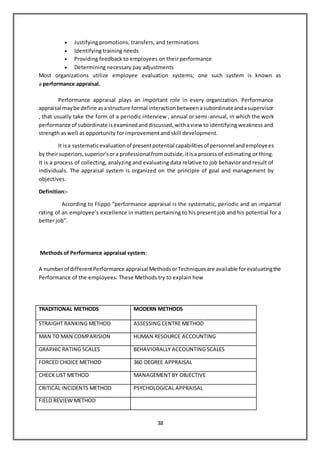
  • 8.
    8 At the timerecruitmentof employees,the initialconsiderationshouldbe giventothose employees who are currently working within the organization. This is an important source of recruitment, which provides the opportunities for the development and utilization of the existing resources within the organization. Internal sources of recruitment are the best and the easiest way of selecting resources as performance of their work is already known to the organization. Let us now discuss more on the various internal sources of recruitment. Promotions Promotionreferstoupgradingthe cadre of the employees by evaluating their performance in the organization. It is the process of shifting an employee from a lower position to a higher position withmore responsibilities, remuneration, facilities, and status. Many organizations fill the higher vacant positions with the process of promotions, internally. Transfers Transferreferstothe process of interchanging from one job to another without any change in the rank and responsibilities.Itcanalso be the shiftingof employees from one department to another departmentorone locationtoanotherlocation,depending upon the requirement of the position. Let’stake an example to understand how it works. Assume there is a finance company called ABC Ltd. Havingtwo branches, Branch-A and Branch-B, and an employee from Branch-A resigned from his job responsibilities. Hence, this position has to be filled for the continuation of the project in Branch-A. In this scenario, instead of searching or sourcing new candidates, which is time consuming and expensive, there is a possibility of shifting an employee from Branch-B to Branch-A, depending upon the project requirements and the capabilities of that respective employee. This internal shifting of an employee from one branch to another branch is called as Transfer. Recruiting Former Employees Recruiting former employees is a process of internal sources of recruitment, wherein the exemployees are called back depending upon the requirement of the position. This process is costeffective andsavesplenty of time. The other major benefit of recruiting former employees is that they are very well versed with the roles and responsibilities of the job and the organization needs to spend less on their training and development. Internal Advertisements (Job Posting) Internal Advertisements is a process of posting/advertising jobs within the organization. This job postingisan openinvitationtoall the employeesinside the organization, where they can apply for the vacant positions. It provides equal opportunities to all the employees working in the organization.Hence,the recruitmentwill be done fromwithinthe organization and it saves a lot of cost. Employee Referrals Employee referrals is an effective way of sourcing the right candidates at a low cost. It is the processof hiring new resources through the references of employees, who are currently working
  • 9.
    9 withthe organization.In thisprocess, the present employees can refer their friends and relatives for filling up the vacant positions. Organizations encourage employee referrals, because it is cost effective and saves time as compared to hiring candidates from external sources. Most organizations, in order to motivate their employees, go ahead and reward them with a referral bonus for a successful hire. Previous Applicants Here,the hiringteamchecksthe profilesof previousapplicantsfromthe organizationalrecruitment database.These applicantsare those whohave appliedforjobsinthe past. These resources can be easilyapproachedand the response will be positive in most of the cases. It is also an inexpensive way of filling up the vacant positions. Pros and Cons of Internal Sources of Recruitment Internal sources of recruitment, i.e., hiring employees within the organization, has its own set of advantages and disadvantages. The advantages are as follows −  It is simple, easy, quick, and cost effective.  No need of induction and training, as the candidates already know their job and responsibilities.  It motivates the employees to work hard, and increases the work relationship within the organization.  It helps in developing employee loyalty towards the organization. The drawbacks of hiring candidates through internal sources are as follows −  It prevents new hiring of potential resources. Sometimes, new resources bring innovative ideas and new thinking onto the table.  It has limited scope because all the vacant positions cannot be filled.  There could be issues in between the employees, who are promoted and who are not.  If an internal resource is promoted or transferred, then that position will remain vacant.  Employees, who are not promoted, may end up being unhappy and demotivated. External Sources of Recruitment External sources of recruitment refer to hiring employees outside the organization externally. In otherwords,the applicantsseekingjobopportunitiesinthiscase are those who are external to the organization. External employees bring innovativeness and fresh thoughts to the organization. Although hiring through external sources is a bit expensive and tough, it has tremendous potential of driving the organizationforwardinachievingitsgoals.Letusnow discussindetail the variousexternal sources of recruitment. Direct Recruitment
  • 10.
    10 Directrecruitmentreferstothe external sourceof recruitment where the recruitment of qualified candidates are done by placing a notice of vacancy on the notice board in the organization. This method of sourcing is also called as factory gate recruitment, as the blue-collar and technical workers are hired through this process. Employment Exchanges As per the law, for certain job vacancies, it is mandatory that the organization provides details to the employmentexchange.Employmentexchangeisagovernmententity,where the details of the job seekers are stored and given to the employers for filling the vacant positions. This external recruitment is helpful in hiring for unskilled, semi-skilled, and skilled workers. Employment Agencies Employmentagenciesare agood external source of recruitment. Employment agencies are run by various sectors like private, public, or government. It provides unskilled, semi-skilled and skilled resourcesasper the requirementsof the organization.These agencieshold a database of qualified candidates and organizations can use their services at a cost. Advertisements Advertisements are the most popular and very much preferred source of external source of recruitment. The job vacancy is announced through various print and electronic media with a specific job description and specifications of the requirements. Using advertisements is the best wayto source candidatesinashort spanand it offersanefficient way of screening the candidates’ specific requirements. Let’s take an example. Assume that there is a Sales Company called XYZ Ltd which has got a new projectof sellingaproductin a shortspan of time,asthe competition is very high. In this scenario, choosingthe specificrecruitmentplaysavital role.Here the ideal type of recruitmentwhichshould be chosen is Advertisement. Advertisementisthe bestsuitable practice for this kind of hiring, because a large volume of hiring ina shortspan can be done throughAdvertisementonly.Advertisementis one of the costliest way to recruit candidates, but when time and number are important, then advertisement is the best source of recruitment. Professional Associations Professionalassociationscanhelpanorganizationinhiringprofessional, technical, and managerial personnel,howevertheyspecialize insourcing mid-level and top-level resources. There are many professional associations that act as a bridge between the organizations and the job-seekers. Campus Recruitment Campusrecruitmentisanexternal source of recruitment, where the educational institutions such as colleges and universities offers opportunities for hiring students. In this process, the organizations visit technical, management, and professional institutions for recruiting students directly for the new positions.
  • 11.
    11 Word of MouthAdvertising Word of mouth is an intangible way of sourcing the candidates for filling up the vacant positions. There are many reputed organizations with good image in the market. Such organizations only needa word-of-mouthadvertisingregardinga job vacancy to attract a large number of candidates. Pros and Cons of External Sources of Recruitment External sourcesof recruitment,i.e.,hiringemployeesoutside anorganization,hasbothitsbenefits and drawbacks. The benefits are as follows −  It encourages new opportunities for job seekers.  Organization branding increases through external sources.  There will be no biasing or partiality between the employees.  The scope for selectingthe rightcandidate ismore,because of the large number candidates appearing. The disadvantages of recruiting through external sources are as follows −  This process consumes more time, as the selection process is very lengthy.  The cost incurred is very high when compared to recruiting through internal sources.  External candidates demand more remuneration and benefits. To conclude,the HR departmentshouldbe flexible enoughtochoose between internal or external methods of recruitment, depending upon the requirement of the organization. SELECTION: Selectionisthe processof choosing the mostsuitable candidates from those who apply for the job. It isa processof offeringjobstodesiredcandidates. Once the potential applicantsare identified,the next step is to evaluate their qualification, qualities, experience, capabilities, etc. & make the selection. It is the process of offering jobs to the desired applicants. Selection means choosing a few from those who apply. It is picking up of applicants or candidates with requisite qualifications and qualities to fill jobs in the organization. Definition of Selection Accordingto HaroldKoontz,“Selectionis the process of choosing from the candidates, from within the organizationorfrom outside,the mostsuitable personfor the current position or for the future positions.” Dale Yoder said, “Selection is the process by which candidates for employment are divided into classes those who will be offered employment and those who will not.” David and Robbins said, “Selection process is a managerial decision-making process as to predict which job applicants will be successful if hired.”
  • 12.
    12 Accordingto R.M. Hodgetts,“Selectionistheprocessin which an enterprise chooses the applicants who best meet the criteria for the available positions.” Steps in Selection Process The selectionprocesstypicallybeginswiththe preliminaryinterview;next,candidates complete the application for employment. They progress through a series of selection tests, the employment interview, and reference and background checks. The successful applicant receives a company physical examination and is employed if the results are satisfactory. Several external andinternal factorsimpactthe selectionprocess,and the manager must take them into account in making selection decisions. 1. Initial Screening The selection processoftenbeginswithaninitial screeningof applicants to remove individuals who obviously do not meet the position requirements. At thisstage,a fewstraightforwardquestionsare asked.Anapplicantmayobviouslybe unqualified to fill the advertised position, but be well qualified to work in other open positions. The Purpose of Screening is to decrease the number of applicants being considered for selection.
  • 13.
    13 Sources utilized inthe screening effort Personal Resume presentedwiththe job application is considered a source of information that can be used for the initial screening process. It mainly includes information in the following areas:  Employment & education history.  Evaluation of character.  Evaluation of job performance. Advantages of Successful Screening If the screening effort is successful, those applicants that do not meet the minimum required qualificationswill notmove tothe nextstage inthe selectionprocess.Companiesutilizingexpensive selection procedures put more effort into screening to reduce costs. 2. Completion of the Application Form ApplicationBlankisaformal recordof an individual’s application for employment. The next step in the selection process may involve having the prospective employee complete an application for employment. This may be as brief as requiring only an applicant’s name, address, and telephone number. In general terms,the applicationformgivesajob-performance-relatedsynopsisof applicants’life,skills and accomplishments. The specific type of information may vary from firm to firm and even by job type within an organization. Application forms are a good way to quickly collect verifiable and fairly accurate historical data from the candidate. 3. Employment Tests Personnel testing is a valuable way to measure individual characteristics. Hundreds of tests have been developed to measure various dimensions of behavior. The tests measure mental abilities, knowledge, physical abilities, personality, interest, temperament, and other attitudes and behaviors. Evidence suggests that the use of tests is becoming more prevalent for assessing an applicant’s qualificationsandpotential forsuccess.Tests are used more in the public sector than in the private sector and in medium-sized and large companies than in small companies. Large organizations are likely to have trained specialists to run their testing programs.
  • 14.
    14 Advantages of usingtests Selectiontestingcanbe a reliable andaccurate meansof selecting qualified candidates from a pool of applicants. As with all selection procedures, it is important to identify the essential functions of each job and determine the skills needed to perform them. Potential Problems using Selection tests Selection tests may accurately predict an applicant’s ability to perform the job, but they are less successful in indicating the extent to which the individual will want to perform it. Anotherpotential problem,relatedprimarilytopersonalitytestsand interest inventories, has to do with applicants honesty. Also, there is the problem of test anxiety. Applicantsoftenbecome quite anxious when confronting yet another hurdle that might eliminate them from consideration. 4. Job Interview An interview is a goal-oriented conversation in which the interviewer and applicant exchange information.The employment interview is especially significant because the applicants who reach this stage are considered to be the most promising candidates. Interview Planning Interview planning is essential to effective employment interviews. The physical locationof the interviewshouldbe bothpleasantandprivate,providing for a minimum of interruptions.The interviewershould possess a pleasant personality, empathy and the ability to listen and communicate effectively. He or she shouldbecome familiarwiththe applicant’squalificationsbyreviewing the data collected fromotherselectiontools.Inpreparingforthe interview,ajobprofile shouldbe developedbasedon the job description. Content of the Interview The specificcontentof employmentinterviewsvariesgreatlybyanorganizationand the level of the job concerned. 1. Occupational experience: Exploring an individual’s occupational experience requires determining the applicant’s skills, abilities, and willingness to handle responsibility.
  • 15.
    15 2. Academic achievement:In the absence of significant work experience, a person’s academic background takes on greater importance. 3. Interpersonal skills:If an individualcannotworkwell withotheremployees, chances for success are slim. This is especially true in today’s world with increasing emphasis being placed on the use of teams. 4. Personal qualities: Personal qualities normally observed during the interview include physical appearance, speaking ability, vocabulary, poise, adaptability, and assertiveness. 5. Organizational fit: A hiring criterion that is not prominently mentioned in the literature is organizational fit. Organizational fit is ill-defined but refers to management’s perception of the degree towhich the prospective employee will fit in with, for example, the firm’s culture or value system. 5. Conditional Job Offer Conditional joboffermeans a tentative job offer that becomes permanent after certain conditions are met. If a job applicant has passed each step of the selection process so far, a conditional job offer is usually made. In essence,the conditionaljobofferimpliesthat if everything checks out – such as passing a certain medical,physical orsubstance abuse test – the conditional nature of the job offer will be removed and the offer will be permanent. 6. Background Investigation Background Investigation is intended to verify that information on the application form is correct and accurate. This step is used to check the accuracy of application form through former employers and references.Verificationof educationandlegal status to work, credit history and criminal record are also made. Personal reference checks may provide additional insight into the information furnished by the applicant and allow verification of its accuracy. Past behavioristhe bestpredictorof future behavior.Itis important to gain as much information as possible about past behavior to understand what kinds of behavior one can expect in the future. Knowledgeaboutattendance problems,insubordinationissues,theft,or other behavioral problems can certainly help one avoid hiring someone who is likely to repeat those behaviors.
  • 16.
    16 Backgroundinvestigationsprimarily seek datafrom references supplied by the applicant including hisor her previous employers. The intensity of background investigations depends on the level of responsibility inherent in the position to be filled. Common sources of background information include:  References are provided by the applicant and are usually very positive.  Former employers should be called to confirm the candidate’s work record and to obtain their performance appraisal.  Educational accomplishments can be verified by asking for transcripts.  Legal status to work.  Credit references, if job-related.  Criminal records can be checked by third-party investigators.  Background checks are conducted by third-party investigators.  Online searches as simple as “Google” search of a candidate can turn up information on press releases or news items about a candidate that was left off the application or resume. 7. Medical/Physical Examination After the decision has been made to extend a job offer, the next phase of the selection process involves the completion of a medical/physical examination. This is an examination to determine an applicant’s physical fitness for essential job performance. Typically, a job offer is contingent on successfully passing this examination. For example,firefightersmustperformactivitiesthatrequire acertainphysical condition.Whetherit is climbing a ladder, lugging a water-filled four-inch hose or carrying an injured victim, these individuals must demonstrate that they are fit for the job. 8. Permanent Job Offer Individualswhoperformsuccessfullyin the preceding steps are now considered eligible to receive the employmentoffer.The actual hiringdecisionshouldbe made bythe managerinthe department where the vacancy exists. Notification to Candidates
  • 17.
    17 The selectionprocessresultsshouldbe madeknowntocandidates—successfulandunsuccessful—as soon as possible. Any delay may result in the firm losing a prime candidate, as top prospects often have other employmentoptions.Asamatter of courtesyand goodpublicrelations,the unsuccessful candidates should also be promptly notified. Conclusion The objectivesof the selectionprocessare toselectthe candidateswhosesuccess probability in the job is the highest and motivate right candidates to opt for the vacancy by a proper presentation of the organization to the potential candidates. In many HR departments, recruiting and selection are combined and called the employment function.Inlarge HR departments,the employmentfunctionisthe responsibility of the HR Director. In smaller departments, HR managers handle these duties. The selection process relies on three helpful inputs. Job analysis information provides the descriptionof the jobs,the humanspecificationsand the performance standards each job requires. Human resource plans tell HR managers what job openings are likely to occur. These plans allow selection to proceed in a logical manner. Finally,recruitsare necessary so that the HR manager has a group of people from which to choose. These three inputs largely determine the effectiveness of the selection process. The selection process is a series of steps through which applicants pass. For example,acandidate whofailstoqualifyforaparticularstepis noteligiblefor appearing for the subsequentstep.The resultof eachstepiscrucial.Failure of anystepdisqualifiesthe candidate from attempting the next step.
  • 18.
    18 INTERVIEW An interview isa purposeful exchange of ideas, the answering of questions and communication betweentwoormore persons.Generally,aninterview isaprocessof private meeting conversation between people, where questions are asked and answered, for obtaining information about qualities,attitudes,prospectusetc.Aninterview referstoa conversation with one or more persons actingas the role of an interviewer who ask questions and the person who answers the questions acts as the role of an interviewee. The primary purpose of an interview is to transfer information from interviewee to interviewer. Interviews can be either formal or informal, structured or unstructured. Interviews can be carried out one-to-one or in groups; they can be conducted over telephone or via video conferencing. Interviews have some basic objectives, which are as follows:  Through interviews, recruiters can verify the information obtained through application forms and tests.  Recruiters canobtainadditional informationaboutthe candidateswhichare notmentioned in the application forms or resumes  Interviewsprovidesanapplicantthe informationandthe necessaryfacts about the job and the organization.
  • 19.
    19  Interviews establisha mutual understanding between the applicant and the organization The followingfive P’sshouldbe takeninto consideration in order to ensure effective selection and interviewing:  Prepare:Preparationisthe firststepof conductinganinterview.Priortointerview,the interviewer shouldmake sure thathe/she understandsthe keyelementsof the job. And the interviewer should go through the resume of the candidate for understanding his/her qualities and efficiencies.  Purpose:The interviewershouldhave knowledgeaboutthe purpose of the interview, why he/she is conducting it. The interviewer should project the organization as the best place to work to the interviewee, which helps in selecting the right candidate.  Performance: An interviewer must identify the attitude, attributes, knowledge and skills of the applicants,whoare needed for the success of the organization. If the requirement is about special education and technical skills, then hiring high-performing applicants plays an important role.  People Skills: The applicant, who comes for an interview, will not be completely transparent. Hence,itis the job of an interviewer to un-mask the applicant and discover the inner qualities and skillsduringthe interview. This good practice of hiring will help in selecting the right candidate for the organization.  Process: Every interviewer should follow a structured interview process to get better results. A structuredprocessof interview avoidsbiasandgivesequal andfair chance to all the applicants. The best way for accomplishing this process is by using the behavioral based questions and situational questions. Importance of Interview: An interviewprovidesan organization the scope to learn more about the applicants, who come for an interview,while the applicantsgetanopportunitytobecome more familiar with the demands of a givenposition.Interviewsenableboththe partiestoexchange information,askquestions and also help in evaluating the potential for establishing a professional working relationship with the organization. The following points explain the importance of conducting interviews:  Interviewshelpinselectingthe rightcandidate from a group of applicants, who applied for a job.  Interviews are a medium to help collect useful information about potential candidates.  Informationgiveninthe applicationformorresume isveryless.Recruiters can ask the candidates to provide an elaborate explanation during the interview.  A good interviewer gives good impression about the organization, which in turn increases the goodwill of the organization.
  • 20.
    20  Interviewsalsohelpinpromotionsandtransfersof thecandidates,asperthe requirements of the organization. Interview Process Interviewingcandidatesisthe final stage inthe recruitmentprocess.Hence,tofindthe right person for a specificposition,there shouldbe aproperprocess,thathas to be followedforthe rightresults. An ideal interview process for selecting the right candidates is as follows:  Determine the requirements of the job. Conduct a thorough job analysis.  Prepare a specific job description and a job specification.  Make a plan − how and where to find qualified candidates.  Collect and review applications and resumes and from them, select the most potential and qualified candidates for further proceedings.  Interview the shortlisted candidates based upon the job description and specification.  Verify the candidates’ background with the references provided by them. Following such an interview process, the HR department can hire the best possible candidates for a vacant job position. Types of Interviews Dependingupthe requirements,situations,locationsandtime,the interviewsare broadly classified intotendifferentcategories.Recruitersshouldbe knowledgeableenoughtounderstand which type of interview should be used when. The ten different types of interviews are as follows: 1. Structured Interview:Inthistype,the interviewisdesignedanddetailedinadvance. A structured interview is pre-planned, accurate, and consistent in hiring the candidates. 2. Unstructured Interview: This type of interview is an unplanned one, where the interview questionnaire is not prepared. Here, the effectiveness of the interview is very less and there is a tremendous waste of time and effort of both the interviewer and the interviewee. 3. Group Interview: In this type of interview, all the candidates or a group of candidates are interviewedtogether.Groupinterviewsare conductedtosave time whenthere is a large number of applications for a few job vacancies. A topic will be given to discuss among the candidates and the interviewer judges the innovativeness and behaviour of each candidate in the group. 4. Depth Interview: Depth interview is a semi-structured interview, where the candidates have to give a detailed information about their education background, work experience, special interests, etc.And the interviewertakesadepthinterviewandtries in finding the expertise of the candidate.
  • 21.
    21 5. StressInterview:Stressinterviewsare conductedtodiscoverhowacandidate behavesinstressful conditions.Inthistype of interview, the interviewer will come to know whether the candidate can handle the demandsof a complex job. The candidate who maintains his composure during a stress interview is normally the right person to handle a stressful job. 6. Individual Interview:Inan individualinterview,the interview takes place one-on-one i.e., there will be a verbal anda visual interactionbetweentwopeople,aninterviewer and a candidate. This is a two-way communication interview, which helps in finding the right candidate for a vacant job position. 7. Informal Interview:Such interviewsare conducted in an informal way, i.e., the interview will be fixedwithoutanywrittencommunicationandcanbe arranged at any place.There isnoprocedure of asking questions in this type of interview, hence it will be a friendly kind of interview. 8. Formal Interview: A formal interview held in a formal way, i.e., the candidate will be intimated about the interview well in advance and the interviewer plans and prepares questions for the interview. This is also called as a planned interview. 9.Panel Interview:Panel interview,asthe name indicates,isbeing conducted by a group of people. In thistype of interview,three tofive membersof the selectioncommittee will be asking questions to the candidates on different aspects. The final decision will be taken by all the members of the panel collectively. 10. Exit Interview: Exit interviews are conducted for those employees who want to leave the organization.The importance of the exitinterview istodiscoverwhyanemployee wantstoleave his job. Example :Suppose there is a software company Global Systems, which has an executive requirementforthe positionCEO.Thiskind of position cannot be fulfilled in a short span. This kind of requirements need a keen observation and a lot of planning. There are different types of interviews,whichare explainedinthe above list.The besttype of interview suitable for hiring a CEO would be a “Structured Interview”. Hiring a CEO for an organization is a big task and it can only be fulfilledwithlotsof planning.Hence the interview process needs to be well structured and it has to be executed in a perfect way. TESTS Individuals differ in many respects including job-related abilities and skills. In order to select a rightpersonfor the job,individual differencesin terms of abilities and skills need to be adequately and accurately measured for comparison. This is done through a device called ‘selection test’. Selection test is a device that uncovers the informationaboutthe candidate whichisnotknownthroughapplicationblankandinterview.In this way, selection test is an adjunct to a selection method.
  • 22.
    22 Definition: MiltonM. Blumhasdefinedtestas“a sampleof an aspectof an individual’sbehaviour,performance and attitude”. Types of Tests: 1. Written tests: Written tests historically have served as significant input into the selection decisions. There has been renewed interest in written tests, since those that have been validated can aid significantly in the acquisition of efficient and effective workers. 2. Achievement tests: To verify how he can achieve the target. Past experience can help the employees to satisfy the recruiters. 3. Intelligent tests: The employee’s intelligent level is determined here. 4. Performance tests: Whether the employees perform well or not. 5. Honestyor polygraph (lie detector) tests:The use of lie detectorforverifying information on the application form can only be used for specific jobs, such as police officer, finance managers etc. 6. Aptitude tests: Whether the employee is interested in the job or not can be determined by this test. 7. Psychological tests: The psychology of the employee is determined. The employees who are psychologically strong and do not get nervous do well. 8. Graphology (Handwriting analysis) tests: It has been said that an individual’s handwriting can suggest the degree of energy, inhibitions, and spontaneity to be found in the writer, disclosing idiosyncrasiesandelementsof balance andcontrol fromwhichmanypersonality- characteristics can be inferred. 9. Physical tests: To examine whether the candidate is physically fit for the job. 10. Personality tests: Through these tests a mental and behavioral quality i.e. personality level is measures. 11. Trainability Tests: For jobs in which training is necessary due to the skill level of the job applicants or the changing nature of the job, trainability tests are useful. Essentially, the goal is to determine the trainability of the candidate. 12. Work Sample:Work Sample testsmeasure the ability to do something rather than the ability to knowsomething.These testsmaymeasure motorskillsorverbal skills,Motorskillsinclude physically manipulatingvariousjobrelatedequipmentandverbal skills include problem solving and language skills.
  • 23.
    23 UNIT-III TRAINING & DEVELOPMENT Trainingand Development is one of the main functions of the human resource management department. Training refers to a systematic setup where employees are instructed and taught mattersof technical knowledge related to their jobs. It focuses on teaching employees how to use particular machines or how to do specific tasks to increase efficiency. Whereas,Developmentreferstothe overall holisticandeducational growth and maturity of people inmanagerial positions.The processof developmentisinrelationtoinsights,attitudes,adaptability, leadership and human relations DEFINITION: TrainingisdefinedbyWayne Cascioas“trainingconsistsof planedprogramsundertakento improve employee knowledge, skills, attitude, and social behavior so that the performance of the organization improves considerably.” Trainingisnormallyviewedasashort process.It is applied to technical staff, lower, middle, senior level management.Whenappliedtolowerandmiddle management staff it is called as training and for senior level it is called managerial development program/executive development program/development program. Objectives/purpose/goals of training and development The purpose of training and development can be explained as follows. 1. Improving quality of work force :- Training and development help companies to improve the qualityof workdone bytheiremployees.Trainingprograms concentrate on specific areas. There by improving the quality of work in that area. 2. Enhance employee growth:- Everyemployee whotakesdevelopmentprogrambecomesbetter at his job. Training provides perfection and required practice, therefore employee’s area able to develop them professionally. 3. Preventsobsolescence:- Throughtraininganddevelopmentthe employee is up to date with new technology and the fear of being thrown out of the job is reduced. 4. Assisting new comer :- Training and development programs greatly help new employees to get accustomed to new methods of working, new technology, the work culture of the company etc. 5. Bridging the gap between planning and implementation :- Plans made by companies expect people to achieve certain targets within certain time limit with certain quality for this employee performance has to be accurate and perfect. Training helps in achieving accuracy and perfection. 6. Health and safety measures :- Training and development program clearly identifies and teaches employeesabout the different risk involved in their job, the different problems that can arise and
  • 24.
    24 how to preventsuch problems. This helps to improve the health and safety measures in the company. Process/procedure of training 1. Determining training needs of employee :- In the very 1st step of training procedure, the HR department, identifies the number of people required training, specific area in which they need training,the age groupof employee,the level inorganization etc. in some cases the employee may be totally new to the organization. Here the general introduction training is required. Some employees may have problems in specific areas; here the training must be specific. This entire information is collected by HR department. 2. Selecting target group :- Based on information collected in step 1 the HR department divides employee into groups based on the following. Age group i. The area of training ii. Level in the organization iii. The intensity of training etc. 3. Preparing trainers :- Once the employees have been divided into groups, the HR department arranges for trainers. Trainers can be in house trainers or specialized trainers from outside. The trainersare givendetailsbyHRdepartment,like numberof peoplein group, their age, their level in organization, the result desired at the end of training, the area of training, the number of days of training, the training budget, facilities available etc. 4. Preparing training packages :- Basedonthe informationprovided by trainers, he prepares entire trainingschedule i.e.number of days, number of sessions each day, topics to be handled each day, depth of which the subject should be covered, the methodology for each session, the test to be given foe each session, handout/printed material to be given in each session. 5. Presentation :- On the first day of training program the trainer introduces himself and specifies the need and objective of the program and then actually stars the program. The performance of each employee is tracked by the trained and necessary feedback is provided. 6. Performance :- At the end of training program the participants reports back to their office or branches.Theyprepare reportonthe entire trainingprogramandwhat theyhave learned. They the start using whatever they have learned during their training. Their progress and performance is constantlytrackedandsuitable incentivesare givenif the participantis able to use whatever he has learned in training. 7. Follow up :- Based on the em0ployee performance, after training, the HR department is able to identify what is exactly wrong with training program and suitable correction is made.
  • 25.
    25 Methods of trainingoperating personnel/factory workers There are different methods of training for operating personnel (factory workers). Trainingthese workersbecomesimportantbecausetheyhandleequipment worth crores of rupees. 1. On the job training method :- In this method workers who have to be trained are taken to the factory,dividedintogroupsandone superior is allotted to every group. This superior or supervisor first demonstrates how the equipment must be handled, and then the worker is asked to repe at whatever he has observed in the presence of the supervisor. This method makes it easy for the employeetolearnthe detailsaboutspecificequipment.Once the workerstudiesthe firstequipment thoroughly the supervisor moveson to the next equipment and so on. 2. Apprenticeship training :- In this method both theory and practical session are conducted. The employee is paid a stipend until he completes training. The theory sessions give theoretical informationaboutthe plantlayout,the differentmachines,theirpartsand safety measures etc. The practical sessionsgive practical traininginhandling the equipment. The apprentice may or may not be continued on the job after training. 3. Vestibule training:- In thismethodof traininganatmosphere which is very similar to the real job atmosphere iscreated.The surroundings,equipment,noise levelwill be similartothe real situation. When an employee is trained under such conditions he gets an idea about what the real job situationwill be like.Similarlywhenhe actuallystartsdoingthe jobhe will notfeel out of place. This method is used to train pilots and astronauts. In some places graphics are also used to create the artificial surroundings. This method involves heavy investment. 4. Job rotation :- In this method the person is transferred from one equipment to the other for a fixedamountof time until he iscomfortable withall the equipments. At the end of the training the employee becomes comfortable with all the equipment. He is then assigned a specific task. 5. Classroommethod :- In thismethodthe trainingisgiveninthe classroom.Video,clippings,slides, charts, diagrams and artificial modules etc are used to give training. Methods of training for managers/methods of development/managerial development/executive development Various methods are used to train personnel for managerial level jobs in the company. These methods can be explained as follows. On the job method:- On the job method refers to training given to personnel inside the company. There are different methods of on the job training. 1. Job rotation :- Thismethodenablesthe company to train managerial personnel in departmental work. They are taught everything about the department. Starting from the lowest level job in the department to the highest level job. This helps when the person takes over as a manager and is required to check whether his juniors are doing the job properly or not. Every minute detail is studied. 2. Plannedprogression:- In thismethodjuniorsare assignedacertainjobof their senior in addition to theirownjob.The methodallowsthe employee toslowlylearnthe jobof his senior so that when
  • 26.
    26 he is promotedtohissenior job it becomes very easy for him to adjust to the new situation. It also provides a chance to learn higher level jobs. 3. Coaching and counseling :- Coaching refers to actually teaching a job to a junior. The senior person who is the coach actually teaches his junior regarding how the work must be handled and howdecisionsmust be taken, the different techniques that can be used on the job, how to handle pressure. There is active participation from the senior. Counseling refers to advising the junior employee as and when he faces problems. The counselor superior plays an advisory role and does not actively teach employees. 4. Under study :- In this method of training a junior is deputed to work under a senior. He takes orders from the senior, observes the senior, attends meetings with him, learns about decision makingandhandlingof day to dayproblems.The methodisusedwhenthe senior is on the verge of retirement and the job will be taken over by the junior. 5. Junior board :- In this method a group of junior level managers are identified and they work togetherina groupcalledjuniorboard. They function just like the board of directors. They identify certain problem, they have to study the problem and provide suggestions. This method improves teamwork anddecisionmakingability.It gives an idea about the intensity of problem faced by the company. Only promising and capable junior level managers are selected for this method. Off the job training method :- Off the job training refers to method of training given outside the company. The different methods adopted here are 1. Classroommethod :- The classroommethodisusedwhenagroup of managershave to be trained in theoretical aspects. The training involves using lectures, audio visuals, case study, role play method, group discussions etc. The method is interactive and provides very good results. 2. Simulation :- Simulation involves creating atmosphere which is very similar to the original work environment. The method helps to train manager handling stress, taking immediate decisions, handling pressure on the jobs etc. An actual feel of the real job environment is given here. 3. Businessgames:- Thismethodinvolvesproviding a market situation to the trainee manager and asking him to provide solutions. If there are many people to be trained they can be divided into groups and each group becomes a separate team and play against each other. 4. Committee :- A committee referstoa groupof people who are officially appointed to look into a problem and provide solution. Trainee managers are put in the committee to identify how they study a problem and what they learn from it. 5. Conference :- Conferencesare conductedbyvariouscompaniesto have elaborate discussions on specific topics. The company which organizes the conference invites trainee manager and calls for expertsindifferentfieldstogive presentation or lecture. The trainee manager can ask their doubts to these experts and understand how problems can be solved on the job. 6. Readings:- This methodinvolvesencouragingthe trainee managertoincrease hisreadingrelated to hissubjectandthenask himto make a presentation on what he has learned. Information can be collected by trainee manager from books, magazines and internet etc.
  • 27.
    27 7. In baskettraining:- In thismethod the training is given to the manager to handle files coming in and to finishhisworkandtake decisionswithinaspecifiedtimelimit.The trainee manager is taught how to prioritize his work, the activities which are important for his job and how to take decisions within limited time limit. Evaluation of training program Effectiveness of training programs are constantly evaluate by the company to find if the money, they have invested has been spend properly or not. Training programs can be evaluated by asking following questions.  Has change occurred after training?  Is the change due to training?  Is the change positive or negative?  Will the change continue with every training program? A training program should give following resulting changes. 1. Reaction :- Reaction refers to attitude of employee about the training, whether the employee considerstrainingtobe +ve or –ve one. If reaction are +ve then people have accepted the program and changes will be possible. 2. Learning:- Anothermethodof judgingeffectivenessistoidentifylevelsof learning i.e. how much the people have learntduringthe training.This can be found out by trainers mark sheet, the report submitted by the employee, and actual performance. 3. Behaviour:- The HR departmentneedstounderstandbehavior of the employees, to understand the effectiveness of training. The behavioral change can be seen in how the person interacts with juniors, peer groups and seniors. They mark change in behavior and inform the HR department of the success of training program. 4. Result :- Results provided by employee in monetary terms also determines effectiveness of trainingprogrami.e.employee success in handling the project, the group performance before and after training etc. 5. Effectiveness: Effectiveness of training program must lead to  Increase in efficiency of worker  Reduction in labour turnover  Increase in discipline  Reduction in wastage and therefore cost of production  Proper care of tools and equipments  Employee development in career terms  Overall efficiency in the company
  • 28.
    28 Advantages of trainingprograms/training The following are the advantages of training program to the company 1. Increase in efficiencyofworker:- Trainingprogramscan helpworkerstoincrease their efficiency levels, improve quality and thereby increase sales for the company. 2. Reduced supervision :- When workers have been formally trained they need not be supervised constantly. This reduces the work load on the supervisor and allows him to concentrate on other activities in the factory. 3. Reduction in wastage :- The amount of material wasted by a trained worker is negligible as compared to the amount of material wasted by an untrained worker. Due to this the company is able to reduce its cost its cost of production. 4. Less turnover of labour :- One of the advantages of the training program is that it increases the confidence of employeesandprovidesthemwithbettercareeropportunities.Due to this employee generally do not leave the company. There by reducing labour turnover. 5. Training helpsnewemployees:- A person,whois totally new to the company, has no idea about itsworking.Traininghelpshim to understand what is required from him and helps him to adjust to the new environment. 6. Unionmanagementrelations:- Whenemployeesare trainedandgetbettercareeropportunities. The unionstarts havinga possible attitude aboutthe management. They feel that the management is genuinely interested in workers development. This improves union management relations. The following are the advantages of training program to the employee 1. Bettercareer opportunities:- Training programs provide the latest information, develops talent and due to this the employee is in a position to get better jobs in the same company or other companies. 2. High rewards :- Effective trainingprograms result in improved performance. When performance appraisal isdone excellentperformancefromthe employee isrewardedbygivinghimincentivesand bonus. 3.Increased motivation :- Employees who have been trained are generally more confident as comparedto others.Since theireffortswill be rewarded in future they are very much interested in improving their performance. Therefore we can say that their motivation levels are very high. 4. Group efforts :- Training programs are not only technical programs but are also conducted in areas like conflict management, group dynamics (formal and informal groups), behavioral skills, stressmanagementetc.thisenablesemployeestoput in group effort without facing problems that groups normally face. In other words training teaches people to work in a group. 5. Promotion:- People whoattendtrainingprogramslearnfrom them and improve themselves are generally considered for promotion. Thus training increases chances of promotion.
  • 29.
    29 CAREER DEVELOPMENT Career developmentinvolves those personal improvements that a person undertakes to achieve a personal career plan. Career management is the process of designing and implementing goals, plans and strategies to enable the organisation, to satisfy employee needs while allowing individuals to achieve their career goals. The career development involves the process of conversion of personal career plan into action in order to achieve career goals. There are three key heroes who share responsibility for an employee’s career development- the employee, the organisation, and the manager. Need for Employees Career Development in an Organisation: The need for effective employees’ career development are for following reasons: i. Making Available Needed Talent: Career development is a natural extension of strategic and employee training. Identifying staff requirements over the intermediate and long-term is necessary when a firm sets long-term goals and objectives. Career development will help organizations in putting the right people in the right job. ii. Attracting and Retaining Talents: There is always a scarcity for talented people and there is competition to secure their services. Talented people always prefer to work in organizations which care for their future concern and exhibit greater loyalty and commitment to organizations where there is career advancement. As
  • 30.
    30 careerdevelopmentisanimportantaspectof work lifeaswell aspersonal life, people prefer to join firms which offer challenges, responsibility and opportunities for advancement. iii. Reduced Employee Frustration: Alongwitheducational level andknowledge, the aspirational level of occupations is also increasing. Whenthese levelsare not met due to economic stagnation frustration sets in. When organizations downsize to cut costs, employee career paths, career tracks and career ladders tend to collapse resultinginaggravation of frustration. Career counseling comes a long way in reducing frustration. iv. Enhancing Cultural Diversity: Fast changing scenarios in globalization reflects a varied combination of workforce representing differenttypesof races, nationalities, religious faiths, ages and values in the workplaces. Effective career development programmes provide access to all levels of employees. v. Improving Organizational Goodwill: It isquite natural that if employees think their organizations care about their long-term well-being throughcareer developmentthey are likely to respond in kind by projecting positive images about theirorganizations. Careerdevelopment does help organization in impressing image and goodwill. Steps for Career Development The steps in career development are: Step # 1. Identifying Career Needs: Some large organizations have assessment centres or conduct career development workshops wherein a group of employees are brought together to undergo psychological testing, simulation exercises, and depth interviews. This process helps the employee to make a decision regarding careergoalsand the stepsto be takentoput effortstoattainthese goals.The HR manager alsoplays an important role of providing information and assistance in making decisions about the career needs of the employee. Step # 2. Developing Career Opportunities: Careeropportunitiesare identifiedthroughjobanalysis.The managershouldidentifycareerpathfor employeesinthe organization.He/sheshoulddiscusswiththe employeeswhat jobs are available in the organizational hierarchyandatthe same time findwhere the employee would want to go up in the organization in future. The employees should be provided information regarding job postings that are available inthe organizationand,forfuture reference,whatrequirements they will have to fulfill to achieve the promotion which they aspire. Step # 3. Integration of Employee Needs with Career Opportunities: It isnecessarytoalignthe needsandaspirationsof the employeeswithcareeropportunitiesinorder to ensure right people will be available to meet the organizational manpower requirements. Therefore, emphasis is placed on the training, on- and off-the-job, counselling and coaching by supervisor, and planned rotation in positions of varying functions and in different locations. The processispursuedfurtherwiththe helpof periodicperformance appraisals.Trainingandcounselling will be a wasteful exercise if the employee does not make progress along his/her career path.
  • 31.
    31 The two importanttechniques in this stage of career development are: (a) Management by objectives (b) Career counselling. Under ‘managementbyobjectives’,the employeesetshis/herdevelopmentgoalsandalso an action plan to achieve those goals. Steps are taken by the line managers to integrate personal goals with the organizational goals. In the case of counselling, the manager discusses the strengths and weaknesses of the employee. Thishelpsthe employee toidentifyareasof developmentsothathe/she canmeetfuture challenges of his/her job. Step # 4. Regular Monitoring: It is necessary to regularly monitor the progress of the employee towards his/her career developmentplansandsee thatthe supportis beingprovidedtodevelopthose careerplans.If there is a discrepancy, steps should be taken to reassign work as necessary to ensure that career development plans are met. In situations where career opportunities are not available due to influenceof technologyandeconomicfactors,the organizationshouldredesign jobs or make career shifts. . Benefits of a Career Development System to Organization:  Once organization hasa fairideaabout employee’s strengths and weaknesses, attitude and behaviour, valuesandfuture aspirations andskillsandcompetencies, they are able to make better use of employee skills and put them at the right place.  The organization candisseminate all importantdetails and information at all organizational levels inordertoensure effective communication at all levels. It fosters and lays emphasis on better communication within the organization as a whole.  It alsohelpsorganization retainvaluedemployees byproviding them what they want. Since the organization isable tocollectall necessary information aboutaspecificindividual, it can make efforts to retain them.  It establishes a reputation of the organization in the market. More and more working professionals see it as a people developer and get attracted towards it. Benefits of a Career Development System to Employees:  The major benefit of career development system to employees is that they get helpful assistance and guidance with their career decisions. They get to know about their own aspirations, objectives and desires and understand how to shape their career.  By usingthissystem, they cansetmore realisticgoalsandobjectives that are feasible to be accomplished over the span of one’s life.  It fosters better communication between the employee and the manager as well as at all levels of the organization.  The bestpart isthat they can getfeedback ontheir performance. This helps them improve their working style and compels them to upgrade their skills.  The process leads to job enrichment and enhanced job satisfaction.
  • 32.
    32 Benefits of aCareer Development System to Managers/Supervisors:  A careerdevelopmentsystemhelpsmanagersand supervisors in improving and upgrading theirskillsinordertomanage theirowncareer. Eventhey getto where they are heading to and what their aspirations are.  It fosters better communication between managers and employees.  It helps them in retaining valued employees as they get to know about their skills and competencies and future aspirations as well.  It helps in discussing productive performance appraisal of employees and planning their promotions as well as their career graph.  It leadsto greaterunderstandingof the organization as a whole and cultivate a supportive and conducive culture in the organization.  It helps managers in understanding the hidden aspects of employees and guides them to allocate employees the right job that matches to their skills and competencies. Problems /Challenges in Career Development Despite planning the career, employees face certain career problems which are as follows: 1. Dual Career Families: With the increase in career orientation among women, number of female employees is on the increase. Withthisthe dual careerfamilies have alsobeenonthe increase. Consequently one of the family members might face the problem of transfer. This has become a complicated problem to organisations. Consequently other employees may be at a disadvantage. 2. Changing Family Needs: Interaction of career issues with the issues of life stages of the employee and his family, changing needs of employee throughout his life cycle complicate the career issues. 3. Low Ceiling Careers: Some careers do nothave scope for much advancement. Employees cannot get promotions despite their career plans and development in such jobs. 4. Declining Career Opportunities: Careeropportunities for certain categories might reach the declining stage due to the influence of the technological or economic factors. Solution for such a problem is career shift. For example, career opportunities for ‘Statisticians’ declined due to computerisation. The existing statisticians could overcome this problem by acquiring skills in computer operations. Role of HR to Manage Career Development Problems: In order to handle and manage the above stated problems the HR function of any organization has to play an instrumental role. This could be achieved by the following strategies, namely: i. Improving Manpower planning and forecasting systems ii. Improving dissemination of career option information iii. Initiating career counselling programs on regular basis iv. Developing effective internal and external Assessment Centres
  • 33.
    33 v. Supporting educationaland training programs on regular basis (e.g.- Learning and Development Cells in organizations like Dell) vi. Introducing more flexible reward and promotional systems EMPLOYEE COUNSELLING Employee Counselling is the most important tool of a supervisor who wants to improve the performance and behavior of employee. If performance problems persist even after feedback and coaching which are other two important tools with a manager, one may need to proceed to counselling. Counsellingfocuses onthe problem, notthe employee, andis positive and constructive. Counselling is a formal straight, face-to-face conversation between a supervisor and an employee concerning conduct, and performance. It is an efficient means for a supervisor to have a positive effect on employee performance. Employee Counselling is based on the premise that employee performance can be enhanced if the employee is properly counselled by skilled managers. Employee Counselling is defined asworkingtohelppoororunderperforming employees improve and therefore it is vital to have an effectiveand well-documented counselling for two important reasons – firstly to improve performance andsecondly toserve assupportandpossible evidence for subsequent termination if the employee fails to improve. Employee Counselling -Concept Counselling is a two-way process in which a counsellor provides help to the workers by way of advice and guidance. There are many occasions in work situations when a worker feels the needforguidance and counselling. The term ‘counselling’ refers to the help given by a superior to his subordinate in improving the latter’s performance. It is a process of helping the employees to achieve better adjustment with his work environmenttobehave asa psychologically mature individual, andhelpinachieving a better under- standingwithothers sothat hisdealings withthemcanbe effective and purposeful. Thus, the basic objective of counselling is overall development of the employee. Objectives of Employee Counselling: (i) Counselling is an exchange of ideas and feelings between two persons. (ii) It is concerned with both personal and work problems. (iii) Counselling may be performed by both professionals and non-professionals. (iv) Counselling is usually confidential so as to have free talk and discussion. (v) It tries to improve organisational performance by helping the employees to cope with their problems. TYPES OF EMPLOYEE COUNSELLING  Directive Counselling: It is full counselling. It is the process of listening to an employee’s problem, deciding with the employee what should be done and telling and motivating the employee to do it. This type of
  • 34.
    34 counsellingmostly doesthe functionof advice, reassurance andcommunication. Itmayalsoperform other functions of counselling. It centers on the counsellor. The counsellor, after hearing the problems of anemployee, decides what should be done and gives advice and suggestion to him to resolve the problem. But directive counselling seldom succeeds, as people do not wish to take up advice normally, no matter how good it might be.  Non-Directive Counselling: It isthe process of skilfully listeningtothe emotional problems of anemployee, understand him/her and determine the course of action to be adopted to resolve his problem. It focuses on the counselee hence itiscalled‘clientcentered’ counselling. Professional counsellors usually adopt this method of counselling. The unique advantage of this type of counselling is its ability to cause the employees reorientation. The main stress is to ‘change’ the person instead of dealing with his immediate problem only. The non-directive counsellor deals with respect the person so affected. He takes the person as best to solve his own problems and he facilitates the person to reach his goal.In non- directive counselling, the employee is permitted to have maximum freedom in determining the course of the interview. Itisthe process of skilfully listeningandencouraginga counselee to explain troublesome problems, understand themanddetermine appropriate solutions. Fundamentally, the approach is to listen, with understanding and without criticism or appraisal, to the problem as it is described by the employee.  Cooperative Counselling: Is the process in which both the councillor and client mutually cooperate to solve the problems of the client. Itisnot neitherwholly client centered nor wholly counsellor centered but it is centered both councillor and client equally. It is defined as mutual discussion of an employee’s emotional problem to set up conditions and plans of actions that will remedy it. This form of counselling appears to be more suitable to managerial attitude and temperament in our country. More frequently, however, the problem cannot be solved easily because of frustrations orconflicts thatare accompanied bystrongfeelings suchasfear, confusion, or hostility. A manager, therefore, needstolearn to use whatever approach appears to be suitable at the time. Flexibility is a key component of the employee counselling process.  Participative Counselling: Both directive and non-directive methods suffer from limitations. While the former is often not acceptedbyindependentemployees, the latterneeds professionals to operate and hence is costly. Hence, the counsellingusedinmostsituations isinbetween these two. Thismiddle pathisknown as participative counselling. Participative isacounsellor-counselee relationshipthatestablishes a cooperative exchange of ideas to helpsolve anemployee’s problems. Itisneitherwhollycounsellorcentered norwholly counselee- centered. Counsellor and counselee mutually apply their different knowledge, perceptions, skills, perspectives and values to problem into the problems and find solutions.  Desensitization: According to Desensitization, once an individual is shocked in a particular situation, he/she gives himself/herself no chance for the situation to recur. This method can be used to overcome avoidance reactions, soasto improve the emotionalweakspots. If an employee is once shocked by the behavior, approach or action of his superior, he would continue to avoid that superior.
  • 35.
    35 It is difficultforsuchsuperiorstobe effective counsellors, unless such superiors prove otherwise throughtheirbehaviororaction on the contrary. Similarly, once an employee is shocked by a particular situation, he can be brought back to that situation only if he will be convinced through desensitization that the shock will not to take place further. Counsellor can make use of desensitization in such situations .  Catharsis: Discharge of emotional tensions can be called catharsis. A Catharsis is an emotional discharge throughwhichone can achieve a state of moral or spiritual renewal or achieve a state of liberation from anxiety and stress. Catharsis is a Greek word and it means cleansing. Emotional tensions can be discharged by talking them out or by relieving of the painful experience whichengendered them. Itisanimportanttechnique as a means of reducing the tensions associated withanxiety, fear, hostility, orguilt. Catharsis helpstogain insight into the ways an emotional trauma has been affecting the behaviour.  Insight: Founded by Sigmund Freud, psychoanalysis or insight delves deep into an employee’s past and bringsto lightpastexperiences andcurrentunconscious thoughts and behaviours of the employee, that are believed tobe the cause of their current problems. Specifically, it targets how inner drives such as the id, superego, and ego conflict with outside pressures such as cultural or religious obligations. Insight is the ability to acquire a new accurate awareness or comprehension about a thing or person. Insight therapy is a type of therapy that helps the employee to understand how eventsinthe past are negatively influencing the current thoughts, emotions, and behaviours. This type of treatment can be quite empowering for employees, because it is identifying the source of theirproblems. Identifyingthe reasons forlow self-esteem, insecurity, depression, anxiety, etc., is the first step towards resolving those conflicts and issues.  Developing the New Patterns: Developing new patterns becomes very often necessary when other methods to deal with weak spots remain ineffective. In order to develop new, more satisfying emotional reactions, the individual needs to expose himself to situations where he can experience positive feelings. The manager who deals with such individuals may motivate or instigate them to put themselves into such situations, so that their self-confidence may increase. Every counsellor must concentrate his/her full attention on two aspects viz., using of assessment tools, andutilizingcounsellingmethods, choice of which differs from person to person, situation to situation, and from case to case. MANAGEMENT DEVELOPMENT “Executive or management development is a planned process of learning and growth designed to bring behavioural change among the executives.” It is continuous process of learning. Itimpliesthatthere will be achange inknowledge and behaviorof the individuals undergoingdevelopmentprogramme. The employee will be able to perform his present job better and will increase his potential for future work.
  • 36.
    36 Managers develop themselvesbyparticipatinginformal trainingcourses organised by the organisation. They also make use of actual job experience in learning new behavior and the organisation must provide opportunities for development of its managers. But an equal, but more important, counterpart to the efforts of the organisation is those of the individuals. Self- development is an important concept in the whole programme of executive development. Aim: “A conscious and systematic process to control the development of managerial resources in the organisation for the achievement of goals and strategies. However, the need for management development can be ascertained from the following: 1. Social Obligation: Organizationisapart of society.Societyhasexpectations,demandsforitsgrowthand development from societal members including organization/s functioning in the society. Organization can fulfil societal demands / requirement if managers are capable enough to analyse social obligations to presentcasesas spokespersonof the societytothe company,todevelopabridge betweencompany thinkingandsocietal expectations, to make the society aware of Contributions Company made for amelioration and well-being of the members of the society. Hence, management development is needed to prepare capable and effective managers. 2. Effect of Globalization: Because of globalization,multinationalcorporations(MNCs) and trans-national corporations (TNCs) have entered in the market resulting in, stiff competition amongst the market players. In such a situation,itbecomesdifficultforthe domesticcompanies to survive in the context of quality goods they supply and the price they fix for the customers. It is, therefore, imperative need for the companies to have world class workers for production of worldclassproduct at reasonable cost;andthe companiescanhave such dynamicworkforce if,they have highly skilled, committed, dynamic pool of management personnel who can prepare the workers’communityaccordingtoneed,requirement of the companies. So, here is the necessity of management development to face the challenges emanated from the globalization. 3. Effective Functioning of Line Management: Line management/technocrats are well conversant with technicalities of production activitiesbut,theymaylackadequate skill,abilitiesinhumanrelationsdevelopment and conceptual areas of the company.For effectivefunctioningof theirworktheyneedimprovement,development of their skills in those areas where they lack.,Hence, management development programmes are required to be conducted to promote enhancement of human skill and conceptual skill of technocrats, line managers of organizations so that, they can perform their job better in terms of need, requirement of the companies.
  • 37.
    37 4. Excellent Qualityof Work of Non-Technical Higher Management: Technical skill is required for excellent performance by nontechnical managers. Requirementof technical skill of managementpersonnel variesindegree consideringgrade/strataof the managementtowhichtheybelong.Higherlevel managementmayneedsome knowledge/skillin technical areas and so, for better functioning they need to acquire skill in this area. Management development programme designed to impart technical skill to such non-technical higher management personnel may facilitate to deliver excellent quality of work by them. 5. Use of Latest Technologies: Every organization needs to use latest technologies in its operational and service activities so that, quality goods at minimum cost can be produced to face competition with the market players but, these latest technologies cannot be effectively used if, the managers are not given proper training to have acquaintances with technologies, its operative areas, use, effectiveness, probable problems, etc. 6. Change in Economic Policy: Change in economic policy creates a new business climate and work culture in organization where re-inventing of management practices appears to be of much necessity. New areas are required to be explored for expansion and diversification of business; continuous improvement of quality in services and products needs to be emphasised; issues like retention of customers and search for new customer be prioritized. For all these, executives need an enrichment of knowledge, specific thought pattern, creative thinking, analytical ability, meaningful vision and foresightedness, and this is possible throughorganizingtailor-madedevelopmentprogrammeswhichmayenable highermanagement to explore new areas and to practice in the company to confront changes. 7. Smooth and Effective Functioning of Business Activities: Workersperformbusinessandindustrialactivities under the guidance and supervision of management. Management personnel play the role of guide, coach, motivator, leader of the people atwork.Workerscan be effective if the decisions, directions, guidance of the management are proper, perfect and accurate. So,for smooth,effective and uninterruptedfunctioningof businessactivities managers should have leadershipqualities,properknowledge,skill in decision making and also should introduce schemes like employee involvement, empowerment and participation in organization. For all this, management development programme should be of much use. EVALUATING EMPLOYEE PERFORMANCE Employee performance should be evaluated regularly. Employees want feedback—they want to know what their supervisors think about their work. Regular performance evaluations not only provide feedback to employees, but also provide employees with an opportunity to correct deficiencies. Evaluations or reviews also help in making key personnel decisions, such as the following:
  • 38.
    38  Justifying promotions,transfers, and terminations  Identifying training needs  Providing feedback to employees on their performance  Determining necessary pay adjustments Most organizations utilize employee evaluation systems; one such system is known as a performance appraisal. Performance appraisal plays an important role in every organization. Performance appraisal maybe define asa structure formal interactionbetweenasubordinateandasupervisor , that usually take the form of a periodic interview , annual or semi-annual, in which the work performance of subordinate isexaminedanddiscussed,withaview to identifying weakness and strength as well as opportunity for improvement and skill development. It isa systematicevaluationof presentpotential capabilitiesof personnel andemployees by theirsuperiors,superior’sora professionalfromoutside,itisa process of estimating or thing. It is a process of collecting, analyzing and evaluating data relative to job behavior and result of individuals. The appraisal system is organized on the principle of goal and management by objectives. Definition:- According to Flippo “performance appraisal is the systematic, periodic and an impartial rating of an employee’s excellence in matters pertaining to his present job and his potential for a better job”. Methods of Performance appraisal system: A numberof differentPerformance appraisal MethodsorTechniquesare available forevaluatingthe Performance of the employees. These Methods try to explain how TRADITIONAL METHODS MODERN METHODS STRAIGHT RANKING METHOD ASSESSING CENTRE METHOD MAN TO MAN COMPARISION HUMAN RESOURCE ACCOUNTING GRAPHIC RATING SCALES BEHAVIORALLY ACCOUNTING SCALES FORCED CHOICE METHOD 360 DEGREE APPRAISAL CHECK LIST METHOD MANAGEMENT BY OBJECTIVE CRITICAL INCIDENTS METHOD PSYCHOLOGICAL APPRAISAL FIELD REVIEW METHOD
  • 39.
    39 m eans to measur e, and evaluat ethe Perform ance of employee.EveryMethodsuffersfromcertain drawbacksinspite of some merits.These methodscan be broadly divided into Traditional and Modern or Non-Traditional Methods. These Methods are the Oldest Methods of Performance Appraisal based on personal Qualities like Knowledge, Capacity, Judgment, Initiative, Loyalty, Attitude, Leadership etc. Modern Methods:- Modern Methods are an improvement over the Traditional Methods. ModernMethodsare an attemptto remove defectsfromOldMethods.ModernMethodsof judging the performance of employees are developed. The Modern &Traditional methods are discussed below Traditional Methods:- These Methodsare the Oldest Methods of Performance Appraisal based on personal Qualities like Knowledge,Capacity,Judgment, Initiative, Loyalty, Attitude, Leadership etc. The following are the Traditional Methods of Performance appraisal system 1) Straight Ranking Method:- This Method is also called “Order of Merit Method” This is the Oldest and Simplest Method of Appraisal.In this technique, the evaluator assigns relative ranks to all employees in same working unitdoingthe same job.Employees are ranked from the Best to the Poorest on the basis of certain Traits and characteristics. The “Whole manis comparedwiththe Whole man” without Performance. The relative position of an employee is reflected in his Numerical Rank. For instance, if five persons A, B, C, D and E are to be ranked, the ranking may be as follows. EMPLOYEE RANK A 2 B 1 GROUP APPRAISAL METHOD CONFIDENTIAL METHOD FREE ESSAY METHOD GRADING METHOD UNSTRUCTURED METHOD PAIRED COMPARISION METHOD
  • 40.
    40 C 5 D 4 E3 2) Man-Man Comparison Method:- Under thismethod,certainfactorsare selectedforanalysis.The factorsinclude leadershipqualities, initiativeetc.The appraiserdevelopsscale foreach factor. The standards are very concrete because these are neithernumbersnoralphabetsnordescriptiveadjectivesbutare personsof varyingability whom the rater has selected and ranked in the ability under consideration. Thus a scale of men is created for each trait. In rating other persons the simply likes over this scale compares them with the persons on the scale. Thismethodisalsoknownas factor comparisonmethod. It was used during World War I by American army. The defect of this method is that the developing a scale is quite tough and complicated task. 3) Graphic Rating Scales:- This method is the Oldest and widely used method. This method is also known as “Linker Rating Scale”. In this method, a printed Appraisal form is used for each employee to be rated. The form contains several Characteristics relating to the Personality and Performance of employee’s Intelligence, Quality of Work Leadership Skills, judgment etc. are some of these characteristics. The Rater records his judgment on the employee’s Trait on the Scale. The numerical points given to an employee are added up to find out his overall Performance standing in the group. Numbers as 5, 4, 3, 2, and 1 may express the numerical points addedup.These numberscanalso be expressedintermsof descriptions like Excellent, Very, Good, Average, Poor and very Poor, Good or Bad and so on. 4) Forced Choice Method:- Thismethod contains a series of group of statements and the rarer cheeks how effectively the statement describe each individual being evaluated. There may be some variations in the methodsandstatementsused.However,the most common method of Forced Choice contains two statements, both of which may be positive or negative. Thoughboth of themdescribe the characteristicsof anemployee,the Raterisforced to take only one statement, which appears to be more descriptive of the employee. Out of these two statements, only one statement is considered for analysis of rating. 5) Checklist Method:- The checklist is a simple rating technique. A Checklist is a list of statement or words that describes the characteristics and Performance of employees on the job. The Rater checks each statement to indicate if the behavior of an employee is positive or not. The Performance of an employee is rated based on number of positive checks.
  • 41.
    41 6) Critical IncidentsMethod:- In this method, the supervisor keeps a written record of critical events, either good or bad and howdifferentemployees behaved during such events. The rating of an employee depends on his positive or negative behavior during these events Critical incidentsare identifiedafterthrough study of the job and discussion with the staff. For example afire,asuddenbreakdownof machinery,aseriousaccidentmaybe identifiedascritical incidents for the working of a factor. 7) Field Review Method:- In this method, a trained officer from the Human Resource department interviews line supervisors to evaluate their respective subordinates. The interviewer prepares in advantage the questions to be asked. By answeringthese questions, asupervisorgiveshisopinionsaboutthe levelof Performance of his subordinate, the subordinate’s work progress, his strengths and weaknesses, promotion potential etc. The Evaluator takes detailed notes on the answers, which are then approved by the concerned supervisor. These are then placed in employee’s personal service file. This system relieves the supervisors of the need for filling in active involvement of the evaluator.The ratingare usuallyclassifiedintothee categories,namelyOutstanding,satisfactoryand Unsatisfactory.Thismethodishoweveratime consuming.The successof thismethoddependsupon the competence and sincerity of the interviewer. 8) Group Appraisal Reports:- Under this method, a group of evaluators assesses employees. This group consists of the immediate supervisor of the employee’s work Head of the Department and Personal Expert. This group determines the standards of Performance for the job, measures actual Performance of an employee, analysis the causes of poor Performance and offers suggestions for improvement in future. 9) Confidential Reports:- Assessing the employee’s performance confidentially is a Traditional Method of performance management system. Under this method, superior appraises the performance of his subordinatesbasedonhisObservations,JudgmentandIntuitions. The superior keeps his judgment and report confidentially. In other words, the superior does not allow the employee to know the report and his performance. Superior writes the report about his subordinate’s Strengths, Weaknesses, Intelligence, and Attitude to Work Sincerity, Commitment, Punctuality, Attendance, Conduct, Character, and Friendliness etc. 10) Free Essay Method:-
  • 42.
    42 Under this method,no quantitative approach is undertaken. It is open-ended appraisal of employees. Evaluator describes in his own words what he perceives about the employee’s performance.While preparingthe essayonthe employee,the raterconsidersthe following factors:- a) Job knowledge and potential of the employee b) Employee is undertaking of the company’s programmers Policies, objectives, etc. c) The employee’s relations with co-worker and superiors. d) The employee is general planning, organizing and controlling ability. e) The attitudes and perceptions of the employee in general. The descriptionis expected to be as factual and concrete as possible. An essay can provide at good deal of informationaboutthe employeeespeciallyif the evaluatorisaskedtogive examples of each one of his judgments. 11) Grading Method:- Under thistechnique of performance evaluation,certaincategoriesof worthare determined in advance and they are carefully defined. These selected and well-defined categories include: Grade ‘A’ for outstanding Grade ‘A’ for very good Grade ‘B’ for satisfactory Grade ‘C’ for unsatisfactory The grades are based on certain selected features of employees such as knowledge, judgment, analytical, ability. Leadership qualities, self expression etc. the actual performance of employees is compared with the above grades and employees are allotted grades that speak for their performance. 12) Unstructured Method:- Under thismethod,the appraiserhastodescribe hisimpression about the employee under appraisal inan unstructuredmanner.Thisisa simple methodof performance management system. The rater has to list his comments specifically on qualities, abilities, attitudes, aptitude and other personal traits of the employees. This makes the method highly subjective in nature. 13) Paired Comparison Method:- This method is a modified form of Man-To-Man Raking. In this method, each employee is compared with all the others in pairs, one at a time. Usually only one Trait, over all suitability to perform the job is containing a pair of names. The Rater puts a Tick markagainstthe personwhomhe considers the better of the two and final ranking is determined by the number of times that person is judgment than others.
  • 43.
    43 Modern Methods:- Modern Methodsare an improvement over the Traditional Methods. Modern Methods are an attemptto remove defectsfromOld Method. The Modern methods of judging the performance of employees are developed. The Modern Methods are discussed below. 1) Assessment Centre Method:- This method of appraising was first applied in Germany Army in 1930. Later, business and industrial houses started using this method. This is not a technique of performance appraisal by itself. In fact it is a system or organization, where assessment of several individuals is done by various experts by using various techniques. Observers rank the performance of each and every participant in order of merit. They use simulationtechniqueslike role-playing, business games and in- to assess work motivation, career- orientation and dependence on others. Paper and pencil tests are used to measure intellectual capacity. 2) Human Resource Accounting Method:- Under this method, performance is judged in terms of costs and contribution of employees. Costs of human resources consist of expenditure on human resources planning, recruitment, selection,induction,training;compensationetc.contribution of human resources is the money value of labor productivity or human resources. Difference between cost and contribution will reflect the performance of employees. 3) Behaviorally Anchored Rating Scales:- Under thismethod combines graphic rating scales with critical incidents method. BARS are descriptionof variousdegreesof behavior relating to specific performance dimensions. Critical areas of job performance and the most effect behavior for getting results are determined in advance. The rater records the observable job behavior of an employee and compares the observation with BARS. In this way an employee’s actual job behavior is judged against the desire behavior. 4) 360 Degree Appraisal:- When superiors, peers, subordinates and clients, make appraisal it is called the 360-degree systemof appraisal.Inthe 360-degree method,besides assessingperformance, other attributes of the assessed,suchastalents,behavior,values,ethical standards,tempersandLoyaltyare also appraised. a) Appraisal by Superior:- b) Appraisal by Peers:- c) Appraisal by Subordinates:- d) Appraisal by Clients:- 5) Appraisal by Results or MBO:-
  • 44.
    44 Peter F. Duckerdeveloped the concept of “management of objectives in 1954. it was describes onlyrecentlyasthe “Large range”in performance appraisal.MBOisa process whereby the superior and subordinate mangers of an organization jointly identify its common goals defined each individual’smajorareasof responsibilityintermsof resultsexpectedof him, anduse these measures for operating the unit and assessing the contribution of its members. Thus,MBO focusesattentiononparticipative setsgoalsthatare tangible,verifiable andmeasurable. Generally, the MBO process is under taken alone the following lines: The subordinate andsuperiorjointlydetermine goalstobe accomplishedduringthe appraisal period and what level of performance is necessary for that subordinate to satisfactory achieve specific goals. Duringthe appraisal periodthe superiorandsubordinate updateandaltergoals as necessary due to change in the business environment. Both superior and subordinate jointly discuss whether the subordinate achieve the goals or not. If not, they should identify the reasons for deviation like strike or lockout or market change, etc. in MBO each person will have different set of goals of non-comparable complexity and degree of accomplishment. However, goal-setting approach to appraise is more accomplishment for managerial, technical and supervisory personnel than for blue-collar workers. 6) Psychological Appraisal:- Psychological appraisalisconductedtoassessthe employeepotential. They consist of (a) in depthinterviews,(b) Psychological tests(c) consultationsanddiscussionswiththe employee (d) discussion with the superiors, subordinates, and peers and (e) review of other evaluation. Evaluation is conduct areas of; a) employees intellectual abilities b) emotional stability c) motivational responses d) reasoning and analytical abilities e) sociability f) interpretation and judgment skills and g) ability to foresee in the future. The psychological results are useful for decisionmakingaboutthe employeesplacement,careerplanninganddevelopmentandtraining and development.
  • 45.
    45 UNIT-IV COMPENSATION In verysimple terms,compensationisthe results or rewards that the employees receive in return for their work. Compensationincludespayments like bonuses, profit sharing, overtime pay, recognition rewards and sales commission, etc. Compensation can also include non-monetary perks like a company-paid car, company-paid housing and stock opportunities. Compensation is a vital part of human resource management, which helps in encouraging the employees and improving organizational effectiveness. Objectives of Compensation Policy The objectives of compensation policy are as follows −  Keep qualified personnel.  Developrewardstructuresthatare equitable withlogical andfairpayrelationshipsbetween differently valued jobs.  Manage pay structures to mirror inflationary effects.  Assure that rewards and salary costs handle changes in market rates or organizational change.  Appraise performance, duty, and loyalty, and provide for progression.  Abide with legal requirements.  Maintain compensation levels and differentials under review and control salary or wage costs. Clearly, managing a firm's compensation policy is a complex task as it facilitates systematically administered and equitable salaries, reconciles employees' career aspirations with respect to earnings,alignsemployees'personal objectiveswiththose of the organization,andkeepsthe firm's costs under control. Importance of Compensation Management A goodcompensationisamust foreverybusinessorganization,asitgivesan employee a reason to stick to the company. An organization gains from a structured compensation management in the following ways −
  • 46.
    46  It triesto give proper refund to the employees for their contributions to the organization.  It discovers a positive control on the efficiency of employees and motivates them to perform better and achieve the specific standards.  It creates a base for happiness and satisfaction of the workforce that limits the labor turnover and confers a stable organization.  It enhancesthe jobevaluationprocess,whichinreturnhelpsinsettingupmore realisticand achievable standards.  It is designed to abide with the various labor acts and thus does not result in conflicts between the employee union and the management. This creates a peaceful relationship between the employer and the employees.  It excites an environment of morale, efficiency and cooperation among the workers and ensures satisfaction to the workers. In short,we can say that compensationmanagementisrequiredasitencouragesthe employees to performbetterandshowtheirexcellence as well as provides growth and development options to the deserving employees. Principles of Employee Compensation  Principle of survival & subsistence  Principle of performance & productivity  Principle of Equity  Principle of motivation & morale’  Principle of attraction  Principle of profitability  Principle of participation & ownership  Principle of organization development  Principle of sustainability Factors Affecting Employee Compensation The Compensation is the monetary and non-monetary rewards given to the employees in returnfor theirworkdone for the organization.Basically,the compensationisinthe form of salaries and wages.There are several internal andexternal factorsaffectingemployee compensation, which are discussed in detail below. Internal factors: The internal factorsexistwithinthe organizationandinfluencesthe paystructure of the company. These are as follows: 1. Ability to Pay:
  • 47.
    47 The prosperousorbigcompaniescanpay highercompensationascompared to the competing firms whereas the smaller companies can afford to maintain their pay scale up to the level of competing firm or sometimes even below the industry standards. 2. Business Strategy: The organization’s strategy also influences the employee compensation. In case the company wants the skilled workers, so as to outshine the competitor, will offer more pay as compared to the others. Whereas, if the company wants to go smooth and is managing with the available workers, will give relatively less pay or equivalent to what others are paying. 3. Job Evaluation and Performance Appraisal: The job evaluation helps to have a satisfactory differential pays for the different jobs. The performance Appraisal helps an employee to earn extra on the basis of his performance. 4. Employee: The employee or a worker himself influences the compensation in one of the following ways. Performance: The better performance fetches more pay to the employee, and thus with the increased compensation, they get motivated and perform their job more efficiently. Experience: As the employeesdevotehisyearsinthe organization,expects to get an increased pay for his experience. Potential: The potential is worthless if it gets unnoticed. Therefore, companies do pay extra to the employees having better potential as compared to others. External Factors: The factors that exist out of the organization but do affect the employee compensation in one or the other way. These factors are as follows: 1. Labor Market: The demand for and supply of labor also influences the employee compensation. The low wage is given, in case, the demand is less than the supply of labor. On the other hand, high pay is fixed, in case, the demand is more than the supply of labor. 2. Going Rate: The compensationisdecidedonthe basisof the rate that isprevailinginthe industry, i.e. the amount the other firms are paying for the same kind of work.
  • 48.
    48 3. Productivity: The compensationincreases with the increase in the production. Thus, to earn more, the workersneedtoworkon theirefficienciesthatcanbe improvedbywayof factors which are beyond their control. The introduction of new technology, new mds, better management techniques are some of the factors that may result in the better employee performance, thereby resulting in the enhanced productivity. 4. Cost of Living: The cost of living index also influences the employee compensation, in a way, that with the increase or fall in the general price level and the consumer price index, the wage or salary is to be varied accordingly. 5. Labour Unions: The powerful labourunionsinfluence the compensationplanof the company.The laborunions are generally formed in the case, where the demand is more, and the labor supply is less or are involvedinthe dangerous work and, therefore, demands more money for endangering their lives. The non-unionized companies or factories enjoy more freedom with respect to the fixation of the compensation plan. 6. Labour laws: There are several laws passed by the Government to safeguard the workers from the exploitation of employers. The payment of wages Act 1936, The Minimum wages act 1948, The payment of Bonus Act 1965, Equal Remuneration Act 1976, Payment of Gratuity Act 1972 are some of the acts passed in the welfare of the labor, and all the employers must abide by these. Thus,there are several internal andexternal factorsthatdecide the amountof compensation to be given to the workers for the amount of work done by them. DESIGNING OF COMPENSATION SYSTEM
  • 49.
    49 Types of Compensations/Methodsof payment We have learnt about what compensation and its importance is. However, when it comes to an organization, be it private or public, compensations are further divided into the following − Direct Compensation It is naturally made up of salary payments and health benefits. The creation of salary ranges and pay scales for different positions within an organization are the central responsibility of compensation management staff. Direct compensation that is in line with the industry standards facilitates employees with the assurance that they are getting paid fairly. This helps the employer not to worry about the costly loss of trained staff to a competitor. Indirect Compensation It focusesonthe personal encouragementsof eachindividualtowork. Although salary is essential, people are most productive in jobs where they share the company's values and priorities. These benefits can include things like free staff development courses, subsidized day care, the chances for promotion or transfer within the company, public recognition, the ability to effect change or bring some changes in the workplace, and service to others. These are the twotypesof compensation that need to be managed and have its own contribution inthe developmentof the organization.Movingforward, we will see the different components of compensation.
  • 50.
    50 Components of Compensation Compensationasawholeismade upof differentcomponents that work as an aid for an employee after retirement or in case of some accident or injury. Now we shall see the key elements or components that make compensation. Wages and Salary Wages mark hourly rates of pay, and salary marks the monthly rate of pay of an employee. It is irrelevantof the numberof hours put in by an employee working in the firm. These are subject to annual increase. Allowances Allowances can be defined as the amount of something that is allowed, especially within a set of rules and regulations or for a specified purpose. Various allowances are paid in addition to basic pay. Some of these allowances are as follows −  DearnessAllowance − Thisallowance isgiventoprotectreal income of an employee against price rise. Dearness allowance (DA) is paid as a percentage of basic pay.  House Rent Allowance − Companies who do not provide living accommodation to their employeespayhouse rentallowance (HRA) toemployees.This allowance is calculated as a percentage of salary.  City CompensatoryAllowance − Thisallowance ispaidbasicallytoemployeesinmetrosand other big cities where cost of living is comparatively more. City compensatory allowance (CCA) is normally a fixed amount per month, like 30 per cent of basic pay in case of government employees.  Transport Allowance/Conveyance Allowance − Some companies pay transport allowance (TA) that accommodatestravel fromthe employee’shouse to the office. A fixed amount is paid every month to cover a part of traveling expenses. Incentives and Performance Based Pay Incentive compensation is performance-related remuneration paid with a view to encourage employees to work hard and do better. Both individual incentives and group incentives are applicable in most cases. Bonus, gain-sharing, commissions on sales are some examples of incentive compensation. Fringe Benefits/Perquisites Fringe benefitsinclude employeebenefitslikemedical care,hospitalization, accident relief, health and group insurance, canteen, uniform, recreation and the likes. In recent years, a great deal of attention has been directed to the development of compensation systems that go beyond just money. We can say that all the components of compensation management play a very important role in the life of an employee.
  • 51.
    51 In particular, therehas been a marked increase in the use of pay-for-performance (PrP) for management and professional employees, especially for executive management and senior managers. Compensation is a primary motivation for most employees. CURREN TIRENDS IN COMPENSATION Compensation means the basic returns that an employee obtains from his/her work. Every organization offers a good compensation to attract and retain the ablest employees on the actual work floor. Compensationin presentdaysto be studied is a need for achieving competent employees to bring effectivenessindaytoday operationof the organization.Itmustbe complete andatthe satisfactory level of employees. Many studies have been taking place in recent few past years regarding compensation. Those current issues about compensation management are Skill-based pay: Compensation to employees is made on the basis of skills. Skill makes the person competent to perform the job. The basis of the job is moving away from job base to competency based. Competencyisaperson’sskills, knowledge, and behavior that enable performance. Job-based pay considers the value of current job based on job title. Under this method, skilled, semi-skilled and unskilledemployeesare groupedandcompensationismade tothemaffordingtotheircompetency. Broad banding: Reduced number of ranges of salary into a low number of the range is called broad banding. Generally, several grades are divided into three bands like clerical bands, professional bands, and managerial bands. It provides flexibility for employee’s assignment. Comparable worth or pricing method: Pricingjobisan equitypay.The brand of compensatingemployeesis to be on the basis of the value of jobwhichgetsthe certainprice. The main objective of developing this trend is to overthrow the inequity between male and female with respect to their compensation. It avoids races and class discriminationtotheir compensation. Under this method, the weight of each job is determined by considering its factors and certain value is given and on the basis of value, compensation is determined. Cafeteria approach:
  • 52.
    52 The important currenttrend in compensating employees is cafeteria approach that consists of pay plusbenefitsandservices.The employee picksbenefitsandservicesasperneeds within the limit of the pay package. Variable pay plans Variable pay plans are also a current issue in compensation management. The use of variable pay system is increasing. This system is based on improving production and sharing of prosperity. INCENTIVE The main purpose of incentiveistotie employees’rewardscloselyto their achievements. This tie is done by providing more compensation for better performance. Individual will generally strive for additional rewardsbyhigherproductionandtheirperformance depends upon higher efforts. Some people may prefer some extra time off rather than more money.An incentive provides additional compensation forthose employees whoperformwell. Itattemptstotie additional compensation as directly as possible to employee productivity. Furtherincentives are monetary benefits paidtoworkmen inrecognition of their outstanding performance. They are defined as “variable reward granted according to variations in the achievement of specific results”. The international labouroffice referstoincentives aspaymentbyresults. Butitis appropriate to call themIncentive systems of payment’. ‘Emphasizingthe motivation i.e., the impartingof incentives to workers for higher production and productivity’. IMPORTANCE OF INCENTIVE: The importance of incentives are given below:  1The primary advantage of incentive isthe inducementandmotivation of workers forhigher efficiency and greater output,  Fixed remuneration removes fearof insecurity inthe minds of employees (as incentive as a part of total remuneration)  Earnings of employees would be enhance due to incentive.  Reduction in the total as well as unit cost of production through incentives (because of higher productivity)  Production capacity is also likely to increase.  Incentive payments reduce supervision, better utilization of equipment, reduce scrap, reduce loss time, and reduce absenteeism and turnover.
  • 53.
    53 Types of Incentives: Organisationsperformuse a combination of incentive system. This incentive plans can be setup as individual, group or organisational in nature. Performance can be measured un-productivity, cost effective, and superiors rating. Type # 1. Individual Incentives: Individual incentive systems may have to be tailored to individual desires for instant salary plus commission basis, only commission or worker wants additional time up instead of additional take home pay. An individual incentive systemmayalsobe usedasa meansof measuringindividual capabilities and initiatives. Type # 2. Peace Rate Systems: The most basic individual incentive system is the Peace Rate System. Under the State Peace Work system wages are determined by multiplying the number of units produce by the Peace Rate for 1 unit. Type # 3. Differential Peace Rate: The differential Peace Rate System pays employees at one peace rate, if they produce less than a standard output and at a higher peace rate if they produce more than the standard, developed by Frederick Taylor in the late 1800s. The system is to design to stimulate employees to achieve or exceed established standard of production. Peace Rate System is difficult to use, because of determination standards. Incentives for Employees: The following are the different incentives for employees which the company can use: a. Financial Incentives: The various financial incentives are: (i) Pay and allowances (ii) Productivity linked wage incentive (iii) Bonus (iv) Co-partnership/stock option (v) Retirement benefits (vi) Perquisites b. Non-Financial Incentives: The various non-financial incentives are: (i) Employee recognition programmes (ii) Employee empowerment (iii) Job security (iv) Status (v) Employee participation (vi) Organisational climate
  • 54.
    54 Classification of IncentivePlans Incentives can be short-term and/or long-term, which can be tied up with the performance of an individualemployee oragroup/unit’s productivity. Performance throughincentives may be defined as cost saving, quantity produced, standards metorqualityimproved, revenue generated, return on investment or increased profit. This means that there are endless possibilities. 1. Long-Term Incentives: Long-term incentives are focused on an employee’s efforts on multi-layered results, such as innovations, strategicsuggestions to increase the return on investments and increasing the market share or multi-layeredcontributions todevelop the organization’s competitiveness. These could be indirect financial support to tax payee employees, social security plans, pension plans, stock ownership, etc. 2. Short-Term Incentives: They are in addition to the basic pay provided within the current operating year which could be supplemented to pay cheques or a separate amount on a monthly, half yearly or yearly basis. This added income relates to the employee’s achievement or special performance to benefit the organization, such as 100% attendance, overtime, reduction in cost, suggestion for improvement, long-term association with the organization, etc. These could be classified as: (a) Individual Bonus: Punctuality, specialized contribution affecting quality or productivity, increasing productivity and reducingcostwithmodified suggestions are generally coveredhere, which encourages an individual to earn more, and the organization is benefited by the increased productivity and profit. (b) Length of Service Award: In a competitive environment, the retention of knowledgeable workers or knowledge bank has become essential and the recognition of long service may also make an employee feel proud. The organization may also feel pride in the retention of the competent employee. They, therefore, offers service awards such as 10 years service awards, 20 years service awards, 25 yearsservice awards, etc. annually andgive recognitiontothe employee in annual functions. These incentives could be in cash or kind. (c) Referral Award: Sometimes whenthe labourmarketistight and the management prefers to have loyal and reliable employees, by seeking referrals from old employees, they would like to pay a cash award to that employeeasithas helped the organization tohave a reliable and loyal employee through him/her. (d) Suggestion Award: Thisis the mostcommon andsimple incentive plantomotivate the employees touse theircreativity and earn recognition. (e) Intellectual Contribution Award: Thisis more applicable tothe executive classwhichcan be motivated to contribute intellectually in suggesting or implementing creative strategies, and to improve the performance or excellence in performingajob. The awards can be calculated based on the total financial improvement achieved
  • 55.
    55 by the companyand the share can be worked out according to the proportion of the individual contribution. (f) Special Achievement Award: This is also very common to boost up the morale of the executives to get recognition in achieving something special by taking initiatives and putting in more efforts. (g) Special Behavioural Award: In discharging duties, behaviour plays an important role. Behavioural theory also indicates that an employee’s performance is dependent on wage/salary acceptance and satisfaction of worth. To encourage the employees to change their behaviour as desired, this incentive has been found advantageous. However, the management, dependinguponthe size, type, financial strength and business nature, may have different values or types of these awards. (h) Productivity Bonus: It isa very commonincentive inany organization aspayfor performance. Itisthe mainmotto. There are various productivity bonus awards applicable in all the organizations. REWARDS AND RECOGNITION Employee rewards and recognition system is not just a positive action towards employees. If it is implementedeffectively,itprovestobe an efficienttool inencouragingthe employeestocreate and bring business for the company. Recognizingthe effortsof employeesandencouragingtheirmorale resultsinincreasedproductivity and decreasedattritionrate. It is a documented fact that an encouraged and dedicated workforce can change the fate of a company. Establishing and executing a reward system needs careful analysis of the company policies and procedures. Deciding how to recognize employees’ efforts and what to provide them needs thorough analysis of duties and risks involved in a particular job. Types of Rewards Reward system of a company should also be in alignment with its goals, objectives, mission and vision. On the basis of the job profile, both monetary and non-monetary rewards can motivate employees to contribute more to the organization.
  • 56.
    56 Monetary Rewards A hikeinsalary,incentives,movie tickets,vacationtrips,monetaryallowancesonspecial occasions, redeemablecoupons,cashbonuses,giftcertificates,stockawards,free ordiscountedhealth check- ups for the complete family and school/tuition fees for employees’ children come under this category. Non-monetary Rewards Non-monetary rewards include awards, certificates, letters of appreciation, dinner with boss, redecorationof employeecabin, membershipof recreationclubs, perks, use of company facilities, suggestion awards, tie-pins, brooches, diaries, promotion, a say in management, etc. A mixture of monetary and non-monetary rewards works wonders and drive employees to act competently continuously. A proper and efficient employee reward and recognition program creates harmonious relationships between employees and the employer. Flexible Pay The practice of relating pay to performance has been around for a while. However, what’s new is that the percentage of pay that is related to performance and the way in which the same is structured around different elements of performance. One of the keyelementsof thisflexible payplanisthe strategyof relatingpayto performance. This strategyhas beenfollowedbymanymultinational companiesworldwideandconsistsof the overall pay structure being broken down into elements. The variable pay would be paid out as a percentage of the complete package, subject to the performance of the employee. For instance, if the employee gets a grade of 3 on a scale of 1 to 5 (with1 as the highestand5 and the lowestgrade),the variablepaywouldbe 60-70% of the eligible amountand if the employee gets a grade of 2, the variable pay would be 110-120% of the eligible amount.The variable component of the salary is determined according to the performance of the employee. The international practice is to increase the element of the variable pay more than the hierarchy. Thiswouldstate that at seniorlevelsof the employeehierarchy, the variable component can be as high as 50-60% of the overall pay.
  • 57.
    57 UNIT-V MANAGING INDUSTRIAL RELATIONS Introduction: Theterm ‘Industrial Relations’ comprises ‘Industry’ and ‘relations’. Industry means any productive activityinwhich an individual isengaged.Itincludes- (a) primaryactivitieslike agriculture, fisheries, plantation, forestry, horticulture, mining etc. etc. and (b) Secondary activities like manufacturing, construction, trade, transport, commerce, banking, communication etc. ‘Relations’means‘therelationsthatexistinthe industrybetweenthe employerandhis work-force. Meaning of Industrial Relations: Industrial relations may be defined as the relations and interactions in the industry particularly between the labour and management as a result of their composite attitudes and approaches in regard to the management of the affairs of the industry, for the betterment of not only the management and the workers but also of the industry and the economy as a whole. The term industrial relations explains the relationship between employees and management which stem directly or indirectly from union-employer relationship. IndustriaI relations include four types of relations:  Labour relations i.e., relations between union- management (also known as labour management relations);  Group relations i.e., relations between various groups of workmen i.e., workmen, supervisors, technical persons, etc.  Employer-employee relations i.e., relations between the management and employees. It denotes all management employer relations except the union- management relations;  Community or Public relations i.e., relations between the industry and the society. Participants of Industrial Relations There are – 3 Main Participants in Industrial Unit.in an industrial unit, different people are performing the different tasks. We can have three parties or participants or actors in an industrial unit: 1. The workers and their unions, 2. Employees and their associations, and 3. Government. 1. Workers and their Unions: The total work plays an important role in industrial relations. The total work includes working age, educational background, family background, Psychological factors, social background, culture, skills, attitude towards other work, etc. Workers organisation prominently in trade union activities. The main purpose of trade unions is to protect the workers economic interest through collective bargainingandby bringingpressure onmanagementthrougheconomicandpolitical practices. Trade union factors include leadership, financial, activities, etc.
  • 58.
    58 2. Managers andtheir Associations: The prominentrole isof work group, the differences in their sizes, constitutions and the degree of specialization they press upon. Of course, there is the necessary provision for mutual communications for the structure of status and authority and for such other organisation as trade unions and employer’s associations. 3. Government: Governmentplaysabalancingrole asa custodian of the nation; government exerts its influence on industrial relations throughitslabour policy, industrial relations policy, implementing labour laws, the processof conciliation andadjudication byplayingthe role of amediator, etc. It tries to regulate the activities and behaviour of both employee’s organisations and employer organisations. Thus the three groupsof employees, employers andthe governmentwork withinthe social and economic environment that prevails at a particular time. Whatever industrial relations systemmaybe in vogue, ithasin itsframework the intricate rulesandregulations whichenforce the workplace and the working community. Strategic Issues in Labour Management Relation With the changing business environment, industrial relations have undergone a sea change. Developing and maintaining good labour relations has become a part of organisational strategy. In this section, we shall discuss some of the strategic issues involved in labour-management relations which are: 1. Developing Healthy Labour-Management Relations: The following conditions facilitate healthy labour-management relations: i.A well-organisedanddemocraticemployee unionthatcan protectemployeeinterestsbyproviding job security and ensuring proper wages and benefits. ii. A well-organised employers union that can promote and maintain uniform personnel policies. They should protect the interests of the weaker employers. iii.Mutual negotiations andconsultations betweenthe employees andthe employers. Itisimportant to develop the collective bargainingapproach, aprocess throughwhichemployee issues are settled through mutual discussions. 2. Maintaining Industrial Peace: Industrial peace is essential to increase production and ensure healthy relations between the workers and employers. The following measures help attain industrial peace: i.Industrial disputes canbe settled withthe helpof legislative enactment such as The Trade Unions Act, The Industrial Disputes Act and Work Committees and by Joint Management Councils. ii. The Government should be empowered to refer disputes to adjudication, specially when the situation gets out of hand. Government intervention is required during frequent stoppage of production due to long strikes or lockouts. iii.Forums based on the code of discipline in industry, the code of conduct, the code of efficiency, etc. can be set up to settle disputes. 3. Developing Industrial Democracy:
  • 59.
    59 Industrial democracy canbeestablished whenlabourisgiventhe righttobe associated with various activities of the industry. Industrial democracy can be attained by: i.Establishingshopcouncils and joint management councils at the floor and plant level to improve the working and living conditions of the workers, enhance productivity, and encourage feedback fromthem. These councils serve as channels of communication between the management and the workers. ii. Recognising human rights in the industry by viewing employees as human resources, not as commodities. iii.Increasinglabourproductivity bymotivatingemployees toperformbetterandhelpthemimprove their efforts and skills. iv. Providing proper work environment to help workers adapt to work. Roles and Responsibilities of the Labour Union and Management: The rolesand responsibilities of unions andmanagementhave undergoneasignificantchange inthe past few years. Earlier, unions used political pressure to force the management to accept their demands. The management looked at unions as negative forces that did more harm than good. The changed roles and responsibilities of unions are: i. To provide job security to workers ii. To safeguard the interests and protect the rights of workers iii. To encourage and enable worker participation in management iv. To help employees develop their skills v. To co-operate with management at times of crises vi. To negotiate with management on industrial conflicts The roles and responsibilities of management are: i. To get things done on time ii. To co-operate with the unions and satisfy their needs iii. To maximise productivity by enabling participation iv. To guarantee rights to workers v. To treat unions as a strength, not as a liability vi. To help workers adapt to changes vii. To involve workers in decision-making 3. Building Consensus: Unionsand managementcanbuild consensus bylisteningtoeachotherand gettinginvolved in each other’s activities. Consensus can be built by: i. Establishing goals ii. Developing strategies and tactics to achieve goals iii. Measuring the results iv. Identifying the problem 4. Conflict Management:
  • 60.
    60 Conflictsatthe workplace affectthephysical andmental healthof the people. This has a bearing on organisational performance. Therefore, it is important to recognise, understand, and resolve conflicts in labour relations. Some methods to manage conflicts are: i.Findsolutions thatare acceptable toconflicting parties with the help of bargaining- a negotiation technique used to ensure that the conflicting parties reach an agreement and settle the issue. Involve a neutral third party to resolve the conflict. ii.Use the problem-solvingapproachhelps toidentify problems anddevise waysandmeans to solve the problem. 5. Effective Negotiations: Negotiation isapeaceful way of resolvingdisputes. Managementandunions can develop strategies to ensure that the negotiations are effective. i. Management Strategies: a. Determining the compensation package that the company intends to offer the union b. Collecting statistical data that is likely to be used during negotiations c. Collectingandcompilinginformation onissues thatare likely to be discussed during negotiations d. Strategic Issues in Employee Safety, Health and Labour Relations e. Analysing various trade union acts and their use in other companies ii. Union Strategies: Collecting information regarding: a. The financial health of the company and its ability to pay employees b. Negotiations handled by the company in the past c. Negotiation strategies adopted by similar companies d. The desires, preferences and interests of employees regarding their work e. Preparing a questionnaire to finalise the demands to be discussed during the negotiation f. Persuading members of the union not to resort to violence during the process of negotiation 6. Interpersonal Communications: Communication is essential for unions to convey their grievances to the management, and for the management to convey its opinions to the union. Effective communication helps remove misunderstandings between the conflicting parties. The different forms of interpersonal communication used in labour relations are: i. Oral Communication ii. Written communication The managementuses oral communication during negotiations, discussions, and interactions with the union. Managementandunions use written communication in the form of memos, letters, and reports. 7. Trust and Co-Operation: Trust and co-operation are essential in labour relations. They help build a partnership between workers andemployers and both groups to work together. Lack of trust and co-operation between the two groupscan resultinconflicts, disputes and strikes. That slows down the productivity of the organisation.
  • 61.
    61 The Steel Authorityof India Limited (SAIL), is well- known for its culture of mutual trust and co- operation between the workers and the management. SAIL has not had a strike after the 1969 negotiations between the management and the trade union. The 1994 collective agreement made by The National Joint Committee for Steel Industry (NJCS) and SAIL identified areas to improve organisational performance. Some of them are: i. Reducing wastage by handling raw materials efficiently ii. Reducing operational costs and procuring material at economic prices iii. Improving quality in all operations iv. Making necessary improvements in the working conditions v. Reducing unauthorised absenteeism vi. Optimising capacity utilisation in each steel plant vii. Improving house-keeping, customer service, and delivery viii. Making effective use of all resources, including human resources. vii. Benefits of Labour-management co-operation TRADE UNIONS A trade union is an association of workers formed with the object of improving the conditions of workers.Itis formedforprotectingthe interestsof workers.Workers have little bargaining capacity when they are unorganized. In fact, trade union movement began against the exploitation of workers by certain managements under the capitalist system. DEFINITION: According to Indian Trade Union Act 1926“Any combination whether temporary or permanent formedprimarilyforthe purpose of regulatingthe relationsbetweenthe workmenand employers”. Objectives: Following are the objectives of trade unions: 1. Ensure Security of Workers: Thisinvolvescontinuedemploymentof workers,preventretrenchment,layoff or lock-outs. Restrict application of “fire” or dismissal or discharge and VRS. 2. Obtain Better Economic Returns: This involves wages hike at periodic intervals, bonus at higher rate, other admissible allowances, subsidized canteen and transport facilities. 3. Secure Power To Influence Management: This involves workers’ participation in management, decision making, role of union in policy decisions affecting workers, and staff members. 4. Secure Power to Influence Government:
  • 62.
    62 Thisinvolvesinfluence ongovernmenttopasslabourlegislationwhichimprovesworkingconditions, safety,welfare,securityandretirementbenefitsof workersandtheirdependents,seek redressal of grievances as and when needed. Functions of a Trade Union: The important basic functions of unions listed by National Commission on labour are: (i) To secure fair wages to workers. (ii) To safeguard security of tenure and improve conditions of service. (iii) To enlarge opportunities for promotion and training. (iv) To improve working and living conditions. (v) To provide for educational, cultural and recreational facilities. (vi) To co-operate in and facilitate technological advance by broadening the understanding of workers on its underlying issues. (vii) To promote identity of interests of workers with their industry. (viii) Toofferresponsiveco-operationinimprovinglevels of production and productivity, discipline and high standards of quality and (ix) To promote individual and collective welfare. Trade Union as an Organisation: Most of the workers are members of any one of the trade unions. There are many reasons of membership and some of which are given below: (a) Security of employment and protection against calamity of accident, death and secure social security cover after retirement. (b) Meeting companionship and affiliation need and improve one’s influence with management. (c) To get a common platform—to air one’s views, aims ideas and feelings and obtain recognition and status among fellow workers. (d) Make use of the “principle of unity” for the purpose of securing good working conditions, high economic compensations, better career prospects and welfare needs. (e) Restrict management actions which are against the interest of workers. Trade Union Formation: Trade unions are formed on different criteria.
  • 63.
    63 Some of thecriteria are: (1) Craft basis, (2) Industrial Unions, (3) General grouping based on place and (4) Federations. 1. Craft Unions: In this organisation the labour class is grouped based on particular trade or occupation. This category is mainly amongst the white collared employees. The measures are mostly in horizontal system and craft conscious rather than class conscious. This will have lot of commonality in thinking and approach to problems resolution. The bank employees’ union, doctors’ union, lawyers’ association, teachers’ association come under this category. 2. Industrial Unions: A particularcategoryof industrywill have theirown unions. All crafts and trades coming under that industry are part of the union. Textile mill unions, steel industry unions, mill mazdoor sangh, grini kamgar unions are some of the examples of industrial unions in India. Theyforma strongforce in collective bargaining.Theycover all welfareof similarindustryworkersin a city or industrial town. Industrial unions are more vocal, volatile and indulge in agitation and strikes. Similarly these industries face more lockouts and arbitration for disputes redressal. 3. General Union: This is a conglomerate group of different industry employees forming a union. This happens normally in industrial towns, ancillary units, and SSI units in a city or suburb. Examples are Peenya industrial workers’ union, Thane industry employees’ unions and Jamshedpur labour union. 4. Federations: These are apex bodies at national level. All trade unions like craft union, industrial unions and general union become members of federations to have bigger identity. Central trade unions as federations help smaller unions and support at national level to address their cause. Table 8.1 : Important Central Trade Unions of India SI. No. Name Year Approx. members(lakhs) 1. AITUC-A11 India Trade Union Congress 1920 30 2. INTUC-Indian National Trade Union Congress 1947 55 3. HMS-Hind Mazdur Sabha 1948 45
  • 64.
    64 4. BMS-Bharathiya MazdurSabha 1955 41 5. HMKP-Hind Muzdur Kisan Parishat 1962 16 6. CITU-Center oflndian Trade Union 1970 24 7. UTUC-United Trade Union Congress 1971 8 In additiontoabove there are unionslike All IndiaBankEmployees’Association, National Federation of Indian Railway- men, All India Port and Dock Workers’ Federations, National Federationof Post&TelegraphWorkers,All IndiaMine WorkersFederationandIndianFederationof Working Journalists. Rights and Liabilities of Registered Trade Unions: 1. Objects on Which General Funds May Be Spent: The general funds of a registered trade union shall not be spent on any other objects than the paymentof salaries,allowancesandexpensestothe office bearersof the trade unions;expensesfor the administrationof the trade union;the presentationordefianceof anylegal proceeding to which the trade unionof anymember thereof is a party; the conduct of trade disputes and compensation of membersforlossarisingoutof trade disputes;provisionof education,social or religious benefits for members; upkeep of a periodical published. 2. Constitution of a Separate Fund for Political Purposes: A registeredtrade unionmayconstituteaseparate fund,fromcontributionsseparately levied for or made to that fund, from which payments may be made for the promotion of the civic and political interestsof itsmembers,infurtherance of any of the objects such as the payment of any expenses incurred, either directly or indirectly; the holding of any meeting or the distribution of any literature/documentsinsupportof any such candidate; the registration of electors of the selection of a candidate forany legislative body constituted under or for any local authority; the registration of electorsorthe selectionof acandidate foranylegislative bodyconstituted under/or for any local authority; holding of political meetings of any kind. 3. Criminal Conspiracy in Trade Disputes: No office bearer or member of a registered trade union shall be liable to punishment under sub- section (2) of Section 120 B of the Indian Penal Code, 1860 in respect of any agreement made between the members for the purpose of furthering any such object of the trade union as is specified in section its unless the agreement is an agreement to commit an offence. 4. Immunity from Civil Suit in Certain Cases: (i) No suit or other legal proceeding shall be maintainable in any civil court against any registered trade unionor any office bearer or member thereof in respect of any act done in contemplation or furtherance of a trade dispute to which a member of the trade union is a party on the ground only that such act induces some other person to break a contract of employment, or that is in
  • 65.
    65 interference withthe trade,businessoremploymentofsome otherpersonorwiththe rightof some other person to dispose of his capital or of his labour as he wills. A registeredtrade unionshallnot be liable in any suit or other legal proceeding in any civil court in respectof any fortuitousactdone incontemplationorfurtherance of a trade dispute by an agent of the trade union if it is proved that such person acted without the knowledge of, or contrary to express instructions given by the executive of the trade unions. 5. Enforceability of Agreements: Notwithstanding anything contained in any other law for the time being in force, an agreement betweenthe membersof aregisteredtrade unionshall notbe void or voidable merely by reason of the fact that any to the subjects of the agreement are in restraint of the trade. 6. Right to Inspect Books of Trade Unions: The account books of a registered trade union and the list of members thereof shall be open to inspectionbyanoffice bearerormemberof the trade unionat such timesas may be provided for in the rules of the trade union. 7. Right of Minors to Membership of Trade Unions: Any person who has attained the age of 18 years may be a member of a registered trade union subject to any rules of the trade union to the contrary, and may subject as aforesaid, enjoy all the rightsof a memberandexecute all instruments and give all acquittances necessary to be executed or given under the rules. 8. Effects of Change of Name and of Amalgamation: The change in the name of a registered trade union shall not affect any rights or obligations of the trade union or render defective any legal proceeding by or against the trade union. An amalgamationof 2 or more registeredtrade unionsshall notprejudice anyright of any of such trade unions or any right of a creditor of any of them. Shortcomings of Trade Unions: Trade union movement in our country suffers from the following weaknesses: 1. Uneven Growth: Trade unions are concentrated in large scale industry sector and in big industrial centers. There is very little trade union activity in small sector, agricultural labour and domestic sector. Trade unionism has touched only a portion of the working class in India. 2. Small Size: Most of the unionshave lowmembershipthoughthe number of unions and union membership are increasing, average membership is inadequate. 3. Weak Financial Position: The average yearlyincome of unionsisverylow andinadequate.The subscription rates are low and many members do not pay the subscription in time. Due to their financial weakness, most of the unions are not in a position to undertake welfare programmes for workers.
  • 66.
    66 4. Political Leadership: Tradeunions are under the leadership and control of political parties and outsiders. Politicians exploitunionsandworkersfortheirpersonal andpolitical gains.Thus,the political leadershipis very harmful to the trade union movement in India. 5. Multiplicity of Unions: There existseveral unionsinthe same establishmentor industry. The existence of rival unions with conflictingideologyisgreatlyresponsible for unhealthy growth of trade union movement. In some cases employers encourage split in unions to undermine their bargaining power. 6. Problem of Recognition: Employers are under no obligation to give recognition to any union. 7. Absence of Paid Office-Bearers: Most of the unions do not have Hill-time paid office-bearers. Union activists working on honorary basis devote only limited time and energy to union activities. Union officers lack adequate knowledge and skill due to lack of proper training, weak financial position and political leadership are the main reasons for this state of affairs. 8. Apathy of Members: Majority of workers do not take keen interest in union activities. The attendance at the general meetings of unions is very poor. 9. Opposition from Employers: Trade unionsinIndiahave toface oppositionfrom employers. Many employers try to intimidate or victimise labour leaders, start rival union and bribe union officials. 10. Inter-Union Rivalry: Multiple unionscreate rivalry.Unionstrytoplaydown each other in order to gain greater influence amongworkers.Employers take advantage of infighting. Inter-union rivalry weakens the power of collective bargaining and reduces the effectiveness of workers in securing their legitimate rights. Benefits of Trade Union: Workers join trade union because of a number of reasons as given below: 1. A worker feels very weak when he is alone. Union provides him an opportunity to achieve his objectives with the support of his fellow colleagues. 2. Union protects the economic interest of the workers and ensures a reasonable wage rates and wage plans for them. 3. Union helps the workers in getting certain amenities for them in addition to higher wages. 4. Union also provides in certain cases cash assistance at the time of sickness or some other emergencies.
  • 67.
    67 5. Union organizenegotiation between workers and management and are instruments for settlement of disputes. 6. Trade union is also beneficial to employer as it organizes the workers under one banner and encourages them follow to peaceful means for getting their demands accepted. 7. Trade unionimpartsself-confidence tothe workers and they feel that they are an important part of the organization. 8. It provides for promotion and training and also helps the workers to go to higher positions. 9. It ensuresstable employmentforthe workersandopposesthe motive of management to replace the workers by automatic machines. 10. Workers get an opportunity to take part in the management and oppose any decision which adversely effects them. EMPLOYEE PARTICIPATION SCHEME/ WORKERS PARTICIPATION SCHEME Workers’ participation in Management in India was given importance only after Independence.Industrial DisputesAct,1947was the firststepinthisdirection, which recommended for the setting up of works committees. The joint management councils were established in 1950 whichincreasedthe labourparticipation in management. Since July 1975 the two-tier participation called shop councils at shop level and Joint councils were introduced. Workers’participation in Management Bill, 1990 was introduced in Parliament which provided scope for up liftment of workers. Reasons for failure of Workers participation Movement in India: 1. Employersresist the participation of workers in decision-making. This is because they feel that workers are not competent enough to take decisions. 2. Workers’ representatives who participate in management have to perform the dual roles of workers’ spokesman and a co-manager. Very few representatives are competent enough to assume the two incompatible roles. 3. Generally Trade Unions’ leaders who represent workers are also active members of various political parties. While participating in management they tend to give priority to political interests rather than the workers’ cause. 4. Schemes of workers’ participation have been initiated and sponsored by the Government.However, there has been a lack of interest and initiative on the part of both the trade unions and employers. 5. In India,labourlawsregulate virtuallyall termsandconditionsof employment at the workplace. Workers do not feel the urge to participate in management, having an innate feeling that they are born to serve and not to rule. 6. The focus has always been on participation at the higher levels, lower levels have never been allowed to participate much in the decision-making in the organizations. 7. The unwillingness of the employer to share powers with the workers’ representatives, the disinterestof the workersandthe perfunctoryattitude of the government towards participation in management act as stumbling blocks in the way of promotion of participative management.
  • 68.
    68 Measures for makingParticipation effective: 1. Employer should adopt a progressive outlook. They should consider the industry as a joint endeavor in which workers have an equal say. Workers should be provided and enlightened about the benefits of their participation in the management. 2. Employers and workers should agree on the objectives of the industry. They should recognize and respect the rights of each other. 3. Workersand theirrepresentativesshould be provided education and training in the philosophy and process of participative management. Workers should be made aware of the benefits of participative management. 4. There should be effective communication between workers and management and effective consultation of workers by the management in decisions that have an impact on them. 5. Participation should be a continuous process. To begin with, participation should start at the operating level of management. 6. A mutual co-operation and commitment to participation must be developed by both management and labour. Modernscholars are of the mind that the old adage “a worker is a worker, a manager is a manager; never the twain shall meet” should be replaced by “managers and workers are partners in the progress of business” Forms of Workers Participation in Management in India Forms of workers’ participation in management The various forms of workers’ participation in management currently prevalent in the country are: 1. Suggestionschemes:Participationof workerscantake place through suggestion scheme. Under thismethodworkersare invitedandencouragedtooffer suggestions for improving the working of the enterprise.A suggestionbox isinstalledandanyworkercanwrite hissuggestionsanddrop theminthe box.Periodicallyall the suggestions are scrutinized by the suggestion committee or suggestionscreeningcommittee.The committeeisconstitutedbyequal representation from the management and the workers. The committee screens various suggestions received from the workers.Good suggestionsare acceptedforimplementationandsuitable awardsare giventothe concerned workers. Suggestion schemes encourage workers’ interest in the functioning of an enterprise. 2. Works committee:Underthe Industrial Disputes Act, 1947, every establishment employing 100 or more workersisrequiredtoconstitute aworkscommittee.Suchacommittee consistsof equal number of representatives from the employer and the employees. The main purpose of this committee istoprovide measuresforsecuringandpreservingamityandgoodrelationsbetween the employer and the employees. Functions:Works committee dealswithmattersof day-to-dayfunctioningatthe shopfloorlevel. Works committees are concerned with: o Conditions of work such as ventilation, lighting and sanitation. o Amenities such as drinking water,canteens, dining rooms, medical and health services. o Educational and recreational activities. o Safety measures, accident prevention mechanisms etc.
  • 69.
    69 o Works committeesfunction actively in some organizations like Tata Steel, HLL, etc but the progress of Works Committees in many organizations has not been very satisfactory due to the following reasons: o Lack of competence and interest on the part of workers’ representatives. o Employees consider it below their dignity and status to sit alongside blue-collar workers. o Lack of feedback on performance of Works Committee. o Undue delay and problems in implementation due to advisory nature of recommendations. 3. Joint Management Councils: Under this system Joint Management Councils are constituted at the plant level. These councils were setup as early as 1958. These councils consist of equal numberof representativesof the employersandemployees,notexceeding 12 at the plant level. The plant should employ at least500 workers. The council discusses various matters relating to the working of the industry. This council is entrusted with the responsibility of administering welfare measures, supervision of safety and health schemes, scheduling of working hours, rewards for suggestions etc. Wages, bonus, personal problems of the workers are outside the scope of Joint management councils. The council is to take up issues related to accident prevention, management of canteens,water,meals,revisionof workrules,absenteeism, indiscipline etc. the performance of Joint Management Councils have not been satisfactory due to the following reasons: o Workers’representativesfeel dissatisfied as the council’s functions are concerned with only the welfare activities. o Trade unionsfear that these councils will weaken their strength as workers come under the direct influence of these councils. 4. Work directors: Under this method, one or two representatives of workers are nominated or elected to the Board of Directors. This is the full-fledged and highest form of workers’ participation in management. The basic idea behind this method is that the representation of workers at the top-level would usher Industrial Democracy, congenial employee-employer relationsandsafeguardthe workers’interests. The Governmentof India introduced this scheme inseveral publicsector enterprises such as Hindustan Antibiotics, Hindustan Organic Chemicals Ltd etc. However the scheme of appointment of such a director from among the employees failed miserably and the scheme was subsequently dropped. 5. Co-partnership: Co-partnership involves employees’ participation in the share capital of a companyinwhichtheyare employed.By virtue of their being shareholders, they have the right to participate in the management of the company. Shares of the company can be acquired by workers making cash payment or by way of stock options scheme. The basic objective of stock options is not to pass on control in the hands of employees but providing better financial incentivesforindustrial productivity.Butindevelopedcountries,WPMthroughco-partnership is limited. 6. Joint Councils: The joint councils are constituted for the whole unit, in every Industrial Unit employing 500 or more workers; there should be a Joint Council for the whole unit. Only such persons who are actually engaged in the unit shall be the members of Joint Council. A joint council shall meet at least once in a quarter. The chief executive of the unit shall be the chairpersonof the jointcouncil.The vice-chairman of the joint council will be nominated by the
  • 70.
    70 worker members ofthe council. The decisions of the Joint Council shall be based on the consensus and not on the basis of voting. In 1977 the above scheme was extended to the PSUs like commercial and service sector organizations employing 100 or more persons. The organizations include hotels, hospitals, railway and road transport, post and telegraph offices, state electricity boards. 7. Shop councils: Government of India on the 30th of October 1975 announced a new scheme in WPM. In every Industrial establishment employing 500 or more workmen, the employer shall constitute a shop council. Shop council represents each department or a shop in a unit. Each shopcouncil consistsof an equal numberof representativesfrom bothemployerandemployees. The employers’ representatives will be nominated by the management and must consist of personswithinthe establishment.The workers’representativeswill be from among the workers of the department or shop concerned. The total number of employees may not exceed 12. Functions of Shop Councils: 1. Assist management in achieving monthly production targets. 2. Improve production and efficiency, including elimination of wastage of man power. 3. Study absenteeism in the shop or department and recommend steps to reduce it. 4. Suggest health, safety and welfare measures to be adopted for smooth functioning of staff. 5. Look after physical conditions of working such as lighting, ventilation, noise and dust. 6. Ensure properflowof adequate twowaycommunicationbetweenmanagementandworkers. Methods/Ways of Participation of Employees in Decision-Making Participationof workersindecision-makingprocesshasresultedinsuccessful value creationinmany organizations.Thoughthe extenttowhich employees should participate in organizational decision making is still a matter of debate. Some say that workers’ union should participate with management as equal partners while some believe in restricted or bounded participation, that is, participation of employees or workers to a limited extent. However, there are a number of ways through which employees can participate in decision-making process of any organization.  Participation at the Board Level: Representation of employees at the board level is known as industrial democracy. This can play an important role in protecting the interests of employees.The representative canputall the problemsandissuesof the employeesinfront of management and guide the board members to invest in employee benefit schemes.  Participation through Ownership: The other way of ensuring workers’ participation in organizational decisionmakingismakingthemshareholdersof the company. Inducing them to buy equity shares, advancing loans, giving financial assistance to enable them to buy equity shares are some of the ways to keep them involved in decision-making.  Participation through Collective Bargaining: This refers to the participation of workers throughcollective agreementsandby deciding and following certain rules and regulations. Thisis consideredasanideal wayto ensure employeeparticipationinmanagerial processes. It should be well controlled otherwise each party tries to take an advantage of the other.  Participation through Suggestion Schemes: Encouraging your employees to come up with unique ideas can work wonders especially on matters such as cost cutting, waste management,safetymeasures,rewardsystem,etc.Developingafull-fledged procedure can
  • 71.
    71 add value tothe organizational functions and create a healthy environment and work culture. For instance, Satyam is known to have introduced an amazing country-wide suggestion scheme, the Idea Junction. It receives over 5,000 ideas per year from its employees and company accepts almost one-fifth of them.  Participation through Complete Control: This is called the system of self management where workersunionactsas management.Throughelectedboards,theyacquirefull control of the management. In this style, workers directly deal with all aspects of management or industrial issues through their representatives.  Participation through Job Enrichment: Expanding the job content and adding additional motivatorsandrewardsto the existingjobprofile is a fine way to keep workers involved in managerial decision-making. Job enrichment offers freedom to employees to exploit their wisdom and use their judgment while handling day-to-day business problems.  Participation through QualityCircles: A qualitycircle isa groupof five totenpeople whoare experts in a particular work area. They meet regularly to identify, analyze and solve the problemsarisingintheirareaof operation.Anyone,fromthe organization, who is an expert of that particular field, can become its member. It is an ideal way to identify the problem areas and work upon them to improve working conditions of the organization. COLLECTIVE BARGAINING Collective bargaining is concerned with the relations between trade unions (representatives of workers) and the management (representatives of employers). Bargaining is collective because chosen representatives of labour and management act as bargaining agents. Both partiessitat the bargainingtable where theydeliberate, persuade, try to influence, argue and haggle. Eventually they reach at an agreement which they record in the form of labour management contract. Definition: According to Edwin B. Flippo, “Collective bargaining is a process in which the representatives of labourorganisationandthe representativesof businessorganisationmeetandattemptto negotiate a contract or agreementwhichspecifiesthe nature of the employer-employee union relationship.” Features of Collective Bargaining: The essential features of collective bargaining are as follows: 1. Group and Collective Action: It is a collective process in two ways. First, the workers collectively bargain for their common interestsandbenefits.Secondly,the workersandmanagementjointlyarrive atanamicable solution through negotiations. 2. Strength: It isan industrial democracyatwork.Acrossthe table,both parties bargain from a position of equal strength. In collective bargaining, the bargaining strength of both the parties is equal.
  • 72.
    72 3. Continuous Process: Itisa continuousprocess.Itestablishesregularandstable relationshipbetweenthe partiesinvolved. It involve not only the negotiation of the contract but also fee administration or application of the contract also. It means that bargaining is a day to day process. 4. Flexible: It is flexible and the parties have to adopt a flexible attitude throughout the process of bargaining since noparty can affordto be rigidandinflexible.The special feature of collectivebargaining is that both the parties concerned start negotiations with completely divergent views but finally reach a middle point acceptable to both. It is, therefore, not a one way street but a give and take process. 5. Voluntary: Collective bargaining is a voluntary process on the part of the management and workers. Both the parties come to the bargaining table in order to have a meaningful dialogue on various troubling issues. The implementation of the agreement reached is also a voluntary process. 6. Dynamic: Collective bargaining is a relatively new concept and is growing, expanding and changing. The way agreementsare arrivedatthe way theyare implemented,the mental makeupof the partieskeepon changing. In the past, the concept used to be emotional, turbulent and sentimental, but now it is scientific, factual and systematic. Its coverage and style have changed. 7. Power Relationship: Collective bargaining involves a power relationship. Workers want to gain the maximum from the management and management wants to extract the maximum from workers by paying as little as possible.To reach a solution, both have to retreat from their positions and accept less than what is askedforand give more that whatis an offer.Bydoingsomanagementwantstoretainitscontrol on workersandwork place matters and unions attempt to strengthen thus hold over workers without any serious dilution of their powers. 8. Bipartite Process: The managementandthe workersnegotiate the issuesdirectlyface toface across the table.There is no third party intervention. 9. Two-Party Process: It isa mutual give andtake ratherthan a take-it-or-leave-itmethodof arrivingatthe settlement of a dispute. As two parties are involved in it, it can succeed only when both labour and management want it to succeed. Objectives of Collective Bargaining: The main objectives of collective bargaining are as follows: 1. To maintain cordial relations between the management and the workers. 2. To settle disputes/conflicts relating to wages and working conditions.
  • 73.
    73 3. To protecttheinterestsof the workers through collective action and to prevent unilateral action on the part of the employers. 4. To ensure the participation of trade unions in industry. 5. To resolve the differencesbetweenworkersandmanagementthroughvoluntary negotiationsand arrive at a consensus. 6. To avoid the need for Government intervention as it is a voluntary process. Types of Collective Bargaining 1. Conjunctive or Distributive Bargaining: In thisformof collective bargaining,boththe partiesviz.The employeeandthe employertryto maximize theirrespective gains. It is based on the principle, “my gain is your loss, and your gain is my loss” i.e. one party wins over the other. The economic issues such as wages, bonus, other benefits are discussed, where the employee wishes to have an increased wage or bonus for his work done, whereas the employer wishes to increase the workload and reduce the wages. 2. Co-operative or Integrative Bargaining: Boththe employee andthe employersittogether and try to resolve the problems of their common interest and reach to an amicable solution. In the case of economic crisis, such as recession, which is beyond the control of either party, may enter into a mutual agreement with respect to the working terms. For example,the workersmayagree forthe low wages or the management may agree to adopt the modernized methods, so as to have an increased production. 3. ProductivityBargaining: Thistype of bargainingisdone bythe management,where the workers are given the incentives or the bonus for the increased productivity. The workers get encouraged and work very hard to reach beyond the standard level of productivity to gain the additional benefits.Throughthisformof collectivebargaining,boththe employer and the employee enjoy the benefits in the form of increased production and the increased pay respectively. 4. Composite Bargaining: In this type of collective bargaining, along with the demand for increased wagesthe workersalsoexpresstheirconcernoverthe workingconditions, recruitment and training policies, environmental issues, mergers and amalgamations with other firms, pricing policies, etc. with the intention to safeguard their interest and protect the dilution of their powers. Thus, the purpose of the Collective Bargaining is to reach a mutual agreement between the employee and the employer with respect to the employment terms and enjoy a long term relationship with each other. Need and Importance of Collective Bargaining: 1. It is a democratic method for the regulation of the conditions of employment of those who are directly concerned about them. It is a voluntary process without any third party intervention.
  • 74.
    74 2. It resultsinbetterunderstandingbetweenworkersandmanagement.Theemployergainsabetter insight into the problems and aspirations of workers and the workers become better aware of the economic and technical problems of the industry. 3. It providesaflexible meansforthe adjustmentof wagesandemploymentconditions to economic and technological changes in the industry, as a result of which the chances of conflict are reduced. 4. It helpsinestablishingacode that definesthe rightsandobligationsof eachparty.Basic standards are fixed and management cannot take arbitrary actions to exploit workers. It creates a sort of “industrial jurisprudence”. 5. It providesasolutiontothe problemof industrial sicknessinindustryandensuresoldage pension benefits and other fringe benefits. 6. It facilitatesbetterimplementationof decisionsdue tothe directinvolvementof both the parties. 7. It is the most important and significant aspect of labour management relations and extends the democratic principle from the political to the industrial field. 8. It is a measure to distribute equitably the benefits derived from industry among all the participantsincludingthe employees,the unions,suppliersthe management,the customers,andthe public. MARKETING KNOWLEDGE WORKERS Knowledge workers,alternativelytermedknowledge entrepreneurs, free agents, or human capital,constitute the fastestgrowingsectorof the workforce in the world. Knowledge workers are those who acquire, manipulate, interpret, and apply information in order to perform multidisciplinary,complex andunpredictablework.Theyanalyze informationand apply expertise in a variety of areas to solve problems, generate ideas, or create new products and services. Definition: According to Peter Drucker the term knowledge worker, defines these individuals as "high level employeeswhoapplytheoreticaland analytical knowledge, acquired through formal education, to develop new products or services". Examplesof knowledge workersinclude professionals,scientists,educators,andinformationsystem designers. Knowledge work is characterized by the use of information, by unique work situations, and by creativity and autonomy. Knowledge workers make decisions rather than physical items and work with ideas rather than with objects. Their work focuses on mental rather than muscle power and is characterized by non-repetitive tasks.Knowledge workers use different methods and techniques to solve problems and have the authority to decide what work methods to use in order to complete their varying job tasks.
  • 75.
    75 Categorizationof Knowledge Worker Knowledgeworkerscanbegrouped into various categories, based on the amount of time spent on individualtasksor on the type of information or skills possessed. The fact that knowledge workers can be classified in different ways is indicative of the variety of jobs they hold. Knowledgeworkerscan be categorized according to the amount of time engaged in routine versus innovative behaviors.  On one endof the scale, workers perform tasks that are primarily repetitive and routine in nature but occasionallyuse complex informationtomake independentdecisions,often with regardto customerservice issues.Employeesatthe spectrum'sopposite end spend most of their time accessing information and making independent decisions with regard to that information.  A second way to categorize those whose work focuses on information and ideas is as follows: specialty knowledge workers, portable knowledge workers, and creation of knowledge workers. Specialty knowledge workers possess a significant amount of knowledge related to a specific company's products or services. These individuals can be thought of as housing vital corporate assets in their heads. Portable knowledge workers possessinformationof wide andimmediateutility.Theyare familiar with knowledge that is indemandby a varietyof organizations.Software programmers,librarians,andpersonswith business degrees are examples of portable knowledge workers. Creation of knowledge workersfocusesthe majorityof theireffortsoninnovativebehaviors,suchasproduct design and development. Examples of creation of knowledge workers include scientists and information systems designers. Knowledge WorkerCharacteristics Knowledgeworkiscomplex,and those who perform it require certain skills and abilities as well as familiaritywithactual andtheoretical knowledge.These personsmustbe able to find, access, recall, and applyinformation,interact well with others, and possess the ability and motivation to acquire and improve these skills. The following are the characteristics of knowledge worker .  Possessing Factual & Theoretical Knowledge Knowledgeworkersare conversantwithspecificfactual andtheoretical information.Schoolteachers possessinformationregardingspecializedsubjectmatter,teaching strategies,andlearning theories. The sales representative commands factual knowledge concerning the product he or she sells and theoretical knowledge about how to interest customers in that product. Prospective knowledge workersmayneedyearsof formal educationtomasterthe informationneeded to enter a particular fieldof work. Because knowledge is always being created, this type of employee will be acquiring additional information on a continual basis.
  • 76.
    76  Finding &Accessing Information. At a time whenthe operationsof today'sinformationsociety depends on knowledge that is continually growing and changing, distribution of information within organizations has become problematicdue tothe massive amount of information with which employees need to be familiar. Knowledge workers must therefore know how to independently identify and find such material. Such employees need to know which sources provide the information they need and how to use these sources in order to locate information successfully.  Ability to Apply Information. Knowledge workers use information to answer questions, solve problems, complete writing assignments, and generate ideas. Use of analogical reasoning and relevance judgment enables employees to address successfully personal and customer service-related issues. Analogical reasoningisa knowledge-based problem-solving process in which persons apply information from precedents to new situations. Relevance judgment is the process by which individuals decide whether or not a precedent is applicable to the problem at hand. The non-repetitive nature of knowledge workers' jobs makes crucial the ability to apply information to new situations.  Communication Skills. Knowledge work is characterized by close contact with customers, supervisors, subordinates, and teammates.Successful knowledge workerspresentclearly,inspokenandwrittenword,bothfactual and theoretical information. These employees listen with understanding and ask for clarification when they do not understand what is being said to them. Knowledgeworkersmustbe able tospeak,read,write,andlisteninone-on-one and group settings. Emphasis on quality customer service and customization of goods and services to meet individual customerneedsandwants brings knowledge workers into close contact with customers. The goals of organizational effectiveness and continual improvement of products, together with the need to continuallyconsidernewinformationinordertoaccomplishwork,require communication between supervisor and supervised and among team mates or colleagues. Knowledge workers possess communicationsskillsthatenable them to collaborate with one another for goal-setting, decision- making, and idea generating purposes.  Motivation. The nature of knowledge work requires continual growth, in terms of mastery of information and skill development,onthe partof those whodo thistype of work. Knowledge workers must become and remaininterestedinfindinginformation, memorizing that information, and applying it to their work.Because newtechnological developmentscall on knowledge workers to change continuously the way theyaccomplishtheirwork,these individuals must maintain a desire to apply their talents toward incorporating new information and new technologies into their work.  Intellectual Capabilities. Knowledgeworkersmusthave the intellectualcapabilitiestoacquire the skillsdiscussedabove.Such intellectual capacities include those concerned with the understanding, recall, processing and
  • 77.
    77 application of specializedinformation. Persons who perform knowledge work must possess the abilitiesneeded to acquire appropriate communication skills and to learn how to figure out where and howinformationcanbe located.Knowledge workers are able to learn how to read and write at postsecondarylevelsandtoperform abstract reasoning. They also have the intellectual capacity to understandthe value of acquiring and maintaining the knowledge and skills needed to accomplish their work.