The Changing Social
UNIT 1            THE CHANGING SOCIAL                                                           Context and
                                                                                             Emerging Issues
                  CONTEXT AND EMERGING
                  ISSUES
Objectives
After completion of the unit, you should be able to:
l     understand the meaning and concept of HRM;
l     describe the emerging scenario of HRM;
l     discuss the challenges of HRM; and
l     explain the HRM position in India.

Structure
1.1    Introduction
1.2    Meaning of Human Resource Management
1.3    A New Mandate for Human Resources
1.4    Why HRM Matters Now More than Ever
1.5    The Changing Role of HRM
1.6    Managing Human Resources in the Emerging Scenario
1.7    Managing Talent : The New ‘AVATAR’of HR Manager
1.8    HRM in India
1.9    Faddism in Western Management and its Implications for Indian Managers
1.10 Guidelines for Better HRM
1.11 Summary
1.12 Self-Assessment Questions
1.13 Further Readings
Appendix 1 : Case Study

1.1     INTRODUCTION
By transformation of economic environment, the information explosion, advances in
technology and the intensly competitive global and domestic markets have created
enormous pressure on organisation to change or perish. Against this challenging
scenario, by choice or default a new era of human resource management practices and
philosophy is emerging and assuming significance in modern organisations. This unit
aims at discussing the emerging scenario of human resource management in detail and
also the position of HRM in India.

1.2 MEANING OF HUMAN RESOURCE MANAGEMENT
Human Resource Management (HRM) is a process of bringing people and
organizations together so that the goals of each are met. It is that part of the
management process which is concerned with the management of human resources in
an organization. It tries to secure the best from people by winning their wholehearted
cooperation. In short, it may be defined as the art of procuring, developing and
maintaining competent workforce to achieve the goals of an organization in an
effective and efficient manner.                                                                         5
Human Resource           According to Invancevich and Glueck, “HRM is concerned with the most effective use
Management: Context,     of people to achieve organizational and individual goals. It is a way of managing
Concept and Doundaries
                         people at work, so that they give their best to the organization.”


                         1.3 A NEW MANDATE FOR HUMAN RESOURCES
                         Should we do away with HR? In recent years, a number of people who study and
                         write about business – along with many who run businesses – have been debating that
                         question. The debate arises out of serious and widespread doubts about HR’s
                         contribution to organizational performance. It is often ineffective, incompetent and
                         costly, in a phrase, it is value sapping. Indeed, if HR were to remain configured as it
                         is today in many companies, the competitive forces that managers face today and will
                         continue to confront in the future demand organizational excellence. The efforts to
                         achieve such excellence – through a focus on learning, quality, teamwork and
                         reengineering – are driven by the way organizations get things done and how they treat
                         their people. Those are fundamental HR issues. Create an entirely new role and
                         agenda for the field that focuses it not on traditional HR activities, such as staffing
                         and compensation, but on outcomes HR should not be defined by what it does but by
                         what it delivers – results that enrich the organization’s value to customers, investors,
                         and employees.
                         More specifically, HR can help to deliver organizational excellence in the following
                         four ways:
                         l    First, HR should become partner with senior and line managers in strategy
                              execution, helping to move planning form the conference room to the
                              marketplace.
                         l    Second, it should become an expert in the way work is organized and executed,
                              delivering administrative efficiency to ensure that costs are reduced while quality
                              is maintained.
                         l    Third, it should become a champion for employees, vigorously representing their
                              concerns to senior management and at the same time working to increase
                              employee contribution; that is employees’ commitment to the organization and
                              their ability to deliver results.
                         l    And finally, HR should become an agent of continuous transformation, shaping
                              processes and a culture that together improve an organization’s capacity for
                              change.


                         1.4 WHY HRM MATTERS NOW MORE THAN EVER
                         Regardless of their industry, size or location, companies today face five critical
                         business challenges. Collectively, these challenges require organizations to build new
                         capabilities. Who is currently responsible for developing those capabilities?
                         everyone and no one. That vacuum is HR’s opportunity to play a leadership role in
                         enabling organizations to meet the following competitive challenges.
                         Globalization: Gone are the days when companies created products at home and
                         shipped them abroad “as is”. With the rapid expansion of global markets, managers
                         are struggling to balance the paradoxical demand to think globally and act locally.
                         The imperative requires them to move people, ideas, products and information around
                         the world to meet local needs. They must add new and important ingredients to the
                         mix when making strategy: volatile political situations, contentious global trade
                         issues, fluctuating exchange rates, and unfamiliar cultures. They must be more
                         literate in the ways of international customers, commerce, and competition than ever
6
before. In short, globalization requires that organizations increase their ability to       The Changing Social
learn and collaborate and to manage diversity, complexity and ambiguity.                           Context and
                                                                                                Emerging Issues
Profitability Through Growth: During the past decade, most Western companies
have been clearing debris, using downsizing, reengineering, delivering and
consolidation to increase efficiency and cut costs. The gains of such yard work,
however, have largely been realized, and executives will now have to pay attention to
the other part of the profitability equation: revenue growth.
Technology: From videoconferencing to the Internet, technology has made out world
smaller and faster. Ideas and massive amounts of information are in constant
movement. The challenge for managers is to make sense and good use of what
technology offers. Not all technology adds value. But technology can and will affect
how and where work gets done. In the coming years, managers will need to figure out
how to make technology a viable, productive part of the work setting. They will need
to stay ahead of the information for business results. Otherwise, they risk being
swallowed by a tidal wave of data – not ideas.
Intellectual Capital: Knowledge has become a direct competitive advantage for
companies selling ideas and relationships (think of professional service, software and
technology-driven companies) and an indirect competitive advantage for all companies
attempting to differentiate themselves by how they service customers. Form now on,
successful companies will be the ones that are the most adept at attracting, developing,
and retaining individuals who can drive a global organization that is responsive to
both its customers and the burgeoning opportunities of technology. Thus the challenge
for organizations is making sure they have the capability to find, assimilate, develop,
compensate, and retain such talented individuals.
Change, Change and More Change: Perhaps the greatest competitive challenge
companies face is adjusting to – indeed, embracing – nonstop change. They must be
able to learn rapidly and continuously, innovate ceaselessly, and take on new strategic
imperatives faster and more comfortably. Constant change means organizations must
create a healthy discomfort with the status quo, an ability to detect emerging trends
quicker than the competition, an ability to make rapid decisions, and the agility to seek
new ways of doing business. To thrive, in other words, companies will need to be in
a never-ending state of transformation, perpetually creating fundamental, enduring
change.
The five challenges described above have one overarching implication for business:
the only competitive weapon left is organization. Sooner or later, traditional forms of
competitiveness-cost, technology, distribution, manufacturing, and product features –
can be copied. They have become table stakes. You must have them to be a player,
but they do not guarantee you will be a winner.


1.5 THE CHANGING ROLE OF HRM
In an organization, there are tall people, short people, fat people, thin people, black
people, white people, elderly people, young people and so on. Even within each
category there are enormous individual differences. Some will be intelligent, others
not so intelligent, some are committed to jobs, others are not, some will be outgoing,
others reserved and so on. “The point is that these differences demand attention so
that each person can maximize his or her potential, so that organizations can
maximize their effectiveness and so that the society as a whole can make the wisest
use of its human resources” (Cascio). The challenge of HR managers today is to
recognize talent and nurture the same carefully and achieve significant productivity
gains over a period of time. The enterprise is nothing but people. Technological
advances, globalize competition, demographic changes, the information revolution and                       7
Human Resource           trends toward a service society have changed the rules of the game significantly. In
Management: Context,     such a scenario, organizations with similar set of resources gain competitive
Concept and Doundaries
                         advantage only through effective and efficient management of human resources
                         (Dessler).
                         The role of a HR manager is shifting from a protector and screener to the planner and
                         change agent. In present day competitive world, highly trained and committed
                         employees are often a firm’s best bet. HR professionals play a key role in planning
                         and implementing downsizing, restructuring and other cost-cutting activities. They
                         enable a firm to be more responsive to product innovations and technological changes.
                         For example, team based work assignments and productivity linked rewards could
                         replace manufacturing systems. In service enterprises like banking, hotels, insurance
                         firms, etc., discourteous employee responses may ruin the relationships with
                         customers. Employees who lack the temperament, maturity, social skills and tolerance
                         for frequent contact should not be selected at all for service-oriented activities. HR
                         professionals can help an organization select and train employees for such emerging
                         roles. Employees are the primary pillars of corporate success. Machines neither have
                         new ideas nor they can solve problems or grasp opportunities. Only people who are
                         involved and thinking can make a difference. Through open communications, proper
                         feedback and fair treatment of all employees’ grievances and discipline matters, HR
                         professionals promote employee commitment at various levels. In such a case
                         employees perform the assigned tasks willingly and enthusiastically and thus offer a
                         competitive advantage to the organization. As rightly pointed out by Charles Creer,
                         (Strategy and Human Resources, 1995), “in a growing number of organizations
                         human resources are now viewed as a source of competitive advantage.
                         ……Increasingly it is being recognized that competitive advantage can be obtained
                         with a high quality workforce that enables organizations to compete on the lines of
                         market responsiveness, product and service quality, differentiated products and
                         technological innovation”.
                         In the new economy, winning will spring form organizational capabilities such as
                         speed, responsiveness, agility, learning capacity and employee competence.
                         Successful organizations will be those that are able to quickly turn strategy into
                         action; to manage processes intelligently and efficiently; to maximize employee
                         contribution and commitment; and to create the conditions of seamless change. The
                         need to develop those capabilities brings us back to the mandate for HR set forth at
                         the beginning of this article. Let’s take a closer look at each HR imperative in turn.
                         Becoming a Partner in Strategy Execution. Strategy is the responsibility of the
                         company’s executive team – of which HR is a member. To be full-fledged strategic
                         partners with senior management, however, HR executives should impel and guide
                         serious discussion of how the company should be organized to carry out its strategy.
                         Creating the conditions for this discussion involves four steps.
                         First, HR should be held responsible for defining an organizational architecture. In
                         other words, it should identify the underlying model of the company’s way of doing
                         business. Several well-established frameworks can be used in this process. Jay
                         Galbraith’s star model, for example, identifies five essential organizational
                         component: strategy, structure, rewards, processes and people. The well-known
                         7-S framework created by McKinsey & Company distinguishes seven components in a
                         company’s architecture: strategy, structure, systems, staff, style, skills and shared
                         values.
                         It’s relatively unimportant which framework the HR staff uses to define the company’s
                         architecture, as along as it’s robust. What matters more is that an architecture be
                         articulated explicitly. Without such clarity managers can become myopic about how
                         the company runs – and thus about what drives strategy implementation and what
8
stands in its way. They might think only of structure as the driving force behind          The Changing Social
actions and decisions, and neglect systems or skills. Or they might understand the                Context and
                                                                                               Emerging Issues
company primarily in terms of its values and pay inadequate attention to the influence
of systems on how work – that is, strategy execution – actually gets accomplished.
In India, the borderless world is shaking the roots of business. While some companies
are feeling the excitement and facing up to the challenges, the demand for a tilted
playing field6 indicates the anxiety among many Indian business leaders about
competition. Increasingly, the mantra of the global economy is performance and
competition.


1.6 MANAGING HUMAN RESOURCES IN THE
    EMERGING SCENARIO
The 21st century would see the following inter-related phenomena emerging, posing
challenges to the corporate world and culminating in Olympian competition:
l    Borderless world
l    Diversity
l    Knowledge Power
The cross-cultural, cross-border mingling has resulted in the creation of a new class of
people—global citizens with global attitudes, tastes and networks. Since it unleashes
multiple variables, the borderless world precludes immense complexity—complexity
in the environment, in inter-organizational relationships, in modes of conducting
business and in socio-cultural diversity.
One of the important duties of the modern HR manager is to get things done through
people. He has to bring employees into contact with the organization in such a way
that the objectives of both groups are achieved. He must be interested in the people,
the work and the achievement of assigned objectives. To be effective, he must balance
his concerns for people and work. In other words, he must know how to utilize human
as well as non-human resources while translating goals into action. It is in managing
human assets that the manager’s capabilities are tested fully, because of the following
reasons:
l    Human resources are heterogeneous. They consist of many different individuals,
     each of whom has a unique personality, a combination of different emotional
     responses to different stimuli and different values, attitudes, motives and modes
     of thought.
l    Human beings behave in widely different and complicated ways. Their reactions
     to promises, praise or criticism, for example, can be quite different. It is very
     difficult to predict their behaviour especially in an organization where they work
     in-groups. Their behaviour is neither consistent nor readily predictable.
l    Modern employees are better educated, possess greater skills, have more
     sophisticated technology available for their use and enjoy higher standards of
     living than previous generations.
l    A human being himself determines what he contributes. If he is motivated, he
     will work for an organization more efficiently and effectively.
So, it must be recognized by the manager that individuals, not organizations, create
excellence. Recognizing the importance of the human element in the production
process, PF Drucker had remarked that “man, of all the resources available to man,
can grow and develop”. The problem of establishing the right climate to maximize
employee motivation and commitment is still with us.
                                                                                                          9
Human Resource           The Challenge of Human Resource Management
Management: Context,
Concept and Doundaries   The most significant resource of any organization is often said to be its people. Such
                         claims appear in organizations’ annual reports and mission statements. Of course, an
                         organization is nothing but a group of people whose activities have been planned and
                         coordinated to meet organizational objectives. An organization that exists to produce
                         goods and services has a good chance to survive and prosper if it consists of the Right
                         People. This is true for all organizations. In a similar fashion, people need
                         organizations. The vast majority of people must work to support themselves and their
                         families. But people work for many reasons other than economic security. For
                         example, many also work to keep busy and feel useful, to create and achieve
                         something. They want to gain recognition and achieve status or to test and stretch
                         their capabilities. To meet these multifarious needs, people and organizations join
                         forces. Unfortunately, this union seldom approaches perfection. Organizations
                         encounter several obstacles in meeting their goals and in a similar way all employees
                         report some problems in their attempts to be productive and efficient in their jobs and
                         to feel satisfied in their work lives. The challenge of human resource management is
                         to minimize these obstacles and problems.
                         The central challenge facing society is the continued improvement of our
                         organizations, both private and public. Another important purpose of human resource
                         management is to improve the contribution made by people to organizations, (Davis)
                         through effective and efficient use of resources. Efficient means that it must use the
                         minimum amount of resources needed to produce results. Effective means producing
                         right things through right ways. The resultant productivity (ratio of output to input)
                         gains obtained through HR efforts enable managers to reduce costs, save scarce
                         resources, enhance profits and offer better pay, benefits and working conditions to
                         employees.
                         l    Pervasive force : HRM is pervasive in nature. It is present in all enterprises. It
                              permeates all levels of management in an organization.
                         l    Action oriented : HRM focuses attention an action, rather than on record
                              keeping, written procedures or rules. The problems of employees at work are
                              solved through rational policies.
                         l    Individually oriented : It tries to help employees develop their potential fully.
                              It encourages them to give out their best to the organization. It motivates
                              employees through systematic process of recruitment, selection, training and
                              development coupled with fair wage policies.
                         l    People oriented : HRM is all about people at work, both as individuals and
                              groups. It tries to put people on assigned jobs in order to produce good results.
                              The resultant gains are used to reward people and motivate them toward further
                              improvements in productivity.
                         l    Development oriented : HRM intends to develop the full potential of
                              employees. The reward structure is tuned to the needs of employees. Training is
                              offered to sharpen and improve their skills. Employees are rotated on various
                              jobs so that they gain experience and exposure. Every attempt is made to use
                              their talents fully in the service of organizational goals.
                         l    Integrating mechanism : HRM tries to build and maintain cordial relations
                              between people working at various levels in the organization. In short, it tries to
                              integrate human assets in the best possible manner in the service of an
                              organization.
                         l    Comprehensive function : HRM is, to some extent, concerned with any
                              organizational decision which has an impact on the, workforce or the potential
1 0
                              workforce (Bernardin). The term ‘workforce’ signifies people working at
various levels, including workers, supervisors, middle and top managers. It is        The Changing Social
     concerned with managing people at work. It covers all types of personnel.                    Context and
                                                                                               Emerging Issues
     Personnel work may take different shapes and forms at each level in the
     organizational hierarchy but the basic objective of achieving organizational
     effectiveness through effective and efficient utilization of human resources,
     remains the same. “It is basically a method of developing potentialities of
     employees so that they get maximum satisfaction out of their work and give their
     best efforts to the organization” (Pigors and Myers).
l    Auxiliary service : HR departments exist to assist and advise the line or
     operating managers to do their personnel work more effectively. HR manager is
     a specialist advisor. It is a staff function.
l    Inter-disciplinary function : HRM is a multi-disciplinary activity, utilizing
     knowledge and inputs drawn from psychology, sociology, anthropology,
     economics, etc. To unravel the mystery surrounding the human brain, managers,
     need to understand the appreciate the contributions of all such ‘soft ‘disciplines.
l    Continuous function : According to Terry, HRM is not a one short deal. It
     cannot be practiced only one hour each day or one day a week. It requires a
     constant alertness and awareness of human relations and their importance in
     every day operations.


1.7 MANAGING TALENT: THE NEW ‘AVATAR’ OF HR
    MANAGER

Human relation movement was the turning point in the management field that changed
the thinking in the field of management. After the Mayo’s work on human relation the
human being has become a central point in the organization. Man as a resource now is
being treated as a human being and not as machine. After that several other
management thinkers also contributed a lot that how we can motivate, attract and
retain people in an organization. Work of Marry Parker Follet, Maslow, Herzberg,
Vroom, and Macgregor are invaluable in this field. The result of all these theories is
the evolution of a new field called Human Resource Management.
The functions of HRM include human resource planning, recruitment, selection,
placement, and orientation of employees; training and career development; labour
relations; management of performance appraisal, compensation, and benefit
programmes and development of personnel policies and procedures. The issue has
been brought into sharper focus over the past few years by the concept of the “war for
talent” and, more recently, new proposals or reporting on human capital management.
There are three fundamental forces fuelling the war for talent: the irreversible shift
from the Industrial Age to the Information Age, the intensifying demand for high-
calibre managerial talent, and the growing propensity for people to switch from one
company to another. Because of above mentioned environment and its impact on
organization, it forces us to give emphasis on understanding the talent management,
what type of challenges it create for HRM and what role human resource management
should play in managing the talented people. The paper starts with highlighting new
vistas of talent management, and then moves on to discuss the new avatar of the HR
manager as talent manager, in the next section various strategies used for attracting
and retaining talent have been outlined.

Talent Management: New Vistas
Talent management is a subject that has dominated HR thinking for years, variously
described as manpower-planning modeling, succession planning or high-flyer                                1 1
Human Resource           identification. As a consequence we have heard the emergence of “talent managers”
Management: Context,     within many organizations.
Concept and Doundaries
                         So, what is talent? A definition could be: “An identifiable ability that is perceived to
                         add immediate or future value to any prescribed activity, discipline or
                         enterprise”(Maurice, 2003). Identified talent normally requires an investment of
                         resource to realize its value and a disciplined organizational mindset prepared to wait
                         for the investment to pay off. As a result, an effective talent-management system or
                         process is both essential for securing competitive advantage and to produce quick results.
                         Talent management is a core element of human capital management. People generate
                         capital for an organization through their competence, their behaviours and their
                         intellectual energy. In a commercial world increasingly dominated by knowledge-
                         intensive organizations, the latter is an ever-more important requirement for
                         competitive success. Intellectual energy is about innovation and change, about new
                         thinking and about opportunities developed from problems.
                         Talent management is primarily about identifying, developing and using those people
                         who can provide those critical intellectual-energy ingredients. In general, from a
                         successful talent-management system we expect: sustainable commercial
                         competitiveness; higher levels of focused innovation; improved staff engagement and
                         commitment, low turnover rates of knowledge and experience, lower external
                         resourcing costs.
                         After the above analysis we can say that talent management has now become a more
                         challenging job for an organization. This is also very clear that managing employees
                         in any organization is a job of Human Resource Department. But as time passes and
                         with reference to above referring environment now there are more opportunities for
                         talented people in today’s world. So because of all these it is very difficult to manage
                         them with traditional human resource practices, we have to do more than that
                         otherwise we will lose them, and in this competitive and fast changing environment we
                         will not survive at all. All these forces are new challenges before the Human Resource
                         Management.
                         One of HR’s most challenging jobs now involves managing talent. Much has
                         changed in recent years to make this an increasingly critical area for HR. Among the
                         issues that have made the talent management job more difficult are: frequent
                         restructuring, a growing reliance on outside hiring, flatter organizations with fewer
                         growth options, a tighter job market (at least in the long term), the aging workforce
                         and the decline of clear career paths, as we mentioned above that it create a big
                         challenge before the HR.
                         In order to retain its most valuable stakeholders, an organization must find innovative
                         ways to continually recruit its own employees. How well do you know and understand
                         your current employees growth path? Are your employees looking outside your
                         company for advancement opportunities? Retaining top quality talent is an enormous
                         challenge facing corporations today and it is duty of HR to cope with it. In order to
                         build effective retention and deployment strategies, companies must maintain visibility
                         into and communication with their employees.
                         An organization’s capacity to hire, develop and retain talent is the most crucial
                         business process as there is a definite correlation between intangible assets and market
                         capitalization, according to the protagonists of talent management. It is due to these
                         intrinsic intangible values that some companies are perceived as more valuable than
                         others. Infosys (Sachdeva, 2002), for example, is perceived as being worth fifty times
                         the value of its recorded assets.
                         Talent research company Kenexa paints a worrying picture of HR’s ability to be on
1 2                      top of its game when it comes to talent management. Ninety per cent of the 22 HR
professionals polled strongly agree that recruiting talented people is a key issue, and   The Changing Social
93 per cent feel the same way about retention. Yet 57 per cent of companies have no              Context and
                                                                                              Emerging Issues
specific talent management strategy, and just 37 per cent employees someone whose
specific remit is to manage talent (Paton, 2002).
For HR professionals, this sets a challenge. On one hand, effective talent management
is an important feather in the cap of any HR manager. On the other hand, identifying,
grooming and retaining talent is a notoriously nebulous business. Human Resources
Department has an important part to play in providing the backbone for talent
management. So at the end we can say that managing the talent means find, develop
and keep the people who keep you in business is the most challengeable job of today’s
HR department in any organization.


1.8 HRM IN INDIA

The Dynamics of Personnel/Human Resource Management (P/HRM)
P/HRM (both terms used interchangeably) is a dynamic discipline as it mostly deals
with ever-changing work settings, characterized by people having varied cultural,
social and religious backgrounds, diverse goals, multifarious expectations and
attitudes. The personnel scene itself has been changing quite dramatically over the
years. Government regulations, competitive pressures, unionization of employees, do
exert a strong influence on the way the personnel function is carried out in various
organizations. Further, the nature of the work goals, make-up of the workgroup, in
the long run. Over the years, employees have become more sophisticated in their
demands for high quality work environments, adequate pay and benefits, proper
training and career growth opportunities. All these factors compel human resource
professionals to look for ways to improve their interactions with employees, other
managers and outside groups in order to maximize worker productivity and
satisfaction. However, as pointed out by Rudrabasavaraj, personnel administration in
India, as it is interpreted, discussed and practiced is largely static, legalistic and
ritualistic. There seems to be a lot of confused thinking and a plain lack of awareness
of what P / HRM is.

Changing Role of Human Resource in View of Social Factors
A number of environmental factors influence the work of a HR manager. He cannot
perform his job in a vacuum. These factors (Table 1) influence the organization
through human resources. The term ‘environment’ here refers to the “totality of all
factors which influence both the organization and personnel sub-system”.

       Table 1: External and Internal Factors influencing the P/HRM Function

      External Factors                                   Internal Factors
  l   Technological factors                         l    Mission
  l   Economic challenges                           l    Policies
  l   Political factors                             l    Organizational culture
  l   Social factors                                l    Organization structure
  l   Local and Governmental issues                 l    HR systems
  l   Unions
  l   Employers’ demands
  l   Workforce diversity
                                                                                                         1 3
Human Resource           The external environment consists of those factors which affect an organization’s
Management: Context,     human resources from outside the organization. Each of these external factors
Concept and Doundaries
                         separately or in combination can influence the HR function of any organization. The
                         job of a HR manager is to balance the demands and expectations of the external
                         groups with the internal requirements and achieve the assigned goals in an efficient
                         and effective manner. Likewise, the internal environment also affects the job of a HR
                         manager. The functional areas, structural changes, specific cultural issues peculiar to
                         a unit, HR systems, corporate policies and a lot of other factors influence the way the
                         HR function is carried out. The HR manager has to work closely with these
                         constituent parts, understand the internal dynamics properly and devise ways and
                         means to survive and progress. In addition to these, the personnel man has to grapple
                         with the problem of workforce diversity. Let us examine these issues in detail.

                         Social Factors
                         HR managers have long realized the importance of conducting their business in a
                         socially relevant and responsible manner. What do you do when the company operates
                         in an area where large army of unemployed people live? A philosophy of hiring
                         workers who are capable of being trained as against hiring only qualified applicants
                         may help reduce unemployment. It may also improve profitability in the long run. Is it
                         possible for a person to buy a firm’s products or services if he remains unemployed?
                         The society at large nowadays is more demanding. The actions of business are being
                         monitored and evaluated closely. If a manufacturer claims that his product has one
                         hundred per cent juice content (e.g., Onjus) and the rival (Tropicana) tries to contest
                         this issue openly, the customer is ready to evaluate the issue dispassionately and
                         decide about the future course of action. If the expectations are not met or the tall
                         claims do not stand the test, the fate of the firm/brand is automatically sealed (as it
                         happened in the case of Bajaj’s motor cycle, ‘Cheetah’, technologically-outdated
                         Ambassador car model, etc.). Firms do not operate in isolation. They are stuck with
                         society. Social impacts have to be carefully evaluated before undertaking any action
                         programme. And society here includes the firms’ own employees and their friends,
                         relations, neighbours as well. Before cutting jobs in a big way (where, for example, in
                         National Textile Corporation 40,000 jobs have been slashed voluntarily), HR
                         managers have to assess reactions beforehand and come out with certai11 proactive
                         steps (explain facts, train or retrain them, give outplacement help, etc.). Considerable
                         pressure can be exerted on a firm to alter its practices (for example, in Steel Authority
                         of India, SBI and other State owned Banks, DTC the slashing of jobs did not take
                         place in a big way) if the public believes that it is not operating in the best interests of
                         society. A firm, after all, operates by public consent to satisfy society’s needs.

                         Local and Governmental Factors
                         Governments all over the world had neither the time nor the interest to care for the
                         problems pertaining to labour arising in industry till the end of 19405. But the need
                         for Governmental interference arose out of the belief that Government is the custodian
                         of industrial and economic activities. The emergence of problems on the industrial
                         front in the form of trade union movement, failure of many employers to deal fairly
                         with workers, non-fulfillment of plan targets and the like, forced the governments to
                         intervene in human resource management and to enact various pieces of labour
                         legislation. Consequently, the Government in India, too, has come out with a complex
                         set of rules and regulations on the employment policy of the organizations by
                         reserving certain number of jobs of all categories to certain sections of the community.
                         Hence, the management cannot manage the personnel unilaterally as it used to do,
                         because it has to abide by the rules and regulations imposed by the Government from
                         time to time.
1 4
One of the most important external factors that affects HRM is the legal environment,      The Changing Social
i.e., awareness of legislations enacted by the government at the Centre and the States.           Context and
                                                                                               Emerging Issues
The important legislations enacted in India affecting HRM are: Factories Act, 1948;
Trade Unions Act, 1926; The Payment of Wages Act, 1936; The Minimum Wages
Act, 1948; The Employment State Insurance Act, 1948; Workmen’s Compensation
Act, 1923; The Payment of Bonus Act, 1965; The Industrial Employment (Standing
Orders) Act, 1946; The Employment Exchange (Compulsory Notification of
Vacancies) Act, 1959; Payment of Gratuity Act, 1972; the Maternity Benefit Act,
1961; The Apprentice Act,1961; etc.

Unions
Unions have also gained strength after the advent of Industrial Revolution. At present,
these organizations constitute one of the power blocks in many countries, including
India. With the formation and recognition of these organizations, the issues relating to
employee interests are no longer determined by the unilateral actions of management.
These have to be discussed with union representatives invariably. In addition, unions
have shifted their emphasis from economic tactics to the political pressures. Thus “.
...the unions have turned increasingly to governmental action as a means of achieving
their objectives in addition to using the more traditional actions”. In consequence, the
scope of managerial discretion in personnel activities has been narrowed down.

Workforce Diversity
Diversity in the field of HRM can be defined as the situation that arises when
employees differ from each other in terms of age, gender, ethnicity, education, etc.
Workforce diversity means that organizations are becoming more heterogeneous in
terms of age gender, race, ethnicity.
The composition of the workforce is changing in India (Teble 2). Young, skilled and
knowledgeable employees are occupying positions of importance. At the same time,
thanks to the opening up of private sector, employees are no more fascinated by
secure, less-paying, routine and standardized jobs offered by the public sector and
other government-owned and controlled organizations. Old employees have grown in
number now, thanks to the improved medical and health care. Big private sector firms
have been exploiting their talents to conceive, operate and develop new ventures in
emerging areas such as oil, telecom, insurance, banking, health care, etc.

                           Table 2: Young vs Old Workforce

      Young                                                  Old
  l   Inexperienced                                     l    Difficult
  l   Impulsive                                         l    Traditional
  l   Inpatient                                         l    Go by the rule book
  l   Unethical / Not always ethically conscious        l    Workaholic
  l   Selfish                                           l    Inflexible
  l   Manipulative                                      l    Prefer safe, steady work
                                                             environments, less risky
                                                             activities

Organizations now cannot discriminate on the basis of age. They must listen to their
experienced employees, to draw from their expertise and initiate programmes that
meet these needs. At the same time companies have to understand and appreciate the
changing values of the young workers who join the company with lot of expectations.
The days of life time employment, total loyalty to company anl1 commitment to work
seem to be a thing of the past. To attract and retain young brains, organizations have
to institute appropriate HR policies, supported by attractive compensation offers.
                                                                                                          1 5
Human Resource           Diversity issues in Indian companies are somewhat peculiar owing to differences in
Management: Context,     social ethos, religious origins, cultural differences and regional origins. Certain
Concept and Doundaries
                         sections of society enjoy a preferential treatment, guaranteed by constitution, right at
                         the entry level itself shown in the following Table.

                                       Table 3: Minority Groups, Reserved Category Employees in India

                                 Scheduled costs and scheduled tribes (SCs & STs)
                                 Other backward castes (OBCs)
                                 Sans of the soil
                                 Ex-Defence and Para-military personnel
                                 Physically disabled
                                 Displaced persons (DPs)
                                 Gender issues
                                 Contract labour
                                 Child labour

                         The job reservation for SCs and STs have been extended for another 10 years, starting
                         from 2,000 tl1rough a recent government notification, in all public sector
                         undertakings. The list of OBCs has also been expanded now by the Vajpayee-led BJP
                         government, to extend employment benefits to other neglected sections of society. The
                         sons of the soil policy ensures reservation of certain category of lower level jobs to
                         local people in preference to outsiders. Shiv Sena, for example, is a strong supporter
                         of this policy ever since its inception as a political party in Maharashtra. Displaced
                         persons too get preferential treatment for lower level positions advertised by the
                         company which has acquired their land/house sites, etc. (Essar Steel, Reliance, etc.),
                         for building factories/production facilities. In addition, HR managers have to deal
                         with issues of child labour (a sensitive issue in industries such as carpet making,
                         crackers industry, etc.) and contract labour where the various pieces of labour
                         legislation are being conveniently ignored by the employers.

                         Women at Work
                         Women employees today constitute a major share of the workforce. In India alone
                         over 400 million are employed in various streams due to a combination of factors like:
                         l       Women’s emancipation
                         l       Growing economic needs
                         l       Greater equality of sexes
                         l       Increased literacy rate
                         l       Suitability for certain soft jobs (public relations, telephone reception
                                 counters, etc.). (Praxis, Women in Management, 1999)
                                                       Exhibit 1: The Invisible Workforce

                             Women hold up more than half the sky. Far from being just a vigorously uttered slogan,
                             government studies reveal that the female workforce in India does indeed make a
                             significant contribution to the nation’s economy and family welfare. Yet, at the same
                             time, this economic contribution is either abjectly unrecognized or where taken note of, is
                             qualitatively unprotected. According to 1981 census, 89.5 per cent of women workers are
                             engaged in the unorganized sector, of which a huge chunk -82.3 per cent -actively
                             participate in agricultural and allied operations. This massive segment of the female
                             workforce contributes as much as 60-70 per cent to total agricultural activity in our
                             village.
                                                                      –Business India, March 6 to 19. Special Feature.
1 6
The initial reluctance of employers to give jobs to women seems to be a thing of the        The Changing Social
past (due to increased financial burden in the form of maternity benefits, creches,                Context and
                                                                                                Emerging Issues
prohibition of women in night shifts and in hazardous jobs, etc.). They handle both
‘hard’ and ‘soft’ jobs now in areas such as accounting, hospitality, banking,
insurance, airways, police, teaching, beauty care and even driving. The principle of
equal pay for equal work has more or less become the rule now in most industries
(barring plantation, construction industry, etc.).
Organizational workforce thus consists of people from different regions, mostly due to
increased transportation facilities and the mobile character of people. Further,
technological revolution has brought about occupational mobility. These changes in
workforce have naturally complicated the task of HRM as the HR manager, has to
grapple with employees with vastly different backgrounds.

Changes in Employee Roles and their Values
Traditionally, it was believed that management has got the brains and hence will
decide what is good or bad for the employees. The employees are expected to follow
the commands of the boss without posing any questions. However, this paternalistic
atmosphere has changed with the advent of unions. Employers have also gained
consciousness regarding their rights in the workplace.
Further, the changing structure of the workforce has led to the introduction of new
values in organizations
                           Exhibit 2: Changing Work Values

 In our increasingly complex society, people have more educational and developmental
 opportunities than ever. This in turn has helped create a whole new set of employee
 expectations.
 As a result, the traditional employee and the contemporary employee tend to hold
 markedly different attitudes toward work and authority. Organizations must now advance
 from general affirmation and enthusiasm for the career development of their personnel to
 greater precision. The concepts and goals of education and development programmes
 must be more precise, more widely understood, reflected in formal policy statements and
 translated into institutional and personnel practice.
                        – Jack Halloran, Personnel and HRM, Prentice Hall, NJ, 1986.

These are moving towards (a) emphasis on quality of life rather than quantity; (b)
equity and justice for the employees over economic efficiency; (c) pluralism and
diversity over uniformity and centralism; (d) participation over authority; (e) personal
convictions over dogma; and (f) the individual over the organization. Alienation from
the job, increasing counter-productive behaviour, rising expectations and changing
ideas of employees are some of the other factors responsible for the changing values
and roles of human force. Consequently, it has become imperative for the management
to include various fringe benefits to improve morale, introduce a machinery to redress
grievances, encourage employee participation in decision-making and the like to pave
the way for industrial betterment and to meet the ever increasing demands of
workforce.
Another change in the values of employees is the declining work ethic. In the days
gone by employees regarded job as a central life interest and pursued work
assignments with single-minded devotion. In recent years, the work ethic has declined
in favour of a more existential view of life. Work is regarded as only one alternative
among many as a means for becoming a whole person in order to do one’s own thing.
Family activities, leisure, avocations and assignments in government and schools are
all equally viable means through which a person can find meaning and become self-
actualized.                                                                                                1 7
Human Resource           Further, employees are seeking a greater balance between their work lives and their
Management: Context,     personal lives, more leisure time and greater flexibility in scheduling time away from
Concept and Doundaries
                         work especially in 80s, Feeling severely constrained by the Monday-through-Friday,
                         nine-to-five grueling routine, they find it difficult to schedule doctors’ appointments,
                         accommodate children’s school schedules and satisfy other personal needs away from
                         work. Employees are demanding that management look more closely at work
                         schedules which accommodate their needs in addition to the needs of the company.

                         Level of Education
                         Workers have been entering the organizations with increased level of formal education
                         in recent years. Increased formal education led to the changes in attitudes of
                         employees. The well-educated employees always challenge and question the
                         management’s decisions and want a voice in the company’s affairs affecting their
                         interests. “As the base of education broadens, management must plan to deal with
                         employees on a higher plane of logical interactions”. One implication of an increase in
                         educated and knowledge workers-accountants, engineers, social workers, nurses,
                         computer experts, teachers, researchers, managers is that HRM will be called upon to
                         find innovative ways of keeping these people challenged and satisfied. Knowledge
                         workers often demand more responsibility and autonomy than their employers are
                         willing or able to afford.


                         1.9     FADDISM IN WESTERN MANAGEMENT AND ITS
                                 IMPLICATIONS FOR INDIAN MANAGERS
                         Though there are number of management theories emerging every now and then, they
                         remain as fads and die in short span of time. The proliferation of management theories
                         and prescriptions are driven by two human instincts. (1) A greed to make fast bucks
                         (2) Fear of becoming bankrupt (Micklethwait and Woodridge, 1996).
                         Practitioners are influenced more by management writings in the popular or business
                         press rather than objective analysis of the “fads”. For example, Total Quality
                         Management (TQM) was one of the themes, which captured the interest of
                         practitioners and became a Mantra of the fashionable business managers and the
                         management institutes in the 80’s and the 90’s. Today even TQM is considered
                         passive by many practicing managers.
                         Another recent fad has been the “Business Process Re-engineering” which according
                         to some is resurrection of F W Taylor’s Scientific Management. However, there is a
                         backlash against “Re-engineering” as some consider that it ignores the human side of
                         the organization.
                         Another fad relates to the terminology of managing people in organizations. The
                         Western Management professionals, specially the American, are unable to decide
                         about the nomenclature for the Management of people. They went on changing from
                         Labour Management to Personnel Management, Human Resource Management
                         (HRM), Human Resource Development (HRD), Human Potential Development and
                         the latest fad is that separate Human Resource (HR) function in an organization itself
                         is redundant and same could be outsourced. The Asian, especially the Indian
                         organizations and the management institutes also are not far behind in moving with
                         these fads.
                         Thus, when the Western management itself is passing through a confused stage of
                         evolutionary process and does not find many of its fads workable, transplanting the
                         same to developing country like India - where environment, values and historical

1 8
background are quite different - results in further confusion leading to “dualism” in       The Changing Social
Indian management (Virmani and Guptan, 1991; Virmani, 2000). This dualism gets                     Context and
                                                                                                Emerging Issues
reflected in wide gap between stated policies and practices and actual policies
followed in reality, though often denied formally. This dualism eventually results in
conflict as the management blames the employees for not allowing them to follow the
“modern” concepts of management, while the employees blame the management for
being “hypocritical” i.e. not following what they preach.
 jobs now involves managing talent. Much has changed in recent years to make this an
increasingly critical area for HR. Among the issues that have made the talent
management job more difficult are: frequent restructuring, a growing reliance on
outside hiring, flatter organizations with fewer growth options, a tighter job market (at
least in the long term), the aging workforce and the decline of clear career paths, as
we mentioned above that it create a big challenge before the HR.
In order to retain its most valuable stakeholders, an organization must find innovative
ways to continually recruit its own employees. How well do you know and understand
your current employees growth path? Are your employees looking outside your
company for advancement opportunities? Retaining top quality talent is an enormous
challenge facing corporations today and it is duty of HR to cope with it. In order to
build effective retention and deployment strategies, companies must maintain visibility
into and communication with their employees.
An organization’s capacity to hire, develop and retain talent is the most crucial
business process as there is a definite correlation between intangible assets and market
capitalization, according to the protagonists of talent management. It is due to these
intrinsic intangible values that some companies are perceived as more valuable than
others. Infosys (Sachdeva, 2002), for example, is perceived as being worth fifty times
the value of its recorded assets.
Talent research company Kenexa paints a worrying picture of HR’s ability to be on
top of its game when it comes to talent management. Ninety per cent of the 22 HR
professionals polled strongly agree that recruiting talented people is a key issue, and
93 per cent feel the same way about retention. Yet 57 per cent of companies have no
specific talent management strategy, and just 37 per cent employees someone whose
specific remit is to manage talent (Paton, 2002).
For HR professionals, this sets a challenge. On one hand, effective talent management
is an important feather in the cap of any HR manager. On the other hand, identifying,
grooming and retaining talent is a notoriously nebulous business. Human Resources
department has an important part to play in providing the backbone for talent
management. So at the end we can say that managing the talent means find, develop
and keep the people who keep you in business is the most challengeable job of today’s
HR department in any organization.
Challenging work environments and the opportunity to gain diverse job
experience motivate high quality employees. These employees want to participate in
the decisions impacting their role within the organization. Give employees control over
their career paths by allowing them to submit their own profiles and skill sets.
Companies can continue to engage employees and provide internal candidates with a
mechanism to manage their individual employment experience within the organization.
Presenting employees with avenues for growth and advancement increases their
loyalty to the organization and reaffirms the company’s commitment to
their employees.


                                                                                                           1 9
Human Resource
Management: Context,     1.10     GUIDELINES FOR BETTER HRM
Concept and Doundaries
                         Following are few guidelines for better HRM.

                         a) Develop People
                         Smart employers know that helping employees to manage their career progress will
                         help them to keep good people. Now more employees are asking ‘what can you do for
                         me’, particularly when they see there peers being provided with development
                         opportunities by their employers. You create opportunities for employees, then
                         definitely they will work hard for you otherwise not. J.Sterling Livingston rightly
                         observed and explained the vital role that managers play in developing their
                         subordinates: “Although most executives have not yet diagnosed the problem,
                         industry’s greatest challenge by far is to rectify the under-development, under-
                         utilization and ineffective management and use of its most valuable resource- its
                         young managerial and professional talent” (Livingston, 1988). So now ‘what the
                         organization is doing for me’ is becoming more important. Now every employee wants
                         that company should give them or send them to different training and development
                         programmes for his/her career developments and have to arrange and give
                         opportunities to employees for all these.
                         One solution has been to implement a company-wide project on internal
                         candidates and interviewing them. Interviews have been made more formal,
                         explaining the reasons behind them and using competency evidence for not only the
                         role, but also for training and development too. In the past, people were often
                         promoted rapidly into roles and moved about the company at will. Now, though,
                         there needs to be a reassessment and a recognition that, as well as moving people
                         about, you need to give them skills and tools to do the job they are currently doing
                         well even better.

                         b) Grooming Future Talent
                         While analytical and communication skills and boosted confidence will often give
                         graduates an edge, HR across the board is rapidly moving away from the perception
                         that a degree is a mandatory springboard to greater things, Murphy reckons. “There
                         are people who do not go to university for some very good reasons. It is our job to
                         provide tools to allow them to do the job” (Reckons, 2002). In this context training
                         needs analysis and plotting of career growth paths for employees are important
                         activity of HR professionals. Instead of conducting it as an annual ritual, the need
                         analysis should really contribute towards the skill enhancement of the employees
                         resulting in the fulfillment of current and future organizational requirements.

                         c) Employees Deployment
                         As employees move easily between diverse roles, the value of the internal talent
                         market increases because employees are armed with transferable skills and knowledge
                         that can be applied in many areas of the organization. This allows companies to
                         become more agile and to rapidly deploy workers to new projects or locations. This
                         deployment is very useful for employees also because now every employee wants to
                         become a multi skill person, because now your one skill can become meaningless any
                         time. So if you have given chance to them for all these than that inspires and motives a
                         lot to any employee. Now this is the duty of organizations that you move for all these
                         so that you can retain employees in your organization.


2 0
d) Build Employee Communities                                                              The Changing Social
                                                                                                  Context and
Organizations should build high quality internal talent communities through                    Emerging Issues
segmentation. This enables employers to cultivate relationships with employees on the
employee’s terms and to consistently demonstrate value to the employee through
opportunities for internal mobility. This increases job satisfaction and leads to higher
retention rates. Any recruitment opportunity in the organization should be viewed as a
career growth opportunity for the existing employees without compromising efficiency
requirements. This always is very cost effective in all respects and will go a long way
in boosting the morale of existing employees. The direct correlation of morale and
higher productivity could be sufficient for any justification required for these moves
when it comes to confronting with the top management.

e) Turn Managers into Coaches
Now time has come that every employee wants to become 24 carrot gold for his future
safety point of view. When a person joins just after his getting degree of MBA, he is
totally zero from the point of view of experience. This demands that intelligent but
non-experienced need a personal coach for their perfection in the job and to cope-up
with early entry-level problem. Personal coaches are personal advocates for their
clients, but advocacy is aimed at the client. What great personal coaches are great at
is helping people help themselves. They offer penetrating insight to people about
themselves. They give them good and bad news. They help people believe that they
can do better. They give people concrete solution to help them improve. And coaches
are right there with the people they coach, encourage them, scolding them when
necessary, praising them when it’s appropriate, and constantly helping their clients
move in the right direction.
So implementation of this system in the organization is a duty of HR department with
the help of top management. From this system we can motivate and inspire the people
to do extraordinary work. Coaching style of management is the single greatest factor
in improving productivity, moral, and retention. Day to day coaching creates the kind
of trust and confidence, the genuine bond between managers and individual
contribution that cuts through everything.


1.11     SUMMARY
HRM should take on responsibility for elder care, long-term security/care, and other
social needs through cafeteria-style benefits programmes, which are crucial for talent
retention in organizations. These benefit packages allow people to identify their own
needs and custom design their own benefits. Employees find such programmes
attractive because they empower the individual to maximize the value of the benefits
an employer offers. For HR, these plans are comparatively easy to set up and, once in
place, there is virtually no additional administration involved. Winning the war for
talent requires winning the hearts of employees and their families, for which,
organizations need to go one step ahead of their competitors in winning the hearts of
their families.
Every leading organization is looking at developing their employees into balanced
human beings in order to make them use their real potential, and that offer a new set
of opportunities to HR in those organizations. Greater level of involvement of HR
people in the day-to-day life of employees is becoming the norm of the day for
companies, which are looking for greater commitment from employees. An increasing
trend is visible among the young professionals in recent years, by way of giving more
and more emphasis on family and life’s interests, and at several occasions it acts as a
                                                                                                          2 1
Human Resource           critical factor for employment decisions as well. Increasing instances of talent
Management: Context,     wedding talent, lead to either of the spouse working from home providing financial
Concept and Doundaries
                         support to the family and thus giving more flexibility to the other person in selecting
                         organizations that provide increased work flexibility. When it comes to occasions of
                         personal realignments, HR has to work as a good friend in need.


                         1.12      SELF ASSESSMENT QUESTIONS
                         1)   Write a comprehension on the emerging dimensions of HRM.
                         2)   Discuss the challenges associated in the HRM in present business scenario.
                         3)   Describe the guidelines for better HRM.


                         1.13      FURTHER READINGS
                         Challenges for Human Resources in Changing Scenario, Dr Pritam Singh and
                         Dr Asha Bhandarkar, Research Paper, 33rd World FTDO Conference, New Delhi,
                         2004.
                         Effective Human Resource T& D Strategies, Dr B Rathan Reddy, Himalaya
                         Publishers, 2004.
                         Management of Human Resouces, Dr T V Rao, 33rd world FTDO Conference, New
                         Delhi, 2004.
                         Personnel and Human Resource Management, A.M. Sarma, Himalaya Publishing,
                         1998.


2 2
Appendix 1: CASE STUDY                                            The Changing Social
                                                                                                 Context and
                                                                                              Emerging Issues
Government Regulation
Since the 1940s the Indian Government has increased its regulation of the way
employers treat employees. The Trade Union Act, 1926, permits workers to join
unions, the Minimum Wages Act, 1948, guarantees a minimum wage, the Factories
Act, 1948, ensures a safe and healthy environment, the Workmen’s Compensation Act,
1923, offers compensation to injured workers, the Payment of Wages Act, 1936,
checks fraudulent practices in the payment of wages to workers. The regulatory
framework covering factories, union-management relations, compensation issues,
dispute settlement, etc., is quite rigorous and elaborate. There are laws that prohibit
discrimination and restrict the freedom of employers to make HR decisions in other
areas as well.
As the guardian of the economy and as a regulator of employment relations, the
Central Government does not seem to loosen its grip in the near future. Experts
believe that the trend toward increased governmental intervention will continue. They
base their arguments on the current trends in developed countries in this area in the
form of employer-sponsored health insurance schemes, greater job security, improved
treatment, etc.
Others, however, are not very optimistic about governments trying to regulate the
employer-employee relations closely. Competitive pressures, deregulation of industry,
rising wage bills, increasing number of older employees needing social security
protection, inflationary pressures, heavy taxes and a host of other factors having a
significant bearing on the profitability of a firm do not seem to support government’s
active intervention in industry. These experts contend that if Indian firms have to
remain competitive in international markets, they should be freed from all types of
control, especially those imposed by the government.

Questions
1)   Which trend do you think will occur and why?
2)   If government regulation continues to increase, how will HR departments be
     affected?


                                                                                                         2 3
Human Resource
Management: Context,
Concept and Doundaries
                         UNIT 2 THE CONCEPT AND FUNCTIONS
                                OF HUMAN RESOURCE
                                MANAGEMENT
                         Objectives
                         After reading this unit, you should be able to:
                         l     understand the meaning and concept of human resource management; and
                         l     explain the functions of HR, and responsibilities and new roles of HR
                               practitioners.

                         Structure
                         2.1   Introduction
                         2.2   Concept of HRM
                         2.3   Objectives of HRM
                         2.4   Human Resource Functions
                         2.5   Summary
                         2.6   Self Assessment Questions
                         2.7   Further Readings


                         2.1 INTRODUCTION
                         Human resource management (HRM) is an approach to the management of people,
                         based on four fundamental principles. First, human resources are the most important
                         assets an organisation has and their effective management is the key to its success.
                         Second, this success is most likely to be achieved if the personnel policies and
                         procedures of the enterprise are closely linked with, and make a major contribution to,
                         the achievement of corporate objectives and strategic plans. Third, the corporate
                         culture and the values, organisational climate and managerial behaviour that emanate
                         from that culture will exert a major influence on the achievement of excellence. This
                         culture must, therefore, be managed which means that organisational values may need
                         to be changed or reinforced, and that continuous effort, starting from the top, will be
                         required to get them accepted and acted upon. Finally, HRM is concerned with
                         integration - getting all the members of the organisation involved and working together
                         with a sense of common purpose.


                         2.2 CONCEPT OF HRM
                         HRM is a strategic approach to the acquisition, motivation, development and
                         management of the organisation’s human resources. It is a specialised field that
                         attempts to devd .ng an appropriate corporate culture, and introducing programmes
                         which reflect and support the core values of the enterprise and ensure its success.
                         HRM is proactive rather than reactive, i.e., always looking forward to what needs to
                         be done and then doing it, rather than waiting to be told what to do about recruiting,
                         paying or training people, or dealing with employee relations problems as they arise.
                         The techniques for the application of HRM will include many familiar functions of
                         personnel managers, such as manpower planning, selection, performance appraisal,
2 4                      salary administration, training and management development. These will be overlaid
by special programmes designed to improve communication systems, involvement,                     The Concept and
commitment, and productivity.                                                                  Functions of Human
                                                                                             Resource Management
Broadly, there are three meanings attached to the concept of HRM. In the first place,
persons working in an organization are regarded as a valuable source, implying that
there is a need to invest time and effort in their development. Secondly, they are
human resources which means that they have their own special characteristics and,
therefore, cannot be treated like material resources. The approach focuses on the need
to humanise organisational life and introduce human values in the organisation. And
thirdly, human resources do not merely focus on employees as individuals, but also on
other social realities, units and processes in the organisation. These include the role or
the job a person has in the organisation, the dydadic unit, (consisting of the person and
his superior), the various teams in which people work, inter-team processes, and the
entity of the total organisation.
In its essence, HRM is the qualitative improvement of human beings who are
considered the most valuable assets of an organization-the sources, resources, and
end-users of all products and services. HRM is, no doubt, an outgrowth of the older
process and approach. But it is much more than its parent disciplines, viz., personnel
management, and behavioural science. HRM is also more comprehensive and deep-
rooted than training and development. Its approach is multi-disciplinary from the
beginning to the end. It is a scientific process of continuously enabling the employees
to improve their competency and capability to play their present as well as future
expected roles so that the goals of the organization are achieved more fully and at the
same time the needs of the employees are also met to an adequate extent.
HRM is a production model approach to personnel management. The HRM model is
characterised as being employee-oriented with an emphasis on the maximisation of
individual skills and motivation through consultation with the workforce so as to
produce high levels of commitment to company strategic goals. It is a resource to be
used to its fullest capacity. It is an asset to be invested in. HRM is concerned with
both the structure of work in a firm and with all the related employment practices that
are needed to carry out the work. HRM is not simply about HR or ‘people practices’,
it is about the management of work and people in the firm. Managing people includes
both individual and collective dimensions. The traditional personnel management is
non-strategic, separate from the business, reactive, short-term, and constrained by a
limited definition of its role as dealing with mostly unionised and low level employees.
The major attention of traditional personnel function is on personnel administration or
management while the major attention of HRM is on developing people and their
competencies. If personnel management is curative, HRM is preventive. The key
distinguishing feature of HRM is its evolving strategic role.
HRM essentially emphasises and incorporates those expectations which are not being
fulfilled through the traditional personnel management. It integrates in a meaningful
way the various sub-systems like performance appraisal, potentiality appraisal and
development, career planning, training and development, organisation development,
research and systems development, rewards, employee welfare and quality of work
life, industrial relations, and human resource information. Under the HRM approach,
some basic assumptions about human resources are also different from the traditional
approach. The important assumptions of HRM are as follows:
1)   The members of an organisation are reservoirs of untapped resources.
2)   There is scope for unlimited development of these resources.
3)   It is more in the nature of self-development than development thrust from outside.
4)   The organisation also undergoes development with the overall benefits along
     with the development of its members.
                                                                                                             2 5
Human Resource           5)     The organisation further develops a culture in which utmost emphasis is placed
Management: Context,            on harmonious superior-subordinate relations, teamwork, collaboration among
Concept and Doundaries
                                different groups of individuals, open communication, and above all, integration
                                of the goals of the organisation with the needs of the employees.
                         6)     Top management takes the initiative for HRM, formulates necessary plans and
                                strategies, and creates an overall climate and support for its implementation.
                         The management of human resources is more of an art than a science. In practice it is
                         an “art” full of pitfalls, judgment calls, and learning from past mistakes.

                              Table 1: Some Basic Assumptions Underlying Traditional Personnel Function and
                                                       Human Resources System

                              Traditional Personnel Function (TPF)        Human Resource Development (HRD)
                          1. TPF is an independent function                1. HRD is a sub-system of a larger
                                                                              system (organisation)
                          2. There are several sub-functions               2. HRD is an organic whole: All the
                             under TPF                                        parts are interlinked
                          3. The main task of TPF is to respond            3. The main task of HRD is to
                             effectively to the demands                       develop enabling capabilities
                             (coping role)                                    (proactive role)
                          4. TPF has the main responsibilities for         4. All managers irrespective of
                             their personnel matters                          functions share the responsibility
                                                                              of human resource functions
                          5. The main responsibilities of TPF              5. The responsibilities of HRS
                             relate to salary and job administration,         relate to HRS, people, systems,
                             and management of people and their               and the process of the total
                             development                                      organisation
                          6. The major attention of TPF is on              6. The major attention of HRS is on
                             personnel administration or                      developing people and their
                             management                                       competencies
                          7. Personnel system and procedures               7. HR systems and procedures should
                             should be designed to achieve                    be designed on the basis of process
                             maximum efficiency                               values to reduce human wastage
                          8. People in an organisation are                 8. People are primarily motivated by
                             motivated mainly by salary and                   challenges and opportunities for
                             rewards                                          development and creativity


                         2.3 OBJECTIVES OF HRM
                         The primary objective of HRM is to ensure the availability of competent and willing
                         workforce to an organisation. Apart from this, there are other objectives too.
                         Specifically, HRM objectives are four fold: societal, organisational, functional, and
                         personal.

                         Societal Objectives
                         The societal objectives are socially and ethically responsible for the needs and
                         challenges of society. While doing so, they have to minimize the negative impact of
                         such demands upon the organisation. The failure of organisations to use their
                         resources for society’s benefit in ethical ways may lead to restrictions. For example,
                         the society may limit human resource decisions to laws that enforce reservation in
                         hiring and laws that address discrimination, safety or other such areas of societal
2 6                      concern.
Organisational Objectives                                                                        The Concept and
                                                                                              Functions of Human
The organisational objectives recognise the role of human resource management in            Resource Management
bringing about organisational effectiveness. Human resource management is not an
end in itself; it is only a means to assist the organisation with its primary objectives.
Simply stated the human resource department exists to serve the rest of the
organisation.

Functional Objectives
Functional objectives try to maintain the department’s contribution at a level
appropriate to the organisation’s needs. Human resources are to be adjusted to suit the
organisation’s demands. The department’s level of service must be tailored to fit the
organisation it serves.

Personal Objectives
Personal objectives assist employees in achieving their personal goals, at least insofar
as these goals enhance the individual’s contribution to the organisation. Personal
objectives of employees must be met if they are to be maintained, retained and
motivated. Otherwise, employee performance and satisfaction may decline giving rise
to employee turnover.

                         Table 2: HRM Objectives and Functions

          HRM Objectives                                  Supporting Functions

  1.   Societal Objectives                       1.   Legal compliance
                                                 2.   Benefits
                                                 3.   Union-management relations

  2.   Organisational Objectives                 1.   Human resource planning
                                                 2.   Employee relations
                                                 3.   Selection
                                                 4.   Training and development
                                                 5.   Appraisal
                                                 6.   Placement
                                                 7.   Assessment

  3.   Functional Objectives                     1.   Appraisal
                                                 2.   Placement
                                                 3.   Assessment

  4.   Personal Objectives                       1.   Training and development
                                                 2.   Appraisal
                                                 3.   Placement
                                                 4.   Compensation
                                                 5.   Assessment

 Source: William B. Werther, Jr., and Keith Davis, Human Resources and Personnel
         Management, p. 15.


                                                                                                            2 7
Human Resource
Management: Context,     2.4 HUMAN RESOURCE FUNCTIONS
Concept and Doundaries
                         The role of human resource management is to plan, develop, and administer policies
                         and programmes designed to make expeditious use of an organisation’s human
                         resources. It is that part of management which is concerned with the people at work
                         and with their relationship within an enterprise. Its objectives are: (1) the effective
                         utilisation of human resources; (2) desirable working relationships among all members
                         of the organisation; and (3) maximum individual development.
                         The major functional areas in human resource management are: (1) planning,
                         (2) staffing, (3) employee development, and (4) employee maintenance. These four
                         areas and their related functions share the common objective of an adequate number of
                         competent employees with the skills, abilities, knowledge, and experience needed for
                         further organisational goals. Although each human resource function can be assigned
                         to one of the four areas of personnel responsibility, some functions serve a variety of
                         purposes. For example, performance appraisal measures serve to stimulate and guide
                         employee development as well as salary administration purposes. The compensation
                         function facilitates retention of employees and also serves to attract potential
                         employees to the organisation. A brief description of usual human resource functions
                         is given below:
                         Human Resource Planning: In the human resource planning function, the number
                         and type of employees needed to accomplish organisational goals are determined.
                         Research is an important part of this function because planning requires the collection
                         and analysis of information in order to forecast human resources supplies and to
                         predict future human resources needs. The basic human resource planning strategy is
                         staffing and employee development.
                         Job Analysis: Job analysis is the process of describing the nature of a job and
                         specifying the human requirements, such as skills, and experience needed to perform
                         it. The end product of the job analysis process is the job description. A job description
                         spells out work duties and activities of employees. Job descriptions are a vital source
                         of information to employees, managers, and personnel people because job content has
                         a great influence on personnel programmes and practices.
                         Staffing: Staffing emphasises the recruitment and selection of the human resources for
                         an organisation. Human resources planning and recruiting precede the actual selection
                         of people for positions in an organisation. Recruiting is the personnel function that
                         attracts qualified applicants to fill job vacancies.
                         In the selection function, the most qualified applicants are selected for hiring from
                         among those attracted to the organisation by the recruiting function. On selection,
                         human resource functionaries are involved in developing and administering methods
                         that enable managers to decide which applicants to select and which to reject for the
                         given jobs.
                         Orientation: Orientation is the first step toward helping a new employee adjust
                         himself to the new job and the employer. It is a method to acquaint new employees
                         with particular aspects of their new job, including pay and benefit programmes,
                         working hours, and company rules and expectations.
                         Training and Development: The training and development function gives employees
                         the skills and knowledge to perform their jobs effectively. In addition to providing
                         training for new or inexperienced employees, organisations often provide training
                         programmes for experienced employees whose jobs are undergoing change. Large
                         organisations often have development programmes which prepare employees for
                         higher level responsibilities within the organisation. Training and development
                         programmes provide useful means of assuring that employees are capable of
2 8
                         performing their jobs at acceptable levels.
Performance Appraisal: This function monitors employee performance to ensure that               The Concept and
it is at acceptable levels. Human resource professionals are usually responsible for         Functions of Human
                                                                                           Resource Management
developing and administering performance appraisal systems, although the actual
appraisal of employee performance is the responsibility of supervisors and managers.
Besides providing a basis for pay, promotion, and disciplinary action, performance
appraisal information is essential for employee development since knowledge of
results (feedback) is necessary to motivate and guide performance improvements.
Career Planning: Career planning has developed partly as a result of the desire of
many employees to grow in their jobs and to advance in their career. Career planning
activities include assessing an individual employee’s potential for growth and
advancement in the organisation.
Compensation: Human resource personnel provide a rational method for determining
how much employees should be paid for performing certain jobs. Pay is obviously
related to the maintenance of human resources. Since compensation is a major cost to
many organisations, it is a major consideration in human resource planning.
Compensation affects staffing in that people are generally attracted to organisations
offering a higher level of pay in exchange for the work performed. It is related to
employee development in that it provides an important incentive in motivating
employees to higher levels of job performance and to higher paying jobs in the
organisation.
Benefits: Benefits are another form of compensation to employees other than direct
pay for work performed. As such, the human resource function of administering
employee benefits shares many characteristics of the compensation function. Benefits
include both the legally required items and those offered at employer’s discretion. The
cost of benefits has risen to such a point that they have become a major consideration
in human resources planning. However, benefits are primarily related to the
maintenance area, since they provide for many basic employee needs.
Labour Relations: The term “labour relations” refers to interaction with employees
who are represented by a trade union. Unions are organisation of employees who join
together to obtain more voice in decisions affecting wages, benefits, working
conditions, and other aspects of employment. With regard to labour relations, the
personnel responsibility primarily involves negotiating with the unions regarding
wages, service conditions, and resolving disputes and grievances.
Record-keeping: The oldest and most basic personnel function is employee record-
keeping. This function involves recording, maintaining, and retrieving employee-
related information for a variety of purposes. Records which must be maintained
include application forms, health and medical records, employment history (jobs held,
promotions, transfers, lay-offs), seniority lists, earnings and hours of work, absences,
turnover, tardiness, and other employee data. Complete and up-to-date employee
records are essential for most personnel functions. More than ever employees today
have a great interest in their personnel records. They want to know what is in them, why
certain statements have been made, and why records may or may not have been updated.
Personnel records provide the following:
i)   A store of up-to-date and accurate information about the company’s employees.
ii)  A guide to the action to be taken regarding an employee, particularly by
     comparing him with other employees.
iii) A guide when recruiting a new employee, e.g. by showing the rates of pay
     received by comparable employees.
iv) A historical record of previous action taken regarding employees.
v) The raw material for statistics which check and guide personnel policies.
vi) The means to comply with certain statutory requirements.                                               2 9
Human Resource           Personnel Research: All personnel people engage in some form of research activities.
Management: Context,     In a good research approach, the object is to get facts and information about personnel
Concept and Doundaries
                         specifics in order to develop and maintain a programme that works. It is impossible to
                         run a personnel programme without some pre-planning and post-reviewing. For that
                         matter, any survey is, in a sense, research. There is a wide scope for research in the
                         areas of recruitment, employee turnover, terminations, training, and so on. Through a
                         well-designed attitude survey, employee opinions can be gathered on wages,
                         promotions, welfare services, working conditions, job security, leadership, industrial
                         relations, and the like. Inspite of its importance, however, in most companies, research
                         is the most neglected area because personnel people are too busy putting out fires.
                         Research is not done to put out fires but to prevent them.
                         Research is not the sole responsibility of any one particular group or department in an
                         organisation. The initial responsibility is that of the human resource department,
                         which however should be assisted by line supervisors and executives at all levels of
                         management. The assistance that can be rendered by trade unions and other
                         organisations should not be ignored, but should be properly made use of.
                         Apart from the above, the HR function involves managing change, technology,
                         innovation, and diversity. It is no longer confined to the culture or ethos of any single
                         organisation; its keynote is a cross-fertilisation of ideas from different organisations.
                         Periodic social audits of HR functions are considered essential.
                         HR professionals have an all-encompassing role. They are required to have a thorough
                         knowledge of the organisation and its intricacies and complexities. The ultimate goal
                         of every HR person should be to develop a linkage between the employee and the
                         organisation because the employee’s commitment to the organisation is crucial. The
                         first and foremost role of HR functionary is to impart continuous education to
                         employees about the changes and challenges facing the country in general, and their
                         organisation in particular. The employees should know about their balance sheet, sales
                         progress, diversification plans, restructuring plans, sharp price movements, turnover
                         and all such details. The HR professionals should impart education to all employees
                         through small booklets, video films, and lectures.
                         The primary responsibilities of a human resource manager are:
                         l    To develop a thorough knowledge of corporate culture, plans and policies.
                         l    To act as an internal change agent and consultant.
                         l    To initiate change and act as an expert and facilitator.
                         l    To actively involve himself in company’s strategy formulation.
                         l    To keep communication lines open between the HRD function and individuals
                              and groups both within and outside the organisation.
                         l    To identify and evolve HRD strategies in consonance with overall business
                              strategy.
                         l    To facilitate the development of various organisational teams and their working
                              relationship with other teams and individuals.
                         l    To try and relate people and work so that the organisation objectives are
                              achieved effectively and efficiently.
                         l    To diagnose problems and to determine appropriate solution particularly in the
                              human resources areas.
                         l    To provide co-ordination and support services for the delivery of HRD
                              programmes and services.
                         l    To evaluate the impact of an HRD intervention or to conduct research so as to
                              identify, develop or test how HRD in general has improved individual or
                              organisational performance.
3 0
The following are the nine new roles of HR practitioner as suggested by Pat McLegan:                                                                The Concept and
                                                                                                                                                 Functions of Human
1)      To bring the issues and trends concerning an organisation’s external and internal                                                      Resource Management
        people to the attention of strategic decision-makers, and to recommend long-term
        strategies to support organisational excellence and endurance.
2)      To design and prepare HR systems and actions for implementation so that
        they can produce maximum impact on organisational performance and
        development.
3)      To facilitate the development and implementation of strategies for transforming
        one’s own organisation by pursuing values and visions.
4)      To create the smoothest flow of products and services to customers; to ensure the
        best and most flexible use of resources and competencies; and to create
        commitment among the people who help us to meet customers’ needs whether
        those people work directly for the organisation or not.
5)      To identify learning needs and then design and develop structured learning
        programmes and materials to help accelerate learning for individuals and groups.
6)      To help individuals and groups work in new situations and to expand and change
        their views so that people in power move from authoritarian to participative
        models of leadership.
7)      To help people assess their competencies, values, and goals so that they can
        identify, plan, and implement development actions.
8)      To assist individuals to add value in the workplace and to focus on the
        interventions and interpersonal skills for helping people change and sustain
        change.
9)      To assess HRD practices and programmes and their impact and to communicate
        results so that the organisation and its people accelerate their change and
        development.
There are four roles which HR play, according to Dave Ulrich. The first, strategic
partner role-turning strategy into results by building organisations that create value;
the second, a change agent role-making change happen and, in particular, help it
happen fast; the third, an employee champion role-managing the talent or the
intellectual capital within a firm; and the fourth, an administrative role-trying to get
things to happen better, faster and cheaper.
Human resource management has received tremendous attention in recent years. Its
role in organisations has also undergone a substantial change and many organisations
have gradually oriented themselves from the traditional personnel management to a
human resource management approach, although many see it as the “old wine in a
new bottle.” The basic approach of HRM is to perceive the organisation in its totality.
Its emphasis is not only on production and productivity but also on the quality of life.
It seeks to achieve the fullest development of human resources and the fullest possible
socio-economic development.

Activity A
With business going global and competition becoming intense today HR has travelled
a long way from its conventional role as a support function to being a strategic
business partner in the present technology leveraged era. Discuss this statement by
citing suitable examples from your own organisation.
............................................................................................................................................
............................................................................................................................................
............................................................................................................................................
                                                                                                                                                               3 1
Human Resource           ............................................................................................................................................
Management: Context,
Concept and Doundaries   ............................................................................................................................................
                         ............................................................................................................................................
                         ............................................................................................................................................
                         ............................................................................................................................................


                         2.5 SUMMARY
                         The human resources of an organisation represent one of its largest investment. The
                         objectives of HRM include getting the organisation right, providing effective
                         motivation and leadership, obtaining and developing the right people, paying and
                         treating them fairly, and getting them involved in working productively. The
                         attainment of these objectives necessitates the performance of several functions. The
                         main HRM systems are: (1) appraisal system; (2) career system; (3) training system;
                         (4) work system; (5) cultural system; and (6) self-renewal system. All systems and
                         sub-systems of HRM must be incorporated in the organisation while setting the goals
                         and objectives. This will also integrate the purposes and processes and make HRM
                         more meaningful. Human resources functions are many and varied and include such
                         things as human resource planning, recruiting, selecting, training, counselling
                         employees, compensation management, and employer-employee relations. In small
                         organisations, most human resource functions are performed by owners or operating
                         managers. Large organisations usually have a human resource or personnel
                         department that is responsible for co-ordinating and directing the human resource
                         functions. Successful human resource management is essential to organisational
                         growth and success. In the light of new challenges, there are indications that human
                         resource people will play an increasingly important role in an organisation’s long-
                         range planning and policy-making activities.


                         2.6 SELF-ASSESSMENT QUESTIONS
                         1.      What is “Human Resource Management”?
                         2.      What functions does a human resource department normally perform?
                         3.      Explain the new roles of HR managers.


                         2.7 FURTHER READINGS
                         Armstrong, M., Managing People, Kogan Page, Vol. 4, India, 1999.
                         Beaumont, P.B., Human Resource Management: Key Concepts and Skills, Sage
                         Publications, London, 1993.
                         Cascio, W.F., Managing Human Resources: Productivity, Quality of Work Life,
                         Profits, McGraw-Hill Book Company, New York, 1992.
                         Purcell J., Boxall P., Strategy and Human Resource Management, Palgrave,
                         Macmillan, New York, 2003.
                         Rao, T.V. and Others, HRD in the New Economic Environment, Tata McGraw-Hill
                         Book Company, New Delhi, 1994.


3 2
Structuring Human
UNIT 3             STRUCTURING HUMAN                                                      Resource Managemnet

                   RESOURCE MANAGEMENT
Objectives
After going through this unit, you should be able to:
l    trace the evolution of Human Resource Management (HRM);
l    discuss the scope and importance of HRM;
l    describe different perspectives on HRM; and
l    appreciate various components of HRM and their role.

Structure
3.1 Introduction
3.2 Evolution of HRM
3.3 Importance of HRM
3.4 Scope of HRM
3.5 Perspectives on HRM
3.6 Components of HRM
3.7 Summary
3.8 Self-Assessment Questions
3.9 Further Readings


3.1 INTRODUCTION
For any organisation to function effectively, it must have resources of men (Human
Resource), money, materials and machiner. The resources by themselves cannot fulfill
the objectives of an organisation, they need to be collected, co-ordinated and utilised
through human resources. And, the effective management of human resources is also
vital. Hence, Human Resource Management (HRM) has emerged as a major function
in organisations. In this unit, we will be discussing about the structural aspect of
HRM such as evolution, approaches, components and scope.


3.2 EVOLUTION OF HRM
HRM activities have probably been performed since ancient times. The pioneering
work of Peter Drucker and Douglas McGregor in the 1950s laid its formal foundation.
Modern concept of HRM has developed through the following stages (Gupta, 1997).
a)   The Commodity Concept: Before industrial revolution, the guild system was
     the beginning of personnel management. Guild was a closely knit group
     concerned with selecting, training, rewarding and maintaining workers. Labour
     began to be considered a commodity to be bought and sold.
b)   The Factor of Production Concept: Employees were considered a factor of
     production just like land, materials, machinery. Taylor’s scientific management
     stressed proper selection and training of employees so as to maximise
     productivity.
                                                                                                         3 3
Human Resource           c)   The Paternalistic Concept: Employees organised together on the basis of their
Management: Context,          common interest and formed trade unions to improve. Also employers began to
Concept and Doundaries
                              provide schemes to workers. Employers assured a fatherly and protective attitude
                              towards their employees.
                         d)   The Humanitarian Concept: It is based on the belief that employees had certain
                              inalienable rights as human beings and it is the duty of the employer to protect.
                              Rather social and psychological satisfaction was equally important. Hawthorne
                              Experiments of Douglas McGregor also generated considerable interest in human
                              problems of work place. This is also known as human relations concept.
                         e)   The Behavioural Human Resource Concept: It aimed at analysing and
                              understanding human behaviour in organisation. Motivation, group dynamics,
                              organisational climate, organisational conflict etc. became popular under this
                              concept. Employees began to be considered as valuable assets of an organisation.
                              Efforts were made to integrate employee with the organisation so that
                              organisational goals and employees aspirations could be achieved
                              simultaneously. Focus shifted towards management practices like two way
                              communication, management by objectives, role of informal groups, quality
                              circles etc.
                         f)   The Emerging Concept: Now employers are considered as partners in industry.
                              They are given share in company’s stock membership. Slowly and steadily, HRM
                              is emerging as a discipline. Unit 1 of this block has dealt in detail the emerging
                              scenario of HRM. Unit 2 has discussed the differences between traditional
                              personnel management and emerging HRM.


                         3.3 IMPORTANCE OF HRM
                         HRM is the central sub-system of an organisation (Figure 1).


                                                                 Finance
                                                                Sub-system
                                                           s


                                                                             s


                                                                                              s
                                           s


                                  Material                        HRM                          Technical
                                 Sub-system                     Sub-system                    Sub-system
                                                                                          s
                                           s


                                                            s


                                                                Marketing
                                                                             s


                                                                Sub-system

                                        Figure 1: HRM as central subsystem in an organisation

                         Source: Gupta, 1997

                         As the central sub-system, HRM interacts closely and continuously with all other
                         sub-systems of an organisation. The quality of people in all sub-systems depends
                         largely upon the policies, programmes and practices of the HRM sub-system.
                         The quality of human resources determines in turn the success of an organisation.
                         The importance of HRM can be discussed at four levels – corporate, professional,
                         social and national (Gupta, 1997).

3 4
1)   Significance for an Enterprise: Human resource management can help an                   Structuring Human
     enterprise in achieving its goals more efficiently and effectively in the following   Resource Managemnet
     ways:
     a)   Attracting and retaining the required talent through effective human
          resource planning, recruitment, selection, placement, orientation,
          compensation and promotion policies.
     b)   Developing the necessary skills and right attitudes among the employees
          through training, development, performance appraisal, etc.
     c)   Securing willing co-operation of employees through motivation,
          participation, grievance handling, etc.
     d)   Utilising effectively the available human resources.
     e)   Ensuring that the enterprise will have in future a team of competent and
          dedicated employees.
2)   Professional Significance: Effective management of human resources helps to
     improve the quality of work life. It permits team work among employees by
     providing a healthy, working environment. It contributes to professional growth
     in the following ways:
     a)   Providing maximum opportunites for personal development of each
          employee.
     b)   Maintaining healthy relationships between individuals and different work
          groups.
     c)   Allocating work properly.
3)   Social Significance: Sound human resource management has a great significance
     for the society. It helps to enhance the dignity of labour in the following ways:
     a)   Providing suitable employment that provides social and psychological
          satisfaction to people.
     b)   Maintaining a balance between the jobs available and the jobseekers in
          terms of numbers, qualifications, needs and aptitudes.
     c)   Eliminating waste of human resources through conservation of physical and
          mental health.
4)   National Significance: Human resources and their management plays a vital role
     in the development of a nation. The effective exploitation and utilisation of a
     nation’s natural, physical and financial resources require an efficient and
     committed manpower. There are wide differences in development between
     countries with similar resources due to differences in the quality of their people.
     Countries are underdeveloped because their people are backward. The level of
     development in a country depends primarily on the skills, attitudes and values of
     its human resources. Effective management of human resources helps to speed
     up the process of economic growth which in turn leads to higher standards of
     living and fuller employment.


3.4 SCOPE OF HUMAN RESOURCE MANAGEMENT
According to Dale Yoder, the scope of human resource management is very wide.
It consists of the following functions:
i)   Setting general and specific management policy for organisational relationships,
     and establishing and maintaining a suitable organisation for leadership and
     co-operation.
                                                                                                          3 5
Human Resource           ii)   Collective bargaining, contract negotiation, contract administration and
Management: Context,           grievance handling.
Concept and Doundaries
                         iii) Staffing the organisation, finding, getting and holding prescribed types and
                              number of workers.
                         iv) Aiding in the self-development of employees at all levels providing opportunities
                             for personal development and growth as well as for acquiring requisite skill and
                             experience.
                         v)    Developing and maintaining motivation for workers by providing incentives.
                         vi) Reviewing and auditing manpower management in the organisation.
                         vii) Industrial relations research—carrying out studies designed to explain employee
                              behaviour and thereby effecting improvement in manpower management.

                         The Indian Institute of Personnel Management has described the scope of human
                         resource management into the following aspects:
                         1)    The Labour or Personnel Aspect: It is concerned with manpower planning,
                               recruitment, selection, placement, induction, transfer, promotion, demotion,
                               termination, training and development, layoff and retrenchment, wage and salary
                               administration (remuneration), incentives, productivity, etc.
                         2)    The Welfare Aspect: This aspect is concerned with working conditions and
                               amenities such as canteens, creches, rest rooms, lunch rooms, housing, transport,
                               education, medical help, health and safety, washing facilities, recreation and
                               cultural facilities, etc.
                                  3) The Industrial Relations Aspect: This is concerned with the company’s
                               relations with the employees. It includes union-management relations, joint
                               consultation, negotiating, collective bargaining, grievance handling, disciplinary
                               actions, settlement of industrial disputes, etc.

                         All the above aspects are concerned with human element in industry as distinct from
                         the mechanical element.


                         3.5 PERSPECTIVES OF HUMAN RESOURCE
                             MANAGEMENT*
                         You can examine the HRM function from several perspectives, and have already
                         looked in some detail at the historical perspective, on the evolution of the HRM
                         function. An environmental perspective tracks the external forces that continuously
                         come to bear on HR. A strategic perspective clarifies the role of the HRM function in
                         the strategy of the organisation. A political perspective shows to what extent and
                         maximise their self interest, which may not reflect the interests of the organisation. An
                         international perspective highlights the problems and opportunities that the HRM
                         function has to face in what is fast becoming a global marketplace. Finally, an
                         evaluation perspective shows the ways in which human resources activities can be
                         evaluated as to their usefulness in attaining organisational goals.

                         a) Historical Perspective on HRM
                         As the early developments have already been discussed under historical antecedents of
                         HRM, what follows will cover the recent trends only.


3 6                      * Adapted from IGNOU Study material for CEMBA-CEMPA, C-3 (Human Resource Management).
Recent Trends                                                                                 Structuring Human
                                                                                            Resource Managemnet
The HRM function started getting attention and focus as research began to question
the notion that job satisfaction and productivity are strongly related. In the US, the
civil rights movement of the 1960s produced a good deal of legislation bearing on
employment relationships. Further, the increase in discrimination-based litigation
during the 1970s boosted the legitimacy of the HRM function in organisations.
Quite apart from various US-based interventions, it is the rise of international
competition in a global market that may finally liberate human resources management
from second-class status. In view of increasingly and fiercely competitive global
markets, the critical need for using employees as a competititve resource has become
increasingly evident. This international competition has led to four conceptual trends
in the HRM function:
l    the need to link human resources to the strategic management process.
l    the need to select, train, and compensate individuals to function in an
     international marketplace.
l    the need to understand the political dynamics that undermine rational HRM
     decision-making processes.
l    the need to provide quantitative estimates of the money value contributions made
     by the human resources department.

b) Environmental Perspective on HRM
The legal environment serves as the filter and as the ultimate mechanism for merging
fact and value in society. When you examine legislation enacted during the human
relations movement, you will note that it dealt extensively with wages and work hours.
It also dealt with union-managment relations within the organisation. It provided for
supervising those relations, i.e., the rights of employees to organise and bargain
collectively vis-a-vis the rights of the employer and the union. In the US, these laws
are still in force, but the federal laws enacted during the 1960s and 70s dealt more
directly with the rights of the individual (or of classes of individuals, such as
minorities and women) in a wide range of issues concerning employer rights.

Organisations as Open Systems
Katz and Kahn (1978) proposed that organisations be viewed as open systems. ‘Open’
means that organisations are responsive to external pressures and ‘systems’ means
that a response by one element in the organisation/environment relationship usually
leads to a variety of other responses by the same element or other elements in that
relationship. Another premise is that, because of a flood of late 20th century laws
regulating many broad organisation-to-society matters, most organisations are more
permeable to external pressures than even before. In addition, the environment itself
also continues to chantge at a rapid pace.

Buffering Strategies as an Organisational Response
As the environment creates uncertainly, how can managers adequately plan, organise,
and control to deal with uncertainty? Organisations should develop a number of
strategies, including forecasting and buffering. Forecasting attempts to anticipate
change before it occurs. Buffering is concrete: designing structural devices (such as
larger or more specialised organistional units) and technological work-flow devices
(such as new or more complex procedures). These buffering devices assist the
organisation to be both proactive and reactive and to shield itself from the pressures of
the environment. They both ease schedules and help managers to figure out the nature
of the environmental pressures so that they can try to make sense of them. As a
                                                                                                           3 7
Human Resource           manager, you often need more time and information to deal with emerging events.
Management: Context,     Once you reasonably assess the strength or potential impact of these pressures and
Concept and Doundaries
                         resources for coping with them, you are in a sound position to safeguard the
                         organisation. The notion of buffering seems to have been taken up by many
                         organisations in response to actual or potential pressures of the legal environment. As
                         a result, larger, more specialised human resources departments handle legal
                         requirements concerning the rights of employees.
                         The HRM function (or any other function), in designing buffering devices, draws on
                         the resources of the organisation and places greater responsibility on that function to
                         meet its organisational obligations. Therefore, HRM has to protect or shield the
                         organisation from errors of commission or omission in the management of its human
                         resources. As this obligation carries with it increased visibility and risk for their
                         function, human resources professionals have been seen at times as heroes and at
                         other times as traitors. Their reaction to this impact demonstrates the ‘open system’
                         theory of Katz and Kuehn: they have designed a few internal buffering devices of their
                         own. One way to reduce the risk of errors is to centralise human resources policy-
                         making and planning activities at the corporate level while continuing to support
                         decentralised decision-making at the unit level. It is at the unit level where you will see
                         more sensitivity to, and information regarding, critical interpersonal and intergroup
                         relationships.

                         c) Strategic Perspective on HRM
                         You have already learned about the various pressures the environment can exert upon
                         the organisation. These have required the organisation to link HR activities to the
                         organisation’s overall strategy. For example, US firms, in the ealry 1980s, had to face
                         stiff competition from foreign companies beginning to export their products to the
                         United States at lower prices than US companies could offer. The cost advantage
                         stemmed from lower labour costs and made it nearly impossible for American
                         companies to survive. They had to look for more efficient and effective ways to use
                         the resources available to them and stay afloat. The ensuing effort gave rise to the
                         concept of Strategic Human Resources Management (SHRM), defined as ‘the
                         pattern of planned human resource deployments and activities intended to enable
                         an organisation to achieve its objectives.’ The first among organisation theories to
                         explicitly discuss the concept of human resources strategies in the context of strategic
                         management were Galbraith and Nathanson. They recognised the need to fit human
                         resources into the strategy implementation process. As they presented the role of
                         human resources in the implementation of organisational strategy, they identified four
                         basic HRM sub-functions or strategies: selection appraisal, rewards, and
                         development.


                                                                                                Rewards
                                                                                           s


                                                             s


                                   Selection            Performance
                                                    s


                                                                               Appraisal
                                                                          s


                                      s

                                                             s


                                                                                               Development
                                                                                           s


                                    Figure 2: A Model of the Human Resources Management Function
                         Source: Tichy, 1982.

3 8                      The figure above shows the interdependencies of the major HRM sub-functions.
d) Political Perspective on HRM                                                                Structuring Human
                                                                                             Resource Managemnet
You will, by now, have a clear understanding of the strategic perspective on HRM, the
objective of which is rational decision-making that aligns HRM practices with the
organisation’s strategic goals. However, as you have probably experienced, in
organisations not all decisions are rational, and many have very little to do with
achieving organisational goals. Recent writers in HRM propose that influence and
politics are a significant part of the HRM function, or at least that they strongly affect
that fuction.
What is meant by politics in HRM is that individuals or groups attempt to exert
influence over others for purposes and in ways that are not approved or sanctioned by
the organisation. Influence often consists of seeking to manage how others interpret
events and symbolic actions. Politics is defined as ‘the management of shared meaning
by individuals, groups, or organisation.’ This view of politics allows you to better
understand the role of influence in HRM, particularly with regard to personnel
selection, performance appraisal, and promotion/reward systems.
In the real world of HRM, it is not easy to identify perfectly the skill requirements of a
particular job or to assess perfectly an applicant’s level of each of the various skills,
as perceived in strategic HRM. There is neither a perfect fit nor a rational decision-
making process. It is the inability to assess fit perfectly in an objective manner that
lets politics enter the decision-making process.
You would have experienced in your work life that there is no objective standard for
assessisng fit. Selection decisions therefore often revolve around the perceived
similarity of an applicant’s skills with the standard. Thus, managing the perceptions of
the decision maker can allow the applicant an opportunity to influence the decision-
making process in a political manner. More specifically, the process of ‘impression
management’ in the employment interview is an example of politics in HRM.
Applicants usually search company information to assess the ‘type of employee’ that
the organisation seeks. An applicant wishing to join an organisation that publicises its
aggressive, market-oriented strategy will attempt to come across as quite aggressive in
the interview. The same applicant wishing to join a firm that promotes its team
atmosphers and group cohesiveness is likely to act significantly less aggressively in an
effort to appear to fit that organisation.
Recent research has demonstrated that attempts to bring influence to bear on the
employment interview do, in fact, affect decision outcomes. For example, it appears
that interviewees who exhibit controlling tactics such as self-prmotion and efforets to
dominate the interview prove more successful than those who act passive or
submissive.
Performance evaluation, too, seems to be an area of HRM that is influenced by
politics. A sacred principle of performance evaluation is to evaluate performance itself
rather than the person in the abstract. As, in most jobs, it is difficult to define the
measure all relevant aspects, the performance evaluation process can appear to be
mostly subjective. Evaluators do aquire generalised impressions regarding employees’
contributions to their organisation. Employees’ behaviours, as well as beliefs, values
and level of effort, all of which can be manipulated, can easily influence the
impressions of evaluators. Often a discrepancy exists between an individual’s
performance and the evaluation result, and this difference stems out of political
influence.
Promotion/succession systems are also subject to dynamics or political influence.
Firms may prefer to fill managerial positions within the ranks to provide motivation.
To assess the fit between the job vacancy and the person being promoted, the firm
must partly rely on past performance evaluations as well as information found through
                                                                                                            3 9
Human Resource           interviews and other means. You have already seen how these processes are affected
Management: Context,     by political influence. Although many may not want to acknowledge the existence of
Concept and Doundaries
                         political influence in organisations, anecdotal and empirical data show very
                         convincingly that these processes are part and parcel of organisations. However, to
                         ignore their existence is short-sighted.

                         e) Interpersonal Perspective on HRM
                         For many years there has been increasing international competition, and today most
                         large corporations in the US, Europe and Japan function in a global economy. A
                         revolution in management practices, and increased emphasis on quality of work life
                         (QWL), has occurred over the same years. In order to compete internationally, many
                         overseas facilities must be established, with the effect that two general concerns are
                         being addressed by many American and European companies. Firstly, how does one
                         manage a company’s citizens working overseas? Secondly, how do organisational
                         management policies and practices in other cultures differ from those in the respective
                         home countries?
                         Expansion of production facilities outside US borders, for instance, provides HRM
                         concerns for the American companies. As a means of keeping production costs down
                         for the automotive industry, Lee Iacocca turned more and more to setting up plants
                         outside America. In 1993, he headed the fight to set up the North American Free
                         Trade Agreement (NAFTA) which created the world’s largest free trade zone by
                         virtually eliminating trade barriers among Canada, Mexico, and the US. In effect what
                         happened was that US firms capitalised on Mexico’s lower labour costs by building
                         production facilities there.
                         The foremost challenge for firms going overseas is the need to select and train
                         individuals who are able to work in a foreign culture. Therefore programmes featuring
                         international management and cross-cultural training have increased in value.
                         Also related to the issue of managing one’s citizens in a foreign setting is the problem
                         of adequate compensation for them. This arises out of the volatility of major foreign
                         currencies, particularly the US dollar. Corporations are meeting this challenge,
                         thererfore, by paying allowances for housing, payment of tax if required, education of
                         the manager’s children, cost of living adjustments etc.
                         The other concern – the influence of culture on HR practices – has created more
                         awareness among academics and HR practitioners. When there are joint ventures in
                         foreign countries, US firms, for instance, need to have a good understanding of the
                         foreign culture concerned. The 1987 conference on international personnel and human
                         resources management held at the National University of Singapore was showcase for
                         the work of academic researchers who had applied a number of methods in various
                         Pacific Rim countries (Japan, China, Taiwan, etc.) to learn the human resources
                         compared with US practices. You would be interested to know that inspite of these
                         efforts to gain an understanding of human resources practices in Pacific Rim
                         countries, evaluations have revealed that practice tends to be primaily guided by an
                         ethnocentric view of the world.
                         For a firm to be competitive these days, its HRM function mut be characterised by:
                         1)   Transnational scope: going beyong a simple national or regional perspective
                              and making human resources decisions with a global perspective.
                         2)   Transnational representation: globally competitive organistions must have
                              multinational representation among their managerial employees.
                         3)   Transnational process: a decision making process that involves representatives
                              and ideas from variety of cultures.
4 0
f) Evaluation Perspective on HRM                                                              Structuring Human
                                                                                            Resource Managemnet
Two criteria are usually used to assess the quality of an enterprise’s HRM function:
efficiency and effectiveness. In judging effectiveness we ask, ‘Is HRM doing the right
things?’ whereas efficiency ‘doing things right’ in the sense of maximising outputs
relative to inputs. Effectiveness may involve biases of people because people decide
what the right things are. Efficiency, by contrast, is associated with an internal value-
free assessment of the function. The HRM function can be judged efficient but
ineffective, effective but inefficient, ineffective and inefficient, or effective and
efficient: the desired status.
Efficiency may be determined from short-term activities such as personnel functions.
For instance, how fast were personnel requisitions filled? However, activities like
preparing job descriptions and providing career counselling are long-term activities
critical to the effectiveness of the organisation. In the short run, they may seem to
resist efforts at efficiency improvement. The ideal is to strike an optimal mix.

Personnel Audits and Utility Analysis
One popular approach to assessing HRM function is called the personnel audit, which
has two components: a procedural audit and a functional audit. The former focusses
on the activities performed by members of the HR department and the amount of time
spent on each. It is internal to the HR department and represents a measure of the
function’s efficiency. The latter, the functional audit, seeks to measure the function’s
effectiveness. In other words, it attempts to assess how well the function is serving the
organisation in helping achieve short- and long-term goals.
Some researchers have demonstrated how human resources can be subjected to ‘utility
analysis’ that leads to determining the money value of HRM activities to the
organisation.


3.6 COMPONENTS OF HRM
The following are the major components of HRM (Sarma, 1998).
Human Resource Organisation: Human resource organisation is concerned with
achieving success by organisation design and development, motivation, the application
of effective leadership, and the process of getting across the message about what the
enterprise is setting out to do and how it proposes to do it. The fundamental objective
of human resource organisation is to ensure that every aspect of the organisation,
employment, motivation, and management of people is integrated with the strategic
objectives of the business and contribute to the successful achievement of those
objectives. The human resource organisation programme has to take account of
cultural issues so that the desired corporate culture can be developed or reinforced.
Moreover, organisational development programmes and interventions are needed to
achieve better integration, improve teamwork, motivate human resource, develop
proper leadership, facilitate communication system, manage conflict and change, and
obtain commitment.
Human Resource Planning: Human resource planning sets out to define how many
people the organisation wants; the type of people the organisation needs at present and
in the future, in terms of their expertise; and how they “fit” the corporate culture. It
involves the forecasting of both the supply and demand for future labour. It provides
the base for recruitment programmes and for human resource development plans.
Human Resource Systems: Human resource systems are the essential programmes
needed to recruit, appraise, pay and look after the health, safety and well-being of the
employees in the organisation. The main key programmes are:                                                4 1
Human Resource           a)   Recruitment management: It is a process of obtaining the required human
Management: Context,          resource for an organisation.
Concept and Doundaries
                         b)   Information management: It is a method of ensuring that all policies and
                              practices are to be well articulated and effectively communicated to the
                              workforce.
                         c)   Training management: It is a system of identification of training needs,
                              preparation of a training strategy, and an appropriate training system.
                         d)   Performance management: It is a technique of appraising performance
                              systematically against defined criteria, reviewing progress to date and assessing
                              the potential for advancement. There are three main appraisal systems such as
                              performance appraisal, potential appraisal, and performance coaching or
                              counselling.
                         e)   Reward management: It is a method to ensure that people are rewarded in
                              accordance with their contribution.
                         f)   Career management: It is a system of charting special career paths for the
                              individual employees for advancement in the organisation.
                         g)   Health and safety management: It is a system of maintaining a healthy and safe
                              system of work in an organisation. (h) Discipline management: It is a system of
                              administering discipline to foster positive employee behaviour that will promote
                              organisational objectives.
                         i)   Culture management: It is a system of thinking and behaving shaped by the
                              values, attitudes, rituals and sanctions in an organisation.
                         Human Resource Development (HRD): Lippit (1978) points out that HRD as a
                         system depends on: (a) the work itself which generates a higher degree of
                         responsibility for the employees; (b) the individual’s personal and professional growth;
                         (c) the improved quality output as a result of increased responsibility; and (d) the
                         organisation as an open system. Focus on all these aspects is what HRD all about.
                         Rao (1985) defines HRD as “a process by which the employees of an organisation are
                         helped, in a continuous planned way to: (a) acquire or sharpen capabilities required to
                         perform various tasks and functions associated with their present or expected future
                         roles; (b) develop their general enabling capabilities as individuals so that they are
                         able to discover and exploit their own inner potentials for their own and/or
                         organisational development purposes; and (c) develop an organisational culture where
                         superior-subordinate relationship, team-work, and collaboration among different sub-
                         units are strong and contribute to the organisational health, dynamism and pride of
                         employees.”
                         HRD is a series of organised activities conducted within a specified time and designed
                         to produce behavioural change. It is rooted in the belief that human beings have the
                         potential to do better. It has two main purposes: (a) to provide employees with a
                         greater opportunity to grow and succeed within a company; and (b) to strengthen
                         management and professional teams at all organisational levels. Furthermore, it aims
                         at developing employee capabilities in line with their career interests and with the
                         manpower needs of the company.
                         HRD as a function consists of various activities related to training, education and
                         development, and performance appraisal. All aspects of training and appraisal playa
                         significant role in achieving the individual’s growth and development. In this respect
                         HRD is more a proactive and supportive function wherein the organisation has to take
                         a lead in helping the people to grow and realise their potential role.
                         Human resource development programmes help to ensure that the organisation has the
4 2                      people with the skills and knowledge it needs to achieve its strategic objectives. They
aim to train new employees to the level of performance required in their jobs quickly         Structuring Human
and economically and to develop the abilities of existing staff so that performance in      Resource Managemnet
their present jobs are improved and they are prepared to take on increased
responsibilities in the future.
The thrust of human resource development is on training and development. It is a
dynamic process which aims at improving the skills and talents of the personnel.
Training fills the gap between what someone can do and what he should be able to do.
Its first aim is to ensure that, as quickly as possible, people can reach an acceptable
level in their jobs. Training then builds on this foundation by enhancing skills and
knowledge as required to improve performance in the present job or to develop the
potential for the future.
Development can be defined as the modification of behaviour through experience. It
provides for people to do better in the existing jobs and prepares them for greater
responsibility in the future. It builds on strengths and helps to overcome weaknesses,
and ensures that the organisation has the expertise it needs. Development operates at
all levels - shop floor level, middle management level, and top management level -
covering executives and non-executives.
HRD is an important force for the future. The challenges to HRD will continue.
Instead of doers, HRD practitioners will be the process designers, researchers,
strategists, advisors, business managers, and consultants. Looking ahead to the 21 st
century, it is clear that the HRD community must accelerate the trends that have just
begun. They must: (a) ensure that all people practice and support continuous
development, learning and high performance; (b) work to create participative cultures
and to dissolve autocratic and dependent mindsets; (c) help prepare people and
institutions to succeed in a rapidly changing global village; (d) treat their employees
like customers for enduring success of the organisation.
Human Resource Relationships: Human resource relationships deal with the
handling of employees individually and collectively asmembers of trade unions or staff
associations. Their main aim is to increase co-operation and trust and to involve
employees actively in the company’s affairs. It also deals with problem-solving
techniques, particularly to solve problems relating to disciplinary cases and
grievances. There are two sides to a dispute in most organisations: the management
and the workers. There is a gap and the means have to be found to bridge that gap.
Whether or not unions exist, it is highly desirable for the management to develop
methods of dealing with employees collectively. Nonetheless, relationships with unions
often involve confrontations. The necessary techniques must be evolved for
encouraging mutuality and working together in the interests of all.
Unions have to be managed like everything else in an organisation. Management
normally gets the union it deserves. If it handles unions the wrong way, the results for
the organisation can be disastrous. An approach to collective dealing should be:
(a) the recognition of the union, (b) the respective role perfonnance of management
and union, (c) the type of procedures one can adopt to regularize relationships with
unions, (d) the basic techniques of negotiating with unions, (e) the mechanism of
involvement through participation, both traditional fonns of joint consultation as well
as the Japanese import of quality circles.
Human Resource Utilisation: According to Peters and Watennan, to achieve
productivity through people, it is very essential to “treat them as adults, treat them as
partners, treat them with dignity, and treat them with respect.” These fundamental
human relations values provide the base for productivity management programmes,
which use techniques such as method study to improve efficiency. Both managers and
workers must be persuaded somehow to realise that they have a common interest in
increasing output.                                                                                         4 3
Human Resource           The following actions are required to improve the use of human resources: (a) conduct
Management: Context,     a productivity drive; (b) improve manpower budgeting and control techniques;
Concept and Doundaries
                         (c) introduce work measurement; (d) use appropriate payment method by results;
                         bonus and profit-sharing schemes; (e) improve motivation; (f) involve employees in
                         improvement programmes; (g) introduce new technology; (h) negotiate appropriate
                         productivity agreements; and (i) introduce training programmes based on an analysis
                         of productivity needs.
                         Human Resource Accounting (HRA): HRA means accounting for people as the
                         organisational resource. It is the measurement of the cost and value of people to
                         organisations and involves measuring the costs incurred on recruiting, selecting,
                         hiring, training and developing employees and judging their economic value to the
                         organisation. HRA can be very useful in managerial decision-making. For instance,
                         whether it is recruitment and selection or replacement of an employee, HRA can
                         provide an estimate of the cost involved in the process.
                         Similarly, it can help the management in budgeting for development of human
                         resources. HRA can also provide data pertaining to turnover costs, the cost of
                         employee’s absence and its impact on performance of others.
                         Human Resource Audit: The purpose of a human resource audit is to assess the
                         effectiveness of the human resource function and to ensure regulatory compliance.
                         Human resource audit is a vast subject and covers many delicate aspects of human
                         and organisational interactions.
                         The HRD auditor has to study the organisation design, its objective, performance of
                         its human resources, as well as the proper maintenance of HRD climate and practices.
                         The job of the HR auditor is not an easy one. To gain success, he has to be very
                         selective about the area and procedure he wishes to follow. Auditing in the field of
                         human resources is a difficult job, more so because unlike other audits, the auditor has
                         to deal with individuals vis-a-vis organisational priorities. Therefore, the HR auditor
                         is required to be very systematic in his job and define the task clearly as to which
                         arena he has to cover.


                         3.7 SUMMARY
                         HRM has emerged as a major function in organisations. Its origin can be
                         traced back to Taylore and McGregor age. Today employee’s position in the
                         organisations has changed. Managing human resources is one of the key elements in
                         the co-ordination and management of work organisations. As discussed in this unit,
                         the scope of HRM is very wide and there are four perspectives on HRM.
                         HRM is carried out in an organisation with the help of number of components it has.
                         Hence, HRM is important for organisations, for organisation’s members as well
                         as for the nation.


                         3.8 SELF-ASSESSMENT QUESTIONS
                         1)   Trace the evolution of HRM.
                         2)   Discuss the importance and scope of HRM.
                         3)   Explain different perspectives on HRM.
                         4)   Describe the components of HRM.


4 4
Structuring Human
3.9 FURTHER READINGS                                                               Resource Managemnet

Yoder, Dale (1977). Personnel Management and Industrial Relations, Prentice Hall
of India, New Delhi.
Indian Institute of Personnel Management (1973). Personnel Management in India,
Asia Publishing House, Mumbai.
Sarma, A.M. (1998). Personnel and Human Resource Management, Himalaya
Publishing House, New Delhi.
Tripathi, P.C. (2004). Personnel Manament and Industrial Relations, Sultan Chand
& Sons, New Delhi.
Katz, R. and Kahn, R. (1978). The Social Psychology of Organisation, Wiley, New
York.
Galbraith, J. and Nathonson, R. (1978). Strategy Implementation: The Role of
Structure and Process, St. Paul, Minnesota.
Tichy, N.N. (182). Strategic Human Resource Management, Sloan Management
Review.


                                                                                                  4 5
ASSESSMENT CENTRES, 360 DEGREE APPRAISAL

         AND CAREER & SUCCESSION PLANNING


INTRODUCTION


This unit deals with mechanisms of performance & potential appraisals and ways and

means employed by organizations to provide growth opportunities to employees.

Nobody wants to work in dead end job. Employees aspire to grow and expect this

growth to take place at frequent intervals


ASSESSMENT CENTRES


Employees are not contended by just having a job. They want growth and individual

development in the organization. “Assessment centre” is a mechanism to identify the

potential for growth. It is a procedure and not a location that uses a variety of

techniques to evaluate employees for manpower purposes and decisions.

Assessment centers are a more elaborate set of performance simulation tests,

specifically designed to evaluate a candidate’s managerial potential. Line executives,

supervisors, and/or trained psychologists evaluate candidates as they go through one

to several days of exercises that simulate real problems that they would confront on

the job. Based on a list of descriptive dimensions that the actual job incumbent has to
meet, activities might include interviews, in-basket problem-solving exercises,

leaderless group discussions, and business decision games. For instance, a candidate

might be required to play the role of a manager who must decide how to respond to

ten memos in his/her in-basket within a two-hour period. Assessment centers have

consistently demonstrated results that predict later job performance in managerial

positions.


The American Telephone and Telegraph Company (AT&T) began experiments with

Assessment Centre approach in the 1950’s as a part of a wide programme of

management development. The AT&T Company designated a particular building

where the Assessments were carried out. This building became known as Assessment

centre and the name has stuck as a way of referring to the method. The method

became established in the industry in the USA during the 1960’s and 1970’s and was

introduced in UK during this period.

This method is now regarded as one of the most accurate and valid assessment

procedures and is widely used for selection and development.


According to IPMA (The International Personnel Management Association), an

assessment center consists of a standardized evaluation of behavior based on multiple

inputs. They are used to assess the strengths, weaknesses and potential of employees.
The specific objective is to reinforce strengths, overcome weaknesses and exploit

potential of the employees through training & developmental efforts. Several trained

observers and techniques are used. Judgments about behavior are made, in major part,

from specifically developed assessment simulations. These judgments are pooled in a

meeting among the assessors or by a statistical integration process. In an integration

discussion, comprehensive accounts of behavior, and often ratings of it, are pooled.

The discussion results in evaluations of the performance of the assessees on the

dimensions/ competencies or other variables that the assessment center is designed to

measure. There is a difference between an assessment center and assessment center

methodology. Various features of the assessment center methodology are used in

procedures that do not meet all of the guidelines set forth here, such as when a

psychologist or human resource professional, acting alone, uses a simulation as a part

of the evaluation of an individual. Such personnel assessment procedures are not

covered by these guidelines; each should be judged on its own merits. Procedures that

do not conform to all the guidelines here should not be represented as assessment

centers or imply that they are assessment centers by using the term “assessment

center” as part of the title. The following are the essential elements for a process to be

considered an assessment center:


a. Job Analysis

   A job analysis of relevant behaviors must be conducted to determine the

   dimensions, competencies, attributes, and job performance indices important to

   job success in order to identify what should be evaluated by the assessment
center. The type and extent of the job analysis depend on the purpose of

assessment, the complexity of the job, the adequacy and appropriateness of prior

information about the job, and the similarity of the new job to jobs that have been

studied previously. If past job analyses and research are used to select dimensions

and exercises for a new job, evidence of the comparability or generalizability of

the jobs must be provided. If job does not currently exist, analyses can be done of

actual or projected tasks or roles that will comprise the new job, position, job

level, or job family. Target dimensions can also be identified from an analysis of

the vision, values, strategies, or key objectives of the organization. Competency-

modeling procedures may be used to determine the dimensions/ competencies to

be assessed by the assessment center, if such procedures are conducted with the

same rigor as traditional job analysis methods. Rigor in this regard is defined as

the involvement of subject matter experts who are knowledgeable about job

requirements, the collection and quantitative evaluation of essential job elements,

and the production of evidence of reliable results. Any job analysis or competency

modeling must result in clearly specified categories of behavior that can be

observed in assessment procedures.

A “competency” may or may not be amenable to behavioral assessment as

defined herein. A competency, as used in various contemporary sources, refers to

an organizational strength, an organizational goal, a valued objective, a construct,

or a grouping of related behaviors or attributes. A competency may be considered

a behavioral dimension for the purposes of assessment in an assessment center if

i.     it can be defined precisely
ii.    Expressed in terms of behaviors observable on the job or in a job family

and in simulation exercises.

iii.   A competency also must be shown to be related to success in the target job

or position or job family.


b.      Behavioral Classification

       Assessment centre requires that Behaviors displayed by participants must

       be classified into meaningful and relevant categories such as dimensions,

       attributes,   characteristics,   aptitudes,   qualities,   skills,   abilities,

       competencies, and knowledge.


c.      Assessment Techniques

       The techniques used in the assessment center must be designed to provide

       information for evaluating the dimensions previously determined by the

       job analysis. Assessment center developers should establish a link from

       behaviors to competencies to exercises/assessment techniques. This

       linkage should be documented in a competency-by exercise/ assessment

       technique matrix.


d.      Multiple Assessments

       Multiple assessment techniques must be used. These can include tests,

       interviews, questionnaires, sociometric devices, and simulations. The
assessment techniques are developed or chosen to elicit a variety of

     behaviors and information relevant to the selected competencies/

     dimensions. Self-assessment and 360 degree assessment data may be

     gathered as assessment information. The assessment techniques will be

     pre-tested to ensure that the techniques provide reliable, objective and

     relevant   behavioral    information.    Pre-testing   might   entail   trial

     administration with participants similar to assessment center candidates,

     thorough review by subject matter experts as to the accuracy and

     representativeness of behavioral sampling and/or evidence from the use of

     these techniques for similar jobs in similar organizations.


e.   Simulations

     The assessment techniques must include a sufficient number of job related

     simulations to allow opportunities to observe the candidate’s behavior

     related to each competency/dimension being assessed. At least one—and

     usually several—job related simulations must be included in each

     assessment center. A simulation is an exercise or technique designed to

     elicit behaviors related to dimensions of performance on the job requiring

     the participants to respond behaviorally to situational stimuli. Examples of

     simulations include, but are not limited to, group exercises, in-basket

     exercises, interaction (interview) simulations, presentations, and fact-

     finding exercises. Stimuli may also be presented through video based or

     virtual simulations delivered via computer, video, the Internet, or an
intranet. Assessment center designers also should be careful to design

     exercises that reliably elicit a large number of competency-related

     behaviors. In turn, this should provide assessors with sufficient

     opportunities to observe competency-related behavior.


f.   Assessors

     Multiple assessors must be used to observe and evaluate each assessee.

     When selecting a group of assessors, consider characteristics such as

     diversity of age, sex, organizational level, and functional work area.

     Computer technology may be used to assess in those situations in which it

     can be shown that a computer program evaluates behaviors at least as well

     as a human assessor. The ratio of assessees to assessors is a function of

     several variables, including the type of exercises used, the dimensions to

     be evaluated, the roles of the assessors, the type of integration carried out,

     the amount of assessor training, the experience of the assessors, and the

     purpose of the assessment center. A typical ratio of assessees to assessors

     is two to one. A participant’s current supervisor should not be involved in

     the assessment of a direct subordinate when the resulting data will be used

     for selection or promotional purposes.


g.   Assessor Training

     Assessors must receive thorough training and demonstrate performance

     that meets requirements prior to participating in an assessment center. The
training should focus on processing of information, drawing conclusions,

     interview techniques and understanding behaviour.


h.   Recording Behavior

     A systematic procedure must be used by assessors to record specific

     behavioral observations accurately at the time of observation. This

     procedure might include techniques such as handwritten notes, behavioral

     observation scales, or behavioral checklists. Audio and video recordings

     of behavior may be made and analyzed at a later date.


i.   Reports

     Assessors must prepare a report of the observations made during each

     exercise before the integration discussion. It is suggested that assessors

     must prepare the report immediately after the assessment is over otherwise

     they are likely to forget the details. Not only this, these reports must be

     independently made.


j.   Data Integration

     The integration of behaviors must be based on a pooling of information

     from assessors or through a statistical integration process validated in

     accordance with professionally accepted standards. During the integration

     discussion of each dimension, assessors should report information derived

     from the assessment techniques but should not report information
irrelevant to the purpose of the assessment process. The integration of

             information may be accomplished by consensus or by some other method

             of arriving at a joint decision. Methods of combining assessors’

             evaluations of information must be supported by the reliability of the

             assessors’ discussions. Computer technology may also be used to support

             the data integration process provided the conditions of this section are met.


Uses of Assessment Centres


  Data generated during the process of Assessment can become extremely useful in

  identifying employee potential for growth. This data can be used for

  a. Recruitment and promotion

         Where particular positions which need to be filled exist, both internal and

         external can be assessed for suitability to those specific posts.

  b. Early identification of personnel

         The underlying rationale here is the need for the organization to optimise

         talent as soon as possible. High potential people also need to be motivated so

         that they remain with the organization.

  c. Diagnosis of training and development needs

         It offers a chance to establish individual training and development needs while

         providing candidates with a greater appreciation of their needs.

  d. Organizational Planning
Assessment centers can be used to identify area where widespread skill

   deficiencies exist within organizations, so that training can be developed in these

   areas. Results can also be integrated with human resource planning data to

   provide additional information concerning number of people with particular skills

   needed to meet future needs.


Assessment Centres and Development Centres


Traditionally an assessment centre consisted of a suite of exercises designed to assess

a set of personal characteristics. It was seen as a rather formal process where the

individuals being assessed had the results fed back to them in the context of a simple

yes/no selection decision. However, recently we have seen a definite shift in thinking

away from this traditional view of an assessment centre to one which stresses the

developmental aspect of assessment. A consequence of this is that today it is very rare

to come across an assessment centre which does not have at least some

developmental aspect to it. Increasingly assessment centres are stressing a

collaborative approach which involves the individual actively participating in the

process rather than being a passive recipient of it. In some cases we can even find

assessment centres that are so developmental in their approach that most of the

assessment work done is carried out by the participants themselves and the major

function of the centre is to provide the participants with feedback that is as much

developmental as judgmental in nature.
Assessment centres typically involve the participants completing a range of exercises

  which simulate the activities carried out in the target job. Various combinations of

  these exercises and sometimes other assessment methods like psychometric testing

  and interviews are used to assess particular competencies in individuals. The theory

  behind this is that if one wishes to predict future job performance then the best way of

  doing this is to get the individual to carry out a set of tasks which accurately sample

  those required in the job. The particular competencies used will depend upon the

  target job but one should also learn such competencies such as relating to people;

  resistance to stress; planning and organising; motivation; adaptability and flexibility;

  problem solving; leadership; communication; decision making and initiative. The fact

  that a set of exercises is used demonstrates one crucial characteristic of an assessment

  centre - namely that it is behaviour that is being observed and measured. This

  represents a significant departure from many traditional selection approaches which

  rely on the observer or selector attempting to infer personal characteristics from

  behaviour based upon subjective judgment and usually precious little evidence. This

  approach is rendered unfair and inaccurate by the subjective whims and biases of the

  selector and in many cases produces a selection decision based on a freewheeling

  social interaction after which a decision was made as whether the individual's 'face fit'

  with the organisation.


Differences between Assessment and Development Centres

  The type of centre can vary between the traditional assessment centre used purely for

  selection to the more modern development centre which involves self-assessment and
whose primary purpose is development. One might ask the question 'Why group

assessment and development centres together if they have different purposes?' The

answer to that question is threefold.

a. they both involve assessment and it is only the end use of the information

   obtained which is different i.e. one for selection and one for development.

b. it is impossible to draw a line between assessment and development centres

   because all centres, be they for assessment or development naturally lie

   somewhere on a continuum somewhere between the two extremes.

c. Most assessment centres involve at least some development and most

   development centres involve at least some assessment. This means that it is very

   rare to find a centre devoted to pure assessment or pure development. It is easier

   to think about assessment centres as being equally to do with selection and

   development because a degree of assessment goes on in both.

d. Development Centres grew out of a liberalization of thinking about assessment

   centres. While assessment centres were once used purely for selection and have

   evolved to have a more developmental flavour, the language used to describe

   them has not. Another problem with using the assessment - development

   dichotomy is that at the very least it causes us to infer that little or no assessment

   goes in development centres. While one hears centres being called assessment or

   development centres assessment goes on in both and to that extent they are both

   assessment centres. The end result of this is that it is not possible to talk about

   assessment or development centres in any but the most general terms. A number
of differences between assessment and development centres exist are presented

   below:

a. Assessment centres have a pass/fail criteria while Development centres do not

   have a pass/fail criteria

b. Assessment centres are geared towards filing a job vacancy while Development

   centres are geared towards developing the individual


c. Assessment     Centres      address   an   immediate   organisational   need   while

   Development Centres address a longer term need


d. Assessment Centres have fewer assessors and more participants while

   Development Centres have a 1:1 ratio of assessor to participant


e. Assessment Centres involve line managers as assessors while Development

   Centres do not have line managers as assessors


f. Assessment Centres have less emphasis placed on self-assessment while

   Development Centres have a greater emphasis placed on self-assessment


g. Assessment Centres focus on what the candidate can do now while Development

   Centres focus on potential
h. Assessment Centres are geared to meet the needs of the organisation while

   Development Centres are geared to meet needs of the individual as well as the

   organization.


i. Assessment Centres assign the role of judge to assessors while Development

   Centres assign the role of facilitator to assessors.


j. Assessment Centres place emphasis on selection with little or no developmental

   while Development Centres place emphasis on developmental feedback and

   follow up with little or no selection function.


k. Assessment Centres feedback and follow up while Development Centres give

   feedback immediately.


l. Assessment Centres give feedback at a later date while Development Centres

   involve the individual having control over the information obtained.


m. Assessment Centres have very little pre-centre briefing while Development

   Centres have a substantial pre-centre briefing.


n. Assessment Centres tend to be used with external candidates while Development

   Centres tend to be used with internal candidates.
360 DEGREE APPRAISAL


The 360 degree feedback process involves collecting perceptions about a person’s

behavior and the impact of that behavior from the person’s boss or bosses, direct reports,

colleagues, fellow members of project teams, internal and external customers, and

suppliers. Other names for 360 degree feedback are multi-rater feedback, multi-source

feedback, full-circle appraisal, and group performance review" .360 degree feedback is a

method and a tool that provides each employee the opportunity to receive performance

feedback from his or her supervisor and four to eight peers, subordinates and customers.

360 degree feedback allows each individual to understand how his effectiveness as an

employee, co-worker, or staff member is viewed by others. The most effective processes

provide feedback that is based on behaviors that other employees can see. The feedback

provides insight about the skills and behaviors desired in the organization to accomplish

the mission, vision, goals and values. The feedback is firmly planted in behaviors needed

to exceed customer expectations.


By contrasting self-evaluation results with feedback culled from others through 360

degree feedback, the process enables an individual to integrate feedback into his or her

self-image, "360 could be of use to an organization that truly believes that performance

can be improved by changing individual behavior and a key reason the desired

behavior(s) is not occurring is that many people


People who are chosen as raters are usually those that interact routinely with the person

receiving feedback. The purpose of the feedback is to
a. assist each individual to understand his or her strengths and weaknesses


   b. to contribute insights into aspects of his or her work needing professional

       development.


Following are some of the major considerations in using 360 degree feedback. These are

basically concerned with how to:


   a. select the feedback tool and process,


   b. select the raters,


   c. use the feedback,


   d. review the feedback, and


   e. manage and integrate the process into a larger performance management system.


Features of 360 degree appraisal

Organizations that are using with the 360 degree component of their performance

management systems identify following positive features of the process. These features

will manifest themselves in well-managed, well-integrated 360 degree processes.


   a. Improved Feedback from More Sources: Provides well-rounded feedback from

       peers, reporting staff, co-workers, and supervisors. This can be a definite

       improvement over feedback from a single individual. 360 feedback can also save
managers’ time in that they can spend less energy providing feedback as more

   people participate in the process. Co-worker perception is important and the

   process helps people understand how other employees view their work.


b. Team Development: Helps team members learn to work more effectively

   together. Team members know more about how other members are performing

   than their supervisor. Multirater feedback makes team members more accountable

   to each other as they share the knowledge that they will provide input on each

   members’ performance. A well-planned process can improve communication and

   team development.


c. Personal and Organizational Performance Development: 360 degree feedback is

   one of the best methods for understanding personal and organizational

   developmental needs.


d. Responsibility for Career Development: For many reasons, organizations per se

   are no longer responsible for developing the careers of theiremployees. Multirater

   feedback can provide excellent information to individuals about what they need to

   do to enhance their career. Additionally, many employees feel 360 degree

   feedback is more accurate, more reflective of their performance, and more

   validating than feedback from the supervisor alone. This makes the information

   more useful for both career and personal development.


e. Reduced Discrimination Risk: When feedback comes from a number of

   individuals in various job functions, biases because of varying reasons are
reduced. The judgemental errors of the supervisors are eliminated as the feedback

       comes from various sources.


   f. Improved Customer Service: Feedback process involves the internal or external

       customer.    Each person receives valuable feedback about the quality of his

       product or services. This feedback should enable the individual to improve the

       quality, reliability, promptness, and comprehensiveness of these products and

       services to his/her customers.


   g. Training Needs Assessment: Multirater feedback provides comprehensive

       information about organization training needs and thus helps in mounting relevant

       training programmes. Such programmes add value to the contribution made by the

       individual employee.


Benefits of 360 degree Appraisal

Following benefits of 360 degree Appraisal accrue to the individual, team and

organization:


To the individual

   a. This process helps individuals to understand how others perceive them

   b. It uncovers blind spots

   c. It provides feedback that is essential for learning

   d. Individuals can better manage their own performance and careers

   e. Quantifiable data on soft skills is made available.
To the team:

  a. It increases communication between team members

  b. It generates higher levels of trust and better communication as individuals identify

      the causes of breakdowns

  c. It creates better team environment as people discover how to treat others and how

      they want to be treated

  d. It supports teamwork by involving team members in the development process

  e. It increased team effectiveness

To the organization:

  a. It reinforces corporate culture of openness and trust.

  b. It provides better opportunities for career development for employees

  c. Employees get growth and promotional opportunities.

  d. It improves customer service by having customers contribute to evaluation

  e. It facilitates the conduct of relevant training programmes.
CAREER PLANNING


Career is viewed as a sequence of position occupied by a person during the course of his

lifetime. Career may also be viewed as amalgam of changes in value, attitude and

motivation that occur, as a person grows older. The implicit assumption is that an

individual, can make a difference in his destiny over time and can adjust in ways that

would help him to enhance and optimize the potential for his own career development

Career planning is important because it would help the individual to explore, choose and

strive to derive satisfaction with ones career object.


The process by which individuals plan their life’s work is referred to as career planning.

Through career planning, a person evaluates his or her own abilities and interests,

considers alternative career opportunities, establishes career goals, and plans practical

developmental activities.


Career planning seeks to achieve the following objectives:

 a. It attracts and retains the right persons in the organization

 b. It maps out careers of employees suitable to their ability, and their willingness to be

     trained and developed for higher positions

 c. It ensures better use of human resources through more satisfied and productive

     employees

 d. It ensures more stable workforce by reducing labour turnover and absenteeism

 e. It utilizes the managerial talent available at all levels within the organization
f. It improves employee morale and motivation by matching skills to job requirements

     and by providing job opportunities for promotion

 g. It ensures that promising persons get experience that will equip them to reach

     responsibility for which they are capable.

 h. It provides guidance and encouragement to employees to fulfill their potential

 i. It helps in achieving higher productivity and organizational development


The essence of a progressive career development program is built on providing support

for employees to continually add to their skills, abilities, and knowledge. This support

from organisation includes:

   a. Clearly communicating the organization’s goals and future strategies.

   b. Creating growth opportunities.

   c. Offering financial assistance.

   d. Providing the time for employees to learn.


   On the part of employees, they should manage their own careers like entrepreneurs

   managing a small business. They should think of themselves as self-employed. They

   should freely participate in career planning activities and must try to get as much as

   possible out of the opportunities provided. The successful career will be built on

   maintaining flexibility and keeping skills and knowledge up to date.
Career anchors

Some recent evidence suggests that six different factors account for the way people select

and prepare for a career. They are called career anchors because they become the basis

for making career choices. They are particularly found to play a significant role amongst

younger generation choosing professions. They are briefly presented below:


 a. Managerial competence: The career goal of managers is to develop qualities of

      interpersonal, analytical, and emotional competence. People using this anchor want

      to manage people.

 b. Functional competence: The anchor for technicians is the continuous development

      of technical talent. These individuals do not seek managerial positions.

 c. Security: The anchor for security-conscious individuals is to stabilize their career

      situations. They often see themselves tied to a particular organization or

      geographical location.

 d. Creativity: Creative individuals are somewhat entrepreneurial in their attitude. They

      want to create or build something that is entirely their own.

 e. Autonomy and independence: The career anchor for independent people is a desire

      to be free from organizational constraints. They value autonomy and want to be

      their own boss and work at their own pace. This also includes an entrepreneurial

      spirit.

 f.   Technological competence: There is a natural affinity for technology and a desire

      to work with technology whenever possible. These individuals often readily accept

      change and therefore are very adaptable.
Career Planning Process

It is obvious from the foregoing analysis that individuals differ a great deal in term of

their career orientation .The career orientation is influenced by the preference for a

particular career anchor, the life cycle stage, individual difference in values, goals,

priorities, and aspiration. Organization also on the other hand differ in term of career path

and opportunities that they can provide given the reality of their internal and external

environments .The career system available in organizational depend on their growth

potential, goals and priorities. The difference between what the employees look for in

their career progression and what career growth opportunities the organization is able to

provide, gives rise to situation of potential conflict. If the conflict is allowed to persist,

the employee will experience dissatisfaction and withdraw from being actively engaged

in the productive pursuit .They might even choose the option of leaving the organization.

In either case, the organization is not able to optimally utilize the potential contribution of

its employee towards the achievement of its goal.


The possibility of conflict between the individual-organization objective calls for career

planning efforts which can help identify areas of conflict and initiate such action as

necessary to resolve the conflict . Career planning thus involves matching of rewards and

incentives offered by the career path and career structure with hope and aspiration of

employees regarding their own concept of progression. A general approach to career

planning would involve the following steps:
a. Analysis of the characteristic of the reward and incentives offered by the

   prevailing career system needs to be done and made know to employee .Many

   individual    may not be aware of their own career progression path as such

   information may be confined to only select group of managers.

b. Analyse the characteristic of the hopes and aspirations of different categories of

   employee including the identification of their career anchor must be done trough the

   objective assignment. Most organization assume the career aspiration of individual

   employee which need not be in tune with the reality .The individual may not have a

   clear idea of their short and long term career and life goals , and may not be aware

   of the aspiration and career anchor .

c. Mechanism for identifying congruence between individual career aspiration and

   organizational career system must develop so as to enable the organization to

   discuses cases of mismatch or incongruence. On the basis of analysis, it will be

   necessary to compare and identify specific area of match and mismatch for different

   categories of employee.

d. Alternative strategies for dealing with mismatch will have to be formulated. Some

   of the strategies adopted by several organization include the following :

 ♦ change in the career system by creating new career path , new incentives ,new

     rewards , by providing challenge trough job redesign opportunities for lateral

     movement and the like

 ♦ change in the employees hopes and aspirations by creating new needs, new goals,

     new aspiration or by helping the employees to scale down goal and aspiration that

     are unrealistic or unattainable for one reason or the other.
♦ Seek new basis of integration, compromise or other form of mutual change on the

     part of employee and organizational trough problem solving, negotiation or other

     devices.

 ♦ A framework of career planning process aimed at integrating individual and

     organizational needs is presented.

e. Reviewing career plans A periodic review of career plans is necessary to know

   whether the plans are contributing to the effective utilization of human resources by

   matching employee objectives to job needs. Review will also indicate to employee

   in which direction the organizations is moving, what changes are likely to take place

   and what skills are needed to adapt to the changing needs of the organization.


  SUCCESSION PLANNING

  Succession planning is an ongoing process that identifies necessary competencies,

  then works to assess, develop, and retain a talent pool of employees, in order to

  ensure a continuity of leadership for all critical positions. Succession planning is a

  specific strategy, which spells out the particular steps to be followed to achieve the

  mission, goals, and initiatives identified in workforce planning. It is a plan that

  managers can follow, implement, and customize to meet the needs of their

  organisation, division, and/or department.


  The continued existence of an organization over time require a succession of persons

  to fill key position .The purpose of succession planning is to identify and develop
people to replace current incumbents in key position for a variety of reasons. Some of

these reasons are given below:


   •   Superannuation: Employees retiring because they reach a certain age.

   •   Resignation: Employees leaving their current job to join a new job

   •   Promotion: Employees moving upward in the hierarchy of the organization.

   •   Diversification: Employees being redeployed to new activities.

   •   Creation of new position: Employees getting placed in new positions at the

       same level.


Succession can be from within or from outside the organization. Succession by

people from within gives a shared felling among employee that they can grow as the

organizational grows. Therefore organization needs to encourage the growth and

development with its employee. They should look inward to identify potential and

make effort to groom people to higher and varied responsibilities. In some

professionally run large organizations, managers and supervisor in every department

are usually asked to identify three or four best candidate to replace them in their jobs

should the need arise. However, the organization may find it necessary to search for

talent from outside in certain circumstance. For example, when qualified and

competent people are not available internally, when it is planning to launch a major

expansion or diversification programmes requiring new ideas etc.. Complete

dependence on internal source may cause stagnation for the organization. Similarly

complete dependence on outside talent may cause stagnation in the career prospects
of the individual within the organization which may in turn generate a sense of

   frustration.


   Succession planning provides managers and supervisors a step-by-step methodology

   to utilize after workforce planning initiatives have identified the critical required job

   needs in their organization. Succession planning is pro-active and future focused, and

   enables managers and supervisors to assess, evaluate, and develop a talent pool of

   individuals who are willing and able to fill positions when needed. It is a tool to meet

   the necessary staffing needs of an organization/department, taking not only quantity

   of available candidates into consideration, but also focusing on the quality of the

   candidates, through addressing competencies and skill gaps.


References:

1. Aswathappa, K.: “Human Resource and Personnel Management”, Himalaya

   Publishing House, New Delhi

2. Davar, Rustom: “The Human side of Management”,(1994) Progressive Corporation

3. Ghosh, P.: Personnel Administration in India, (1990)

4. Gupta, C.B., “Human Resource Management”(1997), Sultan Chand & Sons, New

   Delhi

5. Jucius Micheal, J.: “Personnel Management”,(1995) Richard Irwin

6. Micheal, V.P.: “Human Resource Management and Human Relations” (1998),

   Himalaya Publishing house, New Delhi
7. Monappa, Arun & Saiyadain, Mirza S.: “Personnel Management” (1996), Tata

   McGraw-Hill, New Delhi

8. Saiyadain, Mirza S.: “Human Resource Management”(3rd Ed.),2003, Tata McGraw-

   Hill, New Delhi
Performance Planning and Review


INTRODUCTION

Performance appraisal helps organizations to determine how

employs can help achieve the goals of organizations. It has two

important activities included in it. First has to do with determining

the performance and other with the process of evaluation.


a. Performance

What does the term performance actually mean? Employees are

performing well when they are productive. Productivity implies both

concern for effectiveness and efficiency, Effectiveness refers to goal

accomplishment. However it does not speak of the costs incurred in

reaching the goal. That is where efficiency comes in. Efficiency

evaluates the ratio of inputs consumed to outputs achieved. The

greater the output for a given input, the greater the efficiency. It is

mot desirable to have objective measures of productivity such as

hard data on effectiveness, number of units produced, or percent of

crimes solved etc and hard data on efficiency (average cost per unit

or ratio of sales volume to number of calls made etc.).


                                                                      1
In addition to productivity as measured in terms of effectiveness

and efficiency, performance also includes personnel data such as

measures of accidents, turnover, absences, and tardiness. That is a

good employee is one who not only performs well in terms of

productivity but also minimizes problems for the organisation by

being to work on time, by not missing days, and by minimizing the

number of work-related accidents.

b. Assessment

To evaluate is to assess to worth or value. Appraisals are

judgments of the characteristics, traits and performance of others.

On the basis of these judgments we assess the worth or value of

others and identify what is good or bad. In industry performance

appraisal is a systematic evaluation of employees by supervisors.

Employees also wish to know their position in the organization.

Appraisals are essential for making many administrative decisions:

selection,   training,   promotion,   transfer,   wage   and   salary

administration etc. Besides they aid in personnel research.

Performance Appraisal thus is a systematic and objective way of

judging the relative worth of ability of an employee in performing

his task. Performance appraisal helps to identify those who are


                                                                    2
performing their assigned tasks well and those who are not and the

reasons for such performance.


THE APPRAISAL PROCESS

Following Steps are involved in appraisal process:-

1. The appraisal process begins with the establishment of

performance standards. These should have evolved out of job

analysis and the job description. These performance standards

should also be clear and objective enough to be understood and

measured. Too often, these standards are articulated in some such

phrase as “a full day’s work” or “a good job.” Vague phrases tell us

nothing. The expectations a manager has in term of work

performance by the subordinates must be clear enough in their

minds so that the managers would be able to at some later date, to

communicate    these   expectations   to   their   subordinates   and

appraise their performance against these previously established

standards.


2. Once performance standards are established, it is necessary to

communicate these expectations. It should not be part of the

employees’ job to guess what is expected of them. Unfortunately,


                                                                    3
too many jobs have vague performance standards. The problem is

compounded when these standards are not communicated to the

employees. It is important to note that communication is a two-way

street. Mere transference of information from the manager to the

subordinate    regarding     expectations    is   not   communication.

Communication     only     takes   place   when   the   transference   of

information has taken place and has been received and understood

by subordinate. Therefore feedback is necessary. Hence the

information communicated by the manager has been received and

understood in the way it was intended.


3. The Third step in a appraisal process is measurement of

performance. To determine what actual performance is, it is

necessary to acquire information about it. We should be concerned

with how we measure and what we measure.

Four common sources of information are frequently used by

mangers to measure actual performance: personal observation,

statistical reports, oral reports, and written reports. Each has its

strengths and weaknesses; however, a combination of them

increases both the number of input sources and the probability of

receiving reliable information.


                                                                       4
What we measure is probably more critical to the evaluation

process than how we measure. The selection of the wrong criteria

can result in serious dysfunctional consequences. What we

measure   determines,   to    a great extent, what people in a

organization will attempt to excel at. The criteria we choose to

measure must represent performance as stated in the first two

steps of the appraisal process.


4. The fourth step in the appraisal process is the comparison of

actual performance with standards. The attempt in this step is to

note   deviations   between   standard   performance   and   actual

performance. One of the most challenging tasks facing managers is

to present an accurate appraisal to the subordinate and then have

the subordinate accept the appraisal in a constructive manner. The

impression that subordinates receive about their assessment has a

strong impact on their self-esteem and, very important, on their

subsequent performance. Of course, conveying good news is

considerably less difficult than conveying the bad news that

performance has been below expectations. Thus, the discussion of


                                                                  5
the appraisal can have negative as well as positive motivational

consequences.


5. The final step in the appraisal is the initiation of corrective

action when necessary. Corrective action can be of two types; one is

immediate and deals predominantly with symptoms. The other is

basic and delves into causes. Immediate corrective action is often

described as “putting out fires”, where as basic corrective action

gets to the source of deviation and seeks to adjust the differences

permanently. Immediate action corrects something right now and

gets things back on track. Basic action asks how and why

performance deviated. In some instances, managers may rationalize

that they do not have the time to take basic corrective action and

therefore must be content to “perpetually put out fires.” In

summary the performance process has following steps:-

  a. Establish performance standards.

  b. Communicate performance expectations to employees.

  c. Measure actual performance.

  d. Discuss the appraisal with employees.

  e. If necessary, initiate a corrective action.


                                                                   6
GOALS OF PERFORMANCE APPRAISAL


Conducting performance appraisals on employee’s performance

should be more than a simple checklist of Do’s and Don’ts.

Performance evaluation should serve as a vital component, one that

is of interest to both the organization and the employee. From the

organizational perspective, sound performance appraisals can

assure that correct work is being done, work that assists in

meeting department goals. In a simplistic rendition each employees

work should support the activities on his or her supervisor’s

performance objectives. This should ultimately continue up the

hierarchy, with all efforts supporting corporate strategic goals.

From the employee perspective, properly operating performance

appraisal   systems   provide   a   clear   communication   of   work

expectations. Knowing what is expected is a first step in helping

one to cope better with the stress usually associated with a lack of

clear direction. Secondly, properly designed performance appraisals

should also serve as a means of assisting an employee’s personal

development.


                                                                    7
To make effective performance appraisals a reality, four criteria

need to be present. These are:


  a. Employees should be actively involved in the evaluation and

       development process.

  b. Supervisors need to enter performance appraisals with a

       constructive and helpful attitude.

  c. Realistic goals must be mutually set.

  d. Supervisors must be aware, and have knowledge of the

       employee’s job and performance.


OBJECTIVES OF PERFORMANCE APPRAISAL


Performance appraisal has a number of specific objectives. These

are given below:-

  a.     To review past performance;

  b.     To assess training needs;

  c.     To help develop individuals;

  d.     To audit the skills within an organizations;

  e.     To set targets for future performance;


                                                                8
f.    To identify potential for promotion;


Some employees may believe that performance appraisal is simply

used by the organization to apportion blame and to provide a basis

for disciplinary action. They see it as a stick that management has

introduced with which to beat people. Under such situations a well

thought out performance appraisal is doomed to failure. Even if the

more positive objectives are built into the system, problems may

still arise because they may not all be achievable and they may

cause conflict. For Example, an appraise is less likely to be open

about any shortcomings in past performance during a process that

affects pay or promotion prospects, or which might be perceived as

leading to disciplinary action. It is therefore important that

performance appraisal should have specific objective. Not only

should the objectives be clear but also they should form part of the

organization’s whole strategy. Thus incorporating objectives into

the appraisal system may highlight areas for improvement, new

directions and opportunities.


                                                                   9
BENEFITS OF APPRAISAL


The benefits of an effective appraisal scheme can be summed up

under three categories. These are for the organization, for appraiser

and for appraisee.


1. For the Organizations: following benefits would accrue to the

organization.

  a. Improved performance throughout the organization due to

     more effective communication of the organization’s objectives

     and values, increased sense of cohesiveness and loyalty and

     improved relationships between managers and staff.

  b. Improvement in the tasks performed by each member of the

     staff.

  c. Identification of ideas for improvement.

  d. Expectations and long-term plans can be developed.

  e. Training and development needs can be identified more

     clearly.

  f. A culture of continuous improvement and success can be

     created and maintained.


                                                                   10
g. People   with   potential   can   be   identified   and   career

     development plans      can be     formulated for future staff

     requirements.


2. For the appraiser: The following benefits would accrue to the

appraiser:-

  a. The opportunity to develop an overview of individual jobs and

     departments.

  b. Identification of ideas for improvements.

  c. The opportunity to link team and individual objectives and

     targets with departmental and organizational objectives.

  d. The opportunity to clarify expectations of the contribution the

     manager expects from teams and individuals.

  e. The opportunity to re-prioritize targets.

  f. A means of forming a more productive relationship with staff

     based on mutual trust and understanding.


                                                                   11
3. For the appraisee : for the appraisee the following benefits

  would accrue.


        a. Increased motivation.

        b. Increased job satisfaction.

        c. Increased sense of personal value.


APPRAISAL METHODS

This section looks at how management can actually establish

performance standards and devise instruments that can be used to

measure and appraise an employee’s performance. A number of

methods are now available to assess the performance of the

employees.


1. Critical Incident Method.

Critical incident appraisal focuses the rater’s attention on those

critical or key behaviors that make the difference between doing a

job effectively and doing it ineffectively. What the appraiser does is

write down little anecdotes that describe what the employee did

that was especially effective or ineffective. In this approach to

appraisal,   specific   behaviors   are   cited,   not vaguely   defined


                                                                      12
personality traits. A behaviorally based appraisal such as this

should be more valid than trait-based appraisals because it is

clearly more job related. It is one thing to say that an employee is

“aggressive” or “imaginative or “relaxed,” but that does not tell

anything about how well the job is being done. Critical incidents,

with their focus on behaviors, judge performance rather than

personalities. Additionally, a list of critical incidents on a given

employees provides a rich set of examples from which the employee

can be shown which of his or her behaviors are desirable and

which ones call for improvement. This method suffers from

following two drawbacks:-

  a. Supervisor are reluctant to write these reports on a daily or

     even weekly basis for all of their subordinates as it is time

     consuming and burdensome for them

  b. Critical incidents do not lend themselves to quantification.

     Therefore the comparison and ranking of subordinates is

     difficult.


2. Checklist

In the checklist, the evaluator uses a bit of behavioral descriptions

and checks of those behaviors that apply to the employee. The


                                                                   13
evaluator merely goes down the list and gives “yes” or “no”

responses. Once the checklist is complete, it is usually evaluated

by the staff of personnel department, not the rater himself.

Therefore the rater does not actually evaluate the employee’s

performance; he/she merely records it. An analyst in the personnel

department then scores the checklist, often weighting the factors in

relationship to their importance. The final evaluation can then be

returned to the rating manager for discussion with the subordinate,

or someone from the personnel department can provide the

feedback to the subordinate.


3. Graphic Rating Scale

One of the oldest and most popular methods of appraisal is the

graphic rating scale. They are used to assess factors such as

quantity and quality of work, job knowledge, cooperation, loyalty,

dependability,   attendance,   honesty,   integrity,   attitudes,   and

initiative etc. However, this methods is most valid when abstract

traits like loyalty or integrity are avoided unless they can be defined

in more specific behavioral terms. The assessor goes down the list

of factors and notes that point along the scale or continuum that

list of factors and notes that point along the scale or continuum


                                                                     14
that best describes the employee. There are typically five to ten

points on the continuum. In the design of the graphic scale, the

challenge is to ensure that both the factors evaluated and the scale

pints are clearly understood and unambiguous to the rater. Should

ambiguity occur, bias is introduced. Following are some of the

advantages of this method:-

        a. They    are   less   time-consuming     to    develop     and

           administer.

        b. They permit quantitative analysis.

        c. There    is   greater     standardization    of   items    so

           comparability with other individuals in diverse job

           categories is possible.


4. Forced Choice Method

The forced choice appraisal is a special type of checklist, but the

rater has to choose between two or more statements, all of which

may be favorable or unfavorable. The appraiser’s job is to identify

which statement is most (or in some cases least) descriptive of the

individual being evaluated. To reduce bias, the right answers are

not known to the rater. Someone in the personnel department

scores the answers based on the key. This key should be validated


                                                                      15
so management is in a position to say that individuals with higher

scores are better-performing employees. The major advantages of

the forced choice method are:-

   a. Since the appraiser does not know the “right” answers, it

   reduces bias.

   b. It looks at over all performance.

   c. It is based on the behavior of the employees.


5. Behaviorally Anchored Rating Scales

These scales combine major elements from the critical incident and

graphic rating scale approaches: The appraiser rates the employees

based on items along continuum, but the points are examples of

actual behavior on the given job rather than general descriptions or

traits.   Behaviorally   anchored   rating   scales   specify   definite,

observable, and measurable job behavior. Examples of job-related

behavior and performance dimensions are generated by asking

participants to give specific illustrations on effective and ineffective

behavior regarding each performance dimension. These behavioral

examples are then retranslated into appropriate performance

dimensions. Those that are sorted into the dimension for which

they were generated are retained. The final group of behavior


                                                                      16
incidents are then numerically scaled to a level of performance that

each is perceived to represent. The incidents that are retranslated

and have high rater agreement on performance effectiveness are

retained for use as anchors on the performance dimension. The

results of the above processes are behavioral descriptions, such as

anticipates, plans, executes, solves immediate problems, carries

out orders, and handles emergency situations.


This method has following advantages:

  a. It does tend to reduce rating errors.

  b. It assesses behavior over traits.

  c. It clarifies to both the employee and rater which behaviors

     connote good performance and which connote bad.


6. Group Order Ranking

The group order ranking requires the evaluator to place employees

into a particular classification, such as “top one-fifth” or “second

one-fifth.” Evaluators are asked to rank the employees in the top 5

percent, the next 5 percent, the next 15 percent. So if a rater has

twenty subordinates, only four can be in the top fifth and, of

course, four must also be relegated to the bottom fifth. The


                                                                  17
advantage of this method is that it prevent raters from inflating

their evaluations so everyone looks good or from homogenizing the

evaluations for everyone is rated near the average outcome that are

usual with the graphic rating scale. It has following disadvantage:-

  a.   It is not good if the number of employee being compared is

       small. At the extreme, if the evaluator is looking at only four

       employees, it is very possible that they may all be excellent,

       yet the evaluator may be forced to rank them into top

       quarter, second quarter, third quarter, and low quarter!

  b.   Another disadvantage, which plagues all relative measures,

       is the “zero-sum game”: consideration. This means, any

       change must add up to zero. For example, if there are twelve

       employees in a department performing at different levels of

       effectiveness, by definition, three are in the top quarter,

       three in the second quarter, and so forth. The sixth-best

       employee, for instance, would be in the second quartile.

       Ironically, if two of the workers in the third or fourth

       quartiles leave the department and are not replaced, then

       our sixth best employee now fit into the third quarter.

  c.   Because comparison are relative, an employee who is

       mediocre may score high only because he or she is the “best


                                                                    18
of the worst” Similarly, an excellent performer who is

      matched against “stiff” competition may be evaluated poorly,

      when    in   absolute   terms   his   or   her   performance   is

      outstanding.


7. Individual Ranking

The individual ranking method requires the evaluator merely to list

all the employees in an order from highest to lowest. Only one can

be the “best.” If the evaluator is required to appraise thirty

individuals ranking method carries the same pluses and minuses

as group order ranking.


8. Paired comparison

The paired comparison method is calculated by taking the total of

[n (n-1)]/2 comparisons. A score is obtained for each employee by

simply counting the number of pairs in which the individual is the

preferred member. It ranks each individual in relationship to all

others on a one-on-one basis. If ten people are being evaluated, the

first person is compared, with each of the other nine, and the

number of items this person is preferred in any of the nine pairs is

tabulated. Each of the remaining nine persons, in turn, is


                                                                     19
compared in the same way, and a ranking is evolved by the greatest

number of preferred “victories”. This method ensures that each

employee is compared against every other, but the method can

become unwieldy when large numbers of employees are being

compared.


9. Management By Objectives

Management by objectives (MBO) is a process that converts

organizational objectives into individual objectives. It can be

thought of as consisting of four steps: goal setting, action planning,

self-control, and periodic reviews:-


  a. In goal setting, the organization’s overall objectives are used

     as   guidelines   from which departmental and individual

     objectives are set. At the individual level, the manager and

     subordinate jointly identify those goals that are critical for the

     subordinate to achieve in order to fulfill the requirements of

     the job as determined in job analysis. These goals are agreed

     upon    and   then   become       the   standards   by   which   the

     employee’s results will be evaluated.


                                                                       20
b. In action planning, the means are determined for achieving

  the ends established in goals setting. That is, realistic plans

  are developed to attain the objectives. This step includes

  identifying     the   activities   necessary    to    accomplish   the

  objective, establishing the critical relationships between these

  activities, estimating the time requirement for each activity,

  and determining the resources required to complete each

  activity.

c. Self-control    refers   to   the   systematic       monitoring   and

  measuring of performance. Ideally, by having the individual

  review his or her own performance. The MBO philosophy is

  built on the assumptions that individuals can be responsible,

  can exercise self-direction, and do not require external

  controls and threats of punishment.

d. Finally, with periodic progress reviews, corrective action is

  initiated     when    behavior     deviates    from    the   standards

  established in the goal-setting phase. Again, consistent with

  MBO philosophy, these manager-subordinate reviews are

  conducted in a constructive rather than punitive manner.

  Reviews are not meant to degrade the individual but to aid in


                                                                      21
future performance. These reviews should take place at least

     two or three times a year.


Following are the advantages of MBO:-

  a. It is result –oriented. It assists the planning and control

      functions and provides motivation.

  b. Employees know exactly what is expected of them and how

      they will be evaluated.

  c. Employees have a greater commitment to objectives that they

      have participated in developing than to those unilaterally set

      by their bosses.


10. 360 degree appraisal

Many organizations have expended the idea of upward feedback

into what they call 360 degree appraisal. Here performance

information is collected all around from his or her supervisors,

subordinates, self, peers and internal or external customers. The

feedback is generally used in training and development rather than

pay increase. The individualized reports are presented to person

being rated. They then meet with their own supervisor and


                                                                  22
sometimes with their subordinates and share the information they

feel is relevant for the purpose of developing a self improvement

planed.


   PERFORMANCE COUNSELING AND POTENTIAL

                           APPRAISAL

The main objective of performance counseling is to help the

employee to overcome his weaknesses and to reinforce his

strengths. In this sense it is a developmental process where the

supervisor and the subordinate discuss the past performance with

a view to help the subordinate to improve and become more

effective in future. Appraisal reports serve as spring board for

discussion. One of the fallout effects of this dyadic interaction is

the identification of training needs. Counseling provides an

opportunity to the supervisor to give feedback to the subordinate

on the performance and performance related behavior. Feedback

can be an effective tool provided:

  a. Both negative and positive feedbacks are communicated.

  b. It is not just an opinion but is backed by data. In other words

     it should be descriptive and not evaluative.

  c. It focuses on behavior rather than on the individual.


                                                                  23
d. It is timely. Delayed feedback is neither helpful nor effective.

     On the other hand, it might be seen as criticism which may

     further deteriorate the relationship. As time passes, details

     are forgotten and recall may be jeopardized by distortions.

Several conditions for effective counseling are identified. The

Following are some of the important ones:-

  a. A climate of openness and trust is necessary. When people

     are tense and hostile, attempts should be made to counsel

     and help rather than be critical.

  b. The counselor should be tactful and helpful rather than

     critical and fault finding.

  c. The subordinate should feel comfortable to participate

     without any hesitation or inhibition.

  d. The focus should be on the work-related problems and

     difficulties rather than personality or individuals likes,

     dislikes or idiosyncrasies.

  e. It should be devoid of all discussions on salary, reward and

     punishment. Any discussion on compensation changes the

     focus from performance improvement to the relationship

     between performance and reward.


                                                                   24
Since counseling is a difficult activity, the supervisor should be

specially trained is social competence to handle these aspects of his

job. The skill required to do well in these situations is often referred

to as the use of non-directive technique. It is a methodology of

generating   information   and    using   this   information   to   help

employees. A sample of non-directive technique could be to start

the interview by asking “tell me how you think you are doing”. This

provides an environment for the subordinate to talk about his part

of the story first. The essential feature is to provide an employee an

opportunity to talk and share his experience which the supervisor

should be able to listen and then process and provide feedback to

him.


Many supervisors are hesitant to initiate performance counseling

sessions because the subordinates may raise uneasy questions for

which they may not have answers. Or they may question their

judgments and decisions which may lead to argument, debate and

misunderstanding. That is why there is a need to train supervisors

in the techniques of counseling sessions.

One major outcome of performance counseling is identification of

the potential of the employee’s skills and abilities not known and


                                                                      25
utilized by the organization. Potential appraisal is different from

performance appraisal as the latter limits evaluation to what the

subordinate has done on the job (or his performance) whereas the

former on the other hand, seeks to examine what it that the

subordinate can do is. The distinct advantage of a thoroughly

carried out potential appraisal are given below:-

  a. The organizations are able to identify individuals who can

     take higher responsibilities.

  b. It also conveys the message that people are not working in

     dead-end jobs in the organization.


CAREER PATH

One of the important objectives of appraisal, particularly potential

appraisal   is    to    help   employees    to   move   upwards    in    the

organization. People do not like to work on dead-end jobs. Hence, a

career ladder with clearly defined steps becomes an integral

component        of    human    resources    management.    Most        HRM

practitioners favor restructuring of a job to provide reasonably long

and orderly career growth. Career path basically refers to

opportunities for growth in the organization. Availability of such

opportunities has tremendous motivational value. It also helps in


                                                                          26
designing   salary    structures,    identifying    training    needs      and

developing second line in command. Career paths can be of two

kinds:


  a. Those where designations changes to a higher level position,

      job remaining more or less the same. A good example of this

      is found in teaching institutions, where an assistant professor

      may grow to became associate professor and a professor, but

      the nature of job (teaching and research) remains the same.

      Career path in such situations means a change in status,

      better salary and benefits and perhaps less load and better

      working condition.

  b. Those where changes in position bring about changes in job

      along with increased salary, status and better benefits and

      working conditions. In many engineering organizations, an

      employee    may grow in the           same    line    with increased

      responsibilities or may move to other projects with different

      job demands.


One   important      mechanism      to   identify   the    promotability    of

employees is Assessment Centre. It is a method which uses a


                                                                            27
variety   of   technique   to   evaluate   employees   for   manpower

requirements in the organization. It uses situational tests including

exercises requiring participants to prepare written reports after

analyzing management problem, make oral presentations, answer

mail or memo in in-basket situation and a whole lot of situational

decision making exercises. Assessors observe the behavior and

make independent reports of their evaluation of the strengths and

weaknesses of the attributes being studied.


PROBLEMS IN APPRAISAL

While it is assumed that performance appraisal process and

techniques present an objective system it would be naïve to

assume, however, that all practicing managers impartially interpret

and standardize the criteria upon which their subordinates will be

appraised. In spite of our recognition that a completely error-free

performance appraisal can only be idealized a number of errors

that significantly impede objective evaluation. Some of these errors

are discussed below:-


                                                                   28
1. Leniency Error

Every evaluator has his/her own value system that acts as a

standard against which appraisals are made. Relative to the true or

actual performance an individual exhibits, some evaluators mark

high and others low. The former is referred to as positive leniency

error, and the latter as negative leniency error. When evaluators are

positively lenient in their appraisal, an individual’s performance

becomes overstated; that is rated higher than it actually should.

Similarly, a negative leniency error understates performance, giving

the individuals as lower appraisal.


2. Halo Effect

The halo effect or error is a tendency to rate high or low on all

factors due to the impression of a high or low rating on some

specific   factor.   For   example,   if   an   employee   tends   to   be

conscientious and dependable, the supervisor might become biased

toward that individual to the extent that he will rater him/her high

on many desirable attributes.


                                                                        29
3. Similarity Error

When evaluators rate other people in the same ways that the

evaluators perceive themselves they are making a similarity error.

Based on the perception that evaluators have of themselves, they

project those perceptions onto others. For example, the evaluator

who perceives him self or herself as aggressive may evaluate others

by looking for aggressiveness. Those who demonstrate this

characteristic tend to benefit, while others are penalized.


4. Low Appraiser Motivation

What are the consequences of the appraisal? If the evaluator knows

that a poor appraisal could significantly hurt the employee’s future

particularly opportunities for promotion or a salary increase the

evaluator may be reluctant to give a realistic appraisal. There is

evidence that it is more difficult to obtain accurate appraisals when

important rewards depend on the results.


5. Central Tendency

It is possible that regardless of whom the appraiser evaluates and

what traits are used, the pattern of evaluation remains the same. It

is also possible that the evaluator’s ability to appraise objectively


                                                                   30
and accurately has been impeded by a failure to use the extremes

of the scale, that is, central tendency. Central tendency is the

reluctance to make extreme ratings (in either directions); the

inability to distinguish between and among ratees; a form of range

restriction.


6. Recency Vs. Primacy Effect

Recency refers to the proximity or closeness to appraisal period.

Generally an employee takes it easy for the whole year and does

little to get the punishment. However, comes appraisal time, he

becomes very active. Suddenly there is an aura of efficiency, files

move faster, tasks are taken seriously and the bosses are

constantly appraised of the progress and problems. All this creates

an illusion of high efficiency and plays a significant role in the

appraisal decisions. The supervisor gets railroaded into believing

that the employee is alert and hence, rates him high. In reality

through it refers only to his two to three month’s performance.


The opposite of recency is primancy effect. Here the initial

impression     influences   the   decision   on   year   end   appraisal

irrespective of whether the employee has been able to keep up the


                                                                      31
initial impression or not. First impression is the last impression is

perhaps the most befitting description of this error.


EFFECTIVE PERFORMANCE APPRAISAL

The issues raised above essentially focus on the problems of

reliability and validity of performance appraisal. In other words,

how do we know whether what is appraised is what was supposed

to be appraised. As long as appraisal format and procedure

continues to involve subjective judgment, this question cannot be

fully answered and perhaps, will not be answered completely

because no matter how objective a system is designed it will

continue to be subjective. Perhaps, the following steps can help

improve the system.

  a. The supervisors should be told that performance appraisal is

     an integral part of their job duties and that they themselves

     would be evaluated on how seriously they have taken this

     exercise.

  b. To help them do this task well, they should be provided

     systematic training on writing performance reports and

     handling performance interviews.


                                                                   32
c. Conduct    job   evaluation     studies   and   prepare   job

  descriptions/roles and develop separate forms for various

  positions in the organization.

d. Design the system as simple as possible so that it is neither

  difficult to understand nor impossible to practice

e. Generally after the appraisal interview the employee is left

  alone to improve his performance on the dimensions. The

  supervisor should monitor now and then whether the

  improvement in performance in the areas found weak is

  taking place or not and, if not, help the employee to achieve

  the required improvement.

f. Finally, reviewing, the appraisal systems every now and then

  help updating it, and making suitable evolutionary changes in

  it. This is the most important factor in making performance

  appraisal effective. As time passes changes in technology and

  work environment necessitate changes in tasks, abilities and

  skills to perform these tasks. If changes in the format are not

  incorporated the reports may not generate the kind of date

  needed to satisfy appraisal objectives.


                                                               33
In addition, following can also help in improving the effectiveness of

an appraisal


Behaviorally Based Measures

The evidence strongly favors behaviorally based measures over

those developed around traits. Many traits often considered to be

related to good performance may, in fact have little or no

performance relationship. Traits like loyalty, initiative, courage,

reliability, and self-expression are intuitively appealing as desirable

characteristics in employees. But the relevant question is, Are

individuals who are evaluated as high on those traits higher

performers than those who rate low? Traits like loyalty and

initiative may be prized by managers, but there is no evidence to

support that certain traits      will be   adequate synonyms for

performance in large cross-section of jobs. Behaviorally derived

measures can deal with this objection. Because they deal with

specific examples of performance-both good and bad, they avoid the

problem of using inappropriate substitutes.


                                                                     34
Ongoing Feedback

Employees like to know how they are doing. The annual review,

where the manager shares the subordinates evaluations with them,

can become a problem. In some cases, it is a problem merely

because managers put off such reviews. This is particularly likely if

the appraisal is negative. The solution lies in having the manager

share with the subordinate both expectations and disappointments

on a day-today basis. By providing the employee with frequent

opportunities to discuss performance before any reward or

punishment consequences occur, there will be no surprises at the

time of the annual formal review. In fact, where ongoing feedback

has been provided, the formal sitting down step should not be

particularly traumatic for either party.


Multiple Raters

As the number of raters increase, the probability of attaining more

accurate information increases. If rater error tends to follow a

normal curve, an increase in the number of raters will tend to find

the majority congregating about the middle. If a person has had ten

supervisors, nine having rated him or her excellent and one poor,

we can discount the value of the one poor evaluation.


                                                                   35
Peer Evaluations

Periodically managers find it difficult to evaluate their subordinates’

performance because they are not working with them every day.

Unfortunately, unless they have this information, they may not be

making an accurate assessment. One of the easiest means is

through peer evaluations. Peer evaluations are conducted by

employees’ co-workers, people explicitly familiar with the jobs

involved mainly because they too are doing the same thing, they

are the ones most aware of co-workers’ day to-day work behavior

and should be given the opportunity to provide the management

with some feedback.


The main advantages to peer evaluation are that (a) there is

tendency for co-workers to offer more constructive insight to each

other so that, as a unit, each will improve; and (b) their

recommendations tend to be more specific regarding job behaviors-

unless specificity exists, constructive measures are hard to gain.


                                                                     36
References:

  1. Dessler, Gary, (2002) Human Resource Management Delhi.

    Pearson Education, Pvt. Ltd.

  2. Fisher, Martin(1996) Performance Appraisals London: Kogon

    Page.

  3. Robbins, Stephen P., De Cenzo, David. A(1993) Human

    Resource Management New Delhi, Prentice Hall of India Pvt.

    Ltd.

  4. Rao, T.V.(2004) Performance Management and Appraisal

    Systems HR Tools for global competitiveness New Delhi,

    Response Books.

  5. Saiyadain, Mirza S. (2003) Human Resource Management

    (3rd    Edition)   New   Delhi   Tata   McGraw   Hill   Publishing

    Company Limited.


                                                                    37
Job Analysis and
UNIT 4              JOB ANALYSIS AND JOB DESIGN                                            Job Design


Objectives
After completion of the unit, you should be able to:
l     define Job Analysis (JA);
l     understand the process of JA;
l     discuss the methods of JA;
l     discuss the concept of Job Description and Job Specification;
l     identify techniques of collecting information for JA; and
l     describe the process of Job Design and effects of work flow on people.

Structure
4.1    Introduction
4.2    Purpose and Definition of Job Analysis
4.3    The Focus of Job Analysis: Positions and Jobs
4.4    The Importance of Job Analysis
4.5    Methods of Job Analysis
4.6    Job Description and Job Specification
4.7    Techniques of Collecting Information for Job Analysis
4.8    Techniques of Writing Job Descriptions
4.9    Job Design
4.10 Effects of Work Flow on People
4.11 Different Work Systems
4.12 The Current Picture
4.13 Summary
4.14 Self Assessment Questions
4.15 Further Readings


4.1      INTRODUCTION
Emerging from years of downsizing and restructuring, and with a new appreciation
for the value of their human resources, many organizations are moving rapidly to
embrace a new approach to the management of human resource (HR) process. Job
analysis helps to understand the qualities needed by employees, defined through
behavioral descriptors, to provide optimum work performance. These qualities range
from personality characteristics and abilities to specific skills and knowledge.
By linking HR activities through a common language and framework, by reflective the
values and mission of the organization and by establishing clear expectations of
performance for employees integrates HR practices, defines business strategy of the
organization and maximizes the delivery of its services to clients.
The critical role of modern job analysis is in guiding, learning and development at
activities of employees. Modern Job analysis address development through the                      5
Getting Human   provision of tools for employees that address:
Resources
                l     What it takes to do a job;
                l     What an individual brings to the job; and
                l     What the gaps (learning and development needs) are.
                The purpose of this input is to clearly define the context and status of Job Analysis as
                an HR approach, situate its use within the organization and describe the issues that
                need to be addressed with respect to its growing application across departments and
                agencies.
                It is hoped that this unit will serve as the common platform on the basis of which key
                decisions can be taken by departments, agencies to ensure a more collaborative and
                focused approach to the implementation.

                4.2      PURPOSE AND DEFINITION OF JOB ANALYSIS
                Job analysis is the fundamental process that forms the basis of all human resource
                activities. The importance of job analysis has been well-established for years, dating
                back to at least the First World War. The United States government’s Uniform
                Guidelines on Employee Selection Procedures (1978) and the American Psychological
                Association’s Principles for the Validation and use of Personnel Selection Procedures
                stipulate that job analysis is essential to the valediction of any and all major human
                resources activities.
                In its simplest terms, a job analysis is a systematic process for gathering, documenting
                and analyzing date about the work required for a job. The data collected in a job
                analysis, and reflected through a job description, includes a description of the context
                and principal duties of the job, and information about the skills, responsibilities,
                mental models and techniques for job analysis. These include the Position Analysis
                Questionnaire, which focuses on generalized human behaviors and interviews, task
                inventories, functional job analysis and the job element method.
                A job analysis provides an objective picture of the job, not the person performing the
                job, and as such, provides fundamental information to support all subsequent and
                related HR activities, such as recruitment, training, development, performance
                management and succession planning. Job analysis serves two critical functions with
                respect to these processes. Job analysis helps ensure that decisions made with respect
                to HR processes are good decisions i.e., fair and accurate (e.g., selection of the right
                person for the job, appropriate decisions about training, performance management,
                development, etc.) and its helps ensure the defensibility of decisions made to employee
                (resulting in good HR management) and to the courts (resulting in saving of costs,
                time and reputation).

                4.3     THE FOCUS OF JOB ANALYSIS :
                        POSITIONS AND JOBS
                The unit of study in job analysis may be position or a job. A “position” is the most
                basic structural entity in the organization, representing the collection of duties
                assigned to a single person. One or more similar positions, each of which is
                interchangeable with the others in terms of work activities, makes up a “job.” In fact,
                a “job” has been defined (Henderson, 1979) as “work consisting of responsibilities
                and duties that are sufficiently a like to justify being covered by a single job analysis.”
                It has also been defined as “a collection of position similar enough to one another in
                terms of their work behaviors to share a common job title “(Harvey, 1991). The
                linkage positions in an organization provides a roadmap and tool for translating the
6               organization’s mission, values and business priorities into results.
Why is there a need to talk in terms of positions or jobs? It is because it is necessary    Job Analysis and
to identify the results individual will be accountable for when they are hired, how their        Job Design
work fits in or relates to other work performed in the organization, how their work
should be compensated for in relation to that of others, on what basis recruitment and
training should be carried out, and so on.


4.4     THE IMPORTANCE OF JOB ANALYSIS
According to scientific management, the key to productivity is a precise understanding
of the tasks that constitute a job. If the motions of workers are to become
standardized and machine-like, then it is necessary to be certain about what is to be
accomplished, as well as what abilities and materials are necessary to do the job. For
many years, job analysis was considered the backbone of the scientific clipboards and
stopwatches, was the method used to determine the most efficient way to perform
specific jobs.
As the popularity of scientific management declined after World War II, however, so
did the popularity of job analysis. With the new emphasis on human relations as the
key to productivity job analysis was used primarily to set salary scales. But in the
modern times workers and employers began to take renewed interest in this area
because of concerns about two issues: unfair discrimination and comparable worth.
There are two areas where unfair discrimination in hiring can occur: in the standards
set for being hired; and in the procedures used to assess the applicant’s ability to meet
those standards. Job analysis addresses the question of what tasks, taken together
actually constitute a job. Without this information, standards for hiring may appear to
be arbitrary – or worse, designed to exclude certain individual or groups from the
workplace.
More recently, the issue of comparable worth has also contributed to a new interest in
job analysis. Comparable worth refers to equal pay for individuals who hold different
jobs but perform work that is comparable in terms of knowledge required or level of
responsibility. The major issue of the comparable worth controversy is that women
who are employed in jobs that are comparable to those held by men are paid, on the
average, about 65 percent of what a man would earn. In order to determine the
comparability of job tasks so that salaries can also be compared, a proper job analysis
is necessary. Comparable work is an issue of considerable interest to many people.


4.5     METHODS OF JOB ANALYSIS
Job analysis is the procedure for identifying those duties or behaviors that define a
job. Aside from verifying the fairness of selection procedures, job analysis is the
foundation of virtually every other area of industrial psychology, including
performance appraisal, training and human factors. Additionally, job analysis is the
basis of job evaluation, the procedure for setting salary scales. Figure 1 suggests some
of the many uses of job analysis.
Information about jobs can be collected in a number of ways. McCormick (1976) lists
the following as potential sources: observation, individual interview, group interview,
technical conference, questionnaire, diary, critical incidents, equipment design
information, recording of job activities, or employee records. Possible agents to do the
collecting are professional job analysis, supervisors, job incumbents, or even a camera
in the work-place.
Inspite of both its importance and the availability of data, however, the area of job
analysis has not been studies in details. One reason for the lack of research is the
                                                                                                        7
Getting Human   nature of the data: Although qualitative information about jobs, collected through
Resources       observations, is plentiful, translating this data into a quantitative form amenable to
                statistical analysis is often difficult.
                Over time, different approaches to dealing with data of job description have been
                developed. Some method designed to study jobs include functional job analysis (Fine,
                1974), critical incidents (Flanagan, 1954), job elements (Primoff, 1975) the Position
                Analysis Questionnaire (McCormick, Jeanneret, & Mecham, 1972), and the physical
                abilities requirement approach (Fleishman, 1975).


                                                     DESIGNING THE JOB
                                             l   Meet production goals
                                             l   Promote job mobility / career ladders


                                         s
                                             l   Create entry level jobs
                                             l   Remove artificial barriers to
                                                 employment of special groups


                                                                                                 s

                 MANAGING PERFORMANCE                                       CLASSIFYING / EVALUATING
                 l Promote, award, increase salary                          l Written description of job content,
                 l Discipline, terminate                                      requirements, and context
                 l Provide additional training                              l Identification of critical job
                 l Restructure job                                            requirements
                                                                            l Assessment of job in relation to
                                                                              others to determine pay
                                s


                                                                                                 s

                 APPRAISING PERFORMANCE                                                 RECRUITING
                 l Identification of critical job                           l   Clear statement of job content,
                   elements                                                     requirements, and context
                 l Development of performance                               l   Identification of appropriate
                   standards                                                    recruiting sources
                 l Identification of performance
                   indicators
                                s


                                                                                                 s

                               TRAINING                                                  STAFFING
                 l    Identification of competencies                        l   Identification of minimum
                      needed for successful job                                 qualifications
                      performance                                           l   Identification of special
                 l    Identification for organization-                          selection factors.
                      based competencies                                    l   Development of valid selection
                 l    Development of relevant                                   instruments and procedures
                      curricula for classroom and
                      on-the-job training
                                s


                     Figure 1. Human Resource Management Cycle: Application of Job Analysis Data.
                Source: Bemis, S.E. Belenky, A.H, Soder, D.A. (1983). Job Analysis: An effective
8                       management tool. Washington, DC: Bureau of National Affairs
a) Functional Job Analysis                                                                  Job Analysis and
                                                                                                 Job Design
The rationale behind functional job analysis (FJA) is that jobs must be defined in
terms of the interaction between the task, the individuals responsible for
accomplishing the task, and the environment in which the task is to be performed. FJA
was developed by Sidney A. Fine during the 1950s as part of the Functional
Occupational Classification Project that resulted in the third edition of the Dictionary
of Occupational Titles. As well as providing a system that identifies job tasks,
functional job analysis also allows for the setting of performance standards and the
identifications of materials for training workers.
FJA relies on trained professionals for its data. These professions use employee
materials, training manuals, workers interviews, and direct observation to learn about
a specific job. According to Fine (1974), these analysis study jobs in terms of five
components. First, the purpose, goals and objectives of a specific job need to be
identified, and second, analysis must identify and describe the tasks necessary to
accomplish a job. In the third component of functional job analysis, the analysts
determine the specific abilities necessary to perform the job successfully. In this stage
of the analysis, jobs are reviewed along seven dimensions:
1)    Data (worker’s involvement with information and ideas);
2)    People (communication and interaction);
3)    Things (use of machines and tools);
4)    Amount of autonomy in the tasks;
5)    Reasoning (the use of concepts and decision making);
6)    Mathematics; and
7)    Language (reading, writing, and speaking).
Fourth, from this information, performance standards are set and then, fifth, training
needs are identified in the final stages of functional job analysis.

Example of Functional Job Analysis
Olson et al. (1981) utilized a functional job analysis approach to study the work of
heavy equipment operators that has been described as a model application of this
method. Some workers had complained that the standards necessary to be hired—a
high school diploma, language and mathematics tests, and a four-year
apprenticeship—were to strict, often irrelevant to job performance, and excluded a
disproportionate number of minority candidates. The union representing heavy
equipment operators consequently authorized a job analysis to better understand the
actual work of its members and to assess the relevancy of its selection criteria.
After clarifying the goals and objectives of the job, the analysis developed seven task
statements for successful operation of a piece of heavy equipment. The basic tasks of
heavy equipment operation were identified as follows:
i)    Inspects of equipments (prior to operation);
ii)   Services the equipment;
iii) Starts the equipment;
iv) Operates the equipment – basic, low difficulty, outputs;
v)    Operates the equipment – intermediate difficulty outputs;
vi) Operates the equipments – difficult outputs; and
vii) Shuts down the equipment.
                                                                                                        9
Getting Human   From the seven basic task statement, performance standards – more specific tasks
Resources       within the broader category – were developed by groups of four to six subject matter
                experts or “SMEs” (SMEs are typically supervisors, job incumbents, or job analysts).
                Performance standards are expressed in terms of specific outputs and operator
                behaviors necessary to accomplish those outputs. The number of performance
                standards for any specific job can run into the thousands.
                At this stage of the analysis, the researchers had enough data to develop a test for
                assessing the abilities of heavy equipments operators. The analysts selected a few of
                the performance standards and assembled them into a work sample test designed to be
                a new standard for selecting operators. Table 1 lists some of the outputs tested. Scores
                from the work sample tests developed from the functional job analysis resulted in the
                successful prediction of the performance levels of heavy equipment operators. That is,
                individuals who had been identified by a committee of supervisors as having a high
                level of skill scored high on the work sample test, whereas those having a low level of
                skill did not do as well.

                               Table 1: Outputs Tested for Each Piece of Equipment


                 Bulldozer (3 hours)     Excavate for foundation, backfill
                                         Finish the Slope
                                         Push load scraper, run fill
                                         Cut and fill, build ramp
                 Backhoe (2 hours)       Excavate vertical wall trench
                                         Expose buried pipe
                                         Excavate sloping wall trench
                                         Excavate pier hole
                 Loader (1 ½ hours)      Excavate basement
                                         Form spoil pile
                                         Load haul vehicle from spoil stockpile
                 Grader (2 ½ hours)      Build maintenance road
                                         Cut rough ditches
                                         Level material and crown road
                                         Construct V-ditch to grade
                                         Finish grade to a flat surface
                 Scraper (varied)        Load scraper
                                         Haul material to fill area
                                         Unload scraper
                                         Return to cut area

                Source: Olson, H.C., Fine, S.A,. Myers, D.C, & Jennings, M.C. (1981). The use of
                        functional job analysis in establishing performance standards for heavy
                        equipment operators. Personal Psychology, 34, 351-364.


1 0
Evaluating Functional Job Analysis                                                         Job Analysis and
                                                                                                Job Design
From the foregoing analysis, it is easy to see that FJA yields an extremely detailed
picture of what tasks constitute a specific job. Such detailed information can be used
to identify erroneous and possibly damaging assumptions about job tasks: In the
example just cited, FJA resulted in a major revision of employee selection procedures.
At the same time FJA also required a major commitment in terms of resources.
Studying jobs, identifying tasks, developing performance standards, and testing
operators involves large numbers of personnel in a major effort. For smaller
organizations in particular, this approach may be too burdensome to be useful.
Another consideration with regard to FJA is its use of “experts” to analyse jobs. Since
some of the experts are individuals who do not actually perform the tasks, it is
possible that they may not have a full understanding of the job in question. On the
other hand, the job incumbents may also introduce error into the analysis if they do
not understand the importance of all, the components of a job.

b) Critical Incidents Technique
In contrast to FJA, where experts make judgments about the content of job, the critical
incidents technique (CIT) utilize actual episodes of on-the-job behaviour. This job
analysis method grew out of experiences with selecting candidates for flight school
during World War II. Standards for acceptance or rejection were lax, and vague
reasons such as “lack of inherent flying ability” were used to disqualify individuals
who might have been good crew members.
In an attempt to avoid relying on the impressions of examiners to assess the suitability
of candidates, the Air Force Aviation Psychology Program developed a series of
standards for performance using examples of behaviour that had occurred in military
situations. These “critical incidents” were defined as “extreme behaviour, either
outstandingly effective or ineffective with respect to attaining the general aims of the
activity” (Flanagan, 1954). In other words, CIT asks employees aims of the activity”
(Flanagan, 1954). In other words, CIT asks employees for specific examples of on-
the-job behaviour that demonstrate both high and low levels of performance.
Sources for critical incidents include workers, co-workers, supervisors, managers, and
others. Typically, the job analyst will ask informant’s to think of the most recent
example of a worker performing at a very high level. Informants will describe what
led to the incident, exactly what the employee did, the perceived consequences of the
behaviour, and whether or not these consequences were within the control of the
employee. (See Box 1).
                                         Box 1
  An example of a critical incident for a waiter might be as follows:
  When a waiter and a waitress walked off the job during lunchtime, Johan was left
  alone to serve a restaurant full of customers. Under incredible pressure, he waited
  on tables throughout the room rather than only in his own section. He moved
  quickly and efficiently and kept a pleasant smile on his face the entire time. As a
  result, customers experienced only minimal delays in getting their food.

One advantage to the critical incident approach is that it can be used to gather large
amounts of data in a short period of time. Workers are assembled in groups and asked
to come up with incidents. According to Flanagan, an analysis of simple jobs would
require from 50 to 100 incidents, skilled and semi-skilled jobs would require from
1000 to 2000 incidents, and supervisory jobs would require from 2000 to 4000.
                                                                                                       1 1
Getting Human   After the incidents are collected, they are transferred to index cards, and job
Resources       incumbents, supervisors, or analysts independently group similar incidents into
                broader categories. (Factor analysis is frequently used in this part of the analysis).
                These independent groupings are compared in order to establish categories may
                include “promptness of service,” “accuracy of orders,” or ‘interaction with
                customers.” Raters discuss any differences in categorization in order to ensure
                agreement and the reliability of the ratings. From this procedure, a detailed outline of
                the content of a specific job will emerge.

                Example of Critical Incidents Techniques
                Aamodt and his associates (1981) used the critical incidents techniques to study
                successful and unsuccessful performance on the part of dormitory resident assistants
                (RAs). The researchers asked 93 RAs, head residents, and assistant head residents the
                following question:
                Think of the best (worst) Resident Assistant that you have ever known. Now describe
                in details one incident that reflects why this person was the best (worst).
                Three judges sorted the 312 incidents collected into the following categories:
                availability, fairness, discipline, self-confidence, interest in residents, authoritarianism,
                social skills, self-control, and self-adherence to the rules. After resorting the incidents
                as a check on the reliability of the raters’ judgments, the researchers were able to
                identify qualities of good and poor resident assistants. Good RAs were fair in
                discipline, concerned about residents, planned additional programs, stayed around the
                hall more than was required, and were self-confident and self-controlled. Poor resident
                assistants, on the other hand, were seldom around the hall, disciplined residents but
                not their friends, broke rules, were not friendly, and had a personality style that was
                either excessively timid or authoritarian.

                Evaluating Critical Incidents Technique
                Some authors have pointed out that one weakness of virtually all approaches to job
                analysis is their reliance at some time point on the opinions of a knowledgeable
                individual (e.g., Jones et al., 1982). In the critical incidents approach, this reliance of
                actual instances is at least focused on events that actually happen in the workspace.
                Reports of actual instances of behaviour gathered from a variety of sources may give
                the critical incidents analyst a more objective picture of what behaviour constitute a
                specific job. Supervisors are likely to be best informed about what levels of
                performance are expected, and job incumbents are probably the critical incidents
                technique, experts information is replaced by information from the workers.
                Another important advantage of critical incident is that the data can be used for a
                number of other personnel functions, especially in performance appraisal, job design,
                human factors, and others areas.
                On the other hand a disadvantage of this approach relates to one of its most attractive
                features — the use of employees as the source of data. Asking employees to stop
                work in order to meet in groups and record incidents that have accrued in the
                workspace is time-consuming expensive, and inefficient. It may have a negative effect
                on productivity. In a study comparing various methods of job analysis, Levine, Ash,
                and Bennett (1980) found CIT to be the most expensive.
                In order for CIT be effective, unfortunately, this process cannot be shortened. If an
                insufficient number of incidents is collected, some aspects of jobs may be overlooked,
                or only the most important tasks may be identified (Bemis et al., 1983).
                Along the same lines, another problem with CIT is the subjective nature of the data.
1 2             Workers’ perceptions of effective and ineffective behaviour are likely to be influenced
by factors such as their feelings toward co-workers, perceptions about the quality of      Job Analysis and
their own performances, an their willingness to participate in the critical incidents           Job Design
study. To a certain degree – but not entirely – these subjective factors can be
controlled by collecting large numbers of incidents.

c) Job Elements Approach
This method of job analysis was developed by Ernest Primoff at the Federal Office of
Personnel Management and uses as its focus the elements that a worker uses in
performing a specific job. Job elements include knowledge, skills, and abilities
(KSAs), as well as willingness, interest, and personal characteristics (Primoff, 1975).
Like the critical incidents approach, job elements relies on the knowledge and
experiences of supervisors and job incumbents. In the first stop of a job elements
approach to job analysis, these SMEs participate in a brainstorming session in which
they identify as many of the elements of a particular job as possible.
Next, the identified elements are rated on each of four factors:
1)   Barely acceptable: What relative portion of even barely acceptable workers is
     good in the element?
2)   Superior: How important is the element in picking out the superior worker?
3)   Trouble: How much trouble is likely if the element is ignored when choosing
     among applicants?
4)   Practical: Is the element practical? To what extent can we fill our job openings if
     we demand it?
Using a statistical procedure developed by Primoff, ratings on the above four factors
are analyzed to determine what elements are most important in selecting superior
workers. Box illustrates a rating blank for job elements. From this information, a
“Crediting Plan,” describing the KSAs necessary for successful job performance and
used for evaluating applicants, can be developed.

Example of Job Element Approach
Ash (1982) used the job elements approach in a study of the job of condominium
manager in Florida. In the initial part of the study, 159 task statements were collected
from books, job descriptions, and surveys of supervisors and job incumbents. Through
a statistical technique known as cluster analysis, the number of tasks was reduced to
nineteen in the following five categories: administrative, fiscal, physical maintenance,
legal, and social.
In the second part of the study, KSAs for each of the 11 tasks were generated by 18
SMEs. Each of the elements were then rated on Primof’s four scales. From this
analysis, a detailed picture of the job duties and tasks of the condominium manager
emerged. Box 2 illustrates the elements under the broader category of personnel and
general management, of the 11 tasks identified by Ash.

Evaluating Job Elements Approach
The job elements approach is an involved procedure that provides a detailed analysis
of a particular job. A major advantage of job elements is that, in addition to
identifying the tasks that constitute a particular job, it is particularly useful for
developing training programs. On the basis of job elements analysis, curricula have
recently been developed for professional training in engineering pharmacology, and
cosmetology.

                                                                                                       1 3
Getting Human   Like the other methods, however, job elements is time-consuming and costly to
Resources       operationalise. Additionally, job analysts may have access to computer programs in
                order to complete an analysis. Nevertheless, although job elements has the possibility
                of becoming a bit unwieldy, it had had an important effect on developing other
                methods of job analysis. Primoff had developed a supplemental procedure (Primoff,
                Clark & Caplan, 1982) that combines the job elements method with functional job
                analysis and the critical incident technique.
                                                        Box 2

                            Elements of Personnel and General Management for the
                                         Job of Condominium Manager
                 l      Maintain 24-hour call service
                 l      Hire employees
                 l      Train employees
                 l      Evaluate employees
                 l      Establish job descriptions
                 l      Develop fringe benefits package for employees
                 l      Provide ongoing educational program for employees
                 l      Monitor architectural control requirements
                 l      Assign qualified property manager to supervise and administer the day-to-
                        day on-site activities
                 l      Coordinate volume purchasing
                 l      Develop cost savings procedures

                d) Position Analysis Questionnaire (PAQ)
                The Position Analysis Questionnaire (PAQ) was developed by McCormick and
                associates (1972) on the assumption that there is an underlying taxonomy to all jobs.
                That is, in contract to the other methods, the PAQ approach focuses on broad
                categories common to all jobs rather than on individual elements of specific jobs.
                Given the thousands of tasks for one job that the other methods may identify, PAQ
                attempts to put this data into a more manageable form. PAQ reduces all jobs to 194
                elements, which are classified in terms of six broader dimensions. These six
                dimensions are information input (35 elements), mental processes (14 elements), work
                output (49 elements), interpersonal activities (36 elements), work situation and job
                context (19 elements), and miscellaneous aspects (41 elements). Descriptions of these
                six divisions are presented in Box 3.
                McCormick (1979) has suggested that the analysis of jobs through the PAQ approach
                is usually carried out by job analysts, methods analysts, personnel officers, or
                supervisors. Although job incumbents may use the PAQ form, this is usually restricted
                to managers and white-collar workers.

                Example of Position Analysis Questionnaire Approach
                Robinson, Wahlstrom, and Mecham (1974) used the Position Analysis Questionnaire
                to evaluate 131 clerical, craft, and operative jobs to compare various methods of job
                evaluation and to determine salary fairness. Evaluation of these jobs was undertaken
                at the request of the workers’ union, and since very limited funds were available for
1 4             the project, the PAQ was chosen for the job analysis.
Box 3                                           Job Analysis and
                                                                                                 Job Design
                   Outline of the Position Analysis Questionnaire
  1)    Information input. (Where and how does the worker get the information
        needed to perform the job?)
        Examples: Use of written materials
        Near-Visual differentiation
  2)    Mental processes. (What reasoning, decision-making, planning, and
        information-processing activities are involved in performing the job?)
        Examples: Level of reasoning in problem solving
        Coding/decoding
  3)    Work output. (What physical activities does the worker perform and what
        tools or devices are used?)
        Examples: Use of keyboard devices
        Assembling/disassembling
  4)    Relationships with other persons. (What relationships with other people are
        required in performing the job?)
        Examples: Instructing
        Contacts with public, customers
  5)    Job context (in what physical or social contexts is the work performed?)
        Examples: High temperature
        Interpersonal conflict situations
  6)    Other job characteristics. (what activities, conditions, or characteristics other
        than those described above are relevant to the job?)


After receiving orientation about the jobs and the use of the PAQ, job analysts,
supervisors, and some job incumbents rated the jobs. Overall, salaries were found to
be fair and all methods of job evaluation had similar results. Interestingly, Robinson
et al. found that the analyses done by the job incumbents were not as thorough as
those done by the supervisors.

Evaluation of Position Analysis Questionnaire
There are several advantages inherent in the Position Analysis Questionnaire. First,
PAQ is structured to allow for easy quantification. The format of the instrument
facilities both data collection and computer analysis and can yield results much faster
than the other methods. Another advantage of quantitative basis of the instrument is
that it has been shown to be extremely reliable. That is, results usually replicate on a
second administration.
Another advantage is that the taxonomic approach of the PAQ makes comparison of
jobs relatively easy. Along the same lines, the taxonomy allows the Position Analysis
Questionnaire to be applied in a wide variety of situations without modifications.
Unlike the other methods discussed, not much time needed for this.
One of the major disadvantages of PAQ, however, is related to its taxonomic
approach. In the previously cited study comparing several methods of job analysis,
Levine and associates (1980) found that the PAQ system was the most disliked,
                                                                                                        1 5
Getting Human   probably because its language is not specific to particular jobs. Another criticism of
Resources       the language used in PAQ is that its reading level is too difficult. Ash and Edgell
                (1975) have pointed out that the readability of the instrument is at college level, which
                may explain why the use of job incumbents as informants is limited in the PAQ
                approach.

                e) Physical Abilities Requirements Approach
                One limitation of all the methods discussed is that, with the exception of the PAQ, they
                are not very useful for determining the physical requirements for job performance.
                Although these job analysis methods will identify those tasks that a worker is expected
                to accomplish, information about the physical requirements is usually inferred. For
                many jobs, qualities such as reaction time, manual dexterity, or trunk strength may be
                critical to successful job performance.
                Lack of knowledge about physical requirements can lead to problems in many areas,
                but particularly in personnel selection and employee turnover, Employers who might
                assume that women are unable to accomplish tasks requiring physical strength and
                consequently avoid hiring them may be discriminating unfairly. Unless a thorough job
                analysis reveals specifically that most women do not have the physical abilities
                necessary for successful performance of the job in question (e.g., jackhammer
                operator), employers who hire only men may be violating laws governing fairness in
                personnel selection.
                Uncertainty about physical requirements can also result in turnover or attrition that
                can be quite costly to the employer. When an employer or a job applicant is uncertain
                about the levels of strengths or flexibility necessary to perform a job, then the
                likelihood of the candidate not performing successfully is much greater. Navy
                ordinance disposal divers, for example, face such physically demanding tasks that
                only 48 per cent of diver candidates even finish a training course (Quigley & Hogan,
                1982). Additionally, poor match between applicant abilities and physical requirements
                is likely to lead to a higher accident rate.
                Fleishman (1975) & Quaintance (1984) had developed a taxonomy of physical and
                cognitive abilities that is designed to describe the performance standards of any job.
                According to Fleishman, abilities are the foundation on which skills are built. Whereas
                operating heavy equipment is a skill, some of coordination, and rate control
                (Theologus, Romashko, & Fleishman, 1970). In contrast to the other methods,
                considering jobs from an abilities approach results is much greater generalisability of
                information across differently jobs.
                Levels of physical ability are obviously important in many occupations in our society,
                but the analysis of jobs with regard to this area has not been widely explored in
                industrial and organizational psychology. As suggested, a lack of knowledge about
                physical requirements can lead to problems with selection or employee turnover.

                Example of Physical Abilities Requirements Approach
                In an important study of the validity of physical ability tests to predict job
                performance, Reilly, Zedeck, and Tenopyr (1979) considered the process by which
                telephone line technicians, splicers, and installers, were selected. Specifically, these
                researchers were interested in predicting the ability of applicants to perform tasks
                relating to pole climbing and ladder handling, two essential aspects of successful job
                performance.
                Job analysis started with group interviews of outdoor craft supervisors in order to
                identify those tasks that demanded gross motor proficiency. From these interviews, a
                24-item task list was developed. At the same time, the researcher also asked 58 job
1 6
incumbents and supervisors to classify tasks in terms of sensory, perceptual,               Job Analysis and
cognitive, psychomotor, and physical abilities scales contained in the Abilities                 Job Design
Analysis Manual developed by Theologues, Romashko, and Fleishman.


4.6      JOB DESCRIPTION AND JOB SPECIFICATION
Job analysis is the examination of a job, its component parts and the circumstances in
which it is performed. It leads to a job description which sets out the purpose, scope,
duties and responsibilities of a job. From the job analysis and job description, a job
specification may be derived, which is a statement of the skills, knowledge and other
personal attributes required to carry out the job. Some of the uses are:
1)    Recruitment and selection, where it is provided a basis for a specification of
      what the company is looking for.
2)    Training, where by means of skills and task analysis it produces training
      specifications which set out training needs and are used to prepare training
      programmes.
3)    Job evaluation, where by means of whole job or factor comparison, job
      descriptions can be compared and decisions made on the relative position of a job
      in the hierarchy.
4)    Performance appraisal, where the job description resulting from job analysis is
      used to decide on the objectives and standards the job holder should reach
      against which his or her performance will be measured.
5)    Organization Planning, as part of the process of activity.

4.7 TECHNIQUES OF COLLECTING INFORMATION
    FOR JOB ANALYSIS
Information about jobs can be collected by means of questionnaire and/or interviews.

a) Questionnaires
Questionnaires, to be completed by job-holders and approved by job-holder’s
superiors, are useful when a large number of jobs are to be covered. They can also
save interviewing time by recording purely factual information and by helping the
analyst to structure his or her questions in advance to cover areas which need to be
explored in greater depth.
Questionnaire should provide the following basic information:
l     The job title of the job-holder.
l     The title of the job-holder’s superior.
l     The job titles and numbers of staff reporting to the job-holder (best recorded by
      means of an organization chart).
l     A brief description (one or two sentences) of the overall role or purpose
      of the job.
l     A list of the main tasks or duties that the job-holder has to carry out. As
      appropriate, these should specify the resources controlled, the equipment used,
      the contacts made and the frequency with which the tasks are carried out.

b) Interview
To obtain the full flavour of a job it is usually necessary to interview job-holders and
to check the findings with their superiors. The aim of the interview is to obtain all the               1 7
Getting Human   relevant facts about the job, covering the areas listed above in the section on
Resources       questionnaires.
                To achieve this aim job analysts should:
                1)    work to a logical sequence of questions which help the interviewee to order his or
                      her thoughts about the job;
                2)    pin people down on what they actually do;
                3)    ensure that the job-holder is not allowed to get away with vague or inflated
                      descriptions of his or her work; and
                4)    obtain a clear statement from the job-holder about his or her authority to make
                      decisions and the amount of guidance received from his or her superior.


                4.8       TECHNIQUES OF WRITING JOB DESCRIPTIONS
                Job descriptions are based on the detailed job analysis and should be as brief and as
                factual as possible. The headings under which job descriptions are written are set out
                below.

                Job Title
                The existing or proposed job title indicates as clearly as possible the function in which
                the job is carried out and the level of the job within that function.

                Reporting to
                The job title of the manger or superior to whom the job-holder is directly responsible
                is given under this heading.

                Overall responsibilities
                This part describes as concisely as possible the overall purpose of the job. The aim is
                to convey in no more than two or three sentences a broad picture of the job which will
                clearly distinguish it from other jobs and establish the role of job-holder.

                Main tasks
                The steps taken to define the main tasks of the job are as follows:
                1)    Identify and list the tasks that have to be carried out. No attempt is made to
                      describe in detail how they are carried out, but some indications is given of the
                      purpose or objectives of each task.
                2)    Analyze the initial list of tasks and, so far as possible, simplify the list by
                      grouping related tasks together so that no more than, say, seven or eight main
                      activity areas remain.
                3)    Decide on the order in which tasks should be described. The alternatives include :
                      l     Frequency with which they are carried out (continually, hourly, daily,
                            weekly, monthly, intermittently);
                      l     Chronological order;
                      l     Order of importance; and
                      l     The main process of management that are carried out, for example, setting
                            objectives, planning, organizing, coordinating, operating, directing and
                            motivating staff, and controlling.

1 8
4)    Describe each main task separately in short numbered paragraphs. No more               Job Analysis and
      than one or at most two sentences are used for the description, but, if necessary,          Job Design
      any separate tasks carried out within the task can be tabulated (a, b, c, etc) under
      the overall description of the activity. A typical sentence describing a task
      should:
      l     Start with an active verb to eliminate all unnecessary wording. Active
            verbs are used which express the actual responsibility to recommend, to do,
            ensure that someone else does something, or to collaborate with someone,
            e.g. Prepares, completes, recommends, supervises, ensures that, liaises
            with;
      l     State what is done as succinctly as possible; and
      l     State why it is done: this indicates the purpose of the job gives a lead to
            setting targets or performance standards.

4.9       JOB DESIGN
We can say that the that assembly-line workers are fairly highly involved in the work,
even through they have little autonomy.
                                                                      Thomas M. Lodah
There are two basics ways in which work is organized. The first related to the flow of
authority and is known as organization structure or merely organization. The second
relates to flow of work itself from one operation to another and is known as
procedure. Synonyms are method, system, and work flow. Alert managers usually
recognize the behavioral aspects of organization structure because of the superior-
subordinate relationship which it establishes, but more often than not they ignore or
overlook the behavioral aspects of work flow. The reason that work flow and the lay
out over which it flows are engineering factors, which are to be distinguished from
human factors. In the usual case however, work flow has many behavioral aspects
because it sent people interaction as they perform their work.
One management’s most fundamental idea is systems and method improvement, by
which it seeks to make optimum use of division of labor, and specialization and to
achieve order and balance in the performance of work. However, as indicated in the
quotation introducing this chapter, workers do not like to be “engineered” in methods
improvement. They perceive that improvement is measure in technical terms and that
the human dissatisfaction caused by the “improvement” are generally overlooked. The
goal of methods improvement is greater productivity, but sometimes it brings human
compilations which reduce effectiveness and offset the technical advantages gained.
This part discusses different aspects of work methods. Emphasis is upon the flow of
work among people, rather than the personal work methods of an isolated individual.
Subjects discussed are flow of work and different work systems.

4.10      EFFECTS OF WORK FLOW ON PEOPLE
a) Initiation of Action. One important aspect of work flow is that it determines who
will “initiate” an activity and who will “receive” it. At each point in the flow of work
one person gives material to the next person who will work on it. Along the way, staff
experts give ideas and instruction. This process of sending work to another is an
initiation of action on another person. When an initiation results from work flow, it is
called a procedural initiation to distinguish it from an authority initiation, which
comes from formal authority of a informal organization. The receiver of any initiation
is psychological secondary, but the receiver of a procedural initiation is especially so
                                                                                                         1 9
Getting Human   because he may receive from a worker who is neither his supervisor nor an informal
Resources       leader – from someone who “just shouldn’t be pushing him around.”
                When procedural initiation comes from someone of distinctly less skill, someone much
                younger, or someone inferior by any measure of status, human problems can become
                serious. These problems tend to be compounded if any relationship involves pressure
                on the receiver, as in the following example from Whyte’s study of restaurants.
                Large restaurants sometimes use young boys as runners to communicate the needs of
                the serving pantry to the kitchen. This place the runner in the position of “telling” the
                cooks to prepare and send particular types of food. The result is that a young boy
                imitates action on high-status cooks. In essence, he is telling them what to do. Whyte
                found that this relationship was typically a trouble spot in the restaurants he studied.
                Cooks resented the control exercised on them by young boys of inferior status.
                Practical solutions included,
                1)   using a mechanical voice system which eliminated face-to-face contact, and
                2)   changing the initiator to someone of more status.
                Further problems tend to arise when a procedural initiation affects “sensitive” areas
                such as how much work a man does (e.g., time study) and his conclusion that
                procedural initiations which are from low-status to high-status person, place heavy
                pressures on the receiver, or affect sensitive parts of the receiver’s work tend to be
                trouble spots. Management’s responsibility is to discover these situations in its work
                processes and, if they cannot be avoided to plan them carefully.
                Procedural, authority, and informal initiation of action come from person however, not
                all work imitations are identifiable as coming directly from some wherein people
                respond t cues implicit in the operation situation. For example, a ceramic glaze has
                finished its baking cycle and the operator acts to remove it from the furnace, or the
                cellophane ribbon creases on cellophane machines and men act as a team to correct it.
                In this instance, one cannot determine who initiates an event because it arises from the
                work itself. This kind of initiation not identifiable with persons is called a situational
                interactions. There is some evidence that persons get satisfaction from working in
                harmony with situational initiations and that teams have better moral when their
                teamwork primarily involves situational initiations instead of personal ones. The
                reasons appears to be what workers are less likely to resent and feel subordinate the
                impersonal requirements of the work itself.
                b) Systems Design for better Teamwork. Another important aspect of work
                procedure is that it should permit people to work together as a team whenever the
                work flow requires it. Teamwork can be engineered out of a work situation by means
                of layouts and job assignments which separate people so that it is impractical for them
                to work together, even though the work flow requirement teamwork. In one instance
                two operators, functionally interdependent, was unnecessarily on separate shifts,
                which prevented the operator fed parts to two spiral lines which were in competition,
                and each line regularly claimed that is favored the other. In another situation the
                operator of a continuous bottle forming machine was so far separated from the first
                inspection station on this line that he could never be sure whether his machine was
                producing satisfactory quality. The problem was met by continuously reporting
                inspection result from the inspector to an information panel in front of the operator.
                One of the best illustrations of teamwork engineered out of a job is Rice’s study of
                textile mill in India. (Box 4).


2 0
Box 4                                              Job Analysis and
                                                                                                Job Design
                      (Illustration of Teamwork Engineered)
The mill was intensively reengineered according to basic industrial engineering
procedures. Each job had carefully assigned work loads based on engineering study.
In one room there were 224 looms operated and maintained by twelve occupational
groups. Each weaver tended twenty-four on thirty two looms, each battery filler
served forty to fifty looms, and each smash had served and average of seventy-five
looms. The other nice occupations were service and maintained, and each worker
had either 112 or 224 looms.
Although the mill appeared to be superbly engineered, it failed to reach satisfactory
output. Research disclosed that close teamwork of all twelve occupations was
required to maintain production, yet work organization prevented this teamwork.
Each battery filler served all looms of one weaver and part of the looms of a second
weaver, which meant a weaver and battery filler were not a team unit even though
the nature of the process required it. In effect, a weaver tending twenty-four looms
and using a battery filler serving forty looms, worked with three-fifth of a battery
filler, while another weaver shared two-fifths of him. The situation was even more
confused with smash hands who tended seventy-five looms.
Eventually work was reorganized so that a certain group of workers had
responsibility for definite number of machines. Workers then were able to set up
interaction and teamwork which causes production to soar.
Work flow can also be setup in such a way that the job puts unreasonable pressure
on a person. In a series of similar offices the secretary of each was required to
prepare technical correspondence for five to seven managers, answer the telephone,
greet visitors, and serve as group leader of a few clerks. The result was high
turnover and more than a normal amount of nervous disorders among the
secretaries. Another example is that of a hotel food checker who inspected food
brought by waitresses on the telephone. Under conditions of this type it is useless to
try to solve the problem by training the participants to understand each other better,
to communicate better, or to apply good human relations. The first requirement is to
reorganize the work flow then human relations training may not even be needed!
It is well known that plant layout and work flow have much to do with the
opportunity which people have to talk to one another during work. In an insurance
office, for example, the layout of desks was such that persons who needed to
coordinate their work were unnecessarily separated by a broad aisle. Employee met
the problem by loudly calling across the aisle, but this eventually had to be stopped
because of the disturbance. The end result was poor communication. In another
company sewing machines were located so that talking was discouraged but
management soon discovered that another layout which permitted talking led to
higher productivity because it relived the monotony of routine work.
Managers often overlook the fact that layout can also affect off-duty interaction of
employees. Some years ago I visited a new factory which was a model of
engineering efficiency. Although the lunchroom was spotless and efficiently
designed, I ate an uneasily meal. I normally have an affinity for the factory
environment, but his time it was too much—the cafeteria was located in the
basement directly beneath stamping and light forging presses! Vibration was so
terrific it stopped conversation. The floor and ceiling shook; the dished settled; there
was no sound-deadening tile on the ceiling. The space beneath the presses
apparently was not needed for another function; so the cafeteria got it, but
employee communication and relaxation were thereby exclude at mealtime. Lunch
hours in the plant were staggered into four periods, which meant that the presses
operated during the time most employees ate. When I asked my host, “Why?” his
answer “ The cafeteria is for eating only, and anyway, the noise shouldn’t bother                      2 1
anyone.”
Getting Human   The evidence is clear that work systems and layout have a substantial effect on human
Resources       behaviour. They do this by:
                1)   Determining who initiates procedural action on whom, and some of the
                     conditions in which the initiations occurs.
                2)   Influencing the degree to which employees performing interdependent functions
                     can work together as a team.
                3)   Affecting the communication patterns of employees.
                The general conclusion for management is that relationships among workers in a
                system can be just as important as relationships of the work in that system. In the
                design of any system it is folly to spend all time planning work relationships but
                ignoring worker relationships
                c) Control of Red Tape. One aspect of procedure which is universally known as
                respected for its effect on people is red tape. It is the unnecessary procedure which
                delays and harasses people everywhere. The term originated from real red tape used to
                tie official government documents, many of which having long been challenged as
                unnecessary by those who prepare them. No doubt some of the work in government
                and in business as well is true red tape, but some is in reality “fictions red tape.” It
                exists when those who perform the procedure do not know why they are doing it.
                They, consequently, think it is red tape, but from a broader viewpoint the work is both
                necessary and worthwhile. The remedy for fictitious red tape is improved
                communication and development of a broader perspective among those who perform
                the work.
                Genuine red tape arises primarily because (1) managers are afraid to delegate and
                consequently set up all sorts of unnecessary approvals and checks, and (2) procedures,
                even through once useful, tend to persist long after their usefulness has passed. The
                first reason can be eliminated through good leadership and second reason deserves
                further attention at this point.
                One cause of the “stickiness” of red tape is normal resistance to change. A procedure
                tends to become a habit, and people resist changing it. Since it as, in a sense, set up to
                eliminate thinking by giving its followers a routine to use without having to decide
                each step, they-seldom think about changing it. They get “stuck in a rut.” Another
                cause of useless procedure is that it is often determined by a higher authority who does
                not understand work problems, but his personnel hesitate to challenge the procedure
                because they did not participate in establishing it. In other cases, people do not know
                why they are performing a procedure; consequently they cannot know whether it is
                useless or not, and they do not date to expose their “ignorance” by questioning a
                procedure with their boss may be able to prove essential beyond a shadow of a doubt.
                People do not like to get caught not knowing something about their work.
                Another reason for useless procedures is that most of them cross lines of authority,
                jumping from one chain of command else worry about. “ they know about this
                procedure, too – and it originates with them – so let them change it.” An additional
                reason why procedures tend to outlive their usefulness is that the persons who created
                them are often supervisors all out of proportion to their real significance. Very often
                he focuses extremes attention on one or two of them. They become an obsession with
                him and this condition is known as obsessive thinking.
                Where conditions permit obsessive thinking and the conditions cannot be changed,
                employee effectiveness is increased through the use of activities which occupy the
                mind and crowd out obsessive thinking. The more a worker’s mind is kept busy, the
                less should be his obsessive thinking. This is one reason management provides music

2 2
in routine and monotonous situations. For this same reason management permits –               Job Analysis and
even encourages – talking across the aisle or workbench. Contests and recreational                 Job Design
programs are other activities which occupy the mind, drive out obsessive thinking, and
provide additional group solidarity.
In order to escape some of the human effects of poorly designed systems more
companies are insisting that their systems experts and industrial engineers have human
relations training. Where the stakes are high, even more stringent requirements may be
set. One company which employed many persons with advanced degrees in its offices
and in small lot of production established the policy of having all job design and
systems work performed by a team of two men. On each team one person was an
industrial engineer concerned with technical requirements, and the other was a human
relations specialist dealing with human aspects of the work.


4.11     DIFFERENT WORK SYSTEMS
The way in which work is organized leads to different work systems.
The following systems will be discussed because of their significant influence on
employee behaviour: produced and functional work systems, labor pools, and
assembly lines.
From the social point of view, we need to design systems which are as
appropriate for people as possible, considering economic and other factors the
situation. Regardless of what kind of system is developed, workers and their
supervisors will try to adjust to it. In nearly all cases they will adjust reasonable well,
because people have a remarkable sense of adaptability. Following is a example of
employee adaptability.
An air-conditioning manufacturer required his three final assembly departments to
complete a specific daily quota of air conditioners. Supervisors soon learned that the
ordinary uncertainties of production caused them to produce over their quota on some
days and under their quota on other days. However, management was quite insistent
that they must meet the quota every day that shipping schedules could be met. In
response to this system established by management, each of the supervisors began his
own, “system.” Each started keeping a store of ten to fifty “almost-finished” air
conditioners under starpaulin in his department. When he saw that he was running
short for the day, he took from this store a nearly finished air conditioner and ran it
through final assembly steps in order to meet his standard of 7—air conditioners for
each eight hours day. Then, when he produced over the standard on another day, he
worked some of his production back into the store.
If a supervisor had a series of bad days, the other supervisors lent to him from their
stores, if necessary, or they lent him a man from their group to help him catch up. In
this way, management’s needs for a standard output were met and supervisors’ needs
for acceptance by management were met.
a) Product and Functional Work Systems. Two somewhat opposing work systems
are product and functional organization of worm. Manufacturing affords an
interesting example. The product system is organized around a complete product to be
made. The functional system is organized on the basis of specialized work activities
rather than products. The two type of work systems in a pharmaceutical firm are as
follow. (Box 5).


                                                                                                          2 3
Getting Human                                            Box 5
Resources

                                      Work Systems in a Pharmaceutical Firm
                  The manufacture of pills and tablets is handled differently in one than in the other.
                  In the product system all work on tablets is done in one department under one
                  supervisor. He controls the mixing according to formula, pressing of the tablets,
                  coating-machine operations, and packaging. He controls a varied set of activities
                  which follow the product from beginning to completion. In the functional system
                  tablets are mixed according to formula in the first department; then they are
                  transported to another department for pressing, to another for coating, and finally
                  to the packaging department.


                The two types of work systems create different employee environments.
                In the product system the persons who work together are a conglomerate mix of
                skills. They lack a mutual occupational interest because their associates
                performing similar work are located throughout the plant. There are
                persons mixing formulas in all three departments – tablets, liquid and vaccines.
                Though product employees lack a mutual occupational interest, they do see a whole
                product made in their work area, so their role in the work process becomes more
                meaningful to them. Promotion in the product system usually is gained by learning a
                different occupation, such as moving from tablet packager to tablet presser to tablet
                coater; therefore the route of promotion is less certain and requires more versatility of
                skill. As a result, the workers become broader in experience and outlook.
                The foreman in the product system cannot master all the skills in his department, so he
                is unable to comment respect of the workers through superior’s ability in their
                specialty. He maintains leadership by means of skilled management and human
                motivation. He tends to be a broader, more versatile supervisor than the supervisor of
                a functional system. His supervision tends to be less punitive and directive, because
                natural team work develops as each man sees that his contribution is needed to make
                this whole product.
                Look now at the functional work system. In the mixing department of the
                pharmaceutical firm the foreman probably is the senior man or is the
                mixed with greatest skill or knowledge of formulas. Emphasis is on
                technical skill rather than human skills. Workers in a functional system no
                longer are direct involved in the whole product and tend to feel less responsible
                for it. Since their work goes to one department and then another, potential
                conflict is increased. Bickering develops over whether work is done on time and
                with proper quality, because a breakdown in one department slows the work of all
                other departments. Disputes arise concerning who caused a mistake and at
                what point a department assumed control of a particular batch of work in process.
                In the functional system, top management needs to devote extra attention to
                maintaining interdepartmental cooperation and developing broad, human-oriented
                supervisors. Both tend to be lacking.
                b) Labour Pools. Labour pools are also a special way of organizing work.
                Depending upon their objectives and manner of organization, different relationships
                develop. An example of this is discussed below (Box 6).


2 4
Box 6                                             Job Analysis and
                                                                                               Job Design
                           Labour Pool in Oil Refeneries
 Oil refineries are required to operate twenty-four hours a day because of the
 nature of the production process. One refinery established a central labour pool of
 skilled, versatile men to be sent to other departments to replace persons absent.
 Before the pool was established, engineers and cost experts carefully proved that
 the idea was workable and would reduce costs by reducing overtime and/or
 regular standby men in each department. However, after a year of Herculean effort
 by management the pool had to be abandoned, for two reasons. First, management
 could not keep men in the pool. It lowered their status to be in the pool, and they
 objected to working for different foremen on different jobs. They disliked being
 without a specific work station which they could count as theirs. Some men chose
 to quit the company when transferred to the pool.
 Second, the pool increased labour costs instead of decreasing them. Since pool
 men, lacked interest and motivation, foremen avoided them and started doubling
 shifts (working one of their own men sixteen hours) instead of using pool men.
 This left pool men idle, further hurting their morale and increasing pool costs. It
 also increased department costs by requiring overtime.
 If management had introduced the pool properly, perhaps it could have worked;
 but it failed because management was unaware of how the work system was
 affecting human relations.


c) Assembly Lines . Assembly lines are a type of product work system, because
work is organized and simplified in terms of the product manufactured. An assembly
line is based on the following concepts: (1) standardization (2) interchangeability of
parts, (3) breakdown of jobs into simple motions, (4) an orderly progression of the
product through a series of operations, and (5) mechanical movement of the product to
and from workers.


4.12     THE CURRENT PICTURE
Organization seeking to maximize the value of competency – based management must
apply it to several human recourses functions, most particularly to learning and
development, resourcing and performance management. Some organization have also
applied it to compensation as well. Organization applying a common model use
competencies as the common denominator in selection, developmental and
performance management processes.
The majority of organization defines competencies in terms of knowledge, skills,
abilities, and personal attributes or characteristics, some including values as part of
their competency models. Common to most models is the use of observable and
measurable behavioral descriptors to describe performance requirement for
competencies and the use of scales to differentiate proficiency levels. The grouping of
competencies by job families or generic job roles is also commonly applied.
Frequently used approaches to competency identification include the use of focus
groups of managers and employees as well as individual interviews with “average”
and “superior “ job performers. Behaviour – based interviews are sometimes used to
from those high – performance behaviours that differentiate successful job
performances from other employees. Some competency models emphasize the
“average” vs. “superior“ performance distinction while others focus on identifying the
competencies that result in “successful” performance on the job.
                                                                                                      2 5
Getting Human   Among the products that result from competency projects include self-assessment
Resources       and 360 degree questionnaires, learning plans and learning resource
                information (“learning maps”), behaviour-based interview questions and
                other assessment tools.
                Competency models vary in terms of the types of competency information they
                collect and reflect on “Competency Profiles”, the documents that describe the
                particular set of competencies necessary to carry out the work. Some models
                focus on technical job – specific knowledge and skills while others emphasize very
                generic abilities and personal qualities. More recent models attempt to reflect all the
                types of competencies, including knowledge, skills, abilities and personal attributes,
                related to job success.

                The single-job competency model
                Earlier competency models focused on single, critical jobs in an organization, which is
                still common. While such models have value – they provide a framework for
                describing key job requirements – they are costly to develop and once implemented,
                do not allow for comparisons of the requirements of the job profiled with other jobs in
                the organization. In addition, they cannot readily be tied in any consistent manner to
                existing HR processes that have been re-designed to accommodate a competency
                approach, resulting in fragmented HR practices.
                For a broad range of jobs, for example, all managerial jobs or front-line jobs. Using
                similar techniques as for other competency efforts, a common set of competencies are
                developed which can then be used as the basis of HR processes. While cost-effective
                and permitting a consistent framework for a large number of employees, this approach
                does not clearly describe what is needed in any specific job. This is because seeking
                commonalities among different jobs requires that knowledge and skills to be down
                played and generic abilities and personal qualities be emphasized. As such, the
                competencies have more affinity with organization value than specific job skills or
                abilities.
                The problem with the one-size-fits-all approach is expressed in the following quote:
                “Without the skills component in the model, users say it is often difficult to see the
                linkage of the model to Business result and the model doesn’t fully answer the
                question, “What do have to know and to do to be considered for that job?”
                Additionally, because the model does not differentiate among the requirements of
                different jobs, it has limited use in guiding selection, training and other HR processes
                for specific jobs and for matching individuals to job assignments. This approach also
                shares a problem common to that noted for the single-job approach. That is, the
                competencies identified for the particular group of jobs profiled cannot be compared
                to other jobs in the organization that were not profiled.

                The multiple job approach
                What is being seen more frequently as an alternative to the above, is described as the
                “Multiple-Job Approach.” This approach uses a common set of “building block”
                competencies, including technical competencies, which can be used to build profiles
                for any job. The approach allows for a common conceptual framework for an entire
                organization while permitting customization for individual jobs.
                One of the greatest advantages of using a common language is that by entering
                competency information into a database, an organization can being to capture
                information about skills gaps, identify training and development needs,
                collect qualitative employee data for human resource planning and match
                individuals to jobs.
2 6
This approach is more complex to implement because it covers many different types         Job Analysis and
of jobs and therefore requires buy-in and effort from many key players. The                    Job Design
framework and administrative processes required to implements it is also more
complex. However, the multiple-job approach is more cost effective than the single-job
approach if many competency models must developed.


4.13      SUMMARY
To sum up, this unit provided a clear understanding of the process of job analysis and
the methods involved in it. All the methods discussed have some advantages and
disadvantages. Keeping these in view, an efficient Job Analyst uses the required job
analysis technique. Also, the concept of job design and its associated techniques have
been discussed so as to improve your ability to design jobs more effectively.


4.14     SELF ASSESMENT QUESTIONS
1)   What is the relevance of job analysis in the modern times?
2)   Discuss the methods used job analysis.
3)   Discuss the salient features of job analysis
4)   How relevant is the understanding of job design for developing organizational
     effectiveness.


4.15     FURTHER READINGS
Ash, R.A. & Levine E.L. (1985) Job applicant training and work experience
evaluation: An empirical comparison of four methods. Tour of Applied Psychology.,
70, 572-576
Bemis, S.E., Belenky, A.H. & Soder, D.A. (1983) Job analysis: An effectiveness
management tool, Washington DC: Bureau of National Affairs.
Denis, D.L. (1984) Are recruitment efforts designed to fail? Personnel Tour, 63, 60-67.
Dunnelte, M.D. (1966) Personal selection and placement. Belmont, C.A. Brooks/Cole.
Fleishman, E.A., & Quaintaner, M.K. (1984) Taxonomics of human performance:
The description of human tasks. New York, Academic Press.


                                                                                                      2 7
Getting Human
Resources       UNIT 5
                Objectives
                After completion of the unit, you should be able to:
                l          understand the concept of Human Resource Planning (HRP);
                l          discuss the need and objectives of HRP;
                l          describe the process of HRP; and
                l          discuss the problems of HRP.

                Structure
                5.1          What is Human Resource Planning?
                5.2          Objectives of HRP
                5.3          Levels of HRP
                5.4          Process of HRP
                5.5          Techniques of HR Demand Forecast
                5.6          Factors Affecting HR Demand Forecasting
                5.7          Problems in HRP Process
                5.8          Guidelines for Making HRP Effective
                5.9          Summary
                5.10 Self Assessment Questions
                5.11 Further Readings


                5.1                WHAT IS HUMAN RESOURCE PLANNING?
                Human Resource Planning (HRP) may be defined as strategy for acquisition,
                utilization, improvement and preservation of the human resources of an enterprise.
                The objective is to provide right personnel for the right work and optimum utilization
                of the existing human resources. HRP exists as a part of the planning process of
                business. This is the activity of the management which is aimed at co-ordinating
                requirements for and the availability of different types of employers. The major
                activities of HRP include: forecasting (future requirements), inventorying (present
                strength), anticipating (comparison of present and future requirements) and planning
                (necessary programme to meet future requirements).

                Activity A
                Identify and tabulate the present position of human resources and future requirement
                in your present organization.
                ........................................................................................................................................................................................
                ........................................................................................................................................................................................
                ........................................................................................................................................................................................
                ........................................................................................................................................................................................
                ........................................................................................................................................................................................
2 8
Human Resource
5.2      OBJECTIVES OF HRP                                                                       Planning

The objectives of HRP are mainly to:
a)    ensure optimum utilization of human resources currently employed;
b)    assess or forecast future requirements;
c)    cope up with the changing scenario;
d)    attaching with business plans of organization;
e)    anticipate redundancies;
f)    provide basis for human resource development (HRD); and
g)    assist in productivity bargaining.
Benefits of HRP
Proper HRP results into a number of benefits. Some of them are:
a)    Create reservior of talent.
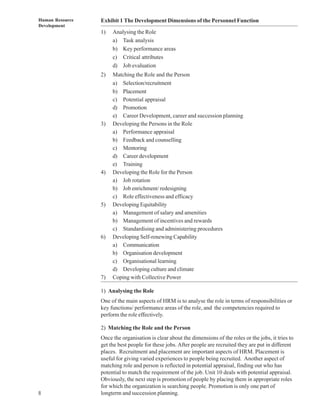
b)    Preparation for future HR needs.
c)    Promote employees in a systematic manner.
d)    Provide basis for HRD.
e)    Help in career and succession planning.

Need for HRP at Macro Level
Major reasons for the emphasis on HRP at macro level include:
Employment-Unemployment Situation: Though in general the number of educated
unemployed is on the rise, there is acute shortage for a variety of skills. This
emphasises the need for more effective recruitment and retaining people.
Technological Changes: The myriad changes in production technologies, marketing
methods and management techniques have been extensive and rapid. Their effect has
been profound on job contents and job contexts. These changes cause problems
relating to redundancies, retraining and redeployment. All these suggest the need to
plan manpower needs intensively and systematically.
Organizational Changes: In the turbulent environment marked by cyclical
fluctuations and discontinuities, the nature and pace of changes in organizational
environment, activities and structures affect manpower requirements and require
strategic considerations.
Demographic Changes: The changing profile of the work force in terms of age, sex,
litercy, technical inputs and social background have implications for HRP.
Skill Shortages: Unemployment does not mean that the labour market is a buyer’s
market. Organizations have generally become more complex and require a wide range
of specialist skills that are rare and scarce. Problems arise when such employees leave.
Governmental Influences: Government control and changes in legislation with regard
to affirmative action for disadvantaged groups, working conditions and hours of work,
restrictions on women and child employment, casual and contract labout, etc. have
stimulated the organizations to become involved in systematic HRP.
Legislative Controls: The days of executive fiat and ‘hire and fire’ policies are gone.
Now legislation makes it difficult to reduce the size of an organization quickly and
cheaply. It is easy to increase but difficult to shed the fat in terms of the numbers
employed because of recent changes in labour law relating to lay-offs and closures.
Those responsible for managing manpower must look far ahead and thus attempt to
foresee manpower problems.
                                                                                                     2 9
Getting Human   Impact of Pressure Groups: Pressure groups such as unions, politicians and persons
Resources       displaced from land by location of giant enterprises have been raising contradictory
                pressures on enterprise management such as internal recruitment and promotions,
                preference to employees’ children, displace persons, sons of the soil etc.
                Systems Concept: The spread of systems thinking and the advent of the macro-
                computer as part of the on-going revolution in information technology which
                emphasises planning and newer ways of handling voluminous personnel records.
                Lead Time: The long lead time is necessary in the selection process and for training
                and deployment of the employee to handle new knowledge and skills successfully.

                5.3                                  LEVELS OF HRP
                HRP is carried out at the following levels:
                a) National Level: The Central Government plans for human resources at the
                    national level. It forecasts the demand for and supply of human resources as a
                    whole. For example, the Government of India specifies the objectives of HRP in
                    successive five-year plans.
                b) Sectoral Levels: Central and State Governments, formulate HRPs for different
                    sectors. For example, industrial sector, agricultural sector etc.
                c) Industry Level: HRP for specific industries are prepared by the particular
                    industries.
                d) Unit Level: HRP for a particular department/sector of an industry is prepared at
                    this level. It again includes the following levels.
                    i)     Plant level;
                    ii) Department level; and
                    iii) Divisional level.

                5.4                                  PROCESS OF HRP
                The process of HRP is entirely based on the corporate plans and objectives. HRP is a
                continuous process of review, control and assessment. Figure 1 clearly indicates the
                HRP process.                               1
                                                                                         Corporate Analysis
                                                                                (a)   Objectives and Strategies
                                                                                                                     s


                                                                                (b)   Company Organization Plans
                                                                                (c)   Market forecasts and Budgets
                  Manpower Objectives and Policies


                                                                                (d)   Financial Plans
                                                                                (e)   Production Targets
                                                                                                                                           Modify Organizational Plans
                                                               2                                4                              3
                                                       Demand Forecast                   Manpower Gaps                  Supply Forecast
                                                     (a) Numbers                      (a) Surplus of numbers         (a) Manpower
                                                     (b) Job Categories                   and skills                     inventory
                                                     (c) Skill requirements           (b) Shortages                  (b) Losses and
                                                                                                                         additions
                                                                                                5                    (c) Externat Supply
                                                                                        Manpower Plans
                                                                              (a)   Recruitment and Selection
                                                                              (b)   Training and Development
                                                                              (c)   Redeployment/Retrenchmant
                                                                         s


                                                                              (d)   Redundancy
                                                                              (e)   Retention/internal mobility
                                                                              (f)   Productivity

                                                                                     Monitoring and Control

                                                                      Figure 1: Human Resource Planning Process
3 0                                 Source: Gupta, C.B. (1997). Human Resource Management, Sultan Chand & Co., New Delhi.
The major stages of HRP are as follows:                                                                                                                                                    Human Resource
                                                                                                                                                                                                 Planning
a) Analysing Operational Plans
It consists of the following substages:
i)         Objectives and strategic plans of the company are analyzed.
ii)        Plans concerning technological, finance, production are analyzed and HRP is
           prepared keeping these in mind.
iii) Future plans, goals, and objectives of the company are also taken into account.

b) Human Resource Demand Forecasting
HR demand forecasting mainly involves three sub functions:
i)         Demand Forecast: Process of estimating future quantity and quality of human
           resources required.
ii)        Manpower Gaps: Depending upon the requirement existing surplus human
           resources having desired skills are matched, if not found then shortage is shown.
iii) Supply Forecast: Basing on the existing HR inventory and the demand forecast,
     the supply forecast of human resources is carried out in an organization.


5.5            TECHNIQUES OF HR DEMAND FORECAST
Techniques of HR demand forecast are discussed below.
a)         Managerial Judgement: In this, experienced managers estimate the human
           resource requirements for their respective departments on the basis of their
           knowledge of expected future work load and employee efficiency.
b)         Work-study Method: In this method time and motion study are used to analyze
           and measure the work being done.
c)         Ratio-Trend Analysis: Under this method ratios (e.g. total output/no. of
           workers, direct workers/indirect workers) are calculated on the basis of past
           data. Future ratios are basing on the past trend.
d)         Mathematical Models: It expresses the relationship between independent
           variable (e.g. investment, production, sales, etc.) and dependent variables (e.g.
           no. of employees required).

Activity B
Describe how human resource demand forecast is carried out in your organization or
an organization you are familiar with.
........................................................................................................................................................................................
........................................................................................................................................................................................
........................................................................................................................................................................................
........................................................................................................................................................................................


5.6              FACTORS AFFECTING HR DEMAND FORECASTING
Human Resource Demand Forecasting depends on several factors, some of which are
given below.
a)         Employment trends;
b)         Replacement needs;                                                                                                                                                                        3 1
Getting Human   c)    Productivity;
Resources
                d)    Absenteeism; and
                e)    Expansion and growth.


                5.7      PROBLEMS IN HRP PROCESS
                The main problems in the process of HRP are as follows:
                a)    Inaccuracy: HRP is entirely dependent on the HR forecasting and supply, which
                      cannot be a cent per cent accurate process.
                b)    Employee resistance: Employees and their unions feel that by HRP, their
                      workload increases so they resist the process.
                c)    Uncertainties: Labour absenteeism, labour turnover, seasonal employment,
                      technological changes and market fluctuations are the uncertainties which HRP
                      process might have to face.
                d)    Inefficient information system: In Indian industries, HRIS is not much strong.
                      In the absence of reliable data it is not possible to develop effective HRP.
                e)    Time and expense: HRP is time consuming and expensive exercice, so industries
                      avoid.

                5.8      GUIDELINES FOR MAKING HRP EFFECTIVE
                Few guidelines to improve effectiveness of HRP process are discussed below.
                a)    Tailormade: HRP should be balanced with corporate objectives.
                b)    Appropriate time: The period of HRP process should be appropriate to the needs
                      and circumstances of an organization.
                c)    Adequate organization: HRP process should be adequately/properly organized.
                d)    Top management support: Before starting the HRP process the support and
                      commitment of top management should be ensured.
                e)    Participation: HRP will be successful if all in an organization are participating.
                f)    Information system: An adequate database should be developed for facilitating
                      HRP.
                g)    Balanced focus: The quantity and quality should be stressed in a balanced
                      manner.


                5.9      SUMMARY
                To sum up, HRP is the process of determining the number and kind of human
                resources required in an organization for a specific time period in future. HRP is
                important for an organization because of the changing scenario. HRP is formulated at
                various levels. The main steps involved in it are analysis of organizational plans,
                demand forecasting, supply forecasting and identifying manpower gaps.


                5.10       SELF ASSESSMENT QUESTIONS
                1)    Explain the objectives of HRP.
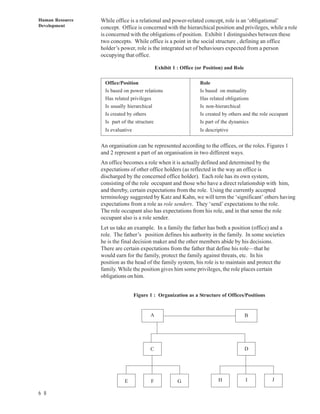
                2)    Describethe process of HRP with illustrations.
                3)    Discuss the problems in HRP and state measures to overcome them.
3 2             4)    Briefly review the forecasting techniques.
Human Resource
5.11     FURTHER READINGS                                                          Planning

Gupta, C.B. (1997). Human Resource Management, S. Chand & Sons, New Delhi.
Pattanayak, B. (2001). Human Resource Management, PHI, New Delhi.
Aswathappa, K. (1999). Human Resource and Personnel Management,
Tata McGraw Hill, New Delhi.


                                                                                       3 3
Getting Human
Resources       UNIT 6             ATTRACTING THE TALENT:
                                   RECRUITMENT, SELECTION,
                                   OUTSOURCING
                Objectives
                After completion of the unit, you should be able to:
                l     explain the need for spelling out job specification as the starting point for the
                      process of selection;
                l     name various sources which can be used for attracting the desired types of
                      manpower;
                l     state, explain and evaluate various methods of recruitment;
                l     explain the need for and the process of initial screening;
                l     describe the process of application scrutiny;
                l     explain the need for, types of, and the uses of various psychological tests in the
                      evaluation of candidates;
                l     explain the purpose and types of interviews, their limitations, and the need for
                      care in using them;
                l     explain the purpose of induction and how it is carried out; and
                l     discuss the function of outsourcing.

                Structure
                6.1    Introduction
                6.2    Some Definitions
                6.3    The Process of Recruitment
                6.4    Methods of Recruitment
                6.5    Selection
                6.6    Selection Tests
                6.7    Interview
                6.8    Physical Examination
                6.9    Reference Checks
                6.10 Final Decision
                6.11 Placement
                6.12 Induction
                6.13 Outsourcing
                6.14 Road Map for Successful Outsourcing
                6.15 Summary
                6.16 Self Assessment Questions
                6.17 Further Readings


                6.1     INTRODUCTION
                The most valuable asset of any large-scale organization is the high-calibre employees.
                Finding right people and putting them at right job is the most important challenge for
3 4             any organization. At the stage of Human Resource Planning, as we have already
discussed in the previous unit, the human resource requirement is forecasted. Keeping             Attracting the Talent:
in mind the forecast the function of attracting the best available talent is carried out by      Recruitment, Selection,
                                                                                                           Outsourcing
an organization. It involves functions like; recruitment, selection, induction. All these
are discussed in this unit.


6.2     SOME DEFINITIONS
Recruitment
Recruitment is the process of identifying the prospective employees, stimulating and
encouraging them to apply for a particular job or jobs in an organization. It is a
positive action as it involves inviting people to apply. The purpose is to have an
inventory of eligible persons from amongst whom proper selection of the most suitable
person can be made.

Selection
Selection is the process of examining the applicants with regard to their suitability for
the given job or jobs, and choosing the best from the suitable candidates and rejecting
the others. Thus, you will notice that this process is negative in nature in the sense that
rejection of candidates is involved.

Placement
Placement is the determination of the job for which a selected candidate is best susited
and assigning that job to him. The ideal situation is ‘the right man for the right job’. A
proper placement of a worker reduces employee turnover, absenteeism, accident rates,
etc., and improves morale, motivation, work, etc.

Induction
Induction is introducing an employee to the job and to the organization. The primary
purpose of induction is to ‘sell’ the company to the new employee so that he may feel
proud of his association with the company. This is called ‘orientation’ or
‘indoctrination’.

Their Inter-relationship
The above are the four steps taken in the order given before a person starts his
training for the job to which he is assigned. First he is recruited, that is, his attention is
drawn to the existence of a possible opening for him and he is invited to apply for it.
In the next stage of selection all the applicants are screened to find their suitability for
the job and the best one is selected. The third step of placement follows selection and a
particular job is assigned to the selected person. After that he is introduced to his job
and to his organization so that he may understand the environment in which he has to
work.
Having defined these four processes, we shall describe them in some detail in the
following paragraphs.


6.3     THE PROCESS OF RECRUITMENT
Preparation for Recruitment
Before you think of inviting people to apply for a job you have to decide what types of
persons are to be invited and what their characteristics should be. This calls for fixing
the ‘job specifications’ which may also be called ‘man specifications’.
                                                                                                                    3 5
Getting Human   Job specifications are based on job description which is dependent upon the nature and
Resources       requirements of a job. Thus, job specification will be different for each job.
                We shall explain below the various elements of job specification.
                Physical Specifications: For certain jobs some special physical features may be
                required. For example, for assembly of a TV set or some other electronic equipment
                good vision is required, for a typing job you need finger dexterity, for a heavy job you
                need a strong, heavy and thick-set body. The particular physical abilities and skills
                necessary for a given job have to be specified. These may refer to height, weight,
                vision, finger dexterity, voice, poise, hand and foot coordination, motor coordination,
                colour discrimination, age-range, etc.
                Mental Specifications: These include intelligence, memory, judgement, ability –
                plan, ability to estimate, to read, to write, to think and concentrate, scientific faculties,
                arithmetical abilities, etc. Different jobs require different degrees of such abilities and
                the more important ones should be specified.
                Emotional and Social Specifications: These include characteristics which will affect
                his working with others, like personal appearance, manners, emotional stability,
                aggressiveness, or submissiveness, extroversion or introversion, leadership,
                cooperativeness, initiative and drive, skill in dealing with others, socia1 adaptability,
                etc.
                Behavioral Specifications: Certain management personnel at higher levels of
                management are expected to behave in a particular manner. These are not formally
                listed but have to be kept in mind during the process of recruitment, selection and
                placement.

                Activity A
                Please describe below your job as carefully and precisely as you can.
                .....................................................................................................................................
                .....................................................................................................................................
                .....................................................................................................................................
                .....................................................................................................................................
                .....................................................................................................................................
                Please give below the ten most important elements of your job specification. Also
                evaluate yourself in respect of each element and write against it whether you meet it
                (a) fully, (b) substantially, (c) to some extent, or (d) not at all.

                      Element                                                            Extent of meeting (a), (b), (c), (d)
                1) ......................................................            ..........................................................
                2) ......................................................            ..........................................................
                3) ......................................................            ..........................................................
                4) ......................................................            ..........................................................
                5) ......................................................            ..........................................................
                6) ......................................................            ..........................................................
                7) ......................................................            ..........................................................
                8) ......................................................            ..........................................................
                9) ......................................................            ..........................................................

3 6
                10) ......................................................           ..........................................................
Sources of Manpower                                                                          Attracting the Talent:
                                                                                            Recruitment, Selection,
There are two categories of sources of supply of manpower— Internal and External.                     Outsourcing

Internal Sources: These include personnel already on the pay-roll of the organization
as also those who were once on the pay-roll of the company but who plan to return, or
whom the company, would like to rehire. These include those who quit voluntarily or
those on production lay-offs.
External Sources: These sources lie outside the organization, like the new entrants to
the labour force without experience. These include college students, the unemployed
with a wider range of skills and abilities, the retired experienced persons, and others
not in the labour force, like married women.
A policy of preferring people from within is advantageous as it improves the morale of
the employees and promotes loyalty among them towards the organization. This also
helps employers as they are in a better position to evaluate those already with them
and as these people require no induction.
The policy of preferring internal candidates, however, suffers from some
disadvantages. It may lead to inbreeding, discouraging new blood from entering an
organization. If promotion is based on seniority, the real capable hands may be left
out.
Likewise, there are good and bad points about external sources. These sources provide
a wide market and the best selection considering skill, training and education. It also
helps to bring new ideas into the organization. Moreover, this source never ‘dries up’.
In respect of people selected under this system, however, one has to take chances with
the selected persons regarding their loyalty and desire to continue. The organization
has to make larger investments in their training and induction.
You will realize now that dependence on just one of the sources is not in the interest of
an organization. It must depend on both in a ratio to be fixed considering various
factors.
Some of these factors are described below.
1)   Effect of the policy on the attitude and actions of all employees: Employees,
     no doubt, feel more secure and identify their own long-term interest with that of
     the organization when they can anticipate first charge at job opportunities. The
     general application of the ‘promotion from within’ policy may encourage
     mediocre performance. The point to be considered here by the organization is,
     how important is the loyalty of the employees to it, balancing the risk of
     mediocre performance.
2)   The level of specialization required of employees: The principal source in
     many organizations may be the ranks of the present employees who have
     received specialized training.
3)   The degree of emphasis on participation by employees at all levels: New
     employees from outside, with no experience in the firm, may not know enough
     about its service or product or processes to participate effectively, for some time
     at least.
4)   The need for and availability of originality and initiative within the
     organization: If the organization feels that it is training its people for these
     qualities it may prefer its own people; if not, new people with different ideas may
     be taken from outside.
5)   Acceptance of seniority principle: The policy or promotion from within will
     succeed only if management and employees accept the seniority principle with or
     without suitable modifications for promotion. If it is not accepted, selection may
                                                                                                               3 7
     better be done on an open basis.
Getting Human
Resources       6.4     METHODS OF RECRUITMENT
                All methods of recruitment can be put into three categories: (a) Direct Methods,
                (b) Indirect Methods, and (c) Third-Party Methods.
                a) Direct Methods include sending recruiters to educational and professional
                institutions, employee contacts with public, manned exhibits and waiting lists.
                Schools and Colleges: For clerical, labour and apprenticeship help, high schools can
                be extensively used. For technical, managerial and professional jobs, colleges,
                university departments and specialized institutes, like the IITs and IIMs, are used.
                These institutions usually have a placement officer a teacher-in-charge of placement,
                who normally provides help in attracting employers arranging interviews, furnishing
                space and other facilities and providing student resumes. The companies maintain a
                list of such institutions, keep in touch with them, send their brochures indicating job
                openings, future prospects, etc. On the basis of these students who want to be
                considered for the given job (s) are referred to the company recruiter.
                Employees’ Contact with the Public: The employees of the organization are told
                about the existence of particular vacancies and they bring this to the notice of their
                relatives, friends and acquaintances.
                Manned Exhibits: The organizations send recruiters to conventions and seminars,
                setting up exhibition at fairs, and using mobile offices to go to the desired centres.
                Waiting Lists: Many firms lean heavily on their own application files. These records
                list individuals who have indicated their interest in jobs, either after visiting the
                organization’s employment office or making enquiries by mail or phone. Such records
                prove a very useful source if they are kept up-to-date.
                b) Indirect Methods cover advertising in newspapers, on the radio, in. trade and
                professional journals, technical journals and brochures.
                When qualified and experienced persons are not available through other sources,
                advertising in newspapers and professional and technical journals is made. Whereas
                all types of advertisements can be made in newspapers and magazines, only particular
                types of posts should be advertised in the professional and technical journals; for
                example, only engineering jobs should be inserted in journals of engineering.       .
                A well thought-out and planned advertisement for an appointment reduces the
                possibility of unqualified people applying. If the advertisement is clear and to the
                point, candidates can assess their abilities and suitability for the position and only
                those who possess the requisite qualifications will apply.
                c) Third-Party Methods: Various agencies are used for recruitment under these
                methods. These include commercial and private employment agencies, state agencies,
                placement offices of schools, colleges and professional associations, recruiting firms,
                management consulting firms, indoctrination seminars for college professors, friends
                and relatives.
                Private Employment Agencies specialize in specific occupation like general office
                help, salesmen, technical workers, accountants, computer staff, engineers and
                executives, etc. These agencies bring together the employers and suitable persons
                available for a job. Because of their specialization, they can interpret the needs of their
                clients and seek out particular types of persons.
                State or Public Employment Agencies, also known as Employment or Labour
                Exchanges, are the main agencies for public employment. They also provide a wide
                range of services, like counselling, assistance in getting jobs, information about the
                labour market, labour and wage rates, etc.
3 8
Executive Search Agencies maintain complete information records about employed                                                       Attracting the Talent:
executives and recommend persons of high calibre for managerial, marketing and                                                      Recruitment, Selection,
                                                                                                                                              Outsourcing
production engineers’ posts. These agencies are looked upon as ‘head hunters’,
‘raiders’, and ‘pirates’.
Indoctrination Seminars for College Professors: These are arranged to discuss the
problems of companies to which professors are invited. Visits and banquets are
arranged so that professors may be favourably impressed and later speak well of the
company and help in getting required personnel.
Friends and Relatives of Present Employees constitute a good source from which
employees may be drawn. This, however, is likely to encourage nepotism, i.e. persons
of one’s own community or caste may only be employed. This may create problems
for the organization.
Trade Unions are often called on by the employers to supply whatever additional
employees may be needed. Unions may be asked for recommendations largely as a
matter of courtesy and an evidence of good will and cooperation.
Professional Societies may provide leads and clues in providing promising candidates
for engineering, technical and management positions. Some of these maintain mail
order placement services.
Temporary Help Agencies employ their own labour force, both full-time and part-
time and make them available to their client organizations for temporary needs.
Casual Labour Source is one which presents itself daily at the factory gate or
employment office. Most industrial units rely to some extent on this source. This
source, you will realise, is the most uncertain of all sources.
Deputation: Persons possessing certain abilities useful to another organization are
sometimes deputed to it for a specified duration. Ready expertise is available but, as
you can guess, such employees do not easily become part of the organization.

Activity B
a)    Recall your first appointment to the present organization and write below which
      of the above mentioned sources of recruitment was used by the organization.
      ...........................................................................................................................
      ...........................................................................................................................
      ...........................................................................................................................
      ...........................................................................................................................
      ...........................................................................................................................

b) Think of the various sources tapped by your organization in getting employees for
   your Section/Department and write below in order of importance the first five. .
1) ...........................................................................................................................
2) ...........................................................................................................................
3) ...........................................................................................................................
4) ...........................................................................................................................
5) ...........................................................................................................................


                                                                                                                                                       3 9
Getting Human
Resources       6.5     SELECTION
                Selection, as you have seen earlier, is the process of securing relevant information
                about an applicant to evaluate his qualifications, experience and other qualities with a
                view to matching these with the requirements of a job. It is essentially a process of
                picking out the man or men best suited for the organization’s requirements.

                The Selection Process
                You would recall that selection process involves rejection of unsuitable or less suitable
                applicants. This may be done at any of the successive hurdles which an applicant must
                cross. These hurdles act as screens designed to eliminate an unqualified applicant at
                any point in the process. This technique is known as the ‘successive hurdles
                technique’. Figure 1 gives these hurdles.
                Yoder calls these hurdles ‘go, no-go’ gauges. Those who qualify a hurdle go to the
                next one; those who do not qualify.are dropped out. Not all selection processes,
                however, include these hurdles. The complexity of the process usually increases with
                the level and responsibility of the position to be filled. Moreover, these hurdles need
                not necessarily be placed in the same order. Their arrangement may differ from
                organisation to organization.


                                                                                                                                                    Employment
                                                                                                                                                Interview with
                                                                                                                               Recommendation

                                                                                                                                                Supervisor
                                                                                                                 Examination
                                                                                                                 Physical
                                                                                                    References
                                                                                     Work History


                                 Application Þ
                                                                        Testing
                                                            Interview
                                                            Second
                                              Application
                                 Prelimmary


                                              Form
                                 Interview


                                                                                  Rejections


                                 Figure 1: Successive Hurdles in the Selection Process

                Initial Screening or Preliminary Interview
                This is a sorting process in which prospective applicants are given the necessary
                information about the nature of the job and also, necessary information is elicited from
                the candidates about their education, experience, skill, salary expected, etc. If the
                candidate is found to be suitable, he is selected for further process and, if not, he is
                eliminated. This is a crude screening and can be done across the counter in the
                organization’s employment offices. This is done by a junior executive in the personnel
                department. Due care should be taken so that suitable candidates are not turned down
                in a hurry. Since this provides personal contact for an individual with the company,
4 0             the interviewer should be courteous, kind, receptive and informal.
When a candidate is found suitable, an application form is given to him to fill in                Attracting the Talent:
and submit.                                                                                      Recruitment, Selection,
                                                                                                           Outsourcing

Application Scrutiny
You might have seen that sometimes applications are asked on a plain sheet. This is
done where no application forms are designed. The applicant is asked to give details
about age, marital status, educational qualifications, work experience and references.
Different types of application forms may be used by the same organization for
different types of employees, e.g., one for managers, the other for supervisors and a
third for other employees. Some forms are simple, general and easily answerable,
while others may require elaborate, complex and detailed information. Reference to
nationality, race, caste, religion and place of birth has been regarded as evidence of
discriminatory attitudes and should be avoided. An application form should be
designed to serve as a highly effective preliminary screening device, particularly, when
applications arc received in direct response to an advertisement and without any
preliminary interview.
The application can be used in two ways: (i) to find out on the basis of information
contained therein as to the chances of success of the candidate in the job for which he
is applying, and (ii) to provide a starting point for the interview.
It is often possible to reject candidates on the basis of scrutiny of the applications as
they are found to be lacking in educational standards, experience or some other
relevant eligibility and traits.


6.6     SELECTION TESTS
A test is a sample of an aspect of an individual’s behavior, performance or attitude. It
can also be a systematic procedure for comparing the behavior of two or more
persons.
Purpose of Tests: The basic assumption underlying the use of tests in personnel
selection is that individuals are different in their job-related abilities and skills and that
these skills can be adequately and accurately measured.
Tests seek to eliminate the possibility of prejudice on the part of the interviewer or
supervisor. Potential ability only will govern selection decisions.
The other major advantage is that the tests may uncover qualifications and talents that
would not be detected by interviews or by listing of education and job expenence.
Types of Tests: The various tests used in selection can be put in to four categories:
(a) Achievement or Intelligence Tests, (b) Aptitude or Potential Ability Tests,
(c) Personality Tests, and (d) Interest Tests.
These tests and what they measure are described below.

a) Achievement or Intelligence Tests
These are also called ‘proficiency tests’. These measure the skill or knowledge which
is acquired as a result of a training programme and on the job experience. These
measure what the applicant can do. These are of two types:
Test for Measuring job Knowledge: These are known as ‘Trade Tests’. These are
administered to determine knowledge of typing, shorthand and in operating
calculators, adding machines, dictating and transcribing machines or simple
mechanical equipment. These are primarily oral tests consisting of a series of
questions which are believed to be satisfactorily answered only by those who know
and thoroughly understand the trade or occupation. Oral tests may be supplemented
by written, picture or performance types.                                                                           4 1
Getting Human   Work Sample Tests: These measure the proficiency with which equipment can be
Resources       handled by the candidate. This is done by giving him a piece of work to judge how
                efficiently he does it. For example, a typing test would provide the material to be
                typed and note the time taken and mistakes committed.

                b) Aptitude or Potential Ability Tests
                These tests measure the latent ability of a candidate to learn a new job or skill.
                Through these tests you can detect peculiarity or defects in a person’s sensory or
                intellectual capacity. These focus attention on particular types of talent such as
                learning, reasoning and mechanical or musical aptitude..’Instruments’ used are
                variously described as tests of ‘intelligence’, ‘mental ability’, ‘mental alertness’, or
                simply as ‘personnel tests’. These are of three types:
                i)   Mental Tests: These measure the overall intellectual ability or the intelligence
                     quotient (I.Q.) of a person and enable us to know whether he has the mental
                     capacity to deal with new problems. These determine an employee’s fluency in
                     language, memory, interction, reasoning, speed of perception, and spatial
                     visualisation.
                ii) Mechanical Aptitude Tests: These measure the capacity of a person to learn a
                     particular type of mechanical work. These are useful when apprentices,
                     machinists, mechanics, maintenance workers, and mechanical technicians are to
                     be selected.
                iii) Psychomotor or Skill Tests: These measure a person’s ability to do a specific
                     job. These are administered to determine mental dexterity or motor ability and
                     similar attributes involving muscular movement, control and coordination. These
                     are primarily used in the selection of workers who have to perform semi-skilled
                     and repetitive jobs, like assembly work, packing, testing, inspection and so on.

                c) Personality Tests
                These discover clues to an individual’s value system, his emotional reactions, maturity
                and his characteristic mood. The tests help in assessing a person’s motivation, his
                ability to adjust himself to the stresses of everyday life and his capacity for inter-
                personal relations and for projecting an impressive image of himself. They are
                expressed in terms of the relative significance of such traits of a person as self-
                confidence, ambition, tact, emotional control, optimism, decisiveness, sociability,
                conformity, objectivity, patience, fear, distrust, initiative, judgement, dominance,
                impulsiveness, sympathy, integrity, and stability. These tests are given to predict
                potential performance and success for supervisory or managerial jobs.
                The personality tests are basically of three types:
                i)   Objective Tests: These measure neurotic tendencies, self-sufficiency, dominance,
                     submission and self-confidence.
                ii) Projective Tests: In these tests, a candidate is asked to project his own
                     interpretation onto certain standard stimuli. The way in which he responds to
                     these stimuli depends on his own values, motives and personality.
                iii) Situation Tests: These measure an applicant’s reaction when he is placed in a
                     peculiar situation, his ability to undergo stress and his demonstration of ingenuity
                     under pressure. These tests usually relate to a leaderless group situation, in
                     which some problems are posed to a group and its members are asked to reach
                     some conclusions without the help of a leader.

                d) Interest Tests
                These tests are designed to discover a person’s areas of interest and to identify the
                kind of work that will satisfy him. The interest tests are used for vocational guidance,
4 2
                and are assessed in the form of answers to a well-prepared questionnaire.
Limitations of Selection Tests: From the basic description of tests described above,                                                Attracting the Talent:
one should not conclude that a hundred per cent prediction of an individual’s on-the-                                              Recruitment, Selection,
                                                                                                                                             Outsourcing
job success can be made through these tests. These tests, at best, reveal that
candidates who have scored above the predetermined cut-off points are likely to be
more successful than those who have scored below the cut-off point.
Tests are useful when the number of applicants is large. Moreover, tests will serve no
useful purpose if they are not properly constructed or selected or administered.
Precautions in using Selection Tests: Test results can help in selecting the best
candidates if the following precautions are taken:
i)   Norms should be developed as a source of reference on all tests used in selection
     and on a representative sample of people on a given job in the same organization.
     This is necessary even though ‘standard’ tests are available now under each of
     the above categories. Norms developed dsewhere should not be blindly used
     because companies differ in their requirements, culture, organization structure
     and philosophy.
ii) Some ‘Warm up’ should be provided to candidates either by giving samples of
     test, and/or answering queries before the test begins.
iii) Tests should first be validated for a given organization and then administered for
     selection of personnel to the organization.
iv) Each test used should be assigned a weightage in the selection.
v) Test scoring, administration and interpretation should be done by persons I
     having technical competence and training in testing.

Activity C
a)    Was any psychological test administered to you for selection or promotion?
      Yes             No
b)    If yes, can you recall at what stage of your career was it given and what were
      you required to do?
      .........................................................................................................................
      .........................................................................................................................
      .........................................................................................................................
      .........................................................................................................................
c)    Can you fit it into one of the above mentioned categories?
      Stage            Required to do                       Category of Test
      First Selection as...............................................................................................
      ..........................................................................................................................
      ..........................................................................................................................
      Later promotion as ............................................................................................
      ..........................................................................................................................
      ..........................................................................................................................


6.7         INTERVIEW
We shall now discuss the post application form interview and not the preliminary
interview. Personal interview is the most universally used tool in any selection
process.
                                                                                                                                                      4 3
Getting Human   Meaning and Purpose: An interview is a conversation with a purpose between one
Resources       person on one side and another person or persons on the other. An employment
                interview should serve three purposes, viz., (i) obtaining information, (ii) giving
                information, and (iii) motivation. It should provide an appraisal of personality by
                obtaining relevant information about the prospective employee’s background, training
                work history, education and interests. The candidate should be given information
                about the company, the specific job and the personnel policies. It should also help in
                establishing a friendly relationship between the employer and the applicant and
                motivate the satisfactory applicant to want to work for the company or organization.
                In practice, however, it may turn out to be a one-sided affair. It helps only in obtaining
                information about the candidate. The other two purposes are generally not served.
                Types of Interview
                Informal Interview: This is may take place anywhere. The employer or a manager in
                the personnal department, may ask a few questions, like name, place of birth, previous
                experience, etc. It is not planned and is used widely when the labour market is tight
                and you need workers very badly. A friend or a relative of the employer may take a
                candidate to the house of the employer or manager where this type of interview may
                be conducted.
                Formal Interview: This held in a more formal atmosphere in the employment office
                by the employment officer with the help of well-structured questions. The time and
                place of the interview are stipulated by the employment office.
                Planned Interview: This is a formal interview carefully planned. The interviewer has
                a plan of action worked out in relation to time to be devoted to each candidate, type of
                information to be sought, information to be given, the modality of interview and so on.
                He may use the plan with some amount of flexibility.
                Patterned Interview: This is also a planned interview but planned to a higher degree
                of accuracy, precision and exactitude. A list of questions and areas are carefully
                prepared. The interviewer goes down the list of questions, asking them one after
                another.
                Non-directive Interview: This is designed to let the interviewee speak his mind freely.
                The interviewer is a careful and patient listener, prodding whenever the candidate is
                silent. The idea is to give the candidate complete freedom to ‘sell’ himself without
                encumberances of the interviewer’s questions.
                Depth Interview: This is designed to intensively examine the candidate’s background
                and thinking and to go into considerable detail on a particular subject to special
                interest to the candidate. The theory behind it is that if the candidate is found good in
                his area of special interest, the chances are high that if given a job he would take
                serious interest in it.
                Stress Interview: This is designed to test the candidate and his conduct and behavior
                by putting him under conditions of stress and strain. This is very useful to test the
                behavior of individuals under disagreeable and trying situations.
                Group Interview: This is designed to see how the candidates react to and against each
                other. All the candidates may be brought together in the office and they may be
                interviewed. The candidates may, alternatively, be given a topic for discussion and be
                observed as to who will lead the discussion, how they will participate in the
                discussion, how each will make his presentation and how they will react to each
                other’s views and presentation.
                Panel Interview: This is done by members of the interview board or a selection
                committee. This is done usually for supervisory and managerial positions. It pools the
4 4
collective judgement and wisdom of members of the panel. The candidate may be             Attracting the Talent:
asked to meet the panel individually for a fairly lengthy interview.                     Recruitment, Selection,
                                                                                                   Outsourcing
Interview Rating: Important aspects of personality can be categorized under the
following seven main headings:
l    Physical Make-up: Health, physique, age, appearance, bearing, speech.
l    Attainments: Education, occupational training and experience.
l    Intelligence: Basic and ‘effective’.
l    Special Aptitudes: Written and oral fluency of expression, numeracy,
     organizational ability, administrative skill.
l    Interests: Intellectual, practical, physically active, social, artistic
l    Disposition: Self-reliance, nature, motivation, acceptability.
l    Circumstances: Domestic, social background and experience, future prospects.
This is called ‘The Seven Point Plan’. The importance of each of these points will
vary from organization to organization and from job to job. Hence, these should be
assigned weightage according to their degree of importance for the job.
On the basis of information gathered through an interview, each candidate should be
rated in respect of each point given above as: (i) outstanding, (ii) good, (iii) above
average, (iv) below average or (v) unsatisfactory. Marks should be allotted to each of
these, and the score for each point is arrived at by multiplying it by weights and the
total of all these will determine the final position of a candidate at the interview.
Limitations of Interviews: Interviews have their own limitations in matters of
selection. Some of these are mentioned below:
l    Subjective judgement of the interviewer may be based on his prejudices, likes,
     dislikes, biases, etc.
l    One prominent characteristic of a candidate may be allowed to dominate
     appraisal of the entire personality.
l    The interviewer’s experience may have created a close association between some
     particular trait and a distinctive type of personality.
l    Some managers believe that they are good at character analysis based on some
     pseudo-scientific methods and are guided by their own abilities at it.
Qualities of ‘Good’ lnterviewers as: A good interviewer should have the following
qualities:
l    Knowledge of the job or other things with which interviews are concerned.
l    Emotional maturity and a stable personality.
l    Sensitivity to the interviewee’s feelings and a sympathetic attitude.
l    Extrovert behavior and considerable physical and mental stamina.
Guidelines for Improving Interviews: Not all interviews are effective. Their
effectiveness can be improved if the following points are kept in mind by an
interviewer:
l    An interview should have a definite time schedule with ample time for interview.
     It should not be hurried.
l    The impersonal approach should be avoided.
l    Interview should have the necessary element of privacy.
l    The interviewer should listen carefully to what the applicant says and the
     information collected should be carefully recorded either while the interview is
     going on or immediately thereafter.                                                                    4 5
Getting Human   l      Attention should be paid not just to the words spoken, but also to the facial
Resources              expressions and mannerisms of the interviewee.
                l      The interview should end when sufficient information has been gathered.
                l      The interviewee should be told where he stands—whether he will be contacted
                       later, whether he is to visit another person, or it appears that the organization will
                       not be able to use his abilities.
                Pseudo-Scientific Methods of Selection: In the past, and to some extent even now,
                stereotyped impressions of personality and characteristics were used as a basis of
                selection. These impressions were gathered through pseudo-scientific methods, like
                phrenology, physiognomy and graphology.
                We shall briefly describe below these methods for your background knowledge only:
                Phrenology: Here it is believed that the strength of each faculty is indicated by
                prominent bumps on certain parts of the skull.
                Physiognomy: Here it is believed that there is a definite correlation between facial
                features and psychological functions and behaviour, for example, thin lips indicate
                determination, broad jaws signify tenacity and so on.
                Graphology: Here it is believed that there is a close relationship between handwriting
                and personality.

                Activity D
                Please find out from your Personel Department which of the above mentioned types of
                interviews they use for the purpose of selection. What do they aim to judge through
                each of these interviews and for selection of what level of employees are these used?
                Write below the information you collect.
                Types of interviews            Points to be judged            Level of employees
                1 ..........................   .......................... .   .......................... .
                2 ..........................   .......................... .   .......................... .
                3 ..........................   .......................... .   .......................... .
                4 ..........................   .......................... .   .......................... .
                5 ..........................   .......................... .   .......................... .


                6.8         PHYSICAL EXAMINATION
                Applicant who get over one or more of the preliminary hurdles are sent for a physical
                examination either to the organization’s physician or to a medical officer approved for
                the purpose.
                Purposes: A physical examination serves the following purposes:
                i)     It gives an indication regarding fitness of a candidate for the job concerned.
                ii)    It discovers existing disabilities and obtains a record thereof, which may be
                       helpful later in deciding the campany’s responsibility in the event of a workman’s
                       campensation claim.
                iii) It helps in preventing employment of those suffering from some type of
                     contagious diseases.
                iv) It helps in placing those who are otherwise employable but whose physical
                handicaps may necessitate assignment only to specified jobs.
4 6
Contents of Physical Examination: Physical examination covers the following:                 Attracting the Talent:
                                                                                            Recruitment, Selection,
l     The applicant’s medical history.                                                                Outsourcing
l     His physical measurements—height, weight, etc.
l     General examinatian—skin, musculature and joints.
l     Specia1 senses—visual and auditory activity.
l     Clinical examinatian—eyes, ears, nose, throat and teeth.
l     Examinatian of chest and lungs.
l     Check-up of blood pressure and heart.
l     Pathological tests of urine, blood etc.
l     X-ray examinatian of chest and other parts of the body.
l     Neuro-psychiatric examinatian, particularly when medical histary or a
      physician’s observations indicate an adjustment problem.
You wauld realize that the importance of these characteristics varies from job to job
and, therefore, different weightages have to be given to each far an overall evaluation.


6.9     REFERENCE CHECKS
The applicant is asked to mention in his application the names and addresses of three
such persons who usually know him well. These may be his previous employers,
friends, or professional colleagues. They are approached by mail or telephone and
requested ta furnish their frank opinion, without incurring any liability, about the
candidate either on specified points or in general. They are assured that all
information supplied would be kept confidential. Yet, often either no response is
received or it is generally a favarable response.


6.10      FINAL DECISION
Applicants who cross all the hurdles are finally considered. If there are more persons
than the number required far a job the best ones, i.e., those with the highest scores are
finally selected.


6.11       PLACEMENT
Sometimes a particular person is selected for a given jab. Often more than one person
may be selected for the jobs of similar nature. In the second case, individual
employees have to be put under individual supervisors with the approval of the latter.
In the first case also his approval is also necessary but it should be done early in the
selection process.
A proper placement reduces employee turnover, absenteeism and accident rates and
improves marale.


6.12       INDUCTION
This is the last activity in relation to a newly employed person before he is trained for
his job.

Meaning
As explained earlier, it is introduction of an employee to the job and the organization.
The primary purpose is to ‘sell’ the company to the new employee so that he may feel
proud of his association with the company.                                                                     4 7
Getting Human   Purpose and Need
Resources
                An employee has to work with fellow employees and his supervisor. For this he must
                know them, the way they work and also the policies and practices of the organization
                so that he may integrate himself with the enterprise. Any neglect in the area of
                induction and orientation may lead to high labour turnover, confusion, wasted time
                and expenditure.

                Induction Programme
                A good induction programme should cover the following:
                l    The company, its history and products, process of production and major
                     operations involved in his job.
                l    The significance of the job with all necessary information about it including job
                     training and job hazards.
                l    Structure of the organization and the functions of various departments.
                l    Employee’s own department and job, and how he fits into the organization.
                l    Personnel policy and sources of information.
                l    Company policies, practices, objectives and regulations.
                l    Terms and conditions of service, amenities and welfare facilities.
                l    Rules and regulations governing hours of work and over-time, safety and
                     accident prevention, holidays and vacations, methods of reporting, tardiness and,
                     absenteeism.
                l    Grievances procedure and discipline handling.
                l    Social benefits and recreation services.
                l    Opportunities, promotions, transfer, suggestion schemes and job satisfaction.
                An induction programme consists primarily of three steps:
                General orientation by the staff: It gives necessary general information about the
                history and the operations of the firm. The purpose is to help an employee to build up
                some pride and interest in the organization.
                Specific orientation by the job supervisor: The employee is shown the department
                and his place of work; the location of facilities and is told about the organization’s
                specific practices and customs. The purpose is to enable the employee to adjust with
                his work and environment.
                Follow-up orientation by either the personnel department or the supervisor: This
                is conducted within one week to six months of the initial induction and by a foreman
                or a specialist.
                The purpose is to find out whether the employee is reasonably well satisfied with him.
                Through personal talks, guidance and counselling efforts are made to remove the
                difficulties experienced by the newcomer.


                6.13     OUTSOURCING
                Companies that see outsourcing as a short-term, cost-cutting opportunity are almost
                always disappointed with the results. But companies that approach outsourcing as one
                element of an overall business strategy are applying some specific best practices to
                reach their goals more quickly and with fewer roadblocks.
                Communicating openly from Day 1. Companies that develop candid internal
4 8             communication plans about sourcing strategies are far less likely to experience
employee backlash as roles begin to move offshore. Eighty-four percent of the buyers          Attracting the Talent:
of outsourcing services in Diamond Cluster’s “2004 Global IT Outsourcing Report”             Recruitment, Selection,
                                                                                                       Outsourcing
said they are concerned about backlash as jobs are lost to offshore outsourcers. But
those same companies have probably underestimated the ripple effect of their
outsourcing decisions.

Why Outsourcing?
An obvious, primary benefit of outsourcing is the significant cost saving and
improvement to the bottom line. Depending upon the work processes outsourced, some
organizations save up to 60 percent in content development costs alone. Cost savings
may also be realized by outsourcing development and maintenance of e-learning
technologies, such as learning management systems (LMSs), content management
systems (CMSs) and authoring platforms.
Saving costs is not the only reason to consider outsourcing, however. Significant
quality improvements, such as consistent instructional design and ongoing content
maintenance, can also be cost-effectively derived through outsourcing. Many
organizations haven’t built the competencies or processes in-house for developing and
delivering e-Iearning, and this provides a way to provide expertly designed e-Iearning
at a reduced cost.
Also, outsourcing is often used to overcome resource shortages. For example,
countries such as Ireland and India have significant English speaking resources that
can be engaged in the design and development of learning content. A robust
educational system in developing countries, such as India, China and the Eastern
European nations, provides access to highly skilled individuals in the areas of
linguistics, IT and engineering, etc. All these factors add up to allow corporations
access to any content expert with proficient English language skills, at less than half
the cost of similar resources elsewhere.
While organizations are primarily driven to outsource training content development
because of cost savings, the trend to outsource this work to specialist vendors is
heightened by two other reasons-increasing need for content and increased pressure to
improve the quality and consistency of training produced to meet these expanding
requirements.
It’s the classic “more for less” story heard everywhere in organizations today.

Specialized Knowledge
In recent months, some training organizations have seen a shift toward centralized
functions. Centralization has put the onus on training management to ensure that
training is not only the best of breed but is also standardized and consistent in quality.
Therefore, training executives are now working closely with the specialist vendors—
the outsourcing partners to control and maintain quality and consistency of training
material, be it e-learning content or classroom courseware. In addition to improving
training effectiveness, education organizations are also under tremendous pressure to
reduce time-to-train or time-to market.
Outsourcing needs to be implemented as a strategic initiative. The organization needs
to be as prepared to outsource as the vendor is prepared to manage the outsourced
operation.

Size Does Matter
Outsourcing can lead to tremendous cost savings. However, organizations must
remember that cost savings actually build up over time. The potential for cost saving
in the early part of the outsourcing initiative is offset by one-time relationship
                                                                                                                4 9
Getting Human   establishment costs, initial time lags in development and the possibility of rework until
Resources       the relationship between the organization and the vendor matures.
                Obviously, the benefit lies in outsourcing medium-to-Iarge contracts. Size matters
                because it’s mutually beneficial for the organization and the vendor. The organization
                yields a higher buyer bargain, and the vendor gains production efficiencies by reusing
                resources, passing the efficiency on to the customer.

                Maturity Makes It Easy
                Organizations with a clear definition of finished deliverables (the output), well-aligned
                resource responsibilities (the process) and requirement acquisition (the input) have
                been shown to outsource more effectively than those without a reliable and consistent
                work plan that includes elements of all three-the output, the input and the processes.
                Organizations can measure the reliability and consistency of their input and output by
                using the Outsourcing Maturity Matrix.
                In the first wave of e-learning, many organizations bought and invested heavily in e-
                learning and training infrastructure. Millions of dollars were invested in the delivery
                systems, such as LMS, LCMS and CMS, and in the authoring tools. Just as the
                infrastructure was being deployed and the users could be trained, the economy turned
                sour. The organizations faced with slashed training budgets were left in a peculiar
                situation-they had the vehicle to deliver training, but not enough fuel since they were
                left without enough budget to develop significant content. Still other organizations
                were slower to adopt e-learning, and when the inevitable budget cutting came, they
                were left without the infrastructure or the content.


                6.14       ROAD MAP FOR SUCCESSFUL OUTSOURCING
                With increasing pressure on training budgets and senior management emphasis on
                improved ROI of training infrastructure, outsourcing proves to be the answer for
                many organizations. In addition to careful selection of the outsourcing partner,
                internal training organizations need to discipline the work plan—the input, the output
                and the processes—prior to outsourcing. Even then, this transition from internal
                development to outsourced development is fraught with road hazards. Call them
                teething pains.
                Client organizations can take several steps to minimize, if not completely eliminate,
                the road hazards on the path to outsourcing. For first-time offshore outsourcing
                clients, reorientation of the internal training organization and selective and/or dual
                shore development models are two ways to mitigate the risks.

                Reorient, You Must
                Success of outsourcing initiatives largely depends upon successful requirements
                management and standardization of output. This helps minimize conflict between the
                expectation and realization of benefit.
                Here, the internal training organization plays an important part in supporting the
                outsourcing operations by effectively managing client and vendor processes. In the
                absence of outsourcing partners, the role of the internal training organization has been
                one of the supplier to the businesses it supports. To ensure a successful outsourcing
                relationship, training organizations need to play two roles interchangeably—one of a
                supplier to the business users, and another of a customer to the outsourcing partner.
                As outsourcing of human resource functions grows; so does the outsourcing industry’s
                need for talented HR and benefits experts who can improve how it delivers services to
5 0
clients.                                                                                     Attracting the Talent:
                                                                                            Recruitment, Selection,
“If even half the projections for growth in HR outsourcing are correct, the industry is               Outsourcing
going to need a lot of professionals at all levels of HR experience to help with that
expansion,” says Glenn Davidson, chairman of the HR Outsourcing Association and
Accenture HR Services’ chief of market strategy and corporate development.

Entrepreneurial culture
Part of the appeal for working with an HR outsourcing company is the change in
culture, Davidson says. “You go from being a cost center to being part of the core
business. A whole world of opportunities opens up for you.
“At most companies, the top HR position is senior vice president of human resources,
and there are very few positions out there,” he continues. “In our industry, HR people
have an opportunity to expand their career sphere into marketing, strategy and even be
chief executives at companies because good HR service is our business.”
Rob Ball, chief people officer at Exult, says that certifications and continuing
education are things HR outsourcing companies look for on resumes when hiring.
Also important is “a big-picture sense of how human resources can help large
enterprises.”
To help HR professionals groom themselves for jobs in the industry, Davidson’s
organization is developing a certificate program in HR. “The program is in its early
stage. We are working on a road-show class that we can take companies who are
interested in HR outsourcing, so their employees can learn more about the trends,”
Davidson says. “Pay for HR professionals can be higher at HR outsourcing firms than
in house HR/benefits work, but salaries vary from company to company.”

Davidson says “Rewards can be greater in the HR outsourcing industry for benefit
professionals. It depends on their ability to produce results,” he says. “People who
have great ideas on how to make HR services a better value proposition for large
employers and who can] dramatically improve employee productivity and save money
will be either famous, rich or both.”


6.15       SUMMARY
This unit has helped you to follow the process of selection in an organization right
from the conception of an idea that a susitable person is to be put on a given job to the
point of ultimately selecting the most suitable person for it, putting him at ease and
making him feel at home with his fellow employees, his supervisor and the
organization as a whole. It has helped you to understand the various activities
involved in the process and the order in which these are carried out. It has given you
insight into the various alternatives and methods of various activities and under what
circumstances each is advisable. It has also helped you to realize the various
precautions to be taken so that your efforts under each activity bring desired results.
Also, the importance and function of outsourcing have been discussed.


6.16       SELF ASSESSMENT QUESTIONS
1)   What do you understand by recruitment? Explain the process of recruitment.
2)   Discuss critically the various sources of recruitments.
3)   Explain the various types of tests used in selection process.
4)   What are the objectives of interview? Describe the process of interview.
5)   Explain the ‘outsourcing’ function in an organization with suitable examples.
                                                                                                               5 1
Getting Human
Resources       6.17     FURTHER READINGS
                Fear, Richard A. 1984. ‘The Evaluation Interview’, McGraw-Hill: New York.
                Maier, Norman R.F. 1982. ‘Psychology in Industrial Organizations’, Houghton
                Mifflin Co.: New York.
                Monappa, Arun and Saiyaddain, Mirza S. 1983. ‘Personnel Management’, Tata
                McGraw-Hill, Mumbai.
                Pigors, P. and Charles, A. Myers. 1981. ‘Personnel Administratio—A Viewpoint and
                a Method’, McGraw-Hill: London.
                Yoder, Dale and Paul D. Staudohar. 1982. ‘Personnel Management and Industrial
                Relations’, Prentice-Hall: Englewood-Cliffs.


5 2
Socialisation, Mobility
UNIT 7                                                ,                                               and Separation


Objectives
                               ,                              :
l                                                                                  ;
l                                                                 ;
l                                      ;
l                                                 ;
l                                                                     ;
l                                                         .

Structure
7.1
7.2                                        :
7.3
7.4
7.5
7.6
7.7
7.8
7.9
7.10
7.11
7.12
7.13


7.1     CONCEPT OF ORGANIZATIONAL SOCIALISATION
“Socialisation refers to the process by which persons acquire the knowledge, skills,
and disposition that make them more or less able members of their society”. We have
all undergone this process many times. Certainly, significant socialisation occurs
during infancy and early childhood. We are born into this world with potential for a
very wide range of behaviour, but we learn from our parents and other close
associates to behave within a narrower range that is customary and acceptable. People
face re-socialisation on entering the first grade, joining and athletic team or the scouts,
matriculating into college, and learning their first job. With all of these early
socialisation experience it might be thought that the adult should easily adapt to new
social situations.
Actual and anticipatory socialisation are vitally important in all our lives. However,
we can look in greater depth at one important segment, organizational socialisation. A
person will be directly involved in this process when he/she leaves college and start
working career. Eventually, as managers and professionals, the person will be
responsible for the socialisation of newcomers and subordinates in his/her
organizations.                                                                                                   5 3
Getting Human
Resources       7.2     INDIVIDUAL AND THE ORGANIZATION: THE
                        PROCESS OF INTEGRATION
                The individual joining any organization develops new values, attitudes, and behaviour
                appropriate for membership. The problems associated with entrance into and
                adaptation to work organizations are issues of adult socialisation. In complex societies
                with rapid technological and sociological changes, it is imposible to socialise the
                young child to all future roles. Every individual must face continuing resocialisation to
                new situations throughout his or her life.
                One of the most important periods of adult socialisation is when the individual is on
                the boundary of a new organization ready to become a member. Figure 1 illustrates the
                individual moving through the boundary to become a member. The diagram is simple
                but the process is complex. There is a great deal of difference between being an
                outsider looking in and being a full-fledged and accepted member. Most organizations
                select individuals who can become members - and require newcomers to behave in
                appropriate ways.

                                                                                 Organizational
                                                                                   Boundary


                             INDIVIDUAL
                             Values, Beliefs,                                   Process of learning
                             attitudes, and behaviour                           and adapting to new
                             patterns obtained          Socialisation Process   expectation and
                             through earlier                                    requirements.
                             socialisation.


                                            Figure 1: The Socialisation Process


                Organizational socialisation — the process of becoming an accepted member is a
                reciprocal process; the individual adapts, but so does the organization. Every time an
                organization takes in a new member too, is subject to new influences increasing
                likelihood of change. For example, the opening up of business and others
                organizations to greater participation by women and minorities not only results in the
                need to socialise these groups, but also require change in the organizations themselves.
                Self-image and Membership
                Individuals hold a certain image of themselves when entering the organization. This
                undergoes changes and they interact with the organization and learn new tasks and
                roles. The new lawyer is likely to have a significantly different self-image after she
                has been in the law firm for six months than when she started. Organizational life
                gives opportunities to test her knowledge and skills and to assess her own strengths
                and weakness.
                Membership often requires the development of new values appropriate to the position.
                To become a successful members, the individual must accommodate, at least to some
                degree, the goals, value and practices of the organization. The new CA fresh from
                examination in accounting theory and practice, may have to modify his approach
                significantly to fit actual organizational practices.
                We have stressed here the initial process of integrating into the organization. But, just
5 4             as in the world at large, the process is never complete. Later on the individual may be
transferred, promoted, move to another organization, or even change careers.                 Socialisation, Mobility
Technological and structural shifts may occur, task requirements may be modified,                    and Separation
and social groups may change. All of these changes may require the resocializaton of
the person into a new situation.
Interactions Between Individual and Organization
How many organizations are you member of? How many affect your life in important
ways? These are simple questions but require some though. If you consider all
organizations that have an influence, (direct or oblique) on your life and behavior, the
list would likely be in the hundreds and still probably would not be complete.
For example, in driving to school (an organization of which you are voluntary
member) your behaviour is influenced by the speed limit (a product of
governmental institutions).
Never the Total Person
Although we recognize that we are in constant interaction with organizations, we
should remember that they never encompass the total person. Organizations are
designed to accomplish specific purposes, and they engage only a segment of a person
in accomplishing these objectives. They are most interested in the specific behavior
that affects individual performance in meeting these goals. A person may be a
champion bowler, a great husband and father a member of the church choir, and a
subscriber to Playboy, but these affiliations are likely to be irrelevant to the
organization if his task is to put two bolts on the left front door of the cars
coming down the assembly line. Managers are interested in having individual
adapt their behavior in organizationally relevant matters. Furthermore, the work
situation requires that the individual shape a vast repertoire of potential behaviours
to a narrow range of specific actions. It seeks to utilize only part of a person’s
skills and abilities.
This implies that there is always limited integration or socialisation of the total person
into the organization. “People who perform organizational tasks must be sustained by
factors outside the boundary of the organization. The organization is not the total
world of the individual; it is not a society. People must fulfill other social roles;
besides, society has shaped them in ways which affect their ability to perform
organizational tasks. A man has a marital status, ethnic identification, religious
affiliations, a distinctive personality, friends, to name only a few .... Daily, people
come contaminated into the organization”. (Perrow, 1970).
Never the Total Organization
Just as the Organizational never encompasses the total, the individual does not
comprehend and experience the total organization. The individual’s “organizational
horizon” is limited (Porter, Lawler, & Hackman, 1975). People in organizations have
limited perspectives of the total organization because of differences in hierarchical
level, tasks assigned, departmental affiliations, and interpersonal contacts. Moreover,
different people subject to the same organizational influences may have different
perceptions. It is often starting for professors who receive evaluations of their
courses to find vast differences among individual responses. Some students may
rate their course and instructor as excellent, while others rate it a disaster.
Similarly workers performing the same task and receiving approximately the same
rewards sometimes have significantly different perceptions about the leadership style
and quality of the work environment. It is quite obvious that we perceive and react to
new situations in different ways because of past socialisations to life and our own
personalities.


                                                                                                                5 5
Getting Human
Resources       7.3     SELF-CONCEPT AND ORGANIZATIONAL
                        SOCIALISATION
                When joining an organization you are not just selling your physical and mental
                abilities. Like it or not, you are also brining along your psychic self in the bargain.
                Your own self-concept plays a major part in the socialisation process.
                Self-concepts is the way you perceive and judge yourself. It is your way of thinking
                about the kind of person you really are. Do you see yourself as a leader or follower?
                Do you have high need for power, achievement, or social affiliations? Are you
                aggressive or passive? People have the unique capacity for thinking about their own
                behavior and their impact on others.
                Self-concept is of vital importance in the process of organizational socialisation.
                When the self-concept is compatible with one’s organizational role and requirements,
                the person is likely to be motivated, oriented to task performance, and satisfied.
                However, when self-concept and organizational role are not compatible, then
                integration is difficult and motivation, performance, and satisfaction are likely to be
                low.
                This does not imply that self-concept is totally fixed. Indeed, one of the important
                aspects of organizational socialisation is the potential modification in self-concept.
                The MBA graduate who thought of herself in passive terms may be thrust into a
                leadership position where she is effective and gratified.
                Part of the organizational socialisation process may be learning to develop a self-
                concept appropriate for the new situation. “Each of us learns to construct somewhat
                different selves for the different kinds of situations in which we are called on to
                perform, and for the different kinds or roles we are expected to take” (Schein, 1974).
                It is unlikely that we can change our basic personalities and value systems
                substantially, but we can develop new social selves in terms of new attitudes,
                competencies, behavior patterns and ways of relating to others in different situations.
                To some extent, we can redesign ourselves to fit the role requirements of new
                situations.


                7.4     CONCEPT OF ROLE AND ORGANIZATIONAL
                        SOCIALISATION
                The idea of role comes form sociology and it is the pattern of actions expected of a
                person in his activities involving others. It arises as a result of the position one
                occupied in the social structure as he/she interacts with other people. In order to be
                able to coordinate his work with others in an organization, one needs some way to
                anticipate their behaviour as one interacts with them. Role performs this functions in
                the social system.
                A person functions in roles both on the job and away from it, as shown in Figure 2.
                One person performs the occupational role of worker, the family role of father, the
                social role of club president, and many others. In his various roles he is both buyer
                and seller, boss and subordinate, a father and son, and an advisor and seeker of
                advice. Each role calls for different types of behaviour. Within the work environment
                alone, a worker has more than one role. He may be a worker in group A, a
                subordinate of foreman in B, and machinist, a member of a union, and a representative
                on the safety committee. Undoubtedly role is the most complexly organized response
                pattern of which a human being is capable. Activities of manager and workers a like
                are guided by their role perceptions, that is, how they think they are supposed to act in
5 6             a given situation. Since mangers perform many different roles, they must be highly
adaptive in order to change from one role to another quickly. The factory foreman’s          Socialisation, Mobility
role particularly requires that he be adaptive in working with the extremes of                       and Separation
subordinate and superior, staff and line, technical and non-technical, and education
and uneducated.


                     Figure 2: Each Employee performs many roles

A role set is the entire configuration of surrounding roles as they affect a particular
role, such as the foreman’s role just described. That is, all the different persons with
whom the foreman interacts in this role of foreman have role expectations concerning
the way in which he should act, and these expectations collectively make up the role
set for his role as foreman, this role set arises partlyfrom the nature of the job itself,
because managers in equivalent jobs but in different companies tend to perceive and
play their roles in about the same way.
The existence of role expectations means that a manager or other person interacting
with someone else needs to perceive three role values, and shown interacting with
someone else needs to perceive three role values, as shown in Figure 3 First, he needs
to see his own role as required by the function he is performing. Then he needs to see
the role of the person he contacts. Finally, he needs to see his role as seen by the other
person. Obviously he cannot meet the needs of others unless he can perceive what they
expect of him. Research shows that where there is wide variance in a manager’s role
perception of his job and the employee’s role expectations of that job, there tends to be
poor motivation and inefficiency. They may even have difficulty communicating
because they will not be talking about the same things in the same way. For example,
difficulties may arise because a manager sees his role as that of a hard boiled pusher,
but his employees expect the opposite.
When role expectations of a job are materially different or opposite, the incumbent in
the job tends to be in role conflict because he cannot meet one expectation without
rejecting the other. A president in one company faced role conflict, for example, when
he learned that both the controller and the personnel director expected him to allocate                         5 7
Getting Human
Resources          Manager                                                    Employee
                   Manager’s perception of                                    Employee’s perception of
                   his own role                                               his own role


                   Manager’s perception of                                    Employee’s perception of
                   employee’s role                                            manager’s role


                   Manager’s perception of the                                Employee’s perception of the
                   manager’s role as seen by                                  employee’s role as seen by
                   the employee                                               manager


                            Figure 3: Role Perception of a Manager and an Employee make a
                                             Complex Web as they Interact


                the new organizational planning function to their departments. Regarding the existence
                of role conflict research suggests that a manager bases his decision primarily on
                legitimacy (which expectations he thinks is more “right” and reasonably) and sanction
                (how he thinks he will be affected if he follows one expectation in preference to the
                other).
                In case role expectations are substantially unknown because of poor communication
                or are inadequately defined, role ambiguity exists, and it is more difficult to predict
                how a person in that role will act.
                From a manager’s point of view, a fuller understanding of roles should help him know
                what others expect of him and how he should act. Knowing this he should be more
                adaptable to each unique role relationship. His decision making should improve
                because he will understand why other people are acting the way they are. He will also
                recognize the variety of roles each employee plays and will try to provide motivations
                and satisfactions for those several job roles.


                7.5     STATUS AND SOCIALISATION
                The social rank of a person comparison with others in a social system is referred to as
                status. Two kinds of status exist: formal and informal. Formal status refers to the rank
                of people as designated by the authority structure of an organization. Informal status
                refers to the social rank which others accord to a person because of their feelings
                toward him. It is the position which one has in an informal social system.
                Status relationships need ranking and comparison, so two or more persons are
                required to make a status relationship. One must be higher and the other lower.
                Individuals are brought together in status systems or status hierarchies, which define
                their rank relative to others in the system. The desire for status is one of the strongest
                motivation forcing among people at work. The term “lose face” is often used as a
                synonym for loss of status in personal interaction, and its seriousness is widely
                recognized.
5 8
Status congruence or consistency reflects the degree of agreement among various                Socialisation, Mobility
indicators of status for a person. An employee who lacks status congruence is                          and Separation
regarded with ambiguity and anxiety by those in this group. Usually he is not as well
accepted as people do not know where to place him in their status system. In one
company, for example, a very skilled young toolmaker was added to a department of
older toolmakers. Though his skill merited the status they had, his age did not, and
they would not accept him. He finally chose a different company having some younger
toolmakers.
Loss of status is more than loss of prestige. It seriously affects personality. People,
therefore, become quite responsible in order to protect and develop their status.
Barnard comments, “the desire for improvement of status and especially the desire to
protect status appears to be the basis of a sense of general responsibility.”
Status is important only in the particular social group where the status is accorded,
rather than being some general characteristic which goes wherever a person goes. One
executive recently told how he worked hard for a promotion and the status it would
bring him with his friends. The promotion finally came, but it required him to move
another city where he was unknown. He said that the promotion was hollow because
in this new location his new friends were his peers and looked on him as “just another
manager.” The importance of status ‘requires management to give attention to how it
arises and whether management actions affect it. Some of the status influences which
arise from organization are organizational level, type of work and skill in it, working
conditions, pay, seniority, education etc.


7.6     SOCIALISATION FACTORS IN ORGANIZATIONAL
        SOCIALISATION
People coming into organization are not like raw material inputs possessing rigid
specifications. No amount of quality .control and inspections will ensure that they are
99.99% perfect and uniform. They are individuals influenced by hereditary factors,
previous socialisation processes, and their other life experiences. In the socialisation
process, organizations are working with highly variable, heterogeneous, and somewhat
imperfect human resources. To the extent that individuals have faced significantly
different acculturation processes in their earlier lives, they represent different inputs to
the socialisation process. Many studies have indicated that workers coming from
different communities (rural versus urban), from different social classes, or who are in
other ways differentiated by past socialisation have different expectations,
motivations, behaviors, and satisfactions. These groups represent subcultures that
prepare people differently for functioning in work organizations. Looking at these
subcultures may help us understand some of the problem that result from variations in
social learning among societies or among subgroups within a society (Nord, 1976).
Influence of Subcultures Relevance for Gender and Minority Issues
The phenomenon of socio-cultural divergence can be illustrated by looking at two
groups in the work force: women and minorities. We are born into two broad
subcultures based on gender—male or female. These are obvious physiological
differences, but how much these contribute to later differences in the behavior men
and women is the subject of much controversy. A good deal of evidence suggests that
much dissimilarity occurs because of different socialisation process for girls and boys.
There appear to be rather clearly defined sex role stereotypes of men and women
(Broverman et al., 1972). The young girl or boy is socialised to match these
stereotypes. Some of the major components of personality characteristics, interests,
and behaviors as appropriate for one sex or the other; (2) sex roles are systematically
inculcated in individuals, beginning at birth, by parents, the educational system, peers,                         5 9
Getting Human   the media, religious institutions, and other informational sources; (3) individuals learn
Resources       appropriate sex roles through role models and differential reinforcement; (4) sex roles
                form the core of an individual’s identity or self image; and (5) in many societies the
                male role enjoys the higher status.
                Stereotypical masculine traits (more logical, objective, aggressive, and ambitious as
                well as less sensitive, warm, and expressive) are often perceived to be more desirable
                for mature adults than stereotypical feminine characteristics (more emotional,
                sensitive, and expressive as well as less aggressive, objective, and standards exist for
                women than for adults. If women adopt the behaviors specified as desirable for
                adults, they risk censure for their failure to be appropriately feminine; but if they
                adopt the behaviors that are designated as feminine, they are necessarily
                deficient with respect to the general standards for adult behaviour”
                (Broverman et aI., 1972, p. 75).
                It also leads to additional problems for women seeking to rise in the organizational
                hierarchy to managerial positions. The effective manager is seen to have those traits
                most closely associated with the masculine (and adult) sex role. The aspiring women
                generally must assume some of these traits if she is to be successful in a managerial
                position. However, the more aggressive women is often described as pushy, ruthless,
                and domineering. An aggressive man, behaving in essentially the same way, is called a
                “go-getter” or a “take-charge guy.” If a women behaves in the stereotypical feminine
                manner, she is likely to be considered overcautious, incapability of decisive action,
                and too emotional.
                There are further indications that other factors in organizations contribute to the
                problem, such as differential recruitment of women to lower-level jobs that require
                dependence and passivity and excessive control that give women less power
                (Acker & Van Houten, 1974). Taken together, past socialisation into differentiated
                sex roles and conditions within organization that reinforce these differences create
                unique problems of socialisation—both for the woman and the organization. It takes
                much more than just saying, “We are opening the doors” to reach a successful
                accommodation.
                It is very important for the organization and the manager not to fall into habits of
                stereotyping different subcultures. Many people associate certain personality traits
                with different groups in our society. Sometimes this is useful, but more likely we find
                that it blinds us to really understanding the individual as the unique human being.
                Often, with better information we find that there are not as many differences as we
                expected.
                There is an additional key factors when considering the socialisation process for
                women and minorities entering into new, higher-level positions in organizations.
                This is not only process of change for the newcomer, but something requiring
                significant resocialisation of existing members. Not only are we modifying the
                values, attitudes, and behavior of the new employee, we are also asking for
                substantial change on the part of others in the organization. This makes the
                process even more difficult.
                Cross-cultural Comparisons
                Early socialisation processes deeply affect the expectations and behaviour of a
                particular people. For example, in Japan the Nenko system of lifetime commitment to
                and organization is often associated with centuries old behavior pattern and value
                orientations. This system is based on traditional Japanese values of respect for elders,
                the importance of family and group social systems, and mutual responsibility, loyalty
                and collaboration. However, the Nenko system is not universal in Japan. It is used
                only in the larger enterprise and does not cover temporary employees and outside
6 0             contract workers.
This system does appear to work well within the culture, but there are major questions       Socialisation, Mobility
about its appropriateness in other societies, such as the United States. The reverse of              and Separation
this is also true: many modern U.S. Corporate practices are not easily transferred to
other countries. This becomes particularly evident in multinational corporations
operating in a foreign country. In the organizational socialisation process abroad, we
may find that we are requiring people to develop attitudes, values, and behavior
patterns that are in conflict for the individual.
As we develop more varied and complex organizations and recruit people from
different subcultures, we can anticipate that the socialisation process will become
even more complex. Not only must individuals adjust, but the organization will have
to adapt to the attitudes, beliefs, and behavior patterns that different people bring into
the organization. We see an increasing possibility of having more diverse values,
views, and even life styles among different participants and groups within
organizations.


7.7     IMPORTANCE OF INITIAL JOB SOCIALISATION
Some people believe that the period of early organizational socialisation is not
particularly important. The newcomer is there to get acquired with the organization, to
learn about the task requirements, and to size up the situation without too much
involvement. The organization should look the newcomer over and really not expect
much. The newcomer should play it cool and not make too many commitments to the
organization.
There is very strong evidence that this approach is inappropriate for the individual and
the organization. The first year is one of the most significant periods in the work
career of the individual. The development of values, attitudes, and behavior patterns
during this period strongly influences future career development.
Why is this so? There is a low of primacy which holds that the earlier an experience,
the more important its effect because it influences how later experiences will be
interpreted. The newcomer entering the organization is uniquely subject to new
influences. When he enters the organization he is uncertain about the role that he will
play and his concept of himself is thrown into question. Finding himself in a stressful
and “unfrozen” situation, “he is motivated to reduce this stress by becoming
incorporated into the ‘interior’ of the company. Being thus motivated to be accepted
by this new social system and to make sense of the ambiguity surrounding him, he is
more receptive to cues from his environment than he will ever be again, and what he
learns at the beginning will becomes the core of his organizational identity” (Berlew &
hall, 1966). This is the very period when recruits can best test their own self-concepts
and expectations of organizational life. It is during this time when the most important
components of the psychological contract will be negotiated, thus determining the new
recruit’s organizational commitment. The researches have shown that very early in his
organizational career an individual will develop enduring attitudes and aspirations
which will have development opment of performance standards and job attitudes.
From the moment he enters the organization, a new manager is given cues about the
quality of performance that this expected and rewarded A few studies have confirmed
that managers given challenging initial jobs with high expectations jobs. They were
socialised to have higher aspirations and performance standards. The moral seems to
be that “success breeds success”; numerous other studies seem to confirm the findings
(Buchanan, 1974). Newcomers should thus be given challenging but obtainable goals
rather than “snap assignments.” They should be involved in the establishment of these
goals and be given honest feedback on performance.

                                                                                                                6 1
Getting Human   The Organization Sizing up the Individual
Resources
                We have emphasised the importance of the initial socialisation process in establishing
                the individual’s values, expectations, behavior patterns, and achievement orientation.
                The other side of the coin is also apparent. It is during this period that other members
                of the organization are making key judgment about the personal characters, behavior,
                and performance of the new individual. Initial impressions (which may be based in
                limited evidence) are long lasting. Just as in Hollywood, there is a danger that the
                individual may become type-cast and it is often difficult to break out of this role in the
                future. The new instructor will often be judged by faculty colleagues as to classroom
                effectiveness early in her career. Quite often these perceptions are based on limited
                information, but they are enduring and difficult to change. The first day and the first
                few months really do count in the individual’s organization career.
                Matching of Individual and Organization
                In view of the large variations in individual personality characteristics and almost
                equally wide different in organizational climates, it is understandable that there are
                many problems in appropriately matching and integrating the individual and the
                organization.
                Frequently both the individual and the organization have some influence in the
                selection process. The corporation recruits, interviews, tests, and selects from a
                number of candidates. The individual investigation has the most say in the matching
                process, the individual investigates and evaluates various job opportunities. In some
                situations, the organization has the most say in the matching process, the individual,
                little.
                In most cases, however there is a potential opportunity for selection and matching on
                the part of both the individual and the organization to increase the probability of more
                effective socialisation and integration.
                People Do Change Organizations
                Socialisation is a two-way process. It is fairly obvious to new parents, for example,
                that their lives have been changed significantly when they bring the first baby home
                from the hospital. And they continually modify their behaviour as the infant passes
                through various stages of childhood. The teacher makes certain attitudinal and
                behavior adjustments for each new class. The manager adapts to the new employee.
                All agents of socialisation are therefore themselves subject to change as a result of this
                process.
                The degree of change effected in organization and in their agents of socialisation is
                directly related to the novelty to the situation with which they are presented. The first
                child is much more likely to change the parents than the tenth. The young teacher is
                more likely to be changed than the veteran. However, even the long-established
                organization member may face a period of significant re-socialisation when presented
                with new circumstances. Examples of the introduction of women and minorities into
                higher position in work organizations illustrate that the established managers also
                undergo major readjustments. The first women in the military academies were not only
                called upon to change themselves but occasioned substantial change that affected other
                recruits and the entire organization.
                Agents of socialisation (parents, peers, teachers, mangers, etc.) faced with different
                types of human inputs into the organization will themselves have anxieties and
                apprehensions about the process; they may behave much like the newcomer. They are
                facing a new social situation and to an extent are unfrozen from their past attitudes
                and behavior patterns. They, too, are more receptive at this time to information inputs
                and cues about how they should perform their role as socialiser.
6 2
Individualization is the reciprocal of socialisation. While the organization is             Socialisation, Mobility
attempting to modify the individual to its requirements, “he in turn is striving to                 and Separation
influence the organization so that it can better satisfy this own needs and his own ideas
about how it can best be operated” (Porter, Lawler, & Hackman, 1975). This
individualization process is of vital importance to the long-term survival of
organizations: particularly those facing rapidly changing environments and internal
circumstances. It is one of the primary sources of organizational change and
adaptation.


7.8     IMPROVING THE SOCIALISATION PROCESS
There seem to be some broad generalisation coming out studies of organizational
socialisation process (Van Maanen & Schein, 1979). First, there is strong evidence
that anticipatory socialisation leads to higher expectations on the part of individuals
about their organizational roles than can be fulfilled. There seems to be a downward
adjustment of expectations and aspirations on the part of new members in the
organization during their first year. This appears to be true for college graduates
entering management training programs, for police trainees, and for many professional
(Van Maanen, 1975). High initial expectations leading to some disillusionment is the
typical pattern.
This may be caused by many factors. The graduate business school that prepares its
MBA graduates to fill high managerial positions later in their career may install
expectations that cannot be met until the individual has earned this position by
performing basic tasks. Unrealistic expectations may also be created in many
industrial jobs. For example, one large organization established a magnificent training
facility for workers just joining the organization. The learning environment was ideal,
the instructors, capable and the training program highly effective. Unfortunately, when
the trainees were assigned to the gritty realities of the shoproom floor, many became
disillusioned and quit.
With the opening of new positions to women and minorities we see many examples of
unrealistic expectations on the part of both the individual and the organization. For
example, when a university department hired its first black assistant professor it
painted a rosy picture of academic life. The professor also put his best foot forward.
However the department failed to specify clearly all of the expectations for teaching
and research of a new assistant professor. Even more critical, it did not fully recognize
the potential role conflicts that the new professor would face.
The Individual Perspective—Realistic Career Planning
The individual should be realistic in recognizing that entering any organizations
entering any organization entails some personal gains and some loses. Every adult
re-socialisation process requires the abandonment of certain past values, attitudes, and
behaviour patterns that may have been part of the self-image cultivated by the
individual. We should not expect the process to be easy.
During the selection process, the individual should obtain as much information as
possible about the organizational climate and its effect on the definition or roles.
Recruiters, in their zeal to attract best new members, are not always the best source
for this kind of information. A more objective appraisal may come from those who
have recently joined the organization. This is not always easy to obtain (it is even
more difficult to get information from those who were dissatisfied and left). But it is
important to investigate longer-range career opportunities as well as immediate
rewards, such as salary and fringe benefits.


                                                                                                               6 3
Getting Human   Organizational Perspective—Initial Socialisation
Resources
                Certainly, more balanced recruitment and selection techniques can ease the
                socialisation process. Some organizations have attempted to provide the prospective
                employee with more realistic job previews in the form of booklets, films, visits, to the
                work site, and informal discussion that convey not only the positive side of
                organizational life, but some of the potential problems and frustrations as well (Hall &
                Hall, 1976; Wanous, 1980; Feldman, 1976). The recruiters fear that this might put of
                the better candidates have proven unjustified, and research indicates that turnover and
                dissatisfaction are significantly lower for people who have received realistic
                information and expectations.
                Organizational socialisation can be underdone, appropriately done, or overdone
                (Schein, 1968). If it is underdone, appropriately done, rebellion and alienation on the
                part of the individual who rejects all the norms and values of the organization. The
                rebellious individual is dissatisfied with both himself and the organization: where the
                individual totally conforms to the organization, unquestioningly perpetuating and
                demanding acceptance of existing goals, values, and practices. The goal of
                appropriate socialisation should develop creative individualism where the person
                generally accepts the key goals, values, and norms of the organization but also retains
                the desire to seek changes and improvement.
                Fortunately, there is growing attention to organizational socialisation process, both by
                researches and practicing managers (Van Maanen, 1978). The importance of these
                processes is becoming more evident in term of both organizational performance and
                human satisfaction.
                Figure 4 provides a summary diagram of the organizational socialisation process. It
                starts with the past life experiences of the individual and the past experiences and
                practces of the organization. Clearly, these have a major influence on the process. The
                diagram suggests that both the individual and the organization bring a number of
                requirements, constraints, and expectations into the process. The socialisation process
                requires significant adaptations on the part of both and results in the negotiation of a
                psychological contract. The outcome of the process may lead to two failures-
                alienation/rebellion or ultraconformity. Neither of these is desirable from either the
                individual’s or the organization’s standpoint. Creative individualism is the desired
                mean: the achievement of which has great importance for the career development of
                the individual and for the continued growth, change, and development of the
                organization.


                7.9      CONCEPT OF MOBILITY
                Mobility is an organizational activity to cope with the changing organizational
                requirements like change in organizational structure, fluctuation in requirement of
                organizational product, introduction of new method of work etc. Mobility in an
                organizational context includes mainly ‘promotion’ and ‘transfer’. Sometimes,
                ‘demotion’ also comes under mobility.

                Purposes of Mobility
                Mobility serve the following purposes:
                a)    To improve organizational effectiveness;
                b)    To maximise employee efficiency;
                c)    To cope with changes in operation; and
6 4             d)    To ensure discipline.
Past life         Self-concept values,
 experience        attitudes, behaviour
                       patterns, and
                        expectations
                                                                                                                                                          Rebellion (Counter dependency)
                                                                                        Search and
                                                                        Expectations    selection
                                              Needs and
                                               abilities                    about
                                                                        organizations                                                                     Creative
                                                                                                     Socialisation Process                                individuals
                                                                                                     Learning mutual expectations and                     in (Interdepen-
                                                                                                     making adjustments                                   dency)               Future
                                                                                                     Ascribing and taking roles                Outcomes                      individual
                     Organization                                                                    Negotiating the psychological                                           career and
                       system                                                                        contract                                                               organization
                                                                                                     Developing expectations about the                    Ultra             development
                                                                                                     effort-performance-rewards-satisfaction              conformity
 Past                                                                                                relationship
                                                                                                                                                          (dependency)
 experiences    Techno-        Goals and        Task and                                             Providing feedback on performance
                 logy           values                                  Expectations                 Developing new self-concepts
 and practice                                     other                    about        Search and
                                              requirement                Individual     selection
                       Managerial
                        system

                Structure     Psychological
                                reasoning


                                                            Figure 4: Diagram of the Organizational Process


6 5
                                                                                                                                                                                                   and Separation
                                                                                                                                                                                           Socialisation, Mobility
Getting Human   Promotion
Resources
                In simpler terms, promotion refers to upward movement in present job leading to
                greater responsibilities, higher status and better salary. Promotion may be temporary
                or permanent depending upon the organizational requirement. According to Clothier
                and Spriegel, “promotion is the transfer of an employee to a job which pays more
                money or one that carries some preffered status.”

                Purpose and Advantages of Promotion
                Promotion stimulates self-development and creates interest in the job. According to
                Yoder, “promotion provides incentive to initiative, enterprise and ambition; minimises
                discontent and unrest; attracts capable individuals; necessitates logical training for
                advancement and forms an effective reward for loyalty and cooperation, long service
                etc.” The purposes and advantages of promotions are to:
                a)   recognize employee’s performance and commitment and motivate him towards
                     better performance;
                b)   develop competitive spirit among employees for acquiring knowledge and skills
                     for higher level jobs;
                c)   retain skilled and talented employees;
                d)   reduce discontent and unrest;
                e)   utilise more effectively the knowledge and skills of employees; and
                f)   attract suitable and competent employees.

                Types of Promotions
                Different types of promotions are discussed below.
                a)   Multiple Chain Promotion: It provides a systematic linkage of each position to
                     several others. It provides multi-promotional opportunities through clearly
                     defined avenues of approach to and exit from each position in the organization.
                b)   Up or Out Promotion: In this case, an employee either earns a promotion or
                     seeks employment elsewhere. Out promotion usually leads to termination of
                     employee and joining some other organization in a better position.
                c)   Dry Promotion: In this type, promotion is given in lieu of increase in salary. For
                     example, when an university professor is made Head of the Department, there is
                     no increase in salary.

                Promotion Programme and Procedure
                Every organization should make advance plans for promotion programme. A carefully
                planned promotion programme has four elements: a) formulation of promotion policy,
                b) identification of promotion channels, c) promotion appraisal, and d) centralised
                records.
                We shall discuss each element in detail.
                a)   Formulation of Promotion Policy: Each organization needs to maintain a
                     balance between the internal sources of personnel promotion and external
                     sources by means of recruitment. Hence, promotion must be based on consistent,
                     fair and clear cut policy. The National Institute of Personnel Management
                     (NIPM) has suggested a promotion policy on the following lines:
                     1)    Encouragement of promotion within the organization instead of looking
                           outside to fill vacancies in higher places.
6 6
2)    An understanding that ability as well as seniority will be taken into account    Socialisation, Mobility
           in making promotions. Ability, efficiency, attitude, job performance,                    and Separation
           physical fitness, leadership, experience, and length of service are some of
           the factors considered in making promotions.
     3)    Drawing up an organization chart to make clear to all the ladder of
           promotion. Where there is a job analysis and a planned wage policy, such
           chart is quite easy to prepare.
     4)    Making the promotion system clear to all concerned who may initiate and
           handle cases of promotion. Though departmental heads may initiate
           promotion, the final approval must lie with the top management, after
           the personnel department has been asked to check from its knowledge
           whether any repercussion is likely to result from the proposed
           promotion.
     5)    All promotions should be for a trial period to ascertain whether the
           promoted person is found capable of handling the job or not.
           Normally, during this trial period, he draws the pay of the higher
           post, but it should be clearly understood that if “he does not make the
           grade” he will be reverted to his former post and former pay scale.
b)   Promotion Channels: Promotion channels should be identified and recorded on
     paper. This process is related with job analysis and career planning of an
     organization.
c)   Promotion Appraisals: The promotion of an employee is entirely dependent
     upon his/her performance appraisal outcome.
d)   Centralised Records: The education, experience, skills, abilities and evaluation
     of all employees should be recorded and maintained in a centralised manner by
     the department of the organization, because basing on these attributes, promotion
     is given to an employee.

Bases of Promotion
Promotion is given on the basis of seniority or merit or a combination of both. Let us
discuss each one as a basis of promotion.
Seniority as a basis: It implies relative length of service in the same organization. The
advantages of this are: relatively easy to measure, simple to understand and operate,
reduces labout turnover and provides sense of satisfaction to senior employees. It has
also certain disadvantages: beyond a certain age a person may not learn, performance
and potential of an employee is not recognized, it kills ambition and zeal to improve
performance.
Merit as a basis: Merit implies the knowledge, skills and performance record of an
employee. The advantages are: motivates competent employees to work hard, helps to
maintain efficiency by recognizing talent and performance. It also suffers from certain
disadvantages like: difficulty in judging merit, merit indicates past achievement, may
not denote future potential and old employees feel insecure.
Seniority-cum-Merit as basis: As both seniority and merit as basis suffer from
certain limitations, therefore, a sound promotion policy should be based on a
combination of both seniority and merit. A proper balance between the two can be
maintained by different ways: minimum length of service may be prescribed, relative
weightage may be assigned to seniority and merit and employees with a minimum
performance record and qualifications are treated eligible for promotion, seniority is
used to choose from the eligible candidates.

                                                                                                               6 7
Getting Human
Resources
                a)    Note down the promotion policy of a Government organization, a Public Sector
                      Undertaking and Private organization with which you are familiar.

                             .....................................................................................................................................

                      .....................................................................................................................................
                      .....................................................................................................................................
                      .....................................................................................................................................
                b) Make a comparison of the above mentioned three.
                      .....................................................................................................................................
                      .....................................................................................................................................
                      .....................................................................................................................................
                      .....................................................................................................................................

                Promotion Practice in India
                In India, seniority is generally used for promotion in Government offices. In public
                sectors, both seniority and seniority-cum-merit promotion system is carried based on
                their policy. In private sectors, the policy by and large is ‘promote the best man
                available’.

                Demotion
                Demotion refers to the lowering down of the status, salary and responsibilites of an
                employee. Demotion is used as a disciplinary measure in an organization. The habitual
                patterns of behaviour such as violation of the rules and conduct, poor attendance
                record, insubordination where the individuals are demoted. Beach (1975) defines
                demotion as “the assignment of an individual to a job of lower rank and pay usually
                involving lower level of difficulty and responsibility”.

                Causes of Demotion
                Demotion may be caused by any of these factors:
                a)    Adverse business conditions: Employees may be demoted because of recession
                      faced by company.
                b)    Incompetency of the employee: It happens when an employee finds it difficult to
                      meet the required standard.
                c)    Technological changes: When employee is unable to adjust with any
                      technological change made by the company.
                d)    Disciplinary measure.


                Yoder, Heneman, Turnbull and Stone (1958) have suggested a five fold policy with
                regard to demotion practice.
                i)    A clear and reasonable list of rules should be framed, violations of which would
                      subject an employee to demotion;
                ii)   This information should be clearly communicated to employees;
                iii) There should be a competent investigation of any alleged violation;
                iv) If violations are discovered, there should be a consistent and equitable
6 8                 application of the penalty, preferably by the immediate supervisor;
v)        There should be a provision for review. (In a unionised case, this will be                                                                                           Socialisation, Mobility
          automatic via the grievance procedure; in a non-unionised case, the employer                                                                                                 and Separation
          will need to make other provisions for review).
Activity B
Take on account of the demotion policy of your organization and give a brief note on
that.
............................................................................................................................................................................

............................................................................................................................................................................

............................................................................................................................................................................

............................................................................................................................................................................

Transfer
A transfer is a horizontal or lateral movement of an employee from one job, section,
department, shift, plant or position to another at the same or another place where his
salary, status and responsibility are the same. Yoder and others (1958) define transfer
as “a lateral shift causing movement of individuals from one position to another
usually without involving marked change in duties, responsibilities, skills needed or
compensation”. Transfer may be initiated either by the company or the employee. It
also can be temporary or permanent.


Transfers are generally affected to build up a more satisfactory work team and to
achieve the following purposes;
i)        To increase the effectiveness of the organization
ii)       To increase versatility and competence of key positions
iii)      To deal with fluctuations in work requirements
iv)       To correct incompatibilties in employee relations
v)        To correct erroneous placement
vi)       To relieve monotony
vii)      To adjust workforce
viii)     To punish employees

Types of Transfers
Employee transfers may be classified as below.
a)        Production transfers: Such transfers are made to meet the company
          requirements. The surplus employees in one department/section who are efficient
          might be absorbed in other place where there is a requirement. Such transfers
          help to stabilise employment.
b)        Replacement transfers: This takes place to replace a new employee who has
          been in the organization for a long time and thereby giving some relief to an old
          employee from the heavy pressure of work.
c)        Versality transfers: It is also know as rotation. It is made to develop all round
          employees by moving them from one job to another. It also helps to reduce
          boredom and monotony.
d)        Personnel or remedial transfers: Such a transfer is made to rectify mistakes in
          selection and placement. As a follow up, the wrongly placed employee is
          transferred to a more suitable job.                                                                                                                                                     6 9
Getting Human   e)        Shift transfers: This is pretty common where there is more than one shift and
Resources                 when there is regularised rotation.

                Transfer Policy
                Every organization should have a fair and impartial transfer policy which should be
                known to each employee. The responsibility for effecting transfers is usually entrusted
                to an executive with power to prescribe the conditions under which requests for
                transfers are approved. Care should be taken to ensure that frequent or large-scale
                transfers are avoided by laying down adequate selection and placement procedures for
                the purpose. A good transfer policy should:
                i)        Specifically clarify the types of transfers and the conditions under which these
                          will be made;
                ii)       Locate the authority in some officer who may initiate and implement transfers;
                iii) Indicate whether transfers can be made only within a sub-unit or also between
                     departments, divisions/plants;
                iv) Indicate the basis for transfer, i.e., whether it will be based on seniority or on
                    skill and competence or any other factor;
                v)        Decide the rate of pay to be given to the transferee;
                vi) Intimate the fact of transfer to the person concerned well in advance;
                vii) Be in writing and duly communicated to all concerned;
                viii) Not be made frequently and not for the sake of transfer only.

                Activity C
                Present a brief not on the transfer policy of your organization along with citing the
                total number of transfer cases of last few years.
                ............................................................................................................................................................................

                ............................................................................................................................................................................

                ............................................................................................................................................................................

                ............................................................................................................................................................................


                7.10             SEPARATIONS
                Separation means cessation of service with the organization for one or other reason. It
                may occur due to resignation, retirement, dismissal, suspension, layoff or death.

                a) Resignation
                Resignation or quit is a voluntary separation initiated by the employee. It may be on
                grounds of health, marriage, better opportunities elsewhere or may be compulsory
                when an employee is asked to resign to avoid termination. Some resignations may
                enable the organization to rectify mistakes in hiring of employees and to bring in fresh
                talent from outside. However, excess turnover is costly for the organization. Hence, to
                find out the real causes of resignation so that appropriate actions may be taken to
                prevent avoidable resignations, HR department conduct ‘Exit Interview’ with the
                employee who is leaving the organization. The main requirements of a successful exit
                interview are as following:
                i)        Win the employee’s confidence by assuring him that whatever he says will be
7 0                       kept strictly confidential.
ii)   Explain to the employee that the purpose of the interview is to improve the           Socialisation, Mobility
      organization’s climate.                                                                       and Separation

iii) The interview should be conducted by a responsible officer from the personnel
     department.
iv) The interview should show a great deal of patience and listen sympathetically.
v)    Try to find out the real cause of resignation and ensure that the employee has
      fully handed over the charge to somebody else.
vi) Assure the employee of the company’s continuing interest in his welfare.

b) Retirement
Retirement is a significant milestone in the life of an employee. It is the main cause of
separation of employees from the organization. Retirement is of three kinds:
i)    Compulsory Retirement: An employee must retire after attaining the specified
      age. In Government office the retirement age is 58 years whereas in the private
      sector the age is generally 60 years.
ii)   Premature Retirement: An employee may retire before attaining the specified
      age due to bad health, physical disability, family problem, etc. He gets the full
      benefit of retirement provided the management allows premature retirement.
iii) Voluntary Retirement: When an organization wants to cut down its operations
     or to close forever, it may give an option to its employees with a certain
     minimum service for voluntary retirement in return for a lumpsum payment. This
     type of retirement is called Golden Hand Shake.

c) Dismissal
Dismissal is the termination of services of an employee by way of punishment for
misconduct or unsatisfactory performance. It is a drastic step taken by employer. The
principle of natural justice is followed for this. Before dismissal, an employee is given
an opportunity to explain his conduct and to show cause why he should not be
dismissed.

d) Suspension
Suspension is a serious punishment and is generally awarded only after a proper
enquiry has been conducted. For reasons of discipline, a workman may be suspended
without prejudice during the course of an enquiry. During suspension, the employee
receives a subsistence allowance.

e) Retrenchment
Retrenchment means permanent termination of service of an employee for economic
reasons in a going concern. The Industrial Disputes Act, 1947 defines retrenchment as
the “termination by the employer of the services of workman for any reason other than
termination of services as punishment given by way of disciplinary action, or
retirement either voluntary or reaching age of superannuation, or continued ill-health
or the closure and winding up of a business”. The Act lays down the following
conditions for retrenchment.
i)    The employee must be given one month’s notice in writing indicating the reasons
      for retrenchment or wages in lieu of such notice.
ii)   The employee must be paid compensation equal to 15 days for every completed
      year of service.
                                                                                                               7 1
Getting Human   iii) Notice in the prescribed manner must be served on the appropriate Government
Resources            authority.
                iv) In the absence of any agreement to the contrary, the worker employed last must
                    be terminated first.
                v)   Retrenched workers must be given preference in future employment.

                f) Layoff
                Layoff implies temporary removal of an employee from the payroll of the organization
                due to circumstances beyond the control of the employer. It may last for an indefinite
                period. But the employee is not terminated and is expected to be called back in future.
                The employer employee relationship does not come to an end but is merely suspended
                during the period of layoff. It is temporary denial of employment. The purpose of
                layoff is to reduce the financial burden on the organization when the human resources
                cannot be utilized profitabily. Under Section 2(KKK) of the Industrial Disputes Act,
                1947, layoff is defined as “the failure, refusal or inability of an employer, on account
                of shortage of coal, power or raw materials or accumulation of stocks or breakdown
                of machinery or by any other reason, to give employment to a workman whose name
                appears on the muster rolls of his industrial establishment and who has not been
                retrenched”. Layoff is restored in cyclical and seasonal industries. In mines workers
                are laid off due to excess of inflammable gas, flood, fire and explosion.
                According to Section 25(c) of the Industrial Disputes Act, 1947, a laidoff worker is
                entitled to compensation equal to 50 per cent of the basic wages and dearness
                allowance that would have been payable to him had he not been laidoff. However, in
                order to claim this compensation, the laidoff workman must satisfy the following
                conditions:
                a)   he should not be a badli or a casual worker,
                b)   his name must appear on the muster rolls of the industrial establishment,
                c)   he must have completed not less than one year of continuous service, and
                d)   he must present himself for work at the appointed time during normal working
                     hours at least once a day.
                The right to compensation is lost if the worker refuses to accept alternative
                employment at a place within 5 miles of the establishment from which he has been laid
                off. No compensation is payable when the layoff in due to strike or slowing down of
                production on the part of workers in another part of the establishment. An industrial
                establishment of a seasonal character or in which work is performed only
                intermittently or which employs less than 20 workers is not required to pay the
                compensation.


                7.11 SUMMARY
                To sum up, in this unit we have discussed three important functions of an
                organisation: Socialisation, Mobility and Separation. We have touched upon the
                individual role and job concept of socialisation. Mobility is the transfer of employees
                to cope up with changing organisational requirements. Mobility takes place in
                different forms like promotion, transfer and demotion. Separation means cessation of
                service for organisational or personal or some other reason. It may occur due to
                resignation, retirement, dismissal, suspension, lay off or death.


7 2
Socialisation, Mobility
7.12 SELF ASSESSMENT QUESTIONS                                                                  and Separation

1)   What does one gain by perceiving organizations as social systems?
2)   Discuss how motivation patterns, role, and status have influenced your
     interactions with others today. What is your primary motivation pattern?
3)   Discuss the statement: A manager cannot satisfy a worker only as an “employee”
     because each worker has many work roles.
4)   From your experience cite examples of poor status congruence.
5)   Compare the ideas of system equilibrium and employee adjustment.
6)   Define distributive justice and its relation to lay off.


7.13     FURTHER READINGS
Adams, J.S. (1965). Inequity in Social Exchange, In L. Berkowitz (Ed.), Advances in
Experimental Social Psychology (Vol. 2, pp. 267-299).
Bies, R.J. & Shapiro, D.L. (1987). Interactional fairness judgments: The influence of
casual accounts. Social Justice Research, 1, 199-218.
Beach, D.S. (1979). Personnel: The Management of People at Work, McMillan
Publishing Co., New York.
Brockner, J., Davy, J. & Carter, C. (1985). Layoffs, self-esteem, and survivor guilt:
Motivational, affective, and attitudinal consequences. Organizational Behaviour and
Human Decision Process, 36, 229-224.
Brockner, J., Grover, S., Reed, T., De Witt, R., & O’Malley, M. (1987). Survivors
reactions, to layoffs; We get by with a little help for our friends. Administrative
Science Quarterly, 32, 526-541.
Clothier, S.W. and Spriegel, W. (1977). Personnel Management: Principles, Practices
and Point of View, Tata McGraw Hill, New Delhi.
Deutsch, M. (1985). Distributive justice: A social-psychological perspective. New
Haven, CT: Yale University Press.
Feldman, Danier C. “A Practical Program for Employee Socialisation,”
Organizational Dynamics 5/2 (Autumn 1976): 64:80.
Greenberg, J. (1982). Approaching equity and avoiding inequity in groups and
organizations. In J. Greenberg & R.L. Cohen (Eds), Equity and justice in social
behaviour (pp. 389-435). New York: Academic Press.
Greenberg, J. (1986a). Determinants of perceived fairness of performance evaluations.
Journal of Applied Psychology, 71, 340-342.
Greenberg, J. (1987a). Using diaries to promote procedural justice in performance
appraisals. Social Justice Research, 1, 219-234.
Levinson, Harry. The Exceptional Executive: A Psychological Conception.
Cambridge, Mass.: Harvard University Press, 1968.
Nord, Walter R. “Culture and Organization Behaviour,” In Concepts and Controversy
in Organizational Behaviour. 2nd ed., pp. 197-221, Santa Monica, California:
Goodyear, 1976.
NIPM, Personnel Management in India, pp. 212-13.
Schien, Edgar H. “Organizational Socialisation and the Profession of Management.”
Industrial Management Review 9/2 (Winter 1968): 1-16.                                                      7 3
Getting Human   Van Maanen, John and Edgar H. Schein, “Toward a Theory of Organizational
Resources       Socialisation.” In Barry M. Staw (ed.), Research in Organizational Behaviour,
                pp. 209-264. Greenwich, Conn: JAI Press, 1979.
                Wanous, John P. Organizational Entry: Recruitment, Selection and Socialisation of
                New Comers. Reading Mass.: Addison-Wesley, 1979.
                Yoder, Dale (1977). Personnel Management and Industrial Relations, Prentice Hall of
                India, New Delhi.
                Yoder, D.; Heneman, H.G.; Turnbull, H.G. and Stone, C.H. (1958). Handbook of
                Personnel Management and Labour Relations, McGraw Hill, New York.
                Sarma, A.M., Personnel and Human Resource Management, Himalaya Publishing
                House, 1998.
                Gupta, C.B., Human Resource Management, Sultan Chand, New Delhi, 1997.
                Mamoria, C.B. & S.V. Gankar, Personnel Management, Himalaya Publishing House,
                2004.


7 4
Past life         Self-concept values,
experience        attitudes, behaviour
                      patterns, and
                       expectations
                                                                                                                                       Rebellion (Counter dependency)
                                                                           Search and
                                                           Expectations    selection
                                             Needs and
                                              abilities        about
                                                           organizations                                                               Creative
                                                                                        Socialisation Process                          individuals
                                                                                        Learning mutual expectations and               in (Interdepen-
                                                                                        making adjustments                             dency)               Future
                                                                                        Ascribing and taking roles          Outcomes                      individual
                   Organization                                                         Negotiating the psychological                                     career and
                     system                                                             contract                                                         organization
                                                                                        Developing expectations about the              Ultra             development
                                                                                        effort-performance-rewards-                    conformity
Past                                                                                    satisfaction relationship
                                                                                                                                       (dependency)
experiences    Techno-        Goals and        Task and                                 Providing feedback on performance
                               values                      Expectations                 Developing new self-concepts
and practice    logy                            other         about        Search and
                                             requirement    Individual     selection
                      Managerial
                       system

               Structure     Psychological
                               reasoning
Competency Mapping
UNIT 8 COMPETENCY MAPPING
Objectives
After completion of the unit, you should be able to:
l    understand the concept of job analysis;
l    explain the competency approach to job analysis;
l    describe the meaning of competency mapping and various methods involved
     in it; and
l    appreciate the benefits of competency mapping.

Structure
8.1 Introduction
8.2 Competency Approach to Job Analysis
8.3 Uses of Competency Approach in an Organisation
8.4 Benefits of the Competency Approach
8.5 Competency Mapping
8.6 Methods of Competency Mapping
8.7 Summary
8.8 Self Assessment Questions
8.9 Further Readings


8.1 INTRODUCTION
Job analysis refers to the process of examining a job to identify its component parts
and circumstances in which it is performed. The critical concern for you as a job
analyst should be to treat jobs as units of organisation. It acts as a tool which provides
the information base for a wide range of organisational and managerial functions. Job
analysis consists of two functions such as Job Description and Job Specification,
which are closely related to each other. Job description is a broad statement of the
purpose, duties and responsibilities of a job and job specification is a broad statement
which specifies about the job holder, i.e., his/her qualification, experience required etc.
The present unit discusses the competency approach to job analysis and the concept of
competency mapping.


8.2 COMPETENCY APPROACH TO JOB ANALYSIS
A skill is a task or activity required for competency on the job. Competency in a skill
requires knowledge, experience, attitude, and feedback. Performance assessment
criteria clearly define the acceptable level of competency for each skill required to
perform the job. The individual’s level of competency in each skill is measured against
a performance standard established by the organization. These competency skills are
grouped according to a major function of the occupation, and are presented in a two-
dimensional chart. Each skill has its own set of “learning outcomes”, which must be
mastered before a competency in the particular skill is acknowledged.

                                                                                                            5
Performance Management     The competency based job analysis involves the following steps:
and Potential Assessment
                           a)   Identification of major job functions;
                           b)   Identification of skills performed within each of the major job functions;
                           c)   Generation of several drafts to be reviewed by employers and employees and
                                modified to accurately reflect the skills performed on the job;
                           d)   Development of an occupational analysis chart. The chart is a two-dimensional
                                spreadsheet chart displaying the major job functions and skills; and
                           e)   Identification of performance standards for each skill using a competency-based
                                rating scale which describes various levels of performance.


                           8.3 USES OF COMPETENCY APPROACH IN AN
                               ORGANISATION
                           Competency approach is a foundation upon which to build a variety of human
                           resource development initiatives. This adaptable, flexible, and scalable tool has been
                           used for the following benefits to the organization:
                           a)   provides a systematic approach to planning training
                           b)   customizes training delivery to the individual or organization
                           c)   evaluates suitability of training programs to promote job competence
                           d)   provides employees with a detailed job description
                           e)   develops job advertisements
                           f)   helps in personnel selection
                           g)   assists in performance appraisals
                           h)   targets training to skills that require development
                           i)   gives credit for prior knowledge and experience
                           j)   focuses on performance improvement
                           k)   promotes ongoing employee performance development
                           l)   identifies employee readiness for promotion
                           m) guides career development of employees
                           n)   develops modular training curriculum that can be clustered as needed
                           o)   develops learning programmes


                           8.4 BENEFITS OF THE COMPETENCY APPROACH
                           There are different approaches to competency analysis.While some competency
                           studies take months to complete and result in vague statements that have little
                           relevance to people in the organization but if done well they provide the following
                           benefits to the organizations:
                           a)   Increased productivity;
                           b)   Improved work performance;
                           c)   Training that is focused on organizational objectives;
                           d)   Employees know up front what is expected of them;
                           e)   Employees are empowered to become partners in their own performance
                                development; and
6                          f)   The approach builds trust between employees and managers
One of the strong points of this approach is that it requires interaction between the                                              Competency Mapping
employer and the employee. The job analysis is a catalyst to meaningful discussion of
job performance because the employer and employee have a common understanding of
expectations. This is due to the explicit nature of the competency statements
pertaining to the job. The fact that the employee conducts a self-appraisal of
performance and the employer must confirm this assessment requires a counseling
type of interaction to take place. The growth plan requires input from the employer
and the employee for its development and follow-up.


8.5 COMPETENCY MAPPING
Competency approach to job depends on competency mapping. Competency Mapping
is a process to identify key competencies for an organization and/or a job and
incorporating those competencies throughout the various processes (i.e. job
evaluation, training, recruitment) of the organization. A competency is defined as a
behavior (i.e. communication, leadership) rather than a skill or ability.
The steps involved in competency mapping are presented below:
a)     Conduct a job analysis by asking incumbents to complete a position information
       questionnaire(PIQ). This can be provided for incumbents to complete, or used as
       a basis for conducting one-on-one interviews using the PIQ as a guide. The
       primary goal is to gather from incumbents what they feel are the key behaviors
       necessary to perform their respective jobs.
b)     Using the results of the job analysis, a competency based job description
       is developed. It is developed after carefully analyzing the input from
       the represented group of incumbents and converting it to standard
       competencies.
c)     With a competency based job description, mapping the competencies can be
       done. The competencies of the respective job description become factors for
       assessment on the performance evaluation. Using competencies will help to
       perform more objective evaluations based on displayed or not displayed
       behaviors.
d)     Taking the competency mapping one step further, one can use the results of one’s
       evaluation to identify in what competencies individuals need additional
       development or training. This will help in focusing on training needs required to
       achieve the goals of the position and company and help the employees develop
       toward the ultimate success of the organization.

Activity A
Prepare a Position Information Questionnaire for two jobs you are familiar with and
derive the outcome.
................................................................................................................................
................................................................................................................................
................................................................................................................................
................................................................................................................................
................................................................................................................................
................................................................................................................................
................................................................................................................................
................................................................................................................................
                                                                                                                                                 7
Performance Management
and Potential Assessment   8.6 METHODS OF COMPETENCY MAPPING
                           It is not easy to identify all the competencies required to fulfill the job requirements.
                           However, a number of methods and approaches have been developed and successfully
                           tried out. These methods have helped managers to a large extent, to identify and
                           reinforce and/or develop these competencies both for the growth of the individual and
                           the growth of the organization. In the following section, some major approaches of
                           competency mapping have been presented.

                           1) Assessment Centre
                           “Assessment Centre” is a mechanism to identify the potential for growth. It is a
                           procedure (not location) that uses a variety of techniques to evaluate employees for
                           manpower purpose and decisions. It was initiated by American Telephone and
                           Telegraph Company in 1960 for line personnel being considered for promotion to
                           supervisory positions. An essential feature of the assessment center is the use of
                           situational test to observe specific job behavior. Since it is with reference to a job,
                           elements related to the job are simulated through a variety of tests. The assessors
                           observe the behavior and make independent evaluation of what they have observed,
                           which results in identifying strengths and weaknesses of the attributes being studied.
                           It is, however, worth remembering that there is a large body of academic research
                           which suggests that the assessment centre is probably one of the most valid predictors
                           of performance in a job and, if correctly structured, is probably one of the fairest and
                           most objective means of gathering information upon which a selection decision can be
                           based. From the candidate’s perspective it is important to be natural and to be oneself
                           when faced with an assessment centre, remembering always that you can only be
                           assessed on what you have done and what the assessors can observe.
                           The International Personnel Management Association (IPMA) has identified the
                           following elements, essential for a process to be considered as assessment center:
                           a)   A job analysis of relevant behavior to determine attributes skills, etc. for
                                effective job performance and what should be evaluated by assessment center.
                           b)   Techniques used must be validated to assess the dimensions of skills and
                                abilities.
                           c)   Multiple assessment techniques must be used.
                           d)   Assessment techniques must include job related simulations.
                           e)   Multiple assessors must be used for each assessed.
                           f)   Assessors must be thoroughly trained.
                           g)   Behavioral observations by assessors must be classified into some meaningful
                                and relevant categories of attributes, skills and abilities, etc.
                           h)   Systematic procedures should be used to record observations.
                           i)   Assessors must prepare a report.
                           j)   All information thus generated must be integrated either by discussion or
                                application of statistical techniques.
                           Data thus generated can become extremely useful in identifying employees with
                           potential for growth. Following are some of the benefits of the assessment center:
                           a)   It helps in identifying early the supervisory/ managerial potential and gives
                                sufficient lead time for training before the person occupies the new position.
                           b)   It helps in identifying the training and development needs.
                           c)   Assessors who are generally senior managers in the organization find the training
8                               for assessor as a relevant experience to know their organization a little better.
d)   The assessment center exercise provides an opportunity for the organization to       Competency Mapping
     review its HRM policies.
Assessment Centre is a complex process and requires investment in time. It should
safeguard itself from misunderstandings and deviations in its implementation. For this,
the following concerns should be ensured:
a)   Assessment Centre for diagnosis is often converted as Assessment Centre for
     prediction of long range potential.
b)   The assessors’ judgment may reflect the perception of reality and not the reality
     itself.
c)   One is not sure if the benefits outweigh the cost.
Assessment Centre comprises a number of exercises or simulations which have been
designed to replicate the tasks and demands of the job. These exercises or simulations
will have been designed in such a way that candidates can undertake them both singly
and together and they will be observed by assessors while they are doing the exercises.
The main types of exercises are presented below. Most organizations use a
combination of them to assess the strengths, weaknesses and potential of employees.
a) Group Discussions: In these, candidates are brought together as a committee or
project team with one or a number of items to make a recommendation on. Candidates
may be assigned specific roles to play in the group or it may be structured in such a
way that all the candidates have the same basic information. Group discussion allows
them to exchange information and ideas and gives them the experience of working in a
team. In the work place, discussions enable management to draw on the ideas and
expertise of staff, and to acknowledge the staff as valued members of a team.
Some advantages of group discussion are:
l    Ideas can be generated.
l    Ideas can be shared.
l    Ideas can be ‘tried out’.
l    Ideas can be responded to by others.
l    When the dynamics are right, groups provide a supportive and nurturing
     environment for academic and professional endeavour.
l    Group discussion skills have many professional applications.
l    Working in groups is fun!
A useful strategy for developing an effective group discussion is to identify task and
maintenance roles that members can take up. Following roles, and the dialogue that
might accompany them in a group discussion have been identified.
1)   Positive Task Roles: These roles help in reaching the goals more effectively:
     l    Initiator: Recommends novel ideas about the problem at hand, new ways to
          approach the problem, or possible solutions not yet considered.
     l    Information seeker: Emphasises “getting the facts” by calling for
          background information from others.
     l    Information giver: Provides data for forming decisions, including facts that
          derive from expertise.
     l    Opinion seeker: Asks for more qualitative types of data, such as attitudes,
          values, and feelings.
     l    Opinion giver: Provides opinions, values, and feelings.
     l    Clarifier: Gives additional information- examples, rephrasing, applications
          about points being made by others.
     l    Summariser: Provides a secretarial function.                                                  9
Performance Management     2)   Positive Maintenance Roles : These become particularly important as the
and Potential Assessment        discussion develops and opposing points of view begin to emerge:
                                l   Social Supporter: Rewards others through agreement, warmth , and praise.
                                l   Harmonizer: Mediates conflicts among group members.
                                l   Tension Reliever: Informally points out the positive and negative aspects of
                                    the group’s dynamics and calls for change, if necessary.
                                l   Energiser: Stimulates the group to continue working when the discussion
                                    flags.
                                l   Compromiser: Shifts her/his own position on an issue in order to reduce
                                    conflict in the group.
                                l   Gatekeeper: Smoothes communication by setting up procedures and
                                    ensuring equal participation from members.
                           During an effective group discussion each participant may take up a number of task
                           and maintenance roles to keep the discussion moving productively.
                           In addition, there are a number of negative roles which are often taken up in group
                           discussion. They should be avoided during group discussions. The discussion group
                           may adopt the ground rule that negative role behaviour will be censured by members
                           of the group. Described below are some of the negative roles to be avoided:
                                l   Disgruntled non-participant: someone who does not contribute and whose
                                    presence inhibits the participation of other group members.
                                l   Attacker: someone who acts aggressively by expressing disapproval of
                                    other members and their contributions to the discussion.
                                l   Dominator: someone who takes control of the discussion by talking too
                                    much, interrupting other members, or behaving in a patronising way.
                                l   Clown: someone who ‘shows off’, refuses to take the discussion seriously,
                                    or disrupts it with inappropriate humour.
                           b)   In Tray: This type of exercise is normally undertaken by candidates individually.
                                The materials comprise a bundle of correspondence and the candidate is placed
                                in the role of somebody, generally, which assumed a new position or replaced
                                their predecessor at short notice and has been asked to deal with their
                                accumulated correspondence. Generally the only evidence that the assessors have
                                to work with is the annotations which the candidates have made on the articles of
                                mail. It is important when undertaking such an exercise to make sure that the
                                items are not just dealt with, but are clearly marked on the items any thoughts
                                that candidates have about them or any other actions that they would wish to
                                undertake.
                           c)   Interview Simulations/Role Plays: In these exercises candidates meet
                                individually with a role player or resource person. Their brief is either to gather
                                information to form a view and make a decision, or alternatively, to engage in
                                discussion with the resource person to come to a resolution on an aspect or issue
                                of dispute. Typically, candidates will be allowed 15 -30 minutes to prepare for
                                such a meeting and will be given a short, general brief on the objective of the
                                meeting. Although the assessment is made mainly on the conduct of the meeting
                                itself, consideration are also be given to preparatory notes.
                           d)   Case Studies / Analysis Exercises: In this type of exercise the candidate is
                                presented with the task of making a decision about a particular business case.
                                They are provided with a large amount of factual information which is generally
                                ambiguous and, in some cases, contradictory. Candidates generally work
                                independently on such an exercise and their recommendation or decision is
1 0                             usually to be communicated in the form of a brief written report and/or a
presentation made to the assessors. As with the other exercises it is important         Competency Mapping
     with this kind of exercise to ensure that their thought processes are clearly
     articulated and available for the scrutiny of the assessors. Of paramount
     importance, if the brief requires a decision to be made, ensure that a decision is
     made and articulated.

2) Critical Incidents Technique
It is difficult to define critical incident except to say that it can contribute to the
growth and decay of a system. Perhaps one way to understand the concept would be to
examine what it does. Despite numerous variations in procedures for gathering and
analyzing critical incidents researchers and practitioners agree the critical incidents
technique can be described as a set of procedures for systematically identifying
behaviours that contribute to success or failure of individuals or organisations in
specific situations. First of all, a list of good and bad on the job behaviour is prepared
for each job. A few judges are asked to rate how good and how bad is good and bad
behaviour, respectively. Based on these ratings a check-list of good and bad behaviour
is prepared.
The next task is to train supervisors in taking notes on critical incidents or outstanding
examples of success or failure of the subordinates in meeting the job requirements.
The incidents are immediately noted down by the supervisor as he observes them. Very
often, the employee concerned is also involved in discussions with his supervisor
before the incidents are recorded, particularly when an unfavourable incident is being
recorded, thus facilitating the employee to come out with his side of the story.
The objective of immediately recording the critical incidents is to improve the
supervisor’s ability as an observer and also to reduce the common tendency to rely on
recall and hence attendant distortions in the incidents. Thus, a balance-sheet for each
employee is generated which can be used at the end of the year to see how well the
employee has performed. Besides being objective a definite advantage of this
technique is that it identifies areas where counseling may be useful.
In real world of task performance, users are perhaps in the best position to recognise
critical incidents caused by usability problems and design flaws in the user interface.
Critical incident identification is arguably the single most important kind of
information associated with task performance in usability -oriented context.
Following are the criteria for a successful use of critical incident technique:
a)   Data are centred around real critical incidents that occur during a task
     performance.
b)   Tasks are performed by real users.
c)   Users are located in their normal working environment.
d)   Data are captured in normal task situations, not contrived laboratory settings.
e)   Users self report their own critical incidents after they have happened.
f)   No direct interaction takes place between user and evaluator during the
     description of the incident(s).
g)   Quality data can be captured at low cost to the user.
Critical Incidents Technique is useful for obtaining in-depth data about a particular
role or set of tasks. It is extremely useful to obtain detailed feedback on a design
option. It involves the following three steps:
Step 1:Gathering facts: The methodology usually employed through an open-ended
questionnaire, gathering retrospective data. The events should have happened fairly
recently: the longer the time period between the events and their gathering, the greater
the danger that the users may reply with imagined stereotypical responses. Interviews                      1 1
Performance Management     can also be used, but these must be handled with extreme care not to bias the user.
and Potential Assessment   There are two kinds of approaches to gather information:
                           1)   Unstructured approach: where the individual is asked to write down two good
                                things and two bad things that happened when one was carrying out an activity.
                           2)   Moderate structured approach: where the individual is asked to respond to
                                following questions relating to what happened when he/she was carrying out an
                                activity.
                                1)    What lead up to the situation?
                                2)    What was done that was especially effective or non- effective?
                                3)    What was the result( outcome)?
                           Step 2: Content analysis: Second step consists of identifying the contents or themes
                           represented by the clusters of incidents and conducting “retranslation” exercises
                           during which the analyst or other respondents sort the incidents into content
                           dimensions or categories. These steps help to identify incidents that are judged to
                           represent dimensions of the behaviour being considered. This can be done using a
                           simple spreadsheet. Every item is entered as a separate incident to start with, and then
                           each of the incidents is compiled into categories. Category membership is marked as
                           identical , quite similar and could be similar. This continues until each item is assigned
                           to a category on at least a “quite similar” basis.Each category is then given a name
                           and the number of the responses in the category are counted. These are in turn
                           converted into percentages (of total number of responses) and a report is formulated.
                           Step 3: Creating feedback: It is important to consider that both positive and negative
                           feedback be provided. The poor features should be arranged in order of frequency,
                           using the number of responses per category. Same should be done with the good
                           features. At this point it is necessary to go back to the software and examine the
                           circumstances that led up to each category of critical incident. Identify what aspect of
                           the interface was responsible for the incident. Sometimes one finds that there is not
                           one, but several aspects of an interaction that lead to a critical incident; it is their
                           conjunction together that makes it critical and it would be an error to focus on one
                           salient aspect .
                           Some of the advantages of critical incident technique are presented below:
                           a)   Some of the human errors that are unconsciously committed can be traced and
                                rectified by these methods. For example, a case study on pilots obtained detailed
                                factual information about pilot error experiences in reading and interpreting
                                aircraft instruments from people not trained in the critical incident technique (i.e.,
                                eyewitness or the pilot who made the error)
                           b)   Users with no background in software engineering or human computer
                                interaction, and with the barest minimum of training in critical incident
                                identification, can identify, report, and rate the severity level of their own critical
                                incidents. This result is important because successful use of the reported critical
                                incident method depends on the ability of typical users to recognise and report
                                critical incidents effectively.
                           Some of the disadvantages of critical incidents method are presented below:
                           a)   It focuses on critical incidents therefore routine incidents will not be reported. It
                                is therefore poor as a tool for routine task analysis.
                           b)   Respondents may still reply with stereotypes, not actual events. Using more
                                structure in the form improves this but not always.
                           c)   Success of the user reported critical incident method depends on the ability of
                                typical end users to recognise and report critical incidents effectively, but there is
1 2                             no reason to believe that all users have this ability naturally.
3) Interview Techniques                                                                         Competency Mapping

Almost every organisation uses an interview in some shape or form, as part of
competency mapping. Enormous amounts of research have been conducted into
interviews and numerous books have been written on the subject. There are, however,
a few general guidelines, the observation of which should aid the use of an interview
for competency mapping.
The interview consists of interaction between interviewer and applicant. If handled
properly, it can be a powerful technique in achieving accurate information and getting
access to material otherwise unavailable. If the interview is not handled carefully, it
can be a source of bias, restricting or distorting the flow of communication.
Since the interview is one of the most commonly used personal contact methods, great
care has to be taken before, during and after the interview. Following steps are
suggested:
a)   Before the actual interviews begins, the critical areas in which questions will be
     asked must be identified for judging ability and skills. It is advisable to write
     down these critical areas, define them with examples, and form a scale to rate
     responses. If there is more than one interviewer, some practice and mock
     interviews will help calibrate variations in individual interviewers’ ratings.
b)   The second step is to scrutinize the information provided to identify skills,
     incidents and experiences in the career of the candidate, which may answer
     questions raised around the critical areas. This procedure will make interviews
     less removed from reality and the applicant will be more comfortable because the
     discussion will focus on his experiences.
c)   An interview is a face-to-face situation. The applicant is “on guard” and careful
     to present the best face possible. At the same time he is tense, nervous and
     possibly frightened. Therefore, during the interview, tact and sensitivity can be
     very useful. The interviewer can get a better response if he creates a sense of
     ease and informality and hence uncover clues to the interviewee’s motivation,
     attitudes, feelings, temperament, etc., which are otherwise difficult to
     comprehend.
d)   The fundamental step is establishing “rapport”, putting the interviewee at ease;
     conveying the impression that the interview is a conversation between two
     friends, and not a confrontation of employer and employee. One way to achieve
     this is by initially asking questions not directly related to the job, that is, chatting
     casually about the weather, journey and so on.
e)   Once the interviewee is put at ease the interviewer starts asking questions, or
     seeking information related to the job. Here again it is extremely important to
     lead up to complex questions gradually. Asking a difficult, complex question in
     the beginning can affect subsequent interaction, particularly if the interviewee is
     not able to answer the question. Thus it is advisable for the pattern to follow the
     simple-to-complex sequence.
f)   Showing surprise or disapproval of speech, clothes, or answers to questions can
     also inhibit the candidate. The interviewee is over-sensitive to such reactions.
     Hence, an effort to try and understand the interviewee’s point of view and
     orientation can go a long way in getting to know the applicant.
g)   Leading questions should be avoided because they give the impression that the
     interviewer is seeking certain kinds of answers. This may create a conflict in the
     interviewee, if he has strong views on the subject. Nor should the interviewer
     allow the interview to get out of hand. He should be alert and check the
     interviewee if he tries to lead the discussion in areas where he feels extremely
     competent, if it is likely to stray from relevant areas.                                                 1 3
Performance Management     h)     The interviewer should be prepared with precise questions, and not take too
and Potential Assessment          much time in framing them.
                           Once this phase is over, the interviewers should discuss the interviewee, identify areas
                           of agreement and disagreement, and make a tentative decision about the candidate. It
                           will be helpful if, in addition to rating the applicant, interviewers made short notes on
                           their impression of candidates’ behavior responses; which can then be discussed later.
                           If the interview is to continue for many days, an evaluation of the day’s work, content
                           of questions and general pattern of response should be made for possible mid-course
                           correction.
                           In addition, a large number of methods have been developed to measure and map
                           competencies. Most of them are of recent origin and are designed to identify those
                           skills, attitudes and knowledge that are suited most for specific jobs. Some of these
                           techniques are briefly presented below:

                           Activity B
                           Assume that you are conducting interview for the post of “Marketing Executive” of a
                           company. Describe how you will perform this job by considering the guidelines
                           provided in the above section.
                           ................................................................................................................................
                           ................................................................................................................................
                           ................................................................................................................................
                           ................................................................................................................................
                           ................................................................................................................................

                           4) Questionnaires
                           Questionnaires are written lists of questions that users fill out questionnaire and
                           return. You begin by formulating questions about your product based on the type of
                           information you want to know. The questionnaire sources below provide more
                           information on designing effective questions. This technique can be used at any stage
                           of development, depending on the questions that are asked in the questionnaire. Often,
                           questionnaires are used after products are shipped to assess customer satisfaction with
                           the product. Such questionnaires often identify usability issues that should have been
                           caught in-house before the product was released to the market.

                           a) Common Metric Questionnaire (CMQ): They examine some of the competencies
                           to work performance and have five sections: Background, Contacts with People,
                           Decision Making, Physical and Mechanical Activities, and Work Setting.
                           The background section asks 41 general questions about work requirements such as
                           travel, seasonality, and license requirements. The Contacts with People section asks
                           62 questions targeting level of supervision, degree of internal and external contacts,
                           and meeting requirements. The 80 Decision Making items in the CMQ focus on
                           relevant occupational knowledge and skill, language and sensory requirements, and
                           managerial and business decision making. The Physical and Mechanical Activities
                           section contains 53 items about physical activities and equipment, machinery, and
                           tools. Work Setting contains 47 items that focus on environmental conditions and
                           other job characteristics. The CMQ is a relatively new instrument.

                           b) Functional Job Analysis: The most recent version of Functional Job Analysis uses
                           seven scales to describe what workers do in jobs. These are:Things, Data, People,
                           Worker Instructions, Reasoning, Maths, and Language.
1 4
Each scale has several levels that are anchored with specific behavioral statements and                                            Competency Mapping
illustrative tasks and are used to collect job information.

c) Multipurpose Occupational System Analysis Inventory (MOSAIC): In this
method each job analysis inventory collects data from the office of personnel
management system through a variety of descriptors. Two major descriptors in each
questionnaire are tasks and competencies. Tasks are rated on importance and
competencies are rated on several scales including importance and requirements for
performing the task. This is mostly used for US government jobs.

d) Occupational Analysis Inventory: It contains 617 “work elements.” designed to
yield more specific job information while still capturing work requirements for
virtually all occupations. The major categories of items are five-fold: Information
Received, Mental Activities, Work Behavior, Work Goals, and Work Context.
Respondents rate each job element on one of four rating scales: part-of-job, extent,
applicability, or a special scale designed for the element. Afterwards , the matching is
done between competencies and work requirements.

e) Position Analysis Questionnaire (PAQ): It is a structured job analysis instrument
to measure job characteristics and relate them to human characteristics. It consists of
195 job elements that represent in a comprehensive manner the domain of human
behavior involved in work activities. These items fall into following five categories:
       a)       Information input (where and how the worker gets information),
       b)       Mental processes (reasoning and other processes that workers use),
       c)       Work output (physical activities and tools used on the job),
       d)       Relationships with other persons, and
       e)       Job context (the physical and social contexts of work).

f) Work Profiling System(WPS): It is designed to help employers accomplish human
resource functions. The competency approach is designed to yield reports targeted
toward various human resource functions such as individual development planning,
employee selection, and job description. There are three versions of the WPS tied to
types of occupations: managerial, service, and technical occupations. It contains a
structured questionaire which measures ability and personality attributes.

Activity C
Prepare a questionnaire to analyse a particular job with which you are familiar with.
Refer back to the types of questionnaires discussed in the section while structuring
your questions.
................................................................................................................................
................................................................................................................................
................................................................................................................................
................................................................................................................................
................................................................................................................................
................................................................................................................................

5) Psychometric Tests

Many organizations use some form of psychometric assessment as a part of their
selection process. For some people this is a prospect about which there is a natural
and understandable wariness of the unknown.                                                                                                      1 5
Performance Management     A psychometric test is a standardized objective measure of a sample of behavior. It is
and Potential Assessment   standardized because the procedure of administering the test, the environment in which
                           the test is taken, and the method of calculating individual scores are uniformly
                           applied. It is objective because a good test measures the individual differences in an
                           unbiased scientific method without the interference of human factors. Most of these
                           tests are time bound and have a correct answer. A person’s score is calculated on the
                           basis of correct answers. Most tests could be classified in two broad categories:
                           a) Aptitude Tests: They refer to the potentiality that a person has to profit from
                           training. It predicts how well a person would be able to perform after training and not
                           what he has done in the past. They are developed to identify individuals with special
                           inclinations in given abilities. Hence they cover more concrete, clearly defined or
                           practical abilities like mechanical aptitude, clinical aptitude and artistic aptitude etc.
                           b) Achievement Tests: These tests measure the level of proficiency that a person has
                           been able to achieve. They measure what a person has done. Most of these tests
                           measure such things as language usage, arithmetic computation and reasoning etc.


                           8.7 SUMMARY
                           An effective manager is one who is able to assign jobs to the correct personnel, which
                           requires perfect job analysis. Job analysis is also useful to make decisions relating to
                           organisational planning and design, recruitment and selection of personnel, their
                           training, appraisal and development and other managerial functions. For all these to
                           happen smoothly there is a requirement of competency approach to job analysis.


                           8.8 SELF ASSESSMENT QUESTIONS
                           1)   Discuss the concept of “Competency Mapping”.
                           2)   Describe the roles that are necessary in group discussion citing suitable
                                examples.
                           3)   Write short notes on:
                                a) Assessment Centre
                                b) Psychometric Tests
                                c) Interview Techniques


                           8.9 FURTHER READINGS
                           Flippo, E.B.(1994) Principles of Personnel Management. New Delhi : Tata McGraw
                           Hill.
                           Saiyadain, M.S.(2003) Human Resources Management .New Delhi : Tata McGraw
                           Hill.
                           Saiyadain, M.S.(2003) Organisational Behaviour .New Delhi : Tata McGraw Hill.
                           Sanghi, S.(2004) The Handbook of Competency Mapping. New Delhi: Sage
                           Publications.


1 6
Performance Planning
UNIT 9 PERFORMANCE PLANNING AND                                                                      and Review

       REVIEW
Objectives
After completion of the unit, you should be able to:
l     understand the concept of performance appraisal;
l     explain the performance appraisal process;
l     discuss the benefits of appraisal;
l     describe various appraisal methods; and
l     understand the problems in appraisal.

Structure
9.1. Introduction
9.2   Concept of Performance Appraisal
9.3   Goals of Performance Appraisal
9.4   Objectives of Performance Appraisal
9.5   The Performance Appraisal Process
9.6   Benefits of Performance Appraisal
9.7   Performance Appraisal Methods
9.8   Performance Counselling
9.9   Problems in Performance Appraisal
9.10 Effective Performance Appraisal
9.11 Summary
9.12 Self Assessment Questions
9.13 Further Readings


9.1 INTRODUCTION
Performance appraisal helps organizations to determine how employees can help to
achieve the goals of organizations. It has two important activities included in it. First
has to do with determining the performance and other with the process of evaluation.
In this unit, concept of performance appraisal and the processes involved in it have
been discussed.


9.2 CONCEPT OF PERFORMANCE APPRAISAL
a) What is Performance?
What does the term performance actually mean? Employees are performing well when
they are productive. Productivity implies both concern for effectiveness and efficiency,
effectiveness refers to goal accomplishment. However it does not speak of the costs
incurred in reaching the goal. That is where efficiency comes in. Efficiency evaluates
the ratio of inputs consumed to outputs achieved. The greater the output for a given
input, the greater the efficiency. It is not desirable to have objective measures of
                                                                                                            1 7
Performance Management     productivity such as hard data on effectiveness, number of units produced, or percent
and Potential Assessment   of crimes solved etc and hard data on efficiency (average cost per unit or ratio of sales
                           volume to number of calls made etc.).
                           In addition to productivity as measured in terms of effectiveness and efficiency,
                           performance also includes personnel data such as measures of accidents, turnover,
                           absences, and tardiness. That is a good employee is one who not only performs well in
                           terms of productivity but also minimizes problems for the organisation by being to
                           work on time, by not missing days, and by minimizing the number of work-related
                           accidents.
                           b) What is Appraisal?
                           Appraisals are judgments of the characteristics, traits and performance of others. On
                           the basis of these judgments we assess the worth or value of others and identify what
                           is good or bad. In industry performance appraisal is a systematic evaluation of
                           employees by supervisors. Employees also wish to know their position in the
                           organization. Appraisals are essential for making many administrative decisions:
                           selection, training, promotion, transfer, wage and salary administration etc. Besides
                           they aid in personnel research.
                           Performance Appraisal thus is a systematic and objective way of judging the relative
                           worth of ability of an employee in performing his task. Performance appraisal helps to
                           identify those who are performing their assigned tasks well and those who are not and
                           the reasons for such performance.


                           9.3 GOALS OF PERFORMANCE APPRAISAL
                           Conducting performance appraisals on employee’s performance should be more than a
                           simple checklist of Do’s and Don’ts. Performance evaluation should serve as a vital
                           component, one that is of interest to both the organization and the employee. From the
                           organizational perspective, sound performance appraisals can ensure that correct work
                           is being done, work that assists in meeting department goals simply put. Each
                           employee’s work should support the activities needed to action his or her supervisor’s
                           performance objectives. This should ultimately continue up the hierarchy, with all
                           efforts supporting corporate strategic goals. From the employee perspective, properly
                           operating performance appraisal systems provide a clear communication of work
                           expectations. Knowing what is expected is a first step in helping one to cope better
                           with the stress usually associated with a lack of clear direction. Secondly, properly
                           designed performance appraisals should also serve as a means of assisting an
                           employee’s personal development.
                           To make effective performance appraisals a reality, four criteria need to be present.
                           These are:
                           a)   Employees should be actively involved in the evaluation and development
                                process.
                           b)   Supervisors need to enter performance appraisals with a constructive and helpful
                                attitude.
                           c)   Realistic goals must be mutually set.
                           d)   Supervisors must be aware, and have knowledge of the employee’s job and
                                performance.


1 8
Performance Planning
9.4 OBJECTIVES OF PERFORMANCE APPRAISAL                                                             and Review

Performance appraisal has a number of specific objectives. These are given below:
a)   To review past performance;
b)   To assess training needs;
c)   To help develop individuals;
d)   To audit the skills within an organizations;
e)   To set targets for future performance;
f)   To identify potential for promotion.
Some employees may believe that performance appraisal is simply used by the
organization to apportion blame and to provide a basis for disciplinary action. They
see it as a stick that management has introduced with which to beat people. Under
such situations a well thought out performance appraisal is doomed to failure. Even if
the more positive objectives are built into the system, problems may still arise because
they may not all be achievable and they may cause conflict. For Example, an appraise
is less likely to be open about any shortcomings in past performance during a process
that affects pay or promotion prospects, or which might be perceived as leading to
disciplinary action. It is therefore important that performance appraisal should have
specific objective. Not only should the objectives be clear but also they should form
part of the organization’s whole strategy. Thus incorporating objectives into the
appraisal system may highlight areas for improvement, new directions and
opportunities.


9.5 THE PERFORMANCE APPRAISAL PROCESS
Following steps are involved in appraisal process:
1)   The appraisal process begins with the establishment of performance standards.
     These should have evolved out of job analysis and the job description. These
     performance standards should also be clear and objective enough to be
     understood and measured. Too often, these standards are articulated in some
     such phrase as “a full day’s work” or “a good job.” Vague phrases tell us
     nothing. The expectations a manager has in term of work performance by the
     subordinates must be clear enough in their minds so that the managers would be
     able to at some later date, to communicate these expectations to their
     subordinates and appraise their performance against these previously established
     standards.
2)   Once performance standards are established, it is necessary to communicate
     these expectations. It should not be part of the employees’ job to guess what is
     expected of them. Unfortunately, too many jobs have vague performance
     standards. The problem is compounded when these standards are not
     communicated to the employees. It is important to note that communication is a
     two-way street. Mere transference of information from the manager to the
     subordinate regarding expectations is not communication. Communication only
     takes place when the transference of information has taken place and has been
     received and understood by subordinate. Therefore feedback is necessary. Hence
     the information communicated by the manager has been received and understood
     in the way it was intended.
3)   The Third step in a appraisal process is measurement of performance. To
     determine what actual performance is, it is necessary to acquire information
     about it. We should be concerned with how we measure and what we measure.
                                                                                                           1 9
Performance Management          Four common sources of information are frequently used by mangers to measure
and Potential Assessment        actual performance: personal observation, statistical reports, oral reports, and
                                written reports. Each has its strengths and weaknesses; however, a combination
                                of them increases both the number of input sources and the probability of
                                receiving reliable information.
                                What we measure is probably more critical to the evaluation process than how
                                we measure. The selection of the wrong criteria can result in serious
                                dysfunctional consequences. What we measure determines, to a great extent,
                                what people in a organization will attempt to excel at. The criteria we choose to
                                measure must represent performance as stated in the first two steps of the
                                appraisal process.
                           4)   The fourth step in the appraisal process is the comparison of actual performance
                                with standards. The attempt in this step is to note deviations between standard
                                performance and actual performance. One of the most challenging tasks facing
                                managers is to present an accurate appraisal to the subordinate and then have the
                                subordinate accept the appraisal in a constructive manner. The impression that
                                subordinates receive about their assessment has a strong impact on their self-
                                esteem and, very important, on their subsequent performance. Of course,
                                conveying good news is considerably less difficult than conveying the bad news
                                that performance has been below expectations. Thus, the discussion of the
                                appraisal can have negative as well as positive motivational consequences.
                           5)   The final step in the appraisal is the initiation of corrective action when
                                necessary. Corrective action can be of two types; one is immediate and deals
                                predominantly with symptoms. The other is basic and delves into causes.
                                Immediate corrective action is often described as “putting out fires”, where as
                                basic corrective action gets to the source of deviation and seeks to adjust the
                                differences permanently. Immediate action corrects something right now and gets
                                things back on track. Basic action asks how and why performance deviated. In
                                some instances, managers may rationalize that they do not have the time to take
                                basic corrective action and therefore must be content to “perpetually put out
                                fires.” Figure 9.1 shows the performance process in summary.


                                                                      Establish
                                                                     Performance
                                                                s


                                                                      Standards

                                                                                                     s

                                   Initiate                                                   Communicate
                                  Corrective                                                  Performance
                                  Action, if                                                  expectations
                                  necessary
                                       s


                                                           Comparison of                             s

                                                                Actual                         Measurement
                                                           Performance in
                                                                            s


                                                                                                of Actual
                                                          the Performance                      Performance
                                                              standards


                                               Figure 9.1: The Performance Appraisal Process

2 0
Performance Planning
9.6 BENEFITS OF PERFORMANCE APPRAISAL                                                                                                       and Review

The benefits of an effective appraisal scheme can be summed up under three
categories. These are for the organization, for appraiser and for appraisee.
1)     For the Organizations: Following benefits would accrue to the organization.
       a)     Improved performance throughout the organization due to more effective
              communication of the organization’s objectives and values, increased sense
              of cohesiveness and loyalty and improved relationships between managers
              and staff.
       b) Improvement in the tasks performed by each member of the staff.
       c)     Identification of ideas for improvement.
       d) Expectations and long-term plans can be developed.
       e)     Training and development needs can be identified more clearly.
       f)     A culture of continuous improvement and success can be created and
              maintained.
       g) People with potential can be identified and career development plans can be
          formulated for future staff requirements.
2)     For the appraiser: The following benefits would accrue to the appraiser:
       a)     The opportunity to develop an overview of individual jobs and departments.
       b) Identification of ideas for improvements.
       c)     The opportunity to link team and individual objectives and targets with
              departmental and organizational objectives.
       d) The opportunity to clarify expectations of the contribution the manager
          expects from teams and individuals.
       e)     The opportunity to re-prioritize targets.
       f)     A means of forming a more productive relationship with staff based on
              mutual trust and understanding.
3)     For the appraisee: For the appraisee the following benefits would accrue:
       a)     Increased motivation.
       b) Increased job satisfaction.
       c)     Increased sense of personal value.

Activity A
Assume you are currently operating an appraisal system in your organisation. How
will you carry out the same following the above sections.
................................................................................................................................
................................................................................................................................
................................................................................................................................
................................................................................................................................


9.7 PERFORMANCE APPRAISAL METHODS
This section looks at how management can actually establish performance standards
and devise instruments that can be used to measure and appraise an employee’s
performance. A number of methods are now available to assess the performance of the
employees.                                                                                                                                         2 1
Performance Management     1) Critical Incident Method
and Potential Assessment
                           Critical incident appraisal focuses the rater’s attention on those critical or key
                           behaviors that make the difference between doing a job effectively and doing it
                           ineffectively. What the appraiser does is write down little anecdotes that describe what
                           the employee did that was especially effective or ineffective. In this approach to
                           appraisal, specific behaviors are cited, not vaguely defined personality traits. A
                           behaviorally based appraisal such as this should be more valid than trait-based
                           appraisals because it is clearly more job related. It is one thing to say that an
                           employee is “aggressive” or “imaginative or “relaxed,” but that does not tell anything
                           about how well the job is being done. Critical incidents, with their focus on behaviors,
                           judge performance rather than personalities. Additionally, a list of critical incidents on
                           a given employees provides a rich set of examples from which the employee can be
                           shown which of his or her behaviors are desirable and which ones call for
                           improvement. This method suffers from following two drawbacks:
                           a)   Supervisors are reluctant to write these reports on a daily or even weekly basis
                                for all of their subordinates as it is time consuming and burdensome for them
                           b)   Critical incidents do not lend themselves to quantification. Therefore the
                                comparison and ranking of subordinates is difficult.

                           2) Checklist
                           In the checklist, the evaluator uses a bit of behavioral descriptions and checks of those
                           behaviors that apply to the employee. The evaluator merely goes down the list and
                           gives “yes” or “no” responses. Once the checklist is complete, it is usually evaluated
                           by the staff of personnel department, not the rater himself. Therefore the rater does not
                           actually evaluate the employee’s performance; he/she merely records it. An analyst in
                           the personnel department then scores the checklist, often weighting the factors in
                           relationship to their importance. The final evaluation can then be returned to the rating
                           manager for discussion with the subordinate, or someone from the personnel
                           department can provide the feedback to the subordinate.

                           3) Graphic Rating Scale
                           One of the oldest and most popular methods of appraisal is the graphic rating scale.
                           They are used to assess factors such as quantity and quality of work, job knowledge,
                           cooperation, loyalty, dependability, attendance, honesty, integrity, attitudes, and
                           initiative etc. However, this method is most valid when abstract traits like loyalty or
                           integrity are avoided unless they can be defined in more specific behavioral terms. The
                           assessor goes down the list of factors and notes that point along the scale or
                           continuum that list of factors and notes that point along the scale or continuum that
                           best describes the employee. There are typically five to ten points on the continuum. In
                           the design of the graphic scale, the challenge is to ensure that both the factors
                           evaluated and the scale pints are clearly understood and unambiguous to the rater.
                           Should ambiguity occur, bias is introduced. Following are some of the advantages of
                           this method:
                           a)   They are less time-consuming to develop and administer.
                           b)   They permit quantitative analysis.
                           c)   There is greater standardization of items so comparability with other individuals
                                in diverse job categories is possible.

                           4) Forced Choice Method
                           The forced choice appraisal is a special type of checklist, but the rater has to choose
                           between two or more statements, all of which may be favorable or unfavorable. The
2 2
appraiser’s job is to identify which statement is most (or in some cases least)              Performance Planning
descriptive of the individual being evaluated. To reduce bias, the right answers are not              and Review
known to the rater. Someone in the personnel department scores the answers based on
the key. This key should be validated so management is in a position to say that
individuals with higher scores are better-performing employees.
The major advantages of the forced choice method are:
a)   Since the appraiser does not know the “right” answers, it reduces bias.
b)   It looks at over all performance.
c)   It is based on the behavior of the employees.

5) Behaviourally Anchored Rating Scales
These scales combine major elements from the critical incident and graphic rating
scale approaches. The appraiser rates the employees based on items along continuum,
but the points are examples of actual behavior on the given job rather than general
descriptions or traits. Behaviorally anchored rating scales specify definite, observable,
and measurable job behavior. Examples of job-related behavior and performance
dimensions are generated by asking participants to give specific illustrations on
effective and ineffective behavior regarding each performance dimension. These
behavioral examples are then retranslated into appropriate performance dimensions.
Those that are sorted into the dimension for which they were generated are retained.
The final group of behavior incidents are then numerically scaled to a level of
performance that each is perceived to represent. The incidents that are retranslated and
have high rater agreement on performance effectiveness are retained for use as
anchors on the performance dimension. The results of the above processes are
behavioral descriptions, such as anticipates, plans, executes, solves immediate
problems, carries out orders, and handles emergency situations.
This method has following advantages:
a)   It does tend to reduce rating errors.
b)   It assesses behavior over traits.
c)   It clarifies to both the employee and rater which behaviors connote good
     performance and which connote bad.

6) Group Order Ranking
The group order ranking requires the evaluator to place employees into a particular
classification, such as “top one-fifth” or “second one-fifth.” Evaluators are asked to
rank the employees in the top 5 per cent, the next 5 per cent, the next 15 per cent. So
if a rater has twenty subordinates, only four can be in the top fifth and, of course, four
must also be relegated to the bottom fifth. The advantage of this method is that it
prevent raters from inflating their evaluations so everyone looks good or from
homogenizing the evaluations for everyone is rated near the average outcome that are
usual with the graphic rating scale. It has following disadvantages:
a)   It is not good if the number of employee being compared is small. At the
     extreme, if the evaluator is looking at only four employees, it is very possible
     that they may all be excellent, yet the evaluator may be forced to rank them into
     top quarter, second quarter, third quarter, and low quarter!
b)   Another disadvantage, which plagues all relative measures, is the “zero-sum
     game”: consideration. This means, any change must add up to zero. For example,
     if there are twelve employees in a department performing at different levels of
     effectiveness, by definition, three are in the top quarter, three in the second
     quarter, and so forth. The sixth-best employee, for instance, would be in the
     second quartile. Ironically, if two of the workers in the third or fourth quartiles                     2 3
Performance Management          leave the department and are not replaced, then our sixth best employee now fit
and Potential Assessment        into the third quarter.
                           c)   Because comparison are relative, an employee who is mediocre may score high
                                only because he or she is the “best of the worst” Similarly, an excellent
                                performer who is matched against “stiff” competition may be evaluated poorly,
                                when in absolute terms his or her performance is outstanding.

                           7) Individual Ranking
                           The individual ranking method requires the evaluator merely to list all the employees
                           in an order from highest to lowest. Only one can be the “best.” If the evaluator is
                           required to appraise thirty individuals ranking method carries the same pluses and
                           minuses as group order ranking.

                           8) Paired Comparison
                           The paired comparison method is calculated by taking the total of [n (n-1)]/2
                           comparisons. A score is obtained for each employee by simply counting the number of
                           pairs in which the individual is the preferred member. It ranks each individual in
                           relationship to all others on a one-on-one basis. If ten people are being evaluated, the
                           first person is compared, with each of the other nine, and the number of items this
                           person is preferred in any of the nine pairs is tabulated. Each of the remaining nine
                           persons, in turn, is compared in the same way, and a ranking is evolved by the greatest
                           number of preferred “victories”. This method ensures that each employee is compared
                           against every other, but the method can become unwieldy when large numbers of
                           employees are being compared.

                           9) Management by Objectives
                           Management by objectives (MBO) is a process that converts organizational objectives
                           into individual objectives. It can be thought of as consisting of four steps: goal setting,
                           action planning, self-control, and periodic reviews:-
                           a)   In goal setting, the organization’s overall objectives are used as guidelines from
                                which departmental and individual objectives are set. At the individual level, the
                                manager and subordinate jointly identify those goals that are critical for the
                                subordinate to achieve in order to fulfill the requirements of the job as
                                determined in job analysis. These goals are agreed upon and then become the
                                standards by which the employee’s results will be evaluated.
                           b)   In action planning, the means are determined for achieving the ends established
                                in goals setting. That is, realistic plans are developed to attain the objectives.
                                This step includes identifying the activities necessary to accomplish the objective,
                                establishing the critical relationships between these activities, estimating the time
                                requirement for each activity, and determining the resources required to complete
                                each activity.
                           c)   Self-control refers to the systematic monitoring and measuring of performance.
                                Ideally, by having the individual review his or her own performance. The MBO
                                philosophy is built on the assumptions that individuals can be responsible, can
                                exercise self-direction, and do not require external controls and threats of
                                punishment.
                           d)   Finally, with periodic progress reviews, corrective action is initiated when
                                behavior deviates from the standards established in the goal-setting phase. Again,
                                consistent with MBO philosophy, these manager-subordinate reviews are
                                conducted in a constructive rather than punitive manner. Reviews are not meant
                                to degrade the individual but to aid in future performance. These reviews should
2 4                             take place at least two or three times a year.
Following are the advantages of MBO:                                                      Performance Planning
                                                                                                   and Review
a)   It is result –oriented. It assists the planning and control functions and provides
     motivation.
b)   Employees know exactly what is expected of them and how they will be
     evaluated.
c)   Employees have a greater commitment to objectives that they have participated
     in developing than to those unilaterally set by their bosses.

10) 360 degree appraisal
The 360 degree feedback process involves collecting perceptions about a person’s
behaviour and the impact of that behaviour from the person’s boss or bosses, direct
reports, colleagues, fellow members of project teams, internal ad external customers,
and suppliers. Other names for 360 degree feedback are multi-rater feedback, multi-
source feedback, full-circle appraisal, and group performance review. 360 degree
feedback is a method and a tool that provides each employee the opportunity to
receive performance feedback from his or her supervisor and four to eight peers,
subordinates and customers. 360 degree feedback allows each individual to understand
how his effectiveness as an employee, co-worker, or staff member is viewed by others.
The most effective processes provide feedback that is based on behaviours that other
employees can see. The feedback provides insight about the skills and behaviours
desired in the organization to accomplish the mission , vision, goals and values. The
feedback is firmly planted in behaviours needed to exceed customer expectations.
People whoe are chosen as raters are usually those that interact routinely with the
person receiving feedback. The purpose of the feedback is to:
a)   assist each individual to understand his or her strengths and weaknesses.
b)   contribute insights into aspects of his or her work needing professional
     development.
Following are some of the major considerations in using 360 degree feedback.
These are basically concerned with how to:
a)   select the feedback tool and process;
b)   select the raters;
c)   use the feedback
d)   review the feedback; and
e)   manage and integrate the process into a larger performance management system.
Features of 360 degree appraisal
Organizations that are using with the 360 degree component of their performance
management systems identify following positive features of the process. These
features will manifest themselves in well-managed, well-integrated 360 degree
processes.
a)   Improved Feedback from more sources: Provides well-rounded feedback from
     peers, reporting staff, co-workers, and supervisors. This can be a definite
     improvement over feedback from a single individual. 360 feedback can also save
     managers’ time in that they can spend less energy providing feedback as more
     people participate in the process. Co-worker perception is important and the
     process helps people understand how other employees view their work.
b)   Team Development: Helps team members learn to work more effectively
     together. Team members know more about how other members are performing
     than their supervisor. Multirater feedback makes team members more
     accountable to each other as they share the knowledge that they will provide                         2 5
Performance Management          input on each member’s performance. A well-planned process can improve
and Potential Assessment        communication and team development.
                           c)   Personal and Organizational Performance Development: 360 degree feedback
                                is one of the best methods for understanding personal and organizational
                                developmental needs.
                           d)   Responsibility for Career Development: For many reasons, organizations per se
                                are no longer responsible for developing the careers of thei employees. Multirater
                                feedback can provide excellent information to individuals about what they need
                                to do to enhance their career. Additionally, many employees feel 360 degree
                                feedback is more accurate, more reflective of their performance, and more
                                validating than feedback from the supervisor along. This makes the information
                                more useful for both career and personal development.
                           e)   Reduced Discrimination Risk: When feedback comes from a number of
                                individuals in various job functions, biases because of varying reasons are
                                reduced. The judgemental errors of the supervisors are eliminated as the
                                feedback comes from various sources.
                           f)   Improved Customer Services: Feedback process involves the internal or external
                                customer. Each person receives valuable feedback about the quality of his
                                product or services. This feedback should enable the individual to improve the
                                quality, reliability, promptness, and comprehesiveness of these products and
                                services to his/her customers.
                           g)   Training Needs Assessment: Multirater feedback provides comprehensive
                                information about organization training needs and thus helps in mounting
                                relevant training programmes. Such programmes add value to the contribution
                                made by the individual employee.
                           Benefits of 360 degree Appraisal:
                           Following benefits of 360 degree Appraisal accrue to the individual, team and
                           organization:
                           To the individual:
                           a)   This process helps individuals to understand how others perceive them
                           b)   It uncovers blind spots
                           c)   It provides feedback that is essential for learning
                           d)   Individuals can better manage their own performance and careers
                           e)   Quantifiable data on soft skills is made available.
                           To the team:
                           a)   It increases communication between team members
                           b)   It generates higher levels of trust ad better communication as individuals identify
                                the causes of breakdowns
                           c)   It creates better team environment as people discover how to treat others and
                                how they want to be treated
                           d)   It supports teamwork by involving team members in the development process
                           e)   It increased team effectiveness.
                           To the Organization:
                           a)   It reinforces corporate culture and openness and trust
                           b)   It provides better opportunities for career development for employees
                           c)   Employees get growth and promotional opportunities
                           d)   It improves customer service by having customers contribute to evaluation
2 6
                           e)   It facilitates the conduct of relevant training programmes.
Activity B                                                                                                                         Performance Planning
                                                                                                                                            and Review
Review the above mentioned methods of Performance Appraisal and evaluate their
advantages and disadvantages in the context of your organisation.
................................................................................................................................
................................................................................................................................
................................................................................................................................
................................................................................................................................
................................................................................................................................

9.8         PERFORMANCE COUNSELLING
The main objective of performance counselling is to help the employee to overcome
his weaknesses and to reinforce his strengths. In this sense it is a developmental
process where the supervisor and the subordinate discuss the past performance with a
view to help the subordinate to improve and become more effective in future.
Appraisal reports serve as spring board for discussion. One of the fallout effects of
this dyadic interaction is the identification of training needs. Counselling provides an
opportunity to the supervisor to give feedback to the subordinate on the performance
and performance related behavior. Feedback can be an effective tool provided:
a)     Both negative and positive feedbacks are communicated.
b)     It is not just an opinion but is backed by data. In other words it should be
       descriptive and not evaluative.
c)     It focuses on behavior rather than on the individual.
d)     It is timely. Delayed feedback is neither helpful nor effective. On the other hand,
       it might be seen as criticism which may further deteriorate the relationship. As
       time passes, details are forgotten and recall may be jeopardized by distortions.
Several conditions for effective counseling are identified. The Following are some of
the important ones:
a)     A climate of openness and trust is necessary. When people are tense and hostile,
       attempts should be made to counsel and help rather than be critical.
b)     The counselor should be tactful and helpful rather than critical and fault finding.
c)     The subordinate should feel comfortable to participate without any hesitation or
       inhibition.
d)     The focus should be on the work-related problems and difficulties rather than
       personality or individuals likes, dislikes or idiosyncrasies.
e)     It should be devoid of all discussions on salary, reward and punishment. Any
       discussion on compensation changes the focus from performance improvement to
       the relationship between performance and reward.
Since counselling is a difficult activity, the supervisor should be specially trained in
social competence to handle these aspects of his job. The skill required to do well in
these situations is often referred to as the use of non-directive technique. It is a
methodology of generating information and using this information to help employees.
A sample of non-directive technique could be to start the interview by asking “tell me
how you think you are doing”. This provides an environment for the subordinate to
talk about his part of the story first. The essential feature is to provide an employee an
opportunity to talk and share his experience which the supervisor should be able to
listen and then process and provide feedback to him.
                                                                                                                                                   2 7
Performance Management     Many supervisors are hesitant to initiate performance counseling sessions because the
and Potential Assessment   subordinates may raise uneasy questions for which they may not have answers. Or
                           they may question their judgments and decisions which may lead to argument, debate
                           and misunderstanding. That is why there is a need to train supervisors in the
                           techniques of counseling sessions.
                           One major outcome of performance counseling is identification of the potential of the
                           employee’s skills and abilities not known and utilized by the organization. Potential
                           appraisal is different from performance appraisal as the latter limits evaluation to
                           what the subordinate has done on the job (or his performance) whereas the former on
                           the other hand, seeks to examine what the subordinate can do?. The distinct advantage
                           of a thoroughly carried out potential appraisal are given below:
                           a)     The organizations are able to identify individuals who can take higher
                                  responsibilities.
                           b)     It also conveys the message that people are not working in dead-end jobs in the
                                  organization.

                           Activity C
                           List out the contexts in which Performance Counselling is carried out for a particular
                           employee in your organization.
                           ................................................................................................................................
                           ................................................................................................................................
                           ................................................................................................................................
                           ................................................................................................................................

                           Career Path
                           One of the important objectives of appraisal, particularly potential appraisal is to help
                           employees to move upwards in the organization. People do not like to work on dead-
                           end jobs. Hence, a career ladder with clearly defined steps becomes an integral
                           component of human resources management. Most HRM practitioners favor
                           restructuring of a job to provide reasonably long and orderly career growth. Career
                           path basically refers to opportunities for growth in the organization. Availability of
                           such opportunities has tremendous motivational value. It also helps in designing salary
                           structures, identifying training needs and developing second line in command. Career
                           paths can be of two kinds:
                           a)     Those where designations changes to a higher level position, job remaining more
                                  or less the same. A good example of this is found in teaching institutions, where
                                  an assistant professor may grow to became associate professor and a professor,
                                  but the nature of job (teaching and research) remains the same. Career path in
                                  such situations means a change in status, better salary and benefits and perhaps
                                  less load and better working condition.
                           b)     Those where changes in position bring about changes in job along with increased
                                  salary, status and better benefits and working conditions. In many engineering
                                  organizations, an employee may grow in the same line with increased
                                  responsibilities or may move to other projects with different job demands.
                           One important mechanism to identify the promotability of employees is Assessment
                           Centre. It is a method which uses a variety of technique to evaluate employees for
                           manpower requirements in the organization. It uses situational tests including
                           exercises requiring participants to prepare written reports after analyzing management
                           problem, make oral presentations, answer mail or memo in in-basket situation and a
2 8
whole lot of situational decision making exercises. Assessors observe the behavior and      Performance Planning
make independent reports of their evaluation of the strengths and weaknesses of the                  and Review
attributes being studied.


9.9 PROBLEMS IN PERFORMANCE APPRAISAL
While it is assumed that performance appraisal process and techniques present an
objective system it would be naïve to assume, however, that all practicing managers
impartially interpret and standardize the criteria upon which their subordinates will be
appraised. In spite of our recognition that a completely error-free performance
appraisal can only be idealized a number of errors that significantly impede objective
evaluation. Some of these errors are discussed below:

1) Leniency Error
Every evaluator has his/her own value system that acts as a standard against which
appraisals are made. Relative to the true or actual performance an individual exhibits,
some evaluators mark high and others low. The former is referred to as positive
leniency error, and the latter as negative leniency error. When evaluators are positively
lenient in their appraisal, an individual’s performance becomes overstated; that is
rated higher than it actually should. Similarly, a negative leniency error understates
performance, giving the individuals as lower appraisal.

2) Halo Effect
The halo effect or error is a tendency to rate high or low on all factors due to the
impression of a high or low rating on some specific factor. For example, if an
employee tends to be conscientious and dependable, the supervisor might become
biased toward that individual to the extent that he will rate him/her high on many
desirable attributes.

3) Similarity Error
When evaluators rate other people in the same ways that the evaluators perceive
themselves they are making a similarity error. Based on the perception that evaluators
have of themselves, they project those perceptions onto others. For example, the
evaluator who perceives him self or herself as aggressive may evaluate others by
looking for aggressiveness. Those who demonstrate this characteristic tend to benefit,
while others are penalized.

4) Low Appraiser Motivation
What are the consequences of the appraisal? If the evaluator knows that a poor
appraisal could significantly hurt the employee’s future particularly opportunities for
promotion or a salary increase the evaluator may be reluctant to give a realistic
appraisal. There is evidence that it is more difficult to obtain accurate appraisals when
important rewards depend on the results.

5) Central Tendency
It is possible that regardless of whom the appraiser evaluates and what traits are used,
the pattern of evaluation remains the same. It is also possible that the evaluator’s
ability to appraise objectively and accurately has been impeded by a failure to use the
extremes of the scale, that is, central tendency. Central tendency is the reluctance to
make extreme ratings (in either directions); the inability to distinguish between and
among ratees; a form of range restriction.
                                                                                                            2 9
Performance Management     6) Recency vs. Primacy Effect
and Potential Assessment
                           Recency refers to the proximity or closeness to appraisal period. Generally an
                           employee takes it easy for the whole year and does little to get the punishment.
                           However, comes appraisal time, he becomes very active. Suddenly there is an aura of
                           efficiency, files move faster, tasks are taken seriously and the bosses are constantly
                           appraised of the progress and problems. All this creates an illusion of high efficiency
                           and plays a significant role in the appraisal decisions. The supervisor gets railroaded
                           into believing that the employee is alert and hence, rates him high. In reality though it
                           refers only to his two to three month’s performance.
                           The opposite of recency is primacy effect. Here the initial impression influences the
                           decision on year end appraisal irrespective of whether the employee has been able to
                           keep up the initial impression or not. First impression is the last impression is perhaps
                           the most befitting description of this error.


                           9.10     EFFECTIVE PERFORMANCE APPRAISAL
                           The issues raised above essentially focus on the problems of reliability and validity of
                           performance appraisal. In other words, how do we know whether what is appraised is
                           what was supposed to be appraised. As long as appraisal format and procedure
                           continues to involve subjective judgment, this question cannot be fully answered and
                           perhaps, will not be answered completely because no matter how objective a system is
                           designed it will continue to be subjective. Perhaps, the following steps can help
                           improve the system.
                           a)   The supervisors should be told that performance appraisal is an integral part of
                                their job duties and that they themselves would be evaluated on how seriously
                                they have taken this exercise.
                           b)   To help them do this task well, they should be provided systematic training on
                                writing performance reports and handling performance interviews.
                           c)   Conduct job evaluation studies and prepare job descriptions/roles and develop
                                separate forms for various positions in the organization.
                           d)   Design the system as simple as possible so that it is neither difficult to
                                understand nor impossible to practice
                           e)   Generally after the appraisal interview the employee is left alone to improve his
                                performance on the dimensions. The supervisor should monitor now and then
                                whether the improvement in performance in the areas found weak is taking place
                                or not and, if not, help the employee to achieve the required improvement.
                           f)   Finally, reviewing, the appraisal systems every now and then help updating it,
                                and making suitable evolutionary changes in it. This is the most important factor
                                in making performance appraisal effective. As time passes changes in technology
                                and work environment necessitate changes in tasks, abilities and skills to perform
                                these tasks. If changes in the format are not incorporated the reports may not
                                generate the kind of date needed to satisfy appraisal objectives.
                           In addition, following can also help in improving the effectiveness of an appraisal:

                           a) Behaviorally Based Measures
                           The evidence strongly favors behaviorally based measures over those developed
                           around traits. Many traits often considered to be related to good performance may, in
                           fact have little or no performance relationship. Traits like loyalty, initiative, courage,
                           reliability, and self-expression are intuitively appealing as desirable characteristics in
                           employees. But the relevant question is, Are individuals who are evaluated as high on
3 0
those traits higher performers than those who rate low? Traits like loyalty and            Performance Planning
initiative may be prized by managers, but there is no evidence to support that certain              and Review
traits will be adequate synonyms for performance in large cross-section of jobs.
Behaviorally derived measures can deal with this objection. Because they deal with
specific examples of performance-both good and bad, they avoid the problem of using
inappropriate substitutes.

b) Ongoing Feedback
Employees like to know how they are doing. The annual review, where the manager
shares the subordinates evaluations with them, can become a problem. In some cases,
it is a problem merely because managers put off such reviews. This is particularly
likely if the appraisal is negative. The solution lies in having the manager share with
the subordinate both expectations and disappointments on a day-today basis. By
providing the employee with frequent opportunities to discuss performance before any
reward or punishment consequences occur, there will be no surprises at the time of the
annual formal review. In fact, where ongoing feedback has been provided, the formal
sitting down step should not be particularly traumatic for either party.

c) Multiple Raters
As the number of raters increase, the probability of attaining more accurate
information increases. If rater error tends to follow a normal curve, an increase in the
number of raters will tend to find the majority congregating about the middle. If a
person has had ten supervisors, nine having rated him or her excellent and one poor,
we can discount the value of the one poor evaluation.

d) Peer Evaluations
Periodically managers find it difficult to evaluate their subordinates’ performance
because they are not working with them every day. Unfortunately, unless they have
this information, they may not be making an accurate assessment. One of the easiest
means is through peer evaluations. Peer evaluations are conducted by employees’ co-
workers, people explicitly familiar with the jobs involved mainly because they too are
doing the same thing, they are the ones most aware of co-workers’ day to-day work
behavior and should be given the opportunity to provide the management with some
feedback.
The main advantages to peer evaluation are that (a) there is tendency for co-workers
to offer more constructive insight to each other so that, as a unit, each will improve;
and (b) their recommendations tend to be more specific regarding job behaviors-unless
specificity exists, constructive measures are hard to gain.


9.11 SUMMARY
Performance appraisal is concerned with setting objectives for individuals, monitoring
progress towards these objectives on a regular basis in our atmosphere of trust and
cooperation between the appraiser and the appraisee. Well designed appraisal systems
benefit the organisation, managers and individuals in different ways and need to fulfill
certain key objectives if they are to be successful. Appraisal systems should be
designed to focus employees on both their short and long-term objectives and career
goals. It is also important to be aware of the problems associated with performance
appraisal systems.


                                                                                                           3 1
Performance Management
and Potential Assessment   9.12 SELF ASSESSMENT QUESTIONS
                           1)   Explain the Performance Appraisal System. Either suggest improvements to an
                                existing appraisal system in your organisation or design an appraisal system
                                which would meet the objectives outlines in this chapter.
                           2)   Describe the 360 degree appraisal with the help of examples.
                           3)   Write short notes of:
                                a) Management by objectives
                                b) Behaviourly Anchored Rating Scale
                                c) Performance Counselling


                           9.13    FURTHER READINGS
                           Dessler, Gary, (2002) Human Resource Management Delhi. Pearson Education, Pvt.
                           Ltd.
                           Fisher, Martin, (1996) Performance Appraisals London: Kogon Page.
                           Robbins, Stephen P., De Cenzo, David. A(1993) Human Resource Management New
                           Delhi, Prentice Hall of India Pvt. Ltd.
                           Rao, T.V., (2004) Performance Management and Appraisal Systems HR Tools for
                           global competitiveness New Delhi, Response Books.
                           Saiyadain, Mirza S., (2003) Human Resource Management
                           (3rd Edition) New Delhi Tata McGraw Hill Publishing Company Limited.


3 2
Potential Appraisal,
UNIT 10 POTENTIAL APPRAISAL,                                                               Assessment Centres
                                                                                               and Career and
        ASSESSMENT CENTRES AND                                                             Succession Planning

        CAREER AND SUCCESSION
        PLANNING
Objectives

After going through this unit, you should be able to :
l      explain the concept of potential appraisal and its importance;
l      understand what ‘assessment centre’ is and how it functions;
l      differentiate between assessment centres and development centres;
l      discuss the process of career planning and its importance; and
l      define ‘succession planning’ and differentiate it from career planning.

Structure
10.1    Introduction
10.2    Potential Appraisal
10.3    Assessment Centres
10.4    Career Planning
10.5    Succession Planning
10.6    Summary
10.7    Self Assessment Questions
10.8    Further Readings


10.1       INTRODUCTION
Employees aspire to grow and expect this growth to take place at frequent intervals.
Achievement of organisational goal, increased productivity and fulfilment of corporate
objectives can be possible only if the employees are feeling satisfaction and
achievement. To achieve this there is a requirement for a well thought out system of
career and succession planning in an organisation. In this backdrop, this unit deals
with mechanisms of potential appraisals and ways and means employed by
organizations such as assessment centres to provide growth opportunities to employees.


10.2 POTENTIAL APPRAISAL
Many companies, which carry out performance appraisal, also keep records on the
potential of their employees for future promotion opportunities. The task of identifying
potential for promotion cannot be easy for the appraising manager, since competence
of a member of staff to perform well in the current job is not an automatic indicator of
potential for promotion. Very often the first class salesman is promoted to become a
mediocre sales manager, the excellent chief engineer is promoted to become a very
poor engineering director, and the star football player struggles to be a football
manager.
Potential can be defined as ‘a latent but unrealised ability’. There are many people
who have the desire and potential to advance through the job they are in, wanting the                      3 3
Performance Management     opportunity to operate at a higher level of competence in the same type of work. The
and Potential Assessment   potential is the one that the appraiser should be able to identity and develop because of
                           the knowledge of the job. This requires an in-depth study of the positions which may
                           become vacant, looking carefully at the specific skills that the new position may
                           demand and also taking into consideration the more subjective areas like ‘qualities’
                           required. These may be areas where the employee has not had a real opportunity to
                           demonstrate the potential ability and there may be areas with which you, as the
                           appraisers are not familiar. There are few indicators of potential (Box 1) which may
                           be considered.
                                                         Box 1: Indicators of Potential

                            l     A sense of reality: This is the extent to which a person thinks and acts
                                  objectively, resisting purely emotional pressures but pursuing realistic projects
                                  with enthusiasm.
                            l     Imagination: The ability to let the mind range over a wide variety of possible
                                  causes of action, going beyond conventional approaches to situations and not
                                  being confined to ‘This is the way it is always being done!’
                            l     Power of analysis: The capacity to break down, reformulate or transform a
                                  complicated situation into manageable terms.
                            l     Breadth of vision: The ability to examine a problem in the context of a much
                                  broader framework of reference; being able to detect, within a specific
                                  situation, relationships with those aspects which could be affecting the
                                  situation.
                            l     Persuasiveness: The ability to sell ideas to other people and gain a continuing
                                  commitment, particularly when the individual is using personal influence rather
                                  than ‘management authority’.
                           Source: Adopted from Philip, Tom (1983). Making Performance Appraisal Work,
                                 McGraw Hill Ltd., U.K.
                           Like the Performance Appraisal, potential appraisal is also done by the employees’
                           supervisor who has had the opportunity to observe the employee for some time.
                           Potential appraisal may be done either regularly or as and when required. Generally
                           last part of appraisal deals with potential appraisal, as this is seen in case of Maruti
                           Udyog Ltd. (Illustration 1).
                           Illustration 1. Potential Appraisal at Maruti Udyog Ltd.
                           Part III of the Performance Appraisal form of Maruti Udyog Ltd. solicits information
                           to assess the future potential and ability of its L8 and above categories of workers to
                           assume a position of higher responsibility (L13) in the following format.
                           1)     Group effectiveness (Maintaining and improving morale of group and helping
                                  its identification with organisational objectives; optimal utilisation of available
                                  manpower resources; directing and co-ordinating efforts and effective follow up
                                  action to ensure accomplishment of planned objectives).


                                Outstanding       Very Good          Good         Satisfactory       Unsatisfactory
                           2)     Ability to develop subordinates (Sensitivity to develop subordinate’s mental
                                  skills; ability to provide professional guidance to produce group results)


3 4                             Outstanding       Very Good          Good         Satisfactory       Unsatisfactory
3) Potential Capability (Overall rating for managerial capability to head a                 Potential Appraisal,
    department based on your assessment related to the above two points).                   Assessment Centres
                                                                                                and Career and
                                                                                            Succession Planning


     Outstanding      Very Good         Good         Satisfactory      Unsatisfactory
Source: Adapted from Tripathi, P.C. (2003). Human Resource Development, Sultan
       Chand & Sons, New Delhi.
Career Path
One of the important objectives of appraisal, particularly potential appraisal is to help
employees to move upwards in the organization. People do not like to work on dead-
end jobs. Hence, a career ladder with clearly defined steps becomes an integral
component of human resources management. Most HRM practitioners favour
restructuring of a job to provide reasonably long and orderly career growth. Career
path basically refers to opportunities for growth in the organization. Availability of
such opportunities has tremendous motivational value. It also helps in designing salary
structures, identifying training needs and developing second line in command. Career
paths can be of two kinds:
a)     Those where designations changes to a higher level position, job remaining more
       or less the same. A good example of this is found in teaching institutions, where
       an assistant professor may grow to become associate professor and a professor,
       but the nature of job (teaching and research) remains the same. Career path in
       such situtions means a change in status, better salary and benefits and perhaps
       less load and better working conditions.
b)     Those where changes in position bring about changes in job along with increased
       salary, status and better benefits and working conditions. In many engineering
       organisations, an employee may grow in the same line with increased
       responsibilities or may move to other projects with different job demands.

10.3      ASSESSMENT CENTRES
Employees are not contended by just having a job. They want growth and individual
development in the organization. An “assessment centre” is a multiple assessment of
several individuals performed simultaneously by a group of trained evaluators using a
variety of group and individual exercises.
Assessment centers are a more elaborate set of performance simulation tests,
specifically designed to evaluate a candidate’s managerial potential. Line executives,
supervisors, and/or trained psychologists evaluate candidates as they go through one
to several days of exercises that simulate real problems that they would confront on
the job. Based on a list of descriptive dimensions that the actual job incumbent has to
meet, activities might include interviews, in-basket problem-solving exercises,
leaderless group discussions, and business decision games. For instance, a candidate
might be required to play the role of a manager who must decide how to respond to ten
memos in his/her in-basket within a two-hour period. Assessment centers have
consistently demonstrated results that predict later job performance in managerial
positions.
The American Telephone and Telegraph Company (AT&T) began experiments with
Assessment Centre approach in the 1950’s as a part of a wide programme of
management development. The AT&T Company designated a particular building
where the Assessments were carried out. This building became known as Assessment
centre and the name has stuck as a way of referring to the method. The method
became established in the industry in the USA during the 1960’s and 1970’s and was
                                                                                                            3 5
introduced in UK during this period.
Performance Management     This method is now regarded as one of the most accurate and valid assessment
and Potential Assessment   procedures and is widely used for selection and development.
                           According to IPMA (The International Personnel Management Association), an
                           assessment center consists of a standardized evaluation of behavior based on multiple
                           inputs. They are used to assess the strengths, weaknesses and potential of employees.
                           The specific objective is to reinforce strengths, overcome weaknesses and exploit
                           potential of the employees through training and developmental efforts. Several trained
                           observers and techniques are used. Judgments about behavior are made, in major part,
                           from specifically developed assessment simulations. These judgments are pooled in a
                           meeting among the assessors or by a statistical integration process. In an integration
                           discussion, comprehensive accounts of behavior, and often ratings of it, are pooled.
                           The discussion results in evaluations of the performance of the assessees on the
                           dimensions/ competencies or other variables that the assessment center is designed to
                           measure. There is a difference between an assessment center and assessment center
                           methodology. Various features of the assessment center methodology are used in
                           procedures that do not meet all of the guidelines set forth here, such as when a
                           psychologist or human resource professional, acting alone, uses a simulation as a part
                           of the evaluation of an individual. Such personnel assessment procedures are not
                           covered by these guidelines; each should be judged on its own merits. Procedures that
                           do not conform to all the guidelines here should not be represented as assessment
                           centers or imply that they are assessment centers by using the term “assessment
                           center” as part of the title. The following are the essential elements for a process to be
                           considered an assessment center:

                           a) Job Analysis
                           A job analysis of relevant behaviors must be conducted to determine the dimensions,
                           competencies, attributes, and job performance indices important to job success in
                           order to identify what should be evaluated by the assessment center. The type and
                           extent of the job analysis depend on the purpose of assessment, the complexity of the
                           job, the adequacy and appropriateness of prior information about the job, and the
                           similarity of the new job to jobs that have been studied previously. If past job analyses
                           and research are used to select dimensions and exercises for a new job, evidence of the
                           comparability or generalizability of the jobs must be provided. If job does not
                           currently exist, analyses can be done of actual or projected tasks or roles that will
                           comprise the new job, position, job level, or job family. Target dimensions can also be
                           identified from an analysis of the vision, values, strategies, or key objectives of the
                           organization. Competency-modeling procedures may be used to determine the
                           dimensions/competencies to be assessed by the assessment center, if such procedures
                           are conducted with the same rigor as traditional job analysis methods. Rigor in this
                           regard is defined as the involvement of subject matter experts who are knowledgeable
                           about job requirements, the collection and quantitative evaluation of essential job
                           elements, and the production of evidence of reliable results. Any job analysis or
                           competency modeling must result in clearly specified categories of behavior that can
                           be observed in assessment procedures.
                           A “competency” may or may not be amenable to behavioral assessment as defined
                           herein. A competency, as used in various contemporary sources, refers to an
                           organizational strength, an organizational goal, a valued objective, a construct, or a
                           grouping of related behaviors or attributes. A competency may be
                           considered a behavioral dimension for the purposes of assessment in an assessment
                           center if
                           i)    it can be defined precisely
                           ii)   expressed in terms of behaviors observable on the job or in a job family and in
3 6                              simulation exercises.
iii) a competency also must be shown to be related to success in the target job or          Potential Appraisal,
     position or job family.                                                                Assessment Centres
                                                                                                and Career and
                                                                                            Succession Planning
b) Behavioural Classification
Assessment centre requires that Behaviors displayed by participants must be classified
into meaningful and relevant categories such as dimensions, attributes, characteristics,
aptitudes, qualities, skills, abilities, competencies, and knowledge.
c) Assessment Techniques
The techniques used in the assessment center must be designed to provide information
for evaluating the dimensions previously determined by the job analysis. Assessment
center developers should establish a link from behaviors to competencies to exercises/
assessment techniques. This linkage should be documented in a competency-by
exercise/ assessment technique matrix.

d) Multiple Assessments
Multiple assessment techniques must be used. These can include tests, interviews,
questionnaires, sociometric devices, and simulations. The assessment techniques are
developed or chosen to elicit a variety of behaviors and information relevant to the
selected competencies/ dimensions. Self-assessment and 360 degree assessment data
may be gathered as assessment information. The assessment techniques will be pre-
tested to ensure that the techniques provide reliable, objective and relevant behavioral
information. Pre-testing might entail trial administration with participants similar to
assessment center candidates, thorough review by subject matter experts as to the
accuracy and representativeness of behavioral sampling and/or evidence from the use
of these techniques for similar jobs in similar organizations.

e) Simulations
The assessment techniques must include a sufficient number of job related simulations
to allow opportunities to observe the candidate’s behavior related to each competency/
dimension being assessed. At least one—and usually several—job related simulations
must be included in each assessment center. A simulation is an exercise or technique
designed to elicit behaviors related to dimensions of performance on the job requiring
the participants to respond behaviorally to situational stimuli. Examples of
simulations include, but are not limited to, group exercises, in-basket exercises,
interaction (interview) simulations, presentations, and fact-finding exercises. Stimuli
may also be presented through video based or virtual simulations delivered via
computer, video, the Internet, or an intranet. Assessment center designers also should
be careful to design exercises that reliably elicit a large number of competency-related
behaviors. In turn, this should provide assessors with sufficient opportunities to
observe competency-related behavior.
f) Assessors
Multiple assessors must be used to observe and evaluate each assessee. When
selecting a group of assessors, consider characteristics such as diversity of age, sex,
organizational level, and functional work area. Computer technology may be used to
assess in those situations in which it can be shown that a computer program evaluates
behaviors at least as well as a human assessor. The ratio of assessees to assessors is a
function of several variables, including the type of exercises used, the dimensions to
be evaluated, the roles of the assessors, the type of integration carried out, the amount
of assessor training, the experience of the assessors, and the purpose of the assessment
center. A typical ratio of assessees to assessors is two to one. A participant’s current
supervisor should not be involved in the assessment of a direct subordinate when the
resulting data will be used for selection or promotional purposes.                                          3 7
Performance Management     g) Assessor Training
and Potential Assessment
                           Assessors must receive thorough training and demonstrate performance that meets
                           requirements prior to participating in an assessment center. The training should focus
                           on processing of information, drawing conclusions, interview techniques and
                           understanding behaviour.

                           h) Recording Behaviour
                           A systematic procedure must be used by assessors to record specific behavioral
                           observations accurately at the time of observation. This procedure might include
                           techniques such as handwritten notes, behavioral observation scales, or behavioral
                           checklists. Audio and video recordings of behavior may be made and analyzed at a
                           later date.

                           i) Reports
                           Assessors must prepare a report of the observations made during each exercise before
                           the integration discussion. It is suggested that assessors must prepare the report
                           immediately after the assessment is over otherwise they are likely to forget the details.
                           Not only this, these reports must be independently made.

                           j) Data Integration
                           The integration of behaviors must be based on a pooling of information from
                           assessors or through a statistical integration process validated in accordance with
                           professionally accepted standards. During the integration discussion of each
                           dimension, assessors should report information derived from the assessment
                           techniques but should not report information irrelevant to the purpose of the
                           assessment process. The integration of information may be accomplished by
                           consensus or by some other method of arriving at a joint decision. Methods of
                           combining assessors’ evaluations of information must be supported by the reliability
                           of the assessors’ discussions. Computer technology may also be used to support the
                           data integration process provided the conditions of this section are met.

                           Uses of Assessment Centres
                           Data generated during the process of Assessment can become extremely useful in
                           identifying employee potential for growth. This data can be used for:

                           a) Recruitment and Promotion: Where particular positions which need to be
                           filled exist, both internal and external can be assessed for suitability to those
                           specific posts.

                           b) Early Identification of Personnel: The underlying rationale here is the need for
                           the organization to optimise talent as soon as possible. High potential people also need
                           to be motivated so that they remain with the organization.

                           c) Diagnosis of Training and Development Needs: It offers a chance to establish
                           individual training and development needs while providing candidates with a greater
                           appreciation of their needs.
                           d) Organizational Planning: Assessment centers can be used to identify area where
                           widespread skill deficiencies exist within organizations, so that training can be
                           developed in these areas. Results can also be integrated with human resource planning
                           data to provide additional information concerning number of people with particular
                           skills needed to meet future needs.

3 8
Assessment Centres and Development Centres                                                Potential Appraisal,
                                                                                          Assessment Centres
Traditionally an assessment centre consisted of a suite of exercises designed to assess       and Career and
a set of personal characteristics. It was seen as a rather formal process where the       Succession Planning
individuals being assessed had the results fed back to them in the context of a simple
yes/no selection decision. However, recently we have seen a definite shift in thinking
away from this traditional view of an assessment centre to one which stresses the
developmental aspect of assessment. A consequence of this is that today it is very rare
to come across an assessment centre which does not have at least some developmental
aspect to it. Increasingly assessment centres are stressing a collaborative approach
which involves the individual actively participating in the process rather than being a
passive recipient of it. In some cases we can even find assessment centres that are so
developmental in their approach that most of the assessment work done is carried out
by the participants themselves and the major function of the centre is to provide the
participants with feedback that is as much developmental as judgmental in nature.
Assessment centres typically involve the participants completing a range of exercises
which simulate the activities carried out in the target job. Various combinations of
these exercises and sometimes other assessment methods like psychometric testing and
interviews are used to assess particular competencies in individuals. The theory behind
this is that if one wishes to predict future job performance then the best way of doing
this is to get the individual to carry out a set of tasks which accurately sample those
required in the job. The particular competencies used will depend upon the target job
but one should also learn such competencies such as relating to people; resistance to
stress; planning and organising; motivation; adaptability and flexibility; problem
solving; leadership; communication; decision making and initiative. The fact that a set
of exercises is used demonstrates one crucial characteristic of an assessment centre,
namely; that it is behaviour that is being observed and measured. This represents a
significant departure from many traditional selection approaches which rely on the
observer or selector attempting to infer personal characteristics from behaviour based
upon subjective judgment and usually precious little evidence. This approach is
rendered unfair and inaccurate by the subjective whims and biases of the selector and
in many cases produces a selection decision based on a freewheeling social interaction
after which a decision was made as whether the individual’s ‘face fit’ with the
organisation.

Differences between Assessment and Development Centres
The type of centre can vary between the traditional assessment centre used purely for
selection to the more modern development centre which involves self-assessment and
whose primary purpose is development. One might ask the question ‘Why group
assessment and development centres together if they have different purposes?’ The
answer to that question is threefold.
a)   they both involve assessment and it is only the end use of the information
     obtained which is different i.e. one for selection and one for development.
b)   it is impossible to draw a line between assessment and development centres
     because all centres, be they for assessment or development naturally lie
     somewhere on a continuum somewhere between the two extremes.
c)   Most assessment centres involve at least some development and most
     development centres involve at least some assessment. This means that it is very
     rare to find a centre devoted to pure assessment or pure development. It is easier
     to think about assessment centres as being equally to do with selection and
     development because a degree of assessment goes on in both.
d)   Development Centres grew out of a liberalization of thinking about assessment
     centres. While assessment centres were once used purely for selection and have                       3 9
Performance Management          evolved to have a more developmental flavour, the language used to describe
and Potential Assessment        them has not. Another problem with using the assessment - development
                                dichotomy is that at the very least it causes us to infer that little or no assessment
                                goes in development centres. While one hears centres being called assessment or
                                development centres assessment goes on in both and to that extent they are both
                                assessment centres. The end result of this is that it is not possible to talk about
                                assessment or development centres in any but the most general terms. A number
                                of differences between assessment and development centres exist are presented
                                below:
                                a)    Assessment centres have a pass/fail criteria while Development centres do
                                      not have a pass/fail criteria
                                b)    Assessment centres are geared towards filing a job vacancy while
                                      Development centres are geared towards developing the individual
                                c)    Assessment Centres address an immediate organisational need while
                                      Development Centres address a longer term need
                                d)    Assessment Centres have fewer assessors and more participants while
                                      Development Centres have a 1:1 ratio of assessor to participant
                                e)    Assessment Centres involve line managers as assessors while Development
                                      Centres do not have line managers as assessors
                                f)    Assessment Centres have less emphasis placed on self-assessment while
                                      Development Centres have a greater emphasis placed on self-assessment
                                g)    Assessment Centres focus on what the candidate can do now while
                                      Development Centres focus on potential
                                h)    Assessment Centres are geared to meet the needs of the organisation while
                                      Development Centres are geared to meet needs of the individual as well as
                                      the organization.
                                i)    Assessment Centres assign the role of judge to assessors while
                                      Development Centres assign the role of facilitator to assessors.
                                j)    Assessment Centres place emphasis on selection with little or no
                                      developmental while Development Centres place emphasis on
                                      developmental feedback and follow up with little or no selection function.
                                k)    Assessment Centres feedback and follow up while Development Centres
                                      give feedback immediately.
                                l)    Assessment Centres give feedback at a later date while Development
                                      Centres involve the individual having control over the information
                                      obtained.
                                m)    Assessment Centres have very little pre-centre briefing while Development
                                      Centres have a substantial pre-centre briefing.
                                n)    Assessment Centres tend to be used with external candidates while
                                      Development Centres tend to be used with internal candidates.

                           10.4 CAREER PLANNING
                           Career is viewed as a sequence of position occupied by a person during the course of
                           his lifetime. Career may also be viewed as amalgam of changes in value, attitude and
                           motivation that occur, as a person grows older. The implicit assumption is that an
                           invididual can make a different in his destiny over time and can adjust in ways that
                           would help him to enhance and optimize the potential for his own career development.
                           Career planning is important because it would help the individual to explore, choose
                           and strive to derive satisfaction with one’s career object.
4 0
The process by which individuals plan their life’s work is referred to as career             Potential Appraisal,
planning. Through career planning, a person evaluates his or her own abilities and           Assessment Centres
                                                                                                 and Career and
interests, considers alternative career opportunities, establishes career goals, and plans   Succession Planning
practical developmental activities.
Career planning seeks to achieve the following objectives:
a)   It attracts and retains the right persons in the organisation
b)   It maps out careers of employees suitable to their ability, and their willingness to
     be trained and developed for higher positions
c)   It ensures better use of human resources through more satisfied and productive
     employees
d)   It ensures more stable workforce by reducing labour turnover and absenteeism
e)   It utilizes the managerial talent available at all levels within the organisation
f)   It improves employee morale and motivation by matching skills to job
     requirements and by providing job opportunities for promotion
g)   It ensures that promising persons get experience that will equip them to reach
     responsibility for which they are capable
h)   It provides guidance and encouragement to employees to fulfill their potential
i)   It helps in achieving higher productivity and organizational development
The essence of a progressive career development programme is built on providing
support for employees to continually add to their skills, abilities and knowledge. This
support from organisation includes:
a)   Clearly communicating the organisation’s goals and future strategies.
b)   Creating growth opportunities
c)   Offering financial assistance
d)   Providing the time for employees to learn.
On the part of employees, they should manage their own careers like entrepreneurs
managing a small business. They should think of themselves as self-employed. They
should freely participate in career planning activities and must try to get as much as
possible out of the opportunities provided. The successful career will be built on
maintaining flexibility and keeping skills and knowledge up to date.
Career anchors
Some recent evidence suggests that six different factors account for the way people
select and prepare for a career. They are called career anchors because they become
the basis for making career choices. They are particularly found to play a significant
role amongst younger generation choosing professions. They are briefly presented
below:
a)   Managerial Competence: The career goal of managers is to develop qualities of
     interpersonal, analytical, and emotional competence. People using this anchor
     want to manage people.
b)   Functional Competence: The anchor for technicians is the continuous
     development of technical talent. These individuals do not seek managerial
     positions.
c)   Security: The anchor for security-conscious individuals is to stabilize their
     career situations. They often see themselves tied to a particular organization or
     geographical location.
d)   Creativity: Creative individuals are somewhat entrepreneurial in their attitude.
     They want to create or build something that is entirely their own.                                      4 1
Performance Management     e)   Autonomy and independence: The career anchor for independent people is a
and Potential Assessment        desire to be free from organizational constraints. They value autonomy and want
                                to be their own boss and work at their own pace. This also includes an
                                entrepreneurial spirit.
                           f)    Technological competence: There is a natural affinity for technology and a
                                desire to work with technology whenever possible. These individuals often
                                readily accept change and therefore are very adaptable.

                           Career Planning Process
                           It is obvious from the foregoing analysis that individuals differ a great deal in term of
                           their career orientation .The career orientation is influenced by the preference for a
                           particular career anchor, the life cycle stage, individual difference in values, goals,
                           priorities, and aspiration. Organization also on the other hand differ in term of career
                           path and opportunities that they can provide given the reality of their internal and
                           external environments .The career system available in organizational depend on their
                           growth potential, goals and priorities. The difference between what the employees look
                           for in their career progression and what career growth opportunities the organization
                           is able to provide, gives rise to situation of potential conflict. If the conflict is allowed
                           to persist, the employee will experience dissatisfaction and withdraw from being
                           actively engaged in the productive pursuit .They might even choose the option of
                           leaving the organization. In either case, the organization is not able to optimally utilize
                           the potential contribution of its employee towards the achievement of its goal.
                           The possibility of conflict between the individual-organization objective calls for
                           career planning efforts which can help identify areas of conflict and initiate such
                           action as necessary to resolve the conflict . Career planning thus involves matching of
                           rewards and incentives offered by the career path and career structure with hope and
                           aspiration of employees regarding their own concept of progression. A general
                           approach to career planning would involve the following steps:
                           a)   Analysis of the characteristic of the reward and incentives offered by the
                                prevailing career system needs to be done and made know to employee .Many
                                individuals may not be aware of their own career progression path as such
                                information may be confined to only select group of managers.
                           b)   Analyse the characteristic of the hopes and aspirations of different categories
                                of employee including the identification of their career anchor must be done
                                through the objective assignment. Most organization assume the career aspiration
                                of individual employee which need not be in tune with the reality .The individual
                                may not have a clear idea of their short and long term career and life goals , and
                                may not be aware of the aspiration and career anchor .
                           c)   Mechanism for identifying congruence between individual career aspiration
                                and organizational career system must develop so as to enable the organization to
                                discuss cases of mismatch or incongruence. On the basis of analysis, it will be
                                necessary to compare and identify specific area of match and mismatch for
                                different categories of employee.
                           d)   Alternative strategies for dealing with mismatch will have to be formulated.
                                Some of the strategies adopted by several organization include the following :
                                l    change in the career system by creating new career path , new incentives,
                                     new rewards, by providing challenge through job redesign opportunities for
                                     lateral movement and the like.
                                l    change in the employees hopes and aspirations by creating new needs, new
                                     goals, new aspiration or by helping the employees to scale down goal and
                                     aspiration that are unrealistic or unattainable for one reason or the other.
4 2
l    Seek new basis of integration, compromise or other form of mutual change          Potential Appraisal,
          on the part of employee and organizational through problem solving,               Assessment Centres
                                                                                                and Career and
          negotiation or other devices.                                                     Succession Planning
     l    A framework of career planning process aimed at integrating individual and
          organizational needs is presented.
e)   Reviewing Career Plans a periodic review of career plans is necessary to know
     whether the plans are contributing to the effective utilization of human resources
     by matching employee objectives to job needs. Review will also indicate to
     employee in which direction the organizations is moving, what changes are likely
     to take place and what skills are needed to adapt to the changing needs of the
     organization.


10.5 SUCCESSION PLANNING
Succession planning is an ongoing process that identifies necessary competencies, then
works to assess, develop, and retain a talent pool of employees, in order to ensure a
continuity of leadership for all critical positions. Succession planning is a specific
strategy, which spells out the particular steps to be followed to achieve the mission,
goals, and initiatives identified in workforce planning. It is a plan that managers can
follow, implement, and customize to meet the needs of their organisation, division,
and/or department.
The continued existence of an organization over time require a succession of persons
to fill key position .The purpose of succession planning is to identify and develop
people to replace current incumbents in key position for a variety of reasons.
Some of these reasons are given below:
l    Superannuation: Employees retiring because they reach a certain age.
l    Resignation: Employees leaving their current job to join a new job
l    Promotion: Employees moving upward in the hierarchy of the organization.
l    Diversification: Employees being redeployed to new activities.
l    Creation of New Position: Employees getting placed in new positions at the
     same level.
Succession can be from within or from outside the organization. Succession by people
from within gives a shared feeling among employee that they can grow as the
organization grows. Therefore organization needs to encourage the growth and
development with its employee. They should look inward to identify potential and
make effort to groom people to higher and varied responsibilities. In some
professionally run large organizations, managers and supervisor in every department
are usually asked to identify three or four best candidate to replace them in their jobs
should the need arise. However, the organization may find it necessary to search for
talent from outside in certain circumstance. For example, when qualified and
competent people are not available internally, when it is planning to launch a major
expansion or diversification programmes requiring new ideas etc.. Complete
dependence on internal source may cause stagnation for the organization. Similarly
complete dependence on outside talent may cause stagnation in the career prospects of
the individual within the organization which may in turn generate a sense of
frustration.
Succession planning provides managers and supervisors a step-by-step methodology
to utilize after workforce planning initiatives have identified the critical required job
needs in their organization. Succession planning is pro-active and future focused, and
enables managers and supervisors to assess, evaluate, and develop a talent pool of
                                                                                                            4 3
Performance Management     individuals who are willing and able to fill positions when needed. It is a tool to meet
and Potential Assessment
                           the necessary staffing needs of an organization/department, taking not only quantity of
                           available candidates into consideration, but also focusing on the quality of the
                           candidates, through addressing competencies and skill gaps.


                           10.6 SUMMARY
                           Continuous self and staff development are essential to continuous performance
                           improvement. One’s own self-development needs to be related to your personal
                           strengths and weaknesses and to the career aspirations. This requires planning of
                           career progression and setting career goals. This can be achieved by identifying
                           potentialities of employees with the help of potential appraisal and various methods
                           involved in it viz. assessment centre.


                           10.7 SELF ASSESSMENT QUESTIONS
                           1)   Explain the concept of ‘potential appraisal’ with illustrations.
                           2)   What is career planning? Discuss its needs, purpose and objectives.
                           3)   Is assessment centre same with development centre? If not, what are the
                                differences?
                           4)   Write a comprehensive note on succession planning citing suitable examples.


                           10.8 FURTHER READINGS
                           Aswathappa, K.: “Human Resource and Personnel Management”, (1999) Himalaya
                           Publishing House, New Delhi.
                           Davar, Rustom: “The Human Side of Management”, (1994) Progressive Corporation.
                           Ghosh, P.: Personnel Administration in India, (1990).
                           Gupta, C.B., “Human Resource Management” (1997), Sultan Chand & Sons, New
                           Delhi.
                           Jucius Micheal, J.: “Personnel Management”,(1995) Richard Irwin.
                           Micheal, V.P.: “Human Resource Management and Human Relations” (1998),
                           Himalaya Publishing house, New Delhi.
                           Monappa, Arun and Saiyadain, Mirza S.: “Personnel Management” (1996), Tata
                           McGraw-Hill, New Delhi.
                           Saiyadain, Mirza S.: “Human Resource Management”(3rd Ed.),2003, Tata McGraw-
                           Hill, New Delhi.
                           Tripathi, P.C.: “Human Resource Development”, 2003, Sultan Chand, New Delhi.
                           Philip, Tom: “Making Performance Appraisal Work”, 1983, McGraw Hill, U.K.


4 4
HR Measurement
UNIT 11 HR MEASUREMENT AND AUDIT                                                                and Audit


Objectives

After completion of this unit, you should be able to:
l      understand the concepts of Human Resource (HR) audit, benchmarking, HR
       accounting, HR information systems and HR research;
l      discuss the benefits and scope of these concepts; and
l      describe the processes involved.

Structure
11.1    Introduction
11.2    Human Resource (HR) Audit
11.3    Benchmarking
11.4    Human Resource (HR) Accounting
11.5    Human Resource Information System (HRIS)
11.6    Human Resource (HR) Research
11.7    Summary
11.8    Self Assessment Questions
11.9    Further Readings


11.1 INTRODUCTION
There seems to be a general notion that one cannot really measure what the HR
function does. That notion is, of course, not of true value. HR function like marketing,
legal, or finance-must be evaluated based on it adds to the organization. Even though
defining and measuring HR effectiveness is not as straightforward as with some areas,
it’s contribution to the overall objectives of organisation cannot be denied.
HR managers perform two major functions. These are traditionally being called as
line and staff functions. While the line function refers basically to managing the HR
department, more significant is the staff function (also called advisory role).
HR managers and their performance are subject to audit for these functions.
Other departments, managers, and employees are the main “customers” for HR
services. If these services are lacking, too expensive, or of poor quality, the
organization may suffer in achieving its objectives. HR can position itself as
a partner in an organization, but only by demonstrating real links between what
HR activities contribute to organizational results. To demonstrate to the rest of the
organization that the HR unit is a partner with a positive influence on the bottom line
of the business, HR professionals must be prepared to measure the results of HR
activities. Then the HR unit must communicate that information to the rest of the
organization.
Studies in India and abroad have found relationship between the best HR practices
and reduced turnover and increased employee productivity. Further, those practices
enhanced profitability and market value of the organisations studied. Data to evaluate
performance and its relationship with HR practices comes from several sources, but
five systems are most often used to measure HR effectiveness. These are:
                                                                                                      4 5
Performance Management     a)   HR audit,
and Potential Assessment
                           b)   Benchmarking,
                           c)   HR accounting ,
                           d)   HR information systems, and
                           e)   HR research.


                           11.2 HUMAN RESOURCE (HR) AUDIT
                           Though auditing of other function of an organization is universally emphasized ,the
                           same cannot be said about the personal function . Various studies indicate that a
                           comprehensive appraisal of the HR function is under taken by only a small
                           percentage of companies, though many of them do conduct appraisal of certain
                           aspects of their personnel activities. However now that the role of HR management
                           has reached a degree of maturity a systematic and comprehensive audit of its function
                           is called for.
                           A human resource audit evaluate the HR activities in an organization with the intent
                           of improving those activities . The audit may include one division or entire company.
                           It provides feed back about the HR function to operating managers and HR specialist.
                           It also provides feedback on how well managers are meeting their HR duties. In short
                           audit is an overall quality control check on HR activities in a division or a company
                           supports the organization strategy. The concept of HR audit is similar to the financial
                           audit –a process to evaluate and a take action where necessary. Auditing is an
                           evaluation of the system in order to enable management to take decision regarding the
                           efficient running of an enterprise.
                           In any organization activities of various departments are constantly reviewed to
                           ascertain if they are moving in the desired direction and to decide what changes should
                           be made in view of altered environment condition. The CEO will want to know how
                           the various units are functioning and how far they have been able to meet policies and
                           guidelines agreed upon. The assistance will depend on the range of services deemed
                           suitable in a situational context. These generally involve maintenance aspects, long
                           range plan and also assumption about the future. Firstly this service needs to be
                           reviewed. Additionally a check is needed to ensure that management objectives are
                           understood in same manner by all involved. Finally an evaluation will serve the
                           purpose of identifying the gap between the objectives and results. In addition to the
                           top management’s need for audit, the HR manager himself will be concerned about
                           reviewing the activity of his department. The frequency and indicator may differ, yet
                           the concern are manifestly the same.
                           Hence auditing which is the part of control function, may be defined as the
                           examination and evaluation of policies, procedures and practices in all phase of
                           business to achieve the most effective administration of the organization. Extending
                           the definition to the field of HR management auditing consist of the analysis and
                           evaluation of policies, procedure and practices to determine the effectiveness of HR
                           management in an organization.

                           Benefits of HR Audit
                           Several benefits associated with HR audit are listed below. An audit reminds member
                           of HR department and others its contribution, creating a more professional image of
                           the department among manager and specialist. The audit helps clarify the
                           department’s role and leads to greater uniformity, especially in the geographically
                           scattered and decentralized HR function of large organisations. Perhaps most
                           important, it finds problems and ensures compliance with a variety of laws and
4 6
strategic plans in an organization.                                                        HR Measurement
                                                                                                and Audit
a)   Identifies the contribution of HR department to the organization
b)   Improves the professional image of the HR department.
c)   Encourages greater responsibility and professionalism among member of the HR
     department.
d)   Clarifies the HR department’s duties and responsibilities.
e)   Stimulates uniformity of HR policies and practices.
f)   Finds critical HR problems.
g)   Ensures timely compliance with legal requirements.
h)   Reduces human resource cost through more effective HR procedure.
i)   Creates increased acceptance of needed change in the HR department.
j)   Requires thorough review of HR department’s information system.
Besides ensuring compliance, the audit can improve the department’s image and
contribution to the company. Operating managers may have more respect for the
department when an audit team seeks their view. If the comments of manager are acted
on, the department will be seen as being more responsive to their needs. And since it is
service department, these actions may improve its contribution to organizational
objectives.

Scope of HR Audit
In order to conduct HR audit, HR manager requires considerable amount of data . To
conduct meaningful HR audit information on following human resource functions is
necessary:

1)   Procurement Function
     a)   In inventory present and future needs for manpower
     b) Reliable performance standard
     c)   Possible change affecting manpower
     d) Location and matching of required and available skills
     e)   Valid measure for testing and selection
     f)   Cost of requirement and replacement

2)   Development Function
     a)   Valid measure of employee performance
     b) Cost benefit calculation on training and development
     c)   Linkage between individual aspirations and organizational needs.
     d) Career and succession planning.

3)   Compensation Function
     a)   Linkage between wages and productivity
     b) Impact of money on work motivation of employee
     c)   Employee cost in term of turnover
     d) Effect of inflation and technology on wages label and productivity
     e)   Value of collective bargaining and fringe benefit programmes to the
          organisation.

4)   Maintenance Function                                                                             4 7
     a)   Absenteeism, turnover ,accidents, grievance disciplines, man-days lost and
Performance Management               other indicator of organizational health
and Potential Assessment
                                b) Environmental standards for physical and mental health of the employees.
                                c)   Causes and cost of employee separation
                                d) Incentives for voluntary separation, if necessary.

                           5)   Integration Function
                                e)   Communication and leadership climate in the company
                                f)   Adoption to environmental change
                                g) Causes of changes in productivity level
                                h) Impact of change in technology and market.
                           The persons in charge of auditing should examine the effectiveness of the HR function
                           by raising the following issues:
                           a)   Identify who is responsible for each activity.
                           b)   Determine the objectives sought by each activity
                           c)   Review the policies and procedures used to achieve those objectives.
                           d)   Sample the records in the HR information system to learn if the policies and
                                procedures are being followed correctly.
                           e)   Prepare a report commending proper objectives, policies, and procedures.
                           f)   Develop an action plan to correct errors in objectives, policies
                                and procedures
                           g)   Follow up on the action plan to see if it solved the problems found through the
                                audit.
                           Obviously, audits are time-consuming. As a result, small firms use ad hoc
                           arrangements that often limit the evaluation to selected areas. Very large organisations
                           have audit teams similar to those used to conduct financial audits. These teams are
                           especially useful when the department is decentralized into regional or field offices.
                           Through the use of audits, the organisation maintains consistency in its practices even
                           though there are several offices in different locations. And the mere existence of
                           corporate audit team encourages compliance and self audits by the regional offices
                           between visits.

                           Audit Reports
                           The audit report is a comprehensive description of HR activities that includes both
                           commendations for effective practices and recommendations for improving practices
                           that are less effective. A recognition of both good and bad practices is more balanced
                           and encourages wider acceptance of the report. An audit report contains several
                           sections. One part is for line managers, another is for managers of specific HR
                           functions, and the final part is for the HR managers. For line managers, the report
                           summarises their HR objectives, responsibilities and duties. Examples of duties
                           include interviewing applicants, training employees, evaluating performance,
                           motivating workers, and satisfying employee needs. The report also identifies people’s
                           problems. Violations of policies and employee relations laws are highlighted. Poor
                           management practices are revealed in the report along with the recommendations.
                           The specialists who handle employment, training, compensation, and other activities
                           also need feedback. The audit report they receive isolates areas of good and poor
                           performance within their functions. For example, one audit team observed that many
                           jobs did not have qualified replacements. This information was given to the manager
4 8
of training and development along with the recommendation for more programs to             HR Measurement
develop promising supervisors and managers. The report may also provide other                   and Audit
feedback such as attitudes of operating managers about the HR specialists’ efforts.
The HR manager’s report contains all the information given to both operating
mangers and staff specialists. In addition, the manager gets feedback about:
a)   Attitudes of operating managers and employees about the department’s benefits
     and services.
b)   A review of the departments’ objectives and plans to achieve them.
c)   HR problems and their implications.
d)   Recommendations for needed changes and the priority for their implementation.
With the information contained in the audit report, the HR manager can take a broad
view of the function. Instead of solving problems in a random manner, the manager
can focus on those which have the greatest potential for improving the department’s
contribution to the organisation. Perhaps the most important, the audit serves as the
map for future efforts and a reference point for future audits. With knowledge of the
department’s current performance, the manager can make long term plans to upgrade
crucial activities. These plans identify new goals for the department, which serve as
standards for future audit teams.

Audit Process
Evaluation by audit results is usually superficial because the interpretation of such
indicators is generally limited. High absence rates, for example, may result from a
variety of causes. Turnover may be low because unemployment is high. The audit
probe should be much deeper –apprising programmes, policies, philosophy and theory
.Policy on the depth of the audit must determine which of the following level is
desired.
     a)    Results including both accomplishment and problem regarded as effect of
           current management.
     b)    Programmes including the detailed practices and procedure of which they
           are composed.
     c)    Policies both explicit and implicit.
     d)    Philosophy of management, its priorities in value, goals and objectives.
     e)    Theory or the assured relationship and plausible explanation they clarify
           and relate philosophies, policies and continuing problems.
The audit process thus consist of identifying indexes, indicators, statistical ratio
and gross number in some cases ,and examining the variation in time frame in
comparison with a similar previous corresponding period . A summary statement is
then prepared and sent to top management for information and action. Subsequent
research and practice have revealed that conventional audit have a limited focus, are
isolated from the totality of the organization and its human resource , and look upon
procedure only, or emphasize apparent results. Substantive issue such as organization
pattern, style of management, appropriate structure and manpower implication or the
centralized Vs decentralized system are not dealt with in depth. To what extent do the
above factors help develop the human resource potential, or assess the impact of
environment change, political and social, on the industrial relation system and
consequently, how effective is the current industrial relation strategy and practice.
Finally, what modifications are envisaged to cope with emerging pattern? These are
the some of the wider issues which must be dealt with as they will have an impact on
effective management of human resources.
One possible approach to start the thinking process in relation to the HR function is to              4 9
ask the following question :-
Performance Management     a)     What is the philosophy underlying the function?
and Potential Assessment
                           b)     What principles of management are being followed in carrying it out?
                           c)     What policies have been established for this function?
                           d)     What procedures have been established? Are they in line with the company
                                  philosophy, policies and principle?
                           e)     Are the procedure, policies management principle and philosophy of each
                                  function consistent with those of other related functions?
                           Such an investigative process calls for imagination in piecing to gather data from
                           company record and discussion with employees, using questionnaires to conduct
                           surveys, obtaining comparative data from other organisations and finally, correlating
                           on variable with another to understand the interrelatedness and thus arriving at a
                           broader and deeper understanding .If the personnel manager is doing the audit he
                           should adopt a fact –finding, probing and problem-solving approach–the role normally
                           played by an external consultant to diagnose the state of an organization’s health.
                           Activity A
                           Collect few HR Audit Reports of your organisation or in an organisation where HR
                           Audit is carried out and write down your comments on them regarding their relevance.
                           .................................................................................................................................
                           .................................................................................................................................
                           .................................................................................................................................
                           .................................................................................................................................

                           11.3 BENCHMARKING
                           A term now often used to describe performance assessment is benchmarking which
                           seeks to asses the competences of an organization against “best in class” wherever that
                           is to be found. Often this taken to mean only measures of output performance which
                           can be defined in quantitative term (comparison of financial performance, key
                           financial ratio and other measure of output such as market share, production
                           throughput). However there are also more qualitative less tangible feature of
                           performance which result on quality or satisfaction such as attitude towards
                           customers. Assessment of these features is more difficult and it can only be done by
                           direct observation or surveying user .Benchmarking should include quantitative and
                           qualitative measure of performance and its emphasize should be on continuous quality
                           improvement. There are two kinds of Benchmarking – Internal Benchmarking and
                           External Benchmarking.

                           Internal Benchmarking
                           Most organizations monitor their own performance in order to identify change in key
                           business activities over time. This may mean looking at the performance of the
                           organization as a whole or comparing the performance of difficult individual teams or
                           business unit with each other. Performance monitoring is continuous process. Those
                           with an interest in an organization’s business (shareholder, analyst, management, etc.)
                           will wish to compare result over time in order to reveal trends in business
                           performance. This is the only way to discern whether performance is in line with
                           expectations. Management will be interested in far more then overall organizational
                           performance. Manager will asses the performance of individual activities involved not
                           just a business unit. Part of this process will involve regular analysis of performance
                           against target e.g. financial performance budget, sales and production achievement
5 0                        against target.
External Benchmarking                                                                   HR Measurement
                                                                                             and Audit
This involves comparing performance with that of other organizations. Organizations
need to decide:
a)   What activities or other dimension of the organization should be compared with
     others?
b)   Who the other organizations should be?
c)   How information on other organizations can be obtained?
In reality external benchmarking can be time consuming and be hampered by the
difficulty of obtaining relevant information .There are also problems of finding
comparable organizations to bench mark against. Nevertheless, most organization will
wish to asses their own performance relatives to industry norm. They could do this
with reference to industry averages or the time performance of best performing
organization. However a danger in relying solely in industry norm analysis is that
industry may itself perform badly. Obviously the scope of cross industry
comparison will be more limited but could relate, for example the employee cost or to
research and development expenditure.
Perhaps a good example of how to conduct benchmarking exercise comes from Xerox
Company. It has following 10 steps which are to be followed according to the
sequence in which they are presented:
1)   Identify what is to be benchmarked.
2)   Identify comparable companies.
3)   Determine data collection methods and collect data.
4)   Determine current performance levels.
5)   Project future performance levels.
6)   Communicate benchmark results and gain acceptance.
7)   Establish functional goals.
8)   Develop action plans.
9)   Implement action plans and monitor progress.
10) Recalibrate benchmarks.
Like general benchmarking, HR benchmarking is extremely important. When
information on HR performance has been gathered, it must be compared to a standard,
which is a model or measure against which something is compared to determine its
performance level. For example, it is meaningless to know that organizational
turnover rate is 75% if the turnover rates at comparable organizations are unknown.
HR benchmarking compares specific measures of performance against data on those
measures in other “best practices” organizations. HR professionals interested in
benchmarking try to locate organizations that do certain activities particularly well
and thus become the “benchmarks.” HR Benchmarking is useful for following
reasons:
a)   An organisation can identify how its HR practices compare with the best
     practices.
b)   It helps organisations learn what type of HR practices work and they can be
     successfully implemented.
c)   They provide a basis for reviewing existing HR practices and developing new
     practices.
d)   They also help managers to establish a strategy and set priorities for HR
     practices.
                                                                                                   5 1
Performance Management     Some of the common benchmarked performance measures in HR management are:
and Potential Assessment
                           a)     Total compensation as a percentage of net income before taxes
                           b)     Per cent of management positions filled internally
                           c)     Rupee sales per employee
                           d)     Benefits as a percentage of payroll cost
                           Managers need to consider several things when benchmarking. Managers must gather
                           information about internal processes to serve as a comparison for best practices. It is
                           also important to clearly identify the purpose of benchmarking and the practice to be
                           benchmarked, and as with most quality approaches, upper-level management needs to
                           be committed to the project. Both qualitative and quantitative data should be collected
                           because descriptions of programmmes and how they operate are as valuable as
                           knowing how best practices contributed to the bottom line.
                           To ensure the broadest information possible, managers should be careful to gather
                           data from the companies both within and outside their industry. Benchmarking may
                           actually limit a company’s performance if the goal is only to learn and copy what
                           competitors have done and not to consider various options to improve their process. It
                           is also important not to view HR practices in isolation from each other. For example,
                           examining recruitment practices also requires consideration on company’s emphasis
                           on use of the company’s staffing strategy. Benchmarking will not provide “right”
                           answer. The information collected needs to be considered in terms of the context of the
                           companies. Finally, benchmarking is one part of an improvement process. As a result,
                           use of the information gathered from benchmarking needs to be considered in the
                           broader framework of organisational change.

                           Activity B
                           List out the benchmarking activities that are being carried out in your organisation or
                           an organisation you are familiar with.
                           .................................................................................................................................
                           .................................................................................................................................
                           .................................................................................................................................
                           .................................................................................................................................


                           11.4 HUMAN RESOURCE (HR) ACCOUNTING
                           Human resource is an important asset in the organisation whose value goes on
                           increasing with its right placement, application and development in the organisation.
                           Inspite of vast physical resources with latest technology, an organisation may quite
                           often find itself in financial crisis if it does not have the right persons to manage its
                           affairs. Thus human resource is a very valuable asset for the organization which aims
                           to progress in all directions amidst heavy competition.
                           Though the concept of Human Resource Accounting is very old, organisations have
                           not made any effort to assign any monetary value to this in their accounting practice
                           till the recent past. The real efforts for viewing the human resource as an asset was
                           started by behavioural scientists from 1960 onwards who tried to develop appropriate
                           methodology and procedure for finding out the cost and value of the people in the
                           organisation. They attached the failure of conventional accounting practice to value
                           the human resource of an organisation along with material resources. Hence, human
                           resources were identified as the value of production capacity of an organisation, and
                           the value of customer goodwill. There are two major reasons why human resource
5 2                        accounting has been receiving so much attention in the recent years.
a)   There is genuine need for reliable and complete management of human resources.        HR Measurement
                                                                                                and Audit
b)   Traditional framework of accounting is in the process to include a much broader
     set of measurement than was possible in the past.
c)   People are the most important assets of an organisation and yet the value of this
     asset does not appear in financial statements. This information does not get
     included in management information systems. Conventional accounting of human
     resources consists of taking note of all expenses of human capital formation
     which does not seem either to be correct or meeting the actual needs. Human
     resource accounting, in simple terms, means accounting for people as the
     organisational resources. Human resource accounting is the process of
     identifying and measuring data about human resources and communicating this
     information to the interested parties. It is the measurement of the cost and value
     of people to the organisation. It involves measuring costs incurred by private
     firms and public sector units to recruit, select, train and develop employees and
     judge their economic value to the organisation.

Objectives of HR Accounting
The objective of HRA is not merely the recognition of the value of all resources used
by the organisation, but it also includes the management of human resource which will
ultimately enhance the quantity and quality of goods and services. The main objectives
of HR Accounting system are as follows:
a)   To furnish cost value information for making proper and effective management
     decisions about acquiring, allocating, developing and maintaining human
     resources in order to achieve cost effective organisational objectives.
b)   To monitor effectively the use of human resources by the management.
c)   To have an analysis of the human assets i.e. whether such assets are conserved,
     depleted or appreciated.
d)   To aid in the development of management principles. and proper decision making
     for the future by classifying financial consequences of various practices.
e)   In all, it facilitates valuation of human resources recording the valuation in the
     books of account and disclosure of the information in the financial statement.
f)   It helps the organisation in decision making in the following areas:
Direct Recruitment vs. promotion, transfer vs. retention, retrenchment vs. retention,
impact on budgetary controls of human relations and organisational behaviour,
decision on reallocation of plants closing down existing units and developing overseas
subsidiaries etc.

Advantages of HR Accounting
Human Resource Planning anticipates not only the required kind and number of
employees but also determines the action plan. The major benefits of HR accounting are:
a)   It checks the corporate plan of the organisation. The corporate plan aiming for
     expansion, diversification, changes in technological growth etc. has to be worked
     out with the availability of human resources for such placements or key
     positions. If such manpower is not likely to be available, HR accounting suggests
     modification of the entire corporate plan.
b)   It offsets uncertainty and change, as it enables the organisation to have the right
     person for the right job at the right time and place.
c)   It provides scope for advancement and development of employees by effective
     training and development.
                                                                                                      5 3
Performance Management     d)   It helps individual employee to aspire for promotion and better benefits.
and Potential Assessment
                           e)   It aims to see that the human involvement in the organisation is not wasted and
                                brings high returns to the organisation.
                           f)   it helps to take steps to improve employee contribution in the form of increased
                                productivity.
                           g)   It provides different methods of testing to be used, interview techniques to be
                                adopted in the selection process based on the level of skill, qualifications and
                                experience of future human resources.
                           h)    It can foresee the change in value, aptitude and attitude of human resources and
                                accordingly change the techniques of interpersonal management

                           Limitations of HR Accounting
                           Human Resource Accounting is the term used to describe the accounting methods,
                           system and techniques, which coupled with special knowledge and ability assist HR
                           management in the valuation of personnel in financial terms. It is based on the
                           assumption that there is great difference among the employees in their knowledge,
                           ability and motivation in the same organisation as well as across organisations. There
                           are some who produce more, understand faster and show efficiency in training
                           programmes as compared to others. HR accounting facilitates decision making about
                           the personnel, either to keep or dispense with their services or to provide training.
                           HR accounting development and application in different industries and organisations
                           has not fully grown. There are many limitations which make the management reluctant
                           to introduce HR accounting in their organisations. Some of these limitations are given
                           below:
                           a)   There is no proper clear-cut and specific procedure or guidelines for finding cost
                                and value of human resources of an organisation.
                           b)   If the period of existence of human resource is uncertain, valuing them under
                                uncertainty in future would be unrealistic
                           c)   There is a fear that HR accounting may dehumanise and manipulate employees.
                                For example an employee with a comparatively low value may feel discouraged
                                and develop a complex which will affect his competency to work.
                           d)   The much needed empirical evidence is yet to be found to support the hypothesis
                                that HR accounting as a tool of the management facilitates better and effective
                                management of human resources.
                           e)   In what form and manner, their value to be included in the financial statement is
                                the question yet to be classified on which there is no consensus in the accounting
                                profession.
                           f)   There is a constant fear of the opposition from the trade unions that placing a
                                value on employees would make them claim rewards and compensation based on
                                such valuation.
                           g)   As human resources are not capable of being owned, retained and utilized, unlike
                                the physical assets, there is a problem for the management to treat them as assets
                                in the strict sense.
                           h)   Inspite of its significance and necessity, tax laws do not recognize human beings
                                as assets.
                           i)   There is no universally accepted method of human resource valuation.


                           11.5 HUMAN RESOURCE INFORMATION
5 4
                                SYSTEM (HRIS)
Improvements in Technology relating to microcomputers and software have also had a            HR Measurement
major impact on the use of information for managing human resources. Traditionally                 and Audit
computers had been used in human resources only for compensation and benefits-for
example, administering payroll. However, new advances in microchips have made it
possible to store large quantities of data on personnel computers and to perform
statistical analyses that were once only possible with large mainframe computers.
A Human Resource Information System (HRIS) is a system used to acquire, store,
manipulate, analyze, retrieve, and distribute information related to the company’s
human resources. From the manager’s perspective, an HRIS can be used to support
strategic decision making, to avoid litigation, to evaluate programs or policies, or to
support daily operating concerns.
A human resource Information system can be as large or as small as is necessary and
may contain one or tow modules or upto twenty or so. Hundreds of HRIS software
packages are being marketed for both mainframe and microcomputers. A great many
decisions need to be made in the course of adopting and implementing an HRIS. The
specific needs of the organization should dictate the type of human resource
Information system chosen. Any project as potentially expensive, complex, and time
consuming as the addition or upgrading of an HRIS requires careful analysis and
planning.
In adopting a HRIS following issues need to be addressed:
a)   Careful need assessment
b)   What type and size of HRIS should be adopted
c)   Whether to develop software or buy and use off the shelf software
d)   Should the HRIS be implemented in total or in stages.
A computerized HRIS is an information system that makes use of computer and
monitors control and influences the movement of human being from the time they
indicate their intention to join an organization till they separate from it after joining .
It consists of the following sub-system.
a)   Recruitment Information: It includes the placement data bank advertisement
     module, general requirement and training requirement data.
b)   Personnel Information: It includes employee information such as transfer
     monitoring and increment and promotion details.
c)   Manpower Planning Information: It seeks to provide information that could
     assist human resource mobilization, career planning, succession planning and
     input for skill development.
d)   Training Information: It provides information for designing course material,
     arrange for need base training and cost analysis of training etc.
e)   Health Information System: This subsystem provides information for
     maintenance of health related activities of the employees.
f)   Appraisal Information: It deals with the performance appraisal and merit rating
     information which serves as input for promotion, increment and secession and
     career planning etc.
g)   Payroll System: It consists of information concerning wages, salaries incentives,
     allowance, perquisite deduction for provident fund etc. Data on compensation
     pattern of competitor is also included in it.
h)   Personnel Statistics System: It is a bank of historic and current data used for
     various type of analyst.

Uses of HRIS
Human resource information system refers to the system of gathering, classifying,
                                                                                                         5 5
processing, recording and dismantling the information required for efficient and
Performance Management     effective management of human resource in an organization. Need for such a system
and Potential Assessment   arises due to several factor.
                           a)   Organizations that employ a very large number of people, it becomes necessary
                                to develop employee database for taking personnel issues.
                           b)   In a geographically dispersed company every office requires timely and accurate
                                information for manpower management. If information is stored in a multiple
                                location cost and inaccuracy will increase.
                           c)   Modern day compensation package is complex consisting of many allowance and
                                deductions etc. A centrally available data can become useful for taking timely
                                decisions.
                           d)   Organizations have to comply with several laws of the land. A computerized
                                information system would store and retrieve data quickly and correctly enabling
                                the organization to comply with statutory requirements.
                           e)   With the help of computerization personnel information system, employer record
                                and file can be integrated and retrieved for cross-referencing and forecasting.
                                The system should be oriented towards decision making rather then towards
                                record keeping.
                           f)   Necessary flexibility for adaptation to changes taking place in the environment
                                can be built into mechanized information system.
                           In the field of human resource management, information system has been limited to
                           payroll preparation, job status and work history report of new hires, termination and
                           insurance payment. Gradually however progressive companies have started
                           computerized information system in the area of collective bargaining, employee
                           manual, training, performance appraisal etc. With sophisticated software, computer
                           based information system can be used in almost all the functions of human resource
                           management. A sound HRIS can offer the following advantages:
                           a)   Clear definitions of goal.
                           b)   Reduction in the amount and cost of stored human resource data.
                           c)   Availability of timely and accurate information about human assets.
                           d)   Development of performance standard for the human resource division
                           e)   More meaningful career planning and counselling at all levels.
                           f)   Individual development through linkage between performance reward and job
                                training.
                           g)   High capability to quickly and effectively solve problems.
                           h)   Implementation of training programmes based on knowledge of organizational
                                needs.
                           i)   Ability to respond to ever changing statutory and other environment
                           j)   Status for the human resource functions due to its capability for strategic
                                planning with the total organization.

                           Designing HRIS
                           The type or range of HRIS depend on the nature and the size of the organization
                           ,preference of top management, need for government regulation and availability of
                           software package etc. The steps involved in the development of sound HRIS are given
                           below:
                           a)   Preliminary System Analysis: It involves definition of the problem specification
                                of the objectives and operational needs, constraint affecting the system, making
                                feasibility study and submission of the report.
5 6
b)   System Design: At this stage the problem is described in details, alternatives to    HR Measurement
     meet the objectives are described and evaluated. Broad engineering requirement            and Audit
     of the chosen alternative are specified and its effect on people are estimated.
c)   System Engineering: In this step a detail study of engineering component and
     their cost effectiveness is made. Recommendation about the system is then made
     to the top management.
d)   System Testing and Implementation: The total HRIS, Its subsystem and
     running of the system are tested and installed.
e)   System Monitoring and Evaluation: It involves measuring the performance of
     the system. Its continuous evaluation and modification. It’s necessary to solve
     properly the human problem in system design and control. For this purpose the
     organization should determine the potential contribution the HRIS can make to
     the strategic need and competitive posture of the company. It is necessary to
     make the people throughout the organization aware of the advantageous of
     Human resource Information system.


11.6 HUMAN RESOURCE (HR) RESEARCH
Research is also used to evaluate HR practices and performance. Research is a
systematic and scientific process of collecting information, analyzing the information
and drawing conclusions for decision-making. At times the research may be advanced,
relying on sophisticated designs and statistics. But whether information is rigorous or
not, research seeks to improve the performance. There are two kinds of research –
academic and applied. Academic research seeks answers to contribute to the existing
body of knowledge. Application – oriented research efforts are called applied research.
For evaluating the HR performance applied research is conducted. There are
following five kinds of applied research.
a)   Comparative Approach: The research team compares its organisation (or
     division) with another organisation (or division) to uncover areas of poor
     performance. This approach commonly is used to compare the results of specific
     activities or programs. It helps detect areas of needed improvement.
b)   Outside Authority Approach: The research team relies on the expertise of a
     consultant or published research findings as a standard against which activities
     or programs are evaluated. The consultant or research findings may help
     diagnose the causes of problems.
c)   Statistical Approach: From existing records, the research team generates
     statistical standards against which activities and programs are evaluated. With
     these mathematical standards, the team may uncover errors while they are still
     minor.
d)   Compliance Approach: By sampling elements of the human resource
     information system, the research team looks for deviations from laws and
     company policies or procedures. Through its fact –finding efforts, the team can
     determine whether there is compliance with company policies and legal
     regulations.
e)   MbO Approach: When an MbO approach is applied to the human resources
     area, the research team can compare actual results with stated objectives. Areas
     of poor performance can be detected and reported.

Research Method
A number of research methods are available that can be chosen to suit the research
                                                                                                     5 7
Performance Management     objectives. However, most research is conducted by using one or more of the
and Potential Assessment   following methods.
                           a)   Interviews: Interview though time consuming provide very valuable information.
                                It refers to a face-to-face discussion with managers and other employees to get
                                information on a particular issue. Interview has several advantages.
                                l   It provides an opportunity to verify information
                                l   Information relating to motivation and commitment can best be sought by
                                    interview.
                                l   It provides an opportunity to explain.
                                l   It is a two-way interaction and hence provides one opportunity to get
                                    in-depth information.
                           Interviews of employees and managers offer research teams a powerful tool for
                           collecting information about HR activities and identifying areas that need
                           improvement. Criticisms and comments from interviews can help pinpoint perceptions
                           and causes that can form the basis for departmental action. Likewise, suggestions by
                           managers may reveal ways to provide them with better service. When the criticisms
                           are valid, changes should be made. But when the HR department is correct, it may
                           have to educate others in the organization by explaining the procedures that are being
                           researched.
                           One useful variation of interview is Exit Interview. Such interviews are conducted
                           when the employees has decided to leave the organizations. At this time the
                           employees can very openly discuss problems issues and concerns because now he /she
                           is not afraid of reprimanded by the authorities. Some extremely useful information
                           can be gathered through exit interviews, which can be very handy in reviewing HR
                           policies, identifying training needs and examine behavioural problems that are not
                           easily identifiable.
                           b)   Questionnaires: Since interviews are time –consuming and costly and often are
                                limited to only a few people, many HR departments use questionnaires to
                                broaden the scope of their research. Also, questionnaires may lead to more
                                candid answers than do face-to-face interviews. Besides being less costly
                                questionnaires provide an opportunity to collect large amount of date in short
                                period of time as they could be administered to a group. Questionnaires
                                generally consist of a list of statement / items to which respondent responds by
                                either saying yes or no or showing varying degrees of agreement/disagreement.
                                However one major disadvantage of questionnaire is that it assumes that
                                respondents can read and write in language used in the questionnaire. Hence
                                they can be given to only literate people.
                           c)   Secondary Source of Data: Both interviews and questionnaires require human
                                beings to provide information. If the focus of research is to collect historical data
                                perhaps the best source could be what is called as secondary source. Where data
                                is available in published documents, government reports, journals and
                                magazines, house magazines, minutes of the meetings and achieves etc. Such
                                data can be extremely useful to examine trends in terms of growth or otherwise.
                                Needless to say secondary source of data can be very handy method to collect
                                specific information.

                           Activity C
                           a)   List out which of the above mentioned HR measurement methods are carried out


5 8
in your organisation and discuss their relevance.                                                                           HR Measurement
                                                                                                                                      and Audit
     .........................................................................................................................
     .........................................................................................................................
     .........................................................................................................................
     .........................................................................................................................
b)   If none of those methods are being used then given responsibility, which of the
     methods you will implement? Substantiate the answer by stating why and how
     you will implement.
     .........................................................................................................................
     .........................................................................................................................
     .........................................................................................................................
     .........................................................................................................................


11.7 SUMMARY
To sum up, although there is a notion that measurement of HR function is difficult still
there are ways to do it. Realising the importance of HR contribution in productivity
and performance of organisations, few devises/methods are carried out to measure the
HR functions contribution. In this unit, we have discussed five such HR measurement
methods and their applications in organisations.


11.8 SELF ASSESSMENT QUESTIONS
1)   Write a comprehensive note on HR Audit. Process with the help of illustrations.
2)   Define ‘Benchmarking’. What are the types of benchmarking process?
3)   Discuss the concept of HR Information System and its applicability.
4)   Write short notes on:
     a) HR Research
     b) HR Audit Reports
     c) Exit Interview


11.9 FURTHER READINGS
Aswathappa, K., (1999): “Human Resource and Personnel Management”, New
Delhi, Himalaya Publishing House
Diwedi, R.S., (1997): Personnel Management in Indian Enterprise, Delhi, Galgotia
Publishing Co.
Flippo Edwin B., (1984): “Personnel Management” New York, McGraw-Hill,
Gupta, C.B., (1997): “Human Resource Management”, Sultan Chand and Sons, New
Delhi.
Monappa, Arun and Saiyadain, Mirza S., (1996): “Personnel Management”, New
Delhi, Tata McGraw-Hill.


                                                                                                                                            5 9
Human Resource
UNIT 12 HUMAN RESOURCE                                                                   Development System

        DEVELOPMENT SYSTEM
Objectives
After going through this unit, you should be able to :
l      understand the concept of Human Resource Development (HRD) system;
l      define HRD;
l      Appreciate the need for HRD;
l      list the various HRD systems;
l      describe sub-systems of HRD; and
l      discuss the changing boundaries of HRD.

Structure
12.1      Introduction
12.2      The Concept of Human Resource Development
12.3      The Need for HRD
12.4      HRD Functions
12.5      Human Resource Development Systems
12.6      Principles in Designing HRD Systems
12.7      Changing Boundaries of HRD
12.8      Summary
12.9      Self Assessment Questions
12.10     Further Readings


12.1 INTRODUCTION
Development of human resources is essential for any organisation that would like to
be dynamic and growth-oriented. Unlike other resources, human resources have rather
unlimited potential capabilities. The potential can be used only by creating a climate
that can continuously identify, bring to surface, nurture and use the capabilities of
people. Human Resrouce Development (HRD) system aims at creating such a climate.
A number of HRD techniques have been developed in recent years to perform the
above task based on certain principles. This unit provides an understanding of the
concept of HRD system, related mechanisms and the changing boundaries of HRD.


12.2 THE CONCEPT OF HUMAN RESOURCE
     DEVELOPMENT
Increasingly, more importance is being given to “people” in organisations. This is
mainly because organisations are realising that human assets are the most important of
all assets. This emphasis can also be partly attributed to the new emerging values of
humanism and humanisation. Moreover, with the increased emphasis on creativity,
and autonomy, which people are increasingly acquiring and enjoying in the society, the
expectations of people are fast changing. People cannot be taken for granted any more.                 5
Human Resource   In the past, people working in organisations were given attention merely in
Development      administering the necessary conditions of work. The traditional concept of personnel
                 management was based on a very narrow view of human motivation. The basic
                 assumption underlying that view was that human beings are primarily motivated by
                 comforts and salary, and necessary attention may be given to rationalise these, so that
                 people do not get dissatisfied. Most of the attention, therefore, was on administration
                 of salary and other benefits. It is now being increasingly realised that people working
                 in organisations are human beings. They have their own needs, motivation and
                 expectations, and that their contribution to the organisation is much more than that of
                 any other resource being used.
                 The concept of Human Resource System (HRS) assumes that human beings are a
                 great asset to an organisation. They are not merely necessary evils to be reckoned
                 with; in fact they can contribute a great deal to the achievement of organisational
                 goals. This positive view of people working in the organisations as an asset with
                 unlimited potential is the core of the concept of the human resource system.
                 Another underlying concept of the system is that investment in human beings is
                 necessary. Investment for increasing the resource is important, and the more an
                 organisation invests in its human resources, the greater the return from the investment
                 is likely to be. This realisation of the need for continuous investment, and the
                 possibility of substantial return, is an important concept of the human resource
                 system. There is also one more reason why investment in human resource is necessary.
                 It is also being realised that organisations have an obligation to the society, that they
                 should also contribute to the development of people, and operate with the new values
                 of treating people as human beings, as well as contribute to this value of creating
                 traditions and culture of respecting people as human beings.
                 Human resource development in the organisation context is a process by which the
                 employees of an organisation are helped, in a continuous and planned way to:
                 1)   Acquire or sharpen capabilities required to perform various functions associated
                      with their present or expected future roles;
                 2)   Develop their general capabilities as individuals and discover and exploit their
                      own inner potentials for their own and/or organisational development purposes;
                      and
                 3)   Develop an organisational culture in which supervisor-subordinate relationships,
                      teamwork and collaboration among sub-units are strong and contribute to the
                      professional well being, motivation and pride of employees.
                 This definition of HRD is limited to the organisational context. In the context of a
                 state or nation it would differ.
                 HRD is a process, not merely a set of mechanisms and techniques. The mechanisms
                 and techniques such as performance appraisal, counselling, training, and organisation
                 development interventions are used to initiate, facilitate, and promote this process in a
                 continuous way. Because the process has no limit, the mechanisms may need to be
                 examined periodically to see whether they are promoting or hindering the process.
                 Organisations can facilitate this process of development by planning for it, by
                 allocating organisational resources for the purpose, and by exemplifying an HRD
                 philosophy that values human beings and promotes their development.


                 12.3 THE NEED FOR HRD
                 HRD is needed by any organisation that wants to be dynamic and growth-oriented or
                 to succeed in a fast-changing environment. Organisations can become dynamic and
6                grow only through the efforts and competencies of their human resources. Personnel
policies can keep the morale and motivation of employees high, but these efforts are           Human Resource
not enough to make the organisation dynamic and take it in new directions. Employee         Development System
capabilities must continuously be acquired, sharpened, and used. For this purpose, an
“enabling” organisational culture is essential. When employees use their initiative,
take risks, experiment, innovate, and make things happen, the organisation may be
said to have an “enabling” culture.
Even an organisation that has reached its limit of growth, needs to adapt to the
changing environment. No organisation is immune to the need for processes that help
to acquire and increase its capabilities for stability and renewal.


12.4 HRD FUNCTIONS
The core of the concept of HRS is that of development of human beings, or HRD. The
concept of development should cover not only the individual but also other units in the
organisation. In addition to developing the individual, attention needs to be given to
the development of stronger dyads, i.e., two-person groups of the employee and his
boss. Such dyads are the basic units of working in the organisation. Besides several
groups like committees, task groups, etc. also require attention. Development of such
groups should be from the point of view of increasing collaboration amongst people
working in the organisation, thus making for an effective decision-making. Finally, the
entire department and the entire organisation also should be covered by development.
Their development would involve developing a climate conducive for their
effectiveness, developing self-renewing mechanisms in the organisations so that they
are able to adjust and proact, and developing relevant processes which contribute to
their effectiveness.
Hence, the goals of the HRD systems are to develop:
l    The capabilities of each employee as an individual.
l    The capabilities of each individual in relation to his or her present role.
l    The capabilities of each employee in relation to his or her expected future role(s).
l    The dyadic relationship between each employee and his or her supervisor.
l    The team spirit and functioning in every organisational unit (department, group,
     etc.).
l    Collaboration among different units of the organisation.
l    The organisation’s overall health and self-renewing capabilities which, in turn,
     increase the enabling capabilities of individuals, dyads, teams, and the entire
     organisation.
Such a concept of development will focus on the different units available in the
organisation for different purposes. The individual and his role are important units for
some purposes. For others, groups, departments and the entire organisation are more
relevant units. The concept of development should therefore cover all such possible
units.
Development in this sense becomes a massive effort. While training may play the
major role in designing and monitoring development efforts in the organisation, other
parts of the organisation have to share in such an effort. In fact, the person, or the
groups for whom the efforts of development are made, is also a partner in this process
of development. The four partners or agents of development can be identified as: (a)
the person or role, (b) the immediate boss of the person, (c) the human resource
management department, and (d) the organisation. The various foci and the four
agents of development are shown in Exhibit 1.
                                                                                                          7
Human Resource   Exhibit 1 The Development Dimensions of the Personnel Function
Development
                 1)   Analysing the Role
                      a) Task analysis
                      b) Key performance areas
                      c) Critical attributes
                      d) Job evaluation
                 2)   Matching the Role and the Person
                      a) Selection/recruitment
                      b) Placement
                      c) Potential appraisal
                      d) Promotion
                      e) Career Development, career and succession planning
                 3)   Developing the Persons in the Role
                      a) Performance appraisal
                      b) Feedback and counselling
                      c) Mentoring
                      d) Career development
                      e) Training
                 4)   Developing the Role for the Person
                      a) Job rotation
                      b) Job enrichment/ redesigning
                      c) Role effectiveness and efficacy
                 5)   Developing Equitability
                      a) Management of salary and amenities
                      b) Management of incentives and rewards
                      c) Standardising and administering procedures
                 6)   Developing Self-renewing Capability
                      a) Communication
                      b) Organisation development
                      c) Organisational learning
                      d) Developing culture and climate
                 7)   Coping with Collective Power

                 1) Analysing the Role
                 One of the main aspects of HRM is to analyse the role in terms of responsibilities or
                 key functions/ performance areas of the role, and the competencies required to
                 perform the role effectively.

                 2) Matching the Role and the Person
                 Once the organisation is clear about the dimensions of the roles or the jobs, it tries to
                 get the best people for these jobs. After people are recruited they are put in different
                 places. Recruitment and placement are important aspects of HRM. Placement is
                 useful for giving varied experiences to people being recruited. Another aspect of
                 matching role and person is reflected in potential appraisal, finding out who has
                 potential to match the requirement of the job. Unit 10 deals with potential appraisal.
                 Obviously, the next step is promotion of people by placing them in appropriate roles
                 for which the organization is searching people. Promotion is only one part of
8                longterm and succession planning.
3. Developing the Persons in the Role                                                          Human Resource
                                                                                            Development System
Individuals develop not only through training, but, and in fact more through effective
supervision, by helping them to understand their strengths so that they can leverage
them for better performance. Similarly, they are helped to find out in what they have
to be more effective in their jobs. Performance appraisal is not complete unless the
performance is properly reviewed and feedback is given, and people are helped to
understand their strengths and weaknesses. We are discussing this aspect in Unit 14 in
this block, along with performance coaching or counseling. It is also important to
give opportunity to young and bright persons to deal with their problems; such help is
provided generally by senior persons who are not necessarily related in job with the
person seeking help. This process of mentoring is also discussed in Unit 14 of this
block. One important aspect relating to employee development, but unfortunately not
adequately dealt with, is training. Unit 13, devoted to this important aspect in this
block.

4) Developing the Role for the Person
Very little attention has been given to role, although job rotation is being practiced in
most of the organizations, and some organisations have also tried out job enrichment
based on Herzberg’s concept of motivators. Unit 15 discusses development of roles,
including role effectiveness and role efficacy. Traditionally HR function has given
attention to individual employees and teams have been generally neglected. It is
evident now that most of the work is done by teams, and team effectiveness is
important for all organizations. We have devoted sufficient attention to this aspect in
Unit 15 of the block.

5) Developing Equitability
Satisfaction level of employees depends to a great extent on their perceived justice
being done to them without any discretion, as reflected in practices like management
of compensation, rewards, and various amenities. People have high performance and
develop competencies only if these are rewarded by the organisation. Reward does not
mean financial reward only, many rewards may be non-financial also. Equitability can
also be developed by standardising administrative procedures, so that people do not
have any feelings that decisions are subjective.

6) Developing Self-renewing Capability
An organisation should be concerned not only with its growth, but also with its health.
It needs to diagnose its problems from time-to-time and take steps to develop new
competencies to cope with the various problems and challenges it would be facing.
This can be done through action research that is concerned with development of
competencies through effective teams to diagnose the problems and initiate the process
of collaborative work to deal with such problems. In Organisation Development (OD),
the focus is on developing process competency to increase organisation effectiveness.
OD aims at maintaining profiles of organisational health, monitoring organisational
health, assisting sick departments, helping interested units and departments in
self-renewal, conflict management, creation of strong teams and so on, and
establishing processes that build a climate to promote enabling capabilities in the
organisation. OD in the earlier years, mainly in the 1960s (and partly in the 1970s)
was team/group-based. Most of the OD interventions in organisations started with
deep process work beginning at the top level. OD has now widened considerably,
it is no more confined to managers, it has been attempted with workers also.
Attention has also been given to organisationaI learning, to develop the competence
of an organisation to analyse its experience and learn from it. This has been
discussed in Unit 13. The third aspect of self-renewal is research orientation in
                                                                                                          9
Human Resource   HRD, which means consciously and continually collecting data in order to understand
Development      the various issues, and designing on-going interventions based on such data. For
                 example, data were collected. and used effectively in L&T on the working of the
                 appraisal system including counselling. Such data can help to improve implementation
                 of the appraisal system. HRD related research is important, it helps in analysing data
                 and information generated by the HRD sub-systems. HRD in L&T has already
                 established the orientation and several other organisations are in the process of
                 introducing such “Research-orientation”. For example, data related to HRD are being
                 systematically analysed in Eicher on a regular basis.
                 Communication and development of culture, two often neglected aspects, are
                 discussed in some details below:
                 Communication: Many organisations have paid attention to communication. Over the
                 years, some innovative and successful practices have been evolved in a number of
                 Indian organisations. For example, in BHEL (Bhopal Unit), Management Employees
                 Communication Meetings (MECOMs) have been effectively used. A MECOM as an
                 open forum, in which more than 700 persons participate. It has contributed to mutual
                 sharing of information and concerns and better understanding between management
                 and employees. It has helped in effective implementation of decisions. Establishing
                 this system was not easy: a great deal of OD work had to be done prior to and during
                 the evolution of MECOM.
                 In Tata Iron and Steel Company (TISCO) the Chairman keeps communication with
                 his employees by answering every letter that is addressed to him (some 80,000 in a
                 year) and has an open house at his residence between 7 and 9 every morning where
                 anyone can walk in and discuss personal or work-related problems. He also holds
                 dialogues with large groups, sometimes consisting of as many as 2500 persons. A
                 very systematic attention has been paid to communication in VSAT Industries
                 (including regular business-related communication with the union) with great benefits
                 Communication ensures the flow of goal-oriented information and messages between
                 different individuals and groups. in all directions, to help them perform their roles
                 more effectively. Communication minimizes distortion of information (studies have
                 shown that in downward communication the information loss in terms of original
                 messages is about 40 per cent by the time it reaches GMs. 60 per cent by the time
                 plant managers receive it. 70 per cent by the time general foremen get it, and the
                 loss is as high as 80 per cent by the time it reaches the worker). Communication also
                 minimises hierarchical and psychological distance and maximises collaboration
                 amongst individuals and teams in an organisation. More specifically, the following are
                 the objectives of communication in an organisation: information sharing, feed- back,
                 control, influence, problem solving, decision making, facilitating change, and
                 facilitating group development. There are mainly four directions of organizational
                 communication:
                 i)   Downward communication: The following types of communications are
                      suggested along with some mechanisms:
                      a)   Diffusion of routine information: This can be better done through
                           circulars, bulletin boards and so on.
                      b) Diffusion of procedural information: This can be done by circulars,
                         especially prepared notebooks and manuals.
                      c)   Socialisation: As already suggested, socialisation of individuals in the value
                           system of the company should be done through induction booklets, special
                           programmes, and meetings. Sharing of information from higher levels with
                           the employees may also help employees to feel they are a part of the
                           organisation.
1 0
d) Job-related information: This needs to be done by interpersonal                      Human Resource
         communication between the job holder and his reporting officer.                   Development System

      e)   Feedback on individual performance: The most effective way of this
           communication is the appraisal review and coaching meetings held on the
           basis of performance appraisal results.
      (f) Employee development: Employee development is done through dyadic
          communication, based on trust between a manager and his employee,
          training programmes. and group meetings. A more effective communication
          for development is by the model set by senior managers.
ii)   Upward communication: Upward communication is as necessary as downward
      communication. There are several purposes for such communication. These are
      suggested below, along with possible mechanisms of developing them.
      a)   Management control: Use of management information ensuring regular
           flow of information helps in achieving effective management control.
      b) Feedback: Feedback from lower levels to higher levels is very useful. Such
         feedback can be provided by use of special questionnaires and interviews.
         Exit interviews conducted when people are leaving the organization are used
         for feedback on important aspects which the people at higher level must
         know.
      c)   Problem solving and involvement: The effective mechanism for solving
           person related problems of lower level management by the higher levels are
           grievance procedures and periodical meetings called by the higher level
           management. Another good method which may help the people at lower
           levels in the organisation to participate in problem solving is a suggestion
           scheme, which however, needs to be well designed, properly executed, and
           periodically reviewed to save it from becoming ritualistic. A small Task
           Force may be constituted to prepare a scheme, and monitor it for sometime.
           Periodical meetings allowing all employees to express their feelings and give
           feedback. to the management, to help them to take follow up action on
           problems has been found to be useful in some organisations. VST Industries
           have introduced the scheme in a planned way (Vidyasagar , in NHN, 1989:
           150).
iii) Horizontal communication: Communication across business groups, regions and
     units is very important to develop collaboration and reduce bureaucratisation.
     The following tasks can be achieved, with different mechanisms as suggested
     below:
      a)   Experience sharing: Functional group meetings (like those of Finance,
           HRD, R&D, EDP people and others) from different business groups, along
           with other relevant people from the cor- porate departments may be helpful.
      b) Problem solving: Participation of people from different business groups in
         solving common problems can be achieved by setting up a special Task
         Force (group to work out details and, in many cases, to implement action
         plans) and a Problem Clinic (group to diagnose problems and suggest
         alternative solutions, using special techniques of diagnosis).
      c)   Coordination: Standing committees are meant to make coordination more
           effective.
iv) External communication: Communication with external agencies, like current
    and potential customers, government agencies. competitors and potential
    collaborators, resource providers (banks and financial institutions) is very
    important, but often gets little attention. The following purposes can be served by
    the suggested mechanisms:                                                                            1 1
Human Resource        a) Image building: Annual reports, balance sheets, brochures. advertisements
Development              and the like are important mechanisms, deserving detailed planning in terms
                         of form and content. Participation of Company Executives in professional
                         bodies like Management Associations, Chambers of Commerce Sub-
                         Committees also help significantly.
                      b) Credibility building: Balance Sheet and correspondence (prompt,
                         purposive, and precise) contribute to the credibility of the company.
                      c) Influencing: An organisation should not shy away from its role of
                         influencing policies and decisions in the concerned industries and other
                         forums. Well-prepared dialogue by the top management and participation in
                         conferences and forums must receive the attention they deserve. One general
                         weakness of Indian companies is the lack of expertise and seriousness in
                         influencing external agencies. One of the most important roles of Corporate
                         Management is to develop an aggressive (in the positive sense) posture and
                         competence to deal with critical issues. This ability has been amply
                         demonstrated by many organisations.
                 Organisational Culture: Culture has remained the most neglected part of HRD, but
                 has attracted some attention in the last few years. Interest in culture has been aroused
                 by the examples of Japanese successes. Some organisations in India have adopted
                 Japanese practices, notable among them being Maruti Udyog and Sundaram Clayton.
                 Maruti Udyog adopted some practices because of the positive pressure of Suzuki.
                 These practices are a 7 hours 45 minutes shift, zero-defect production, cost cutting,
                 and discipline. This helped in the development of a new organisational culture.
                 Organisational culture can be defined as cumulative ways of thinking and behaving
                 which the values, attitudes, rituals, and sanctions in an organisation shape.
                 Operationally, development of culture would involve developing a strong corporate
                 identity, development of important values, building healthy traditions and developing
                 consistent management practices. Cultural systems are concerned with development of
                 appropriate organisational culture. Creating conducing organisational climate.
                 Improving communication and evolving effective reward systems. It is to be noted that
                 whatever is rewarded in an organisation gets reinforced. Therefore, a reward system
                 (including incentives) both for individuals and teams deserves careful attention.
                 Rewards can facilitate and promote good work but if not designed properly, can do a
                 great deal of harm to the organisation. Systematic attention has been given to the
                 reward systems in the construction group of L&T, where a need-based system was
                 evolved.
                 Organisational climate is another concept close to culture that has received attention in
                 recent years. Different approaches have been adopted to create a climate conducive to
                 work. An instrument for assessing appropriate HRD climate has been developed and
                 used in many organisations and some instruments to measure ethos and, atmosphere
                 are available. Development of appropriate culture has attracted a great deal of
                 academic attention in the past few years. Some companies have paid deliberate
                 attention to developing an appropriate culture (viz. C-Dot, Modi Xerox, Sundaram
                 Clayton, Eicher). Some have made attempts to improve their cultures (viz. Procter
                 and Gamble, Ballarpur Industries Ltd., Indian Farmers’ Fertiliser Cooperative
                 (IFFCO).
                 Development of culture takes a long time and involves complex processes. The
                 following aspects deserve attention in this regard.
                 a) Strong Corporate Identity: The sense of identity with the organisation develops
                      when the employees have a sense of belonging, and they feel proud to belong to
                      the organisation. Identity develops as a result of interaction of the employees
                      with the organisation. The following action ideas help in developing strong
1 2
                      corporate identity.
i)   Developing an attractive booklet, giving basic information about the                   Human Resource
          company. Indo-Burma Petroleum Company (IBP Co.) and several other                   Development System
          organisations have developed good induction material.
     ii) Films on success experiences in organisations, if shown on special
          occasions, may help build corporate identity. “Manthan” directed by Shyam
          Benegal for NDDB is a good example of such a film. By inviting
          suggestions from the key divisions of an organisation, the HRD Department
          can prepare a list of such video films to be developed.
     iii) Company newsletters giving information about business development and
          significant information about the employees are being published by many
          organisations.
     iv) Mobility of people (corporate field, division-unit, inter-division) has been
          used among other things for the development of organisational identity.
b)   Developing Important Values: Values related to organisationaI culture, such as
     values of excellence and human consideration do not develop through mere
     didactic exercises like lectures, talks, or writing, but by demonstrating these
     values in action by the key role holders. The following practices have helped the
     development of relevant values.
     i)   Survey feedback of values, in particular, feedback on the gap between
          “espoused values” and “values in action” as reflected in the management
          practices. Seminars can be held at different levels to deal with the data
          generated on these gaps.
     ii) Special value-orientation programmes in developing appropriate values, in
          which, instead of teaching what values are good, the programme helps
          participants to examine the relevance and functionality of certain values and
          openly questions and discusses the desirable value system and the one that
          they see in action. Such programs on value clarification help people to
          internalise values by stating their own values without hesitation, by
          examining openly and frankly the desirability of a different value system,
          and also by developing specific ideas of practicing such values in the workplace.
     iii) Examining the various operating systems in the organisation. As for
          example, a content analysis of the budgetary, MIS, appraisal, promotion,
          career planning and rewards system can indicate what values they reinforce.
          The concerned groups can then examine the data for insight and
          development of appropriate action plan(s).
     iv) Special OD intervention in developing collaboration and concern for
          excellence may help in anchoring appropriate value orientation through such
          exercises as team building, achievement and extension motivation
          programmes and so on.
c)   Building Healthy Traditions and Practices: Traditions in an organisation are
     built on the basis of important rituals. Rituals or celebrations associated with the
     transition of people from one state to another are important avenues for
     identifying a culture. In Indian society for example, about 16 rituals are
     associated with transition from one phase of life to another. These rituals do
     contribute to the development of social, and family traditions. Attention should
     be given to the identification of functional rituals within the organisation. Some
     interesting practices have already been found useful in some companies.
     i) Induction programme for new entrants help the employees to develop a sense
          of belonging. Detailed planning is needed to help them develop pride and joy
          in becoming a member of the company that will reinforce the sense of
          belonging and identification with the company. Sundaram Clayton’s
          “acculturation workshops” for new entrants are very well designed and
                                                                                                            1 3
          exemplary.
Human Resource        ii) Promotions need to be treated as an important event of transition of a person
Development                from one stage to another. Instead of only written communication of
                           promotion, a face-to-face conversation with the concerned chief may be
                           useful, before it is communicated in writing; the information of promotion is
                           shared with the concerned employee along with its implications.
                      iii) Rituals associated with Old age and retirement of people should also receive
                           due attention from the HRD wing. The Malayala Manorama group has
                           evolved some rituals associated with an employee’s death and old age. For
                           example, “senior members” (employees having completed certain years of
                           service) are taken free on a Bharat darshan trip along with their spouses.
                           (“senior couples”’).
                      iv) The exceptional behaviour of an employee in helping the organisation or in
                           solving different problems and so on, must be recognised. rewarded and
                           made visible. This may help to develop the tradition of indulging in such
                           behaviour more frequently. People find reasons to repeat a behaviour that is
                           rewarded, and thereby, they are reinforced by the organisation. A behaviour
                           repeated by one is internalised over a period of time, and these internalise
                           materials in the collective sense from a sub-culture and eventually integrate
                           with the culture in the organisation.
                      v) Celebrations of incidents significant to individual employees and the
                           organisation are important. Some interesting experiences in some
                           organisations have shown that these may help not only to develop a strong
                           organisational identification and thereby contribute to culture, but may also
                           make organisations more akin to the Indian culture in a broader sense.
                           Following are two such examples. Petrofils, a successful and fast expanding
                           company in the joint sector has been using rituals involving the top
                           management, the employees, and their families. For instance, record
                           breaking performances are celebrated by rewarding everyone in the
                           company, so as to symbolise the contribution of all the employees.
                           Transition from one productive year to the next is marked by a committee of
                           employees selecting a gift for everyone. For example, in 1985 a new record
                           for sales was set when a profit of Rs.36 crores on an investment of Rs. 67
                           crores was made. That year everyone took home a mixer-grinder. A number
                           of such rituals are being designed, and care is taken to ensure that they
                           remain meaningful and do not degenerate into mechanistic rituals.
                           Another interesting ritual is the celebration of birthdays in the Board room
                           for all employees, from the Chairman to the Khalasi (helper), to strengthen
                           the feeling of the company being a family. Everyone is given a gift worth
                           Rs.51 and the item for the year is selected by a group of about 40
                           employees.
                          Steel Tubes of India (STI) has evolved a governance-system suited to the
                          Indian culture, consisting of joint committees (representatives of
                          management and workers, elected by the entire work force) and Jan Sabha
                          (representing elected members, departmental councils, best workers awarded
                          during the past seven years, employees with over 20 years service, senior
                          managers, departmental heads and directors of the company).

                 7) Coping with Collective Power
                 Traditionally industrial relations have been dealt in the framework of Industrial and
                 labour laws. Unions and associations of employees use collective power to bargain
                 with the organizations. Although this aspect is undergoing a lot of change, it is still
                 very important, and a whole block has been devoted to various aspects of workers and
1 4              related issues.
Activity A                                                                                                                           Human Resource
                                                                                                                                  Development System
Consider the development dimensions in above section and describe how do these
HRD functions are carried out in your organisation.
...............................................................................................................................
...............................................................................................................................
...............................................................................................................................
...............................................................................................................................
...............................................................................................................................


12.5 HUMAN RESOURCE DEVELOPMENT SYSTEM
The combination of the four foci of HRD ( Individuals, Dyades, Collectives,
and Organisation) with four agents of HRD (Self, Immediate boss, HR department,
and Organisations) gives the HRD systems. In matrix representing the HRD
system is given in Exhibit 2 . As will be seen, the elements in the cells are the various
development aspects discussed above. HRD system caters to all human resource units
of the organizations, and all concerned are involved in running
the system.

                        Exhibit 2 : Matrix of Human Resource Development *

                                                              Agents of the HRD Process
          Foci of HRD
                                                 Person         Immediate           Personnel or              Organisation
                                                  (Self)          boss              HRD Dept.

 The Individual
   Goal setting                                   1a, 3a           1a, 3a           3a, 3e                   1a
   Performance analysis                           3a, 3b           3b               3e                            —
   Performance improvement                        3a               3b               3e                       4a, 5b
   Work humanisation                              1a               1a               4b                       4b, 4c
   Education                                      —                —                3a                           4a
   Coping                                         —                3b               —                        4c
   Advancement                                    —                3b               3d, 1b, 1c, 3e           1c, 2b, 2c, 3c,
 The Dyad (employee-boss)                                                                                    3d, 4a
   Trust                                          3b               3b               6                        6
   Mutuality                                      3b               3b               6                        6
   Helping                                        3b               3b               6                        6
 The Collectives (teams)
   Effectiveness                                                                    6, 7                     6, 7
   Collaboration                                                                    6, 7                     6, 7
 Department/Organisation
   Climate                                                                                                   5a, 5b, 5c
   Self-renewing                                                                                             7
      Process                                                                       6                        6

* The numbers in the cells refer to the various development dimensions given in
  Exhibit 1

                                                                                                                                                1 5
Human Resource   Activity B
Development
                 Study the above exhibit and develop a similar matrix for your organisation showing
                 linkages of various development dimensions.
                 ...............................................................................................................................
                 ...............................................................................................................................
                 ...............................................................................................................................
                 ...............................................................................................................................


                 12.6 PRINCIPLES IN DESIGNING HRD SYESTEM
                 Of course, HRD systems must be designed differently for different organisations.
                 Although the basic principles may remain the same, the specific components, their
                 relationships, the processes involved in each, the phasing, and so on, may differ from
                 organisation to organisation.
                 Designing in integrated HRD systems requires a thorough understanding of the
                 principles and models of human resource development and a diagnosis of the
                 organisation culture, existing HRD practices in the organisation, employee perceptions
                 of these practices, and the developmental climate within the organisation. The
                 following principles related to focus, structure, and functioning should be considered
                 when designing integrated HRD systems.

                 Focus of the System
                 a) Focus on enabling capabilities: The primary purpose of HRD is to help the
                 organisation to increase its “enabling” capabilities. These include development of
                 human resources, development of organisational health, improvement of problem
                 solving capabilities, development of diagnostic ability (so that problems can be
                 located quickly and effectively), and increased employee productivity and
                 commitment.
                 b) Balancing adaptation and change in the organisational culture: Although HRD
                 systems are designed to suit the organisational culture, the role of HRD may be to
                 modify that culture to increase the effectiveness of the organisation. There always has
                 been a controversy between those who believe that HRD should be designed to suit the
                 culture and those who believe that HRD should be able to change the culture. Both
                 positions seem to be extreme. HRD should take the organisation forward, and this can
                 be done only if its design anticipates change and evolution in the future.
                 c) Attention to contextual factors: What is to be included in the HRD systems, how
                 is it to be sub-divided, what designations and titles will be used, and similar issues
                 should be settled after consideration of the various contextual factors of the
                 organisation—its culture and tradition, size, technology, levels of existing skills,
                 available support for the function, availability of outside help and so on.
                 d) Building linkages with other functions: Human resource development systems
                 should be designed to strengthen other functions in the company such as long-range
                 corporate planning, budgeting and finance, marketing, production, and other similar
                 functions. These linkages are extremely important.
                 e) Balancing specialisation and diffusion of the function: Although HRD involves
                 specialised functions, line people should be involved in various aspects of HRD.
                 Action is the sole responsibility of the line people, and HRD should strengthen their
                 roles.
1 6
Structure of the System                                                                         Human Resource
                                                                                             Development System
a) Establishing the identity of HRD: It is important that the distinct identity of
HRD be recognised. The person in charge of HRD should have responsibility for this
function exclusively and should not be expected to do it in addition to any other
function. Multiple responsibilites produce several kinds of conflict. This person
should report directly to the chief executive of the organisation.
b) Ensuring respectability for the function: In many companies, the personnel
function does not have much credibility because it is not perceived as a major function
within the organisation. It is necessary that HRD be instituted at a very high level in
the organisation and that the head of the HRD department be classified as a senior
manager. Both the credibility and usefulness of HRD depend on this.
c) Balancing differentiation and integration: The human resource development
function often includes personnel administration, human resource development and
training, and industrial relations. These three functions have distinct identities and
requirements and should be differentiated witin the HRD department. One person may
be responsible for OD, another for training, another for potential appraisal and
assessment, etc. At the same time, these roles should be integrated through a variety of
mechanisms. For example, inputs from manpower planning should be available to line
managers for career planning and HRD units for potential appraisal and development.
Data from recruitment should be fed into the human resources information system. If
salary administration and placement are handled separately, they should be linked to
performance appraisals. Differentiation as well as integration mechanisms are
essential if the HRD system is to function well.
d) Establishing linkage mechanisms: HRD has linkages with outside systems as
well as with internal sub-systems. It is wise to establish specific linkages to be used to
manage the system. Standing committees for various purposes (with membership from
various parts and levels of the organisation), task groups, and ad hoc committees for
specific tasks are useful mechanisms.
e) Developing monitoring mechanisms: The HRD function is always evolving. It
therefore requires systematic monitoring to review the progress and level of
effectiveness of the system and to plan for its next step. A thorough annual review
reappraisal every three years will be invaluable in reviewing and planning the system.
It may be helpful to include persons from other functions in the organisation in the
HRD assessment effort.

Functioning of the System
a) Building feedback and reinforcing mechanisms: The various sub-systems within
HRD should provide feedback to one another. Systematic feedback loops should be
designed for this purpose. For example, performance and potential appraisals provide
necessary information for training and OD, and OD programmes provide information
for work redesign.
b) Balancing quantitative and qualitative decisions: Many aspects of HRD, such as
performance and potential appraisals, are difficult to quantify. Of course attempts
should be made to quantify many variables and to design computer storage of various
types of information, but qualitative and insightful decisions are also necessary and
desirable. For example, in considering people for promotions, quantitative data are
necessary inputs, but other factors must also be taken into consideration. Thus a
balance between the mechanical and the human factors is necessary.
c) Balancing internal and external expertise: A human resource development
system requires the development of internal expertise and resources, specifically in
content areas that are used frequently within the organisation. For expertise that is                      1 7
Human Resource   required only occasionally, the use of external resources or consultants may be the
Development      most feasible. It is necessary to plan for an economical and workable balance between
                 the two. It is preferable to use internal personnel to conduct training; however, an
                 organisation that uses only in-house expertise may not benefit from new thinking in
                 the field. On the other hand, a company that relies solely on external HRD help does
                 not develop the internal resources that are necessary for effective functioning.
                 d) Planning for the evolution of HRD: Various aspects of HRD can be introduced
                 into the organisation in stages, depending on its needs, size and level of sophistication.
                 Some aspects may require a great deal of preparation. Rushing the introduction of an
                 aspect of HRD may limit its effectiveness. Each stage should be planned carefully,
                 with sequenced phases built one over the other. This may include:
                 i)   Geographical phasing introducing the system in a few parts of the organisation
                      and slowly spreading it to other parts. This may be necessary in a large or widely
                      located organisation.
                 ii) Vertical phasing introducing the system at one or a few levels in the organisation
                      and expanding up or down gradually.
                 iii) Functional phasing introducing one function or sub-system, followed by other
                      functions. For example, introducing job specifications (identification of critical
                      attributes of jobs) before introducing a complete potential-appraisal system.
                 iv) Sophistication phasing introducing simple forms of sub-systems, followed after
                      some time by more sophisticated forms.

                 12.7 CHANGING BOUNDARIES OF HRD
                 Over time there have been many changes in the HR function. Slowly the term
                 Personnel Function has been replaced with the term Human Resource or HR Function,
                 and Personnel departments and Personnel Managers have been re-designated as
                 Human Resource Departments or Human Resources Managers. The status of the HR
                 function got very much uplifted across the world, and particularly in India. Lifting up
                 the HR function to the Director level in the corporations, and representation of HR
                 Directors on the Board are two significant indicators of the recognition of people as a
                 resource and partners in business. This is what was envisaged in some ways when the
                 first HRD department was designed in Larsen & Toubro in mid-seventies. The HR
                 function also got expanded to include some new initiatives in a few organisations.
                 Some of the new roles the HR functionaries started performing in the last decade
                 include the following. Most of these relate to human resource development.
                 1)   Reorganisation and restructuring, including downsizing, rightsizing, flattening
                      the structure, outsourcing etc.;
                 2)   Managing mergers and acquisitions by changing HR policies, realigning and
                      redrafting HR policies and practices;
                 3)   Initiating and managing quality initiatives, including quality circles, small
                      group activities, ISO certification etc.;
                 4)   Conducting a variety of surveys, including climate surveys, employee
                      satisfaction surveys, internal customer satisfaction surveys, and bench marking
                      with competitors and others globally;
                 5)   Restructuring salary and reward systems through compensation surveys,
                      introduction of stock options, performance-linked pay or pay-for-performance,
                      compensation planning etc.;
                 6)   Enhanced emphasis on recruitment or placement. With the recognition of the
                      need for competent people, the new economy industries like the IT, Telecom,
                      Financial services, Insurance, BPO organisations (call centres) have further
1 8                   increased their focus on recruitment and outsourcing of recruitment;
7)   Introducing new technologies of training, including e-learning, on-line                 Human Resource
     education, distance learning, off campus learning, web based learning and use of     Development System
     other technologies for learning;
8)   Starting of Corporate Universities and in-house training institutions and
     academies to encourage continuous education programmes and competency
     building;
9)   Introduction of 360 Degree Feedback, including using it for leadership
     development, evolving leadership models that fit into the company culture and
     take care of the unique needs of the company, and exploring it as an individual as
     well as performance development tools, experimenting with 360 degree feedback
     by linking with reward systems;
10) Use of Assessment Centres or Development centres for identifying, developing
    and promoting talented individuals, starting of fast track systems, identification
    of high potential employees and designing retention strategies;
11) Increased emphasis on mentoring and coaching;
12) Increased emphasis on training of all employees, particularly operators,
    workmen etc., through multi-skilling, etc.,
13) Emphasis on leadership and leadership development at all levels; and
14) Participation in strategic thinking, business planning, mergers, acquisitions etc.
15) Improving quality of work life. This has been has been brought into focus by
    the IT industry where the environment becomes a critical factor in effective
    functioning of knowledge workers.
All these new developments of the last decade are in the direction of making HR,more
specifically HRD, a strategic business partner. Recently HR team from one company
in India suggested seven ways of making HR a business partner (See Exhibit 3).

                     Exhibit 3: Making HR a Business Partner

1)   Train HR people in business to get a holistic business perspectives
2)   Get involved in larger organisational issues and handle coordination at that level
3)   Align HR strategies with business strategies
4)   Keep in mind business strategy while designing training programmes
5)   Convene business strategies forums, hold strategic discuss meetings, and prepare
     discussion paper
6)   Initiate process of discussion on strategy formulation from the front-line upward
7)   Help in searching state of the art practices to discuss with the business team.
Source: HR Group of Turner-Morrsion, July, 1998.
These new functions fall into one or more of the categories of the HRD system,
shown in Exhibit 2. The classification suggested earlier is only indicative.
Organisation can structure their function the way that suits their requirements. The
principles remain the same. The boundary gets extended to participation in strategy
and business planning (including planning of mergers, acquisitions, expansions,
consolidations etc.). The HRD systems model is broad enough to include the new roles
of HR managers.
Researches have shown that effective firms adopt some of the following HR
practices:
     l   Financial incentives for excellent performance
     l   Practices that motivate employee effort and capture the benefits of know-
         how and skill                                                                                  1 9
Human Resource        l   Rigorous selection and selectivity in recruiting
Development
                      l   Higher than average wages
                      l   Plans of employee share of ownership
                      l   Extensive information sharing
                      l   Decentralisation of decision-making and empowerment
                      l   Self-managing teams
                      l   High investment in training and skill development
                      l   Having people do multiple jobs and job-rotation
                      l   Elimination of status symbols
                      l   A more compressed distribution of salaries across and within levels
                      l   Promotion from within
                      l   Long-term perspective
                      l   Measurement of HR practices and policy implementation


                 12.8 SUMMARY
                 Today every successful organisation pays adequate attention to their HRD functions.
                 To obtain full benefits of HRD, it should be introduced as a system and should be
                 updated to keep track with the changing boundaries. If implemented, properly,
                 integrated HRD systems can contribute significantly to positive cultural changes,
                 increased productivity and excellence in organisation.


                 12.9 SELF ASSESSMENT QUESTIONS
                 1)   Describe the concept of HRD and its need in present industrial scenario.
                 2)   Write short notes on:
                      a) Communiction
                      b) Developing equitability
                      c) Coping with collective power
                 3)   Discuss how organisational culture can be developed.
                 4)   What are the principles in designing a HRD system?
                 5)   Write an overview of the changing boundaries of HRD.

                 12.10     FURTHER READINGS
                 Pareek, V. and Rao, T.V. (1981). Designing and Managing Human Resource
                 Systems, Oxford & IBH Publishing Co., New Delhi.
                 Rao, T.V. and Pereira, D.F. (1986). Recent Experiences in Human Resource
                 Development, Oxford & IBH Publishing Co., New Delhi.
                 Ulrich, D. (1997). Human Resource Champions , Harvard Business School Press.
                 Kaplan, R. (1992). “Balance Score Card”, Harvard Business Review,
                 January-February.
                 Pfeffer (1994). Competitive Advantage through People, Harvard Business School Press.
                 Tripathi, P.C. (2003). Human Resource Development, Sultan Chand & Sons,
                 New Delhi.
2 0
Training
UNIT 13 TRAINING
Objectives

After going through this unit, you should be able to:
l      explain the meaning of training;
l      discuss the need and importance of training;
l      describe various methods of training;
l      suggest a training system;
l      identify areas for evaluation of training;
l      discuss ways of making training more strategic;
l      explain the concept of retraining; and
l      elaborate dimensions of organizational learning.

Structure
13.1     Introduction
13.2     Defining Training
13.3     Needs and Benefits of Training
13.4     Organising Training Programmes
13.5     A Suggested Training System
13.6     Evaluation of Training
13.7     Retraining
13.8     Some Issues in Training
13.9     The Present Status of Training
13.10 Making Training a Strategic Function
13.11 Towards Learning Organisation
13.12 Summary
13.13 Self Assessment Questions
13.14 Further Readings


13.1 INTRODUCTION
Training is required at every stage of work and for every person at work. To keep
oneself updated with the fast changing technologies, concepts, values and
environment, training plays a vital role. Training programmes are also necessary in
any organisation for improving the quality of work of the employees at all levels. It is
also required when a person is moved from one assignment to another of a different
nature. Taking into account this context, this unit aims at providing insight into the
concept, need and methods of training, also areas of evaluation of training, retraining
and dimensions of organisational learning.


                                                                                               2 1
Human Resource
Development      13.2 DEFINING TRAINING
                 Training is the most important function that directly contributes to the development of
                 human resources. This also happens to be a neglected function in most of the
                 organisations. Recent surveys on the investments made by Indian organisations on
                 training indicate that a large number of organisations do not even spend 0.1 per cent
                 of their budget on training. Many organisations do not even have a training
                 department. If human resources have to be developed, the organisation should create
                 conditions in which people acquire new knowledge and skills and develop healthy
                 patterns of behaviour and styles. One of the main mechanisms of achieving this
                 environment is institutional training. Training is a short-term process utilising a
                 systematic and organised procedure by which personnel acquire technical knowledge
                 and skills for a definite purpose.


                 13.3 NEEDS AND BENEFITS OF TRAINING
                 Training is essential because technology is developing continuously and at a fast rate.
                 Systems and practices get outdated soon due to new discoveries in technology,
                 including technical, managerial and behavioural aspects. Organisations that do not
                 develop mechanisms to catch up with and use the growing technology soon become
                 stale. However, developing individuals in the organisation can contribute to its
                 effectiveness of the organisation.
                 There are some other reasons also for which this training becomes necessary.
                 Explained below are various factors, giving rise to the need for training.
                 l    Employment of inexperienced and new labour requires detailed instructions for
                      effective performance on the job.
                 l    People have not to work, but work effectively with the minimum of supervision,
                      minimum of cost, waste and spoilage, and to produce quality goods and services.
                 l    Increasing use of fast changing techniques in production and other operations
                      requires training into newer methods for the operatives.
                 l    Old employees need refresher training to enable them to keep abreast of changing
                      techniques and the use of sophisticated tools and equipment.
                 l    Training is necessary when a person has to move from one job to another
                      because of transfer, promotion or demotion.
                 Such development, however, should be monitored so as to be purposeful. Without
                 proper monitoring, development is likely to increase the frustration of employees if
                 when, once their skills are developed, and expectations raised, they are not given
                 opportunities for the application of such skills. A good training sub-system would help
                 greatly in monitoring the directions in which employees should develop in the best
                 interest of the organisation. A good training system also ensures that employees
                 develop in directions congruent with their career plans.
                 Hence, a well-planned and well-executed training programme should result in:
                 l    reduction in waste and spoilage;
                 l    improvement in methods of work;
                 l    reduction in learning time;
                 l    reduction in supervisory burden;
                 l    reduction in machine breakage and maintenance cost;
                 l    reduction in accident rate;
2 2              l    improvement in quality of products;
l    improvement in production rate;                                                       Training

l    improvement of morale and reduction in grievances;
l    improvement of efficiency and productivity;
l    reduction in manpower obsolescence;
l    enabling the organisation to provide increased financial incentives, opportunity
     for internal promotion and raising of pay rates;
l    wider awareness among participants, enlarged skill; and
l    personal growth.


13.4 ORGANISING TRAINING PROGRAMMES
A good system of training starts with the identification of training needs. The
following sources can be used for identifying training needs.

Performance Review Reports
Performance review reports help in identifying directions in which the individuals
should be trained and developed. On the basis of the annual appraisal reports, various
dimensions of training can be identified. Training needs identified on the basis of
performance appraisal, provide good information for organising in-company training,
and on-the-job training for a select group of employees.

Potential Appraisal
Training needs identified on the basis of potential appraisal, would become inputs for
designing training programmes or work-out training strategies for developing the
potential of a selected group of employees who are identified for performing future
roles in the organisation.

Job Rotation
Working in the same job continuously for several years without much change may
have demotivating effects. Some organisations plan job rotation as a mechanism of
maintaining the motivation of people. Training is critical in preparing the employees
before placing them in a new job.

Continuing Education
Besides these, most of the training programmes that are organised today, aim at
equipping the managers with new technology. These training programmes attempt to
help the managers raise their present level of effectiveness.
A) Methods of Training
Analysis of an Activity: List in a logical sequence, the activities in producing product
or service or part thereof, and determine what new knowledge or skill is called for or
which aspects of present knowledge or skill need to be modified.
Analysis of Problems: To analyse ‘problems’ and determine what additional skills,
knowledge or insights are required to handle it.
Analysis of Behaviour: To analyse typical behaviour by individuals or groups and
determine the corrective action involving training.
Analysis of an organisation: To analyse organisational weaknesses to produce clues
to both individual and group training needs.
Appraisal of Performance: To analyse performance and determine if someone should
get something, be it additional knowledge, skill or understanding.                             2 3
Human Resource   Brainstorming: To bring together a homogenous group and to ask individuals in the
Development      group to call out any ideas they have for answering a ‘how to’ question and identify
                 items which call for additional knowledge, skill or attitude.
                 Buzzing: To ask an audience of supervisors, managers, professional, personnel or
                 others (as long as it is homogenous), as to what the desirable next steps are in the
                 organisation’s training programme or ‘what additional areas of knowledge (or skill or
                 understanding), do we need to handle our work better’.
                 Card Sort: To write statements or potential training needs on cards, hand them over to
                 the persons whose ideas are sought, to arrange these cards in what they feel is their
                 order of importance for various training needs.
                 Checklist: To break down a job, process, programme, activity, or area of
                 responsibility into a list of detailed parts or steps arranged in logical sequence. Then
                 to have checked off by each employee the items about which he feels he would like to
                 have more skill or knowledge.
                 Committee: To constitute an advisory committee composed of persons responsible for
                 or with a direct interest in an activity to identify training needs.
                 Comparison: To compare what an individual is doing (or contemplates doing) with
                 what others are doing or have done to learn about new ways to handle old problems,
                 keep up-to-date on new techniques and procedures, and fight his own obsolescence.
                 Conference: To identify training needs and make decisions on ways these needs shall
                 be met.
                 Consultants: To employ outside consultants to determine training needs and develop
                 ways to meet them.
                 Counselling: To discuss between a training practitioner and a person seeking guidance
                 regarding way he can improve his on-the-job performance or prepare for
                 advancement.
                 In-basket: To measure or test a manager’s ability to handle some of the day to day
                 challenges which come to him in writing in his ‘in-box’ from various sources.
                 Incident Pattern: To note in terms of success or failure, the responses to special
                 situations and to study the pattern of deviation.
                 Informal Talks: To meet and talk informally with people for finding clues to training
                 needs.
                 Interviews: To arrange a formal meeting with the person or group concerned
                 employing the interview techniques.
                 Observation: To observe such things as may have value as indicators of training
                 needs, especially needs which are just under-the-surface or emerging.
                 Problem Clinic: To arrange meetings of a homogenous group to discuss a common
                 problem and develop a solution.
                 Research: To identify implications for training and development as a result of
                 research.
                 Role Playing: To get clues to his training needs in a skill, an area of knowledge, or in
                 understanding or attitude by observing how each role player acts in a role playing
                 situation.
                 Self-analysis: To self-evaluate and know what is needed in theory, additional
                 knowledge, skill or insight.
                 Simulation: To analyse performance in simulated exercise to reveal individual and/or
2 4              group training needs.
Skill Inventory: To establish and annually update an inventory of the skills of their                                               Training
employees and to identify gaps or blind spots in reserve or stand-by-skills.
Slip Writing: To write on a slip the type of training needed and analyse the
information on these slips.
Studies: To undertake studies which can turn up training needs which will have to be
met if the plans were adopted.
Surveys: To undertake surveys that can be used to take inventory of operations,
employee attitudes, implications of advanced planning, etc.
Tests: To perform tests to measure skill, knowledge or attitude and to identify gaps.
Task Force: To constitute a task force which, in analysing the problem may unearth
training needs which must be met before their recommended solution to the problem
can be implemented.
Questionnaire: To develop a questionnaire to elicit information which can be used to
determine training needs, delimit the scope of the training, identify course contents,
etc.
Workshop: To identify in a workshop, the need for further understanding or insight
about organisation goals or operations.
Activity A
You may be aware of how training needs are determined in your organisation. If not,
you may contact your Personnel Department for the purpose. Write below the ten
most commonly used methods for identifying training needs.
1)     ..........................................................................................................................
2)     ..........................................................................................................................
3)     ..........................................................................................................................
4)     ..........................................................................................................................
5)     ..........................................................................................................................
6)     ..........................................................................................................................
7)     ..........................................................................................................................
8)     ..........................................................................................................................
9)     ..........................................................................................................................
10) .........................................................................................................................
B) Formulation of Training Objectives
As you have seen earlier, the first objective of training is to prepare employees for the
job meant for them while on first appointment, on transfer, or on promotion, and
impart to them the required skill and knowledge. The second objective is to assist the
employees to function more effectively in their present positions by exposing them to
the latest concepts, information, techniques, and developing the skills that would be
required in their particular fields. The third objective is to build a second line of
competent officers and prepare them to occupy more responsible positions.
C) Formulation of Training Policy
Even though training is primarily the responsibilsity of the Personnel Department, a
suitable training policy has to be evolved by the top management. It should reflect the
primary and secondary objectives mentioned above. A training policy should be able
to provide answers to the following questions:
                                                                                                                                        2 5
Human Resource   1) What do you want and hope to accomplish through training?
Development
                 2) Who is responsible for the training function?
                 3) Should the training be formal or informal?
                 4) What are the training priorities?
                 5) What types of training is needed?
                 6) When and where should training be given?
                 7) Should training be continuous or casual?
                 8) How much should the employees be paid during training?
                 9) Which outisde agencies should be associated with training?
                 10) How should training be related to labour policy?
                 D) Principles of an Effective Training Programme
                 A successful training programme should be based on the following principles:
                 1)   The objectives and scope of a training plan should be defined before its
                      development is begun, in order to provide a basis for common agreement and co-
                      opertive action.
                 2)   The techniques and processes of a training programme should be related directly
                      to the needs and objectives of an organisation.
                 3)   To be effective, the training must use tested principles of learning.
                 4)   Training should be conducted in the actual job environment to the maximum
                      possible extent.

                 Principles of Learning
                 Certain principles are followed for developing effective training programmes.
                 Some of these are described below:
                 1)   Every human being is capable of learning.
                 2)   An adequate interest in and motive for learning is essential because people are
                      goal-oriented.
                 3)   Learning is active, and not passive.
                 4)   People learn more and faster when they are information of their achievements.
                 5)   People learn more by doing than by hearing alone.
                 6)   Time must be provided to practise what has been learnt.
                 7)   A knowledge of the standards of performance makes learning effective.
                 8)   Learning is a cumulative process. An individual’s reaction to any lesson is
                      conditioned and modified by what has been learned by him in earlier lessons and
                      by previous experience.
                 9)   Early success increases an individual’s chances for effective learning.
                 10) Effective learning results when initial learning is followed immediately by
                     application.
                 11) The rate of learning decreases when complex skills are involved.
                 12) Learning is closely related to attention and concentration.
                 13) Learning is more effective when one sheds one’s half-knowledge, prejudices,
                     biases, likes and dislikes.
                 14) Learning to be successful should be related to a learner’s experiences in life.
2 6              15) Trainees learn better when they learn at their own pace.
E) Training Methods                                                                         Training

Various methods of training have been evolved and any one method, or a combination
of any two or more of these can be used, depending upon the training requirements
and the level of people to be trained.
Training for Different Employees
The employees who are to be trained can be different types and each type would
require a different type of training.
Unskilled workers are given training in improved methods of handling machines and
materials. The objective here is to secure reduction in cost of production and waste.
Training is given on the job itself, by immediate superior officers.
Semi-silled workers require training to cope with requirements arising out of adoption
of mechanisation, rationalisation and technical processes. Training is given by more
proficient workers, bosses or inspectors. It may be given either in the section or
department of the worker or in segregated training shops.
Skilled workers are given training through apprenticeship in training centres or in the
industry itself.
Salesmen are trained in the art of salesmanship, in handling customers, planning their
work, and facing challenges of market place. Supervisory staff constitute a very
important link in the chain administration. They have to cope with the increasing
demands of the enterprise in which they are employed and to develop team spirit
among people under their charge. A training programme for them should aim at
helping the supervisors to improve their performance, and to prepare them for
assuming greater responsibilities at higher levels of management.
All training methods can be broadly classified as (a) on-the-job-methods, and
(b) off-the-job methods.
a) On-the-job-Methods
Under these methods the principle of learning by doing is used. These methods are
briefly described below:
1)   On-the-job Training: An employee is placed in a new job and is told how it is to
     be performed. It aims at developing skills and habits consistent with the existing
     practices of an organisation and by orienting him to his immediate problems.
     Coaching and instructing is done by skilled workers, by supervisors, or by
     special training instructors. A variety of training aids and techniques are used
     such as procedure charts, lecture manuals, sample problems, demonstrations,
     oral and written explanations, tape recorders, etc.
2)   Vestibule Training or Training-Centre: It involves classroom training imparted
     with the help of equipment and machines identical to those in use at the place of
     work. Theoretical training is given in the classroom, while practical work is
     conducted on the production line. It is often used to train clerks, bank tellers,
     inspectors, machine operators, typists, etc.
3)   Simulation: It is an extension of vestibule training. The trainee works in closely
     ‘duplicated’ real job conditions. This is essential in cases in which actual on-
     ste-job practice is expensive, might result in serious injury, a costly error or the
     destruction of valuable material or resources, e.g. in aeronautical industry.
4)   Demonstration and Examples: Here the trainer describes and demonstrates how
     to do a certain work. He performs the activity himself, going through a step-by-
     step explanation of the ‘why’, ‘how’ and ‘what’ of what he is doing.
     Demonstrations are often used in combination with lectures, pictures, text
     material, discussion, etc. The emphasis under this method is on know-how.
                                                                                                2 7
     The principles and theory of a job must be taught by some other methods.
Human Resource   5)   Apprenticeship: A major part of training time is spent on the on-the-job
Development           productive work. Each apprentice is given a programme of assignments
                      according to a predetermined schedule which provides for efficient training in
                      trade skills. This method is appropriate for training in crafts, trades and technical
                      areas, specially when proficiency in a job is the result of a relatively long
                      training or apprenticeship period, e.g., job of a craftsman, a machinist, a printer,
                      a tool maker, a pattern designer, a mechanic, etc.
                 b) Off-the-job or Classroom Methods
                 Training on the job is not a part of every day activity under these methods. Location
                 of this training may be a company classroom, an outside place owned by the
                 organisation, an education institution or association, which is not a part of the
                 company.
                 These methods are:
                 1)   Lectures: These are formally organised talks by an instructor on specific topics.
                      This method is useful when philosophy, concepts, attitudes, theories and problem
                      solving have to be discussed. The lectures can be used for a very large group to
                      be trained in a short time. These are essential when technical or special
                      information of a complex nature is to be imparted. The lectures are supplemented
                      with discussions, film shows, case studies, role-playing, etc.
                 2)   The Conference Method: Under this method, a conference is held in accordance
                      with an organised plan. Mutual problems are discussed and participants pool
                      their ideas and experience in attempting to arrive at better methods of dealing
                      with these problems. The members of the group come to teach each other and to
                      learn together. Conferences may include Buzz sessions which divide Conferences
                      into small groups of four or five for intensive discussions. These small groups
                      report back to the whole group with their conclusions or questions. This method
                      is ideally suited for analysing problems and issues, and examining them from
                      different viewpoints. It helps in developing conceptual knowledge, reducing
                      dogmatism and modifying attitudes.
                      However, it is suitable only for a small group of, say 20-30 persons, because a
                      larger group often discourages active participation of all the conferees. Under
                      this method the conferees should have some knowledge of the subject to be
                      discussed. They should be good stimulating leaders who can adopt a flexible
                      attitude and encourage members to express themselves without fear. They should
                      also control the more verbose members while bringing out the more reserved.
                      They can develop sensitivity to the thoughts and feelings of individuals,
                      summarise material at appropriate times during a discussion, and ensure a
                      general consensus on points without forcing agreement or side-stepping
                      disagreements.
                 3)   Seminar of Team Discussion: The group learns through discussion of a paper
                      on a selected subject. The paper is written by one or more trainees. Discussion
                      may be on a statement made by the person in charge of the seminar or on a
                      document prepared by an expert. The material to be analysed is distributed in
                      advance in the form of required reading.
                 4)   Case Discussion: Under this method, a real (or hypothetical) business problem
                      or situation demanding solution, is presented to the group and members are
                      trained to identify the problems present, they must suggest various alternatives
                      for tackling them, analyse each one of these, find out their comparative
                      suitability, and decide for themselves the best solution. The trainer only guides
                      the discussion and in the process ensures that no relevant aspect is left out of
                      discussion, and adequate time is spent on each aspect. This method promotes
2 8
analytical thinking and problem-solving ability. It encourages open-mindedness,                             Training
      patient listening, respecting others’ views and integrating the knowledge obtained
      from different basic disciplines. Incidentally, it enables trainees to become
      increasingly aware of obsecurities, contradictions and uncertainties encountered
      in a business. This method is extensively used in professional schools of law and
      management, and in supervisory and executive training programmes in industry.
5)    Role-Playing: This method is also called ‘role-reversal’, ‘socio-drama’ or
      ‘psycho-drama’. Here trainees act out a given role as they would in a stage play.
      Two or more trainees are assigned roles in a given situation, which is explained
      to the group. There are no written lines to be said and, naturally, no rehearsals.
      The role players have to quickly respond to the situation that is ever changing
      and to react to it as they would in the real one. It is a method of human
      interaction which involves realistic behaviour in an imaginary or hypothetical
      situation.
      Role playing primarily involves employee-employer relationships, hiring, firing,
      discussing a grievance problem, conducting a post appraisal interview,
      disciplining a subordinate, or a salesman making presentation to a customer.
6)    Programme Instruction: This involves two essential elements: (a) a step-by-step
      series of bits of knowledge, each building upon what has gone before, and (b) a
      mechanism for presenting the series and checking on the trainee’s knowledge.
      Questions are asked in proper sequence and indication given promptly whether
      the answers are correct.
      This programme may be carried out with a book, a manual or a teaching
      machine. It is primarily used for teaching factual knowledge such as
      Mathematics, Physics, etc.
Activity B
Find out about the various training programmes used in your organisation, as also the
types of employees for whom each is used and what it seeks to accomplish. Write
these below:
         Programme                          Employees for                      What it seeks to
                                            whom used                          accomplish
1)       ................................   ................................   ................................
1)       ................................   ................................   ................................
2)       ................................   ................................   ................................
3)       ................................   ................................   ................................
4)       ................................   ................................   ................................
5)       ................................   ................................   ................................
6)       ................................   ................................   ................................
7)       ................................   ................................   ................................
8)       ................................   ................................   ................................
9)       ................................   ................................   ................................
10)      ................................   ................................   ................................
F) Responsibility for Training
If you have realised that training is quite a stupendous task, which cannot be done by
one single department, you are right in your thinking.
                                                                                                                      2 9
Human Resource   In fact, total responsibility for training has to be shared among:
Development
                 l    The top management who should frame and authorise the basic training policies,
                      review and approve the broad outlines of training plans and programmes, and
                      approve training budgets.
                 l    The personnel department, which should plan, establish and evaluate
                      instructional programmes.
                 l    The supervisor who should implement and supply the various developmental
                      plans.
                 l    Employees, who should provide feedback, revision and suggestions for
                      improvement in the programme.


                 13.5     A SUGGESTED TRAINING SYSTEM
                 After identifying the training needs, the next step is to design and organise training
                 programmes. In large companies it is possible for the training department to organise
                 several in-company training programmes.
                 For designing the training programme on the basis of the training needs, the following
                 points may be kept in view:
                 1)   Wherever there are sizeable number of people having the same training needs, it
                      is advisable to organise an in-company programme. The organisation can save a
                      lot of cost. Besides, by having the group of people from the same work place
                      mutuality can be inculcated. The probability of the trainees actually applying
                      what they have learnt is high because of high group support.
                 2)   Whenever new systems have to be introduced training is needed to develop
                      competencies needed to run the systems.
                 3)   It is better to aim at in-company programmes for technical skills wherever
                      possible and outside programmes for managerial and behavioural development.
                 4)   People performing responsible roles in the organisation should be encouraged to
                      go out periodically for training where they would have more opportunities to
                      interact with executives of other organisations and get ideas as well as stimulate
                      their own thinking.
                 5)   The training department should play a dynamic role in monitoring the training
                      activities. It should continuously assess the impact of training and help the
                      trainees in practising whatever they have learnt.
                 6)   Whenever an individual is sponsored for training he should be told categorically
                      the reasons for sponsoring him and the expectations of the organisation from him
                      after he returns from the programme.
                 Most companies do not inform the employees why they have been sponsored; such a
                 practice reduces learning, as the employees sponsored are more concerned about the
                 reasons for being sponsored than actually getting involved in and benefiting from the
                 training.


                 13.6      EVALUATION OF TRAINING
                 Many organisations, especially industries, have been concerned with the difficult but
                 critical question of evaluation. Training managers or organisers are also concerned
                 with this question. All books on training have dealt with this issue, but no satisfactory
                 and comprehensive accounts of evaluation are available.
3 0
For the preparation of a comprehensive conceptual framework of training evaluation           Training
and an effective strategy of evaluating training programmes and system, it is
necessary to consider several aspects of evaluation. The basic question in this regard
relates to the value of evaluation: why evaluate training? Hamblin has discussed this
question very well—that evaluation helps in providing feedback for improvement (and
better control) of training. When we discuss feedback and improvement, two relevant
questions are raised: feedback to whom? Improvement of what? The former question
relates to the main client groups, and the latter to the main dimensions and specific
areas of evaluation.
Two additional questions are: how should evaluation be done? What specific ways
should be adopted for it? These questions relate to the design and techniques of
evaluation, respectively.

A) Main Clients
There are several partners in the training act and process, and all of them are the client
of evaluation. Their needs for feedback and use of feedback for improvement (control)
will naturally be different with some overlapping. There are four main partners in
training (and clients for evaluation):
1)   The participants or learners (P)
2)   The training organisation or institute (I) including
     a)    Curriculum planners (CP)
     b)    Programme designers (PD)
     c)    Programme managers (PM)
3)   The faculty or facilitators or trainers (F)
4)   The client organisation, the ultimate user and financier of training (O)
Literature on training evaluation has not paid due attention to this respect.

B) Dimensions of Evaluation
Attention has been given to the main dimensions of training, and most of the suggested
models are based on these. Four main dimensions have usually been suggested:
contexts, inputs, outputs, and reaction. The last dimension is not in the same category
as the other three. Reaction evaluation can be of contextual factors, training
inputs, and outcomes of training.
In all discussions of training evaluation the most neglected aspect has been the
training process which cannot be covered by training inputs. The climate of the
training organisation, the relationship between participants and trainers, the general
attitudes and approaches of the trainers, training methods, etc., are very important
aspects determining the effectiveness of training. Evaluation of the training process,
therefore, should constitute an important element. We may thus have four main
dimensions of evaluation: evaluation of contextual factors (C), evaluation of training
inputs (I), evaluation of training process (P), and evaluation of training outcomes (O).

C) Areas of Evaluation
The various areas of training evaluation need more attention and elaboration. Seven
main areas, with some sub-areas under each, are suggested for consideration. These
are shown in Exhibit 1 in sequential order; the exhibit also shows the conceptual
model of training, by relating the areas to the dimensions. This model is based on the
following assumptions.

                                                                                                 3 1
Human Resource                            Exhibit 1 : Coverage of Evaluation
Development
                           Area of Evaluation                                    Dimension
                 1) Pre-training Factors                                         Context
                    a) Preparation
                    b) Learning Motivation
                    c) Expectations
                 2) Training                                                     Events
                    a) Curriculum Including
                    b) Specific Events
                    c) Specific Sessions
                 3) Training Management                                          Context
                    a) Areas of Satisfaction/Dissatisfaction
                    b) Training Facilities
                    c) Other Facilities
                 4) Training                                                     Process
                    a) Learning Climate
                    b) Training Methods (Pedagogy)
                    c) Trainer Team Effectiveness
                 5) Participant Development                                      Outcome
                    a) Conceptual Development
                    b) Learning of Skills
                    c) Change in Values/Attitudes
                    d) Change of Behaviour
                    e) Application
                 6) Organisational Development                                   Outcome
                    a) Job Effectiveness
                    b) Team Effectiveness
                    c) Organisational Effectiveness
                 7) Post-training Factors                                        Context
                    a) Cost
                    b) Organisational Support
                    c) Organisational Factors Hindering
                         or Facilitating Use of Training

                 1)   Effectiveness of training depends on the synergic relationship and collaborative
                      working amongst the four major partners of training (participants, training
                      organisation, trainers and client organisation). Hence evaluation should provide
                      the necessary feedback to these for contributing to training effectiveness.
                 2)   Training effectiveness depends not only on what happens during training, but
                      also on what happens before the actual training (pre-training factors) and what
                      happens after the training has formally ended (post-training factors). Evaluation
                      cannot neglect these important contextual factors.
                 3)   Various aspects of the training process that are not direct training inputs (for
                      example also contribute to its effectiveness. Evaluation should, therefore, also
3 2
                      focus on these factors.
4)   The focus or the main task of evaluation should not only be in the nature of            Training
     auditing (measuring training outcomes in terms of what has been achieved and
     how much), but should also be diagnostic (why the effectiveness has been low or
     high), and remedial (how effectiveness can be raised).

D) Design of Evaluation
The overall design of evaluation helps in planning the evaluation strategy in advance.
Evaluation designs can be classified in various ways. Two important dimensions,
however, are the time when evaluation is done (or data are collected), and the group,
or groups involved in evaluation (or data collection). Data on relevant aspects may
either be collected only once after the training is over, or on two (or several) occasions
before training interventions, and later again, after the training is over. On the other
hand, only one or more group that undergoes training may be involved in evaluation.
These methods give us four basic designs of evaluation.
Longitudinal design (L) is one in which data are collected from the same group over a
length of time , usually on several occasions, but at least twice, i.e., before and after
training. In the latter case, it is called “before-after” design.
In ex post facto design (E), data are collected from the group which has been exposed
to training only after the training is over. Obviously, this design has inherent
limitations in drawing conclusions from evaluation. But in many practical situations
this is reality, and is a challenge for evaluation designers to devise ways of extracting
the most in such a design.
Comparative survey design (S) may involve collection of data from many other
groups, in addition to the group exposed to training. In this design also there is no
control and there are limitations in drawing conclusions.
The design with a great deal of control and sophistication is the matched group design
(M). Several variations of this design can be used. Another group, matched on some
significant dimensions with the group being exposed to training, can be identified, and
data can be collected from both, once (ex post facto) or several times (longitudinal).
Or, matched sampling can be selected for a comparative or cross-sectional survey. The
design can be made very sophisticated with several matched groups (one with training
“treatment”, another with a different type of treatment, and the third with no
treatment, combined with E and L designs, and making it a “blind” study investigators
not knowing which group is of what category). Both experimental and quasi-
experimental designs can be used.
Enough literature on these designs is available. Hamblin has referred to some of these,
but not in a systematic way. He makes a distinction between the “scientific” approach
(rigorous evaluation to test hypotheses of change) and the “discovery” approach
(evaluation to discover intended and unintended consequences). This distinction does
not serve any purpose and is, in fact, misleading. There can be variations in the degree
of sophistication and rigour. Also, there may be different objectives of evaluation.
Evaluation may be used as part of the training process to provide feedback and plan
for using feedback. Evaluation may be made to find out what changes have occurred
in terms of scope, substance and sustenance in the letter case, the design will be more
complex and more sophisticated. As already discussed, the purpose of evaluation will
began on the main clients of evaluation and what they want to know.

E) Evaluation Techniques
These can be classified in various ways. One way to classify them into response
(reactive) techniques (R). Techniques requiring some kind of response produce some
reaction in those who are responding. The very act of asking people questions (orally
or in a written form) may produce change. Since they produce reactions they are
                                                                                                 3 3
called response or reactive techniques.
Human Resource   Other techniques can be called unobtrusive measures or secondary source data
Development      technique(s); the word “unobstrusive” being borrowed from Webb et al. (1970). These
                 make use of available data or secondary source data. Hamblin calls them “keyhole”
                 techniques, thereby expressing his disapproval of such measures.’ There is no reason
                 to consider such measures as unethical. All indicators, indexes, etc., are such
                 measures. For example, to measure whether general morale has improved in a unit, it
                 may be more useful to use secondary source data like examining figures of
                 absenteeism rather than asking questions. Similarly, an unobtrusive measure or
                 secondary source data may be much more creative and imaginative and need to be
                 discovered and used more often for evaluation. However, if some data are collected
                 about individuals’ behaviour (whether by asking others or unobtrusively) without their
                 knowledge and approval, which may be unethical. This applies as much to responsive
                 techniques as to unobtrusive ones, because collecting information from a third person
                 without the approval or knowledge of the person being studied, is unethical.
                 Another non-reactive technique, a very old one, is that of observation (O).
                 Observation can also become a reactive technique if persons being observed know that
                 they are being observed.
                 The method of data collection for response or reaction techniques (R) may include
                 interviews, written reactions (questionnaires, scales, open-ended forms), and
                 projective techniques. One additional method in this category worth mentioning is
                 group discussion and consensus report. In many cases, discussion by a small group
                 consisting of individuals having experience and with a adequate knowledge about it
                 may give better evaluation results than figures calculated from routine responses.
                 Advances in scaling techniques have made the greatest contribution to the
                 development of evaluation techniques. Techniques based on well-prepared instruments
                 to measure various dimensions are being increasingly used. Various methods of
                 scaling can be used to develop effective evaluation techniques. The three well-known
                 scaling techniques associated with Thurstone, Likert, and Guttman, can be
                 imaginatively used in preparing new evaluation tools. More recent developments have
                 opened new vistas for sophistication in evaluation work.
                 Hamblin has done as excellent job in discussing the studies in training evaluation to
                 illustrate the techniques used. His book will be found very useful for this. Whitelaw has
                 also cited some studies but has not been able to integrate them. At the end of his book,
                 Hamblin has summarised the various techniques discussed under his five-level model.
                 Reaction Session: Reaction scales, reactions notebooks and participation, observers’
                 records, studies of inter-trainee relationships, end-of-course reaction form, post-
                 reactions questionnaires and interviews, and expectations evaluation.
                 Learning: Pre-course questionnaires to instructors; programmed instruction;
                 objective tests, essay-type written or oral examinations, assessment by trainees of
                 knowledge changes; skill and task analyses, standardised tests of skill; tailor-made
                 techniques for evaluating skill, assessment by trainees of skill changes; standardised
                 attitude questionnaires; tailor-made attitude questionnaires; semantic differential
                 scales; and group feedback analysis.
                 Job Behaviour: Activity sampling; SISCO and Wirdenius techniques; observers’
                 diaries; self-diaries with interview and questionnaires; appraisal and self-appraisal;
                 critical incident technique; observation of specific incidents, depth interviews and
                 questionnaires; open-ended depth techniques; and prescription for involving
                 management in the training process.
                 Organisation: Indexes of productivity, labour turnover, etc., studies of organisational
                 climate; use of job behavioural objectives to study behaviour of non-trainees; and
                 work flow studies.
3 4              Ultimate Value: Cost-benefit analysis and human resources accounting.
An illustration of systematic evaluation has been given in Illustration 1.                Training

Illustration 1: An Illustration of Systematic Evaluation

  A good example of systematic evaluation is available from a study of the State
  Bank Staff College (SBSC) titled, Training Evaluation System: Branch Manager
  Programme-A Study on the Impact of Training on Branch Managers. This is one
  of the several reports the State Bank Staff College is planning to bring out on their
  programmes. In this report they have taken the branch management programme
  for evaluation. Management programmes were organised by the State Bank Staff
  College for rural branches, urban/metropolitan branches, industrial branches, and
  agricultural development branches. Eight programmes, completed between
  October 1976 and April 1977, were taken up for evaluation. About 206 branch
  managers from various circles of the bank had participated in these programmes.
  In the study, the framework of evaluation has been stated in the beginning
  emphasising: pre-training stage (performance gaps); training stage (training
  design); and post-training stage (assessment whether the gaps were filled). In order
  to measure the impact of training on various aspects, Key Responsibility Areas
  (KRAS) of the branch managers have been identified as follows: business, quality
  of advances, external service, internal administration, and staff relations. These
  have been analysed into the performance process and performance results. The
  objectives of the training programme have been analysed in relation to these areas.
  As part of the evaluation study, both participants and the “controlling authorities”
  were approached. It was very encouraging to note that 92 per cent of the
  participants and 85 per cent of the controlling authorities responded to the study at
  the pre-training stage; for the post-training stage the figures were 51 and 56 per
  cent respectively. Written questionnaires were used and interviews were
  conducted. In addition to questions on various aspects of the role of branch
  managers and the KRAS, some psychological measures were also included:
  working in the organisation; job related items; leadership style (Fiedler’s LPC
  scale); and interpersonal orientation (FIRO-B).


13.7 RETRAINING
Retraining programmes are designed as a means of avoiding personal obsolescence. It
is the tendency of the individual worker to become outdated in terms of job
requirements. This is true of employees at every level in the organisation.
However, retraining is focused on rank-and-file workers. This is so because their
number is large and technological change makes its immediate impact on those who
work closer to technological resources. Besides they are less equipped to foresee their
personal needs and because they require more assistance in advance planning than do
others.
Workers require refresher courses to help them recall what they have forgotten and to
overcome some practices they have come to accept as satisfactory. They also need to
bring them with respect to relevant new knowledge and skill. The need for retraining
also arises as a result of technological changes resulting in changes in equipment,
tools, and work methods.


13.8     SOME ISSUES IN TRAINING
Improvement of training in organisations requires paying attention to some critical
dimensions. The role of training for development of people and organisations has been
                                                                                              3 5
discussed separately in detail, including pre-training work, curriculum development,
Human Resource   selection of methods, building a training establishment and post-training support and
Development      follow-up (Lynton and Pareek, 2000). However, a few important dimensions which
                 require special attention in organisations are discussed here.

                 1) Learning
                 The main function of training is to facilitate learning. The most effective learning is
                 self-initiated and self-managed learning. Training should help in developing a culture
                 of self-managed learning. In general, learning by discovery is more internalised and is
                 longer-lasting than didactic learning from others.
                 Below are suggested 15 different conditions to make learning effective.
                 For this purpose, learning has been defined as “the process of acquiring,
                 assimilating, and internalising cognitive, motor or behavioural inputs for their
                 effective and varied use when required, and leading to enhanced capability of further
                 self-monitored learning”.
                 i)    Authentic and open system of training institution or the place of learning.
                 ii)   Non-threatening climate.
                 iii) Challenging learning tasks.
                 iv) Collaborative arrangements for mutual support of learners.
                 v)    Organisation of graduated experiences of challenging successes.
                 vi) Mechanisms for supportive and quick feedback.
                 vii) Opportunities to practise the skills learnt.
                 viii) Opportunities to apply learning.
                 ix) Opportunities for and encouragement to self-learning.
                 x)    Opportunities for and support to experimentation.
                 xi) Emphasis on learning through discovery.
                 xii) Indirect and liberating influence by trainer/teacher through minimum guidance.
                 xiii) Trainer’s/teacher’s human values and faith in man.
                 xiv) Trainer’s/teacher’s high expectations from learners, and openness to examine
                      own needs.
                 xv) Trainer’s/teacher’s competence.

                 2) Pre-training Work
                 Unless attention is paid to the following pre-training work, training cannot succeed in
                 developing people, groups, and organisations: proper identification of training needs;
                 developing a strategy of development of people through training, including the
                 rationale and criteria of who (which role occupants) should be sent for training, how
                 many at a time and, in what sequence; the process of helping people to volunteer, and
                 the departments to ask for training; pre-training workshop in some cases to raise the
                 level of motivation of participants and finalise the curriculum; building expectations
                 of prospective participants from training, etc.

                 3) Post-training Work
                 Equally important is what is done after the training is over. The training section needs
                 to help the concerned managers to plan to utilise the participants’ training, and
                 provide the needed support to them. Post-training work helps in building linkages
                 between the training section and the line departments. Follow-up work by the training
                 section is critical.
3 6
4) Expanding the Training Concept                                                           Training

The concept of training has to be widened and training should include not only
programmes involving face-to-face classroom work, but should also include other
ways of providing information and giving necessary skills to people in an
organisation. In fact, getting people together in a group for giving information which
can be given in some other form is a waste of resources. Moreover, the organisation
cannot afford to provide the necessary information and skills on all aspects to all those
who need it, by using the classroom model of training. Self-instructional packages and
manuals of various kinds can be very rich and useful resources of training, even
without collecting people at one site. For example, all those who join the organisation
should know about the budgetary processes and the concept of transfer price. If a self-
instructional book is prepared on this subject, this can be given to anyone who joins
the organisation so that he gets familiar with this concept and can understand the
whole process of all the negotiations taking place in the company. It may, therefore, be
recommended that a list of areas in which such self-instructional material can be
prepared should be developed. This may include the new sales tax rules, new
environmental changes, basic financial problems, calculating contribution, etc.
Similarly, manuals of simple office procedures, leave rules, various personnel
practices, etc., may also be prepared. However, the immediate superior officer may
help the employees by calling them for dialogue and further clarifications after the
employees have learnt through such self-instructional books.

5) Preparation of Training Materials
There is a great need to develop more training materials. Unfortunately, most of the
training programmes use only the lecture method. While the lecture method itself
needs improvement through use of small group discussions, etc., new training
materials need to be developed. These will include simulation exercises and games,
role play cases and material, cases and incidents, practical work manuals, tests and
instruments, and self-instructional materials. Preparation of such material involves
large investment of money, time and energy. But it is still worthwhile, and will have
much higher pay-off than the cost of the investment. In some cases an organisation
can get help from outside experts in the preparation of such material, especially
simulation exercises and games, role plays, cases, and self-instructional material.


13.9 THE PRESENT STATUS OF TRAINING
Training is not fulfilling its proper role in various organisations. There are, at least,
the following five reasons for the plight in which training is at present.

1) Call-girl Role
The training unit organises training events on the initiation or suggestion of the
persons who matter in the organisation. Training plays a reactive rather than a
proactive role. Instead of being a partner in the process of development of the
organisation, it merely responds to requests made to it. This essentially reduces its
effectiveness. This plight is largely shared by the outside consultants and trainers who
are invited to do a particular training programme, or even to give one or more talks on
specific topics. But this is also true of the in-company training function. While talking
to persons in charge of training in various organisations, one gets the impression that
they do not have enough opportunity in the organisation to innovate and suggest ways
of developing it.
So far training has been treated either as a feudal wife or as a call-girl rather than a
modern housewife. The role of the wife in the feudal society was to decorate the home
and bear children, but not necessarily be a life partner in enjoying life, or sharing           3 7
Human Resource   problems. A call-girl is invited when she is needed and she also does not participate in
Development      the vital decisions of a man’s life. Similarly, taking either analogy, training is not able
                 to fulfil the obligation of being really effective in an organisation. Training has to
                 become comparable to a real housewife, by not only responding to the needs of the
                 organisation, but by determining these needs and being a partner in the process of
                 development. Unless training is treated as a partner in decision making, it cannot play
                 the role of contributing to organisational effectiveness.

                 2) Expectancy of Peripherality
                 By and large there seems to be a general feeling in the organisation that training is a
                 peripheral activity rather than a central one. In many organisations training is more
                 decorative than functional. Some organisations start a training department in order to
                 look modern, while in some organisations training performs the role of the family
                 priest. This role is enjoyed by the training sub-system also. The family priest mainly
                 helps in the performance of religious rituals appropriate to the caste of the family. He
                 also gives pious advice, often to be merely heard and not necessarily acted upon. He,
                 however, is not involved in any vital decisions taken by the family. Training therefore
                 is often regarded as a useful but not a very essential activity in the organisation. Other
                 functions such as production, marketing, personnel, and finance are very central and
                 important, and compared to these functions training is only of secondary importance.
                 This concept of training as a non-essential or a peripheral activity produces several
                 effects in the organisation. It produces a different sense of priority for training in the
                 organisation. The personnel connected with the training activity have a low self-image,
                 and cannot operate with confidence.

                 3) Low Status
                 Since training is regarded as peripheral, and since it is treated as a service department,
                 only responding to the various demands of the organisation, it is unfortunately given
                 rather a low status. This is a vicious circle. No activity can become central in an
                 organisation unless the organisation expects that activity to be important and gives it
                 high enough status. On the other hand, the status is also a function of the activity
                 being central. The low status of training is reflected in the level at which the TM is
                 being recruited in the organisation. In most organisations he is at such a low level that
                 it becomes difficult for to him assert himself and to be heard with respect.
                 Unfortunately, in Indian organisations status and grade play an important part in
                 deciding how much say a person would have in the organisation. Low status of
                 training, therefore, limits its effectiveness considerably.

                 4) Non-professional Image
                 Training is becoming a profession. Although it has not been completely
                 professionalised, it has developed its own techniques, and is fast emerging as a
                 profession. However, organisations in India still do not treat training as a profession;
                 in fact, they do not take it seriously. Training is seen as a function which can be
                 managed by anyone who is good in the main activity of the organisation. As a result,
                 people appointed to manage training may not have the necessary professional skills
                 which TMs would be required to have. In some cases those who are found to be less
                 efficient and effective in other functions are transferred to the training function. Such
                 practices reflect the attitude of the management towards training. The example is cited
                 of one organisation in which the training system is fairly large. Discussions with
                 persons in various parts of the organisation revealed that they were recommending or
                 nominating those persons for appointment as trainers whom they did not
                 find very useful. In some cases the transfers of people to the training units and
                 back to operations were very frequent. Those who were not trainers were not given
3 8              any orientation or training before being made to take up their new roles as trainers.
5) Slow Professionalisation                                                                   Training

One factor for which we, those who are in the field of training, are responsible is the
slow speed with which we are professionalising training in India. Each profession has
its own system of preparation of those persons who want to join it. It develops its own
skills of working, its own techniques, and its own standards of ethics. It develops a
strong pressure group to ensure that the minimum standards of pre-professional and
in-professional training are maintained. The establishment of the Indian Institute of
Management and the Indian Society for Training and Development has helped in
developing training as a profession. However, the aspirations of training personnel are
so low, and their behaviour so different, that they project a weak image of training.
They only respond to the needs of the organisation, rather than thinking of ways of
transforming their role into a more central one. We need to do a great deal in
developing training as a profession.
Because of these and some other factors the role of training has remained rather
peripheral. It is necessary that it is transformed into a more active and effective tool
for helping the organisation solve some of its problems. Training has to become more
proactive.
Training can play a more effective role in the organisation if it is regarded as one
intervention in a larger context in which several interventions precede or follow it.
Training can either be expanded or formally transformed into organisational
development. Even without such transformation training can begin to play a more
proactive role. We suggest at least two such important roles: Firstly, training
personnel can educate the top management through a series of systematic feedback
from the data generated during the training programmes, as successfully done by one
organisation. The top management in that organisation have increasingly asked for
more advanced programmes for their own education. Secondly, training can be
used as an entry point for further organisational work. For example, one
organisation hired consultants for a specific programme of achievement-motivation
training. After the first programme, the consultants had discussions on their
understanding of the problems, and recommended to the top management to
look into the various other aspects of the organisation. As a result of this
discussion, the top management agreed for a more systematic work of diagnosis and
a possible OD effort.
Such a proactive role requires authenticity on the part of the trainers and
consultants. If they feel that some intervention other than training may be
more useful, it may be helpful to have a dialogue with the management. One of
their roles is to confront the senior management with the understanding of the
problem and help it to be aware of a variety of interventions for the solution of
problems. Training can be a good diagnostic tool also-the first step in a strategy of
organisational change.
Training, like any other activity in an organisation, is meant to help in the
achievement of the organisational goals. The organisation evaluates the various
inputs in terms of cost-benefit ratio. It may be useful for the training unit to
increasingly develop evaluation systems in cost-benefit terms. It should be possible to
show how training is helping the organisation in reducing various kinds of wastage.
Such an evaluation of training in hardware terms will increase its credibility and
boost its self-image.
Training has to be professionalised at a faster rate. One of the skills that we lack is the
use of rich data generated during training and collected in the follow-up work. To
make training an effective intervention or organisational change, the development of
skills of collecting and meaningfully using relevant data for decision making and for
recording the experience for possible sharing with others is very essential.                      3 9
Human Resource   The increasing professionalisation should reflect in the training of the personnel of the
Development      OD units in various kinds of skills, such as organisational diagnosis, problem solving,
                 innovation for organisational change, data collection, data processing and interpreting
                 the data, etc. In fact, research should be functional for facilitating organisational
                 change and these skills are necessary for the successful implementation of the
                 programme of organisational development.
                 It may be useful to take help from some agencies for developing such skills.
                 In order to utilise the rare skills in these areas, some agencies should be
                 persuaded to undertake the responsibility of developing strategies of and
                 providing help in data collection, interpretation and feedback for organisational
                 development. All organisations, however, need not have this kind of expertise.
                 One or a few organisations can coordinate and provide this kind of expert help.
                 For example, some institutions can develop a survey and data feedback centre,
                 providing these services at reasonable cost. It can make available meticulously
                 standardised devices for diagnosis and organisational survey, and can analyse data and
                 provide confidential reports on the various aspects of organisational health and
                 effectiveness. Such a centre can serve the Indian organisations in publishing
                 consolidated annual reports on general trends in the country, according to various
                 types of organisations.
                 The suggestions of transformation of training into organisational development, may
                 imply elitism in training. While we may plead for this transformation, it is equally
                 important that the strategy for supervisory and operational training is streamlined.
                 Such training also needs a wider perspective; attention to the method of receiving and
                 inducting the new employees in the organisation; determining technical and
                 behavioural needs for their effective role performance; ways of enhancing teamwork
                 and inter role support; variety of training inputs and their sequencing to meet the
                 training needs; and evaluation and follow-up plans, including ways of building post-
                 training support for achieving training goals.


                 13.10       MAKING TRAINING A STRATEGIC FUNCTION
                 Turnaround in thinking on training is already evident - that it must move from
                 periphery to the centre, from being a service function to partnership in the main task
                 of the organisation. In a recent study of HR reiengineering at 34 large US companies
                 69% respondents mentioned “repositioning of HR as a strategic business partner with
                 the management” as a re-engineering goal. The same is true of training.
                 Training is concerned with increasing organisational effectiveness. So far the
                 approach of training has been to offer/organise training for specific competencies.
                 The movement is in the direction of training becoming more proactive, and contribute
                 to strategic thinking of the organisation. This swing is sometime seen as abandoning
                 the previous position and taking a new one. Repositioning does not mean taking an
                 “either or” position. Repositioning involves expanding the role and emphasising the
                 strategic role, of training. While the strategic role is important, the other roles are not
                 to be neglected.
                 Training should attend both to the current as well as the future needs. The current
                 perspective is more operational, while the futuristic perspectiveis strategic. The other
                 dimension relevant for the role of training is that of content vs process. While the
                 former emphasises the development of specific competencies, the latter is concerned
                 with developing learning and empowering capability. If we combine these two
                 dimensions, we get four training modes as shown in Exhibit 2.


4 0
Exhibit 2 : Training Modes                                  Training


                                    PERSPECTIVE


                                   OPERATIONAL              STRATEGIC

       CONTENT                     TRAINING                 RESEARCH

        Concerns

       PROCESS                     CONSULTING            CHANGE MANAGEMENT


All the four modes of training are important. However, increasingly training must
move towards transformational and strategic roles. Exhibit 3 shows the foci,
objectives, and postures, for these four training modes. We shall briefly discuss these,
taking the four main roles of training.

                         Exhibit 3 : Training Modes in Details

                                    Training                      Research
                   Focus            Current Role                  Multiple Roles
  Content          Objective        Role Effectiveness            Org. Effectiveness
                   Posture          Implement                     Provide input
  Concern
                                    Consulting                    Change Management
                   Focus            Teams                         Leadership
  Process          Objective        Synergy (Team Building)       Transformation
                   Posture          Help                          Partner


Training Role: Training system should develop needed competencies for various role
occupant. The emphasis is on making the current roles in the organisation more
effective by equipping people occupying these roles with the needed competencies.
Training takes current strategy and implements it in terms of development of needed
competencies. The trainers should deliver good training. And to do this they
themselves must have the relevant technical competencies.
Research Role: In order to move in the strategic direction, trainers need to search
what competencies are needed and will be needed in the organisation. Training then
assumes two more functions: searching future competencies, and developing them.
Since the narrow boundaries of roles are breaking down, a person should develop
flexibility to perform various roles. Multi-skilled workers is a good example of such
effort. This becomes the first essential step for developing autonomous work groups
and self-managed teams. The trainers, who function as researchers, need to develop
their deep insight into organisational needs and process. Trainers should develop
research competencies, especially those of action research.
Consulting Role: Greater emphasis on organisational effectiveness, rather than only
on individual role effectiveness, will require more group process-orientation of
trainers. Development of effective teams influence both the effectiveness of the
individual team members as well as organisational effectiveness. The emphasis is
synergy building, thereby enhancing effectiveness of each member. This can be done
if the trainers advance with their research competencies into a consulting role
                                                                                               4 1
Human Resource   analyse problems, develop and use interventions involving concerned line people to
Development      deal with the problems, help in implementing the agreed action plan, and support it to
                 stabilise the decisions. This is one step further in contributing to the strategic process.
                 Training is then seen as a useful function for developing organisational strategy.
                 Trainers should develop both sharper understanding of the organisational strategy,
                 and consulting competencies to play this role effectively. Training function
                 should be used more frequently for international consulting. Trainers then will also
                 develop more hand-on experience, which will make training more realistic and
                 relevant.
                 Change Management Role: This is the real strategic partnership role. The focus of
                 training is to develop leadership at all levels in the organisation - the ability of
                 strategic thinking, taking responsibility, creativity to find alternative solutions, and
                 empowering others. The objective is to transform the organisation, to make paradigm
                 shift if needed. Training then becomes a true strategic partner. This is not possible
                 without involvement of the trainers in the main business of the organisation, and
                 gaining relevant business knowledge.

                 Translating Business Strategy into Training Terms
                 Successful implementation of the business strategy of an organisation will require
                 some competencies. Business strategy indicates the broad direction for the future
                 movement of an organisation, and preferred ways of doing so. for successful
                 implementation, the organisational tasks must be translated into various functional
                 terms: marketing, financial, technology, human resources, training etc. This helps to
                 make strategy formulation and implementation participative.
                 The overall organisational or “business” strategy should provide the framework for
                 developing the training strategy to facilitate effective implementation of the strategy.
                 It will include detailed approach to be adopted, competencies to be developed (in
                 what thrust, evaluation etc. Training strategy thus prepared may be reviewed by all
                 the functional leaders preparing the strategies which must be integrated into the main
                 strategy for better synergy.
                 Another way to translate business strategy into training terms may be to develop
                 strategies for key decisions taken by the organisation. For example, if cost
                 reduction is one of the elements in the business strategy, training may develop
                 ways of advancing this concern and achieving concrete results. In a study of
                 34 large US companies, for example, 78% HR professionals listed “cost
                 reduction” as a top goal.
                 Training goals get closely linked with business goals. By maintaining an independent
                 strategy, training may send a signal that is not connected with the other functions.
                 Regarding HR, one participant in the study said “If I had to do it again, I’d build HR
                 strategies directly into business strategies and make them seamless”.

                 Working More Closely with Line Managers
                 People dealing with training should work more closely with line people. They are
                 already working with line people in the areas of coaching, counseling, training,
                 strategy planning for the departments etc. When cross-functional task forces and
                 implementation teams are set up, training people should join these. Similarly, when
                 teams are set up to discuss training issues etc., line people should be invited as
                 members. Such close working together may help in integrating training with the
                 various business groups, and making training a strategic partner.
                 Rosow and Zager have made some recommendations to forge stronger links between
                 training and business strategy (Exhibits 4 and 5)
4 2
The partnership in training should be based on value-added partnership of the trainers     Training
and training system. As strategic partners training people should raise serious
discussion on how organisational strategy should be developed, and how it can
implemented faster. Effective partnership comes out of professional competence and
credibility.

                  Exhibit 4 : Making Training a Strategic Partner
1)   The vice-president responsible for the training function should be actively
     involved in formulating corporate strategy, to ensure that:
     l   Strategic goals are realistically ambitious with respect to the reservoir of
         skills that will be available to meet them
     l   The training function will be able to help top management communicate
         corporate strategy throughout the organisation and to help managers
         translate the strategy into training needs.
2)   The vice -president for the training function should ensure that all training
     programs (1) are necessary to the corporate strategy; (2) are recommended by
     (and, if possible, budgeted to) the managers whose employees are to be trained;
     and (3) help the trainees progress along the career paths jointly set by them and
     their managers.
3)   The effectiveness of a program should be measured by how fully and how
     durably the trainees have mastered the subject matter.
4)   The most controversial-and potentially the largest-factor in measuring the cost of
     a program is whether the trainee’s time spent in training should be considered a
     cost. Since training (assuming that its objectives are strategically necessary) is
     an essential part of every job, we recommend that it not be considered an added
     cost. On the other hand, management should count as a cost any additional
     expense incurred to cover the trainee’s work while training is in progress.
5)   When an employer invites an employee to be retrained, it should ensure that the
     employee becomes fully acquainted, as early as possible, with the new position,
     work unit, and supervisor, whether the position is within or outside the firm.
     Such acquaintance maximizes the trainee’s ability to learn and to apply the new
     skills.

         Exhibit 5 : Aligning Training strategy with Corporate Strategy
1)   The Chief executive officer (CEO) and senior associates should include a
     training plan as a critical component of the corporate strategic plan, to ensure
     that all levels of the organisation will have the knowledge and skills to carry out
     the strategic plan. The training plan should distinguish clearly between (1)
     tactical programs designed to meet current needs, and (2) strategic programs
     designed to keep up with - and even anticipate-changes in technology,
     competition, and work-force standards, as well as with the rapid obsolescence of
     occupations.
2)   The CEO should regularly monitor the training function to ascertain that (1)
     program priorities match those of the corporate strategy, (2) program cost and
     skill objectives are valid, and (3) program cost and skill objectives are met.
3)   Employers should think of their organisations as, in a sense, institutions for
     continuous learning, and should make them function as such. They should,
     therefore, aim to involve all employees in all stages of training, from needs
     analysis through evaluation.
4)   Where employees are presented by unions, employers should invite the unions
     to share in the design and administration of training for their members. Unions           4 3
Human Resource        should press for and accept such joint programs, but they should be careful to
Development           take on responsibility no faster than they acquire the skills and experience to
                      discharge it.
                 5)   To institutionalize continuous learning throughout the organisation, the employer
                      should encourage employees to make special efforts to learn - and/or to help
                      other employees learn - skills valuable to the employer. Encouragement should
                      take such forms as:
                      l   A clear declaration that continuous learning and helping other employees to
                          learn are integral parts of every job and every employee’s responsibility.
                      l   Favorable structures and mechanisms, for example, learning by objectives,
                          train-the-trainer programs, continuous learning centres, semiautonomous
                          work teams
                      l   Appropriate rewards, for example pay raises, eligibility for promotion,
                          recognition by peers
                      l   Where a union is present, a jointly administered training program and fund
                      l   Training, with focus of competency building amongst various organisational
                          units, requires collaboration amongst several players in the organisation.
                          Partnering by different key persons in the organisation is important for the
                          success of training.
                 As Sloman (1996) says “If training in the organisation is to become more effective,
                 action will be required from trainers, academics, business schools, consultants and
                 Government. While external agencies like management institutions, academics,
                 consultants and the government are important for making training effective, the more
                 critical role has to be played by the internal people in the organisations”. Exhibit 6
                 summarises the various roles of external agencies as suggested by Sloman (1996).

                                Exhibit 6 : Ways of Enhancing the Training Function
                 The role of the training function would be enhanced if

                 TRAINERS
                 l    developed their own clear model of the role in their own organisation and
                      communicated it accordingly
                 l    participated in appropriate networks to keep abreast of the debate on the
                      changing nature of the function

                 ACADEMICS, BUSINESS SCHOOLS AND CONSULTANTS
                 l    recognised that the place of training in most organisations does not correspond
                      to best practice, and developed models accordingly
                 l    concentrated efforts on the need to produce practical instruments for translating
                      an organisation’s strategic policy into human resource terms.

                 GOVERNMENT
                 l    recognised the limitations of public statements on the importance of training
                 l    introduced fiscal measures designed to ensure that employers invest at least a
                      specified amount in the training of their workforce.

                 In Exhibits 7 and 8 are reproduced several recommendations from Rosow and Zager
                 (1988) for aligning training with technology strategy and with financial strategy
                 respectively.
4 4
Exhibit 7 : Aligning Training with Technology Strategy                       Training

1)   The manufacturer of new technology should, in its own self-interest, take
     responsibility for ensuring that the user becomes capable of operating the new
     technology profitably.
2.   Such a relationship is advantageous to the manufacturer because (1) it binds the
     user to the manufacturer in goodwill; (2) it gives the manufacturer a competitive
     edge in acquiring marketable innovations and adaptations developed by the user;
     (3) it helps the manufacturer develop improvements in current technology and
     designs for newer technology; and (4) it minimizes the possibility of user
     disappointment, which acts as a drag on sales.
3)   Since formal training is an indispensable part of implementing new technology,
     manufacturer and user should jointly develop a training strategy that will ensure
     profitable operation by the user. The manufacturer should act either directly or
     through a third party for whose performance it accepts responsibility.
4)   The manufacturer should adopt a formal business plan that establishes the
     function of user training as a critical element of long-term business survival
     and growth.
5)   Training needs and costs should be included as an explicit part of the investment
     in new technology. Hopes of accomplishing training cheaply and by
     improvisation are doomed to failure.
6)   Manufacturer and user should jointly secure that the user’s employees learn not
     only the technical aspects of operating, troubleshooting, and maintaining a
     system, but also the scientific and technological principles on which it is based.
     This will enable the user’s employees to solve problems on equipment of all
     kinds.
7)   Manufacturer and user should pay early attention to how the new technology will
     affect organisation, decision-making patterns, work rules, job design,
     communications, and learning systems. These issues require advance planning
     and may determine the success of the organisation. Ad hoc or ex post facto
     decisions are often too little, too late, and too costly.
8)   When an integrated system is assembled from components supplied by
     multiple vendors, the user should seek the assistance of an organisation whose
     expertise encompasses both training and most or all of the technologies involved.

               Exhibit 8 : Aligning Training with Financial Strategy
1)   Senior management should require training proposals to include clear-cut
     information related to cost-effectiveness, including need, objectives, content,
     design, and delivery. Costs should be related to subject matter and performance-
     involvement goals. Comparative cost data should be required whenever possible.
2)   Senior management should evaluate cost-effectiveness in terms of agreed-upon
     objectives - specifically whether the functional elements are shaped and
     combined in the manner best suited to the organisation’s needs. The key
     elements include project management, use of in-house versus outside talent,
     instructional design, course development, and delivery systems.
3)   Employers should give serious consideration to the continuous learning/
     employment security connection as a strategy for the long-term survival and
     growth of the enterprise.
4)   Employers should give as broad a guarantee of employment security as they can
     manage, to strengthen work-force receptivity to the continuous change and
     continuous learning that competition demands. At the least, they should
     guarantee that no program for introducing new technology into the workplace              4 5
     will cause employees to lose employment or income.
Human Resource   5)   Employers should evaluate the costs of retraining career employees as
Development           compared with the visible and hidden costs of separation and replacement with
                      the new, trained outsiders. Often the costs of retraining (combined with the
                      advantage of stability of the work force) may be lower, and the costs of
                      dismissal or retirement and the hiring of new people may be higher, than
                      appears on the surface.
                 6)   To promote employment security, which is key to high productivity, employers
                      should assign responsibilities and establish routines to (1) anticipate the
                      obsolescence of current jobs and the emergence of new jobs, (2) identify current
                      employees who can be advantageously retrained for the emerging jobs, (3)
                      provide employees with early opportunities to volunteer for education and
                      training, and (4) ensure that employees are ready to enter the new jobs when
                      needed. Where there is a union, it should be involved in these activities insofar
                      as they apply to employees in the bargaining unit.
                 7)   Employers should anticipate unavoidable displacements or forced dismissals as
                      far ahead as possible and use the lead time to develop market-oriented re-training
                      and outplacement programs. Economic supports should be built into the
                      programs to reinforce employment security.


                 13.11      TOWARDS LEARNING ORGANISATION
                 Organisation-wide learning, widespread and as a clear concept, dates only from the
                 1970s, and that learning had to be continuous only from the 1980s. Continuous
                 learning that also embraces the environment—the organization-in-its-environment—
                 has been the top agenda since the 1990s.
                 The organisation-wide learning view is already a long way from viewing training as
                 something for individuals, or a class, or a team at work or play. The next step
                 however, and each step after, does not follow at all smoothly. Each calls for
                 reconceiving the change effort and so also the training for it. The very next step makes
                 occasional into permanent effort, and this can usually not be done with merely
                 stretching what is already there but often calls for programming, resources, and
                 integration of a different order, and reorganisation. The next step again then broadens
                 the perspective beyond the organisation to include people outside, and not just as
                 clients, suppliers, or more or less distant regulators or other officials as before and
                 one-by-one, but as essential partners and together.
                 Turbulence, newly and reluctantly recognised as the now normal state of the
                 environment and fed by instantaneous global information and tremors of all kinds,
                 causes the shift to a continuously learning organisation. It is a basic shift, to a
                 different disposition for the organisation as a whole. It orients and prepares the
                 organisation differently, different even from the recent past when its people expected
                 and then also buckled down to making a learning effort from time-to-time and here
                 and there in the organisation, and even when lately that exigency occurred ever more
                 frequently. So the shift is not just for more economy of effort and smoothing out
                 interruptions of normal living and working.
                 Urgent as it is, understanding this move, from spasmodic organisation-wide learning
                 to a continuously learning organisation is essential, and can be achieved by
                 collaborative effort. Exhibits and extracts from major works may serve best for an
                 overview and also for connecting readers with the works themselves for fuller
                 exposition of views of special interest to them.
                 Exhibit 9 contrasts organisational learning with a continuously learning organisation
                 on the six dimensions highlighted in organisational studies since the 1970s. What
4 6              Chris Argyris calls ‘double-loop learning’ sets the stage for the rest: not only is
something learned that improves task performance (single-loop learning), but the           Training
organisation too takes note and modifies its policies, structure, ways of
operating, and whatever else is necessary to support that change and to promote
further changes. In both cases, learning only registers when it shows in improved
performance.
The key difference lies in the scope of that performance: in single-loop learning, even
if it be organisation-wide, the organisational framework remains unchanged; in
double-loop learning, the organisation uses the learning for changing its framework as
well. Indeed, when that becomes its culture, it expects and is continuously prepared
for using innovative inputs for improving performance directly and also improving
itself. Basic to this shift is what Harold Bridger, a founder member of the Tavistock
Institute in London, calls the ‘double-task’: learning for improved performance plus
learning how the improvement is effected, for use next time and also to guide adjusting
the framework so it can support further learning.

       Exhibit 9 : Organisation-wide Learning and Learning Organisations
      Organisation-              The Learning
      Wide learning              Organisation
1)    Single-loop learning       Double-loop learning        (Argyris, 1977)
2)    Incremental                Transformational            (Argyris and Schon, 1978)
3)    Lower-level                Higher-level              (Fiol and Lyles, 1985)
4)    Adaptive                   Generative                (Senge, 1990)
5)    Tactical                   Strategic                   (Dodgson, 1991)
6)    Occasional                 Continuous
Training needs to be re-oriented so that it become a strategic function, and contributes
notonly to the development of individuals and teams, but is able to help the
organization become a learning organization. Training, therefore, deserves rethinking
and replanning.


13.12      SUMMARY
To sum up, training is the act of increasing the knowledge and skill of an employee for
doing a particular job. Training is required in every organisation so as to cope the
employees with the emerging trends. There are various methods of training as
discussed in this unit. Depending upon the training need analysis, a particular method
of training is chosen for the employee(s). Nowadays training has almost become a
strategic function of an organisation. Evaluation of training is as important as
execution of training and the concept of retraining is based on this.


13.13      SELF ASSESSMENT QUESTIONS
1)   Define training and discuss its importance.
2)   How training needs are identified in an organisation?
3)   Describe the methods of on-the-job training.
4)   Explain the concept of organisational learning with examples.


                                                                                               4 7
Human Resource
Development      13.14     FURTHER READINGS
                 Ralf P. Lynton and Pareek, V. (2000). Training for Organisational Transformation,
                 Sage Publications, New Delhi.
                 Sloman, M. (1996). A Handook of Training Strategy, Jaico, Bombay.
                 Goldstein, I.L. and Ford, J.K. (2002). Training in Organisations: Needs Assessment,
                 Development and Evaluation, Wordsworth.
                 Agochiya, D. (2002). Every Trainer’s Handbook, Sage Publications, New Delhi.
                 Rosow, J.M. and Zager, R. (1988). Training: The Competitive Edge, Jossey Bass,
                 San Francisco.
                 Hamblin, A.C. (1974). Evaluation and Control of Training, McGraw Hill, London.
                 Pareek, V. (1978). “Evaluation of Training”, Vikalpa, Vol. 4, No. 3.
                 Dasgupta, A. (1974). Business and Management in India, Vishal Publishing House,
                 Delhi.


4 8
Mentoring and
UNIT 14 MENTORING AND                                                                      Performance Coaching

        PERFORMANCE COACHING
Objectives
After going through this unit, you should be able to:
l      define coaching and mentoring;
l      list the goals of performance coaching and mentoring;
l      describe the processes of coaching and mentoring; and
l      highlight the process of implementing them in organizations.

Structure
14.1    Conditions for Employee Development
14.2    The Objectives of Performance Coaching
14.3    Conditions for Effective Coaching
14.4    The Process of Coaching
14.5    Phases of Performance Coaching
14.6    Making Coaching Effective
14.7    The Process of Mentoring
14.8    Summary
14.9    Self Assessment Questions
14.10 Further Readings


14.1      CONDITIONS FOR EMPLOYEE DEVELOPMENT
For helping an employee to grow and develop in any Organisation, it is necessary to
understand the conditions associated with development. The following are some such
conditions.

1) The individual should be interested in developing himself
Development cannot take place if the person himself is not interested in it. The first
condition for Human Resources Development is to ensure the interest of the individual
in developing himself. Quite often, higher level officers in the organisations write off
some of their employees as not growing or not willing to grow. Such perceptions only
show bias. No individual wants to stagnate. Only others, because of their expectations
and their limited perspectives, brand people as stagnating. This may be because of the
difference between the observer’s interest in the employee’s development in one
direction, being different from the employee’s own desire to learn something else. It is
useful to know in which areas the employee is interested in developing. Through such
an understanding and mutual discussion, it may be possible to create interest in
individuals for new areas of development that are congruent with organisational goals
and plans.

2) The individual should know the areas of his potential development
Although the recent researches in behaviour suggest that individuals can learn any
skills, there is also ample evidence to show that some individuals can grow faster on
some dimensions that on others. These are called aptitudes. While in the developed                         4 9
Human Resource   countries there are enough opportunities for an individual to know about his potential
Development      through psychological tests, school coaching services, family guidance services, etc.,
                 we do not have such services easily available in India. An individual himself may
                 discover, quite often too late, that he is good at certain things and he is not as good at
                 certain other things. A person’s insight into his strengths and weaknesses may depend
                 on his introspective capability and the opportunities he gets to test himself. In
                 organisations where fresh graduates are exposed to a variety of jobs through job
                 rotation procedures, the young men get opportunities to test themselves and their
                 aptitudes in relation to various functions. In organisations which do not have such a
                 job rotation policy at the early stages of employee’s career, the chances of round pegs
                 being put in square holes increase. While every individual should attempt to discover
                 his own potential, the organisation also has an obligation to create conditions for such
                 a discovery.

                 3) The individual should make a clear choice about the direction in which he
                    would like to grow and develop
                 Besides discovering his aptitude, the individual should be in a position to make a clear
                 choice about his career. He might discover that he has more than one strength. A
                 combination of his strengths may indicate that he is good at a number of things. Some
                 careers may be more paying than others. Sometimes the individual may have the
                 strengths required for a particular career, which according to him is rewarding only in
                 a limited way. In such a case, he should be able to take the risk and create
                 opportunities for himself to develop strengths required for new careers. Through a
                 good career planning and training system, the organisation should attempt to help him
                 to develop himself. The organisation should also help in setting such career goals
                 realistically.

                 4) He should be able to identify opportunities for development within and outside
                    the organisation
                 Identification of potential, strengths, weaknesses, etc., may have a demoralising effect
                 on the employees if no system exists for developing or overcoming them.
                 Opportunities for the development of individual employees within and outside the
                 organisation should be created.

                 5) He should identify mechanisms of using these opportunities and get the
                    support he needs from his superiors and the organisation
                 While the organisation should plan for the growth of the employees according to their
                 career plan, it is unrealistic to expect it to support the career goal of each individual
                 employee. However, it should help the individual to understand the limitations and
                 work out alternative strategies.

                 6) He should make efforts to develop
                 Mere interest in development does not serve any purpose if the individual is not
                 prepared to invest himself and his energies in his development. Such an investment
                 would depend upon how much he is prepared to act. Development can take place only
                 through concentrated efforts to acquire knowledge and the ability to experiment with
                 that knowledge. High-activity level and risk-taking orientation ‘accelerate learning.

                 7) He should take outside help to periodically review his progress
                 Persons cannot develop in isolation. Most of the development at higher levels is
                 facilitated through human interaction. A person should have either a reference group
                 or a few selected helpers in the environment for periodical reviews. The reference
                 group or selected helpers act as mirrors so that the individual can continuously look at
5 0              himself in the direction in which he is growing.
8) A positive emotional and professional climate should be created in the work                    Mentoring and
   place for the employee to progress and review himself                                   Performance Coaching

The responsibility for creating such a climate lies at every level with higher level
officers and the top management of the organisation. Such a climate facilitates free
expression of feelings, emotions, free exchange of views, opinions and, at the same
time fostering of mutual trust.
The identification of potential and development of the employee is a joint
responsibility of the employee himself and the organisation. While the latter should
provide opportunities for the individual to grow, the former should get interested in
identifying opportunities, strengths and weaknesses, set himself realistic career goals,
and continuously review his growth. The individual has the responsibility to make use
of such opportunities and act with drive and determination. One of the most effective
instruments in the hands of an employee for development is performance review
(feedback and coaching).
Performance review can be done at several stages. While it is the responsibility of the
supervisors to guide and counsel their employees in relation to their past, present and
future, a formal system of performance review can be employed by organisations.
Performance review can be done both for the individual and the group.


14.2 THE OBJECTIVES OF PERFORMANCE COACHING
Coaching aims at developing employees in an organization, by the following.
1)   Helping them to realise their potential as managers.
2)   Helping them to understand themselves – their strengths and weaknesses
3)   Providing them opportunity to acquire more insight into their behaviour and
     analyse the dynamics of such behaviour.
4)   Helping them to have a better understanding of the environment.
5)   Increasing their personal and interpersonal effectiveness by giving them feedback
     about their behaviour and assisting them in analysing their inter-personal
     competence.
6)   Encouraging them to set goals for further improvement.
7)   Encouraging them to generate alternatives for dealing with various problems.
8)   Providing them empathic atmosphere for sharing and discussing tensions,
     conflicts, concerns and problems.
9)   Helping them to develop various action plans for further improvement.
10) Helping them to review in a non-threatening way their progress in achieving
    various objectives.
11) Strengthening the dyadic relationship between the employee and his boss.

a) Individual-level Review
The purpose of performance review is to help the employee grow and develop. Others
can help him as quite often he may not be aware of his own strengths, just as he may
be blind to his weaknesses. Those who continuously interact with the person can act
as mirrors. However, such a feedback should be specific and purposeful. It serves
three main purposes: (1) general improvement of the person, (2) improvement of his
performance in specific tasks, and (3) identification and development of his potential
for higher level responsibilities.
                                                                                                           5 1
Human Resource   1. General Improvement : Feedback for the general improvement of an employee is a
Development      continuous process. It occurs either inside or outside the organisation through
                 colleagues, friends, subordinates, family members, etc. Within the organisation,
                 people who work closely can be instrumental in helping the employee continuously
                 assess the impact he is making on people and the environment. Such an assessment
                 would help him to understand his own characteristics and develop as a mature person.
                 No formal system can help in such a continuous interpersonal feedback. However, it
                 can be facilitated through an open climate, a climate of psychological security, and
                 positive attitudes towards one another in the organisation.
                 2. Improved Performance: While the senior officer help their subordinates to perform
                 gains. Usually, managers guide their subordinates more in relation to specific,
                 immediate task-related problems rather than on other aspects of behaviour. For
                 example, whenever a subordinate faces a problem, his officer may give a solution for
                 that particular problem. Merely providing the solution to a problem does not amount
                 to giving feedback. This will not necessarily help the employee to develop the ability
                 to solve future problems by himself This ability to solve problems by himself can be
                 developed through continuous education.
                 The formal appraisal system is another mechanism of giving feedback discussion. In
                 such a formal system, the tasks are set much in advance. The qualities on which the
                 individual is going to be rated are also identified in advance. At the end of a specified
                 period of time, both the individual and his senior officer sit together for performance
                 review. Feedback is a critical factor in such a review. In the performance review, the
                 individual points out his own accomplishments in relation to the objectives decided
                 upon. He may also identify the factors that have helped him in achieving whatever he
                 could achieve, and the factors that prevented him from doing better. The individual
                 may also highlight the qualities he has shown in that particular period. After he
                 presents his own assessment, his senior officer tries to help him analyse his own
                 performance in greater depth. He might add a number of other factors which have
                 helped him to achieve whatever he has achieved, and a number of other factors that
                 prevented him from doing better. The senior officer may also focus on the strengths
                 and weaknesses of the appraises. He might also point out the consistencies or
                 inconsistencies of behaviour he observed in the employee. Both the manager and his
                 employee jointly identify the developmental needs and ways of meeting the needs.
                 3. Potential Development of the Employee: Employees develop their potential if they
                 are aware of the opportunities in the organisation and also of the mechanisms for
                 developing this potential. Some organisations use mechanisms to appraise the
                 potential of an employee. Usually, data are collected about all the employees whose
                 potential is being assessed. It may be useful to give feedback to the employee on such
                 data. Feedback on potential assessment would help the employee to understand his
                 strengths and weaknesses, and help him to modify his career plans accordingly. If the
                 employee has no opportunity to explore the feedback further, it is likely to demoralise
                 him. Since emotions are involved here, it should be handled delicately. Such review
                 should better be done either by one whom the employee trusts, or by an outside expert
                 who has used objective measures of assessing the potential, or by a group of people
                 from the top management who have a broader perspective and who can coach the
                 employee. The officers one or two levels above the employee can give such feedback,
                 either formally or informally, after a system of potential appraisal has been introduced
                 in the organisation. In such a review with the employee, they would have with them
                 the employee’s ratings and other data on his potential. The following points may be
                 kept in mind in the potential appraisal review of the employees.
                 a)   The employee should be given the source of feedback;
                 b)   The employee should be told the limits of the feedback;
5 2              c)   The employee should be helped to view alternative career opportunities;
d)   Before giving such feedback, it should be ensured that the employee believes that           Mentoring and
     there are opportunities to develop his potential and that human behaviour is         Performance Coaching
     dynamic and changeable; and
e)   While giving the feedback, the relationship of the employee with others who
     work with him should also be kept in mind.

b) Feedback to Groups or Teams
Feedback needs to be given to a group of people who constitute a small unit or a
department within a large organisation. It may help the group to grow and develop as
such. Feedback to groups is generally useful in terms of the process mechanisms
operating in the group, like decision-making styles, collaborative orientation of the
group with other groups, delegation, supervisory styles, morale, etc Feedbacks can be
given either by the organisational leader or through an external agent using the
research and surveys. Mechanisms of giving group feedback using survey research are
described in the section on research and organisation development.


14.3 CONDITIONS FOR EFFECTIVE COACHING
Coaching is a means and not an end in itself. Development does not occur just because
there is coaching. Coaching could be an effective instrument in helping people
integrate with their organisations and have a sense of involvement and satisfaction.
The following conditions are necessary for coaching to be effective:

1) General Climate of Openness and Mutuality
If the organisation or department in which the employee is working is full of tension,
and people do not trust each other, coaching cannot be effective. A climate of
minimum trust and openness is essential for effective coaching.

2) General Helpful and Empathic Attitude of Management
Coaching involves effective helping, which is not possible unless the coach has a
general helping attitude and has empathy for the counselled.

3) Uninhibited Participation by the Subordinates in the Review Process
Unless the subordinates in a department or organisation feel free enough to participate
without inhibition in the process of review and feedback, coaching cannot be effective.
Coaching is not a one-way process of communicating to the employee what he should
or should not do. It is a process of developing a dialogue which eventually contributes
to a better understanding on the part of the counsellee.

4) Dialogic Relationship in Goal Setting and Performance Review
Performance coaching focuses on the counsellee’s achievement of the performance
goals set in consultation with his manager. Joint participation by the employee and his
reporting officer is necessary both in goal-setting and performance review. Without
such collaborative effort, coaching cannot achieve its purpose.

5) Focus on Work-oriented Behaviour
The main purpose of performance coaching is to help the employee to improve his
performance. Coaching can be effective if the focus is kept on the work-related goals
rather than on diffusing attention into various other areas. While doing so, discussion
may involve other related and personal issues, but these are used to refocus on
improvement on organisation roles rather than on personal or general personality
problems.                                                                                                 5 3
Human Resource   6) Focus on Work-related Problems and Difficulties
Development
                 Performance coaching is not only related to the achievement of goals, but also to the
                 contextual problems in achieving or not achieving the goals. Analysis of performance
                 therefore becomes the basis of coaching.

                 7) Avoidance of Discussion of Salary and other Rewards
                 Performance coaching may not serve its purpose if it includes discussion about salary
                 raise, rewards, etc. The main purpose of performance coaching is to use performance
                 appraisal in planning and improvement of the employee, rather than in understanding
                 the relationship between performance and rewards like salary, etc. Bringing such
                 discussion in the performance coaching may vitiate the main purpose of coaching.


                 14.4      THE PROCESS OF COACHING
                 Coaching is given by one who is senior to the person, receiving the help—in
                 competence, knowledge, psychological expertise, or in the hierarchical position in an
                 organisation. There are three main processes involved in coaching—communication,
                 influencing and helping. The coach essentially communicates with the employee.
                 Communication involves receiving messages (listening), giving messages
                 (responding), and giving feedback. The person who provides coaching does all the
                 three things. Coaching also involves influencing the counsellee in several ways. The
                 manager cannot deny the fact that he is influencing his employee in such a way that
                 the latter is able to move in some direction. However, this influence is of a special that
                 is, enabling the other person to exercise more autonomy, providing positive
                 reinforcement so that desirable behaviour is further strengthened, and creating
                 conditions in which the person is able to learn from the behaviour of the coach
                 through the process of identification. The third element in the process, i.e., helping,
                 also functions in a similar way. It involves three different elements. Firstly, helping
                 behaviour is based on the concern and empathy the coach has for his counselee.
                 Secondly, it is also based on the mutuality of relationship; the counselee responds as
                 much to the coach’s needs as the latter does to the former’s. Finally, helping primarily
                 involves identification of developmental needs of the counselee so that he may be able
                 to develop and increase his effectiveness. This dynamic process of coaching is shown
                 in Figure 1.
                                          Figure 1 : The Process of Coaching


                                  Responding                             Empathy
                                   Initiating

                   Listening                                                             Development


                               Communications                             Helping

                                                     Counselling                           Mutuality
                   Feedback

                                                     Influencing


                                  Identification                            Positive
                                                                         reinforcement
                                                      Autonomy
5 4
The various elements of the process is explained in more detail below.                              Mentoring and
                                                                                             Performance Coaching
1) Communication
Interpersonal communication is the basis of performance review in which both the
employee and his reporting officer are involved. Such a conversation in performance
review should be congenial, which may help the employee to be in a receptive mood. It
is important to keep in mind that communication is greatly influenced by how
problems and issues are perceived by the two persons involved in the conversation. It
may get distorted if people are not empathic to each other and do not try to understand
each others’ point of view. Non-verbal communication is as important as verbal
communication. People speak much more through their gestures and postures than
through words. The tone and manner of speaking is also important. There are three
main elements in communication.
Listening: Listening is the first effective step in communication. Listening involves
paying attention to the various messages being sent by the other person. The obvious
message is the ideas being communicated (cognitive message). But there may be
hidden feelings and concerns which the other person may not be able to put clearly in
words. Listening to feelings and concerns is very important for effective coaching.
This involves skills which can be practised. Some exercises can be used to improve
listening of such hidden messages (Rao and Pareek, 1978).
Asking Questions and Responding: Questions can facilitate or hinder the process of
communication. They can serve several purposes: they can help in getting more
information, establishing mutuality, clarifying matters, stimulating thinking. Questions
play a very important role in coaching. Some questions can shut off the employee, or
make him dependent on the coach, while some others can build the autonomy of the
employee. Obviously, the latter will be helpful, and not the former.
Questions that do not Help: The following types of questions are not only unhelpful,
but they also hinder the process of effective coaching:
a)   Critical questions: Questions which are used to criticise, reprimand or doubt the
     counsellee, create a gap between him and the counsellor. The way the question is
     asked (skeptical or sarcastic tone) may indicate that the question is a critical one.
     The choice of words may also indicate the critical nature of the question. “Why
     did you fail to achieve your targets?” communicates criticism, whereas “Why
     could you not attain your targets?” would normally communicate an invitation to
     examine hindering factors. “How did you again fall short of your target?” is a
     reprimanding question. “How can you achieve this target since you failed last
     time?” indicates doubt in the ability of the employee. All such critical questions
     either shut off the counsellee or make him diffident.
b)   Testing questions: Questions that are asked to find out whether a person is right
     or wrong, or how much he knows, are evaluating or testing questions. Such
     questions may tend to put the other person on the defensive. In a testing question,
     the person asking the question takes a superior attitude, while the other person is
     put in a kind of witness box. Such questions may also take the form of a cross-
     examination. A reporting officer who proposes to find out why his employee was
     not able to meet his target can easily slip into a cross-examination, testing or
     evaluating posture. Again, the tone of the interviewer may determine whether the
     question is a testing question. Such questions are sometimes similar to critical
     questions.
c)   Resenting questions: A person may ask questions to indicate his resentment of
     the behaviour of the other person. When an employee in a coaching situation
     asks: “How should I attain a higher target?”, it may indicate his resentment
     depending on the tone in which such a question is asked.
                                                                                                             5 5
Human Resource   d)   Leading questions: Quite often unknowingly, the questions asked indicate what
Development           kind of answers are wanted and such answers are actually received. Such a
                      question may be asked after making a statement. For example, a reporting officer
                      may say to his employee: “You could not attain the target because maintenance
                      department did not cooperate. Is that true?”, or it may be put in the question
                      form: “Were you not able to attain the target because the maintenance
                      department did not cooperate?” Both are leading questions. A leading question
                      almost seduces the other person to go along the line of thinking of the one who
                      asks the question. This tends to stop further exploration and is not helpful.
                 Questions that are Helpful: The following types of questions may be of help in
                 developing a more healthy relationship and in increasing the effectiveness of the other
                 person.
                 a)   Trusting questions: Questions which are asked to that the questioner is seeking
                      help or suggestions may indicate the trust he has in the other person. The
                      question “How do you think I can deal with the problem I am facing?” is seeking
                      help from the other person. Such questions may be asked both by the employee
                      and the supervisor.
                 b)   Clarifying questions: Questions may be asked to collect information, more facts
                      and figures. Such questions are very helpful. If a coach asks his employee
                      several questions to help him to get more information about various aspects, the
                      employee, in turn, would provide him with relevant information to understand his
                      problems. After listening to a person for some time, the coach may paraphrase
                      the counsellee’s statement (also called mirroring), and then he may ask a question
                      to confirm whether his understanding is correct. For example, the question, “Are
                      you worried about your lack of knowledge of the new system?” is a clarifying
                      question. A clarifying question helps the manager and the employee to remain at
                      the same level throughout the conversation.
                 c)   Empathic questions: Questions about the feelings of a person, his concern, his
                      problem, not so much for finding solutions as to indicate and express concern,
                      may be classified as empathic questions. When a manager asks an employee:
                      “How is your son feeling now?”, he is not merely seeking information, but in fact
                      indicating his personal concern about the health of the employee’s son and
                      thereby expressing empathy with the employee. Such questions help to generate
                      more trust, and the necessary rapport with the employee. Empathic questions
                      create a climate of mutual trust and human understanding.
                 d)   Open questions: The most useful questions are those which stimulate reflection
                      and thinking in the employee. “Why do you think we have not achieved the
                      targets this year while the other company has?” is an open question inviting the
                      other person to explore the various possible dimensions, and to share them with
                      the person who is asking such a question. Open questions encourage creativity,
                      and a tendency to explore several directions which might have been neglected so
                      far. Such questions are very useful.
                 e)   Responding to questions: Coaches sometimes use certain responses, some of
                      which are useful and some dysfunctional. Some coaches may be using certain
                      types of responses more often than others. It is necessary to be aware of this.
                      Responses that alienate the employee, criticise him or order him, are more likely
                      to be dysfunctional. Empathic, supportive, and exploring responses are more
                      functional. Various verbal behaviours in a coaching situation that characterise
                      these responses are shown in Exhibit 1.


5 6
Exhibit 1 : Coach Responses                                      Mentoring and
                                                                                          Performance Coaching
Unhelpful                                          Effective and helpful
Alienating                                         Empathic
Continuous stress on conformity                    Leveling
Not encouraging creative acts                      Rapport building
Passive listening                                  Identifying feelings
Lack of verbal response                            Supportive
Critical                                           Recognising
Criticising                                        Communicating availability
Pointing inconsistencies                           Committing support
Repeated mention of weaknesses                     Trusting
Belittling                                         Exploring Questions
Reprimanding                                       Questions
Directive                                          Reflecting
Prescribing                                        Sharing
Ordering                                           Probing
Threatening                                        Closing
Giving no options                                  Summarising
Pointing out only one aceptable way                Concluding
Quoting rules and regulations                      Contracting for follow up and help

Feedback
Interpersonal feedback is an important input for increasing self awareness. It helps in
reducing the blind area of a person, helping him to become more aware about his
strengths and weaknesses. If properly used, it results in a higher mutuality between
two persons. The process of interpersonal feedback, and conditions which make it
effective, have been discussed in detail (Pareek, 1976). The following hints are
reproduced from that source:
Feedback will be effective if the person giving feedback (coach) makes sure that it is:
1.    descriptive and not evaluative;
2.    focused on the behaviour of the person and not on the person himself;
3.    data-based and specific and not impressionistic;
4.    reinforces positive new behaviour;
5.    suggestive and not prescriptive;
6.    continuous;
7.    mostly personal, giving data from one’s own experience;
8.    need-based and solicited;
9.    intended to help;
10.   focused on modifiable behaviour;
11. satisfying the needs of both (giver and receiver of feedback)
12. checked and verified;
13. well timed; and
14. contributes to mutuality and building up of relationship.
From the point of view of the one who receives the feedback, it is necessary that the
reaction to feedback is more in terms of exploring ways of improving behaviour rather
                                                                                                          5 7
Human Resource   than of defensive behaviour. The following defensive behaviour might not help in
Development      using feedback properly; the behaviour which are opposite of these may be helpful.
                 1)  Denying feedback as opposed to owning up responsibility for behaviour.
                 2)  Rationalisation (explaining away feedback by giving reasons) as opposed
                     to self-analysis to find why such behaviour was shown.
                 3) Projection (contributing negative feelings to the other persons) as opposed to
                     empathy (trying to understand the point of view of the other persons).
                 4) Displacement (expressing negative feelings to one who may not fight back) as
                     opposed to exploration (taking help of the other person in knowing more about
                     the feedback given).
                 5) Quick acceptance without exploration as opposed to collecting more information
                     and data to understand the behaviour.
                 6) Aggression towards the person giving feedback as opposed to seeking his help in
                     understanding the feedback.
                 7) Humour and wit as opposed to concern for improvement.
                 8) Counterdependence (rejecting the authority) as opposed to listening carefully to
                     the person giving feedback.
                 9) Cynicism (generally strong skepticism that things cannot improve) as opposed to
                     a positive, critical attitude to accept some feedback and to question some other.
                 10) Generalisation (explaining things in a general way) as opposed to experimenting.

                 2) Influencing
                 Influencing would mean making an impact on the person in relationship. Such impact
                 need not necessarily be of a restrictive type. Influencing in coaching would involve the
                 following three aspects:
                 a) Increasing Autonomy of the Person Usually, influencing is understood only in the
                 sense of restricting the autonomy of the person and directing him into channels which
                 are predetermined by the person exerting influence. Positive influencing is the opposite
                 of this; the autonomy of the other person is increased, and he has larger scope of
                 making his own choice. Even this is influencing, but of a different kind. Flanders
                 makes a distinction between the two modes of influence, viz., the direct mode of
                 influence (which restricts the freedom of the other person), and the indirect mode of
                 influence (which increases the freedom of the other person). Flanders has developed
                 some categories to indicate the two modes. He classifies criticism and punishment in
                 the first category, and encouraging a person in the second category of influence. The
                 reason is obvious. When a person is criticised or punished, some actions for which he
                 is criticised or punished are inhibited and the person avoids doing those in future. This
                 restricts his freedom. On the other hand, if a person is praised or recognised, he feels
                 encouraged to take more initiative in exploring new directions. This results in an
                 increase in the field of his autonomy. In coaching, much more use is made of the
                 indirect mode of influence, by recognising and expressing feelings, acknowledging and
                 praising good ideas given by the counsellee, and raising questions which promote
                 thinking and exploration.
                 b) Positive Reinforcement: It has been established by Skinner that change in
                 behaviour cannot be brought about in human beings through punishment or
                 negative reinforcement, but only through positive reinforcement. Influencing would
                 involve providing encouragement and reinforcing success so that the person takes
                 more initiative and is able to experiment with new ideas. Change cannot take place
                 without experiment and risk taking. And these are encouraged through positive
                 reinforcement.
5 8
c) Identification: One major influence which helps an employee to develop is the                  Mentoring and
opportunity for him to identify himself with individuals having more experience, skill     Performance Coaching
and influence. This is the first stage in the development of psycho-social maturity, or
power motivation. This legitimate need should be fulfilled. Levinson states several
barriers which may come in the way of such a legitimate process of identification: lack
of time, intolerance for mistakes, complete rejection of dependency needs, repression
of rivalry, and unexamined relationship. Levinson suggests that, to help the
development of the process of identification it is necessary that the manager also
examines his own process, and needs of interacting with the subordinates.

3) Helping
Coaching is essentially helping. Helping involves several processes but the following
three are mainly important.
a) Concern and Empathy: Without the manager’s concern for his employee, effective
helping cannot be provided in a coaching session. Such concern is shown when the
coach is able to feel for his subordinate and is able to empathise with him. This would
be reflected in the kinds of questions asked and the tone in which the conversation
takes place. Managers may constantly ask themselves how much concern and genuine
empathy they have for the employees they are coaching. Without such genuine
concern, coaching may only degenerate into a ritual and cannot achieve its goals.
b) Mutuality of Relationship: Coaching should not be regarded as merely giving help.
It is also receiving help on various aspects. Unless such a relationship is established—
i.e., both persons involved in the relationship feeling free to ask for and provide help
to each other—coaching cannot be effective. Mutuality is based on trust and the
genuine perception that each person has enough to contribute. Although the
coach is in a superior position, he continues to learn and to receive help from
the counsellee.
c) Identifying Developmental Needs: The main purpose of performance coaching is to
identify the development needs of the employee which can be met through various
ways. It is necessary that coaching results in clear and systematic identification of
such needs and in subsequent plans as to how these needs will be fulfilled.
Sperry and Hess (1974) have advocated the use of contact coaching, which they
defined as “ the process by which the manager aids the employee in effective problem-
solving, and develop using the techniques or keying, responding and guiding.” Contact
coaching is based on a transactional analysis approach and makes use of several skills
already discussed. Keying refers to reading people. The supervisor uses an
appropriate frame of reference to perceive what the employee means by his verbal and
non-verbal responses. Responding concerns what the supervisor communicates back
to the employee. What is learnt from keying is replayed in a manner which adds to, on
subtracts from, the interchanges with the meaning the employee communicates.
Guiding is the techniques the supervisor uses to motivate or help the employee to
change his behaviour. The supervisor as motivator can increase the employee’s drive
and direct it so that he accomplishes his objectives better.
Morrisey (1972) has suggested a few other techniques, such as a you-we technique,
second-hand compliment, advice-request and summary. In the you-we technique, one
uses you to compliment and we to criticise (“you are doing a great job, we have a
problem”). The second-hand compliment is communicating to the subordinate a
compliment for him received from a third party (Mr. Raman says that you have done
an excellent job for him). The advice-request is asking the employee for suggestions
and advice. Summarising at the end helps in clarifying the decisions taken and fixing
the responsibilities and integrating the whole discussions.
                                                                                                           5 9
Human Resource   Values in the Helping Process: The central issue in a helping process relates to the
Development      values of the helper. The helping behaviour and strategies flow out of the basic stand
                 he takes in relation to the client. Figure 2 gives in summary the dynamics of the
                 helping process in value terms. The helper should ask himself/herself what values he/
                 she holds, and with what consequences.
                 Okun (1976) has suggested that the following set of images of people is essential for
                 an effective helping process:
                 1)   People are responsible, and capable of making their own choices and decisions.
                 2)   People are controlled to a certain extent by their environment, but they are able
                      to direct their lives more than they realise. They always have choices and
                      freedom, along with responsibility, even if they have restricted options due to
                      environmental variables or inherent biological or personality predispositions.
                 3)   Behaviours are purposive and goal-directed. People are continuously striving
                      towards meeting their own needs, ranging from basic physiological needs to
                      abstract self-actualisation ones (fulfilling physiological, psychological and
                      aesthetic needs).
                 4)   People want to feel good about themselves and continuously need positive
                      confirmation of their own self-worth from significant persons. They want to feel
                      and behave congruently, to reduce dissonance between internal and external
                      realities.
                 5)   People are capable of learning new behaviours and unlearning existing ones and
                      they are subject to environmental and internal consequences of their behaviours,
                      which in turn, serve as reinforcements. They strive for reinforcements that are
                      meaningful and congruent with their personal values and belief systems.
                 6)   People’s personal problems may arise from unfinished business (unresolved
                      conflicts) stemming from the past (concerning events and relationships) and,
                      although some exploration of causation may be beneficial in some cases, most
                      problems can be worked through by focusing on the here and now, on what
                      choices the person has now. Problems are also caused by incongruence between
                      internal (how you see things inside) and external (how you see things outside)
                      perceptions in the present.
                 7)   Many problems experienced by people today are societal or systemic rather than
                      personal or interpersonal. People are capable of learning to effect choices and
                      changes within the system as well as from without.


                 14.5     PHASES OF PERFORMANCE COACHING
                 Coaching is helping the employee to grow and develop in the organisation. Every
                 manager is coaching his employee, knowingly or unknowingly, in his day-to-day
                 work-life. An effective manager coach is one who helps his employees to become more
                 aware of their strengths and weaknesses and helps them to improve further on the
                 strong points and overcome weaknesses. By the process of mutuality and support, he
                 helps the employee to develop, by providing the proper emotional climate. Mutuality
                 involves working together with the employee and developing future plans of action for
                 the employee’s growth and contribution to the organisation. Support involves
                 acceptance of the employee as a total person, with his strengths and weaknesses, and
                 encouraging him with warmth.
                 Coaching requires certain interpersonal skills which can be acquired easily if a
                 manager is genuinely interested in developing his subordinates. Coaching skills are
                 important for a manager, particularly at the time of performance review.
6 0
Figure 2 : Circular Helping Process – Two Types                          Mentoring and
                                                                                           Performance Coaching
                    TYPE A
                    Perception of
                    client as


                                      s
                     l       Ignorant
                                                        l       Dependence
                     l       Incapable of making
                                                                or
                             rational choices
                                                        l       Counterdependence
                     l       Irresponsible
                                                                                    s

                    Perception of the problem,                       Resulting in
                    as caused by clients
                    s

              l   Ignorance                             l   Tell what to do
              l   Lack of understancing                 l   Explain
              l   Lack of capability                    l   Suggest simple solutions
              l   Inability to act                      l   Advice
              l   Inability to make make                l   Give solution, not rationale
                  rational decisions                    l   Criticise, reprimand
              l   Weaknesses
                                                                        s


                    TYPE B
                    Perception of
                    client as
                                               Confirming
                                      s


                         l   Ignorant
                                                            l   Autonomy
                         l   Capable of rational
                                                                or
                             decisions
                                                            l   Interdependece
                         l   Responsible
                                                                                    s
                    Perception of problem                            Resulting in
                    as caused by
                    s


             l    Outside forces                    l   Analyse (with client) the forces
             l    Complex factors                   l   Encourage the client to analyse
             l    Blocks preventing Client              the dynamics
                  to perceive complexity            l   Encourage the client to identify
             l    Client’s unfamilianty with            the blocks
                  resources                         l   Encourage the client to develop
                                                        referral systems
                                                                         s


                                            The hilping mode


Good managers, whenever the necessity arises, coach their employees in their jobs.
Annual performance reviews provide formal opportunities for formal coaching. Such
a formal coaching process passes through certain stages, which are important for the
managers to note. The coaching process has the following three phases: rapport
building, exploration, and action planning.
In the rapport-building phase, a good coach attempts to establish a climate of
acceptance, warmth, support, openness and mutuality. He does this by empathising
with the employee and his orientations, by listening to his problems and feelings, by
communicating his understanding to the employee, and by expressing empathy with
and genuineness of interest in him.
                                                                                                           6 1
Human Resource   In the exploration phase, the coach attempts to help the employee to understand
Development      himself and his problem better. He may do this by raising questions to help the
                 employee explore his problems and diagnose the problem properly.
                 In the action planning phase, the coach and the employee jointly work out or plan
                 specific action steps for the development of the latter. The manager makes
                 commitments to provide the specific support to employee for development.
                 Exhibit 2 gives the three phases (and the sub-phases) of the coaching process. Against
                 each sub-phase are mentioned types of coach behaviour which either help or hinder
                 the coaching process.

                                  Exhibit 2 : Sequential Process of Performance Coaching

                    Phases                  Helpful Behaviour                      Hindering Behaviour
                 Report Building
                 Attending             Rituals, smile
                                       Conversation on personal matters         Discussion from start
                 Listening (to)        Physical attention (posture)             Distraction (attending to
                                                                                other things, telephones etc.)
                 feelings              Eye contact                              Signing letters, talking to
                 concerns              Response (verbal and non-verbal)         others etc.
                 problems              Keeping out telephones, noise,           disturbance, etc.
                                       during conversation
                 Acceptance            Communication of feelings and            Lack of response
                 (empathy)             concerns Paraphrasing feeling            Passive listening for a long
                                       Sharing own experience                   period
                 Exploration
                 Exploring             Mirroring or paraphrasing                Criticising
                                       Open questions                           Avoiding or hedging
                                       Encouragement to explore
                 Problem               Questions to explore possible problems   Suggestion of a problem
                 Identification        Encouragement to generate information
                                       Identification of a probable problem
                 Diagnosis             Exploratory questions                    Suggesting the cause
                                       Generating several possible causes
                 Action Planning
                 Searching             Questions on possible solutions          Advising
                                       Generating alternative solutions
                 Decision making       Questions on feasibility, priority       Directing
                                       pros and cons                            Making a fixed plan
                                       Discussion of one solution
                                       Discusssion of an action plan
                                       Contingency plan
                 Supporting            Identification of needed help            Promise of general help
                                       Monitoring
                                       Contract on help

                 Rapport Building
                 Rapport building is essential for any effective coaching outcome. This phase involves
                 generating confidence in the employee to open up and frankly share his perceptions,
                 problems, concerns, feelings, etc. The coach-manager should level himself with his
                 employee and tune himself to his orientations. This can be done by adopting the
6 2              employee’s frame of reference.
Attending: The opening phase of coaching is very important in rapport building.                   Mentoring and
General opening rituals may communicate messages of attending to the employee and          Performance Coaching
give importance to the coaching transaction. Inviting rituals like offering the chair,
closing the door to indicate privacy, asking the secretary not to disturb or not to
connect telephonic calls during the conversation, may indicate that the coach is
attending to the employee. However, all such rituals should come out of the genuine
concern for and full attention to the employee during the coaching session.
Listening: It has already been discussed that listening is important for effective
coaching. As already stated it is important to listen to what the employee says, as well
as to his feelings and concerns. Physical posture (e.g., leaning forward) and keeping
eye contact with the employee are indicators of listening.
Acceptance: Establishing a climate of acceptance is a necessary part of establishing
rapport. The employee must feel that he is wanted and that his coach is interested in
understanding him as a person rather than as a role or a position in an organisation.
The coach communicates this to the employee by listening to all the problems of the
employee and communicating back to the employee that he is listening. The coach can
communicate back to the employee by paraphrasing or mirroring or reflecting what
the employee says. For example, when an employee says, “I am really mad. I have
tried to do my best in the past year. I have worked twice as hard as anyone else in the
office. But I never get promotion,” he is expressing his anger. The coach may reflect
back and say, “You feel that your superiors have not shown proper recognition for
your hard work.” Such a reflection or mirroring would help the employee feel that he
is being understood and that his coach is interested in him. This builds a climate of
acceptance and facilitates the process.
Exploration: Besides accepting the employee, listening to him, and establishing a
climate of openness, the coach should attempt to understand as well as help the
employee understand his own situation, strengths, weaknesses, problems and needs.
Nobody would like to be directly told his weaknesses. Coaching skill lies in making
the employee discover his own weaknesses, and identify his problem. At the most, the
coach may use open and exploring questions.
Exploring helps an employee to search various dimensions of the problems, or
discover unidentified problems and bring to the surface unnoticed issues. Exploring
can be done by using questions and suggesting to the employee to talk more on a
problem he mentions. As already discussed, a variety of questions may be used.
Problem Identification: After general exploring, questions may be asked to help the
employee focus on the problem. It is necessary for the coach to use questions, both to
generate information on some concerns and problems and to narrow down focus to
identify a more probable problem. For example, if an employee feels that his problem
is that others do not cooperate with him, the coach may ask questions to narrow down
the problem to the employee’s relationship with a few colleagues, and then questions
may be asked to help the employee see what he does that prevents possible
cooperation. Eventually, the problem may turn out as to how the employee may deal
with competitive relationship, and yet collaborate. Identification of a problem is the
necessary step in planning for improvement.
Diagnosis: Diagnosis of the problem is the next step in exploration. Explorations
should lead to the diagnosis. Without diagnosis there is little scope for solving any
problem. Open questions like “Why do you think people are put off when you talk
with them?”, “Can you recall occasions when you got full cooperation?”, “What do
you attribute it to?”, “What personal limitations mainly bother you?” may help the
employee more towards a better diagnosis. The main attempt should be to generate
several alternative causes of a problem.
                                                                                                           6 3
Human Resource   Action Planning: Managers are expected to guide their employees and contribute to
Development      their development. Coaching interviews should end with specific plans of action for
                 the development of the employee. Identifying a training need, job rotation, sponsoring
                 for further training, increased responsibility, role clarity, etc., are some of the likely
                 outcomes in such action plans. Three sub-phases can be identified in action planning.
                 Searching: The main contribution of the coach to action planning is the help he
                 provides to the employee in thinking of alternative ways of dealing with a problem. In
                 addition to encouraging the employee in brain-storming such alternatives, the coach at
                 a later stage can also add to this list of alternatives for further exploration. This
                 should, however, be done only after some time. The employee should primarily take
                 the responsibility of generating alternatives.
                 Decision Making: After the alternatives have been generated, the coach may help the
                 employee assess the advantages and disadvantages of each alternative, raise questions
                 on the feasibility of the various alternatives, and help finalise a plan to be
                 implemented. This may, however, be regarded as a contingency plan, to be altered in
                 the light of further experience.

                 Supporting
                 The final and, crucial stage of coaching is to communicate support and plan for such
                 support in implementing the agreed action plan. Psychological contract of providing
                 help should emerge after considerable exploration and discussion. Support and help
                 should facilitate in further increasing the autonomy of the employee, and not his
                 dependence on the coach. A system for monitoring and follow up of the action plan
                 may be prepared. This closes the coaching interaction.


                 14.6      MAKING COACHING EFFECTIVE
                 In performance coaching formally organised by the organisation, the employee may
                 not ask for coaching but his superior may organise coaching interviews as an
                 organisational requirement. On such occasions, the employee may be forced into a
                 coaching situation. If coaching is given without having been sought, it is likely to be
                 of limited value. It may prove frustrating both to the coach and to the employee. In
                 such situations, the coach would do well by forgetting about performance coaching
                 and talk to the employee about his lack of interest in growth. The employee is likely to
                 open up if the coach establishes an open climate. If the employee has serious
                 emotional block in dealing with his superior, there is no use organising a coaching
                 interview. They need a problem-solving session before that. Hence, before coaching, it
                 must be ensured that the employee is willing to learn from this interview.
                 Some employees are so loyal and some superiors so protective, that there is a danger
                 of employees becoming totally dependent on the coach. The coach should check from
                 time to time through reflection, if he is making the employee too dependent on him.
                 The coach must allow the employee to make his own decisions and perhaps help him
                 in making decisions, but must not take decisions for him.
                 The employee must understand the purpose of coaching. If he does not understand, or
                 has wrong expectations, he may not receive whatever is said to him in the proper
                 perspective. If it is felt that he has some misunderstandings, it is better to use the first
                 session to clarify them and then schedule another session.
                 Arguments should be minimised. One argument is sufficient to make both parties
                 defensive. The coach should accept everything the employees says and try to build on
                 it. Acceptance is the best way of bringing about self-realisation in the person.

6 4              Good coaching sessions fail to produce effective results due to lack of follow up.
Follow ups through informal exchanges go a long way in communicating interest in                  Mentoring and
the employee. Otherwise, he may feel that the coaching is only artificial and may lose      Performance Coaching
interest in it eventually.


14.7     THE PROCESS OF MENTORING
The word “mentor” comes from the Greek epic story about Odysseus who wandered
the world seeking adventure and—you could say—personal development. Before
going on his ten-year voyage (none of this weekend workshop stuff for Odysseus!), he
left his son Telemachus in the care of an older and trusted friend whose name was
Mentor. In Odysseus’ absence, Mentor not only helped the boy become a competent
young man but also saved his life. This relationship, and the name of the older man
who assisted the younger man in developing himself, became a model for what is now
known as mentoring.
Mentoring is the process where a person (the mentor) provides support, training, and
guidance to a less experienced, usually younger person (the mentee, mentoree, or
protege). Some benefits of mentoring are that it enhances productivity and teamwork,
it encourages continued learning, it improves the self-esteem of the protege, and it
improves the chances of success in the protege’s endeavours.
Levinson et al. (1978) have contributed the most to the understanding of the
mentoring process. Levinson’s concept of a mentor includes being a teacher, sponsor,
counsellor, developer of skills and intellect, host, guide, exemplar, and most
importantly supporter and facilitator in the realization of the vision the young person
has about the kind of life he wants as an adult. Mentoring integrates characteristics of
the parent-child relationship and peer support without being either. According to
Levinson not having a mentor in formative years of a young person could be a great
handicap to one’s psychological and career development.
Although young person during their professional journey, unknowingly research and
discover appropriate mentors, organisations are increasingly paying attention to this
phenomenon. Generally, more promising young managers are given mentoring
experience. A young manager assigned to a mentor, who is senior in position and age
sometimes several levels senior to the protege; not necessarily from the protege’s
department. Mentors are selected on the basis of their interest, availability, and
“mentoring competence” (image of competence, empathy, and ability to provide
emotional support). One mentor may have not more than five protege. Tata Iron
successfully used this arrangement.
There are two main phases in mentoring process: dependence and inter-dependence,
although counter-dependence may in some cases be an intermediary phase between
the two. During dependence phase admiration for the mentor is followed by
identification with him, followed by approval (getting guidance and checking
alternative action ideas). The inter-dependence phase is characterised by trust-building
and mutuality when the mentor and the protege may begin to collaborate and provide
emotional support to each other, If the mentor is experienced as overwhelming and
overpowering, counter-dependence may develop before inter-dependence. The protege
may reject the mentor and may develop his own independence. Search of one’s own
identity may later lead to appreciation of the mentor’s role and relationship, leading to
inter-dependence. Several well-known persons in the west having famous mentors
passed through the counter-dependence phase, and some could not make much
progress to inter-dependence.
Mentoring process is quite similar to the counselling process. The dynamics of the
phases discussed with counselling are also applicable to mentoring. The ultimate goal
of both counselling and mentoring is to help an employee attain psychological
                                                                                                            6 5
maturity and effectiveness.
Human Resource
Development      14.8     SUMMARY
                 Performance coaching is important as it helps the employees to realise their potentials,
                 knowing their weaknesses and to grow and develop. There are few conditions
                 associated with these developments and also for effective coaching. The process of
                 coaching involves communication, influencing and helping and there are also phases
                 of coaching. Mentoring is the process where a person (the mentor) provides support,
                 training and guidance to a less experienced person. It involves two phases i.e.
                 dependence and interdependence.


                 14.9     SELF ASSESSMENT QUESTIONS
                 1)   Define performance coaching and write its objectives.
                 2)   Describe the process of performance coaching.
                 3)   Discuss the phases of performance coaching with suitable examples.
                 4)   Write a note on the process of mentoring, citing examples.


                 14.10      FURTHER READINGS
                 Morrisey, G.L. (1974). Appraisal and Development through Objectives and Results,
                 Addison-Wesley.
                 Sperry, L. and Hess, L.R. (1974). Contact Counselling, Addison-Wesley.
                 Okum, B.F. (1976). Effective Helping: Interviewing and Counselling Techniques,
                 Durbury Press.
                 Pareek, V. and Rao T.V. (2000). Designing and Managing Human Resource System,
                 Oxford & IBH.
                 Whitmore, J. (2002). Coaching for Performance, Nicholas Brealey, London.
                 Burnard, P. (1995). Counselling Skills Training, Viva Books, New Delhi.
                 Hunt, J.M. and Weintraub, J.R. (2002). The Coaching Manager, Response Books,
                 New Delhi.
                 Levinson, D. (1978). The Seasons of a Man’s Life, Knopt.


6 6
Building Roles and Teams
UNIT 15 BUILDING ROLES AND TEAMS
Objectives
After going through this unit, you will be able to:
l      distinguish between position and role in a system;
l      recognise the significance of role in person -system integration;
l      identify role systems;
l      define role efficacy and enumerate its different aspects;
l      distinguish a team from a group;
l      identify different stages of team development;
l      list criteria of effectiveness of teams; and
l      suggest different ways of team building.

Structure
15.1     The Concept of Role
15.2     Role Systems
15.3     Developing Roles: Roles Efficacy
15.4     The Concept of Team
15.5     Team Development
15.6     Making Teams Effective
15.7     Summary
15.8     Self Assessment Questions
15.9     Further Readings


15.1       THE CONCEPT OF ROLE
In any social system, such as the family, club, religious community, work
organisation, etc., individuals have certain obligations towards the system, which in
turn gives each one of them a defined place in the society. This system of mutual
obligations can be called a role, and the individual’s place a position or an office. For
example, when one joins a new club, one is admitted as a member (that is an office or
a position). One’s position as a member is defined in terms of the hierarchical
placement and privileges (the power one will enjoy). One also agrees to abide by
certain rules, carry out certain activities when required, volunteer for certain work,
etc. The other members of the club expect all this from the individual, and one also
expects to do the needful. All these expectations, together with one’s response to them
comprise the role. Briefly then, an individual occupies a hierarchical position in a
system, along with the ensuing powers and privileges, and performs certain functions
in response to his and the members’ expectations. In this case the former is the office
(or position) and the latter the role.
Role is the position one occupies in a social system, as defined by the functions one
performs in response to the expectations of the ‘significant’ members of a social
system, and one’s own expectations from that position or office.
Role and office (or position), though two sides of the same coin, are, however, two
separate concepts. According to Katz and Kahn, “Office is essentially a relational
concept, defining each position in terms of its relationships to others and to the system
as a whole”.                                                                                                    6 7
Human Resource   While office is a relational and power-related concept, role is an ‘obligational’
Development      concept. Office is concerned with the hierarchical position and privileges, while a role
                 is concerned with the obligations of position. Exhibit 1 distinguishes between these
                 two concepts. While office is a point in the social structure , defining an office
                 holder’s power, role is the integrated set of behaviours expected from a person
                 occupying that office.

                                             Exhibit 1 : Office (or Position) and Role

                  Office/Position                                Role
                  Is based on power relations                    Is based on mutuality
                  Has related privileges                         Has related obligations
                  Is usually hierarchical                        Is non-hierarchical
                  Is created by others                           Is created by others and the role occupant
                  Is part of the structure                       Is part of the dynamics
                  Is evaluative                                  Is descriptive


                 An organisation can be represented according to the offices, or the roles. Figures 1
                 and 2 represent a part of an organisation in two different ways.
                 An office becomes a role when it is actually defined and determined by the
                 expectations of other office holders (as reflected in the way an office is
                 discharged by the concerned office holder). Each role has its own system,
                 consisting of the role occupant and those who have a direct relationship with him,
                 and thereby, certain expectations from the role. Using the currently accepted
                 terminology suggested by Katz and Kahn, we will term the ‘significant’ others having
                 expectations from a role as role senders. They ‘send’ expectations to the role.
                 The role occupant also has expectations from his role, and in that sense the role
                 occupant also is a role sender.
                 Let us take an example. In a family the father has both a position (office) and a
                 role. The father’s position defines his authority in the family. In some societies
                 he is the final decision maker and the other members abide by his decisions.
                 There are certain expectations from the father that define his role—that he
                 would earn for the family, protect the family against threats, etc. In his
                 position as the head of the family system, his role is to maintain and protect the
                 family. While the position gives him some privileges, the role places certain
                 obligations on him.


                                  Figure 1 : Organization as a Structure of Offices/Positions


                                         A                                               B


                                         C                                               D


                           E             F             G                  H              I         J

6 8
Figure 2 : Organization as a System of Roles                            Building Roles and Teams


                         I                         A


                                                                       B
          H


          G                                                                   C


                         F
                                                                   D
                                           E


A role is not defined without the expectations of the role senders, including the role
occupant. The position of a personnel manager may be created in an organisation, but
his role will be defined by the expectations (started or unstated) that different persons
have from the personnel manager, and the expectations that he in turn, has from the
role. In this sense, the role senders, including the role occupant, define the role in each
system.
However, a question that can be raised is: If the role is defined in each case by the
role senders, how can we talk about a role in general, e.g., the father’s role? While
strictly speaking, a role in general does not make much sense, in a larger social system
the expectations from a role are largely shared, and have common elements. These
are generalised, and we, therefore, talk about the role of the Indian mother, or the role
of a chairman in a public sector concern, etc.
Confusion sometimes arises because the word role has two different connotations. At
times it denotes the position a person holds in an organisation, along with the
expectations from that position (e.g., the role a teacher, a policeman, etc.), and
sometime it describes only the expected behaviour or activities (for example, a
disciplinarian or an evaluator role of a teacher, task and maintenance roles, etc.) For
the sake of convenience we shall use the word role for a position a person holds in a
system (organisation), as defined by the expectations various ‘significant’ persons,
including oneself, have from that person. We will use the term function to indicate a
set of interrelated expectations from a role; developing a sales force and customer
contact are the functions of a salesman’s role.
The concept of role is vital for the integration of the individual with an organisation.
The individual and organisation come together through a role. As shown in Figure 3
the organisation has its own structure and goals. Similarly, the individual has his
personality and needs (motivations). These interact with each other and to some
extent get integrated in a role. Role is also a central concept in work motivation. It is
only through a role that the individual and an organisation interact with each other, as
shown in Figure 4.

                                                                                                                  6 9
Human Resource     Figure 3 : Role as an Integrating Point of an Organization and the Individual
Development


                     Organization                Structure               Goals
                                                                                               Role
                      Individual                 Personality             Needs


                         Figure 4 : Role as a Region of Individual-Organization Interaction


                                    Individual          Role           Organization


                 When a person becomes a member of a social system, he ‘receives’ certain
                 expectations from other members, and he responds to these, at the same time
                 projecting his own expectations from the role. Either one of them (responding to
                 others’ expectations or projecting one’s own expectations from one’s role) may
                 dominates the other.
                 One may react very positively and with great satisfaction to others’ expectations, and
                 fulfil them to the best of one’s abilities. Such a ‘reactive’ (responsive) approach will
                 help individual take the role effectively. In contrast, another individual may use the
                 expectations he has from his role (what Kahn and Quinn call reflexive role
                 expectations) and develop a role behaviour influenced by these expectations. This is
                 a ‘’proactive’ approach to role performance. Some authors have contrasted these two
                 approaches, calling the first, ‘role taking’ and the second, ‘role making’ the main
                 difference being the use of one’s own expectations in defining a role and determining
                 one’s own role behaviour (as in the latter case).
                 Katz and Kahn have proposed the concept of ‘role episode’ to explain the process of
                 role taking. Role taking involves both role-sending (by the ‘significant’ others ) and
                 role-receiving (by the role occupant). The role occupant and the role senders
                 constantly interact, and the processes of role sending and role receiving together
                 influence the role behaviour of the individual. The role senders have expectations on
                 the basis of their perception of the role occupant’s behaviour. The role occupant acts
                 on the basis of his perception of the role. However, a person’s role behaviour also
                 influences the expectations of the role senders. Thus, a role episode has a feedback


7 0
loop. Katz and Kahn have further elaborated on this concept to include the                  Building Roles and Teams
interaction between role senders and the role occupants as well as the interpersonal
and personality factors.
The other aspect of role taking is concerned with the identification of the self with the
role. If the role expectations are congruent with the self concept, there will be role
acceptance. However, if the expectations conflict with the self-concept, it may result
in what we call self-role distance. Even when there is no evident self-role distance, the
degree of role acceptance can be defined in terms of the intensity with which an
individual is able to get into a role – the intensity may vary from casual role taking to
a moribund identity with the role.


15.2     ROLE SYSTEMS
An organisation can be defined as a system of roles. However, a role itself is a
system. From the individual’s point of view there are two role systems: the system of
various roles which the individual carries and performs, and the system of various
roles of which his role is a part. The first, we will call role space and the second a
role set.
Each individual occupies and plays several roles. A person X, is a daughter, a
mother, a salesperson, a member of a club, a member of a voluntary organisation, and
so on. All these roles constitute the role space of X. At the centre of the role space is
the self. As the concept of role is central to the organisation, so also the concept of
self is central to the several roles of a person. The term ‘self’ refers to the
interpretations the person makes about the referent “I”. It is a cognitive structure that
evolves from past experience with other persons and objects. Self can be defined as
the experience of an identity arising from a person’s interactions with the external
reality – things, persons and systems.
A person performs various roles, which are centred around the self. These roles are at
varying distances from the self (and from each other.). These relationships define the
role space. Role space then is a dynamic interrelationship between the self and the
various roles an individual occupies, and also amongst these roles.
The distance between a role and the self indicates the extent to which the role is
integrated with the self. When we do not enjoy a particular role, or do not get
involved in it, there is a distance between the self and the role. We shall use the term
self-role distance to denote this. Similarly, there may be distance between two roles
that a person occupies. For example, the role of club membership may be distant
from the role of husband. This we will term as inter-role distance or inter-role
conflict.
The role space map of an individual can be drawn by locating the self in the
centre, and various roles occupied at varying distances from the self. Figure 5
presents the role space of a person “A”, who is a personnel manager in a company.
The numbers 9 to 1, for the various circles, represent distances from the self—1
denoting the least distance and 9 the most. The various roles of A are located in
the four quadrants according to the context (i.e., family, organisation,
profession or recreation). More segments of role space can be added in
the diagram.


                                                                                                                7 1
Human Resource                                                   Figure 5 : Role Space Map of “A”
Development


                                                                                                      ○
                                                                                                              9


                                                                                                      ○
                                                                                                              8


                                                                                                      ○
                                                                                                      ○
                                                                                                              7


                                                                                                      ○
                                                                                                      ○
                                                                                                              6


                                                                                                      ○
                                                                                                      ○
                                                                                                              5


                                                                                                      ○
                                                                                                      ○
                                                                                                              4


                                                                                                      ○
                                                                                                      ○
                                                                                                              3


                                                                                                      ○
                                                                                                      ○
                                                                                                              2


                                                                                                      ○
                                                                                                          1


                                                                                                      ○
                                                                                                      ○
                                                                                                      ○
                                                                                                      ○
                         ○   ○   ○   ○   ○   ○   ○   ○   ○   ○    ○   ○   ○   ○   ○   ○   ○   ○   ○       ○       ○   ○   ○   ○   ○   ○   ○   ○   ○   ○   ○   ○   ○   ○   ○   ○   ○   ○


                                                                                                      ○
                                                                                                      ○
                                                                                                      ○
                                                                                                      ○
                                                                                                      ○
                                                                                                      ○
                                                                                                      ○
                                                                                                      ○
                                                                                                      ○
                                                                                                      ○
                                                                                                      ○
                                                                                                      ○
                                                                                                      ○
                                                                                                      ○
                                                                                                      ○
                                                                                                      ○
                                                                                                      ○
                                                                                                      ○
                                                                                                      ○


                 The expectations of other significant roles, and those of the individual himself, define
                 the individual’s role in the organisation. The role set is a pattern of interrelationships
                 between a role, and the other roles.
                 The role set map for an individual’s role can be also prepared on the same lines as
                 those suggested for preparing a role space map. In a role set map the occupants role
                 will be in the centre, and all the other roles can be located at various points on the
                 map. Using a circular model, the roles can be located in concentric circles marked 9
                 to 1-9 indicating the roles closest to the occupant’s role, and 1 indicating those which
                 are the most distant. We will use the term inter-role distance to indicate the distance
                 between the occupant’s role and other roles. Lesser distance indicates higher role
                 linkages (which can be defined as the reverse of inter-role distance). Role linkage is
                 an important concept in role satisfaction and role conflict. Figure 6 gives the role set
                 map of a person “A”.


7 2
Figure 6 : Role Set Map of “A”                                                                                               Building Roles and Teams


                                                                                        ○
                                                                                        ○
                                                                                        ○
                                                                                        ○
                                                                                        ○
                                                                                        ○
                                                                                        ○
                                                                                        ○
                                                                                        ○
                                                                                        ○
                                                                                        ○
                                                                                        ○
                                                                                        ○
                                                                                        ○
                                                                                        ○
                                                                                        ○
                                                                                        ○
                                                                                        ○
                                                                                        ○
                                                                                        ○
   ○   ○   ○   ○   ○   ○   ○   ○   ○   ○   ○   ○   ○    ○   ○   ○   ○   ○   ○   ○   ○       ○   ○   ○   ○   ○   ○   ○   ○   ○   ○   ○   ○   ○   ○   ○   ○   ○   ○   ○   ○   ○   ○


                                                                                        ○
                                                                                        ○
                                                                                        ○
                                                                                        ○
                                                                                        ○
                                                                                        ○
                                                                                        ○
                                                                                        ○
                                                                                        ○
                                                                                        ○
                                                                                        ○
                                                                                        ○
                                                                                        ○
                                                                                        ○
                                                                                        ○
                                                                                        ○
                                                                                        ○
                                                                                        ○
                                                                                        ○
                                                                                        ○
                                                                                        ○
                                                                                        ○


Role sets are the sub-systems in an organisation. In Figure 2 nine role sets for the
roles of offices A , B, C, D, E, F, G, H, and I are indicated.
In conclusion, role is a very useful concept in understanding the dynamics of the
integration of an individual with a social system. It also helps in understanding the
problems that arise in this individual-organisation interaction and integration. This
would enable the individual at the centre (called role set). These help an individual
identify several possible role problems.
To sum up, the concept of role goes beyond the individual job holder, and indicates a
need to involve other significant persons in defining the role requirements. The focus
on roles can be useful in planning organisational effectiveness.


15.3               DEVELOPING ROLES: ROLE EFFICACY
The performance of a person working in an organisation depends on his own potential
effectiveness as a person, his technical competence, his managerial experience, etc., as
well as the way the role which the performs in the organisation is designed. It is the
integration of the two (the person and the role) that ensures the person’s effectiveness
in the organisation. Unless the person has the requisite knowledge, technical
competence, and the skills required for the role, he can not be effective. But equally
important is how the role which he occupies in the organisation is designed. If the
role does not allow him to use his competence, and if he constantly feels frustrated in
the role, his effectiveness is likely to be low. The integration of the person and the
role comes about when the role is able to fulfil the needs of the individual, and when
the individual is able to contribute to the evolution of the role. The more we move
                                                                                                                                                                                                        7 3
Human Resource   from role taking (responding to the expectations by various other persons) to role
Development      making (taking initiative in designing the role more creatively in a way that the
                 various expectations from others as well as of the role occupant are integrated), the
                 more the role is likely to be effective. Effectiveness of a person-in-a-role-in-an-
                 organisation, therefore, may depend on his own potential effectiveness, the potential
                 effectiveness of the role and the organisational climate. The potential effectiveness
                 can be called efficacy. Personal efficacy would mean potential effectiveness of a
                 person in personal and interpersonal situations. Role efficacy means the potential
                 effectiveness of an individual occupying a particular role in an organisation. Role
                 efficacy can be seen as the psychological factor underlying role effectiveness. In
                 short, role efficacy is potential effectiveness.

                 Aspects of Role Efficacy
                 Role efficacy has several aspects. The more these aspects are present in a role, the
                 higher the efficacy of that role is likely to be. These aspects can be classified into
                 three groups, or dimension. One dimension of role efficacy is called “role making”
                 contrasted with role taking. The first is an active attitude towards the role (to define
                 and make the role as one likes), whereas the second is a passive attitude (mainly
                 responding to others expectations). The aspects in the second dimension are
                 concerned with increasing the power of the role, making it more important. This can
                 be called “role centering” which can be contrasted with “role entering” (accepting the
                 role as given, and reconciling oneself to its present importance or unimportance). The
                 third dimension is called “role linking” (extending the relationship of the role with
                 other roles and groups), contrasted with “role shrinking” (making the role narrow,
                 confined to work-related expectations).

                 Dimension 1: Role making
                 1)   Self-role Integration: Every person has his strength-his experience, his
                      technical training, the special skills he may have, some unique contribution he
                      may be able to make. The more the role a person occupies provides an
                      opportunity for the use of such special strengths, the higher the efficacy is likely
                      to be. This is called self-role integration. The self of the person and the role get
                      integrated through the possibility of a person’s use of his special strengths in the
                      role. In one organisation, a person was promoted to a responsible position. This
                      was seen as a convertible reward and the person was quite happy in getting such
                      a well deserved promotion. However, he soon discovered that in the new position
                      he occupied, he was not able to use his special skills of training, counselling,
                      and organisational diagnosis. Inspite of his working very well in the new role,
                      his efficacy was not as high as it was in the previous job. Later when the role
                      was redesigned to enable him to use his rare skills, his efficacy went up. All of
                      us want that our special strengths are used in the role so that it may be possible
                      for us to demonstrate how effective we can be. As such, integration contributes
                      to high role efficacy. On the other hand, if there is distance between the self and
                      the role, role efficacy is likely to be low.
                 2)   Proactivity: A person who occupies a role responds to various expectations
                      people in the organisation have from that role. This certainly gives him
                      satisfaction, and it also satisfied others in the organisation. However, if he is
                      also to take initiative in starting some activity, his efficacy will be higher. The
                      reactive behaviour (responding to the expectations of others) helps a person to
                      be effective to some extent, but proactivity (taking initiative rather than only
                      responding to the others expectations) contributes much more to efficacy. But if
                      a person feels that he would like to take initiative but has no opportunity to do so
                      in the role he occupies in the organisation, his efficacy will be low.
7 4
3)   Creativity: It is not only initiative which is important for efficacy. An                 Building Roles and Teams
     opportunity to try new and unconventional ways of solving problems or an
     opportunity to be creative is equally important. In one State Government
     Department people performing some clerical roles met, as a part of re-
     organisation experiment, to discuss how each individual could experiment with a
     system of cutting delays in processing papers. The results were amazing. Not
     only did the satisfaction of people in that department go up, but delays were
     considerably reduced and some innovative systems emerged. Certainly these
     were further discussed and modified, but the opportunity people get in being
     creative, in trying innovative ideas increased their role efficacy and their
     performance become markedly better than its previous level and compared with
     performance of some other departments in the same secretariat. If a person
     perceives that he has to perform only routine tasks, it does not help him to have a
     high role efficacy. If he feels that his role does not allow any time or
     opportunity to be creative, his efficacy will be low.
4)   Conformation: In general, if people in an organisation avoid problems, or shift
     the problems to some other people to solve them, their role efficacy will be low.
     The general tendency to confront the problems to find relevant solutions
     contributes to efficacy. When people facing interpersonal problems sit down,
     talk about these problems, and search solutions, their efficacy is likely to be
     higher compared with situations in which they either deny such problems, or
     refer these to their higher officers.

Dimension 2 : Role Centering
5)   Centrality: If a person occupying a particular role in the organisation generally
     feels that the role he/she occupies is central in the organisation, his/her role
     efficacy is likely to be high. Every one working in an origination wants to feel
     that his/her role is important. If persons occupying the various roles feel that
     their roles are peripheral, i.e., they are not much important , their potential
     effectiveness will be low. This is true not only of persons at a higher level in the
     organisation, but about people even at the lowest level. In a large hospital, class
     IV employee like ward boys and attendants had very high motivation when they
     joined the hospital. And coming from nearby villages, they would bring their
     friends and relatives to proudly show the place where they were working.
     However, within a few months, they neglected work, sat in groups gossiping and
     not caring about the cleanliness, etc. They were rated as very low in their
     effectiveness. An investigation of this problem showed that within a few months
     of their joining the hospital, their perception changed about the perceived
     importance of their role, they felt that their role was not important at all. In
     contrast, with this, in another hospital, the guard was trained to screen the
     requests of visitors who wanted to have some exceptions to the rule of coming
     only furring the visitors’ hours. He used his discretion in making or not making
     exceptions in such cases, and referred a case to the nurses or doctors only for
     clarification and guidance for himself. Interviews with Class IV employees in
     this hospital showed that they perceived their roles as quite important. One
     obvious difference in low motivation of the former, and higher motivation of the
     latter, was their perceived importance of their roles.
6)   Influence: A related concept is that of influence or power. The more influence
     a person is able to exercise in the role, the higher the role efficacy is likely to be.
     One factor which may make roles in the public-sector or civil service more
     efficacious is the opportunity to influence a larger sector in the society. On the
     other hand, if a person feels that he has no power in the role he occupies in the
     organisation, he is likely to have low efficacy.
                                                                                                                   7 5
Human Resource   7)   Personal growth: One factor which contributes effectively to role efficacy is the
Development           perception that the role provides the individual an opportunity to grow and
                      develop. There are several examples of people leaving one role and becoming
                      very effective in another primarily because they feel that they have more
                      opportunity to grow in the latter. One head of a training institute accepted the
                      position by taking a big financial cut in his salary mainly because he felt that he
                      had nothing more to learn in the previous role, and in the new role, he had
                      opportunities to grow further. Examples of executives of companies going for
                      faculty roles in the institutes of management indicate the importance of the factor
                      of self-development for role efficacy. If a person feels that he is stagnating in the
                      role and does not get any opportunity to grow, he is likely to have low role
                      efficacy. In many institutes of higher learning; the roles of the staff have low
                      efficacy. The main factor contributing to this is the lack of opportunity for them
                      to systematically grow in their roles. The institutes which are able to plan the
                      growth of such people in the roles are able to have higher efficacy and a great
                      deal of contribution from them.

                 Dimension 3: Role Linking
                 8)   Inter-role linkage: Linkage of one’s role with other roles in the organisation
                      increases efficacy. If there is a joint effort in understanding problems, finding
                      solutions, etc., the efficacy of the various roles involved is likely to be high. Of
                      course, the presumption is that people know how to work effectively. Similarly,
                      if a person is a member of a task-group set up for a specific purpose, his
                      efficacy, with other factors being common, is likely to be high. The feeling of
                      isolation of a role (that a person works without any linkage with other roles)
                      reduces role efficacy.
                 9)   Helping relationship: In addition to inter-role linkages, the opportunity for
                      people to receive and give help also increases role efficacy. If persons
                      performing a particular role feel that they can get help from some source in the
                      organisation , whenever they have such a need, they are likely to have higher role
                      efficacy. On the other hand, if there is a feeling that either no help is given when
                      asked for, or that the respondents are hostile, role efficacy will be low. Helping
                      relationships is of both kinds—feeling free to ask for help and expecting that help
                      would be available when it is needed, as well as willingness to give help and
                      respond to the needs of others.
                 10) Superordination: A role may have linkages with systems, groups and entities
                     beyond the organisation. When a person performing a particular role feels that
                     what he does as a part of his role is likely to be of value to a larger group, his
                     efficacy is likely to be high. The roles which give opportunities to role occupants
                     to work for superordinate goals have very high role efficacy. Superordinate
                     goals are goals of serving large groups, and those which cannot be achieved
                     without some collaborative effort. One major motivation for people at the top to
                     move to public-sector undertakings is to have opportunity to work for larger
                     goals which are likely to help larger sections of the society. Many people have
                     voluntarily accepted cuts in their salaries to move from the private sector to the
                     public sector at the top level, mainly because the new role would give them an
                     opportunity to serve a larger interest. Roles in which people feel that what they
                     are doing is helpful to the organisation in which they work, also results in some
                     role efficacy. But if a person feels that he does not get an opportunity to be of
                     help to a larger group in his role, his role efficacy is likely to be low.
                 Regarding the personal profile of role efficacy, research has shown that persons with
                 high role efficacy seem to rely on their own strengths to cope with problems , they
                 are active and interact with people and the environment, and persist in solving
7 6
problem mostly by themselves and sometimes by taking help of other people. They            Building Roles and Teams
show positive and approach behaviour, and feel satisfied with life and with their jobs
and roles in their organisations. Such a profile is that of effective managers.
Regarding organisational aspects a participative climate, in which the employees get
higher job satisfaction contributes to role efficacy. It seems that the climate
promoting concern for excellence, use of expertise, and concern for the larger issues
also contributes to role efficacy. On the other hand, a climate characterized by control
and affiliation seems to lower employee’s role efficacy (Sayeed and Pareek, 2000 for
results of researches on role efficacy).

Increasing Role Efficacy
One can plan to increase role efficacy of one’s own role, as well as those of one’s
employees. Some practical suggestions, based on work in some organisations, are
given for the supervisors to increase role efficacy of their employees.

Self- Role Integration
1)   Work with the employees in redesigning their roles in which their strengths can
     be utilised.
2)   Recommend replacement of a misfit in a job which can use his assets.

Proactivity
1)   Minimise supervision of employees, and encourage them to ask for your help
     when they need such help.
2)   Reward initiative of employees.
3)   Listen to the employees, give respect to their views, and use these wherever
     possible.
4)   Arrange for visits of the employees to other organisation.

Creativity
1)   Encourage your employees to give ideas to solve problems.
2)   Crate a climate which encourages people to generate ideas without fear of
     being criticised.
3)   Appreciate and use new ideas given by the employees.
4)   Encourage and reward suggestions to solve problems.

Confrontation
1)   Take the employees into confidence while confronting a problem.
2)   Support the action taken by the employee if it is within the rules and procedures.
3)   Appoint a task group for a problem making decision.
4)   Use failure of an employee as an experience and help him to learn from it.
5)   Encourage employees to bring problems.
6)   Anticipate problems in collaboration with your employees.
7)   Encourage subordinates to solve problems and report to you.
8)   Follow the “buck stops here” dictum.

Centrality
1)   Communicate the importance of the roles to their incumbents (the critical
     contributions of the roles).                                                                              7 7
Human Resource   2)   Communicate the importance of the roles as perceived by others.
Development
                 3)   Give enough freedom to each employee to set his objectives and decide ways of
                      achieving them.
                 4)   Give increasingly difficult and challenging responsibilities.

                 Influence
                 1)   Delegate enough authority.
                 2)   Give relevant details of decision made.
                 3)   Send good ideas of employees to higher management.
                 4)   Give feedback to employees on their suggestions.
                 5)   Be willing to accept mistake.

                 Growth
                 1)   Appreciate employee’s work.
                 2)   Do not snub the employees for their shortcomings but cooperate to improve
                      them.
                 3)   Delegate to them increasingly difficult and challenging tasks.

                 Inter-role Linkage
                 1)   Encourage employees to seek/render cooperation with departments.
                 2)   Encourage employees to solve problems by working with their peer-level
                      colleagues (and not refer the problems to you unless it needs your intervention).

                 Helping
                 1)   Encourage the employees to respond to requests by other departments.
                 2)   Encourage them to seek help from peers from other departments.
                 3)   Seek help of your employees in areas they can contribute.
                 4)   Encourage your employees to come to you for help, and respond to them
                      positively.

                 Superordination
                 1)   Help employees to understand and appreciate the contribution of their role to the
                      society.
                 2)   Help the employees link (and see the linkage ) of objectives of their roles with
                      organisational objectives.
                 3)   Encourage them to include in their roles what may be useful for a larger section.
                 4)   Encourage team work.
                 5)   Communicate accessibility to the employees.


                 15.4        THE CONCEPT OF TEAM
                 Most of the work in organisations is done in teams. Even though individuals are
                 important, their effectiveness depends, to a large extent, on the teams of which they
                 are members. In modern organisations individuals are required to work in different
                 types of teams. In fact, new organisations can be described as composed of teams.
                 What is a team? A team consists of individuals. However, collection of individuals in
                 a place may be only a crowd. When the individuals come together for certain tasks,
7 8              then we have formation of a group. The main function of a group is to exchange task-
related information and discuss task-related issues.The accountability in the group       Building Roles and Teams
remains of the individual. Each individual brings his/her competencies as well as the
relevant information related to the task. Thus the group can be defined as a collection
of individuals working in face-to-face relationship to share information and resources
for a task to be achieved. The team is qualitatively different from the group in
several ways. The team functions almost like an individual. In other words, the team
is accountable for results; collective responsibility is taken. There is mutuality and
complementarity of the members of the team. The most important characteristics of a
team is that it creates synergy, i.e., the performance of the team is more than the
collective performance of the individual members. A team can be defined as a group
of individuals working in face-to-face relationship for a common goal, having
collective accountability for the outcome of its effort. Exhibit 2 shows the difference
between groups and teams.

             Exhibit 2 : Difference Between Work Groups and Teams*

                             Work Groups                     Teams
1      Propose               Same as organisation            Specific
2      Work Products         Individual                      Collective
3      Process               Discuss, decide, delegate       Discuss, decide, do
4      Leadership            A single leader                 Shared
5      Meetings              Efficient                       Open, problem-solving
6      Accountability        Individual                      Individual and mutual
7      Evaluation            Indirect (e.g. financial)       Direct (collective work
                                                             product)

* Adapted from Katzenback & Smith, 1993

As already stated, a team has several characteristics : members are inter-dependent; it
has a common goal or goals; each member’s contribution is as important as any other
member’s contribution; there is congruence between achievement of individual goals
and that of the team goal.
The importance of teams was first realised by the results of the famous Hawthorne
studies in 1930s. However, it was McGregor who gave special attention to teams in
1960s. Likert during the same period focused attention on teams as important
elements of humanisation of organisations.


15.5       TEAM DEVELOPMENT
Teams take time to develop. A team is not formed merely by declaring some
individuals as a team. A lot of research has been done on group formation and
development, and different theories of groups development have been suggested
(e.g.Bennis & Shepard, 1956; Bion, 1961; Gibb, 1964; Schutz, 1958, 1982;
Tuckman, 1965; Tuckman & Jensen, 1977; and Yalom, 1970). Tuckman (1977)
summarising the various theories suggested five stages of group development.
Tuckman’s model has been widely accepted: forming, storming, norming, performing,
and adjourning. Kormanski & Mozenter (1987) integrated the various theories and
suggested the following stages of team development. These stages are sequential
(each stage is followed by the next one). Each stage has a task outcome and a
relationships outcome, as shown in Exhibit 3.


                                                                                                              7 9
Human Resource                            Exhibit 3 : A Model of Team Building
Development
                 Stage          Theme                    Task Outcome             Relationship Outcome
                 One            Awareness                Commitment               Acceptance
                 Two            Conflict                 Clarification            Belonging
                 Three          Cooperation              Involvement              Support
                 Four           Productivity             Achievement              Pride
                 Five           Separation               Recognition              Satisfaction

                 1)     Awareness: At this stage individuals get to know each other. By knowing the
                        goals of the team they commit themselves to the goals. The members get to
                        know and accept to work together for a goal about which they have enough
                        knowledge.
                 2)     Conflict: At the first stage (awareness) the members know the team goals and
                        accept to work together; but this is at the surface level. At the second stage they
                        search and begin to ask questions. As a result several matters are clarified.
                        They also fight with each and in this process of interaction resolve any hostilities
                        they may have, resulting in the feeling of belonging to the group.
                 3)     Cooperation: In the third stage the members own the team goals and get
                        involved in those goals. Having resolved feelings, they also support
                        each other.
                 4)     Productivity: This is the stage of real achievement of the goals/outcomes,
                        and the team members achieving these objectives feel proud of their
                        achievement.
                 5)     Separation: Having accomplished the goals or the outcomes, some task-specific
                        teams may decide to get dissolved, or a time-bound time comes to a close. The
                        excellent work done by the members is recognised, and the team members have a
                        high sense of satisfaction of working with each other. This is the stage of closure
                        of the team, or closure of one task on which the team was working.
                 Pradip Khandwalla, who has done pioneering studies of turnaround of organisations,
                 concludes “the Great Person model of turnaround maker has to be replaced by the
                 growing Great Team model of turnaround facilitation (Khandwalla, 1992). The
                 following caselet illustrates how team can be used in turning around an organisation.

                 Turnaround through Teams *
                 Lakhanpal National Limited is a Japanese joint venture operating in India and
                 producing and marketing the well-known Novino batteries. In 1990, the company
                 launched the ‘Human 21’ campaign of innovation to ‘double performance’ by 1993.
                 The campaign was designed by Matsushita Electric, one of the owners of
                 Lakhanpal. A company brochure explained ‘Human 21’ as a campaign to
                 use all the potential energies within the staff in a visible and pronounced manner so
                 that the company could be fully ready to meet the challenges of the 21st century.
                 Each department/section undertook to double by 1993 the performance in its
                 work area.
                 Seventy-two sub-themes were identified and teams were formed to pursue each one of
                 these. Some of the sub-themes were: the formulation of a system for improving the
                 health of the employees; reduction of the rejection of good cells by 50%; reduction of
                 parts section manpower by 50%; reduction of falling of battery jacket on the floor by
                 50%; achievement of zero ageing of a particular type of battery; cutting of water


8 0              * Reproduced with permission from Khandwalla, 1992, p.256, with modified title.
consumption by 50%; reduction of total inventory level by 50%; doubling of computer        Building Roles and Teams
utilisation; reduction of the import of spares by half;’ halving of electrical breakdown
time loss; increase of output of a battery by 70% without increase in manpower;
improvement in working area and working conditions ‘twofold’; reduction of
telephone expenses by 50%; beautification of the reception area; lifetime employment
and career development plan for employees; doubling sales to institutions and
doubling of sales volume in various states; preparation of consolidated sales
report by the 5th of each month instead of the 10th; having the annual general
meeting of the company within three months of year end instead of six; reducing
manual work load in preparing accounts by 50% through computerisation;
preparing costing data within 20 days of the quarter ending instead of 40;
implementing systematic job rotation; doubling the productivity of every
manufacturing section; and reducing electrical machinery breakdowns by 50%
through better plant maintenance.
Notice the large range of areas where drastic improvement was sought. Notice also
the mundane, down-to-earth nature of them: production, loading finished goods,
maintenance, preparation of accounts and reports, wastage, etc. Not “image’,
goodwill, ‘professionalisation’, ‘morale’, ‘technological excellence’, ‘marketing
excellence’ or other such abstract arenas of management. The strategy was of
achieving large improvements through team effort in very many specific areas of
operations. The strategy also seemed to be one of forcing innovation by overloading.
It is obvious that without innovation in every tangible area of operations, doubling
performance in three years would be an empty slogan.


15.6       MAKING TEAMS EFFECTIVE
McGregor and Likert, who gave importance to teams in 1960s, listed a large number
of characteristics of effective work groups or teams. Dyer (1987pp.12-16) has
summarised 11 characteristics of an effective work team suggested by McGregor, and
24 characteristics of an effective work group as suggested by Likert. Exhibit 4 lists
10 main characteristics of effective teams, covering suggestions given both by
McGregor and Likert. The numbers in the Exhibit refer to the serial number of the
suggestions by Dyer.

      Exhibit 4 : Characteristics of Effective Work Teams (McGregor and Likert)

                                                        McGregor               Likert
 1.       Commitment and Inspiring Goals                 8, 12, 13
 2.       Role Clarity                                         3, 9                 23
 3.       Self-disclosure (including Confrontation)     5, 7, 8, 11                 17
 4.       Opnness to Feedback                                     4            18, 19
 5.       Competence                                                                 1
 6.       Creativity with Constructive Confronting                             15, 16
 7.       Collaboration/Support/Trust                             1        2, 4, 9, 14
 8.       Congruence between Individual and Group Goals                 3, 5, 6, 7, 11
 9.       Supportive Leadership                                                10, 24
 10.      Management of Power                              2, 6, 10       20, 21, 22

Several types of teams function in an organisation. The most common are the teams
composed of individuals who are assigned a particular task to be completed in a given
time. These are natural teams of which organisation is composed. These may be
departmental teams or teams set up to complete some tasks. Special teams which are                             8 1
Human Resource   constituted to work on some assignments to be completed within a time period are
Development      called Task Forces. Continuing groups or those which are set up for a particular
                 period of time to deal with certain issues are generally called Committees. Special
                 teams may also be constituted to complete a particular task; of these may be Project
                 Teams. Attention needs to be given to make all such teams effective in accomplishing
                 their goals.
                 In addition to work teams and other teams in the organisation attention also needs to
                 be given to working of two or more teams together. These may be cross-functional or
                 inter departmental or inter-level teams. Inter team functioning is increasing in most
                 organisations, as such significant attention is to be given to teams.
                 Team effectiveness can be conceived from several angles. To use the Joharl Window
                 concept , an effective team is one in which people give their opinions and comments
                 without hesitation; listen to others and examine others opinions comments and feed-
                 back given by colleagues at all levels; and are sensitive to the needs of others (called
                 perceptiveness). An instrument measuring effectiveness from this point of view is
                 available (Pareek, 2002).
                 Team effectiveness can also be understood in terms of team functioning and team
                 empowerment. These are three main characteristics of team functioning: cohesion
                 (amongst members of the team), confrontation i.e., solving problems as they arise,
                 rather than shying away from them; and collaboration, i.e., working together, giving
                 and receiving help to each other. The four main characteristics of team empowerment
                 are: clarity of roles of different members of the team, autonomy of the team, support
                 provided to the team in terms of resources etc., and accountability of the team to
                 achieve the goals to which commitment has been made. Pareek (2002b, Chapter 83)
                 has developed an instrument to measure team effectiveness, using this concept.
                 How can we make teams more effective? The process of making teams effective is
                 called team building. There are several approaches to team building, depending on the
                 kind of conceptual framework we use. Some of the approaches are as follows:
                 1) Johari Window Approach : According to this approach team building will
                      involve helping individuals to take risk and frankly express their opinions and
                      reactions, help them to accept feedback from others with enough opportunity to
                      explore further and increasing their sensitivity to and perceptiveness of others’
                      needs and orientations. This can be done by developing a profile of a team based
                      on individual members responses to an instrument (eg. The Instrument in
                      Pareek, 2002).
                 2)   Role Negotiation Approach: Team building can be done by using role
                      negotiation (Harrison, 1971). Members of the team share each others’ images
                      and then list expectations of what they would like the other group to continue to
                      do, stop or reduce, and start or increase doing something which will make ones
                      own group more effective. Based on such expectations negotiation between the
                      two teams are to develop more and more collaboration between the two teams.
                      Team Roles Approach : As already mentioned Belbin (1981) suggested eight
                      ‘team roles’ which people take (chairman/coordinator, shaper, plant, monitor/
                      evaluator, company worker, resource investigator, team worker, completor/
                      finisher). Team building can be done by setting up effective teams and
                      developing teams (Pareek, 1993).
                 3)   Behaviour Modification Approach: Team building can also be done by helping
                      people to become more effective in their individual orientations. . Collaboration
                      depends on the individual’s orientation styles and attitudes. According to this
                      approach some instruments (Pareek, 2002) are used to help individuals examine
                      their styles and orientation and then increase their own effectiveness by
8 2
modifying their behaviour. This is seen as an important way to enhance               Building Roles and Teams
     individuals’ potential for collaboration and team building. Using the concept of
     power, as already suggested, an instrument (Pareek, 2002) can be used to help
     team members examine their bases of power, and plan to increase their
     persuasive power.
4)   Simulation Approach: Team building can be attempted by creating artificial
     teams in which people have an opportunity to experiment and learn from their
     behaviour in less threatening context. Various games or exercises are used for
     this purpose, like Broken Squares, Hollow Square, Win As Much As You Can,
     Maximising Your Gains etc. (Pareek & Rao, 1991). After people participate in
     such games they also discuss how similar dynamics operate in their backhome
     situation, and how they can use their learnings from simulations to make their
     own teams effective.
5)   Action Research Approach: In this approach team building is done through
     several steps which are generally taken in action research or organisation
     development. Dyer (1978) has used this approach in his elaborate discussion of
     team building through five stages: data strengthening, data analysis, action
     planning, implementation, evaluation. In this approach diagnosis is done on the
     basis of questionnaires, interviews or observations. The steps involved in action
     research and OD are taken in this approach.
6)   Appreciative Inquiry Approach: In this approach emphasis is given more on
     the positive aspects, including inspiring future dreams or goods, , and
     appreciating positive qualities in each other. Appreciative Inquiry (Cooperrider
     & Whitney, 1999) has become quite popular as a method of increasing
     collaboration amongst people for building strong teams.
Combining the various approaches the following steps are suggested for team
building:
1)   Projection in the future: The team may prepare a common understanding
     desirable future of the team. Members individually or in a small groups may
     prepare a picture of their team as they see it in the next five or seven years. A
     special future scenario will help to inspire individuals to move towards it. The
     future is a better diagnosis device than analysis of the past
2)   Linkage with individual goals: The future fantasy of the team should be linked
     with the individuals aspirations and goals. Individuals in small groups may
     discuss how their own expirations and goals of life can be achieved through the
     ideal future of the team being developed by the group.
3)   Force field analysis : the team may identify the forces which are positive and
     helping the team to move towards the desirable future, and the forces which are
     likely to hinder its progress towards the future. Such analysis is helpful to move
     to the next step.
4)   Strengthen positive forces: The team may go into details of reinforcing the
     positive aspects which may help the team to achieve its desirable future. They
     can take each positive force and work out plans to strengthen it further.
5)   Reducing negative forces: The team can take up all the
     restraining or inhibit forces and can plan specific action steps to reduce, if not
     eliminate them.
6)   Monitoring: After decisions are taken to work on strengthening positive forces,
     and reducing negative forces a plan can be prepared to monitor action being
     taken. Responsibility of monitoring can be taken up by one or two persons, and
     the team may meet from time to time to review the progress of action being
     taken.
                                                                                                              8 3
Human Resource   Whatever approaches are adopted for team building, emphasis should be given on
Development      understanding team effectiveness and taking steps to increase its level. Similar steps
                 can be taken for building inter-team collaboration. Dyer (1987) also discusses ways
                 of dealing with intra-team and inter-team conflicts. Team members have the
                 responsibility of making their teams effective. Kormanski & Mozenter (1987)
                 have suggested the following characteristics of team members contributing to
                 team effectiveness. They have suggested that these characteristics are in a
                 sequential pattern, alternating task and relationship behaviours. Members in
                 effective teams:
                 l    Understand and are committed to group goals;
                 l    Are friendly, concerned, and interested in others;
                 l    Acknowledge and confront conflict openly
                 l    Listen to others with understanding
                 l    Include others in the decision-makfing process;
                 l    Recognize and respect individual differences;
                 l    Contribute ideas and solutions;
                 l    Value the ideas and contributions of others;
                 l    Recognize and reward team efforts; and
                 l    Encourage and appreciate comments about team performance.

                 15.7 SUMMARY
                 People play different roles in different positions and places. In organisation point of
                 view, the concept of role is vital integrating an individual with an organisation.
                 An organisation can be defined as a set of roles and a person plays various roles
                 centred around himself. The performance of a person in an organisation depends
                 upon the integration of the person and the role he plays, which in turn is the role
                 efficacy. Role efficacy has three dimensions: role making, role centering and role
                 linking. Supervisors can increase their subordinates’ role efficacy by adopting few
                 measures like self role integration, proactivity, creativity etc. Similarly teams
                 consists of individuals with common objectives. There are several approaches
                 to team development like Johari window, role negation, behaviour
                 modification etc.

                 15.8      SELF ASSESSMENT QUESTIONS
                 1)   Define “role” and distinguish role from position, citing examples.
                 2)   Write a comprehensive note on “role efficacy” and enumerate its different
                      aspects.
                 3)   Discuss different approaches to team development with illustrations.

                 15.9      FURTHER READINGS
                 Kahn, R.L, R.P. Wolfe, P. Quinn; J.D Shock & R.A. Rosenthal (1964).
                 Organisational stress : Studies in role conflict and ambiguity. New York : Wiley.
                 Pareek, Udai (1993) Making organisational roles effective, New Delhi: Tata
                 McGraw-Hill.
                 Sayeed, O.B & Udai Pareek (Eds.) (2000) Actualising managerial roles:
                 Studies in role efficacy, New Delhi : Tata McGraw – Hill.
                 Dyer, W. (1994) Team building: Issues and alternatives. Reading, Mass.: Addison &
8 4              Wesley
Laws Covering Wages,
UNIT 16 LAWS COVERING WAGES,                                                               Welfare and Benefits

        WELFARE AND BENEFITS
Objectives
After going through this unit, you should be able to:
l    explain the salient features of Payment of Wages Act;
l    understand the main provisions of Minimum Wages Act;
l    describe the main features of Payment of Bonus Act;
l    realise the importance of Equal Remuneration Act for the betterment of female
     employees; and
l    understand different social security benefits granted under social security
     enactments.

Structure
16.1 Introduction
16.2 The Payment of Wages Act, 1936
16.3 The Minimum Wages Act, 1948
16.4 The Payment of Bonus Act, 1965
16.5 The Equal Remuneration Act, 1976
16.6 Statutory Social Security Benefits
16.7 Summary
16.8 Self-Assessment Questions
16.9 Further Readings


16.1     INTRODUCTION
Wages are among the major factors in the economic and social life of any community.
It has ethical, social, economic, political, psychological, and legal ramifications in
organisational life. The International Labour Organisation (ILO) has adopted various
conventions and recommendations laying down the principles and methods of wage
payment and fixation. The Constitution of India enshrines the concept of social justice
as one of the objectives of the State, which it seeks to achieve, among other things,
through labour legislation. The legal framework on wages in our country includes:
(i) the Payment of Wages Act, 1936; (ii) the Minimum Wages Act, 1948; (iii) the
Payment of Bonus Act, 1965; and (iv) the Equal Remuneration Act, 1976; and the
rules framed there under by the Government. Under different social security
enactments, the employers are also required to provide various benefits to the
employees in cash and kind.


16.2      THE PAYMENT OF WAGES ACT, 1936
The Royal Commission on Labour in its report (1931) recommended, among other
things, that legislation on timely payment of wages, deductions from wages and fines,
was necessary and desirable. In the light of its recommendations, the Government of
India introduced a bill in 1936, and the Act came into force from 28th March, 1937.
The Payment of Wages Act is in three parts. Part I deals with the regulation and                           5
Compensation and    payment of wages by the employer. Part II specifies the heads under which deductions
Reward Management   can be made from wages. Part III provides machinery for enforcing specific claims
                    arising out of delayed payments, deduction from wages, appeals, etc. It is a self-
                    contained Act and provides its own machinery for the disposal of the claims. The Act
                    contains 26 Sections.

                    Object of the Act
                    The object of the Act is to regulate the payment of wages to certain classes of persons
                    employed in industry in a particular form and at regular intervals; and to prevent
                    unauthorised deductions from the wages. The Act is concerned merely with the
                    fixation of wage periods and not with the fixation of wages.

                    Applicability
                    The Act is applicable to persons employed in any factory, railway, and to such other
                    establishments to which the State Government may, by notification, extend the
                    provisions of the Act after giving three months’ notice to that effect. In the case of
                    industrial establishments owned by the Central Government the notification can be
                    issued with the concurrence of the Central Government.
                    Employees whose average wage is less than rupees 1,600 a month are covered under
                    the Act. The Payment of Wages (Amendment) Bill, 2002 provides for the
                    enhancement of the wage ceiling to rupees 6,500 per month.

                    Definitions
                    “Wages” means all remuneration (whether by way of salary, allowances or otherwise)
                    expressed in terms of money or capable of being so expressed which, if the terms of
                    employment express or implied were fulfilled, would be payable to a person employed
                    in respect of his employment or of work done in such employment. It includes:
                    i)    Any remuneration payable under any award or settlement between the parties or
                          order of a court;
                    ii)   Any remuneration to which the person employed is entitled in respect of
                          overtime work or holidays or any leave period;
                    iii) Any sum which by reason of the termination of employment of the person
                          employed is capable under any law, contract or instrument which provides
                          for the payment of such sum, whether with or without deduction but does
                          not provide for the time within which the payment is to be made.
                    iv) Any sum to which the person employed is entitled under any scheme framed
                        under any law for the time being in force.
                    However, it does not include:
                    i)    Any bonus (whether under a scheme of profit sharing or otherwise) which
                          does not form part of the remuneration payable under the terms of employment
                          or which is not payable under any award or settlement between the parties or
                          order of a court;
                    ii)   The value of any house accommodation or of the supply of light, water,
                          medical attendance or other amenity or of any service excluded from the
                          computation of wages by a general or special order of the state government;
                    iii) Any contribution paid by the employer to any pension or provident fund
                         and the interest which may have accrued thereon;
                    iv) Any travelling concession;
6
v)   Any sum paid to the employed person to defray special expenses entailed on him          Laws Covering Wages,
     by the nature of his employment; or                                                      Welfare and Benefits

vi) Any gratuity payable on the termination of employment
The term “establishment” includes:
a)   tramway service or motor transport engaged in carrying passengers and goods or
     both by road for hire or reward;
b)   air transport service other than such service belonging to, or exclusively
     employed in the military, naval or airforce of the Union, or the Civil Aviation
     Department of the Govt. of India;
c)   dock, wharf, or jetty;
d)   inland vessel mechanically propelled;
e)   mine, quarry or oil field;
f)   plantation;
g)   workshop, or other establishments in which articles are produced, adapted, or
     manufactured, with a view to their use, transport or sale;
h)   establishment in which any work relating to the construction, development or
     maintenance of building, roads, bridges or canals or relating to transmission, or
     distribution of electricity, or any other form of power is being carried on;
i)   any other establishment, or class of establishments, which the Central or a State
     Government may notify in the Official Gazette.

Wage Payment
The responsibility for the payment of wages under the Act is that of the employer or
his representative. In the absence of the employer, a person who employs the labourers
and with whom they enter into a contract of employment will be regarded as the
employer.
No wage period shall exceed one month in any case. The main purpose of this
provision is to ensure that inordinate delay is not caused in the payment of wages and
that a long time does not elapse before wages are paid for the period for which an
employee has worked.
Wages may be payable daily, weekly, fortnightly and monthly. But the payment
thereof must not extend over a period longer than one month (month means a solar
month; a period of four weeks or 30 days).
Where less than 1,000 persons are employed, wages shall be paid before the expiry of
the 7th day and in other cases before the expiry of the 10th day, after the last day of
the wage period. If for instance, the wage period fixed is the first day of January to the
thirty-first day of January an employed person working in any railway, factory
or industrial establishment in which less than one thousand persons are employed
would be entitled to receive his wages before the seventh day of February and in other
cases on the tenth day of February in respect of the wage period of January.
In case the employer terminates the services of an employee, the employee is entitled
to receive the wage earned by him before the expiry of the 2nd working day from the
day on which his employment has been terminated. The weekly or other recognised
holiday is to be excluded in computing the second working day.
All wages shall be paid in current coin or currency notes or in both. The employer
may, after obtaining the written authorisation of the employed person, pay the wages
either by cheque or by crediting the wages into his bank account.
                                                                                                              7
Compensation and    Deductions from Wages
Reward Management
                    Wages shall be paid to an employed person without deductions of any kind except
                    those authorised by or under the Act. Withholding of increment or promotion
                    (including the stoppage of increment at an efficiency bar); reduction to a lower post or
                    time scale or to a lower stage in a time scale and suspension are not deemed to be
                    deductions from wages.
                    The term ‘deduction from wages’ has not been defined in the Act. However, the Act
                    specifies the heads from which deductions from wages may be made.
                    Deductions may be made by an employer, with the written authorisation of the
                    employed person, from the wages payable to such an employed person, for
                    payment of contribution to any welfare fund constituted by the employer for the
                    welfare of employed persons and the members of their families, and also for the
                    payment of the fees payable by the employed person for membership of any registered
                    trade union.
                    There are also certain deductions peculiar to railways, such as deductions for recovery
                    of losses sustained by railway administration on account of certain omissions and
                    commissions on the part of the employees.
                    The total amount of deduction which may be made in any wage period from the wages
                    of an employed person shall not exceed 75 per cent of such wages in cases where such
                    deductions were wholly or partly made for payment to co-operative societies; and in
                    any other case, 50 per cent of such wages.
                    There are certain conditions and limits subject to which fines may be imposed.
                    These are:
                    i)    A fine can be imposed only for such acts or omissions as are specified by the
                          employer and previously approved by the State Government;
                    ii)   A notice specifying such acts or omissions must be exhibited on the premises in
                          which employment is carried on;
                    iii) A person involved must be informed in writing the reasons for
                         imposing fine;
                    iv) No fine shall be imposed on an employed person who is under the age of 15
                        years.
                    v) No fine shall be recovered from an employed person by instalments after the expiry
                        of 60 days from the day on which it was imposed;
                    vi) The total amount of fine in one wage period shall not exceed an amount equal to
                        3 per cent for that wage period;
                    vii) All realisations by way of fine have to be recorded in a register and must be
                         applied only for such purpose as are beneficial to the persons employed in the
                         factory or establishment as are approved by the prescribed authority.
                    The Act authorises deductions for actual absence from duty. However, if 10 or
                    more employed persons acting in concert absent themselves without due notice and
                    without reasonable cause, such deductions may be made for a maximum period of
                    8 days.
                    Deductions from wages for damage or loss caused to the employer by the neglect or
                    default of the employed person have been laid down under the Act. Such deductions
                    can be made only after giving the person concerned an opportunity of showing cause
                    against the deductions. All such deductions and realisations are to be recorded in a
                    register.

8
Exhibit 16.1                                        Laws Covering Wages,
                                                                                           Welfare and Benefits
                     List of Authorised or Permissible Deductions

 1)       Deductions for fines.
 2)       Deductions for absence from duty.
 3)       Deductions for damage or loss.
 4)       Deductions for house accommodation.
 5)       Deductions for amenities and services.
 6)       Deductions for recovery of advances or for adjustment of over
          payment of wages.
 7)       Deductions for recovery of loans made for the welfare of labour.
 8)       Deductions for recovery of loans granted for house building.
 9)       Deductions for payment to co-operative societies and insurance schemes.
 10)      Deductions of income tax.
 11)      Deductions made under orders of court.
 12)      Deductions for contributions to provident fund.
 13)      Deductions for the welfare of the employed persons.
 14)      Deductions in respect of fees payable for the membership of trade union.
 15)      Deductions for payment of insurance premia on fidelity guarantee bonds.
 16)      Deductions for recovery of losses sustained by railway administration.
 17)      Deductions for contribution to the Prime Minister’s National Relief Fund.
 18)      Deductions for contributions to any insurance scheme.


Authorities
The Act makes provision for the appointment of inspectors. The Inspector of Factories
is also the Inspector under this Act.
The Act also provides for the appointment of a person to be the authority to hear and
decide, for any specified area, claims arising out of deductions from wages or delay in
payment of wages.
The authority under the Act can only adjudicate upon claims regarding deductions and
delay in payment of wages and not upon any dispute in respect of wages.
An appeal lies against the decision of the authority to a Court of Small Causes in a
metropolitan town and before the District Court elsewhere within a period of one
month.
The Act prescribes penalties for offences committed under the Act.
Any contract or agreement whereby an employed person relinquishes any right
conferred by this Act shall be null and void.

Obligations of Employers
1)     To fix the wage-period not exceeding one month.
2)     To pay wages in cash or by cheque after taking written authorisation of the
       employed person.                                                                                    9
Compensation and    3)   To pay wages on any working day.
Reward Management
                    4)   To make deductions permissible from the wages of the employed person.
                    7)   To ensure that deductions do not exceed 75% where payment to a cooperative
                         society is to be made, and in other cases, deductions do not exceed 50%.
                    6)   To seek, before imposing fines approval of list of acts and omissions from the
                         prescribed authority.
                    7)   Not to impose fines exceeding 3% of the wages on the employee.
                    8)   To give show-cause notice to the employed person before imposing fines.
                    9)   To recover fines within 60 days of the date of offence.
                    10) To afford facilities to Inspectors for entry, inspection, supervision, examination
                        or inquiry under the Act.
                    11) To display abstract of the Act and the Rules in English and in a language
                        understood by the majority of workmen.
                    12) To maintain following register in the prescribed forms:
                         i)     Register of wages;
                         ii)    Register of fines;
                         iii)   Register of deductions for damage or loss;
                         iv)    Register of advances.
                    Apart from maintaining necessary records and registers, the employer is required to
                    display an abstract of the Act at a conspicuous place.

                    Obligations of Employees
                    Every employee is entitled:
                    1)   To receive his wages in the prescribed wage period in cash or by
                         cheque or by credit to his bank account.
                    2)   To refuse to agree to any deductions and fines other than those authorised under
                         the Act.
                    3)   To approach within six months the prescribed authority to claim unpaid or
                         delayed wages, unauthorised deductions and fines along with compensation.
                    4)   To appeal against the direction made by the authority if the amount of wages
                         claimed exceeds rupees one hundred.


                    16.3        THE MINIMUM WAGES ACT, 1948
                    The genesis of the Minimum Wages Act is traceable to the Minimum Wage Fixing
                    Machinery Convention, 1928 (No. 28) of the International Labour Organisation
                    (ILO). This Convention has become one of the most widely accepted instruments of
                    the ILO. The Minimum Wages Bill was introduced in the Central Legislature in 1946
                    and was passed in 1948. The Act contains 31 Sections.

                    Object of the Act
                    The Act aims to extend the concept of social justice to the workmen employed in
                    certain scheduled employments by statutorily providing for them minimum rates of
                    wages. It is a piece of social legislation which provides protection to workers in
                    employments in which they are vulnerable to exploitation by reason of the
                    lack of organisation and bargaining power and where sweated labour is most
                    prevalent.
1 0
Applicability                                                                            Laws Covering Wages,
                                                                                          Welfare and Benefits
The Act is not applicable to all employments or industries. A schedule appended to the
Act gives a list of employments covered by the Act. It covers an establishment
regardless of the number of workers actually employed. Some of the employments are
listed in Part I of the schedule. Part II of the schedule contains employment in
agriculture and other allied activities.
The appropriate government may add to the schedule any other employment in respect
of which it is of the opinion that minimum rates of wages should be fixed.
The contract labour, falling within the purview of the Contract Labour (Regulation
and Abolition) Act, 1970, has to be paid mininum wages under the Minimum Wages
Act.

Definitions
The Act contains a number of definitions. Some of the important definitions are the
following:
Appropriate Government: In this Act, the term “appropriate government” means:
Central Government– for any scheduled employment carried on under the authority
of Central Government or railway administrations and for a mine, oilfield or major
port or any corporation established by a central act.
State Government– for any other scheduled employment carried on within its
territory.
Wages: “Wages” means all remuneration capable of being expressed in terms of
money, which would, if the terms of the contract of employment, express or implied,
were fulfilled, be payable to a person employed in respect of his employment or of
work done in such employment, and includes house rent allowance but does not
include:
i)    The value of any house accommodation, supply of light, water, medical
      attendance; or any other amenity or any service excluded by general or special
      order of the appropriate government;
ii)   Any contribution paid by the employer to any pension fund or provident fund or
      under any scheme of social insurance;
iii) Any travelling allowance or the value of any travelling concession;
iv) Any sum paid to the person employed to defray special expenses entailed on him
    by the nature of his employment; or
v)    Any gratuity payable on discharge.
Employer: The term ‘employer’ means any person who employs one or more
employees in any scheduled employment in respect of which minimum rates of wages
have been fixed under the Act. The term ‘employer’ also includes:
l     Manager of a factory as defined under the Factories Act, 1948.
l     Head of department or any person appointed for the supervision and control of
      employees or Chief Executive Officer of a local authority in case the scheduled
      employment is carried on under Central Government or a local authority.
l     In any other case the person responsible for supervision, control or payment of
      wages.


                                                                                                          1 1
Compensation and    Employee: The term ‘employee’ means any person who is employed for hire or
Reward Management   reward to do any work, skilled or unskilled, manual or clerical, in a scheduled
                    employment.

                    Fixing of Minimum Rates of Wages
                    When, in respect of an employment, the appropriate government has fixed and notified
                    minimum rates of wages, the employer is bound to pay every employee engaged in
                    that employment at rates not less than the rates notified.
                    The appropriate government may review wages at such intervals as they think fit but
                    not exceeding five years, and revise them, if necessary.
                    The appropriate government may refrain from fixing minimum rates of wages in
                    respect of any scheduled employment in which less than 1000 employees are employed
                    in the whole State.
                    The minimum rates of wages may be fixed:
                    i)    For different employments
                    ii)   For different classes in the same employment
                    iii) For adolescents, children and apprentices
                    iv) For different localities.
                    The rates of wages may be:
                    i)    A time rate
                    ii)   A piece rate
                    iii) A guaranteed time rate
                    iv) An overtime rate.
                    The rates may be fixed by the hour, by the day or by the month or by any other longer
                    period as may be prescribed. The rate fixed may consist of the basic rate of wages and
                    cost of living allowance and the cash value of concessions in respect of supply of
                    essential commodities at concessional rates.
                    In fixing or revising the minimum wages, the appropriate government shall either:
                    a)    Appoint as many committees and sub-committees as it considers necessary to
                          hold enquiries and advise it in respect of such fixation or revision, as the case
                          may be; or
                    b)    By notification in the Official Gazette, publish its proposals for the information
                          of persons likely to be affected thereby and specify a date, not less than two
                          months from the date of the notification, on which the proposals will be taken
                          into consideration.
                    After considering the advice of the said committee or representations received,
                    the appropriate government will, by notification in the gazette, fix or revise the
                    minimum rates of wages. Unless otherwise provided, the decision shall come into
                    force on the expiry of three months from the date of notification. When fixation is
                    made on the basis of representations, the appropriate government shall consult the
                    Advisory Board also. The government is not bound to accept the committee’s
                    recommendations.
                    The Act also empowers state governments to constitute Advisory Boards to
                    co-ordinate the work of different committees and sub-committees and advise the
                    government on the fixation of minimum wages. Similarly, the Central Government is
                    empowered to constitute a Central Advisory Board to advise Central and State
1 2
                    Government, and to co-ordinate the work of the Advisory Boards. These bodies
consist of an equal number of employers’ and employees’ representatives, and of            Laws Covering Wages,
independent persons not exceeding one-third of their total strength. The non-official       Welfare and Benefits
members hold office for a period of two years, while others hold office during the
pleasure of the government.
The mininum wages payable under the Act are to be paid in cash. But it also provides
for authorisation of payment in kind where the appropriate government considers it
necessary. It may direct the supply of essential commodities at concessional rates by
notifying it in the Official Gazette. Authorised deductions are allowed under the Act.
The appropriate government may fix the number of hours of work, rest day, payment
of overtime in respect of scheduled employments.

Registers, Notices, Abstract and Returns
Every employer is required to maintain:
1)   Register of wages
2)   Register of
Hrm ignou
Hrm ignou
Hrm ignou
Hrm ignou
Hrm ignou
Hrm ignou
Hrm ignou
Hrm ignou
Hrm ignou
Hrm ignou
Hrm ignou
Hrm ignou
Hrm ignou
Hrm ignou
Hrm ignou
Hrm ignou
Hrm ignou
Hrm ignou
Hrm ignou
Hrm ignou
Hrm ignou
Hrm ignou
Hrm ignou
Hrm ignou
Hrm ignou
Hrm ignou
Hrm ignou
Hrm ignou
Hrm ignou
Hrm ignou
Hrm ignou
Hrm ignou
Hrm ignou
Hrm ignou
Hrm ignou
Hrm ignou
Hrm ignou
Hrm ignou
Hrm ignou
Hrm ignou
Hrm ignou
Hrm ignou
Hrm ignou
Hrm ignou
Hrm ignou
Hrm ignou
Hrm ignou
Hrm ignou
Hrm ignou
Hrm ignou
Hrm ignou
Hrm ignou
Hrm ignou
Hrm ignou
Hrm ignou
Hrm ignou
Hrm ignou
Hrm ignou
Hrm ignou
Hrm ignou
Hrm ignou
Hrm ignou
Hrm ignou
Hrm ignou
Hrm ignou
Hrm ignou
Hrm ignou
Hrm ignou
Hrm ignou
Hrm ignou
Hrm ignou
Hrm ignou
Hrm ignou
Hrm ignou
Hrm ignou
Hrm ignou
Hrm ignou
Hrm ignou
Hrm ignou
Hrm ignou
Hrm ignou
Hrm ignou
Hrm ignou
Hrm ignou
Hrm ignou
Hrm ignou
Hrm ignou
Hrm ignou
Hrm ignou
Hrm ignou
Hrm ignou
Hrm ignou
Hrm ignou
Hrm ignou
Hrm ignou
Hrm ignou
Hrm ignou
Hrm ignou
Hrm ignou
Hrm ignou
Hrm ignou
Hrm ignou
Hrm ignou
Hrm ignou
Hrm ignou
Hrm ignou
Hrm ignou
Hrm ignou
Hrm ignou
Hrm ignou
Hrm ignou
Hrm ignou
Hrm ignou
Hrm ignou
Hrm ignou
Hrm ignou
Hrm ignou
Hrm ignou
Hrm ignou
Hrm ignou
Hrm ignou
Hrm ignou
Hrm ignou
Hrm ignou
Hrm ignou
Hrm ignou
Hrm ignou
Hrm ignou
Hrm ignou
Hrm ignou
Hrm ignou

Hrm ignou

  • 1.
    The Changing Social UNIT1 THE CHANGING SOCIAL Context and Emerging Issues CONTEXT AND EMERGING ISSUES Objectives After completion of the unit, you should be able to: l understand the meaning and concept of HRM; l describe the emerging scenario of HRM; l discuss the challenges of HRM; and l explain the HRM position in India. Structure 1.1 Introduction 1.2 Meaning of Human Resource Management 1.3 A New Mandate for Human Resources 1.4 Why HRM Matters Now More than Ever 1.5 The Changing Role of HRM 1.6 Managing Human Resources in the Emerging Scenario 1.7 Managing Talent : The New ‘AVATAR’of HR Manager 1.8 HRM in India 1.9 Faddism in Western Management and its Implications for Indian Managers 1.10 Guidelines for Better HRM 1.11 Summary 1.12 Self-Assessment Questions 1.13 Further Readings Appendix 1 : Case Study 1.1 INTRODUCTION By transformation of economic environment, the information explosion, advances in technology and the intensly competitive global and domestic markets have created enormous pressure on organisation to change or perish. Against this challenging scenario, by choice or default a new era of human resource management practices and philosophy is emerging and assuming significance in modern organisations. This unit aims at discussing the emerging scenario of human resource management in detail and also the position of HRM in India. 1.2 MEANING OF HUMAN RESOURCE MANAGEMENT Human Resource Management (HRM) is a process of bringing people and organizations together so that the goals of each are met. It is that part of the management process which is concerned with the management of human resources in an organization. It tries to secure the best from people by winning their wholehearted cooperation. In short, it may be defined as the art of procuring, developing and maintaining competent workforce to achieve the goals of an organization in an effective and efficient manner. 5
  • 2.
    Human Resource According to Invancevich and Glueck, “HRM is concerned with the most effective use Management: Context, of people to achieve organizational and individual goals. It is a way of managing Concept and Doundaries people at work, so that they give their best to the organization.” 1.3 A NEW MANDATE FOR HUMAN RESOURCES Should we do away with HR? In recent years, a number of people who study and write about business – along with many who run businesses – have been debating that question. The debate arises out of serious and widespread doubts about HR’s contribution to organizational performance. It is often ineffective, incompetent and costly, in a phrase, it is value sapping. Indeed, if HR were to remain configured as it is today in many companies, the competitive forces that managers face today and will continue to confront in the future demand organizational excellence. The efforts to achieve such excellence – through a focus on learning, quality, teamwork and reengineering – are driven by the way organizations get things done and how they treat their people. Those are fundamental HR issues. Create an entirely new role and agenda for the field that focuses it not on traditional HR activities, such as staffing and compensation, but on outcomes HR should not be defined by what it does but by what it delivers – results that enrich the organization’s value to customers, investors, and employees. More specifically, HR can help to deliver organizational excellence in the following four ways: l First, HR should become partner with senior and line managers in strategy execution, helping to move planning form the conference room to the marketplace. l Second, it should become an expert in the way work is organized and executed, delivering administrative efficiency to ensure that costs are reduced while quality is maintained. l Third, it should become a champion for employees, vigorously representing their concerns to senior management and at the same time working to increase employee contribution; that is employees’ commitment to the organization and their ability to deliver results. l And finally, HR should become an agent of continuous transformation, shaping processes and a culture that together improve an organization’s capacity for change. 1.4 WHY HRM MATTERS NOW MORE THAN EVER Regardless of their industry, size or location, companies today face five critical business challenges. Collectively, these challenges require organizations to build new capabilities. Who is currently responsible for developing those capabilities? everyone and no one. That vacuum is HR’s opportunity to play a leadership role in enabling organizations to meet the following competitive challenges. Globalization: Gone are the days when companies created products at home and shipped them abroad “as is”. With the rapid expansion of global markets, managers are struggling to balance the paradoxical demand to think globally and act locally. The imperative requires them to move people, ideas, products and information around the world to meet local needs. They must add new and important ingredients to the mix when making strategy: volatile political situations, contentious global trade issues, fluctuating exchange rates, and unfamiliar cultures. They must be more literate in the ways of international customers, commerce, and competition than ever 6
  • 3.
    before. In short,globalization requires that organizations increase their ability to The Changing Social learn and collaborate and to manage diversity, complexity and ambiguity. Context and Emerging Issues Profitability Through Growth: During the past decade, most Western companies have been clearing debris, using downsizing, reengineering, delivering and consolidation to increase efficiency and cut costs. The gains of such yard work, however, have largely been realized, and executives will now have to pay attention to the other part of the profitability equation: revenue growth. Technology: From videoconferencing to the Internet, technology has made out world smaller and faster. Ideas and massive amounts of information are in constant movement. The challenge for managers is to make sense and good use of what technology offers. Not all technology adds value. But technology can and will affect how and where work gets done. In the coming years, managers will need to figure out how to make technology a viable, productive part of the work setting. They will need to stay ahead of the information for business results. Otherwise, they risk being swallowed by a tidal wave of data – not ideas. Intellectual Capital: Knowledge has become a direct competitive advantage for companies selling ideas and relationships (think of professional service, software and technology-driven companies) and an indirect competitive advantage for all companies attempting to differentiate themselves by how they service customers. Form now on, successful companies will be the ones that are the most adept at attracting, developing, and retaining individuals who can drive a global organization that is responsive to both its customers and the burgeoning opportunities of technology. Thus the challenge for organizations is making sure they have the capability to find, assimilate, develop, compensate, and retain such talented individuals. Change, Change and More Change: Perhaps the greatest competitive challenge companies face is adjusting to – indeed, embracing – nonstop change. They must be able to learn rapidly and continuously, innovate ceaselessly, and take on new strategic imperatives faster and more comfortably. Constant change means organizations must create a healthy discomfort with the status quo, an ability to detect emerging trends quicker than the competition, an ability to make rapid decisions, and the agility to seek new ways of doing business. To thrive, in other words, companies will need to be in a never-ending state of transformation, perpetually creating fundamental, enduring change. The five challenges described above have one overarching implication for business: the only competitive weapon left is organization. Sooner or later, traditional forms of competitiveness-cost, technology, distribution, manufacturing, and product features – can be copied. They have become table stakes. You must have them to be a player, but they do not guarantee you will be a winner. 1.5 THE CHANGING ROLE OF HRM In an organization, there are tall people, short people, fat people, thin people, black people, white people, elderly people, young people and so on. Even within each category there are enormous individual differences. Some will be intelligent, others not so intelligent, some are committed to jobs, others are not, some will be outgoing, others reserved and so on. “The point is that these differences demand attention so that each person can maximize his or her potential, so that organizations can maximize their effectiveness and so that the society as a whole can make the wisest use of its human resources” (Cascio). The challenge of HR managers today is to recognize talent and nurture the same carefully and achieve significant productivity gains over a period of time. The enterprise is nothing but people. Technological advances, globalize competition, demographic changes, the information revolution and 7
  • 4.
    Human Resource trends toward a service society have changed the rules of the game significantly. In Management: Context, such a scenario, organizations with similar set of resources gain competitive Concept and Doundaries advantage only through effective and efficient management of human resources (Dessler). The role of a HR manager is shifting from a protector and screener to the planner and change agent. In present day competitive world, highly trained and committed employees are often a firm’s best bet. HR professionals play a key role in planning and implementing downsizing, restructuring and other cost-cutting activities. They enable a firm to be more responsive to product innovations and technological changes. For example, team based work assignments and productivity linked rewards could replace manufacturing systems. In service enterprises like banking, hotels, insurance firms, etc., discourteous employee responses may ruin the relationships with customers. Employees who lack the temperament, maturity, social skills and tolerance for frequent contact should not be selected at all for service-oriented activities. HR professionals can help an organization select and train employees for such emerging roles. Employees are the primary pillars of corporate success. Machines neither have new ideas nor they can solve problems or grasp opportunities. Only people who are involved and thinking can make a difference. Through open communications, proper feedback and fair treatment of all employees’ grievances and discipline matters, HR professionals promote employee commitment at various levels. In such a case employees perform the assigned tasks willingly and enthusiastically and thus offer a competitive advantage to the organization. As rightly pointed out by Charles Creer, (Strategy and Human Resources, 1995), “in a growing number of organizations human resources are now viewed as a source of competitive advantage. ……Increasingly it is being recognized that competitive advantage can be obtained with a high quality workforce that enables organizations to compete on the lines of market responsiveness, product and service quality, differentiated products and technological innovation”. In the new economy, winning will spring form organizational capabilities such as speed, responsiveness, agility, learning capacity and employee competence. Successful organizations will be those that are able to quickly turn strategy into action; to manage processes intelligently and efficiently; to maximize employee contribution and commitment; and to create the conditions of seamless change. The need to develop those capabilities brings us back to the mandate for HR set forth at the beginning of this article. Let’s take a closer look at each HR imperative in turn. Becoming a Partner in Strategy Execution. Strategy is the responsibility of the company’s executive team – of which HR is a member. To be full-fledged strategic partners with senior management, however, HR executives should impel and guide serious discussion of how the company should be organized to carry out its strategy. Creating the conditions for this discussion involves four steps. First, HR should be held responsible for defining an organizational architecture. In other words, it should identify the underlying model of the company’s way of doing business. Several well-established frameworks can be used in this process. Jay Galbraith’s star model, for example, identifies five essential organizational component: strategy, structure, rewards, processes and people. The well-known 7-S framework created by McKinsey & Company distinguishes seven components in a company’s architecture: strategy, structure, systems, staff, style, skills and shared values. It’s relatively unimportant which framework the HR staff uses to define the company’s architecture, as along as it’s robust. What matters more is that an architecture be articulated explicitly. Without such clarity managers can become myopic about how the company runs – and thus about what drives strategy implementation and what 8
  • 5.
    stands in itsway. They might think only of structure as the driving force behind The Changing Social actions and decisions, and neglect systems or skills. Or they might understand the Context and Emerging Issues company primarily in terms of its values and pay inadequate attention to the influence of systems on how work – that is, strategy execution – actually gets accomplished. In India, the borderless world is shaking the roots of business. While some companies are feeling the excitement and facing up to the challenges, the demand for a tilted playing field6 indicates the anxiety among many Indian business leaders about competition. Increasingly, the mantra of the global economy is performance and competition. 1.6 MANAGING HUMAN RESOURCES IN THE EMERGING SCENARIO The 21st century would see the following inter-related phenomena emerging, posing challenges to the corporate world and culminating in Olympian competition: l Borderless world l Diversity l Knowledge Power The cross-cultural, cross-border mingling has resulted in the creation of a new class of people—global citizens with global attitudes, tastes and networks. Since it unleashes multiple variables, the borderless world precludes immense complexity—complexity in the environment, in inter-organizational relationships, in modes of conducting business and in socio-cultural diversity. One of the important duties of the modern HR manager is to get things done through people. He has to bring employees into contact with the organization in such a way that the objectives of both groups are achieved. He must be interested in the people, the work and the achievement of assigned objectives. To be effective, he must balance his concerns for people and work. In other words, he must know how to utilize human as well as non-human resources while translating goals into action. It is in managing human assets that the manager’s capabilities are tested fully, because of the following reasons: l Human resources are heterogeneous. They consist of many different individuals, each of whom has a unique personality, a combination of different emotional responses to different stimuli and different values, attitudes, motives and modes of thought. l Human beings behave in widely different and complicated ways. Their reactions to promises, praise or criticism, for example, can be quite different. It is very difficult to predict their behaviour especially in an organization where they work in-groups. Their behaviour is neither consistent nor readily predictable. l Modern employees are better educated, possess greater skills, have more sophisticated technology available for their use and enjoy higher standards of living than previous generations. l A human being himself determines what he contributes. If he is motivated, he will work for an organization more efficiently and effectively. So, it must be recognized by the manager that individuals, not organizations, create excellence. Recognizing the importance of the human element in the production process, PF Drucker had remarked that “man, of all the resources available to man, can grow and develop”. The problem of establishing the right climate to maximize employee motivation and commitment is still with us. 9
  • 6.
    Human Resource The Challenge of Human Resource Management Management: Context, Concept and Doundaries The most significant resource of any organization is often said to be its people. Such claims appear in organizations’ annual reports and mission statements. Of course, an organization is nothing but a group of people whose activities have been planned and coordinated to meet organizational objectives. An organization that exists to produce goods and services has a good chance to survive and prosper if it consists of the Right People. This is true for all organizations. In a similar fashion, people need organizations. The vast majority of people must work to support themselves and their families. But people work for many reasons other than economic security. For example, many also work to keep busy and feel useful, to create and achieve something. They want to gain recognition and achieve status or to test and stretch their capabilities. To meet these multifarious needs, people and organizations join forces. Unfortunately, this union seldom approaches perfection. Organizations encounter several obstacles in meeting their goals and in a similar way all employees report some problems in their attempts to be productive and efficient in their jobs and to feel satisfied in their work lives. The challenge of human resource management is to minimize these obstacles and problems. The central challenge facing society is the continued improvement of our organizations, both private and public. Another important purpose of human resource management is to improve the contribution made by people to organizations, (Davis) through effective and efficient use of resources. Efficient means that it must use the minimum amount of resources needed to produce results. Effective means producing right things through right ways. The resultant productivity (ratio of output to input) gains obtained through HR efforts enable managers to reduce costs, save scarce resources, enhance profits and offer better pay, benefits and working conditions to employees. l Pervasive force : HRM is pervasive in nature. It is present in all enterprises. It permeates all levels of management in an organization. l Action oriented : HRM focuses attention an action, rather than on record keeping, written procedures or rules. The problems of employees at work are solved through rational policies. l Individually oriented : It tries to help employees develop their potential fully. It encourages them to give out their best to the organization. It motivates employees through systematic process of recruitment, selection, training and development coupled with fair wage policies. l People oriented : HRM is all about people at work, both as individuals and groups. It tries to put people on assigned jobs in order to produce good results. The resultant gains are used to reward people and motivate them toward further improvements in productivity. l Development oriented : HRM intends to develop the full potential of employees. The reward structure is tuned to the needs of employees. Training is offered to sharpen and improve their skills. Employees are rotated on various jobs so that they gain experience and exposure. Every attempt is made to use their talents fully in the service of organizational goals. l Integrating mechanism : HRM tries to build and maintain cordial relations between people working at various levels in the organization. In short, it tries to integrate human assets in the best possible manner in the service of an organization. l Comprehensive function : HRM is, to some extent, concerned with any organizational decision which has an impact on the, workforce or the potential 1 0 workforce (Bernardin). The term ‘workforce’ signifies people working at
  • 7.
    various levels, includingworkers, supervisors, middle and top managers. It is The Changing Social concerned with managing people at work. It covers all types of personnel. Context and Emerging Issues Personnel work may take different shapes and forms at each level in the organizational hierarchy but the basic objective of achieving organizational effectiveness through effective and efficient utilization of human resources, remains the same. “It is basically a method of developing potentialities of employees so that they get maximum satisfaction out of their work and give their best efforts to the organization” (Pigors and Myers). l Auxiliary service : HR departments exist to assist and advise the line or operating managers to do their personnel work more effectively. HR manager is a specialist advisor. It is a staff function. l Inter-disciplinary function : HRM is a multi-disciplinary activity, utilizing knowledge and inputs drawn from psychology, sociology, anthropology, economics, etc. To unravel the mystery surrounding the human brain, managers, need to understand the appreciate the contributions of all such ‘soft ‘disciplines. l Continuous function : According to Terry, HRM is not a one short deal. It cannot be practiced only one hour each day or one day a week. It requires a constant alertness and awareness of human relations and their importance in every day operations. 1.7 MANAGING TALENT: THE NEW ‘AVATAR’ OF HR MANAGER Human relation movement was the turning point in the management field that changed the thinking in the field of management. After the Mayo’s work on human relation the human being has become a central point in the organization. Man as a resource now is being treated as a human being and not as machine. After that several other management thinkers also contributed a lot that how we can motivate, attract and retain people in an organization. Work of Marry Parker Follet, Maslow, Herzberg, Vroom, and Macgregor are invaluable in this field. The result of all these theories is the evolution of a new field called Human Resource Management. The functions of HRM include human resource planning, recruitment, selection, placement, and orientation of employees; training and career development; labour relations; management of performance appraisal, compensation, and benefit programmes and development of personnel policies and procedures. The issue has been brought into sharper focus over the past few years by the concept of the “war for talent” and, more recently, new proposals or reporting on human capital management. There are three fundamental forces fuelling the war for talent: the irreversible shift from the Industrial Age to the Information Age, the intensifying demand for high- calibre managerial talent, and the growing propensity for people to switch from one company to another. Because of above mentioned environment and its impact on organization, it forces us to give emphasis on understanding the talent management, what type of challenges it create for HRM and what role human resource management should play in managing the talented people. The paper starts with highlighting new vistas of talent management, and then moves on to discuss the new avatar of the HR manager as talent manager, in the next section various strategies used for attracting and retaining talent have been outlined. Talent Management: New Vistas Talent management is a subject that has dominated HR thinking for years, variously described as manpower-planning modeling, succession planning or high-flyer 1 1
  • 8.
    Human Resource identification. As a consequence we have heard the emergence of “talent managers” Management: Context, within many organizations. Concept and Doundaries So, what is talent? A definition could be: “An identifiable ability that is perceived to add immediate or future value to any prescribed activity, discipline or enterprise”(Maurice, 2003). Identified talent normally requires an investment of resource to realize its value and a disciplined organizational mindset prepared to wait for the investment to pay off. As a result, an effective talent-management system or process is both essential for securing competitive advantage and to produce quick results. Talent management is a core element of human capital management. People generate capital for an organization through their competence, their behaviours and their intellectual energy. In a commercial world increasingly dominated by knowledge- intensive organizations, the latter is an ever-more important requirement for competitive success. Intellectual energy is about innovation and change, about new thinking and about opportunities developed from problems. Talent management is primarily about identifying, developing and using those people who can provide those critical intellectual-energy ingredients. In general, from a successful talent-management system we expect: sustainable commercial competitiveness; higher levels of focused innovation; improved staff engagement and commitment, low turnover rates of knowledge and experience, lower external resourcing costs. After the above analysis we can say that talent management has now become a more challenging job for an organization. This is also very clear that managing employees in any organization is a job of Human Resource Department. But as time passes and with reference to above referring environment now there are more opportunities for talented people in today’s world. So because of all these it is very difficult to manage them with traditional human resource practices, we have to do more than that otherwise we will lose them, and in this competitive and fast changing environment we will not survive at all. All these forces are new challenges before the Human Resource Management. One of HR’s most challenging jobs now involves managing talent. Much has changed in recent years to make this an increasingly critical area for HR. Among the issues that have made the talent management job more difficult are: frequent restructuring, a growing reliance on outside hiring, flatter organizations with fewer growth options, a tighter job market (at least in the long term), the aging workforce and the decline of clear career paths, as we mentioned above that it create a big challenge before the HR. In order to retain its most valuable stakeholders, an organization must find innovative ways to continually recruit its own employees. How well do you know and understand your current employees growth path? Are your employees looking outside your company for advancement opportunities? Retaining top quality talent is an enormous challenge facing corporations today and it is duty of HR to cope with it. In order to build effective retention and deployment strategies, companies must maintain visibility into and communication with their employees. An organization’s capacity to hire, develop and retain talent is the most crucial business process as there is a definite correlation between intangible assets and market capitalization, according to the protagonists of talent management. It is due to these intrinsic intangible values that some companies are perceived as more valuable than others. Infosys (Sachdeva, 2002), for example, is perceived as being worth fifty times the value of its recorded assets. Talent research company Kenexa paints a worrying picture of HR’s ability to be on 1 2 top of its game when it comes to talent management. Ninety per cent of the 22 HR
  • 9.
    professionals polled stronglyagree that recruiting talented people is a key issue, and The Changing Social 93 per cent feel the same way about retention. Yet 57 per cent of companies have no Context and Emerging Issues specific talent management strategy, and just 37 per cent employees someone whose specific remit is to manage talent (Paton, 2002). For HR professionals, this sets a challenge. On one hand, effective talent management is an important feather in the cap of any HR manager. On the other hand, identifying, grooming and retaining talent is a notoriously nebulous business. Human Resources Department has an important part to play in providing the backbone for talent management. So at the end we can say that managing the talent means find, develop and keep the people who keep you in business is the most challengeable job of today’s HR department in any organization. 1.8 HRM IN INDIA The Dynamics of Personnel/Human Resource Management (P/HRM) P/HRM (both terms used interchangeably) is a dynamic discipline as it mostly deals with ever-changing work settings, characterized by people having varied cultural, social and religious backgrounds, diverse goals, multifarious expectations and attitudes. The personnel scene itself has been changing quite dramatically over the years. Government regulations, competitive pressures, unionization of employees, do exert a strong influence on the way the personnel function is carried out in various organizations. Further, the nature of the work goals, make-up of the workgroup, in the long run. Over the years, employees have become more sophisticated in their demands for high quality work environments, adequate pay and benefits, proper training and career growth opportunities. All these factors compel human resource professionals to look for ways to improve their interactions with employees, other managers and outside groups in order to maximize worker productivity and satisfaction. However, as pointed out by Rudrabasavaraj, personnel administration in India, as it is interpreted, discussed and practiced is largely static, legalistic and ritualistic. There seems to be a lot of confused thinking and a plain lack of awareness of what P / HRM is. Changing Role of Human Resource in View of Social Factors A number of environmental factors influence the work of a HR manager. He cannot perform his job in a vacuum. These factors (Table 1) influence the organization through human resources. The term ‘environment’ here refers to the “totality of all factors which influence both the organization and personnel sub-system”. Table 1: External and Internal Factors influencing the P/HRM Function External Factors Internal Factors l Technological factors l Mission l Economic challenges l Policies l Political factors l Organizational culture l Social factors l Organization structure l Local and Governmental issues l HR systems l Unions l Employers’ demands l Workforce diversity 1 3
  • 10.
    Human Resource The external environment consists of those factors which affect an organization’s Management: Context, human resources from outside the organization. Each of these external factors Concept and Doundaries separately or in combination can influence the HR function of any organization. The job of a HR manager is to balance the demands and expectations of the external groups with the internal requirements and achieve the assigned goals in an efficient and effective manner. Likewise, the internal environment also affects the job of a HR manager. The functional areas, structural changes, specific cultural issues peculiar to a unit, HR systems, corporate policies and a lot of other factors influence the way the HR function is carried out. The HR manager has to work closely with these constituent parts, understand the internal dynamics properly and devise ways and means to survive and progress. In addition to these, the personnel man has to grapple with the problem of workforce diversity. Let us examine these issues in detail. Social Factors HR managers have long realized the importance of conducting their business in a socially relevant and responsible manner. What do you do when the company operates in an area where large army of unemployed people live? A philosophy of hiring workers who are capable of being trained as against hiring only qualified applicants may help reduce unemployment. It may also improve profitability in the long run. Is it possible for a person to buy a firm’s products or services if he remains unemployed? The society at large nowadays is more demanding. The actions of business are being monitored and evaluated closely. If a manufacturer claims that his product has one hundred per cent juice content (e.g., Onjus) and the rival (Tropicana) tries to contest this issue openly, the customer is ready to evaluate the issue dispassionately and decide about the future course of action. If the expectations are not met or the tall claims do not stand the test, the fate of the firm/brand is automatically sealed (as it happened in the case of Bajaj’s motor cycle, ‘Cheetah’, technologically-outdated Ambassador car model, etc.). Firms do not operate in isolation. They are stuck with society. Social impacts have to be carefully evaluated before undertaking any action programme. And society here includes the firms’ own employees and their friends, relations, neighbours as well. Before cutting jobs in a big way (where, for example, in National Textile Corporation 40,000 jobs have been slashed voluntarily), HR managers have to assess reactions beforehand and come out with certai11 proactive steps (explain facts, train or retrain them, give outplacement help, etc.). Considerable pressure can be exerted on a firm to alter its practices (for example, in Steel Authority of India, SBI and other State owned Banks, DTC the slashing of jobs did not take place in a big way) if the public believes that it is not operating in the best interests of society. A firm, after all, operates by public consent to satisfy society’s needs. Local and Governmental Factors Governments all over the world had neither the time nor the interest to care for the problems pertaining to labour arising in industry till the end of 19405. But the need for Governmental interference arose out of the belief that Government is the custodian of industrial and economic activities. The emergence of problems on the industrial front in the form of trade union movement, failure of many employers to deal fairly with workers, non-fulfillment of plan targets and the like, forced the governments to intervene in human resource management and to enact various pieces of labour legislation. Consequently, the Government in India, too, has come out with a complex set of rules and regulations on the employment policy of the organizations by reserving certain number of jobs of all categories to certain sections of the community. Hence, the management cannot manage the personnel unilaterally as it used to do, because it has to abide by the rules and regulations imposed by the Government from time to time. 1 4
  • 11.
    One of themost important external factors that affects HRM is the legal environment, The Changing Social i.e., awareness of legislations enacted by the government at the Centre and the States. Context and Emerging Issues The important legislations enacted in India affecting HRM are: Factories Act, 1948; Trade Unions Act, 1926; The Payment of Wages Act, 1936; The Minimum Wages Act, 1948; The Employment State Insurance Act, 1948; Workmen’s Compensation Act, 1923; The Payment of Bonus Act, 1965; The Industrial Employment (Standing Orders) Act, 1946; The Employment Exchange (Compulsory Notification of Vacancies) Act, 1959; Payment of Gratuity Act, 1972; the Maternity Benefit Act, 1961; The Apprentice Act,1961; etc. Unions Unions have also gained strength after the advent of Industrial Revolution. At present, these organizations constitute one of the power blocks in many countries, including India. With the formation and recognition of these organizations, the issues relating to employee interests are no longer determined by the unilateral actions of management. These have to be discussed with union representatives invariably. In addition, unions have shifted their emphasis from economic tactics to the political pressures. Thus “. ...the unions have turned increasingly to governmental action as a means of achieving their objectives in addition to using the more traditional actions”. In consequence, the scope of managerial discretion in personnel activities has been narrowed down. Workforce Diversity Diversity in the field of HRM can be defined as the situation that arises when employees differ from each other in terms of age, gender, ethnicity, education, etc. Workforce diversity means that organizations are becoming more heterogeneous in terms of age gender, race, ethnicity. The composition of the workforce is changing in India (Teble 2). Young, skilled and knowledgeable employees are occupying positions of importance. At the same time, thanks to the opening up of private sector, employees are no more fascinated by secure, less-paying, routine and standardized jobs offered by the public sector and other government-owned and controlled organizations. Old employees have grown in number now, thanks to the improved medical and health care. Big private sector firms have been exploiting their talents to conceive, operate and develop new ventures in emerging areas such as oil, telecom, insurance, banking, health care, etc. Table 2: Young vs Old Workforce Young Old l Inexperienced l Difficult l Impulsive l Traditional l Inpatient l Go by the rule book l Unethical / Not always ethically conscious l Workaholic l Selfish l Inflexible l Manipulative l Prefer safe, steady work environments, less risky activities Organizations now cannot discriminate on the basis of age. They must listen to their experienced employees, to draw from their expertise and initiate programmes that meet these needs. At the same time companies have to understand and appreciate the changing values of the young workers who join the company with lot of expectations. The days of life time employment, total loyalty to company anl1 commitment to work seem to be a thing of the past. To attract and retain young brains, organizations have to institute appropriate HR policies, supported by attractive compensation offers. 1 5
  • 12.
    Human Resource Diversity issues in Indian companies are somewhat peculiar owing to differences in Management: Context, social ethos, religious origins, cultural differences and regional origins. Certain Concept and Doundaries sections of society enjoy a preferential treatment, guaranteed by constitution, right at the entry level itself shown in the following Table. Table 3: Minority Groups, Reserved Category Employees in India Scheduled costs and scheduled tribes (SCs & STs) Other backward castes (OBCs) Sans of the soil Ex-Defence and Para-military personnel Physically disabled Displaced persons (DPs) Gender issues Contract labour Child labour The job reservation for SCs and STs have been extended for another 10 years, starting from 2,000 tl1rough a recent government notification, in all public sector undertakings. The list of OBCs has also been expanded now by the Vajpayee-led BJP government, to extend employment benefits to other neglected sections of society. The sons of the soil policy ensures reservation of certain category of lower level jobs to local people in preference to outsiders. Shiv Sena, for example, is a strong supporter of this policy ever since its inception as a political party in Maharashtra. Displaced persons too get preferential treatment for lower level positions advertised by the company which has acquired their land/house sites, etc. (Essar Steel, Reliance, etc.), for building factories/production facilities. In addition, HR managers have to deal with issues of child labour (a sensitive issue in industries such as carpet making, crackers industry, etc.) and contract labour where the various pieces of labour legislation are being conveniently ignored by the employers. Women at Work Women employees today constitute a major share of the workforce. In India alone over 400 million are employed in various streams due to a combination of factors like: l Women’s emancipation l Growing economic needs l Greater equality of sexes l Increased literacy rate l Suitability for certain soft jobs (public relations, telephone reception counters, etc.). (Praxis, Women in Management, 1999) Exhibit 1: The Invisible Workforce Women hold up more than half the sky. Far from being just a vigorously uttered slogan, government studies reveal that the female workforce in India does indeed make a significant contribution to the nation’s economy and family welfare. Yet, at the same time, this economic contribution is either abjectly unrecognized or where taken note of, is qualitatively unprotected. According to 1981 census, 89.5 per cent of women workers are engaged in the unorganized sector, of which a huge chunk -82.3 per cent -actively participate in agricultural and allied operations. This massive segment of the female workforce contributes as much as 60-70 per cent to total agricultural activity in our village. –Business India, March 6 to 19. Special Feature. 1 6
  • 13.
    The initial reluctanceof employers to give jobs to women seems to be a thing of the The Changing Social past (due to increased financial burden in the form of maternity benefits, creches, Context and Emerging Issues prohibition of women in night shifts and in hazardous jobs, etc.). They handle both ‘hard’ and ‘soft’ jobs now in areas such as accounting, hospitality, banking, insurance, airways, police, teaching, beauty care and even driving. The principle of equal pay for equal work has more or less become the rule now in most industries (barring plantation, construction industry, etc.). Organizational workforce thus consists of people from different regions, mostly due to increased transportation facilities and the mobile character of people. Further, technological revolution has brought about occupational mobility. These changes in workforce have naturally complicated the task of HRM as the HR manager, has to grapple with employees with vastly different backgrounds. Changes in Employee Roles and their Values Traditionally, it was believed that management has got the brains and hence will decide what is good or bad for the employees. The employees are expected to follow the commands of the boss without posing any questions. However, this paternalistic atmosphere has changed with the advent of unions. Employers have also gained consciousness regarding their rights in the workplace. Further, the changing structure of the workforce has led to the introduction of new values in organizations Exhibit 2: Changing Work Values In our increasingly complex society, people have more educational and developmental opportunities than ever. This in turn has helped create a whole new set of employee expectations. As a result, the traditional employee and the contemporary employee tend to hold markedly different attitudes toward work and authority. Organizations must now advance from general affirmation and enthusiasm for the career development of their personnel to greater precision. The concepts and goals of education and development programmes must be more precise, more widely understood, reflected in formal policy statements and translated into institutional and personnel practice. – Jack Halloran, Personnel and HRM, Prentice Hall, NJ, 1986. These are moving towards (a) emphasis on quality of life rather than quantity; (b) equity and justice for the employees over economic efficiency; (c) pluralism and diversity over uniformity and centralism; (d) participation over authority; (e) personal convictions over dogma; and (f) the individual over the organization. Alienation from the job, increasing counter-productive behaviour, rising expectations and changing ideas of employees are some of the other factors responsible for the changing values and roles of human force. Consequently, it has become imperative for the management to include various fringe benefits to improve morale, introduce a machinery to redress grievances, encourage employee participation in decision-making and the like to pave the way for industrial betterment and to meet the ever increasing demands of workforce. Another change in the values of employees is the declining work ethic. In the days gone by employees regarded job as a central life interest and pursued work assignments with single-minded devotion. In recent years, the work ethic has declined in favour of a more existential view of life. Work is regarded as only one alternative among many as a means for becoming a whole person in order to do one’s own thing. Family activities, leisure, avocations and assignments in government and schools are all equally viable means through which a person can find meaning and become self- actualized. 1 7
  • 14.
    Human Resource Further, employees are seeking a greater balance between their work lives and their Management: Context, personal lives, more leisure time and greater flexibility in scheduling time away from Concept and Doundaries work especially in 80s, Feeling severely constrained by the Monday-through-Friday, nine-to-five grueling routine, they find it difficult to schedule doctors’ appointments, accommodate children’s school schedules and satisfy other personal needs away from work. Employees are demanding that management look more closely at work schedules which accommodate their needs in addition to the needs of the company. Level of Education Workers have been entering the organizations with increased level of formal education in recent years. Increased formal education led to the changes in attitudes of employees. The well-educated employees always challenge and question the management’s decisions and want a voice in the company’s affairs affecting their interests. “As the base of education broadens, management must plan to deal with employees on a higher plane of logical interactions”. One implication of an increase in educated and knowledge workers-accountants, engineers, social workers, nurses, computer experts, teachers, researchers, managers is that HRM will be called upon to find innovative ways of keeping these people challenged and satisfied. Knowledge workers often demand more responsibility and autonomy than their employers are willing or able to afford. 1.9 FADDISM IN WESTERN MANAGEMENT AND ITS IMPLICATIONS FOR INDIAN MANAGERS Though there are number of management theories emerging every now and then, they remain as fads and die in short span of time. The proliferation of management theories and prescriptions are driven by two human instincts. (1) A greed to make fast bucks (2) Fear of becoming bankrupt (Micklethwait and Woodridge, 1996). Practitioners are influenced more by management writings in the popular or business press rather than objective analysis of the “fads”. For example, Total Quality Management (TQM) was one of the themes, which captured the interest of practitioners and became a Mantra of the fashionable business managers and the management institutes in the 80’s and the 90’s. Today even TQM is considered passive by many practicing managers. Another recent fad has been the “Business Process Re-engineering” which according to some is resurrection of F W Taylor’s Scientific Management. However, there is a backlash against “Re-engineering” as some consider that it ignores the human side of the organization. Another fad relates to the terminology of managing people in organizations. The Western Management professionals, specially the American, are unable to decide about the nomenclature for the Management of people. They went on changing from Labour Management to Personnel Management, Human Resource Management (HRM), Human Resource Development (HRD), Human Potential Development and the latest fad is that separate Human Resource (HR) function in an organization itself is redundant and same could be outsourced. The Asian, especially the Indian organizations and the management institutes also are not far behind in moving with these fads. Thus, when the Western management itself is passing through a confused stage of evolutionary process and does not find many of its fads workable, transplanting the same to developing country like India - where environment, values and historical 1 8
  • 15.
    background are quitedifferent - results in further confusion leading to “dualism” in The Changing Social Indian management (Virmani and Guptan, 1991; Virmani, 2000). This dualism gets Context and Emerging Issues reflected in wide gap between stated policies and practices and actual policies followed in reality, though often denied formally. This dualism eventually results in conflict as the management blames the employees for not allowing them to follow the “modern” concepts of management, while the employees blame the management for being “hypocritical” i.e. not following what they preach. jobs now involves managing talent. Much has changed in recent years to make this an increasingly critical area for HR. Among the issues that have made the talent management job more difficult are: frequent restructuring, a growing reliance on outside hiring, flatter organizations with fewer growth options, a tighter job market (at least in the long term), the aging workforce and the decline of clear career paths, as we mentioned above that it create a big challenge before the HR. In order to retain its most valuable stakeholders, an organization must find innovative ways to continually recruit its own employees. How well do you know and understand your current employees growth path? Are your employees looking outside your company for advancement opportunities? Retaining top quality talent is an enormous challenge facing corporations today and it is duty of HR to cope with it. In order to build effective retention and deployment strategies, companies must maintain visibility into and communication with their employees. An organization’s capacity to hire, develop and retain talent is the most crucial business process as there is a definite correlation between intangible assets and market capitalization, according to the protagonists of talent management. It is due to these intrinsic intangible values that some companies are perceived as more valuable than others. Infosys (Sachdeva, 2002), for example, is perceived as being worth fifty times the value of its recorded assets. Talent research company Kenexa paints a worrying picture of HR’s ability to be on top of its game when it comes to talent management. Ninety per cent of the 22 HR professionals polled strongly agree that recruiting talented people is a key issue, and 93 per cent feel the same way about retention. Yet 57 per cent of companies have no specific talent management strategy, and just 37 per cent employees someone whose specific remit is to manage talent (Paton, 2002). For HR professionals, this sets a challenge. On one hand, effective talent management is an important feather in the cap of any HR manager. On the other hand, identifying, grooming and retaining talent is a notoriously nebulous business. Human Resources department has an important part to play in providing the backbone for talent management. So at the end we can say that managing the talent means find, develop and keep the people who keep you in business is the most challengeable job of today’s HR department in any organization. Challenging work environments and the opportunity to gain diverse job experience motivate high quality employees. These employees want to participate in the decisions impacting their role within the organization. Give employees control over their career paths by allowing them to submit their own profiles and skill sets. Companies can continue to engage employees and provide internal candidates with a mechanism to manage their individual employment experience within the organization. Presenting employees with avenues for growth and advancement increases their loyalty to the organization and reaffirms the company’s commitment to their employees. 1 9
  • 16.
    Human Resource Management: Context, 1.10 GUIDELINES FOR BETTER HRM Concept and Doundaries Following are few guidelines for better HRM. a) Develop People Smart employers know that helping employees to manage their career progress will help them to keep good people. Now more employees are asking ‘what can you do for me’, particularly when they see there peers being provided with development opportunities by their employers. You create opportunities for employees, then definitely they will work hard for you otherwise not. J.Sterling Livingston rightly observed and explained the vital role that managers play in developing their subordinates: “Although most executives have not yet diagnosed the problem, industry’s greatest challenge by far is to rectify the under-development, under- utilization and ineffective management and use of its most valuable resource- its young managerial and professional talent” (Livingston, 1988). So now ‘what the organization is doing for me’ is becoming more important. Now every employee wants that company should give them or send them to different training and development programmes for his/her career developments and have to arrange and give opportunities to employees for all these. One solution has been to implement a company-wide project on internal candidates and interviewing them. Interviews have been made more formal, explaining the reasons behind them and using competency evidence for not only the role, but also for training and development too. In the past, people were often promoted rapidly into roles and moved about the company at will. Now, though, there needs to be a reassessment and a recognition that, as well as moving people about, you need to give them skills and tools to do the job they are currently doing well even better. b) Grooming Future Talent While analytical and communication skills and boosted confidence will often give graduates an edge, HR across the board is rapidly moving away from the perception that a degree is a mandatory springboard to greater things, Murphy reckons. “There are people who do not go to university for some very good reasons. It is our job to provide tools to allow them to do the job” (Reckons, 2002). In this context training needs analysis and plotting of career growth paths for employees are important activity of HR professionals. Instead of conducting it as an annual ritual, the need analysis should really contribute towards the skill enhancement of the employees resulting in the fulfillment of current and future organizational requirements. c) Employees Deployment As employees move easily between diverse roles, the value of the internal talent market increases because employees are armed with transferable skills and knowledge that can be applied in many areas of the organization. This allows companies to become more agile and to rapidly deploy workers to new projects or locations. This deployment is very useful for employees also because now every employee wants to become a multi skill person, because now your one skill can become meaningless any time. So if you have given chance to them for all these than that inspires and motives a lot to any employee. Now this is the duty of organizations that you move for all these so that you can retain employees in your organization. 2 0
  • 17.
    d) Build EmployeeCommunities The Changing Social Context and Organizations should build high quality internal talent communities through Emerging Issues segmentation. This enables employers to cultivate relationships with employees on the employee’s terms and to consistently demonstrate value to the employee through opportunities for internal mobility. This increases job satisfaction and leads to higher retention rates. Any recruitment opportunity in the organization should be viewed as a career growth opportunity for the existing employees without compromising efficiency requirements. This always is very cost effective in all respects and will go a long way in boosting the morale of existing employees. The direct correlation of morale and higher productivity could be sufficient for any justification required for these moves when it comes to confronting with the top management. e) Turn Managers into Coaches Now time has come that every employee wants to become 24 carrot gold for his future safety point of view. When a person joins just after his getting degree of MBA, he is totally zero from the point of view of experience. This demands that intelligent but non-experienced need a personal coach for their perfection in the job and to cope-up with early entry-level problem. Personal coaches are personal advocates for their clients, but advocacy is aimed at the client. What great personal coaches are great at is helping people help themselves. They offer penetrating insight to people about themselves. They give them good and bad news. They help people believe that they can do better. They give people concrete solution to help them improve. And coaches are right there with the people they coach, encourage them, scolding them when necessary, praising them when it’s appropriate, and constantly helping their clients move in the right direction. So implementation of this system in the organization is a duty of HR department with the help of top management. From this system we can motivate and inspire the people to do extraordinary work. Coaching style of management is the single greatest factor in improving productivity, moral, and retention. Day to day coaching creates the kind of trust and confidence, the genuine bond between managers and individual contribution that cuts through everything. 1.11 SUMMARY HRM should take on responsibility for elder care, long-term security/care, and other social needs through cafeteria-style benefits programmes, which are crucial for talent retention in organizations. These benefit packages allow people to identify their own needs and custom design their own benefits. Employees find such programmes attractive because they empower the individual to maximize the value of the benefits an employer offers. For HR, these plans are comparatively easy to set up and, once in place, there is virtually no additional administration involved. Winning the war for talent requires winning the hearts of employees and their families, for which, organizations need to go one step ahead of their competitors in winning the hearts of their families. Every leading organization is looking at developing their employees into balanced human beings in order to make them use their real potential, and that offer a new set of opportunities to HR in those organizations. Greater level of involvement of HR people in the day-to-day life of employees is becoming the norm of the day for companies, which are looking for greater commitment from employees. An increasing trend is visible among the young professionals in recent years, by way of giving more and more emphasis on family and life’s interests, and at several occasions it acts as a 2 1
  • 18.
    Human Resource critical factor for employment decisions as well. Increasing instances of talent Management: Context, wedding talent, lead to either of the spouse working from home providing financial Concept and Doundaries support to the family and thus giving more flexibility to the other person in selecting organizations that provide increased work flexibility. When it comes to occasions of personal realignments, HR has to work as a good friend in need. 1.12 SELF ASSESSMENT QUESTIONS 1) Write a comprehension on the emerging dimensions of HRM. 2) Discuss the challenges associated in the HRM in present business scenario. 3) Describe the guidelines for better HRM. 1.13 FURTHER READINGS Challenges for Human Resources in Changing Scenario, Dr Pritam Singh and Dr Asha Bhandarkar, Research Paper, 33rd World FTDO Conference, New Delhi, 2004. Effective Human Resource T& D Strategies, Dr B Rathan Reddy, Himalaya Publishers, 2004. Management of Human Resouces, Dr T V Rao, 33rd world FTDO Conference, New Delhi, 2004. Personnel and Human Resource Management, A.M. Sarma, Himalaya Publishing, 1998. 2 2
  • 19.
    Appendix 1: CASESTUDY The Changing Social Context and Emerging Issues Government Regulation Since the 1940s the Indian Government has increased its regulation of the way employers treat employees. The Trade Union Act, 1926, permits workers to join unions, the Minimum Wages Act, 1948, guarantees a minimum wage, the Factories Act, 1948, ensures a safe and healthy environment, the Workmen’s Compensation Act, 1923, offers compensation to injured workers, the Payment of Wages Act, 1936, checks fraudulent practices in the payment of wages to workers. The regulatory framework covering factories, union-management relations, compensation issues, dispute settlement, etc., is quite rigorous and elaborate. There are laws that prohibit discrimination and restrict the freedom of employers to make HR decisions in other areas as well. As the guardian of the economy and as a regulator of employment relations, the Central Government does not seem to loosen its grip in the near future. Experts believe that the trend toward increased governmental intervention will continue. They base their arguments on the current trends in developed countries in this area in the form of employer-sponsored health insurance schemes, greater job security, improved treatment, etc. Others, however, are not very optimistic about governments trying to regulate the employer-employee relations closely. Competitive pressures, deregulation of industry, rising wage bills, increasing number of older employees needing social security protection, inflationary pressures, heavy taxes and a host of other factors having a significant bearing on the profitability of a firm do not seem to support government’s active intervention in industry. These experts contend that if Indian firms have to remain competitive in international markets, they should be freed from all types of control, especially those imposed by the government. Questions 1) Which trend do you think will occur and why? 2) If government regulation continues to increase, how will HR departments be affected? 2 3
  • 20.
    Human Resource Management: Context, Conceptand Doundaries UNIT 2 THE CONCEPT AND FUNCTIONS OF HUMAN RESOURCE MANAGEMENT Objectives After reading this unit, you should be able to: l understand the meaning and concept of human resource management; and l explain the functions of HR, and responsibilities and new roles of HR practitioners. Structure 2.1 Introduction 2.2 Concept of HRM 2.3 Objectives of HRM 2.4 Human Resource Functions 2.5 Summary 2.6 Self Assessment Questions 2.7 Further Readings 2.1 INTRODUCTION Human resource management (HRM) is an approach to the management of people, based on four fundamental principles. First, human resources are the most important assets an organisation has and their effective management is the key to its success. Second, this success is most likely to be achieved if the personnel policies and procedures of the enterprise are closely linked with, and make a major contribution to, the achievement of corporate objectives and strategic plans. Third, the corporate culture and the values, organisational climate and managerial behaviour that emanate from that culture will exert a major influence on the achievement of excellence. This culture must, therefore, be managed which means that organisational values may need to be changed or reinforced, and that continuous effort, starting from the top, will be required to get them accepted and acted upon. Finally, HRM is concerned with integration - getting all the members of the organisation involved and working together with a sense of common purpose. 2.2 CONCEPT OF HRM HRM is a strategic approach to the acquisition, motivation, development and management of the organisation’s human resources. It is a specialised field that attempts to devd .ng an appropriate corporate culture, and introducing programmes which reflect and support the core values of the enterprise and ensure its success. HRM is proactive rather than reactive, i.e., always looking forward to what needs to be done and then doing it, rather than waiting to be told what to do about recruiting, paying or training people, or dealing with employee relations problems as they arise. The techniques for the application of HRM will include many familiar functions of personnel managers, such as manpower planning, selection, performance appraisal, 2 4 salary administration, training and management development. These will be overlaid
  • 21.
    by special programmesdesigned to improve communication systems, involvement, The Concept and commitment, and productivity. Functions of Human Resource Management Broadly, there are three meanings attached to the concept of HRM. In the first place, persons working in an organization are regarded as a valuable source, implying that there is a need to invest time and effort in their development. Secondly, they are human resources which means that they have their own special characteristics and, therefore, cannot be treated like material resources. The approach focuses on the need to humanise organisational life and introduce human values in the organisation. And thirdly, human resources do not merely focus on employees as individuals, but also on other social realities, units and processes in the organisation. These include the role or the job a person has in the organisation, the dydadic unit, (consisting of the person and his superior), the various teams in which people work, inter-team processes, and the entity of the total organisation. In its essence, HRM is the qualitative improvement of human beings who are considered the most valuable assets of an organization-the sources, resources, and end-users of all products and services. HRM is, no doubt, an outgrowth of the older process and approach. But it is much more than its parent disciplines, viz., personnel management, and behavioural science. HRM is also more comprehensive and deep- rooted than training and development. Its approach is multi-disciplinary from the beginning to the end. It is a scientific process of continuously enabling the employees to improve their competency and capability to play their present as well as future expected roles so that the goals of the organization are achieved more fully and at the same time the needs of the employees are also met to an adequate extent. HRM is a production model approach to personnel management. The HRM model is characterised as being employee-oriented with an emphasis on the maximisation of individual skills and motivation through consultation with the workforce so as to produce high levels of commitment to company strategic goals. It is a resource to be used to its fullest capacity. It is an asset to be invested in. HRM is concerned with both the structure of work in a firm and with all the related employment practices that are needed to carry out the work. HRM is not simply about HR or ‘people practices’, it is about the management of work and people in the firm. Managing people includes both individual and collective dimensions. The traditional personnel management is non-strategic, separate from the business, reactive, short-term, and constrained by a limited definition of its role as dealing with mostly unionised and low level employees. The major attention of traditional personnel function is on personnel administration or management while the major attention of HRM is on developing people and their competencies. If personnel management is curative, HRM is preventive. The key distinguishing feature of HRM is its evolving strategic role. HRM essentially emphasises and incorporates those expectations which are not being fulfilled through the traditional personnel management. It integrates in a meaningful way the various sub-systems like performance appraisal, potentiality appraisal and development, career planning, training and development, organisation development, research and systems development, rewards, employee welfare and quality of work life, industrial relations, and human resource information. Under the HRM approach, some basic assumptions about human resources are also different from the traditional approach. The important assumptions of HRM are as follows: 1) The members of an organisation are reservoirs of untapped resources. 2) There is scope for unlimited development of these resources. 3) It is more in the nature of self-development than development thrust from outside. 4) The organisation also undergoes development with the overall benefits along with the development of its members. 2 5
  • 22.
    Human Resource 5) The organisation further develops a culture in which utmost emphasis is placed Management: Context, on harmonious superior-subordinate relations, teamwork, collaboration among Concept and Doundaries different groups of individuals, open communication, and above all, integration of the goals of the organisation with the needs of the employees. 6) Top management takes the initiative for HRM, formulates necessary plans and strategies, and creates an overall climate and support for its implementation. The management of human resources is more of an art than a science. In practice it is an “art” full of pitfalls, judgment calls, and learning from past mistakes. Table 1: Some Basic Assumptions Underlying Traditional Personnel Function and Human Resources System Traditional Personnel Function (TPF) Human Resource Development (HRD) 1. TPF is an independent function 1. HRD is a sub-system of a larger system (organisation) 2. There are several sub-functions 2. HRD is an organic whole: All the under TPF parts are interlinked 3. The main task of TPF is to respond 3. The main task of HRD is to effectively to the demands develop enabling capabilities (coping role) (proactive role) 4. TPF has the main responsibilities for 4. All managers irrespective of their personnel matters functions share the responsibility of human resource functions 5. The main responsibilities of TPF 5. The responsibilities of HRS relate to salary and job administration, relate to HRS, people, systems, and management of people and their and the process of the total development organisation 6. The major attention of TPF is on 6. The major attention of HRS is on personnel administration or developing people and their management competencies 7. Personnel system and procedures 7. HR systems and procedures should should be designed to achieve be designed on the basis of process maximum efficiency values to reduce human wastage 8. People in an organisation are 8. People are primarily motivated by motivated mainly by salary and challenges and opportunities for rewards development and creativity 2.3 OBJECTIVES OF HRM The primary objective of HRM is to ensure the availability of competent and willing workforce to an organisation. Apart from this, there are other objectives too. Specifically, HRM objectives are four fold: societal, organisational, functional, and personal. Societal Objectives The societal objectives are socially and ethically responsible for the needs and challenges of society. While doing so, they have to minimize the negative impact of such demands upon the organisation. The failure of organisations to use their resources for society’s benefit in ethical ways may lead to restrictions. For example, the society may limit human resource decisions to laws that enforce reservation in hiring and laws that address discrimination, safety or other such areas of societal 2 6 concern.
  • 23.
    Organisational Objectives The Concept and Functions of Human The organisational objectives recognise the role of human resource management in Resource Management bringing about organisational effectiveness. Human resource management is not an end in itself; it is only a means to assist the organisation with its primary objectives. Simply stated the human resource department exists to serve the rest of the organisation. Functional Objectives Functional objectives try to maintain the department’s contribution at a level appropriate to the organisation’s needs. Human resources are to be adjusted to suit the organisation’s demands. The department’s level of service must be tailored to fit the organisation it serves. Personal Objectives Personal objectives assist employees in achieving their personal goals, at least insofar as these goals enhance the individual’s contribution to the organisation. Personal objectives of employees must be met if they are to be maintained, retained and motivated. Otherwise, employee performance and satisfaction may decline giving rise to employee turnover. Table 2: HRM Objectives and Functions HRM Objectives Supporting Functions 1. Societal Objectives 1. Legal compliance 2. Benefits 3. Union-management relations 2. Organisational Objectives 1. Human resource planning 2. Employee relations 3. Selection 4. Training and development 5. Appraisal 6. Placement 7. Assessment 3. Functional Objectives 1. Appraisal 2. Placement 3. Assessment 4. Personal Objectives 1. Training and development 2. Appraisal 3. Placement 4. Compensation 5. Assessment Source: William B. Werther, Jr., and Keith Davis, Human Resources and Personnel Management, p. 15. 2 7
  • 24.
    Human Resource Management: Context, 2.4 HUMAN RESOURCE FUNCTIONS Concept and Doundaries The role of human resource management is to plan, develop, and administer policies and programmes designed to make expeditious use of an organisation’s human resources. It is that part of management which is concerned with the people at work and with their relationship within an enterprise. Its objectives are: (1) the effective utilisation of human resources; (2) desirable working relationships among all members of the organisation; and (3) maximum individual development. The major functional areas in human resource management are: (1) planning, (2) staffing, (3) employee development, and (4) employee maintenance. These four areas and their related functions share the common objective of an adequate number of competent employees with the skills, abilities, knowledge, and experience needed for further organisational goals. Although each human resource function can be assigned to one of the four areas of personnel responsibility, some functions serve a variety of purposes. For example, performance appraisal measures serve to stimulate and guide employee development as well as salary administration purposes. The compensation function facilitates retention of employees and also serves to attract potential employees to the organisation. A brief description of usual human resource functions is given below: Human Resource Planning: In the human resource planning function, the number and type of employees needed to accomplish organisational goals are determined. Research is an important part of this function because planning requires the collection and analysis of information in order to forecast human resources supplies and to predict future human resources needs. The basic human resource planning strategy is staffing and employee development. Job Analysis: Job analysis is the process of describing the nature of a job and specifying the human requirements, such as skills, and experience needed to perform it. The end product of the job analysis process is the job description. A job description spells out work duties and activities of employees. Job descriptions are a vital source of information to employees, managers, and personnel people because job content has a great influence on personnel programmes and practices. Staffing: Staffing emphasises the recruitment and selection of the human resources for an organisation. Human resources planning and recruiting precede the actual selection of people for positions in an organisation. Recruiting is the personnel function that attracts qualified applicants to fill job vacancies. In the selection function, the most qualified applicants are selected for hiring from among those attracted to the organisation by the recruiting function. On selection, human resource functionaries are involved in developing and administering methods that enable managers to decide which applicants to select and which to reject for the given jobs. Orientation: Orientation is the first step toward helping a new employee adjust himself to the new job and the employer. It is a method to acquaint new employees with particular aspects of their new job, including pay and benefit programmes, working hours, and company rules and expectations. Training and Development: The training and development function gives employees the skills and knowledge to perform their jobs effectively. In addition to providing training for new or inexperienced employees, organisations often provide training programmes for experienced employees whose jobs are undergoing change. Large organisations often have development programmes which prepare employees for higher level responsibilities within the organisation. Training and development programmes provide useful means of assuring that employees are capable of 2 8 performing their jobs at acceptable levels.
  • 25.
    Performance Appraisal: Thisfunction monitors employee performance to ensure that The Concept and it is at acceptable levels. Human resource professionals are usually responsible for Functions of Human Resource Management developing and administering performance appraisal systems, although the actual appraisal of employee performance is the responsibility of supervisors and managers. Besides providing a basis for pay, promotion, and disciplinary action, performance appraisal information is essential for employee development since knowledge of results (feedback) is necessary to motivate and guide performance improvements. Career Planning: Career planning has developed partly as a result of the desire of many employees to grow in their jobs and to advance in their career. Career planning activities include assessing an individual employee’s potential for growth and advancement in the organisation. Compensation: Human resource personnel provide a rational method for determining how much employees should be paid for performing certain jobs. Pay is obviously related to the maintenance of human resources. Since compensation is a major cost to many organisations, it is a major consideration in human resource planning. Compensation affects staffing in that people are generally attracted to organisations offering a higher level of pay in exchange for the work performed. It is related to employee development in that it provides an important incentive in motivating employees to higher levels of job performance and to higher paying jobs in the organisation. Benefits: Benefits are another form of compensation to employees other than direct pay for work performed. As such, the human resource function of administering employee benefits shares many characteristics of the compensation function. Benefits include both the legally required items and those offered at employer’s discretion. The cost of benefits has risen to such a point that they have become a major consideration in human resources planning. However, benefits are primarily related to the maintenance area, since they provide for many basic employee needs. Labour Relations: The term “labour relations” refers to interaction with employees who are represented by a trade union. Unions are organisation of employees who join together to obtain more voice in decisions affecting wages, benefits, working conditions, and other aspects of employment. With regard to labour relations, the personnel responsibility primarily involves negotiating with the unions regarding wages, service conditions, and resolving disputes and grievances. Record-keeping: The oldest and most basic personnel function is employee record- keeping. This function involves recording, maintaining, and retrieving employee- related information for a variety of purposes. Records which must be maintained include application forms, health and medical records, employment history (jobs held, promotions, transfers, lay-offs), seniority lists, earnings and hours of work, absences, turnover, tardiness, and other employee data. Complete and up-to-date employee records are essential for most personnel functions. More than ever employees today have a great interest in their personnel records. They want to know what is in them, why certain statements have been made, and why records may or may not have been updated. Personnel records provide the following: i) A store of up-to-date and accurate information about the company’s employees. ii) A guide to the action to be taken regarding an employee, particularly by comparing him with other employees. iii) A guide when recruiting a new employee, e.g. by showing the rates of pay received by comparable employees. iv) A historical record of previous action taken regarding employees. v) The raw material for statistics which check and guide personnel policies. vi) The means to comply with certain statutory requirements. 2 9
  • 26.
    Human Resource Personnel Research: All personnel people engage in some form of research activities. Management: Context, In a good research approach, the object is to get facts and information about personnel Concept and Doundaries specifics in order to develop and maintain a programme that works. It is impossible to run a personnel programme without some pre-planning and post-reviewing. For that matter, any survey is, in a sense, research. There is a wide scope for research in the areas of recruitment, employee turnover, terminations, training, and so on. Through a well-designed attitude survey, employee opinions can be gathered on wages, promotions, welfare services, working conditions, job security, leadership, industrial relations, and the like. Inspite of its importance, however, in most companies, research is the most neglected area because personnel people are too busy putting out fires. Research is not done to put out fires but to prevent them. Research is not the sole responsibility of any one particular group or department in an organisation. The initial responsibility is that of the human resource department, which however should be assisted by line supervisors and executives at all levels of management. The assistance that can be rendered by trade unions and other organisations should not be ignored, but should be properly made use of. Apart from the above, the HR function involves managing change, technology, innovation, and diversity. It is no longer confined to the culture or ethos of any single organisation; its keynote is a cross-fertilisation of ideas from different organisations. Periodic social audits of HR functions are considered essential. HR professionals have an all-encompassing role. They are required to have a thorough knowledge of the organisation and its intricacies and complexities. The ultimate goal of every HR person should be to develop a linkage between the employee and the organisation because the employee’s commitment to the organisation is crucial. The first and foremost role of HR functionary is to impart continuous education to employees about the changes and challenges facing the country in general, and their organisation in particular. The employees should know about their balance sheet, sales progress, diversification plans, restructuring plans, sharp price movements, turnover and all such details. The HR professionals should impart education to all employees through small booklets, video films, and lectures. The primary responsibilities of a human resource manager are: l To develop a thorough knowledge of corporate culture, plans and policies. l To act as an internal change agent and consultant. l To initiate change and act as an expert and facilitator. l To actively involve himself in company’s strategy formulation. l To keep communication lines open between the HRD function and individuals and groups both within and outside the organisation. l To identify and evolve HRD strategies in consonance with overall business strategy. l To facilitate the development of various organisational teams and their working relationship with other teams and individuals. l To try and relate people and work so that the organisation objectives are achieved effectively and efficiently. l To diagnose problems and to determine appropriate solution particularly in the human resources areas. l To provide co-ordination and support services for the delivery of HRD programmes and services. l To evaluate the impact of an HRD intervention or to conduct research so as to identify, develop or test how HRD in general has improved individual or organisational performance. 3 0
  • 27.
    The following arethe nine new roles of HR practitioner as suggested by Pat McLegan: The Concept and Functions of Human 1) To bring the issues and trends concerning an organisation’s external and internal Resource Management people to the attention of strategic decision-makers, and to recommend long-term strategies to support organisational excellence and endurance. 2) To design and prepare HR systems and actions for implementation so that they can produce maximum impact on organisational performance and development. 3) To facilitate the development and implementation of strategies for transforming one’s own organisation by pursuing values and visions. 4) To create the smoothest flow of products and services to customers; to ensure the best and most flexible use of resources and competencies; and to create commitment among the people who help us to meet customers’ needs whether those people work directly for the organisation or not. 5) To identify learning needs and then design and develop structured learning programmes and materials to help accelerate learning for individuals and groups. 6) To help individuals and groups work in new situations and to expand and change their views so that people in power move from authoritarian to participative models of leadership. 7) To help people assess their competencies, values, and goals so that they can identify, plan, and implement development actions. 8) To assist individuals to add value in the workplace and to focus on the interventions and interpersonal skills for helping people change and sustain change. 9) To assess HRD practices and programmes and their impact and to communicate results so that the organisation and its people accelerate their change and development. There are four roles which HR play, according to Dave Ulrich. The first, strategic partner role-turning strategy into results by building organisations that create value; the second, a change agent role-making change happen and, in particular, help it happen fast; the third, an employee champion role-managing the talent or the intellectual capital within a firm; and the fourth, an administrative role-trying to get things to happen better, faster and cheaper. Human resource management has received tremendous attention in recent years. Its role in organisations has also undergone a substantial change and many organisations have gradually oriented themselves from the traditional personnel management to a human resource management approach, although many see it as the “old wine in a new bottle.” The basic approach of HRM is to perceive the organisation in its totality. Its emphasis is not only on production and productivity but also on the quality of life. It seeks to achieve the fullest development of human resources and the fullest possible socio-economic development. Activity A With business going global and competition becoming intense today HR has travelled a long way from its conventional role as a support function to being a strategic business partner in the present technology leveraged era. Discuss this statement by citing suitable examples from your own organisation. ............................................................................................................................................ ............................................................................................................................................ ............................................................................................................................................ 3 1
  • 28.
    Human Resource ............................................................................................................................................ Management: Context, Concept and Doundaries ............................................................................................................................................ ............................................................................................................................................ ............................................................................................................................................ ............................................................................................................................................ 2.5 SUMMARY The human resources of an organisation represent one of its largest investment. The objectives of HRM include getting the organisation right, providing effective motivation and leadership, obtaining and developing the right people, paying and treating them fairly, and getting them involved in working productively. The attainment of these objectives necessitates the performance of several functions. The main HRM systems are: (1) appraisal system; (2) career system; (3) training system; (4) work system; (5) cultural system; and (6) self-renewal system. All systems and sub-systems of HRM must be incorporated in the organisation while setting the goals and objectives. This will also integrate the purposes and processes and make HRM more meaningful. Human resources functions are many and varied and include such things as human resource planning, recruiting, selecting, training, counselling employees, compensation management, and employer-employee relations. In small organisations, most human resource functions are performed by owners or operating managers. Large organisations usually have a human resource or personnel department that is responsible for co-ordinating and directing the human resource functions. Successful human resource management is essential to organisational growth and success. In the light of new challenges, there are indications that human resource people will play an increasingly important role in an organisation’s long- range planning and policy-making activities. 2.6 SELF-ASSESSMENT QUESTIONS 1. What is “Human Resource Management”? 2. What functions does a human resource department normally perform? 3. Explain the new roles of HR managers. 2.7 FURTHER READINGS Armstrong, M., Managing People, Kogan Page, Vol. 4, India, 1999. Beaumont, P.B., Human Resource Management: Key Concepts and Skills, Sage Publications, London, 1993. Cascio, W.F., Managing Human Resources: Productivity, Quality of Work Life, Profits, McGraw-Hill Book Company, New York, 1992. Purcell J., Boxall P., Strategy and Human Resource Management, Palgrave, Macmillan, New York, 2003. Rao, T.V. and Others, HRD in the New Economic Environment, Tata McGraw-Hill Book Company, New Delhi, 1994. 3 2
  • 29.
    Structuring Human UNIT 3 STRUCTURING HUMAN Resource Managemnet RESOURCE MANAGEMENT Objectives After going through this unit, you should be able to: l trace the evolution of Human Resource Management (HRM); l discuss the scope and importance of HRM; l describe different perspectives on HRM; and l appreciate various components of HRM and their role. Structure 3.1 Introduction 3.2 Evolution of HRM 3.3 Importance of HRM 3.4 Scope of HRM 3.5 Perspectives on HRM 3.6 Components of HRM 3.7 Summary 3.8 Self-Assessment Questions 3.9 Further Readings 3.1 INTRODUCTION For any organisation to function effectively, it must have resources of men (Human Resource), money, materials and machiner. The resources by themselves cannot fulfill the objectives of an organisation, they need to be collected, co-ordinated and utilised through human resources. And, the effective management of human resources is also vital. Hence, Human Resource Management (HRM) has emerged as a major function in organisations. In this unit, we will be discussing about the structural aspect of HRM such as evolution, approaches, components and scope. 3.2 EVOLUTION OF HRM HRM activities have probably been performed since ancient times. The pioneering work of Peter Drucker and Douglas McGregor in the 1950s laid its formal foundation. Modern concept of HRM has developed through the following stages (Gupta, 1997). a) The Commodity Concept: Before industrial revolution, the guild system was the beginning of personnel management. Guild was a closely knit group concerned with selecting, training, rewarding and maintaining workers. Labour began to be considered a commodity to be bought and sold. b) The Factor of Production Concept: Employees were considered a factor of production just like land, materials, machinery. Taylor’s scientific management stressed proper selection and training of employees so as to maximise productivity. 3 3
  • 30.
    Human Resource c) The Paternalistic Concept: Employees organised together on the basis of their Management: Context, common interest and formed trade unions to improve. Also employers began to Concept and Doundaries provide schemes to workers. Employers assured a fatherly and protective attitude towards their employees. d) The Humanitarian Concept: It is based on the belief that employees had certain inalienable rights as human beings and it is the duty of the employer to protect. Rather social and psychological satisfaction was equally important. Hawthorne Experiments of Douglas McGregor also generated considerable interest in human problems of work place. This is also known as human relations concept. e) The Behavioural Human Resource Concept: It aimed at analysing and understanding human behaviour in organisation. Motivation, group dynamics, organisational climate, organisational conflict etc. became popular under this concept. Employees began to be considered as valuable assets of an organisation. Efforts were made to integrate employee with the organisation so that organisational goals and employees aspirations could be achieved simultaneously. Focus shifted towards management practices like two way communication, management by objectives, role of informal groups, quality circles etc. f) The Emerging Concept: Now employers are considered as partners in industry. They are given share in company’s stock membership. Slowly and steadily, HRM is emerging as a discipline. Unit 1 of this block has dealt in detail the emerging scenario of HRM. Unit 2 has discussed the differences between traditional personnel management and emerging HRM. 3.3 IMPORTANCE OF HRM HRM is the central sub-system of an organisation (Figure 1). Finance Sub-system s s s s Material HRM Technical Sub-system Sub-system Sub-system s s s Marketing s Sub-system Figure 1: HRM as central subsystem in an organisation Source: Gupta, 1997 As the central sub-system, HRM interacts closely and continuously with all other sub-systems of an organisation. The quality of people in all sub-systems depends largely upon the policies, programmes and practices of the HRM sub-system. The quality of human resources determines in turn the success of an organisation. The importance of HRM can be discussed at four levels – corporate, professional, social and national (Gupta, 1997). 3 4
  • 31.
    1) Significance for an Enterprise: Human resource management can help an Structuring Human enterprise in achieving its goals more efficiently and effectively in the following Resource Managemnet ways: a) Attracting and retaining the required talent through effective human resource planning, recruitment, selection, placement, orientation, compensation and promotion policies. b) Developing the necessary skills and right attitudes among the employees through training, development, performance appraisal, etc. c) Securing willing co-operation of employees through motivation, participation, grievance handling, etc. d) Utilising effectively the available human resources. e) Ensuring that the enterprise will have in future a team of competent and dedicated employees. 2) Professional Significance: Effective management of human resources helps to improve the quality of work life. It permits team work among employees by providing a healthy, working environment. It contributes to professional growth in the following ways: a) Providing maximum opportunites for personal development of each employee. b) Maintaining healthy relationships between individuals and different work groups. c) Allocating work properly. 3) Social Significance: Sound human resource management has a great significance for the society. It helps to enhance the dignity of labour in the following ways: a) Providing suitable employment that provides social and psychological satisfaction to people. b) Maintaining a balance between the jobs available and the jobseekers in terms of numbers, qualifications, needs and aptitudes. c) Eliminating waste of human resources through conservation of physical and mental health. 4) National Significance: Human resources and their management plays a vital role in the development of a nation. The effective exploitation and utilisation of a nation’s natural, physical and financial resources require an efficient and committed manpower. There are wide differences in development between countries with similar resources due to differences in the quality of their people. Countries are underdeveloped because their people are backward. The level of development in a country depends primarily on the skills, attitudes and values of its human resources. Effective management of human resources helps to speed up the process of economic growth which in turn leads to higher standards of living and fuller employment. 3.4 SCOPE OF HUMAN RESOURCE MANAGEMENT According to Dale Yoder, the scope of human resource management is very wide. It consists of the following functions: i) Setting general and specific management policy for organisational relationships, and establishing and maintaining a suitable organisation for leadership and co-operation. 3 5
  • 32.
    Human Resource ii) Collective bargaining, contract negotiation, contract administration and Management: Context, grievance handling. Concept and Doundaries iii) Staffing the organisation, finding, getting and holding prescribed types and number of workers. iv) Aiding in the self-development of employees at all levels providing opportunities for personal development and growth as well as for acquiring requisite skill and experience. v) Developing and maintaining motivation for workers by providing incentives. vi) Reviewing and auditing manpower management in the organisation. vii) Industrial relations research—carrying out studies designed to explain employee behaviour and thereby effecting improvement in manpower management. The Indian Institute of Personnel Management has described the scope of human resource management into the following aspects: 1) The Labour or Personnel Aspect: It is concerned with manpower planning, recruitment, selection, placement, induction, transfer, promotion, demotion, termination, training and development, layoff and retrenchment, wage and salary administration (remuneration), incentives, productivity, etc. 2) The Welfare Aspect: This aspect is concerned with working conditions and amenities such as canteens, creches, rest rooms, lunch rooms, housing, transport, education, medical help, health and safety, washing facilities, recreation and cultural facilities, etc. 3) The Industrial Relations Aspect: This is concerned with the company’s relations with the employees. It includes union-management relations, joint consultation, negotiating, collective bargaining, grievance handling, disciplinary actions, settlement of industrial disputes, etc. All the above aspects are concerned with human element in industry as distinct from the mechanical element. 3.5 PERSPECTIVES OF HUMAN RESOURCE MANAGEMENT* You can examine the HRM function from several perspectives, and have already looked in some detail at the historical perspective, on the evolution of the HRM function. An environmental perspective tracks the external forces that continuously come to bear on HR. A strategic perspective clarifies the role of the HRM function in the strategy of the organisation. A political perspective shows to what extent and maximise their self interest, which may not reflect the interests of the organisation. An international perspective highlights the problems and opportunities that the HRM function has to face in what is fast becoming a global marketplace. Finally, an evaluation perspective shows the ways in which human resources activities can be evaluated as to their usefulness in attaining organisational goals. a) Historical Perspective on HRM As the early developments have already been discussed under historical antecedents of HRM, what follows will cover the recent trends only. 3 6 * Adapted from IGNOU Study material for CEMBA-CEMPA, C-3 (Human Resource Management).
  • 33.
    Recent Trends Structuring Human Resource Managemnet The HRM function started getting attention and focus as research began to question the notion that job satisfaction and productivity are strongly related. In the US, the civil rights movement of the 1960s produced a good deal of legislation bearing on employment relationships. Further, the increase in discrimination-based litigation during the 1970s boosted the legitimacy of the HRM function in organisations. Quite apart from various US-based interventions, it is the rise of international competition in a global market that may finally liberate human resources management from second-class status. In view of increasingly and fiercely competitive global markets, the critical need for using employees as a competititve resource has become increasingly evident. This international competition has led to four conceptual trends in the HRM function: l the need to link human resources to the strategic management process. l the need to select, train, and compensate individuals to function in an international marketplace. l the need to understand the political dynamics that undermine rational HRM decision-making processes. l the need to provide quantitative estimates of the money value contributions made by the human resources department. b) Environmental Perspective on HRM The legal environment serves as the filter and as the ultimate mechanism for merging fact and value in society. When you examine legislation enacted during the human relations movement, you will note that it dealt extensively with wages and work hours. It also dealt with union-managment relations within the organisation. It provided for supervising those relations, i.e., the rights of employees to organise and bargain collectively vis-a-vis the rights of the employer and the union. In the US, these laws are still in force, but the federal laws enacted during the 1960s and 70s dealt more directly with the rights of the individual (or of classes of individuals, such as minorities and women) in a wide range of issues concerning employer rights. Organisations as Open Systems Katz and Kahn (1978) proposed that organisations be viewed as open systems. ‘Open’ means that organisations are responsive to external pressures and ‘systems’ means that a response by one element in the organisation/environment relationship usually leads to a variety of other responses by the same element or other elements in that relationship. Another premise is that, because of a flood of late 20th century laws regulating many broad organisation-to-society matters, most organisations are more permeable to external pressures than even before. In addition, the environment itself also continues to chantge at a rapid pace. Buffering Strategies as an Organisational Response As the environment creates uncertainly, how can managers adequately plan, organise, and control to deal with uncertainty? Organisations should develop a number of strategies, including forecasting and buffering. Forecasting attempts to anticipate change before it occurs. Buffering is concrete: designing structural devices (such as larger or more specialised organistional units) and technological work-flow devices (such as new or more complex procedures). These buffering devices assist the organisation to be both proactive and reactive and to shield itself from the pressures of the environment. They both ease schedules and help managers to figure out the nature of the environmental pressures so that they can try to make sense of them. As a 3 7
  • 34.
    Human Resource manager, you often need more time and information to deal with emerging events. Management: Context, Once you reasonably assess the strength or potential impact of these pressures and Concept and Doundaries resources for coping with them, you are in a sound position to safeguard the organisation. The notion of buffering seems to have been taken up by many organisations in response to actual or potential pressures of the legal environment. As a result, larger, more specialised human resources departments handle legal requirements concerning the rights of employees. The HRM function (or any other function), in designing buffering devices, draws on the resources of the organisation and places greater responsibility on that function to meet its organisational obligations. Therefore, HRM has to protect or shield the organisation from errors of commission or omission in the management of its human resources. As this obligation carries with it increased visibility and risk for their function, human resources professionals have been seen at times as heroes and at other times as traitors. Their reaction to this impact demonstrates the ‘open system’ theory of Katz and Kuehn: they have designed a few internal buffering devices of their own. One way to reduce the risk of errors is to centralise human resources policy- making and planning activities at the corporate level while continuing to support decentralised decision-making at the unit level. It is at the unit level where you will see more sensitivity to, and information regarding, critical interpersonal and intergroup relationships. c) Strategic Perspective on HRM You have already learned about the various pressures the environment can exert upon the organisation. These have required the organisation to link HR activities to the organisation’s overall strategy. For example, US firms, in the ealry 1980s, had to face stiff competition from foreign companies beginning to export their products to the United States at lower prices than US companies could offer. The cost advantage stemmed from lower labour costs and made it nearly impossible for American companies to survive. They had to look for more efficient and effective ways to use the resources available to them and stay afloat. The ensuing effort gave rise to the concept of Strategic Human Resources Management (SHRM), defined as ‘the pattern of planned human resource deployments and activities intended to enable an organisation to achieve its objectives.’ The first among organisation theories to explicitly discuss the concept of human resources strategies in the context of strategic management were Galbraith and Nathanson. They recognised the need to fit human resources into the strategy implementation process. As they presented the role of human resources in the implementation of organisational strategy, they identified four basic HRM sub-functions or strategies: selection appraisal, rewards, and development. Rewards s s Selection Performance s Appraisal s s s Development s Figure 2: A Model of the Human Resources Management Function Source: Tichy, 1982. 3 8 The figure above shows the interdependencies of the major HRM sub-functions.
  • 35.
    d) Political Perspectiveon HRM Structuring Human Resource Managemnet You will, by now, have a clear understanding of the strategic perspective on HRM, the objective of which is rational decision-making that aligns HRM practices with the organisation’s strategic goals. However, as you have probably experienced, in organisations not all decisions are rational, and many have very little to do with achieving organisational goals. Recent writers in HRM propose that influence and politics are a significant part of the HRM function, or at least that they strongly affect that fuction. What is meant by politics in HRM is that individuals or groups attempt to exert influence over others for purposes and in ways that are not approved or sanctioned by the organisation. Influence often consists of seeking to manage how others interpret events and symbolic actions. Politics is defined as ‘the management of shared meaning by individuals, groups, or organisation.’ This view of politics allows you to better understand the role of influence in HRM, particularly with regard to personnel selection, performance appraisal, and promotion/reward systems. In the real world of HRM, it is not easy to identify perfectly the skill requirements of a particular job or to assess perfectly an applicant’s level of each of the various skills, as perceived in strategic HRM. There is neither a perfect fit nor a rational decision- making process. It is the inability to assess fit perfectly in an objective manner that lets politics enter the decision-making process. You would have experienced in your work life that there is no objective standard for assessisng fit. Selection decisions therefore often revolve around the perceived similarity of an applicant’s skills with the standard. Thus, managing the perceptions of the decision maker can allow the applicant an opportunity to influence the decision- making process in a political manner. More specifically, the process of ‘impression management’ in the employment interview is an example of politics in HRM. Applicants usually search company information to assess the ‘type of employee’ that the organisation seeks. An applicant wishing to join an organisation that publicises its aggressive, market-oriented strategy will attempt to come across as quite aggressive in the interview. The same applicant wishing to join a firm that promotes its team atmosphers and group cohesiveness is likely to act significantly less aggressively in an effort to appear to fit that organisation. Recent research has demonstrated that attempts to bring influence to bear on the employment interview do, in fact, affect decision outcomes. For example, it appears that interviewees who exhibit controlling tactics such as self-prmotion and efforets to dominate the interview prove more successful than those who act passive or submissive. Performance evaluation, too, seems to be an area of HRM that is influenced by politics. A sacred principle of performance evaluation is to evaluate performance itself rather than the person in the abstract. As, in most jobs, it is difficult to define the measure all relevant aspects, the performance evaluation process can appear to be mostly subjective. Evaluators do aquire generalised impressions regarding employees’ contributions to their organisation. Employees’ behaviours, as well as beliefs, values and level of effort, all of which can be manipulated, can easily influence the impressions of evaluators. Often a discrepancy exists between an individual’s performance and the evaluation result, and this difference stems out of political influence. Promotion/succession systems are also subject to dynamics or political influence. Firms may prefer to fill managerial positions within the ranks to provide motivation. To assess the fit between the job vacancy and the person being promoted, the firm must partly rely on past performance evaluations as well as information found through 3 9
  • 36.
    Human Resource interviews and other means. You have already seen how these processes are affected Management: Context, by political influence. Although many may not want to acknowledge the existence of Concept and Doundaries political influence in organisations, anecdotal and empirical data show very convincingly that these processes are part and parcel of organisations. However, to ignore their existence is short-sighted. e) Interpersonal Perspective on HRM For many years there has been increasing international competition, and today most large corporations in the US, Europe and Japan function in a global economy. A revolution in management practices, and increased emphasis on quality of work life (QWL), has occurred over the same years. In order to compete internationally, many overseas facilities must be established, with the effect that two general concerns are being addressed by many American and European companies. Firstly, how does one manage a company’s citizens working overseas? Secondly, how do organisational management policies and practices in other cultures differ from those in the respective home countries? Expansion of production facilities outside US borders, for instance, provides HRM concerns for the American companies. As a means of keeping production costs down for the automotive industry, Lee Iacocca turned more and more to setting up plants outside America. In 1993, he headed the fight to set up the North American Free Trade Agreement (NAFTA) which created the world’s largest free trade zone by virtually eliminating trade barriers among Canada, Mexico, and the US. In effect what happened was that US firms capitalised on Mexico’s lower labour costs by building production facilities there. The foremost challenge for firms going overseas is the need to select and train individuals who are able to work in a foreign culture. Therefore programmes featuring international management and cross-cultural training have increased in value. Also related to the issue of managing one’s citizens in a foreign setting is the problem of adequate compensation for them. This arises out of the volatility of major foreign currencies, particularly the US dollar. Corporations are meeting this challenge, thererfore, by paying allowances for housing, payment of tax if required, education of the manager’s children, cost of living adjustments etc. The other concern – the influence of culture on HR practices – has created more awareness among academics and HR practitioners. When there are joint ventures in foreign countries, US firms, for instance, need to have a good understanding of the foreign culture concerned. The 1987 conference on international personnel and human resources management held at the National University of Singapore was showcase for the work of academic researchers who had applied a number of methods in various Pacific Rim countries (Japan, China, Taiwan, etc.) to learn the human resources compared with US practices. You would be interested to know that inspite of these efforts to gain an understanding of human resources practices in Pacific Rim countries, evaluations have revealed that practice tends to be primaily guided by an ethnocentric view of the world. For a firm to be competitive these days, its HRM function mut be characterised by: 1) Transnational scope: going beyong a simple national or regional perspective and making human resources decisions with a global perspective. 2) Transnational representation: globally competitive organistions must have multinational representation among their managerial employees. 3) Transnational process: a decision making process that involves representatives and ideas from variety of cultures. 4 0
  • 37.
    f) Evaluation Perspectiveon HRM Structuring Human Resource Managemnet Two criteria are usually used to assess the quality of an enterprise’s HRM function: efficiency and effectiveness. In judging effectiveness we ask, ‘Is HRM doing the right things?’ whereas efficiency ‘doing things right’ in the sense of maximising outputs relative to inputs. Effectiveness may involve biases of people because people decide what the right things are. Efficiency, by contrast, is associated with an internal value- free assessment of the function. The HRM function can be judged efficient but ineffective, effective but inefficient, ineffective and inefficient, or effective and efficient: the desired status. Efficiency may be determined from short-term activities such as personnel functions. For instance, how fast were personnel requisitions filled? However, activities like preparing job descriptions and providing career counselling are long-term activities critical to the effectiveness of the organisation. In the short run, they may seem to resist efforts at efficiency improvement. The ideal is to strike an optimal mix. Personnel Audits and Utility Analysis One popular approach to assessing HRM function is called the personnel audit, which has two components: a procedural audit and a functional audit. The former focusses on the activities performed by members of the HR department and the amount of time spent on each. It is internal to the HR department and represents a measure of the function’s efficiency. The latter, the functional audit, seeks to measure the function’s effectiveness. In other words, it attempts to assess how well the function is serving the organisation in helping achieve short- and long-term goals. Some researchers have demonstrated how human resources can be subjected to ‘utility analysis’ that leads to determining the money value of HRM activities to the organisation. 3.6 COMPONENTS OF HRM The following are the major components of HRM (Sarma, 1998). Human Resource Organisation: Human resource organisation is concerned with achieving success by organisation design and development, motivation, the application of effective leadership, and the process of getting across the message about what the enterprise is setting out to do and how it proposes to do it. The fundamental objective of human resource organisation is to ensure that every aspect of the organisation, employment, motivation, and management of people is integrated with the strategic objectives of the business and contribute to the successful achievement of those objectives. The human resource organisation programme has to take account of cultural issues so that the desired corporate culture can be developed or reinforced. Moreover, organisational development programmes and interventions are needed to achieve better integration, improve teamwork, motivate human resource, develop proper leadership, facilitate communication system, manage conflict and change, and obtain commitment. Human Resource Planning: Human resource planning sets out to define how many people the organisation wants; the type of people the organisation needs at present and in the future, in terms of their expertise; and how they “fit” the corporate culture. It involves the forecasting of both the supply and demand for future labour. It provides the base for recruitment programmes and for human resource development plans. Human Resource Systems: Human resource systems are the essential programmes needed to recruit, appraise, pay and look after the health, safety and well-being of the employees in the organisation. The main key programmes are: 4 1
  • 38.
    Human Resource a) Recruitment management: It is a process of obtaining the required human Management: Context, resource for an organisation. Concept and Doundaries b) Information management: It is a method of ensuring that all policies and practices are to be well articulated and effectively communicated to the workforce. c) Training management: It is a system of identification of training needs, preparation of a training strategy, and an appropriate training system. d) Performance management: It is a technique of appraising performance systematically against defined criteria, reviewing progress to date and assessing the potential for advancement. There are three main appraisal systems such as performance appraisal, potential appraisal, and performance coaching or counselling. e) Reward management: It is a method to ensure that people are rewarded in accordance with their contribution. f) Career management: It is a system of charting special career paths for the individual employees for advancement in the organisation. g) Health and safety management: It is a system of maintaining a healthy and safe system of work in an organisation. (h) Discipline management: It is a system of administering discipline to foster positive employee behaviour that will promote organisational objectives. i) Culture management: It is a system of thinking and behaving shaped by the values, attitudes, rituals and sanctions in an organisation. Human Resource Development (HRD): Lippit (1978) points out that HRD as a system depends on: (a) the work itself which generates a higher degree of responsibility for the employees; (b) the individual’s personal and professional growth; (c) the improved quality output as a result of increased responsibility; and (d) the organisation as an open system. Focus on all these aspects is what HRD all about. Rao (1985) defines HRD as “a process by which the employees of an organisation are helped, in a continuous planned way to: (a) acquire or sharpen capabilities required to perform various tasks and functions associated with their present or expected future roles; (b) develop their general enabling capabilities as individuals so that they are able to discover and exploit their own inner potentials for their own and/or organisational development purposes; and (c) develop an organisational culture where superior-subordinate relationship, team-work, and collaboration among different sub- units are strong and contribute to the organisational health, dynamism and pride of employees.” HRD is a series of organised activities conducted within a specified time and designed to produce behavioural change. It is rooted in the belief that human beings have the potential to do better. It has two main purposes: (a) to provide employees with a greater opportunity to grow and succeed within a company; and (b) to strengthen management and professional teams at all organisational levels. Furthermore, it aims at developing employee capabilities in line with their career interests and with the manpower needs of the company. HRD as a function consists of various activities related to training, education and development, and performance appraisal. All aspects of training and appraisal playa significant role in achieving the individual’s growth and development. In this respect HRD is more a proactive and supportive function wherein the organisation has to take a lead in helping the people to grow and realise their potential role. Human resource development programmes help to ensure that the organisation has the 4 2 people with the skills and knowledge it needs to achieve its strategic objectives. They
  • 39.
    aim to trainnew employees to the level of performance required in their jobs quickly Structuring Human and economically and to develop the abilities of existing staff so that performance in Resource Managemnet their present jobs are improved and they are prepared to take on increased responsibilities in the future. The thrust of human resource development is on training and development. It is a dynamic process which aims at improving the skills and talents of the personnel. Training fills the gap between what someone can do and what he should be able to do. Its first aim is to ensure that, as quickly as possible, people can reach an acceptable level in their jobs. Training then builds on this foundation by enhancing skills and knowledge as required to improve performance in the present job or to develop the potential for the future. Development can be defined as the modification of behaviour through experience. It provides for people to do better in the existing jobs and prepares them for greater responsibility in the future. It builds on strengths and helps to overcome weaknesses, and ensures that the organisation has the expertise it needs. Development operates at all levels - shop floor level, middle management level, and top management level - covering executives and non-executives. HRD is an important force for the future. The challenges to HRD will continue. Instead of doers, HRD practitioners will be the process designers, researchers, strategists, advisors, business managers, and consultants. Looking ahead to the 21 st century, it is clear that the HRD community must accelerate the trends that have just begun. They must: (a) ensure that all people practice and support continuous development, learning and high performance; (b) work to create participative cultures and to dissolve autocratic and dependent mindsets; (c) help prepare people and institutions to succeed in a rapidly changing global village; (d) treat their employees like customers for enduring success of the organisation. Human Resource Relationships: Human resource relationships deal with the handling of employees individually and collectively asmembers of trade unions or staff associations. Their main aim is to increase co-operation and trust and to involve employees actively in the company’s affairs. It also deals with problem-solving techniques, particularly to solve problems relating to disciplinary cases and grievances. There are two sides to a dispute in most organisations: the management and the workers. There is a gap and the means have to be found to bridge that gap. Whether or not unions exist, it is highly desirable for the management to develop methods of dealing with employees collectively. Nonetheless, relationships with unions often involve confrontations. The necessary techniques must be evolved for encouraging mutuality and working together in the interests of all. Unions have to be managed like everything else in an organisation. Management normally gets the union it deserves. If it handles unions the wrong way, the results for the organisation can be disastrous. An approach to collective dealing should be: (a) the recognition of the union, (b) the respective role perfonnance of management and union, (c) the type of procedures one can adopt to regularize relationships with unions, (d) the basic techniques of negotiating with unions, (e) the mechanism of involvement through participation, both traditional fonns of joint consultation as well as the Japanese import of quality circles. Human Resource Utilisation: According to Peters and Watennan, to achieve productivity through people, it is very essential to “treat them as adults, treat them as partners, treat them with dignity, and treat them with respect.” These fundamental human relations values provide the base for productivity management programmes, which use techniques such as method study to improve efficiency. Both managers and workers must be persuaded somehow to realise that they have a common interest in increasing output. 4 3
  • 40.
    Human Resource The following actions are required to improve the use of human resources: (a) conduct Management: Context, a productivity drive; (b) improve manpower budgeting and control techniques; Concept and Doundaries (c) introduce work measurement; (d) use appropriate payment method by results; bonus and profit-sharing schemes; (e) improve motivation; (f) involve employees in improvement programmes; (g) introduce new technology; (h) negotiate appropriate productivity agreements; and (i) introduce training programmes based on an analysis of productivity needs. Human Resource Accounting (HRA): HRA means accounting for people as the organisational resource. It is the measurement of the cost and value of people to organisations and involves measuring the costs incurred on recruiting, selecting, hiring, training and developing employees and judging their economic value to the organisation. HRA can be very useful in managerial decision-making. For instance, whether it is recruitment and selection or replacement of an employee, HRA can provide an estimate of the cost involved in the process. Similarly, it can help the management in budgeting for development of human resources. HRA can also provide data pertaining to turnover costs, the cost of employee’s absence and its impact on performance of others. Human Resource Audit: The purpose of a human resource audit is to assess the effectiveness of the human resource function and to ensure regulatory compliance. Human resource audit is a vast subject and covers many delicate aspects of human and organisational interactions. The HRD auditor has to study the organisation design, its objective, performance of its human resources, as well as the proper maintenance of HRD climate and practices. The job of the HR auditor is not an easy one. To gain success, he has to be very selective about the area and procedure he wishes to follow. Auditing in the field of human resources is a difficult job, more so because unlike other audits, the auditor has to deal with individuals vis-a-vis organisational priorities. Therefore, the HR auditor is required to be very systematic in his job and define the task clearly as to which arena he has to cover. 3.7 SUMMARY HRM has emerged as a major function in organisations. Its origin can be traced back to Taylore and McGregor age. Today employee’s position in the organisations has changed. Managing human resources is one of the key elements in the co-ordination and management of work organisations. As discussed in this unit, the scope of HRM is very wide and there are four perspectives on HRM. HRM is carried out in an organisation with the help of number of components it has. Hence, HRM is important for organisations, for organisation’s members as well as for the nation. 3.8 SELF-ASSESSMENT QUESTIONS 1) Trace the evolution of HRM. 2) Discuss the importance and scope of HRM. 3) Explain different perspectives on HRM. 4) Describe the components of HRM. 4 4
  • 41.
    Structuring Human 3.9 FURTHERREADINGS Resource Managemnet Yoder, Dale (1977). Personnel Management and Industrial Relations, Prentice Hall of India, New Delhi. Indian Institute of Personnel Management (1973). Personnel Management in India, Asia Publishing House, Mumbai. Sarma, A.M. (1998). Personnel and Human Resource Management, Himalaya Publishing House, New Delhi. Tripathi, P.C. (2004). Personnel Manament and Industrial Relations, Sultan Chand & Sons, New Delhi. Katz, R. and Kahn, R. (1978). The Social Psychology of Organisation, Wiley, New York. Galbraith, J. and Nathonson, R. (1978). Strategy Implementation: The Role of Structure and Process, St. Paul, Minnesota. Tichy, N.N. (182). Strategic Human Resource Management, Sloan Management Review. 4 5
  • 42.
    ASSESSMENT CENTRES, 360DEGREE APPRAISAL AND CAREER & SUCCESSION PLANNING INTRODUCTION This unit deals with mechanisms of performance & potential appraisals and ways and means employed by organizations to provide growth opportunities to employees. Nobody wants to work in dead end job. Employees aspire to grow and expect this growth to take place at frequent intervals ASSESSMENT CENTRES Employees are not contended by just having a job. They want growth and individual development in the organization. “Assessment centre” is a mechanism to identify the potential for growth. It is a procedure and not a location that uses a variety of techniques to evaluate employees for manpower purposes and decisions. Assessment centers are a more elaborate set of performance simulation tests, specifically designed to evaluate a candidate’s managerial potential. Line executives, supervisors, and/or trained psychologists evaluate candidates as they go through one to several days of exercises that simulate real problems that they would confront on the job. Based on a list of descriptive dimensions that the actual job incumbent has to
  • 43.
    meet, activities mightinclude interviews, in-basket problem-solving exercises, leaderless group discussions, and business decision games. For instance, a candidate might be required to play the role of a manager who must decide how to respond to ten memos in his/her in-basket within a two-hour period. Assessment centers have consistently demonstrated results that predict later job performance in managerial positions. The American Telephone and Telegraph Company (AT&T) began experiments with Assessment Centre approach in the 1950’s as a part of a wide programme of management development. The AT&T Company designated a particular building where the Assessments were carried out. This building became known as Assessment centre and the name has stuck as a way of referring to the method. The method became established in the industry in the USA during the 1960’s and 1970’s and was introduced in UK during this period. This method is now regarded as one of the most accurate and valid assessment procedures and is widely used for selection and development. According to IPMA (The International Personnel Management Association), an assessment center consists of a standardized evaluation of behavior based on multiple inputs. They are used to assess the strengths, weaknesses and potential of employees.
  • 44.
    The specific objectiveis to reinforce strengths, overcome weaknesses and exploit potential of the employees through training & developmental efforts. Several trained observers and techniques are used. Judgments about behavior are made, in major part, from specifically developed assessment simulations. These judgments are pooled in a meeting among the assessors or by a statistical integration process. In an integration discussion, comprehensive accounts of behavior, and often ratings of it, are pooled. The discussion results in evaluations of the performance of the assessees on the dimensions/ competencies or other variables that the assessment center is designed to measure. There is a difference between an assessment center and assessment center methodology. Various features of the assessment center methodology are used in procedures that do not meet all of the guidelines set forth here, such as when a psychologist or human resource professional, acting alone, uses a simulation as a part of the evaluation of an individual. Such personnel assessment procedures are not covered by these guidelines; each should be judged on its own merits. Procedures that do not conform to all the guidelines here should not be represented as assessment centers or imply that they are assessment centers by using the term “assessment center” as part of the title. The following are the essential elements for a process to be considered an assessment center: a. Job Analysis A job analysis of relevant behaviors must be conducted to determine the dimensions, competencies, attributes, and job performance indices important to job success in order to identify what should be evaluated by the assessment
  • 45.
    center. The typeand extent of the job analysis depend on the purpose of assessment, the complexity of the job, the adequacy and appropriateness of prior information about the job, and the similarity of the new job to jobs that have been studied previously. If past job analyses and research are used to select dimensions and exercises for a new job, evidence of the comparability or generalizability of the jobs must be provided. If job does not currently exist, analyses can be done of actual or projected tasks or roles that will comprise the new job, position, job level, or job family. Target dimensions can also be identified from an analysis of the vision, values, strategies, or key objectives of the organization. Competency- modeling procedures may be used to determine the dimensions/ competencies to be assessed by the assessment center, if such procedures are conducted with the same rigor as traditional job analysis methods. Rigor in this regard is defined as the involvement of subject matter experts who are knowledgeable about job requirements, the collection and quantitative evaluation of essential job elements, and the production of evidence of reliable results. Any job analysis or competency modeling must result in clearly specified categories of behavior that can be observed in assessment procedures. A “competency” may or may not be amenable to behavioral assessment as defined herein. A competency, as used in various contemporary sources, refers to an organizational strength, an organizational goal, a valued objective, a construct, or a grouping of related behaviors or attributes. A competency may be considered a behavioral dimension for the purposes of assessment in an assessment center if i. it can be defined precisely
  • 46.
    ii. Expressed in terms of behaviors observable on the job or in a job family and in simulation exercises. iii. A competency also must be shown to be related to success in the target job or position or job family. b. Behavioral Classification Assessment centre requires that Behaviors displayed by participants must be classified into meaningful and relevant categories such as dimensions, attributes, characteristics, aptitudes, qualities, skills, abilities, competencies, and knowledge. c. Assessment Techniques The techniques used in the assessment center must be designed to provide information for evaluating the dimensions previously determined by the job analysis. Assessment center developers should establish a link from behaviors to competencies to exercises/assessment techniques. This linkage should be documented in a competency-by exercise/ assessment technique matrix. d. Multiple Assessments Multiple assessment techniques must be used. These can include tests, interviews, questionnaires, sociometric devices, and simulations. The
  • 47.
    assessment techniques aredeveloped or chosen to elicit a variety of behaviors and information relevant to the selected competencies/ dimensions. Self-assessment and 360 degree assessment data may be gathered as assessment information. The assessment techniques will be pre-tested to ensure that the techniques provide reliable, objective and relevant behavioral information. Pre-testing might entail trial administration with participants similar to assessment center candidates, thorough review by subject matter experts as to the accuracy and representativeness of behavioral sampling and/or evidence from the use of these techniques for similar jobs in similar organizations. e. Simulations The assessment techniques must include a sufficient number of job related simulations to allow opportunities to observe the candidate’s behavior related to each competency/dimension being assessed. At least one—and usually several—job related simulations must be included in each assessment center. A simulation is an exercise or technique designed to elicit behaviors related to dimensions of performance on the job requiring the participants to respond behaviorally to situational stimuli. Examples of simulations include, but are not limited to, group exercises, in-basket exercises, interaction (interview) simulations, presentations, and fact- finding exercises. Stimuli may also be presented through video based or virtual simulations delivered via computer, video, the Internet, or an
  • 48.
    intranet. Assessment centerdesigners also should be careful to design exercises that reliably elicit a large number of competency-related behaviors. In turn, this should provide assessors with sufficient opportunities to observe competency-related behavior. f. Assessors Multiple assessors must be used to observe and evaluate each assessee. When selecting a group of assessors, consider characteristics such as diversity of age, sex, organizational level, and functional work area. Computer technology may be used to assess in those situations in which it can be shown that a computer program evaluates behaviors at least as well as a human assessor. The ratio of assessees to assessors is a function of several variables, including the type of exercises used, the dimensions to be evaluated, the roles of the assessors, the type of integration carried out, the amount of assessor training, the experience of the assessors, and the purpose of the assessment center. A typical ratio of assessees to assessors is two to one. A participant’s current supervisor should not be involved in the assessment of a direct subordinate when the resulting data will be used for selection or promotional purposes. g. Assessor Training Assessors must receive thorough training and demonstrate performance that meets requirements prior to participating in an assessment center. The
  • 49.
    training should focuson processing of information, drawing conclusions, interview techniques and understanding behaviour. h. Recording Behavior A systematic procedure must be used by assessors to record specific behavioral observations accurately at the time of observation. This procedure might include techniques such as handwritten notes, behavioral observation scales, or behavioral checklists. Audio and video recordings of behavior may be made and analyzed at a later date. i. Reports Assessors must prepare a report of the observations made during each exercise before the integration discussion. It is suggested that assessors must prepare the report immediately after the assessment is over otherwise they are likely to forget the details. Not only this, these reports must be independently made. j. Data Integration The integration of behaviors must be based on a pooling of information from assessors or through a statistical integration process validated in accordance with professionally accepted standards. During the integration discussion of each dimension, assessors should report information derived from the assessment techniques but should not report information
  • 50.
    irrelevant to thepurpose of the assessment process. The integration of information may be accomplished by consensus or by some other method of arriving at a joint decision. Methods of combining assessors’ evaluations of information must be supported by the reliability of the assessors’ discussions. Computer technology may also be used to support the data integration process provided the conditions of this section are met. Uses of Assessment Centres Data generated during the process of Assessment can become extremely useful in identifying employee potential for growth. This data can be used for a. Recruitment and promotion Where particular positions which need to be filled exist, both internal and external can be assessed for suitability to those specific posts. b. Early identification of personnel The underlying rationale here is the need for the organization to optimise talent as soon as possible. High potential people also need to be motivated so that they remain with the organization. c. Diagnosis of training and development needs It offers a chance to establish individual training and development needs while providing candidates with a greater appreciation of their needs. d. Organizational Planning
  • 51.
    Assessment centers canbe used to identify area where widespread skill deficiencies exist within organizations, so that training can be developed in these areas. Results can also be integrated with human resource planning data to provide additional information concerning number of people with particular skills needed to meet future needs. Assessment Centres and Development Centres Traditionally an assessment centre consisted of a suite of exercises designed to assess a set of personal characteristics. It was seen as a rather formal process where the individuals being assessed had the results fed back to them in the context of a simple yes/no selection decision. However, recently we have seen a definite shift in thinking away from this traditional view of an assessment centre to one which stresses the developmental aspect of assessment. A consequence of this is that today it is very rare to come across an assessment centre which does not have at least some developmental aspect to it. Increasingly assessment centres are stressing a collaborative approach which involves the individual actively participating in the process rather than being a passive recipient of it. In some cases we can even find assessment centres that are so developmental in their approach that most of the assessment work done is carried out by the participants themselves and the major function of the centre is to provide the participants with feedback that is as much developmental as judgmental in nature.
  • 52.
    Assessment centres typicallyinvolve the participants completing a range of exercises which simulate the activities carried out in the target job. Various combinations of these exercises and sometimes other assessment methods like psychometric testing and interviews are used to assess particular competencies in individuals. The theory behind this is that if one wishes to predict future job performance then the best way of doing this is to get the individual to carry out a set of tasks which accurately sample those required in the job. The particular competencies used will depend upon the target job but one should also learn such competencies such as relating to people; resistance to stress; planning and organising; motivation; adaptability and flexibility; problem solving; leadership; communication; decision making and initiative. The fact that a set of exercises is used demonstrates one crucial characteristic of an assessment centre - namely that it is behaviour that is being observed and measured. This represents a significant departure from many traditional selection approaches which rely on the observer or selector attempting to infer personal characteristics from behaviour based upon subjective judgment and usually precious little evidence. This approach is rendered unfair and inaccurate by the subjective whims and biases of the selector and in many cases produces a selection decision based on a freewheeling social interaction after which a decision was made as whether the individual's 'face fit' with the organisation. Differences between Assessment and Development Centres The type of centre can vary between the traditional assessment centre used purely for selection to the more modern development centre which involves self-assessment and
  • 53.
    whose primary purposeis development. One might ask the question 'Why group assessment and development centres together if they have different purposes?' The answer to that question is threefold. a. they both involve assessment and it is only the end use of the information obtained which is different i.e. one for selection and one for development. b. it is impossible to draw a line between assessment and development centres because all centres, be they for assessment or development naturally lie somewhere on a continuum somewhere between the two extremes. c. Most assessment centres involve at least some development and most development centres involve at least some assessment. This means that it is very rare to find a centre devoted to pure assessment or pure development. It is easier to think about assessment centres as being equally to do with selection and development because a degree of assessment goes on in both. d. Development Centres grew out of a liberalization of thinking about assessment centres. While assessment centres were once used purely for selection and have evolved to have a more developmental flavour, the language used to describe them has not. Another problem with using the assessment - development dichotomy is that at the very least it causes us to infer that little or no assessment goes in development centres. While one hears centres being called assessment or development centres assessment goes on in both and to that extent they are both assessment centres. The end result of this is that it is not possible to talk about assessment or development centres in any but the most general terms. A number
  • 54.
    of differences betweenassessment and development centres exist are presented below: a. Assessment centres have a pass/fail criteria while Development centres do not have a pass/fail criteria b. Assessment centres are geared towards filing a job vacancy while Development centres are geared towards developing the individual c. Assessment Centres address an immediate organisational need while Development Centres address a longer term need d. Assessment Centres have fewer assessors and more participants while Development Centres have a 1:1 ratio of assessor to participant e. Assessment Centres involve line managers as assessors while Development Centres do not have line managers as assessors f. Assessment Centres have less emphasis placed on self-assessment while Development Centres have a greater emphasis placed on self-assessment g. Assessment Centres focus on what the candidate can do now while Development Centres focus on potential
  • 55.
    h. Assessment Centresare geared to meet the needs of the organisation while Development Centres are geared to meet needs of the individual as well as the organization. i. Assessment Centres assign the role of judge to assessors while Development Centres assign the role of facilitator to assessors. j. Assessment Centres place emphasis on selection with little or no developmental while Development Centres place emphasis on developmental feedback and follow up with little or no selection function. k. Assessment Centres feedback and follow up while Development Centres give feedback immediately. l. Assessment Centres give feedback at a later date while Development Centres involve the individual having control over the information obtained. m. Assessment Centres have very little pre-centre briefing while Development Centres have a substantial pre-centre briefing. n. Assessment Centres tend to be used with external candidates while Development Centres tend to be used with internal candidates.
  • 56.
    360 DEGREE APPRAISAL The360 degree feedback process involves collecting perceptions about a person’s behavior and the impact of that behavior from the person’s boss or bosses, direct reports, colleagues, fellow members of project teams, internal and external customers, and suppliers. Other names for 360 degree feedback are multi-rater feedback, multi-source feedback, full-circle appraisal, and group performance review" .360 degree feedback is a method and a tool that provides each employee the opportunity to receive performance feedback from his or her supervisor and four to eight peers, subordinates and customers. 360 degree feedback allows each individual to understand how his effectiveness as an employee, co-worker, or staff member is viewed by others. The most effective processes provide feedback that is based on behaviors that other employees can see. The feedback provides insight about the skills and behaviors desired in the organization to accomplish the mission, vision, goals and values. The feedback is firmly planted in behaviors needed to exceed customer expectations. By contrasting self-evaluation results with feedback culled from others through 360 degree feedback, the process enables an individual to integrate feedback into his or her self-image, "360 could be of use to an organization that truly believes that performance can be improved by changing individual behavior and a key reason the desired behavior(s) is not occurring is that many people People who are chosen as raters are usually those that interact routinely with the person receiving feedback. The purpose of the feedback is to
  • 57.
    a. assist eachindividual to understand his or her strengths and weaknesses b. to contribute insights into aspects of his or her work needing professional development. Following are some of the major considerations in using 360 degree feedback. These are basically concerned with how to: a. select the feedback tool and process, b. select the raters, c. use the feedback, d. review the feedback, and e. manage and integrate the process into a larger performance management system. Features of 360 degree appraisal Organizations that are using with the 360 degree component of their performance management systems identify following positive features of the process. These features will manifest themselves in well-managed, well-integrated 360 degree processes. a. Improved Feedback from More Sources: Provides well-rounded feedback from peers, reporting staff, co-workers, and supervisors. This can be a definite improvement over feedback from a single individual. 360 feedback can also save
  • 58.
    managers’ time inthat they can spend less energy providing feedback as more people participate in the process. Co-worker perception is important and the process helps people understand how other employees view their work. b. Team Development: Helps team members learn to work more effectively together. Team members know more about how other members are performing than their supervisor. Multirater feedback makes team members more accountable to each other as they share the knowledge that they will provide input on each members’ performance. A well-planned process can improve communication and team development. c. Personal and Organizational Performance Development: 360 degree feedback is one of the best methods for understanding personal and organizational developmental needs. d. Responsibility for Career Development: For many reasons, organizations per se are no longer responsible for developing the careers of theiremployees. Multirater feedback can provide excellent information to individuals about what they need to do to enhance their career. Additionally, many employees feel 360 degree feedback is more accurate, more reflective of their performance, and more validating than feedback from the supervisor alone. This makes the information more useful for both career and personal development. e. Reduced Discrimination Risk: When feedback comes from a number of individuals in various job functions, biases because of varying reasons are
  • 59.
    reduced. The judgementalerrors of the supervisors are eliminated as the feedback comes from various sources. f. Improved Customer Service: Feedback process involves the internal or external customer. Each person receives valuable feedback about the quality of his product or services. This feedback should enable the individual to improve the quality, reliability, promptness, and comprehensiveness of these products and services to his/her customers. g. Training Needs Assessment: Multirater feedback provides comprehensive information about organization training needs and thus helps in mounting relevant training programmes. Such programmes add value to the contribution made by the individual employee. Benefits of 360 degree Appraisal Following benefits of 360 degree Appraisal accrue to the individual, team and organization: To the individual a. This process helps individuals to understand how others perceive them b. It uncovers blind spots c. It provides feedback that is essential for learning d. Individuals can better manage their own performance and careers e. Quantifiable data on soft skills is made available.
  • 60.
    To the team: a. It increases communication between team members b. It generates higher levels of trust and better communication as individuals identify the causes of breakdowns c. It creates better team environment as people discover how to treat others and how they want to be treated d. It supports teamwork by involving team members in the development process e. It increased team effectiveness To the organization: a. It reinforces corporate culture of openness and trust. b. It provides better opportunities for career development for employees c. Employees get growth and promotional opportunities. d. It improves customer service by having customers contribute to evaluation e. It facilitates the conduct of relevant training programmes.
  • 61.
    CAREER PLANNING Career isviewed as a sequence of position occupied by a person during the course of his lifetime. Career may also be viewed as amalgam of changes in value, attitude and motivation that occur, as a person grows older. The implicit assumption is that an individual, can make a difference in his destiny over time and can adjust in ways that would help him to enhance and optimize the potential for his own career development Career planning is important because it would help the individual to explore, choose and strive to derive satisfaction with ones career object. The process by which individuals plan their life’s work is referred to as career planning. Through career planning, a person evaluates his or her own abilities and interests, considers alternative career opportunities, establishes career goals, and plans practical developmental activities. Career planning seeks to achieve the following objectives: a. It attracts and retains the right persons in the organization b. It maps out careers of employees suitable to their ability, and their willingness to be trained and developed for higher positions c. It ensures better use of human resources through more satisfied and productive employees d. It ensures more stable workforce by reducing labour turnover and absenteeism e. It utilizes the managerial talent available at all levels within the organization
  • 62.
    f. It improvesemployee morale and motivation by matching skills to job requirements and by providing job opportunities for promotion g. It ensures that promising persons get experience that will equip them to reach responsibility for which they are capable. h. It provides guidance and encouragement to employees to fulfill their potential i. It helps in achieving higher productivity and organizational development The essence of a progressive career development program is built on providing support for employees to continually add to their skills, abilities, and knowledge. This support from organisation includes: a. Clearly communicating the organization’s goals and future strategies. b. Creating growth opportunities. c. Offering financial assistance. d. Providing the time for employees to learn. On the part of employees, they should manage their own careers like entrepreneurs managing a small business. They should think of themselves as self-employed. They should freely participate in career planning activities and must try to get as much as possible out of the opportunities provided. The successful career will be built on maintaining flexibility and keeping skills and knowledge up to date.
  • 63.
    Career anchors Some recentevidence suggests that six different factors account for the way people select and prepare for a career. They are called career anchors because they become the basis for making career choices. They are particularly found to play a significant role amongst younger generation choosing professions. They are briefly presented below: a. Managerial competence: The career goal of managers is to develop qualities of interpersonal, analytical, and emotional competence. People using this anchor want to manage people. b. Functional competence: The anchor for technicians is the continuous development of technical talent. These individuals do not seek managerial positions. c. Security: The anchor for security-conscious individuals is to stabilize their career situations. They often see themselves tied to a particular organization or geographical location. d. Creativity: Creative individuals are somewhat entrepreneurial in their attitude. They want to create or build something that is entirely their own. e. Autonomy and independence: The career anchor for independent people is a desire to be free from organizational constraints. They value autonomy and want to be their own boss and work at their own pace. This also includes an entrepreneurial spirit. f. Technological competence: There is a natural affinity for technology and a desire to work with technology whenever possible. These individuals often readily accept change and therefore are very adaptable.
  • 64.
    Career Planning Process Itis obvious from the foregoing analysis that individuals differ a great deal in term of their career orientation .The career orientation is influenced by the preference for a particular career anchor, the life cycle stage, individual difference in values, goals, priorities, and aspiration. Organization also on the other hand differ in term of career path and opportunities that they can provide given the reality of their internal and external environments .The career system available in organizational depend on their growth potential, goals and priorities. The difference between what the employees look for in their career progression and what career growth opportunities the organization is able to provide, gives rise to situation of potential conflict. If the conflict is allowed to persist, the employee will experience dissatisfaction and withdraw from being actively engaged in the productive pursuit .They might even choose the option of leaving the organization. In either case, the organization is not able to optimally utilize the potential contribution of its employee towards the achievement of its goal. The possibility of conflict between the individual-organization objective calls for career planning efforts which can help identify areas of conflict and initiate such action as necessary to resolve the conflict . Career planning thus involves matching of rewards and incentives offered by the career path and career structure with hope and aspiration of employees regarding their own concept of progression. A general approach to career planning would involve the following steps:
  • 65.
    a. Analysis ofthe characteristic of the reward and incentives offered by the prevailing career system needs to be done and made know to employee .Many individual may not be aware of their own career progression path as such information may be confined to only select group of managers. b. Analyse the characteristic of the hopes and aspirations of different categories of employee including the identification of their career anchor must be done trough the objective assignment. Most organization assume the career aspiration of individual employee which need not be in tune with the reality .The individual may not have a clear idea of their short and long term career and life goals , and may not be aware of the aspiration and career anchor . c. Mechanism for identifying congruence between individual career aspiration and organizational career system must develop so as to enable the organization to discuses cases of mismatch or incongruence. On the basis of analysis, it will be necessary to compare and identify specific area of match and mismatch for different categories of employee. d. Alternative strategies for dealing with mismatch will have to be formulated. Some of the strategies adopted by several organization include the following : ♦ change in the career system by creating new career path , new incentives ,new rewards , by providing challenge trough job redesign opportunities for lateral movement and the like ♦ change in the employees hopes and aspirations by creating new needs, new goals, new aspiration or by helping the employees to scale down goal and aspiration that are unrealistic or unattainable for one reason or the other.
  • 66.
    ♦ Seek newbasis of integration, compromise or other form of mutual change on the part of employee and organizational trough problem solving, negotiation or other devices. ♦ A framework of career planning process aimed at integrating individual and organizational needs is presented. e. Reviewing career plans A periodic review of career plans is necessary to know whether the plans are contributing to the effective utilization of human resources by matching employee objectives to job needs. Review will also indicate to employee in which direction the organizations is moving, what changes are likely to take place and what skills are needed to adapt to the changing needs of the organization. SUCCESSION PLANNING Succession planning is an ongoing process that identifies necessary competencies, then works to assess, develop, and retain a talent pool of employees, in order to ensure a continuity of leadership for all critical positions. Succession planning is a specific strategy, which spells out the particular steps to be followed to achieve the mission, goals, and initiatives identified in workforce planning. It is a plan that managers can follow, implement, and customize to meet the needs of their organisation, division, and/or department. The continued existence of an organization over time require a succession of persons to fill key position .The purpose of succession planning is to identify and develop
  • 67.
    people to replacecurrent incumbents in key position for a variety of reasons. Some of these reasons are given below: • Superannuation: Employees retiring because they reach a certain age. • Resignation: Employees leaving their current job to join a new job • Promotion: Employees moving upward in the hierarchy of the organization. • Diversification: Employees being redeployed to new activities. • Creation of new position: Employees getting placed in new positions at the same level. Succession can be from within or from outside the organization. Succession by people from within gives a shared felling among employee that they can grow as the organizational grows. Therefore organization needs to encourage the growth and development with its employee. They should look inward to identify potential and make effort to groom people to higher and varied responsibilities. In some professionally run large organizations, managers and supervisor in every department are usually asked to identify three or four best candidate to replace them in their jobs should the need arise. However, the organization may find it necessary to search for talent from outside in certain circumstance. For example, when qualified and competent people are not available internally, when it is planning to launch a major expansion or diversification programmes requiring new ideas etc.. Complete dependence on internal source may cause stagnation for the organization. Similarly complete dependence on outside talent may cause stagnation in the career prospects
  • 68.
    of the individualwithin the organization which may in turn generate a sense of frustration. Succession planning provides managers and supervisors a step-by-step methodology to utilize after workforce planning initiatives have identified the critical required job needs in their organization. Succession planning is pro-active and future focused, and enables managers and supervisors to assess, evaluate, and develop a talent pool of individuals who are willing and able to fill positions when needed. It is a tool to meet the necessary staffing needs of an organization/department, taking not only quantity of available candidates into consideration, but also focusing on the quality of the candidates, through addressing competencies and skill gaps. References: 1. Aswathappa, K.: “Human Resource and Personnel Management”, Himalaya Publishing House, New Delhi 2. Davar, Rustom: “The Human side of Management”,(1994) Progressive Corporation 3. Ghosh, P.: Personnel Administration in India, (1990) 4. Gupta, C.B., “Human Resource Management”(1997), Sultan Chand & Sons, New Delhi 5. Jucius Micheal, J.: “Personnel Management”,(1995) Richard Irwin 6. Micheal, V.P.: “Human Resource Management and Human Relations” (1998), Himalaya Publishing house, New Delhi
  • 69.
    7. Monappa, Arun& Saiyadain, Mirza S.: “Personnel Management” (1996), Tata McGraw-Hill, New Delhi 8. Saiyadain, Mirza S.: “Human Resource Management”(3rd Ed.),2003, Tata McGraw- Hill, New Delhi
  • 70.
    Performance Planning andReview INTRODUCTION Performance appraisal helps organizations to determine how employs can help achieve the goals of organizations. It has two important activities included in it. First has to do with determining the performance and other with the process of evaluation. a. Performance What does the term performance actually mean? Employees are performing well when they are productive. Productivity implies both concern for effectiveness and efficiency, Effectiveness refers to goal accomplishment. However it does not speak of the costs incurred in reaching the goal. That is where efficiency comes in. Efficiency evaluates the ratio of inputs consumed to outputs achieved. The greater the output for a given input, the greater the efficiency. It is mot desirable to have objective measures of productivity such as hard data on effectiveness, number of units produced, or percent of crimes solved etc and hard data on efficiency (average cost per unit or ratio of sales volume to number of calls made etc.). 1
  • 71.
    In addition toproductivity as measured in terms of effectiveness and efficiency, performance also includes personnel data such as measures of accidents, turnover, absences, and tardiness. That is a good employee is one who not only performs well in terms of productivity but also minimizes problems for the organisation by being to work on time, by not missing days, and by minimizing the number of work-related accidents. b. Assessment To evaluate is to assess to worth or value. Appraisals are judgments of the characteristics, traits and performance of others. On the basis of these judgments we assess the worth or value of others and identify what is good or bad. In industry performance appraisal is a systematic evaluation of employees by supervisors. Employees also wish to know their position in the organization. Appraisals are essential for making many administrative decisions: selection, training, promotion, transfer, wage and salary administration etc. Besides they aid in personnel research. Performance Appraisal thus is a systematic and objective way of judging the relative worth of ability of an employee in performing his task. Performance appraisal helps to identify those who are 2
  • 72.
    performing their assignedtasks well and those who are not and the reasons for such performance. THE APPRAISAL PROCESS Following Steps are involved in appraisal process:- 1. The appraisal process begins with the establishment of performance standards. These should have evolved out of job analysis and the job description. These performance standards should also be clear and objective enough to be understood and measured. Too often, these standards are articulated in some such phrase as “a full day’s work” or “a good job.” Vague phrases tell us nothing. The expectations a manager has in term of work performance by the subordinates must be clear enough in their minds so that the managers would be able to at some later date, to communicate these expectations to their subordinates and appraise their performance against these previously established standards. 2. Once performance standards are established, it is necessary to communicate these expectations. It should not be part of the employees’ job to guess what is expected of them. Unfortunately, 3
  • 73.
    too many jobshave vague performance standards. The problem is compounded when these standards are not communicated to the employees. It is important to note that communication is a two-way street. Mere transference of information from the manager to the subordinate regarding expectations is not communication. Communication only takes place when the transference of information has taken place and has been received and understood by subordinate. Therefore feedback is necessary. Hence the information communicated by the manager has been received and understood in the way it was intended. 3. The Third step in a appraisal process is measurement of performance. To determine what actual performance is, it is necessary to acquire information about it. We should be concerned with how we measure and what we measure. Four common sources of information are frequently used by mangers to measure actual performance: personal observation, statistical reports, oral reports, and written reports. Each has its strengths and weaknesses; however, a combination of them increases both the number of input sources and the probability of receiving reliable information. 4
  • 74.
    What we measureis probably more critical to the evaluation process than how we measure. The selection of the wrong criteria can result in serious dysfunctional consequences. What we measure determines, to a great extent, what people in a organization will attempt to excel at. The criteria we choose to measure must represent performance as stated in the first two steps of the appraisal process. 4. The fourth step in the appraisal process is the comparison of actual performance with standards. The attempt in this step is to note deviations between standard performance and actual performance. One of the most challenging tasks facing managers is to present an accurate appraisal to the subordinate and then have the subordinate accept the appraisal in a constructive manner. The impression that subordinates receive about their assessment has a strong impact on their self-esteem and, very important, on their subsequent performance. Of course, conveying good news is considerably less difficult than conveying the bad news that performance has been below expectations. Thus, the discussion of 5
  • 75.
    the appraisal canhave negative as well as positive motivational consequences. 5. The final step in the appraisal is the initiation of corrective action when necessary. Corrective action can be of two types; one is immediate and deals predominantly with symptoms. The other is basic and delves into causes. Immediate corrective action is often described as “putting out fires”, where as basic corrective action gets to the source of deviation and seeks to adjust the differences permanently. Immediate action corrects something right now and gets things back on track. Basic action asks how and why performance deviated. In some instances, managers may rationalize that they do not have the time to take basic corrective action and therefore must be content to “perpetually put out fires.” In summary the performance process has following steps:- a. Establish performance standards. b. Communicate performance expectations to employees. c. Measure actual performance. d. Discuss the appraisal with employees. e. If necessary, initiate a corrective action. 6
  • 76.
    GOALS OF PERFORMANCEAPPRAISAL Conducting performance appraisals on employee’s performance should be more than a simple checklist of Do’s and Don’ts. Performance evaluation should serve as a vital component, one that is of interest to both the organization and the employee. From the organizational perspective, sound performance appraisals can assure that correct work is being done, work that assists in meeting department goals. In a simplistic rendition each employees work should support the activities on his or her supervisor’s performance objectives. This should ultimately continue up the hierarchy, with all efforts supporting corporate strategic goals. From the employee perspective, properly operating performance appraisal systems provide a clear communication of work expectations. Knowing what is expected is a first step in helping one to cope better with the stress usually associated with a lack of clear direction. Secondly, properly designed performance appraisals should also serve as a means of assisting an employee’s personal development. 7
  • 77.
    To make effectiveperformance appraisals a reality, four criteria need to be present. These are: a. Employees should be actively involved in the evaluation and development process. b. Supervisors need to enter performance appraisals with a constructive and helpful attitude. c. Realistic goals must be mutually set. d. Supervisors must be aware, and have knowledge of the employee’s job and performance. OBJECTIVES OF PERFORMANCE APPRAISAL Performance appraisal has a number of specific objectives. These are given below:- a. To review past performance; b. To assess training needs; c. To help develop individuals; d. To audit the skills within an organizations; e. To set targets for future performance; 8
  • 78.
    f. To identify potential for promotion; Some employees may believe that performance appraisal is simply used by the organization to apportion blame and to provide a basis for disciplinary action. They see it as a stick that management has introduced with which to beat people. Under such situations a well thought out performance appraisal is doomed to failure. Even if the more positive objectives are built into the system, problems may still arise because they may not all be achievable and they may cause conflict. For Example, an appraise is less likely to be open about any shortcomings in past performance during a process that affects pay or promotion prospects, or which might be perceived as leading to disciplinary action. It is therefore important that performance appraisal should have specific objective. Not only should the objectives be clear but also they should form part of the organization’s whole strategy. Thus incorporating objectives into the appraisal system may highlight areas for improvement, new directions and opportunities. 9
  • 79.
    BENEFITS OF APPRAISAL Thebenefits of an effective appraisal scheme can be summed up under three categories. These are for the organization, for appraiser and for appraisee. 1. For the Organizations: following benefits would accrue to the organization. a. Improved performance throughout the organization due to more effective communication of the organization’s objectives and values, increased sense of cohesiveness and loyalty and improved relationships between managers and staff. b. Improvement in the tasks performed by each member of the staff. c. Identification of ideas for improvement. d. Expectations and long-term plans can be developed. e. Training and development needs can be identified more clearly. f. A culture of continuous improvement and success can be created and maintained. 10
  • 80.
    g. People with potential can be identified and career development plans can be formulated for future staff requirements. 2. For the appraiser: The following benefits would accrue to the appraiser:- a. The opportunity to develop an overview of individual jobs and departments. b. Identification of ideas for improvements. c. The opportunity to link team and individual objectives and targets with departmental and organizational objectives. d. The opportunity to clarify expectations of the contribution the manager expects from teams and individuals. e. The opportunity to re-prioritize targets. f. A means of forming a more productive relationship with staff based on mutual trust and understanding. 11
  • 81.
    3. For theappraisee : for the appraisee the following benefits would accrue. a. Increased motivation. b. Increased job satisfaction. c. Increased sense of personal value. APPRAISAL METHODS This section looks at how management can actually establish performance standards and devise instruments that can be used to measure and appraise an employee’s performance. A number of methods are now available to assess the performance of the employees. 1. Critical Incident Method. Critical incident appraisal focuses the rater’s attention on those critical or key behaviors that make the difference between doing a job effectively and doing it ineffectively. What the appraiser does is write down little anecdotes that describe what the employee did that was especially effective or ineffective. In this approach to appraisal, specific behaviors are cited, not vaguely defined 12
  • 82.
    personality traits. Abehaviorally based appraisal such as this should be more valid than trait-based appraisals because it is clearly more job related. It is one thing to say that an employee is “aggressive” or “imaginative or “relaxed,” but that does not tell anything about how well the job is being done. Critical incidents, with their focus on behaviors, judge performance rather than personalities. Additionally, a list of critical incidents on a given employees provides a rich set of examples from which the employee can be shown which of his or her behaviors are desirable and which ones call for improvement. This method suffers from following two drawbacks:- a. Supervisor are reluctant to write these reports on a daily or even weekly basis for all of their subordinates as it is time consuming and burdensome for them b. Critical incidents do not lend themselves to quantification. Therefore the comparison and ranking of subordinates is difficult. 2. Checklist In the checklist, the evaluator uses a bit of behavioral descriptions and checks of those behaviors that apply to the employee. The 13
  • 83.
    evaluator merely goesdown the list and gives “yes” or “no” responses. Once the checklist is complete, it is usually evaluated by the staff of personnel department, not the rater himself. Therefore the rater does not actually evaluate the employee’s performance; he/she merely records it. An analyst in the personnel department then scores the checklist, often weighting the factors in relationship to their importance. The final evaluation can then be returned to the rating manager for discussion with the subordinate, or someone from the personnel department can provide the feedback to the subordinate. 3. Graphic Rating Scale One of the oldest and most popular methods of appraisal is the graphic rating scale. They are used to assess factors such as quantity and quality of work, job knowledge, cooperation, loyalty, dependability, attendance, honesty, integrity, attitudes, and initiative etc. However, this methods is most valid when abstract traits like loyalty or integrity are avoided unless they can be defined in more specific behavioral terms. The assessor goes down the list of factors and notes that point along the scale or continuum that list of factors and notes that point along the scale or continuum 14
  • 84.
    that best describesthe employee. There are typically five to ten points on the continuum. In the design of the graphic scale, the challenge is to ensure that both the factors evaluated and the scale pints are clearly understood and unambiguous to the rater. Should ambiguity occur, bias is introduced. Following are some of the advantages of this method:- a. They are less time-consuming to develop and administer. b. They permit quantitative analysis. c. There is greater standardization of items so comparability with other individuals in diverse job categories is possible. 4. Forced Choice Method The forced choice appraisal is a special type of checklist, but the rater has to choose between two or more statements, all of which may be favorable or unfavorable. The appraiser’s job is to identify which statement is most (or in some cases least) descriptive of the individual being evaluated. To reduce bias, the right answers are not known to the rater. Someone in the personnel department scores the answers based on the key. This key should be validated 15
  • 85.
    so management isin a position to say that individuals with higher scores are better-performing employees. The major advantages of the forced choice method are:- a. Since the appraiser does not know the “right” answers, it reduces bias. b. It looks at over all performance. c. It is based on the behavior of the employees. 5. Behaviorally Anchored Rating Scales These scales combine major elements from the critical incident and graphic rating scale approaches: The appraiser rates the employees based on items along continuum, but the points are examples of actual behavior on the given job rather than general descriptions or traits. Behaviorally anchored rating scales specify definite, observable, and measurable job behavior. Examples of job-related behavior and performance dimensions are generated by asking participants to give specific illustrations on effective and ineffective behavior regarding each performance dimension. These behavioral examples are then retranslated into appropriate performance dimensions. Those that are sorted into the dimension for which they were generated are retained. The final group of behavior 16
  • 86.
    incidents are thennumerically scaled to a level of performance that each is perceived to represent. The incidents that are retranslated and have high rater agreement on performance effectiveness are retained for use as anchors on the performance dimension. The results of the above processes are behavioral descriptions, such as anticipates, plans, executes, solves immediate problems, carries out orders, and handles emergency situations. This method has following advantages: a. It does tend to reduce rating errors. b. It assesses behavior over traits. c. It clarifies to both the employee and rater which behaviors connote good performance and which connote bad. 6. Group Order Ranking The group order ranking requires the evaluator to place employees into a particular classification, such as “top one-fifth” or “second one-fifth.” Evaluators are asked to rank the employees in the top 5 percent, the next 5 percent, the next 15 percent. So if a rater has twenty subordinates, only four can be in the top fifth and, of course, four must also be relegated to the bottom fifth. The 17
  • 87.
    advantage of thismethod is that it prevent raters from inflating their evaluations so everyone looks good or from homogenizing the evaluations for everyone is rated near the average outcome that are usual with the graphic rating scale. It has following disadvantage:- a. It is not good if the number of employee being compared is small. At the extreme, if the evaluator is looking at only four employees, it is very possible that they may all be excellent, yet the evaluator may be forced to rank them into top quarter, second quarter, third quarter, and low quarter! b. Another disadvantage, which plagues all relative measures, is the “zero-sum game”: consideration. This means, any change must add up to zero. For example, if there are twelve employees in a department performing at different levels of effectiveness, by definition, three are in the top quarter, three in the second quarter, and so forth. The sixth-best employee, for instance, would be in the second quartile. Ironically, if two of the workers in the third or fourth quartiles leave the department and are not replaced, then our sixth best employee now fit into the third quarter. c. Because comparison are relative, an employee who is mediocre may score high only because he or she is the “best 18
  • 88.
    of the worst”Similarly, an excellent performer who is matched against “stiff” competition may be evaluated poorly, when in absolute terms his or her performance is outstanding. 7. Individual Ranking The individual ranking method requires the evaluator merely to list all the employees in an order from highest to lowest. Only one can be the “best.” If the evaluator is required to appraise thirty individuals ranking method carries the same pluses and minuses as group order ranking. 8. Paired comparison The paired comparison method is calculated by taking the total of [n (n-1)]/2 comparisons. A score is obtained for each employee by simply counting the number of pairs in which the individual is the preferred member. It ranks each individual in relationship to all others on a one-on-one basis. If ten people are being evaluated, the first person is compared, with each of the other nine, and the number of items this person is preferred in any of the nine pairs is tabulated. Each of the remaining nine persons, in turn, is 19
  • 89.
    compared in thesame way, and a ranking is evolved by the greatest number of preferred “victories”. This method ensures that each employee is compared against every other, but the method can become unwieldy when large numbers of employees are being compared. 9. Management By Objectives Management by objectives (MBO) is a process that converts organizational objectives into individual objectives. It can be thought of as consisting of four steps: goal setting, action planning, self-control, and periodic reviews:- a. In goal setting, the organization’s overall objectives are used as guidelines from which departmental and individual objectives are set. At the individual level, the manager and subordinate jointly identify those goals that are critical for the subordinate to achieve in order to fulfill the requirements of the job as determined in job analysis. These goals are agreed upon and then become the standards by which the employee’s results will be evaluated. 20
  • 90.
    b. In actionplanning, the means are determined for achieving the ends established in goals setting. That is, realistic plans are developed to attain the objectives. This step includes identifying the activities necessary to accomplish the objective, establishing the critical relationships between these activities, estimating the time requirement for each activity, and determining the resources required to complete each activity. c. Self-control refers to the systematic monitoring and measuring of performance. Ideally, by having the individual review his or her own performance. The MBO philosophy is built on the assumptions that individuals can be responsible, can exercise self-direction, and do not require external controls and threats of punishment. d. Finally, with periodic progress reviews, corrective action is initiated when behavior deviates from the standards established in the goal-setting phase. Again, consistent with MBO philosophy, these manager-subordinate reviews are conducted in a constructive rather than punitive manner. Reviews are not meant to degrade the individual but to aid in 21
  • 91.
    future performance. Thesereviews should take place at least two or three times a year. Following are the advantages of MBO:- a. It is result –oriented. It assists the planning and control functions and provides motivation. b. Employees know exactly what is expected of them and how they will be evaluated. c. Employees have a greater commitment to objectives that they have participated in developing than to those unilaterally set by their bosses. 10. 360 degree appraisal Many organizations have expended the idea of upward feedback into what they call 360 degree appraisal. Here performance information is collected all around from his or her supervisors, subordinates, self, peers and internal or external customers. The feedback is generally used in training and development rather than pay increase. The individualized reports are presented to person being rated. They then meet with their own supervisor and 22
  • 92.
    sometimes with theirsubordinates and share the information they feel is relevant for the purpose of developing a self improvement planed. PERFORMANCE COUNSELING AND POTENTIAL APPRAISAL The main objective of performance counseling is to help the employee to overcome his weaknesses and to reinforce his strengths. In this sense it is a developmental process where the supervisor and the subordinate discuss the past performance with a view to help the subordinate to improve and become more effective in future. Appraisal reports serve as spring board for discussion. One of the fallout effects of this dyadic interaction is the identification of training needs. Counseling provides an opportunity to the supervisor to give feedback to the subordinate on the performance and performance related behavior. Feedback can be an effective tool provided: a. Both negative and positive feedbacks are communicated. b. It is not just an opinion but is backed by data. In other words it should be descriptive and not evaluative. c. It focuses on behavior rather than on the individual. 23
  • 93.
    d. It istimely. Delayed feedback is neither helpful nor effective. On the other hand, it might be seen as criticism which may further deteriorate the relationship. As time passes, details are forgotten and recall may be jeopardized by distortions. Several conditions for effective counseling are identified. The Following are some of the important ones:- a. A climate of openness and trust is necessary. When people are tense and hostile, attempts should be made to counsel and help rather than be critical. b. The counselor should be tactful and helpful rather than critical and fault finding. c. The subordinate should feel comfortable to participate without any hesitation or inhibition. d. The focus should be on the work-related problems and difficulties rather than personality or individuals likes, dislikes or idiosyncrasies. e. It should be devoid of all discussions on salary, reward and punishment. Any discussion on compensation changes the focus from performance improvement to the relationship between performance and reward. 24
  • 94.
    Since counseling isa difficult activity, the supervisor should be specially trained is social competence to handle these aspects of his job. The skill required to do well in these situations is often referred to as the use of non-directive technique. It is a methodology of generating information and using this information to help employees. A sample of non-directive technique could be to start the interview by asking “tell me how you think you are doing”. This provides an environment for the subordinate to talk about his part of the story first. The essential feature is to provide an employee an opportunity to talk and share his experience which the supervisor should be able to listen and then process and provide feedback to him. Many supervisors are hesitant to initiate performance counseling sessions because the subordinates may raise uneasy questions for which they may not have answers. Or they may question their judgments and decisions which may lead to argument, debate and misunderstanding. That is why there is a need to train supervisors in the techniques of counseling sessions. One major outcome of performance counseling is identification of the potential of the employee’s skills and abilities not known and 25
  • 95.
    utilized by theorganization. Potential appraisal is different from performance appraisal as the latter limits evaluation to what the subordinate has done on the job (or his performance) whereas the former on the other hand, seeks to examine what it that the subordinate can do is. The distinct advantage of a thoroughly carried out potential appraisal are given below:- a. The organizations are able to identify individuals who can take higher responsibilities. b. It also conveys the message that people are not working in dead-end jobs in the organization. CAREER PATH One of the important objectives of appraisal, particularly potential appraisal is to help employees to move upwards in the organization. People do not like to work on dead-end jobs. Hence, a career ladder with clearly defined steps becomes an integral component of human resources management. Most HRM practitioners favor restructuring of a job to provide reasonably long and orderly career growth. Career path basically refers to opportunities for growth in the organization. Availability of such opportunities has tremendous motivational value. It also helps in 26
  • 96.
    designing salary structures, identifying training needs and developing second line in command. Career paths can be of two kinds: a. Those where designations changes to a higher level position, job remaining more or less the same. A good example of this is found in teaching institutions, where an assistant professor may grow to became associate professor and a professor, but the nature of job (teaching and research) remains the same. Career path in such situations means a change in status, better salary and benefits and perhaps less load and better working condition. b. Those where changes in position bring about changes in job along with increased salary, status and better benefits and working conditions. In many engineering organizations, an employee may grow in the same line with increased responsibilities or may move to other projects with different job demands. One important mechanism to identify the promotability of employees is Assessment Centre. It is a method which uses a 27
  • 97.
    variety of technique to evaluate employees for manpower requirements in the organization. It uses situational tests including exercises requiring participants to prepare written reports after analyzing management problem, make oral presentations, answer mail or memo in in-basket situation and a whole lot of situational decision making exercises. Assessors observe the behavior and make independent reports of their evaluation of the strengths and weaknesses of the attributes being studied. PROBLEMS IN APPRAISAL While it is assumed that performance appraisal process and techniques present an objective system it would be naïve to assume, however, that all practicing managers impartially interpret and standardize the criteria upon which their subordinates will be appraised. In spite of our recognition that a completely error-free performance appraisal can only be idealized a number of errors that significantly impede objective evaluation. Some of these errors are discussed below:- 28
  • 98.
    1. Leniency Error Everyevaluator has his/her own value system that acts as a standard against which appraisals are made. Relative to the true or actual performance an individual exhibits, some evaluators mark high and others low. The former is referred to as positive leniency error, and the latter as negative leniency error. When evaluators are positively lenient in their appraisal, an individual’s performance becomes overstated; that is rated higher than it actually should. Similarly, a negative leniency error understates performance, giving the individuals as lower appraisal. 2. Halo Effect The halo effect or error is a tendency to rate high or low on all factors due to the impression of a high or low rating on some specific factor. For example, if an employee tends to be conscientious and dependable, the supervisor might become biased toward that individual to the extent that he will rater him/her high on many desirable attributes. 29
  • 99.
    3. Similarity Error Whenevaluators rate other people in the same ways that the evaluators perceive themselves they are making a similarity error. Based on the perception that evaluators have of themselves, they project those perceptions onto others. For example, the evaluator who perceives him self or herself as aggressive may evaluate others by looking for aggressiveness. Those who demonstrate this characteristic tend to benefit, while others are penalized. 4. Low Appraiser Motivation What are the consequences of the appraisal? If the evaluator knows that a poor appraisal could significantly hurt the employee’s future particularly opportunities for promotion or a salary increase the evaluator may be reluctant to give a realistic appraisal. There is evidence that it is more difficult to obtain accurate appraisals when important rewards depend on the results. 5. Central Tendency It is possible that regardless of whom the appraiser evaluates and what traits are used, the pattern of evaluation remains the same. It is also possible that the evaluator’s ability to appraise objectively 30
  • 100.
    and accurately hasbeen impeded by a failure to use the extremes of the scale, that is, central tendency. Central tendency is the reluctance to make extreme ratings (in either directions); the inability to distinguish between and among ratees; a form of range restriction. 6. Recency Vs. Primacy Effect Recency refers to the proximity or closeness to appraisal period. Generally an employee takes it easy for the whole year and does little to get the punishment. However, comes appraisal time, he becomes very active. Suddenly there is an aura of efficiency, files move faster, tasks are taken seriously and the bosses are constantly appraised of the progress and problems. All this creates an illusion of high efficiency and plays a significant role in the appraisal decisions. The supervisor gets railroaded into believing that the employee is alert and hence, rates him high. In reality through it refers only to his two to three month’s performance. The opposite of recency is primancy effect. Here the initial impression influences the decision on year end appraisal irrespective of whether the employee has been able to keep up the 31
  • 101.
    initial impression ornot. First impression is the last impression is perhaps the most befitting description of this error. EFFECTIVE PERFORMANCE APPRAISAL The issues raised above essentially focus on the problems of reliability and validity of performance appraisal. In other words, how do we know whether what is appraised is what was supposed to be appraised. As long as appraisal format and procedure continues to involve subjective judgment, this question cannot be fully answered and perhaps, will not be answered completely because no matter how objective a system is designed it will continue to be subjective. Perhaps, the following steps can help improve the system. a. The supervisors should be told that performance appraisal is an integral part of their job duties and that they themselves would be evaluated on how seriously they have taken this exercise. b. To help them do this task well, they should be provided systematic training on writing performance reports and handling performance interviews. 32
  • 102.
    c. Conduct job evaluation studies and prepare job descriptions/roles and develop separate forms for various positions in the organization. d. Design the system as simple as possible so that it is neither difficult to understand nor impossible to practice e. Generally after the appraisal interview the employee is left alone to improve his performance on the dimensions. The supervisor should monitor now and then whether the improvement in performance in the areas found weak is taking place or not and, if not, help the employee to achieve the required improvement. f. Finally, reviewing, the appraisal systems every now and then help updating it, and making suitable evolutionary changes in it. This is the most important factor in making performance appraisal effective. As time passes changes in technology and work environment necessitate changes in tasks, abilities and skills to perform these tasks. If changes in the format are not incorporated the reports may not generate the kind of date needed to satisfy appraisal objectives. 33
  • 103.
    In addition, followingcan also help in improving the effectiveness of an appraisal Behaviorally Based Measures The evidence strongly favors behaviorally based measures over those developed around traits. Many traits often considered to be related to good performance may, in fact have little or no performance relationship. Traits like loyalty, initiative, courage, reliability, and self-expression are intuitively appealing as desirable characteristics in employees. But the relevant question is, Are individuals who are evaluated as high on those traits higher performers than those who rate low? Traits like loyalty and initiative may be prized by managers, but there is no evidence to support that certain traits will be adequate synonyms for performance in large cross-section of jobs. Behaviorally derived measures can deal with this objection. Because they deal with specific examples of performance-both good and bad, they avoid the problem of using inappropriate substitutes. 34
  • 104.
    Ongoing Feedback Employees liketo know how they are doing. The annual review, where the manager shares the subordinates evaluations with them, can become a problem. In some cases, it is a problem merely because managers put off such reviews. This is particularly likely if the appraisal is negative. The solution lies in having the manager share with the subordinate both expectations and disappointments on a day-today basis. By providing the employee with frequent opportunities to discuss performance before any reward or punishment consequences occur, there will be no surprises at the time of the annual formal review. In fact, where ongoing feedback has been provided, the formal sitting down step should not be particularly traumatic for either party. Multiple Raters As the number of raters increase, the probability of attaining more accurate information increases. If rater error tends to follow a normal curve, an increase in the number of raters will tend to find the majority congregating about the middle. If a person has had ten supervisors, nine having rated him or her excellent and one poor, we can discount the value of the one poor evaluation. 35
  • 105.
    Peer Evaluations Periodically managersfind it difficult to evaluate their subordinates’ performance because they are not working with them every day. Unfortunately, unless they have this information, they may not be making an accurate assessment. One of the easiest means is through peer evaluations. Peer evaluations are conducted by employees’ co-workers, people explicitly familiar with the jobs involved mainly because they too are doing the same thing, they are the ones most aware of co-workers’ day to-day work behavior and should be given the opportunity to provide the management with some feedback. The main advantages to peer evaluation are that (a) there is tendency for co-workers to offer more constructive insight to each other so that, as a unit, each will improve; and (b) their recommendations tend to be more specific regarding job behaviors- unless specificity exists, constructive measures are hard to gain. 36
  • 106.
    References: 1.Dessler, Gary, (2002) Human Resource Management Delhi. Pearson Education, Pvt. Ltd. 2. Fisher, Martin(1996) Performance Appraisals London: Kogon Page. 3. Robbins, Stephen P., De Cenzo, David. A(1993) Human Resource Management New Delhi, Prentice Hall of India Pvt. Ltd. 4. Rao, T.V.(2004) Performance Management and Appraisal Systems HR Tools for global competitiveness New Delhi, Response Books. 5. Saiyadain, Mirza S. (2003) Human Resource Management (3rd Edition) New Delhi Tata McGraw Hill Publishing Company Limited. 37
  • 107.
    Job Analysis and UNIT4 JOB ANALYSIS AND JOB DESIGN Job Design Objectives After completion of the unit, you should be able to: l define Job Analysis (JA); l understand the process of JA; l discuss the methods of JA; l discuss the concept of Job Description and Job Specification; l identify techniques of collecting information for JA; and l describe the process of Job Design and effects of work flow on people. Structure 4.1 Introduction 4.2 Purpose and Definition of Job Analysis 4.3 The Focus of Job Analysis: Positions and Jobs 4.4 The Importance of Job Analysis 4.5 Methods of Job Analysis 4.6 Job Description and Job Specification 4.7 Techniques of Collecting Information for Job Analysis 4.8 Techniques of Writing Job Descriptions 4.9 Job Design 4.10 Effects of Work Flow on People 4.11 Different Work Systems 4.12 The Current Picture 4.13 Summary 4.14 Self Assessment Questions 4.15 Further Readings 4.1 INTRODUCTION Emerging from years of downsizing and restructuring, and with a new appreciation for the value of their human resources, many organizations are moving rapidly to embrace a new approach to the management of human resource (HR) process. Job analysis helps to understand the qualities needed by employees, defined through behavioral descriptors, to provide optimum work performance. These qualities range from personality characteristics and abilities to specific skills and knowledge. By linking HR activities through a common language and framework, by reflective the values and mission of the organization and by establishing clear expectations of performance for employees integrates HR practices, defines business strategy of the organization and maximizes the delivery of its services to clients. The critical role of modern job analysis is in guiding, learning and development at activities of employees. Modern Job analysis address development through the 5
  • 108.
    Getting Human provision of tools for employees that address: Resources l What it takes to do a job; l What an individual brings to the job; and l What the gaps (learning and development needs) are. The purpose of this input is to clearly define the context and status of Job Analysis as an HR approach, situate its use within the organization and describe the issues that need to be addressed with respect to its growing application across departments and agencies. It is hoped that this unit will serve as the common platform on the basis of which key decisions can be taken by departments, agencies to ensure a more collaborative and focused approach to the implementation. 4.2 PURPOSE AND DEFINITION OF JOB ANALYSIS Job analysis is the fundamental process that forms the basis of all human resource activities. The importance of job analysis has been well-established for years, dating back to at least the First World War. The United States government’s Uniform Guidelines on Employee Selection Procedures (1978) and the American Psychological Association’s Principles for the Validation and use of Personnel Selection Procedures stipulate that job analysis is essential to the valediction of any and all major human resources activities. In its simplest terms, a job analysis is a systematic process for gathering, documenting and analyzing date about the work required for a job. The data collected in a job analysis, and reflected through a job description, includes a description of the context and principal duties of the job, and information about the skills, responsibilities, mental models and techniques for job analysis. These include the Position Analysis Questionnaire, which focuses on generalized human behaviors and interviews, task inventories, functional job analysis and the job element method. A job analysis provides an objective picture of the job, not the person performing the job, and as such, provides fundamental information to support all subsequent and related HR activities, such as recruitment, training, development, performance management and succession planning. Job analysis serves two critical functions with respect to these processes. Job analysis helps ensure that decisions made with respect to HR processes are good decisions i.e., fair and accurate (e.g., selection of the right person for the job, appropriate decisions about training, performance management, development, etc.) and its helps ensure the defensibility of decisions made to employee (resulting in good HR management) and to the courts (resulting in saving of costs, time and reputation). 4.3 THE FOCUS OF JOB ANALYSIS : POSITIONS AND JOBS The unit of study in job analysis may be position or a job. A “position” is the most basic structural entity in the organization, representing the collection of duties assigned to a single person. One or more similar positions, each of which is interchangeable with the others in terms of work activities, makes up a “job.” In fact, a “job” has been defined (Henderson, 1979) as “work consisting of responsibilities and duties that are sufficiently a like to justify being covered by a single job analysis.” It has also been defined as “a collection of position similar enough to one another in terms of their work behaviors to share a common job title “(Harvey, 1991). The linkage positions in an organization provides a roadmap and tool for translating the 6 organization’s mission, values and business priorities into results.
  • 109.
    Why is therea need to talk in terms of positions or jobs? It is because it is necessary Job Analysis and to identify the results individual will be accountable for when they are hired, how their Job Design work fits in or relates to other work performed in the organization, how their work should be compensated for in relation to that of others, on what basis recruitment and training should be carried out, and so on. 4.4 THE IMPORTANCE OF JOB ANALYSIS According to scientific management, the key to productivity is a precise understanding of the tasks that constitute a job. If the motions of workers are to become standardized and machine-like, then it is necessary to be certain about what is to be accomplished, as well as what abilities and materials are necessary to do the job. For many years, job analysis was considered the backbone of the scientific clipboards and stopwatches, was the method used to determine the most efficient way to perform specific jobs. As the popularity of scientific management declined after World War II, however, so did the popularity of job analysis. With the new emphasis on human relations as the key to productivity job analysis was used primarily to set salary scales. But in the modern times workers and employers began to take renewed interest in this area because of concerns about two issues: unfair discrimination and comparable worth. There are two areas where unfair discrimination in hiring can occur: in the standards set for being hired; and in the procedures used to assess the applicant’s ability to meet those standards. Job analysis addresses the question of what tasks, taken together actually constitute a job. Without this information, standards for hiring may appear to be arbitrary – or worse, designed to exclude certain individual or groups from the workplace. More recently, the issue of comparable worth has also contributed to a new interest in job analysis. Comparable worth refers to equal pay for individuals who hold different jobs but perform work that is comparable in terms of knowledge required or level of responsibility. The major issue of the comparable worth controversy is that women who are employed in jobs that are comparable to those held by men are paid, on the average, about 65 percent of what a man would earn. In order to determine the comparability of job tasks so that salaries can also be compared, a proper job analysis is necessary. Comparable work is an issue of considerable interest to many people. 4.5 METHODS OF JOB ANALYSIS Job analysis is the procedure for identifying those duties or behaviors that define a job. Aside from verifying the fairness of selection procedures, job analysis is the foundation of virtually every other area of industrial psychology, including performance appraisal, training and human factors. Additionally, job analysis is the basis of job evaluation, the procedure for setting salary scales. Figure 1 suggests some of the many uses of job analysis. Information about jobs can be collected in a number of ways. McCormick (1976) lists the following as potential sources: observation, individual interview, group interview, technical conference, questionnaire, diary, critical incidents, equipment design information, recording of job activities, or employee records. Possible agents to do the collecting are professional job analysis, supervisors, job incumbents, or even a camera in the work-place. Inspite of both its importance and the availability of data, however, the area of job analysis has not been studies in details. One reason for the lack of research is the 7
  • 110.
    Getting Human nature of the data: Although qualitative information about jobs, collected through Resources observations, is plentiful, translating this data into a quantitative form amenable to statistical analysis is often difficult. Over time, different approaches to dealing with data of job description have been developed. Some method designed to study jobs include functional job analysis (Fine, 1974), critical incidents (Flanagan, 1954), job elements (Primoff, 1975) the Position Analysis Questionnaire (McCormick, Jeanneret, & Mecham, 1972), and the physical abilities requirement approach (Fleishman, 1975). DESIGNING THE JOB l Meet production goals l Promote job mobility / career ladders s l Create entry level jobs l Remove artificial barriers to employment of special groups s MANAGING PERFORMANCE CLASSIFYING / EVALUATING l Promote, award, increase salary l Written description of job content, l Discipline, terminate requirements, and context l Provide additional training l Identification of critical job l Restructure job requirements l Assessment of job in relation to others to determine pay s s APPRAISING PERFORMANCE RECRUITING l Identification of critical job l Clear statement of job content, elements requirements, and context l Development of performance l Identification of appropriate standards recruiting sources l Identification of performance indicators s s TRAINING STAFFING l Identification of competencies l Identification of minimum needed for successful job qualifications performance l Identification of special l Identification for organization- selection factors. based competencies l Development of valid selection l Development of relevant instruments and procedures curricula for classroom and on-the-job training s Figure 1. Human Resource Management Cycle: Application of Job Analysis Data. Source: Bemis, S.E. Belenky, A.H, Soder, D.A. (1983). Job Analysis: An effective 8 management tool. Washington, DC: Bureau of National Affairs
  • 111.
    a) Functional JobAnalysis Job Analysis and Job Design The rationale behind functional job analysis (FJA) is that jobs must be defined in terms of the interaction between the task, the individuals responsible for accomplishing the task, and the environment in which the task is to be performed. FJA was developed by Sidney A. Fine during the 1950s as part of the Functional Occupational Classification Project that resulted in the third edition of the Dictionary of Occupational Titles. As well as providing a system that identifies job tasks, functional job analysis also allows for the setting of performance standards and the identifications of materials for training workers. FJA relies on trained professionals for its data. These professions use employee materials, training manuals, workers interviews, and direct observation to learn about a specific job. According to Fine (1974), these analysis study jobs in terms of five components. First, the purpose, goals and objectives of a specific job need to be identified, and second, analysis must identify and describe the tasks necessary to accomplish a job. In the third component of functional job analysis, the analysts determine the specific abilities necessary to perform the job successfully. In this stage of the analysis, jobs are reviewed along seven dimensions: 1) Data (worker’s involvement with information and ideas); 2) People (communication and interaction); 3) Things (use of machines and tools); 4) Amount of autonomy in the tasks; 5) Reasoning (the use of concepts and decision making); 6) Mathematics; and 7) Language (reading, writing, and speaking). Fourth, from this information, performance standards are set and then, fifth, training needs are identified in the final stages of functional job analysis. Example of Functional Job Analysis Olson et al. (1981) utilized a functional job analysis approach to study the work of heavy equipment operators that has been described as a model application of this method. Some workers had complained that the standards necessary to be hired—a high school diploma, language and mathematics tests, and a four-year apprenticeship—were to strict, often irrelevant to job performance, and excluded a disproportionate number of minority candidates. The union representing heavy equipment operators consequently authorized a job analysis to better understand the actual work of its members and to assess the relevancy of its selection criteria. After clarifying the goals and objectives of the job, the analysis developed seven task statements for successful operation of a piece of heavy equipment. The basic tasks of heavy equipment operation were identified as follows: i) Inspects of equipments (prior to operation); ii) Services the equipment; iii) Starts the equipment; iv) Operates the equipment – basic, low difficulty, outputs; v) Operates the equipment – intermediate difficulty outputs; vi) Operates the equipments – difficult outputs; and vii) Shuts down the equipment. 9
  • 112.
    Getting Human From the seven basic task statement, performance standards – more specific tasks Resources within the broader category – were developed by groups of four to six subject matter experts or “SMEs” (SMEs are typically supervisors, job incumbents, or job analysts). Performance standards are expressed in terms of specific outputs and operator behaviors necessary to accomplish those outputs. The number of performance standards for any specific job can run into the thousands. At this stage of the analysis, the researchers had enough data to develop a test for assessing the abilities of heavy equipments operators. The analysts selected a few of the performance standards and assembled them into a work sample test designed to be a new standard for selecting operators. Table 1 lists some of the outputs tested. Scores from the work sample tests developed from the functional job analysis resulted in the successful prediction of the performance levels of heavy equipment operators. That is, individuals who had been identified by a committee of supervisors as having a high level of skill scored high on the work sample test, whereas those having a low level of skill did not do as well. Table 1: Outputs Tested for Each Piece of Equipment Bulldozer (3 hours) Excavate for foundation, backfill Finish the Slope Push load scraper, run fill Cut and fill, build ramp Backhoe (2 hours) Excavate vertical wall trench Expose buried pipe Excavate sloping wall trench Excavate pier hole Loader (1 ½ hours) Excavate basement Form spoil pile Load haul vehicle from spoil stockpile Grader (2 ½ hours) Build maintenance road Cut rough ditches Level material and crown road Construct V-ditch to grade Finish grade to a flat surface Scraper (varied) Load scraper Haul material to fill area Unload scraper Return to cut area Source: Olson, H.C., Fine, S.A,. Myers, D.C, & Jennings, M.C. (1981). The use of functional job analysis in establishing performance standards for heavy equipment operators. Personal Psychology, 34, 351-364. 1 0
  • 113.
    Evaluating Functional JobAnalysis Job Analysis and Job Design From the foregoing analysis, it is easy to see that FJA yields an extremely detailed picture of what tasks constitute a specific job. Such detailed information can be used to identify erroneous and possibly damaging assumptions about job tasks: In the example just cited, FJA resulted in a major revision of employee selection procedures. At the same time FJA also required a major commitment in terms of resources. Studying jobs, identifying tasks, developing performance standards, and testing operators involves large numbers of personnel in a major effort. For smaller organizations in particular, this approach may be too burdensome to be useful. Another consideration with regard to FJA is its use of “experts” to analyse jobs. Since some of the experts are individuals who do not actually perform the tasks, it is possible that they may not have a full understanding of the job in question. On the other hand, the job incumbents may also introduce error into the analysis if they do not understand the importance of all, the components of a job. b) Critical Incidents Technique In contrast to FJA, where experts make judgments about the content of job, the critical incidents technique (CIT) utilize actual episodes of on-the-job behaviour. This job analysis method grew out of experiences with selecting candidates for flight school during World War II. Standards for acceptance or rejection were lax, and vague reasons such as “lack of inherent flying ability” were used to disqualify individuals who might have been good crew members. In an attempt to avoid relying on the impressions of examiners to assess the suitability of candidates, the Air Force Aviation Psychology Program developed a series of standards for performance using examples of behaviour that had occurred in military situations. These “critical incidents” were defined as “extreme behaviour, either outstandingly effective or ineffective with respect to attaining the general aims of the activity” (Flanagan, 1954). In other words, CIT asks employees aims of the activity” (Flanagan, 1954). In other words, CIT asks employees for specific examples of on- the-job behaviour that demonstrate both high and low levels of performance. Sources for critical incidents include workers, co-workers, supervisors, managers, and others. Typically, the job analyst will ask informant’s to think of the most recent example of a worker performing at a very high level. Informants will describe what led to the incident, exactly what the employee did, the perceived consequences of the behaviour, and whether or not these consequences were within the control of the employee. (See Box 1). Box 1 An example of a critical incident for a waiter might be as follows: When a waiter and a waitress walked off the job during lunchtime, Johan was left alone to serve a restaurant full of customers. Under incredible pressure, he waited on tables throughout the room rather than only in his own section. He moved quickly and efficiently and kept a pleasant smile on his face the entire time. As a result, customers experienced only minimal delays in getting their food. One advantage to the critical incident approach is that it can be used to gather large amounts of data in a short period of time. Workers are assembled in groups and asked to come up with incidents. According to Flanagan, an analysis of simple jobs would require from 50 to 100 incidents, skilled and semi-skilled jobs would require from 1000 to 2000 incidents, and supervisory jobs would require from 2000 to 4000. 1 1
  • 114.
    Getting Human After the incidents are collected, they are transferred to index cards, and job Resources incumbents, supervisors, or analysts independently group similar incidents into broader categories. (Factor analysis is frequently used in this part of the analysis). These independent groupings are compared in order to establish categories may include “promptness of service,” “accuracy of orders,” or ‘interaction with customers.” Raters discuss any differences in categorization in order to ensure agreement and the reliability of the ratings. From this procedure, a detailed outline of the content of a specific job will emerge. Example of Critical Incidents Techniques Aamodt and his associates (1981) used the critical incidents techniques to study successful and unsuccessful performance on the part of dormitory resident assistants (RAs). The researchers asked 93 RAs, head residents, and assistant head residents the following question: Think of the best (worst) Resident Assistant that you have ever known. Now describe in details one incident that reflects why this person was the best (worst). Three judges sorted the 312 incidents collected into the following categories: availability, fairness, discipline, self-confidence, interest in residents, authoritarianism, social skills, self-control, and self-adherence to the rules. After resorting the incidents as a check on the reliability of the raters’ judgments, the researchers were able to identify qualities of good and poor resident assistants. Good RAs were fair in discipline, concerned about residents, planned additional programs, stayed around the hall more than was required, and were self-confident and self-controlled. Poor resident assistants, on the other hand, were seldom around the hall, disciplined residents but not their friends, broke rules, were not friendly, and had a personality style that was either excessively timid or authoritarian. Evaluating Critical Incidents Technique Some authors have pointed out that one weakness of virtually all approaches to job analysis is their reliance at some time point on the opinions of a knowledgeable individual (e.g., Jones et al., 1982). In the critical incidents approach, this reliance of actual instances is at least focused on events that actually happen in the workspace. Reports of actual instances of behaviour gathered from a variety of sources may give the critical incidents analyst a more objective picture of what behaviour constitute a specific job. Supervisors are likely to be best informed about what levels of performance are expected, and job incumbents are probably the critical incidents technique, experts information is replaced by information from the workers. Another important advantage of critical incident is that the data can be used for a number of other personnel functions, especially in performance appraisal, job design, human factors, and others areas. On the other hand a disadvantage of this approach relates to one of its most attractive features — the use of employees as the source of data. Asking employees to stop work in order to meet in groups and record incidents that have accrued in the workspace is time-consuming expensive, and inefficient. It may have a negative effect on productivity. In a study comparing various methods of job analysis, Levine, Ash, and Bennett (1980) found CIT to be the most expensive. In order for CIT be effective, unfortunately, this process cannot be shortened. If an insufficient number of incidents is collected, some aspects of jobs may be overlooked, or only the most important tasks may be identified (Bemis et al., 1983). Along the same lines, another problem with CIT is the subjective nature of the data. 1 2 Workers’ perceptions of effective and ineffective behaviour are likely to be influenced
  • 115.
    by factors suchas their feelings toward co-workers, perceptions about the quality of Job Analysis and their own performances, an their willingness to participate in the critical incidents Job Design study. To a certain degree – but not entirely – these subjective factors can be controlled by collecting large numbers of incidents. c) Job Elements Approach This method of job analysis was developed by Ernest Primoff at the Federal Office of Personnel Management and uses as its focus the elements that a worker uses in performing a specific job. Job elements include knowledge, skills, and abilities (KSAs), as well as willingness, interest, and personal characteristics (Primoff, 1975). Like the critical incidents approach, job elements relies on the knowledge and experiences of supervisors and job incumbents. In the first stop of a job elements approach to job analysis, these SMEs participate in a brainstorming session in which they identify as many of the elements of a particular job as possible. Next, the identified elements are rated on each of four factors: 1) Barely acceptable: What relative portion of even barely acceptable workers is good in the element? 2) Superior: How important is the element in picking out the superior worker? 3) Trouble: How much trouble is likely if the element is ignored when choosing among applicants? 4) Practical: Is the element practical? To what extent can we fill our job openings if we demand it? Using a statistical procedure developed by Primoff, ratings on the above four factors are analyzed to determine what elements are most important in selecting superior workers. Box illustrates a rating blank for job elements. From this information, a “Crediting Plan,” describing the KSAs necessary for successful job performance and used for evaluating applicants, can be developed. Example of Job Element Approach Ash (1982) used the job elements approach in a study of the job of condominium manager in Florida. In the initial part of the study, 159 task statements were collected from books, job descriptions, and surveys of supervisors and job incumbents. Through a statistical technique known as cluster analysis, the number of tasks was reduced to nineteen in the following five categories: administrative, fiscal, physical maintenance, legal, and social. In the second part of the study, KSAs for each of the 11 tasks were generated by 18 SMEs. Each of the elements were then rated on Primof’s four scales. From this analysis, a detailed picture of the job duties and tasks of the condominium manager emerged. Box 2 illustrates the elements under the broader category of personnel and general management, of the 11 tasks identified by Ash. Evaluating Job Elements Approach The job elements approach is an involved procedure that provides a detailed analysis of a particular job. A major advantage of job elements is that, in addition to identifying the tasks that constitute a particular job, it is particularly useful for developing training programs. On the basis of job elements analysis, curricula have recently been developed for professional training in engineering pharmacology, and cosmetology. 1 3
  • 116.
    Getting Human Like the other methods, however, job elements is time-consuming and costly to Resources operationalise. Additionally, job analysts may have access to computer programs in order to complete an analysis. Nevertheless, although job elements has the possibility of becoming a bit unwieldy, it had had an important effect on developing other methods of job analysis. Primoff had developed a supplemental procedure (Primoff, Clark & Caplan, 1982) that combines the job elements method with functional job analysis and the critical incident technique. Box 2 Elements of Personnel and General Management for the Job of Condominium Manager l Maintain 24-hour call service l Hire employees l Train employees l Evaluate employees l Establish job descriptions l Develop fringe benefits package for employees l Provide ongoing educational program for employees l Monitor architectural control requirements l Assign qualified property manager to supervise and administer the day-to- day on-site activities l Coordinate volume purchasing l Develop cost savings procedures d) Position Analysis Questionnaire (PAQ) The Position Analysis Questionnaire (PAQ) was developed by McCormick and associates (1972) on the assumption that there is an underlying taxonomy to all jobs. That is, in contract to the other methods, the PAQ approach focuses on broad categories common to all jobs rather than on individual elements of specific jobs. Given the thousands of tasks for one job that the other methods may identify, PAQ attempts to put this data into a more manageable form. PAQ reduces all jobs to 194 elements, which are classified in terms of six broader dimensions. These six dimensions are information input (35 elements), mental processes (14 elements), work output (49 elements), interpersonal activities (36 elements), work situation and job context (19 elements), and miscellaneous aspects (41 elements). Descriptions of these six divisions are presented in Box 3. McCormick (1979) has suggested that the analysis of jobs through the PAQ approach is usually carried out by job analysts, methods analysts, personnel officers, or supervisors. Although job incumbents may use the PAQ form, this is usually restricted to managers and white-collar workers. Example of Position Analysis Questionnaire Approach Robinson, Wahlstrom, and Mecham (1974) used the Position Analysis Questionnaire to evaluate 131 clerical, craft, and operative jobs to compare various methods of job evaluation and to determine salary fairness. Evaluation of these jobs was undertaken at the request of the workers’ union, and since very limited funds were available for 1 4 the project, the PAQ was chosen for the job analysis.
  • 117.
    Box 3 Job Analysis and Job Design Outline of the Position Analysis Questionnaire 1) Information input. (Where and how does the worker get the information needed to perform the job?) Examples: Use of written materials Near-Visual differentiation 2) Mental processes. (What reasoning, decision-making, planning, and information-processing activities are involved in performing the job?) Examples: Level of reasoning in problem solving Coding/decoding 3) Work output. (What physical activities does the worker perform and what tools or devices are used?) Examples: Use of keyboard devices Assembling/disassembling 4) Relationships with other persons. (What relationships with other people are required in performing the job?) Examples: Instructing Contacts with public, customers 5) Job context (in what physical or social contexts is the work performed?) Examples: High temperature Interpersonal conflict situations 6) Other job characteristics. (what activities, conditions, or characteristics other than those described above are relevant to the job?) After receiving orientation about the jobs and the use of the PAQ, job analysts, supervisors, and some job incumbents rated the jobs. Overall, salaries were found to be fair and all methods of job evaluation had similar results. Interestingly, Robinson et al. found that the analyses done by the job incumbents were not as thorough as those done by the supervisors. Evaluation of Position Analysis Questionnaire There are several advantages inherent in the Position Analysis Questionnaire. First, PAQ is structured to allow for easy quantification. The format of the instrument facilities both data collection and computer analysis and can yield results much faster than the other methods. Another advantage of quantitative basis of the instrument is that it has been shown to be extremely reliable. That is, results usually replicate on a second administration. Another advantage is that the taxonomic approach of the PAQ makes comparison of jobs relatively easy. Along the same lines, the taxonomy allows the Position Analysis Questionnaire to be applied in a wide variety of situations without modifications. Unlike the other methods discussed, not much time needed for this. One of the major disadvantages of PAQ, however, is related to its taxonomic approach. In the previously cited study comparing several methods of job analysis, Levine and associates (1980) found that the PAQ system was the most disliked, 1 5
  • 118.
    Getting Human probably because its language is not specific to particular jobs. Another criticism of Resources the language used in PAQ is that its reading level is too difficult. Ash and Edgell (1975) have pointed out that the readability of the instrument is at college level, which may explain why the use of job incumbents as informants is limited in the PAQ approach. e) Physical Abilities Requirements Approach One limitation of all the methods discussed is that, with the exception of the PAQ, they are not very useful for determining the physical requirements for job performance. Although these job analysis methods will identify those tasks that a worker is expected to accomplish, information about the physical requirements is usually inferred. For many jobs, qualities such as reaction time, manual dexterity, or trunk strength may be critical to successful job performance. Lack of knowledge about physical requirements can lead to problems in many areas, but particularly in personnel selection and employee turnover, Employers who might assume that women are unable to accomplish tasks requiring physical strength and consequently avoid hiring them may be discriminating unfairly. Unless a thorough job analysis reveals specifically that most women do not have the physical abilities necessary for successful performance of the job in question (e.g., jackhammer operator), employers who hire only men may be violating laws governing fairness in personnel selection. Uncertainty about physical requirements can also result in turnover or attrition that can be quite costly to the employer. When an employer or a job applicant is uncertain about the levels of strengths or flexibility necessary to perform a job, then the likelihood of the candidate not performing successfully is much greater. Navy ordinance disposal divers, for example, face such physically demanding tasks that only 48 per cent of diver candidates even finish a training course (Quigley & Hogan, 1982). Additionally, poor match between applicant abilities and physical requirements is likely to lead to a higher accident rate. Fleishman (1975) & Quaintance (1984) had developed a taxonomy of physical and cognitive abilities that is designed to describe the performance standards of any job. According to Fleishman, abilities are the foundation on which skills are built. Whereas operating heavy equipment is a skill, some of coordination, and rate control (Theologus, Romashko, & Fleishman, 1970). In contrast to the other methods, considering jobs from an abilities approach results is much greater generalisability of information across differently jobs. Levels of physical ability are obviously important in many occupations in our society, but the analysis of jobs with regard to this area has not been widely explored in industrial and organizational psychology. As suggested, a lack of knowledge about physical requirements can lead to problems with selection or employee turnover. Example of Physical Abilities Requirements Approach In an important study of the validity of physical ability tests to predict job performance, Reilly, Zedeck, and Tenopyr (1979) considered the process by which telephone line technicians, splicers, and installers, were selected. Specifically, these researchers were interested in predicting the ability of applicants to perform tasks relating to pole climbing and ladder handling, two essential aspects of successful job performance. Job analysis started with group interviews of outdoor craft supervisors in order to identify those tasks that demanded gross motor proficiency. From these interviews, a 24-item task list was developed. At the same time, the researcher also asked 58 job 1 6
  • 119.
    incumbents and supervisorsto classify tasks in terms of sensory, perceptual, Job Analysis and cognitive, psychomotor, and physical abilities scales contained in the Abilities Job Design Analysis Manual developed by Theologues, Romashko, and Fleishman. 4.6 JOB DESCRIPTION AND JOB SPECIFICATION Job analysis is the examination of a job, its component parts and the circumstances in which it is performed. It leads to a job description which sets out the purpose, scope, duties and responsibilities of a job. From the job analysis and job description, a job specification may be derived, which is a statement of the skills, knowledge and other personal attributes required to carry out the job. Some of the uses are: 1) Recruitment and selection, where it is provided a basis for a specification of what the company is looking for. 2) Training, where by means of skills and task analysis it produces training specifications which set out training needs and are used to prepare training programmes. 3) Job evaluation, where by means of whole job or factor comparison, job descriptions can be compared and decisions made on the relative position of a job in the hierarchy. 4) Performance appraisal, where the job description resulting from job analysis is used to decide on the objectives and standards the job holder should reach against which his or her performance will be measured. 5) Organization Planning, as part of the process of activity. 4.7 TECHNIQUES OF COLLECTING INFORMATION FOR JOB ANALYSIS Information about jobs can be collected by means of questionnaire and/or interviews. a) Questionnaires Questionnaires, to be completed by job-holders and approved by job-holder’s superiors, are useful when a large number of jobs are to be covered. They can also save interviewing time by recording purely factual information and by helping the analyst to structure his or her questions in advance to cover areas which need to be explored in greater depth. Questionnaire should provide the following basic information: l The job title of the job-holder. l The title of the job-holder’s superior. l The job titles and numbers of staff reporting to the job-holder (best recorded by means of an organization chart). l A brief description (one or two sentences) of the overall role or purpose of the job. l A list of the main tasks or duties that the job-holder has to carry out. As appropriate, these should specify the resources controlled, the equipment used, the contacts made and the frequency with which the tasks are carried out. b) Interview To obtain the full flavour of a job it is usually necessary to interview job-holders and to check the findings with their superiors. The aim of the interview is to obtain all the 1 7
  • 120.
    Getting Human relevant facts about the job, covering the areas listed above in the section on Resources questionnaires. To achieve this aim job analysts should: 1) work to a logical sequence of questions which help the interviewee to order his or her thoughts about the job; 2) pin people down on what they actually do; 3) ensure that the job-holder is not allowed to get away with vague or inflated descriptions of his or her work; and 4) obtain a clear statement from the job-holder about his or her authority to make decisions and the amount of guidance received from his or her superior. 4.8 TECHNIQUES OF WRITING JOB DESCRIPTIONS Job descriptions are based on the detailed job analysis and should be as brief and as factual as possible. The headings under which job descriptions are written are set out below. Job Title The existing or proposed job title indicates as clearly as possible the function in which the job is carried out and the level of the job within that function. Reporting to The job title of the manger or superior to whom the job-holder is directly responsible is given under this heading. Overall responsibilities This part describes as concisely as possible the overall purpose of the job. The aim is to convey in no more than two or three sentences a broad picture of the job which will clearly distinguish it from other jobs and establish the role of job-holder. Main tasks The steps taken to define the main tasks of the job are as follows: 1) Identify and list the tasks that have to be carried out. No attempt is made to describe in detail how they are carried out, but some indications is given of the purpose or objectives of each task. 2) Analyze the initial list of tasks and, so far as possible, simplify the list by grouping related tasks together so that no more than, say, seven or eight main activity areas remain. 3) Decide on the order in which tasks should be described. The alternatives include : l Frequency with which they are carried out (continually, hourly, daily, weekly, monthly, intermittently); l Chronological order; l Order of importance; and l The main process of management that are carried out, for example, setting objectives, planning, organizing, coordinating, operating, directing and motivating staff, and controlling. 1 8
  • 121.
    4) Describe each main task separately in short numbered paragraphs. No more Job Analysis and than one or at most two sentences are used for the description, but, if necessary, Job Design any separate tasks carried out within the task can be tabulated (a, b, c, etc) under the overall description of the activity. A typical sentence describing a task should: l Start with an active verb to eliminate all unnecessary wording. Active verbs are used which express the actual responsibility to recommend, to do, ensure that someone else does something, or to collaborate with someone, e.g. Prepares, completes, recommends, supervises, ensures that, liaises with; l State what is done as succinctly as possible; and l State why it is done: this indicates the purpose of the job gives a lead to setting targets or performance standards. 4.9 JOB DESIGN We can say that the that assembly-line workers are fairly highly involved in the work, even through they have little autonomy. Thomas M. Lodah There are two basics ways in which work is organized. The first related to the flow of authority and is known as organization structure or merely organization. The second relates to flow of work itself from one operation to another and is known as procedure. Synonyms are method, system, and work flow. Alert managers usually recognize the behavioral aspects of organization structure because of the superior- subordinate relationship which it establishes, but more often than not they ignore or overlook the behavioral aspects of work flow. The reason that work flow and the lay out over which it flows are engineering factors, which are to be distinguished from human factors. In the usual case however, work flow has many behavioral aspects because it sent people interaction as they perform their work. One management’s most fundamental idea is systems and method improvement, by which it seeks to make optimum use of division of labor, and specialization and to achieve order and balance in the performance of work. However, as indicated in the quotation introducing this chapter, workers do not like to be “engineered” in methods improvement. They perceive that improvement is measure in technical terms and that the human dissatisfaction caused by the “improvement” are generally overlooked. The goal of methods improvement is greater productivity, but sometimes it brings human compilations which reduce effectiveness and offset the technical advantages gained. This part discusses different aspects of work methods. Emphasis is upon the flow of work among people, rather than the personal work methods of an isolated individual. Subjects discussed are flow of work and different work systems. 4.10 EFFECTS OF WORK FLOW ON PEOPLE a) Initiation of Action. One important aspect of work flow is that it determines who will “initiate” an activity and who will “receive” it. At each point in the flow of work one person gives material to the next person who will work on it. Along the way, staff experts give ideas and instruction. This process of sending work to another is an initiation of action on another person. When an initiation results from work flow, it is called a procedural initiation to distinguish it from an authority initiation, which comes from formal authority of a informal organization. The receiver of any initiation is psychological secondary, but the receiver of a procedural initiation is especially so 1 9
  • 122.
    Getting Human because he may receive from a worker who is neither his supervisor nor an informal Resources leader – from someone who “just shouldn’t be pushing him around.” When procedural initiation comes from someone of distinctly less skill, someone much younger, or someone inferior by any measure of status, human problems can become serious. These problems tend to be compounded if any relationship involves pressure on the receiver, as in the following example from Whyte’s study of restaurants. Large restaurants sometimes use young boys as runners to communicate the needs of the serving pantry to the kitchen. This place the runner in the position of “telling” the cooks to prepare and send particular types of food. The result is that a young boy imitates action on high-status cooks. In essence, he is telling them what to do. Whyte found that this relationship was typically a trouble spot in the restaurants he studied. Cooks resented the control exercised on them by young boys of inferior status. Practical solutions included, 1) using a mechanical voice system which eliminated face-to-face contact, and 2) changing the initiator to someone of more status. Further problems tend to arise when a procedural initiation affects “sensitive” areas such as how much work a man does (e.g., time study) and his conclusion that procedural initiations which are from low-status to high-status person, place heavy pressures on the receiver, or affect sensitive parts of the receiver’s work tend to be trouble spots. Management’s responsibility is to discover these situations in its work processes and, if they cannot be avoided to plan them carefully. Procedural, authority, and informal initiation of action come from person however, not all work imitations are identifiable as coming directly from some wherein people respond t cues implicit in the operation situation. For example, a ceramic glaze has finished its baking cycle and the operator acts to remove it from the furnace, or the cellophane ribbon creases on cellophane machines and men act as a team to correct it. In this instance, one cannot determine who initiates an event because it arises from the work itself. This kind of initiation not identifiable with persons is called a situational interactions. There is some evidence that persons get satisfaction from working in harmony with situational initiations and that teams have better moral when their teamwork primarily involves situational initiations instead of personal ones. The reasons appears to be what workers are less likely to resent and feel subordinate the impersonal requirements of the work itself. b) Systems Design for better Teamwork. Another important aspect of work procedure is that it should permit people to work together as a team whenever the work flow requires it. Teamwork can be engineered out of a work situation by means of layouts and job assignments which separate people so that it is impractical for them to work together, even though the work flow requirement teamwork. In one instance two operators, functionally interdependent, was unnecessarily on separate shifts, which prevented the operator fed parts to two spiral lines which were in competition, and each line regularly claimed that is favored the other. In another situation the operator of a continuous bottle forming machine was so far separated from the first inspection station on this line that he could never be sure whether his machine was producing satisfactory quality. The problem was met by continuously reporting inspection result from the inspector to an information panel in front of the operator. One of the best illustrations of teamwork engineered out of a job is Rice’s study of textile mill in India. (Box 4). 2 0
  • 123.
    Box 4 Job Analysis and Job Design (Illustration of Teamwork Engineered) The mill was intensively reengineered according to basic industrial engineering procedures. Each job had carefully assigned work loads based on engineering study. In one room there were 224 looms operated and maintained by twelve occupational groups. Each weaver tended twenty-four on thirty two looms, each battery filler served forty to fifty looms, and each smash had served and average of seventy-five looms. The other nice occupations were service and maintained, and each worker had either 112 or 224 looms. Although the mill appeared to be superbly engineered, it failed to reach satisfactory output. Research disclosed that close teamwork of all twelve occupations was required to maintain production, yet work organization prevented this teamwork. Each battery filler served all looms of one weaver and part of the looms of a second weaver, which meant a weaver and battery filler were not a team unit even though the nature of the process required it. In effect, a weaver tending twenty-four looms and using a battery filler serving forty looms, worked with three-fifth of a battery filler, while another weaver shared two-fifths of him. The situation was even more confused with smash hands who tended seventy-five looms. Eventually work was reorganized so that a certain group of workers had responsibility for definite number of machines. Workers then were able to set up interaction and teamwork which causes production to soar. Work flow can also be setup in such a way that the job puts unreasonable pressure on a person. In a series of similar offices the secretary of each was required to prepare technical correspondence for five to seven managers, answer the telephone, greet visitors, and serve as group leader of a few clerks. The result was high turnover and more than a normal amount of nervous disorders among the secretaries. Another example is that of a hotel food checker who inspected food brought by waitresses on the telephone. Under conditions of this type it is useless to try to solve the problem by training the participants to understand each other better, to communicate better, or to apply good human relations. The first requirement is to reorganize the work flow then human relations training may not even be needed! It is well known that plant layout and work flow have much to do with the opportunity which people have to talk to one another during work. In an insurance office, for example, the layout of desks was such that persons who needed to coordinate their work were unnecessarily separated by a broad aisle. Employee met the problem by loudly calling across the aisle, but this eventually had to be stopped because of the disturbance. The end result was poor communication. In another company sewing machines were located so that talking was discouraged but management soon discovered that another layout which permitted talking led to higher productivity because it relived the monotony of routine work. Managers often overlook the fact that layout can also affect off-duty interaction of employees. Some years ago I visited a new factory which was a model of engineering efficiency. Although the lunchroom was spotless and efficiently designed, I ate an uneasily meal. I normally have an affinity for the factory environment, but his time it was too much—the cafeteria was located in the basement directly beneath stamping and light forging presses! Vibration was so terrific it stopped conversation. The floor and ceiling shook; the dished settled; there was no sound-deadening tile on the ceiling. The space beneath the presses apparently was not needed for another function; so the cafeteria got it, but employee communication and relaxation were thereby exclude at mealtime. Lunch hours in the plant were staggered into four periods, which meant that the presses operated during the time most employees ate. When I asked my host, “Why?” his answer “ The cafeteria is for eating only, and anyway, the noise shouldn’t bother 2 1 anyone.”
  • 124.
    Getting Human The evidence is clear that work systems and layout have a substantial effect on human Resources behaviour. They do this by: 1) Determining who initiates procedural action on whom, and some of the conditions in which the initiations occurs. 2) Influencing the degree to which employees performing interdependent functions can work together as a team. 3) Affecting the communication patterns of employees. The general conclusion for management is that relationships among workers in a system can be just as important as relationships of the work in that system. In the design of any system it is folly to spend all time planning work relationships but ignoring worker relationships c) Control of Red Tape. One aspect of procedure which is universally known as respected for its effect on people is red tape. It is the unnecessary procedure which delays and harasses people everywhere. The term originated from real red tape used to tie official government documents, many of which having long been challenged as unnecessary by those who prepare them. No doubt some of the work in government and in business as well is true red tape, but some is in reality “fictions red tape.” It exists when those who perform the procedure do not know why they are doing it. They, consequently, think it is red tape, but from a broader viewpoint the work is both necessary and worthwhile. The remedy for fictitious red tape is improved communication and development of a broader perspective among those who perform the work. Genuine red tape arises primarily because (1) managers are afraid to delegate and consequently set up all sorts of unnecessary approvals and checks, and (2) procedures, even through once useful, tend to persist long after their usefulness has passed. The first reason can be eliminated through good leadership and second reason deserves further attention at this point. One cause of the “stickiness” of red tape is normal resistance to change. A procedure tends to become a habit, and people resist changing it. Since it as, in a sense, set up to eliminate thinking by giving its followers a routine to use without having to decide each step, they-seldom think about changing it. They get “stuck in a rut.” Another cause of useless procedure is that it is often determined by a higher authority who does not understand work problems, but his personnel hesitate to challenge the procedure because they did not participate in establishing it. In other cases, people do not know why they are performing a procedure; consequently they cannot know whether it is useless or not, and they do not date to expose their “ignorance” by questioning a procedure with their boss may be able to prove essential beyond a shadow of a doubt. People do not like to get caught not knowing something about their work. Another reason for useless procedures is that most of them cross lines of authority, jumping from one chain of command else worry about. “ they know about this procedure, too – and it originates with them – so let them change it.” An additional reason why procedures tend to outlive their usefulness is that the persons who created them are often supervisors all out of proportion to their real significance. Very often he focuses extremes attention on one or two of them. They become an obsession with him and this condition is known as obsessive thinking. Where conditions permit obsessive thinking and the conditions cannot be changed, employee effectiveness is increased through the use of activities which occupy the mind and crowd out obsessive thinking. The more a worker’s mind is kept busy, the less should be his obsessive thinking. This is one reason management provides music 2 2
  • 125.
    in routine andmonotonous situations. For this same reason management permits – Job Analysis and even encourages – talking across the aisle or workbench. Contests and recreational Job Design programs are other activities which occupy the mind, drive out obsessive thinking, and provide additional group solidarity. In order to escape some of the human effects of poorly designed systems more companies are insisting that their systems experts and industrial engineers have human relations training. Where the stakes are high, even more stringent requirements may be set. One company which employed many persons with advanced degrees in its offices and in small lot of production established the policy of having all job design and systems work performed by a team of two men. On each team one person was an industrial engineer concerned with technical requirements, and the other was a human relations specialist dealing with human aspects of the work. 4.11 DIFFERENT WORK SYSTEMS The way in which work is organized leads to different work systems. The following systems will be discussed because of their significant influence on employee behaviour: produced and functional work systems, labor pools, and assembly lines. From the social point of view, we need to design systems which are as appropriate for people as possible, considering economic and other factors the situation. Regardless of what kind of system is developed, workers and their supervisors will try to adjust to it. In nearly all cases they will adjust reasonable well, because people have a remarkable sense of adaptability. Following is a example of employee adaptability. An air-conditioning manufacturer required his three final assembly departments to complete a specific daily quota of air conditioners. Supervisors soon learned that the ordinary uncertainties of production caused them to produce over their quota on some days and under their quota on other days. However, management was quite insistent that they must meet the quota every day that shipping schedules could be met. In response to this system established by management, each of the supervisors began his own, “system.” Each started keeping a store of ten to fifty “almost-finished” air conditioners under starpaulin in his department. When he saw that he was running short for the day, he took from this store a nearly finished air conditioner and ran it through final assembly steps in order to meet his standard of 7—air conditioners for each eight hours day. Then, when he produced over the standard on another day, he worked some of his production back into the store. If a supervisor had a series of bad days, the other supervisors lent to him from their stores, if necessary, or they lent him a man from their group to help him catch up. In this way, management’s needs for a standard output were met and supervisors’ needs for acceptance by management were met. a) Product and Functional Work Systems. Two somewhat opposing work systems are product and functional organization of worm. Manufacturing affords an interesting example. The product system is organized around a complete product to be made. The functional system is organized on the basis of specialized work activities rather than products. The two type of work systems in a pharmaceutical firm are as follow. (Box 5). 2 3
  • 126.
    Getting Human Box 5 Resources Work Systems in a Pharmaceutical Firm The manufacture of pills and tablets is handled differently in one than in the other. In the product system all work on tablets is done in one department under one supervisor. He controls the mixing according to formula, pressing of the tablets, coating-machine operations, and packaging. He controls a varied set of activities which follow the product from beginning to completion. In the functional system tablets are mixed according to formula in the first department; then they are transported to another department for pressing, to another for coating, and finally to the packaging department. The two types of work systems create different employee environments. In the product system the persons who work together are a conglomerate mix of skills. They lack a mutual occupational interest because their associates performing similar work are located throughout the plant. There are persons mixing formulas in all three departments – tablets, liquid and vaccines. Though product employees lack a mutual occupational interest, they do see a whole product made in their work area, so their role in the work process becomes more meaningful to them. Promotion in the product system usually is gained by learning a different occupation, such as moving from tablet packager to tablet presser to tablet coater; therefore the route of promotion is less certain and requires more versatility of skill. As a result, the workers become broader in experience and outlook. The foreman in the product system cannot master all the skills in his department, so he is unable to comment respect of the workers through superior’s ability in their specialty. He maintains leadership by means of skilled management and human motivation. He tends to be a broader, more versatile supervisor than the supervisor of a functional system. His supervision tends to be less punitive and directive, because natural team work develops as each man sees that his contribution is needed to make this whole product. Look now at the functional work system. In the mixing department of the pharmaceutical firm the foreman probably is the senior man or is the mixed with greatest skill or knowledge of formulas. Emphasis is on technical skill rather than human skills. Workers in a functional system no longer are direct involved in the whole product and tend to feel less responsible for it. Since their work goes to one department and then another, potential conflict is increased. Bickering develops over whether work is done on time and with proper quality, because a breakdown in one department slows the work of all other departments. Disputes arise concerning who caused a mistake and at what point a department assumed control of a particular batch of work in process. In the functional system, top management needs to devote extra attention to maintaining interdepartmental cooperation and developing broad, human-oriented supervisors. Both tend to be lacking. b) Labour Pools. Labour pools are also a special way of organizing work. Depending upon their objectives and manner of organization, different relationships develop. An example of this is discussed below (Box 6). 2 4
  • 127.
    Box 6 Job Analysis and Job Design Labour Pool in Oil Refeneries Oil refineries are required to operate twenty-four hours a day because of the nature of the production process. One refinery established a central labour pool of skilled, versatile men to be sent to other departments to replace persons absent. Before the pool was established, engineers and cost experts carefully proved that the idea was workable and would reduce costs by reducing overtime and/or regular standby men in each department. However, after a year of Herculean effort by management the pool had to be abandoned, for two reasons. First, management could not keep men in the pool. It lowered their status to be in the pool, and they objected to working for different foremen on different jobs. They disliked being without a specific work station which they could count as theirs. Some men chose to quit the company when transferred to the pool. Second, the pool increased labour costs instead of decreasing them. Since pool men, lacked interest and motivation, foremen avoided them and started doubling shifts (working one of their own men sixteen hours) instead of using pool men. This left pool men idle, further hurting their morale and increasing pool costs. It also increased department costs by requiring overtime. If management had introduced the pool properly, perhaps it could have worked; but it failed because management was unaware of how the work system was affecting human relations. c) Assembly Lines . Assembly lines are a type of product work system, because work is organized and simplified in terms of the product manufactured. An assembly line is based on the following concepts: (1) standardization (2) interchangeability of parts, (3) breakdown of jobs into simple motions, (4) an orderly progression of the product through a series of operations, and (5) mechanical movement of the product to and from workers. 4.12 THE CURRENT PICTURE Organization seeking to maximize the value of competency – based management must apply it to several human recourses functions, most particularly to learning and development, resourcing and performance management. Some organization have also applied it to compensation as well. Organization applying a common model use competencies as the common denominator in selection, developmental and performance management processes. The majority of organization defines competencies in terms of knowledge, skills, abilities, and personal attributes or characteristics, some including values as part of their competency models. Common to most models is the use of observable and measurable behavioral descriptors to describe performance requirement for competencies and the use of scales to differentiate proficiency levels. The grouping of competencies by job families or generic job roles is also commonly applied. Frequently used approaches to competency identification include the use of focus groups of managers and employees as well as individual interviews with “average” and “superior “ job performers. Behaviour – based interviews are sometimes used to from those high – performance behaviours that differentiate successful job performances from other employees. Some competency models emphasize the “average” vs. “superior“ performance distinction while others focus on identifying the competencies that result in “successful” performance on the job. 2 5
  • 128.
    Getting Human Among the products that result from competency projects include self-assessment Resources and 360 degree questionnaires, learning plans and learning resource information (“learning maps”), behaviour-based interview questions and other assessment tools. Competency models vary in terms of the types of competency information they collect and reflect on “Competency Profiles”, the documents that describe the particular set of competencies necessary to carry out the work. Some models focus on technical job – specific knowledge and skills while others emphasize very generic abilities and personal qualities. More recent models attempt to reflect all the types of competencies, including knowledge, skills, abilities and personal attributes, related to job success. The single-job competency model Earlier competency models focused on single, critical jobs in an organization, which is still common. While such models have value – they provide a framework for describing key job requirements – they are costly to develop and once implemented, do not allow for comparisons of the requirements of the job profiled with other jobs in the organization. In addition, they cannot readily be tied in any consistent manner to existing HR processes that have been re-designed to accommodate a competency approach, resulting in fragmented HR practices. For a broad range of jobs, for example, all managerial jobs or front-line jobs. Using similar techniques as for other competency efforts, a common set of competencies are developed which can then be used as the basis of HR processes. While cost-effective and permitting a consistent framework for a large number of employees, this approach does not clearly describe what is needed in any specific job. This is because seeking commonalities among different jobs requires that knowledge and skills to be down played and generic abilities and personal qualities be emphasized. As such, the competencies have more affinity with organization value than specific job skills or abilities. The problem with the one-size-fits-all approach is expressed in the following quote: “Without the skills component in the model, users say it is often difficult to see the linkage of the model to Business result and the model doesn’t fully answer the question, “What do have to know and to do to be considered for that job?” Additionally, because the model does not differentiate among the requirements of different jobs, it has limited use in guiding selection, training and other HR processes for specific jobs and for matching individuals to job assignments. This approach also shares a problem common to that noted for the single-job approach. That is, the competencies identified for the particular group of jobs profiled cannot be compared to other jobs in the organization that were not profiled. The multiple job approach What is being seen more frequently as an alternative to the above, is described as the “Multiple-Job Approach.” This approach uses a common set of “building block” competencies, including technical competencies, which can be used to build profiles for any job. The approach allows for a common conceptual framework for an entire organization while permitting customization for individual jobs. One of the greatest advantages of using a common language is that by entering competency information into a database, an organization can being to capture information about skills gaps, identify training and development needs, collect qualitative employee data for human resource planning and match individuals to jobs. 2 6
  • 129.
    This approach ismore complex to implement because it covers many different types Job Analysis and of jobs and therefore requires buy-in and effort from many key players. The Job Design framework and administrative processes required to implements it is also more complex. However, the multiple-job approach is more cost effective than the single-job approach if many competency models must developed. 4.13 SUMMARY To sum up, this unit provided a clear understanding of the process of job analysis and the methods involved in it. All the methods discussed have some advantages and disadvantages. Keeping these in view, an efficient Job Analyst uses the required job analysis technique. Also, the concept of job design and its associated techniques have been discussed so as to improve your ability to design jobs more effectively. 4.14 SELF ASSESMENT QUESTIONS 1) What is the relevance of job analysis in the modern times? 2) Discuss the methods used job analysis. 3) Discuss the salient features of job analysis 4) How relevant is the understanding of job design for developing organizational effectiveness. 4.15 FURTHER READINGS Ash, R.A. & Levine E.L. (1985) Job applicant training and work experience evaluation: An empirical comparison of four methods. Tour of Applied Psychology., 70, 572-576 Bemis, S.E., Belenky, A.H. & Soder, D.A. (1983) Job analysis: An effectiveness management tool, Washington DC: Bureau of National Affairs. Denis, D.L. (1984) Are recruitment efforts designed to fail? Personnel Tour, 63, 60-67. Dunnelte, M.D. (1966) Personal selection and placement. Belmont, C.A. Brooks/Cole. Fleishman, E.A., & Quaintaner, M.K. (1984) Taxonomics of human performance: The description of human tasks. New York, Academic Press. 2 7
  • 130.
    Getting Human Resources UNIT 5 Objectives After completion of the unit, you should be able to: l understand the concept of Human Resource Planning (HRP); l discuss the need and objectives of HRP; l describe the process of HRP; and l discuss the problems of HRP. Structure 5.1 What is Human Resource Planning? 5.2 Objectives of HRP 5.3 Levels of HRP 5.4 Process of HRP 5.5 Techniques of HR Demand Forecast 5.6 Factors Affecting HR Demand Forecasting 5.7 Problems in HRP Process 5.8 Guidelines for Making HRP Effective 5.9 Summary 5.10 Self Assessment Questions 5.11 Further Readings 5.1 WHAT IS HUMAN RESOURCE PLANNING? Human Resource Planning (HRP) may be defined as strategy for acquisition, utilization, improvement and preservation of the human resources of an enterprise. The objective is to provide right personnel for the right work and optimum utilization of the existing human resources. HRP exists as a part of the planning process of business. This is the activity of the management which is aimed at co-ordinating requirements for and the availability of different types of employers. The major activities of HRP include: forecasting (future requirements), inventorying (present strength), anticipating (comparison of present and future requirements) and planning (necessary programme to meet future requirements). Activity A Identify and tabulate the present position of human resources and future requirement in your present organization. ........................................................................................................................................................................................ ........................................................................................................................................................................................ ........................................................................................................................................................................................ ........................................................................................................................................................................................ ........................................................................................................................................................................................ 2 8
  • 131.
    Human Resource 5.2 OBJECTIVES OF HRP Planning The objectives of HRP are mainly to: a) ensure optimum utilization of human resources currently employed; b) assess or forecast future requirements; c) cope up with the changing scenario; d) attaching with business plans of organization; e) anticipate redundancies; f) provide basis for human resource development (HRD); and g) assist in productivity bargaining. Benefits of HRP Proper HRP results into a number of benefits. Some of them are: a) Create reservior of talent. b) Preparation for future HR needs. c) Promote employees in a systematic manner. d) Provide basis for HRD. e) Help in career and succession planning. Need for HRP at Macro Level Major reasons for the emphasis on HRP at macro level include: Employment-Unemployment Situation: Though in general the number of educated unemployed is on the rise, there is acute shortage for a variety of skills. This emphasises the need for more effective recruitment and retaining people. Technological Changes: The myriad changes in production technologies, marketing methods and management techniques have been extensive and rapid. Their effect has been profound on job contents and job contexts. These changes cause problems relating to redundancies, retraining and redeployment. All these suggest the need to plan manpower needs intensively and systematically. Organizational Changes: In the turbulent environment marked by cyclical fluctuations and discontinuities, the nature and pace of changes in organizational environment, activities and structures affect manpower requirements and require strategic considerations. Demographic Changes: The changing profile of the work force in terms of age, sex, litercy, technical inputs and social background have implications for HRP. Skill Shortages: Unemployment does not mean that the labour market is a buyer’s market. Organizations have generally become more complex and require a wide range of specialist skills that are rare and scarce. Problems arise when such employees leave. Governmental Influences: Government control and changes in legislation with regard to affirmative action for disadvantaged groups, working conditions and hours of work, restrictions on women and child employment, casual and contract labout, etc. have stimulated the organizations to become involved in systematic HRP. Legislative Controls: The days of executive fiat and ‘hire and fire’ policies are gone. Now legislation makes it difficult to reduce the size of an organization quickly and cheaply. It is easy to increase but difficult to shed the fat in terms of the numbers employed because of recent changes in labour law relating to lay-offs and closures. Those responsible for managing manpower must look far ahead and thus attempt to foresee manpower problems. 2 9
  • 132.
    Getting Human Impact of Pressure Groups: Pressure groups such as unions, politicians and persons Resources displaced from land by location of giant enterprises have been raising contradictory pressures on enterprise management such as internal recruitment and promotions, preference to employees’ children, displace persons, sons of the soil etc. Systems Concept: The spread of systems thinking and the advent of the macro- computer as part of the on-going revolution in information technology which emphasises planning and newer ways of handling voluminous personnel records. Lead Time: The long lead time is necessary in the selection process and for training and deployment of the employee to handle new knowledge and skills successfully. 5.3 LEVELS OF HRP HRP is carried out at the following levels: a) National Level: The Central Government plans for human resources at the national level. It forecasts the demand for and supply of human resources as a whole. For example, the Government of India specifies the objectives of HRP in successive five-year plans. b) Sectoral Levels: Central and State Governments, formulate HRPs for different sectors. For example, industrial sector, agricultural sector etc. c) Industry Level: HRP for specific industries are prepared by the particular industries. d) Unit Level: HRP for a particular department/sector of an industry is prepared at this level. It again includes the following levels. i) Plant level; ii) Department level; and iii) Divisional level. 5.4 PROCESS OF HRP The process of HRP is entirely based on the corporate plans and objectives. HRP is a continuous process of review, control and assessment. Figure 1 clearly indicates the HRP process. 1 Corporate Analysis (a) Objectives and Strategies s (b) Company Organization Plans (c) Market forecasts and Budgets Manpower Objectives and Policies (d) Financial Plans (e) Production Targets Modify Organizational Plans 2 4 3 Demand Forecast Manpower Gaps Supply Forecast (a) Numbers (a) Surplus of numbers (a) Manpower (b) Job Categories and skills inventory (c) Skill requirements (b) Shortages (b) Losses and additions 5 (c) Externat Supply Manpower Plans (a) Recruitment and Selection (b) Training and Development (c) Redeployment/Retrenchmant s (d) Redundancy (e) Retention/internal mobility (f) Productivity Monitoring and Control Figure 1: Human Resource Planning Process 3 0 Source: Gupta, C.B. (1997). Human Resource Management, Sultan Chand & Co., New Delhi.
  • 133.
    The major stagesof HRP are as follows: Human Resource Planning a) Analysing Operational Plans It consists of the following substages: i) Objectives and strategic plans of the company are analyzed. ii) Plans concerning technological, finance, production are analyzed and HRP is prepared keeping these in mind. iii) Future plans, goals, and objectives of the company are also taken into account. b) Human Resource Demand Forecasting HR demand forecasting mainly involves three sub functions: i) Demand Forecast: Process of estimating future quantity and quality of human resources required. ii) Manpower Gaps: Depending upon the requirement existing surplus human resources having desired skills are matched, if not found then shortage is shown. iii) Supply Forecast: Basing on the existing HR inventory and the demand forecast, the supply forecast of human resources is carried out in an organization. 5.5 TECHNIQUES OF HR DEMAND FORECAST Techniques of HR demand forecast are discussed below. a) Managerial Judgement: In this, experienced managers estimate the human resource requirements for their respective departments on the basis of their knowledge of expected future work load and employee efficiency. b) Work-study Method: In this method time and motion study are used to analyze and measure the work being done. c) Ratio-Trend Analysis: Under this method ratios (e.g. total output/no. of workers, direct workers/indirect workers) are calculated on the basis of past data. Future ratios are basing on the past trend. d) Mathematical Models: It expresses the relationship between independent variable (e.g. investment, production, sales, etc.) and dependent variables (e.g. no. of employees required). Activity B Describe how human resource demand forecast is carried out in your organization or an organization you are familiar with. ........................................................................................................................................................................................ ........................................................................................................................................................................................ ........................................................................................................................................................................................ ........................................................................................................................................................................................ 5.6 FACTORS AFFECTING HR DEMAND FORECASTING Human Resource Demand Forecasting depends on several factors, some of which are given below. a) Employment trends; b) Replacement needs; 3 1
  • 134.
    Getting Human c) Productivity; Resources d) Absenteeism; and e) Expansion and growth. 5.7 PROBLEMS IN HRP PROCESS The main problems in the process of HRP are as follows: a) Inaccuracy: HRP is entirely dependent on the HR forecasting and supply, which cannot be a cent per cent accurate process. b) Employee resistance: Employees and their unions feel that by HRP, their workload increases so they resist the process. c) Uncertainties: Labour absenteeism, labour turnover, seasonal employment, technological changes and market fluctuations are the uncertainties which HRP process might have to face. d) Inefficient information system: In Indian industries, HRIS is not much strong. In the absence of reliable data it is not possible to develop effective HRP. e) Time and expense: HRP is time consuming and expensive exercice, so industries avoid. 5.8 GUIDELINES FOR MAKING HRP EFFECTIVE Few guidelines to improve effectiveness of HRP process are discussed below. a) Tailormade: HRP should be balanced with corporate objectives. b) Appropriate time: The period of HRP process should be appropriate to the needs and circumstances of an organization. c) Adequate organization: HRP process should be adequately/properly organized. d) Top management support: Before starting the HRP process the support and commitment of top management should be ensured. e) Participation: HRP will be successful if all in an organization are participating. f) Information system: An adequate database should be developed for facilitating HRP. g) Balanced focus: The quantity and quality should be stressed in a balanced manner. 5.9 SUMMARY To sum up, HRP is the process of determining the number and kind of human resources required in an organization for a specific time period in future. HRP is important for an organization because of the changing scenario. HRP is formulated at various levels. The main steps involved in it are analysis of organizational plans, demand forecasting, supply forecasting and identifying manpower gaps. 5.10 SELF ASSESSMENT QUESTIONS 1) Explain the objectives of HRP. 2) Describethe process of HRP with illustrations. 3) Discuss the problems in HRP and state measures to overcome them. 3 2 4) Briefly review the forecasting techniques.
  • 135.
    Human Resource 5.11 FURTHER READINGS Planning Gupta, C.B. (1997). Human Resource Management, S. Chand & Sons, New Delhi. Pattanayak, B. (2001). Human Resource Management, PHI, New Delhi. Aswathappa, K. (1999). Human Resource and Personnel Management, Tata McGraw Hill, New Delhi. 3 3
  • 136.
    Getting Human Resources UNIT 6 ATTRACTING THE TALENT: RECRUITMENT, SELECTION, OUTSOURCING Objectives After completion of the unit, you should be able to: l explain the need for spelling out job specification as the starting point for the process of selection; l name various sources which can be used for attracting the desired types of manpower; l state, explain and evaluate various methods of recruitment; l explain the need for and the process of initial screening; l describe the process of application scrutiny; l explain the need for, types of, and the uses of various psychological tests in the evaluation of candidates; l explain the purpose and types of interviews, their limitations, and the need for care in using them; l explain the purpose of induction and how it is carried out; and l discuss the function of outsourcing. Structure 6.1 Introduction 6.2 Some Definitions 6.3 The Process of Recruitment 6.4 Methods of Recruitment 6.5 Selection 6.6 Selection Tests 6.7 Interview 6.8 Physical Examination 6.9 Reference Checks 6.10 Final Decision 6.11 Placement 6.12 Induction 6.13 Outsourcing 6.14 Road Map for Successful Outsourcing 6.15 Summary 6.16 Self Assessment Questions 6.17 Further Readings 6.1 INTRODUCTION The most valuable asset of any large-scale organization is the high-calibre employees. Finding right people and putting them at right job is the most important challenge for 3 4 any organization. At the stage of Human Resource Planning, as we have already
  • 137.
    discussed in theprevious unit, the human resource requirement is forecasted. Keeping Attracting the Talent: in mind the forecast the function of attracting the best available talent is carried out by Recruitment, Selection, Outsourcing an organization. It involves functions like; recruitment, selection, induction. All these are discussed in this unit. 6.2 SOME DEFINITIONS Recruitment Recruitment is the process of identifying the prospective employees, stimulating and encouraging them to apply for a particular job or jobs in an organization. It is a positive action as it involves inviting people to apply. The purpose is to have an inventory of eligible persons from amongst whom proper selection of the most suitable person can be made. Selection Selection is the process of examining the applicants with regard to their suitability for the given job or jobs, and choosing the best from the suitable candidates and rejecting the others. Thus, you will notice that this process is negative in nature in the sense that rejection of candidates is involved. Placement Placement is the determination of the job for which a selected candidate is best susited and assigning that job to him. The ideal situation is ‘the right man for the right job’. A proper placement of a worker reduces employee turnover, absenteeism, accident rates, etc., and improves morale, motivation, work, etc. Induction Induction is introducing an employee to the job and to the organization. The primary purpose of induction is to ‘sell’ the company to the new employee so that he may feel proud of his association with the company. This is called ‘orientation’ or ‘indoctrination’. Their Inter-relationship The above are the four steps taken in the order given before a person starts his training for the job to which he is assigned. First he is recruited, that is, his attention is drawn to the existence of a possible opening for him and he is invited to apply for it. In the next stage of selection all the applicants are screened to find their suitability for the job and the best one is selected. The third step of placement follows selection and a particular job is assigned to the selected person. After that he is introduced to his job and to his organization so that he may understand the environment in which he has to work. Having defined these four processes, we shall describe them in some detail in the following paragraphs. 6.3 THE PROCESS OF RECRUITMENT Preparation for Recruitment Before you think of inviting people to apply for a job you have to decide what types of persons are to be invited and what their characteristics should be. This calls for fixing the ‘job specifications’ which may also be called ‘man specifications’. 3 5
  • 138.
    Getting Human Job specifications are based on job description which is dependent upon the nature and Resources requirements of a job. Thus, job specification will be different for each job. We shall explain below the various elements of job specification. Physical Specifications: For certain jobs some special physical features may be required. For example, for assembly of a TV set or some other electronic equipment good vision is required, for a typing job you need finger dexterity, for a heavy job you need a strong, heavy and thick-set body. The particular physical abilities and skills necessary for a given job have to be specified. These may refer to height, weight, vision, finger dexterity, voice, poise, hand and foot coordination, motor coordination, colour discrimination, age-range, etc. Mental Specifications: These include intelligence, memory, judgement, ability – plan, ability to estimate, to read, to write, to think and concentrate, scientific faculties, arithmetical abilities, etc. Different jobs require different degrees of such abilities and the more important ones should be specified. Emotional and Social Specifications: These include characteristics which will affect his working with others, like personal appearance, manners, emotional stability, aggressiveness, or submissiveness, extroversion or introversion, leadership, cooperativeness, initiative and drive, skill in dealing with others, socia1 adaptability, etc. Behavioral Specifications: Certain management personnel at higher levels of management are expected to behave in a particular manner. These are not formally listed but have to be kept in mind during the process of recruitment, selection and placement. Activity A Please describe below your job as carefully and precisely as you can. ..................................................................................................................................... ..................................................................................................................................... ..................................................................................................................................... ..................................................................................................................................... ..................................................................................................................................... Please give below the ten most important elements of your job specification. Also evaluate yourself in respect of each element and write against it whether you meet it (a) fully, (b) substantially, (c) to some extent, or (d) not at all. Element Extent of meeting (a), (b), (c), (d) 1) ...................................................... .......................................................... 2) ...................................................... .......................................................... 3) ...................................................... .......................................................... 4) ...................................................... .......................................................... 5) ...................................................... .......................................................... 6) ...................................................... .......................................................... 7) ...................................................... .......................................................... 8) ...................................................... .......................................................... 9) ...................................................... .......................................................... 3 6 10) ...................................................... ..........................................................
  • 139.
    Sources of Manpower Attracting the Talent: Recruitment, Selection, There are two categories of sources of supply of manpower— Internal and External. Outsourcing Internal Sources: These include personnel already on the pay-roll of the organization as also those who were once on the pay-roll of the company but who plan to return, or whom the company, would like to rehire. These include those who quit voluntarily or those on production lay-offs. External Sources: These sources lie outside the organization, like the new entrants to the labour force without experience. These include college students, the unemployed with a wider range of skills and abilities, the retired experienced persons, and others not in the labour force, like married women. A policy of preferring people from within is advantageous as it improves the morale of the employees and promotes loyalty among them towards the organization. This also helps employers as they are in a better position to evaluate those already with them and as these people require no induction. The policy of preferring internal candidates, however, suffers from some disadvantages. It may lead to inbreeding, discouraging new blood from entering an organization. If promotion is based on seniority, the real capable hands may be left out. Likewise, there are good and bad points about external sources. These sources provide a wide market and the best selection considering skill, training and education. It also helps to bring new ideas into the organization. Moreover, this source never ‘dries up’. In respect of people selected under this system, however, one has to take chances with the selected persons regarding their loyalty and desire to continue. The organization has to make larger investments in their training and induction. You will realize now that dependence on just one of the sources is not in the interest of an organization. It must depend on both in a ratio to be fixed considering various factors. Some of these factors are described below. 1) Effect of the policy on the attitude and actions of all employees: Employees, no doubt, feel more secure and identify their own long-term interest with that of the organization when they can anticipate first charge at job opportunities. The general application of the ‘promotion from within’ policy may encourage mediocre performance. The point to be considered here by the organization is, how important is the loyalty of the employees to it, balancing the risk of mediocre performance. 2) The level of specialization required of employees: The principal source in many organizations may be the ranks of the present employees who have received specialized training. 3) The degree of emphasis on participation by employees at all levels: New employees from outside, with no experience in the firm, may not know enough about its service or product or processes to participate effectively, for some time at least. 4) The need for and availability of originality and initiative within the organization: If the organization feels that it is training its people for these qualities it may prefer its own people; if not, new people with different ideas may be taken from outside. 5) Acceptance of seniority principle: The policy or promotion from within will succeed only if management and employees accept the seniority principle with or without suitable modifications for promotion. If it is not accepted, selection may 3 7 better be done on an open basis.
  • 140.
    Getting Human Resources 6.4 METHODS OF RECRUITMENT All methods of recruitment can be put into three categories: (a) Direct Methods, (b) Indirect Methods, and (c) Third-Party Methods. a) Direct Methods include sending recruiters to educational and professional institutions, employee contacts with public, manned exhibits and waiting lists. Schools and Colleges: For clerical, labour and apprenticeship help, high schools can be extensively used. For technical, managerial and professional jobs, colleges, university departments and specialized institutes, like the IITs and IIMs, are used. These institutions usually have a placement officer a teacher-in-charge of placement, who normally provides help in attracting employers arranging interviews, furnishing space and other facilities and providing student resumes. The companies maintain a list of such institutions, keep in touch with them, send their brochures indicating job openings, future prospects, etc. On the basis of these students who want to be considered for the given job (s) are referred to the company recruiter. Employees’ Contact with the Public: The employees of the organization are told about the existence of particular vacancies and they bring this to the notice of their relatives, friends and acquaintances. Manned Exhibits: The organizations send recruiters to conventions and seminars, setting up exhibition at fairs, and using mobile offices to go to the desired centres. Waiting Lists: Many firms lean heavily on their own application files. These records list individuals who have indicated their interest in jobs, either after visiting the organization’s employment office or making enquiries by mail or phone. Such records prove a very useful source if they are kept up-to-date. b) Indirect Methods cover advertising in newspapers, on the radio, in. trade and professional journals, technical journals and brochures. When qualified and experienced persons are not available through other sources, advertising in newspapers and professional and technical journals is made. Whereas all types of advertisements can be made in newspapers and magazines, only particular types of posts should be advertised in the professional and technical journals; for example, only engineering jobs should be inserted in journals of engineering. . A well thought-out and planned advertisement for an appointment reduces the possibility of unqualified people applying. If the advertisement is clear and to the point, candidates can assess their abilities and suitability for the position and only those who possess the requisite qualifications will apply. c) Third-Party Methods: Various agencies are used for recruitment under these methods. These include commercial and private employment agencies, state agencies, placement offices of schools, colleges and professional associations, recruiting firms, management consulting firms, indoctrination seminars for college professors, friends and relatives. Private Employment Agencies specialize in specific occupation like general office help, salesmen, technical workers, accountants, computer staff, engineers and executives, etc. These agencies bring together the employers and suitable persons available for a job. Because of their specialization, they can interpret the needs of their clients and seek out particular types of persons. State or Public Employment Agencies, also known as Employment or Labour Exchanges, are the main agencies for public employment. They also provide a wide range of services, like counselling, assistance in getting jobs, information about the labour market, labour and wage rates, etc. 3 8
  • 141.
    Executive Search Agenciesmaintain complete information records about employed Attracting the Talent: executives and recommend persons of high calibre for managerial, marketing and Recruitment, Selection, Outsourcing production engineers’ posts. These agencies are looked upon as ‘head hunters’, ‘raiders’, and ‘pirates’. Indoctrination Seminars for College Professors: These are arranged to discuss the problems of companies to which professors are invited. Visits and banquets are arranged so that professors may be favourably impressed and later speak well of the company and help in getting required personnel. Friends and Relatives of Present Employees constitute a good source from which employees may be drawn. This, however, is likely to encourage nepotism, i.e. persons of one’s own community or caste may only be employed. This may create problems for the organization. Trade Unions are often called on by the employers to supply whatever additional employees may be needed. Unions may be asked for recommendations largely as a matter of courtesy and an evidence of good will and cooperation. Professional Societies may provide leads and clues in providing promising candidates for engineering, technical and management positions. Some of these maintain mail order placement services. Temporary Help Agencies employ their own labour force, both full-time and part- time and make them available to their client organizations for temporary needs. Casual Labour Source is one which presents itself daily at the factory gate or employment office. Most industrial units rely to some extent on this source. This source, you will realise, is the most uncertain of all sources. Deputation: Persons possessing certain abilities useful to another organization are sometimes deputed to it for a specified duration. Ready expertise is available but, as you can guess, such employees do not easily become part of the organization. Activity B a) Recall your first appointment to the present organization and write below which of the above mentioned sources of recruitment was used by the organization. ........................................................................................................................... ........................................................................................................................... ........................................................................................................................... ........................................................................................................................... ........................................................................................................................... b) Think of the various sources tapped by your organization in getting employees for your Section/Department and write below in order of importance the first five. . 1) ........................................................................................................................... 2) ........................................................................................................................... 3) ........................................................................................................................... 4) ........................................................................................................................... 5) ........................................................................................................................... 3 9
  • 142.
    Getting Human Resources 6.5 SELECTION Selection, as you have seen earlier, is the process of securing relevant information about an applicant to evaluate his qualifications, experience and other qualities with a view to matching these with the requirements of a job. It is essentially a process of picking out the man or men best suited for the organization’s requirements. The Selection Process You would recall that selection process involves rejection of unsuitable or less suitable applicants. This may be done at any of the successive hurdles which an applicant must cross. These hurdles act as screens designed to eliminate an unqualified applicant at any point in the process. This technique is known as the ‘successive hurdles technique’. Figure 1 gives these hurdles. Yoder calls these hurdles ‘go, no-go’ gauges. Those who qualify a hurdle go to the next one; those who do not qualify.are dropped out. Not all selection processes, however, include these hurdles. The complexity of the process usually increases with the level and responsibility of the position to be filled. Moreover, these hurdles need not necessarily be placed in the same order. Their arrangement may differ from organisation to organization. Employment Interview with Recommendation Supervisor Examination Physical References Work History Application Þ Testing Interview Second Application Prelimmary Form Interview Rejections Figure 1: Successive Hurdles in the Selection Process Initial Screening or Preliminary Interview This is a sorting process in which prospective applicants are given the necessary information about the nature of the job and also, necessary information is elicited from the candidates about their education, experience, skill, salary expected, etc. If the candidate is found to be suitable, he is selected for further process and, if not, he is eliminated. This is a crude screening and can be done across the counter in the organization’s employment offices. This is done by a junior executive in the personnel department. Due care should be taken so that suitable candidates are not turned down in a hurry. Since this provides personal contact for an individual with the company, 4 0 the interviewer should be courteous, kind, receptive and informal.
  • 143.
    When a candidateis found suitable, an application form is given to him to fill in Attracting the Talent: and submit. Recruitment, Selection, Outsourcing Application Scrutiny You might have seen that sometimes applications are asked on a plain sheet. This is done where no application forms are designed. The applicant is asked to give details about age, marital status, educational qualifications, work experience and references. Different types of application forms may be used by the same organization for different types of employees, e.g., one for managers, the other for supervisors and a third for other employees. Some forms are simple, general and easily answerable, while others may require elaborate, complex and detailed information. Reference to nationality, race, caste, religion and place of birth has been regarded as evidence of discriminatory attitudes and should be avoided. An application form should be designed to serve as a highly effective preliminary screening device, particularly, when applications arc received in direct response to an advertisement and without any preliminary interview. The application can be used in two ways: (i) to find out on the basis of information contained therein as to the chances of success of the candidate in the job for which he is applying, and (ii) to provide a starting point for the interview. It is often possible to reject candidates on the basis of scrutiny of the applications as they are found to be lacking in educational standards, experience or some other relevant eligibility and traits. 6.6 SELECTION TESTS A test is a sample of an aspect of an individual’s behavior, performance or attitude. It can also be a systematic procedure for comparing the behavior of two or more persons. Purpose of Tests: The basic assumption underlying the use of tests in personnel selection is that individuals are different in their job-related abilities and skills and that these skills can be adequately and accurately measured. Tests seek to eliminate the possibility of prejudice on the part of the interviewer or supervisor. Potential ability only will govern selection decisions. The other major advantage is that the tests may uncover qualifications and talents that would not be detected by interviews or by listing of education and job expenence. Types of Tests: The various tests used in selection can be put in to four categories: (a) Achievement or Intelligence Tests, (b) Aptitude or Potential Ability Tests, (c) Personality Tests, and (d) Interest Tests. These tests and what they measure are described below. a) Achievement or Intelligence Tests These are also called ‘proficiency tests’. These measure the skill or knowledge which is acquired as a result of a training programme and on the job experience. These measure what the applicant can do. These are of two types: Test for Measuring job Knowledge: These are known as ‘Trade Tests’. These are administered to determine knowledge of typing, shorthand and in operating calculators, adding machines, dictating and transcribing machines or simple mechanical equipment. These are primarily oral tests consisting of a series of questions which are believed to be satisfactorily answered only by those who know and thoroughly understand the trade or occupation. Oral tests may be supplemented by written, picture or performance types. 4 1
  • 144.
    Getting Human Work Sample Tests: These measure the proficiency with which equipment can be Resources handled by the candidate. This is done by giving him a piece of work to judge how efficiently he does it. For example, a typing test would provide the material to be typed and note the time taken and mistakes committed. b) Aptitude or Potential Ability Tests These tests measure the latent ability of a candidate to learn a new job or skill. Through these tests you can detect peculiarity or defects in a person’s sensory or intellectual capacity. These focus attention on particular types of talent such as learning, reasoning and mechanical or musical aptitude..’Instruments’ used are variously described as tests of ‘intelligence’, ‘mental ability’, ‘mental alertness’, or simply as ‘personnel tests’. These are of three types: i) Mental Tests: These measure the overall intellectual ability or the intelligence quotient (I.Q.) of a person and enable us to know whether he has the mental capacity to deal with new problems. These determine an employee’s fluency in language, memory, interction, reasoning, speed of perception, and spatial visualisation. ii) Mechanical Aptitude Tests: These measure the capacity of a person to learn a particular type of mechanical work. These are useful when apprentices, machinists, mechanics, maintenance workers, and mechanical technicians are to be selected. iii) Psychomotor or Skill Tests: These measure a person’s ability to do a specific job. These are administered to determine mental dexterity or motor ability and similar attributes involving muscular movement, control and coordination. These are primarily used in the selection of workers who have to perform semi-skilled and repetitive jobs, like assembly work, packing, testing, inspection and so on. c) Personality Tests These discover clues to an individual’s value system, his emotional reactions, maturity and his characteristic mood. The tests help in assessing a person’s motivation, his ability to adjust himself to the stresses of everyday life and his capacity for inter- personal relations and for projecting an impressive image of himself. They are expressed in terms of the relative significance of such traits of a person as self- confidence, ambition, tact, emotional control, optimism, decisiveness, sociability, conformity, objectivity, patience, fear, distrust, initiative, judgement, dominance, impulsiveness, sympathy, integrity, and stability. These tests are given to predict potential performance and success for supervisory or managerial jobs. The personality tests are basically of three types: i) Objective Tests: These measure neurotic tendencies, self-sufficiency, dominance, submission and self-confidence. ii) Projective Tests: In these tests, a candidate is asked to project his own interpretation onto certain standard stimuli. The way in which he responds to these stimuli depends on his own values, motives and personality. iii) Situation Tests: These measure an applicant’s reaction when he is placed in a peculiar situation, his ability to undergo stress and his demonstration of ingenuity under pressure. These tests usually relate to a leaderless group situation, in which some problems are posed to a group and its members are asked to reach some conclusions without the help of a leader. d) Interest Tests These tests are designed to discover a person’s areas of interest and to identify the kind of work that will satisfy him. The interest tests are used for vocational guidance, 4 2 and are assessed in the form of answers to a well-prepared questionnaire.
  • 145.
    Limitations of SelectionTests: From the basic description of tests described above, Attracting the Talent: one should not conclude that a hundred per cent prediction of an individual’s on-the- Recruitment, Selection, Outsourcing job success can be made through these tests. These tests, at best, reveal that candidates who have scored above the predetermined cut-off points are likely to be more successful than those who have scored below the cut-off point. Tests are useful when the number of applicants is large. Moreover, tests will serve no useful purpose if they are not properly constructed or selected or administered. Precautions in using Selection Tests: Test results can help in selecting the best candidates if the following precautions are taken: i) Norms should be developed as a source of reference on all tests used in selection and on a representative sample of people on a given job in the same organization. This is necessary even though ‘standard’ tests are available now under each of the above categories. Norms developed dsewhere should not be blindly used because companies differ in their requirements, culture, organization structure and philosophy. ii) Some ‘Warm up’ should be provided to candidates either by giving samples of test, and/or answering queries before the test begins. iii) Tests should first be validated for a given organization and then administered for selection of personnel to the organization. iv) Each test used should be assigned a weightage in the selection. v) Test scoring, administration and interpretation should be done by persons I having technical competence and training in testing. Activity C a) Was any psychological test administered to you for selection or promotion? Yes No b) If yes, can you recall at what stage of your career was it given and what were you required to do? ......................................................................................................................... ......................................................................................................................... ......................................................................................................................... ......................................................................................................................... c) Can you fit it into one of the above mentioned categories? Stage Required to do Category of Test First Selection as............................................................................................... .......................................................................................................................... .......................................................................................................................... Later promotion as ............................................................................................ .......................................................................................................................... .......................................................................................................................... 6.7 INTERVIEW We shall now discuss the post application form interview and not the preliminary interview. Personal interview is the most universally used tool in any selection process. 4 3
  • 146.
    Getting Human Meaning and Purpose: An interview is a conversation with a purpose between one Resources person on one side and another person or persons on the other. An employment interview should serve three purposes, viz., (i) obtaining information, (ii) giving information, and (iii) motivation. It should provide an appraisal of personality by obtaining relevant information about the prospective employee’s background, training work history, education and interests. The candidate should be given information about the company, the specific job and the personnel policies. It should also help in establishing a friendly relationship between the employer and the applicant and motivate the satisfactory applicant to want to work for the company or organization. In practice, however, it may turn out to be a one-sided affair. It helps only in obtaining information about the candidate. The other two purposes are generally not served. Types of Interview Informal Interview: This is may take place anywhere. The employer or a manager in the personnal department, may ask a few questions, like name, place of birth, previous experience, etc. It is not planned and is used widely when the labour market is tight and you need workers very badly. A friend or a relative of the employer may take a candidate to the house of the employer or manager where this type of interview may be conducted. Formal Interview: This held in a more formal atmosphere in the employment office by the employment officer with the help of well-structured questions. The time and place of the interview are stipulated by the employment office. Planned Interview: This is a formal interview carefully planned. The interviewer has a plan of action worked out in relation to time to be devoted to each candidate, type of information to be sought, information to be given, the modality of interview and so on. He may use the plan with some amount of flexibility. Patterned Interview: This is also a planned interview but planned to a higher degree of accuracy, precision and exactitude. A list of questions and areas are carefully prepared. The interviewer goes down the list of questions, asking them one after another. Non-directive Interview: This is designed to let the interviewee speak his mind freely. The interviewer is a careful and patient listener, prodding whenever the candidate is silent. The idea is to give the candidate complete freedom to ‘sell’ himself without encumberances of the interviewer’s questions. Depth Interview: This is designed to intensively examine the candidate’s background and thinking and to go into considerable detail on a particular subject to special interest to the candidate. The theory behind it is that if the candidate is found good in his area of special interest, the chances are high that if given a job he would take serious interest in it. Stress Interview: This is designed to test the candidate and his conduct and behavior by putting him under conditions of stress and strain. This is very useful to test the behavior of individuals under disagreeable and trying situations. Group Interview: This is designed to see how the candidates react to and against each other. All the candidates may be brought together in the office and they may be interviewed. The candidates may, alternatively, be given a topic for discussion and be observed as to who will lead the discussion, how they will participate in the discussion, how each will make his presentation and how they will react to each other’s views and presentation. Panel Interview: This is done by members of the interview board or a selection committee. This is done usually for supervisory and managerial positions. It pools the 4 4
  • 147.
    collective judgement andwisdom of members of the panel. The candidate may be Attracting the Talent: asked to meet the panel individually for a fairly lengthy interview. Recruitment, Selection, Outsourcing Interview Rating: Important aspects of personality can be categorized under the following seven main headings: l Physical Make-up: Health, physique, age, appearance, bearing, speech. l Attainments: Education, occupational training and experience. l Intelligence: Basic and ‘effective’. l Special Aptitudes: Written and oral fluency of expression, numeracy, organizational ability, administrative skill. l Interests: Intellectual, practical, physically active, social, artistic l Disposition: Self-reliance, nature, motivation, acceptability. l Circumstances: Domestic, social background and experience, future prospects. This is called ‘The Seven Point Plan’. The importance of each of these points will vary from organization to organization and from job to job. Hence, these should be assigned weightage according to their degree of importance for the job. On the basis of information gathered through an interview, each candidate should be rated in respect of each point given above as: (i) outstanding, (ii) good, (iii) above average, (iv) below average or (v) unsatisfactory. Marks should be allotted to each of these, and the score for each point is arrived at by multiplying it by weights and the total of all these will determine the final position of a candidate at the interview. Limitations of Interviews: Interviews have their own limitations in matters of selection. Some of these are mentioned below: l Subjective judgement of the interviewer may be based on his prejudices, likes, dislikes, biases, etc. l One prominent characteristic of a candidate may be allowed to dominate appraisal of the entire personality. l The interviewer’s experience may have created a close association between some particular trait and a distinctive type of personality. l Some managers believe that they are good at character analysis based on some pseudo-scientific methods and are guided by their own abilities at it. Qualities of ‘Good’ lnterviewers as: A good interviewer should have the following qualities: l Knowledge of the job or other things with which interviews are concerned. l Emotional maturity and a stable personality. l Sensitivity to the interviewee’s feelings and a sympathetic attitude. l Extrovert behavior and considerable physical and mental stamina. Guidelines for Improving Interviews: Not all interviews are effective. Their effectiveness can be improved if the following points are kept in mind by an interviewer: l An interview should have a definite time schedule with ample time for interview. It should not be hurried. l The impersonal approach should be avoided. l Interview should have the necessary element of privacy. l The interviewer should listen carefully to what the applicant says and the information collected should be carefully recorded either while the interview is going on or immediately thereafter. 4 5
  • 148.
    Getting Human l Attention should be paid not just to the words spoken, but also to the facial Resources expressions and mannerisms of the interviewee. l The interview should end when sufficient information has been gathered. l The interviewee should be told where he stands—whether he will be contacted later, whether he is to visit another person, or it appears that the organization will not be able to use his abilities. Pseudo-Scientific Methods of Selection: In the past, and to some extent even now, stereotyped impressions of personality and characteristics were used as a basis of selection. These impressions were gathered through pseudo-scientific methods, like phrenology, physiognomy and graphology. We shall briefly describe below these methods for your background knowledge only: Phrenology: Here it is believed that the strength of each faculty is indicated by prominent bumps on certain parts of the skull. Physiognomy: Here it is believed that there is a definite correlation between facial features and psychological functions and behaviour, for example, thin lips indicate determination, broad jaws signify tenacity and so on. Graphology: Here it is believed that there is a close relationship between handwriting and personality. Activity D Please find out from your Personel Department which of the above mentioned types of interviews they use for the purpose of selection. What do they aim to judge through each of these interviews and for selection of what level of employees are these used? Write below the information you collect. Types of interviews Points to be judged Level of employees 1 .......................... .......................... . .......................... . 2 .......................... .......................... . .......................... . 3 .......................... .......................... . .......................... . 4 .......................... .......................... . .......................... . 5 .......................... .......................... . .......................... . 6.8 PHYSICAL EXAMINATION Applicant who get over one or more of the preliminary hurdles are sent for a physical examination either to the organization’s physician or to a medical officer approved for the purpose. Purposes: A physical examination serves the following purposes: i) It gives an indication regarding fitness of a candidate for the job concerned. ii) It discovers existing disabilities and obtains a record thereof, which may be helpful later in deciding the campany’s responsibility in the event of a workman’s campensation claim. iii) It helps in preventing employment of those suffering from some type of contagious diseases. iv) It helps in placing those who are otherwise employable but whose physical handicaps may necessitate assignment only to specified jobs. 4 6
  • 149.
    Contents of PhysicalExamination: Physical examination covers the following: Attracting the Talent: Recruitment, Selection, l The applicant’s medical history. Outsourcing l His physical measurements—height, weight, etc. l General examinatian—skin, musculature and joints. l Specia1 senses—visual and auditory activity. l Clinical examinatian—eyes, ears, nose, throat and teeth. l Examinatian of chest and lungs. l Check-up of blood pressure and heart. l Pathological tests of urine, blood etc. l X-ray examinatian of chest and other parts of the body. l Neuro-psychiatric examinatian, particularly when medical histary or a physician’s observations indicate an adjustment problem. You wauld realize that the importance of these characteristics varies from job to job and, therefore, different weightages have to be given to each far an overall evaluation. 6.9 REFERENCE CHECKS The applicant is asked to mention in his application the names and addresses of three such persons who usually know him well. These may be his previous employers, friends, or professional colleagues. They are approached by mail or telephone and requested ta furnish their frank opinion, without incurring any liability, about the candidate either on specified points or in general. They are assured that all information supplied would be kept confidential. Yet, often either no response is received or it is generally a favarable response. 6.10 FINAL DECISION Applicants who cross all the hurdles are finally considered. If there are more persons than the number required far a job the best ones, i.e., those with the highest scores are finally selected. 6.11 PLACEMENT Sometimes a particular person is selected for a given jab. Often more than one person may be selected for the jobs of similar nature. In the second case, individual employees have to be put under individual supervisors with the approval of the latter. In the first case also his approval is also necessary but it should be done early in the selection process. A proper placement reduces employee turnover, absenteeism and accident rates and improves marale. 6.12 INDUCTION This is the last activity in relation to a newly employed person before he is trained for his job. Meaning As explained earlier, it is introduction of an employee to the job and the organization. The primary purpose is to ‘sell’ the company to the new employee so that he may feel proud of his association with the company. 4 7
  • 150.
    Getting Human Purpose and Need Resources An employee has to work with fellow employees and his supervisor. For this he must know them, the way they work and also the policies and practices of the organization so that he may integrate himself with the enterprise. Any neglect in the area of induction and orientation may lead to high labour turnover, confusion, wasted time and expenditure. Induction Programme A good induction programme should cover the following: l The company, its history and products, process of production and major operations involved in his job. l The significance of the job with all necessary information about it including job training and job hazards. l Structure of the organization and the functions of various departments. l Employee’s own department and job, and how he fits into the organization. l Personnel policy and sources of information. l Company policies, practices, objectives and regulations. l Terms and conditions of service, amenities and welfare facilities. l Rules and regulations governing hours of work and over-time, safety and accident prevention, holidays and vacations, methods of reporting, tardiness and, absenteeism. l Grievances procedure and discipline handling. l Social benefits and recreation services. l Opportunities, promotions, transfer, suggestion schemes and job satisfaction. An induction programme consists primarily of three steps: General orientation by the staff: It gives necessary general information about the history and the operations of the firm. The purpose is to help an employee to build up some pride and interest in the organization. Specific orientation by the job supervisor: The employee is shown the department and his place of work; the location of facilities and is told about the organization’s specific practices and customs. The purpose is to enable the employee to adjust with his work and environment. Follow-up orientation by either the personnel department or the supervisor: This is conducted within one week to six months of the initial induction and by a foreman or a specialist. The purpose is to find out whether the employee is reasonably well satisfied with him. Through personal talks, guidance and counselling efforts are made to remove the difficulties experienced by the newcomer. 6.13 OUTSOURCING Companies that see outsourcing as a short-term, cost-cutting opportunity are almost always disappointed with the results. But companies that approach outsourcing as one element of an overall business strategy are applying some specific best practices to reach their goals more quickly and with fewer roadblocks. Communicating openly from Day 1. Companies that develop candid internal 4 8 communication plans about sourcing strategies are far less likely to experience
  • 151.
    employee backlash asroles begin to move offshore. Eighty-four percent of the buyers Attracting the Talent: of outsourcing services in Diamond Cluster’s “2004 Global IT Outsourcing Report” Recruitment, Selection, Outsourcing said they are concerned about backlash as jobs are lost to offshore outsourcers. But those same companies have probably underestimated the ripple effect of their outsourcing decisions. Why Outsourcing? An obvious, primary benefit of outsourcing is the significant cost saving and improvement to the bottom line. Depending upon the work processes outsourced, some organizations save up to 60 percent in content development costs alone. Cost savings may also be realized by outsourcing development and maintenance of e-learning technologies, such as learning management systems (LMSs), content management systems (CMSs) and authoring platforms. Saving costs is not the only reason to consider outsourcing, however. Significant quality improvements, such as consistent instructional design and ongoing content maintenance, can also be cost-effectively derived through outsourcing. Many organizations haven’t built the competencies or processes in-house for developing and delivering e-Iearning, and this provides a way to provide expertly designed e-Iearning at a reduced cost. Also, outsourcing is often used to overcome resource shortages. For example, countries such as Ireland and India have significant English speaking resources that can be engaged in the design and development of learning content. A robust educational system in developing countries, such as India, China and the Eastern European nations, provides access to highly skilled individuals in the areas of linguistics, IT and engineering, etc. All these factors add up to allow corporations access to any content expert with proficient English language skills, at less than half the cost of similar resources elsewhere. While organizations are primarily driven to outsource training content development because of cost savings, the trend to outsource this work to specialist vendors is heightened by two other reasons-increasing need for content and increased pressure to improve the quality and consistency of training produced to meet these expanding requirements. It’s the classic “more for less” story heard everywhere in organizations today. Specialized Knowledge In recent months, some training organizations have seen a shift toward centralized functions. Centralization has put the onus on training management to ensure that training is not only the best of breed but is also standardized and consistent in quality. Therefore, training executives are now working closely with the specialist vendors— the outsourcing partners to control and maintain quality and consistency of training material, be it e-learning content or classroom courseware. In addition to improving training effectiveness, education organizations are also under tremendous pressure to reduce time-to-train or time-to market. Outsourcing needs to be implemented as a strategic initiative. The organization needs to be as prepared to outsource as the vendor is prepared to manage the outsourced operation. Size Does Matter Outsourcing can lead to tremendous cost savings. However, organizations must remember that cost savings actually build up over time. The potential for cost saving in the early part of the outsourcing initiative is offset by one-time relationship 4 9
  • 152.
    Getting Human establishment costs, initial time lags in development and the possibility of rework until Resources the relationship between the organization and the vendor matures. Obviously, the benefit lies in outsourcing medium-to-Iarge contracts. Size matters because it’s mutually beneficial for the organization and the vendor. The organization yields a higher buyer bargain, and the vendor gains production efficiencies by reusing resources, passing the efficiency on to the customer. Maturity Makes It Easy Organizations with a clear definition of finished deliverables (the output), well-aligned resource responsibilities (the process) and requirement acquisition (the input) have been shown to outsource more effectively than those without a reliable and consistent work plan that includes elements of all three-the output, the input and the processes. Organizations can measure the reliability and consistency of their input and output by using the Outsourcing Maturity Matrix. In the first wave of e-learning, many organizations bought and invested heavily in e- learning and training infrastructure. Millions of dollars were invested in the delivery systems, such as LMS, LCMS and CMS, and in the authoring tools. Just as the infrastructure was being deployed and the users could be trained, the economy turned sour. The organizations faced with slashed training budgets were left in a peculiar situation-they had the vehicle to deliver training, but not enough fuel since they were left without enough budget to develop significant content. Still other organizations were slower to adopt e-learning, and when the inevitable budget cutting came, they were left without the infrastructure or the content. 6.14 ROAD MAP FOR SUCCESSFUL OUTSOURCING With increasing pressure on training budgets and senior management emphasis on improved ROI of training infrastructure, outsourcing proves to be the answer for many organizations. In addition to careful selection of the outsourcing partner, internal training organizations need to discipline the work plan—the input, the output and the processes—prior to outsourcing. Even then, this transition from internal development to outsourced development is fraught with road hazards. Call them teething pains. Client organizations can take several steps to minimize, if not completely eliminate, the road hazards on the path to outsourcing. For first-time offshore outsourcing clients, reorientation of the internal training organization and selective and/or dual shore development models are two ways to mitigate the risks. Reorient, You Must Success of outsourcing initiatives largely depends upon successful requirements management and standardization of output. This helps minimize conflict between the expectation and realization of benefit. Here, the internal training organization plays an important part in supporting the outsourcing operations by effectively managing client and vendor processes. In the absence of outsourcing partners, the role of the internal training organization has been one of the supplier to the businesses it supports. To ensure a successful outsourcing relationship, training organizations need to play two roles interchangeably—one of a supplier to the business users, and another of a customer to the outsourcing partner. As outsourcing of human resource functions grows; so does the outsourcing industry’s need for talented HR and benefits experts who can improve how it delivers services to 5 0
  • 153.
    clients. Attracting the Talent: Recruitment, Selection, “If even half the projections for growth in HR outsourcing are correct, the industry is Outsourcing going to need a lot of professionals at all levels of HR experience to help with that expansion,” says Glenn Davidson, chairman of the HR Outsourcing Association and Accenture HR Services’ chief of market strategy and corporate development. Entrepreneurial culture Part of the appeal for working with an HR outsourcing company is the change in culture, Davidson says. “You go from being a cost center to being part of the core business. A whole world of opportunities opens up for you. “At most companies, the top HR position is senior vice president of human resources, and there are very few positions out there,” he continues. “In our industry, HR people have an opportunity to expand their career sphere into marketing, strategy and even be chief executives at companies because good HR service is our business.” Rob Ball, chief people officer at Exult, says that certifications and continuing education are things HR outsourcing companies look for on resumes when hiring. Also important is “a big-picture sense of how human resources can help large enterprises.” To help HR professionals groom themselves for jobs in the industry, Davidson’s organization is developing a certificate program in HR. “The program is in its early stage. We are working on a road-show class that we can take companies who are interested in HR outsourcing, so their employees can learn more about the trends,” Davidson says. “Pay for HR professionals can be higher at HR outsourcing firms than in house HR/benefits work, but salaries vary from company to company.” Davidson says “Rewards can be greater in the HR outsourcing industry for benefit professionals. It depends on their ability to produce results,” he says. “People who have great ideas on how to make HR services a better value proposition for large employers and who can] dramatically improve employee productivity and save money will be either famous, rich or both.” 6.15 SUMMARY This unit has helped you to follow the process of selection in an organization right from the conception of an idea that a susitable person is to be put on a given job to the point of ultimately selecting the most suitable person for it, putting him at ease and making him feel at home with his fellow employees, his supervisor and the organization as a whole. It has helped you to understand the various activities involved in the process and the order in which these are carried out. It has given you insight into the various alternatives and methods of various activities and under what circumstances each is advisable. It has also helped you to realize the various precautions to be taken so that your efforts under each activity bring desired results. Also, the importance and function of outsourcing have been discussed. 6.16 SELF ASSESSMENT QUESTIONS 1) What do you understand by recruitment? Explain the process of recruitment. 2) Discuss critically the various sources of recruitments. 3) Explain the various types of tests used in selection process. 4) What are the objectives of interview? Describe the process of interview. 5) Explain the ‘outsourcing’ function in an organization with suitable examples. 5 1
  • 154.
    Getting Human Resources 6.17 FURTHER READINGS Fear, Richard A. 1984. ‘The Evaluation Interview’, McGraw-Hill: New York. Maier, Norman R.F. 1982. ‘Psychology in Industrial Organizations’, Houghton Mifflin Co.: New York. Monappa, Arun and Saiyaddain, Mirza S. 1983. ‘Personnel Management’, Tata McGraw-Hill, Mumbai. Pigors, P. and Charles, A. Myers. 1981. ‘Personnel Administratio—A Viewpoint and a Method’, McGraw-Hill: London. Yoder, Dale and Paul D. Staudohar. 1982. ‘Personnel Management and Industrial Relations’, Prentice-Hall: Englewood-Cliffs. 5 2
  • 155.
    Socialisation, Mobility UNIT 7 , and Separation Objectives , : l ; l ; l ; l ; l ; l . Structure 7.1 7.2 : 7.3 7.4 7.5 7.6 7.7 7.8 7.9 7.10 7.11 7.12 7.13 7.1 CONCEPT OF ORGANIZATIONAL SOCIALISATION “Socialisation refers to the process by which persons acquire the knowledge, skills, and disposition that make them more or less able members of their society”. We have all undergone this process many times. Certainly, significant socialisation occurs during infancy and early childhood. We are born into this world with potential for a very wide range of behaviour, but we learn from our parents and other close associates to behave within a narrower range that is customary and acceptable. People face re-socialisation on entering the first grade, joining and athletic team or the scouts, matriculating into college, and learning their first job. With all of these early socialisation experience it might be thought that the adult should easily adapt to new social situations. Actual and anticipatory socialisation are vitally important in all our lives. However, we can look in greater depth at one important segment, organizational socialisation. A person will be directly involved in this process when he/she leaves college and start working career. Eventually, as managers and professionals, the person will be responsible for the socialisation of newcomers and subordinates in his/her organizations. 5 3
  • 156.
    Getting Human Resources 7.2 INDIVIDUAL AND THE ORGANIZATION: THE PROCESS OF INTEGRATION The individual joining any organization develops new values, attitudes, and behaviour appropriate for membership. The problems associated with entrance into and adaptation to work organizations are issues of adult socialisation. In complex societies with rapid technological and sociological changes, it is imposible to socialise the young child to all future roles. Every individual must face continuing resocialisation to new situations throughout his or her life. One of the most important periods of adult socialisation is when the individual is on the boundary of a new organization ready to become a member. Figure 1 illustrates the individual moving through the boundary to become a member. The diagram is simple but the process is complex. There is a great deal of difference between being an outsider looking in and being a full-fledged and accepted member. Most organizations select individuals who can become members - and require newcomers to behave in appropriate ways. Organizational Boundary INDIVIDUAL Values, Beliefs, Process of learning attitudes, and behaviour and adapting to new patterns obtained Socialisation Process expectation and through earlier requirements. socialisation. Figure 1: The Socialisation Process Organizational socialisation — the process of becoming an accepted member is a reciprocal process; the individual adapts, but so does the organization. Every time an organization takes in a new member too, is subject to new influences increasing likelihood of change. For example, the opening up of business and others organizations to greater participation by women and minorities not only results in the need to socialise these groups, but also require change in the organizations themselves. Self-image and Membership Individuals hold a certain image of themselves when entering the organization. This undergoes changes and they interact with the organization and learn new tasks and roles. The new lawyer is likely to have a significantly different self-image after she has been in the law firm for six months than when she started. Organizational life gives opportunities to test her knowledge and skills and to assess her own strengths and weakness. Membership often requires the development of new values appropriate to the position. To become a successful members, the individual must accommodate, at least to some degree, the goals, value and practices of the organization. The new CA fresh from examination in accounting theory and practice, may have to modify his approach significantly to fit actual organizational practices. We have stressed here the initial process of integrating into the organization. But, just 5 4 as in the world at large, the process is never complete. Later on the individual may be
  • 157.
    transferred, promoted, moveto another organization, or even change careers. Socialisation, Mobility Technological and structural shifts may occur, task requirements may be modified, and Separation and social groups may change. All of these changes may require the resocializaton of the person into a new situation. Interactions Between Individual and Organization How many organizations are you member of? How many affect your life in important ways? These are simple questions but require some though. If you consider all organizations that have an influence, (direct or oblique) on your life and behavior, the list would likely be in the hundreds and still probably would not be complete. For example, in driving to school (an organization of which you are voluntary member) your behaviour is influenced by the speed limit (a product of governmental institutions). Never the Total Person Although we recognize that we are in constant interaction with organizations, we should remember that they never encompass the total person. Organizations are designed to accomplish specific purposes, and they engage only a segment of a person in accomplishing these objectives. They are most interested in the specific behavior that affects individual performance in meeting these goals. A person may be a champion bowler, a great husband and father a member of the church choir, and a subscriber to Playboy, but these affiliations are likely to be irrelevant to the organization if his task is to put two bolts on the left front door of the cars coming down the assembly line. Managers are interested in having individual adapt their behavior in organizationally relevant matters. Furthermore, the work situation requires that the individual shape a vast repertoire of potential behaviours to a narrow range of specific actions. It seeks to utilize only part of a person’s skills and abilities. This implies that there is always limited integration or socialisation of the total person into the organization. “People who perform organizational tasks must be sustained by factors outside the boundary of the organization. The organization is not the total world of the individual; it is not a society. People must fulfill other social roles; besides, society has shaped them in ways which affect their ability to perform organizational tasks. A man has a marital status, ethnic identification, religious affiliations, a distinctive personality, friends, to name only a few .... Daily, people come contaminated into the organization”. (Perrow, 1970). Never the Total Organization Just as the Organizational never encompasses the total, the individual does not comprehend and experience the total organization. The individual’s “organizational horizon” is limited (Porter, Lawler, & Hackman, 1975). People in organizations have limited perspectives of the total organization because of differences in hierarchical level, tasks assigned, departmental affiliations, and interpersonal contacts. Moreover, different people subject to the same organizational influences may have different perceptions. It is often starting for professors who receive evaluations of their courses to find vast differences among individual responses. Some students may rate their course and instructor as excellent, while others rate it a disaster. Similarly workers performing the same task and receiving approximately the same rewards sometimes have significantly different perceptions about the leadership style and quality of the work environment. It is quite obvious that we perceive and react to new situations in different ways because of past socialisations to life and our own personalities. 5 5
  • 158.
    Getting Human Resources 7.3 SELF-CONCEPT AND ORGANIZATIONAL SOCIALISATION When joining an organization you are not just selling your physical and mental abilities. Like it or not, you are also brining along your psychic self in the bargain. Your own self-concept plays a major part in the socialisation process. Self-concepts is the way you perceive and judge yourself. It is your way of thinking about the kind of person you really are. Do you see yourself as a leader or follower? Do you have high need for power, achievement, or social affiliations? Are you aggressive or passive? People have the unique capacity for thinking about their own behavior and their impact on others. Self-concept is of vital importance in the process of organizational socialisation. When the self-concept is compatible with one’s organizational role and requirements, the person is likely to be motivated, oriented to task performance, and satisfied. However, when self-concept and organizational role are not compatible, then integration is difficult and motivation, performance, and satisfaction are likely to be low. This does not imply that self-concept is totally fixed. Indeed, one of the important aspects of organizational socialisation is the potential modification in self-concept. The MBA graduate who thought of herself in passive terms may be thrust into a leadership position where she is effective and gratified. Part of the organizational socialisation process may be learning to develop a self- concept appropriate for the new situation. “Each of us learns to construct somewhat different selves for the different kinds of situations in which we are called on to perform, and for the different kinds or roles we are expected to take” (Schein, 1974). It is unlikely that we can change our basic personalities and value systems substantially, but we can develop new social selves in terms of new attitudes, competencies, behavior patterns and ways of relating to others in different situations. To some extent, we can redesign ourselves to fit the role requirements of new situations. 7.4 CONCEPT OF ROLE AND ORGANIZATIONAL SOCIALISATION The idea of role comes form sociology and it is the pattern of actions expected of a person in his activities involving others. It arises as a result of the position one occupied in the social structure as he/she interacts with other people. In order to be able to coordinate his work with others in an organization, one needs some way to anticipate their behaviour as one interacts with them. Role performs this functions in the social system. A person functions in roles both on the job and away from it, as shown in Figure 2. One person performs the occupational role of worker, the family role of father, the social role of club president, and many others. In his various roles he is both buyer and seller, boss and subordinate, a father and son, and an advisor and seeker of advice. Each role calls for different types of behaviour. Within the work environment alone, a worker has more than one role. He may be a worker in group A, a subordinate of foreman in B, and machinist, a member of a union, and a representative on the safety committee. Undoubtedly role is the most complexly organized response pattern of which a human being is capable. Activities of manager and workers a like are guided by their role perceptions, that is, how they think they are supposed to act in 5 6 a given situation. Since mangers perform many different roles, they must be highly
  • 159.
    adaptive in orderto change from one role to another quickly. The factory foreman’s Socialisation, Mobility role particularly requires that he be adaptive in working with the extremes of and Separation subordinate and superior, staff and line, technical and non-technical, and education and uneducated. Figure 2: Each Employee performs many roles A role set is the entire configuration of surrounding roles as they affect a particular role, such as the foreman’s role just described. That is, all the different persons with whom the foreman interacts in this role of foreman have role expectations concerning the way in which he should act, and these expectations collectively make up the role set for his role as foreman, this role set arises partlyfrom the nature of the job itself, because managers in equivalent jobs but in different companies tend to perceive and play their roles in about the same way. The existence of role expectations means that a manager or other person interacting with someone else needs to perceive three role values, and shown interacting with someone else needs to perceive three role values, as shown in Figure 3 First, he needs to see his own role as required by the function he is performing. Then he needs to see the role of the person he contacts. Finally, he needs to see his role as seen by the other person. Obviously he cannot meet the needs of others unless he can perceive what they expect of him. Research shows that where there is wide variance in a manager’s role perception of his job and the employee’s role expectations of that job, there tends to be poor motivation and inefficiency. They may even have difficulty communicating because they will not be talking about the same things in the same way. For example, difficulties may arise because a manager sees his role as that of a hard boiled pusher, but his employees expect the opposite. When role expectations of a job are materially different or opposite, the incumbent in the job tends to be in role conflict because he cannot meet one expectation without rejecting the other. A president in one company faced role conflict, for example, when he learned that both the controller and the personnel director expected him to allocate 5 7
  • 160.
    Getting Human Resources Manager Employee Manager’s perception of Employee’s perception of his own role his own role Manager’s perception of Employee’s perception of employee’s role manager’s role Manager’s perception of the Employee’s perception of the manager’s role as seen by employee’s role as seen by the employee manager Figure 3: Role Perception of a Manager and an Employee make a Complex Web as they Interact the new organizational planning function to their departments. Regarding the existence of role conflict research suggests that a manager bases his decision primarily on legitimacy (which expectations he thinks is more “right” and reasonably) and sanction (how he thinks he will be affected if he follows one expectation in preference to the other). In case role expectations are substantially unknown because of poor communication or are inadequately defined, role ambiguity exists, and it is more difficult to predict how a person in that role will act. From a manager’s point of view, a fuller understanding of roles should help him know what others expect of him and how he should act. Knowing this he should be more adaptable to each unique role relationship. His decision making should improve because he will understand why other people are acting the way they are. He will also recognize the variety of roles each employee plays and will try to provide motivations and satisfactions for those several job roles. 7.5 STATUS AND SOCIALISATION The social rank of a person comparison with others in a social system is referred to as status. Two kinds of status exist: formal and informal. Formal status refers to the rank of people as designated by the authority structure of an organization. Informal status refers to the social rank which others accord to a person because of their feelings toward him. It is the position which one has in an informal social system. Status relationships need ranking and comparison, so two or more persons are required to make a status relationship. One must be higher and the other lower. Individuals are brought together in status systems or status hierarchies, which define their rank relative to others in the system. The desire for status is one of the strongest motivation forcing among people at work. The term “lose face” is often used as a synonym for loss of status in personal interaction, and its seriousness is widely recognized. 5 8
  • 161.
    Status congruence orconsistency reflects the degree of agreement among various Socialisation, Mobility indicators of status for a person. An employee who lacks status congruence is and Separation regarded with ambiguity and anxiety by those in this group. Usually he is not as well accepted as people do not know where to place him in their status system. In one company, for example, a very skilled young toolmaker was added to a department of older toolmakers. Though his skill merited the status they had, his age did not, and they would not accept him. He finally chose a different company having some younger toolmakers. Loss of status is more than loss of prestige. It seriously affects personality. People, therefore, become quite responsible in order to protect and develop their status. Barnard comments, “the desire for improvement of status and especially the desire to protect status appears to be the basis of a sense of general responsibility.” Status is important only in the particular social group where the status is accorded, rather than being some general characteristic which goes wherever a person goes. One executive recently told how he worked hard for a promotion and the status it would bring him with his friends. The promotion finally came, but it required him to move another city where he was unknown. He said that the promotion was hollow because in this new location his new friends were his peers and looked on him as “just another manager.” The importance of status ‘requires management to give attention to how it arises and whether management actions affect it. Some of the status influences which arise from organization are organizational level, type of work and skill in it, working conditions, pay, seniority, education etc. 7.6 SOCIALISATION FACTORS IN ORGANIZATIONAL SOCIALISATION People coming into organization are not like raw material inputs possessing rigid specifications. No amount of quality .control and inspections will ensure that they are 99.99% perfect and uniform. They are individuals influenced by hereditary factors, previous socialisation processes, and their other life experiences. In the socialisation process, organizations are working with highly variable, heterogeneous, and somewhat imperfect human resources. To the extent that individuals have faced significantly different acculturation processes in their earlier lives, they represent different inputs to the socialisation process. Many studies have indicated that workers coming from different communities (rural versus urban), from different social classes, or who are in other ways differentiated by past socialisation have different expectations, motivations, behaviors, and satisfactions. These groups represent subcultures that prepare people differently for functioning in work organizations. Looking at these subcultures may help us understand some of the problem that result from variations in social learning among societies or among subgroups within a society (Nord, 1976). Influence of Subcultures Relevance for Gender and Minority Issues The phenomenon of socio-cultural divergence can be illustrated by looking at two groups in the work force: women and minorities. We are born into two broad subcultures based on gender—male or female. These are obvious physiological differences, but how much these contribute to later differences in the behavior men and women is the subject of much controversy. A good deal of evidence suggests that much dissimilarity occurs because of different socialisation process for girls and boys. There appear to be rather clearly defined sex role stereotypes of men and women (Broverman et al., 1972). The young girl or boy is socialised to match these stereotypes. Some of the major components of personality characteristics, interests, and behaviors as appropriate for one sex or the other; (2) sex roles are systematically inculcated in individuals, beginning at birth, by parents, the educational system, peers, 5 9
  • 162.
    Getting Human the media, religious institutions, and other informational sources; (3) individuals learn Resources appropriate sex roles through role models and differential reinforcement; (4) sex roles form the core of an individual’s identity or self image; and (5) in many societies the male role enjoys the higher status. Stereotypical masculine traits (more logical, objective, aggressive, and ambitious as well as less sensitive, warm, and expressive) are often perceived to be more desirable for mature adults than stereotypical feminine characteristics (more emotional, sensitive, and expressive as well as less aggressive, objective, and standards exist for women than for adults. If women adopt the behaviors specified as desirable for adults, they risk censure for their failure to be appropriately feminine; but if they adopt the behaviors that are designated as feminine, they are necessarily deficient with respect to the general standards for adult behaviour” (Broverman et aI., 1972, p. 75). It also leads to additional problems for women seeking to rise in the organizational hierarchy to managerial positions. The effective manager is seen to have those traits most closely associated with the masculine (and adult) sex role. The aspiring women generally must assume some of these traits if she is to be successful in a managerial position. However, the more aggressive women is often described as pushy, ruthless, and domineering. An aggressive man, behaving in essentially the same way, is called a “go-getter” or a “take-charge guy.” If a women behaves in the stereotypical feminine manner, she is likely to be considered overcautious, incapability of decisive action, and too emotional. There are further indications that other factors in organizations contribute to the problem, such as differential recruitment of women to lower-level jobs that require dependence and passivity and excessive control that give women less power (Acker & Van Houten, 1974). Taken together, past socialisation into differentiated sex roles and conditions within organization that reinforce these differences create unique problems of socialisation—both for the woman and the organization. It takes much more than just saying, “We are opening the doors” to reach a successful accommodation. It is very important for the organization and the manager not to fall into habits of stereotyping different subcultures. Many people associate certain personality traits with different groups in our society. Sometimes this is useful, but more likely we find that it blinds us to really understanding the individual as the unique human being. Often, with better information we find that there are not as many differences as we expected. There is an additional key factors when considering the socialisation process for women and minorities entering into new, higher-level positions in organizations. This is not only process of change for the newcomer, but something requiring significant resocialisation of existing members. Not only are we modifying the values, attitudes, and behavior of the new employee, we are also asking for substantial change on the part of others in the organization. This makes the process even more difficult. Cross-cultural Comparisons Early socialisation processes deeply affect the expectations and behaviour of a particular people. For example, in Japan the Nenko system of lifetime commitment to and organization is often associated with centuries old behavior pattern and value orientations. This system is based on traditional Japanese values of respect for elders, the importance of family and group social systems, and mutual responsibility, loyalty and collaboration. However, the Nenko system is not universal in Japan. It is used only in the larger enterprise and does not cover temporary employees and outside 6 0 contract workers.
  • 163.
    This system doesappear to work well within the culture, but there are major questions Socialisation, Mobility about its appropriateness in other societies, such as the United States. The reverse of and Separation this is also true: many modern U.S. Corporate practices are not easily transferred to other countries. This becomes particularly evident in multinational corporations operating in a foreign country. In the organizational socialisation process abroad, we may find that we are requiring people to develop attitudes, values, and behavior patterns that are in conflict for the individual. As we develop more varied and complex organizations and recruit people from different subcultures, we can anticipate that the socialisation process will become even more complex. Not only must individuals adjust, but the organization will have to adapt to the attitudes, beliefs, and behavior patterns that different people bring into the organization. We see an increasing possibility of having more diverse values, views, and even life styles among different participants and groups within organizations. 7.7 IMPORTANCE OF INITIAL JOB SOCIALISATION Some people believe that the period of early organizational socialisation is not particularly important. The newcomer is there to get acquired with the organization, to learn about the task requirements, and to size up the situation without too much involvement. The organization should look the newcomer over and really not expect much. The newcomer should play it cool and not make too many commitments to the organization. There is very strong evidence that this approach is inappropriate for the individual and the organization. The first year is one of the most significant periods in the work career of the individual. The development of values, attitudes, and behavior patterns during this period strongly influences future career development. Why is this so? There is a low of primacy which holds that the earlier an experience, the more important its effect because it influences how later experiences will be interpreted. The newcomer entering the organization is uniquely subject to new influences. When he enters the organization he is uncertain about the role that he will play and his concept of himself is thrown into question. Finding himself in a stressful and “unfrozen” situation, “he is motivated to reduce this stress by becoming incorporated into the ‘interior’ of the company. Being thus motivated to be accepted by this new social system and to make sense of the ambiguity surrounding him, he is more receptive to cues from his environment than he will ever be again, and what he learns at the beginning will becomes the core of his organizational identity” (Berlew & hall, 1966). This is the very period when recruits can best test their own self-concepts and expectations of organizational life. It is during this time when the most important components of the psychological contract will be negotiated, thus determining the new recruit’s organizational commitment. The researches have shown that very early in his organizational career an individual will develop enduring attitudes and aspirations which will have development opment of performance standards and job attitudes. From the moment he enters the organization, a new manager is given cues about the quality of performance that this expected and rewarded A few studies have confirmed that managers given challenging initial jobs with high expectations jobs. They were socialised to have higher aspirations and performance standards. The moral seems to be that “success breeds success”; numerous other studies seem to confirm the findings (Buchanan, 1974). Newcomers should thus be given challenging but obtainable goals rather than “snap assignments.” They should be involved in the establishment of these goals and be given honest feedback on performance. 6 1
  • 164.
    Getting Human The Organization Sizing up the Individual Resources We have emphasised the importance of the initial socialisation process in establishing the individual’s values, expectations, behavior patterns, and achievement orientation. The other side of the coin is also apparent. It is during this period that other members of the organization are making key judgment about the personal characters, behavior, and performance of the new individual. Initial impressions (which may be based in limited evidence) are long lasting. Just as in Hollywood, there is a danger that the individual may become type-cast and it is often difficult to break out of this role in the future. The new instructor will often be judged by faculty colleagues as to classroom effectiveness early in her career. Quite often these perceptions are based on limited information, but they are enduring and difficult to change. The first day and the first few months really do count in the individual’s organization career. Matching of Individual and Organization In view of the large variations in individual personality characteristics and almost equally wide different in organizational climates, it is understandable that there are many problems in appropriately matching and integrating the individual and the organization. Frequently both the individual and the organization have some influence in the selection process. The corporation recruits, interviews, tests, and selects from a number of candidates. The individual investigation has the most say in the matching process, the individual investigates and evaluates various job opportunities. In some situations, the organization has the most say in the matching process, the individual, little. In most cases, however there is a potential opportunity for selection and matching on the part of both the individual and the organization to increase the probability of more effective socialisation and integration. People Do Change Organizations Socialisation is a two-way process. It is fairly obvious to new parents, for example, that their lives have been changed significantly when they bring the first baby home from the hospital. And they continually modify their behaviour as the infant passes through various stages of childhood. The teacher makes certain attitudinal and behavior adjustments for each new class. The manager adapts to the new employee. All agents of socialisation are therefore themselves subject to change as a result of this process. The degree of change effected in organization and in their agents of socialisation is directly related to the novelty to the situation with which they are presented. The first child is much more likely to change the parents than the tenth. The young teacher is more likely to be changed than the veteran. However, even the long-established organization member may face a period of significant re-socialisation when presented with new circumstances. Examples of the introduction of women and minorities into higher position in work organizations illustrate that the established managers also undergo major readjustments. The first women in the military academies were not only called upon to change themselves but occasioned substantial change that affected other recruits and the entire organization. Agents of socialisation (parents, peers, teachers, mangers, etc.) faced with different types of human inputs into the organization will themselves have anxieties and apprehensions about the process; they may behave much like the newcomer. They are facing a new social situation and to an extent are unfrozen from their past attitudes and behavior patterns. They, too, are more receptive at this time to information inputs and cues about how they should perform their role as socialiser. 6 2
  • 165.
    Individualization is thereciprocal of socialisation. While the organization is Socialisation, Mobility attempting to modify the individual to its requirements, “he in turn is striving to and Separation influence the organization so that it can better satisfy this own needs and his own ideas about how it can best be operated” (Porter, Lawler, & Hackman, 1975). This individualization process is of vital importance to the long-term survival of organizations: particularly those facing rapidly changing environments and internal circumstances. It is one of the primary sources of organizational change and adaptation. 7.8 IMPROVING THE SOCIALISATION PROCESS There seem to be some broad generalisation coming out studies of organizational socialisation process (Van Maanen & Schein, 1979). First, there is strong evidence that anticipatory socialisation leads to higher expectations on the part of individuals about their organizational roles than can be fulfilled. There seems to be a downward adjustment of expectations and aspirations on the part of new members in the organization during their first year. This appears to be true for college graduates entering management training programs, for police trainees, and for many professional (Van Maanen, 1975). High initial expectations leading to some disillusionment is the typical pattern. This may be caused by many factors. The graduate business school that prepares its MBA graduates to fill high managerial positions later in their career may install expectations that cannot be met until the individual has earned this position by performing basic tasks. Unrealistic expectations may also be created in many industrial jobs. For example, one large organization established a magnificent training facility for workers just joining the organization. The learning environment was ideal, the instructors, capable and the training program highly effective. Unfortunately, when the trainees were assigned to the gritty realities of the shoproom floor, many became disillusioned and quit. With the opening of new positions to women and minorities we see many examples of unrealistic expectations on the part of both the individual and the organization. For example, when a university department hired its first black assistant professor it painted a rosy picture of academic life. The professor also put his best foot forward. However the department failed to specify clearly all of the expectations for teaching and research of a new assistant professor. Even more critical, it did not fully recognize the potential role conflicts that the new professor would face. The Individual Perspective—Realistic Career Planning The individual should be realistic in recognizing that entering any organizations entering any organization entails some personal gains and some loses. Every adult re-socialisation process requires the abandonment of certain past values, attitudes, and behaviour patterns that may have been part of the self-image cultivated by the individual. We should not expect the process to be easy. During the selection process, the individual should obtain as much information as possible about the organizational climate and its effect on the definition or roles. Recruiters, in their zeal to attract best new members, are not always the best source for this kind of information. A more objective appraisal may come from those who have recently joined the organization. This is not always easy to obtain (it is even more difficult to get information from those who were dissatisfied and left). But it is important to investigate longer-range career opportunities as well as immediate rewards, such as salary and fringe benefits. 6 3
  • 166.
    Getting Human Organizational Perspective—Initial Socialisation Resources Certainly, more balanced recruitment and selection techniques can ease the socialisation process. Some organizations have attempted to provide the prospective employee with more realistic job previews in the form of booklets, films, visits, to the work site, and informal discussion that convey not only the positive side of organizational life, but some of the potential problems and frustrations as well (Hall & Hall, 1976; Wanous, 1980; Feldman, 1976). The recruiters fear that this might put of the better candidates have proven unjustified, and research indicates that turnover and dissatisfaction are significantly lower for people who have received realistic information and expectations. Organizational socialisation can be underdone, appropriately done, or overdone (Schein, 1968). If it is underdone, appropriately done, rebellion and alienation on the part of the individual who rejects all the norms and values of the organization. The rebellious individual is dissatisfied with both himself and the organization: where the individual totally conforms to the organization, unquestioningly perpetuating and demanding acceptance of existing goals, values, and practices. The goal of appropriate socialisation should develop creative individualism where the person generally accepts the key goals, values, and norms of the organization but also retains the desire to seek changes and improvement. Fortunately, there is growing attention to organizational socialisation process, both by researches and practicing managers (Van Maanen, 1978). The importance of these processes is becoming more evident in term of both organizational performance and human satisfaction. Figure 4 provides a summary diagram of the organizational socialisation process. It starts with the past life experiences of the individual and the past experiences and practces of the organization. Clearly, these have a major influence on the process. The diagram suggests that both the individual and the organization bring a number of requirements, constraints, and expectations into the process. The socialisation process requires significant adaptations on the part of both and results in the negotiation of a psychological contract. The outcome of the process may lead to two failures- alienation/rebellion or ultraconformity. Neither of these is desirable from either the individual’s or the organization’s standpoint. Creative individualism is the desired mean: the achievement of which has great importance for the career development of the individual and for the continued growth, change, and development of the organization. 7.9 CONCEPT OF MOBILITY Mobility is an organizational activity to cope with the changing organizational requirements like change in organizational structure, fluctuation in requirement of organizational product, introduction of new method of work etc. Mobility in an organizational context includes mainly ‘promotion’ and ‘transfer’. Sometimes, ‘demotion’ also comes under mobility. Purposes of Mobility Mobility serve the following purposes: a) To improve organizational effectiveness; b) To maximise employee efficiency; c) To cope with changes in operation; and 6 4 d) To ensure discipline.
  • 167.
    Past life Self-concept values, experience attitudes, behaviour patterns, and expectations Rebellion (Counter dependency) Search and Expectations selection Needs and abilities about organizations Creative Socialisation Process individuals Learning mutual expectations and in (Interdepen- making adjustments dency) Future Ascribing and taking roles Outcomes individual Organization Negotiating the psychological career and system contract organization Developing expectations about the Ultra development effort-performance-rewards-satisfaction conformity Past relationship (dependency) experiences Techno- Goals and Task and Providing feedback on performance logy values Expectations Developing new self-concepts and practice other about Search and requirement Individual selection Managerial system Structure Psychological reasoning Figure 4: Diagram of the Organizational Process 6 5 and Separation Socialisation, Mobility
  • 168.
    Getting Human Promotion Resources In simpler terms, promotion refers to upward movement in present job leading to greater responsibilities, higher status and better salary. Promotion may be temporary or permanent depending upon the organizational requirement. According to Clothier and Spriegel, “promotion is the transfer of an employee to a job which pays more money or one that carries some preffered status.” Purpose and Advantages of Promotion Promotion stimulates self-development and creates interest in the job. According to Yoder, “promotion provides incentive to initiative, enterprise and ambition; minimises discontent and unrest; attracts capable individuals; necessitates logical training for advancement and forms an effective reward for loyalty and cooperation, long service etc.” The purposes and advantages of promotions are to: a) recognize employee’s performance and commitment and motivate him towards better performance; b) develop competitive spirit among employees for acquiring knowledge and skills for higher level jobs; c) retain skilled and talented employees; d) reduce discontent and unrest; e) utilise more effectively the knowledge and skills of employees; and f) attract suitable and competent employees. Types of Promotions Different types of promotions are discussed below. a) Multiple Chain Promotion: It provides a systematic linkage of each position to several others. It provides multi-promotional opportunities through clearly defined avenues of approach to and exit from each position in the organization. b) Up or Out Promotion: In this case, an employee either earns a promotion or seeks employment elsewhere. Out promotion usually leads to termination of employee and joining some other organization in a better position. c) Dry Promotion: In this type, promotion is given in lieu of increase in salary. For example, when an university professor is made Head of the Department, there is no increase in salary. Promotion Programme and Procedure Every organization should make advance plans for promotion programme. A carefully planned promotion programme has four elements: a) formulation of promotion policy, b) identification of promotion channels, c) promotion appraisal, and d) centralised records. We shall discuss each element in detail. a) Formulation of Promotion Policy: Each organization needs to maintain a balance between the internal sources of personnel promotion and external sources by means of recruitment. Hence, promotion must be based on consistent, fair and clear cut policy. The National Institute of Personnel Management (NIPM) has suggested a promotion policy on the following lines: 1) Encouragement of promotion within the organization instead of looking outside to fill vacancies in higher places. 6 6
  • 169.
    2) An understanding that ability as well as seniority will be taken into account Socialisation, Mobility in making promotions. Ability, efficiency, attitude, job performance, and Separation physical fitness, leadership, experience, and length of service are some of the factors considered in making promotions. 3) Drawing up an organization chart to make clear to all the ladder of promotion. Where there is a job analysis and a planned wage policy, such chart is quite easy to prepare. 4) Making the promotion system clear to all concerned who may initiate and handle cases of promotion. Though departmental heads may initiate promotion, the final approval must lie with the top management, after the personnel department has been asked to check from its knowledge whether any repercussion is likely to result from the proposed promotion. 5) All promotions should be for a trial period to ascertain whether the promoted person is found capable of handling the job or not. Normally, during this trial period, he draws the pay of the higher post, but it should be clearly understood that if “he does not make the grade” he will be reverted to his former post and former pay scale. b) Promotion Channels: Promotion channels should be identified and recorded on paper. This process is related with job analysis and career planning of an organization. c) Promotion Appraisals: The promotion of an employee is entirely dependent upon his/her performance appraisal outcome. d) Centralised Records: The education, experience, skills, abilities and evaluation of all employees should be recorded and maintained in a centralised manner by the department of the organization, because basing on these attributes, promotion is given to an employee. Bases of Promotion Promotion is given on the basis of seniority or merit or a combination of both. Let us discuss each one as a basis of promotion. Seniority as a basis: It implies relative length of service in the same organization. The advantages of this are: relatively easy to measure, simple to understand and operate, reduces labout turnover and provides sense of satisfaction to senior employees. It has also certain disadvantages: beyond a certain age a person may not learn, performance and potential of an employee is not recognized, it kills ambition and zeal to improve performance. Merit as a basis: Merit implies the knowledge, skills and performance record of an employee. The advantages are: motivates competent employees to work hard, helps to maintain efficiency by recognizing talent and performance. It also suffers from certain disadvantages like: difficulty in judging merit, merit indicates past achievement, may not denote future potential and old employees feel insecure. Seniority-cum-Merit as basis: As both seniority and merit as basis suffer from certain limitations, therefore, a sound promotion policy should be based on a combination of both seniority and merit. A proper balance between the two can be maintained by different ways: minimum length of service may be prescribed, relative weightage may be assigned to seniority and merit and employees with a minimum performance record and qualifications are treated eligible for promotion, seniority is used to choose from the eligible candidates. 6 7
  • 170.
    Getting Human Resources a) Note down the promotion policy of a Government organization, a Public Sector Undertaking and Private organization with which you are familiar. ..................................................................................................................................... ..................................................................................................................................... ..................................................................................................................................... ..................................................................................................................................... b) Make a comparison of the above mentioned three. ..................................................................................................................................... ..................................................................................................................................... ..................................................................................................................................... ..................................................................................................................................... Promotion Practice in India In India, seniority is generally used for promotion in Government offices. In public sectors, both seniority and seniority-cum-merit promotion system is carried based on their policy. In private sectors, the policy by and large is ‘promote the best man available’. Demotion Demotion refers to the lowering down of the status, salary and responsibilites of an employee. Demotion is used as a disciplinary measure in an organization. The habitual patterns of behaviour such as violation of the rules and conduct, poor attendance record, insubordination where the individuals are demoted. Beach (1975) defines demotion as “the assignment of an individual to a job of lower rank and pay usually involving lower level of difficulty and responsibility”. Causes of Demotion Demotion may be caused by any of these factors: a) Adverse business conditions: Employees may be demoted because of recession faced by company. b) Incompetency of the employee: It happens when an employee finds it difficult to meet the required standard. c) Technological changes: When employee is unable to adjust with any technological change made by the company. d) Disciplinary measure. Yoder, Heneman, Turnbull and Stone (1958) have suggested a five fold policy with regard to demotion practice. i) A clear and reasonable list of rules should be framed, violations of which would subject an employee to demotion; ii) This information should be clearly communicated to employees; iii) There should be a competent investigation of any alleged violation; iv) If violations are discovered, there should be a consistent and equitable 6 8 application of the penalty, preferably by the immediate supervisor;
  • 171.
    v) There should be a provision for review. (In a unionised case, this will be Socialisation, Mobility automatic via the grievance procedure; in a non-unionised case, the employer and Separation will need to make other provisions for review). Activity B Take on account of the demotion policy of your organization and give a brief note on that. ............................................................................................................................................................................ ............................................................................................................................................................................ ............................................................................................................................................................................ ............................................................................................................................................................................ Transfer A transfer is a horizontal or lateral movement of an employee from one job, section, department, shift, plant or position to another at the same or another place where his salary, status and responsibility are the same. Yoder and others (1958) define transfer as “a lateral shift causing movement of individuals from one position to another usually without involving marked change in duties, responsibilities, skills needed or compensation”. Transfer may be initiated either by the company or the employee. It also can be temporary or permanent. Transfers are generally affected to build up a more satisfactory work team and to achieve the following purposes; i) To increase the effectiveness of the organization ii) To increase versatility and competence of key positions iii) To deal with fluctuations in work requirements iv) To correct incompatibilties in employee relations v) To correct erroneous placement vi) To relieve monotony vii) To adjust workforce viii) To punish employees Types of Transfers Employee transfers may be classified as below. a) Production transfers: Such transfers are made to meet the company requirements. The surplus employees in one department/section who are efficient might be absorbed in other place where there is a requirement. Such transfers help to stabilise employment. b) Replacement transfers: This takes place to replace a new employee who has been in the organization for a long time and thereby giving some relief to an old employee from the heavy pressure of work. c) Versality transfers: It is also know as rotation. It is made to develop all round employees by moving them from one job to another. It also helps to reduce boredom and monotony. d) Personnel or remedial transfers: Such a transfer is made to rectify mistakes in selection and placement. As a follow up, the wrongly placed employee is transferred to a more suitable job. 6 9
  • 172.
    Getting Human e) Shift transfers: This is pretty common where there is more than one shift and Resources when there is regularised rotation. Transfer Policy Every organization should have a fair and impartial transfer policy which should be known to each employee. The responsibility for effecting transfers is usually entrusted to an executive with power to prescribe the conditions under which requests for transfers are approved. Care should be taken to ensure that frequent or large-scale transfers are avoided by laying down adequate selection and placement procedures for the purpose. A good transfer policy should: i) Specifically clarify the types of transfers and the conditions under which these will be made; ii) Locate the authority in some officer who may initiate and implement transfers; iii) Indicate whether transfers can be made only within a sub-unit or also between departments, divisions/plants; iv) Indicate the basis for transfer, i.e., whether it will be based on seniority or on skill and competence or any other factor; v) Decide the rate of pay to be given to the transferee; vi) Intimate the fact of transfer to the person concerned well in advance; vii) Be in writing and duly communicated to all concerned; viii) Not be made frequently and not for the sake of transfer only. Activity C Present a brief not on the transfer policy of your organization along with citing the total number of transfer cases of last few years. ............................................................................................................................................................................ ............................................................................................................................................................................ ............................................................................................................................................................................ ............................................................................................................................................................................ 7.10 SEPARATIONS Separation means cessation of service with the organization for one or other reason. It may occur due to resignation, retirement, dismissal, suspension, layoff or death. a) Resignation Resignation or quit is a voluntary separation initiated by the employee. It may be on grounds of health, marriage, better opportunities elsewhere or may be compulsory when an employee is asked to resign to avoid termination. Some resignations may enable the organization to rectify mistakes in hiring of employees and to bring in fresh talent from outside. However, excess turnover is costly for the organization. Hence, to find out the real causes of resignation so that appropriate actions may be taken to prevent avoidable resignations, HR department conduct ‘Exit Interview’ with the employee who is leaving the organization. The main requirements of a successful exit interview are as following: i) Win the employee’s confidence by assuring him that whatever he says will be 7 0 kept strictly confidential.
  • 173.
    ii) Explain to the employee that the purpose of the interview is to improve the Socialisation, Mobility organization’s climate. and Separation iii) The interview should be conducted by a responsible officer from the personnel department. iv) The interview should show a great deal of patience and listen sympathetically. v) Try to find out the real cause of resignation and ensure that the employee has fully handed over the charge to somebody else. vi) Assure the employee of the company’s continuing interest in his welfare. b) Retirement Retirement is a significant milestone in the life of an employee. It is the main cause of separation of employees from the organization. Retirement is of three kinds: i) Compulsory Retirement: An employee must retire after attaining the specified age. In Government office the retirement age is 58 years whereas in the private sector the age is generally 60 years. ii) Premature Retirement: An employee may retire before attaining the specified age due to bad health, physical disability, family problem, etc. He gets the full benefit of retirement provided the management allows premature retirement. iii) Voluntary Retirement: When an organization wants to cut down its operations or to close forever, it may give an option to its employees with a certain minimum service for voluntary retirement in return for a lumpsum payment. This type of retirement is called Golden Hand Shake. c) Dismissal Dismissal is the termination of services of an employee by way of punishment for misconduct or unsatisfactory performance. It is a drastic step taken by employer. The principle of natural justice is followed for this. Before dismissal, an employee is given an opportunity to explain his conduct and to show cause why he should not be dismissed. d) Suspension Suspension is a serious punishment and is generally awarded only after a proper enquiry has been conducted. For reasons of discipline, a workman may be suspended without prejudice during the course of an enquiry. During suspension, the employee receives a subsistence allowance. e) Retrenchment Retrenchment means permanent termination of service of an employee for economic reasons in a going concern. The Industrial Disputes Act, 1947 defines retrenchment as the “termination by the employer of the services of workman for any reason other than termination of services as punishment given by way of disciplinary action, or retirement either voluntary or reaching age of superannuation, or continued ill-health or the closure and winding up of a business”. The Act lays down the following conditions for retrenchment. i) The employee must be given one month’s notice in writing indicating the reasons for retrenchment or wages in lieu of such notice. ii) The employee must be paid compensation equal to 15 days for every completed year of service. 7 1
  • 174.
    Getting Human iii) Notice in the prescribed manner must be served on the appropriate Government Resources authority. iv) In the absence of any agreement to the contrary, the worker employed last must be terminated first. v) Retrenched workers must be given preference in future employment. f) Layoff Layoff implies temporary removal of an employee from the payroll of the organization due to circumstances beyond the control of the employer. It may last for an indefinite period. But the employee is not terminated and is expected to be called back in future. The employer employee relationship does not come to an end but is merely suspended during the period of layoff. It is temporary denial of employment. The purpose of layoff is to reduce the financial burden on the organization when the human resources cannot be utilized profitabily. Under Section 2(KKK) of the Industrial Disputes Act, 1947, layoff is defined as “the failure, refusal or inability of an employer, on account of shortage of coal, power or raw materials or accumulation of stocks or breakdown of machinery or by any other reason, to give employment to a workman whose name appears on the muster rolls of his industrial establishment and who has not been retrenched”. Layoff is restored in cyclical and seasonal industries. In mines workers are laid off due to excess of inflammable gas, flood, fire and explosion. According to Section 25(c) of the Industrial Disputes Act, 1947, a laidoff worker is entitled to compensation equal to 50 per cent of the basic wages and dearness allowance that would have been payable to him had he not been laidoff. However, in order to claim this compensation, the laidoff workman must satisfy the following conditions: a) he should not be a badli or a casual worker, b) his name must appear on the muster rolls of the industrial establishment, c) he must have completed not less than one year of continuous service, and d) he must present himself for work at the appointed time during normal working hours at least once a day. The right to compensation is lost if the worker refuses to accept alternative employment at a place within 5 miles of the establishment from which he has been laid off. No compensation is payable when the layoff in due to strike or slowing down of production on the part of workers in another part of the establishment. An industrial establishment of a seasonal character or in which work is performed only intermittently or which employs less than 20 workers is not required to pay the compensation. 7.11 SUMMARY To sum up, in this unit we have discussed three important functions of an organisation: Socialisation, Mobility and Separation. We have touched upon the individual role and job concept of socialisation. Mobility is the transfer of employees to cope up with changing organisational requirements. Mobility takes place in different forms like promotion, transfer and demotion. Separation means cessation of service for organisational or personal or some other reason. It may occur due to resignation, retirement, dismissal, suspension, lay off or death. 7 2
  • 175.
    Socialisation, Mobility 7.12 SELFASSESSMENT QUESTIONS and Separation 1) What does one gain by perceiving organizations as social systems? 2) Discuss how motivation patterns, role, and status have influenced your interactions with others today. What is your primary motivation pattern? 3) Discuss the statement: A manager cannot satisfy a worker only as an “employee” because each worker has many work roles. 4) From your experience cite examples of poor status congruence. 5) Compare the ideas of system equilibrium and employee adjustment. 6) Define distributive justice and its relation to lay off. 7.13 FURTHER READINGS Adams, J.S. (1965). Inequity in Social Exchange, In L. Berkowitz (Ed.), Advances in Experimental Social Psychology (Vol. 2, pp. 267-299). Bies, R.J. & Shapiro, D.L. (1987). Interactional fairness judgments: The influence of casual accounts. Social Justice Research, 1, 199-218. Beach, D.S. (1979). Personnel: The Management of People at Work, McMillan Publishing Co., New York. Brockner, J., Davy, J. & Carter, C. (1985). Layoffs, self-esteem, and survivor guilt: Motivational, affective, and attitudinal consequences. Organizational Behaviour and Human Decision Process, 36, 229-224. Brockner, J., Grover, S., Reed, T., De Witt, R., & O’Malley, M. (1987). Survivors reactions, to layoffs; We get by with a little help for our friends. Administrative Science Quarterly, 32, 526-541. Clothier, S.W. and Spriegel, W. (1977). Personnel Management: Principles, Practices and Point of View, Tata McGraw Hill, New Delhi. Deutsch, M. (1985). Distributive justice: A social-psychological perspective. New Haven, CT: Yale University Press. Feldman, Danier C. “A Practical Program for Employee Socialisation,” Organizational Dynamics 5/2 (Autumn 1976): 64:80. Greenberg, J. (1982). Approaching equity and avoiding inequity in groups and organizations. In J. Greenberg & R.L. Cohen (Eds), Equity and justice in social behaviour (pp. 389-435). New York: Academic Press. Greenberg, J. (1986a). Determinants of perceived fairness of performance evaluations. Journal of Applied Psychology, 71, 340-342. Greenberg, J. (1987a). Using diaries to promote procedural justice in performance appraisals. Social Justice Research, 1, 219-234. Levinson, Harry. The Exceptional Executive: A Psychological Conception. Cambridge, Mass.: Harvard University Press, 1968. Nord, Walter R. “Culture and Organization Behaviour,” In Concepts and Controversy in Organizational Behaviour. 2nd ed., pp. 197-221, Santa Monica, California: Goodyear, 1976. NIPM, Personnel Management in India, pp. 212-13. Schien, Edgar H. “Organizational Socialisation and the Profession of Management.” Industrial Management Review 9/2 (Winter 1968): 1-16. 7 3
  • 176.
    Getting Human Van Maanen, John and Edgar H. Schein, “Toward a Theory of Organizational Resources Socialisation.” In Barry M. Staw (ed.), Research in Organizational Behaviour, pp. 209-264. Greenwich, Conn: JAI Press, 1979. Wanous, John P. Organizational Entry: Recruitment, Selection and Socialisation of New Comers. Reading Mass.: Addison-Wesley, 1979. Yoder, Dale (1977). Personnel Management and Industrial Relations, Prentice Hall of India, New Delhi. Yoder, D.; Heneman, H.G.; Turnbull, H.G. and Stone, C.H. (1958). Handbook of Personnel Management and Labour Relations, McGraw Hill, New York. Sarma, A.M., Personnel and Human Resource Management, Himalaya Publishing House, 1998. Gupta, C.B., Human Resource Management, Sultan Chand, New Delhi, 1997. Mamoria, C.B. & S.V. Gankar, Personnel Management, Himalaya Publishing House, 2004. 7 4
  • 177.
    Past life Self-concept values, experience attitudes, behaviour patterns, and expectations Rebellion (Counter dependency) Search and Expectations selection Needs and abilities about organizations Creative Socialisation Process individuals Learning mutual expectations and in (Interdepen- making adjustments dency) Future Ascribing and taking roles Outcomes individual Organization Negotiating the psychological career and system contract organization Developing expectations about the Ultra development effort-performance-rewards- conformity Past satisfaction relationship (dependency) experiences Techno- Goals and Task and Providing feedback on performance values Expectations Developing new self-concepts and practice logy other about Search and requirement Individual selection Managerial system Structure Psychological reasoning
  • 178.
    Competency Mapping UNIT 8COMPETENCY MAPPING Objectives After completion of the unit, you should be able to: l understand the concept of job analysis; l explain the competency approach to job analysis; l describe the meaning of competency mapping and various methods involved in it; and l appreciate the benefits of competency mapping. Structure 8.1 Introduction 8.2 Competency Approach to Job Analysis 8.3 Uses of Competency Approach in an Organisation 8.4 Benefits of the Competency Approach 8.5 Competency Mapping 8.6 Methods of Competency Mapping 8.7 Summary 8.8 Self Assessment Questions 8.9 Further Readings 8.1 INTRODUCTION Job analysis refers to the process of examining a job to identify its component parts and circumstances in which it is performed. The critical concern for you as a job analyst should be to treat jobs as units of organisation. It acts as a tool which provides the information base for a wide range of organisational and managerial functions. Job analysis consists of two functions such as Job Description and Job Specification, which are closely related to each other. Job description is a broad statement of the purpose, duties and responsibilities of a job and job specification is a broad statement which specifies about the job holder, i.e., his/her qualification, experience required etc. The present unit discusses the competency approach to job analysis and the concept of competency mapping. 8.2 COMPETENCY APPROACH TO JOB ANALYSIS A skill is a task or activity required for competency on the job. Competency in a skill requires knowledge, experience, attitude, and feedback. Performance assessment criteria clearly define the acceptable level of competency for each skill required to perform the job. The individual’s level of competency in each skill is measured against a performance standard established by the organization. These competency skills are grouped according to a major function of the occupation, and are presented in a two- dimensional chart. Each skill has its own set of “learning outcomes”, which must be mastered before a competency in the particular skill is acknowledged. 5
  • 179.
    Performance Management The competency based job analysis involves the following steps: and Potential Assessment a) Identification of major job functions; b) Identification of skills performed within each of the major job functions; c) Generation of several drafts to be reviewed by employers and employees and modified to accurately reflect the skills performed on the job; d) Development of an occupational analysis chart. The chart is a two-dimensional spreadsheet chart displaying the major job functions and skills; and e) Identification of performance standards for each skill using a competency-based rating scale which describes various levels of performance. 8.3 USES OF COMPETENCY APPROACH IN AN ORGANISATION Competency approach is a foundation upon which to build a variety of human resource development initiatives. This adaptable, flexible, and scalable tool has been used for the following benefits to the organization: a) provides a systematic approach to planning training b) customizes training delivery to the individual or organization c) evaluates suitability of training programs to promote job competence d) provides employees with a detailed job description e) develops job advertisements f) helps in personnel selection g) assists in performance appraisals h) targets training to skills that require development i) gives credit for prior knowledge and experience j) focuses on performance improvement k) promotes ongoing employee performance development l) identifies employee readiness for promotion m) guides career development of employees n) develops modular training curriculum that can be clustered as needed o) develops learning programmes 8.4 BENEFITS OF THE COMPETENCY APPROACH There are different approaches to competency analysis.While some competency studies take months to complete and result in vague statements that have little relevance to people in the organization but if done well they provide the following benefits to the organizations: a) Increased productivity; b) Improved work performance; c) Training that is focused on organizational objectives; d) Employees know up front what is expected of them; e) Employees are empowered to become partners in their own performance development; and 6 f) The approach builds trust between employees and managers
  • 180.
    One of thestrong points of this approach is that it requires interaction between the Competency Mapping employer and the employee. The job analysis is a catalyst to meaningful discussion of job performance because the employer and employee have a common understanding of expectations. This is due to the explicit nature of the competency statements pertaining to the job. The fact that the employee conducts a self-appraisal of performance and the employer must confirm this assessment requires a counseling type of interaction to take place. The growth plan requires input from the employer and the employee for its development and follow-up. 8.5 COMPETENCY MAPPING Competency approach to job depends on competency mapping. Competency Mapping is a process to identify key competencies for an organization and/or a job and incorporating those competencies throughout the various processes (i.e. job evaluation, training, recruitment) of the organization. A competency is defined as a behavior (i.e. communication, leadership) rather than a skill or ability. The steps involved in competency mapping are presented below: a) Conduct a job analysis by asking incumbents to complete a position information questionnaire(PIQ). This can be provided for incumbents to complete, or used as a basis for conducting one-on-one interviews using the PIQ as a guide. The primary goal is to gather from incumbents what they feel are the key behaviors necessary to perform their respective jobs. b) Using the results of the job analysis, a competency based job description is developed. It is developed after carefully analyzing the input from the represented group of incumbents and converting it to standard competencies. c) With a competency based job description, mapping the competencies can be done. The competencies of the respective job description become factors for assessment on the performance evaluation. Using competencies will help to perform more objective evaluations based on displayed or not displayed behaviors. d) Taking the competency mapping one step further, one can use the results of one’s evaluation to identify in what competencies individuals need additional development or training. This will help in focusing on training needs required to achieve the goals of the position and company and help the employees develop toward the ultimate success of the organization. Activity A Prepare a Position Information Questionnaire for two jobs you are familiar with and derive the outcome. ................................................................................................................................ ................................................................................................................................ ................................................................................................................................ ................................................................................................................................ ................................................................................................................................ ................................................................................................................................ ................................................................................................................................ ................................................................................................................................ 7
  • 181.
    Performance Management and PotentialAssessment 8.6 METHODS OF COMPETENCY MAPPING It is not easy to identify all the competencies required to fulfill the job requirements. However, a number of methods and approaches have been developed and successfully tried out. These methods have helped managers to a large extent, to identify and reinforce and/or develop these competencies both for the growth of the individual and the growth of the organization. In the following section, some major approaches of competency mapping have been presented. 1) Assessment Centre “Assessment Centre” is a mechanism to identify the potential for growth. It is a procedure (not location) that uses a variety of techniques to evaluate employees for manpower purpose and decisions. It was initiated by American Telephone and Telegraph Company in 1960 for line personnel being considered for promotion to supervisory positions. An essential feature of the assessment center is the use of situational test to observe specific job behavior. Since it is with reference to a job, elements related to the job are simulated through a variety of tests. The assessors observe the behavior and make independent evaluation of what they have observed, which results in identifying strengths and weaknesses of the attributes being studied. It is, however, worth remembering that there is a large body of academic research which suggests that the assessment centre is probably one of the most valid predictors of performance in a job and, if correctly structured, is probably one of the fairest and most objective means of gathering information upon which a selection decision can be based. From the candidate’s perspective it is important to be natural and to be oneself when faced with an assessment centre, remembering always that you can only be assessed on what you have done and what the assessors can observe. The International Personnel Management Association (IPMA) has identified the following elements, essential for a process to be considered as assessment center: a) A job analysis of relevant behavior to determine attributes skills, etc. for effective job performance and what should be evaluated by assessment center. b) Techniques used must be validated to assess the dimensions of skills and abilities. c) Multiple assessment techniques must be used. d) Assessment techniques must include job related simulations. e) Multiple assessors must be used for each assessed. f) Assessors must be thoroughly trained. g) Behavioral observations by assessors must be classified into some meaningful and relevant categories of attributes, skills and abilities, etc. h) Systematic procedures should be used to record observations. i) Assessors must prepare a report. j) All information thus generated must be integrated either by discussion or application of statistical techniques. Data thus generated can become extremely useful in identifying employees with potential for growth. Following are some of the benefits of the assessment center: a) It helps in identifying early the supervisory/ managerial potential and gives sufficient lead time for training before the person occupies the new position. b) It helps in identifying the training and development needs. c) Assessors who are generally senior managers in the organization find the training 8 for assessor as a relevant experience to know their organization a little better.
  • 182.
    d) The assessment center exercise provides an opportunity for the organization to Competency Mapping review its HRM policies. Assessment Centre is a complex process and requires investment in time. It should safeguard itself from misunderstandings and deviations in its implementation. For this, the following concerns should be ensured: a) Assessment Centre for diagnosis is often converted as Assessment Centre for prediction of long range potential. b) The assessors’ judgment may reflect the perception of reality and not the reality itself. c) One is not sure if the benefits outweigh the cost. Assessment Centre comprises a number of exercises or simulations which have been designed to replicate the tasks and demands of the job. These exercises or simulations will have been designed in such a way that candidates can undertake them both singly and together and they will be observed by assessors while they are doing the exercises. The main types of exercises are presented below. Most organizations use a combination of them to assess the strengths, weaknesses and potential of employees. a) Group Discussions: In these, candidates are brought together as a committee or project team with one or a number of items to make a recommendation on. Candidates may be assigned specific roles to play in the group or it may be structured in such a way that all the candidates have the same basic information. Group discussion allows them to exchange information and ideas and gives them the experience of working in a team. In the work place, discussions enable management to draw on the ideas and expertise of staff, and to acknowledge the staff as valued members of a team. Some advantages of group discussion are: l Ideas can be generated. l Ideas can be shared. l Ideas can be ‘tried out’. l Ideas can be responded to by others. l When the dynamics are right, groups provide a supportive and nurturing environment for academic and professional endeavour. l Group discussion skills have many professional applications. l Working in groups is fun! A useful strategy for developing an effective group discussion is to identify task and maintenance roles that members can take up. Following roles, and the dialogue that might accompany them in a group discussion have been identified. 1) Positive Task Roles: These roles help in reaching the goals more effectively: l Initiator: Recommends novel ideas about the problem at hand, new ways to approach the problem, or possible solutions not yet considered. l Information seeker: Emphasises “getting the facts” by calling for background information from others. l Information giver: Provides data for forming decisions, including facts that derive from expertise. l Opinion seeker: Asks for more qualitative types of data, such as attitudes, values, and feelings. l Opinion giver: Provides opinions, values, and feelings. l Clarifier: Gives additional information- examples, rephrasing, applications about points being made by others. l Summariser: Provides a secretarial function. 9
  • 183.
    Performance Management 2) Positive Maintenance Roles : These become particularly important as the and Potential Assessment discussion develops and opposing points of view begin to emerge: l Social Supporter: Rewards others through agreement, warmth , and praise. l Harmonizer: Mediates conflicts among group members. l Tension Reliever: Informally points out the positive and negative aspects of the group’s dynamics and calls for change, if necessary. l Energiser: Stimulates the group to continue working when the discussion flags. l Compromiser: Shifts her/his own position on an issue in order to reduce conflict in the group. l Gatekeeper: Smoothes communication by setting up procedures and ensuring equal participation from members. During an effective group discussion each participant may take up a number of task and maintenance roles to keep the discussion moving productively. In addition, there are a number of negative roles which are often taken up in group discussion. They should be avoided during group discussions. The discussion group may adopt the ground rule that negative role behaviour will be censured by members of the group. Described below are some of the negative roles to be avoided: l Disgruntled non-participant: someone who does not contribute and whose presence inhibits the participation of other group members. l Attacker: someone who acts aggressively by expressing disapproval of other members and their contributions to the discussion. l Dominator: someone who takes control of the discussion by talking too much, interrupting other members, or behaving in a patronising way. l Clown: someone who ‘shows off’, refuses to take the discussion seriously, or disrupts it with inappropriate humour. b) In Tray: This type of exercise is normally undertaken by candidates individually. The materials comprise a bundle of correspondence and the candidate is placed in the role of somebody, generally, which assumed a new position or replaced their predecessor at short notice and has been asked to deal with their accumulated correspondence. Generally the only evidence that the assessors have to work with is the annotations which the candidates have made on the articles of mail. It is important when undertaking such an exercise to make sure that the items are not just dealt with, but are clearly marked on the items any thoughts that candidates have about them or any other actions that they would wish to undertake. c) Interview Simulations/Role Plays: In these exercises candidates meet individually with a role player or resource person. Their brief is either to gather information to form a view and make a decision, or alternatively, to engage in discussion with the resource person to come to a resolution on an aspect or issue of dispute. Typically, candidates will be allowed 15 -30 minutes to prepare for such a meeting and will be given a short, general brief on the objective of the meeting. Although the assessment is made mainly on the conduct of the meeting itself, consideration are also be given to preparatory notes. d) Case Studies / Analysis Exercises: In this type of exercise the candidate is presented with the task of making a decision about a particular business case. They are provided with a large amount of factual information which is generally ambiguous and, in some cases, contradictory. Candidates generally work independently on such an exercise and their recommendation or decision is 1 0 usually to be communicated in the form of a brief written report and/or a
  • 184.
    presentation made tothe assessors. As with the other exercises it is important Competency Mapping with this kind of exercise to ensure that their thought processes are clearly articulated and available for the scrutiny of the assessors. Of paramount importance, if the brief requires a decision to be made, ensure that a decision is made and articulated. 2) Critical Incidents Technique It is difficult to define critical incident except to say that it can contribute to the growth and decay of a system. Perhaps one way to understand the concept would be to examine what it does. Despite numerous variations in procedures for gathering and analyzing critical incidents researchers and practitioners agree the critical incidents technique can be described as a set of procedures for systematically identifying behaviours that contribute to success or failure of individuals or organisations in specific situations. First of all, a list of good and bad on the job behaviour is prepared for each job. A few judges are asked to rate how good and how bad is good and bad behaviour, respectively. Based on these ratings a check-list of good and bad behaviour is prepared. The next task is to train supervisors in taking notes on critical incidents or outstanding examples of success or failure of the subordinates in meeting the job requirements. The incidents are immediately noted down by the supervisor as he observes them. Very often, the employee concerned is also involved in discussions with his supervisor before the incidents are recorded, particularly when an unfavourable incident is being recorded, thus facilitating the employee to come out with his side of the story. The objective of immediately recording the critical incidents is to improve the supervisor’s ability as an observer and also to reduce the common tendency to rely on recall and hence attendant distortions in the incidents. Thus, a balance-sheet for each employee is generated which can be used at the end of the year to see how well the employee has performed. Besides being objective a definite advantage of this technique is that it identifies areas where counseling may be useful. In real world of task performance, users are perhaps in the best position to recognise critical incidents caused by usability problems and design flaws in the user interface. Critical incident identification is arguably the single most important kind of information associated with task performance in usability -oriented context. Following are the criteria for a successful use of critical incident technique: a) Data are centred around real critical incidents that occur during a task performance. b) Tasks are performed by real users. c) Users are located in their normal working environment. d) Data are captured in normal task situations, not contrived laboratory settings. e) Users self report their own critical incidents after they have happened. f) No direct interaction takes place between user and evaluator during the description of the incident(s). g) Quality data can be captured at low cost to the user. Critical Incidents Technique is useful for obtaining in-depth data about a particular role or set of tasks. It is extremely useful to obtain detailed feedback on a design option. It involves the following three steps: Step 1:Gathering facts: The methodology usually employed through an open-ended questionnaire, gathering retrospective data. The events should have happened fairly recently: the longer the time period between the events and their gathering, the greater the danger that the users may reply with imagined stereotypical responses. Interviews 1 1
  • 185.
    Performance Management can also be used, but these must be handled with extreme care not to bias the user. and Potential Assessment There are two kinds of approaches to gather information: 1) Unstructured approach: where the individual is asked to write down two good things and two bad things that happened when one was carrying out an activity. 2) Moderate structured approach: where the individual is asked to respond to following questions relating to what happened when he/she was carrying out an activity. 1) What lead up to the situation? 2) What was done that was especially effective or non- effective? 3) What was the result( outcome)? Step 2: Content analysis: Second step consists of identifying the contents or themes represented by the clusters of incidents and conducting “retranslation” exercises during which the analyst or other respondents sort the incidents into content dimensions or categories. These steps help to identify incidents that are judged to represent dimensions of the behaviour being considered. This can be done using a simple spreadsheet. Every item is entered as a separate incident to start with, and then each of the incidents is compiled into categories. Category membership is marked as identical , quite similar and could be similar. This continues until each item is assigned to a category on at least a “quite similar” basis.Each category is then given a name and the number of the responses in the category are counted. These are in turn converted into percentages (of total number of responses) and a report is formulated. Step 3: Creating feedback: It is important to consider that both positive and negative feedback be provided. The poor features should be arranged in order of frequency, using the number of responses per category. Same should be done with the good features. At this point it is necessary to go back to the software and examine the circumstances that led up to each category of critical incident. Identify what aspect of the interface was responsible for the incident. Sometimes one finds that there is not one, but several aspects of an interaction that lead to a critical incident; it is their conjunction together that makes it critical and it would be an error to focus on one salient aspect . Some of the advantages of critical incident technique are presented below: a) Some of the human errors that are unconsciously committed can be traced and rectified by these methods. For example, a case study on pilots obtained detailed factual information about pilot error experiences in reading and interpreting aircraft instruments from people not trained in the critical incident technique (i.e., eyewitness or the pilot who made the error) b) Users with no background in software engineering or human computer interaction, and with the barest minimum of training in critical incident identification, can identify, report, and rate the severity level of their own critical incidents. This result is important because successful use of the reported critical incident method depends on the ability of typical users to recognise and report critical incidents effectively. Some of the disadvantages of critical incidents method are presented below: a) It focuses on critical incidents therefore routine incidents will not be reported. It is therefore poor as a tool for routine task analysis. b) Respondents may still reply with stereotypes, not actual events. Using more structure in the form improves this but not always. c) Success of the user reported critical incident method depends on the ability of typical end users to recognise and report critical incidents effectively, but there is 1 2 no reason to believe that all users have this ability naturally.
  • 186.
    3) Interview Techniques Competency Mapping Almost every organisation uses an interview in some shape or form, as part of competency mapping. Enormous amounts of research have been conducted into interviews and numerous books have been written on the subject. There are, however, a few general guidelines, the observation of which should aid the use of an interview for competency mapping. The interview consists of interaction between interviewer and applicant. If handled properly, it can be a powerful technique in achieving accurate information and getting access to material otherwise unavailable. If the interview is not handled carefully, it can be a source of bias, restricting or distorting the flow of communication. Since the interview is one of the most commonly used personal contact methods, great care has to be taken before, during and after the interview. Following steps are suggested: a) Before the actual interviews begins, the critical areas in which questions will be asked must be identified for judging ability and skills. It is advisable to write down these critical areas, define them with examples, and form a scale to rate responses. If there is more than one interviewer, some practice and mock interviews will help calibrate variations in individual interviewers’ ratings. b) The second step is to scrutinize the information provided to identify skills, incidents and experiences in the career of the candidate, which may answer questions raised around the critical areas. This procedure will make interviews less removed from reality and the applicant will be more comfortable because the discussion will focus on his experiences. c) An interview is a face-to-face situation. The applicant is “on guard” and careful to present the best face possible. At the same time he is tense, nervous and possibly frightened. Therefore, during the interview, tact and sensitivity can be very useful. The interviewer can get a better response if he creates a sense of ease and informality and hence uncover clues to the interviewee’s motivation, attitudes, feelings, temperament, etc., which are otherwise difficult to comprehend. d) The fundamental step is establishing “rapport”, putting the interviewee at ease; conveying the impression that the interview is a conversation between two friends, and not a confrontation of employer and employee. One way to achieve this is by initially asking questions not directly related to the job, that is, chatting casually about the weather, journey and so on. e) Once the interviewee is put at ease the interviewer starts asking questions, or seeking information related to the job. Here again it is extremely important to lead up to complex questions gradually. Asking a difficult, complex question in the beginning can affect subsequent interaction, particularly if the interviewee is not able to answer the question. Thus it is advisable for the pattern to follow the simple-to-complex sequence. f) Showing surprise or disapproval of speech, clothes, or answers to questions can also inhibit the candidate. The interviewee is over-sensitive to such reactions. Hence, an effort to try and understand the interviewee’s point of view and orientation can go a long way in getting to know the applicant. g) Leading questions should be avoided because they give the impression that the interviewer is seeking certain kinds of answers. This may create a conflict in the interviewee, if he has strong views on the subject. Nor should the interviewer allow the interview to get out of hand. He should be alert and check the interviewee if he tries to lead the discussion in areas where he feels extremely competent, if it is likely to stray from relevant areas. 1 3
  • 187.
    Performance Management h) The interviewer should be prepared with precise questions, and not take too and Potential Assessment much time in framing them. Once this phase is over, the interviewers should discuss the interviewee, identify areas of agreement and disagreement, and make a tentative decision about the candidate. It will be helpful if, in addition to rating the applicant, interviewers made short notes on their impression of candidates’ behavior responses; which can then be discussed later. If the interview is to continue for many days, an evaluation of the day’s work, content of questions and general pattern of response should be made for possible mid-course correction. In addition, a large number of methods have been developed to measure and map competencies. Most of them are of recent origin and are designed to identify those skills, attitudes and knowledge that are suited most for specific jobs. Some of these techniques are briefly presented below: Activity B Assume that you are conducting interview for the post of “Marketing Executive” of a company. Describe how you will perform this job by considering the guidelines provided in the above section. ................................................................................................................................ ................................................................................................................................ ................................................................................................................................ ................................................................................................................................ ................................................................................................................................ 4) Questionnaires Questionnaires are written lists of questions that users fill out questionnaire and return. You begin by formulating questions about your product based on the type of information you want to know. The questionnaire sources below provide more information on designing effective questions. This technique can be used at any stage of development, depending on the questions that are asked in the questionnaire. Often, questionnaires are used after products are shipped to assess customer satisfaction with the product. Such questionnaires often identify usability issues that should have been caught in-house before the product was released to the market. a) Common Metric Questionnaire (CMQ): They examine some of the competencies to work performance and have five sections: Background, Contacts with People, Decision Making, Physical and Mechanical Activities, and Work Setting. The background section asks 41 general questions about work requirements such as travel, seasonality, and license requirements. The Contacts with People section asks 62 questions targeting level of supervision, degree of internal and external contacts, and meeting requirements. The 80 Decision Making items in the CMQ focus on relevant occupational knowledge and skill, language and sensory requirements, and managerial and business decision making. The Physical and Mechanical Activities section contains 53 items about physical activities and equipment, machinery, and tools. Work Setting contains 47 items that focus on environmental conditions and other job characteristics. The CMQ is a relatively new instrument. b) Functional Job Analysis: The most recent version of Functional Job Analysis uses seven scales to describe what workers do in jobs. These are:Things, Data, People, Worker Instructions, Reasoning, Maths, and Language. 1 4
  • 188.
    Each scale hasseveral levels that are anchored with specific behavioral statements and Competency Mapping illustrative tasks and are used to collect job information. c) Multipurpose Occupational System Analysis Inventory (MOSAIC): In this method each job analysis inventory collects data from the office of personnel management system through a variety of descriptors. Two major descriptors in each questionnaire are tasks and competencies. Tasks are rated on importance and competencies are rated on several scales including importance and requirements for performing the task. This is mostly used for US government jobs. d) Occupational Analysis Inventory: It contains 617 “work elements.” designed to yield more specific job information while still capturing work requirements for virtually all occupations. The major categories of items are five-fold: Information Received, Mental Activities, Work Behavior, Work Goals, and Work Context. Respondents rate each job element on one of four rating scales: part-of-job, extent, applicability, or a special scale designed for the element. Afterwards , the matching is done between competencies and work requirements. e) Position Analysis Questionnaire (PAQ): It is a structured job analysis instrument to measure job characteristics and relate them to human characteristics. It consists of 195 job elements that represent in a comprehensive manner the domain of human behavior involved in work activities. These items fall into following five categories: a) Information input (where and how the worker gets information), b) Mental processes (reasoning and other processes that workers use), c) Work output (physical activities and tools used on the job), d) Relationships with other persons, and e) Job context (the physical and social contexts of work). f) Work Profiling System(WPS): It is designed to help employers accomplish human resource functions. The competency approach is designed to yield reports targeted toward various human resource functions such as individual development planning, employee selection, and job description. There are three versions of the WPS tied to types of occupations: managerial, service, and technical occupations. It contains a structured questionaire which measures ability and personality attributes. Activity C Prepare a questionnaire to analyse a particular job with which you are familiar with. Refer back to the types of questionnaires discussed in the section while structuring your questions. ................................................................................................................................ ................................................................................................................................ ................................................................................................................................ ................................................................................................................................ ................................................................................................................................ ................................................................................................................................ 5) Psychometric Tests Many organizations use some form of psychometric assessment as a part of their selection process. For some people this is a prospect about which there is a natural and understandable wariness of the unknown. 1 5
  • 189.
    Performance Management A psychometric test is a standardized objective measure of a sample of behavior. It is and Potential Assessment standardized because the procedure of administering the test, the environment in which the test is taken, and the method of calculating individual scores are uniformly applied. It is objective because a good test measures the individual differences in an unbiased scientific method without the interference of human factors. Most of these tests are time bound and have a correct answer. A person’s score is calculated on the basis of correct answers. Most tests could be classified in two broad categories: a) Aptitude Tests: They refer to the potentiality that a person has to profit from training. It predicts how well a person would be able to perform after training and not what he has done in the past. They are developed to identify individuals with special inclinations in given abilities. Hence they cover more concrete, clearly defined or practical abilities like mechanical aptitude, clinical aptitude and artistic aptitude etc. b) Achievement Tests: These tests measure the level of proficiency that a person has been able to achieve. They measure what a person has done. Most of these tests measure such things as language usage, arithmetic computation and reasoning etc. 8.7 SUMMARY An effective manager is one who is able to assign jobs to the correct personnel, which requires perfect job analysis. Job analysis is also useful to make decisions relating to organisational planning and design, recruitment and selection of personnel, their training, appraisal and development and other managerial functions. For all these to happen smoothly there is a requirement of competency approach to job analysis. 8.8 SELF ASSESSMENT QUESTIONS 1) Discuss the concept of “Competency Mapping”. 2) Describe the roles that are necessary in group discussion citing suitable examples. 3) Write short notes on: a) Assessment Centre b) Psychometric Tests c) Interview Techniques 8.9 FURTHER READINGS Flippo, E.B.(1994) Principles of Personnel Management. New Delhi : Tata McGraw Hill. Saiyadain, M.S.(2003) Human Resources Management .New Delhi : Tata McGraw Hill. Saiyadain, M.S.(2003) Organisational Behaviour .New Delhi : Tata McGraw Hill. Sanghi, S.(2004) The Handbook of Competency Mapping. New Delhi: Sage Publications. 1 6
  • 190.
    Performance Planning UNIT 9PERFORMANCE PLANNING AND and Review REVIEW Objectives After completion of the unit, you should be able to: l understand the concept of performance appraisal; l explain the performance appraisal process; l discuss the benefits of appraisal; l describe various appraisal methods; and l understand the problems in appraisal. Structure 9.1. Introduction 9.2 Concept of Performance Appraisal 9.3 Goals of Performance Appraisal 9.4 Objectives of Performance Appraisal 9.5 The Performance Appraisal Process 9.6 Benefits of Performance Appraisal 9.7 Performance Appraisal Methods 9.8 Performance Counselling 9.9 Problems in Performance Appraisal 9.10 Effective Performance Appraisal 9.11 Summary 9.12 Self Assessment Questions 9.13 Further Readings 9.1 INTRODUCTION Performance appraisal helps organizations to determine how employees can help to achieve the goals of organizations. It has two important activities included in it. First has to do with determining the performance and other with the process of evaluation. In this unit, concept of performance appraisal and the processes involved in it have been discussed. 9.2 CONCEPT OF PERFORMANCE APPRAISAL a) What is Performance? What does the term performance actually mean? Employees are performing well when they are productive. Productivity implies both concern for effectiveness and efficiency, effectiveness refers to goal accomplishment. However it does not speak of the costs incurred in reaching the goal. That is where efficiency comes in. Efficiency evaluates the ratio of inputs consumed to outputs achieved. The greater the output for a given input, the greater the efficiency. It is not desirable to have objective measures of 1 7
  • 191.
    Performance Management productivity such as hard data on effectiveness, number of units produced, or percent and Potential Assessment of crimes solved etc and hard data on efficiency (average cost per unit or ratio of sales volume to number of calls made etc.). In addition to productivity as measured in terms of effectiveness and efficiency, performance also includes personnel data such as measures of accidents, turnover, absences, and tardiness. That is a good employee is one who not only performs well in terms of productivity but also minimizes problems for the organisation by being to work on time, by not missing days, and by minimizing the number of work-related accidents. b) What is Appraisal? Appraisals are judgments of the characteristics, traits and performance of others. On the basis of these judgments we assess the worth or value of others and identify what is good or bad. In industry performance appraisal is a systematic evaluation of employees by supervisors. Employees also wish to know their position in the organization. Appraisals are essential for making many administrative decisions: selection, training, promotion, transfer, wage and salary administration etc. Besides they aid in personnel research. Performance Appraisal thus is a systematic and objective way of judging the relative worth of ability of an employee in performing his task. Performance appraisal helps to identify those who are performing their assigned tasks well and those who are not and the reasons for such performance. 9.3 GOALS OF PERFORMANCE APPRAISAL Conducting performance appraisals on employee’s performance should be more than a simple checklist of Do’s and Don’ts. Performance evaluation should serve as a vital component, one that is of interest to both the organization and the employee. From the organizational perspective, sound performance appraisals can ensure that correct work is being done, work that assists in meeting department goals simply put. Each employee’s work should support the activities needed to action his or her supervisor’s performance objectives. This should ultimately continue up the hierarchy, with all efforts supporting corporate strategic goals. From the employee perspective, properly operating performance appraisal systems provide a clear communication of work expectations. Knowing what is expected is a first step in helping one to cope better with the stress usually associated with a lack of clear direction. Secondly, properly designed performance appraisals should also serve as a means of assisting an employee’s personal development. To make effective performance appraisals a reality, four criteria need to be present. These are: a) Employees should be actively involved in the evaluation and development process. b) Supervisors need to enter performance appraisals with a constructive and helpful attitude. c) Realistic goals must be mutually set. d) Supervisors must be aware, and have knowledge of the employee’s job and performance. 1 8
  • 192.
    Performance Planning 9.4 OBJECTIVESOF PERFORMANCE APPRAISAL and Review Performance appraisal has a number of specific objectives. These are given below: a) To review past performance; b) To assess training needs; c) To help develop individuals; d) To audit the skills within an organizations; e) To set targets for future performance; f) To identify potential for promotion. Some employees may believe that performance appraisal is simply used by the organization to apportion blame and to provide a basis for disciplinary action. They see it as a stick that management has introduced with which to beat people. Under such situations a well thought out performance appraisal is doomed to failure. Even if the more positive objectives are built into the system, problems may still arise because they may not all be achievable and they may cause conflict. For Example, an appraise is less likely to be open about any shortcomings in past performance during a process that affects pay or promotion prospects, or which might be perceived as leading to disciplinary action. It is therefore important that performance appraisal should have specific objective. Not only should the objectives be clear but also they should form part of the organization’s whole strategy. Thus incorporating objectives into the appraisal system may highlight areas for improvement, new directions and opportunities. 9.5 THE PERFORMANCE APPRAISAL PROCESS Following steps are involved in appraisal process: 1) The appraisal process begins with the establishment of performance standards. These should have evolved out of job analysis and the job description. These performance standards should also be clear and objective enough to be understood and measured. Too often, these standards are articulated in some such phrase as “a full day’s work” or “a good job.” Vague phrases tell us nothing. The expectations a manager has in term of work performance by the subordinates must be clear enough in their minds so that the managers would be able to at some later date, to communicate these expectations to their subordinates and appraise their performance against these previously established standards. 2) Once performance standards are established, it is necessary to communicate these expectations. It should not be part of the employees’ job to guess what is expected of them. Unfortunately, too many jobs have vague performance standards. The problem is compounded when these standards are not communicated to the employees. It is important to note that communication is a two-way street. Mere transference of information from the manager to the subordinate regarding expectations is not communication. Communication only takes place when the transference of information has taken place and has been received and understood by subordinate. Therefore feedback is necessary. Hence the information communicated by the manager has been received and understood in the way it was intended. 3) The Third step in a appraisal process is measurement of performance. To determine what actual performance is, it is necessary to acquire information about it. We should be concerned with how we measure and what we measure. 1 9
  • 193.
    Performance Management Four common sources of information are frequently used by mangers to measure and Potential Assessment actual performance: personal observation, statistical reports, oral reports, and written reports. Each has its strengths and weaknesses; however, a combination of them increases both the number of input sources and the probability of receiving reliable information. What we measure is probably more critical to the evaluation process than how we measure. The selection of the wrong criteria can result in serious dysfunctional consequences. What we measure determines, to a great extent, what people in a organization will attempt to excel at. The criteria we choose to measure must represent performance as stated in the first two steps of the appraisal process. 4) The fourth step in the appraisal process is the comparison of actual performance with standards. The attempt in this step is to note deviations between standard performance and actual performance. One of the most challenging tasks facing managers is to present an accurate appraisal to the subordinate and then have the subordinate accept the appraisal in a constructive manner. The impression that subordinates receive about their assessment has a strong impact on their self- esteem and, very important, on their subsequent performance. Of course, conveying good news is considerably less difficult than conveying the bad news that performance has been below expectations. Thus, the discussion of the appraisal can have negative as well as positive motivational consequences. 5) The final step in the appraisal is the initiation of corrective action when necessary. Corrective action can be of two types; one is immediate and deals predominantly with symptoms. The other is basic and delves into causes. Immediate corrective action is often described as “putting out fires”, where as basic corrective action gets to the source of deviation and seeks to adjust the differences permanently. Immediate action corrects something right now and gets things back on track. Basic action asks how and why performance deviated. In some instances, managers may rationalize that they do not have the time to take basic corrective action and therefore must be content to “perpetually put out fires.” Figure 9.1 shows the performance process in summary. Establish Performance s Standards s Initiate Communicate Corrective Performance Action, if expectations necessary s Comparison of s Actual Measurement Performance in s of Actual the Performance Performance standards Figure 9.1: The Performance Appraisal Process 2 0
  • 194.
    Performance Planning 9.6 BENEFITSOF PERFORMANCE APPRAISAL and Review The benefits of an effective appraisal scheme can be summed up under three categories. These are for the organization, for appraiser and for appraisee. 1) For the Organizations: Following benefits would accrue to the organization. a) Improved performance throughout the organization due to more effective communication of the organization’s objectives and values, increased sense of cohesiveness and loyalty and improved relationships between managers and staff. b) Improvement in the tasks performed by each member of the staff. c) Identification of ideas for improvement. d) Expectations and long-term plans can be developed. e) Training and development needs can be identified more clearly. f) A culture of continuous improvement and success can be created and maintained. g) People with potential can be identified and career development plans can be formulated for future staff requirements. 2) For the appraiser: The following benefits would accrue to the appraiser: a) The opportunity to develop an overview of individual jobs and departments. b) Identification of ideas for improvements. c) The opportunity to link team and individual objectives and targets with departmental and organizational objectives. d) The opportunity to clarify expectations of the contribution the manager expects from teams and individuals. e) The opportunity to re-prioritize targets. f) A means of forming a more productive relationship with staff based on mutual trust and understanding. 3) For the appraisee: For the appraisee the following benefits would accrue: a) Increased motivation. b) Increased job satisfaction. c) Increased sense of personal value. Activity A Assume you are currently operating an appraisal system in your organisation. How will you carry out the same following the above sections. ................................................................................................................................ ................................................................................................................................ ................................................................................................................................ ................................................................................................................................ 9.7 PERFORMANCE APPRAISAL METHODS This section looks at how management can actually establish performance standards and devise instruments that can be used to measure and appraise an employee’s performance. A number of methods are now available to assess the performance of the employees. 2 1
  • 195.
    Performance Management 1) Critical Incident Method and Potential Assessment Critical incident appraisal focuses the rater’s attention on those critical or key behaviors that make the difference between doing a job effectively and doing it ineffectively. What the appraiser does is write down little anecdotes that describe what the employee did that was especially effective or ineffective. In this approach to appraisal, specific behaviors are cited, not vaguely defined personality traits. A behaviorally based appraisal such as this should be more valid than trait-based appraisals because it is clearly more job related. It is one thing to say that an employee is “aggressive” or “imaginative or “relaxed,” but that does not tell anything about how well the job is being done. Critical incidents, with their focus on behaviors, judge performance rather than personalities. Additionally, a list of critical incidents on a given employees provides a rich set of examples from which the employee can be shown which of his or her behaviors are desirable and which ones call for improvement. This method suffers from following two drawbacks: a) Supervisors are reluctant to write these reports on a daily or even weekly basis for all of their subordinates as it is time consuming and burdensome for them b) Critical incidents do not lend themselves to quantification. Therefore the comparison and ranking of subordinates is difficult. 2) Checklist In the checklist, the evaluator uses a bit of behavioral descriptions and checks of those behaviors that apply to the employee. The evaluator merely goes down the list and gives “yes” or “no” responses. Once the checklist is complete, it is usually evaluated by the staff of personnel department, not the rater himself. Therefore the rater does not actually evaluate the employee’s performance; he/she merely records it. An analyst in the personnel department then scores the checklist, often weighting the factors in relationship to their importance. The final evaluation can then be returned to the rating manager for discussion with the subordinate, or someone from the personnel department can provide the feedback to the subordinate. 3) Graphic Rating Scale One of the oldest and most popular methods of appraisal is the graphic rating scale. They are used to assess factors such as quantity and quality of work, job knowledge, cooperation, loyalty, dependability, attendance, honesty, integrity, attitudes, and initiative etc. However, this method is most valid when abstract traits like loyalty or integrity are avoided unless they can be defined in more specific behavioral terms. The assessor goes down the list of factors and notes that point along the scale or continuum that list of factors and notes that point along the scale or continuum that best describes the employee. There are typically five to ten points on the continuum. In the design of the graphic scale, the challenge is to ensure that both the factors evaluated and the scale pints are clearly understood and unambiguous to the rater. Should ambiguity occur, bias is introduced. Following are some of the advantages of this method: a) They are less time-consuming to develop and administer. b) They permit quantitative analysis. c) There is greater standardization of items so comparability with other individuals in diverse job categories is possible. 4) Forced Choice Method The forced choice appraisal is a special type of checklist, but the rater has to choose between two or more statements, all of which may be favorable or unfavorable. The 2 2
  • 196.
    appraiser’s job isto identify which statement is most (or in some cases least) Performance Planning descriptive of the individual being evaluated. To reduce bias, the right answers are not and Review known to the rater. Someone in the personnel department scores the answers based on the key. This key should be validated so management is in a position to say that individuals with higher scores are better-performing employees. The major advantages of the forced choice method are: a) Since the appraiser does not know the “right” answers, it reduces bias. b) It looks at over all performance. c) It is based on the behavior of the employees. 5) Behaviourally Anchored Rating Scales These scales combine major elements from the critical incident and graphic rating scale approaches. The appraiser rates the employees based on items along continuum, but the points are examples of actual behavior on the given job rather than general descriptions or traits. Behaviorally anchored rating scales specify definite, observable, and measurable job behavior. Examples of job-related behavior and performance dimensions are generated by asking participants to give specific illustrations on effective and ineffective behavior regarding each performance dimension. These behavioral examples are then retranslated into appropriate performance dimensions. Those that are sorted into the dimension for which they were generated are retained. The final group of behavior incidents are then numerically scaled to a level of performance that each is perceived to represent. The incidents that are retranslated and have high rater agreement on performance effectiveness are retained for use as anchors on the performance dimension. The results of the above processes are behavioral descriptions, such as anticipates, plans, executes, solves immediate problems, carries out orders, and handles emergency situations. This method has following advantages: a) It does tend to reduce rating errors. b) It assesses behavior over traits. c) It clarifies to both the employee and rater which behaviors connote good performance and which connote bad. 6) Group Order Ranking The group order ranking requires the evaluator to place employees into a particular classification, such as “top one-fifth” or “second one-fifth.” Evaluators are asked to rank the employees in the top 5 per cent, the next 5 per cent, the next 15 per cent. So if a rater has twenty subordinates, only four can be in the top fifth and, of course, four must also be relegated to the bottom fifth. The advantage of this method is that it prevent raters from inflating their evaluations so everyone looks good or from homogenizing the evaluations for everyone is rated near the average outcome that are usual with the graphic rating scale. It has following disadvantages: a) It is not good if the number of employee being compared is small. At the extreme, if the evaluator is looking at only four employees, it is very possible that they may all be excellent, yet the evaluator may be forced to rank them into top quarter, second quarter, third quarter, and low quarter! b) Another disadvantage, which plagues all relative measures, is the “zero-sum game”: consideration. This means, any change must add up to zero. For example, if there are twelve employees in a department performing at different levels of effectiveness, by definition, three are in the top quarter, three in the second quarter, and so forth. The sixth-best employee, for instance, would be in the second quartile. Ironically, if two of the workers in the third or fourth quartiles 2 3
  • 197.
    Performance Management leave the department and are not replaced, then our sixth best employee now fit and Potential Assessment into the third quarter. c) Because comparison are relative, an employee who is mediocre may score high only because he or she is the “best of the worst” Similarly, an excellent performer who is matched against “stiff” competition may be evaluated poorly, when in absolute terms his or her performance is outstanding. 7) Individual Ranking The individual ranking method requires the evaluator merely to list all the employees in an order from highest to lowest. Only one can be the “best.” If the evaluator is required to appraise thirty individuals ranking method carries the same pluses and minuses as group order ranking. 8) Paired Comparison The paired comparison method is calculated by taking the total of [n (n-1)]/2 comparisons. A score is obtained for each employee by simply counting the number of pairs in which the individual is the preferred member. It ranks each individual in relationship to all others on a one-on-one basis. If ten people are being evaluated, the first person is compared, with each of the other nine, and the number of items this person is preferred in any of the nine pairs is tabulated. Each of the remaining nine persons, in turn, is compared in the same way, and a ranking is evolved by the greatest number of preferred “victories”. This method ensures that each employee is compared against every other, but the method can become unwieldy when large numbers of employees are being compared. 9) Management by Objectives Management by objectives (MBO) is a process that converts organizational objectives into individual objectives. It can be thought of as consisting of four steps: goal setting, action planning, self-control, and periodic reviews:- a) In goal setting, the organization’s overall objectives are used as guidelines from which departmental and individual objectives are set. At the individual level, the manager and subordinate jointly identify those goals that are critical for the subordinate to achieve in order to fulfill the requirements of the job as determined in job analysis. These goals are agreed upon and then become the standards by which the employee’s results will be evaluated. b) In action planning, the means are determined for achieving the ends established in goals setting. That is, realistic plans are developed to attain the objectives. This step includes identifying the activities necessary to accomplish the objective, establishing the critical relationships between these activities, estimating the time requirement for each activity, and determining the resources required to complete each activity. c) Self-control refers to the systematic monitoring and measuring of performance. Ideally, by having the individual review his or her own performance. The MBO philosophy is built on the assumptions that individuals can be responsible, can exercise self-direction, and do not require external controls and threats of punishment. d) Finally, with periodic progress reviews, corrective action is initiated when behavior deviates from the standards established in the goal-setting phase. Again, consistent with MBO philosophy, these manager-subordinate reviews are conducted in a constructive rather than punitive manner. Reviews are not meant to degrade the individual but to aid in future performance. These reviews should 2 4 take place at least two or three times a year.
  • 198.
    Following are theadvantages of MBO: Performance Planning and Review a) It is result –oriented. It assists the planning and control functions and provides motivation. b) Employees know exactly what is expected of them and how they will be evaluated. c) Employees have a greater commitment to objectives that they have participated in developing than to those unilaterally set by their bosses. 10) 360 degree appraisal The 360 degree feedback process involves collecting perceptions about a person’s behaviour and the impact of that behaviour from the person’s boss or bosses, direct reports, colleagues, fellow members of project teams, internal ad external customers, and suppliers. Other names for 360 degree feedback are multi-rater feedback, multi- source feedback, full-circle appraisal, and group performance review. 360 degree feedback is a method and a tool that provides each employee the opportunity to receive performance feedback from his or her supervisor and four to eight peers, subordinates and customers. 360 degree feedback allows each individual to understand how his effectiveness as an employee, co-worker, or staff member is viewed by others. The most effective processes provide feedback that is based on behaviours that other employees can see. The feedback provides insight about the skills and behaviours desired in the organization to accomplish the mission , vision, goals and values. The feedback is firmly planted in behaviours needed to exceed customer expectations. People whoe are chosen as raters are usually those that interact routinely with the person receiving feedback. The purpose of the feedback is to: a) assist each individual to understand his or her strengths and weaknesses. b) contribute insights into aspects of his or her work needing professional development. Following are some of the major considerations in using 360 degree feedback. These are basically concerned with how to: a) select the feedback tool and process; b) select the raters; c) use the feedback d) review the feedback; and e) manage and integrate the process into a larger performance management system. Features of 360 degree appraisal Organizations that are using with the 360 degree component of their performance management systems identify following positive features of the process. These features will manifest themselves in well-managed, well-integrated 360 degree processes. a) Improved Feedback from more sources: Provides well-rounded feedback from peers, reporting staff, co-workers, and supervisors. This can be a definite improvement over feedback from a single individual. 360 feedback can also save managers’ time in that they can spend less energy providing feedback as more people participate in the process. Co-worker perception is important and the process helps people understand how other employees view their work. b) Team Development: Helps team members learn to work more effectively together. Team members know more about how other members are performing than their supervisor. Multirater feedback makes team members more accountable to each other as they share the knowledge that they will provide 2 5
  • 199.
    Performance Management input on each member’s performance. A well-planned process can improve and Potential Assessment communication and team development. c) Personal and Organizational Performance Development: 360 degree feedback is one of the best methods for understanding personal and organizational developmental needs. d) Responsibility for Career Development: For many reasons, organizations per se are no longer responsible for developing the careers of thei employees. Multirater feedback can provide excellent information to individuals about what they need to do to enhance their career. Additionally, many employees feel 360 degree feedback is more accurate, more reflective of their performance, and more validating than feedback from the supervisor along. This makes the information more useful for both career and personal development. e) Reduced Discrimination Risk: When feedback comes from a number of individuals in various job functions, biases because of varying reasons are reduced. The judgemental errors of the supervisors are eliminated as the feedback comes from various sources. f) Improved Customer Services: Feedback process involves the internal or external customer. Each person receives valuable feedback about the quality of his product or services. This feedback should enable the individual to improve the quality, reliability, promptness, and comprehesiveness of these products and services to his/her customers. g) Training Needs Assessment: Multirater feedback provides comprehensive information about organization training needs and thus helps in mounting relevant training programmes. Such programmes add value to the contribution made by the individual employee. Benefits of 360 degree Appraisal: Following benefits of 360 degree Appraisal accrue to the individual, team and organization: To the individual: a) This process helps individuals to understand how others perceive them b) It uncovers blind spots c) It provides feedback that is essential for learning d) Individuals can better manage their own performance and careers e) Quantifiable data on soft skills is made available. To the team: a) It increases communication between team members b) It generates higher levels of trust ad better communication as individuals identify the causes of breakdowns c) It creates better team environment as people discover how to treat others and how they want to be treated d) It supports teamwork by involving team members in the development process e) It increased team effectiveness. To the Organization: a) It reinforces corporate culture and openness and trust b) It provides better opportunities for career development for employees c) Employees get growth and promotional opportunities d) It improves customer service by having customers contribute to evaluation 2 6 e) It facilitates the conduct of relevant training programmes.
  • 200.
    Activity B Performance Planning and Review Review the above mentioned methods of Performance Appraisal and evaluate their advantages and disadvantages in the context of your organisation. ................................................................................................................................ ................................................................................................................................ ................................................................................................................................ ................................................................................................................................ ................................................................................................................................ 9.8 PERFORMANCE COUNSELLING The main objective of performance counselling is to help the employee to overcome his weaknesses and to reinforce his strengths. In this sense it is a developmental process where the supervisor and the subordinate discuss the past performance with a view to help the subordinate to improve and become more effective in future. Appraisal reports serve as spring board for discussion. One of the fallout effects of this dyadic interaction is the identification of training needs. Counselling provides an opportunity to the supervisor to give feedback to the subordinate on the performance and performance related behavior. Feedback can be an effective tool provided: a) Both negative and positive feedbacks are communicated. b) It is not just an opinion but is backed by data. In other words it should be descriptive and not evaluative. c) It focuses on behavior rather than on the individual. d) It is timely. Delayed feedback is neither helpful nor effective. On the other hand, it might be seen as criticism which may further deteriorate the relationship. As time passes, details are forgotten and recall may be jeopardized by distortions. Several conditions for effective counseling are identified. The Following are some of the important ones: a) A climate of openness and trust is necessary. When people are tense and hostile, attempts should be made to counsel and help rather than be critical. b) The counselor should be tactful and helpful rather than critical and fault finding. c) The subordinate should feel comfortable to participate without any hesitation or inhibition. d) The focus should be on the work-related problems and difficulties rather than personality or individuals likes, dislikes or idiosyncrasies. e) It should be devoid of all discussions on salary, reward and punishment. Any discussion on compensation changes the focus from performance improvement to the relationship between performance and reward. Since counselling is a difficult activity, the supervisor should be specially trained in social competence to handle these aspects of his job. The skill required to do well in these situations is often referred to as the use of non-directive technique. It is a methodology of generating information and using this information to help employees. A sample of non-directive technique could be to start the interview by asking “tell me how you think you are doing”. This provides an environment for the subordinate to talk about his part of the story first. The essential feature is to provide an employee an opportunity to talk and share his experience which the supervisor should be able to listen and then process and provide feedback to him. 2 7
  • 201.
    Performance Management Many supervisors are hesitant to initiate performance counseling sessions because the and Potential Assessment subordinates may raise uneasy questions for which they may not have answers. Or they may question their judgments and decisions which may lead to argument, debate and misunderstanding. That is why there is a need to train supervisors in the techniques of counseling sessions. One major outcome of performance counseling is identification of the potential of the employee’s skills and abilities not known and utilized by the organization. Potential appraisal is different from performance appraisal as the latter limits evaluation to what the subordinate has done on the job (or his performance) whereas the former on the other hand, seeks to examine what the subordinate can do?. The distinct advantage of a thoroughly carried out potential appraisal are given below: a) The organizations are able to identify individuals who can take higher responsibilities. b) It also conveys the message that people are not working in dead-end jobs in the organization. Activity C List out the contexts in which Performance Counselling is carried out for a particular employee in your organization. ................................................................................................................................ ................................................................................................................................ ................................................................................................................................ ................................................................................................................................ Career Path One of the important objectives of appraisal, particularly potential appraisal is to help employees to move upwards in the organization. People do not like to work on dead- end jobs. Hence, a career ladder with clearly defined steps becomes an integral component of human resources management. Most HRM practitioners favor restructuring of a job to provide reasonably long and orderly career growth. Career path basically refers to opportunities for growth in the organization. Availability of such opportunities has tremendous motivational value. It also helps in designing salary structures, identifying training needs and developing second line in command. Career paths can be of two kinds: a) Those where designations changes to a higher level position, job remaining more or less the same. A good example of this is found in teaching institutions, where an assistant professor may grow to became associate professor and a professor, but the nature of job (teaching and research) remains the same. Career path in such situations means a change in status, better salary and benefits and perhaps less load and better working condition. b) Those where changes in position bring about changes in job along with increased salary, status and better benefits and working conditions. In many engineering organizations, an employee may grow in the same line with increased responsibilities or may move to other projects with different job demands. One important mechanism to identify the promotability of employees is Assessment Centre. It is a method which uses a variety of technique to evaluate employees for manpower requirements in the organization. It uses situational tests including exercises requiring participants to prepare written reports after analyzing management problem, make oral presentations, answer mail or memo in in-basket situation and a 2 8
  • 202.
    whole lot ofsituational decision making exercises. Assessors observe the behavior and Performance Planning make independent reports of their evaluation of the strengths and weaknesses of the and Review attributes being studied. 9.9 PROBLEMS IN PERFORMANCE APPRAISAL While it is assumed that performance appraisal process and techniques present an objective system it would be naïve to assume, however, that all practicing managers impartially interpret and standardize the criteria upon which their subordinates will be appraised. In spite of our recognition that a completely error-free performance appraisal can only be idealized a number of errors that significantly impede objective evaluation. Some of these errors are discussed below: 1) Leniency Error Every evaluator has his/her own value system that acts as a standard against which appraisals are made. Relative to the true or actual performance an individual exhibits, some evaluators mark high and others low. The former is referred to as positive leniency error, and the latter as negative leniency error. When evaluators are positively lenient in their appraisal, an individual’s performance becomes overstated; that is rated higher than it actually should. Similarly, a negative leniency error understates performance, giving the individuals as lower appraisal. 2) Halo Effect The halo effect or error is a tendency to rate high or low on all factors due to the impression of a high or low rating on some specific factor. For example, if an employee tends to be conscientious and dependable, the supervisor might become biased toward that individual to the extent that he will rate him/her high on many desirable attributes. 3) Similarity Error When evaluators rate other people in the same ways that the evaluators perceive themselves they are making a similarity error. Based on the perception that evaluators have of themselves, they project those perceptions onto others. For example, the evaluator who perceives him self or herself as aggressive may evaluate others by looking for aggressiveness. Those who demonstrate this characteristic tend to benefit, while others are penalized. 4) Low Appraiser Motivation What are the consequences of the appraisal? If the evaluator knows that a poor appraisal could significantly hurt the employee’s future particularly opportunities for promotion or a salary increase the evaluator may be reluctant to give a realistic appraisal. There is evidence that it is more difficult to obtain accurate appraisals when important rewards depend on the results. 5) Central Tendency It is possible that regardless of whom the appraiser evaluates and what traits are used, the pattern of evaluation remains the same. It is also possible that the evaluator’s ability to appraise objectively and accurately has been impeded by a failure to use the extremes of the scale, that is, central tendency. Central tendency is the reluctance to make extreme ratings (in either directions); the inability to distinguish between and among ratees; a form of range restriction. 2 9
  • 203.
    Performance Management 6) Recency vs. Primacy Effect and Potential Assessment Recency refers to the proximity or closeness to appraisal period. Generally an employee takes it easy for the whole year and does little to get the punishment. However, comes appraisal time, he becomes very active. Suddenly there is an aura of efficiency, files move faster, tasks are taken seriously and the bosses are constantly appraised of the progress and problems. All this creates an illusion of high efficiency and plays a significant role in the appraisal decisions. The supervisor gets railroaded into believing that the employee is alert and hence, rates him high. In reality though it refers only to his two to three month’s performance. The opposite of recency is primacy effect. Here the initial impression influences the decision on year end appraisal irrespective of whether the employee has been able to keep up the initial impression or not. First impression is the last impression is perhaps the most befitting description of this error. 9.10 EFFECTIVE PERFORMANCE APPRAISAL The issues raised above essentially focus on the problems of reliability and validity of performance appraisal. In other words, how do we know whether what is appraised is what was supposed to be appraised. As long as appraisal format and procedure continues to involve subjective judgment, this question cannot be fully answered and perhaps, will not be answered completely because no matter how objective a system is designed it will continue to be subjective. Perhaps, the following steps can help improve the system. a) The supervisors should be told that performance appraisal is an integral part of their job duties and that they themselves would be evaluated on how seriously they have taken this exercise. b) To help them do this task well, they should be provided systematic training on writing performance reports and handling performance interviews. c) Conduct job evaluation studies and prepare job descriptions/roles and develop separate forms for various positions in the organization. d) Design the system as simple as possible so that it is neither difficult to understand nor impossible to practice e) Generally after the appraisal interview the employee is left alone to improve his performance on the dimensions. The supervisor should monitor now and then whether the improvement in performance in the areas found weak is taking place or not and, if not, help the employee to achieve the required improvement. f) Finally, reviewing, the appraisal systems every now and then help updating it, and making suitable evolutionary changes in it. This is the most important factor in making performance appraisal effective. As time passes changes in technology and work environment necessitate changes in tasks, abilities and skills to perform these tasks. If changes in the format are not incorporated the reports may not generate the kind of date needed to satisfy appraisal objectives. In addition, following can also help in improving the effectiveness of an appraisal: a) Behaviorally Based Measures The evidence strongly favors behaviorally based measures over those developed around traits. Many traits often considered to be related to good performance may, in fact have little or no performance relationship. Traits like loyalty, initiative, courage, reliability, and self-expression are intuitively appealing as desirable characteristics in employees. But the relevant question is, Are individuals who are evaluated as high on 3 0
  • 204.
    those traits higherperformers than those who rate low? Traits like loyalty and Performance Planning initiative may be prized by managers, but there is no evidence to support that certain and Review traits will be adequate synonyms for performance in large cross-section of jobs. Behaviorally derived measures can deal with this objection. Because they deal with specific examples of performance-both good and bad, they avoid the problem of using inappropriate substitutes. b) Ongoing Feedback Employees like to know how they are doing. The annual review, where the manager shares the subordinates evaluations with them, can become a problem. In some cases, it is a problem merely because managers put off such reviews. This is particularly likely if the appraisal is negative. The solution lies in having the manager share with the subordinate both expectations and disappointments on a day-today basis. By providing the employee with frequent opportunities to discuss performance before any reward or punishment consequences occur, there will be no surprises at the time of the annual formal review. In fact, where ongoing feedback has been provided, the formal sitting down step should not be particularly traumatic for either party. c) Multiple Raters As the number of raters increase, the probability of attaining more accurate information increases. If rater error tends to follow a normal curve, an increase in the number of raters will tend to find the majority congregating about the middle. If a person has had ten supervisors, nine having rated him or her excellent and one poor, we can discount the value of the one poor evaluation. d) Peer Evaluations Periodically managers find it difficult to evaluate their subordinates’ performance because they are not working with them every day. Unfortunately, unless they have this information, they may not be making an accurate assessment. One of the easiest means is through peer evaluations. Peer evaluations are conducted by employees’ co- workers, people explicitly familiar with the jobs involved mainly because they too are doing the same thing, they are the ones most aware of co-workers’ day to-day work behavior and should be given the opportunity to provide the management with some feedback. The main advantages to peer evaluation are that (a) there is tendency for co-workers to offer more constructive insight to each other so that, as a unit, each will improve; and (b) their recommendations tend to be more specific regarding job behaviors-unless specificity exists, constructive measures are hard to gain. 9.11 SUMMARY Performance appraisal is concerned with setting objectives for individuals, monitoring progress towards these objectives on a regular basis in our atmosphere of trust and cooperation between the appraiser and the appraisee. Well designed appraisal systems benefit the organisation, managers and individuals in different ways and need to fulfill certain key objectives if they are to be successful. Appraisal systems should be designed to focus employees on both their short and long-term objectives and career goals. It is also important to be aware of the problems associated with performance appraisal systems. 3 1
  • 205.
    Performance Management and PotentialAssessment 9.12 SELF ASSESSMENT QUESTIONS 1) Explain the Performance Appraisal System. Either suggest improvements to an existing appraisal system in your organisation or design an appraisal system which would meet the objectives outlines in this chapter. 2) Describe the 360 degree appraisal with the help of examples. 3) Write short notes of: a) Management by objectives b) Behaviourly Anchored Rating Scale c) Performance Counselling 9.13 FURTHER READINGS Dessler, Gary, (2002) Human Resource Management Delhi. Pearson Education, Pvt. Ltd. Fisher, Martin, (1996) Performance Appraisals London: Kogon Page. Robbins, Stephen P., De Cenzo, David. A(1993) Human Resource Management New Delhi, Prentice Hall of India Pvt. Ltd. Rao, T.V., (2004) Performance Management and Appraisal Systems HR Tools for global competitiveness New Delhi, Response Books. Saiyadain, Mirza S., (2003) Human Resource Management (3rd Edition) New Delhi Tata McGraw Hill Publishing Company Limited. 3 2
  • 206.
    Potential Appraisal, UNIT 10POTENTIAL APPRAISAL, Assessment Centres and Career and ASSESSMENT CENTRES AND Succession Planning CAREER AND SUCCESSION PLANNING Objectives After going through this unit, you should be able to : l explain the concept of potential appraisal and its importance; l understand what ‘assessment centre’ is and how it functions; l differentiate between assessment centres and development centres; l discuss the process of career planning and its importance; and l define ‘succession planning’ and differentiate it from career planning. Structure 10.1 Introduction 10.2 Potential Appraisal 10.3 Assessment Centres 10.4 Career Planning 10.5 Succession Planning 10.6 Summary 10.7 Self Assessment Questions 10.8 Further Readings 10.1 INTRODUCTION Employees aspire to grow and expect this growth to take place at frequent intervals. Achievement of organisational goal, increased productivity and fulfilment of corporate objectives can be possible only if the employees are feeling satisfaction and achievement. To achieve this there is a requirement for a well thought out system of career and succession planning in an organisation. In this backdrop, this unit deals with mechanisms of potential appraisals and ways and means employed by organizations such as assessment centres to provide growth opportunities to employees. 10.2 POTENTIAL APPRAISAL Many companies, which carry out performance appraisal, also keep records on the potential of their employees for future promotion opportunities. The task of identifying potential for promotion cannot be easy for the appraising manager, since competence of a member of staff to perform well in the current job is not an automatic indicator of potential for promotion. Very often the first class salesman is promoted to become a mediocre sales manager, the excellent chief engineer is promoted to become a very poor engineering director, and the star football player struggles to be a football manager. Potential can be defined as ‘a latent but unrealised ability’. There are many people who have the desire and potential to advance through the job they are in, wanting the 3 3
  • 207.
    Performance Management opportunity to operate at a higher level of competence in the same type of work. The and Potential Assessment potential is the one that the appraiser should be able to identity and develop because of the knowledge of the job. This requires an in-depth study of the positions which may become vacant, looking carefully at the specific skills that the new position may demand and also taking into consideration the more subjective areas like ‘qualities’ required. These may be areas where the employee has not had a real opportunity to demonstrate the potential ability and there may be areas with which you, as the appraisers are not familiar. There are few indicators of potential (Box 1) which may be considered. Box 1: Indicators of Potential l A sense of reality: This is the extent to which a person thinks and acts objectively, resisting purely emotional pressures but pursuing realistic projects with enthusiasm. l Imagination: The ability to let the mind range over a wide variety of possible causes of action, going beyond conventional approaches to situations and not being confined to ‘This is the way it is always being done!’ l Power of analysis: The capacity to break down, reformulate or transform a complicated situation into manageable terms. l Breadth of vision: The ability to examine a problem in the context of a much broader framework of reference; being able to detect, within a specific situation, relationships with those aspects which could be affecting the situation. l Persuasiveness: The ability to sell ideas to other people and gain a continuing commitment, particularly when the individual is using personal influence rather than ‘management authority’. Source: Adopted from Philip, Tom (1983). Making Performance Appraisal Work, McGraw Hill Ltd., U.K. Like the Performance Appraisal, potential appraisal is also done by the employees’ supervisor who has had the opportunity to observe the employee for some time. Potential appraisal may be done either regularly or as and when required. Generally last part of appraisal deals with potential appraisal, as this is seen in case of Maruti Udyog Ltd. (Illustration 1). Illustration 1. Potential Appraisal at Maruti Udyog Ltd. Part III of the Performance Appraisal form of Maruti Udyog Ltd. solicits information to assess the future potential and ability of its L8 and above categories of workers to assume a position of higher responsibility (L13) in the following format. 1) Group effectiveness (Maintaining and improving morale of group and helping its identification with organisational objectives; optimal utilisation of available manpower resources; directing and co-ordinating efforts and effective follow up action to ensure accomplishment of planned objectives). Outstanding Very Good Good Satisfactory Unsatisfactory 2) Ability to develop subordinates (Sensitivity to develop subordinate’s mental skills; ability to provide professional guidance to produce group results) 3 4 Outstanding Very Good Good Satisfactory Unsatisfactory
  • 208.
    3) Potential Capability(Overall rating for managerial capability to head a Potential Appraisal, department based on your assessment related to the above two points). Assessment Centres and Career and Succession Planning Outstanding Very Good Good Satisfactory Unsatisfactory Source: Adapted from Tripathi, P.C. (2003). Human Resource Development, Sultan Chand & Sons, New Delhi. Career Path One of the important objectives of appraisal, particularly potential appraisal is to help employees to move upwards in the organization. People do not like to work on dead- end jobs. Hence, a career ladder with clearly defined steps becomes an integral component of human resources management. Most HRM practitioners favour restructuring of a job to provide reasonably long and orderly career growth. Career path basically refers to opportunities for growth in the organization. Availability of such opportunities has tremendous motivational value. It also helps in designing salary structures, identifying training needs and developing second line in command. Career paths can be of two kinds: a) Those where designations changes to a higher level position, job remaining more or less the same. A good example of this is found in teaching institutions, where an assistant professor may grow to become associate professor and a professor, but the nature of job (teaching and research) remains the same. Career path in such situtions means a change in status, better salary and benefits and perhaps less load and better working conditions. b) Those where changes in position bring about changes in job along with increased salary, status and better benefits and working conditions. In many engineering organisations, an employee may grow in the same line with increased responsibilities or may move to other projects with different job demands. 10.3 ASSESSMENT CENTRES Employees are not contended by just having a job. They want growth and individual development in the organization. An “assessment centre” is a multiple assessment of several individuals performed simultaneously by a group of trained evaluators using a variety of group and individual exercises. Assessment centers are a more elaborate set of performance simulation tests, specifically designed to evaluate a candidate’s managerial potential. Line executives, supervisors, and/or trained psychologists evaluate candidates as they go through one to several days of exercises that simulate real problems that they would confront on the job. Based on a list of descriptive dimensions that the actual job incumbent has to meet, activities might include interviews, in-basket problem-solving exercises, leaderless group discussions, and business decision games. For instance, a candidate might be required to play the role of a manager who must decide how to respond to ten memos in his/her in-basket within a two-hour period. Assessment centers have consistently demonstrated results that predict later job performance in managerial positions. The American Telephone and Telegraph Company (AT&T) began experiments with Assessment Centre approach in the 1950’s as a part of a wide programme of management development. The AT&T Company designated a particular building where the Assessments were carried out. This building became known as Assessment centre and the name has stuck as a way of referring to the method. The method became established in the industry in the USA during the 1960’s and 1970’s and was 3 5 introduced in UK during this period.
  • 209.
    Performance Management This method is now regarded as one of the most accurate and valid assessment and Potential Assessment procedures and is widely used for selection and development. According to IPMA (The International Personnel Management Association), an assessment center consists of a standardized evaluation of behavior based on multiple inputs. They are used to assess the strengths, weaknesses and potential of employees. The specific objective is to reinforce strengths, overcome weaknesses and exploit potential of the employees through training and developmental efforts. Several trained observers and techniques are used. Judgments about behavior are made, in major part, from specifically developed assessment simulations. These judgments are pooled in a meeting among the assessors or by a statistical integration process. In an integration discussion, comprehensive accounts of behavior, and often ratings of it, are pooled. The discussion results in evaluations of the performance of the assessees on the dimensions/ competencies or other variables that the assessment center is designed to measure. There is a difference between an assessment center and assessment center methodology. Various features of the assessment center methodology are used in procedures that do not meet all of the guidelines set forth here, such as when a psychologist or human resource professional, acting alone, uses a simulation as a part of the evaluation of an individual. Such personnel assessment procedures are not covered by these guidelines; each should be judged on its own merits. Procedures that do not conform to all the guidelines here should not be represented as assessment centers or imply that they are assessment centers by using the term “assessment center” as part of the title. The following are the essential elements for a process to be considered an assessment center: a) Job Analysis A job analysis of relevant behaviors must be conducted to determine the dimensions, competencies, attributes, and job performance indices important to job success in order to identify what should be evaluated by the assessment center. The type and extent of the job analysis depend on the purpose of assessment, the complexity of the job, the adequacy and appropriateness of prior information about the job, and the similarity of the new job to jobs that have been studied previously. If past job analyses and research are used to select dimensions and exercises for a new job, evidence of the comparability or generalizability of the jobs must be provided. If job does not currently exist, analyses can be done of actual or projected tasks or roles that will comprise the new job, position, job level, or job family. Target dimensions can also be identified from an analysis of the vision, values, strategies, or key objectives of the organization. Competency-modeling procedures may be used to determine the dimensions/competencies to be assessed by the assessment center, if such procedures are conducted with the same rigor as traditional job analysis methods. Rigor in this regard is defined as the involvement of subject matter experts who are knowledgeable about job requirements, the collection and quantitative evaluation of essential job elements, and the production of evidence of reliable results. Any job analysis or competency modeling must result in clearly specified categories of behavior that can be observed in assessment procedures. A “competency” may or may not be amenable to behavioral assessment as defined herein. A competency, as used in various contemporary sources, refers to an organizational strength, an organizational goal, a valued objective, a construct, or a grouping of related behaviors or attributes. A competency may be considered a behavioral dimension for the purposes of assessment in an assessment center if i) it can be defined precisely ii) expressed in terms of behaviors observable on the job or in a job family and in 3 6 simulation exercises.
  • 210.
    iii) a competencyalso must be shown to be related to success in the target job or Potential Appraisal, position or job family. Assessment Centres and Career and Succession Planning b) Behavioural Classification Assessment centre requires that Behaviors displayed by participants must be classified into meaningful and relevant categories such as dimensions, attributes, characteristics, aptitudes, qualities, skills, abilities, competencies, and knowledge. c) Assessment Techniques The techniques used in the assessment center must be designed to provide information for evaluating the dimensions previously determined by the job analysis. Assessment center developers should establish a link from behaviors to competencies to exercises/ assessment techniques. This linkage should be documented in a competency-by exercise/ assessment technique matrix. d) Multiple Assessments Multiple assessment techniques must be used. These can include tests, interviews, questionnaires, sociometric devices, and simulations. The assessment techniques are developed or chosen to elicit a variety of behaviors and information relevant to the selected competencies/ dimensions. Self-assessment and 360 degree assessment data may be gathered as assessment information. The assessment techniques will be pre- tested to ensure that the techniques provide reliable, objective and relevant behavioral information. Pre-testing might entail trial administration with participants similar to assessment center candidates, thorough review by subject matter experts as to the accuracy and representativeness of behavioral sampling and/or evidence from the use of these techniques for similar jobs in similar organizations. e) Simulations The assessment techniques must include a sufficient number of job related simulations to allow opportunities to observe the candidate’s behavior related to each competency/ dimension being assessed. At least one—and usually several—job related simulations must be included in each assessment center. A simulation is an exercise or technique designed to elicit behaviors related to dimensions of performance on the job requiring the participants to respond behaviorally to situational stimuli. Examples of simulations include, but are not limited to, group exercises, in-basket exercises, interaction (interview) simulations, presentations, and fact-finding exercises. Stimuli may also be presented through video based or virtual simulations delivered via computer, video, the Internet, or an intranet. Assessment center designers also should be careful to design exercises that reliably elicit a large number of competency-related behaviors. In turn, this should provide assessors with sufficient opportunities to observe competency-related behavior. f) Assessors Multiple assessors must be used to observe and evaluate each assessee. When selecting a group of assessors, consider characteristics such as diversity of age, sex, organizational level, and functional work area. Computer technology may be used to assess in those situations in which it can be shown that a computer program evaluates behaviors at least as well as a human assessor. The ratio of assessees to assessors is a function of several variables, including the type of exercises used, the dimensions to be evaluated, the roles of the assessors, the type of integration carried out, the amount of assessor training, the experience of the assessors, and the purpose of the assessment center. A typical ratio of assessees to assessors is two to one. A participant’s current supervisor should not be involved in the assessment of a direct subordinate when the resulting data will be used for selection or promotional purposes. 3 7
  • 211.
    Performance Management g) Assessor Training and Potential Assessment Assessors must receive thorough training and demonstrate performance that meets requirements prior to participating in an assessment center. The training should focus on processing of information, drawing conclusions, interview techniques and understanding behaviour. h) Recording Behaviour A systematic procedure must be used by assessors to record specific behavioral observations accurately at the time of observation. This procedure might include techniques such as handwritten notes, behavioral observation scales, or behavioral checklists. Audio and video recordings of behavior may be made and analyzed at a later date. i) Reports Assessors must prepare a report of the observations made during each exercise before the integration discussion. It is suggested that assessors must prepare the report immediately after the assessment is over otherwise they are likely to forget the details. Not only this, these reports must be independently made. j) Data Integration The integration of behaviors must be based on a pooling of information from assessors or through a statistical integration process validated in accordance with professionally accepted standards. During the integration discussion of each dimension, assessors should report information derived from the assessment techniques but should not report information irrelevant to the purpose of the assessment process. The integration of information may be accomplished by consensus or by some other method of arriving at a joint decision. Methods of combining assessors’ evaluations of information must be supported by the reliability of the assessors’ discussions. Computer technology may also be used to support the data integration process provided the conditions of this section are met. Uses of Assessment Centres Data generated during the process of Assessment can become extremely useful in identifying employee potential for growth. This data can be used for: a) Recruitment and Promotion: Where particular positions which need to be filled exist, both internal and external can be assessed for suitability to those specific posts. b) Early Identification of Personnel: The underlying rationale here is the need for the organization to optimise talent as soon as possible. High potential people also need to be motivated so that they remain with the organization. c) Diagnosis of Training and Development Needs: It offers a chance to establish individual training and development needs while providing candidates with a greater appreciation of their needs. d) Organizational Planning: Assessment centers can be used to identify area where widespread skill deficiencies exist within organizations, so that training can be developed in these areas. Results can also be integrated with human resource planning data to provide additional information concerning number of people with particular skills needed to meet future needs. 3 8
  • 212.
    Assessment Centres andDevelopment Centres Potential Appraisal, Assessment Centres Traditionally an assessment centre consisted of a suite of exercises designed to assess and Career and a set of personal characteristics. It was seen as a rather formal process where the Succession Planning individuals being assessed had the results fed back to them in the context of a simple yes/no selection decision. However, recently we have seen a definite shift in thinking away from this traditional view of an assessment centre to one which stresses the developmental aspect of assessment. A consequence of this is that today it is very rare to come across an assessment centre which does not have at least some developmental aspect to it. Increasingly assessment centres are stressing a collaborative approach which involves the individual actively participating in the process rather than being a passive recipient of it. In some cases we can even find assessment centres that are so developmental in their approach that most of the assessment work done is carried out by the participants themselves and the major function of the centre is to provide the participants with feedback that is as much developmental as judgmental in nature. Assessment centres typically involve the participants completing a range of exercises which simulate the activities carried out in the target job. Various combinations of these exercises and sometimes other assessment methods like psychometric testing and interviews are used to assess particular competencies in individuals. The theory behind this is that if one wishes to predict future job performance then the best way of doing this is to get the individual to carry out a set of tasks which accurately sample those required in the job. The particular competencies used will depend upon the target job but one should also learn such competencies such as relating to people; resistance to stress; planning and organising; motivation; adaptability and flexibility; problem solving; leadership; communication; decision making and initiative. The fact that a set of exercises is used demonstrates one crucial characteristic of an assessment centre, namely; that it is behaviour that is being observed and measured. This represents a significant departure from many traditional selection approaches which rely on the observer or selector attempting to infer personal characteristics from behaviour based upon subjective judgment and usually precious little evidence. This approach is rendered unfair and inaccurate by the subjective whims and biases of the selector and in many cases produces a selection decision based on a freewheeling social interaction after which a decision was made as whether the individual’s ‘face fit’ with the organisation. Differences between Assessment and Development Centres The type of centre can vary between the traditional assessment centre used purely for selection to the more modern development centre which involves self-assessment and whose primary purpose is development. One might ask the question ‘Why group assessment and development centres together if they have different purposes?’ The answer to that question is threefold. a) they both involve assessment and it is only the end use of the information obtained which is different i.e. one for selection and one for development. b) it is impossible to draw a line between assessment and development centres because all centres, be they for assessment or development naturally lie somewhere on a continuum somewhere between the two extremes. c) Most assessment centres involve at least some development and most development centres involve at least some assessment. This means that it is very rare to find a centre devoted to pure assessment or pure development. It is easier to think about assessment centres as being equally to do with selection and development because a degree of assessment goes on in both. d) Development Centres grew out of a liberalization of thinking about assessment centres. While assessment centres were once used purely for selection and have 3 9
  • 213.
    Performance Management evolved to have a more developmental flavour, the language used to describe and Potential Assessment them has not. Another problem with using the assessment - development dichotomy is that at the very least it causes us to infer that little or no assessment goes in development centres. While one hears centres being called assessment or development centres assessment goes on in both and to that extent they are both assessment centres. The end result of this is that it is not possible to talk about assessment or development centres in any but the most general terms. A number of differences between assessment and development centres exist are presented below: a) Assessment centres have a pass/fail criteria while Development centres do not have a pass/fail criteria b) Assessment centres are geared towards filing a job vacancy while Development centres are geared towards developing the individual c) Assessment Centres address an immediate organisational need while Development Centres address a longer term need d) Assessment Centres have fewer assessors and more participants while Development Centres have a 1:1 ratio of assessor to participant e) Assessment Centres involve line managers as assessors while Development Centres do not have line managers as assessors f) Assessment Centres have less emphasis placed on self-assessment while Development Centres have a greater emphasis placed on self-assessment g) Assessment Centres focus on what the candidate can do now while Development Centres focus on potential h) Assessment Centres are geared to meet the needs of the organisation while Development Centres are geared to meet needs of the individual as well as the organization. i) Assessment Centres assign the role of judge to assessors while Development Centres assign the role of facilitator to assessors. j) Assessment Centres place emphasis on selection with little or no developmental while Development Centres place emphasis on developmental feedback and follow up with little or no selection function. k) Assessment Centres feedback and follow up while Development Centres give feedback immediately. l) Assessment Centres give feedback at a later date while Development Centres involve the individual having control over the information obtained. m) Assessment Centres have very little pre-centre briefing while Development Centres have a substantial pre-centre briefing. n) Assessment Centres tend to be used with external candidates while Development Centres tend to be used with internal candidates. 10.4 CAREER PLANNING Career is viewed as a sequence of position occupied by a person during the course of his lifetime. Career may also be viewed as amalgam of changes in value, attitude and motivation that occur, as a person grows older. The implicit assumption is that an invididual can make a different in his destiny over time and can adjust in ways that would help him to enhance and optimize the potential for his own career development. Career planning is important because it would help the individual to explore, choose and strive to derive satisfaction with one’s career object. 4 0
  • 214.
    The process bywhich individuals plan their life’s work is referred to as career Potential Appraisal, planning. Through career planning, a person evaluates his or her own abilities and Assessment Centres and Career and interests, considers alternative career opportunities, establishes career goals, and plans Succession Planning practical developmental activities. Career planning seeks to achieve the following objectives: a) It attracts and retains the right persons in the organisation b) It maps out careers of employees suitable to their ability, and their willingness to be trained and developed for higher positions c) It ensures better use of human resources through more satisfied and productive employees d) It ensures more stable workforce by reducing labour turnover and absenteeism e) It utilizes the managerial talent available at all levels within the organisation f) It improves employee morale and motivation by matching skills to job requirements and by providing job opportunities for promotion g) It ensures that promising persons get experience that will equip them to reach responsibility for which they are capable h) It provides guidance and encouragement to employees to fulfill their potential i) It helps in achieving higher productivity and organizational development The essence of a progressive career development programme is built on providing support for employees to continually add to their skills, abilities and knowledge. This support from organisation includes: a) Clearly communicating the organisation’s goals and future strategies. b) Creating growth opportunities c) Offering financial assistance d) Providing the time for employees to learn. On the part of employees, they should manage their own careers like entrepreneurs managing a small business. They should think of themselves as self-employed. They should freely participate in career planning activities and must try to get as much as possible out of the opportunities provided. The successful career will be built on maintaining flexibility and keeping skills and knowledge up to date. Career anchors Some recent evidence suggests that six different factors account for the way people select and prepare for a career. They are called career anchors because they become the basis for making career choices. They are particularly found to play a significant role amongst younger generation choosing professions. They are briefly presented below: a) Managerial Competence: The career goal of managers is to develop qualities of interpersonal, analytical, and emotional competence. People using this anchor want to manage people. b) Functional Competence: The anchor for technicians is the continuous development of technical talent. These individuals do not seek managerial positions. c) Security: The anchor for security-conscious individuals is to stabilize their career situations. They often see themselves tied to a particular organization or geographical location. d) Creativity: Creative individuals are somewhat entrepreneurial in their attitude. They want to create or build something that is entirely their own. 4 1
  • 215.
    Performance Management e) Autonomy and independence: The career anchor for independent people is a and Potential Assessment desire to be free from organizational constraints. They value autonomy and want to be their own boss and work at their own pace. This also includes an entrepreneurial spirit. f) Technological competence: There is a natural affinity for technology and a desire to work with technology whenever possible. These individuals often readily accept change and therefore are very adaptable. Career Planning Process It is obvious from the foregoing analysis that individuals differ a great deal in term of their career orientation .The career orientation is influenced by the preference for a particular career anchor, the life cycle stage, individual difference in values, goals, priorities, and aspiration. Organization also on the other hand differ in term of career path and opportunities that they can provide given the reality of their internal and external environments .The career system available in organizational depend on their growth potential, goals and priorities. The difference between what the employees look for in their career progression and what career growth opportunities the organization is able to provide, gives rise to situation of potential conflict. If the conflict is allowed to persist, the employee will experience dissatisfaction and withdraw from being actively engaged in the productive pursuit .They might even choose the option of leaving the organization. In either case, the organization is not able to optimally utilize the potential contribution of its employee towards the achievement of its goal. The possibility of conflict between the individual-organization objective calls for career planning efforts which can help identify areas of conflict and initiate such action as necessary to resolve the conflict . Career planning thus involves matching of rewards and incentives offered by the career path and career structure with hope and aspiration of employees regarding their own concept of progression. A general approach to career planning would involve the following steps: a) Analysis of the characteristic of the reward and incentives offered by the prevailing career system needs to be done and made know to employee .Many individuals may not be aware of their own career progression path as such information may be confined to only select group of managers. b) Analyse the characteristic of the hopes and aspirations of different categories of employee including the identification of their career anchor must be done through the objective assignment. Most organization assume the career aspiration of individual employee which need not be in tune with the reality .The individual may not have a clear idea of their short and long term career and life goals , and may not be aware of the aspiration and career anchor . c) Mechanism for identifying congruence between individual career aspiration and organizational career system must develop so as to enable the organization to discuss cases of mismatch or incongruence. On the basis of analysis, it will be necessary to compare and identify specific area of match and mismatch for different categories of employee. d) Alternative strategies for dealing with mismatch will have to be formulated. Some of the strategies adopted by several organization include the following : l change in the career system by creating new career path , new incentives, new rewards, by providing challenge through job redesign opportunities for lateral movement and the like. l change in the employees hopes and aspirations by creating new needs, new goals, new aspiration or by helping the employees to scale down goal and aspiration that are unrealistic or unattainable for one reason or the other. 4 2
  • 216.
    l Seek new basis of integration, compromise or other form of mutual change Potential Appraisal, on the part of employee and organizational through problem solving, Assessment Centres and Career and negotiation or other devices. Succession Planning l A framework of career planning process aimed at integrating individual and organizational needs is presented. e) Reviewing Career Plans a periodic review of career plans is necessary to know whether the plans are contributing to the effective utilization of human resources by matching employee objectives to job needs. Review will also indicate to employee in which direction the organizations is moving, what changes are likely to take place and what skills are needed to adapt to the changing needs of the organization. 10.5 SUCCESSION PLANNING Succession planning is an ongoing process that identifies necessary competencies, then works to assess, develop, and retain a talent pool of employees, in order to ensure a continuity of leadership for all critical positions. Succession planning is a specific strategy, which spells out the particular steps to be followed to achieve the mission, goals, and initiatives identified in workforce planning. It is a plan that managers can follow, implement, and customize to meet the needs of their organisation, division, and/or department. The continued existence of an organization over time require a succession of persons to fill key position .The purpose of succession planning is to identify and develop people to replace current incumbents in key position for a variety of reasons. Some of these reasons are given below: l Superannuation: Employees retiring because they reach a certain age. l Resignation: Employees leaving their current job to join a new job l Promotion: Employees moving upward in the hierarchy of the organization. l Diversification: Employees being redeployed to new activities. l Creation of New Position: Employees getting placed in new positions at the same level. Succession can be from within or from outside the organization. Succession by people from within gives a shared feeling among employee that they can grow as the organization grows. Therefore organization needs to encourage the growth and development with its employee. They should look inward to identify potential and make effort to groom people to higher and varied responsibilities. In some professionally run large organizations, managers and supervisor in every department are usually asked to identify three or four best candidate to replace them in their jobs should the need arise. However, the organization may find it necessary to search for talent from outside in certain circumstance. For example, when qualified and competent people are not available internally, when it is planning to launch a major expansion or diversification programmes requiring new ideas etc.. Complete dependence on internal source may cause stagnation for the organization. Similarly complete dependence on outside talent may cause stagnation in the career prospects of the individual within the organization which may in turn generate a sense of frustration. Succession planning provides managers and supervisors a step-by-step methodology to utilize after workforce planning initiatives have identified the critical required job needs in their organization. Succession planning is pro-active and future focused, and enables managers and supervisors to assess, evaluate, and develop a talent pool of 4 3
  • 217.
    Performance Management individuals who are willing and able to fill positions when needed. It is a tool to meet and Potential Assessment the necessary staffing needs of an organization/department, taking not only quantity of available candidates into consideration, but also focusing on the quality of the candidates, through addressing competencies and skill gaps. 10.6 SUMMARY Continuous self and staff development are essential to continuous performance improvement. One’s own self-development needs to be related to your personal strengths and weaknesses and to the career aspirations. This requires planning of career progression and setting career goals. This can be achieved by identifying potentialities of employees with the help of potential appraisal and various methods involved in it viz. assessment centre. 10.7 SELF ASSESSMENT QUESTIONS 1) Explain the concept of ‘potential appraisal’ with illustrations. 2) What is career planning? Discuss its needs, purpose and objectives. 3) Is assessment centre same with development centre? If not, what are the differences? 4) Write a comprehensive note on succession planning citing suitable examples. 10.8 FURTHER READINGS Aswathappa, K.: “Human Resource and Personnel Management”, (1999) Himalaya Publishing House, New Delhi. Davar, Rustom: “The Human Side of Management”, (1994) Progressive Corporation. Ghosh, P.: Personnel Administration in India, (1990). Gupta, C.B., “Human Resource Management” (1997), Sultan Chand & Sons, New Delhi. Jucius Micheal, J.: “Personnel Management”,(1995) Richard Irwin. Micheal, V.P.: “Human Resource Management and Human Relations” (1998), Himalaya Publishing house, New Delhi. Monappa, Arun and Saiyadain, Mirza S.: “Personnel Management” (1996), Tata McGraw-Hill, New Delhi. Saiyadain, Mirza S.: “Human Resource Management”(3rd Ed.),2003, Tata McGraw- Hill, New Delhi. Tripathi, P.C.: “Human Resource Development”, 2003, Sultan Chand, New Delhi. Philip, Tom: “Making Performance Appraisal Work”, 1983, McGraw Hill, U.K. 4 4
  • 218.
    HR Measurement UNIT 11HR MEASUREMENT AND AUDIT and Audit Objectives After completion of this unit, you should be able to: l understand the concepts of Human Resource (HR) audit, benchmarking, HR accounting, HR information systems and HR research; l discuss the benefits and scope of these concepts; and l describe the processes involved. Structure 11.1 Introduction 11.2 Human Resource (HR) Audit 11.3 Benchmarking 11.4 Human Resource (HR) Accounting 11.5 Human Resource Information System (HRIS) 11.6 Human Resource (HR) Research 11.7 Summary 11.8 Self Assessment Questions 11.9 Further Readings 11.1 INTRODUCTION There seems to be a general notion that one cannot really measure what the HR function does. That notion is, of course, not of true value. HR function like marketing, legal, or finance-must be evaluated based on it adds to the organization. Even though defining and measuring HR effectiveness is not as straightforward as with some areas, it’s contribution to the overall objectives of organisation cannot be denied. HR managers perform two major functions. These are traditionally being called as line and staff functions. While the line function refers basically to managing the HR department, more significant is the staff function (also called advisory role). HR managers and their performance are subject to audit for these functions. Other departments, managers, and employees are the main “customers” for HR services. If these services are lacking, too expensive, or of poor quality, the organization may suffer in achieving its objectives. HR can position itself as a partner in an organization, but only by demonstrating real links between what HR activities contribute to organizational results. To demonstrate to the rest of the organization that the HR unit is a partner with a positive influence on the bottom line of the business, HR professionals must be prepared to measure the results of HR activities. Then the HR unit must communicate that information to the rest of the organization. Studies in India and abroad have found relationship between the best HR practices and reduced turnover and increased employee productivity. Further, those practices enhanced profitability and market value of the organisations studied. Data to evaluate performance and its relationship with HR practices comes from several sources, but five systems are most often used to measure HR effectiveness. These are: 4 5
  • 219.
    Performance Management a) HR audit, and Potential Assessment b) Benchmarking, c) HR accounting , d) HR information systems, and e) HR research. 11.2 HUMAN RESOURCE (HR) AUDIT Though auditing of other function of an organization is universally emphasized ,the same cannot be said about the personal function . Various studies indicate that a comprehensive appraisal of the HR function is under taken by only a small percentage of companies, though many of them do conduct appraisal of certain aspects of their personnel activities. However now that the role of HR management has reached a degree of maturity a systematic and comprehensive audit of its function is called for. A human resource audit evaluate the HR activities in an organization with the intent of improving those activities . The audit may include one division or entire company. It provides feed back about the HR function to operating managers and HR specialist. It also provides feedback on how well managers are meeting their HR duties. In short audit is an overall quality control check on HR activities in a division or a company supports the organization strategy. The concept of HR audit is similar to the financial audit –a process to evaluate and a take action where necessary. Auditing is an evaluation of the system in order to enable management to take decision regarding the efficient running of an enterprise. In any organization activities of various departments are constantly reviewed to ascertain if they are moving in the desired direction and to decide what changes should be made in view of altered environment condition. The CEO will want to know how the various units are functioning and how far they have been able to meet policies and guidelines agreed upon. The assistance will depend on the range of services deemed suitable in a situational context. These generally involve maintenance aspects, long range plan and also assumption about the future. Firstly this service needs to be reviewed. Additionally a check is needed to ensure that management objectives are understood in same manner by all involved. Finally an evaluation will serve the purpose of identifying the gap between the objectives and results. In addition to the top management’s need for audit, the HR manager himself will be concerned about reviewing the activity of his department. The frequency and indicator may differ, yet the concern are manifestly the same. Hence auditing which is the part of control function, may be defined as the examination and evaluation of policies, procedures and practices in all phase of business to achieve the most effective administration of the organization. Extending the definition to the field of HR management auditing consist of the analysis and evaluation of policies, procedure and practices to determine the effectiveness of HR management in an organization. Benefits of HR Audit Several benefits associated with HR audit are listed below. An audit reminds member of HR department and others its contribution, creating a more professional image of the department among manager and specialist. The audit helps clarify the department’s role and leads to greater uniformity, especially in the geographically scattered and decentralized HR function of large organisations. Perhaps most important, it finds problems and ensures compliance with a variety of laws and 4 6
  • 220.
    strategic plans inan organization. HR Measurement and Audit a) Identifies the contribution of HR department to the organization b) Improves the professional image of the HR department. c) Encourages greater responsibility and professionalism among member of the HR department. d) Clarifies the HR department’s duties and responsibilities. e) Stimulates uniformity of HR policies and practices. f) Finds critical HR problems. g) Ensures timely compliance with legal requirements. h) Reduces human resource cost through more effective HR procedure. i) Creates increased acceptance of needed change in the HR department. j) Requires thorough review of HR department’s information system. Besides ensuring compliance, the audit can improve the department’s image and contribution to the company. Operating managers may have more respect for the department when an audit team seeks their view. If the comments of manager are acted on, the department will be seen as being more responsive to their needs. And since it is service department, these actions may improve its contribution to organizational objectives. Scope of HR Audit In order to conduct HR audit, HR manager requires considerable amount of data . To conduct meaningful HR audit information on following human resource functions is necessary: 1) Procurement Function a) In inventory present and future needs for manpower b) Reliable performance standard c) Possible change affecting manpower d) Location and matching of required and available skills e) Valid measure for testing and selection f) Cost of requirement and replacement 2) Development Function a) Valid measure of employee performance b) Cost benefit calculation on training and development c) Linkage between individual aspirations and organizational needs. d) Career and succession planning. 3) Compensation Function a) Linkage between wages and productivity b) Impact of money on work motivation of employee c) Employee cost in term of turnover d) Effect of inflation and technology on wages label and productivity e) Value of collective bargaining and fringe benefit programmes to the organisation. 4) Maintenance Function 4 7 a) Absenteeism, turnover ,accidents, grievance disciplines, man-days lost and
  • 221.
    Performance Management other indicator of organizational health and Potential Assessment b) Environmental standards for physical and mental health of the employees. c) Causes and cost of employee separation d) Incentives for voluntary separation, if necessary. 5) Integration Function e) Communication and leadership climate in the company f) Adoption to environmental change g) Causes of changes in productivity level h) Impact of change in technology and market. The persons in charge of auditing should examine the effectiveness of the HR function by raising the following issues: a) Identify who is responsible for each activity. b) Determine the objectives sought by each activity c) Review the policies and procedures used to achieve those objectives. d) Sample the records in the HR information system to learn if the policies and procedures are being followed correctly. e) Prepare a report commending proper objectives, policies, and procedures. f) Develop an action plan to correct errors in objectives, policies and procedures g) Follow up on the action plan to see if it solved the problems found through the audit. Obviously, audits are time-consuming. As a result, small firms use ad hoc arrangements that often limit the evaluation to selected areas. Very large organisations have audit teams similar to those used to conduct financial audits. These teams are especially useful when the department is decentralized into regional or field offices. Through the use of audits, the organisation maintains consistency in its practices even though there are several offices in different locations. And the mere existence of corporate audit team encourages compliance and self audits by the regional offices between visits. Audit Reports The audit report is a comprehensive description of HR activities that includes both commendations for effective practices and recommendations for improving practices that are less effective. A recognition of both good and bad practices is more balanced and encourages wider acceptance of the report. An audit report contains several sections. One part is for line managers, another is for managers of specific HR functions, and the final part is for the HR managers. For line managers, the report summarises their HR objectives, responsibilities and duties. Examples of duties include interviewing applicants, training employees, evaluating performance, motivating workers, and satisfying employee needs. The report also identifies people’s problems. Violations of policies and employee relations laws are highlighted. Poor management practices are revealed in the report along with the recommendations. The specialists who handle employment, training, compensation, and other activities also need feedback. The audit report they receive isolates areas of good and poor performance within their functions. For example, one audit team observed that many jobs did not have qualified replacements. This information was given to the manager 4 8
  • 222.
    of training anddevelopment along with the recommendation for more programs to HR Measurement develop promising supervisors and managers. The report may also provide other and Audit feedback such as attitudes of operating managers about the HR specialists’ efforts. The HR manager’s report contains all the information given to both operating mangers and staff specialists. In addition, the manager gets feedback about: a) Attitudes of operating managers and employees about the department’s benefits and services. b) A review of the departments’ objectives and plans to achieve them. c) HR problems and their implications. d) Recommendations for needed changes and the priority for their implementation. With the information contained in the audit report, the HR manager can take a broad view of the function. Instead of solving problems in a random manner, the manager can focus on those which have the greatest potential for improving the department’s contribution to the organisation. Perhaps the most important, the audit serves as the map for future efforts and a reference point for future audits. With knowledge of the department’s current performance, the manager can make long term plans to upgrade crucial activities. These plans identify new goals for the department, which serve as standards for future audit teams. Audit Process Evaluation by audit results is usually superficial because the interpretation of such indicators is generally limited. High absence rates, for example, may result from a variety of causes. Turnover may be low because unemployment is high. The audit probe should be much deeper –apprising programmes, policies, philosophy and theory .Policy on the depth of the audit must determine which of the following level is desired. a) Results including both accomplishment and problem regarded as effect of current management. b) Programmes including the detailed practices and procedure of which they are composed. c) Policies both explicit and implicit. d) Philosophy of management, its priorities in value, goals and objectives. e) Theory or the assured relationship and plausible explanation they clarify and relate philosophies, policies and continuing problems. The audit process thus consist of identifying indexes, indicators, statistical ratio and gross number in some cases ,and examining the variation in time frame in comparison with a similar previous corresponding period . A summary statement is then prepared and sent to top management for information and action. Subsequent research and practice have revealed that conventional audit have a limited focus, are isolated from the totality of the organization and its human resource , and look upon procedure only, or emphasize apparent results. Substantive issue such as organization pattern, style of management, appropriate structure and manpower implication or the centralized Vs decentralized system are not dealt with in depth. To what extent do the above factors help develop the human resource potential, or assess the impact of environment change, political and social, on the industrial relation system and consequently, how effective is the current industrial relation strategy and practice. Finally, what modifications are envisaged to cope with emerging pattern? These are the some of the wider issues which must be dealt with as they will have an impact on effective management of human resources. One possible approach to start the thinking process in relation to the HR function is to 4 9 ask the following question :-
  • 223.
    Performance Management a) What is the philosophy underlying the function? and Potential Assessment b) What principles of management are being followed in carrying it out? c) What policies have been established for this function? d) What procedures have been established? Are they in line with the company philosophy, policies and principle? e) Are the procedure, policies management principle and philosophy of each function consistent with those of other related functions? Such an investigative process calls for imagination in piecing to gather data from company record and discussion with employees, using questionnaires to conduct surveys, obtaining comparative data from other organisations and finally, correlating on variable with another to understand the interrelatedness and thus arriving at a broader and deeper understanding .If the personnel manager is doing the audit he should adopt a fact –finding, probing and problem-solving approach–the role normally played by an external consultant to diagnose the state of an organization’s health. Activity A Collect few HR Audit Reports of your organisation or in an organisation where HR Audit is carried out and write down your comments on them regarding their relevance. ................................................................................................................................. ................................................................................................................................. ................................................................................................................................. ................................................................................................................................. 11.3 BENCHMARKING A term now often used to describe performance assessment is benchmarking which seeks to asses the competences of an organization against “best in class” wherever that is to be found. Often this taken to mean only measures of output performance which can be defined in quantitative term (comparison of financial performance, key financial ratio and other measure of output such as market share, production throughput). However there are also more qualitative less tangible feature of performance which result on quality or satisfaction such as attitude towards customers. Assessment of these features is more difficult and it can only be done by direct observation or surveying user .Benchmarking should include quantitative and qualitative measure of performance and its emphasize should be on continuous quality improvement. There are two kinds of Benchmarking – Internal Benchmarking and External Benchmarking. Internal Benchmarking Most organizations monitor their own performance in order to identify change in key business activities over time. This may mean looking at the performance of the organization as a whole or comparing the performance of difficult individual teams or business unit with each other. Performance monitoring is continuous process. Those with an interest in an organization’s business (shareholder, analyst, management, etc.) will wish to compare result over time in order to reveal trends in business performance. This is the only way to discern whether performance is in line with expectations. Management will be interested in far more then overall organizational performance. Manager will asses the performance of individual activities involved not just a business unit. Part of this process will involve regular analysis of performance against target e.g. financial performance budget, sales and production achievement 5 0 against target.
  • 224.
    External Benchmarking HR Measurement and Audit This involves comparing performance with that of other organizations. Organizations need to decide: a) What activities or other dimension of the organization should be compared with others? b) Who the other organizations should be? c) How information on other organizations can be obtained? In reality external benchmarking can be time consuming and be hampered by the difficulty of obtaining relevant information .There are also problems of finding comparable organizations to bench mark against. Nevertheless, most organization will wish to asses their own performance relatives to industry norm. They could do this with reference to industry averages or the time performance of best performing organization. However a danger in relying solely in industry norm analysis is that industry may itself perform badly. Obviously the scope of cross industry comparison will be more limited but could relate, for example the employee cost or to research and development expenditure. Perhaps a good example of how to conduct benchmarking exercise comes from Xerox Company. It has following 10 steps which are to be followed according to the sequence in which they are presented: 1) Identify what is to be benchmarked. 2) Identify comparable companies. 3) Determine data collection methods and collect data. 4) Determine current performance levels. 5) Project future performance levels. 6) Communicate benchmark results and gain acceptance. 7) Establish functional goals. 8) Develop action plans. 9) Implement action plans and monitor progress. 10) Recalibrate benchmarks. Like general benchmarking, HR benchmarking is extremely important. When information on HR performance has been gathered, it must be compared to a standard, which is a model or measure against which something is compared to determine its performance level. For example, it is meaningless to know that organizational turnover rate is 75% if the turnover rates at comparable organizations are unknown. HR benchmarking compares specific measures of performance against data on those measures in other “best practices” organizations. HR professionals interested in benchmarking try to locate organizations that do certain activities particularly well and thus become the “benchmarks.” HR Benchmarking is useful for following reasons: a) An organisation can identify how its HR practices compare with the best practices. b) It helps organisations learn what type of HR practices work and they can be successfully implemented. c) They provide a basis for reviewing existing HR practices and developing new practices. d) They also help managers to establish a strategy and set priorities for HR practices. 5 1
  • 225.
    Performance Management Some of the common benchmarked performance measures in HR management are: and Potential Assessment a) Total compensation as a percentage of net income before taxes b) Per cent of management positions filled internally c) Rupee sales per employee d) Benefits as a percentage of payroll cost Managers need to consider several things when benchmarking. Managers must gather information about internal processes to serve as a comparison for best practices. It is also important to clearly identify the purpose of benchmarking and the practice to be benchmarked, and as with most quality approaches, upper-level management needs to be committed to the project. Both qualitative and quantitative data should be collected because descriptions of programmmes and how they operate are as valuable as knowing how best practices contributed to the bottom line. To ensure the broadest information possible, managers should be careful to gather data from the companies both within and outside their industry. Benchmarking may actually limit a company’s performance if the goal is only to learn and copy what competitors have done and not to consider various options to improve their process. It is also important not to view HR practices in isolation from each other. For example, examining recruitment practices also requires consideration on company’s emphasis on use of the company’s staffing strategy. Benchmarking will not provide “right” answer. The information collected needs to be considered in terms of the context of the companies. Finally, benchmarking is one part of an improvement process. As a result, use of the information gathered from benchmarking needs to be considered in the broader framework of organisational change. Activity B List out the benchmarking activities that are being carried out in your organisation or an organisation you are familiar with. ................................................................................................................................. ................................................................................................................................. ................................................................................................................................. ................................................................................................................................. 11.4 HUMAN RESOURCE (HR) ACCOUNTING Human resource is an important asset in the organisation whose value goes on increasing with its right placement, application and development in the organisation. Inspite of vast physical resources with latest technology, an organisation may quite often find itself in financial crisis if it does not have the right persons to manage its affairs. Thus human resource is a very valuable asset for the organization which aims to progress in all directions amidst heavy competition. Though the concept of Human Resource Accounting is very old, organisations have not made any effort to assign any monetary value to this in their accounting practice till the recent past. The real efforts for viewing the human resource as an asset was started by behavioural scientists from 1960 onwards who tried to develop appropriate methodology and procedure for finding out the cost and value of the people in the organisation. They attached the failure of conventional accounting practice to value the human resource of an organisation along with material resources. Hence, human resources were identified as the value of production capacity of an organisation, and the value of customer goodwill. There are two major reasons why human resource 5 2 accounting has been receiving so much attention in the recent years.
  • 226.
    a) There is genuine need for reliable and complete management of human resources. HR Measurement and Audit b) Traditional framework of accounting is in the process to include a much broader set of measurement than was possible in the past. c) People are the most important assets of an organisation and yet the value of this asset does not appear in financial statements. This information does not get included in management information systems. Conventional accounting of human resources consists of taking note of all expenses of human capital formation which does not seem either to be correct or meeting the actual needs. Human resource accounting, in simple terms, means accounting for people as the organisational resources. Human resource accounting is the process of identifying and measuring data about human resources and communicating this information to the interested parties. It is the measurement of the cost and value of people to the organisation. It involves measuring costs incurred by private firms and public sector units to recruit, select, train and develop employees and judge their economic value to the organisation. Objectives of HR Accounting The objective of HRA is not merely the recognition of the value of all resources used by the organisation, but it also includes the management of human resource which will ultimately enhance the quantity and quality of goods and services. The main objectives of HR Accounting system are as follows: a) To furnish cost value information for making proper and effective management decisions about acquiring, allocating, developing and maintaining human resources in order to achieve cost effective organisational objectives. b) To monitor effectively the use of human resources by the management. c) To have an analysis of the human assets i.e. whether such assets are conserved, depleted or appreciated. d) To aid in the development of management principles. and proper decision making for the future by classifying financial consequences of various practices. e) In all, it facilitates valuation of human resources recording the valuation in the books of account and disclosure of the information in the financial statement. f) It helps the organisation in decision making in the following areas: Direct Recruitment vs. promotion, transfer vs. retention, retrenchment vs. retention, impact on budgetary controls of human relations and organisational behaviour, decision on reallocation of plants closing down existing units and developing overseas subsidiaries etc. Advantages of HR Accounting Human Resource Planning anticipates not only the required kind and number of employees but also determines the action plan. The major benefits of HR accounting are: a) It checks the corporate plan of the organisation. The corporate plan aiming for expansion, diversification, changes in technological growth etc. has to be worked out with the availability of human resources for such placements or key positions. If such manpower is not likely to be available, HR accounting suggests modification of the entire corporate plan. b) It offsets uncertainty and change, as it enables the organisation to have the right person for the right job at the right time and place. c) It provides scope for advancement and development of employees by effective training and development. 5 3
  • 227.
    Performance Management d) It helps individual employee to aspire for promotion and better benefits. and Potential Assessment e) It aims to see that the human involvement in the organisation is not wasted and brings high returns to the organisation. f) it helps to take steps to improve employee contribution in the form of increased productivity. g) It provides different methods of testing to be used, interview techniques to be adopted in the selection process based on the level of skill, qualifications and experience of future human resources. h) It can foresee the change in value, aptitude and attitude of human resources and accordingly change the techniques of interpersonal management Limitations of HR Accounting Human Resource Accounting is the term used to describe the accounting methods, system and techniques, which coupled with special knowledge and ability assist HR management in the valuation of personnel in financial terms. It is based on the assumption that there is great difference among the employees in their knowledge, ability and motivation in the same organisation as well as across organisations. There are some who produce more, understand faster and show efficiency in training programmes as compared to others. HR accounting facilitates decision making about the personnel, either to keep or dispense with their services or to provide training. HR accounting development and application in different industries and organisations has not fully grown. There are many limitations which make the management reluctant to introduce HR accounting in their organisations. Some of these limitations are given below: a) There is no proper clear-cut and specific procedure or guidelines for finding cost and value of human resources of an organisation. b) If the period of existence of human resource is uncertain, valuing them under uncertainty in future would be unrealistic c) There is a fear that HR accounting may dehumanise and manipulate employees. For example an employee with a comparatively low value may feel discouraged and develop a complex which will affect his competency to work. d) The much needed empirical evidence is yet to be found to support the hypothesis that HR accounting as a tool of the management facilitates better and effective management of human resources. e) In what form and manner, their value to be included in the financial statement is the question yet to be classified on which there is no consensus in the accounting profession. f) There is a constant fear of the opposition from the trade unions that placing a value on employees would make them claim rewards and compensation based on such valuation. g) As human resources are not capable of being owned, retained and utilized, unlike the physical assets, there is a problem for the management to treat them as assets in the strict sense. h) Inspite of its significance and necessity, tax laws do not recognize human beings as assets. i) There is no universally accepted method of human resource valuation. 11.5 HUMAN RESOURCE INFORMATION 5 4 SYSTEM (HRIS)
  • 228.
    Improvements in Technologyrelating to microcomputers and software have also had a HR Measurement major impact on the use of information for managing human resources. Traditionally and Audit computers had been used in human resources only for compensation and benefits-for example, administering payroll. However, new advances in microchips have made it possible to store large quantities of data on personnel computers and to perform statistical analyses that were once only possible with large mainframe computers. A Human Resource Information System (HRIS) is a system used to acquire, store, manipulate, analyze, retrieve, and distribute information related to the company’s human resources. From the manager’s perspective, an HRIS can be used to support strategic decision making, to avoid litigation, to evaluate programs or policies, or to support daily operating concerns. A human resource Information system can be as large or as small as is necessary and may contain one or tow modules or upto twenty or so. Hundreds of HRIS software packages are being marketed for both mainframe and microcomputers. A great many decisions need to be made in the course of adopting and implementing an HRIS. The specific needs of the organization should dictate the type of human resource Information system chosen. Any project as potentially expensive, complex, and time consuming as the addition or upgrading of an HRIS requires careful analysis and planning. In adopting a HRIS following issues need to be addressed: a) Careful need assessment b) What type and size of HRIS should be adopted c) Whether to develop software or buy and use off the shelf software d) Should the HRIS be implemented in total or in stages. A computerized HRIS is an information system that makes use of computer and monitors control and influences the movement of human being from the time they indicate their intention to join an organization till they separate from it after joining . It consists of the following sub-system. a) Recruitment Information: It includes the placement data bank advertisement module, general requirement and training requirement data. b) Personnel Information: It includes employee information such as transfer monitoring and increment and promotion details. c) Manpower Planning Information: It seeks to provide information that could assist human resource mobilization, career planning, succession planning and input for skill development. d) Training Information: It provides information for designing course material, arrange for need base training and cost analysis of training etc. e) Health Information System: This subsystem provides information for maintenance of health related activities of the employees. f) Appraisal Information: It deals with the performance appraisal and merit rating information which serves as input for promotion, increment and secession and career planning etc. g) Payroll System: It consists of information concerning wages, salaries incentives, allowance, perquisite deduction for provident fund etc. Data on compensation pattern of competitor is also included in it. h) Personnel Statistics System: It is a bank of historic and current data used for various type of analyst. Uses of HRIS Human resource information system refers to the system of gathering, classifying, 5 5 processing, recording and dismantling the information required for efficient and
  • 229.
    Performance Management effective management of human resource in an organization. Need for such a system and Potential Assessment arises due to several factor. a) Organizations that employ a very large number of people, it becomes necessary to develop employee database for taking personnel issues. b) In a geographically dispersed company every office requires timely and accurate information for manpower management. If information is stored in a multiple location cost and inaccuracy will increase. c) Modern day compensation package is complex consisting of many allowance and deductions etc. A centrally available data can become useful for taking timely decisions. d) Organizations have to comply with several laws of the land. A computerized information system would store and retrieve data quickly and correctly enabling the organization to comply with statutory requirements. e) With the help of computerization personnel information system, employer record and file can be integrated and retrieved for cross-referencing and forecasting. The system should be oriented towards decision making rather then towards record keeping. f) Necessary flexibility for adaptation to changes taking place in the environment can be built into mechanized information system. In the field of human resource management, information system has been limited to payroll preparation, job status and work history report of new hires, termination and insurance payment. Gradually however progressive companies have started computerized information system in the area of collective bargaining, employee manual, training, performance appraisal etc. With sophisticated software, computer based information system can be used in almost all the functions of human resource management. A sound HRIS can offer the following advantages: a) Clear definitions of goal. b) Reduction in the amount and cost of stored human resource data. c) Availability of timely and accurate information about human assets. d) Development of performance standard for the human resource division e) More meaningful career planning and counselling at all levels. f) Individual development through linkage between performance reward and job training. g) High capability to quickly and effectively solve problems. h) Implementation of training programmes based on knowledge of organizational needs. i) Ability to respond to ever changing statutory and other environment j) Status for the human resource functions due to its capability for strategic planning with the total organization. Designing HRIS The type or range of HRIS depend on the nature and the size of the organization ,preference of top management, need for government regulation and availability of software package etc. The steps involved in the development of sound HRIS are given below: a) Preliminary System Analysis: It involves definition of the problem specification of the objectives and operational needs, constraint affecting the system, making feasibility study and submission of the report. 5 6
  • 230.
    b) System Design: At this stage the problem is described in details, alternatives to HR Measurement meet the objectives are described and evaluated. Broad engineering requirement and Audit of the chosen alternative are specified and its effect on people are estimated. c) System Engineering: In this step a detail study of engineering component and their cost effectiveness is made. Recommendation about the system is then made to the top management. d) System Testing and Implementation: The total HRIS, Its subsystem and running of the system are tested and installed. e) System Monitoring and Evaluation: It involves measuring the performance of the system. Its continuous evaluation and modification. It’s necessary to solve properly the human problem in system design and control. For this purpose the organization should determine the potential contribution the HRIS can make to the strategic need and competitive posture of the company. It is necessary to make the people throughout the organization aware of the advantageous of Human resource Information system. 11.6 HUMAN RESOURCE (HR) RESEARCH Research is also used to evaluate HR practices and performance. Research is a systematic and scientific process of collecting information, analyzing the information and drawing conclusions for decision-making. At times the research may be advanced, relying on sophisticated designs and statistics. But whether information is rigorous or not, research seeks to improve the performance. There are two kinds of research – academic and applied. Academic research seeks answers to contribute to the existing body of knowledge. Application – oriented research efforts are called applied research. For evaluating the HR performance applied research is conducted. There are following five kinds of applied research. a) Comparative Approach: The research team compares its organisation (or division) with another organisation (or division) to uncover areas of poor performance. This approach commonly is used to compare the results of specific activities or programs. It helps detect areas of needed improvement. b) Outside Authority Approach: The research team relies on the expertise of a consultant or published research findings as a standard against which activities or programs are evaluated. The consultant or research findings may help diagnose the causes of problems. c) Statistical Approach: From existing records, the research team generates statistical standards against which activities and programs are evaluated. With these mathematical standards, the team may uncover errors while they are still minor. d) Compliance Approach: By sampling elements of the human resource information system, the research team looks for deviations from laws and company policies or procedures. Through its fact –finding efforts, the team can determine whether there is compliance with company policies and legal regulations. e) MbO Approach: When an MbO approach is applied to the human resources area, the research team can compare actual results with stated objectives. Areas of poor performance can be detected and reported. Research Method A number of research methods are available that can be chosen to suit the research 5 7
  • 231.
    Performance Management objectives. However, most research is conducted by using one or more of the and Potential Assessment following methods. a) Interviews: Interview though time consuming provide very valuable information. It refers to a face-to-face discussion with managers and other employees to get information on a particular issue. Interview has several advantages. l It provides an opportunity to verify information l Information relating to motivation and commitment can best be sought by interview. l It provides an opportunity to explain. l It is a two-way interaction and hence provides one opportunity to get in-depth information. Interviews of employees and managers offer research teams a powerful tool for collecting information about HR activities and identifying areas that need improvement. Criticisms and comments from interviews can help pinpoint perceptions and causes that can form the basis for departmental action. Likewise, suggestions by managers may reveal ways to provide them with better service. When the criticisms are valid, changes should be made. But when the HR department is correct, it may have to educate others in the organization by explaining the procedures that are being researched. One useful variation of interview is Exit Interview. Such interviews are conducted when the employees has decided to leave the organizations. At this time the employees can very openly discuss problems issues and concerns because now he /she is not afraid of reprimanded by the authorities. Some extremely useful information can be gathered through exit interviews, which can be very handy in reviewing HR policies, identifying training needs and examine behavioural problems that are not easily identifiable. b) Questionnaires: Since interviews are time –consuming and costly and often are limited to only a few people, many HR departments use questionnaires to broaden the scope of their research. Also, questionnaires may lead to more candid answers than do face-to-face interviews. Besides being less costly questionnaires provide an opportunity to collect large amount of date in short period of time as they could be administered to a group. Questionnaires generally consist of a list of statement / items to which respondent responds by either saying yes or no or showing varying degrees of agreement/disagreement. However one major disadvantage of questionnaire is that it assumes that respondents can read and write in language used in the questionnaire. Hence they can be given to only literate people. c) Secondary Source of Data: Both interviews and questionnaires require human beings to provide information. If the focus of research is to collect historical data perhaps the best source could be what is called as secondary source. Where data is available in published documents, government reports, journals and magazines, house magazines, minutes of the meetings and achieves etc. Such data can be extremely useful to examine trends in terms of growth or otherwise. Needless to say secondary source of data can be very handy method to collect specific information. Activity C a) List out which of the above mentioned HR measurement methods are carried out 5 8
  • 232.
    in your organisationand discuss their relevance. HR Measurement and Audit ......................................................................................................................... ......................................................................................................................... ......................................................................................................................... ......................................................................................................................... b) If none of those methods are being used then given responsibility, which of the methods you will implement? Substantiate the answer by stating why and how you will implement. ......................................................................................................................... ......................................................................................................................... ......................................................................................................................... ......................................................................................................................... 11.7 SUMMARY To sum up, although there is a notion that measurement of HR function is difficult still there are ways to do it. Realising the importance of HR contribution in productivity and performance of organisations, few devises/methods are carried out to measure the HR functions contribution. In this unit, we have discussed five such HR measurement methods and their applications in organisations. 11.8 SELF ASSESSMENT QUESTIONS 1) Write a comprehensive note on HR Audit. Process with the help of illustrations. 2) Define ‘Benchmarking’. What are the types of benchmarking process? 3) Discuss the concept of HR Information System and its applicability. 4) Write short notes on: a) HR Research b) HR Audit Reports c) Exit Interview 11.9 FURTHER READINGS Aswathappa, K., (1999): “Human Resource and Personnel Management”, New Delhi, Himalaya Publishing House Diwedi, R.S., (1997): Personnel Management in Indian Enterprise, Delhi, Galgotia Publishing Co. Flippo Edwin B., (1984): “Personnel Management” New York, McGraw-Hill, Gupta, C.B., (1997): “Human Resource Management”, Sultan Chand and Sons, New Delhi. Monappa, Arun and Saiyadain, Mirza S., (1996): “Personnel Management”, New Delhi, Tata McGraw-Hill. 5 9
  • 233.
    Human Resource UNIT 12HUMAN RESOURCE Development System DEVELOPMENT SYSTEM Objectives After going through this unit, you should be able to : l understand the concept of Human Resource Development (HRD) system; l define HRD; l Appreciate the need for HRD; l list the various HRD systems; l describe sub-systems of HRD; and l discuss the changing boundaries of HRD. Structure 12.1 Introduction 12.2 The Concept of Human Resource Development 12.3 The Need for HRD 12.4 HRD Functions 12.5 Human Resource Development Systems 12.6 Principles in Designing HRD Systems 12.7 Changing Boundaries of HRD 12.8 Summary 12.9 Self Assessment Questions 12.10 Further Readings 12.1 INTRODUCTION Development of human resources is essential for any organisation that would like to be dynamic and growth-oriented. Unlike other resources, human resources have rather unlimited potential capabilities. The potential can be used only by creating a climate that can continuously identify, bring to surface, nurture and use the capabilities of people. Human Resrouce Development (HRD) system aims at creating such a climate. A number of HRD techniques have been developed in recent years to perform the above task based on certain principles. This unit provides an understanding of the concept of HRD system, related mechanisms and the changing boundaries of HRD. 12.2 THE CONCEPT OF HUMAN RESOURCE DEVELOPMENT Increasingly, more importance is being given to “people” in organisations. This is mainly because organisations are realising that human assets are the most important of all assets. This emphasis can also be partly attributed to the new emerging values of humanism and humanisation. Moreover, with the increased emphasis on creativity, and autonomy, which people are increasingly acquiring and enjoying in the society, the expectations of people are fast changing. People cannot be taken for granted any more. 5
  • 234.
    Human Resource In the past, people working in organisations were given attention merely in Development administering the necessary conditions of work. The traditional concept of personnel management was based on a very narrow view of human motivation. The basic assumption underlying that view was that human beings are primarily motivated by comforts and salary, and necessary attention may be given to rationalise these, so that people do not get dissatisfied. Most of the attention, therefore, was on administration of salary and other benefits. It is now being increasingly realised that people working in organisations are human beings. They have their own needs, motivation and expectations, and that their contribution to the organisation is much more than that of any other resource being used. The concept of Human Resource System (HRS) assumes that human beings are a great asset to an organisation. They are not merely necessary evils to be reckoned with; in fact they can contribute a great deal to the achievement of organisational goals. This positive view of people working in the organisations as an asset with unlimited potential is the core of the concept of the human resource system. Another underlying concept of the system is that investment in human beings is necessary. Investment for increasing the resource is important, and the more an organisation invests in its human resources, the greater the return from the investment is likely to be. This realisation of the need for continuous investment, and the possibility of substantial return, is an important concept of the human resource system. There is also one more reason why investment in human resource is necessary. It is also being realised that organisations have an obligation to the society, that they should also contribute to the development of people, and operate with the new values of treating people as human beings, as well as contribute to this value of creating traditions and culture of respecting people as human beings. Human resource development in the organisation context is a process by which the employees of an organisation are helped, in a continuous and planned way to: 1) Acquire or sharpen capabilities required to perform various functions associated with their present or expected future roles; 2) Develop their general capabilities as individuals and discover and exploit their own inner potentials for their own and/or organisational development purposes; and 3) Develop an organisational culture in which supervisor-subordinate relationships, teamwork and collaboration among sub-units are strong and contribute to the professional well being, motivation and pride of employees. This definition of HRD is limited to the organisational context. In the context of a state or nation it would differ. HRD is a process, not merely a set of mechanisms and techniques. The mechanisms and techniques such as performance appraisal, counselling, training, and organisation development interventions are used to initiate, facilitate, and promote this process in a continuous way. Because the process has no limit, the mechanisms may need to be examined periodically to see whether they are promoting or hindering the process. Organisations can facilitate this process of development by planning for it, by allocating organisational resources for the purpose, and by exemplifying an HRD philosophy that values human beings and promotes their development. 12.3 THE NEED FOR HRD HRD is needed by any organisation that wants to be dynamic and growth-oriented or to succeed in a fast-changing environment. Organisations can become dynamic and 6 grow only through the efforts and competencies of their human resources. Personnel
  • 235.
    policies can keepthe morale and motivation of employees high, but these efforts are Human Resource not enough to make the organisation dynamic and take it in new directions. Employee Development System capabilities must continuously be acquired, sharpened, and used. For this purpose, an “enabling” organisational culture is essential. When employees use their initiative, take risks, experiment, innovate, and make things happen, the organisation may be said to have an “enabling” culture. Even an organisation that has reached its limit of growth, needs to adapt to the changing environment. No organisation is immune to the need for processes that help to acquire and increase its capabilities for stability and renewal. 12.4 HRD FUNCTIONS The core of the concept of HRS is that of development of human beings, or HRD. The concept of development should cover not only the individual but also other units in the organisation. In addition to developing the individual, attention needs to be given to the development of stronger dyads, i.e., two-person groups of the employee and his boss. Such dyads are the basic units of working in the organisation. Besides several groups like committees, task groups, etc. also require attention. Development of such groups should be from the point of view of increasing collaboration amongst people working in the organisation, thus making for an effective decision-making. Finally, the entire department and the entire organisation also should be covered by development. Their development would involve developing a climate conducive for their effectiveness, developing self-renewing mechanisms in the organisations so that they are able to adjust and proact, and developing relevant processes which contribute to their effectiveness. Hence, the goals of the HRD systems are to develop: l The capabilities of each employee as an individual. l The capabilities of each individual in relation to his or her present role. l The capabilities of each employee in relation to his or her expected future role(s). l The dyadic relationship between each employee and his or her supervisor. l The team spirit and functioning in every organisational unit (department, group, etc.). l Collaboration among different units of the organisation. l The organisation’s overall health and self-renewing capabilities which, in turn, increase the enabling capabilities of individuals, dyads, teams, and the entire organisation. Such a concept of development will focus on the different units available in the organisation for different purposes. The individual and his role are important units for some purposes. For others, groups, departments and the entire organisation are more relevant units. The concept of development should therefore cover all such possible units. Development in this sense becomes a massive effort. While training may play the major role in designing and monitoring development efforts in the organisation, other parts of the organisation have to share in such an effort. In fact, the person, or the groups for whom the efforts of development are made, is also a partner in this process of development. The four partners or agents of development can be identified as: (a) the person or role, (b) the immediate boss of the person, (c) the human resource management department, and (d) the organisation. The various foci and the four agents of development are shown in Exhibit 1. 7
  • 236.
    Human Resource Exhibit 1 The Development Dimensions of the Personnel Function Development 1) Analysing the Role a) Task analysis b) Key performance areas c) Critical attributes d) Job evaluation 2) Matching the Role and the Person a) Selection/recruitment b) Placement c) Potential appraisal d) Promotion e) Career Development, career and succession planning 3) Developing the Persons in the Role a) Performance appraisal b) Feedback and counselling c) Mentoring d) Career development e) Training 4) Developing the Role for the Person a) Job rotation b) Job enrichment/ redesigning c) Role effectiveness and efficacy 5) Developing Equitability a) Management of salary and amenities b) Management of incentives and rewards c) Standardising and administering procedures 6) Developing Self-renewing Capability a) Communication b) Organisation development c) Organisational learning d) Developing culture and climate 7) Coping with Collective Power 1) Analysing the Role One of the main aspects of HRM is to analyse the role in terms of responsibilities or key functions/ performance areas of the role, and the competencies required to perform the role effectively. 2) Matching the Role and the Person Once the organisation is clear about the dimensions of the roles or the jobs, it tries to get the best people for these jobs. After people are recruited they are put in different places. Recruitment and placement are important aspects of HRM. Placement is useful for giving varied experiences to people being recruited. Another aspect of matching role and person is reflected in potential appraisal, finding out who has potential to match the requirement of the job. Unit 10 deals with potential appraisal. Obviously, the next step is promotion of people by placing them in appropriate roles for which the organization is searching people. Promotion is only one part of 8 longterm and succession planning.
  • 237.
    3. Developing thePersons in the Role Human Resource Development System Individuals develop not only through training, but, and in fact more through effective supervision, by helping them to understand their strengths so that they can leverage them for better performance. Similarly, they are helped to find out in what they have to be more effective in their jobs. Performance appraisal is not complete unless the performance is properly reviewed and feedback is given, and people are helped to understand their strengths and weaknesses. We are discussing this aspect in Unit 14 in this block, along with performance coaching or counseling. It is also important to give opportunity to young and bright persons to deal with their problems; such help is provided generally by senior persons who are not necessarily related in job with the person seeking help. This process of mentoring is also discussed in Unit 14 of this block. One important aspect relating to employee development, but unfortunately not adequately dealt with, is training. Unit 13, devoted to this important aspect in this block. 4) Developing the Role for the Person Very little attention has been given to role, although job rotation is being practiced in most of the organizations, and some organisations have also tried out job enrichment based on Herzberg’s concept of motivators. Unit 15 discusses development of roles, including role effectiveness and role efficacy. Traditionally HR function has given attention to individual employees and teams have been generally neglected. It is evident now that most of the work is done by teams, and team effectiveness is important for all organizations. We have devoted sufficient attention to this aspect in Unit 15 of the block. 5) Developing Equitability Satisfaction level of employees depends to a great extent on their perceived justice being done to them without any discretion, as reflected in practices like management of compensation, rewards, and various amenities. People have high performance and develop competencies only if these are rewarded by the organisation. Reward does not mean financial reward only, many rewards may be non-financial also. Equitability can also be developed by standardising administrative procedures, so that people do not have any feelings that decisions are subjective. 6) Developing Self-renewing Capability An organisation should be concerned not only with its growth, but also with its health. It needs to diagnose its problems from time-to-time and take steps to develop new competencies to cope with the various problems and challenges it would be facing. This can be done through action research that is concerned with development of competencies through effective teams to diagnose the problems and initiate the process of collaborative work to deal with such problems. In Organisation Development (OD), the focus is on developing process competency to increase organisation effectiveness. OD aims at maintaining profiles of organisational health, monitoring organisational health, assisting sick departments, helping interested units and departments in self-renewal, conflict management, creation of strong teams and so on, and establishing processes that build a climate to promote enabling capabilities in the organisation. OD in the earlier years, mainly in the 1960s (and partly in the 1970s) was team/group-based. Most of the OD interventions in organisations started with deep process work beginning at the top level. OD has now widened considerably, it is no more confined to managers, it has been attempted with workers also. Attention has also been given to organisationaI learning, to develop the competence of an organisation to analyse its experience and learn from it. This has been discussed in Unit 13. The third aspect of self-renewal is research orientation in 9
  • 238.
    Human Resource HRD, which means consciously and continually collecting data in order to understand Development the various issues, and designing on-going interventions based on such data. For example, data were collected. and used effectively in L&T on the working of the appraisal system including counselling. Such data can help to improve implementation of the appraisal system. HRD related research is important, it helps in analysing data and information generated by the HRD sub-systems. HRD in L&T has already established the orientation and several other organisations are in the process of introducing such “Research-orientation”. For example, data related to HRD are being systematically analysed in Eicher on a regular basis. Communication and development of culture, two often neglected aspects, are discussed in some details below: Communication: Many organisations have paid attention to communication. Over the years, some innovative and successful practices have been evolved in a number of Indian organisations. For example, in BHEL (Bhopal Unit), Management Employees Communication Meetings (MECOMs) have been effectively used. A MECOM as an open forum, in which more than 700 persons participate. It has contributed to mutual sharing of information and concerns and better understanding between management and employees. It has helped in effective implementation of decisions. Establishing this system was not easy: a great deal of OD work had to be done prior to and during the evolution of MECOM. In Tata Iron and Steel Company (TISCO) the Chairman keeps communication with his employees by answering every letter that is addressed to him (some 80,000 in a year) and has an open house at his residence between 7 and 9 every morning where anyone can walk in and discuss personal or work-related problems. He also holds dialogues with large groups, sometimes consisting of as many as 2500 persons. A very systematic attention has been paid to communication in VSAT Industries (including regular business-related communication with the union) with great benefits Communication ensures the flow of goal-oriented information and messages between different individuals and groups. in all directions, to help them perform their roles more effectively. Communication minimizes distortion of information (studies have shown that in downward communication the information loss in terms of original messages is about 40 per cent by the time it reaches GMs. 60 per cent by the time plant managers receive it. 70 per cent by the time general foremen get it, and the loss is as high as 80 per cent by the time it reaches the worker). Communication also minimises hierarchical and psychological distance and maximises collaboration amongst individuals and teams in an organisation. More specifically, the following are the objectives of communication in an organisation: information sharing, feed- back, control, influence, problem solving, decision making, facilitating change, and facilitating group development. There are mainly four directions of organizational communication: i) Downward communication: The following types of communications are suggested along with some mechanisms: a) Diffusion of routine information: This can be better done through circulars, bulletin boards and so on. b) Diffusion of procedural information: This can be done by circulars, especially prepared notebooks and manuals. c) Socialisation: As already suggested, socialisation of individuals in the value system of the company should be done through induction booklets, special programmes, and meetings. Sharing of information from higher levels with the employees may also help employees to feel they are a part of the organisation. 1 0
  • 239.
    d) Job-related information:This needs to be done by interpersonal Human Resource communication between the job holder and his reporting officer. Development System e) Feedback on individual performance: The most effective way of this communication is the appraisal review and coaching meetings held on the basis of performance appraisal results. (f) Employee development: Employee development is done through dyadic communication, based on trust between a manager and his employee, training programmes. and group meetings. A more effective communication for development is by the model set by senior managers. ii) Upward communication: Upward communication is as necessary as downward communication. There are several purposes for such communication. These are suggested below, along with possible mechanisms of developing them. a) Management control: Use of management information ensuring regular flow of information helps in achieving effective management control. b) Feedback: Feedback from lower levels to higher levels is very useful. Such feedback can be provided by use of special questionnaires and interviews. Exit interviews conducted when people are leaving the organization are used for feedback on important aspects which the people at higher level must know. c) Problem solving and involvement: The effective mechanism for solving person related problems of lower level management by the higher levels are grievance procedures and periodical meetings called by the higher level management. Another good method which may help the people at lower levels in the organisation to participate in problem solving is a suggestion scheme, which however, needs to be well designed, properly executed, and periodically reviewed to save it from becoming ritualistic. A small Task Force may be constituted to prepare a scheme, and monitor it for sometime. Periodical meetings allowing all employees to express their feelings and give feedback. to the management, to help them to take follow up action on problems has been found to be useful in some organisations. VST Industries have introduced the scheme in a planned way (Vidyasagar , in NHN, 1989: 150). iii) Horizontal communication: Communication across business groups, regions and units is very important to develop collaboration and reduce bureaucratisation. The following tasks can be achieved, with different mechanisms as suggested below: a) Experience sharing: Functional group meetings (like those of Finance, HRD, R&D, EDP people and others) from different business groups, along with other relevant people from the cor- porate departments may be helpful. b) Problem solving: Participation of people from different business groups in solving common problems can be achieved by setting up a special Task Force (group to work out details and, in many cases, to implement action plans) and a Problem Clinic (group to diagnose problems and suggest alternative solutions, using special techniques of diagnosis). c) Coordination: Standing committees are meant to make coordination more effective. iv) External communication: Communication with external agencies, like current and potential customers, government agencies. competitors and potential collaborators, resource providers (banks and financial institutions) is very important, but often gets little attention. The following purposes can be served by the suggested mechanisms: 1 1
  • 240.
    Human Resource a) Image building: Annual reports, balance sheets, brochures. advertisements Development and the like are important mechanisms, deserving detailed planning in terms of form and content. Participation of Company Executives in professional bodies like Management Associations, Chambers of Commerce Sub- Committees also help significantly. b) Credibility building: Balance Sheet and correspondence (prompt, purposive, and precise) contribute to the credibility of the company. c) Influencing: An organisation should not shy away from its role of influencing policies and decisions in the concerned industries and other forums. Well-prepared dialogue by the top management and participation in conferences and forums must receive the attention they deserve. One general weakness of Indian companies is the lack of expertise and seriousness in influencing external agencies. One of the most important roles of Corporate Management is to develop an aggressive (in the positive sense) posture and competence to deal with critical issues. This ability has been amply demonstrated by many organisations. Organisational Culture: Culture has remained the most neglected part of HRD, but has attracted some attention in the last few years. Interest in culture has been aroused by the examples of Japanese successes. Some organisations in India have adopted Japanese practices, notable among them being Maruti Udyog and Sundaram Clayton. Maruti Udyog adopted some practices because of the positive pressure of Suzuki. These practices are a 7 hours 45 minutes shift, zero-defect production, cost cutting, and discipline. This helped in the development of a new organisational culture. Organisational culture can be defined as cumulative ways of thinking and behaving which the values, attitudes, rituals, and sanctions in an organisation shape. Operationally, development of culture would involve developing a strong corporate identity, development of important values, building healthy traditions and developing consistent management practices. Cultural systems are concerned with development of appropriate organisational culture. Creating conducing organisational climate. Improving communication and evolving effective reward systems. It is to be noted that whatever is rewarded in an organisation gets reinforced. Therefore, a reward system (including incentives) both for individuals and teams deserves careful attention. Rewards can facilitate and promote good work but if not designed properly, can do a great deal of harm to the organisation. Systematic attention has been given to the reward systems in the construction group of L&T, where a need-based system was evolved. Organisational climate is another concept close to culture that has received attention in recent years. Different approaches have been adopted to create a climate conducive to work. An instrument for assessing appropriate HRD climate has been developed and used in many organisations and some instruments to measure ethos and, atmosphere are available. Development of appropriate culture has attracted a great deal of academic attention in the past few years. Some companies have paid deliberate attention to developing an appropriate culture (viz. C-Dot, Modi Xerox, Sundaram Clayton, Eicher). Some have made attempts to improve their cultures (viz. Procter and Gamble, Ballarpur Industries Ltd., Indian Farmers’ Fertiliser Cooperative (IFFCO). Development of culture takes a long time and involves complex processes. The following aspects deserve attention in this regard. a) Strong Corporate Identity: The sense of identity with the organisation develops when the employees have a sense of belonging, and they feel proud to belong to the organisation. Identity develops as a result of interaction of the employees with the organisation. The following action ideas help in developing strong 1 2 corporate identity.
  • 241.
    i) Developing an attractive booklet, giving basic information about the Human Resource company. Indo-Burma Petroleum Company (IBP Co.) and several other Development System organisations have developed good induction material. ii) Films on success experiences in organisations, if shown on special occasions, may help build corporate identity. “Manthan” directed by Shyam Benegal for NDDB is a good example of such a film. By inviting suggestions from the key divisions of an organisation, the HRD Department can prepare a list of such video films to be developed. iii) Company newsletters giving information about business development and significant information about the employees are being published by many organisations. iv) Mobility of people (corporate field, division-unit, inter-division) has been used among other things for the development of organisational identity. b) Developing Important Values: Values related to organisationaI culture, such as values of excellence and human consideration do not develop through mere didactic exercises like lectures, talks, or writing, but by demonstrating these values in action by the key role holders. The following practices have helped the development of relevant values. i) Survey feedback of values, in particular, feedback on the gap between “espoused values” and “values in action” as reflected in the management practices. Seminars can be held at different levels to deal with the data generated on these gaps. ii) Special value-orientation programmes in developing appropriate values, in which, instead of teaching what values are good, the programme helps participants to examine the relevance and functionality of certain values and openly questions and discusses the desirable value system and the one that they see in action. Such programs on value clarification help people to internalise values by stating their own values without hesitation, by examining openly and frankly the desirability of a different value system, and also by developing specific ideas of practicing such values in the workplace. iii) Examining the various operating systems in the organisation. As for example, a content analysis of the budgetary, MIS, appraisal, promotion, career planning and rewards system can indicate what values they reinforce. The concerned groups can then examine the data for insight and development of appropriate action plan(s). iv) Special OD intervention in developing collaboration and concern for excellence may help in anchoring appropriate value orientation through such exercises as team building, achievement and extension motivation programmes and so on. c) Building Healthy Traditions and Practices: Traditions in an organisation are built on the basis of important rituals. Rituals or celebrations associated with the transition of people from one state to another are important avenues for identifying a culture. In Indian society for example, about 16 rituals are associated with transition from one phase of life to another. These rituals do contribute to the development of social, and family traditions. Attention should be given to the identification of functional rituals within the organisation. Some interesting practices have already been found useful in some companies. i) Induction programme for new entrants help the employees to develop a sense of belonging. Detailed planning is needed to help them develop pride and joy in becoming a member of the company that will reinforce the sense of belonging and identification with the company. Sundaram Clayton’s “acculturation workshops” for new entrants are very well designed and 1 3 exemplary.
  • 242.
    Human Resource ii) Promotions need to be treated as an important event of transition of a person Development from one stage to another. Instead of only written communication of promotion, a face-to-face conversation with the concerned chief may be useful, before it is communicated in writing; the information of promotion is shared with the concerned employee along with its implications. iii) Rituals associated with Old age and retirement of people should also receive due attention from the HRD wing. The Malayala Manorama group has evolved some rituals associated with an employee’s death and old age. For example, “senior members” (employees having completed certain years of service) are taken free on a Bharat darshan trip along with their spouses. (“senior couples”’). iv) The exceptional behaviour of an employee in helping the organisation or in solving different problems and so on, must be recognised. rewarded and made visible. This may help to develop the tradition of indulging in such behaviour more frequently. People find reasons to repeat a behaviour that is rewarded, and thereby, they are reinforced by the organisation. A behaviour repeated by one is internalised over a period of time, and these internalise materials in the collective sense from a sub-culture and eventually integrate with the culture in the organisation. v) Celebrations of incidents significant to individual employees and the organisation are important. Some interesting experiences in some organisations have shown that these may help not only to develop a strong organisational identification and thereby contribute to culture, but may also make organisations more akin to the Indian culture in a broader sense. Following are two such examples. Petrofils, a successful and fast expanding company in the joint sector has been using rituals involving the top management, the employees, and their families. For instance, record breaking performances are celebrated by rewarding everyone in the company, so as to symbolise the contribution of all the employees. Transition from one productive year to the next is marked by a committee of employees selecting a gift for everyone. For example, in 1985 a new record for sales was set when a profit of Rs.36 crores on an investment of Rs. 67 crores was made. That year everyone took home a mixer-grinder. A number of such rituals are being designed, and care is taken to ensure that they remain meaningful and do not degenerate into mechanistic rituals. Another interesting ritual is the celebration of birthdays in the Board room for all employees, from the Chairman to the Khalasi (helper), to strengthen the feeling of the company being a family. Everyone is given a gift worth Rs.51 and the item for the year is selected by a group of about 40 employees. Steel Tubes of India (STI) has evolved a governance-system suited to the Indian culture, consisting of joint committees (representatives of management and workers, elected by the entire work force) and Jan Sabha (representing elected members, departmental councils, best workers awarded during the past seven years, employees with over 20 years service, senior managers, departmental heads and directors of the company). 7) Coping with Collective Power Traditionally industrial relations have been dealt in the framework of Industrial and labour laws. Unions and associations of employees use collective power to bargain with the organizations. Although this aspect is undergoing a lot of change, it is still very important, and a whole block has been devoted to various aspects of workers and 1 4 related issues.
  • 243.
    Activity A Human Resource Development System Consider the development dimensions in above section and describe how do these HRD functions are carried out in your organisation. ............................................................................................................................... ............................................................................................................................... ............................................................................................................................... ............................................................................................................................... ............................................................................................................................... 12.5 HUMAN RESOURCE DEVELOPMENT SYSTEM The combination of the four foci of HRD ( Individuals, Dyades, Collectives, and Organisation) with four agents of HRD (Self, Immediate boss, HR department, and Organisations) gives the HRD systems. In matrix representing the HRD system is given in Exhibit 2 . As will be seen, the elements in the cells are the various development aspects discussed above. HRD system caters to all human resource units of the organizations, and all concerned are involved in running the system. Exhibit 2 : Matrix of Human Resource Development * Agents of the HRD Process Foci of HRD Person Immediate Personnel or Organisation (Self) boss HRD Dept. The Individual Goal setting 1a, 3a 1a, 3a 3a, 3e 1a Performance analysis 3a, 3b 3b 3e — Performance improvement 3a 3b 3e 4a, 5b Work humanisation 1a 1a 4b 4b, 4c Education — — 3a 4a Coping — 3b — 4c Advancement — 3b 3d, 1b, 1c, 3e 1c, 2b, 2c, 3c, The Dyad (employee-boss) 3d, 4a Trust 3b 3b 6 6 Mutuality 3b 3b 6 6 Helping 3b 3b 6 6 The Collectives (teams) Effectiveness 6, 7 6, 7 Collaboration 6, 7 6, 7 Department/Organisation Climate 5a, 5b, 5c Self-renewing 7 Process 6 6 * The numbers in the cells refer to the various development dimensions given in Exhibit 1 1 5
  • 244.
    Human Resource Activity B Development Study the above exhibit and develop a similar matrix for your organisation showing linkages of various development dimensions. ............................................................................................................................... ............................................................................................................................... ............................................................................................................................... ............................................................................................................................... 12.6 PRINCIPLES IN DESIGNING HRD SYESTEM Of course, HRD systems must be designed differently for different organisations. Although the basic principles may remain the same, the specific components, their relationships, the processes involved in each, the phasing, and so on, may differ from organisation to organisation. Designing in integrated HRD systems requires a thorough understanding of the principles and models of human resource development and a diagnosis of the organisation culture, existing HRD practices in the organisation, employee perceptions of these practices, and the developmental climate within the organisation. The following principles related to focus, structure, and functioning should be considered when designing integrated HRD systems. Focus of the System a) Focus on enabling capabilities: The primary purpose of HRD is to help the organisation to increase its “enabling” capabilities. These include development of human resources, development of organisational health, improvement of problem solving capabilities, development of diagnostic ability (so that problems can be located quickly and effectively), and increased employee productivity and commitment. b) Balancing adaptation and change in the organisational culture: Although HRD systems are designed to suit the organisational culture, the role of HRD may be to modify that culture to increase the effectiveness of the organisation. There always has been a controversy between those who believe that HRD should be designed to suit the culture and those who believe that HRD should be able to change the culture. Both positions seem to be extreme. HRD should take the organisation forward, and this can be done only if its design anticipates change and evolution in the future. c) Attention to contextual factors: What is to be included in the HRD systems, how is it to be sub-divided, what designations and titles will be used, and similar issues should be settled after consideration of the various contextual factors of the organisation—its culture and tradition, size, technology, levels of existing skills, available support for the function, availability of outside help and so on. d) Building linkages with other functions: Human resource development systems should be designed to strengthen other functions in the company such as long-range corporate planning, budgeting and finance, marketing, production, and other similar functions. These linkages are extremely important. e) Balancing specialisation and diffusion of the function: Although HRD involves specialised functions, line people should be involved in various aspects of HRD. Action is the sole responsibility of the line people, and HRD should strengthen their roles. 1 6
  • 245.
    Structure of theSystem Human Resource Development System a) Establishing the identity of HRD: It is important that the distinct identity of HRD be recognised. The person in charge of HRD should have responsibility for this function exclusively and should not be expected to do it in addition to any other function. Multiple responsibilites produce several kinds of conflict. This person should report directly to the chief executive of the organisation. b) Ensuring respectability for the function: In many companies, the personnel function does not have much credibility because it is not perceived as a major function within the organisation. It is necessary that HRD be instituted at a very high level in the organisation and that the head of the HRD department be classified as a senior manager. Both the credibility and usefulness of HRD depend on this. c) Balancing differentiation and integration: The human resource development function often includes personnel administration, human resource development and training, and industrial relations. These three functions have distinct identities and requirements and should be differentiated witin the HRD department. One person may be responsible for OD, another for training, another for potential appraisal and assessment, etc. At the same time, these roles should be integrated through a variety of mechanisms. For example, inputs from manpower planning should be available to line managers for career planning and HRD units for potential appraisal and development. Data from recruitment should be fed into the human resources information system. If salary administration and placement are handled separately, they should be linked to performance appraisals. Differentiation as well as integration mechanisms are essential if the HRD system is to function well. d) Establishing linkage mechanisms: HRD has linkages with outside systems as well as with internal sub-systems. It is wise to establish specific linkages to be used to manage the system. Standing committees for various purposes (with membership from various parts and levels of the organisation), task groups, and ad hoc committees for specific tasks are useful mechanisms. e) Developing monitoring mechanisms: The HRD function is always evolving. It therefore requires systematic monitoring to review the progress and level of effectiveness of the system and to plan for its next step. A thorough annual review reappraisal every three years will be invaluable in reviewing and planning the system. It may be helpful to include persons from other functions in the organisation in the HRD assessment effort. Functioning of the System a) Building feedback and reinforcing mechanisms: The various sub-systems within HRD should provide feedback to one another. Systematic feedback loops should be designed for this purpose. For example, performance and potential appraisals provide necessary information for training and OD, and OD programmes provide information for work redesign. b) Balancing quantitative and qualitative decisions: Many aspects of HRD, such as performance and potential appraisals, are difficult to quantify. Of course attempts should be made to quantify many variables and to design computer storage of various types of information, but qualitative and insightful decisions are also necessary and desirable. For example, in considering people for promotions, quantitative data are necessary inputs, but other factors must also be taken into consideration. Thus a balance between the mechanical and the human factors is necessary. c) Balancing internal and external expertise: A human resource development system requires the development of internal expertise and resources, specifically in content areas that are used frequently within the organisation. For expertise that is 1 7
  • 246.
    Human Resource required only occasionally, the use of external resources or consultants may be the Development most feasible. It is necessary to plan for an economical and workable balance between the two. It is preferable to use internal personnel to conduct training; however, an organisation that uses only in-house expertise may not benefit from new thinking in the field. On the other hand, a company that relies solely on external HRD help does not develop the internal resources that are necessary for effective functioning. d) Planning for the evolution of HRD: Various aspects of HRD can be introduced into the organisation in stages, depending on its needs, size and level of sophistication. Some aspects may require a great deal of preparation. Rushing the introduction of an aspect of HRD may limit its effectiveness. Each stage should be planned carefully, with sequenced phases built one over the other. This may include: i) Geographical phasing introducing the system in a few parts of the organisation and slowly spreading it to other parts. This may be necessary in a large or widely located organisation. ii) Vertical phasing introducing the system at one or a few levels in the organisation and expanding up or down gradually. iii) Functional phasing introducing one function or sub-system, followed by other functions. For example, introducing job specifications (identification of critical attributes of jobs) before introducing a complete potential-appraisal system. iv) Sophistication phasing introducing simple forms of sub-systems, followed after some time by more sophisticated forms. 12.7 CHANGING BOUNDARIES OF HRD Over time there have been many changes in the HR function. Slowly the term Personnel Function has been replaced with the term Human Resource or HR Function, and Personnel departments and Personnel Managers have been re-designated as Human Resource Departments or Human Resources Managers. The status of the HR function got very much uplifted across the world, and particularly in India. Lifting up the HR function to the Director level in the corporations, and representation of HR Directors on the Board are two significant indicators of the recognition of people as a resource and partners in business. This is what was envisaged in some ways when the first HRD department was designed in Larsen & Toubro in mid-seventies. The HR function also got expanded to include some new initiatives in a few organisations. Some of the new roles the HR functionaries started performing in the last decade include the following. Most of these relate to human resource development. 1) Reorganisation and restructuring, including downsizing, rightsizing, flattening the structure, outsourcing etc.; 2) Managing mergers and acquisitions by changing HR policies, realigning and redrafting HR policies and practices; 3) Initiating and managing quality initiatives, including quality circles, small group activities, ISO certification etc.; 4) Conducting a variety of surveys, including climate surveys, employee satisfaction surveys, internal customer satisfaction surveys, and bench marking with competitors and others globally; 5) Restructuring salary and reward systems through compensation surveys, introduction of stock options, performance-linked pay or pay-for-performance, compensation planning etc.; 6) Enhanced emphasis on recruitment or placement. With the recognition of the need for competent people, the new economy industries like the IT, Telecom, Financial services, Insurance, BPO organisations (call centres) have further 1 8 increased their focus on recruitment and outsourcing of recruitment;
  • 247.
    7) Introducing new technologies of training, including e-learning, on-line Human Resource education, distance learning, off campus learning, web based learning and use of Development System other technologies for learning; 8) Starting of Corporate Universities and in-house training institutions and academies to encourage continuous education programmes and competency building; 9) Introduction of 360 Degree Feedback, including using it for leadership development, evolving leadership models that fit into the company culture and take care of the unique needs of the company, and exploring it as an individual as well as performance development tools, experimenting with 360 degree feedback by linking with reward systems; 10) Use of Assessment Centres or Development centres for identifying, developing and promoting talented individuals, starting of fast track systems, identification of high potential employees and designing retention strategies; 11) Increased emphasis on mentoring and coaching; 12) Increased emphasis on training of all employees, particularly operators, workmen etc., through multi-skilling, etc., 13) Emphasis on leadership and leadership development at all levels; and 14) Participation in strategic thinking, business planning, mergers, acquisitions etc. 15) Improving quality of work life. This has been has been brought into focus by the IT industry where the environment becomes a critical factor in effective functioning of knowledge workers. All these new developments of the last decade are in the direction of making HR,more specifically HRD, a strategic business partner. Recently HR team from one company in India suggested seven ways of making HR a business partner (See Exhibit 3). Exhibit 3: Making HR a Business Partner 1) Train HR people in business to get a holistic business perspectives 2) Get involved in larger organisational issues and handle coordination at that level 3) Align HR strategies with business strategies 4) Keep in mind business strategy while designing training programmes 5) Convene business strategies forums, hold strategic discuss meetings, and prepare discussion paper 6) Initiate process of discussion on strategy formulation from the front-line upward 7) Help in searching state of the art practices to discuss with the business team. Source: HR Group of Turner-Morrsion, July, 1998. These new functions fall into one or more of the categories of the HRD system, shown in Exhibit 2. The classification suggested earlier is only indicative. Organisation can structure their function the way that suits their requirements. The principles remain the same. The boundary gets extended to participation in strategy and business planning (including planning of mergers, acquisitions, expansions, consolidations etc.). The HRD systems model is broad enough to include the new roles of HR managers. Researches have shown that effective firms adopt some of the following HR practices: l Financial incentives for excellent performance l Practices that motivate employee effort and capture the benefits of know- how and skill 1 9
  • 248.
    Human Resource l Rigorous selection and selectivity in recruiting Development l Higher than average wages l Plans of employee share of ownership l Extensive information sharing l Decentralisation of decision-making and empowerment l Self-managing teams l High investment in training and skill development l Having people do multiple jobs and job-rotation l Elimination of status symbols l A more compressed distribution of salaries across and within levels l Promotion from within l Long-term perspective l Measurement of HR practices and policy implementation 12.8 SUMMARY Today every successful organisation pays adequate attention to their HRD functions. To obtain full benefits of HRD, it should be introduced as a system and should be updated to keep track with the changing boundaries. If implemented, properly, integrated HRD systems can contribute significantly to positive cultural changes, increased productivity and excellence in organisation. 12.9 SELF ASSESSMENT QUESTIONS 1) Describe the concept of HRD and its need in present industrial scenario. 2) Write short notes on: a) Communiction b) Developing equitability c) Coping with collective power 3) Discuss how organisational culture can be developed. 4) What are the principles in designing a HRD system? 5) Write an overview of the changing boundaries of HRD. 12.10 FURTHER READINGS Pareek, V. and Rao, T.V. (1981). Designing and Managing Human Resource Systems, Oxford & IBH Publishing Co., New Delhi. Rao, T.V. and Pereira, D.F. (1986). Recent Experiences in Human Resource Development, Oxford & IBH Publishing Co., New Delhi. Ulrich, D. (1997). Human Resource Champions , Harvard Business School Press. Kaplan, R. (1992). “Balance Score Card”, Harvard Business Review, January-February. Pfeffer (1994). Competitive Advantage through People, Harvard Business School Press. Tripathi, P.C. (2003). Human Resource Development, Sultan Chand & Sons, New Delhi. 2 0
  • 249.
    Training UNIT 13 TRAINING Objectives Aftergoing through this unit, you should be able to: l explain the meaning of training; l discuss the need and importance of training; l describe various methods of training; l suggest a training system; l identify areas for evaluation of training; l discuss ways of making training more strategic; l explain the concept of retraining; and l elaborate dimensions of organizational learning. Structure 13.1 Introduction 13.2 Defining Training 13.3 Needs and Benefits of Training 13.4 Organising Training Programmes 13.5 A Suggested Training System 13.6 Evaluation of Training 13.7 Retraining 13.8 Some Issues in Training 13.9 The Present Status of Training 13.10 Making Training a Strategic Function 13.11 Towards Learning Organisation 13.12 Summary 13.13 Self Assessment Questions 13.14 Further Readings 13.1 INTRODUCTION Training is required at every stage of work and for every person at work. To keep oneself updated with the fast changing technologies, concepts, values and environment, training plays a vital role. Training programmes are also necessary in any organisation for improving the quality of work of the employees at all levels. It is also required when a person is moved from one assignment to another of a different nature. Taking into account this context, this unit aims at providing insight into the concept, need and methods of training, also areas of evaluation of training, retraining and dimensions of organisational learning. 2 1
  • 250.
    Human Resource Development 13.2 DEFINING TRAINING Training is the most important function that directly contributes to the development of human resources. This also happens to be a neglected function in most of the organisations. Recent surveys on the investments made by Indian organisations on training indicate that a large number of organisations do not even spend 0.1 per cent of their budget on training. Many organisations do not even have a training department. If human resources have to be developed, the organisation should create conditions in which people acquire new knowledge and skills and develop healthy patterns of behaviour and styles. One of the main mechanisms of achieving this environment is institutional training. Training is a short-term process utilising a systematic and organised procedure by which personnel acquire technical knowledge and skills for a definite purpose. 13.3 NEEDS AND BENEFITS OF TRAINING Training is essential because technology is developing continuously and at a fast rate. Systems and practices get outdated soon due to new discoveries in technology, including technical, managerial and behavioural aspects. Organisations that do not develop mechanisms to catch up with and use the growing technology soon become stale. However, developing individuals in the organisation can contribute to its effectiveness of the organisation. There are some other reasons also for which this training becomes necessary. Explained below are various factors, giving rise to the need for training. l Employment of inexperienced and new labour requires detailed instructions for effective performance on the job. l People have not to work, but work effectively with the minimum of supervision, minimum of cost, waste and spoilage, and to produce quality goods and services. l Increasing use of fast changing techniques in production and other operations requires training into newer methods for the operatives. l Old employees need refresher training to enable them to keep abreast of changing techniques and the use of sophisticated tools and equipment. l Training is necessary when a person has to move from one job to another because of transfer, promotion or demotion. Such development, however, should be monitored so as to be purposeful. Without proper monitoring, development is likely to increase the frustration of employees if when, once their skills are developed, and expectations raised, they are not given opportunities for the application of such skills. A good training sub-system would help greatly in monitoring the directions in which employees should develop in the best interest of the organisation. A good training system also ensures that employees develop in directions congruent with their career plans. Hence, a well-planned and well-executed training programme should result in: l reduction in waste and spoilage; l improvement in methods of work; l reduction in learning time; l reduction in supervisory burden; l reduction in machine breakage and maintenance cost; l reduction in accident rate; 2 2 l improvement in quality of products;
  • 251.
    l improvement in production rate; Training l improvement of morale and reduction in grievances; l improvement of efficiency and productivity; l reduction in manpower obsolescence; l enabling the organisation to provide increased financial incentives, opportunity for internal promotion and raising of pay rates; l wider awareness among participants, enlarged skill; and l personal growth. 13.4 ORGANISING TRAINING PROGRAMMES A good system of training starts with the identification of training needs. The following sources can be used for identifying training needs. Performance Review Reports Performance review reports help in identifying directions in which the individuals should be trained and developed. On the basis of the annual appraisal reports, various dimensions of training can be identified. Training needs identified on the basis of performance appraisal, provide good information for organising in-company training, and on-the-job training for a select group of employees. Potential Appraisal Training needs identified on the basis of potential appraisal, would become inputs for designing training programmes or work-out training strategies for developing the potential of a selected group of employees who are identified for performing future roles in the organisation. Job Rotation Working in the same job continuously for several years without much change may have demotivating effects. Some organisations plan job rotation as a mechanism of maintaining the motivation of people. Training is critical in preparing the employees before placing them in a new job. Continuing Education Besides these, most of the training programmes that are organised today, aim at equipping the managers with new technology. These training programmes attempt to help the managers raise their present level of effectiveness. A) Methods of Training Analysis of an Activity: List in a logical sequence, the activities in producing product or service or part thereof, and determine what new knowledge or skill is called for or which aspects of present knowledge or skill need to be modified. Analysis of Problems: To analyse ‘problems’ and determine what additional skills, knowledge or insights are required to handle it. Analysis of Behaviour: To analyse typical behaviour by individuals or groups and determine the corrective action involving training. Analysis of an organisation: To analyse organisational weaknesses to produce clues to both individual and group training needs. Appraisal of Performance: To analyse performance and determine if someone should get something, be it additional knowledge, skill or understanding. 2 3
  • 252.
    Human Resource Brainstorming: To bring together a homogenous group and to ask individuals in the Development group to call out any ideas they have for answering a ‘how to’ question and identify items which call for additional knowledge, skill or attitude. Buzzing: To ask an audience of supervisors, managers, professional, personnel or others (as long as it is homogenous), as to what the desirable next steps are in the organisation’s training programme or ‘what additional areas of knowledge (or skill or understanding), do we need to handle our work better’. Card Sort: To write statements or potential training needs on cards, hand them over to the persons whose ideas are sought, to arrange these cards in what they feel is their order of importance for various training needs. Checklist: To break down a job, process, programme, activity, or area of responsibility into a list of detailed parts or steps arranged in logical sequence. Then to have checked off by each employee the items about which he feels he would like to have more skill or knowledge. Committee: To constitute an advisory committee composed of persons responsible for or with a direct interest in an activity to identify training needs. Comparison: To compare what an individual is doing (or contemplates doing) with what others are doing or have done to learn about new ways to handle old problems, keep up-to-date on new techniques and procedures, and fight his own obsolescence. Conference: To identify training needs and make decisions on ways these needs shall be met. Consultants: To employ outside consultants to determine training needs and develop ways to meet them. Counselling: To discuss between a training practitioner and a person seeking guidance regarding way he can improve his on-the-job performance or prepare for advancement. In-basket: To measure or test a manager’s ability to handle some of the day to day challenges which come to him in writing in his ‘in-box’ from various sources. Incident Pattern: To note in terms of success or failure, the responses to special situations and to study the pattern of deviation. Informal Talks: To meet and talk informally with people for finding clues to training needs. Interviews: To arrange a formal meeting with the person or group concerned employing the interview techniques. Observation: To observe such things as may have value as indicators of training needs, especially needs which are just under-the-surface or emerging. Problem Clinic: To arrange meetings of a homogenous group to discuss a common problem and develop a solution. Research: To identify implications for training and development as a result of research. Role Playing: To get clues to his training needs in a skill, an area of knowledge, or in understanding or attitude by observing how each role player acts in a role playing situation. Self-analysis: To self-evaluate and know what is needed in theory, additional knowledge, skill or insight. Simulation: To analyse performance in simulated exercise to reveal individual and/or 2 4 group training needs.
  • 253.
    Skill Inventory: Toestablish and annually update an inventory of the skills of their Training employees and to identify gaps or blind spots in reserve or stand-by-skills. Slip Writing: To write on a slip the type of training needed and analyse the information on these slips. Studies: To undertake studies which can turn up training needs which will have to be met if the plans were adopted. Surveys: To undertake surveys that can be used to take inventory of operations, employee attitudes, implications of advanced planning, etc. Tests: To perform tests to measure skill, knowledge or attitude and to identify gaps. Task Force: To constitute a task force which, in analysing the problem may unearth training needs which must be met before their recommended solution to the problem can be implemented. Questionnaire: To develop a questionnaire to elicit information which can be used to determine training needs, delimit the scope of the training, identify course contents, etc. Workshop: To identify in a workshop, the need for further understanding or insight about organisation goals or operations. Activity A You may be aware of how training needs are determined in your organisation. If not, you may contact your Personnel Department for the purpose. Write below the ten most commonly used methods for identifying training needs. 1) .......................................................................................................................... 2) .......................................................................................................................... 3) .......................................................................................................................... 4) .......................................................................................................................... 5) .......................................................................................................................... 6) .......................................................................................................................... 7) .......................................................................................................................... 8) .......................................................................................................................... 9) .......................................................................................................................... 10) ......................................................................................................................... B) Formulation of Training Objectives As you have seen earlier, the first objective of training is to prepare employees for the job meant for them while on first appointment, on transfer, or on promotion, and impart to them the required skill and knowledge. The second objective is to assist the employees to function more effectively in their present positions by exposing them to the latest concepts, information, techniques, and developing the skills that would be required in their particular fields. The third objective is to build a second line of competent officers and prepare them to occupy more responsible positions. C) Formulation of Training Policy Even though training is primarily the responsibilsity of the Personnel Department, a suitable training policy has to be evolved by the top management. It should reflect the primary and secondary objectives mentioned above. A training policy should be able to provide answers to the following questions: 2 5
  • 254.
    Human Resource 1) What do you want and hope to accomplish through training? Development 2) Who is responsible for the training function? 3) Should the training be formal or informal? 4) What are the training priorities? 5) What types of training is needed? 6) When and where should training be given? 7) Should training be continuous or casual? 8) How much should the employees be paid during training? 9) Which outisde agencies should be associated with training? 10) How should training be related to labour policy? D) Principles of an Effective Training Programme A successful training programme should be based on the following principles: 1) The objectives and scope of a training plan should be defined before its development is begun, in order to provide a basis for common agreement and co- opertive action. 2) The techniques and processes of a training programme should be related directly to the needs and objectives of an organisation. 3) To be effective, the training must use tested principles of learning. 4) Training should be conducted in the actual job environment to the maximum possible extent. Principles of Learning Certain principles are followed for developing effective training programmes. Some of these are described below: 1) Every human being is capable of learning. 2) An adequate interest in and motive for learning is essential because people are goal-oriented. 3) Learning is active, and not passive. 4) People learn more and faster when they are information of their achievements. 5) People learn more by doing than by hearing alone. 6) Time must be provided to practise what has been learnt. 7) A knowledge of the standards of performance makes learning effective. 8) Learning is a cumulative process. An individual’s reaction to any lesson is conditioned and modified by what has been learned by him in earlier lessons and by previous experience. 9) Early success increases an individual’s chances for effective learning. 10) Effective learning results when initial learning is followed immediately by application. 11) The rate of learning decreases when complex skills are involved. 12) Learning is closely related to attention and concentration. 13) Learning is more effective when one sheds one’s half-knowledge, prejudices, biases, likes and dislikes. 14) Learning to be successful should be related to a learner’s experiences in life. 2 6 15) Trainees learn better when they learn at their own pace.
  • 255.
    E) Training Methods Training Various methods of training have been evolved and any one method, or a combination of any two or more of these can be used, depending upon the training requirements and the level of people to be trained. Training for Different Employees The employees who are to be trained can be different types and each type would require a different type of training. Unskilled workers are given training in improved methods of handling machines and materials. The objective here is to secure reduction in cost of production and waste. Training is given on the job itself, by immediate superior officers. Semi-silled workers require training to cope with requirements arising out of adoption of mechanisation, rationalisation and technical processes. Training is given by more proficient workers, bosses or inspectors. It may be given either in the section or department of the worker or in segregated training shops. Skilled workers are given training through apprenticeship in training centres or in the industry itself. Salesmen are trained in the art of salesmanship, in handling customers, planning their work, and facing challenges of market place. Supervisory staff constitute a very important link in the chain administration. They have to cope with the increasing demands of the enterprise in which they are employed and to develop team spirit among people under their charge. A training programme for them should aim at helping the supervisors to improve their performance, and to prepare them for assuming greater responsibilities at higher levels of management. All training methods can be broadly classified as (a) on-the-job-methods, and (b) off-the-job methods. a) On-the-job-Methods Under these methods the principle of learning by doing is used. These methods are briefly described below: 1) On-the-job Training: An employee is placed in a new job and is told how it is to be performed. It aims at developing skills and habits consistent with the existing practices of an organisation and by orienting him to his immediate problems. Coaching and instructing is done by skilled workers, by supervisors, or by special training instructors. A variety of training aids and techniques are used such as procedure charts, lecture manuals, sample problems, demonstrations, oral and written explanations, tape recorders, etc. 2) Vestibule Training or Training-Centre: It involves classroom training imparted with the help of equipment and machines identical to those in use at the place of work. Theoretical training is given in the classroom, while practical work is conducted on the production line. It is often used to train clerks, bank tellers, inspectors, machine operators, typists, etc. 3) Simulation: It is an extension of vestibule training. The trainee works in closely ‘duplicated’ real job conditions. This is essential in cases in which actual on- ste-job practice is expensive, might result in serious injury, a costly error or the destruction of valuable material or resources, e.g. in aeronautical industry. 4) Demonstration and Examples: Here the trainer describes and demonstrates how to do a certain work. He performs the activity himself, going through a step-by- step explanation of the ‘why’, ‘how’ and ‘what’ of what he is doing. Demonstrations are often used in combination with lectures, pictures, text material, discussion, etc. The emphasis under this method is on know-how. 2 7 The principles and theory of a job must be taught by some other methods.
  • 256.
    Human Resource 5) Apprenticeship: A major part of training time is spent on the on-the-job Development productive work. Each apprentice is given a programme of assignments according to a predetermined schedule which provides for efficient training in trade skills. This method is appropriate for training in crafts, trades and technical areas, specially when proficiency in a job is the result of a relatively long training or apprenticeship period, e.g., job of a craftsman, a machinist, a printer, a tool maker, a pattern designer, a mechanic, etc. b) Off-the-job or Classroom Methods Training on the job is not a part of every day activity under these methods. Location of this training may be a company classroom, an outside place owned by the organisation, an education institution or association, which is not a part of the company. These methods are: 1) Lectures: These are formally organised talks by an instructor on specific topics. This method is useful when philosophy, concepts, attitudes, theories and problem solving have to be discussed. The lectures can be used for a very large group to be trained in a short time. These are essential when technical or special information of a complex nature is to be imparted. The lectures are supplemented with discussions, film shows, case studies, role-playing, etc. 2) The Conference Method: Under this method, a conference is held in accordance with an organised plan. Mutual problems are discussed and participants pool their ideas and experience in attempting to arrive at better methods of dealing with these problems. The members of the group come to teach each other and to learn together. Conferences may include Buzz sessions which divide Conferences into small groups of four or five for intensive discussions. These small groups report back to the whole group with their conclusions or questions. This method is ideally suited for analysing problems and issues, and examining them from different viewpoints. It helps in developing conceptual knowledge, reducing dogmatism and modifying attitudes. However, it is suitable only for a small group of, say 20-30 persons, because a larger group often discourages active participation of all the conferees. Under this method the conferees should have some knowledge of the subject to be discussed. They should be good stimulating leaders who can adopt a flexible attitude and encourage members to express themselves without fear. They should also control the more verbose members while bringing out the more reserved. They can develop sensitivity to the thoughts and feelings of individuals, summarise material at appropriate times during a discussion, and ensure a general consensus on points without forcing agreement or side-stepping disagreements. 3) Seminar of Team Discussion: The group learns through discussion of a paper on a selected subject. The paper is written by one or more trainees. Discussion may be on a statement made by the person in charge of the seminar or on a document prepared by an expert. The material to be analysed is distributed in advance in the form of required reading. 4) Case Discussion: Under this method, a real (or hypothetical) business problem or situation demanding solution, is presented to the group and members are trained to identify the problems present, they must suggest various alternatives for tackling them, analyse each one of these, find out their comparative suitability, and decide for themselves the best solution. The trainer only guides the discussion and in the process ensures that no relevant aspect is left out of discussion, and adequate time is spent on each aspect. This method promotes 2 8
  • 257.
    analytical thinking andproblem-solving ability. It encourages open-mindedness, Training patient listening, respecting others’ views and integrating the knowledge obtained from different basic disciplines. Incidentally, it enables trainees to become increasingly aware of obsecurities, contradictions and uncertainties encountered in a business. This method is extensively used in professional schools of law and management, and in supervisory and executive training programmes in industry. 5) Role-Playing: This method is also called ‘role-reversal’, ‘socio-drama’ or ‘psycho-drama’. Here trainees act out a given role as they would in a stage play. Two or more trainees are assigned roles in a given situation, which is explained to the group. There are no written lines to be said and, naturally, no rehearsals. The role players have to quickly respond to the situation that is ever changing and to react to it as they would in the real one. It is a method of human interaction which involves realistic behaviour in an imaginary or hypothetical situation. Role playing primarily involves employee-employer relationships, hiring, firing, discussing a grievance problem, conducting a post appraisal interview, disciplining a subordinate, or a salesman making presentation to a customer. 6) Programme Instruction: This involves two essential elements: (a) a step-by-step series of bits of knowledge, each building upon what has gone before, and (b) a mechanism for presenting the series and checking on the trainee’s knowledge. Questions are asked in proper sequence and indication given promptly whether the answers are correct. This programme may be carried out with a book, a manual or a teaching machine. It is primarily used for teaching factual knowledge such as Mathematics, Physics, etc. Activity B Find out about the various training programmes used in your organisation, as also the types of employees for whom each is used and what it seeks to accomplish. Write these below: Programme Employees for What it seeks to whom used accomplish 1) ................................ ................................ ................................ 1) ................................ ................................ ................................ 2) ................................ ................................ ................................ 3) ................................ ................................ ................................ 4) ................................ ................................ ................................ 5) ................................ ................................ ................................ 6) ................................ ................................ ................................ 7) ................................ ................................ ................................ 8) ................................ ................................ ................................ 9) ................................ ................................ ................................ 10) ................................ ................................ ................................ F) Responsibility for Training If you have realised that training is quite a stupendous task, which cannot be done by one single department, you are right in your thinking. 2 9
  • 258.
    Human Resource In fact, total responsibility for training has to be shared among: Development l The top management who should frame and authorise the basic training policies, review and approve the broad outlines of training plans and programmes, and approve training budgets. l The personnel department, which should plan, establish and evaluate instructional programmes. l The supervisor who should implement and supply the various developmental plans. l Employees, who should provide feedback, revision and suggestions for improvement in the programme. 13.5 A SUGGESTED TRAINING SYSTEM After identifying the training needs, the next step is to design and organise training programmes. In large companies it is possible for the training department to organise several in-company training programmes. For designing the training programme on the basis of the training needs, the following points may be kept in view: 1) Wherever there are sizeable number of people having the same training needs, it is advisable to organise an in-company programme. The organisation can save a lot of cost. Besides, by having the group of people from the same work place mutuality can be inculcated. The probability of the trainees actually applying what they have learnt is high because of high group support. 2) Whenever new systems have to be introduced training is needed to develop competencies needed to run the systems. 3) It is better to aim at in-company programmes for technical skills wherever possible and outside programmes for managerial and behavioural development. 4) People performing responsible roles in the organisation should be encouraged to go out periodically for training where they would have more opportunities to interact with executives of other organisations and get ideas as well as stimulate their own thinking. 5) The training department should play a dynamic role in monitoring the training activities. It should continuously assess the impact of training and help the trainees in practising whatever they have learnt. 6) Whenever an individual is sponsored for training he should be told categorically the reasons for sponsoring him and the expectations of the organisation from him after he returns from the programme. Most companies do not inform the employees why they have been sponsored; such a practice reduces learning, as the employees sponsored are more concerned about the reasons for being sponsored than actually getting involved in and benefiting from the training. 13.6 EVALUATION OF TRAINING Many organisations, especially industries, have been concerned with the difficult but critical question of evaluation. Training managers or organisers are also concerned with this question. All books on training have dealt with this issue, but no satisfactory and comprehensive accounts of evaluation are available. 3 0
  • 259.
    For the preparationof a comprehensive conceptual framework of training evaluation Training and an effective strategy of evaluating training programmes and system, it is necessary to consider several aspects of evaluation. The basic question in this regard relates to the value of evaluation: why evaluate training? Hamblin has discussed this question very well—that evaluation helps in providing feedback for improvement (and better control) of training. When we discuss feedback and improvement, two relevant questions are raised: feedback to whom? Improvement of what? The former question relates to the main client groups, and the latter to the main dimensions and specific areas of evaluation. Two additional questions are: how should evaluation be done? What specific ways should be adopted for it? These questions relate to the design and techniques of evaluation, respectively. A) Main Clients There are several partners in the training act and process, and all of them are the client of evaluation. Their needs for feedback and use of feedback for improvement (control) will naturally be different with some overlapping. There are four main partners in training (and clients for evaluation): 1) The participants or learners (P) 2) The training organisation or institute (I) including a) Curriculum planners (CP) b) Programme designers (PD) c) Programme managers (PM) 3) The faculty or facilitators or trainers (F) 4) The client organisation, the ultimate user and financier of training (O) Literature on training evaluation has not paid due attention to this respect. B) Dimensions of Evaluation Attention has been given to the main dimensions of training, and most of the suggested models are based on these. Four main dimensions have usually been suggested: contexts, inputs, outputs, and reaction. The last dimension is not in the same category as the other three. Reaction evaluation can be of contextual factors, training inputs, and outcomes of training. In all discussions of training evaluation the most neglected aspect has been the training process which cannot be covered by training inputs. The climate of the training organisation, the relationship between participants and trainers, the general attitudes and approaches of the trainers, training methods, etc., are very important aspects determining the effectiveness of training. Evaluation of the training process, therefore, should constitute an important element. We may thus have four main dimensions of evaluation: evaluation of contextual factors (C), evaluation of training inputs (I), evaluation of training process (P), and evaluation of training outcomes (O). C) Areas of Evaluation The various areas of training evaluation need more attention and elaboration. Seven main areas, with some sub-areas under each, are suggested for consideration. These are shown in Exhibit 1 in sequential order; the exhibit also shows the conceptual model of training, by relating the areas to the dimensions. This model is based on the following assumptions. 3 1
  • 260.
    Human Resource Exhibit 1 : Coverage of Evaluation Development Area of Evaluation Dimension 1) Pre-training Factors Context a) Preparation b) Learning Motivation c) Expectations 2) Training Events a) Curriculum Including b) Specific Events c) Specific Sessions 3) Training Management Context a) Areas of Satisfaction/Dissatisfaction b) Training Facilities c) Other Facilities 4) Training Process a) Learning Climate b) Training Methods (Pedagogy) c) Trainer Team Effectiveness 5) Participant Development Outcome a) Conceptual Development b) Learning of Skills c) Change in Values/Attitudes d) Change of Behaviour e) Application 6) Organisational Development Outcome a) Job Effectiveness b) Team Effectiveness c) Organisational Effectiveness 7) Post-training Factors Context a) Cost b) Organisational Support c) Organisational Factors Hindering or Facilitating Use of Training 1) Effectiveness of training depends on the synergic relationship and collaborative working amongst the four major partners of training (participants, training organisation, trainers and client organisation). Hence evaluation should provide the necessary feedback to these for contributing to training effectiveness. 2) Training effectiveness depends not only on what happens during training, but also on what happens before the actual training (pre-training factors) and what happens after the training has formally ended (post-training factors). Evaluation cannot neglect these important contextual factors. 3) Various aspects of the training process that are not direct training inputs (for example also contribute to its effectiveness. Evaluation should, therefore, also 3 2 focus on these factors.
  • 261.
    4) The focus or the main task of evaluation should not only be in the nature of Training auditing (measuring training outcomes in terms of what has been achieved and how much), but should also be diagnostic (why the effectiveness has been low or high), and remedial (how effectiveness can be raised). D) Design of Evaluation The overall design of evaluation helps in planning the evaluation strategy in advance. Evaluation designs can be classified in various ways. Two important dimensions, however, are the time when evaluation is done (or data are collected), and the group, or groups involved in evaluation (or data collection). Data on relevant aspects may either be collected only once after the training is over, or on two (or several) occasions before training interventions, and later again, after the training is over. On the other hand, only one or more group that undergoes training may be involved in evaluation. These methods give us four basic designs of evaluation. Longitudinal design (L) is one in which data are collected from the same group over a length of time , usually on several occasions, but at least twice, i.e., before and after training. In the latter case, it is called “before-after” design. In ex post facto design (E), data are collected from the group which has been exposed to training only after the training is over. Obviously, this design has inherent limitations in drawing conclusions from evaluation. But in many practical situations this is reality, and is a challenge for evaluation designers to devise ways of extracting the most in such a design. Comparative survey design (S) may involve collection of data from many other groups, in addition to the group exposed to training. In this design also there is no control and there are limitations in drawing conclusions. The design with a great deal of control and sophistication is the matched group design (M). Several variations of this design can be used. Another group, matched on some significant dimensions with the group being exposed to training, can be identified, and data can be collected from both, once (ex post facto) or several times (longitudinal). Or, matched sampling can be selected for a comparative or cross-sectional survey. The design can be made very sophisticated with several matched groups (one with training “treatment”, another with a different type of treatment, and the third with no treatment, combined with E and L designs, and making it a “blind” study investigators not knowing which group is of what category). Both experimental and quasi- experimental designs can be used. Enough literature on these designs is available. Hamblin has referred to some of these, but not in a systematic way. He makes a distinction between the “scientific” approach (rigorous evaluation to test hypotheses of change) and the “discovery” approach (evaluation to discover intended and unintended consequences). This distinction does not serve any purpose and is, in fact, misleading. There can be variations in the degree of sophistication and rigour. Also, there may be different objectives of evaluation. Evaluation may be used as part of the training process to provide feedback and plan for using feedback. Evaluation may be made to find out what changes have occurred in terms of scope, substance and sustenance in the letter case, the design will be more complex and more sophisticated. As already discussed, the purpose of evaluation will began on the main clients of evaluation and what they want to know. E) Evaluation Techniques These can be classified in various ways. One way to classify them into response (reactive) techniques (R). Techniques requiring some kind of response produce some reaction in those who are responding. The very act of asking people questions (orally or in a written form) may produce change. Since they produce reactions they are 3 3 called response or reactive techniques.
  • 262.
    Human Resource Other techniques can be called unobtrusive measures or secondary source data Development technique(s); the word “unobstrusive” being borrowed from Webb et al. (1970). These make use of available data or secondary source data. Hamblin calls them “keyhole” techniques, thereby expressing his disapproval of such measures.’ There is no reason to consider such measures as unethical. All indicators, indexes, etc., are such measures. For example, to measure whether general morale has improved in a unit, it may be more useful to use secondary source data like examining figures of absenteeism rather than asking questions. Similarly, an unobtrusive measure or secondary source data may be much more creative and imaginative and need to be discovered and used more often for evaluation. However, if some data are collected about individuals’ behaviour (whether by asking others or unobtrusively) without their knowledge and approval, which may be unethical. This applies as much to responsive techniques as to unobtrusive ones, because collecting information from a third person without the approval or knowledge of the person being studied, is unethical. Another non-reactive technique, a very old one, is that of observation (O). Observation can also become a reactive technique if persons being observed know that they are being observed. The method of data collection for response or reaction techniques (R) may include interviews, written reactions (questionnaires, scales, open-ended forms), and projective techniques. One additional method in this category worth mentioning is group discussion and consensus report. In many cases, discussion by a small group consisting of individuals having experience and with a adequate knowledge about it may give better evaluation results than figures calculated from routine responses. Advances in scaling techniques have made the greatest contribution to the development of evaluation techniques. Techniques based on well-prepared instruments to measure various dimensions are being increasingly used. Various methods of scaling can be used to develop effective evaluation techniques. The three well-known scaling techniques associated with Thurstone, Likert, and Guttman, can be imaginatively used in preparing new evaluation tools. More recent developments have opened new vistas for sophistication in evaluation work. Hamblin has done as excellent job in discussing the studies in training evaluation to illustrate the techniques used. His book will be found very useful for this. Whitelaw has also cited some studies but has not been able to integrate them. At the end of his book, Hamblin has summarised the various techniques discussed under his five-level model. Reaction Session: Reaction scales, reactions notebooks and participation, observers’ records, studies of inter-trainee relationships, end-of-course reaction form, post- reactions questionnaires and interviews, and expectations evaluation. Learning: Pre-course questionnaires to instructors; programmed instruction; objective tests, essay-type written or oral examinations, assessment by trainees of knowledge changes; skill and task analyses, standardised tests of skill; tailor-made techniques for evaluating skill, assessment by trainees of skill changes; standardised attitude questionnaires; tailor-made attitude questionnaires; semantic differential scales; and group feedback analysis. Job Behaviour: Activity sampling; SISCO and Wirdenius techniques; observers’ diaries; self-diaries with interview and questionnaires; appraisal and self-appraisal; critical incident technique; observation of specific incidents, depth interviews and questionnaires; open-ended depth techniques; and prescription for involving management in the training process. Organisation: Indexes of productivity, labour turnover, etc., studies of organisational climate; use of job behavioural objectives to study behaviour of non-trainees; and work flow studies. 3 4 Ultimate Value: Cost-benefit analysis and human resources accounting.
  • 263.
    An illustration ofsystematic evaluation has been given in Illustration 1. Training Illustration 1: An Illustration of Systematic Evaluation A good example of systematic evaluation is available from a study of the State Bank Staff College (SBSC) titled, Training Evaluation System: Branch Manager Programme-A Study on the Impact of Training on Branch Managers. This is one of the several reports the State Bank Staff College is planning to bring out on their programmes. In this report they have taken the branch management programme for evaluation. Management programmes were organised by the State Bank Staff College for rural branches, urban/metropolitan branches, industrial branches, and agricultural development branches. Eight programmes, completed between October 1976 and April 1977, were taken up for evaluation. About 206 branch managers from various circles of the bank had participated in these programmes. In the study, the framework of evaluation has been stated in the beginning emphasising: pre-training stage (performance gaps); training stage (training design); and post-training stage (assessment whether the gaps were filled). In order to measure the impact of training on various aspects, Key Responsibility Areas (KRAS) of the branch managers have been identified as follows: business, quality of advances, external service, internal administration, and staff relations. These have been analysed into the performance process and performance results. The objectives of the training programme have been analysed in relation to these areas. As part of the evaluation study, both participants and the “controlling authorities” were approached. It was very encouraging to note that 92 per cent of the participants and 85 per cent of the controlling authorities responded to the study at the pre-training stage; for the post-training stage the figures were 51 and 56 per cent respectively. Written questionnaires were used and interviews were conducted. In addition to questions on various aspects of the role of branch managers and the KRAS, some psychological measures were also included: working in the organisation; job related items; leadership style (Fiedler’s LPC scale); and interpersonal orientation (FIRO-B). 13.7 RETRAINING Retraining programmes are designed as a means of avoiding personal obsolescence. It is the tendency of the individual worker to become outdated in terms of job requirements. This is true of employees at every level in the organisation. However, retraining is focused on rank-and-file workers. This is so because their number is large and technological change makes its immediate impact on those who work closer to technological resources. Besides they are less equipped to foresee their personal needs and because they require more assistance in advance planning than do others. Workers require refresher courses to help them recall what they have forgotten and to overcome some practices they have come to accept as satisfactory. They also need to bring them with respect to relevant new knowledge and skill. The need for retraining also arises as a result of technological changes resulting in changes in equipment, tools, and work methods. 13.8 SOME ISSUES IN TRAINING Improvement of training in organisations requires paying attention to some critical dimensions. The role of training for development of people and organisations has been 3 5 discussed separately in detail, including pre-training work, curriculum development,
  • 264.
    Human Resource selection of methods, building a training establishment and post-training support and Development follow-up (Lynton and Pareek, 2000). However, a few important dimensions which require special attention in organisations are discussed here. 1) Learning The main function of training is to facilitate learning. The most effective learning is self-initiated and self-managed learning. Training should help in developing a culture of self-managed learning. In general, learning by discovery is more internalised and is longer-lasting than didactic learning from others. Below are suggested 15 different conditions to make learning effective. For this purpose, learning has been defined as “the process of acquiring, assimilating, and internalising cognitive, motor or behavioural inputs for their effective and varied use when required, and leading to enhanced capability of further self-monitored learning”. i) Authentic and open system of training institution or the place of learning. ii) Non-threatening climate. iii) Challenging learning tasks. iv) Collaborative arrangements for mutual support of learners. v) Organisation of graduated experiences of challenging successes. vi) Mechanisms for supportive and quick feedback. vii) Opportunities to practise the skills learnt. viii) Opportunities to apply learning. ix) Opportunities for and encouragement to self-learning. x) Opportunities for and support to experimentation. xi) Emphasis on learning through discovery. xii) Indirect and liberating influence by trainer/teacher through minimum guidance. xiii) Trainer’s/teacher’s human values and faith in man. xiv) Trainer’s/teacher’s high expectations from learners, and openness to examine own needs. xv) Trainer’s/teacher’s competence. 2) Pre-training Work Unless attention is paid to the following pre-training work, training cannot succeed in developing people, groups, and organisations: proper identification of training needs; developing a strategy of development of people through training, including the rationale and criteria of who (which role occupants) should be sent for training, how many at a time and, in what sequence; the process of helping people to volunteer, and the departments to ask for training; pre-training workshop in some cases to raise the level of motivation of participants and finalise the curriculum; building expectations of prospective participants from training, etc. 3) Post-training Work Equally important is what is done after the training is over. The training section needs to help the concerned managers to plan to utilise the participants’ training, and provide the needed support to them. Post-training work helps in building linkages between the training section and the line departments. Follow-up work by the training section is critical. 3 6
  • 265.
    4) Expanding theTraining Concept Training The concept of training has to be widened and training should include not only programmes involving face-to-face classroom work, but should also include other ways of providing information and giving necessary skills to people in an organisation. In fact, getting people together in a group for giving information which can be given in some other form is a waste of resources. Moreover, the organisation cannot afford to provide the necessary information and skills on all aspects to all those who need it, by using the classroom model of training. Self-instructional packages and manuals of various kinds can be very rich and useful resources of training, even without collecting people at one site. For example, all those who join the organisation should know about the budgetary processes and the concept of transfer price. If a self- instructional book is prepared on this subject, this can be given to anyone who joins the organisation so that he gets familiar with this concept and can understand the whole process of all the negotiations taking place in the company. It may, therefore, be recommended that a list of areas in which such self-instructional material can be prepared should be developed. This may include the new sales tax rules, new environmental changes, basic financial problems, calculating contribution, etc. Similarly, manuals of simple office procedures, leave rules, various personnel practices, etc., may also be prepared. However, the immediate superior officer may help the employees by calling them for dialogue and further clarifications after the employees have learnt through such self-instructional books. 5) Preparation of Training Materials There is a great need to develop more training materials. Unfortunately, most of the training programmes use only the lecture method. While the lecture method itself needs improvement through use of small group discussions, etc., new training materials need to be developed. These will include simulation exercises and games, role play cases and material, cases and incidents, practical work manuals, tests and instruments, and self-instructional materials. Preparation of such material involves large investment of money, time and energy. But it is still worthwhile, and will have much higher pay-off than the cost of the investment. In some cases an organisation can get help from outside experts in the preparation of such material, especially simulation exercises and games, role plays, cases, and self-instructional material. 13.9 THE PRESENT STATUS OF TRAINING Training is not fulfilling its proper role in various organisations. There are, at least, the following five reasons for the plight in which training is at present. 1) Call-girl Role The training unit organises training events on the initiation or suggestion of the persons who matter in the organisation. Training plays a reactive rather than a proactive role. Instead of being a partner in the process of development of the organisation, it merely responds to requests made to it. This essentially reduces its effectiveness. This plight is largely shared by the outside consultants and trainers who are invited to do a particular training programme, or even to give one or more talks on specific topics. But this is also true of the in-company training function. While talking to persons in charge of training in various organisations, one gets the impression that they do not have enough opportunity in the organisation to innovate and suggest ways of developing it. So far training has been treated either as a feudal wife or as a call-girl rather than a modern housewife. The role of the wife in the feudal society was to decorate the home and bear children, but not necessarily be a life partner in enjoying life, or sharing 3 7
  • 266.
    Human Resource problems. A call-girl is invited when she is needed and she also does not participate in Development the vital decisions of a man’s life. Similarly, taking either analogy, training is not able to fulfil the obligation of being really effective in an organisation. Training has to become comparable to a real housewife, by not only responding to the needs of the organisation, but by determining these needs and being a partner in the process of development. Unless training is treated as a partner in decision making, it cannot play the role of contributing to organisational effectiveness. 2) Expectancy of Peripherality By and large there seems to be a general feeling in the organisation that training is a peripheral activity rather than a central one. In many organisations training is more decorative than functional. Some organisations start a training department in order to look modern, while in some organisations training performs the role of the family priest. This role is enjoyed by the training sub-system also. The family priest mainly helps in the performance of religious rituals appropriate to the caste of the family. He also gives pious advice, often to be merely heard and not necessarily acted upon. He, however, is not involved in any vital decisions taken by the family. Training therefore is often regarded as a useful but not a very essential activity in the organisation. Other functions such as production, marketing, personnel, and finance are very central and important, and compared to these functions training is only of secondary importance. This concept of training as a non-essential or a peripheral activity produces several effects in the organisation. It produces a different sense of priority for training in the organisation. The personnel connected with the training activity have a low self-image, and cannot operate with confidence. 3) Low Status Since training is regarded as peripheral, and since it is treated as a service department, only responding to the various demands of the organisation, it is unfortunately given rather a low status. This is a vicious circle. No activity can become central in an organisation unless the organisation expects that activity to be important and gives it high enough status. On the other hand, the status is also a function of the activity being central. The low status of training is reflected in the level at which the TM is being recruited in the organisation. In most organisations he is at such a low level that it becomes difficult for to him assert himself and to be heard with respect. Unfortunately, in Indian organisations status and grade play an important part in deciding how much say a person would have in the organisation. Low status of training, therefore, limits its effectiveness considerably. 4) Non-professional Image Training is becoming a profession. Although it has not been completely professionalised, it has developed its own techniques, and is fast emerging as a profession. However, organisations in India still do not treat training as a profession; in fact, they do not take it seriously. Training is seen as a function which can be managed by anyone who is good in the main activity of the organisation. As a result, people appointed to manage training may not have the necessary professional skills which TMs would be required to have. In some cases those who are found to be less efficient and effective in other functions are transferred to the training function. Such practices reflect the attitude of the management towards training. The example is cited of one organisation in which the training system is fairly large. Discussions with persons in various parts of the organisation revealed that they were recommending or nominating those persons for appointment as trainers whom they did not find very useful. In some cases the transfers of people to the training units and back to operations were very frequent. Those who were not trainers were not given 3 8 any orientation or training before being made to take up their new roles as trainers.
  • 267.
    5) Slow Professionalisation Training One factor for which we, those who are in the field of training, are responsible is the slow speed with which we are professionalising training in India. Each profession has its own system of preparation of those persons who want to join it. It develops its own skills of working, its own techniques, and its own standards of ethics. It develops a strong pressure group to ensure that the minimum standards of pre-professional and in-professional training are maintained. The establishment of the Indian Institute of Management and the Indian Society for Training and Development has helped in developing training as a profession. However, the aspirations of training personnel are so low, and their behaviour so different, that they project a weak image of training. They only respond to the needs of the organisation, rather than thinking of ways of transforming their role into a more central one. We need to do a great deal in developing training as a profession. Because of these and some other factors the role of training has remained rather peripheral. It is necessary that it is transformed into a more active and effective tool for helping the organisation solve some of its problems. Training has to become more proactive. Training can play a more effective role in the organisation if it is regarded as one intervention in a larger context in which several interventions precede or follow it. Training can either be expanded or formally transformed into organisational development. Even without such transformation training can begin to play a more proactive role. We suggest at least two such important roles: Firstly, training personnel can educate the top management through a series of systematic feedback from the data generated during the training programmes, as successfully done by one organisation. The top management in that organisation have increasingly asked for more advanced programmes for their own education. Secondly, training can be used as an entry point for further organisational work. For example, one organisation hired consultants for a specific programme of achievement-motivation training. After the first programme, the consultants had discussions on their understanding of the problems, and recommended to the top management to look into the various other aspects of the organisation. As a result of this discussion, the top management agreed for a more systematic work of diagnosis and a possible OD effort. Such a proactive role requires authenticity on the part of the trainers and consultants. If they feel that some intervention other than training may be more useful, it may be helpful to have a dialogue with the management. One of their roles is to confront the senior management with the understanding of the problem and help it to be aware of a variety of interventions for the solution of problems. Training can be a good diagnostic tool also-the first step in a strategy of organisational change. Training, like any other activity in an organisation, is meant to help in the achievement of the organisational goals. The organisation evaluates the various inputs in terms of cost-benefit ratio. It may be useful for the training unit to increasingly develop evaluation systems in cost-benefit terms. It should be possible to show how training is helping the organisation in reducing various kinds of wastage. Such an evaluation of training in hardware terms will increase its credibility and boost its self-image. Training has to be professionalised at a faster rate. One of the skills that we lack is the use of rich data generated during training and collected in the follow-up work. To make training an effective intervention or organisational change, the development of skills of collecting and meaningfully using relevant data for decision making and for recording the experience for possible sharing with others is very essential. 3 9
  • 268.
    Human Resource The increasing professionalisation should reflect in the training of the personnel of the Development OD units in various kinds of skills, such as organisational diagnosis, problem solving, innovation for organisational change, data collection, data processing and interpreting the data, etc. In fact, research should be functional for facilitating organisational change and these skills are necessary for the successful implementation of the programme of organisational development. It may be useful to take help from some agencies for developing such skills. In order to utilise the rare skills in these areas, some agencies should be persuaded to undertake the responsibility of developing strategies of and providing help in data collection, interpretation and feedback for organisational development. All organisations, however, need not have this kind of expertise. One or a few organisations can coordinate and provide this kind of expert help. For example, some institutions can develop a survey and data feedback centre, providing these services at reasonable cost. It can make available meticulously standardised devices for diagnosis and organisational survey, and can analyse data and provide confidential reports on the various aspects of organisational health and effectiveness. Such a centre can serve the Indian organisations in publishing consolidated annual reports on general trends in the country, according to various types of organisations. The suggestions of transformation of training into organisational development, may imply elitism in training. While we may plead for this transformation, it is equally important that the strategy for supervisory and operational training is streamlined. Such training also needs a wider perspective; attention to the method of receiving and inducting the new employees in the organisation; determining technical and behavioural needs for their effective role performance; ways of enhancing teamwork and inter role support; variety of training inputs and their sequencing to meet the training needs; and evaluation and follow-up plans, including ways of building post- training support for achieving training goals. 13.10 MAKING TRAINING A STRATEGIC FUNCTION Turnaround in thinking on training is already evident - that it must move from periphery to the centre, from being a service function to partnership in the main task of the organisation. In a recent study of HR reiengineering at 34 large US companies 69% respondents mentioned “repositioning of HR as a strategic business partner with the management” as a re-engineering goal. The same is true of training. Training is concerned with increasing organisational effectiveness. So far the approach of training has been to offer/organise training for specific competencies. The movement is in the direction of training becoming more proactive, and contribute to strategic thinking of the organisation. This swing is sometime seen as abandoning the previous position and taking a new one. Repositioning does not mean taking an “either or” position. Repositioning involves expanding the role and emphasising the strategic role, of training. While the strategic role is important, the other roles are not to be neglected. Training should attend both to the current as well as the future needs. The current perspective is more operational, while the futuristic perspectiveis strategic. The other dimension relevant for the role of training is that of content vs process. While the former emphasises the development of specific competencies, the latter is concerned with developing learning and empowering capability. If we combine these two dimensions, we get four training modes as shown in Exhibit 2. 4 0
  • 269.
    Exhibit 2 :Training Modes Training PERSPECTIVE OPERATIONAL STRATEGIC CONTENT TRAINING RESEARCH Concerns PROCESS CONSULTING CHANGE MANAGEMENT All the four modes of training are important. However, increasingly training must move towards transformational and strategic roles. Exhibit 3 shows the foci, objectives, and postures, for these four training modes. We shall briefly discuss these, taking the four main roles of training. Exhibit 3 : Training Modes in Details Training Research Focus Current Role Multiple Roles Content Objective Role Effectiveness Org. Effectiveness Posture Implement Provide input Concern Consulting Change Management Focus Teams Leadership Process Objective Synergy (Team Building) Transformation Posture Help Partner Training Role: Training system should develop needed competencies for various role occupant. The emphasis is on making the current roles in the organisation more effective by equipping people occupying these roles with the needed competencies. Training takes current strategy and implements it in terms of development of needed competencies. The trainers should deliver good training. And to do this they themselves must have the relevant technical competencies. Research Role: In order to move in the strategic direction, trainers need to search what competencies are needed and will be needed in the organisation. Training then assumes two more functions: searching future competencies, and developing them. Since the narrow boundaries of roles are breaking down, a person should develop flexibility to perform various roles. Multi-skilled workers is a good example of such effort. This becomes the first essential step for developing autonomous work groups and self-managed teams. The trainers, who function as researchers, need to develop their deep insight into organisational needs and process. Trainers should develop research competencies, especially those of action research. Consulting Role: Greater emphasis on organisational effectiveness, rather than only on individual role effectiveness, will require more group process-orientation of trainers. Development of effective teams influence both the effectiveness of the individual team members as well as organisational effectiveness. The emphasis is synergy building, thereby enhancing effectiveness of each member. This can be done if the trainers advance with their research competencies into a consulting role 4 1
  • 270.
    Human Resource analyse problems, develop and use interventions involving concerned line people to Development deal with the problems, help in implementing the agreed action plan, and support it to stabilise the decisions. This is one step further in contributing to the strategic process. Training is then seen as a useful function for developing organisational strategy. Trainers should develop both sharper understanding of the organisational strategy, and consulting competencies to play this role effectively. Training function should be used more frequently for international consulting. Trainers then will also develop more hand-on experience, which will make training more realistic and relevant. Change Management Role: This is the real strategic partnership role. The focus of training is to develop leadership at all levels in the organisation - the ability of strategic thinking, taking responsibility, creativity to find alternative solutions, and empowering others. The objective is to transform the organisation, to make paradigm shift if needed. Training then becomes a true strategic partner. This is not possible without involvement of the trainers in the main business of the organisation, and gaining relevant business knowledge. Translating Business Strategy into Training Terms Successful implementation of the business strategy of an organisation will require some competencies. Business strategy indicates the broad direction for the future movement of an organisation, and preferred ways of doing so. for successful implementation, the organisational tasks must be translated into various functional terms: marketing, financial, technology, human resources, training etc. This helps to make strategy formulation and implementation participative. The overall organisational or “business” strategy should provide the framework for developing the training strategy to facilitate effective implementation of the strategy. It will include detailed approach to be adopted, competencies to be developed (in what thrust, evaluation etc. Training strategy thus prepared may be reviewed by all the functional leaders preparing the strategies which must be integrated into the main strategy for better synergy. Another way to translate business strategy into training terms may be to develop strategies for key decisions taken by the organisation. For example, if cost reduction is one of the elements in the business strategy, training may develop ways of advancing this concern and achieving concrete results. In a study of 34 large US companies, for example, 78% HR professionals listed “cost reduction” as a top goal. Training goals get closely linked with business goals. By maintaining an independent strategy, training may send a signal that is not connected with the other functions. Regarding HR, one participant in the study said “If I had to do it again, I’d build HR strategies directly into business strategies and make them seamless”. Working More Closely with Line Managers People dealing with training should work more closely with line people. They are already working with line people in the areas of coaching, counseling, training, strategy planning for the departments etc. When cross-functional task forces and implementation teams are set up, training people should join these. Similarly, when teams are set up to discuss training issues etc., line people should be invited as members. Such close working together may help in integrating training with the various business groups, and making training a strategic partner. Rosow and Zager have made some recommendations to forge stronger links between training and business strategy (Exhibits 4 and 5) 4 2
  • 271.
    The partnership intraining should be based on value-added partnership of the trainers Training and training system. As strategic partners training people should raise serious discussion on how organisational strategy should be developed, and how it can implemented faster. Effective partnership comes out of professional competence and credibility. Exhibit 4 : Making Training a Strategic Partner 1) The vice-president responsible for the training function should be actively involved in formulating corporate strategy, to ensure that: l Strategic goals are realistically ambitious with respect to the reservoir of skills that will be available to meet them l The training function will be able to help top management communicate corporate strategy throughout the organisation and to help managers translate the strategy into training needs. 2) The vice -president for the training function should ensure that all training programs (1) are necessary to the corporate strategy; (2) are recommended by (and, if possible, budgeted to) the managers whose employees are to be trained; and (3) help the trainees progress along the career paths jointly set by them and their managers. 3) The effectiveness of a program should be measured by how fully and how durably the trainees have mastered the subject matter. 4) The most controversial-and potentially the largest-factor in measuring the cost of a program is whether the trainee’s time spent in training should be considered a cost. Since training (assuming that its objectives are strategically necessary) is an essential part of every job, we recommend that it not be considered an added cost. On the other hand, management should count as a cost any additional expense incurred to cover the trainee’s work while training is in progress. 5) When an employer invites an employee to be retrained, it should ensure that the employee becomes fully acquainted, as early as possible, with the new position, work unit, and supervisor, whether the position is within or outside the firm. Such acquaintance maximizes the trainee’s ability to learn and to apply the new skills. Exhibit 5 : Aligning Training strategy with Corporate Strategy 1) The Chief executive officer (CEO) and senior associates should include a training plan as a critical component of the corporate strategic plan, to ensure that all levels of the organisation will have the knowledge and skills to carry out the strategic plan. The training plan should distinguish clearly between (1) tactical programs designed to meet current needs, and (2) strategic programs designed to keep up with - and even anticipate-changes in technology, competition, and work-force standards, as well as with the rapid obsolescence of occupations. 2) The CEO should regularly monitor the training function to ascertain that (1) program priorities match those of the corporate strategy, (2) program cost and skill objectives are valid, and (3) program cost and skill objectives are met. 3) Employers should think of their organisations as, in a sense, institutions for continuous learning, and should make them function as such. They should, therefore, aim to involve all employees in all stages of training, from needs analysis through evaluation. 4) Where employees are presented by unions, employers should invite the unions to share in the design and administration of training for their members. Unions 4 3
  • 272.
    Human Resource should press for and accept such joint programs, but they should be careful to Development take on responsibility no faster than they acquire the skills and experience to discharge it. 5) To institutionalize continuous learning throughout the organisation, the employer should encourage employees to make special efforts to learn - and/or to help other employees learn - skills valuable to the employer. Encouragement should take such forms as: l A clear declaration that continuous learning and helping other employees to learn are integral parts of every job and every employee’s responsibility. l Favorable structures and mechanisms, for example, learning by objectives, train-the-trainer programs, continuous learning centres, semiautonomous work teams l Appropriate rewards, for example pay raises, eligibility for promotion, recognition by peers l Where a union is present, a jointly administered training program and fund l Training, with focus of competency building amongst various organisational units, requires collaboration amongst several players in the organisation. Partnering by different key persons in the organisation is important for the success of training. As Sloman (1996) says “If training in the organisation is to become more effective, action will be required from trainers, academics, business schools, consultants and Government. While external agencies like management institutions, academics, consultants and the government are important for making training effective, the more critical role has to be played by the internal people in the organisations”. Exhibit 6 summarises the various roles of external agencies as suggested by Sloman (1996). Exhibit 6 : Ways of Enhancing the Training Function The role of the training function would be enhanced if TRAINERS l developed their own clear model of the role in their own organisation and communicated it accordingly l participated in appropriate networks to keep abreast of the debate on the changing nature of the function ACADEMICS, BUSINESS SCHOOLS AND CONSULTANTS l recognised that the place of training in most organisations does not correspond to best practice, and developed models accordingly l concentrated efforts on the need to produce practical instruments for translating an organisation’s strategic policy into human resource terms. GOVERNMENT l recognised the limitations of public statements on the importance of training l introduced fiscal measures designed to ensure that employers invest at least a specified amount in the training of their workforce. In Exhibits 7 and 8 are reproduced several recommendations from Rosow and Zager (1988) for aligning training with technology strategy and with financial strategy respectively. 4 4
  • 273.
    Exhibit 7 :Aligning Training with Technology Strategy Training 1) The manufacturer of new technology should, in its own self-interest, take responsibility for ensuring that the user becomes capable of operating the new technology profitably. 2. Such a relationship is advantageous to the manufacturer because (1) it binds the user to the manufacturer in goodwill; (2) it gives the manufacturer a competitive edge in acquiring marketable innovations and adaptations developed by the user; (3) it helps the manufacturer develop improvements in current technology and designs for newer technology; and (4) it minimizes the possibility of user disappointment, which acts as a drag on sales. 3) Since formal training is an indispensable part of implementing new technology, manufacturer and user should jointly develop a training strategy that will ensure profitable operation by the user. The manufacturer should act either directly or through a third party for whose performance it accepts responsibility. 4) The manufacturer should adopt a formal business plan that establishes the function of user training as a critical element of long-term business survival and growth. 5) Training needs and costs should be included as an explicit part of the investment in new technology. Hopes of accomplishing training cheaply and by improvisation are doomed to failure. 6) Manufacturer and user should jointly secure that the user’s employees learn not only the technical aspects of operating, troubleshooting, and maintaining a system, but also the scientific and technological principles on which it is based. This will enable the user’s employees to solve problems on equipment of all kinds. 7) Manufacturer and user should pay early attention to how the new technology will affect organisation, decision-making patterns, work rules, job design, communications, and learning systems. These issues require advance planning and may determine the success of the organisation. Ad hoc or ex post facto decisions are often too little, too late, and too costly. 8) When an integrated system is assembled from components supplied by multiple vendors, the user should seek the assistance of an organisation whose expertise encompasses both training and most or all of the technologies involved. Exhibit 8 : Aligning Training with Financial Strategy 1) Senior management should require training proposals to include clear-cut information related to cost-effectiveness, including need, objectives, content, design, and delivery. Costs should be related to subject matter and performance- involvement goals. Comparative cost data should be required whenever possible. 2) Senior management should evaluate cost-effectiveness in terms of agreed-upon objectives - specifically whether the functional elements are shaped and combined in the manner best suited to the organisation’s needs. The key elements include project management, use of in-house versus outside talent, instructional design, course development, and delivery systems. 3) Employers should give serious consideration to the continuous learning/ employment security connection as a strategy for the long-term survival and growth of the enterprise. 4) Employers should give as broad a guarantee of employment security as they can manage, to strengthen work-force receptivity to the continuous change and continuous learning that competition demands. At the least, they should guarantee that no program for introducing new technology into the workplace 4 5 will cause employees to lose employment or income.
  • 274.
    Human Resource 5) Employers should evaluate the costs of retraining career employees as Development compared with the visible and hidden costs of separation and replacement with the new, trained outsiders. Often the costs of retraining (combined with the advantage of stability of the work force) may be lower, and the costs of dismissal or retirement and the hiring of new people may be higher, than appears on the surface. 6) To promote employment security, which is key to high productivity, employers should assign responsibilities and establish routines to (1) anticipate the obsolescence of current jobs and the emergence of new jobs, (2) identify current employees who can be advantageously retrained for the emerging jobs, (3) provide employees with early opportunities to volunteer for education and training, and (4) ensure that employees are ready to enter the new jobs when needed. Where there is a union, it should be involved in these activities insofar as they apply to employees in the bargaining unit. 7) Employers should anticipate unavoidable displacements or forced dismissals as far ahead as possible and use the lead time to develop market-oriented re-training and outplacement programs. Economic supports should be built into the programs to reinforce employment security. 13.11 TOWARDS LEARNING ORGANISATION Organisation-wide learning, widespread and as a clear concept, dates only from the 1970s, and that learning had to be continuous only from the 1980s. Continuous learning that also embraces the environment—the organization-in-its-environment— has been the top agenda since the 1990s. The organisation-wide learning view is already a long way from viewing training as something for individuals, or a class, or a team at work or play. The next step however, and each step after, does not follow at all smoothly. Each calls for reconceiving the change effort and so also the training for it. The very next step makes occasional into permanent effort, and this can usually not be done with merely stretching what is already there but often calls for programming, resources, and integration of a different order, and reorganisation. The next step again then broadens the perspective beyond the organisation to include people outside, and not just as clients, suppliers, or more or less distant regulators or other officials as before and one-by-one, but as essential partners and together. Turbulence, newly and reluctantly recognised as the now normal state of the environment and fed by instantaneous global information and tremors of all kinds, causes the shift to a continuously learning organisation. It is a basic shift, to a different disposition for the organisation as a whole. It orients and prepares the organisation differently, different even from the recent past when its people expected and then also buckled down to making a learning effort from time-to-time and here and there in the organisation, and even when lately that exigency occurred ever more frequently. So the shift is not just for more economy of effort and smoothing out interruptions of normal living and working. Urgent as it is, understanding this move, from spasmodic organisation-wide learning to a continuously learning organisation is essential, and can be achieved by collaborative effort. Exhibits and extracts from major works may serve best for an overview and also for connecting readers with the works themselves for fuller exposition of views of special interest to them. Exhibit 9 contrasts organisational learning with a continuously learning organisation on the six dimensions highlighted in organisational studies since the 1970s. What 4 6 Chris Argyris calls ‘double-loop learning’ sets the stage for the rest: not only is
  • 275.
    something learned thatimproves task performance (single-loop learning), but the Training organisation too takes note and modifies its policies, structure, ways of operating, and whatever else is necessary to support that change and to promote further changes. In both cases, learning only registers when it shows in improved performance. The key difference lies in the scope of that performance: in single-loop learning, even if it be organisation-wide, the organisational framework remains unchanged; in double-loop learning, the organisation uses the learning for changing its framework as well. Indeed, when that becomes its culture, it expects and is continuously prepared for using innovative inputs for improving performance directly and also improving itself. Basic to this shift is what Harold Bridger, a founder member of the Tavistock Institute in London, calls the ‘double-task’: learning for improved performance plus learning how the improvement is effected, for use next time and also to guide adjusting the framework so it can support further learning. Exhibit 9 : Organisation-wide Learning and Learning Organisations Organisation- The Learning Wide learning Organisation 1) Single-loop learning Double-loop learning (Argyris, 1977) 2) Incremental Transformational (Argyris and Schon, 1978) 3) Lower-level Higher-level (Fiol and Lyles, 1985) 4) Adaptive Generative (Senge, 1990) 5) Tactical Strategic (Dodgson, 1991) 6) Occasional Continuous Training needs to be re-oriented so that it become a strategic function, and contributes notonly to the development of individuals and teams, but is able to help the organization become a learning organization. Training, therefore, deserves rethinking and replanning. 13.12 SUMMARY To sum up, training is the act of increasing the knowledge and skill of an employee for doing a particular job. Training is required in every organisation so as to cope the employees with the emerging trends. There are various methods of training as discussed in this unit. Depending upon the training need analysis, a particular method of training is chosen for the employee(s). Nowadays training has almost become a strategic function of an organisation. Evaluation of training is as important as execution of training and the concept of retraining is based on this. 13.13 SELF ASSESSMENT QUESTIONS 1) Define training and discuss its importance. 2) How training needs are identified in an organisation? 3) Describe the methods of on-the-job training. 4) Explain the concept of organisational learning with examples. 4 7
  • 276.
    Human Resource Development 13.14 FURTHER READINGS Ralf P. Lynton and Pareek, V. (2000). Training for Organisational Transformation, Sage Publications, New Delhi. Sloman, M. (1996). A Handook of Training Strategy, Jaico, Bombay. Goldstein, I.L. and Ford, J.K. (2002). Training in Organisations: Needs Assessment, Development and Evaluation, Wordsworth. Agochiya, D. (2002). Every Trainer’s Handbook, Sage Publications, New Delhi. Rosow, J.M. and Zager, R. (1988). Training: The Competitive Edge, Jossey Bass, San Francisco. Hamblin, A.C. (1974). Evaluation and Control of Training, McGraw Hill, London. Pareek, V. (1978). “Evaluation of Training”, Vikalpa, Vol. 4, No. 3. Dasgupta, A. (1974). Business and Management in India, Vishal Publishing House, Delhi. 4 8
  • 277.
    Mentoring and UNIT 14MENTORING AND Performance Coaching PERFORMANCE COACHING Objectives After going through this unit, you should be able to: l define coaching and mentoring; l list the goals of performance coaching and mentoring; l describe the processes of coaching and mentoring; and l highlight the process of implementing them in organizations. Structure 14.1 Conditions for Employee Development 14.2 The Objectives of Performance Coaching 14.3 Conditions for Effective Coaching 14.4 The Process of Coaching 14.5 Phases of Performance Coaching 14.6 Making Coaching Effective 14.7 The Process of Mentoring 14.8 Summary 14.9 Self Assessment Questions 14.10 Further Readings 14.1 CONDITIONS FOR EMPLOYEE DEVELOPMENT For helping an employee to grow and develop in any Organisation, it is necessary to understand the conditions associated with development. The following are some such conditions. 1) The individual should be interested in developing himself Development cannot take place if the person himself is not interested in it. The first condition for Human Resources Development is to ensure the interest of the individual in developing himself. Quite often, higher level officers in the organisations write off some of their employees as not growing or not willing to grow. Such perceptions only show bias. No individual wants to stagnate. Only others, because of their expectations and their limited perspectives, brand people as stagnating. This may be because of the difference between the observer’s interest in the employee’s development in one direction, being different from the employee’s own desire to learn something else. It is useful to know in which areas the employee is interested in developing. Through such an understanding and mutual discussion, it may be possible to create interest in individuals for new areas of development that are congruent with organisational goals and plans. 2) The individual should know the areas of his potential development Although the recent researches in behaviour suggest that individuals can learn any skills, there is also ample evidence to show that some individuals can grow faster on some dimensions that on others. These are called aptitudes. While in the developed 4 9
  • 278.
    Human Resource countries there are enough opportunities for an individual to know about his potential Development through psychological tests, school coaching services, family guidance services, etc., we do not have such services easily available in India. An individual himself may discover, quite often too late, that he is good at certain things and he is not as good at certain other things. A person’s insight into his strengths and weaknesses may depend on his introspective capability and the opportunities he gets to test himself. In organisations where fresh graduates are exposed to a variety of jobs through job rotation procedures, the young men get opportunities to test themselves and their aptitudes in relation to various functions. In organisations which do not have such a job rotation policy at the early stages of employee’s career, the chances of round pegs being put in square holes increase. While every individual should attempt to discover his own potential, the organisation also has an obligation to create conditions for such a discovery. 3) The individual should make a clear choice about the direction in which he would like to grow and develop Besides discovering his aptitude, the individual should be in a position to make a clear choice about his career. He might discover that he has more than one strength. A combination of his strengths may indicate that he is good at a number of things. Some careers may be more paying than others. Sometimes the individual may have the strengths required for a particular career, which according to him is rewarding only in a limited way. In such a case, he should be able to take the risk and create opportunities for himself to develop strengths required for new careers. Through a good career planning and training system, the organisation should attempt to help him to develop himself. The organisation should also help in setting such career goals realistically. 4) He should be able to identify opportunities for development within and outside the organisation Identification of potential, strengths, weaknesses, etc., may have a demoralising effect on the employees if no system exists for developing or overcoming them. Opportunities for the development of individual employees within and outside the organisation should be created. 5) He should identify mechanisms of using these opportunities and get the support he needs from his superiors and the organisation While the organisation should plan for the growth of the employees according to their career plan, it is unrealistic to expect it to support the career goal of each individual employee. However, it should help the individual to understand the limitations and work out alternative strategies. 6) He should make efforts to develop Mere interest in development does not serve any purpose if the individual is not prepared to invest himself and his energies in his development. Such an investment would depend upon how much he is prepared to act. Development can take place only through concentrated efforts to acquire knowledge and the ability to experiment with that knowledge. High-activity level and risk-taking orientation ‘accelerate learning. 7) He should take outside help to periodically review his progress Persons cannot develop in isolation. Most of the development at higher levels is facilitated through human interaction. A person should have either a reference group or a few selected helpers in the environment for periodical reviews. The reference group or selected helpers act as mirrors so that the individual can continuously look at 5 0 himself in the direction in which he is growing.
  • 279.
    8) A positiveemotional and professional climate should be created in the work Mentoring and place for the employee to progress and review himself Performance Coaching The responsibility for creating such a climate lies at every level with higher level officers and the top management of the organisation. Such a climate facilitates free expression of feelings, emotions, free exchange of views, opinions and, at the same time fostering of mutual trust. The identification of potential and development of the employee is a joint responsibility of the employee himself and the organisation. While the latter should provide opportunities for the individual to grow, the former should get interested in identifying opportunities, strengths and weaknesses, set himself realistic career goals, and continuously review his growth. The individual has the responsibility to make use of such opportunities and act with drive and determination. One of the most effective instruments in the hands of an employee for development is performance review (feedback and coaching). Performance review can be done at several stages. While it is the responsibility of the supervisors to guide and counsel their employees in relation to their past, present and future, a formal system of performance review can be employed by organisations. Performance review can be done both for the individual and the group. 14.2 THE OBJECTIVES OF PERFORMANCE COACHING Coaching aims at developing employees in an organization, by the following. 1) Helping them to realise their potential as managers. 2) Helping them to understand themselves – their strengths and weaknesses 3) Providing them opportunity to acquire more insight into their behaviour and analyse the dynamics of such behaviour. 4) Helping them to have a better understanding of the environment. 5) Increasing their personal and interpersonal effectiveness by giving them feedback about their behaviour and assisting them in analysing their inter-personal competence. 6) Encouraging them to set goals for further improvement. 7) Encouraging them to generate alternatives for dealing with various problems. 8) Providing them empathic atmosphere for sharing and discussing tensions, conflicts, concerns and problems. 9) Helping them to develop various action plans for further improvement. 10) Helping them to review in a non-threatening way their progress in achieving various objectives. 11) Strengthening the dyadic relationship between the employee and his boss. a) Individual-level Review The purpose of performance review is to help the employee grow and develop. Others can help him as quite often he may not be aware of his own strengths, just as he may be blind to his weaknesses. Those who continuously interact with the person can act as mirrors. However, such a feedback should be specific and purposeful. It serves three main purposes: (1) general improvement of the person, (2) improvement of his performance in specific tasks, and (3) identification and development of his potential for higher level responsibilities. 5 1
  • 280.
    Human Resource 1. General Improvement : Feedback for the general improvement of an employee is a Development continuous process. It occurs either inside or outside the organisation through colleagues, friends, subordinates, family members, etc. Within the organisation, people who work closely can be instrumental in helping the employee continuously assess the impact he is making on people and the environment. Such an assessment would help him to understand his own characteristics and develop as a mature person. No formal system can help in such a continuous interpersonal feedback. However, it can be facilitated through an open climate, a climate of psychological security, and positive attitudes towards one another in the organisation. 2. Improved Performance: While the senior officer help their subordinates to perform gains. Usually, managers guide their subordinates more in relation to specific, immediate task-related problems rather than on other aspects of behaviour. For example, whenever a subordinate faces a problem, his officer may give a solution for that particular problem. Merely providing the solution to a problem does not amount to giving feedback. This will not necessarily help the employee to develop the ability to solve future problems by himself This ability to solve problems by himself can be developed through continuous education. The formal appraisal system is another mechanism of giving feedback discussion. In such a formal system, the tasks are set much in advance. The qualities on which the individual is going to be rated are also identified in advance. At the end of a specified period of time, both the individual and his senior officer sit together for performance review. Feedback is a critical factor in such a review. In the performance review, the individual points out his own accomplishments in relation to the objectives decided upon. He may also identify the factors that have helped him in achieving whatever he could achieve, and the factors that prevented him from doing better. The individual may also highlight the qualities he has shown in that particular period. After he presents his own assessment, his senior officer tries to help him analyse his own performance in greater depth. He might add a number of other factors which have helped him to achieve whatever he has achieved, and a number of other factors that prevented him from doing better. The senior officer may also focus on the strengths and weaknesses of the appraises. He might also point out the consistencies or inconsistencies of behaviour he observed in the employee. Both the manager and his employee jointly identify the developmental needs and ways of meeting the needs. 3. Potential Development of the Employee: Employees develop their potential if they are aware of the opportunities in the organisation and also of the mechanisms for developing this potential. Some organisations use mechanisms to appraise the potential of an employee. Usually, data are collected about all the employees whose potential is being assessed. It may be useful to give feedback to the employee on such data. Feedback on potential assessment would help the employee to understand his strengths and weaknesses, and help him to modify his career plans accordingly. If the employee has no opportunity to explore the feedback further, it is likely to demoralise him. Since emotions are involved here, it should be handled delicately. Such review should better be done either by one whom the employee trusts, or by an outside expert who has used objective measures of assessing the potential, or by a group of people from the top management who have a broader perspective and who can coach the employee. The officers one or two levels above the employee can give such feedback, either formally or informally, after a system of potential appraisal has been introduced in the organisation. In such a review with the employee, they would have with them the employee’s ratings and other data on his potential. The following points may be kept in mind in the potential appraisal review of the employees. a) The employee should be given the source of feedback; b) The employee should be told the limits of the feedback; 5 2 c) The employee should be helped to view alternative career opportunities;
  • 281.
    d) Before giving such feedback, it should be ensured that the employee believes that Mentoring and there are opportunities to develop his potential and that human behaviour is Performance Coaching dynamic and changeable; and e) While giving the feedback, the relationship of the employee with others who work with him should also be kept in mind. b) Feedback to Groups or Teams Feedback needs to be given to a group of people who constitute a small unit or a department within a large organisation. It may help the group to grow and develop as such. Feedback to groups is generally useful in terms of the process mechanisms operating in the group, like decision-making styles, collaborative orientation of the group with other groups, delegation, supervisory styles, morale, etc Feedbacks can be given either by the organisational leader or through an external agent using the research and surveys. Mechanisms of giving group feedback using survey research are described in the section on research and organisation development. 14.3 CONDITIONS FOR EFFECTIVE COACHING Coaching is a means and not an end in itself. Development does not occur just because there is coaching. Coaching could be an effective instrument in helping people integrate with their organisations and have a sense of involvement and satisfaction. The following conditions are necessary for coaching to be effective: 1) General Climate of Openness and Mutuality If the organisation or department in which the employee is working is full of tension, and people do not trust each other, coaching cannot be effective. A climate of minimum trust and openness is essential for effective coaching. 2) General Helpful and Empathic Attitude of Management Coaching involves effective helping, which is not possible unless the coach has a general helping attitude and has empathy for the counselled. 3) Uninhibited Participation by the Subordinates in the Review Process Unless the subordinates in a department or organisation feel free enough to participate without inhibition in the process of review and feedback, coaching cannot be effective. Coaching is not a one-way process of communicating to the employee what he should or should not do. It is a process of developing a dialogue which eventually contributes to a better understanding on the part of the counsellee. 4) Dialogic Relationship in Goal Setting and Performance Review Performance coaching focuses on the counsellee’s achievement of the performance goals set in consultation with his manager. Joint participation by the employee and his reporting officer is necessary both in goal-setting and performance review. Without such collaborative effort, coaching cannot achieve its purpose. 5) Focus on Work-oriented Behaviour The main purpose of performance coaching is to help the employee to improve his performance. Coaching can be effective if the focus is kept on the work-related goals rather than on diffusing attention into various other areas. While doing so, discussion may involve other related and personal issues, but these are used to refocus on improvement on organisation roles rather than on personal or general personality problems. 5 3
  • 282.
    Human Resource 6) Focus on Work-related Problems and Difficulties Development Performance coaching is not only related to the achievement of goals, but also to the contextual problems in achieving or not achieving the goals. Analysis of performance therefore becomes the basis of coaching. 7) Avoidance of Discussion of Salary and other Rewards Performance coaching may not serve its purpose if it includes discussion about salary raise, rewards, etc. The main purpose of performance coaching is to use performance appraisal in planning and improvement of the employee, rather than in understanding the relationship between performance and rewards like salary, etc. Bringing such discussion in the performance coaching may vitiate the main purpose of coaching. 14.4 THE PROCESS OF COACHING Coaching is given by one who is senior to the person, receiving the help—in competence, knowledge, psychological expertise, or in the hierarchical position in an organisation. There are three main processes involved in coaching—communication, influencing and helping. The coach essentially communicates with the employee. Communication involves receiving messages (listening), giving messages (responding), and giving feedback. The person who provides coaching does all the three things. Coaching also involves influencing the counsellee in several ways. The manager cannot deny the fact that he is influencing his employee in such a way that the latter is able to move in some direction. However, this influence is of a special that is, enabling the other person to exercise more autonomy, providing positive reinforcement so that desirable behaviour is further strengthened, and creating conditions in which the person is able to learn from the behaviour of the coach through the process of identification. The third element in the process, i.e., helping, also functions in a similar way. It involves three different elements. Firstly, helping behaviour is based on the concern and empathy the coach has for his counselee. Secondly, it is also based on the mutuality of relationship; the counselee responds as much to the coach’s needs as the latter does to the former’s. Finally, helping primarily involves identification of developmental needs of the counselee so that he may be able to develop and increase his effectiveness. This dynamic process of coaching is shown in Figure 1. Figure 1 : The Process of Coaching Responding Empathy Initiating Listening Development Communications Helping Counselling Mutuality Feedback Influencing Identification Positive reinforcement Autonomy 5 4
  • 283.
    The various elementsof the process is explained in more detail below. Mentoring and Performance Coaching 1) Communication Interpersonal communication is the basis of performance review in which both the employee and his reporting officer are involved. Such a conversation in performance review should be congenial, which may help the employee to be in a receptive mood. It is important to keep in mind that communication is greatly influenced by how problems and issues are perceived by the two persons involved in the conversation. It may get distorted if people are not empathic to each other and do not try to understand each others’ point of view. Non-verbal communication is as important as verbal communication. People speak much more through their gestures and postures than through words. The tone and manner of speaking is also important. There are three main elements in communication. Listening: Listening is the first effective step in communication. Listening involves paying attention to the various messages being sent by the other person. The obvious message is the ideas being communicated (cognitive message). But there may be hidden feelings and concerns which the other person may not be able to put clearly in words. Listening to feelings and concerns is very important for effective coaching. This involves skills which can be practised. Some exercises can be used to improve listening of such hidden messages (Rao and Pareek, 1978). Asking Questions and Responding: Questions can facilitate or hinder the process of communication. They can serve several purposes: they can help in getting more information, establishing mutuality, clarifying matters, stimulating thinking. Questions play a very important role in coaching. Some questions can shut off the employee, or make him dependent on the coach, while some others can build the autonomy of the employee. Obviously, the latter will be helpful, and not the former. Questions that do not Help: The following types of questions are not only unhelpful, but they also hinder the process of effective coaching: a) Critical questions: Questions which are used to criticise, reprimand or doubt the counsellee, create a gap between him and the counsellor. The way the question is asked (skeptical or sarcastic tone) may indicate that the question is a critical one. The choice of words may also indicate the critical nature of the question. “Why did you fail to achieve your targets?” communicates criticism, whereas “Why could you not attain your targets?” would normally communicate an invitation to examine hindering factors. “How did you again fall short of your target?” is a reprimanding question. “How can you achieve this target since you failed last time?” indicates doubt in the ability of the employee. All such critical questions either shut off the counsellee or make him diffident. b) Testing questions: Questions that are asked to find out whether a person is right or wrong, or how much he knows, are evaluating or testing questions. Such questions may tend to put the other person on the defensive. In a testing question, the person asking the question takes a superior attitude, while the other person is put in a kind of witness box. Such questions may also take the form of a cross- examination. A reporting officer who proposes to find out why his employee was not able to meet his target can easily slip into a cross-examination, testing or evaluating posture. Again, the tone of the interviewer may determine whether the question is a testing question. Such questions are sometimes similar to critical questions. c) Resenting questions: A person may ask questions to indicate his resentment of the behaviour of the other person. When an employee in a coaching situation asks: “How should I attain a higher target?”, it may indicate his resentment depending on the tone in which such a question is asked. 5 5
  • 284.
    Human Resource d) Leading questions: Quite often unknowingly, the questions asked indicate what Development kind of answers are wanted and such answers are actually received. Such a question may be asked after making a statement. For example, a reporting officer may say to his employee: “You could not attain the target because maintenance department did not cooperate. Is that true?”, or it may be put in the question form: “Were you not able to attain the target because the maintenance department did not cooperate?” Both are leading questions. A leading question almost seduces the other person to go along the line of thinking of the one who asks the question. This tends to stop further exploration and is not helpful. Questions that are Helpful: The following types of questions may be of help in developing a more healthy relationship and in increasing the effectiveness of the other person. a) Trusting questions: Questions which are asked to that the questioner is seeking help or suggestions may indicate the trust he has in the other person. The question “How do you think I can deal with the problem I am facing?” is seeking help from the other person. Such questions may be asked both by the employee and the supervisor. b) Clarifying questions: Questions may be asked to collect information, more facts and figures. Such questions are very helpful. If a coach asks his employee several questions to help him to get more information about various aspects, the employee, in turn, would provide him with relevant information to understand his problems. After listening to a person for some time, the coach may paraphrase the counsellee’s statement (also called mirroring), and then he may ask a question to confirm whether his understanding is correct. For example, the question, “Are you worried about your lack of knowledge of the new system?” is a clarifying question. A clarifying question helps the manager and the employee to remain at the same level throughout the conversation. c) Empathic questions: Questions about the feelings of a person, his concern, his problem, not so much for finding solutions as to indicate and express concern, may be classified as empathic questions. When a manager asks an employee: “How is your son feeling now?”, he is not merely seeking information, but in fact indicating his personal concern about the health of the employee’s son and thereby expressing empathy with the employee. Such questions help to generate more trust, and the necessary rapport with the employee. Empathic questions create a climate of mutual trust and human understanding. d) Open questions: The most useful questions are those which stimulate reflection and thinking in the employee. “Why do you think we have not achieved the targets this year while the other company has?” is an open question inviting the other person to explore the various possible dimensions, and to share them with the person who is asking such a question. Open questions encourage creativity, and a tendency to explore several directions which might have been neglected so far. Such questions are very useful. e) Responding to questions: Coaches sometimes use certain responses, some of which are useful and some dysfunctional. Some coaches may be using certain types of responses more often than others. It is necessary to be aware of this. Responses that alienate the employee, criticise him or order him, are more likely to be dysfunctional. Empathic, supportive, and exploring responses are more functional. Various verbal behaviours in a coaching situation that characterise these responses are shown in Exhibit 1. 5 6
  • 285.
    Exhibit 1 :Coach Responses Mentoring and Performance Coaching Unhelpful Effective and helpful Alienating Empathic Continuous stress on conformity Leveling Not encouraging creative acts Rapport building Passive listening Identifying feelings Lack of verbal response Supportive Critical Recognising Criticising Communicating availability Pointing inconsistencies Committing support Repeated mention of weaknesses Trusting Belittling Exploring Questions Reprimanding Questions Directive Reflecting Prescribing Sharing Ordering Probing Threatening Closing Giving no options Summarising Pointing out only one aceptable way Concluding Quoting rules and regulations Contracting for follow up and help Feedback Interpersonal feedback is an important input for increasing self awareness. It helps in reducing the blind area of a person, helping him to become more aware about his strengths and weaknesses. If properly used, it results in a higher mutuality between two persons. The process of interpersonal feedback, and conditions which make it effective, have been discussed in detail (Pareek, 1976). The following hints are reproduced from that source: Feedback will be effective if the person giving feedback (coach) makes sure that it is: 1. descriptive and not evaluative; 2. focused on the behaviour of the person and not on the person himself; 3. data-based and specific and not impressionistic; 4. reinforces positive new behaviour; 5. suggestive and not prescriptive; 6. continuous; 7. mostly personal, giving data from one’s own experience; 8. need-based and solicited; 9. intended to help; 10. focused on modifiable behaviour; 11. satisfying the needs of both (giver and receiver of feedback) 12. checked and verified; 13. well timed; and 14. contributes to mutuality and building up of relationship. From the point of view of the one who receives the feedback, it is necessary that the reaction to feedback is more in terms of exploring ways of improving behaviour rather 5 7
  • 286.
    Human Resource than of defensive behaviour. The following defensive behaviour might not help in Development using feedback properly; the behaviour which are opposite of these may be helpful. 1) Denying feedback as opposed to owning up responsibility for behaviour. 2) Rationalisation (explaining away feedback by giving reasons) as opposed to self-analysis to find why such behaviour was shown. 3) Projection (contributing negative feelings to the other persons) as opposed to empathy (trying to understand the point of view of the other persons). 4) Displacement (expressing negative feelings to one who may not fight back) as opposed to exploration (taking help of the other person in knowing more about the feedback given). 5) Quick acceptance without exploration as opposed to collecting more information and data to understand the behaviour. 6) Aggression towards the person giving feedback as opposed to seeking his help in understanding the feedback. 7) Humour and wit as opposed to concern for improvement. 8) Counterdependence (rejecting the authority) as opposed to listening carefully to the person giving feedback. 9) Cynicism (generally strong skepticism that things cannot improve) as opposed to a positive, critical attitude to accept some feedback and to question some other. 10) Generalisation (explaining things in a general way) as opposed to experimenting. 2) Influencing Influencing would mean making an impact on the person in relationship. Such impact need not necessarily be of a restrictive type. Influencing in coaching would involve the following three aspects: a) Increasing Autonomy of the Person Usually, influencing is understood only in the sense of restricting the autonomy of the person and directing him into channels which are predetermined by the person exerting influence. Positive influencing is the opposite of this; the autonomy of the other person is increased, and he has larger scope of making his own choice. Even this is influencing, but of a different kind. Flanders makes a distinction between the two modes of influence, viz., the direct mode of influence (which restricts the freedom of the other person), and the indirect mode of influence (which increases the freedom of the other person). Flanders has developed some categories to indicate the two modes. He classifies criticism and punishment in the first category, and encouraging a person in the second category of influence. The reason is obvious. When a person is criticised or punished, some actions for which he is criticised or punished are inhibited and the person avoids doing those in future. This restricts his freedom. On the other hand, if a person is praised or recognised, he feels encouraged to take more initiative in exploring new directions. This results in an increase in the field of his autonomy. In coaching, much more use is made of the indirect mode of influence, by recognising and expressing feelings, acknowledging and praising good ideas given by the counsellee, and raising questions which promote thinking and exploration. b) Positive Reinforcement: It has been established by Skinner that change in behaviour cannot be brought about in human beings through punishment or negative reinforcement, but only through positive reinforcement. Influencing would involve providing encouragement and reinforcing success so that the person takes more initiative and is able to experiment with new ideas. Change cannot take place without experiment and risk taking. And these are encouraged through positive reinforcement. 5 8
  • 287.
    c) Identification: Onemajor influence which helps an employee to develop is the Mentoring and opportunity for him to identify himself with individuals having more experience, skill Performance Coaching and influence. This is the first stage in the development of psycho-social maturity, or power motivation. This legitimate need should be fulfilled. Levinson states several barriers which may come in the way of such a legitimate process of identification: lack of time, intolerance for mistakes, complete rejection of dependency needs, repression of rivalry, and unexamined relationship. Levinson suggests that, to help the development of the process of identification it is necessary that the manager also examines his own process, and needs of interacting with the subordinates. 3) Helping Coaching is essentially helping. Helping involves several processes but the following three are mainly important. a) Concern and Empathy: Without the manager’s concern for his employee, effective helping cannot be provided in a coaching session. Such concern is shown when the coach is able to feel for his subordinate and is able to empathise with him. This would be reflected in the kinds of questions asked and the tone in which the conversation takes place. Managers may constantly ask themselves how much concern and genuine empathy they have for the employees they are coaching. Without such genuine concern, coaching may only degenerate into a ritual and cannot achieve its goals. b) Mutuality of Relationship: Coaching should not be regarded as merely giving help. It is also receiving help on various aspects. Unless such a relationship is established— i.e., both persons involved in the relationship feeling free to ask for and provide help to each other—coaching cannot be effective. Mutuality is based on trust and the genuine perception that each person has enough to contribute. Although the coach is in a superior position, he continues to learn and to receive help from the counsellee. c) Identifying Developmental Needs: The main purpose of performance coaching is to identify the development needs of the employee which can be met through various ways. It is necessary that coaching results in clear and systematic identification of such needs and in subsequent plans as to how these needs will be fulfilled. Sperry and Hess (1974) have advocated the use of contact coaching, which they defined as “ the process by which the manager aids the employee in effective problem- solving, and develop using the techniques or keying, responding and guiding.” Contact coaching is based on a transactional analysis approach and makes use of several skills already discussed. Keying refers to reading people. The supervisor uses an appropriate frame of reference to perceive what the employee means by his verbal and non-verbal responses. Responding concerns what the supervisor communicates back to the employee. What is learnt from keying is replayed in a manner which adds to, on subtracts from, the interchanges with the meaning the employee communicates. Guiding is the techniques the supervisor uses to motivate or help the employee to change his behaviour. The supervisor as motivator can increase the employee’s drive and direct it so that he accomplishes his objectives better. Morrisey (1972) has suggested a few other techniques, such as a you-we technique, second-hand compliment, advice-request and summary. In the you-we technique, one uses you to compliment and we to criticise (“you are doing a great job, we have a problem”). The second-hand compliment is communicating to the subordinate a compliment for him received from a third party (Mr. Raman says that you have done an excellent job for him). The advice-request is asking the employee for suggestions and advice. Summarising at the end helps in clarifying the decisions taken and fixing the responsibilities and integrating the whole discussions. 5 9
  • 288.
    Human Resource Values in the Helping Process: The central issue in a helping process relates to the Development values of the helper. The helping behaviour and strategies flow out of the basic stand he takes in relation to the client. Figure 2 gives in summary the dynamics of the helping process in value terms. The helper should ask himself/herself what values he/ she holds, and with what consequences. Okun (1976) has suggested that the following set of images of people is essential for an effective helping process: 1) People are responsible, and capable of making their own choices and decisions. 2) People are controlled to a certain extent by their environment, but they are able to direct their lives more than they realise. They always have choices and freedom, along with responsibility, even if they have restricted options due to environmental variables or inherent biological or personality predispositions. 3) Behaviours are purposive and goal-directed. People are continuously striving towards meeting their own needs, ranging from basic physiological needs to abstract self-actualisation ones (fulfilling physiological, psychological and aesthetic needs). 4) People want to feel good about themselves and continuously need positive confirmation of their own self-worth from significant persons. They want to feel and behave congruently, to reduce dissonance between internal and external realities. 5) People are capable of learning new behaviours and unlearning existing ones and they are subject to environmental and internal consequences of their behaviours, which in turn, serve as reinforcements. They strive for reinforcements that are meaningful and congruent with their personal values and belief systems. 6) People’s personal problems may arise from unfinished business (unresolved conflicts) stemming from the past (concerning events and relationships) and, although some exploration of causation may be beneficial in some cases, most problems can be worked through by focusing on the here and now, on what choices the person has now. Problems are also caused by incongruence between internal (how you see things inside) and external (how you see things outside) perceptions in the present. 7) Many problems experienced by people today are societal or systemic rather than personal or interpersonal. People are capable of learning to effect choices and changes within the system as well as from without. 14.5 PHASES OF PERFORMANCE COACHING Coaching is helping the employee to grow and develop in the organisation. Every manager is coaching his employee, knowingly or unknowingly, in his day-to-day work-life. An effective manager coach is one who helps his employees to become more aware of their strengths and weaknesses and helps them to improve further on the strong points and overcome weaknesses. By the process of mutuality and support, he helps the employee to develop, by providing the proper emotional climate. Mutuality involves working together with the employee and developing future plans of action for the employee’s growth and contribution to the organisation. Support involves acceptance of the employee as a total person, with his strengths and weaknesses, and encouraging him with warmth. Coaching requires certain interpersonal skills which can be acquired easily if a manager is genuinely interested in developing his subordinates. Coaching skills are important for a manager, particularly at the time of performance review. 6 0
  • 289.
    Figure 2 :Circular Helping Process – Two Types Mentoring and Performance Coaching TYPE A Perception of client as s l Ignorant l Dependence l Incapable of making or rational choices l Counterdependence l Irresponsible s Perception of the problem, Resulting in as caused by clients s l Ignorance l Tell what to do l Lack of understancing l Explain l Lack of capability l Suggest simple solutions l Inability to act l Advice l Inability to make make l Give solution, not rationale rational decisions l Criticise, reprimand l Weaknesses s TYPE B Perception of client as Confirming s l Ignorant l Autonomy l Capable of rational or decisions l Interdependece l Responsible s Perception of problem Resulting in as caused by s l Outside forces l Analyse (with client) the forces l Complex factors l Encourage the client to analyse l Blocks preventing Client the dynamics to perceive complexity l Encourage the client to identify l Client’s unfamilianty with the blocks resources l Encourage the client to develop referral systems s The hilping mode Good managers, whenever the necessity arises, coach their employees in their jobs. Annual performance reviews provide formal opportunities for formal coaching. Such a formal coaching process passes through certain stages, which are important for the managers to note. The coaching process has the following three phases: rapport building, exploration, and action planning. In the rapport-building phase, a good coach attempts to establish a climate of acceptance, warmth, support, openness and mutuality. He does this by empathising with the employee and his orientations, by listening to his problems and feelings, by communicating his understanding to the employee, and by expressing empathy with and genuineness of interest in him. 6 1
  • 290.
    Human Resource In the exploration phase, the coach attempts to help the employee to understand Development himself and his problem better. He may do this by raising questions to help the employee explore his problems and diagnose the problem properly. In the action planning phase, the coach and the employee jointly work out or plan specific action steps for the development of the latter. The manager makes commitments to provide the specific support to employee for development. Exhibit 2 gives the three phases (and the sub-phases) of the coaching process. Against each sub-phase are mentioned types of coach behaviour which either help or hinder the coaching process. Exhibit 2 : Sequential Process of Performance Coaching Phases Helpful Behaviour Hindering Behaviour Report Building Attending Rituals, smile Conversation on personal matters Discussion from start Listening (to) Physical attention (posture) Distraction (attending to other things, telephones etc.) feelings Eye contact Signing letters, talking to concerns Response (verbal and non-verbal) others etc. problems Keeping out telephones, noise, disturbance, etc. during conversation Acceptance Communication of feelings and Lack of response (empathy) concerns Paraphrasing feeling Passive listening for a long Sharing own experience period Exploration Exploring Mirroring or paraphrasing Criticising Open questions Avoiding or hedging Encouragement to explore Problem Questions to explore possible problems Suggestion of a problem Identification Encouragement to generate information Identification of a probable problem Diagnosis Exploratory questions Suggesting the cause Generating several possible causes Action Planning Searching Questions on possible solutions Advising Generating alternative solutions Decision making Questions on feasibility, priority Directing pros and cons Making a fixed plan Discussion of one solution Discusssion of an action plan Contingency plan Supporting Identification of needed help Promise of general help Monitoring Contract on help Rapport Building Rapport building is essential for any effective coaching outcome. This phase involves generating confidence in the employee to open up and frankly share his perceptions, problems, concerns, feelings, etc. The coach-manager should level himself with his employee and tune himself to his orientations. This can be done by adopting the 6 2 employee’s frame of reference.
  • 291.
    Attending: The openingphase of coaching is very important in rapport building. Mentoring and General opening rituals may communicate messages of attending to the employee and Performance Coaching give importance to the coaching transaction. Inviting rituals like offering the chair, closing the door to indicate privacy, asking the secretary not to disturb or not to connect telephonic calls during the conversation, may indicate that the coach is attending to the employee. However, all such rituals should come out of the genuine concern for and full attention to the employee during the coaching session. Listening: It has already been discussed that listening is important for effective coaching. As already stated it is important to listen to what the employee says, as well as to his feelings and concerns. Physical posture (e.g., leaning forward) and keeping eye contact with the employee are indicators of listening. Acceptance: Establishing a climate of acceptance is a necessary part of establishing rapport. The employee must feel that he is wanted and that his coach is interested in understanding him as a person rather than as a role or a position in an organisation. The coach communicates this to the employee by listening to all the problems of the employee and communicating back to the employee that he is listening. The coach can communicate back to the employee by paraphrasing or mirroring or reflecting what the employee says. For example, when an employee says, “I am really mad. I have tried to do my best in the past year. I have worked twice as hard as anyone else in the office. But I never get promotion,” he is expressing his anger. The coach may reflect back and say, “You feel that your superiors have not shown proper recognition for your hard work.” Such a reflection or mirroring would help the employee feel that he is being understood and that his coach is interested in him. This builds a climate of acceptance and facilitates the process. Exploration: Besides accepting the employee, listening to him, and establishing a climate of openness, the coach should attempt to understand as well as help the employee understand his own situation, strengths, weaknesses, problems and needs. Nobody would like to be directly told his weaknesses. Coaching skill lies in making the employee discover his own weaknesses, and identify his problem. At the most, the coach may use open and exploring questions. Exploring helps an employee to search various dimensions of the problems, or discover unidentified problems and bring to the surface unnoticed issues. Exploring can be done by using questions and suggesting to the employee to talk more on a problem he mentions. As already discussed, a variety of questions may be used. Problem Identification: After general exploring, questions may be asked to help the employee focus on the problem. It is necessary for the coach to use questions, both to generate information on some concerns and problems and to narrow down focus to identify a more probable problem. For example, if an employee feels that his problem is that others do not cooperate with him, the coach may ask questions to narrow down the problem to the employee’s relationship with a few colleagues, and then questions may be asked to help the employee see what he does that prevents possible cooperation. Eventually, the problem may turn out as to how the employee may deal with competitive relationship, and yet collaborate. Identification of a problem is the necessary step in planning for improvement. Diagnosis: Diagnosis of the problem is the next step in exploration. Explorations should lead to the diagnosis. Without diagnosis there is little scope for solving any problem. Open questions like “Why do you think people are put off when you talk with them?”, “Can you recall occasions when you got full cooperation?”, “What do you attribute it to?”, “What personal limitations mainly bother you?” may help the employee more towards a better diagnosis. The main attempt should be to generate several alternative causes of a problem. 6 3
  • 292.
    Human Resource Action Planning: Managers are expected to guide their employees and contribute to Development their development. Coaching interviews should end with specific plans of action for the development of the employee. Identifying a training need, job rotation, sponsoring for further training, increased responsibility, role clarity, etc., are some of the likely outcomes in such action plans. Three sub-phases can be identified in action planning. Searching: The main contribution of the coach to action planning is the help he provides to the employee in thinking of alternative ways of dealing with a problem. In addition to encouraging the employee in brain-storming such alternatives, the coach at a later stage can also add to this list of alternatives for further exploration. This should, however, be done only after some time. The employee should primarily take the responsibility of generating alternatives. Decision Making: After the alternatives have been generated, the coach may help the employee assess the advantages and disadvantages of each alternative, raise questions on the feasibility of the various alternatives, and help finalise a plan to be implemented. This may, however, be regarded as a contingency plan, to be altered in the light of further experience. Supporting The final and, crucial stage of coaching is to communicate support and plan for such support in implementing the agreed action plan. Psychological contract of providing help should emerge after considerable exploration and discussion. Support and help should facilitate in further increasing the autonomy of the employee, and not his dependence on the coach. A system for monitoring and follow up of the action plan may be prepared. This closes the coaching interaction. 14.6 MAKING COACHING EFFECTIVE In performance coaching formally organised by the organisation, the employee may not ask for coaching but his superior may organise coaching interviews as an organisational requirement. On such occasions, the employee may be forced into a coaching situation. If coaching is given without having been sought, it is likely to be of limited value. It may prove frustrating both to the coach and to the employee. In such situations, the coach would do well by forgetting about performance coaching and talk to the employee about his lack of interest in growth. The employee is likely to open up if the coach establishes an open climate. If the employee has serious emotional block in dealing with his superior, there is no use organising a coaching interview. They need a problem-solving session before that. Hence, before coaching, it must be ensured that the employee is willing to learn from this interview. Some employees are so loyal and some superiors so protective, that there is a danger of employees becoming totally dependent on the coach. The coach should check from time to time through reflection, if he is making the employee too dependent on him. The coach must allow the employee to make his own decisions and perhaps help him in making decisions, but must not take decisions for him. The employee must understand the purpose of coaching. If he does not understand, or has wrong expectations, he may not receive whatever is said to him in the proper perspective. If it is felt that he has some misunderstandings, it is better to use the first session to clarify them and then schedule another session. Arguments should be minimised. One argument is sufficient to make both parties defensive. The coach should accept everything the employees says and try to build on it. Acceptance is the best way of bringing about self-realisation in the person. 6 4 Good coaching sessions fail to produce effective results due to lack of follow up.
  • 293.
    Follow ups throughinformal exchanges go a long way in communicating interest in Mentoring and the employee. Otherwise, he may feel that the coaching is only artificial and may lose Performance Coaching interest in it eventually. 14.7 THE PROCESS OF MENTORING The word “mentor” comes from the Greek epic story about Odysseus who wandered the world seeking adventure and—you could say—personal development. Before going on his ten-year voyage (none of this weekend workshop stuff for Odysseus!), he left his son Telemachus in the care of an older and trusted friend whose name was Mentor. In Odysseus’ absence, Mentor not only helped the boy become a competent young man but also saved his life. This relationship, and the name of the older man who assisted the younger man in developing himself, became a model for what is now known as mentoring. Mentoring is the process where a person (the mentor) provides support, training, and guidance to a less experienced, usually younger person (the mentee, mentoree, or protege). Some benefits of mentoring are that it enhances productivity and teamwork, it encourages continued learning, it improves the self-esteem of the protege, and it improves the chances of success in the protege’s endeavours. Levinson et al. (1978) have contributed the most to the understanding of the mentoring process. Levinson’s concept of a mentor includes being a teacher, sponsor, counsellor, developer of skills and intellect, host, guide, exemplar, and most importantly supporter and facilitator in the realization of the vision the young person has about the kind of life he wants as an adult. Mentoring integrates characteristics of the parent-child relationship and peer support without being either. According to Levinson not having a mentor in formative years of a young person could be a great handicap to one’s psychological and career development. Although young person during their professional journey, unknowingly research and discover appropriate mentors, organisations are increasingly paying attention to this phenomenon. Generally, more promising young managers are given mentoring experience. A young manager assigned to a mentor, who is senior in position and age sometimes several levels senior to the protege; not necessarily from the protege’s department. Mentors are selected on the basis of their interest, availability, and “mentoring competence” (image of competence, empathy, and ability to provide emotional support). One mentor may have not more than five protege. Tata Iron successfully used this arrangement. There are two main phases in mentoring process: dependence and inter-dependence, although counter-dependence may in some cases be an intermediary phase between the two. During dependence phase admiration for the mentor is followed by identification with him, followed by approval (getting guidance and checking alternative action ideas). The inter-dependence phase is characterised by trust-building and mutuality when the mentor and the protege may begin to collaborate and provide emotional support to each other, If the mentor is experienced as overwhelming and overpowering, counter-dependence may develop before inter-dependence. The protege may reject the mentor and may develop his own independence. Search of one’s own identity may later lead to appreciation of the mentor’s role and relationship, leading to inter-dependence. Several well-known persons in the west having famous mentors passed through the counter-dependence phase, and some could not make much progress to inter-dependence. Mentoring process is quite similar to the counselling process. The dynamics of the phases discussed with counselling are also applicable to mentoring. The ultimate goal of both counselling and mentoring is to help an employee attain psychological 6 5 maturity and effectiveness.
  • 294.
    Human Resource Development 14.8 SUMMARY Performance coaching is important as it helps the employees to realise their potentials, knowing their weaknesses and to grow and develop. There are few conditions associated with these developments and also for effective coaching. The process of coaching involves communication, influencing and helping and there are also phases of coaching. Mentoring is the process where a person (the mentor) provides support, training and guidance to a less experienced person. It involves two phases i.e. dependence and interdependence. 14.9 SELF ASSESSMENT QUESTIONS 1) Define performance coaching and write its objectives. 2) Describe the process of performance coaching. 3) Discuss the phases of performance coaching with suitable examples. 4) Write a note on the process of mentoring, citing examples. 14.10 FURTHER READINGS Morrisey, G.L. (1974). Appraisal and Development through Objectives and Results, Addison-Wesley. Sperry, L. and Hess, L.R. (1974). Contact Counselling, Addison-Wesley. Okum, B.F. (1976). Effective Helping: Interviewing and Counselling Techniques, Durbury Press. Pareek, V. and Rao T.V. (2000). Designing and Managing Human Resource System, Oxford & IBH. Whitmore, J. (2002). Coaching for Performance, Nicholas Brealey, London. Burnard, P. (1995). Counselling Skills Training, Viva Books, New Delhi. Hunt, J.M. and Weintraub, J.R. (2002). The Coaching Manager, Response Books, New Delhi. Levinson, D. (1978). The Seasons of a Man’s Life, Knopt. 6 6
  • 295.
    Building Roles andTeams UNIT 15 BUILDING ROLES AND TEAMS Objectives After going through this unit, you will be able to: l distinguish between position and role in a system; l recognise the significance of role in person -system integration; l identify role systems; l define role efficacy and enumerate its different aspects; l distinguish a team from a group; l identify different stages of team development; l list criteria of effectiveness of teams; and l suggest different ways of team building. Structure 15.1 The Concept of Role 15.2 Role Systems 15.3 Developing Roles: Roles Efficacy 15.4 The Concept of Team 15.5 Team Development 15.6 Making Teams Effective 15.7 Summary 15.8 Self Assessment Questions 15.9 Further Readings 15.1 THE CONCEPT OF ROLE In any social system, such as the family, club, religious community, work organisation, etc., individuals have certain obligations towards the system, which in turn gives each one of them a defined place in the society. This system of mutual obligations can be called a role, and the individual’s place a position or an office. For example, when one joins a new club, one is admitted as a member (that is an office or a position). One’s position as a member is defined in terms of the hierarchical placement and privileges (the power one will enjoy). One also agrees to abide by certain rules, carry out certain activities when required, volunteer for certain work, etc. The other members of the club expect all this from the individual, and one also expects to do the needful. All these expectations, together with one’s response to them comprise the role. Briefly then, an individual occupies a hierarchical position in a system, along with the ensuing powers and privileges, and performs certain functions in response to his and the members’ expectations. In this case the former is the office (or position) and the latter the role. Role is the position one occupies in a social system, as defined by the functions one performs in response to the expectations of the ‘significant’ members of a social system, and one’s own expectations from that position or office. Role and office (or position), though two sides of the same coin, are, however, two separate concepts. According to Katz and Kahn, “Office is essentially a relational concept, defining each position in terms of its relationships to others and to the system as a whole”. 6 7
  • 296.
    Human Resource While office is a relational and power-related concept, role is an ‘obligational’ Development concept. Office is concerned with the hierarchical position and privileges, while a role is concerned with the obligations of position. Exhibit 1 distinguishes between these two concepts. While office is a point in the social structure , defining an office holder’s power, role is the integrated set of behaviours expected from a person occupying that office. Exhibit 1 : Office (or Position) and Role Office/Position Role Is based on power relations Is based on mutuality Has related privileges Has related obligations Is usually hierarchical Is non-hierarchical Is created by others Is created by others and the role occupant Is part of the structure Is part of the dynamics Is evaluative Is descriptive An organisation can be represented according to the offices, or the roles. Figures 1 and 2 represent a part of an organisation in two different ways. An office becomes a role when it is actually defined and determined by the expectations of other office holders (as reflected in the way an office is discharged by the concerned office holder). Each role has its own system, consisting of the role occupant and those who have a direct relationship with him, and thereby, certain expectations from the role. Using the currently accepted terminology suggested by Katz and Kahn, we will term the ‘significant’ others having expectations from a role as role senders. They ‘send’ expectations to the role. The role occupant also has expectations from his role, and in that sense the role occupant also is a role sender. Let us take an example. In a family the father has both a position (office) and a role. The father’s position defines his authority in the family. In some societies he is the final decision maker and the other members abide by his decisions. There are certain expectations from the father that define his role—that he would earn for the family, protect the family against threats, etc. In his position as the head of the family system, his role is to maintain and protect the family. While the position gives him some privileges, the role places certain obligations on him. Figure 1 : Organization as a Structure of Offices/Positions A B C D E F G H I J 6 8
  • 297.
    Figure 2 :Organization as a System of Roles Building Roles and Teams I A B H G C F D E A role is not defined without the expectations of the role senders, including the role occupant. The position of a personnel manager may be created in an organisation, but his role will be defined by the expectations (started or unstated) that different persons have from the personnel manager, and the expectations that he in turn, has from the role. In this sense, the role senders, including the role occupant, define the role in each system. However, a question that can be raised is: If the role is defined in each case by the role senders, how can we talk about a role in general, e.g., the father’s role? While strictly speaking, a role in general does not make much sense, in a larger social system the expectations from a role are largely shared, and have common elements. These are generalised, and we, therefore, talk about the role of the Indian mother, or the role of a chairman in a public sector concern, etc. Confusion sometimes arises because the word role has two different connotations. At times it denotes the position a person holds in an organisation, along with the expectations from that position (e.g., the role a teacher, a policeman, etc.), and sometime it describes only the expected behaviour or activities (for example, a disciplinarian or an evaluator role of a teacher, task and maintenance roles, etc.) For the sake of convenience we shall use the word role for a position a person holds in a system (organisation), as defined by the expectations various ‘significant’ persons, including oneself, have from that person. We will use the term function to indicate a set of interrelated expectations from a role; developing a sales force and customer contact are the functions of a salesman’s role. The concept of role is vital for the integration of the individual with an organisation. The individual and organisation come together through a role. As shown in Figure 3 the organisation has its own structure and goals. Similarly, the individual has his personality and needs (motivations). These interact with each other and to some extent get integrated in a role. Role is also a central concept in work motivation. It is only through a role that the individual and an organisation interact with each other, as shown in Figure 4. 6 9
  • 298.
    Human Resource Figure 3 : Role as an Integrating Point of an Organization and the Individual Development Organization Structure Goals Role Individual Personality Needs Figure 4 : Role as a Region of Individual-Organization Interaction Individual Role Organization When a person becomes a member of a social system, he ‘receives’ certain expectations from other members, and he responds to these, at the same time projecting his own expectations from the role. Either one of them (responding to others’ expectations or projecting one’s own expectations from one’s role) may dominates the other. One may react very positively and with great satisfaction to others’ expectations, and fulfil them to the best of one’s abilities. Such a ‘reactive’ (responsive) approach will help individual take the role effectively. In contrast, another individual may use the expectations he has from his role (what Kahn and Quinn call reflexive role expectations) and develop a role behaviour influenced by these expectations. This is a ‘’proactive’ approach to role performance. Some authors have contrasted these two approaches, calling the first, ‘role taking’ and the second, ‘role making’ the main difference being the use of one’s own expectations in defining a role and determining one’s own role behaviour (as in the latter case). Katz and Kahn have proposed the concept of ‘role episode’ to explain the process of role taking. Role taking involves both role-sending (by the ‘significant’ others ) and role-receiving (by the role occupant). The role occupant and the role senders constantly interact, and the processes of role sending and role receiving together influence the role behaviour of the individual. The role senders have expectations on the basis of their perception of the role occupant’s behaviour. The role occupant acts on the basis of his perception of the role. However, a person’s role behaviour also influences the expectations of the role senders. Thus, a role episode has a feedback 7 0
  • 299.
    loop. Katz andKahn have further elaborated on this concept to include the Building Roles and Teams interaction between role senders and the role occupants as well as the interpersonal and personality factors. The other aspect of role taking is concerned with the identification of the self with the role. If the role expectations are congruent with the self concept, there will be role acceptance. However, if the expectations conflict with the self-concept, it may result in what we call self-role distance. Even when there is no evident self-role distance, the degree of role acceptance can be defined in terms of the intensity with which an individual is able to get into a role – the intensity may vary from casual role taking to a moribund identity with the role. 15.2 ROLE SYSTEMS An organisation can be defined as a system of roles. However, a role itself is a system. From the individual’s point of view there are two role systems: the system of various roles which the individual carries and performs, and the system of various roles of which his role is a part. The first, we will call role space and the second a role set. Each individual occupies and plays several roles. A person X, is a daughter, a mother, a salesperson, a member of a club, a member of a voluntary organisation, and so on. All these roles constitute the role space of X. At the centre of the role space is the self. As the concept of role is central to the organisation, so also the concept of self is central to the several roles of a person. The term ‘self’ refers to the interpretations the person makes about the referent “I”. It is a cognitive structure that evolves from past experience with other persons and objects. Self can be defined as the experience of an identity arising from a person’s interactions with the external reality – things, persons and systems. A person performs various roles, which are centred around the self. These roles are at varying distances from the self (and from each other.). These relationships define the role space. Role space then is a dynamic interrelationship between the self and the various roles an individual occupies, and also amongst these roles. The distance between a role and the self indicates the extent to which the role is integrated with the self. When we do not enjoy a particular role, or do not get involved in it, there is a distance between the self and the role. We shall use the term self-role distance to denote this. Similarly, there may be distance between two roles that a person occupies. For example, the role of club membership may be distant from the role of husband. This we will term as inter-role distance or inter-role conflict. The role space map of an individual can be drawn by locating the self in the centre, and various roles occupied at varying distances from the self. Figure 5 presents the role space of a person “A”, who is a personnel manager in a company. The numbers 9 to 1, for the various circles, represent distances from the self—1 denoting the least distance and 9 the most. The various roles of A are located in the four quadrants according to the context (i.e., family, organisation, profession or recreation). More segments of role space can be added in the diagram. 7 1
  • 300.
    Human Resource Figure 5 : Role Space Map of “A” Development ○ 9 ○ 8 ○ ○ 7 ○ ○ 6 ○ ○ 5 ○ ○ 4 ○ ○ 3 ○ ○ 2 ○ 1 ○ ○ ○ ○ ○ ○ ○ ○ ○ ○ ○ ○ ○ ○ ○ ○ ○ ○ ○ ○ ○ ○ ○ ○ ○ ○ ○ ○ ○ ○ ○ ○ ○ ○ ○ ○ ○ ○ ○ ○ ○ ○ ○ ○ ○ ○ ○ ○ ○ ○ ○ ○ ○ ○ ○ ○ ○ ○ ○ ○ ○ The expectations of other significant roles, and those of the individual himself, define the individual’s role in the organisation. The role set is a pattern of interrelationships between a role, and the other roles. The role set map for an individual’s role can be also prepared on the same lines as those suggested for preparing a role space map. In a role set map the occupants role will be in the centre, and all the other roles can be located at various points on the map. Using a circular model, the roles can be located in concentric circles marked 9 to 1-9 indicating the roles closest to the occupant’s role, and 1 indicating those which are the most distant. We will use the term inter-role distance to indicate the distance between the occupant’s role and other roles. Lesser distance indicates higher role linkages (which can be defined as the reverse of inter-role distance). Role linkage is an important concept in role satisfaction and role conflict. Figure 6 gives the role set map of a person “A”. 7 2
  • 301.
    Figure 6 :Role Set Map of “A” Building Roles and Teams ○ ○ ○ ○ ○ ○ ○ ○ ○ ○ ○ ○ ○ ○ ○ ○ ○ ○ ○ ○ ○ ○ ○ ○ ○ ○ ○ ○ ○ ○ ○ ○ ○ ○ ○ ○ ○ ○ ○ ○ ○ ○ ○ ○ ○ ○ ○ ○ ○ ○ ○ ○ ○ ○ ○ ○ ○ ○ ○ ○ ○ ○ ○ ○ ○ ○ ○ ○ ○ ○ ○ ○ ○ ○ ○ ○ ○ ○ ○ ○ ○ ○ ○ ○ ○ Role sets are the sub-systems in an organisation. In Figure 2 nine role sets for the roles of offices A , B, C, D, E, F, G, H, and I are indicated. In conclusion, role is a very useful concept in understanding the dynamics of the integration of an individual with a social system. It also helps in understanding the problems that arise in this individual-organisation interaction and integration. This would enable the individual at the centre (called role set). These help an individual identify several possible role problems. To sum up, the concept of role goes beyond the individual job holder, and indicates a need to involve other significant persons in defining the role requirements. The focus on roles can be useful in planning organisational effectiveness. 15.3 DEVELOPING ROLES: ROLE EFFICACY The performance of a person working in an organisation depends on his own potential effectiveness as a person, his technical competence, his managerial experience, etc., as well as the way the role which the performs in the organisation is designed. It is the integration of the two (the person and the role) that ensures the person’s effectiveness in the organisation. Unless the person has the requisite knowledge, technical competence, and the skills required for the role, he can not be effective. But equally important is how the role which he occupies in the organisation is designed. If the role does not allow him to use his competence, and if he constantly feels frustrated in the role, his effectiveness is likely to be low. The integration of the person and the role comes about when the role is able to fulfil the needs of the individual, and when the individual is able to contribute to the evolution of the role. The more we move 7 3
  • 302.
    Human Resource from role taking (responding to the expectations by various other persons) to role Development making (taking initiative in designing the role more creatively in a way that the various expectations from others as well as of the role occupant are integrated), the more the role is likely to be effective. Effectiveness of a person-in-a-role-in-an- organisation, therefore, may depend on his own potential effectiveness, the potential effectiveness of the role and the organisational climate. The potential effectiveness can be called efficacy. Personal efficacy would mean potential effectiveness of a person in personal and interpersonal situations. Role efficacy means the potential effectiveness of an individual occupying a particular role in an organisation. Role efficacy can be seen as the psychological factor underlying role effectiveness. In short, role efficacy is potential effectiveness. Aspects of Role Efficacy Role efficacy has several aspects. The more these aspects are present in a role, the higher the efficacy of that role is likely to be. These aspects can be classified into three groups, or dimension. One dimension of role efficacy is called “role making” contrasted with role taking. The first is an active attitude towards the role (to define and make the role as one likes), whereas the second is a passive attitude (mainly responding to others expectations). The aspects in the second dimension are concerned with increasing the power of the role, making it more important. This can be called “role centering” which can be contrasted with “role entering” (accepting the role as given, and reconciling oneself to its present importance or unimportance). The third dimension is called “role linking” (extending the relationship of the role with other roles and groups), contrasted with “role shrinking” (making the role narrow, confined to work-related expectations). Dimension 1: Role making 1) Self-role Integration: Every person has his strength-his experience, his technical training, the special skills he may have, some unique contribution he may be able to make. The more the role a person occupies provides an opportunity for the use of such special strengths, the higher the efficacy is likely to be. This is called self-role integration. The self of the person and the role get integrated through the possibility of a person’s use of his special strengths in the role. In one organisation, a person was promoted to a responsible position. This was seen as a convertible reward and the person was quite happy in getting such a well deserved promotion. However, he soon discovered that in the new position he occupied, he was not able to use his special skills of training, counselling, and organisational diagnosis. Inspite of his working very well in the new role, his efficacy was not as high as it was in the previous job. Later when the role was redesigned to enable him to use his rare skills, his efficacy went up. All of us want that our special strengths are used in the role so that it may be possible for us to demonstrate how effective we can be. As such, integration contributes to high role efficacy. On the other hand, if there is distance between the self and the role, role efficacy is likely to be low. 2) Proactivity: A person who occupies a role responds to various expectations people in the organisation have from that role. This certainly gives him satisfaction, and it also satisfied others in the organisation. However, if he is also to take initiative in starting some activity, his efficacy will be higher. The reactive behaviour (responding to the expectations of others) helps a person to be effective to some extent, but proactivity (taking initiative rather than only responding to the others expectations) contributes much more to efficacy. But if a person feels that he would like to take initiative but has no opportunity to do so in the role he occupies in the organisation, his efficacy will be low. 7 4
  • 303.
    3) Creativity: It is not only initiative which is important for efficacy. An Building Roles and Teams opportunity to try new and unconventional ways of solving problems or an opportunity to be creative is equally important. In one State Government Department people performing some clerical roles met, as a part of re- organisation experiment, to discuss how each individual could experiment with a system of cutting delays in processing papers. The results were amazing. Not only did the satisfaction of people in that department go up, but delays were considerably reduced and some innovative systems emerged. Certainly these were further discussed and modified, but the opportunity people get in being creative, in trying innovative ideas increased their role efficacy and their performance become markedly better than its previous level and compared with performance of some other departments in the same secretariat. If a person perceives that he has to perform only routine tasks, it does not help him to have a high role efficacy. If he feels that his role does not allow any time or opportunity to be creative, his efficacy will be low. 4) Conformation: In general, if people in an organisation avoid problems, or shift the problems to some other people to solve them, their role efficacy will be low. The general tendency to confront the problems to find relevant solutions contributes to efficacy. When people facing interpersonal problems sit down, talk about these problems, and search solutions, their efficacy is likely to be higher compared with situations in which they either deny such problems, or refer these to their higher officers. Dimension 2 : Role Centering 5) Centrality: If a person occupying a particular role in the organisation generally feels that the role he/she occupies is central in the organisation, his/her role efficacy is likely to be high. Every one working in an origination wants to feel that his/her role is important. If persons occupying the various roles feel that their roles are peripheral, i.e., they are not much important , their potential effectiveness will be low. This is true not only of persons at a higher level in the organisation, but about people even at the lowest level. In a large hospital, class IV employee like ward boys and attendants had very high motivation when they joined the hospital. And coming from nearby villages, they would bring their friends and relatives to proudly show the place where they were working. However, within a few months, they neglected work, sat in groups gossiping and not caring about the cleanliness, etc. They were rated as very low in their effectiveness. An investigation of this problem showed that within a few months of their joining the hospital, their perception changed about the perceived importance of their role, they felt that their role was not important at all. In contrast, with this, in another hospital, the guard was trained to screen the requests of visitors who wanted to have some exceptions to the rule of coming only furring the visitors’ hours. He used his discretion in making or not making exceptions in such cases, and referred a case to the nurses or doctors only for clarification and guidance for himself. Interviews with Class IV employees in this hospital showed that they perceived their roles as quite important. One obvious difference in low motivation of the former, and higher motivation of the latter, was their perceived importance of their roles. 6) Influence: A related concept is that of influence or power. The more influence a person is able to exercise in the role, the higher the role efficacy is likely to be. One factor which may make roles in the public-sector or civil service more efficacious is the opportunity to influence a larger sector in the society. On the other hand, if a person feels that he has no power in the role he occupies in the organisation, he is likely to have low efficacy. 7 5
  • 304.
    Human Resource 7) Personal growth: One factor which contributes effectively to role efficacy is the Development perception that the role provides the individual an opportunity to grow and develop. There are several examples of people leaving one role and becoming very effective in another primarily because they feel that they have more opportunity to grow in the latter. One head of a training institute accepted the position by taking a big financial cut in his salary mainly because he felt that he had nothing more to learn in the previous role, and in the new role, he had opportunities to grow further. Examples of executives of companies going for faculty roles in the institutes of management indicate the importance of the factor of self-development for role efficacy. If a person feels that he is stagnating in the role and does not get any opportunity to grow, he is likely to have low role efficacy. In many institutes of higher learning; the roles of the staff have low efficacy. The main factor contributing to this is the lack of opportunity for them to systematically grow in their roles. The institutes which are able to plan the growth of such people in the roles are able to have higher efficacy and a great deal of contribution from them. Dimension 3: Role Linking 8) Inter-role linkage: Linkage of one’s role with other roles in the organisation increases efficacy. If there is a joint effort in understanding problems, finding solutions, etc., the efficacy of the various roles involved is likely to be high. Of course, the presumption is that people know how to work effectively. Similarly, if a person is a member of a task-group set up for a specific purpose, his efficacy, with other factors being common, is likely to be high. The feeling of isolation of a role (that a person works without any linkage with other roles) reduces role efficacy. 9) Helping relationship: In addition to inter-role linkages, the opportunity for people to receive and give help also increases role efficacy. If persons performing a particular role feel that they can get help from some source in the organisation , whenever they have such a need, they are likely to have higher role efficacy. On the other hand, if there is a feeling that either no help is given when asked for, or that the respondents are hostile, role efficacy will be low. Helping relationships is of both kinds—feeling free to ask for help and expecting that help would be available when it is needed, as well as willingness to give help and respond to the needs of others. 10) Superordination: A role may have linkages with systems, groups and entities beyond the organisation. When a person performing a particular role feels that what he does as a part of his role is likely to be of value to a larger group, his efficacy is likely to be high. The roles which give opportunities to role occupants to work for superordinate goals have very high role efficacy. Superordinate goals are goals of serving large groups, and those which cannot be achieved without some collaborative effort. One major motivation for people at the top to move to public-sector undertakings is to have opportunity to work for larger goals which are likely to help larger sections of the society. Many people have voluntarily accepted cuts in their salaries to move from the private sector to the public sector at the top level, mainly because the new role would give them an opportunity to serve a larger interest. Roles in which people feel that what they are doing is helpful to the organisation in which they work, also results in some role efficacy. But if a person feels that he does not get an opportunity to be of help to a larger group in his role, his role efficacy is likely to be low. Regarding the personal profile of role efficacy, research has shown that persons with high role efficacy seem to rely on their own strengths to cope with problems , they are active and interact with people and the environment, and persist in solving 7 6
  • 305.
    problem mostly bythemselves and sometimes by taking help of other people. They Building Roles and Teams show positive and approach behaviour, and feel satisfied with life and with their jobs and roles in their organisations. Such a profile is that of effective managers. Regarding organisational aspects a participative climate, in which the employees get higher job satisfaction contributes to role efficacy. It seems that the climate promoting concern for excellence, use of expertise, and concern for the larger issues also contributes to role efficacy. On the other hand, a climate characterized by control and affiliation seems to lower employee’s role efficacy (Sayeed and Pareek, 2000 for results of researches on role efficacy). Increasing Role Efficacy One can plan to increase role efficacy of one’s own role, as well as those of one’s employees. Some practical suggestions, based on work in some organisations, are given for the supervisors to increase role efficacy of their employees. Self- Role Integration 1) Work with the employees in redesigning their roles in which their strengths can be utilised. 2) Recommend replacement of a misfit in a job which can use his assets. Proactivity 1) Minimise supervision of employees, and encourage them to ask for your help when they need such help. 2) Reward initiative of employees. 3) Listen to the employees, give respect to their views, and use these wherever possible. 4) Arrange for visits of the employees to other organisation. Creativity 1) Encourage your employees to give ideas to solve problems. 2) Crate a climate which encourages people to generate ideas without fear of being criticised. 3) Appreciate and use new ideas given by the employees. 4) Encourage and reward suggestions to solve problems. Confrontation 1) Take the employees into confidence while confronting a problem. 2) Support the action taken by the employee if it is within the rules and procedures. 3) Appoint a task group for a problem making decision. 4) Use failure of an employee as an experience and help him to learn from it. 5) Encourage employees to bring problems. 6) Anticipate problems in collaboration with your employees. 7) Encourage subordinates to solve problems and report to you. 8) Follow the “buck stops here” dictum. Centrality 1) Communicate the importance of the roles to their incumbents (the critical contributions of the roles). 7 7
  • 306.
    Human Resource 2) Communicate the importance of the roles as perceived by others. Development 3) Give enough freedom to each employee to set his objectives and decide ways of achieving them. 4) Give increasingly difficult and challenging responsibilities. Influence 1) Delegate enough authority. 2) Give relevant details of decision made. 3) Send good ideas of employees to higher management. 4) Give feedback to employees on their suggestions. 5) Be willing to accept mistake. Growth 1) Appreciate employee’s work. 2) Do not snub the employees for their shortcomings but cooperate to improve them. 3) Delegate to them increasingly difficult and challenging tasks. Inter-role Linkage 1) Encourage employees to seek/render cooperation with departments. 2) Encourage employees to solve problems by working with their peer-level colleagues (and not refer the problems to you unless it needs your intervention). Helping 1) Encourage the employees to respond to requests by other departments. 2) Encourage them to seek help from peers from other departments. 3) Seek help of your employees in areas they can contribute. 4) Encourage your employees to come to you for help, and respond to them positively. Superordination 1) Help employees to understand and appreciate the contribution of their role to the society. 2) Help the employees link (and see the linkage ) of objectives of their roles with organisational objectives. 3) Encourage them to include in their roles what may be useful for a larger section. 4) Encourage team work. 5) Communicate accessibility to the employees. 15.4 THE CONCEPT OF TEAM Most of the work in organisations is done in teams. Even though individuals are important, their effectiveness depends, to a large extent, on the teams of which they are members. In modern organisations individuals are required to work in different types of teams. In fact, new organisations can be described as composed of teams. What is a team? A team consists of individuals. However, collection of individuals in a place may be only a crowd. When the individuals come together for certain tasks, 7 8 then we have formation of a group. The main function of a group is to exchange task-
  • 307.
    related information anddiscuss task-related issues.The accountability in the group Building Roles and Teams remains of the individual. Each individual brings his/her competencies as well as the relevant information related to the task. Thus the group can be defined as a collection of individuals working in face-to-face relationship to share information and resources for a task to be achieved. The team is qualitatively different from the group in several ways. The team functions almost like an individual. In other words, the team is accountable for results; collective responsibility is taken. There is mutuality and complementarity of the members of the team. The most important characteristics of a team is that it creates synergy, i.e., the performance of the team is more than the collective performance of the individual members. A team can be defined as a group of individuals working in face-to-face relationship for a common goal, having collective accountability for the outcome of its effort. Exhibit 2 shows the difference between groups and teams. Exhibit 2 : Difference Between Work Groups and Teams* Work Groups Teams 1 Propose Same as organisation Specific 2 Work Products Individual Collective 3 Process Discuss, decide, delegate Discuss, decide, do 4 Leadership A single leader Shared 5 Meetings Efficient Open, problem-solving 6 Accountability Individual Individual and mutual 7 Evaluation Indirect (e.g. financial) Direct (collective work product) * Adapted from Katzenback & Smith, 1993 As already stated, a team has several characteristics : members are inter-dependent; it has a common goal or goals; each member’s contribution is as important as any other member’s contribution; there is congruence between achievement of individual goals and that of the team goal. The importance of teams was first realised by the results of the famous Hawthorne studies in 1930s. However, it was McGregor who gave special attention to teams in 1960s. Likert during the same period focused attention on teams as important elements of humanisation of organisations. 15.5 TEAM DEVELOPMENT Teams take time to develop. A team is not formed merely by declaring some individuals as a team. A lot of research has been done on group formation and development, and different theories of groups development have been suggested (e.g.Bennis & Shepard, 1956; Bion, 1961; Gibb, 1964; Schutz, 1958, 1982; Tuckman, 1965; Tuckman & Jensen, 1977; and Yalom, 1970). Tuckman (1977) summarising the various theories suggested five stages of group development. Tuckman’s model has been widely accepted: forming, storming, norming, performing, and adjourning. Kormanski & Mozenter (1987) integrated the various theories and suggested the following stages of team development. These stages are sequential (each stage is followed by the next one). Each stage has a task outcome and a relationships outcome, as shown in Exhibit 3. 7 9
  • 308.
    Human Resource Exhibit 3 : A Model of Team Building Development Stage Theme Task Outcome Relationship Outcome One Awareness Commitment Acceptance Two Conflict Clarification Belonging Three Cooperation Involvement Support Four Productivity Achievement Pride Five Separation Recognition Satisfaction 1) Awareness: At this stage individuals get to know each other. By knowing the goals of the team they commit themselves to the goals. The members get to know and accept to work together for a goal about which they have enough knowledge. 2) Conflict: At the first stage (awareness) the members know the team goals and accept to work together; but this is at the surface level. At the second stage they search and begin to ask questions. As a result several matters are clarified. They also fight with each and in this process of interaction resolve any hostilities they may have, resulting in the feeling of belonging to the group. 3) Cooperation: In the third stage the members own the team goals and get involved in those goals. Having resolved feelings, they also support each other. 4) Productivity: This is the stage of real achievement of the goals/outcomes, and the team members achieving these objectives feel proud of their achievement. 5) Separation: Having accomplished the goals or the outcomes, some task-specific teams may decide to get dissolved, or a time-bound time comes to a close. The excellent work done by the members is recognised, and the team members have a high sense of satisfaction of working with each other. This is the stage of closure of the team, or closure of one task on which the team was working. Pradip Khandwalla, who has done pioneering studies of turnaround of organisations, concludes “the Great Person model of turnaround maker has to be replaced by the growing Great Team model of turnaround facilitation (Khandwalla, 1992). The following caselet illustrates how team can be used in turning around an organisation. Turnaround through Teams * Lakhanpal National Limited is a Japanese joint venture operating in India and producing and marketing the well-known Novino batteries. In 1990, the company launched the ‘Human 21’ campaign of innovation to ‘double performance’ by 1993. The campaign was designed by Matsushita Electric, one of the owners of Lakhanpal. A company brochure explained ‘Human 21’ as a campaign to use all the potential energies within the staff in a visible and pronounced manner so that the company could be fully ready to meet the challenges of the 21st century. Each department/section undertook to double by 1993 the performance in its work area. Seventy-two sub-themes were identified and teams were formed to pursue each one of these. Some of the sub-themes were: the formulation of a system for improving the health of the employees; reduction of the rejection of good cells by 50%; reduction of parts section manpower by 50%; reduction of falling of battery jacket on the floor by 50%; achievement of zero ageing of a particular type of battery; cutting of water 8 0 * Reproduced with permission from Khandwalla, 1992, p.256, with modified title.
  • 309.
    consumption by 50%;reduction of total inventory level by 50%; doubling of computer Building Roles and Teams utilisation; reduction of the import of spares by half;’ halving of electrical breakdown time loss; increase of output of a battery by 70% without increase in manpower; improvement in working area and working conditions ‘twofold’; reduction of telephone expenses by 50%; beautification of the reception area; lifetime employment and career development plan for employees; doubling sales to institutions and doubling of sales volume in various states; preparation of consolidated sales report by the 5th of each month instead of the 10th; having the annual general meeting of the company within three months of year end instead of six; reducing manual work load in preparing accounts by 50% through computerisation; preparing costing data within 20 days of the quarter ending instead of 40; implementing systematic job rotation; doubling the productivity of every manufacturing section; and reducing electrical machinery breakdowns by 50% through better plant maintenance. Notice the large range of areas where drastic improvement was sought. Notice also the mundane, down-to-earth nature of them: production, loading finished goods, maintenance, preparation of accounts and reports, wastage, etc. Not “image’, goodwill, ‘professionalisation’, ‘morale’, ‘technological excellence’, ‘marketing excellence’ or other such abstract arenas of management. The strategy was of achieving large improvements through team effort in very many specific areas of operations. The strategy also seemed to be one of forcing innovation by overloading. It is obvious that without innovation in every tangible area of operations, doubling performance in three years would be an empty slogan. 15.6 MAKING TEAMS EFFECTIVE McGregor and Likert, who gave importance to teams in 1960s, listed a large number of characteristics of effective work groups or teams. Dyer (1987pp.12-16) has summarised 11 characteristics of an effective work team suggested by McGregor, and 24 characteristics of an effective work group as suggested by Likert. Exhibit 4 lists 10 main characteristics of effective teams, covering suggestions given both by McGregor and Likert. The numbers in the Exhibit refer to the serial number of the suggestions by Dyer. Exhibit 4 : Characteristics of Effective Work Teams (McGregor and Likert) McGregor Likert 1. Commitment and Inspiring Goals 8, 12, 13 2. Role Clarity 3, 9 23 3. Self-disclosure (including Confrontation) 5, 7, 8, 11 17 4. Opnness to Feedback 4 18, 19 5. Competence 1 6. Creativity with Constructive Confronting 15, 16 7. Collaboration/Support/Trust 1 2, 4, 9, 14 8. Congruence between Individual and Group Goals 3, 5, 6, 7, 11 9. Supportive Leadership 10, 24 10. Management of Power 2, 6, 10 20, 21, 22 Several types of teams function in an organisation. The most common are the teams composed of individuals who are assigned a particular task to be completed in a given time. These are natural teams of which organisation is composed. These may be departmental teams or teams set up to complete some tasks. Special teams which are 8 1
  • 310.
    Human Resource constituted to work on some assignments to be completed within a time period are Development called Task Forces. Continuing groups or those which are set up for a particular period of time to deal with certain issues are generally called Committees. Special teams may also be constituted to complete a particular task; of these may be Project Teams. Attention needs to be given to make all such teams effective in accomplishing their goals. In addition to work teams and other teams in the organisation attention also needs to be given to working of two or more teams together. These may be cross-functional or inter departmental or inter-level teams. Inter team functioning is increasing in most organisations, as such significant attention is to be given to teams. Team effectiveness can be conceived from several angles. To use the Joharl Window concept , an effective team is one in which people give their opinions and comments without hesitation; listen to others and examine others opinions comments and feed- back given by colleagues at all levels; and are sensitive to the needs of others (called perceptiveness). An instrument measuring effectiveness from this point of view is available (Pareek, 2002). Team effectiveness can also be understood in terms of team functioning and team empowerment. These are three main characteristics of team functioning: cohesion (amongst members of the team), confrontation i.e., solving problems as they arise, rather than shying away from them; and collaboration, i.e., working together, giving and receiving help to each other. The four main characteristics of team empowerment are: clarity of roles of different members of the team, autonomy of the team, support provided to the team in terms of resources etc., and accountability of the team to achieve the goals to which commitment has been made. Pareek (2002b, Chapter 83) has developed an instrument to measure team effectiveness, using this concept. How can we make teams more effective? The process of making teams effective is called team building. There are several approaches to team building, depending on the kind of conceptual framework we use. Some of the approaches are as follows: 1) Johari Window Approach : According to this approach team building will involve helping individuals to take risk and frankly express their opinions and reactions, help them to accept feedback from others with enough opportunity to explore further and increasing their sensitivity to and perceptiveness of others’ needs and orientations. This can be done by developing a profile of a team based on individual members responses to an instrument (eg. The Instrument in Pareek, 2002). 2) Role Negotiation Approach: Team building can be done by using role negotiation (Harrison, 1971). Members of the team share each others’ images and then list expectations of what they would like the other group to continue to do, stop or reduce, and start or increase doing something which will make ones own group more effective. Based on such expectations negotiation between the two teams are to develop more and more collaboration between the two teams. Team Roles Approach : As already mentioned Belbin (1981) suggested eight ‘team roles’ which people take (chairman/coordinator, shaper, plant, monitor/ evaluator, company worker, resource investigator, team worker, completor/ finisher). Team building can be done by setting up effective teams and developing teams (Pareek, 1993). 3) Behaviour Modification Approach: Team building can also be done by helping people to become more effective in their individual orientations. . Collaboration depends on the individual’s orientation styles and attitudes. According to this approach some instruments (Pareek, 2002) are used to help individuals examine their styles and orientation and then increase their own effectiveness by 8 2
  • 311.
    modifying their behaviour.This is seen as an important way to enhance Building Roles and Teams individuals’ potential for collaboration and team building. Using the concept of power, as already suggested, an instrument (Pareek, 2002) can be used to help team members examine their bases of power, and plan to increase their persuasive power. 4) Simulation Approach: Team building can be attempted by creating artificial teams in which people have an opportunity to experiment and learn from their behaviour in less threatening context. Various games or exercises are used for this purpose, like Broken Squares, Hollow Square, Win As Much As You Can, Maximising Your Gains etc. (Pareek & Rao, 1991). After people participate in such games they also discuss how similar dynamics operate in their backhome situation, and how they can use their learnings from simulations to make their own teams effective. 5) Action Research Approach: In this approach team building is done through several steps which are generally taken in action research or organisation development. Dyer (1978) has used this approach in his elaborate discussion of team building through five stages: data strengthening, data analysis, action planning, implementation, evaluation. In this approach diagnosis is done on the basis of questionnaires, interviews or observations. The steps involved in action research and OD are taken in this approach. 6) Appreciative Inquiry Approach: In this approach emphasis is given more on the positive aspects, including inspiring future dreams or goods, , and appreciating positive qualities in each other. Appreciative Inquiry (Cooperrider & Whitney, 1999) has become quite popular as a method of increasing collaboration amongst people for building strong teams. Combining the various approaches the following steps are suggested for team building: 1) Projection in the future: The team may prepare a common understanding desirable future of the team. Members individually or in a small groups may prepare a picture of their team as they see it in the next five or seven years. A special future scenario will help to inspire individuals to move towards it. The future is a better diagnosis device than analysis of the past 2) Linkage with individual goals: The future fantasy of the team should be linked with the individuals aspirations and goals. Individuals in small groups may discuss how their own expirations and goals of life can be achieved through the ideal future of the team being developed by the group. 3) Force field analysis : the team may identify the forces which are positive and helping the team to move towards the desirable future, and the forces which are likely to hinder its progress towards the future. Such analysis is helpful to move to the next step. 4) Strengthen positive forces: The team may go into details of reinforcing the positive aspects which may help the team to achieve its desirable future. They can take each positive force and work out plans to strengthen it further. 5) Reducing negative forces: The team can take up all the restraining or inhibit forces and can plan specific action steps to reduce, if not eliminate them. 6) Monitoring: After decisions are taken to work on strengthening positive forces, and reducing negative forces a plan can be prepared to monitor action being taken. Responsibility of monitoring can be taken up by one or two persons, and the team may meet from time to time to review the progress of action being taken. 8 3
  • 312.
    Human Resource Whatever approaches are adopted for team building, emphasis should be given on Development understanding team effectiveness and taking steps to increase its level. Similar steps can be taken for building inter-team collaboration. Dyer (1987) also discusses ways of dealing with intra-team and inter-team conflicts. Team members have the responsibility of making their teams effective. Kormanski & Mozenter (1987) have suggested the following characteristics of team members contributing to team effectiveness. They have suggested that these characteristics are in a sequential pattern, alternating task and relationship behaviours. Members in effective teams: l Understand and are committed to group goals; l Are friendly, concerned, and interested in others; l Acknowledge and confront conflict openly l Listen to others with understanding l Include others in the decision-makfing process; l Recognize and respect individual differences; l Contribute ideas and solutions; l Value the ideas and contributions of others; l Recognize and reward team efforts; and l Encourage and appreciate comments about team performance. 15.7 SUMMARY People play different roles in different positions and places. In organisation point of view, the concept of role is vital integrating an individual with an organisation. An organisation can be defined as a set of roles and a person plays various roles centred around himself. The performance of a person in an organisation depends upon the integration of the person and the role he plays, which in turn is the role efficacy. Role efficacy has three dimensions: role making, role centering and role linking. Supervisors can increase their subordinates’ role efficacy by adopting few measures like self role integration, proactivity, creativity etc. Similarly teams consists of individuals with common objectives. There are several approaches to team development like Johari window, role negation, behaviour modification etc. 15.8 SELF ASSESSMENT QUESTIONS 1) Define “role” and distinguish role from position, citing examples. 2) Write a comprehensive note on “role efficacy” and enumerate its different aspects. 3) Discuss different approaches to team development with illustrations. 15.9 FURTHER READINGS Kahn, R.L, R.P. Wolfe, P. Quinn; J.D Shock & R.A. Rosenthal (1964). Organisational stress : Studies in role conflict and ambiguity. New York : Wiley. Pareek, Udai (1993) Making organisational roles effective, New Delhi: Tata McGraw-Hill. Sayeed, O.B & Udai Pareek (Eds.) (2000) Actualising managerial roles: Studies in role efficacy, New Delhi : Tata McGraw – Hill. Dyer, W. (1994) Team building: Issues and alternatives. Reading, Mass.: Addison & 8 4 Wesley
  • 313.
    Laws Covering Wages, UNIT16 LAWS COVERING WAGES, Welfare and Benefits WELFARE AND BENEFITS Objectives After going through this unit, you should be able to: l explain the salient features of Payment of Wages Act; l understand the main provisions of Minimum Wages Act; l describe the main features of Payment of Bonus Act; l realise the importance of Equal Remuneration Act for the betterment of female employees; and l understand different social security benefits granted under social security enactments. Structure 16.1 Introduction 16.2 The Payment of Wages Act, 1936 16.3 The Minimum Wages Act, 1948 16.4 The Payment of Bonus Act, 1965 16.5 The Equal Remuneration Act, 1976 16.6 Statutory Social Security Benefits 16.7 Summary 16.8 Self-Assessment Questions 16.9 Further Readings 16.1 INTRODUCTION Wages are among the major factors in the economic and social life of any community. It has ethical, social, economic, political, psychological, and legal ramifications in organisational life. The International Labour Organisation (ILO) has adopted various conventions and recommendations laying down the principles and methods of wage payment and fixation. The Constitution of India enshrines the concept of social justice as one of the objectives of the State, which it seeks to achieve, among other things, through labour legislation. The legal framework on wages in our country includes: (i) the Payment of Wages Act, 1936; (ii) the Minimum Wages Act, 1948; (iii) the Payment of Bonus Act, 1965; and (iv) the Equal Remuneration Act, 1976; and the rules framed there under by the Government. Under different social security enactments, the employers are also required to provide various benefits to the employees in cash and kind. 16.2 THE PAYMENT OF WAGES ACT, 1936 The Royal Commission on Labour in its report (1931) recommended, among other things, that legislation on timely payment of wages, deductions from wages and fines, was necessary and desirable. In the light of its recommendations, the Government of India introduced a bill in 1936, and the Act came into force from 28th March, 1937. The Payment of Wages Act is in three parts. Part I deals with the regulation and 5
  • 314.
    Compensation and payment of wages by the employer. Part II specifies the heads under which deductions Reward Management can be made from wages. Part III provides machinery for enforcing specific claims arising out of delayed payments, deduction from wages, appeals, etc. It is a self- contained Act and provides its own machinery for the disposal of the claims. The Act contains 26 Sections. Object of the Act The object of the Act is to regulate the payment of wages to certain classes of persons employed in industry in a particular form and at regular intervals; and to prevent unauthorised deductions from the wages. The Act is concerned merely with the fixation of wage periods and not with the fixation of wages. Applicability The Act is applicable to persons employed in any factory, railway, and to such other establishments to which the State Government may, by notification, extend the provisions of the Act after giving three months’ notice to that effect. In the case of industrial establishments owned by the Central Government the notification can be issued with the concurrence of the Central Government. Employees whose average wage is less than rupees 1,600 a month are covered under the Act. The Payment of Wages (Amendment) Bill, 2002 provides for the enhancement of the wage ceiling to rupees 6,500 per month. Definitions “Wages” means all remuneration (whether by way of salary, allowances or otherwise) expressed in terms of money or capable of being so expressed which, if the terms of employment express or implied were fulfilled, would be payable to a person employed in respect of his employment or of work done in such employment. It includes: i) Any remuneration payable under any award or settlement between the parties or order of a court; ii) Any remuneration to which the person employed is entitled in respect of overtime work or holidays or any leave period; iii) Any sum which by reason of the termination of employment of the person employed is capable under any law, contract or instrument which provides for the payment of such sum, whether with or without deduction but does not provide for the time within which the payment is to be made. iv) Any sum to which the person employed is entitled under any scheme framed under any law for the time being in force. However, it does not include: i) Any bonus (whether under a scheme of profit sharing or otherwise) which does not form part of the remuneration payable under the terms of employment or which is not payable under any award or settlement between the parties or order of a court; ii) The value of any house accommodation or of the supply of light, water, medical attendance or other amenity or of any service excluded from the computation of wages by a general or special order of the state government; iii) Any contribution paid by the employer to any pension or provident fund and the interest which may have accrued thereon; iv) Any travelling concession; 6
  • 315.
    v) Any sum paid to the employed person to defray special expenses entailed on him Laws Covering Wages, by the nature of his employment; or Welfare and Benefits vi) Any gratuity payable on the termination of employment The term “establishment” includes: a) tramway service or motor transport engaged in carrying passengers and goods or both by road for hire or reward; b) air transport service other than such service belonging to, or exclusively employed in the military, naval or airforce of the Union, or the Civil Aviation Department of the Govt. of India; c) dock, wharf, or jetty; d) inland vessel mechanically propelled; e) mine, quarry or oil field; f) plantation; g) workshop, or other establishments in which articles are produced, adapted, or manufactured, with a view to their use, transport or sale; h) establishment in which any work relating to the construction, development or maintenance of building, roads, bridges or canals or relating to transmission, or distribution of electricity, or any other form of power is being carried on; i) any other establishment, or class of establishments, which the Central or a State Government may notify in the Official Gazette. Wage Payment The responsibility for the payment of wages under the Act is that of the employer or his representative. In the absence of the employer, a person who employs the labourers and with whom they enter into a contract of employment will be regarded as the employer. No wage period shall exceed one month in any case. The main purpose of this provision is to ensure that inordinate delay is not caused in the payment of wages and that a long time does not elapse before wages are paid for the period for which an employee has worked. Wages may be payable daily, weekly, fortnightly and monthly. But the payment thereof must not extend over a period longer than one month (month means a solar month; a period of four weeks or 30 days). Where less than 1,000 persons are employed, wages shall be paid before the expiry of the 7th day and in other cases before the expiry of the 10th day, after the last day of the wage period. If for instance, the wage period fixed is the first day of January to the thirty-first day of January an employed person working in any railway, factory or industrial establishment in which less than one thousand persons are employed would be entitled to receive his wages before the seventh day of February and in other cases on the tenth day of February in respect of the wage period of January. In case the employer terminates the services of an employee, the employee is entitled to receive the wage earned by him before the expiry of the 2nd working day from the day on which his employment has been terminated. The weekly or other recognised holiday is to be excluded in computing the second working day. All wages shall be paid in current coin or currency notes or in both. The employer may, after obtaining the written authorisation of the employed person, pay the wages either by cheque or by crediting the wages into his bank account. 7
  • 316.
    Compensation and Deductions from Wages Reward Management Wages shall be paid to an employed person without deductions of any kind except those authorised by or under the Act. Withholding of increment or promotion (including the stoppage of increment at an efficiency bar); reduction to a lower post or time scale or to a lower stage in a time scale and suspension are not deemed to be deductions from wages. The term ‘deduction from wages’ has not been defined in the Act. However, the Act specifies the heads from which deductions from wages may be made. Deductions may be made by an employer, with the written authorisation of the employed person, from the wages payable to such an employed person, for payment of contribution to any welfare fund constituted by the employer for the welfare of employed persons and the members of their families, and also for the payment of the fees payable by the employed person for membership of any registered trade union. There are also certain deductions peculiar to railways, such as deductions for recovery of losses sustained by railway administration on account of certain omissions and commissions on the part of the employees. The total amount of deduction which may be made in any wage period from the wages of an employed person shall not exceed 75 per cent of such wages in cases where such deductions were wholly or partly made for payment to co-operative societies; and in any other case, 50 per cent of such wages. There are certain conditions and limits subject to which fines may be imposed. These are: i) A fine can be imposed only for such acts or omissions as are specified by the employer and previously approved by the State Government; ii) A notice specifying such acts or omissions must be exhibited on the premises in which employment is carried on; iii) A person involved must be informed in writing the reasons for imposing fine; iv) No fine shall be imposed on an employed person who is under the age of 15 years. v) No fine shall be recovered from an employed person by instalments after the expiry of 60 days from the day on which it was imposed; vi) The total amount of fine in one wage period shall not exceed an amount equal to 3 per cent for that wage period; vii) All realisations by way of fine have to be recorded in a register and must be applied only for such purpose as are beneficial to the persons employed in the factory or establishment as are approved by the prescribed authority. The Act authorises deductions for actual absence from duty. However, if 10 or more employed persons acting in concert absent themselves without due notice and without reasonable cause, such deductions may be made for a maximum period of 8 days. Deductions from wages for damage or loss caused to the employer by the neglect or default of the employed person have been laid down under the Act. Such deductions can be made only after giving the person concerned an opportunity of showing cause against the deductions. All such deductions and realisations are to be recorded in a register. 8
  • 317.
    Exhibit 16.1 Laws Covering Wages, Welfare and Benefits List of Authorised or Permissible Deductions 1) Deductions for fines. 2) Deductions for absence from duty. 3) Deductions for damage or loss. 4) Deductions for house accommodation. 5) Deductions for amenities and services. 6) Deductions for recovery of advances or for adjustment of over payment of wages. 7) Deductions for recovery of loans made for the welfare of labour. 8) Deductions for recovery of loans granted for house building. 9) Deductions for payment to co-operative societies and insurance schemes. 10) Deductions of income tax. 11) Deductions made under orders of court. 12) Deductions for contributions to provident fund. 13) Deductions for the welfare of the employed persons. 14) Deductions in respect of fees payable for the membership of trade union. 15) Deductions for payment of insurance premia on fidelity guarantee bonds. 16) Deductions for recovery of losses sustained by railway administration. 17) Deductions for contribution to the Prime Minister’s National Relief Fund. 18) Deductions for contributions to any insurance scheme. Authorities The Act makes provision for the appointment of inspectors. The Inspector of Factories is also the Inspector under this Act. The Act also provides for the appointment of a person to be the authority to hear and decide, for any specified area, claims arising out of deductions from wages or delay in payment of wages. The authority under the Act can only adjudicate upon claims regarding deductions and delay in payment of wages and not upon any dispute in respect of wages. An appeal lies against the decision of the authority to a Court of Small Causes in a metropolitan town and before the District Court elsewhere within a period of one month. The Act prescribes penalties for offences committed under the Act. Any contract or agreement whereby an employed person relinquishes any right conferred by this Act shall be null and void. Obligations of Employers 1) To fix the wage-period not exceeding one month. 2) To pay wages in cash or by cheque after taking written authorisation of the employed person. 9
  • 318.
    Compensation and 3) To pay wages on any working day. Reward Management 4) To make deductions permissible from the wages of the employed person. 7) To ensure that deductions do not exceed 75% where payment to a cooperative society is to be made, and in other cases, deductions do not exceed 50%. 6) To seek, before imposing fines approval of list of acts and omissions from the prescribed authority. 7) Not to impose fines exceeding 3% of the wages on the employee. 8) To give show-cause notice to the employed person before imposing fines. 9) To recover fines within 60 days of the date of offence. 10) To afford facilities to Inspectors for entry, inspection, supervision, examination or inquiry under the Act. 11) To display abstract of the Act and the Rules in English and in a language understood by the majority of workmen. 12) To maintain following register in the prescribed forms: i) Register of wages; ii) Register of fines; iii) Register of deductions for damage or loss; iv) Register of advances. Apart from maintaining necessary records and registers, the employer is required to display an abstract of the Act at a conspicuous place. Obligations of Employees Every employee is entitled: 1) To receive his wages in the prescribed wage period in cash or by cheque or by credit to his bank account. 2) To refuse to agree to any deductions and fines other than those authorised under the Act. 3) To approach within six months the prescribed authority to claim unpaid or delayed wages, unauthorised deductions and fines along with compensation. 4) To appeal against the direction made by the authority if the amount of wages claimed exceeds rupees one hundred. 16.3 THE MINIMUM WAGES ACT, 1948 The genesis of the Minimum Wages Act is traceable to the Minimum Wage Fixing Machinery Convention, 1928 (No. 28) of the International Labour Organisation (ILO). This Convention has become one of the most widely accepted instruments of the ILO. The Minimum Wages Bill was introduced in the Central Legislature in 1946 and was passed in 1948. The Act contains 31 Sections. Object of the Act The Act aims to extend the concept of social justice to the workmen employed in certain scheduled employments by statutorily providing for them minimum rates of wages. It is a piece of social legislation which provides protection to workers in employments in which they are vulnerable to exploitation by reason of the lack of organisation and bargaining power and where sweated labour is most prevalent. 1 0
  • 319.
    Applicability Laws Covering Wages, Welfare and Benefits The Act is not applicable to all employments or industries. A schedule appended to the Act gives a list of employments covered by the Act. It covers an establishment regardless of the number of workers actually employed. Some of the employments are listed in Part I of the schedule. Part II of the schedule contains employment in agriculture and other allied activities. The appropriate government may add to the schedule any other employment in respect of which it is of the opinion that minimum rates of wages should be fixed. The contract labour, falling within the purview of the Contract Labour (Regulation and Abolition) Act, 1970, has to be paid mininum wages under the Minimum Wages Act. Definitions The Act contains a number of definitions. Some of the important definitions are the following: Appropriate Government: In this Act, the term “appropriate government” means: Central Government– for any scheduled employment carried on under the authority of Central Government or railway administrations and for a mine, oilfield or major port or any corporation established by a central act. State Government– for any other scheduled employment carried on within its territory. Wages: “Wages” means all remuneration capable of being expressed in terms of money, which would, if the terms of the contract of employment, express or implied, were fulfilled, be payable to a person employed in respect of his employment or of work done in such employment, and includes house rent allowance but does not include: i) The value of any house accommodation, supply of light, water, medical attendance; or any other amenity or any service excluded by general or special order of the appropriate government; ii) Any contribution paid by the employer to any pension fund or provident fund or under any scheme of social insurance; iii) Any travelling allowance or the value of any travelling concession; iv) Any sum paid to the person employed to defray special expenses entailed on him by the nature of his employment; or v) Any gratuity payable on discharge. Employer: The term ‘employer’ means any person who employs one or more employees in any scheduled employment in respect of which minimum rates of wages have been fixed under the Act. The term ‘employer’ also includes: l Manager of a factory as defined under the Factories Act, 1948. l Head of department or any person appointed for the supervision and control of employees or Chief Executive Officer of a local authority in case the scheduled employment is carried on under Central Government or a local authority. l In any other case the person responsible for supervision, control or payment of wages. 1 1
  • 320.
    Compensation and Employee: The term ‘employee’ means any person who is employed for hire or Reward Management reward to do any work, skilled or unskilled, manual or clerical, in a scheduled employment. Fixing of Minimum Rates of Wages When, in respect of an employment, the appropriate government has fixed and notified minimum rates of wages, the employer is bound to pay every employee engaged in that employment at rates not less than the rates notified. The appropriate government may review wages at such intervals as they think fit but not exceeding five years, and revise them, if necessary. The appropriate government may refrain from fixing minimum rates of wages in respect of any scheduled employment in which less than 1000 employees are employed in the whole State. The minimum rates of wages may be fixed: i) For different employments ii) For different classes in the same employment iii) For adolescents, children and apprentices iv) For different localities. The rates of wages may be: i) A time rate ii) A piece rate iii) A guaranteed time rate iv) An overtime rate. The rates may be fixed by the hour, by the day or by the month or by any other longer period as may be prescribed. The rate fixed may consist of the basic rate of wages and cost of living allowance and the cash value of concessions in respect of supply of essential commodities at concessional rates. In fixing or revising the minimum wages, the appropriate government shall either: a) Appoint as many committees and sub-committees as it considers necessary to hold enquiries and advise it in respect of such fixation or revision, as the case may be; or b) By notification in the Official Gazette, publish its proposals for the information of persons likely to be affected thereby and specify a date, not less than two months from the date of the notification, on which the proposals will be taken into consideration. After considering the advice of the said committee or representations received, the appropriate government will, by notification in the gazette, fix or revise the minimum rates of wages. Unless otherwise provided, the decision shall come into force on the expiry of three months from the date of notification. When fixation is made on the basis of representations, the appropriate government shall consult the Advisory Board also. The government is not bound to accept the committee’s recommendations. The Act also empowers state governments to constitute Advisory Boards to co-ordinate the work of different committees and sub-committees and advise the government on the fixation of minimum wages. Similarly, the Central Government is empowered to constitute a Central Advisory Board to advise Central and State 1 2 Government, and to co-ordinate the work of the Advisory Boards. These bodies
  • 321.
    consist of anequal number of employers’ and employees’ representatives, and of Laws Covering Wages, independent persons not exceeding one-third of their total strength. The non-official Welfare and Benefits members hold office for a period of two years, while others hold office during the pleasure of the government. The mininum wages payable under the Act are to be paid in cash. But it also provides for authorisation of payment in kind where the appropriate government considers it necessary. It may direct the supply of essential commodities at concessional rates by notifying it in the Official Gazette. Authorised deductions are allowed under the Act. The appropriate government may fix the number of hours of work, rest day, payment of overtime in respect of scheduled employments. Registers, Notices, Abstract and Returns Every employer is required to maintain: 1) Register of wages 2) Register of