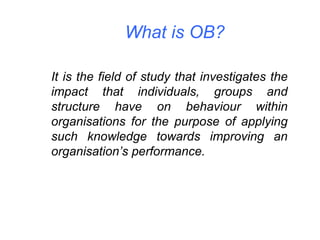
What is OB? It is the field of study that investigates the impact that individuals, groups and structure have on behaviour within organisations for the purpose of applying such knowledge towards improving an organisation’s performance.
Four central characteristics of the field: OB applies the scientific method to practical managerial problems. OB focuses on three levels of analysis:  individuals, groups, and organisations. OB seeks to improve organisational effectiveness and the quality of life at work. OB is multidisciplinary in nature.
Contributing disciplines to the field of OB Psychology Sociology Anthropology Political Science Motivation Learning Personality Perception Leadership Group dynamics Communication Power & Conflict Organisational  change & culture Comparative values Cross-cultural analysis Power Politics conflict Study of Organisational Behaviour
Shifting Paradigms of OB Flat organisational structure Empowerment Teamwork Work-life balance New workforce expectations where less tolerance for hierarchy, more informality and concern of performance rather than status
What is Management? Management is the process of coordinating work activities so that they are completed effectively and efficiently with and through other people.
  Efficiency (Means)   Effectiveness (Ends)    Low Waste   High Attainment Resource  Usage Goal  Attainment Management strives for: Low resource waste (High Efficiency) High goal attainment (High Effectiveness)
Productivity and  Managerial Performance
Effective managers focus on 2 key results: -  Task performance -  Job satisfaction
Managers Team Leaders Planning Controlling Organising Leading Choosing goals and means to achieve them Measuring performance & ensuring results Creating structures & work systems Inspiring people to work hard PROCESS OF MANAGEMENT
Time spent in carrying out functions at various levels of mnagement Top level  managers Middle level managers First level supervisors CONTROLING LEADING ORGANISING PLANNING
ESSENTIAL MANAGERIAL SKILLS -- Robert Katz Lower-level Managers Middle-level Managers Upper-level Managers TECHNICAL SKILLS The ability to perform specific tasks HUMAN SKILLS The ability to work well with people CONCEPTUAL SKILLS The ability to solve complex problems
Interpersonal Roles How a manager interacts with other people Figurehead Leader Liaison Informational Roles How a manager exchanges and processes information Monitor Disseminator Spokesperson Decisional Roles How a manager uses information in decision making Entrepreneur Disturbance  handler Resource allocator Negotiator Ten Roles of an effective manager – Henry Mintzberg

HR-1

  • 1.
    What is OB?It is the field of study that investigates the impact that individuals, groups and structure have on behaviour within organisations for the purpose of applying such knowledge towards improving an organisation’s performance.
  • 2.
    Four central characteristicsof the field: OB applies the scientific method to practical managerial problems. OB focuses on three levels of analysis: individuals, groups, and organisations. OB seeks to improve organisational effectiveness and the quality of life at work. OB is multidisciplinary in nature.
  • 3.
    Contributing disciplines tothe field of OB Psychology Sociology Anthropology Political Science Motivation Learning Personality Perception Leadership Group dynamics Communication Power & Conflict Organisational change & culture Comparative values Cross-cultural analysis Power Politics conflict Study of Organisational Behaviour
  • 4.
    Shifting Paradigms ofOB Flat organisational structure Empowerment Teamwork Work-life balance New workforce expectations where less tolerance for hierarchy, more informality and concern of performance rather than status
  • 5.
    What is Management?Management is the process of coordinating work activities so that they are completed effectively and efficiently with and through other people.
  • 6.
    Efficiency(Means) Effectiveness (Ends) Low Waste High Attainment Resource Usage Goal Attainment Management strives for: Low resource waste (High Efficiency) High goal attainment (High Effectiveness)
  • 7.
    Productivity and Managerial Performance
  • 8.
    Effective managers focuson 2 key results: - Task performance - Job satisfaction
  • 9.
    Managers Team LeadersPlanning Controlling Organising Leading Choosing goals and means to achieve them Measuring performance & ensuring results Creating structures & work systems Inspiring people to work hard PROCESS OF MANAGEMENT
  • 10.
    Time spent incarrying out functions at various levels of mnagement Top level managers Middle level managers First level supervisors CONTROLING LEADING ORGANISING PLANNING
  • 11.
    ESSENTIAL MANAGERIAL SKILLS-- Robert Katz Lower-level Managers Middle-level Managers Upper-level Managers TECHNICAL SKILLS The ability to perform specific tasks HUMAN SKILLS The ability to work well with people CONCEPTUAL SKILLS The ability to solve complex problems
  • 12.
    Interpersonal Roles Howa manager interacts with other people Figurehead Leader Liaison Informational Roles How a manager exchanges and processes information Monitor Disseminator Spokesperson Decisional Roles How a manager uses information in decision making Entrepreneur Disturbance handler Resource allocator Negotiator Ten Roles of an effective manager – Henry Mintzberg