Workforce
Analytics in India
A State-of-Evolution Report: 2018
Workforce Analytics: The next wave for HR
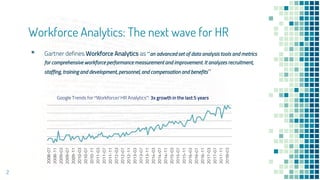
▪ Gartner defines Workforce Analytics as “an advanced set of data analysis tools and metrics
for comprehensive workforce performance measurement and improvement. It analyzes recruitment,
staffing, training and development, personnel, and compensation and benefits”
2
Google Trends for “Workforce/ HR Analytics”: 3x growth in the last 5 years
3
Application lags the perceived importance of
Workforce Analytics…
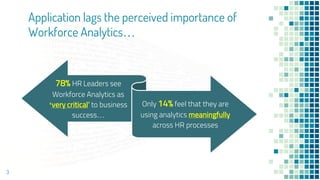
78% HR Leaders see
Workforce Analytics as
‘very critical’ to business
success…
Only 14% feel that they are
using analytics meaningfully
across HR processes
4
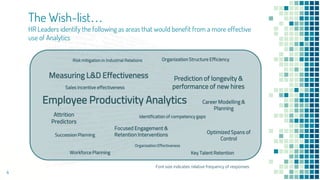
Font size indicates relative frequency of responses
Employee Productivity Analytics
Prediction of longevity &
performance of new hires
Attrition
Predictors
Organization Structure Efficiency
Measuring L&D Effectiveness
Career Modelling &
Planning
Focused Engagement &
Retention Interventions
Workforce Planning Key Talent Retention
Optimized Spans of
Control
Succession Planning
Sales incentive effectiveness
Organization Effectiveness
Identification of competency gaps
Risk mitigation in Industrial Relations
The Wish-list…
HR Leaders identify the following as areas that would benefit from a more effective
use of Analytics
5
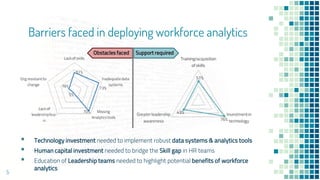
Barriers faced in deploying workforce analytics
Obstacles faced Support required
▪ Technology investment needed to implement robust data systems & analytics tools
▪ Human capital investment needed to bridge the Skill gap in HR teams
▪ Education of Leadership teams needed to highlight potential benefits of workforce
analytics
6
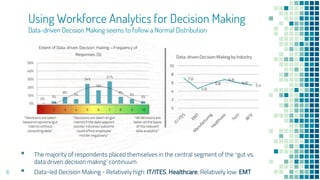
▪ The majority of respondents placed themselves in the central segment of the „gut vs.
data driven decision making’ continuum
▪ Data-led Decision Making - Relatively high: IT/ITES, Healthcare; Relatively low: EMT
Using Workforce Analytics for Decision Making
Data-driven Decision Making seems to follow a Normal Distribution
7
StrategicOperational
Reporting/
Reactive
Predictive/
Proactive
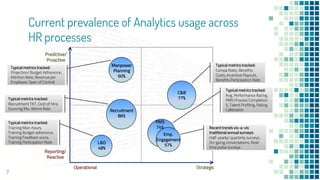
Current prevalence of Analytics usage across
HR processes
Recruitment
86%
Manpower
Planning
60%
C&B
77%
L&D
48%
Emp.
Engagement
57%
PMS
74%
Typical metrics tracked:
Avg. Performance Rating,
PMS Process Completion
%, Talent Profiling, Rating
Calibration
Typical metrics tracked:
Projection/ Budget Adherence;
Attrition Rate, Revenue per
Employee, Span of Control
Typical metrics tracked:
Compa Ratio, Benefits
Costs, Incentive Payouts,
Benefits Participation Rate
Typical metrics tracked:
Training Man-hours,
Training Budget adherence,
Training Feedback score,
Training Participation Rate
Typical metrics tracked:
Recruitment TAT, Cost of Hire,
Sourcing Mix, Rehire Rate
Recent trends vis-a-vis
traditional annual surveys:
Half-yearly/ quarterly surveys,
On-going conversations, Real-
time pulse surveys
8
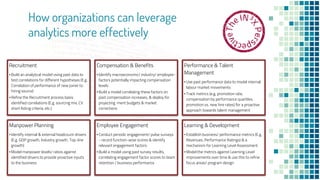
How organizations can leverage
analytics more effectively
Recruitment
• Build an analytical model using past data to
test correlations for different hypotheses (E.g.
Correlation of performance of new joiner to
hiring source)
• Refine the Recruitment process basis
identified correlations (E.g. sourcing mix, CV
short listing criteria, etc.)
Compensation & Benefits
• Identify macroeconomic/ industry/ employee-
factors potentially impacting compensation
levels
• Build a model correlating these factors on
past compensation increases, & deploy for
projecting merit budgets & market
corrections
Performance & Talent
Management
• Use past performance data to model internal
labour market movements
• Track metrics (e.g. promotion rate,
compensation by performance quartiles,
promotion vs. new hire rates) for a proactive
approach towards talent management
Manpower Planning
• Identify internal & external headcount drivers
(E.g. GDP growth, Industry growth, Top-line
growth)
• Model manpower levels/ ratios against
identified drivers to provide proactive inputs
to the business
Employee Engagement
• Conduct periodic engagement/ pulse surveys
– record function-wise scores & identify
relevant engagement factors
• Build a model using past survey results,
correlating engagement factor scores to team
retention / business performance
Learning & Development
• Establish business/ performance metrics (E.g.
Revenues, Performance Ratings) & a
mechanism for Learning Level Assessment
• Model the metrics against Learning Level
improvements over time & use this to refine
focus areas/ program design
The path ahead
9
▪ To be able to effectively drive the Analytics agenda, HR teams need to first identify
tangible business problems/ issues that would benefit from its active use
▪ Next, it is critical to identify and address different obstacles to adoption unique to
an organization (legacy culture, lack of tech investment, inadequate leadership
buy-in, etc.)
▪ This must be followed by building a strong business case, substantiated by a pilot
project serving as proof of concept and basis for expanding the ambit of Workforce
Analytics usage
▪ At every step of the way, it is instructive to deploy a comprehensive change
management approach towards developing a measurement mindset across the
HR team and the larger organization
▪ Lastly, with a continuously evolving analytics ecosystem (service providers,
technology solutions, aware consumers), it is crucial to learn both from emerging
best practices and failure stories
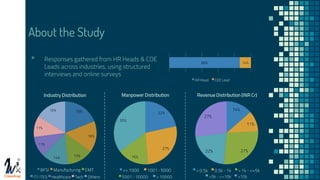
About the Study
▪ Responses gathered from HR Heads & COE
Leads across industries, using structured
interviews and online surveys
10
Industry Distribution Manpower Distribution Revenue Distribution (INR Cr)
About Inqubex Consulting
▪ IN3X (Inqubex) Consulting is a niche HR advisory firm. We drive organizational
success through interventions in organization design, talent management, people
strategy and processes.
▪ Our work on workforce analytics includes measuring organization productivity,
establishing analytics metrics to assess/ track business health, conducting
engagement & talent assessments, and helping organizations institutionalize a
measurement based approach to workforce management.
Reach us at
▫ To know more about Inqubex services visit www.inqubex.com
▫ For more information regarding this study, contact
justin.cherian@inqubex.com and varun.chaudhary@inqubex.com
11

Workforce Analytics in India - A state-of-evolution report 2018

  • 1.
    Workforce Analytics in India AState-of-Evolution Report: 2018
  • 2.
    Workforce Analytics: Thenext wave for HR ▪ Gartner defines Workforce Analytics as “an advanced set of data analysis tools and metrics for comprehensive workforce performance measurement and improvement. It analyzes recruitment, staffing, training and development, personnel, and compensation and benefits” 2 Google Trends for “Workforce/ HR Analytics”: 3x growth in the last 5 years
  • 3.
    3 Application lags theperceived importance of Workforce Analytics… 78% HR Leaders see Workforce Analytics as ‘very critical’ to business success… Only 14% feel that they are using analytics meaningfully across HR processes
  • 4.
    4 Font size indicatesrelative frequency of responses Employee Productivity Analytics Prediction of longevity & performance of new hires Attrition Predictors Organization Structure Efficiency Measuring L&D Effectiveness Career Modelling & Planning Focused Engagement & Retention Interventions Workforce Planning Key Talent Retention Optimized Spans of Control Succession Planning Sales incentive effectiveness Organization Effectiveness Identification of competency gaps Risk mitigation in Industrial Relations The Wish-list… HR Leaders identify the following as areas that would benefit from a more effective use of Analytics
  • 5.
    5 Barriers faced indeploying workforce analytics Obstacles faced Support required ▪ Technology investment needed to implement robust data systems & analytics tools ▪ Human capital investment needed to bridge the Skill gap in HR teams ▪ Education of Leadership teams needed to highlight potential benefits of workforce analytics
  • 6.
    6 ▪ The majorityof respondents placed themselves in the central segment of the „gut vs. data driven decision making’ continuum ▪ Data-led Decision Making - Relatively high: IT/ITES, Healthcare; Relatively low: EMT Using Workforce Analytics for Decision Making Data-driven Decision Making seems to follow a Normal Distribution
  • 7.
    7 StrategicOperational Reporting/ Reactive Predictive/ Proactive Current prevalence ofAnalytics usage across HR processes Recruitment 86% Manpower Planning 60% C&B 77% L&D 48% Emp. Engagement 57% PMS 74% Typical metrics tracked: Avg. Performance Rating, PMS Process Completion %, Talent Profiling, Rating Calibration Typical metrics tracked: Projection/ Budget Adherence; Attrition Rate, Revenue per Employee, Span of Control Typical metrics tracked: Compa Ratio, Benefits Costs, Incentive Payouts, Benefits Participation Rate Typical metrics tracked: Training Man-hours, Training Budget adherence, Training Feedback score, Training Participation Rate Typical metrics tracked: Recruitment TAT, Cost of Hire, Sourcing Mix, Rehire Rate Recent trends vis-a-vis traditional annual surveys: Half-yearly/ quarterly surveys, On-going conversations, Real- time pulse surveys
  • 8.
    8 How organizations canleverage analytics more effectively Recruitment • Build an analytical model using past data to test correlations for different hypotheses (E.g. Correlation of performance of new joiner to hiring source) • Refine the Recruitment process basis identified correlations (E.g. sourcing mix, CV short listing criteria, etc.) Compensation & Benefits • Identify macroeconomic/ industry/ employee- factors potentially impacting compensation levels • Build a model correlating these factors on past compensation increases, & deploy for projecting merit budgets & market corrections Performance & Talent Management • Use past performance data to model internal labour market movements • Track metrics (e.g. promotion rate, compensation by performance quartiles, promotion vs. new hire rates) for a proactive approach towards talent management Manpower Planning • Identify internal & external headcount drivers (E.g. GDP growth, Industry growth, Top-line growth) • Model manpower levels/ ratios against identified drivers to provide proactive inputs to the business Employee Engagement • Conduct periodic engagement/ pulse surveys – record function-wise scores & identify relevant engagement factors • Build a model using past survey results, correlating engagement factor scores to team retention / business performance Learning & Development • Establish business/ performance metrics (E.g. Revenues, Performance Ratings) & a mechanism for Learning Level Assessment • Model the metrics against Learning Level improvements over time & use this to refine focus areas/ program design
  • 9.
    The path ahead 9 ▪To be able to effectively drive the Analytics agenda, HR teams need to first identify tangible business problems/ issues that would benefit from its active use ▪ Next, it is critical to identify and address different obstacles to adoption unique to an organization (legacy culture, lack of tech investment, inadequate leadership buy-in, etc.) ▪ This must be followed by building a strong business case, substantiated by a pilot project serving as proof of concept and basis for expanding the ambit of Workforce Analytics usage ▪ At every step of the way, it is instructive to deploy a comprehensive change management approach towards developing a measurement mindset across the HR team and the larger organization ▪ Lastly, with a continuously evolving analytics ecosystem (service providers, technology solutions, aware consumers), it is crucial to learn both from emerging best practices and failure stories
  • 10.
    About the Study ▪Responses gathered from HR Heads & COE Leads across industries, using structured interviews and online surveys 10 Industry Distribution Manpower Distribution Revenue Distribution (INR Cr)
  • 11.
    About Inqubex Consulting ▪IN3X (Inqubex) Consulting is a niche HR advisory firm. We drive organizational success through interventions in organization design, talent management, people strategy and processes. ▪ Our work on workforce analytics includes measuring organization productivity, establishing analytics metrics to assess/ track business health, conducting engagement & talent assessments, and helping organizations institutionalize a measurement based approach to workforce management. Reach us at ▫ To know more about Inqubex services visit www.inqubex.com ▫ For more information regarding this study, contact justin.cherian@inqubex.com and varun.chaudhary@inqubex.com 11