8/8/2020
1
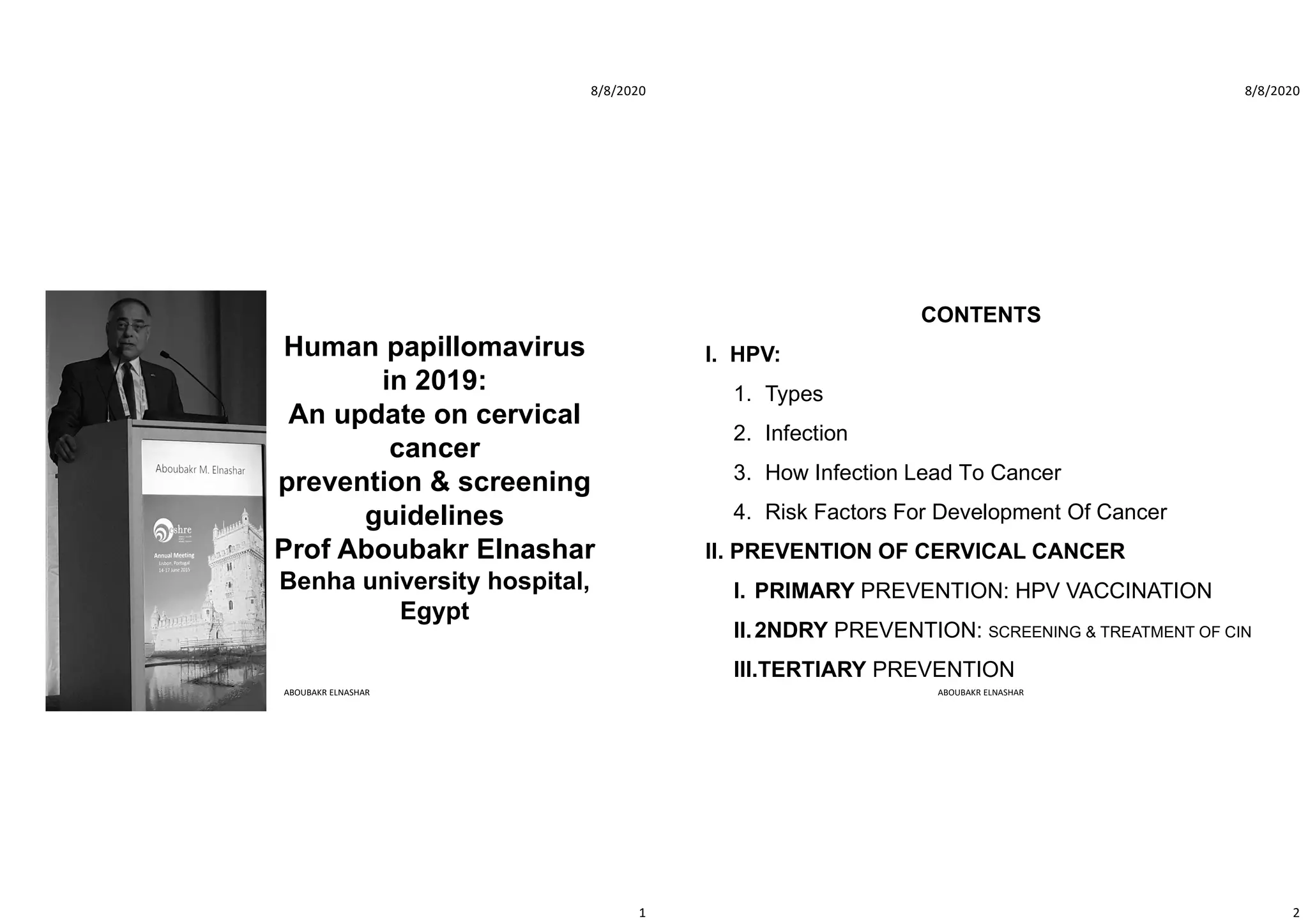
Human papillomavirus
in 2019:
An update on cervical
cancer
prevention & screening
guidelines
Prof Aboubakr Elnashar
Benha university hospital,
Egypt
ABOUBAKR ELNASHAR
8/8/2020
2
CONTENTS
I. HPV:
1. Types
2. Infection
3. How Infection Lead To Cancer
4. Risk Factors For Development Of Cancer
II. PREVENTION OF CERVICAL CANCER
I. PRIMARY PREVENTION: HPV VACCINATION
II.2NDRY PREVENTION: SCREENING & TREATMENT OF CIN
III.TERTIARY PREVENTION
ABOUBAKR ELNASHAR
8/8/2020
3
CERVICAL CANCER
 The 4th most frequent cancer in women with an
 570 000 new cases in 2018
 7.5% of all female cancer deaths.
 311 000 deaths from cervical cancer every year
 85% of these occur in less developed regions.
ABOUBAKR ELNASHAR
8/8/2020
4
CIN in Egypt
(Elnashar, 2019)
Aboubakr ElnasharABOUBAKR ELNASHAR
8/8/2020
5
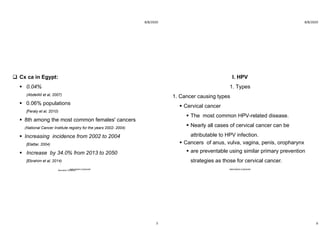
 Cx ca in Egypt:
 0.04%
(AbdelAll et al, 2007)
 0.06% populations
[Feraly et al, 2010)
 8th among the most common females' cancers
(National Cancer Institute registry for the years 2002- 2004)
 Increasing incidence from 2002 to 2004
[Elattar, 2004)
 Increase by 34.0% from 2013 to 2050
[Ebrahim et al, 2014)
Aboubakr ElnasharABOUBAKR ELNASHAR
8/8/2020
6
I. HPV
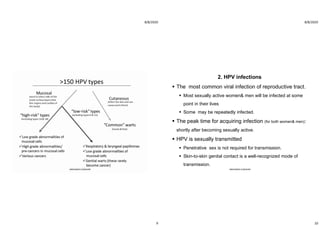
1. Types
1. Cancer causing types
 Cervical cancer
 The most common HPV-related disease.
 Nearly all cases of cervical cancer can be
attributable to HPV infection.
 Cancers of anus, vulva, vagina, penis, oropharynx
 are preventable using similar primary prevention
strategies as those for cervical cancer.
ABOUBAKR ELNASHAR
8/8/2020
7
 Non-cancer causing types
 Especially types 6, 11
 Can cause
 Genital warts
 very common
 highly infectious & affect sexual life.
 Respiratory papillomatosis
 Tumours grow in the air passages leading
from the nose& mouth into the lungs.
 Very rarely result in death
ABOUBAKR ELNASHAR
8/8/2020
8
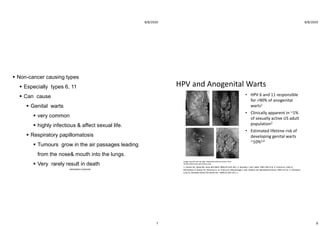
HPV and Anogenital Warts
• HPV 6 and 11 responsible
for >90% of anogenital
warts1
• Clinically apparent in ~1%
of sexually active US adult
population2
• Estimated lifetime risk of
developing genital warts
~10%3,4
1. Jansen KU, Shaw AR. Annu Rev Med. 2004;55:319–331. 2. Koutsky L. Am J Med. 1997;102:3–8. 3. Franco EL, Villa LL,
Richardson H, Rohan TE, Ferenczy A. In: Franco EL, Monsonego J, eds. Oxford, UK: Blackwell Science; 1997:14–22. 4. Tortolero-
Luna G. Hematol Oncol Clin North Am. 1999;13:245–257, x.
Images top left and top right: Reprinted with permission from
NZ DermNet (www.dermnetnz.org)
8/8/2020
9
ABOUBAKR ELNASHAR
8/8/2020
10
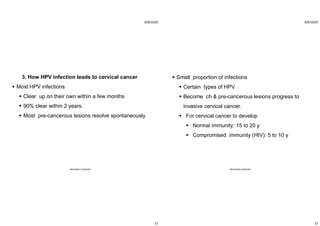
2. HPV infections
 The most common viral infection of reproductive tract.
 Most sexually active women& men will be infected at some
point in their lives
 Some may be repeatedly infected.
 The peak time for acquiring infection (for both women& men):
shortly after becoming sexually active.
 HPV is sexually transmitted
 Penetrative sex is not required for transmission.
 Skin-to-skin genital contact is a well-recognized mode of
transmission.
ABOUBAKR ELNASHAR
8/8/2020
11
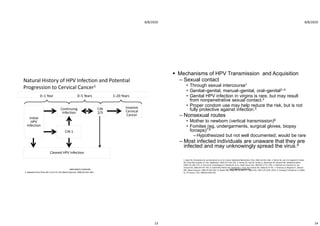
3. How HPV infection leads to cervical cancer
 Most HPV infections
 Clear up on their own within a few months
 90% clear within 2 years.
 Most pre-cancerous lesions resolve spontaneously
ABOUBAKR ELNASHAR
8/8/2020
12
 Small proportion of infections
 Certain types of HPV
 Become ch & pre-cancerous lesions progress to
invasive cervical cancer.
 For cervical cancer to develop
 Normal immunity: 15 to 20 y
 Compromised immunity (HIV): 5 to 10 y
ABOUBAKR ELNASHAR
8/8/2020
13
0–1 Year 0–5 Years 1–20 Years
Invasive
Cervical
Cancer
Cleared HPV Infection
1. Adapted from Pinto AP, Crum CP. Clin Obstet Gynecol. 2000;43:352–362.
CIN 1
Initial
HPV
Infection
Continuing
Infection
CIN
2/3
Natural History of HPV Infection and Potential
Progression to Cervical Cancer1
ABOUBAKR ELNASHAR
8/8/2020
14
 Mechanisms of HPV Transmission and Acquisition
– Sexual contact
• Through sexual intercourse1
• Genital–genital, manual–genital, oral–genital2–4
• Genital HPV infection in virgins is rare, but may result
from nonpenetrative sexual contact.2
• Proper condom use may help reduce the risk, but is not
fully protective against infection.5
– Nonsexual routes
• Mother to newborn (vertical transmission)6
• Fomites (eg, undergarments, surgical gloves, biopsy
forceps)7,8
– Hypothesized but not well documented; would be rare
– Most infected individuals are unaware that they are
infected and may unknowingly spread the virus.9
1. Kjaer SK, Chackerian B, van den Brule AJ, et al. Cancer Epidemiol Biomarkers Prev. 2001;10:101–106. 2. Winer RL, Lee S-K, Hughes JP, Adam
DE, Kiviat NB, Koutsky LA. Am J Epidemiol. 2003;157:218–226. 3. Fairley CK, Gay NJ, Forbes A, Abramson M, Garland SM. Epidemiol Infect.
1995;115:169–176. 4. Herrero R, Castellsagué X, Pawlita M, et al. J Natl Cancer Inst. 2003;95:1772–1783. 5. Manhart LE, Koutsky LA. Sex
Transm Dis. 2002;29:725–735. 6. Smith EM, Ritchie JM, Yankowitz J, et al. Sex Transm Dis. 2004;31:57–62. 7. Ferenczy A, Bergeron C, Richart
RM. Obstet Gynecol. 1989;74:950–954. 8. Roden RBS, Lowy DR, Schiller JT. J Infect Dis. 1997;176:1076–1079. 9. Anhang R, Goodman A, Goldie
SJ. CA Cancer J Clin. 2004;54:248–259.
ABOUBAKR ELNASHAR
8/8/2020
15
ABOUBAKR ELNASHAR
8/8/2020
16
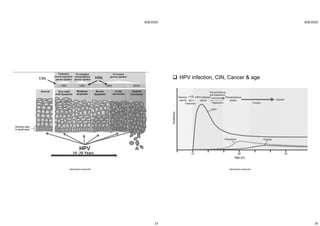
 HPV infection, CIN, Cancer & age
ABOUBAKR ELNASHAR
8/8/2020
17
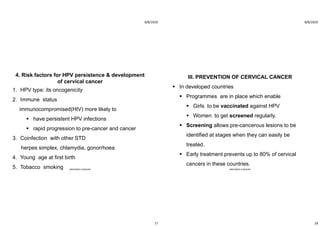
4. Risk factors for HPV persistence & development
of cervical cancer
1. HPV type: its oncogenicity
2. Immune status
immunocompromised(HIV) more likely to
 have persistent HPV infections
 rapid progression to pre-cancer and cancer
3. Coinfection with other STD
herpes simplex, chlamydia, gonorrhoea
4. Young age at first birth
5. Tobacco smoking ABOUBAKR ELNASHAR
8/8/2020
18
III. PREVENTION OF CERVICAL CANCER
 In developed countries
 Programmes are in place which enable
 Girls to be vaccinated against HPV
 Women to get screened regularly.
 Screening allows pre-cancerous lesions to be
identified at stages when they can easily be
treated.
 Early treatment prevents up to 80% of cervical
cancers in these countries.
ABOUBAKR ELNASHAR
8/8/2020
19
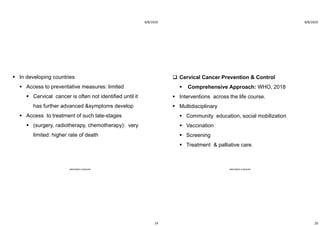
 In developing countries
 Access to preventative measures: limited
 Cervical cancer is often not identified until it
has further advanced &symptoms develop
 Access to treatment of such late-stages
 (surgery, radiotherapy, chemotherapy): very
limited: higher rate of death
ABOUBAKR ELNASHAR
8/8/2020
20
 Cervical Cancer Prevention & Control
 Comprehensive Approach: WHO, 2018
 Interventions across the life course.
 Multidisciplinary
 Community education, social mobilization
 Vaccination
 Screening
 Treatment & palliative care.
ABOUBAKR ELNASHAR
8/8/2020
21
ABOUBAKR ELNASHAR
8/8/2020
22
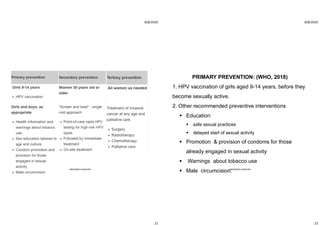
PRIMARY PREVENTION: (WHO, 2018)
1. HPV vaccination of girls aged 9-14 years, before they
become sexually active.
2. Other recommended preventive interventions
 Education:
 safe sexual practices
 delayed start of sexual activity
 Promotion & provision of condoms for those
already engaged in sexual activity
 Warnings about tobacco use
 Male circumcision.ABOUBAKR ELNASHAR
8/8/2020
23
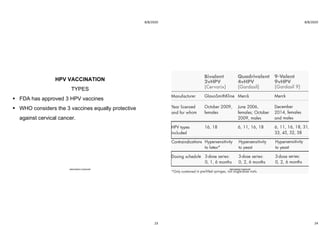
HPV VACCINATION
TYPES
 FDA has approved 3 HPV vaccines
 WHO considers the 3 vaccines equally protective
against cervical cancer.
ABOUBAKR ELNASHAR
8/8/2020
24
ABOUBAKR ELNASHAR
8/8/2020
25
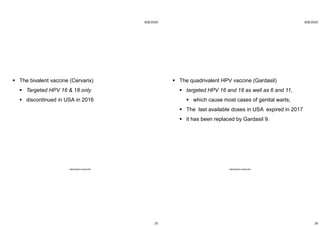
 The bivalent vaccine (Cervarix)
 Targeted HPV 16 & 18 only
 discontinued in USA in 2016
ABOUBAKR ELNASHAR
8/8/2020
26
 The quadrivalent HPV vaccine (Gardasil)
 targeted HPV 16 and 18 as well as 6 and 11,
 which cause most cases of genital warts;
 The last available doses in USA expired in 2017
 it has been replaced by Gardasil 9.
ABOUBAKR ELNASHAR
8/8/2020
27
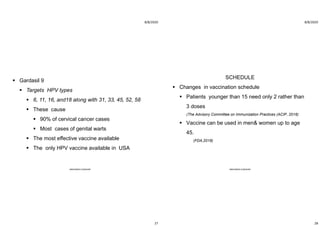
 Gardasil 9
 Targets HPV types
 6, 11, 16, and18 along with 31, 33, 45, 52, 58
 These cause
 90% of cervical cancer cases
 Most cases of genital warts
 The most effective vaccine available
 The only HPV vaccine available in USA
ABOUBAKR ELNASHAR
8/8/2020
28
SCHEDULE
 Changes in vaccination schedule
 Patients younger than 15 need only 2 rather than
3 doses
(The Advisory Committee on Immunization Practices (ACIP, 2016)
 Vaccine can be used in men& women up to age
45.
(FDA,2018)
ABOUBAKR ELNASHAR
8/8/2020
29
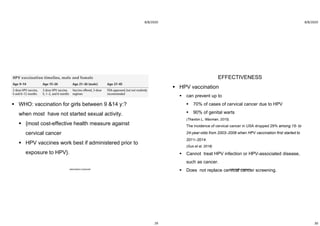
 WHO: vaccination for girls between 9 &14 y:?
when most have not started sexual activity.
 {most cost-effective health measure against
cervical cancer
 HPV vaccines work best if administered prior to
exposure to HPV}.
ABOUBAKR ELNASHAR
8/8/2020
30
EFFECTIVENESS
 HPV vaccination
 can prevent up to
 70% of cases of cervical cancer due to HPV
 90% of genital warts
(Thaxton L, Waxman, 2015).
The incidence of cervical cancer in USA dropped 29% among 15- to
24-year-olds from 2003–2006 when HPV vaccination first started to
2011–2014.
(Guo et al, 2018)
 Cannot treat HPV infection or HPV-associated disease,
such as cancer.
 Does not replace cervical cancer screening.ABOUBAKR ELNASHAR
8/8/2020
31
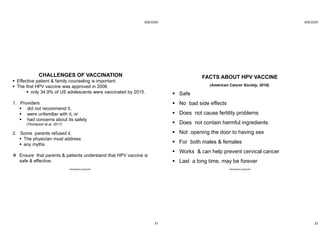
CHALLENGES OF VACCINATION
 Effective patient & family counseling is important.
 The first HPV vaccine was approved in 2006
 only 34.9% of US adolescents were vaccinated by 2015.
1. Providers
 did not recommend it,
 were unfamiliar with it, or
 had concerns about its safety
(Thompson et al, 2017)
2. Some parents refused it.
 The physician must address
 any myths
 Ensure that parents & patients understand that HPV vaccine is
safe & effective.
ABOUBAKR ELNASHAR
8/8/2020
32
FACTS ABOUT HPV VACCINE
(American Cancer Society, 2018).
 Safe
 No bad side effects
 Does not cause fertility problems
 Does not contain harmful ingredients
 Not opening the door to having sex
 For both males & females
 Works & can help prevent cervical cancer
 Last a long time, may be forever
ABOUBAKR ELNASHAR
8/8/2020
33
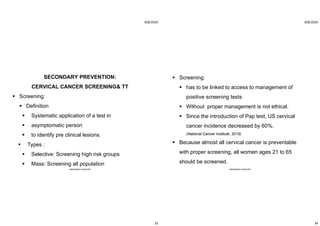
SECONDARY PREVENTION:
CERVICAL CANCER SCREENING& TT
 Screening:
 Definition
 Systematic application of a test in
 asymptomatic person
 to identify pre clinical lesions.
 Types :
 Selective: Screening high risk groups
 Mass: Screening all population
ABOUBAKR ELNASHAR
8/8/2020
34
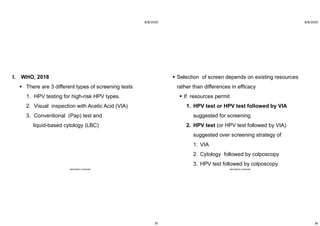
 Screening:
 has to be linked to access to management of
positive screening tests
 Without proper management is not ethical.
 Since the introduction of Pap test, US cervical
cancer incidence decreased by 60%.
(National Cancer Institute, 2019)
 Because almost all cervical cancer is preventable
with proper screening, all women ages 21 to 65
should be screened.
ABOUBAKR ELNASHAR
8/8/2020
35
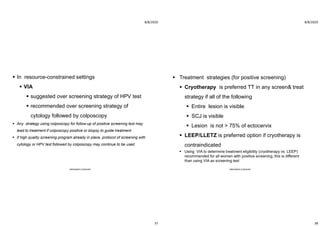
I. WHO, 2018
 There are 3 different types of screening tests
1. HPV testing for high-risk HPV types.
2. Visual inspection with Acetic Acid (VIA)
3. Conventional (Pap) test and
liquid-based cytology (LBC)
ABOUBAKR ELNASHAR
8/8/2020
36
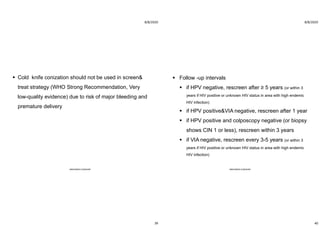
 Selection of screen depends on existing resources
rather than differences in efficacy
 If resources permit
1. HPV test or HPV test followed by VIA
suggested for screening
2. HPV test (or HPV test followed by VIA)
suggested over screening strategy of
1. VIA
2. Cytology followed by colposcopy
3. HPV test followed by colposcopy
ABOUBAKR ELNASHAR
8/8/2020
37
 In resource-constrained settings
 VIA
 suggested over screening strategy of HPV test
 recommended over screening strategy of
cytology followed by colposcopy
 Any strategy using colposcopy for follow-up of positive screening test may
lead to treatment if colposcopy positive or biopsy to guide treatment
 if high quality screening program already in place, protocol of screening with
cytology or HPV test followed by colposcopy may continue to be used
ABOUBAKR ELNASHAR
8/8/2020
38
 Treatment strategies (for positive screening)
 Cryotherapy is preferred TT in any screen& treat
strategy if all of the following
 Entire lesion is visible
 SCJ is visible
 Lesion is not > 75% of ectocervix
 LEEP/LLETZ is preferred option if cryotherapy is
contraindicated
 Using VIA to determine treatment eligibility (cryotherapy vs. LEEP)
recommended for all women with positive screening, this is different
than using VIA as screening test
ABOUBAKR ELNASHAR
8/8/2020
39
 Cold knife conization should not be used in screen&
treat strategy (WHO Strong Recommendation, Very
low-quality evidence) due to risk of major bleeding and
premature delivery
ABOUBAKR ELNASHAR
8/8/2020
40
 Follow -up intervals
 if HPV negative, rescreen after ≥ 5 years (or within 3
years if HIV positive or unknown HIV status in area with high endemic
HIV infection)
 if HPV positive&VIA negative, rescreen after 1 year
 if HPV positive and colposcopy negative (or biopsy
shows CIN 1 or less), rescreen within 3 years
 if VIA negative, rescreen every 3-5 years (or within 3
years if HIV positive or unknown HIV status in area with high endemic
HIV infection)
ABOUBAKR ELNASHAR
8/8/2020
41
 if cytology normal, rescreen every 3-5 years (or within 3
years if HIV positive or unknown HIV status in area with high endemic HIV
infection)
 If cytology ASCUS or greater and colposcopy
negative (or biopsy shows CIN 1 or less), rescreen
within 3 years
 If abnormality treated with cryotherapy or LEEP,
follow up posttreatment at 1 year regardless of
strategy, treat any lesion suspicious for cancer
(WHO, 2013)
ABOUBAKR ELNASHAR
8/8/2020
42
ABOUBAKR ELNASHAR
8/8/2020
43
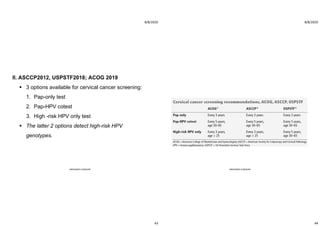
II. ASCCP2012, USPSTF2018; ACOG 2019
 3 options available for cervical cancer screening:
1. Pap-only test
2. Pap-HPV cotest
3. High -risk HPV only test
 The latter 2 options detect high-risk HPV
genotypes.
ABOUBAKR ELNASHAR
8/8/2020
44
ABOUBAKR ELNASHAR
8/8/2020
45
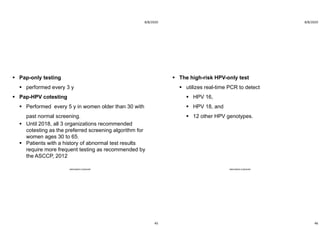
 Pap-only testing
 performed every 3 y
 Pap-HPV cotesting
 Performed every 5 y in women older than 30 with
past normal screening.
 Until 2018, all 3 organizations recommended
cotesting as the preferred screening algorithm for
women ages 30 to 65.
 Patients with a history of abnormal test results
require more frequent testing as recommended by
the ASCCP, 2012
ABOUBAKR ELNASHAR
8/8/2020
46
 The high-risk HPV-only test
 utilizes real-time PCR to detect
 HPV 16,
 HPV 18, and
 12 other HPV genotypes.
ABOUBAKR ELNASHAR
8/8/2020
47
ASCCP, ACOG
ABOUBAKR ELNASHAR
8/8/2020
48
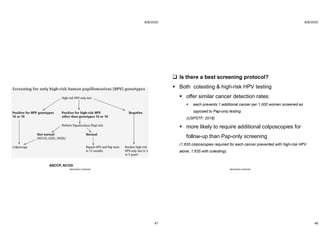
 Is there a best screening protocol?
 Both cotesting & high-risk HPV testing
 offer similar cancer detection rates:
 each prevents 1 additional cancer per 1,000 women screened as
opposed to Pap-only testing.
(USPSTF; 2018)
 more likely to require additional colposcopies for
follow-up than Pap-only screening
(1,630 colposcopies required for each cancer prevented with high-risk HPV
alone, 1,635 with cotesting).
ABOUBAKR ELNASHAR
8/8/2020
49
 High-risk HPV screening
 offer better detection of cervical adenocarcinoma
(which has a worse prognosis than the more common squamous cell
carcinoma type).
 should be repeated every 5 years if normal (as
opposed to every 3 years as recommended by
(ACOG, 2019 and ASCCP, 2012).
 All 3 cervical cancer screening methods
 provide highly effective cancer prevention: choose
the strategy that best fits practice.
ABOUBAKR ELNASHAR
8/8/2020
50
 1 round of high-risk HPV-only screening for women
older than 25 was more sensitive than Pap-only or
cotesting for stage 3 CIN or more severe disease
(after 3 years of follow-up).
(Wright et al, 2015, Addressing the Need for Advanced HPV Diagnostics
(ATHENA)
ABOUBAKR ELNASHAR
8/8/2020
51
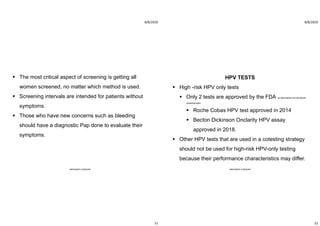
 The most critical aspect of screening is getting all
women screened, no matter which method is used.
 Screening intervals are intended for patients without
symptoms.
 Those who have new concerns such as bleeding
should have a diagnostic Pap done to evaluate their
symptoms.
ABOUBAKR ELNASHAR
8/8/2020
52
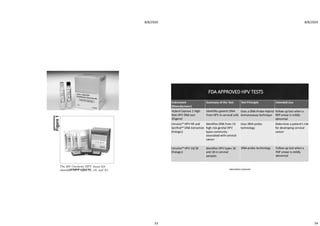
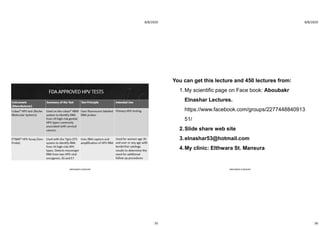
HPV TESTS
 High -risk HPV only tests
 Only 2 tests are approved by the FDA as stand-alone cervical cancer
screening tests
 Roche Cobas HPV test approved in 2014
 Becton Dickinson Onclarity HPV assay
approved in 2018.
 Other HPV tests that are used in a cotesting strategy
should not be used for high-risk HPV-only testing
because their performance characteristics may differ.
ABOUBAKR ELNASHAR
8/8/2020
53
ABOUBAKR ELNASHAR
8/8/2020
54
ABOUBAKR ELNASHAR
8/8/2020
55
ABOUBAKR ELNASHAR
8/8/2020
56
You can get this lecture and 450 lectures from:
1.My scientific page on Face book: Aboubakr
Elnashar Lectures.
https://www.facebook.com/groups/2277448840913
51/
2.Slide share web site
3.elnashar53@hotmail.com
4.My clinic: Elthwara St. Mansura
ABOUBAKR ELNASHAR

HPV, Cervical cancer prevention and screening

  • 1.
    8/8/2020 1 Human papillomavirus in 2019: Anupdate on cervical cancer prevention & screening guidelines Prof Aboubakr Elnashar Benha university hospital, Egypt ABOUBAKR ELNASHAR 8/8/2020 2 CONTENTS I. HPV: 1. Types 2. Infection 3. How Infection Lead To Cancer 4. Risk Factors For Development Of Cancer II. PREVENTION OF CERVICAL CANCER I. PRIMARY PREVENTION: HPV VACCINATION II.2NDRY PREVENTION: SCREENING & TREATMENT OF CIN III.TERTIARY PREVENTION ABOUBAKR ELNASHAR
  • 2.
    8/8/2020 3 CERVICAL CANCER  The4th most frequent cancer in women with an  570 000 new cases in 2018  7.5% of all female cancer deaths.  311 000 deaths from cervical cancer every year  85% of these occur in less developed regions. ABOUBAKR ELNASHAR 8/8/2020 4 CIN in Egypt (Elnashar, 2019) Aboubakr ElnasharABOUBAKR ELNASHAR
  • 3.
    8/8/2020 5  Cx cain Egypt:  0.04% (AbdelAll et al, 2007)  0.06% populations [Feraly et al, 2010)  8th among the most common females' cancers (National Cancer Institute registry for the years 2002- 2004)  Increasing incidence from 2002 to 2004 [Elattar, 2004)  Increase by 34.0% from 2013 to 2050 [Ebrahim et al, 2014) Aboubakr ElnasharABOUBAKR ELNASHAR 8/8/2020 6 I. HPV 1. Types 1. Cancer causing types  Cervical cancer  The most common HPV-related disease.  Nearly all cases of cervical cancer can be attributable to HPV infection.  Cancers of anus, vulva, vagina, penis, oropharynx  are preventable using similar primary prevention strategies as those for cervical cancer. ABOUBAKR ELNASHAR
  • 4.
    8/8/2020 7  Non-cancer causingtypes  Especially types 6, 11  Can cause  Genital warts  very common  highly infectious & affect sexual life.  Respiratory papillomatosis  Tumours grow in the air passages leading from the nose& mouth into the lungs.  Very rarely result in death ABOUBAKR ELNASHAR 8/8/2020 8 HPV and Anogenital Warts • HPV 6 and 11 responsible for >90% of anogenital warts1 • Clinically apparent in ~1% of sexually active US adult population2 • Estimated lifetime risk of developing genital warts ~10%3,4 1. Jansen KU, Shaw AR. Annu Rev Med. 2004;55:319–331. 2. Koutsky L. Am J Med. 1997;102:3–8. 3. Franco EL, Villa LL, Richardson H, Rohan TE, Ferenczy A. In: Franco EL, Monsonego J, eds. Oxford, UK: Blackwell Science; 1997:14–22. 4. Tortolero- Luna G. Hematol Oncol Clin North Am. 1999;13:245–257, x. Images top left and top right: Reprinted with permission from NZ DermNet (www.dermnetnz.org)
  • 5.
    8/8/2020 9 ABOUBAKR ELNASHAR 8/8/2020 10 2. HPVinfections  The most common viral infection of reproductive tract.  Most sexually active women& men will be infected at some point in their lives  Some may be repeatedly infected.  The peak time for acquiring infection (for both women& men): shortly after becoming sexually active.  HPV is sexually transmitted  Penetrative sex is not required for transmission.  Skin-to-skin genital contact is a well-recognized mode of transmission. ABOUBAKR ELNASHAR
  • 6.
    8/8/2020 11 3. How HPVinfection leads to cervical cancer  Most HPV infections  Clear up on their own within a few months  90% clear within 2 years.  Most pre-cancerous lesions resolve spontaneously ABOUBAKR ELNASHAR 8/8/2020 12  Small proportion of infections  Certain types of HPV  Become ch & pre-cancerous lesions progress to invasive cervical cancer.  For cervical cancer to develop  Normal immunity: 15 to 20 y  Compromised immunity (HIV): 5 to 10 y ABOUBAKR ELNASHAR
  • 7.
    8/8/2020 13 0–1 Year 0–5Years 1–20 Years Invasive Cervical Cancer Cleared HPV Infection 1. Adapted from Pinto AP, Crum CP. Clin Obstet Gynecol. 2000;43:352–362. CIN 1 Initial HPV Infection Continuing Infection CIN 2/3 Natural History of HPV Infection and Potential Progression to Cervical Cancer1 ABOUBAKR ELNASHAR 8/8/2020 14  Mechanisms of HPV Transmission and Acquisition – Sexual contact • Through sexual intercourse1 • Genital–genital, manual–genital, oral–genital2–4 • Genital HPV infection in virgins is rare, but may result from nonpenetrative sexual contact.2 • Proper condom use may help reduce the risk, but is not fully protective against infection.5 – Nonsexual routes • Mother to newborn (vertical transmission)6 • Fomites (eg, undergarments, surgical gloves, biopsy forceps)7,8 – Hypothesized but not well documented; would be rare – Most infected individuals are unaware that they are infected and may unknowingly spread the virus.9 1. Kjaer SK, Chackerian B, van den Brule AJ, et al. Cancer Epidemiol Biomarkers Prev. 2001;10:101–106. 2. Winer RL, Lee S-K, Hughes JP, Adam DE, Kiviat NB, Koutsky LA. Am J Epidemiol. 2003;157:218–226. 3. Fairley CK, Gay NJ, Forbes A, Abramson M, Garland SM. Epidemiol Infect. 1995;115:169–176. 4. Herrero R, Castellsagué X, Pawlita M, et al. J Natl Cancer Inst. 2003;95:1772–1783. 5. Manhart LE, Koutsky LA. Sex Transm Dis. 2002;29:725–735. 6. Smith EM, Ritchie JM, Yankowitz J, et al. Sex Transm Dis. 2004;31:57–62. 7. Ferenczy A, Bergeron C, Richart RM. Obstet Gynecol. 1989;74:950–954. 8. Roden RBS, Lowy DR, Schiller JT. J Infect Dis. 1997;176:1076–1079. 9. Anhang R, Goodman A, Goldie SJ. CA Cancer J Clin. 2004;54:248–259. ABOUBAKR ELNASHAR
  • 8.
    8/8/2020 15 ABOUBAKR ELNASHAR 8/8/2020 16  HPVinfection, CIN, Cancer & age ABOUBAKR ELNASHAR
  • 9.
    8/8/2020 17 4. Risk factorsfor HPV persistence & development of cervical cancer 1. HPV type: its oncogenicity 2. Immune status immunocompromised(HIV) more likely to  have persistent HPV infections  rapid progression to pre-cancer and cancer 3. Coinfection with other STD herpes simplex, chlamydia, gonorrhoea 4. Young age at first birth 5. Tobacco smoking ABOUBAKR ELNASHAR 8/8/2020 18 III. PREVENTION OF CERVICAL CANCER  In developed countries  Programmes are in place which enable  Girls to be vaccinated against HPV  Women to get screened regularly.  Screening allows pre-cancerous lesions to be identified at stages when they can easily be treated.  Early treatment prevents up to 80% of cervical cancers in these countries. ABOUBAKR ELNASHAR
  • 10.
    8/8/2020 19  In developingcountries  Access to preventative measures: limited  Cervical cancer is often not identified until it has further advanced &symptoms develop  Access to treatment of such late-stages  (surgery, radiotherapy, chemotherapy): very limited: higher rate of death ABOUBAKR ELNASHAR 8/8/2020 20  Cervical Cancer Prevention & Control  Comprehensive Approach: WHO, 2018  Interventions across the life course.  Multidisciplinary  Community education, social mobilization  Vaccination  Screening  Treatment & palliative care. ABOUBAKR ELNASHAR
  • 11.
    8/8/2020 21 ABOUBAKR ELNASHAR 8/8/2020 22 PRIMARY PREVENTION:(WHO, 2018) 1. HPV vaccination of girls aged 9-14 years, before they become sexually active. 2. Other recommended preventive interventions  Education:  safe sexual practices  delayed start of sexual activity  Promotion & provision of condoms for those already engaged in sexual activity  Warnings about tobacco use  Male circumcision.ABOUBAKR ELNASHAR
  • 12.
    8/8/2020 23 HPV VACCINATION TYPES  FDAhas approved 3 HPV vaccines  WHO considers the 3 vaccines equally protective against cervical cancer. ABOUBAKR ELNASHAR 8/8/2020 24 ABOUBAKR ELNASHAR
  • 13.
    8/8/2020 25  The bivalentvaccine (Cervarix)  Targeted HPV 16 & 18 only  discontinued in USA in 2016 ABOUBAKR ELNASHAR 8/8/2020 26  The quadrivalent HPV vaccine (Gardasil)  targeted HPV 16 and 18 as well as 6 and 11,  which cause most cases of genital warts;  The last available doses in USA expired in 2017  it has been replaced by Gardasil 9. ABOUBAKR ELNASHAR
  • 14.
    8/8/2020 27  Gardasil 9 Targets HPV types  6, 11, 16, and18 along with 31, 33, 45, 52, 58  These cause  90% of cervical cancer cases  Most cases of genital warts  The most effective vaccine available  The only HPV vaccine available in USA ABOUBAKR ELNASHAR 8/8/2020 28 SCHEDULE  Changes in vaccination schedule  Patients younger than 15 need only 2 rather than 3 doses (The Advisory Committee on Immunization Practices (ACIP, 2016)  Vaccine can be used in men& women up to age 45. (FDA,2018) ABOUBAKR ELNASHAR
  • 15.
    8/8/2020 29  WHO: vaccinationfor girls between 9 &14 y:? when most have not started sexual activity.  {most cost-effective health measure against cervical cancer  HPV vaccines work best if administered prior to exposure to HPV}. ABOUBAKR ELNASHAR 8/8/2020 30 EFFECTIVENESS  HPV vaccination  can prevent up to  70% of cases of cervical cancer due to HPV  90% of genital warts (Thaxton L, Waxman, 2015). The incidence of cervical cancer in USA dropped 29% among 15- to 24-year-olds from 2003–2006 when HPV vaccination first started to 2011–2014. (Guo et al, 2018)  Cannot treat HPV infection or HPV-associated disease, such as cancer.  Does not replace cervical cancer screening.ABOUBAKR ELNASHAR
  • 16.
    8/8/2020 31 CHALLENGES OF VACCINATION Effective patient & family counseling is important.  The first HPV vaccine was approved in 2006  only 34.9% of US adolescents were vaccinated by 2015. 1. Providers  did not recommend it,  were unfamiliar with it, or  had concerns about its safety (Thompson et al, 2017) 2. Some parents refused it.  The physician must address  any myths  Ensure that parents & patients understand that HPV vaccine is safe & effective. ABOUBAKR ELNASHAR 8/8/2020 32 FACTS ABOUT HPV VACCINE (American Cancer Society, 2018).  Safe  No bad side effects  Does not cause fertility problems  Does not contain harmful ingredients  Not opening the door to having sex  For both males & females  Works & can help prevent cervical cancer  Last a long time, may be forever ABOUBAKR ELNASHAR
  • 17.
    8/8/2020 33 SECONDARY PREVENTION: CERVICAL CANCERSCREENING& TT  Screening:  Definition  Systematic application of a test in  asymptomatic person  to identify pre clinical lesions.  Types :  Selective: Screening high risk groups  Mass: Screening all population ABOUBAKR ELNASHAR 8/8/2020 34  Screening:  has to be linked to access to management of positive screening tests  Without proper management is not ethical.  Since the introduction of Pap test, US cervical cancer incidence decreased by 60%. (National Cancer Institute, 2019)  Because almost all cervical cancer is preventable with proper screening, all women ages 21 to 65 should be screened. ABOUBAKR ELNASHAR
  • 18.
    8/8/2020 35 I. WHO, 2018 There are 3 different types of screening tests 1. HPV testing for high-risk HPV types. 2. Visual inspection with Acetic Acid (VIA) 3. Conventional (Pap) test and liquid-based cytology (LBC) ABOUBAKR ELNASHAR 8/8/2020 36  Selection of screen depends on existing resources rather than differences in efficacy  If resources permit 1. HPV test or HPV test followed by VIA suggested for screening 2. HPV test (or HPV test followed by VIA) suggested over screening strategy of 1. VIA 2. Cytology followed by colposcopy 3. HPV test followed by colposcopy ABOUBAKR ELNASHAR
  • 19.
    8/8/2020 37  In resource-constrainedsettings  VIA  suggested over screening strategy of HPV test  recommended over screening strategy of cytology followed by colposcopy  Any strategy using colposcopy for follow-up of positive screening test may lead to treatment if colposcopy positive or biopsy to guide treatment  if high quality screening program already in place, protocol of screening with cytology or HPV test followed by colposcopy may continue to be used ABOUBAKR ELNASHAR 8/8/2020 38  Treatment strategies (for positive screening)  Cryotherapy is preferred TT in any screen& treat strategy if all of the following  Entire lesion is visible  SCJ is visible  Lesion is not > 75% of ectocervix  LEEP/LLETZ is preferred option if cryotherapy is contraindicated  Using VIA to determine treatment eligibility (cryotherapy vs. LEEP) recommended for all women with positive screening, this is different than using VIA as screening test ABOUBAKR ELNASHAR
  • 20.
    8/8/2020 39  Cold knifeconization should not be used in screen& treat strategy (WHO Strong Recommendation, Very low-quality evidence) due to risk of major bleeding and premature delivery ABOUBAKR ELNASHAR 8/8/2020 40  Follow -up intervals  if HPV negative, rescreen after ≥ 5 years (or within 3 years if HIV positive or unknown HIV status in area with high endemic HIV infection)  if HPV positive&VIA negative, rescreen after 1 year  if HPV positive and colposcopy negative (or biopsy shows CIN 1 or less), rescreen within 3 years  if VIA negative, rescreen every 3-5 years (or within 3 years if HIV positive or unknown HIV status in area with high endemic HIV infection) ABOUBAKR ELNASHAR
  • 21.
    8/8/2020 41  if cytologynormal, rescreen every 3-5 years (or within 3 years if HIV positive or unknown HIV status in area with high endemic HIV infection)  If cytology ASCUS or greater and colposcopy negative (or biopsy shows CIN 1 or less), rescreen within 3 years  If abnormality treated with cryotherapy or LEEP, follow up posttreatment at 1 year regardless of strategy, treat any lesion suspicious for cancer (WHO, 2013) ABOUBAKR ELNASHAR 8/8/2020 42 ABOUBAKR ELNASHAR
  • 22.
    8/8/2020 43 II. ASCCP2012, USPSTF2018;ACOG 2019  3 options available for cervical cancer screening: 1. Pap-only test 2. Pap-HPV cotest 3. High -risk HPV only test  The latter 2 options detect high-risk HPV genotypes. ABOUBAKR ELNASHAR 8/8/2020 44 ABOUBAKR ELNASHAR
  • 23.
    8/8/2020 45  Pap-only testing performed every 3 y  Pap-HPV cotesting  Performed every 5 y in women older than 30 with past normal screening.  Until 2018, all 3 organizations recommended cotesting as the preferred screening algorithm for women ages 30 to 65.  Patients with a history of abnormal test results require more frequent testing as recommended by the ASCCP, 2012 ABOUBAKR ELNASHAR 8/8/2020 46  The high-risk HPV-only test  utilizes real-time PCR to detect  HPV 16,  HPV 18, and  12 other HPV genotypes. ABOUBAKR ELNASHAR
  • 24.
    8/8/2020 47 ASCCP, ACOG ABOUBAKR ELNASHAR 8/8/2020 48 Is there a best screening protocol?  Both cotesting & high-risk HPV testing  offer similar cancer detection rates:  each prevents 1 additional cancer per 1,000 women screened as opposed to Pap-only testing. (USPSTF; 2018)  more likely to require additional colposcopies for follow-up than Pap-only screening (1,630 colposcopies required for each cancer prevented with high-risk HPV alone, 1,635 with cotesting). ABOUBAKR ELNASHAR
  • 25.
    8/8/2020 49  High-risk HPVscreening  offer better detection of cervical adenocarcinoma (which has a worse prognosis than the more common squamous cell carcinoma type).  should be repeated every 5 years if normal (as opposed to every 3 years as recommended by (ACOG, 2019 and ASCCP, 2012).  All 3 cervical cancer screening methods  provide highly effective cancer prevention: choose the strategy that best fits practice. ABOUBAKR ELNASHAR 8/8/2020 50  1 round of high-risk HPV-only screening for women older than 25 was more sensitive than Pap-only or cotesting for stage 3 CIN or more severe disease (after 3 years of follow-up). (Wright et al, 2015, Addressing the Need for Advanced HPV Diagnostics (ATHENA) ABOUBAKR ELNASHAR
  • 26.
    8/8/2020 51  The mostcritical aspect of screening is getting all women screened, no matter which method is used.  Screening intervals are intended for patients without symptoms.  Those who have new concerns such as bleeding should have a diagnostic Pap done to evaluate their symptoms. ABOUBAKR ELNASHAR 8/8/2020 52 HPV TESTS  High -risk HPV only tests  Only 2 tests are approved by the FDA as stand-alone cervical cancer screening tests  Roche Cobas HPV test approved in 2014  Becton Dickinson Onclarity HPV assay approved in 2018.  Other HPV tests that are used in a cotesting strategy should not be used for high-risk HPV-only testing because their performance characteristics may differ. ABOUBAKR ELNASHAR
  • 27.
  • 28.
    8/8/2020 55 ABOUBAKR ELNASHAR 8/8/2020 56 You canget this lecture and 450 lectures from: 1.My scientific page on Face book: Aboubakr Elnashar Lectures. https://www.facebook.com/groups/2277448840913 51/ 2.Slide share web site 3.elnashar53@hotmail.com 4.My clinic: Elthwara St. Mansura ABOUBAKR ELNASHAR