Hewlett Packard – Computer Systems Organisation:
                    selling to enterprise customers
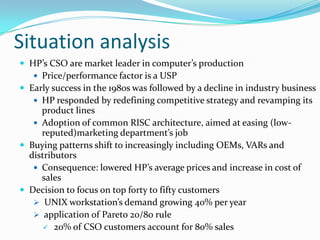
Situation analysis
 HP’s CSO are market leader in computer’s production
    Price/performance factor is a USP
 Early success in the 1980s was followed by a decline in industry business
    HP responded by redefining competitive strategy and revamping its
     product lines
    Adoption of common RISC architecture, aimed at easing (low-
     reputed)marketing department’s job
 Buying patterns shift to increasingly including OEMs, VARs and
  distributors
    Consequence: lowered HP’s average prices and increase in cost of
     sales
 Decision to focus on top forty to fifty customers
    UNIX workstation’s demand growing 40% per year
    application of Pareto 20/80 rule
       20% of CSO customers account for 80% sales
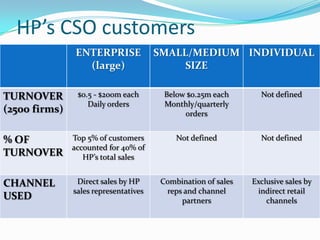
HP’s CSO customers
                ENTERPRISE             SMALL/MEDIUM INDIVIDUAL
                  (large)                   SIZE

TURNOVER        $0.5 - $200m each       Below $0.25m each       Not defined
                   Daily orders         Monthly/quarterly
(2500 firms)                                 orders


% OF           Top 5% of customers         Not defined          Not defined
               accounted for 40% of
TURNOVER          HP’s total sales


CHANNEL         Direct sales by HP     Combination of sales   Exclusive sales by
               sales representatives    reps and channel       indirect retail
USED                                        partners              channels
Issue at hand

    Identify market and
        organisational               Redefinition of industry
opportunities to grow and              focused approach to
reduce operational costs           selling to large/enterprise
 (i.e. Sales, support) from                 customers
         30% to 10%


 solving the issue could yield another structural change
in the sales organisation department (first change:1992)
 Robert Dudley from Leap Consulting commissioned to
audit HP’s enterprise customer management approach
Planning the next step:
           the sales process audit
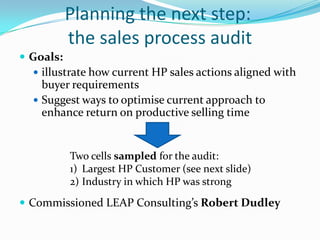
 Goals:
   illustrate how current HP sales actions aligned with
    buyer requirements
   Suggest ways to optimise current approach to
    enhance return on productive selling time


           Two cells sampled for the audit:
           1) Largest HP Customer (see next slide)
           2) Industry in which HP was strong

 Commissioned LEAP Consulting’s Robert Dudley
Planning the next step:
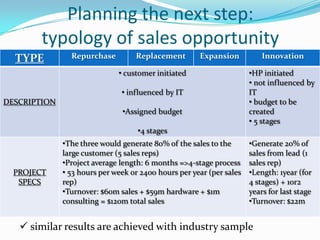
        typology of sales opportunity
  TYPE          Repurchase         Replacement        Expansion           Innovation

                              • customer initiated                    •HP initiated
                                                                      • not influenced by
                               • influenced by IT                     IT
DESCRIPTION                                                           • budget to be
                               •Assigned budget                       created
                                                                      • 5 stages
                                    •4 stages
              •The three would generate 80% of the sales to the       •Generate 20% of
              large customer (5 sales reps)                           sales from lead (1
              •Project average length: 6 months =>4-stage process     sales rep)
  PROJECT     • 53 hours per week or 2400 hours per year (per sales   •Length: 1year (for
   SPECS      rep)                                                    4 stages) + 1or2
              •Turnover: $60m sales + $59m hardware + $1m             years for last stage
              consulting = $120m total sales                          •Turnover: $22m


    similar results are achieved with industry sample
The next steps
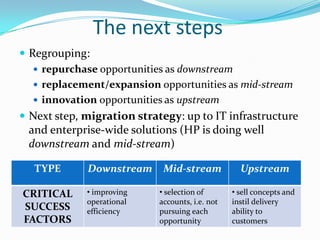
 Regrouping:
    repurchase opportunities as downstream
    replacement/expansion opportunities as mid-stream
    innovation opportunities as upstream
 Next step, migration strategy: up to IT infrastructure
 and enterprise-wide solutions (HP is doing well
 downstream and mid-stream)

   TYPE      Downstream      Mid-stream            Upstream

CRITICAL     • improving    • selection of       • sell concepts and
             operational    accounts, i.e. not   instil delivery
SUCCESS      efficiency     pursuing each        ability to
FACTORS                     opportunity          customers
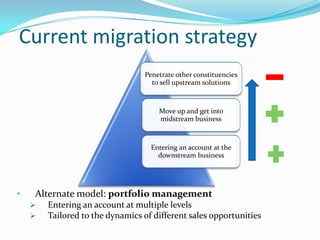
Current migration strategy
                                 Penetrate other constituencies
                                   to sell upstream solutions


                                     Move up and get into
                                     midstream business


                                   Entering an account at the
                                     downstream business


•   Alternate model: portfolio management
       Entering an account at multiple levels
       Tailored to the dynamics of different sales opportunities
Questions
1)   Is this the time for HP’s CSO to institute more changes? What
     are your recommendations to Diaz?
•    It’s about time for HP’s CSO to institute some changes to the
     current architecture:
        Avoidance of numerous time drains due to sales rep “running in a
         treadmill” to do everything for their accounts, e.g. Developing
         quotes, configuring systems
        Need to prioritise the accounts and institute a support team
         specialised on understanding the accounts’ needs further
         reducing wasted time
        The latter point will reflect a better conversion rate in sales
         opportunities, focusing not solely on repurchase opportunities
        In general give more specifications as to which procedures to
         follow in deciding to serve an account and at which conditions
Questions
2) How is selling instruments (HP’s traditional business)
  different from selling computer systems? Why does HP
  treat its sales force as a cost centre? What are the
  implications of such a structure?
 it differs in that HP “evolved from a manufacturer of ‘hot
  boxes’ into a global supplier of information appliances and
  solutions”
 HP treats its sales force as a cost centre because they are
  focused on additional profits, thus making the salesforce
  strive to close as many orders as possible, not being able to
  add value to any business
    also due to the transactional nature of the businesses HP
     serves; no customer seems interested in partnering up in the
     long term with HP so that to mutually benefit and add value
    Emphasised by the (almost) lack of innovative projects
Questions
3) What is HP’s CSO approach to building relationships with
   enterprise customers? What are its strengths and weaknesses?
 HP serves this segment directly
 HP sales rep invested time and effort from an early stage in
   learning their customers’ businesses both identifying problems
   and solutions to save money and increase efficiency
    salespeople transformed in consultants
 Strengths: develop long-term relationship with customers,
  adding value to both businesses through customisation of
  offerings
 Weaknesses: need for optimisation in providing such kind of
  customised “consultant” service. In fact sales people are used by
  the customers to solve any problem they may have. Also, there is
  a need to prioritise accounts: skip that and you’ll lose business
Questions
4) Do you agree with the findings of the two audits as well as the
  consultant’s recommendations? How is the new approach
  different from HP’s CSO current approach to managing enterprise
  customers?
 The recommendations by the consultant are consistent with the
  critical success factors of the three new categories (down,mid and
  up stream) and with the findings
 However HP needs to resolve its internal and external issues (e.g.
  being positioned only as a hardware supplier) before moving on
  to a portfolio management strategy
    That means focusing on training more salespeople in forging
     relationships with large enterprises; it also involves prioritisation
     procedure for mid-stream and up-stream opportunities
    Currently, HP salespeople are not prepared for such a switch (HP is
     not well known for its marketing savvy)
 In the new approach HP would enter an account at multiple levels
  instead of entering it at the downstream level and then trying to
  tackle the rest of the organisation’s needs

B2b marketing

  • 1.
    Hewlett Packard –Computer Systems Organisation: selling to enterprise customers
  • 2.
    Situation analysis  HP’sCSO are market leader in computer’s production  Price/performance factor is a USP  Early success in the 1980s was followed by a decline in industry business  HP responded by redefining competitive strategy and revamping its product lines  Adoption of common RISC architecture, aimed at easing (low- reputed)marketing department’s job  Buying patterns shift to increasingly including OEMs, VARs and distributors  Consequence: lowered HP’s average prices and increase in cost of sales  Decision to focus on top forty to fifty customers  UNIX workstation’s demand growing 40% per year  application of Pareto 20/80 rule  20% of CSO customers account for 80% sales
  • 3.
    HP’s CSO customers ENTERPRISE SMALL/MEDIUM INDIVIDUAL (large) SIZE TURNOVER $0.5 - $200m each Below $0.25m each Not defined Daily orders Monthly/quarterly (2500 firms) orders % OF Top 5% of customers Not defined Not defined accounted for 40% of TURNOVER HP’s total sales CHANNEL Direct sales by HP Combination of sales Exclusive sales by sales representatives reps and channel indirect retail USED partners channels
  • 4.
    Issue at hand Identify market and organisational Redefinition of industry opportunities to grow and focused approach to reduce operational costs selling to large/enterprise (i.e. Sales, support) from customers 30% to 10%  solving the issue could yield another structural change in the sales organisation department (first change:1992)  Robert Dudley from Leap Consulting commissioned to audit HP’s enterprise customer management approach
  • 5.
    Planning the nextstep: the sales process audit  Goals:  illustrate how current HP sales actions aligned with buyer requirements  Suggest ways to optimise current approach to enhance return on productive selling time Two cells sampled for the audit: 1) Largest HP Customer (see next slide) 2) Industry in which HP was strong  Commissioned LEAP Consulting’s Robert Dudley
  • 6.
    Planning the nextstep: typology of sales opportunity TYPE Repurchase Replacement Expansion Innovation • customer initiated •HP initiated • not influenced by • influenced by IT IT DESCRIPTION • budget to be •Assigned budget created • 5 stages •4 stages •The three would generate 80% of the sales to the •Generate 20% of large customer (5 sales reps) sales from lead (1 •Project average length: 6 months =>4-stage process sales rep) PROJECT • 53 hours per week or 2400 hours per year (per sales •Length: 1year (for SPECS rep) 4 stages) + 1or2 •Turnover: $60m sales + $59m hardware + $1m years for last stage consulting = $120m total sales •Turnover: $22m  similar results are achieved with industry sample
  • 7.
    The next steps Regrouping:  repurchase opportunities as downstream  replacement/expansion opportunities as mid-stream  innovation opportunities as upstream  Next step, migration strategy: up to IT infrastructure and enterprise-wide solutions (HP is doing well downstream and mid-stream) TYPE Downstream Mid-stream Upstream CRITICAL • improving • selection of • sell concepts and operational accounts, i.e. not instil delivery SUCCESS efficiency pursuing each ability to FACTORS opportunity customers
  • 8.
    Current migration strategy Penetrate other constituencies to sell upstream solutions Move up and get into midstream business Entering an account at the downstream business • Alternate model: portfolio management  Entering an account at multiple levels  Tailored to the dynamics of different sales opportunities
  • 9.
    Questions 1) Is this the time for HP’s CSO to institute more changes? What are your recommendations to Diaz? • It’s about time for HP’s CSO to institute some changes to the current architecture:  Avoidance of numerous time drains due to sales rep “running in a treadmill” to do everything for their accounts, e.g. Developing quotes, configuring systems  Need to prioritise the accounts and institute a support team specialised on understanding the accounts’ needs further reducing wasted time  The latter point will reflect a better conversion rate in sales opportunities, focusing not solely on repurchase opportunities  In general give more specifications as to which procedures to follow in deciding to serve an account and at which conditions
  • 10.
    Questions 2) How isselling instruments (HP’s traditional business) different from selling computer systems? Why does HP treat its sales force as a cost centre? What are the implications of such a structure?  it differs in that HP “evolved from a manufacturer of ‘hot boxes’ into a global supplier of information appliances and solutions”  HP treats its sales force as a cost centre because they are focused on additional profits, thus making the salesforce strive to close as many orders as possible, not being able to add value to any business  also due to the transactional nature of the businesses HP serves; no customer seems interested in partnering up in the long term with HP so that to mutually benefit and add value  Emphasised by the (almost) lack of innovative projects
  • 11.
    Questions 3) What isHP’s CSO approach to building relationships with enterprise customers? What are its strengths and weaknesses?  HP serves this segment directly  HP sales rep invested time and effort from an early stage in learning their customers’ businesses both identifying problems and solutions to save money and increase efficiency  salespeople transformed in consultants  Strengths: develop long-term relationship with customers, adding value to both businesses through customisation of offerings  Weaknesses: need for optimisation in providing such kind of customised “consultant” service. In fact sales people are used by the customers to solve any problem they may have. Also, there is a need to prioritise accounts: skip that and you’ll lose business
  • 12.
    Questions 4) Do youagree with the findings of the two audits as well as the consultant’s recommendations? How is the new approach different from HP’s CSO current approach to managing enterprise customers?  The recommendations by the consultant are consistent with the critical success factors of the three new categories (down,mid and up stream) and with the findings  However HP needs to resolve its internal and external issues (e.g. being positioned only as a hardware supplier) before moving on to a portfolio management strategy  That means focusing on training more salespeople in forging relationships with large enterprises; it also involves prioritisation procedure for mid-stream and up-stream opportunities  Currently, HP salespeople are not prepared for such a switch (HP is not well known for its marketing savvy)  In the new approach HP would enter an account at multiple levels instead of entering it at the downstream level and then trying to tackle the rest of the organisation’s needs