How to Write an A+ Essay
for Competitive Exams
By Rruchi Shrimalli
Things to Come
Most of the college-level or career-oriented exams, such as UPSC exams, Bank PO exams, MBA
entrance exams, or admission tests for colleges abroad include essay writing questions.
In this ppt, we will discuss:
• What do examiners look for in an Essay?
• Preparation to do before the Competitive Exam
• Structure of a Good Essay
• Tips on how to write a Scoring Essay in the Examination Hall
• Things to avoid while writing an Essay in Competitive Exams
What do instructors look for in an Essay?
• Types of essays asked in a competitive exam
can vary, according to what the selectors are
looking for in the candidates, such as:
• Informative Essays are meant to test your
knowledge on a subject, and how well you can
explain it to others; or
• Persuasive Essays are argumentative in nature,
and check your logical reasoning, clarity of your
thoughts, how well you assess a situation, whether
your approach is balanced or not, and how well
you can communicate your ideas to others.
• Essays should have substance. Content is King
here. Instructors and selectors can tell when
students are bluffing.
What do examiners look for in an Essay?
• Essays should be grammatically correct, and
should be within the given word limit.
• Introduction of an Essay is worth at least 10%
of your marks. It should be succinct, introduce
the topic clearly, and give a quick re-cap of
how you are going to prove your point.
• Organization of thoughts is important too.
Ideally, each paragraph should discuss only one
point. Flow of ideas is important too.
• Make sure you end your essay with an effective
and well-crafted Conclusion.
Preparation to do before the Competitive Exam
• Go through the previous years' questions papers and see
what kind of essay topics have been asked. Were they
based on competitive events. Did they ask students to
compare two theories and take sides? Prepare for the
questions accordingly.
• Writing a good essay needs regular practice. Focus on
introducing your arguments or ideas clearly and concisely,
supporting them with facts and figures, drawing inferences
logically, and concluding your essay well.
• Memorizing key events, names, facts and figures about the
probable topics can help you add life to your essay.
• Learn how to organize your ideas in different kinds of
essays. For example, in a comparison essay, you need to
touch upon the theories you are discussing, describe the
topic briefly, compare the arguments and predictions, and
present the clear and logical conclusion.
Suggested Reading for Essay Writing in
Competitive Exams
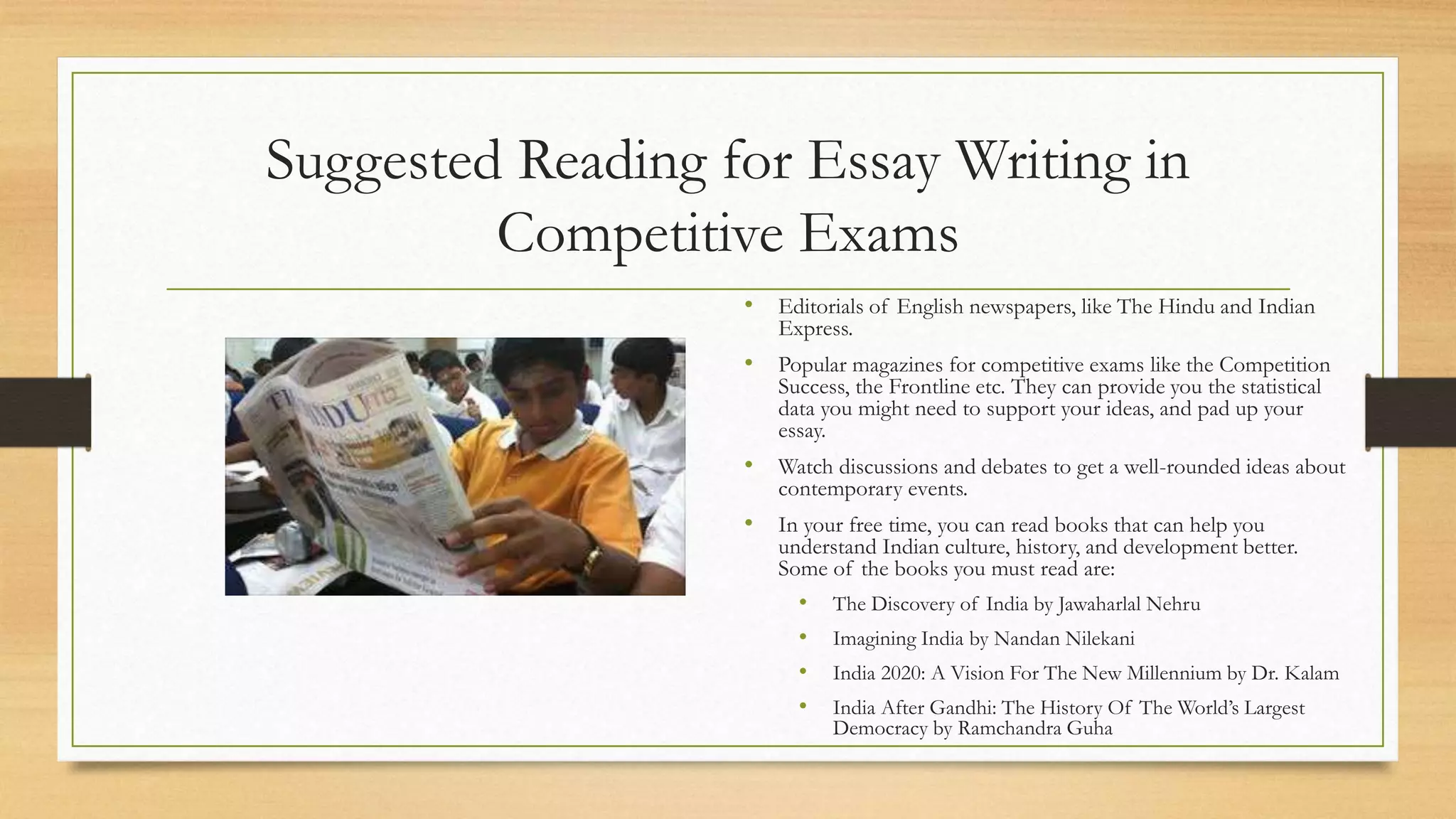
• Editorials of English newspapers, like The Hindu and Indian
Express.
• Popular magazines for competitive exams like the Competition
Success, the Frontline etc. They can provide you the statistical
data you might need to support your ideas, and pad up your
essay.
• Watch discussions and debates to get a well-rounded ideas about
contemporary events.
• In your free time, you can read books that can help you
understand Indian culture, history, and development better.
Some of the books you must read are:
• The Discovery of India by Jawaharlal Nehru
• Imagining India by Nandan Nilekani
• India 2020: A Vision For The New Millennium by Dr. Kalam
• India After Gandhi: The History Of The World’s Largest
Democracy by Ramchandra Guha
Structure of a Good Essay
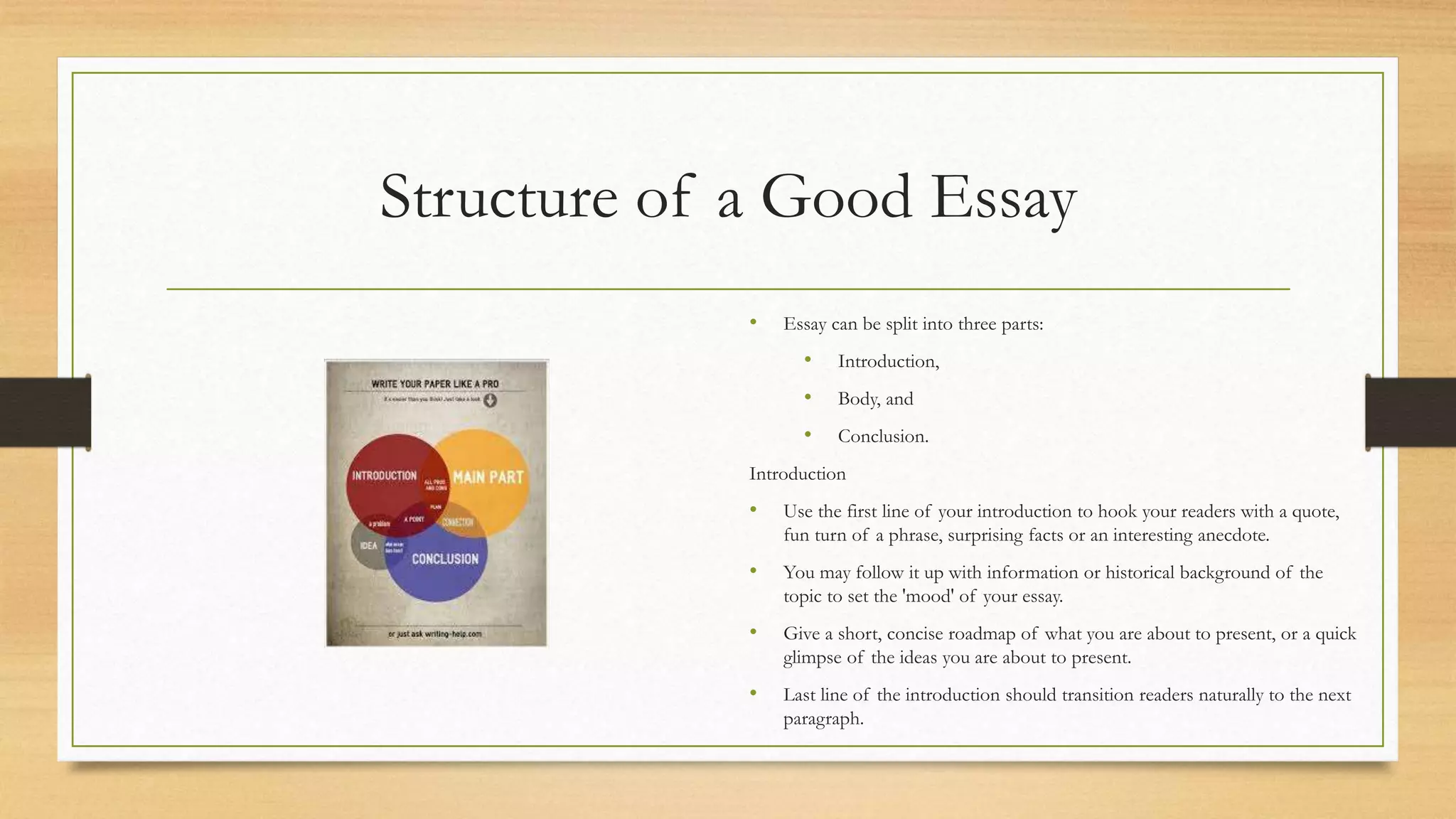
• Essay can be split into three parts:
• Introduction,
• Body, and
• Conclusion.
Introduction
• Use the first line of your introduction to hook your readers with a quote,
fun turn of a phrase, surprising facts or an interesting anecdote.
• You may follow it up with information or historical background of the
topic to set the 'mood' of your essay.
• Give a short, concise roadmap of what you are about to present, or a quick
glimpse of the ideas you are about to present.
• Last line of the introduction should transition readers naturally to the next
paragraph.
Structure of a Good Essay
Body
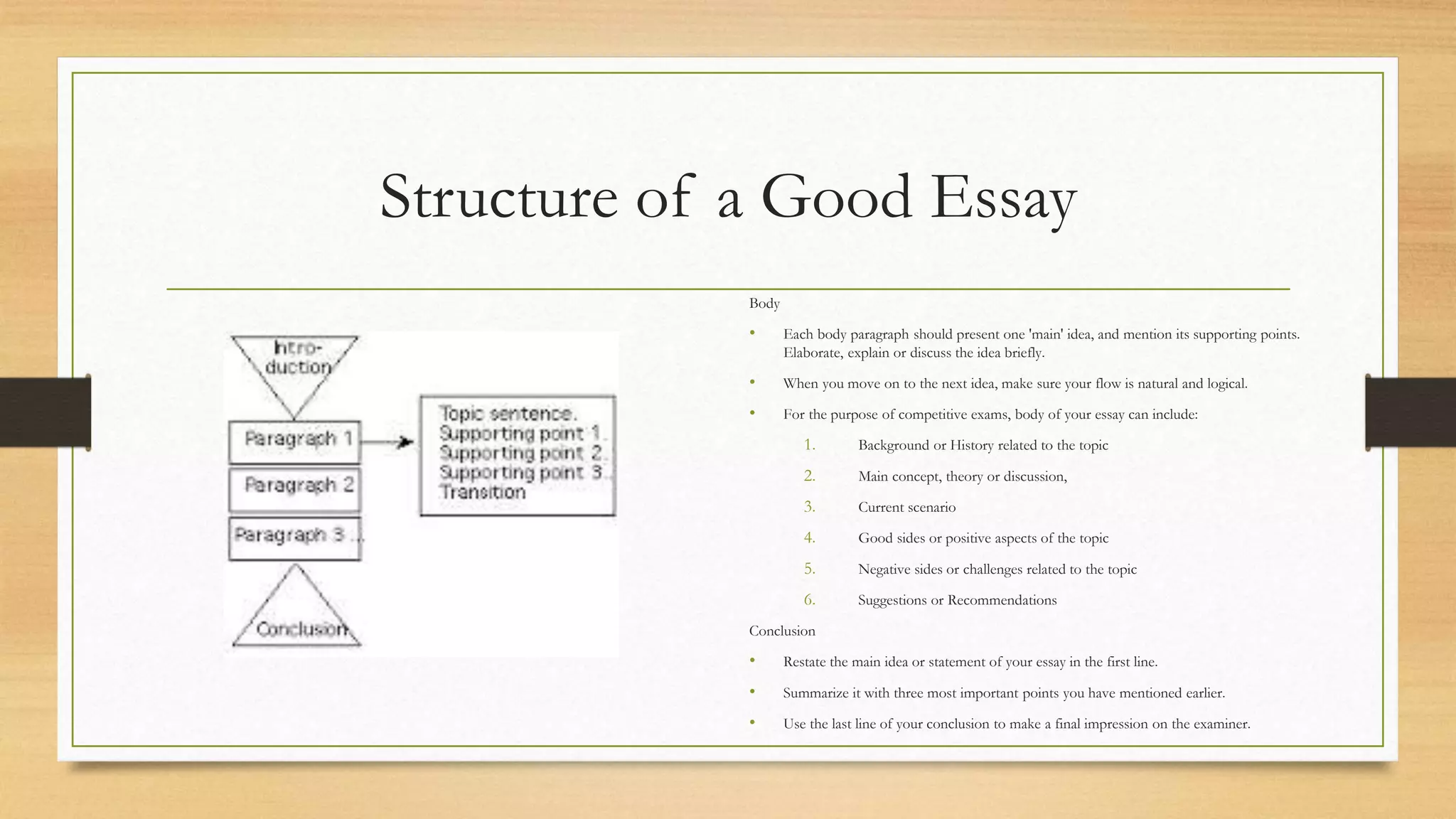
• Each body paragraph should present one 'main' idea, and mention its supporting points.
Elaborate, explain or discuss the idea briefly.
• When you move on to the next idea, make sure your flow is natural and logical.
• For the purpose of competitive exams, body of your essay can include:
1. Background or History related to the topic
2. Main concept, theory or discussion,
3. Current scenario
4. Good sides or positive aspects of the topic
5. Negative sides or challenges related to the topic
6. Suggestions or Recommendations
Conclusion
• Restate the main idea or statement of your essay in the first line.
• Summarize it with three most important points you have mentioned earlier.
• Use the last line of your conclusion to make a final impression on the examiner.
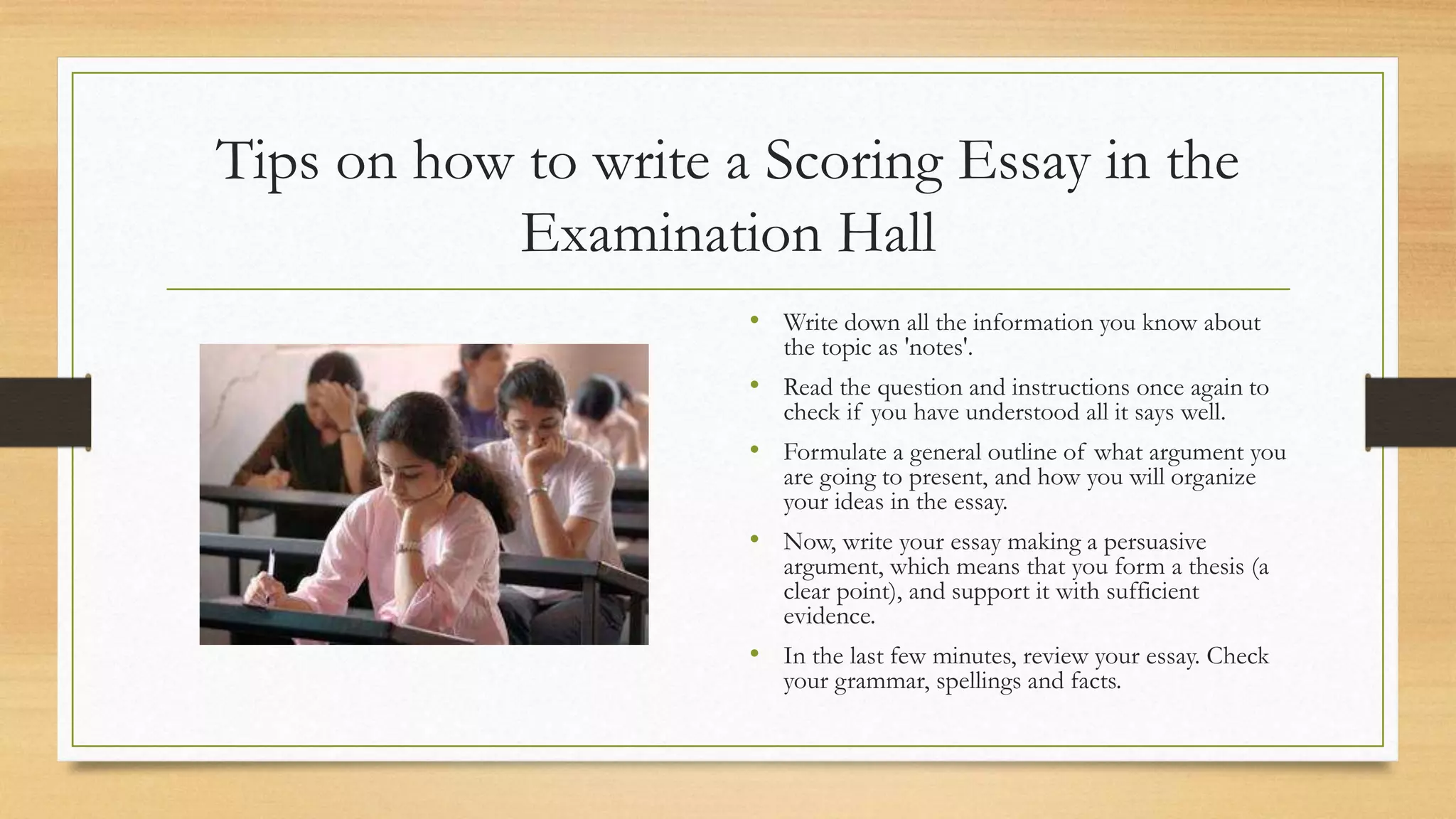
Tips on how to write a Scoring Essay in the
Examination Hall
• Write down all the information you know about
the topic as 'notes'.
• Read the question and instructions once again to
check if you have understood all it says well.
• Formulate a general outline of what argument you
are going to present, and how you will organize
your ideas in the essay.
• Now, write your essay making a persuasive
argument, which means that you form a thesis (a
clear point), and support it with sufficient
evidence.
• In the last few minutes, review your essay. Check
your grammar, spellings and facts.
Things to avoid while writing an Essay in
Competitive Exams
• Many things can go wrong when you attempt to write an
essay. You may run out of time or ideas. But do not end your
essay with excuses like 'I am out of time' or 'I couldn't study
about it because I was sick.' It is a sure-shot way to make the
examiner suck in your scores.
• If you draw out a blank, elaborate on something you know
and is related to the question.
• Do not dump everything you know about the topic on the
paper. Only include what is relevant to the question, and
whatever supports your take on the topic.
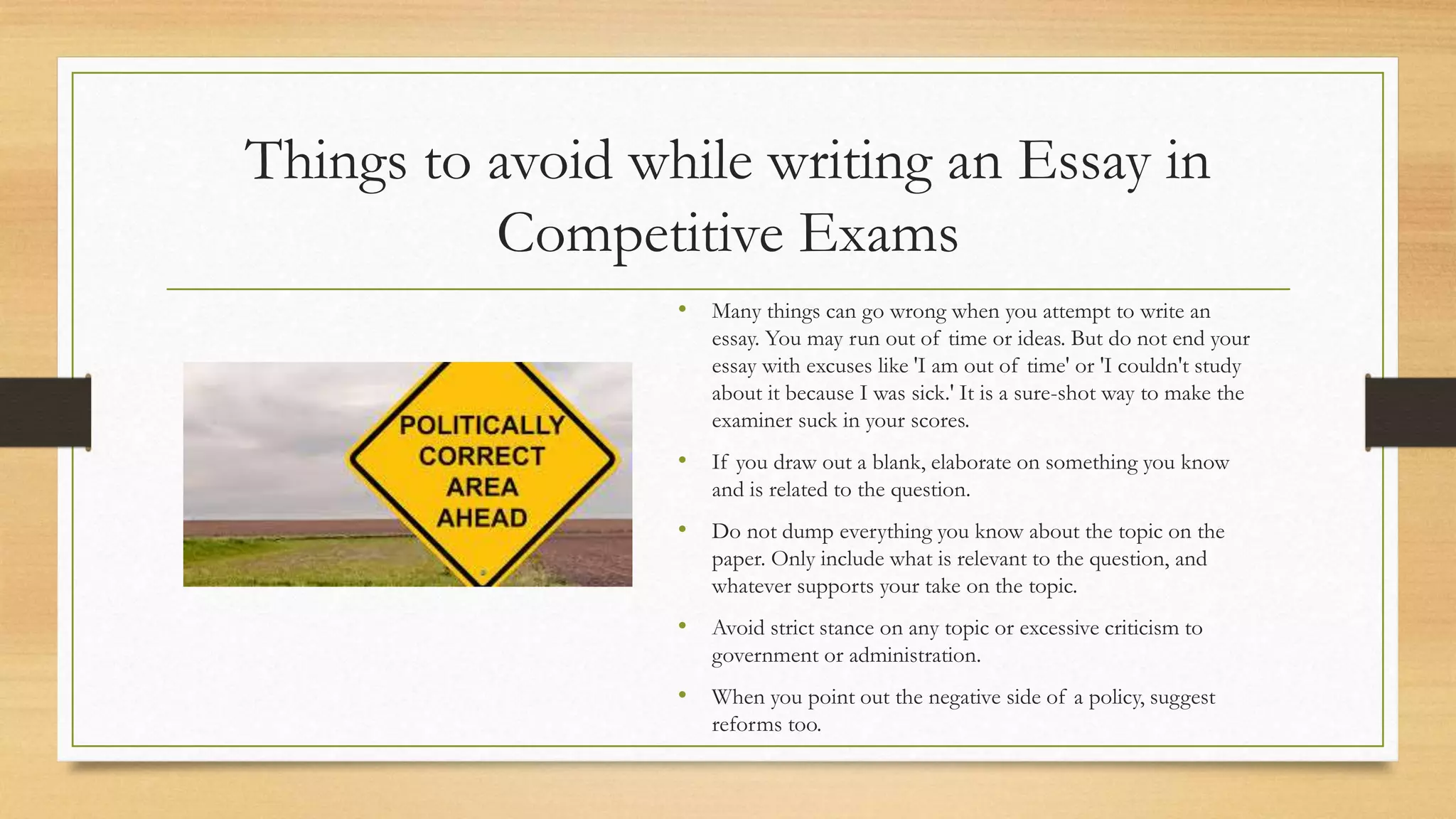
• Avoid strict stance on any topic or excessive criticism to
government or administration.
• When you point out the negative side of a policy, suggest
reforms too.
Things to avoid while writing an Essay in
Competitive Exams
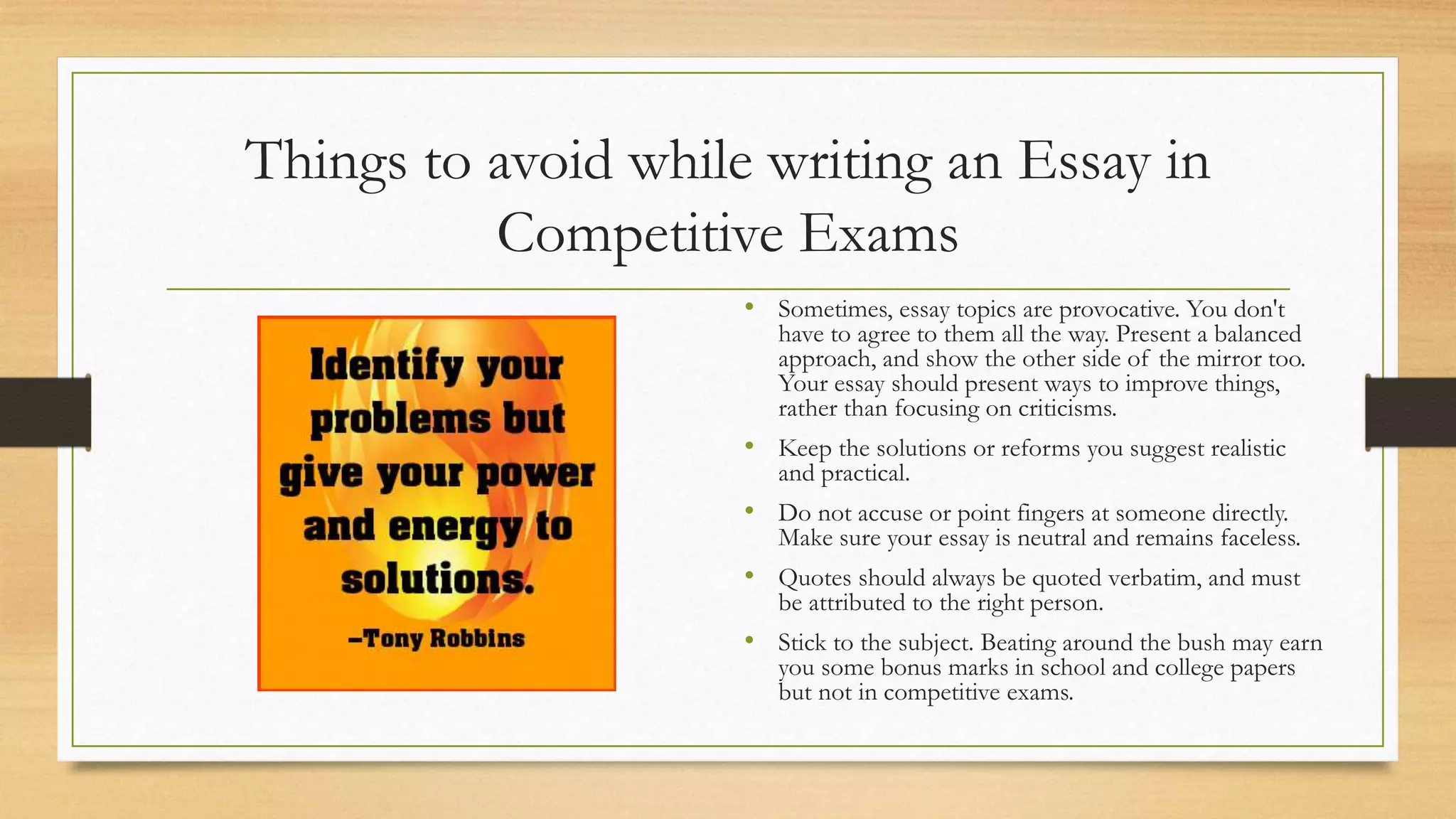
• Sometimes, essay topics are provocative. You don't
have to agree to them all the way. Present a balanced
approach, and show the other side of the mirror too.
Your essay should present ways to improve things,
rather than focusing on criticisms.
• Keep the solutions or reforms you suggest realistic
and practical.
• Do not accuse or point fingers at someone directly.
Make sure your essay is neutral and remains faceless.
• Quotes should always be quoted verbatim, and must
be attributed to the right person.
• Stick to the subject. Beating around the bush may earn
you some bonus marks in school and college papers
but not in competitive exams.
Thank You!
For more guidance on how to crack competitive exams, or how to write a high-
scoring essay, contact us at help@transtutors.com

How to write an awesome A+ essay

  • 1.
    How to Writean A+ Essay for Competitive Exams By Rruchi Shrimalli
  • 2.
    Things to Come Mostof the college-level or career-oriented exams, such as UPSC exams, Bank PO exams, MBA entrance exams, or admission tests for colleges abroad include essay writing questions. In this ppt, we will discuss: • What do examiners look for in an Essay? • Preparation to do before the Competitive Exam • Structure of a Good Essay • Tips on how to write a Scoring Essay in the Examination Hall • Things to avoid while writing an Essay in Competitive Exams
  • 3.
    What do instructorslook for in an Essay? • Types of essays asked in a competitive exam can vary, according to what the selectors are looking for in the candidates, such as: • Informative Essays are meant to test your knowledge on a subject, and how well you can explain it to others; or • Persuasive Essays are argumentative in nature, and check your logical reasoning, clarity of your thoughts, how well you assess a situation, whether your approach is balanced or not, and how well you can communicate your ideas to others. • Essays should have substance. Content is King here. Instructors and selectors can tell when students are bluffing.
  • 4.
    What do examinerslook for in an Essay? • Essays should be grammatically correct, and should be within the given word limit. • Introduction of an Essay is worth at least 10% of your marks. It should be succinct, introduce the topic clearly, and give a quick re-cap of how you are going to prove your point. • Organization of thoughts is important too. Ideally, each paragraph should discuss only one point. Flow of ideas is important too. • Make sure you end your essay with an effective and well-crafted Conclusion.
  • 5.
    Preparation to dobefore the Competitive Exam • Go through the previous years' questions papers and see what kind of essay topics have been asked. Were they based on competitive events. Did they ask students to compare two theories and take sides? Prepare for the questions accordingly. • Writing a good essay needs regular practice. Focus on introducing your arguments or ideas clearly and concisely, supporting them with facts and figures, drawing inferences logically, and concluding your essay well. • Memorizing key events, names, facts and figures about the probable topics can help you add life to your essay. • Learn how to organize your ideas in different kinds of essays. For example, in a comparison essay, you need to touch upon the theories you are discussing, describe the topic briefly, compare the arguments and predictions, and present the clear and logical conclusion.
  • 6.
    Suggested Reading forEssay Writing in Competitive Exams • Editorials of English newspapers, like The Hindu and Indian Express. • Popular magazines for competitive exams like the Competition Success, the Frontline etc. They can provide you the statistical data you might need to support your ideas, and pad up your essay. • Watch discussions and debates to get a well-rounded ideas about contemporary events. • In your free time, you can read books that can help you understand Indian culture, history, and development better. Some of the books you must read are: • The Discovery of India by Jawaharlal Nehru • Imagining India by Nandan Nilekani • India 2020: A Vision For The New Millennium by Dr. Kalam • India After Gandhi: The History Of The World’s Largest Democracy by Ramchandra Guha
  • 7.
    Structure of aGood Essay • Essay can be split into three parts: • Introduction, • Body, and • Conclusion. Introduction • Use the first line of your introduction to hook your readers with a quote, fun turn of a phrase, surprising facts or an interesting anecdote. • You may follow it up with information or historical background of the topic to set the 'mood' of your essay. • Give a short, concise roadmap of what you are about to present, or a quick glimpse of the ideas you are about to present. • Last line of the introduction should transition readers naturally to the next paragraph.
  • 8.
    Structure of aGood Essay Body • Each body paragraph should present one 'main' idea, and mention its supporting points. Elaborate, explain or discuss the idea briefly. • When you move on to the next idea, make sure your flow is natural and logical. • For the purpose of competitive exams, body of your essay can include: 1. Background or History related to the topic 2. Main concept, theory or discussion, 3. Current scenario 4. Good sides or positive aspects of the topic 5. Negative sides or challenges related to the topic 6. Suggestions or Recommendations Conclusion • Restate the main idea or statement of your essay in the first line. • Summarize it with three most important points you have mentioned earlier. • Use the last line of your conclusion to make a final impression on the examiner.
  • 9.
    Tips on howto write a Scoring Essay in the Examination Hall • Write down all the information you know about the topic as 'notes'. • Read the question and instructions once again to check if you have understood all it says well. • Formulate a general outline of what argument you are going to present, and how you will organize your ideas in the essay. • Now, write your essay making a persuasive argument, which means that you form a thesis (a clear point), and support it with sufficient evidence. • In the last few minutes, review your essay. Check your grammar, spellings and facts.
  • 10.
    Things to avoidwhile writing an Essay in Competitive Exams • Many things can go wrong when you attempt to write an essay. You may run out of time or ideas. But do not end your essay with excuses like 'I am out of time' or 'I couldn't study about it because I was sick.' It is a sure-shot way to make the examiner suck in your scores. • If you draw out a blank, elaborate on something you know and is related to the question. • Do not dump everything you know about the topic on the paper. Only include what is relevant to the question, and whatever supports your take on the topic. • Avoid strict stance on any topic or excessive criticism to government or administration. • When you point out the negative side of a policy, suggest reforms too.
  • 11.
    Things to avoidwhile writing an Essay in Competitive Exams • Sometimes, essay topics are provocative. You don't have to agree to them all the way. Present a balanced approach, and show the other side of the mirror too. Your essay should present ways to improve things, rather than focusing on criticisms. • Keep the solutions or reforms you suggest realistic and practical. • Do not accuse or point fingers at someone directly. Make sure your essay is neutral and remains faceless. • Quotes should always be quoted verbatim, and must be attributed to the right person. • Stick to the subject. Beating around the bush may earn you some bonus marks in school and college papers but not in competitive exams.
  • 12.
    Thank You! For moreguidance on how to crack competitive exams, or how to write a high- scoring essay, contact us at help@transtutors.com