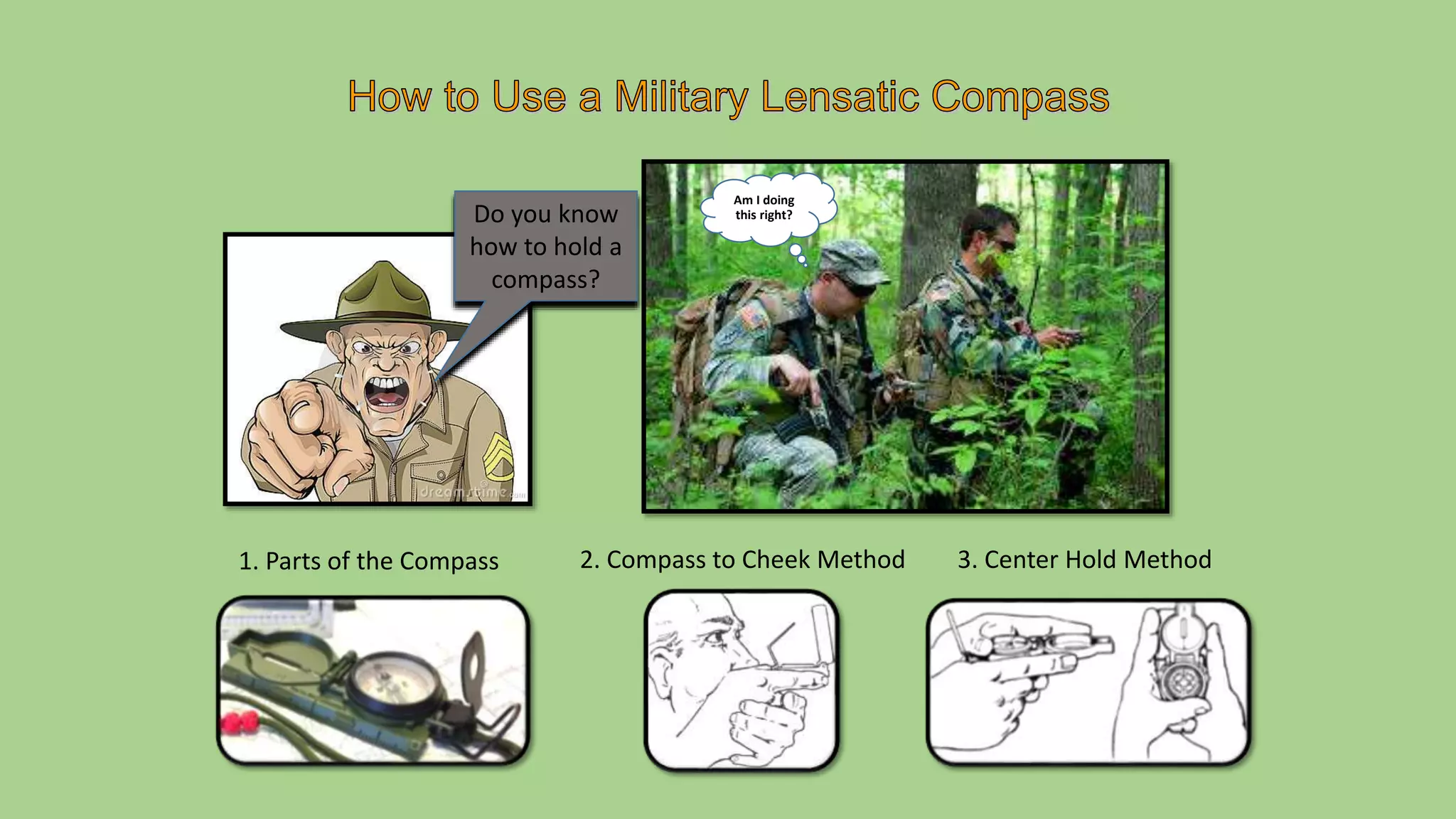
3. Center Hold Method2. Compass to Cheek Method1. Parts of the Compass
Do you know
how to hold a
compass?
Am I doing
this right?
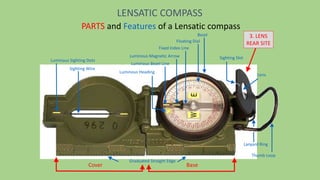
Thumb Loop
Lanyard Ring
Sighting Slot
Lens
Luminous Bezel Line
Luminous Magnetic Arrow
Fixed Index Line
Luminous Heading
Luminous Sighting Dots
Sighting Wire
Graduated Straight Edge
Floating Dial
Bezel 3. LENS
REAR SITE
LENSATIC COMPASS
PARTS and Features of a Lensatic compass
Cover Base
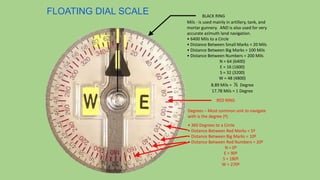
Degrees – Most common unit to navigate
with is the degree (º).
• 360 Degrees to a Circle
• Distance Between Red Marks = 5º
• Distance Between Big Marks = 10º
• Distance Between Red Numbers = 20º
N = 0º
E = 90º
S = 180º
W = 270º
BLACK RING
RED RING
FLOATING DIAL SCALE
Mils - is used mainly in artillery, tank, and
mortar gunnery. AND is also used for very
accurate azimuth land navigation.
• 6400 Mils to a Circle
• Distance Between Small Marks = 20 Mils
• Distance Between Big Marks = 100 Mils
• Distance Between Numbers = 200 Mils
N = 64 (6400)
E = 16 (1600)
S = 32 (3200)
W = 48 (4800)
8.89 Mils = ½ Degree
17.78 Mils = 1 Degree
Compass to Cheek Method
Click forward
for Compass
to Cheek!
Am I doing
this right?
Compass-to-Cheek method
for taking a target azimuth bearing
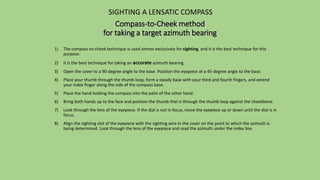
1) The compass-to-cheek technique is used almost exclusively for sighting, and it is the best
technique for this purpose.
2) It is the best technique for taking an accurate azimuth bearing.
3) Open the cover to a 90-degree angle to the base. Position the eyepiece at a 45-degree angle to the
base.
4) Place your thumb through the thumb loop, form a steady base with your third and fourth fingers,
and extend your index finger along the side of the compass base.
5) Place the hand holding the compass into the palm of the other hand.
6) Bring both hands up to the face and position the thumb that is through the thumb loop against the
cheekbone.
7) Look through the lens of the eyepiece. If the dial is not in focus, move the eyepiece up or down
until the dial is in focus.
8) Align the sighting slot of the eyepiece with the sighting wire in the cover on the point to which the
azimuth is being determined. Look through the lens of the eyepiece and read the azimuth under
the index line.
SIGHTING A LENSATIC COMPASS
Compass-to-Cheek method
for taking a target azimuth bearing
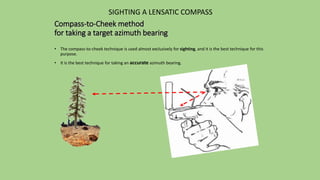
• The compass-to-cheek technique is used almost exclusively for sighting, and it is the best technique for this
purpose.
• It is the best technique for taking an accurate azimuth bearing.
SIGHTING A LENSATIC COMPASS
Center Hold Method
Click forward
to the Center
Hold Method!
Am I doing
this right?
Center-Hold method
for taking a target azimuth bearing
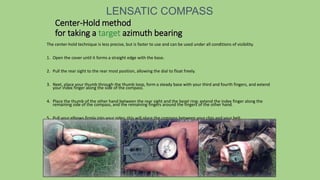
The center-hold technique is less precise, but is faster to use and can be used under all conditions of visibility.
1. Open the cover until it forms a straight edge with the base.
2. Pull the rear sight to the rear most position, allowing the dial to float freely.
3. Next, place your thumb through the thumb loop, form a steady base with your third and fourth fingers, and extend
your index finger along the side of the compass.
4. Place the thumb of the other hand between the rear sight and the bezel ring; extend the index finger along the
remaining side of the compass, and the remaining fingers around the fingers of the other hand.
5. Pull your elbows firmly into your sides; this will place the compass between your chin and your belt.
6. To measure azimuth, turn entire body toward the object, pointing the compass cover directly at the object.
7. Once you are pointing at the object, look down and read the azimuth from the fixed black index line.
LENSATIC COMPASS
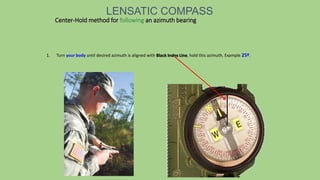
Center-Hold method for following an azimuth bearing
LENSATIC COMPASS
1. Turn your body until desired azimuth is aligned with Black Index Line, hold this azimuth. Example 25º.

How to use a lensatic compass

  • 1.
    3. Center HoldMethod2. Compass to Cheek Method1. Parts of the Compass Do you know how to hold a compass? Am I doing this right?
  • 2.
    Thumb Loop Lanyard Ring SightingSlot Lens Luminous Bezel Line Luminous Magnetic Arrow Fixed Index Line Luminous Heading Luminous Sighting Dots Sighting Wire Graduated Straight Edge Floating Dial Bezel 3. LENS REAR SITE LENSATIC COMPASS PARTS and Features of a Lensatic compass Cover Base
  • 3.
    Degrees – Mostcommon unit to navigate with is the degree (º). • 360 Degrees to a Circle • Distance Between Red Marks = 5º • Distance Between Big Marks = 10º • Distance Between Red Numbers = 20º N = 0º E = 90º S = 180º W = 270º BLACK RING RED RING FLOATING DIAL SCALE Mils - is used mainly in artillery, tank, and mortar gunnery. AND is also used for very accurate azimuth land navigation. • 6400 Mils to a Circle • Distance Between Small Marks = 20 Mils • Distance Between Big Marks = 100 Mils • Distance Between Numbers = 200 Mils N = 64 (6400) E = 16 (1600) S = 32 (3200) W = 48 (4800) 8.89 Mils = ½ Degree 17.78 Mils = 1 Degree
  • 4.
    Compass to CheekMethod Click forward for Compass to Cheek! Am I doing this right?
  • 5.
    Compass-to-Cheek method for takinga target azimuth bearing 1) The compass-to-cheek technique is used almost exclusively for sighting, and it is the best technique for this purpose. 2) It is the best technique for taking an accurate azimuth bearing. 3) Open the cover to a 90-degree angle to the base. Position the eyepiece at a 45-degree angle to the base. 4) Place your thumb through the thumb loop, form a steady base with your third and fourth fingers, and extend your index finger along the side of the compass base. 5) Place the hand holding the compass into the palm of the other hand. 6) Bring both hands up to the face and position the thumb that is through the thumb loop against the cheekbone. 7) Look through the lens of the eyepiece. If the dial is not in focus, move the eyepiece up or down until the dial is in focus. 8) Align the sighting slot of the eyepiece with the sighting wire in the cover on the point to which the azimuth is being determined. Look through the lens of the eyepiece and read the azimuth under the index line. SIGHTING A LENSATIC COMPASS
  • 6.
    Compass-to-Cheek method for takinga target azimuth bearing • The compass-to-cheek technique is used almost exclusively for sighting, and it is the best technique for this purpose. • It is the best technique for taking an accurate azimuth bearing. SIGHTING A LENSATIC COMPASS
  • 7.
    Center Hold Method Clickforward to the Center Hold Method! Am I doing this right?
  • 8.
    Center-Hold method for takinga target azimuth bearing The center-hold technique is less precise, but is faster to use and can be used under all conditions of visibility. 1. Open the cover until it forms a straight edge with the base. 2. Pull the rear sight to the rear most position, allowing the dial to float freely. 3. Next, place your thumb through the thumb loop, form a steady base with your third and fourth fingers, and extend your index finger along the side of the compass. 4. Place the thumb of the other hand between the rear sight and the bezel ring; extend the index finger along the remaining side of the compass, and the remaining fingers around the fingers of the other hand. 5. Pull your elbows firmly into your sides; this will place the compass between your chin and your belt. 6. To measure azimuth, turn entire body toward the object, pointing the compass cover directly at the object. 7. Once you are pointing at the object, look down and read the azimuth from the fixed black index line. LENSATIC COMPASS
  • 9.
    Center-Hold method forfollowing an azimuth bearing LENSATIC COMPASS 1. Turn your body until desired azimuth is aligned with Black Index Line, hold this azimuth. Example 25º.

Editor's Notes

  • #2 “Using the military lensatic compass we will learn basic land navigation skills to keep us from getting lost.”
  • #3 BEFORE CONTINUING WITH THE SLIDE “The lensatic compass has 3 PARTS with features on each part.” “As we go through these PARTS and FEATURES, we will go into more detail on each feature on the next slides. Right now we are just going to go through the names of each item.” CONTINUE WITH THE SLIDE PARTS 1. Cover 2. Base 3. Lens Rear Site FEATURES Luminous Sighting Dots Sighting Wire Etc
  • #4 AT THE END OF THE RED RING DESCRIPTION Have students look at the compass.
  • #5 “Using the military lensatic compass we will learn basic land navigation skills to keep us from getting lost.”
  • #6 Demonstrate procedures to the class. Explain step-by-step. Place your thumb through the thumb loop, and form a steady base with your third and fourth fingers, and extend your index finger along the side of the compass base. Place the hand holding compass into the palm of the other hand. Bring both hands up to the face and position the thumb that is through the thumb loop against the cheekbone. Look through the lens of the eyepiece. If the dial is not in focus, move the eyepiece up or down until the dial is in focus. Align the sighting slot of the eyepiece with the sighting wire in the cover on the point to which the azimuth is being determined. Look through the lens of the eyepiece and read the azimuth under the index line.
  • #7 Demonstrate procedures to the class. Explain step-by-step. Place your thumb through the thumb loop, and form a steady base with your third and fourth fingers, and extend your index finger along the side of the compass base. Place the hand holding compass into the palm of the other hand. Bring both hands up to the face and position the thumb that is through the thumb loop against the cheekbone. Look through the lens of the eyepiece. If the dial is not in focus, move the eyepiece up or down until the dial is in focus. Align the sighting slot of the eyepiece with the sighting wire in the cover on the point to which the azimuth is being determined. Look through the lens of the eyepiece and read the azimuth under the index line.
  • #8 “Using the military lensatic compass we will learn basic land navigation skills to keep us from getting lost.”
  • #9 Read the procedures first. Have the students try this. Procedures continued on next slide.
  • #10 Describe each procedure step-by-step first, before students perform this procedure. Pick a random azimuth and have the students perform this procedure using the same random azimuth. Verify their readings; they all should be the same. Random azimuth selected Luminous Bezel Line reading.