How to support safe driving at work –
Possible safety culture interventions


Prof. Dr. Gudela Grote
Departement Management, Technology, and Economics
ETH Zürich
Overview
                                                Gudela Grote
                                                    Page2


   A general model for safe driving at work
   Characteristics of driver behavior
   Organizational factors influencing safe driving
   Supporting organizational and cultural
    change
Gudela Grote


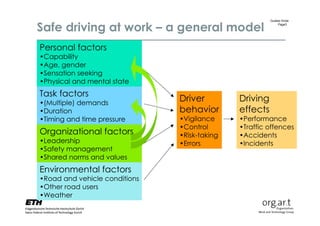
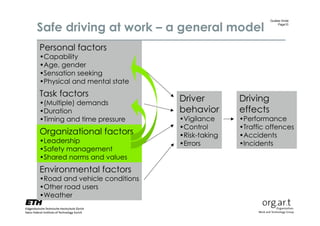
Safe driving at work – a general model                      Page3


Personal factors
•Capability
•Age, gender
•Sensation seeking
•Physical and mental state
Task factors
•(Multiple) demands
                               Driver         Driving
•Duration                      behavior       effects
•Timing and time pressure      •Vigilance     •Performance
                               •Control       •Traffic offences
Organizational factors         •Risk-taking   •Accidents
•Leadership                    •Errors        •Incidents
•Safety management
•Shared norms and values
Environmental factors
•Road and vehicle conditions
•Other road users
•Weather
Gudela Grote


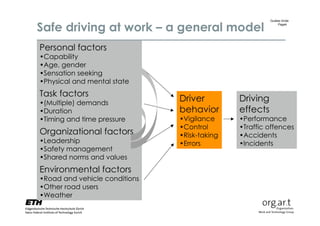
Safe driving at work – a general model                      Page4


Personal factors
•Capability
•Age, gender
•Sensation seeking
•Physical and mental state
Task factors
•(Multiple) demands
                               Driver         Driving
•Duration                      behavior       effects
•Timing and time pressure      •Vigilance     •Performance
                               •Control       •Traffic offences
Organizational factors         •Risk-taking   •Accidents
•Leadership                    •Errors        •Incidents
•Safety management
•Shared norms and values
Environmental factors
•Road and vehicle conditions
•Other road users
•Weather
Unrealistic optimism and illusion of                                Gudela Grote
                                                                        Page5


control

 People underestimate the likelihood of bad
  outcomes and overestimate the likelihood of
  good outcomes for themselves compared to
  others.
 This tendency is strengthened for outcomes
  perceived as controllable by the person.
 Examples:
  - Newlyweds expect their marriage to last a lifetime, even while
    aware of the divorce statistics.
  - Smokers believe they are less at risk of developing smoking-related
    diseases than others who smoke.
  - Car drivers estimate their chances of an accident when driving
    under the influence of alcohol as lower than for drunken driving in
    general.
Risk perception in driving (Fuller, 2005)
                                                 Gudela Grote
                                                     Page6


 Felt risk mirrors task difficulty.
 Task difficulty is determined by task demands
  and individual capability.
 Estimated statistical risk and felt risk regarding
  speed only coincide at higher speeds where
  task demands approach individual capability
  (= task difficulty is very high).
Risk as benefit: Risk seeking behavior
                                              Gudela Grote
                                                  Page7


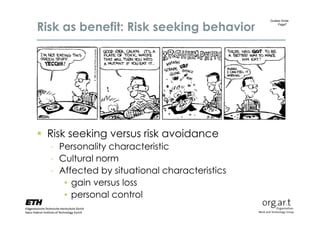
 Risk seeking versus risk avoidance
  - Personality characteristic
  - Cultural norm
  - Affected by situational characteristics
     • gain versus loss
     • personal control
Different types of driver errors
                                                           Gudela Grote
                                                               Page8


(Reason et al., 1990)


 Lapse
     - e.g. attempt to drive away from traffic light in third
       gear
 Mistake
     - e.g. underestimate the speed of oncoming vehicle
       when overtaking
 Violation
     - Unintended: e.g. unknowingly speeding
     - Deliberate: e.g. get involved in races with other
       drivers
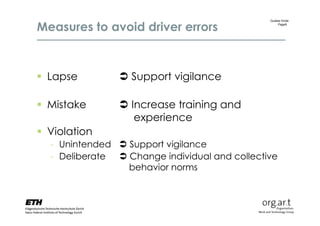
Measures to avoid driver errors
                                               Gudela Grote
                                                   Page9


 Lapse          Support vigilance

 Mistake        Increase training and
                   experience
 Violation
  - Unintended  Support vigilance
  - Deliberate  Change individual and collective
                 behavior norms
Gudela Grote


Safe driving at work – a general model                      Page10


Personal factors
•Capability
•Age, gender
•Sensation seeking
•Physical and mental state
Task factors
•(Multiple) demands
                               Driver         Driving
•Duration                      behavior       effects
•Timing and time pressure      •Vigilance     •Performance
                               •Control       •Traffic offences
Organizational factors         •Risk-taking   •Accidents
•Leadership                    •Errors        •Incidents
•Safety management
•Shared norms and values
Environmental factors
•Road and vehicle conditions
•Other road users
•Weather
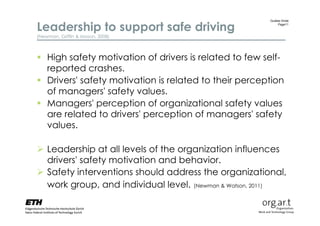
Leadership to support safe driving
                                                       Gudela Grote
                                                           Page11


(Newman, Griffin & Mason, 2008)


 High safety motivation of drivers is related to few self-
  reported crashes.
 Drivers' safety motivation is related to their perception
  of managers' safety values.
 Managers' perception of organizational safety values
  are related to drivers' perception of managers' safety
  values.

 Leadership at all levels of the organization influences
  drivers' safety motivation and behavior.
 Safety interventions should address the organizational,
  work group, and individual level. (Newman & Watson, 2011)
General safety management
                                            Gudela Grote
                                                Page12


   Safety Policy
   Risk identification and mitigation
   Safety resources and responsibilities
   Standards and procedures
   Training
   Safety performance monitoring
   Continuous improvement
   Management of change
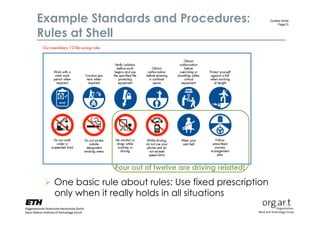
Example Standards and Procedures:                          Gudela Grote
                                                               Page13


Rules at Shell


                 Four out of twelve are driving related!

  One basic rule about rules: Use fixed prescription
   only when it really holds in all situations
Specific safety management measures                            Gudela Grote
                                                                   Page14


for safe driving
 Selection
  - avoid hiring young men
  - test for risk perception and risk seeking/avoidance
 Handling fatigue
  - establish a not fit to drive rule
  - structure driving schedules to allow for sufficient breaks and
    rest time
  - take into account commuting time when designing work
    schedules more generally
  - train drivers to handle monotony while driving
 Policy for mobile phone use
  - generally avoid phone use
  - if unavoidable only use when vehicle is stopped
  - if unavoidable during driving ensure proper technical systems
    and training
Shared norms and values
                                               Gudela Grote
                                                   Page15


 Establishing shared norms and values that
  support safe work processes and behaviors as
  defined in the safety management system
   Establish a safety culture
 Safety culture as part of organizational culture
  = shared basic beliefs and assumptions
  - safety versus production
  - trust versus control
  - role of people and technology
 Culture often most visible as a source of
  resistance to change
Supporting organizational and cultural                  Gudela Grote
                                                            Page16


change

 Causes of resistance to change
  - Sense of loss of control
  - Sticking to old norms as part of existing culture
 Strategies for dealing with resistance
  - Coercive: sanction change through use of power
  - Rational: inform about advantages of change
  - Normative: develop new values and norms =
    culture change
 Requirements for normative strategy
  - Participation to improve quality and acceptance
    of decisions
  - Psychological safety
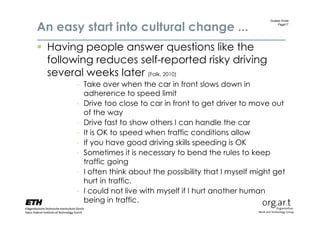
An easy start into cultural change ...
                                                                Gudela Grote
                                                                    Page17


 Having people answer questions like the
  following reduces self-reported risky driving
  several weeks later (Falk, 2010)
        - Take over when the car in front slows down in
          adherence to speed limit
        - Drive too close to car in front to get driver to move out
          of the way
        - Drive fast to show others I can handle the car
        - It is OK to speed when traffic conditions allow
        - If you have good driving skills speeding is OK
        - Sometimes it is necessary to bend the rules to keep
          traffic going
        - I often think about the possibility that I myself might get
          hurt in traffic.
        - I could not live with myself if I hurt another human
          being in traffic.
Gudela Grote
                             Page18


   Thank you!


     Contact:
Prof. Dr. Gudela Grote
       ETH Zürich
   www.oat.ethz.ch
   ggrote@ethz.ch

How to support safe driving at work

  • 1.
    How to supportsafe driving at work – Possible safety culture interventions Prof. Dr. Gudela Grote Departement Management, Technology, and Economics ETH Zürich
  • 2.
    Overview Gudela Grote Page2  A general model for safe driving at work  Characteristics of driver behavior  Organizational factors influencing safe driving  Supporting organizational and cultural change
  • 3.
    Gudela Grote Safe drivingat work – a general model Page3 Personal factors •Capability •Age, gender •Sensation seeking •Physical and mental state Task factors •(Multiple) demands Driver Driving •Duration behavior effects •Timing and time pressure •Vigilance •Performance •Control •Traffic offences Organizational factors •Risk-taking •Accidents •Leadership •Errors •Incidents •Safety management •Shared norms and values Environmental factors •Road and vehicle conditions •Other road users •Weather
  • 4.
    Gudela Grote Safe drivingat work – a general model Page4 Personal factors •Capability •Age, gender •Sensation seeking •Physical and mental state Task factors •(Multiple) demands Driver Driving •Duration behavior effects •Timing and time pressure •Vigilance •Performance •Control •Traffic offences Organizational factors •Risk-taking •Accidents •Leadership •Errors •Incidents •Safety management •Shared norms and values Environmental factors •Road and vehicle conditions •Other road users •Weather
  • 5.
    Unrealistic optimism andillusion of Gudela Grote Page5 control  People underestimate the likelihood of bad outcomes and overestimate the likelihood of good outcomes for themselves compared to others.  This tendency is strengthened for outcomes perceived as controllable by the person.  Examples: - Newlyweds expect their marriage to last a lifetime, even while aware of the divorce statistics. - Smokers believe they are less at risk of developing smoking-related diseases than others who smoke. - Car drivers estimate their chances of an accident when driving under the influence of alcohol as lower than for drunken driving in general.
  • 6.
    Risk perception indriving (Fuller, 2005) Gudela Grote Page6  Felt risk mirrors task difficulty.  Task difficulty is determined by task demands and individual capability.  Estimated statistical risk and felt risk regarding speed only coincide at higher speeds where task demands approach individual capability (= task difficulty is very high).
  • 7.
    Risk as benefit:Risk seeking behavior Gudela Grote Page7  Risk seeking versus risk avoidance - Personality characteristic - Cultural norm - Affected by situational characteristics • gain versus loss • personal control
  • 8.
    Different types ofdriver errors Gudela Grote Page8 (Reason et al., 1990)  Lapse - e.g. attempt to drive away from traffic light in third gear  Mistake - e.g. underestimate the speed of oncoming vehicle when overtaking  Violation - Unintended: e.g. unknowingly speeding - Deliberate: e.g. get involved in races with other drivers
  • 9.
    Measures to avoiddriver errors Gudela Grote Page9  Lapse  Support vigilance  Mistake  Increase training and experience  Violation - Unintended  Support vigilance - Deliberate  Change individual and collective behavior norms
  • 10.
    Gudela Grote Safe drivingat work – a general model Page10 Personal factors •Capability •Age, gender •Sensation seeking •Physical and mental state Task factors •(Multiple) demands Driver Driving •Duration behavior effects •Timing and time pressure •Vigilance •Performance •Control •Traffic offences Organizational factors •Risk-taking •Accidents •Leadership •Errors •Incidents •Safety management •Shared norms and values Environmental factors •Road and vehicle conditions •Other road users •Weather
  • 11.
    Leadership to supportsafe driving Gudela Grote Page11 (Newman, Griffin & Mason, 2008)  High safety motivation of drivers is related to few self- reported crashes.  Drivers' safety motivation is related to their perception of managers' safety values.  Managers' perception of organizational safety values are related to drivers' perception of managers' safety values.  Leadership at all levels of the organization influences drivers' safety motivation and behavior.  Safety interventions should address the organizational, work group, and individual level. (Newman & Watson, 2011)
  • 12.
    General safety management Gudela Grote Page12  Safety Policy  Risk identification and mitigation  Safety resources and responsibilities  Standards and procedures  Training  Safety performance monitoring  Continuous improvement  Management of change
  • 13.
    Example Standards andProcedures: Gudela Grote Page13 Rules at Shell Four out of twelve are driving related!  One basic rule about rules: Use fixed prescription only when it really holds in all situations
  • 14.
    Specific safety managementmeasures Gudela Grote Page14 for safe driving  Selection - avoid hiring young men - test for risk perception and risk seeking/avoidance  Handling fatigue - establish a not fit to drive rule - structure driving schedules to allow for sufficient breaks and rest time - take into account commuting time when designing work schedules more generally - train drivers to handle monotony while driving  Policy for mobile phone use - generally avoid phone use - if unavoidable only use when vehicle is stopped - if unavoidable during driving ensure proper technical systems and training
  • 15.
    Shared norms andvalues Gudela Grote Page15  Establishing shared norms and values that support safe work processes and behaviors as defined in the safety management system  Establish a safety culture  Safety culture as part of organizational culture = shared basic beliefs and assumptions - safety versus production - trust versus control - role of people and technology  Culture often most visible as a source of resistance to change
  • 16.
    Supporting organizational andcultural Gudela Grote Page16 change  Causes of resistance to change - Sense of loss of control - Sticking to old norms as part of existing culture  Strategies for dealing with resistance - Coercive: sanction change through use of power - Rational: inform about advantages of change - Normative: develop new values and norms = culture change  Requirements for normative strategy - Participation to improve quality and acceptance of decisions - Psychological safety
  • 17.
    An easy startinto cultural change ... Gudela Grote Page17  Having people answer questions like the following reduces self-reported risky driving several weeks later (Falk, 2010) - Take over when the car in front slows down in adherence to speed limit - Drive too close to car in front to get driver to move out of the way - Drive fast to show others I can handle the car - It is OK to speed when traffic conditions allow - If you have good driving skills speeding is OK - Sometimes it is necessary to bend the rules to keep traffic going - I often think about the possibility that I myself might get hurt in traffic. - I could not live with myself if I hurt another human being in traffic.
  • 18.
    Gudela Grote Page18 Thank you! Contact: Prof. Dr. Gudela Grote ETH Zürich www.oat.ethz.ch ggrote@ethz.ch