ONTOLOGIES FOR ADVANCED
DRIVER ASSISTANCE
SYSTEMS
Presentation by Lihua ZhaoSWO2015
Lihua Zhao, Toyota Technological Institute
Ryutaro Ichise, National Institute of
Informatics
Seiichi Mita, Toyota Technological Institute
Yutaka Sasaki, Toyota Technological Institute
SIG-SWO-035-03
Outline
 Motivation
 Related Work
 Ontology-Based Knowledge Base
 Advanced Driver Assistance ADAS Systems
(ADAS)
 Experiment
 Conclusion & Future Work
2
 Advanced Driver Assistance Systems (ADAS)
 Perceive driving environment by processing sensor data.
 Make driving decisions in different traffic situations.
 Machine Understandable Ontology-based Knowledge Base
 Advanced Digital Map
 Road information, speed limits, etc.
 Traffic Regulations
 Right-of-Way Rules
Motivation
3
 Automation level ontology and situation assessment ontology are
designed for co-driving. [Pollard, 2013]
 Use ontology and 14 SWRL rules to enable the vehicle to understand the
context information when it approaches road intersections. [Armand, 2014]
 A complex intersection ontology (car, crossing, road connection, and sign
at crossing) is introduced for fast reasoning. [Hulsen, 2011]
 An ontology-based traffic model that can represent typical traffic
scenarios such as intersections, multi-lane roads, opposing traffic, and bi-
directional lanes is introduced. [Regele,2008]
Related Work
4
 Ontology
 Instances
 SWRL Rules
 SPARQL Queries
 C-SPARQL Query
Ontology-Based Knowledge
Base
5
 Ontology: Machine-understandable knowledge representation
 Classes: called as Concepts, defined by owl:Class.
 Properties: owl:ObjectProperty and owl:DatatypeProperty.
 Instances: individuals of a domain, defined by owl:Thing.
 Rules: describe logical inferences, with if-then sentence.
 Ontology Editor
 Protégé ontology editor
Ontologies
6
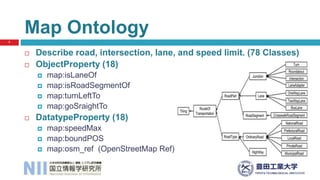
 Describe road, intersection, lane, and speed limit. (78 Classes)
 ObjectProperty (18)
 map:isLaneOf
 map:isRoadSegmentOf
 map:turnLeftTo
 map:goSraightTo
 DatatypeProperty (18)
 map:speedMax
 map:boundPOS
 map:osm_ref (OpenStreetMap Ref)
Map Ontology
7
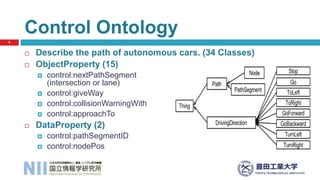
 Describe the path of autonomous cars. (34 Classes)
 ObjectProperty (15)
 control:nextPathSegment
(intersection or lane)
 control:giveWay
 control:collisionWarningWith
 control:approachTo
 DataProperty (2)
 control:pathSegmentID
 control:nodePos
Control Ontology
8
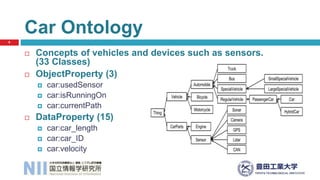
 Concepts of vehicles and devices such as sensors.
(33 Classes)
 ObjectProperty (3)
 car:usedSensor
 car:isRunningOn
 car:currentPath
 DataProperty (15)
 car:car_length
 car:car_ID
 car:velocity
Car Ontology
9
Instances are also known as individuals that model
abstract or concrete objects based on the ontologies.
 Tempaku Map Instance
 Path Instance
 Car Instance
Instances
10
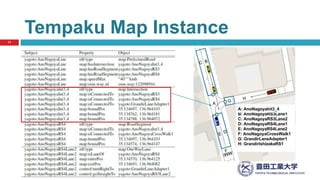
Tempaku Map Instance
11
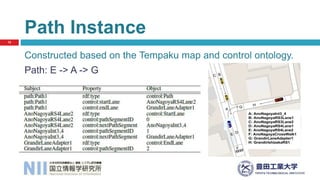
Constructed based on the Tempaku map and control ontology.
Path: E -> A -> G
Path Instance
12
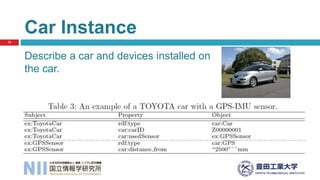
Describe a car and devices installed on
the car.
Car Instance
13
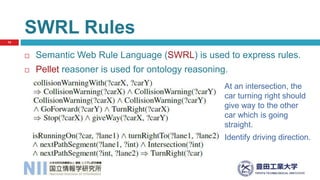
 Semantic Web Rule Language (SWRL) is used to express rules.
 Pellet reasoner is used for ontology reasoning.
SWRL Rules
14
At an intersection, the
car turning right should
give way to the other
car which is going
straight.
Identify driving direction.
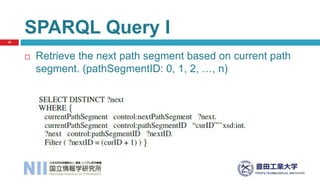
 Retrieve the next path segment based on current path
segment. (pathSegmentID: 0, 1, 2, …, n)
SPARQL Query I
15
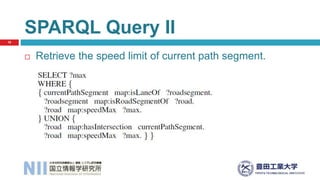
 Retrieve the speed limit of current path segment.
SPARQL Query II
16
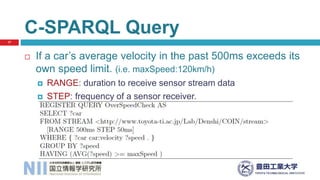
 If a car’s average velocity in the past 500ms exceeds its
own speed limit. (i.e. maxSpeed:120km/h)
 RANGE: duration to receive sensor stream data
 STEP: frequency of a sensor receiver.
C-SPARQL Query
17
 Intelligent Speed Adaptation (ISA) System
 Detect overspeed situations.
 Intelligent Decision Making System
 Make driving decisions at uncontrolled
intersections.
ADAS Systems
18
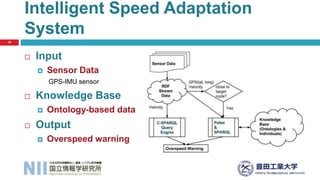
 Input
 Sensor Data
GPS-IMU sensor
 Knowledge Base
 Ontology-based data
 Output
 Overspeed warning
Intelligent Speed Adaptation
System
19
Intelligent Decision Making
System
20
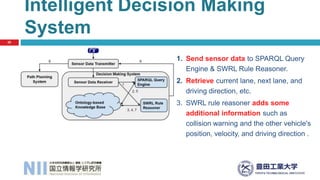
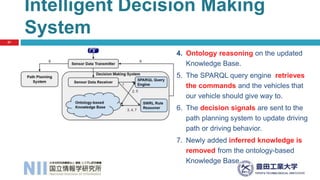
1. Send sensor data to SPARQL Query
Engine & SWRL Rule Reasoner.
2. Retrieve current lane, next lane, and
driving direction, etc.
3. SWRL rule reasoner adds some
additional information such as
collision warning and the other vehicle's
position, velocity, and driving direction .
Intelligent Decision Making
System
21
4. Ontology reasoning on the updated
Knowledge Base.
5. The SPARQL query engine retrieves
the commands and the vehicles that
our vehicle should give way to.
6. The decision signals are sent to the
path planning system to update driving
path or driving behavior.
7. Newly added inferred knowledge is
removed from the ontology-based
Knowledge Base.
 Data Format
 Evaluation of ISA System
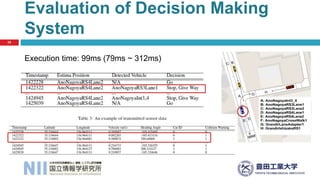
 Evaluation of Decision Making System
Experiment
22
Data Format
23
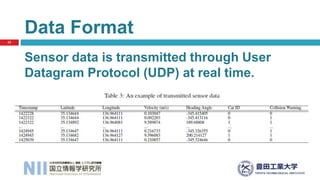
Sensor data is transmitted through User
Datagram Protocol (UDP) at real time.
Evaluation of ISA System
24
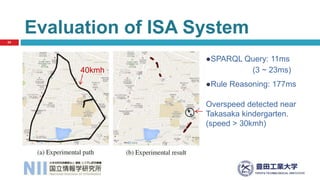
●SPARQL Query: 11ms
(3 ~ 23ms)
●Rule Reasoning: 177ms
Overspeed detected near
Takasaka kindergarten.
(speed > 30kmh)
40kmh
Evaluation of Decision Making
System
25
Execution time: 99ms (79ms ~ 312ms)
 Ontology-Based Knowledge Base
 Advanced Driver Assistance Systems (ADAS)
 Intelligent Speed Adaptation System
 Intelligent Decision Making System
 Experiment with real sensor data.
Conclusion
26
 Speed up execution time
 Use part of Knowledge Base for reasoning.
 Add more rules to cover other situations
 Driving on a corner or on private roads.
Future Work
27
Lihua Zhao: lihua@toyota-ti.ac.jp
Thank you !

Ontologies for Advanced Driver Assistance Systems

  • 1.
    ONTOLOGIES FOR ADVANCED DRIVERASSISTANCE SYSTEMS Presentation by Lihua ZhaoSWO2015 Lihua Zhao, Toyota Technological Institute Ryutaro Ichise, National Institute of Informatics Seiichi Mita, Toyota Technological Institute Yutaka Sasaki, Toyota Technological Institute SIG-SWO-035-03
  • 2.
    Outline  Motivation  RelatedWork  Ontology-Based Knowledge Base  Advanced Driver Assistance ADAS Systems (ADAS)  Experiment  Conclusion & Future Work 2
  • 3.
     Advanced DriverAssistance Systems (ADAS)  Perceive driving environment by processing sensor data.  Make driving decisions in different traffic situations.  Machine Understandable Ontology-based Knowledge Base  Advanced Digital Map  Road information, speed limits, etc.  Traffic Regulations  Right-of-Way Rules Motivation 3
  • 4.
     Automation levelontology and situation assessment ontology are designed for co-driving. [Pollard, 2013]  Use ontology and 14 SWRL rules to enable the vehicle to understand the context information when it approaches road intersections. [Armand, 2014]  A complex intersection ontology (car, crossing, road connection, and sign at crossing) is introduced for fast reasoning. [Hulsen, 2011]  An ontology-based traffic model that can represent typical traffic scenarios such as intersections, multi-lane roads, opposing traffic, and bi- directional lanes is introduced. [Regele,2008] Related Work 4
  • 5.
     Ontology  Instances SWRL Rules  SPARQL Queries  C-SPARQL Query Ontology-Based Knowledge Base 5
  • 6.
     Ontology: Machine-understandableknowledge representation  Classes: called as Concepts, defined by owl:Class.  Properties: owl:ObjectProperty and owl:DatatypeProperty.  Instances: individuals of a domain, defined by owl:Thing.  Rules: describe logical inferences, with if-then sentence.  Ontology Editor  Protégé ontology editor Ontologies 6
  • 7.
     Describe road,intersection, lane, and speed limit. (78 Classes)  ObjectProperty (18)  map:isLaneOf  map:isRoadSegmentOf  map:turnLeftTo  map:goSraightTo  DatatypeProperty (18)  map:speedMax  map:boundPOS  map:osm_ref (OpenStreetMap Ref) Map Ontology 7
  • 8.
     Describe thepath of autonomous cars. (34 Classes)  ObjectProperty (15)  control:nextPathSegment (intersection or lane)  control:giveWay  control:collisionWarningWith  control:approachTo  DataProperty (2)  control:pathSegmentID  control:nodePos Control Ontology 8
  • 9.
     Concepts ofvehicles and devices such as sensors. (33 Classes)  ObjectProperty (3)  car:usedSensor  car:isRunningOn  car:currentPath  DataProperty (15)  car:car_length  car:car_ID  car:velocity Car Ontology 9
  • 10.
    Instances are alsoknown as individuals that model abstract or concrete objects based on the ontologies.  Tempaku Map Instance  Path Instance  Car Instance Instances 10
  • 11.
  • 12.
    Constructed based onthe Tempaku map and control ontology. Path: E -> A -> G Path Instance 12
  • 13.
    Describe a carand devices installed on the car. Car Instance 13
  • 14.
     Semantic WebRule Language (SWRL) is used to express rules.  Pellet reasoner is used for ontology reasoning. SWRL Rules 14 At an intersection, the car turning right should give way to the other car which is going straight. Identify driving direction.
  • 15.
     Retrieve thenext path segment based on current path segment. (pathSegmentID: 0, 1, 2, …, n) SPARQL Query I 15
  • 16.
     Retrieve thespeed limit of current path segment. SPARQL Query II 16
  • 17.
     If acar’s average velocity in the past 500ms exceeds its own speed limit. (i.e. maxSpeed:120km/h)  RANGE: duration to receive sensor stream data  STEP: frequency of a sensor receiver. C-SPARQL Query 17
  • 18.
     Intelligent SpeedAdaptation (ISA) System  Detect overspeed situations.  Intelligent Decision Making System  Make driving decisions at uncontrolled intersections. ADAS Systems 18
  • 19.
     Input  SensorData GPS-IMU sensor  Knowledge Base  Ontology-based data  Output  Overspeed warning Intelligent Speed Adaptation System 19
  • 20.
    Intelligent Decision Making System 20 1.Send sensor data to SPARQL Query Engine & SWRL Rule Reasoner. 2. Retrieve current lane, next lane, and driving direction, etc. 3. SWRL rule reasoner adds some additional information such as collision warning and the other vehicle's position, velocity, and driving direction .
  • 21.
    Intelligent Decision Making System 21 4.Ontology reasoning on the updated Knowledge Base. 5. The SPARQL query engine retrieves the commands and the vehicles that our vehicle should give way to. 6. The decision signals are sent to the path planning system to update driving path or driving behavior. 7. Newly added inferred knowledge is removed from the ontology-based Knowledge Base.
  • 22.
     Data Format Evaluation of ISA System  Evaluation of Decision Making System Experiment 22
  • 23.
    Data Format 23 Sensor datais transmitted through User Datagram Protocol (UDP) at real time.
  • 24.
    Evaluation of ISASystem 24 ●SPARQL Query: 11ms (3 ~ 23ms) ●Rule Reasoning: 177ms Overspeed detected near Takasaka kindergarten. (speed > 30kmh) 40kmh
  • 25.
    Evaluation of DecisionMaking System 25 Execution time: 99ms (79ms ~ 312ms)
  • 26.
     Ontology-Based KnowledgeBase  Advanced Driver Assistance Systems (ADAS)  Intelligent Speed Adaptation System  Intelligent Decision Making System  Experiment with real sensor data. Conclusion 26
  • 27.
     Speed upexecution time  Use part of Knowledge Base for reasoning.  Add more rules to cover other situations  Driving on a corner or on private roads. Future Work 27
  • 28.