Behavioural Meetup
Guest Speaker: Professor Alan Tapp
Why we think we are better drivers than we
actually are.. and other mysteries of driving
Why we think we are better drivers than
we actually are.. and other mysteries of
driving.
Professor Alan Tapp, Bristol Social Marketing Centre, UWE
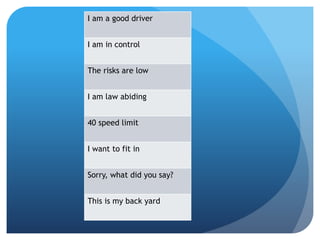
I am a good driver
I am in control
The risks are low
I am law abiding
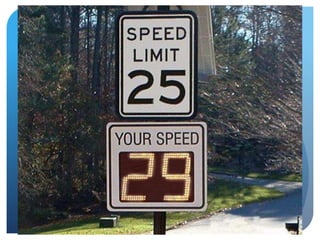
40 speed limit
I want to fit in
Sorry, what did you say?
This is my back yard
The speed paradox
 90% of drivers approve of speed limits
 But two thirds of drivers speed
 One third habitually speed
 Can anyone explain what’s going on here?..!
Stradling, S., Campbell, M., Allan, I., Gorrell, R., Hill, J., Winter, M. & Hope, S.
(2003) The Speeding Driver: Who, How and Why?
Edinburgh: Scottish Executive Development Department Research Findings No. 170/2003.
Self-enhancement bias
….. has been widely attributed to the tendency for drivers to over-estimate
their own driving ability and under-estimate that of others..
Svenson, O. (1981) Are we all less risky and more skilful than our fellow drivers?,
Acta Psychologica, 47, 143-148.
Attributed to an ‘illusion of control’ (a belief of personal control over events
that, in reality, is not merited)
McKenna, F. (1993), "It won't happen to me: Unrealistic optimism or
illusion of control?" British Journal of Psychology
(British Psychological Society) 84, 1, 39–50
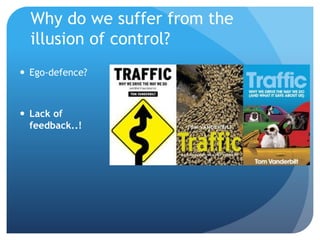
Why do we suffer from the
illusion of control?
 Ego-defence?
 Lack of
feedback..!
 https://www.youtube.com/watch?v=XXHZvlsU6yk&feature=player_
embedded
 South Australia campaign.
 Attempt to overcome illusion of control problem by talking about
other people .. and the need for defensive driving.
The risks of speeding are
contested
How well do we calculate risk in our everyday lives?
“It is common (even amongst driver trainers) to find the argument that
speeding is not risky provided the skill levels of drivers is high enough to
handle the speed”.
McKenna, F., (2010) Education in Road Safety –
Are We Getting It Right? Report for RAC Foundation.
Report Number: 10/113
“Assessing risk is a calculation most people are poorly equipped to make
accurately.”
Roberts, I. (2013) Why improving public health may
lead to more injury not less. In Safety, sustainability
and future urban transport, ed. Mohan, D., Eicher: New Delhi
.
Attitudes to law breaking
I’m not a criminal !
“94% of drivers see themselves as law abiding…”
Musselwhite, C., Avineri, E., Fulcher, E., Goodwin, P., and Susilo, Y. (2010b)
Public attitudes to road user safety: a review of the
literature 2000-2009. University Transport Study Group; Plymouth.
So…
“enforcement of speed limits as strict liability adds to the sense of
unfairness”.
Wells, H., 2012, The fast and the furious: drivers,
speed cameras and control in a risk society, Ashgate: Surrey.
Attitudes to law breaking
Who breaks the law?
Regular speeders are drivers whose high confidence in their own skills
lead them to conclude that speed limit laws should not apply to them.
In contrast rare speeders feel a moral imperative to comply, and pay
strong attention to speed limits.
Corbett, C. and Simon, F. (1992) Decisions to break or adhere to the
rules of the road, viewed from the rational choice perspective.
British Journal of Criminology, 32, 4, 537-549
A final category may be instrumental speeders: those who make a
purely instrumental judgement whether to speed based on the chances of
being caught speeding.
Fleiter, J., Watson, B. & Lennon A. (2013) Effective punishment
experiences - a novel approach to conceptualising behavioural
punishers and reinforcers in a road safety context. In N. Castro (Ed.),
Psychology of Punishment: New Research (pp. 1-30): Nova.
Personalised speed limits
Drivers do not regard speed limits as absolutes,
instead creating a personal limit that they felt better
expressed the true risks.
Corbett, C. and Simon, F. (1992b) Unlawful driving behaviour: a
criminological perspective. Contractor report 310. Crowthorne: Transport Research Laboratory.
Fleiter, J. and Watson, B. (2006) The speed paradox: the misalignment between
driver attitudes and speeding behaviour. Journal of the Australasian College of Road Safety, 17, 2, 23‐30.
Mannering, F., (2009) An empirical analysis of driver perceptions of the relationship
between speed limits and safety. Transportation Research Part F 12, 2, 99–106
The TAC Wipe Off 5 Campaign
 https://www.youtube.com/watch?feature=player_detail
page&v=nyOfJTi0jFw
Copycat effects of other
drivers on one’s own
driving
Four Copycat effects
1. Copycat Drivers adopt speeds according to the speed of others on the
road.
2. ‘Pressure to keep up’: In the U.K. one third of drivers said they would
drive faster if the traffic is moving faster than they normally travel at.
3. Drivers over-estimate speeds of other drivers to create a ‘false
consensus’ that distorts driving norms
4. Self identity & ego-defence…people want to be regarded as ‘normal’..
Stradling, S., Campbell, M., Allan, I., Gorrell, R., Hill, J., Winter, M. & Hope, S.
(2003) The Speeding Driver: Who, How and Why? Edinburgh:
Scottish Executive Development Department Research Findings No. 170/2003.
Musselwhite, C., Avineri, E., Fulcher, E., Goodwin, P., and Susilo, Y.
(2010b) Public attitudes to road user safety: a review of the literature 2000-2009.
University Transport Study Group; Plymouth
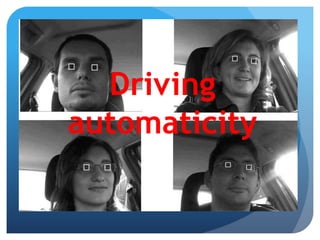
Driving
automaticity
Driving automaticity
attitudes to speeding study.. found 46% claimed to speed ‘without realising
it’.
Caused by… width of the road, the quietness of the car at speed, and
speed perceptions distorted by long travel at high speeds on motorways
McKenna, F. (2010) Behavioural research in road safety. Road Safety Congress: Eighteenth Seminar; London:
Department for Transport.
Recarte, M. and Nunes, L. (2002) Mental load and loss of control over speed in real driving: towards a theory of
attentional speed control. Transportation Research Part F, 5, 2, 111-122
Corbett, C. and Simon, F. (1992) Unlawful driving behaviour: a criminological perspective. Contractor report 310.
Crowthorne: Transport Research Laboratory.
The JIMBY effect
…the tendency of drivers to drive slowly on roads within their
own neighbourhood but faster elsewhere.
Tapp, A. , Nancarrow, C., and Davis, A. (2015), Exploring driver support and compliance
in 20mph limits in GB, Transportation Research part F (accepted, to be published)
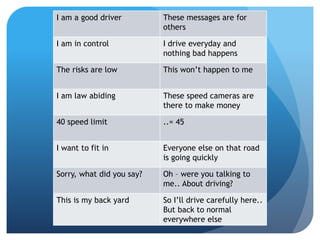
I am a good driver These messages are for
others
I am in control I drive everyday and
nothing bad happens
The risks are low This won’t happen to me
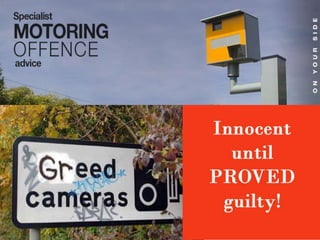
I am law abiding These speed cameras are
there to make money
40 speed limit ..= 45
I want to fit in Everyone else on that road
is going quickly
Sorry, what did you say? Oh – were you talking to
me.. About driving?
This is my back yard So I’ll drive carefully here..
But back to normal
everywhere else
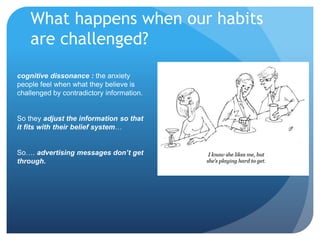
cognitive dissonance : the anxiety
people feel when what they believe is
challenged by contradictory information.
So they adjust the information so that
it fits with their belief system…
So…. advertising messages don’t get
through.
What happens when our habits
are challenged?
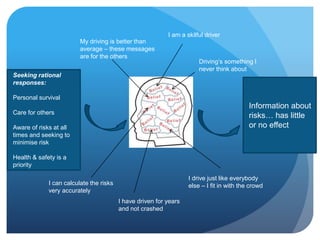
Seeking rational
responses:
Personal survival
Care for others
Aware of risks at all
times and seeking to
minimise risk
Health & safety is a
priority
Information about
risks… has little
or no effect
I am a skilful driver
Driving’s something I
never think about
My driving is better than
average – these messages
are for the others
I drive just like everybody
else – I fit in with the crowd
I have driven for years
and not crashed
I can calculate the risks
very accurately
Behaviour change
What’s the evidence?
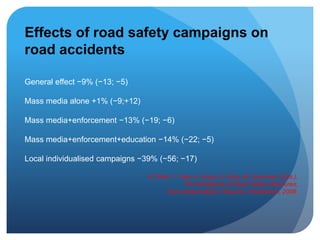
Effects of road safety campaigns on
road accidents
General effect −9% (−13; −5)
Mass media alone +1% (−9;+12)
Mass media+enforcement −13% (−19; −6)
Mass media+enforcement+education −14% (−22; −5)
Local individualised campaigns −39% (−56; −17)
R. Elvik, T. Vaa, A. Hoye, A. Erke, M. Sorensen (Eds.),
The Handbook of Road Safety Measures,
2nd revised edition, Elsevier, Amsterdam, 2009.
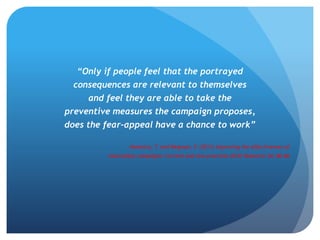
“Only if people feel that the portrayed
consequences are relevant to themselves
and feel they are able to take the
preventive measures the campaign proposes,
does the fear-appeal have a chance to work”
Hoekstra, T. and Wegman, F. (2011) Improving the effectiveness of
road safety campaigns: Current and new practices IATSS Research 34; 80–86
So…to make further progress,
do we need to think outside
the box of the current design
of road safety campaigns?
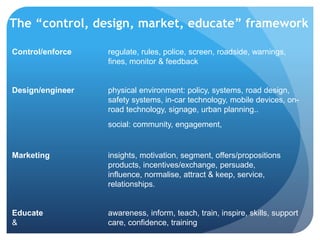
Control/enforce regulate, rules, police, screen, roadside, warnings,
fines, monitor & feedback
Design/engineer physical environment: policy, systems, road design,
safety systems, in-car technology, mobile devices, on-
road technology, signage, urban planning..
social: community, engagement,
Marketing insights, motivation, segment, offers/propositions
products, incentives/exchange, persuade,
influence, normalise, attract & keep, service,
relationships.
Educate awareness, inform, teach, train, inspire, skills, support
& care, confidence, training
The “control, design, market, educate” framework
Appreciate your time
Alan.Tapp@uwe.ac.uk
meetup.com/behavioural/
Brought to you by:

Behavioural meetup: Prof. Alan Tapp

  • 1.
    Behavioural Meetup Guest Speaker:Professor Alan Tapp Why we think we are better drivers than we actually are.. and other mysteries of driving
  • 2.
    Why we thinkwe are better drivers than we actually are.. and other mysteries of driving. Professor Alan Tapp, Bristol Social Marketing Centre, UWE
  • 3.
    I am agood driver I am in control The risks are low I am law abiding 40 speed limit I want to fit in Sorry, what did you say? This is my back yard
  • 4.
    The speed paradox 90% of drivers approve of speed limits  But two thirds of drivers speed  One third habitually speed  Can anyone explain what’s going on here?..! Stradling, S., Campbell, M., Allan, I., Gorrell, R., Hill, J., Winter, M. & Hope, S. (2003) The Speeding Driver: Who, How and Why? Edinburgh: Scottish Executive Development Department Research Findings No. 170/2003.
  • 5.
    Self-enhancement bias ….. hasbeen widely attributed to the tendency for drivers to over-estimate their own driving ability and under-estimate that of others.. Svenson, O. (1981) Are we all less risky and more skilful than our fellow drivers?, Acta Psychologica, 47, 143-148. Attributed to an ‘illusion of control’ (a belief of personal control over events that, in reality, is not merited) McKenna, F. (1993), "It won't happen to me: Unrealistic optimism or illusion of control?" British Journal of Psychology (British Psychological Society) 84, 1, 39–50
  • 6.
    Why do wesuffer from the illusion of control?  Ego-defence?  Lack of feedback..!
  • 7.
     https://www.youtube.com/watch?v=XXHZvlsU6yk&feature=player_ embedded  SouthAustralia campaign.  Attempt to overcome illusion of control problem by talking about other people .. and the need for defensive driving.
  • 8.
    The risks ofspeeding are contested How well do we calculate risk in our everyday lives?
  • 10.
    “It is common(even amongst driver trainers) to find the argument that speeding is not risky provided the skill levels of drivers is high enough to handle the speed”. McKenna, F., (2010) Education in Road Safety – Are We Getting It Right? Report for RAC Foundation. Report Number: 10/113 “Assessing risk is a calculation most people are poorly equipped to make accurately.” Roberts, I. (2013) Why improving public health may lead to more injury not less. In Safety, sustainability and future urban transport, ed. Mohan, D., Eicher: New Delhi .
  • 11.
    Attitudes to lawbreaking I’m not a criminal !
  • 13.
    “94% of driverssee themselves as law abiding…” Musselwhite, C., Avineri, E., Fulcher, E., Goodwin, P., and Susilo, Y. (2010b) Public attitudes to road user safety: a review of the literature 2000-2009. University Transport Study Group; Plymouth. So… “enforcement of speed limits as strict liability adds to the sense of unfairness”. Wells, H., 2012, The fast and the furious: drivers, speed cameras and control in a risk society, Ashgate: Surrey. Attitudes to law breaking
  • 14.
    Who breaks thelaw? Regular speeders are drivers whose high confidence in their own skills lead them to conclude that speed limit laws should not apply to them. In contrast rare speeders feel a moral imperative to comply, and pay strong attention to speed limits. Corbett, C. and Simon, F. (1992) Decisions to break or adhere to the rules of the road, viewed from the rational choice perspective. British Journal of Criminology, 32, 4, 537-549 A final category may be instrumental speeders: those who make a purely instrumental judgement whether to speed based on the chances of being caught speeding. Fleiter, J., Watson, B. & Lennon A. (2013) Effective punishment experiences - a novel approach to conceptualising behavioural punishers and reinforcers in a road safety context. In N. Castro (Ed.), Psychology of Punishment: New Research (pp. 1-30): Nova.
  • 15.
  • 17.
    Personalised speed limits Driversdo not regard speed limits as absolutes, instead creating a personal limit that they felt better expressed the true risks. Corbett, C. and Simon, F. (1992b) Unlawful driving behaviour: a criminological perspective. Contractor report 310. Crowthorne: Transport Research Laboratory. Fleiter, J. and Watson, B. (2006) The speed paradox: the misalignment between driver attitudes and speeding behaviour. Journal of the Australasian College of Road Safety, 17, 2, 23‐30. Mannering, F., (2009) An empirical analysis of driver perceptions of the relationship between speed limits and safety. Transportation Research Part F 12, 2, 99–106
  • 18.
    The TAC WipeOff 5 Campaign  https://www.youtube.com/watch?feature=player_detail page&v=nyOfJTi0jFw
  • 19.
    Copycat effects ofother drivers on one’s own driving
  • 20.
    Four Copycat effects 1.Copycat Drivers adopt speeds according to the speed of others on the road. 2. ‘Pressure to keep up’: In the U.K. one third of drivers said they would drive faster if the traffic is moving faster than they normally travel at. 3. Drivers over-estimate speeds of other drivers to create a ‘false consensus’ that distorts driving norms 4. Self identity & ego-defence…people want to be regarded as ‘normal’.. Stradling, S., Campbell, M., Allan, I., Gorrell, R., Hill, J., Winter, M. & Hope, S. (2003) The Speeding Driver: Who, How and Why? Edinburgh: Scottish Executive Development Department Research Findings No. 170/2003. Musselwhite, C., Avineri, E., Fulcher, E., Goodwin, P., and Susilo, Y. (2010b) Public attitudes to road user safety: a review of the literature 2000-2009. University Transport Study Group; Plymouth
  • 21.
  • 22.
    Driving automaticity attitudes tospeeding study.. found 46% claimed to speed ‘without realising it’. Caused by… width of the road, the quietness of the car at speed, and speed perceptions distorted by long travel at high speeds on motorways McKenna, F. (2010) Behavioural research in road safety. Road Safety Congress: Eighteenth Seminar; London: Department for Transport. Recarte, M. and Nunes, L. (2002) Mental load and loss of control over speed in real driving: towards a theory of attentional speed control. Transportation Research Part F, 5, 2, 111-122 Corbett, C. and Simon, F. (1992) Unlawful driving behaviour: a criminological perspective. Contractor report 310. Crowthorne: Transport Research Laboratory.
  • 23.
    The JIMBY effect …thetendency of drivers to drive slowly on roads within their own neighbourhood but faster elsewhere. Tapp, A. , Nancarrow, C., and Davis, A. (2015), Exploring driver support and compliance in 20mph limits in GB, Transportation Research part F (accepted, to be published)
  • 24.
    I am agood driver These messages are for others I am in control I drive everyday and nothing bad happens The risks are low This won’t happen to me I am law abiding These speed cameras are there to make money 40 speed limit ..= 45 I want to fit in Everyone else on that road is going quickly Sorry, what did you say? Oh – were you talking to me.. About driving? This is my back yard So I’ll drive carefully here.. But back to normal everywhere else
  • 25.
    cognitive dissonance :the anxiety people feel when what they believe is challenged by contradictory information. So they adjust the information so that it fits with their belief system… So…. advertising messages don’t get through. What happens when our habits are challenged?
  • 26.
    Seeking rational responses: Personal survival Carefor others Aware of risks at all times and seeking to minimise risk Health & safety is a priority Information about risks… has little or no effect I am a skilful driver Driving’s something I never think about My driving is better than average – these messages are for the others I drive just like everybody else – I fit in with the crowd I have driven for years and not crashed I can calculate the risks very accurately
  • 27.
  • 28.
    Effects of roadsafety campaigns on road accidents General effect −9% (−13; −5) Mass media alone +1% (−9;+12) Mass media+enforcement −13% (−19; −6) Mass media+enforcement+education −14% (−22; −5) Local individualised campaigns −39% (−56; −17) R. Elvik, T. Vaa, A. Hoye, A. Erke, M. Sorensen (Eds.), The Handbook of Road Safety Measures, 2nd revised edition, Elsevier, Amsterdam, 2009.
  • 29.
    “Only if peoplefeel that the portrayed consequences are relevant to themselves and feel they are able to take the preventive measures the campaign proposes, does the fear-appeal have a chance to work” Hoekstra, T. and Wegman, F. (2011) Improving the effectiveness of road safety campaigns: Current and new practices IATSS Research 34; 80–86
  • 30.
    So…to make furtherprogress, do we need to think outside the box of the current design of road safety campaigns?
  • 31.
    Control/enforce regulate, rules,police, screen, roadside, warnings, fines, monitor & feedback Design/engineer physical environment: policy, systems, road design, safety systems, in-car technology, mobile devices, on- road technology, signage, urban planning.. social: community, engagement, Marketing insights, motivation, segment, offers/propositions products, incentives/exchange, persuade, influence, normalise, attract & keep, service, relationships. Educate awareness, inform, teach, train, inspire, skills, support & care, confidence, training The “control, design, market, educate” framework
  • 32.
  • 33.

Editor's Notes

  • #3 Intro , challenge we have begun to grasp but can we take our thinking to a new level, opportunity to improve, SM, agenda So – mysteries of driving and unravelling these, and our other agenda is to explore the opportunity that SM offers the world of road safety The thesis is that these mysteries – complexities of behaviour – mean that simple beh ch tactics don’t work so well , we need something more sophiticated So enter social marketing The role of SM has been mostly campaigns and we’ll discuss these in a sec after some intro stuff, but what about more strategic use? So - 1st some intro material – show you what I mean by strat use of SM - and then a closer look at some adverts Then coffee Then psycho effects in detail after the break, then strtategic / multi-disc road safety. Brisk…lots to cover so lets get moving
  • #6 Lots of bias - Causes ego defence, and Availability heuristic – our own driving performance is fine! Perception bias – only take in other driving when its bad.. COMPLEX CAUSES OF SEB INCLUDING SELECTIVE PROCESSING OF OTHER PEOPLE’S DRIIVNG (ONLY REMEMEBER THE BAD STUFF) AND LACK OF FEEDBACK IN ONE’S OWN DRIVING.. ILLUSION OF C
  • #12 THIS IS A COGNITIVE DISSONANCE EFFECT – BEING CAUGHT SPEEDING ATTACKS OUR SELF-IDENTITY, SENSE OF SELF
  • #16 ROOT CAUSE..? LACK OF FEEDBACK AGAIN – THE ROOT CAUSE IS LINKED TO THE NATURE OF ‘LIVE’ DRIIVNG – THAT WE DRIVE ACCORDING TO ROAD DESIGN, OTHERS, .. WE RESPOND TO THE SITUATION ‘LIVE’ AND DON’T DRIVE RIGIDLY ACCORDING TO SPEED LIMITS. SO… ?!
  • #20 THIS IS CLASSIC NUDGE TERRITORY.. COGNITIVE OR AUTOMATIC … THIS IS AN AUTO EFFECT, HEURISTIC – SAVES US THINKING – GET TO THAT IN A MINUTE BUT ALSO A SOCIAL EFFECT – WE WANT TO FIT IN – UNCONSCIOUSLY – NON-COGNITIVELY
  • #24 SELF INTEREST VS OTHERS INTEREST EFFECT