Topic: How to solve ethical issues in business
MINISTRY OF EDUCATION OF AZERBAIJAN
Subject: “Business English”
Student: Guluzade Qorxmaz
Group: 942
PLAN:
What are the ethical issues in business?
Common ethical issues in business
What is business ethics?
Understanding business ethics
Types of business ethics
What are ethical issues in business?
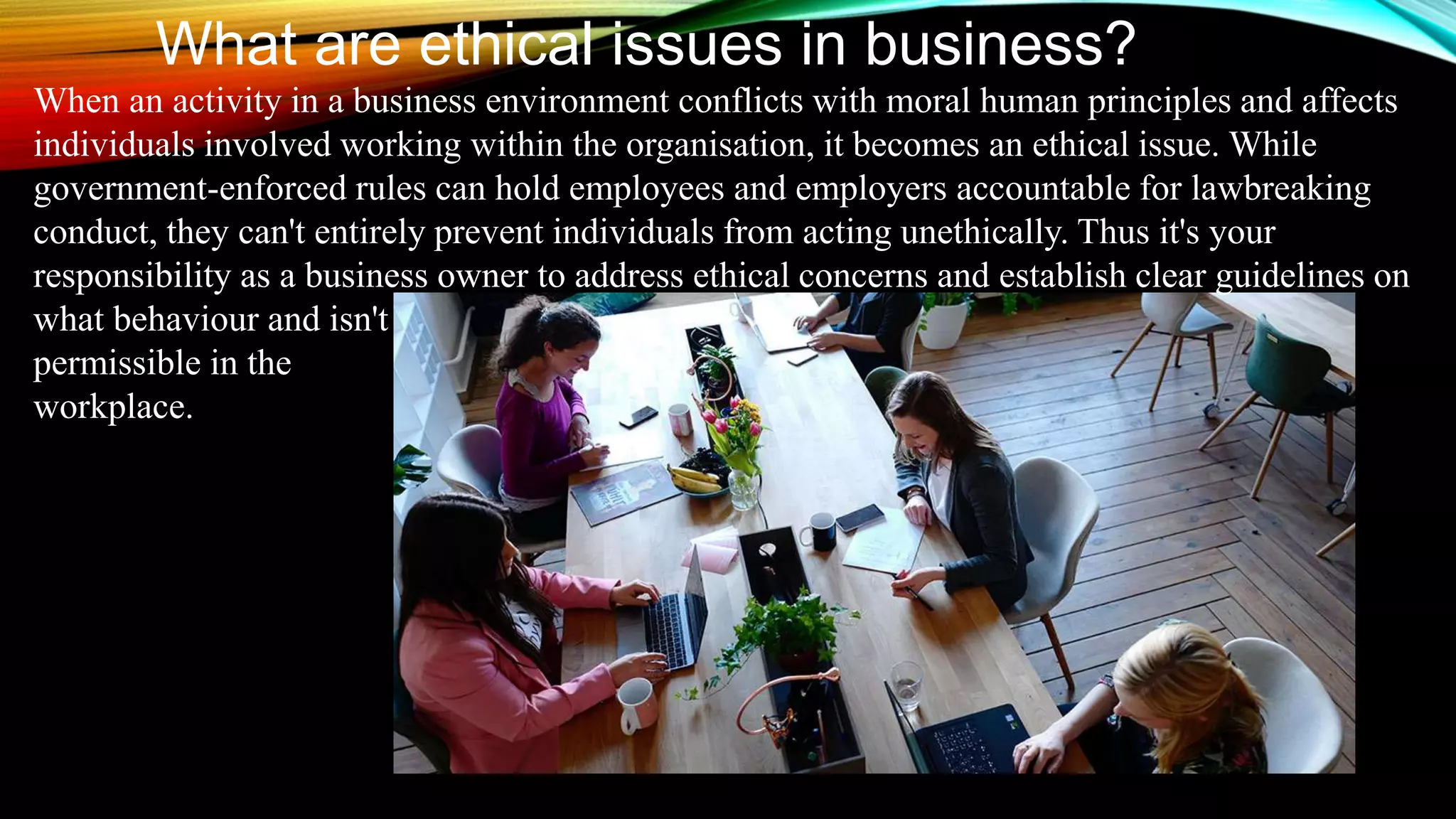
When an activity in a business environment conflicts with moral human principles and affects
individuals involved working within the organisation, it becomes an ethical issue. While
government-enforced rules can hold employees and employers accountable for lawbreaking
conduct, they can't entirely prevent individuals from acting unethically. Thus it's your
responsibility as a business owner to address ethical concerns and establish clear guidelines on
what behaviour and isn't
permissible in the
workplace.
COMMON ETHICAL ISSUES IN BUSINESS
Discrimination
Discrimination is still a major concern in this modern world,
and a workplace is no exception. Workplace discrimination
happens when an employee is treated unfairly due to prejudice
towards a particular gender, age, ethnicity, religious views, and
more.
Workplace safety
According to a 2019 report by Safe Work Australia, 183 Australian workers lost their lives at work
due to injuries sustained doing a work-related activity. Although the overall the number of
fatalities has been decreasing since 2007, every number above zero is one number too many.
Social media use
It's hard to determine the ethics of dismissing or disciplining workers for their social media
behaviour outside of work hours. In most situations, an employee can be fired for their online
behaviour given that there's a justifiable reason rather than an attempt to cover up a business's
unlawful activities.
Employee privacy
With advancements in surveillance technology, you can now track every step your employees
make on your business-owned devices. While this move is intended to ensure productivity, it can
quickly become unethical when it crosses the line into snooping.
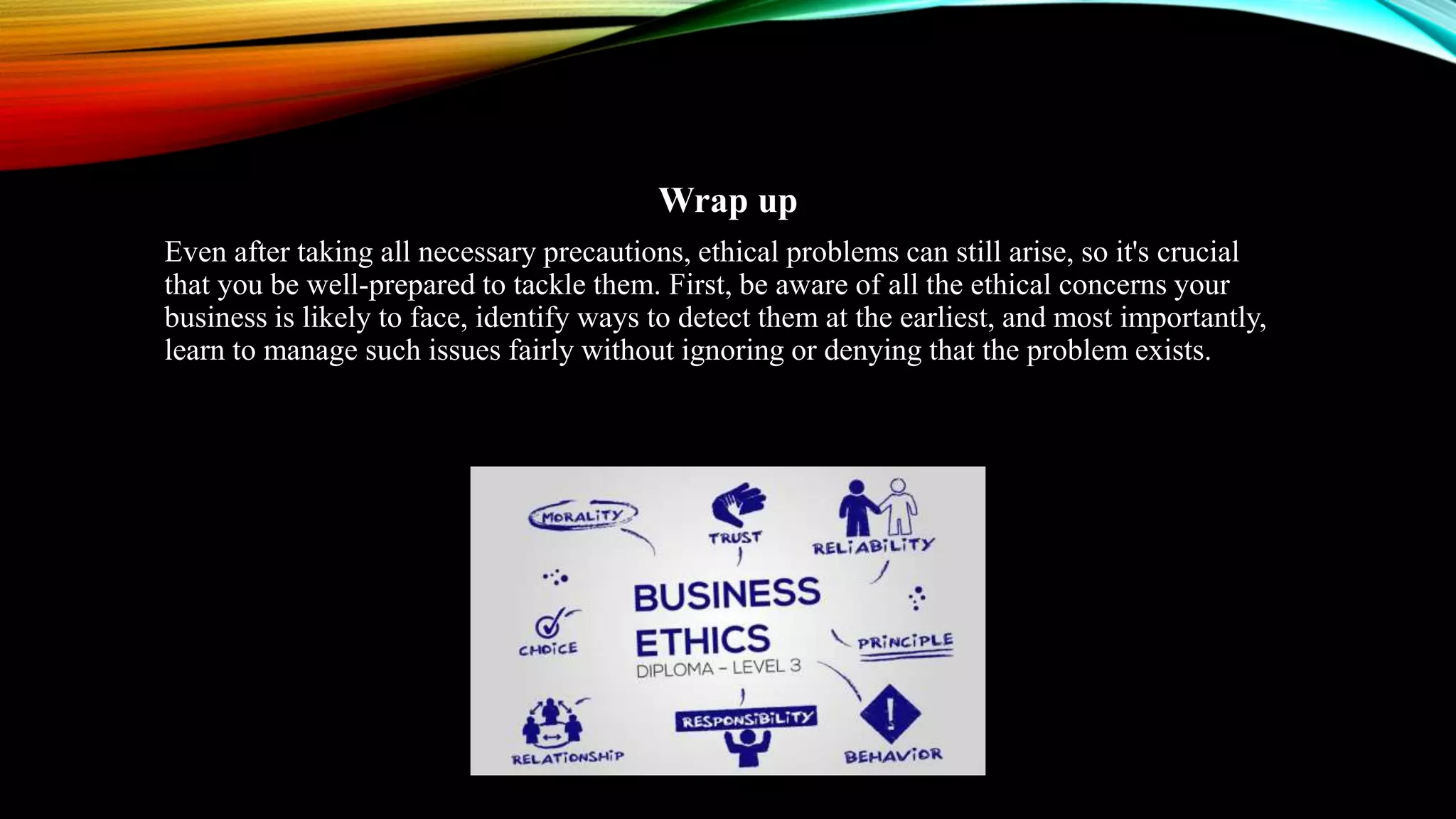
Wrap up
Even after taking all necessary precautions, ethical problems can still arise, so it's crucial
that you be well-prepared to tackle them. First, be aware of all the ethical concerns your
business is likely to face, identify ways to detect them at the earliest, and most importantly,
learn to manage such issues fairly without ignoring or denying that the problem exists.
Business ethics studies appropriate business policies
and practices regarding potentially controversial
subjects, including corporate governance, insider
trading, bribery, discrimination, corporate social
responsibility, fiduciary responsibilities, and much
more. The law often guides business ethics, but at
other times business ethics provide a basic guideline
that businesses can follow to gain public approval.
What is Business ethics?
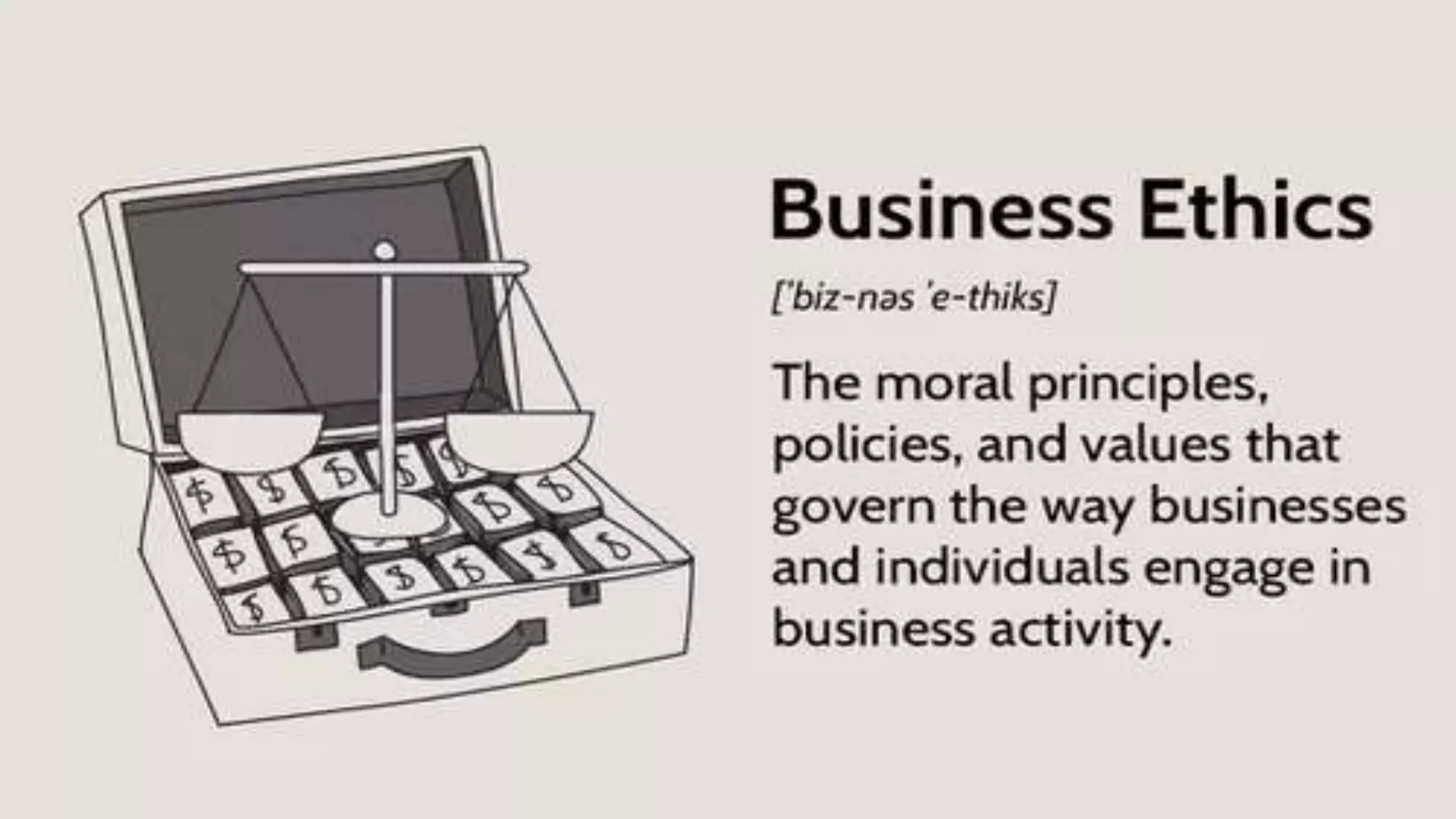
Understanding Business Ethics
Business ethics ensure that a certain basic level of
trust exists between consumers and various forms
of market participants with businesses. For
example, a portfolio manager must give the same
consideration to the portfolios of family members
and small individual investors as they do to
wealthier clients. These kinds of practices ensure
the public receives fair treatment.
TYPES OF BUSINESS
ETHICS
There are several theories regarding business ethics, and many different types can be found, but
what makes a business stand out are its corporate social responsibility practices, transparency
and trustworthiness, fairness, and technological practices.
Corporate Social Responsibility
Corporate social responsibility (CSR) is the concept of meeting the needs of stakeholders while accounting for the
impact meeting those needs has on employees, the environment, society, and the community in which the business
operates. Of course, finances and profits are important, but they should be secondary to the welfare of society,
customers, and employees—because studies have concluded that corporate governance and ethical practices
increase financial performance.
Businesses should hold themselves accountable and responsible for their environmental,
philanthropic, ethical, and economic impacts.
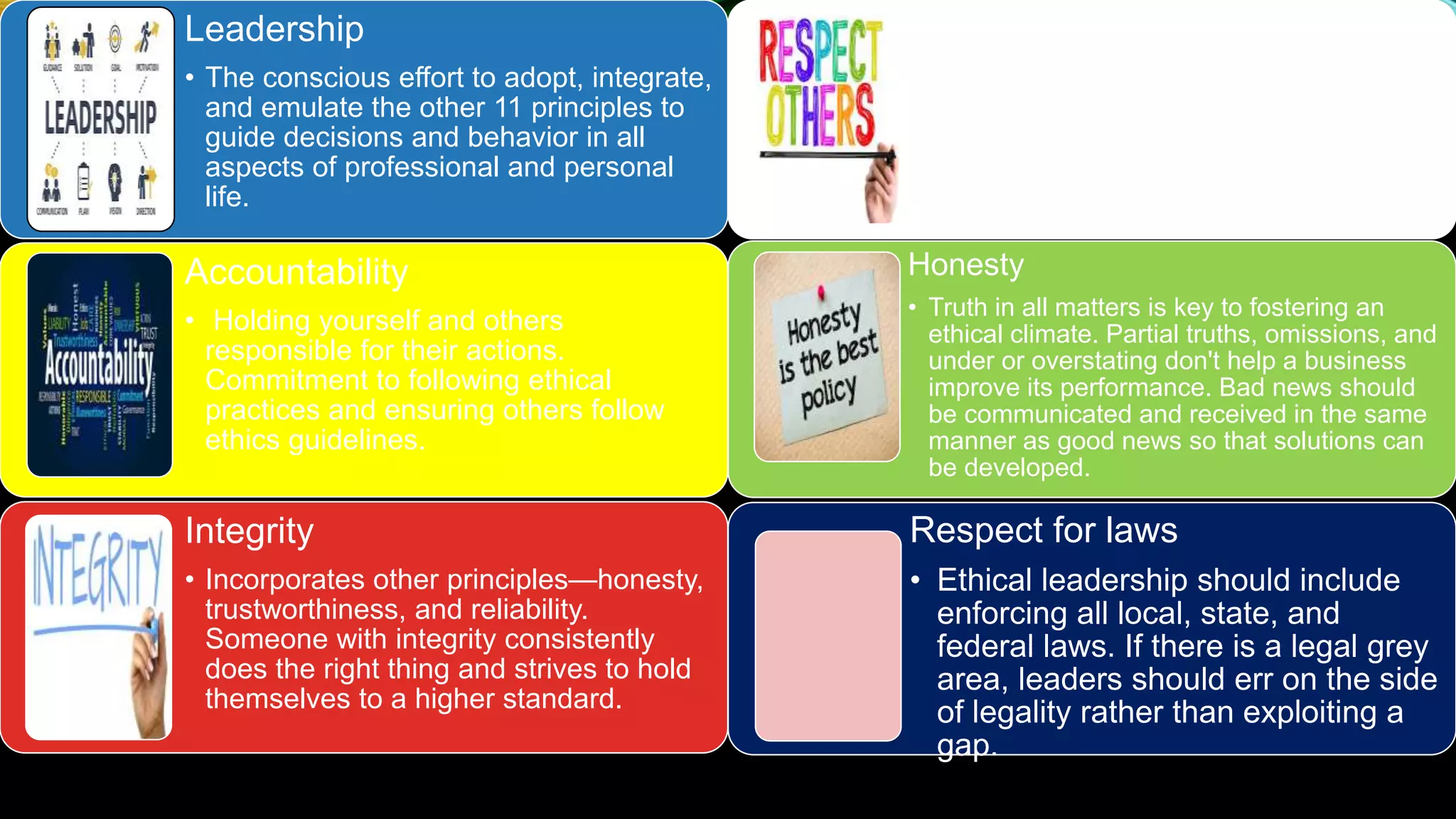
Leadership
• The conscious effort to adopt, integrate,
and emulate the other 11 principles to
guide decisions and behavior in all
aspects of professional and personal
life.
Accountability
• Holding yourself and others
responsible for their actions.
Commitment to following ethical
practices and ensuring others follow
ethics guidelines.
Integrity
• Incorporates other principles—honesty,
trustworthiness, and reliability.
Someone with integrity consistently
does the right thing and strives to hold
themselves to a higher standard.
Respect for others
• To foster ethical behavior and
environments in the workplace, respecting
others is a critical component. Everyone
deserves dignity, privacy, equality,
opportunity, compassion, and empathy.
Honesty
• Truth in all matters is key to fostering an
ethical climate. Partial truths, omissions, and
under or overstating don't help a business
improve its performance. Bad news should
be communicated and received in the same
manner as good news so that solutions can
be developed.
Respect for laws
• Ethical leadership should include
enforcing all local, state, and
federal laws. If there is a legal grey
area, leaders should err on the side
of legality rather than exploiting a
gap.
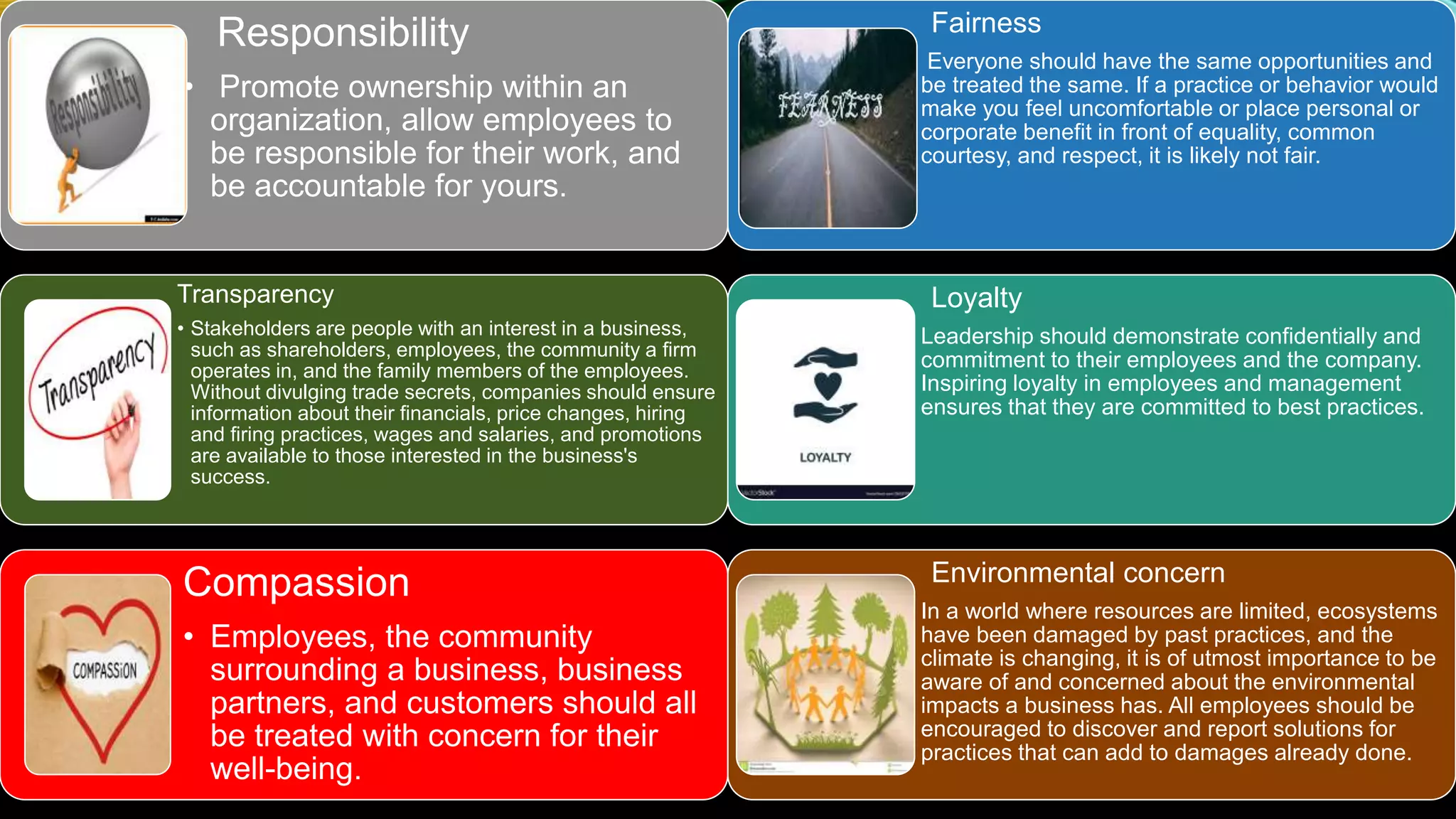
Responsibility
• Promote ownership within an
organization, allow employees to
be responsible for their work, and
be accountable for yours.
Transparency
• Stakeholders are people with an interest in a business,
such as shareholders, employees, the community a firm
operates in, and the family members of the employees.
Without divulging trade secrets, companies should ensure
information about their financials, price changes, hiring
and firing practices, wages and salaries, and promotions
are available to those interested in the business's
success.
Compassion
• Employees, the community
surrounding a business, business
partners, and customers should all
be treated with concern for their
well-being.
Fairness
• Everyone should have the same opportunities and
be treated the same. If a practice or behavior would
make you feel uncomfortable or place personal or
corporate benefit in front of equality, common
courtesy, and respect, it is likely not fair.
Loyalty
• Leadership should demonstrate confidentially and
commitment to their employees and the company.
Inspiring loyalty in employees and management
ensures that they are committed to best practices.
Environmental concern
• In a world where resources are limited, ecosystems
have been damaged by past practices, and the
climate is changing, it is of utmost importance to be
aware of and concerned about the environmental
impacts a business has. All employees should be
encouraged to discover and report solutions for
practices that can add to damages already done.
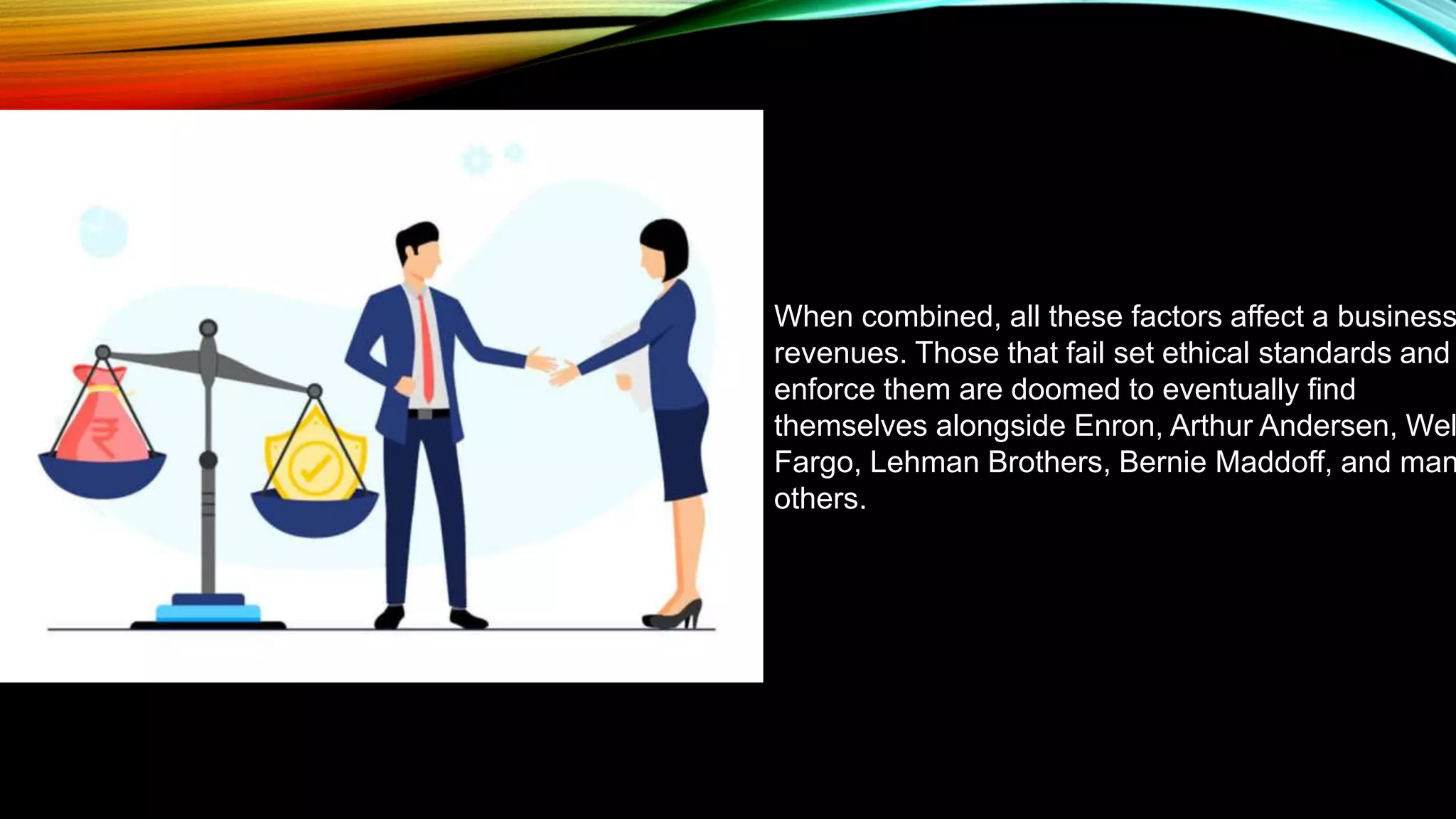
When combined, all these factors affect a business
revenues. Those that fail set ethical standards and
enforce them are doomed to eventually find
themselves alongside Enron, Arthur Andersen, Wel
Fargo, Lehman Brothers, Bernie Maddoff, and man
others.
Literature
https://www.investopedia.com/terms/b/business-ethics.asp
https://en.wikipedia.org/wiki/Business_ethics
https://www.redlands.edu/study/schools-and-
centers/business/sbblog/2019/may-2019/3-reasons-why-business-ethics-
important/
How to solve ethical issues in business

How to solve ethical issues in business

  • 1.
    Topic: How tosolve ethical issues in business MINISTRY OF EDUCATION OF AZERBAIJAN Subject: “Business English” Student: Guluzade Qorxmaz Group: 942
  • 2.
    PLAN: What are theethical issues in business? Common ethical issues in business What is business ethics? Understanding business ethics Types of business ethics
  • 3.
    What are ethicalissues in business? When an activity in a business environment conflicts with moral human principles and affects individuals involved working within the organisation, it becomes an ethical issue. While government-enforced rules can hold employees and employers accountable for lawbreaking conduct, they can't entirely prevent individuals from acting unethically. Thus it's your responsibility as a business owner to address ethical concerns and establish clear guidelines on what behaviour and isn't permissible in the workplace.
  • 4.
    COMMON ETHICAL ISSUESIN BUSINESS Discrimination Discrimination is still a major concern in this modern world, and a workplace is no exception. Workplace discrimination happens when an employee is treated unfairly due to prejudice towards a particular gender, age, ethnicity, religious views, and more.
  • 5.
    Workplace safety According toa 2019 report by Safe Work Australia, 183 Australian workers lost their lives at work due to injuries sustained doing a work-related activity. Although the overall the number of fatalities has been decreasing since 2007, every number above zero is one number too many. Social media use It's hard to determine the ethics of dismissing or disciplining workers for their social media behaviour outside of work hours. In most situations, an employee can be fired for their online behaviour given that there's a justifiable reason rather than an attempt to cover up a business's unlawful activities. Employee privacy With advancements in surveillance technology, you can now track every step your employees make on your business-owned devices. While this move is intended to ensure productivity, it can quickly become unethical when it crosses the line into snooping.
  • 6.
    Wrap up Even aftertaking all necessary precautions, ethical problems can still arise, so it's crucial that you be well-prepared to tackle them. First, be aware of all the ethical concerns your business is likely to face, identify ways to detect them at the earliest, and most importantly, learn to manage such issues fairly without ignoring or denying that the problem exists.
  • 8.
    Business ethics studiesappropriate business policies and practices regarding potentially controversial subjects, including corporate governance, insider trading, bribery, discrimination, corporate social responsibility, fiduciary responsibilities, and much more. The law often guides business ethics, but at other times business ethics provide a basic guideline that businesses can follow to gain public approval. What is Business ethics?
  • 10.
    Understanding Business Ethics Businessethics ensure that a certain basic level of trust exists between consumers and various forms of market participants with businesses. For example, a portfolio manager must give the same consideration to the portfolios of family members and small individual investors as they do to wealthier clients. These kinds of practices ensure the public receives fair treatment.
  • 11.
    TYPES OF BUSINESS ETHICS Thereare several theories regarding business ethics, and many different types can be found, but what makes a business stand out are its corporate social responsibility practices, transparency and trustworthiness, fairness, and technological practices. Corporate Social Responsibility Corporate social responsibility (CSR) is the concept of meeting the needs of stakeholders while accounting for the impact meeting those needs has on employees, the environment, society, and the community in which the business operates. Of course, finances and profits are important, but they should be secondary to the welfare of society, customers, and employees—because studies have concluded that corporate governance and ethical practices increase financial performance. Businesses should hold themselves accountable and responsible for their environmental, philanthropic, ethical, and economic impacts.
  • 12.
    Leadership • The consciouseffort to adopt, integrate, and emulate the other 11 principles to guide decisions and behavior in all aspects of professional and personal life. Accountability • Holding yourself and others responsible for their actions. Commitment to following ethical practices and ensuring others follow ethics guidelines. Integrity • Incorporates other principles—honesty, trustworthiness, and reliability. Someone with integrity consistently does the right thing and strives to hold themselves to a higher standard. Respect for others • To foster ethical behavior and environments in the workplace, respecting others is a critical component. Everyone deserves dignity, privacy, equality, opportunity, compassion, and empathy. Honesty • Truth in all matters is key to fostering an ethical climate. Partial truths, omissions, and under or overstating don't help a business improve its performance. Bad news should be communicated and received in the same manner as good news so that solutions can be developed. Respect for laws • Ethical leadership should include enforcing all local, state, and federal laws. If there is a legal grey area, leaders should err on the side of legality rather than exploiting a gap.
  • 13.
    Responsibility • Promote ownershipwithin an organization, allow employees to be responsible for their work, and be accountable for yours. Transparency • Stakeholders are people with an interest in a business, such as shareholders, employees, the community a firm operates in, and the family members of the employees. Without divulging trade secrets, companies should ensure information about their financials, price changes, hiring and firing practices, wages and salaries, and promotions are available to those interested in the business's success. Compassion • Employees, the community surrounding a business, business partners, and customers should all be treated with concern for their well-being. Fairness • Everyone should have the same opportunities and be treated the same. If a practice or behavior would make you feel uncomfortable or place personal or corporate benefit in front of equality, common courtesy, and respect, it is likely not fair. Loyalty • Leadership should demonstrate confidentially and commitment to their employees and the company. Inspiring loyalty in employees and management ensures that they are committed to best practices. Environmental concern • In a world where resources are limited, ecosystems have been damaged by past practices, and the climate is changing, it is of utmost importance to be aware of and concerned about the environmental impacts a business has. All employees should be encouraged to discover and report solutions for practices that can add to damages already done.
  • 14.
    When combined, allthese factors affect a business revenues. Those that fail set ethical standards and enforce them are doomed to eventually find themselves alongside Enron, Arthur Andersen, Wel Fargo, Lehman Brothers, Bernie Maddoff, and man others.
  • 15.