Business Ethics
Definition of business ethics
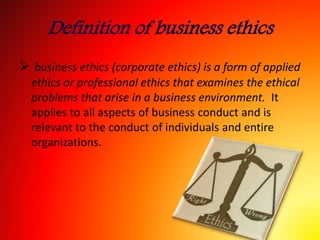
 business ethics (corporate ethics) is a form of applied
ethics or professional ethics that examines the ethical
problems that arise in a business environment. It
applies to all aspects of business conduct and is
relevant to the conduct of individuals and entire
organizations.
What does business ethics mean?
• comprises principles and standards that guide
behavior in the world of business
• acceptable or unacceptable behavior within or
outside the organization
• is determined by key stakeholders
• what is right and wrong, good and bad, and harmful
or beneficial regarding decisions and actions in &
around organizational activities
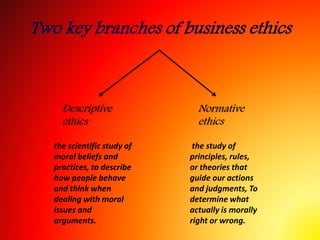
Two key branches of business ethics
Descriptive
ethics
Normative
ethics
the scientific study of
moral beliefs and
practices, to describe
how people behave
and think when
dealing with moral
issues and
arguments.
the study of
principles, rules,
or theories that
guide our actions
and judgments, To
determine what
actually is morally
right or wrong.
12 principles of business ethics
 Honesty : be honest in all communications and
actions
 Integrity: maintain personal integrity
 Promise-keeping: keep promises and fulfill
commitments
 Loyalty: be loyal within the framework of other
ethical principles
 Fairness: strive to be fair and just in all dealings.
 Caring: demonstrate compassion an a genuine concern
for the well being of the others
 Respect for others: treat everyone with respect
 Law abiding: obey the law
 Commitment to excellence: pursue excellence all the
time in all things
 Leadership: exemplify honor and ethics
 Reputation and morale: build and protect the
company’s good reputation and the morale of its
employees
 Accountability: be accountable
Importance of business ethics
Ethical motivation: it protects or improves
reputation of the organization by creating efficient
and productive environment.
Balance the needs and wishes of
stakeholders: business ethics requires businesses
to think about the impact of its decision on
stakeholders who are directly or indirectly affected by
those decision.
 Global challenges: business must be aware of the
ethical diversity of this world because of increasing
globalization of thee economy.
Ethical pay-off: they serve to protect the
organization from significant risks and to some
degree help grow the business.
Preventing civil law suits: giving employees an
internal outlet can solve problems without the event
becoming public knowledge or an issue for the courts.
Market leadership : when a company fully
integrates its values into its culture, quality rises due
to the employees focus on the values. Customers sees
that the employees care more about the customers
concerns.
Setting the example: by setting the example in the
community and the market the entire industry has a
new standard that allows the community and the
market to recognize the company as a leader.
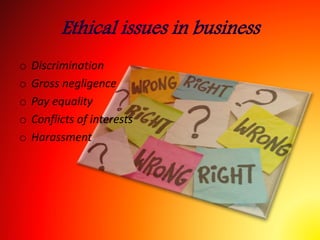
Ethical issues in business
o Discrimination
o Gross negligence
o Pay equality
o Conflicts of interests
o Harassment
Encouraging ethical behavior in
organization
I. Communicating the code of ethics
II. Making the managers as role model
(i) employees will have a guiding force to promote ethical
behavior.
(ii)employees tend to emulate the managers & if they are
ethical in their behaviors, it lends more creditability to the
code of ethics
(iii)if managers strictly adhere to ethical standards
themselves, employees feel less reluctant to oppose the
guidelines laid out for ethical behavior.
III. Disciplinary actions for unethical behavior
IV. Rewards for ethical behavior.

Business ethics

  • 1.
  • 2.
    Definition of businessethics  business ethics (corporate ethics) is a form of applied ethics or professional ethics that examines the ethical problems that arise in a business environment. It applies to all aspects of business conduct and is relevant to the conduct of individuals and entire organizations.
  • 3.
    What does businessethics mean? • comprises principles and standards that guide behavior in the world of business • acceptable or unacceptable behavior within or outside the organization • is determined by key stakeholders • what is right and wrong, good and bad, and harmful or beneficial regarding decisions and actions in & around organizational activities
  • 4.
    Two key branchesof business ethics Descriptive ethics Normative ethics the scientific study of moral beliefs and practices, to describe how people behave and think when dealing with moral issues and arguments. the study of principles, rules, or theories that guide our actions and judgments, To determine what actually is morally right or wrong.
  • 5.
    12 principles ofbusiness ethics  Honesty : be honest in all communications and actions  Integrity: maintain personal integrity  Promise-keeping: keep promises and fulfill commitments  Loyalty: be loyal within the framework of other ethical principles  Fairness: strive to be fair and just in all dealings.
  • 6.
     Caring: demonstratecompassion an a genuine concern for the well being of the others  Respect for others: treat everyone with respect  Law abiding: obey the law  Commitment to excellence: pursue excellence all the time in all things  Leadership: exemplify honor and ethics  Reputation and morale: build and protect the company’s good reputation and the morale of its employees  Accountability: be accountable
  • 7.
    Importance of businessethics Ethical motivation: it protects or improves reputation of the organization by creating efficient and productive environment. Balance the needs and wishes of stakeholders: business ethics requires businesses to think about the impact of its decision on stakeholders who are directly or indirectly affected by those decision.
  • 8.
     Global challenges:business must be aware of the ethical diversity of this world because of increasing globalization of thee economy. Ethical pay-off: they serve to protect the organization from significant risks and to some degree help grow the business. Preventing civil law suits: giving employees an internal outlet can solve problems without the event becoming public knowledge or an issue for the courts.
  • 9.
    Market leadership :when a company fully integrates its values into its culture, quality rises due to the employees focus on the values. Customers sees that the employees care more about the customers concerns. Setting the example: by setting the example in the community and the market the entire industry has a new standard that allows the community and the market to recognize the company as a leader.
  • 10.
    Ethical issues inbusiness o Discrimination o Gross negligence o Pay equality o Conflicts of interests o Harassment
  • 11.
    Encouraging ethical behaviorin organization I. Communicating the code of ethics II. Making the managers as role model (i) employees will have a guiding force to promote ethical behavior. (ii)employees tend to emulate the managers & if they are ethical in their behaviors, it lends more creditability to the code of ethics (iii)if managers strictly adhere to ethical standards themselves, employees feel less reluctant to oppose the guidelines laid out for ethical behavior. III. Disciplinary actions for unethical behavior IV. Rewards for ethical behavior.