

boricha.ashwin@gmail.com
How to shoot your first
DSLR video
boricha.ashwin@gmail.com
Read your DSLR manual
boricha.ashwin@gmail.com
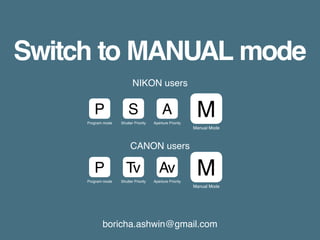
Switch to MANUAL mode
P
P
S
Tv
A
Av
M
M
NIKON users
CANON users
Program mode
Program mode
Shutter Priority
Shutter Priority
Aperture Priority
Aperture Priority
Manual Mode
Manual Mode
boricha.ashwin@gmail.com
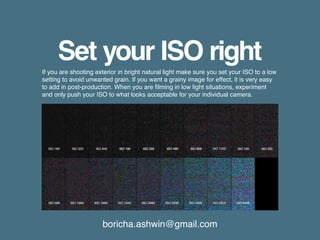
Set your ISO right
If you are shooting exterior in bright natural light make sure you set your ISO to a low
setting to avoid unwanted grain. If you want a grainy image for effect, it is very easy
to add in post-production. When you are filming in low light situations, experiment
and only push your ISO to what looks acceptable for your individual camera.
boricha.ashwin@gmail.com
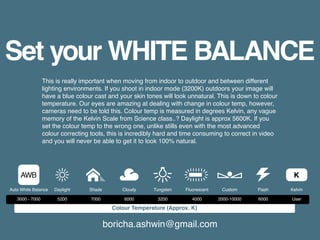
Colour Temperature (Approx. K)
Set your WHITE BALANCE
This is really important when moving from indoor to outdoor and between different
lighting environments. If you shoot in indoor mode (3200K) outdoors your image will
have a blue colour cast and your skin tones will look unnatural. This is down to colour
temperature. Our eyes are amazing at dealing with change in colour temp, however,
cameras need to be told this. Colour temp is measured in degrees Kelvin, any vague
memory of the Kelvin Scale from Science class..? Daylight is approx 5600K. If you
set the colour temp to the wrong one, unlike stills even with the most advanced
colour correcting tools, this is incredibly hard and time consuming to correct in video
and you will never be able to get it to look 100% natural.
AWB K
Auto White Balance
3000 - 7000
Daylight
5200
Shade
7000
Cloudy
6000
Tungsten
3200
Fluorescent
4000
Custom
2000-10000
Flash
6000
Kelvin
User
boricha.ashwin@gmail.com
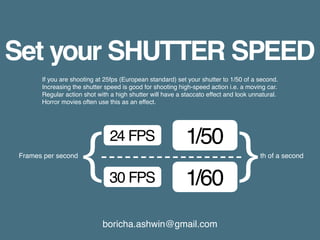
Set your SHUTTER SPEED
If you are shooting at 25fps (European standard) set your shutter to 1/50 of a second.
Increasing the shutter speed is good for shooting high-speed action i.e. a moving car.
Regular action shot with a high shutter will have a staccato effect and look unnatural.
Horror movies often use this as an effect.
24 FPS
30 FPS
1/50
1/60
Frames per second th of a second
boricha.ashwin@gmail.com
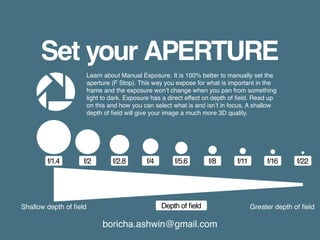
Set your APERTURE
Learn about Manual Exposure. It is 100% better to manually set the
aperture (F Stop). This way you expose for what is important in the
frame and the exposure won’t change when you pan from something
light to dark. Exposure has a direct effect on depth of field. Read up
on this and how you can select what is and isn’t in focus. A shallow
depth of field will give your image a much more 3D quality.
f/22f/16f/11f/8f/5.6
Depth of field
f/4f/2.8f/2f/1.4
Shallow depth of field Greater depth of field
boricha.ashwin@gmail.com
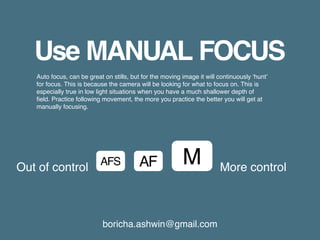
Use MANUAL FOCUS
Auto focus, can be great on stills, but for the moving image it will continuously ‘hunt’
for focus. This is because the camera will be looking for what to focus on. This is
especially true in low light situations when you have a much shallower depth of
field. Practice following movement, the more you practice the better you will get at
manually focusing.
AFAFS M More controlOut of control
boricha.ashwin@gmail.com
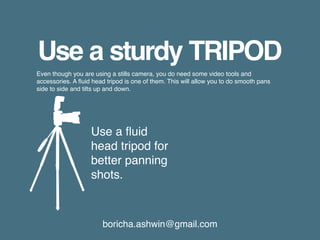
Use a sturdy TRIPOD
Even though you are using a stills camera, you do need some video tools and
accessories. A fluid head tripod is one of them. This will allow you to do smooth pans
side to side and tilts up and down.
Use a fluid
head tripod for
better panning
shots.
boricha.ashwin@gmail.com
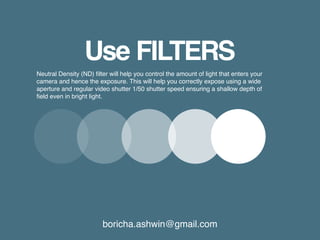
Use FILTERS
Neutral Density (ND) filter will help you control the amount of light that enters your
camera and hence the exposure. This will help you correctly expose using a wide
aperture and regular video shutter 1/50 shutter speed ensuring a shallow depth of
field even in bright light.
boricha.ashwin@gmail.com
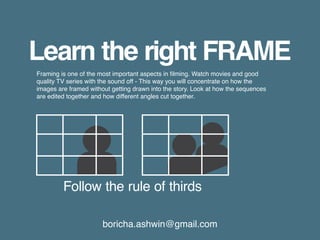
Learn the right FRAME
Follow the rule of thirds
Framing is one of the most important aspects in filming. Watch movies and good
quality TV series with the sound off - This way you will concentrate on how the
images are framed without getting drawn into the story. Look at how the sequences
are edited together and how different angles cut together.
boricha.ashwin@gmail.com
Few TIPS
1) Talk to who you are filming, build a relationship with them
2) Get them to feel comfortable with you and being filmed
3) Enjoy and experiment: Try shooting hand held. Learn how to be comfortable with
the camera.
4) The more you feel comfortable and in-control behind the camera the more your
filming skills will improve.
5) Get hold of some basic accessories to make your life easier
boricha.ashwin@gmail.com
Happy shooting
&
Thank you

How to shoot your first dslr video

  • 1.
  • 2.
  • 3.
    boricha.ashwin@gmail.com Switch to MANUALmode P P S Tv A Av M M NIKON users CANON users Program mode Program mode Shutter Priority Shutter Priority Aperture Priority Aperture Priority Manual Mode Manual Mode
  • 4.
    boricha.ashwin@gmail.com Set your ISOright If you are shooting exterior in bright natural light make sure you set your ISO to a low setting to avoid unwanted grain. If you want a grainy image for effect, it is very easy to add in post-production. When you are filming in low light situations, experiment and only push your ISO to what looks acceptable for your individual camera.
  • 5.
    boricha.ashwin@gmail.com Colour Temperature (Approx.K) Set your WHITE BALANCE This is really important when moving from indoor to outdoor and between different lighting environments. If you shoot in indoor mode (3200K) outdoors your image will have a blue colour cast and your skin tones will look unnatural. This is down to colour temperature. Our eyes are amazing at dealing with change in colour temp, however, cameras need to be told this. Colour temp is measured in degrees Kelvin, any vague memory of the Kelvin Scale from Science class..? Daylight is approx 5600K. If you set the colour temp to the wrong one, unlike stills even with the most advanced colour correcting tools, this is incredibly hard and time consuming to correct in video and you will never be able to get it to look 100% natural. AWB K Auto White Balance 3000 - 7000 Daylight 5200 Shade 7000 Cloudy 6000 Tungsten 3200 Fluorescent 4000 Custom 2000-10000 Flash 6000 Kelvin User
  • 6.
    boricha.ashwin@gmail.com Set your SHUTTERSPEED If you are shooting at 25fps (European standard) set your shutter to 1/50 of a second. Increasing the shutter speed is good for shooting high-speed action i.e. a moving car. Regular action shot with a high shutter will have a staccato effect and look unnatural. Horror movies often use this as an effect. 24 FPS 30 FPS 1/50 1/60 Frames per second th of a second
  • 7.
    boricha.ashwin@gmail.com Set your APERTURE Learnabout Manual Exposure. It is 100% better to manually set the aperture (F Stop). This way you expose for what is important in the frame and the exposure won’t change when you pan from something light to dark. Exposure has a direct effect on depth of field. Read up on this and how you can select what is and isn’t in focus. A shallow depth of field will give your image a much more 3D quality. f/22f/16f/11f/8f/5.6 Depth of field f/4f/2.8f/2f/1.4 Shallow depth of field Greater depth of field
  • 8.
    boricha.ashwin@gmail.com Use MANUAL FOCUS Autofocus, can be great on stills, but for the moving image it will continuously ‘hunt’ for focus. This is because the camera will be looking for what to focus on. This is especially true in low light situations when you have a much shallower depth of field. Practice following movement, the more you practice the better you will get at manually focusing. AFAFS M More controlOut of control
  • 9.
    boricha.ashwin@gmail.com Use a sturdyTRIPOD Even though you are using a stills camera, you do need some video tools and accessories. A fluid head tripod is one of them. This will allow you to do smooth pans side to side and tilts up and down. Use a fluid head tripod for better panning shots.
  • 10.
    boricha.ashwin@gmail.com Use FILTERS Neutral Density(ND) filter will help you control the amount of light that enters your camera and hence the exposure. This will help you correctly expose using a wide aperture and regular video shutter 1/50 shutter speed ensuring a shallow depth of field even in bright light.
  • 11.
    boricha.ashwin@gmail.com Learn the rightFRAME Follow the rule of thirds Framing is one of the most important aspects in filming. Watch movies and good quality TV series with the sound off - This way you will concentrate on how the images are framed without getting drawn into the story. Look at how the sequences are edited together and how different angles cut together.
  • 12.
    boricha.ashwin@gmail.com Few TIPS 1) Talkto who you are filming, build a relationship with them 2) Get them to feel comfortable with you and being filmed 3) Enjoy and experiment: Try shooting hand held. Learn how to be comfortable with the camera. 4) The more you feel comfortable and in-control behind the camera the more your filming skills will improve. 5) Get hold of some basic accessories to make your life easier
  • 13.