Optimizing Your Audience Targeting, Ad Content,
Landing Page, and Post Click Experience.
How to Perform Full Funnel CRO
Jason Puckett
Jason Puckett is the CEO & Founder
of AdBasis. Ad creative optimization is the
name of Jason's game. AdBasis is an A/B
and Multivariate testing platform for search,
display, remarketing & mobile ads. Jason is a
digital marketing strategist, ad optimization
expert and conversion rate enthusiast.
#DigitalAgencyDay
Michael McEuen
Michael McEuen is the Director of Demand
Generation at AdStage. Multi-Network ROAS
optimization is his true North. The AdStage
Platform is a self-serve cross-network
platform that allows marketers to create,
automate, and report on their ad campaigns
across search and social.
#DigitalAgencyDay
Anatomy of an Ad
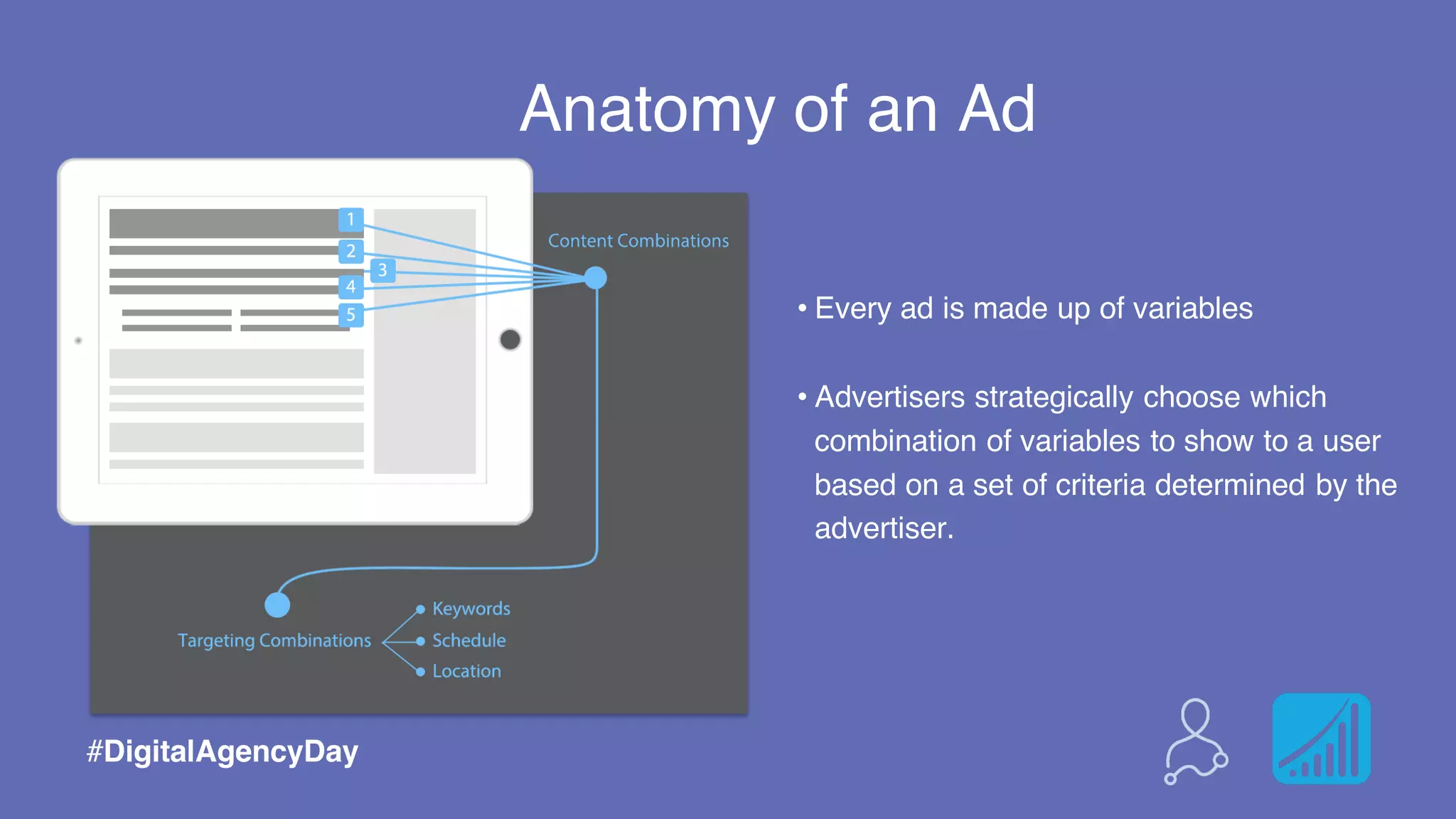
• Every ad is made up of variables
• Advertisers strategically choose which
combination of variables to show to a user
based on a set of criteria determined by the
advertiser.
#DigitalAgencyDay
Variable Prediction
Advertisers can predict the ideal combination
of ad variables by looking at certain data:
• Demographic of the user
• What the user is looking for (search terms)
• Stage of the buying cycle (long-tailed search terms)
• Geographic region (where the user is located)
• Time of day in which the user conducts the search
• Ad content- optimized to get attention
• Ad content- optimized to deliver the correct message
• Call to action (description 1 and description 2)
• Destination URL (landing page)
#DigitalAgencyDay
Buying Scenarios
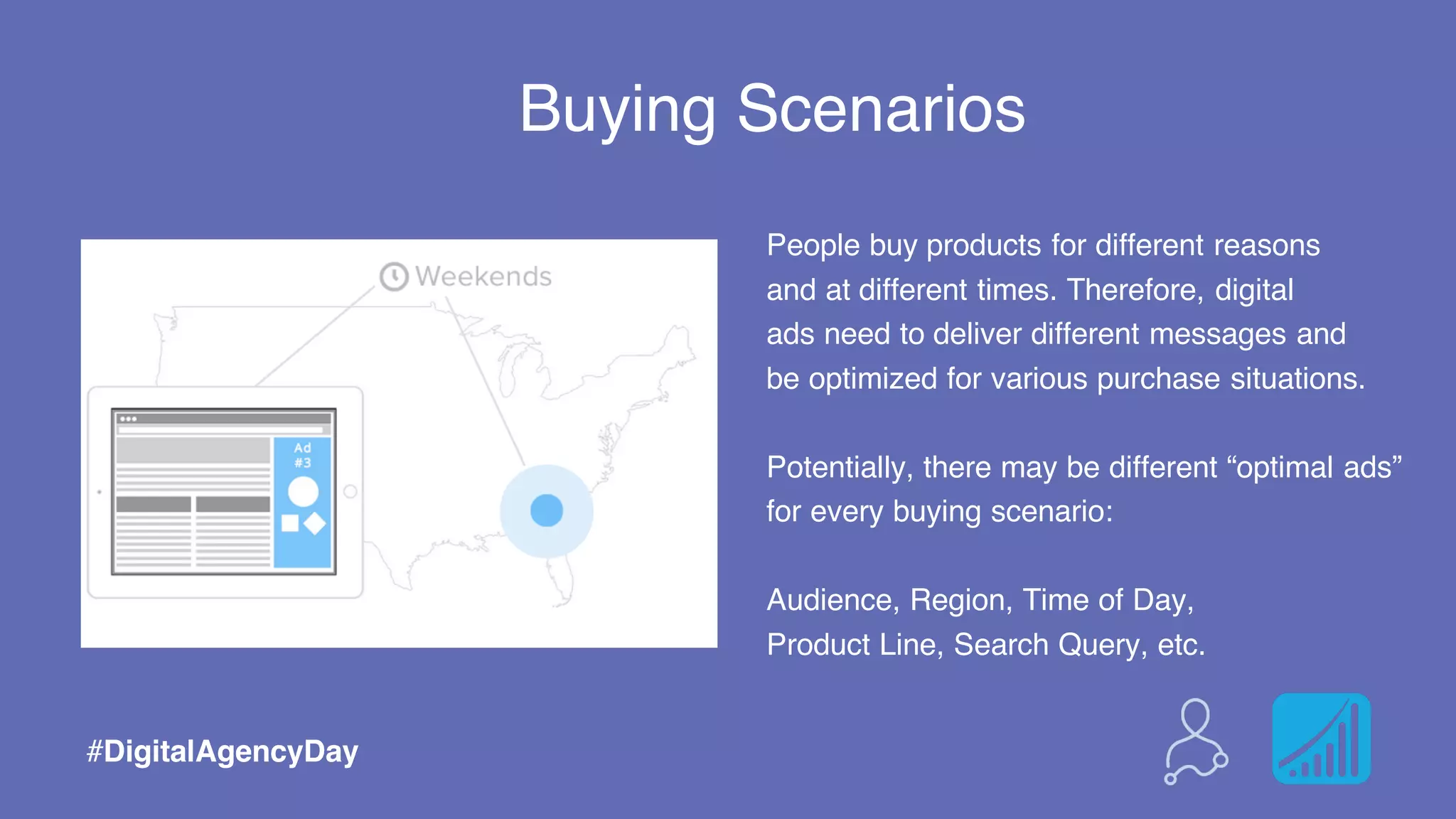
People buy products for different reasons
and at different times. Therefore, digital
ads need to deliver different messages and
be optimized for various purchase situations.
Potentially, there may be different “optimal ads”
for every buying scenario:
Audience, Region, Time of Day,
Product Line, Search Query, etc.
#DigitalAgencyDay
How do agencies find the optimal
combinations of variables
to maximize ROI?
#DigitalAgencyDay
A/B Ad Testing
When is it used?
• Compare two ad variations for performance
• Compare two elements within an ad in order to
understand impact
• When you don’t have enough volume
in order to run a multivariate test
The Goal:
To find the optimal combination of ad variables
(variation) for a specific outcome.
#DigitalAgencyDay
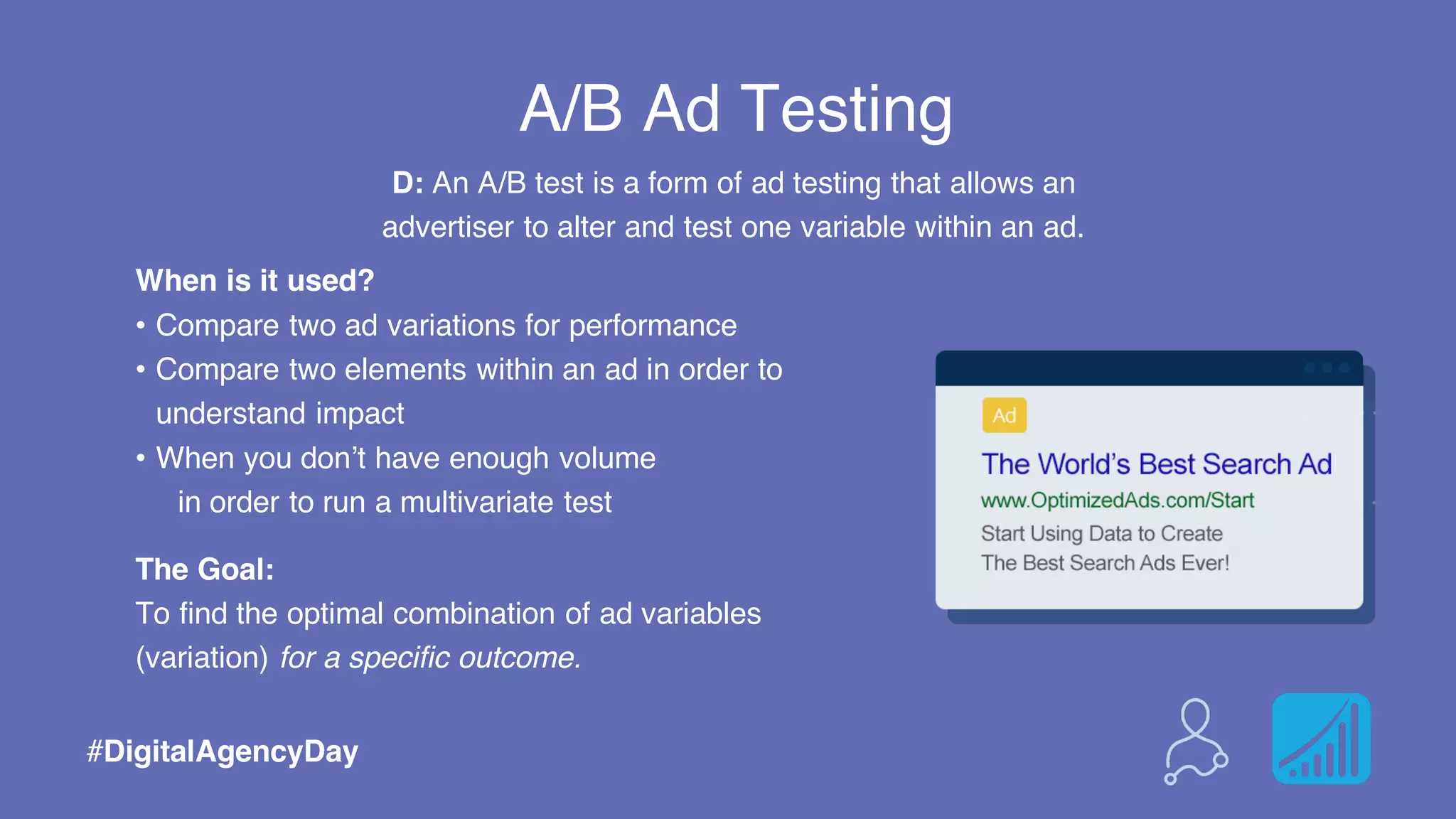
D: An A/B test is a form of ad testing that allows an
advertiser to alter and test one variable within an ad.
Multivariate Ad Testing
When is it used?
• Multiple elements within an ad up for debate
• Within the context of that specific variation
The Goal:
To find the optimal combination of ad variables
(variation) for a specific outcome.
#DigitalAgencyDay
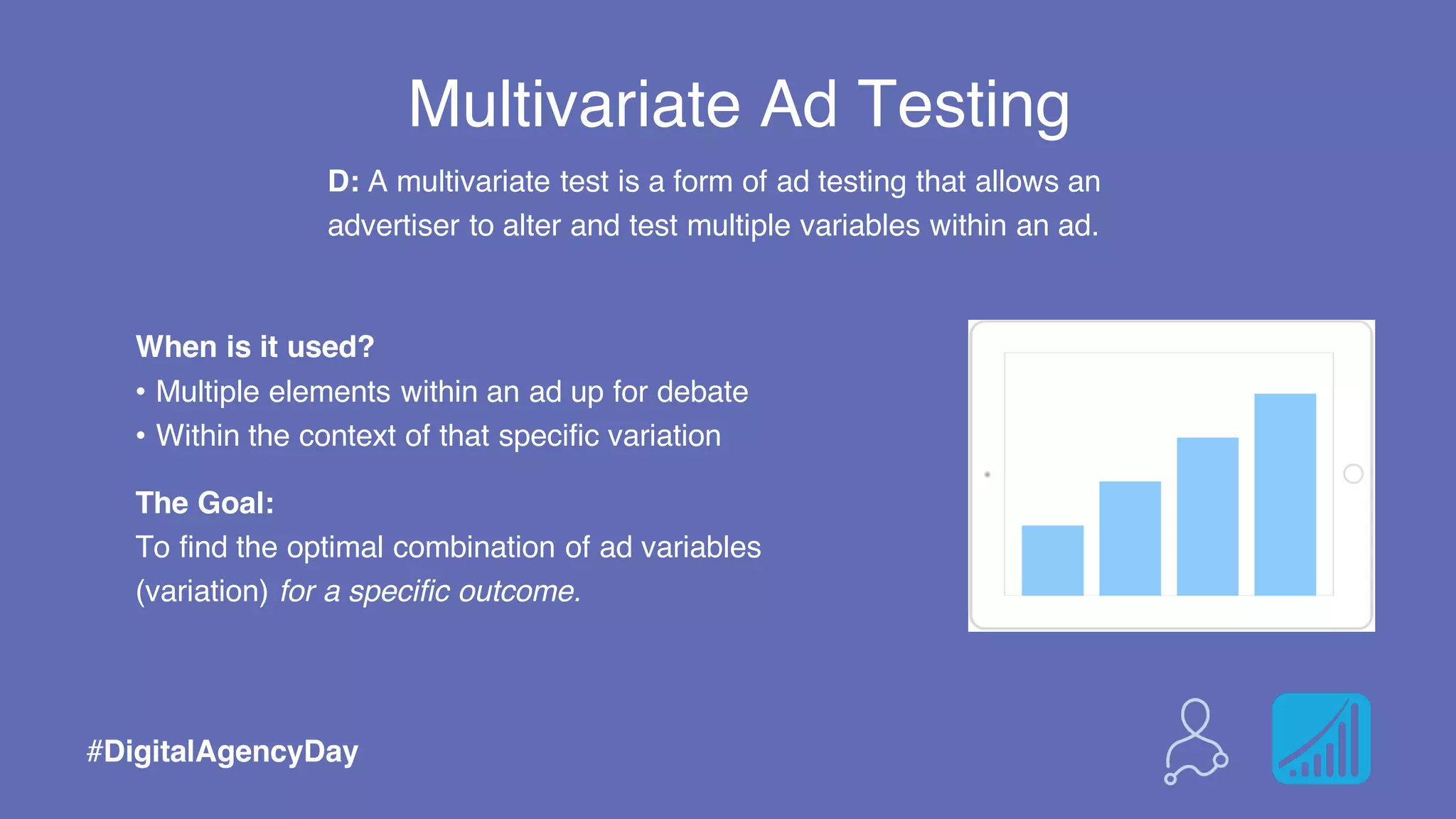
D: A multivariate test is a form of ad testing that allows an
advertiser to alter and test multiple variables within an ad.
Single Layer vs. Full Funnel Testing
#DigitalAgencyDay
Traditional Testing
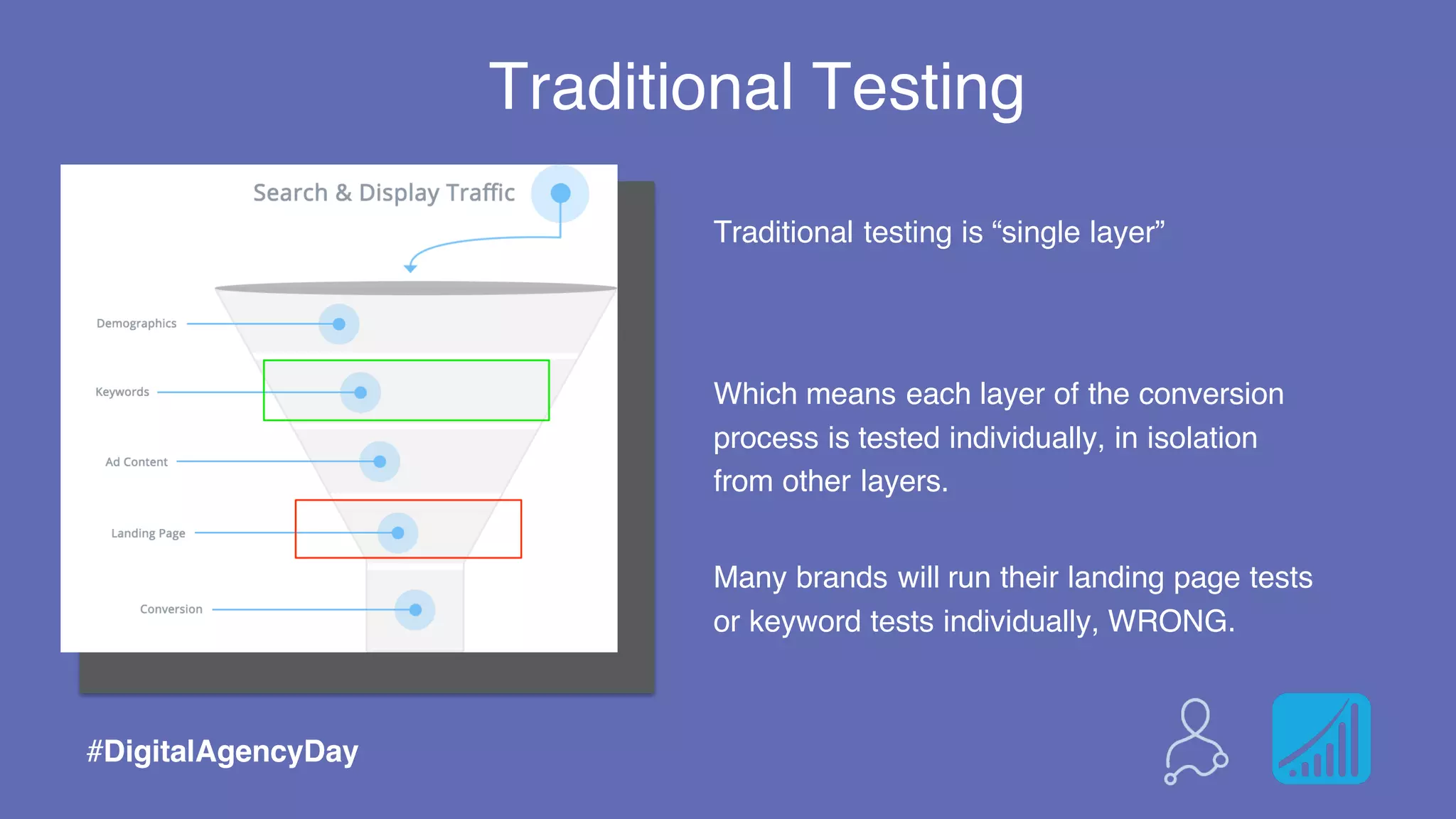
Traditional testing is “single layer”
#DigitalAgencyDay
Which means each layer of the conversion
process is tested individually, in isolation
from other layers.
Many brands will run their landing page tests
or keyword tests individually, WRONG.
Single Layer Testing
#DigitalAgencyDay
Why is this wrong? Testing in isolation provides misleading results
Examples:
• Landing pages may only convert well for certain demographics
• Some ad content may work well for European audiences but not Americans.
• Some promotional language may only convert traffic at certain times of day.
…The list goes on.
Full Funnel Testing
#DigitalAgencyDay
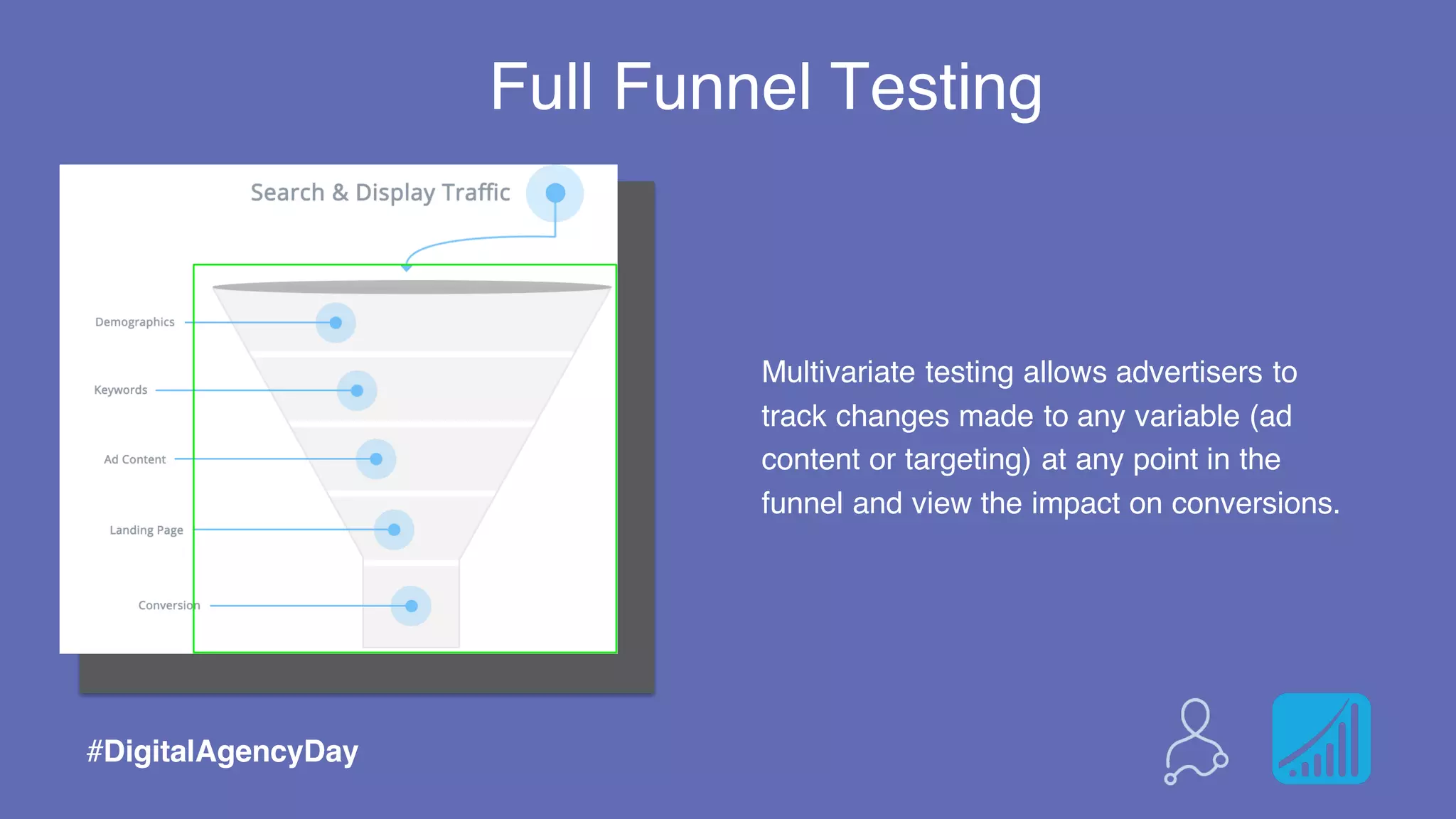
Multivariate testing allows advertisers to
track changes made to any variable (ad
content or targeting) at any point in the
funnel and view the impact on conversions.
Approaching Full Funnel Testing
#DigitalAgencyDay
Approach Your Creative
#DigitalAgencyDay
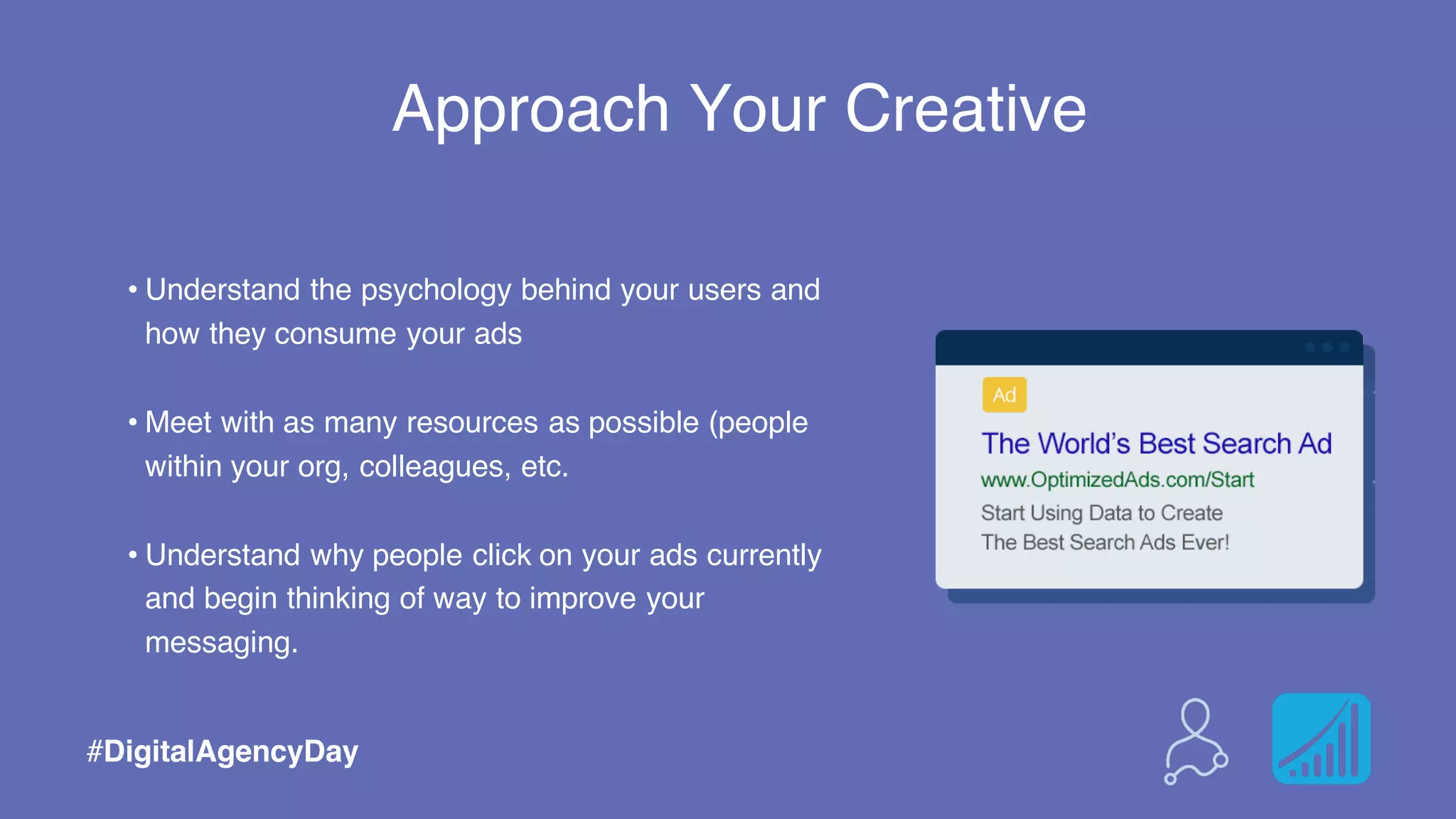
• Understand the psychology behind your users and
how they consume your ads
• Meet with as many resources as possible (people
within your org, colleagues, etc.
• Understand why people click on your ads currently
and begin thinking of way to improve your
messaging.
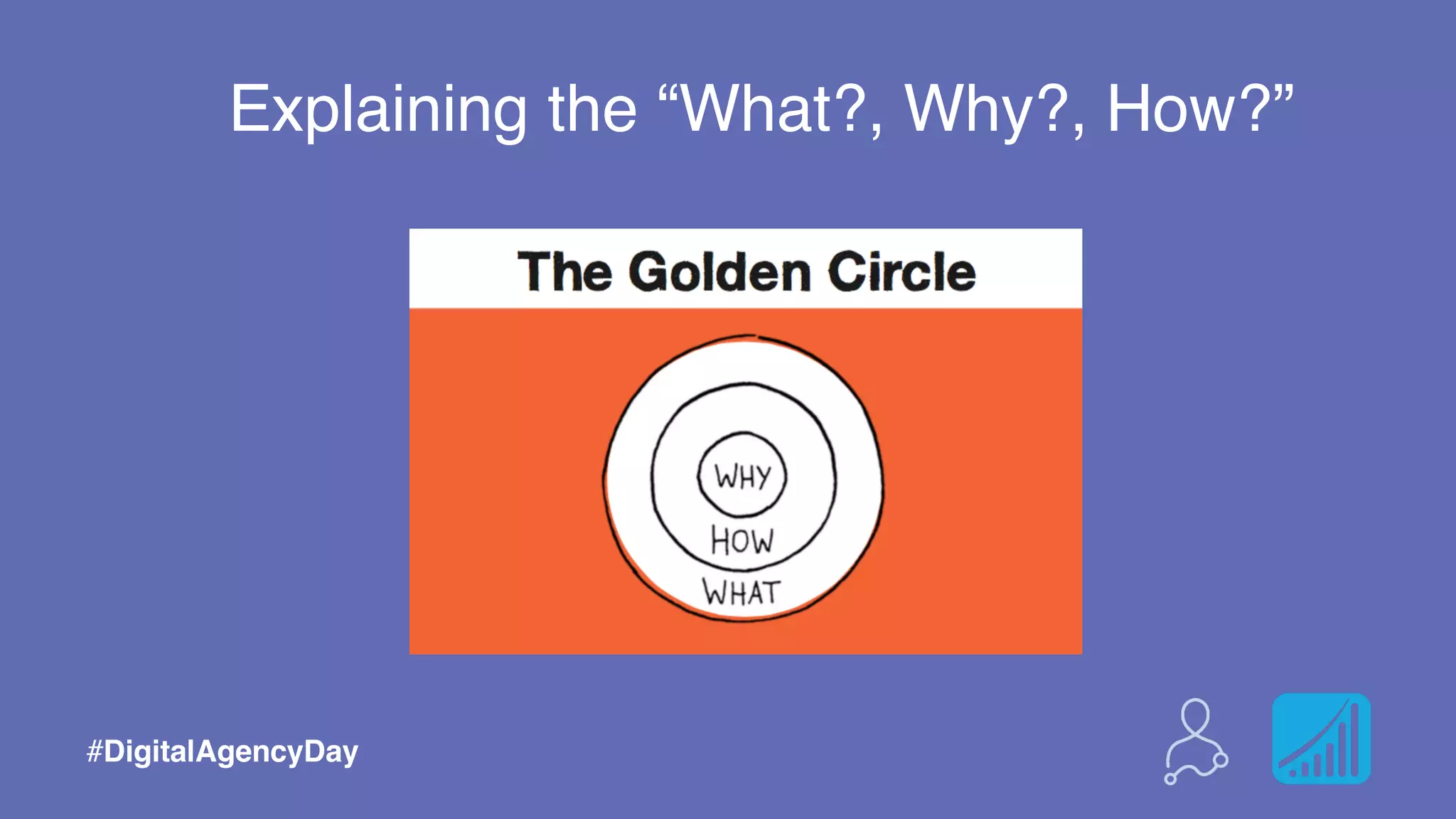
Explaining the “What?, Why?, How?”
#DigitalAgencyDay
#DigitalAgencyDay
Optimize Your Ad Elements
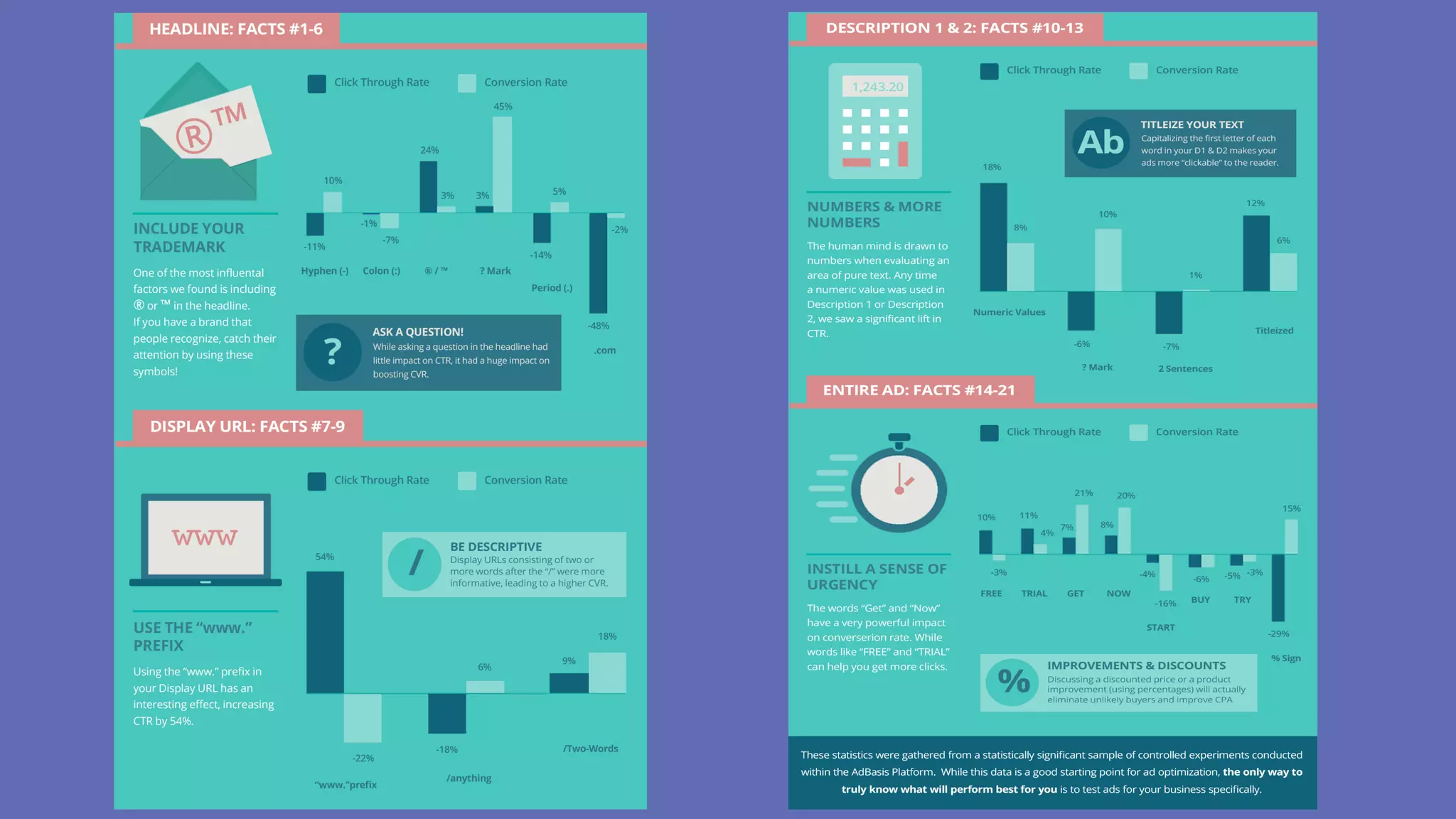
Optimize Your Elements
#DigitalAgencyDay
Analyzing The Results
#DigitalAgencyDay
Documenting Your Process
Advertisers can predict the ideal combination
of ad variables by looking at certain data:
• Demographic of the user
• What the user is looking for (search terms)
• Stage of the buying cycle (long-tailed search terms)
• Geographic region (where the user is located)
• Time of day in which the user conducts the search
• Ad content- optimized to get attention
• Ad content- optimized to deliver the correct message
• Call to action (description 1 and description 2)
• Destination URL (landing page)
#DigitalAgencyDay
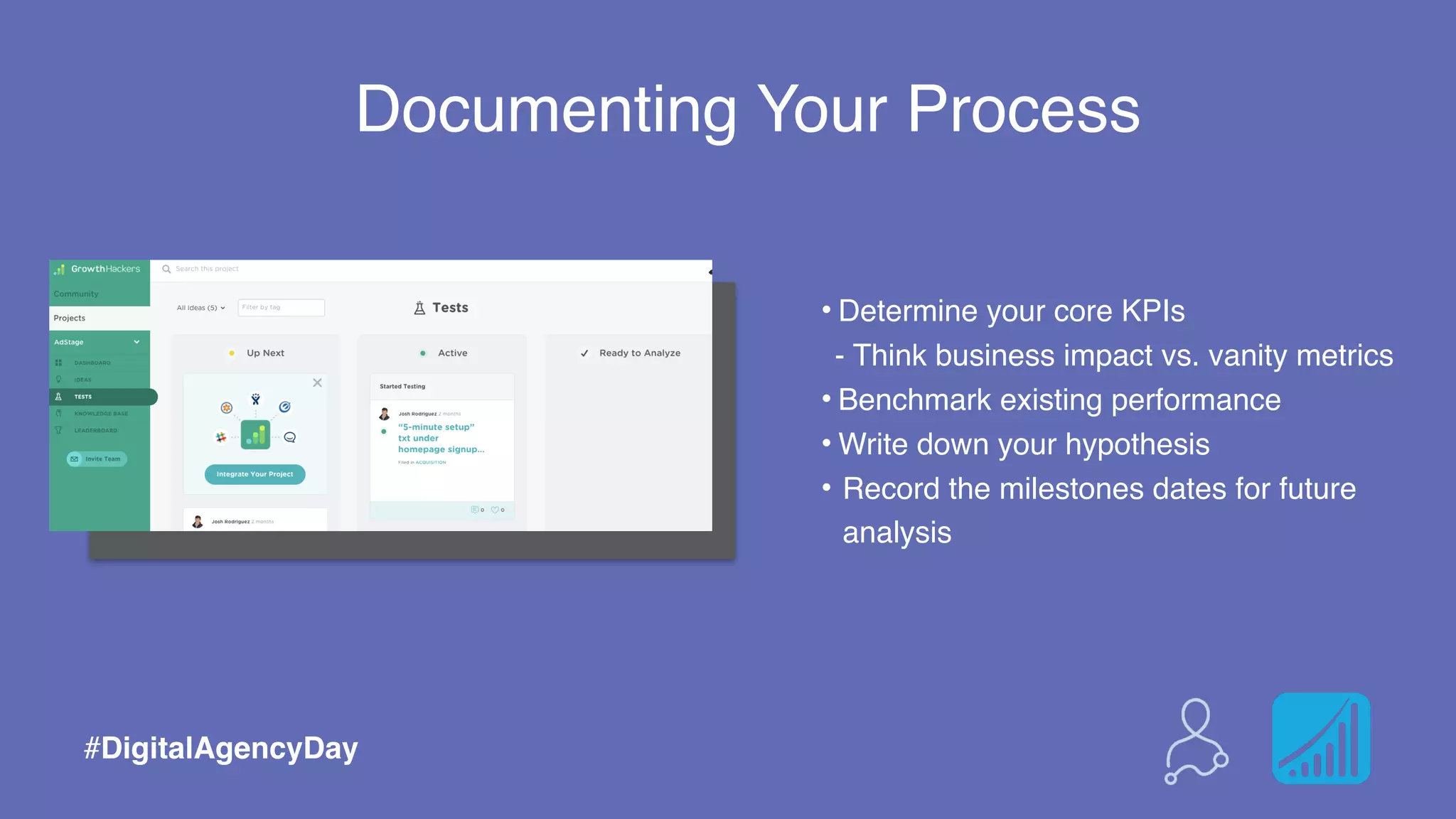
Documenting Your Process
• Determine your core KPIs
- Think business impact vs. vanity metrics
• Benchmark existing performance
• Write down your hypothesis
• Record the milestones dates for future
analysis
#DigitalAgencyDay
Advertisers can predict the ideal combination
of ad variables by looking at certain data:
• Demographic of the user
• What the user is looking for (search terms)
• Stage of the buying cycle (long-tailed search terms)
• Geographic region (where the user is located)
• Time of day in which the user conducts the search
• Ad content- optimized to get attention
• Ad content- optimized to deliver the correct message
• Call to action (description 1 and description 2)
• Destination URL (landing page)
#DigitalAgencyDay
Analyze Your Results
Steps to analysis:
• Is the sample size large enough? (statistically
significant)
• How did the variation(s) perform against the historic
version?
• Did the experiment prove my hypothesis?
• What are your next steps?
#DigitalAgencyDay
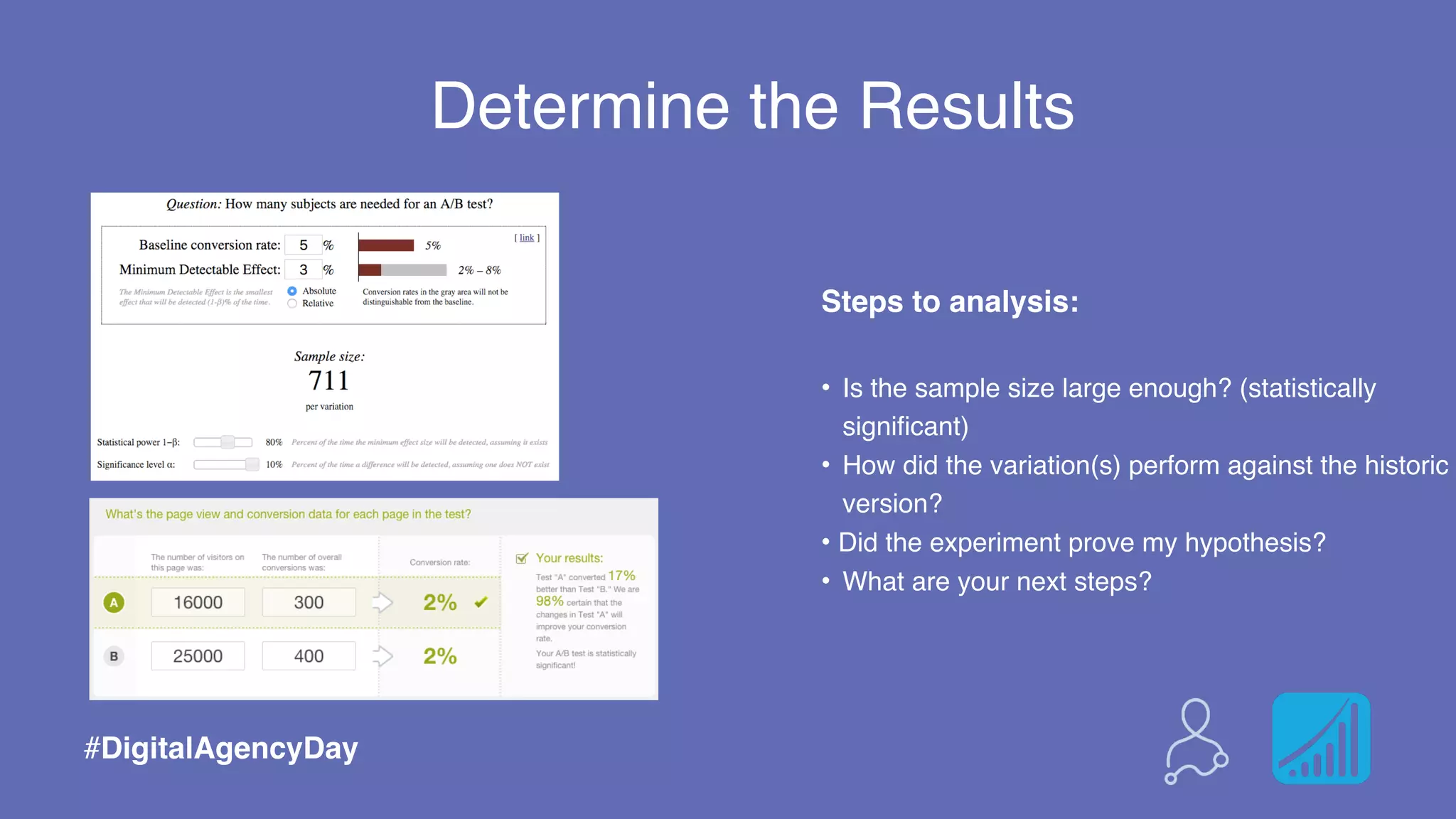
Determine the Results
Steps to analysis:
• Is the sample size large enough? (statistically
significant)
• How did the variation(s) perform against the historic
version?
• Did the experiment prove my hypothesis?
• What are your next steps?
#DigitalAgencyDay
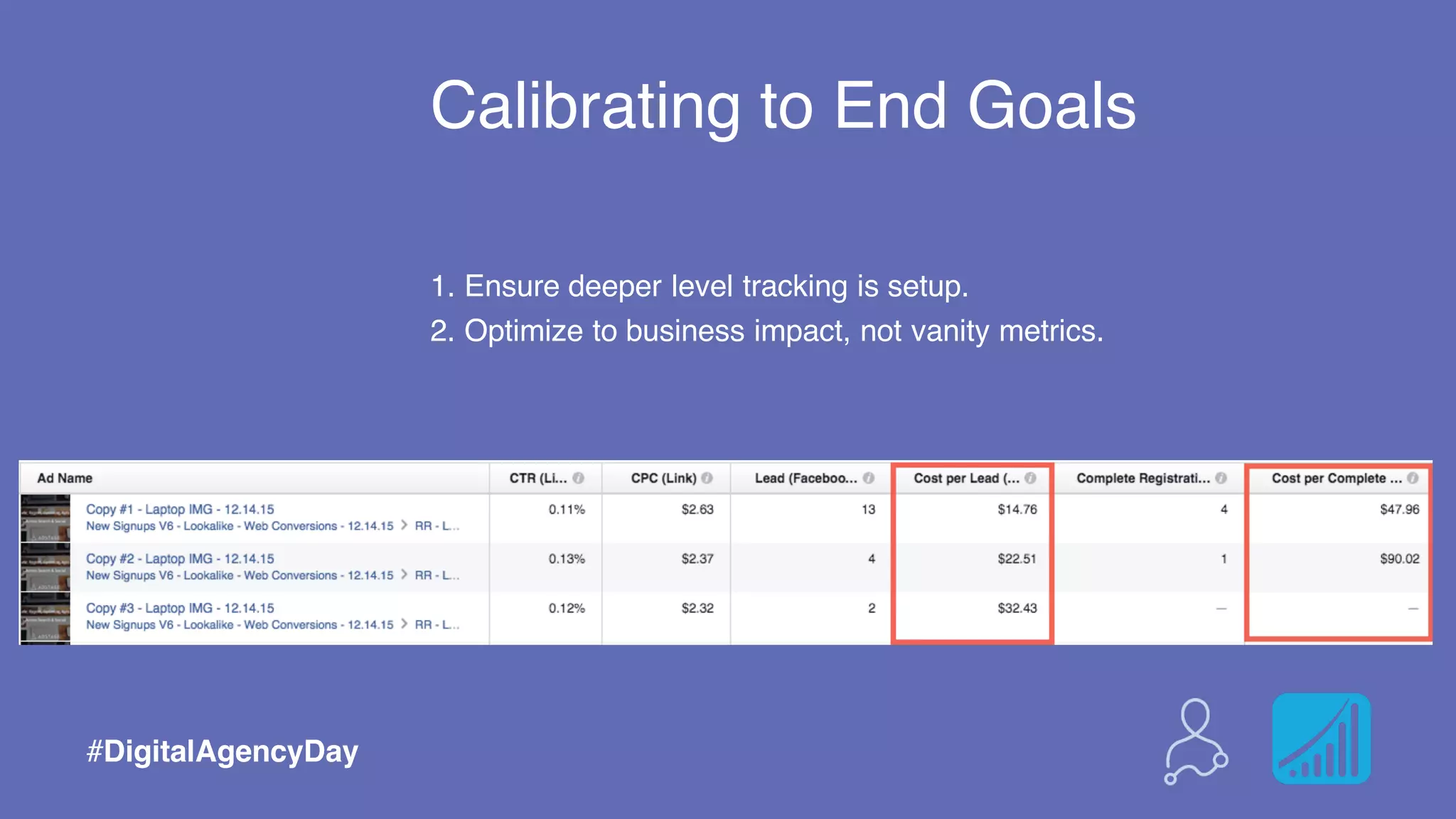
Determine the Results
1. Ensure deeper level tracking is setup.
2. Optimize to business impact, not vanity metrics.
#DigitalAgencyDay
Calibrating to End Goals
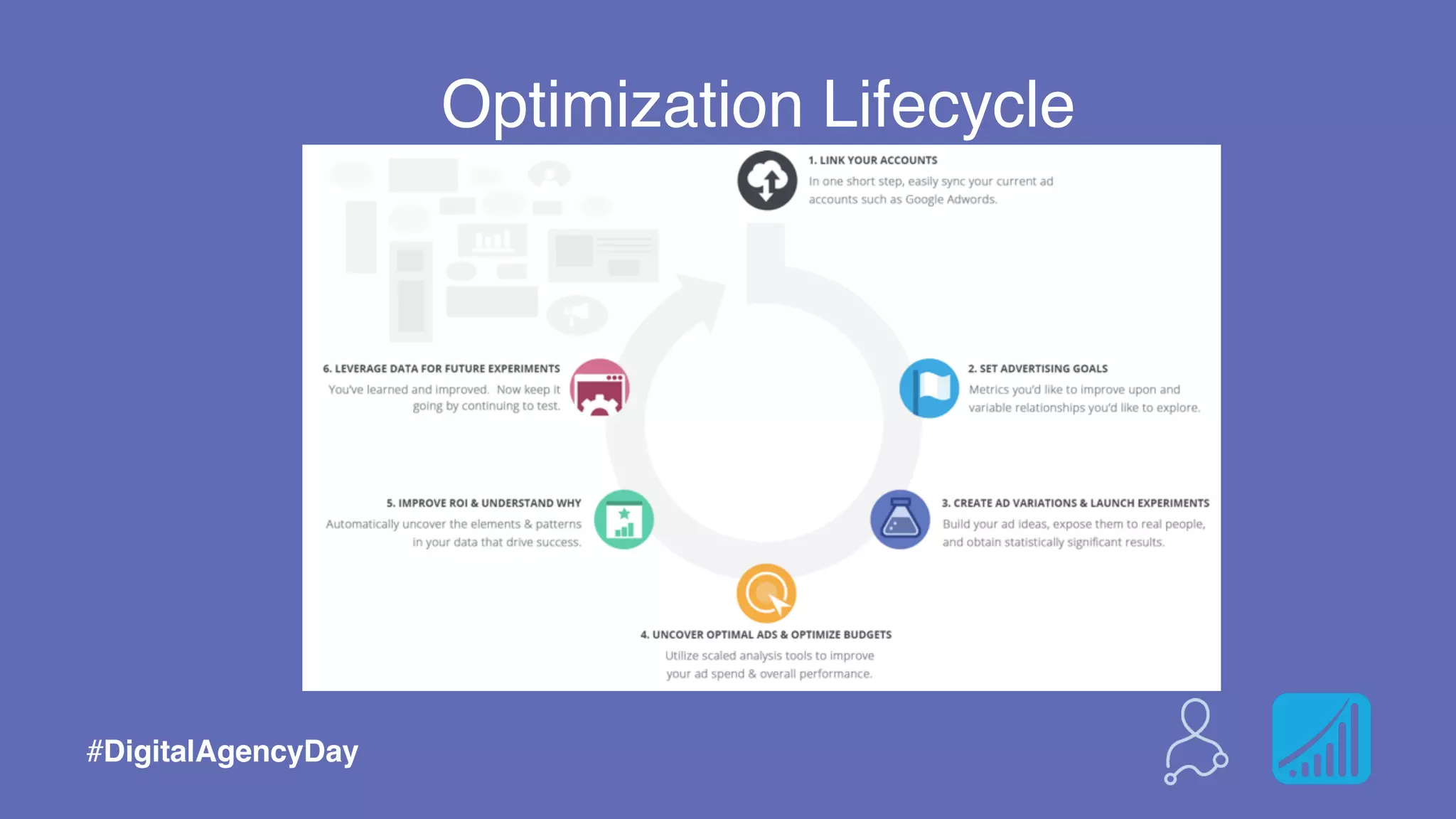
Optimization Lifecycle
#DigitalAgencyDay
Optimizing for Post-Click
#DigitalAgencyDay
Segment Your Retargeting:
#DigitalAgencyDay
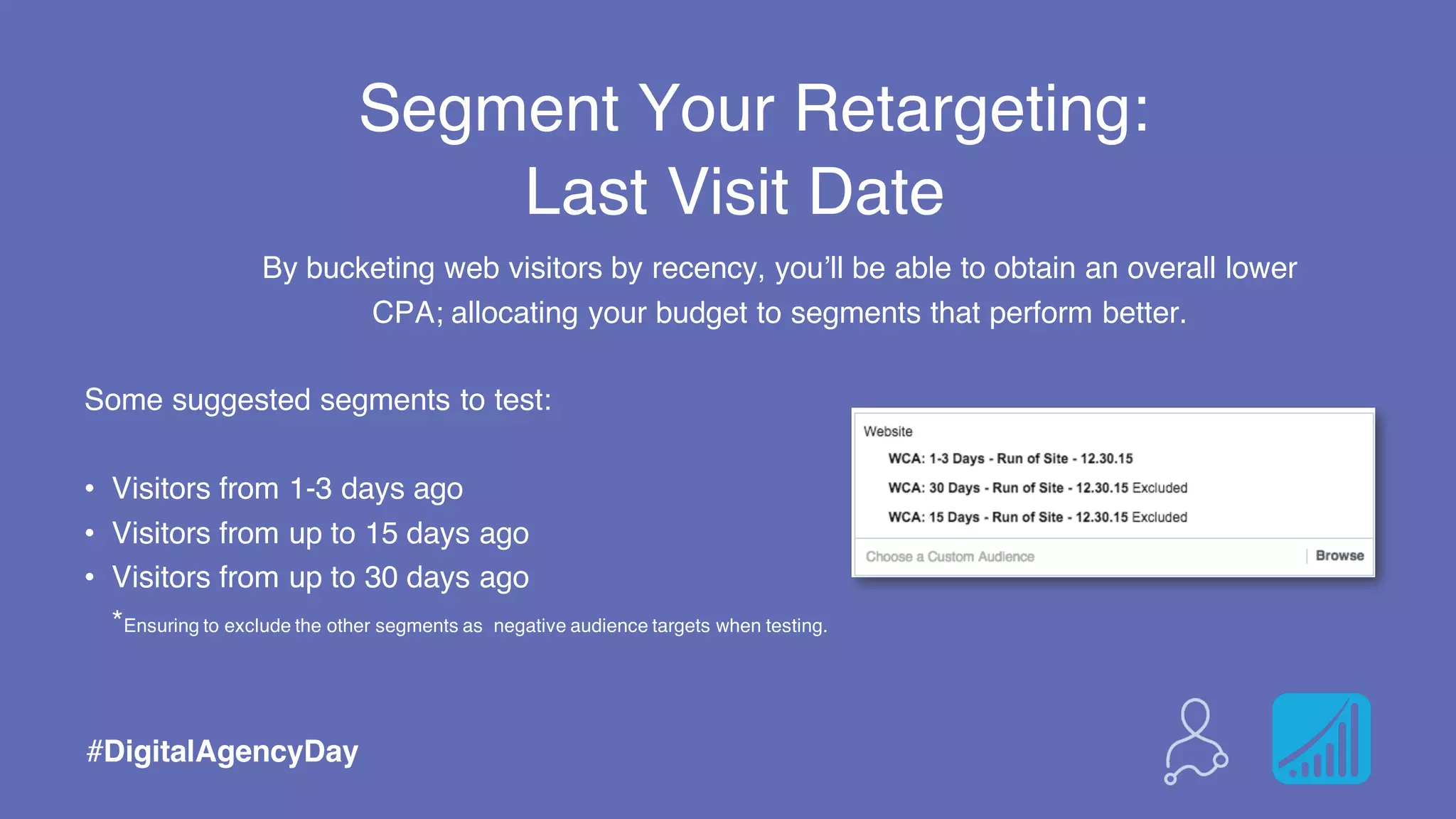
Last Visit Date
Some suggested segments to test:
• Visitors from 1-3 days ago
• Visitors from up to 15 days ago
• Visitors from up to 30 days ago
*Ensuring to exclude the other segments as negative audience targets when testing.
By bucketing web visitors by recency, you’ll be able to obtain an overall lower
CPA; allocating your budget to segments that perform better.
Segment Your Retargeting:
#DigitalAgencyDay
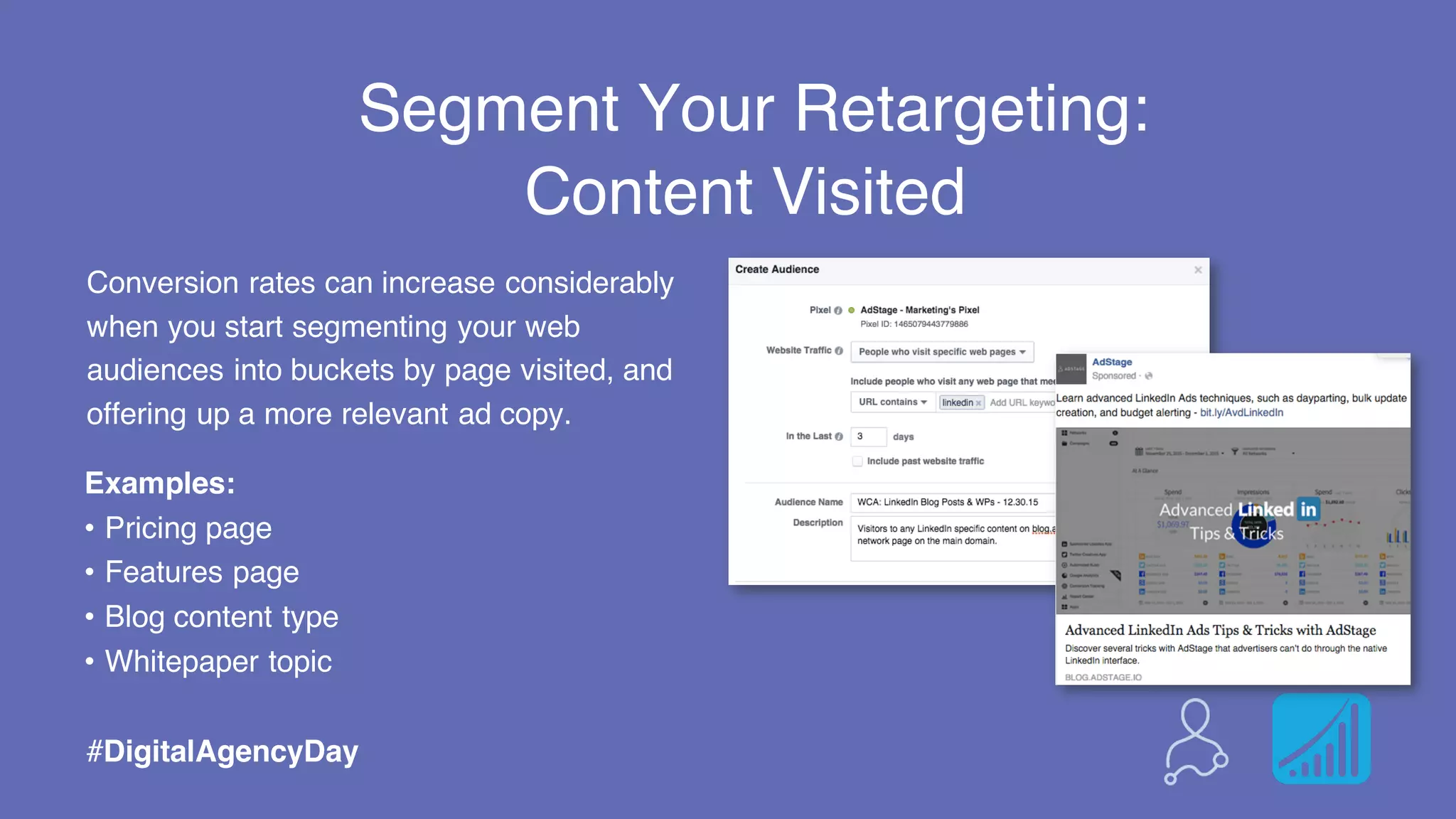
Content Visited
Examples:
• Pricing page
• Features page
• Blog content type
• Whitepaper topic
Conversion rates can increase considerably
when you start segmenting your web
audiences into buckets by page visited, and
offering up a more relevant ad copy.
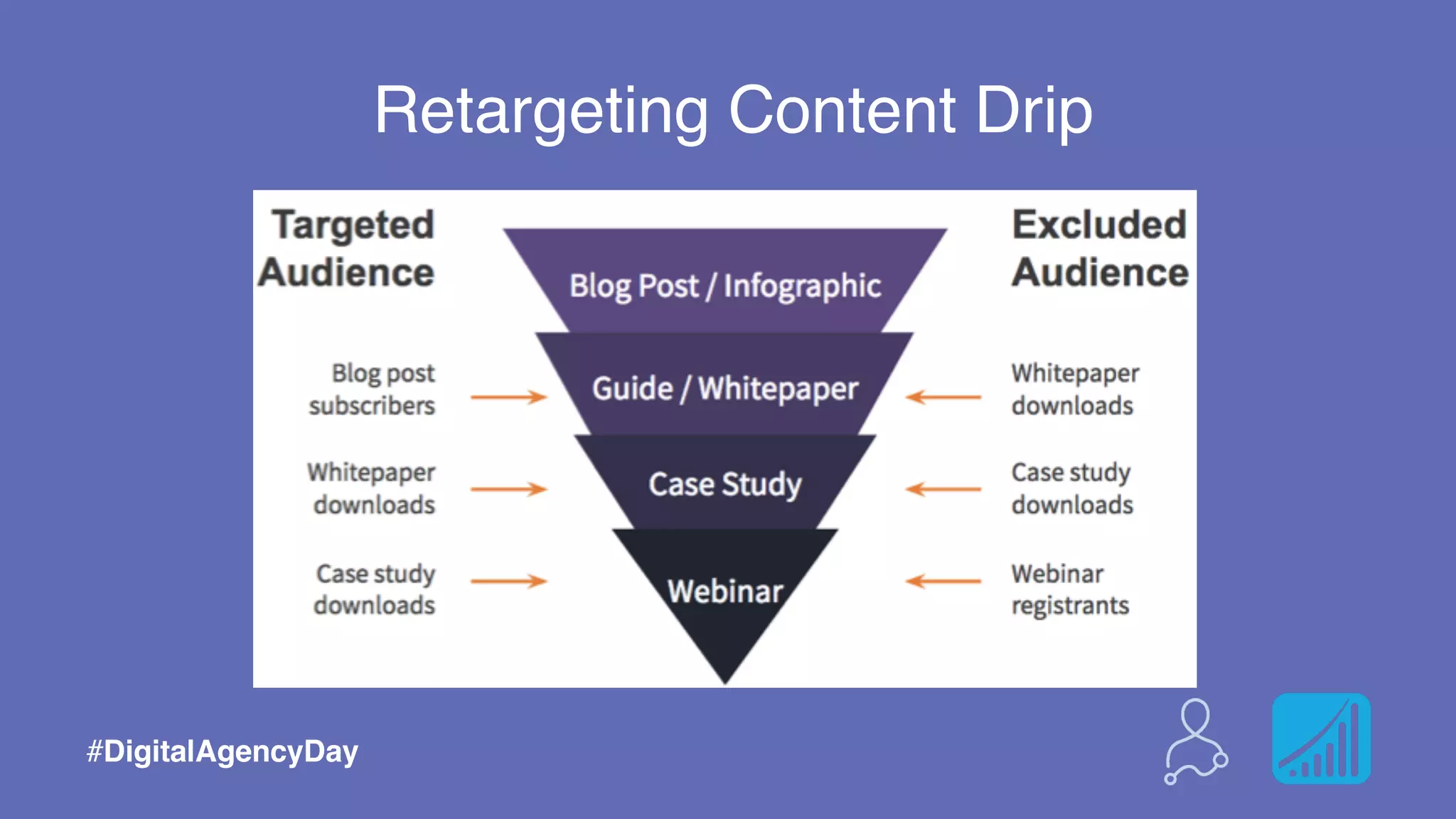
Retargeting Content Drip
#DigitalAgencyDay
#DigitalAgencyDay
Questions & Answers

How to Perform Full Funnel CRO

  • 1.
    Optimizing Your AudienceTargeting, Ad Content, Landing Page, and Post Click Experience. How to Perform Full Funnel CRO
  • 2.
    Jason Puckett Jason Puckettis the CEO & Founder of AdBasis. Ad creative optimization is the name of Jason's game. AdBasis is an A/B and Multivariate testing platform for search, display, remarketing & mobile ads. Jason is a digital marketing strategist, ad optimization expert and conversion rate enthusiast. #DigitalAgencyDay
  • 3.
    Michael McEuen Michael McEuenis the Director of Demand Generation at AdStage. Multi-Network ROAS optimization is his true North. The AdStage Platform is a self-serve cross-network platform that allows marketers to create, automate, and report on their ad campaigns across search and social. #DigitalAgencyDay
  • 4.
    Anatomy of anAd • Every ad is made up of variables • Advertisers strategically choose which combination of variables to show to a user based on a set of criteria determined by the advertiser. #DigitalAgencyDay
  • 5.
    Variable Prediction Advertisers canpredict the ideal combination of ad variables by looking at certain data: • Demographic of the user • What the user is looking for (search terms) • Stage of the buying cycle (long-tailed search terms) • Geographic region (where the user is located) • Time of day in which the user conducts the search • Ad content- optimized to get attention • Ad content- optimized to deliver the correct message • Call to action (description 1 and description 2) • Destination URL (landing page) #DigitalAgencyDay
  • 6.
    Buying Scenarios People buyproducts for different reasons and at different times. Therefore, digital ads need to deliver different messages and be optimized for various purchase situations. Potentially, there may be different “optimal ads” for every buying scenario: Audience, Region, Time of Day, Product Line, Search Query, etc. #DigitalAgencyDay
  • 7.
    How do agenciesfind the optimal combinations of variables to maximize ROI? #DigitalAgencyDay
  • 8.
    A/B Ad Testing Whenis it used? • Compare two ad variations for performance • Compare two elements within an ad in order to understand impact • When you don’t have enough volume in order to run a multivariate test The Goal: To find the optimal combination of ad variables (variation) for a specific outcome. #DigitalAgencyDay D: An A/B test is a form of ad testing that allows an advertiser to alter and test one variable within an ad.
  • 9.
    Multivariate Ad Testing Whenis it used? • Multiple elements within an ad up for debate • Within the context of that specific variation The Goal: To find the optimal combination of ad variables (variation) for a specific outcome. #DigitalAgencyDay D: A multivariate test is a form of ad testing that allows an advertiser to alter and test multiple variables within an ad.
  • 10.
    Single Layer vs.Full Funnel Testing #DigitalAgencyDay
  • 11.
    Traditional Testing Traditional testingis “single layer” #DigitalAgencyDay Which means each layer of the conversion process is tested individually, in isolation from other layers. Many brands will run their landing page tests or keyword tests individually, WRONG.
  • 12.
    Single Layer Testing #DigitalAgencyDay Whyis this wrong? Testing in isolation provides misleading results Examples: • Landing pages may only convert well for certain demographics • Some ad content may work well for European audiences but not Americans. • Some promotional language may only convert traffic at certain times of day. …The list goes on.
  • 13.
    Full Funnel Testing #DigitalAgencyDay Multivariatetesting allows advertisers to track changes made to any variable (ad content or targeting) at any point in the funnel and view the impact on conversions.
  • 14.
    Approaching Full FunnelTesting #DigitalAgencyDay
  • 15.
    Approach Your Creative #DigitalAgencyDay •Understand the psychology behind your users and how they consume your ads • Meet with as many resources as possible (people within your org, colleagues, etc. • Understand why people click on your ads currently and begin thinking of way to improve your messaging.
  • 16.
    Explaining the “What?,Why?, How?” #DigitalAgencyDay
  • 17.
  • 19.
  • 20.
    Documenting Your Process Advertiserscan predict the ideal combination of ad variables by looking at certain data: • Demographic of the user • What the user is looking for (search terms) • Stage of the buying cycle (long-tailed search terms) • Geographic region (where the user is located) • Time of day in which the user conducts the search • Ad content- optimized to get attention • Ad content- optimized to deliver the correct message • Call to action (description 1 and description 2) • Destination URL (landing page) #DigitalAgencyDay Documenting Your Process • Determine your core KPIs - Think business impact vs. vanity metrics • Benchmark existing performance • Write down your hypothesis • Record the milestones dates for future analysis #DigitalAgencyDay
  • 21.
    Advertisers can predictthe ideal combination of ad variables by looking at certain data: • Demographic of the user • What the user is looking for (search terms) • Stage of the buying cycle (long-tailed search terms) • Geographic region (where the user is located) • Time of day in which the user conducts the search • Ad content- optimized to get attention • Ad content- optimized to deliver the correct message • Call to action (description 1 and description 2) • Destination URL (landing page) #DigitalAgencyDay Analyze Your Results Steps to analysis: • Is the sample size large enough? (statistically significant) • How did the variation(s) perform against the historic version? • Did the experiment prove my hypothesis? • What are your next steps? #DigitalAgencyDay Determine the Results Steps to analysis: • Is the sample size large enough? (statistically significant) • How did the variation(s) perform against the historic version? • Did the experiment prove my hypothesis? • What are your next steps? #DigitalAgencyDay Determine the Results
  • 22.
    1. Ensure deeperlevel tracking is setup. 2. Optimize to business impact, not vanity metrics. #DigitalAgencyDay Calibrating to End Goals
  • 23.
  • 24.
  • 25.
    Segment Your Retargeting: #DigitalAgencyDay LastVisit Date Some suggested segments to test: • Visitors from 1-3 days ago • Visitors from up to 15 days ago • Visitors from up to 30 days ago *Ensuring to exclude the other segments as negative audience targets when testing. By bucketing web visitors by recency, you’ll be able to obtain an overall lower CPA; allocating your budget to segments that perform better.
  • 26.
    Segment Your Retargeting: #DigitalAgencyDay ContentVisited Examples: • Pricing page • Features page • Blog content type • Whitepaper topic Conversion rates can increase considerably when you start segmenting your web audiences into buckets by page visited, and offering up a more relevant ad copy.
  • 27.
  • 28.