How to design healthy team dynamics to
deliver successful digital projects
March 5th 2024
We've changed our
name, but not our
focus...
We bring people working
in non profits and Tech
for Good together, to
share & learn from each
other
@TSC_London
Welcome to TechSoup Connect London Chapter
techsoup-connect-london
https://events.techsoup.org/techsoup-
connect-london-chapter/
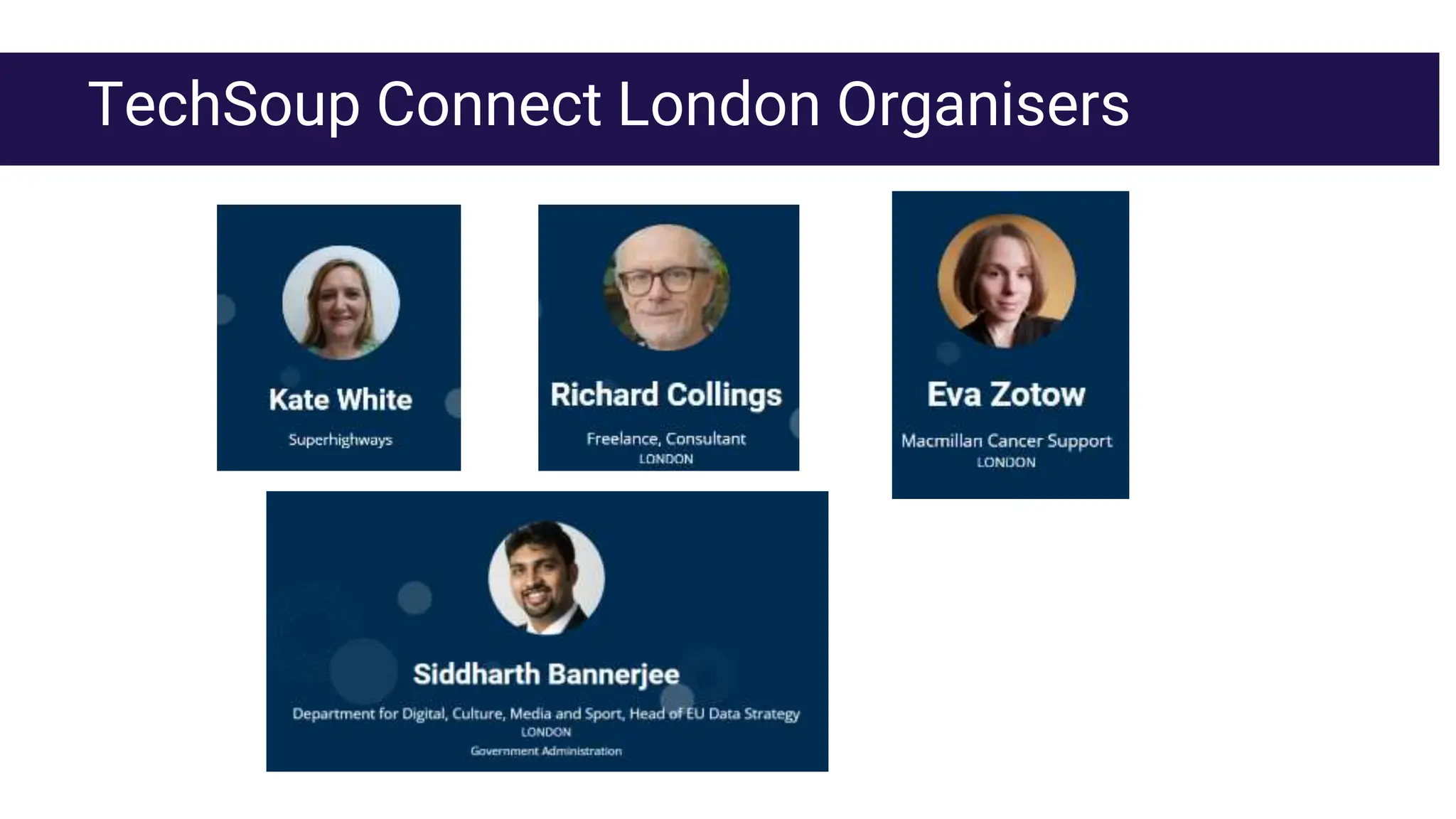
TechSoup Connect London Organisers
Our agenda
● Networking
● Janine Woodward-Grant : What is the role of ‘people and culture’ in
a digital project
● Alex Mecklenburg: How to design healthy team dynamics to
deliver successful digital projects
● Community shout outs
● Ideas for future sessions
“We are really small and so each member of the team may
have a number of roles, and sometimes roles need to be
shared due to part time working. It will be interesting to
learn more.”
“Practical exercises that can be applied in my team and
how to be clear about expectations etc when one person
has multiple roles as well as their relationships to other
team members.”
Some networking
● Exchange a positive example of where roles were clearly
defined and this led to amazing collaboration in your team
OR
● Share an example of a challenging situation where roles
weren’t clearly defined and this became problematic
New Dynamics
Moving towards a more digital culture at
The Carers’ Centre
Janine Woodward-Grant
Our Recipe
• A new way of thinking
• A new way of engaging with each other
• A new set of tools
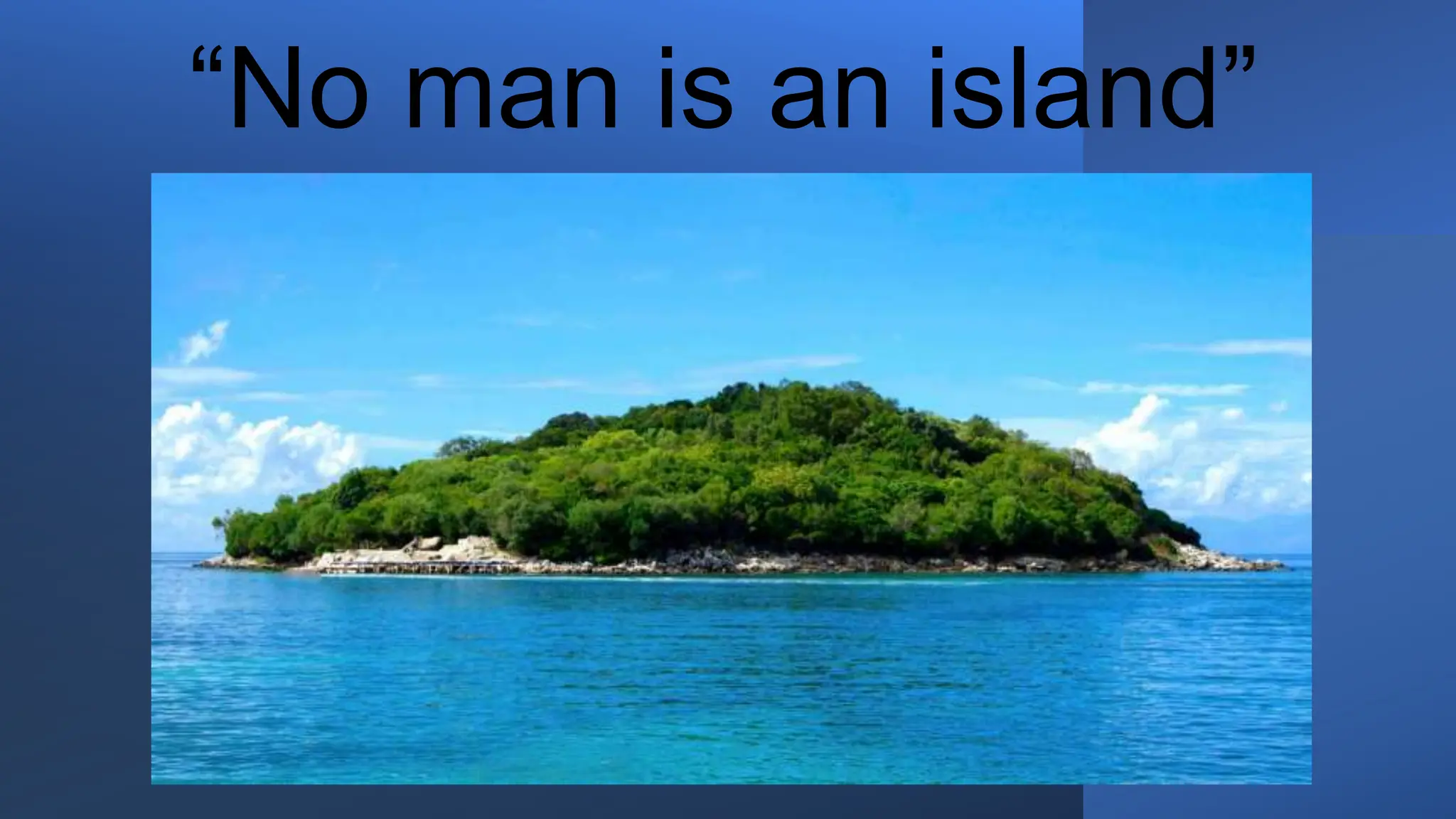
“No man is an island”
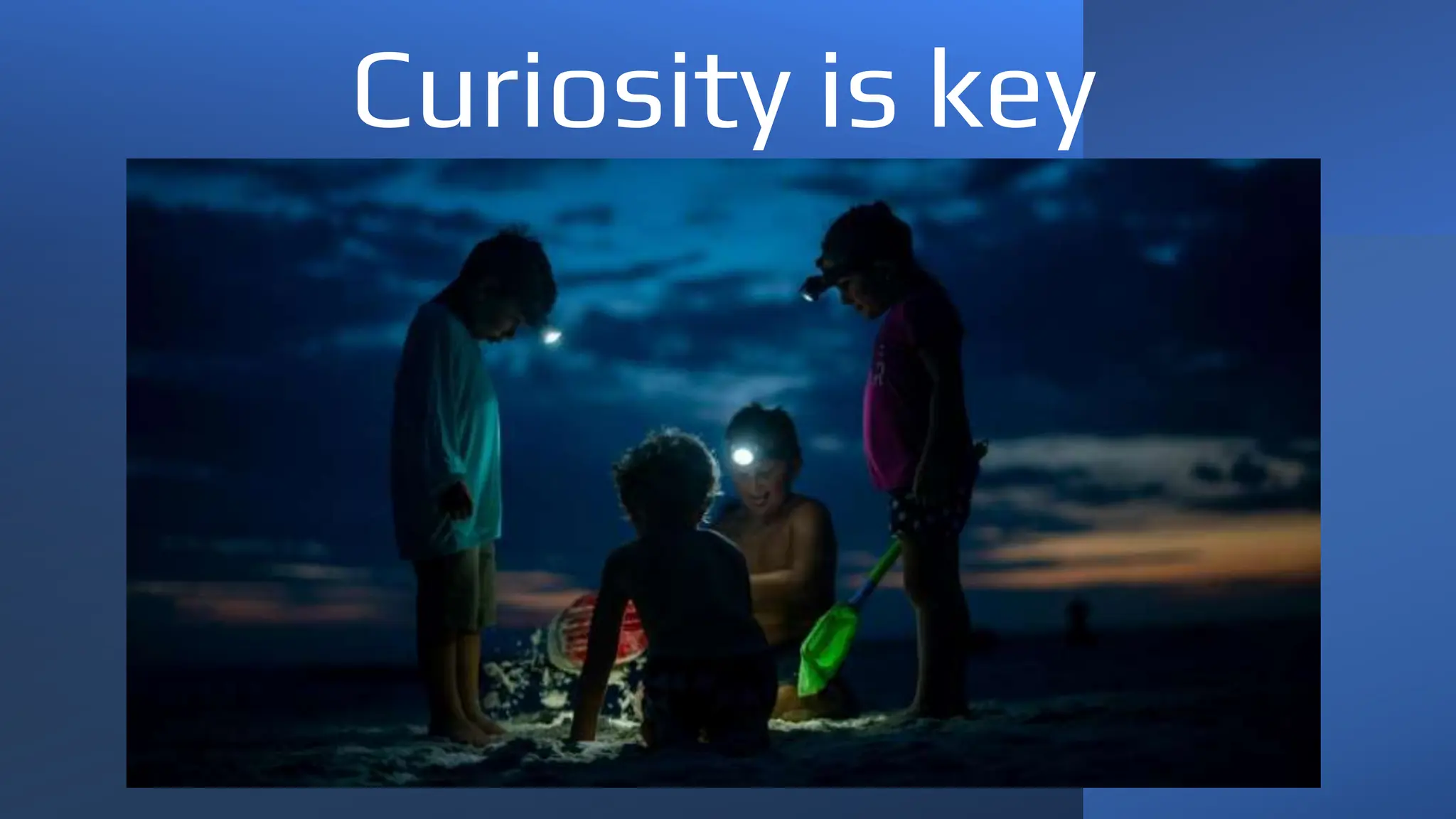
Curiosity is key
It felt a lot like this…..
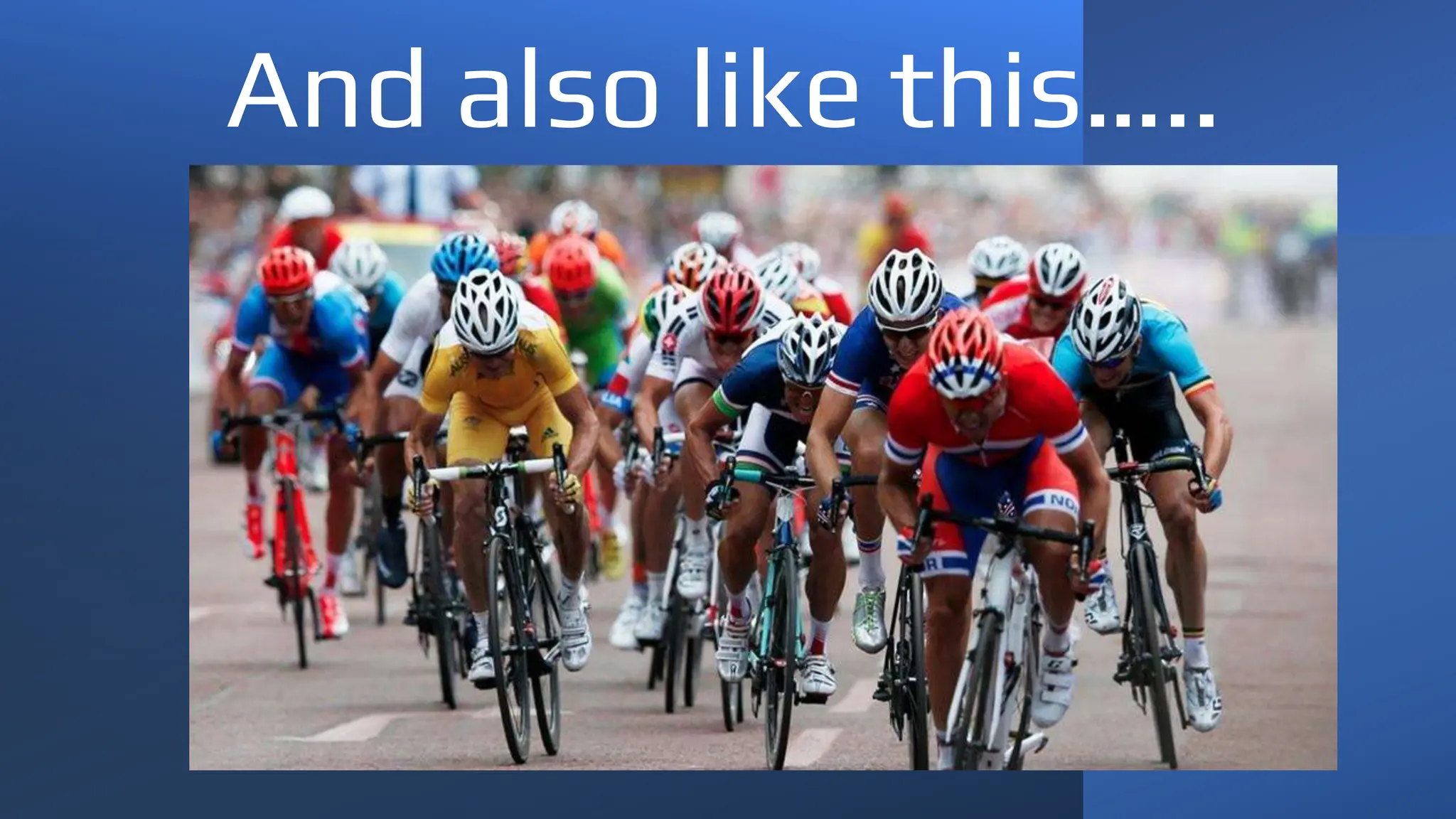
And also like this…..
The Challenges
• The day job
• Everyone is on their own journey
• Transformation speed
How to design healthy team dynamics to
deliver successful digital projects.
A practical work session to help
teams get passionate about
team roles & relationships
Hello.
Alexandra Mecklenburg
Creative Consultant and Change Coach
Co-founder of the Dot Project
Co-founder of Consequential CIC
Co-founder of Truth & Spectacle
alex@dotproject.coop
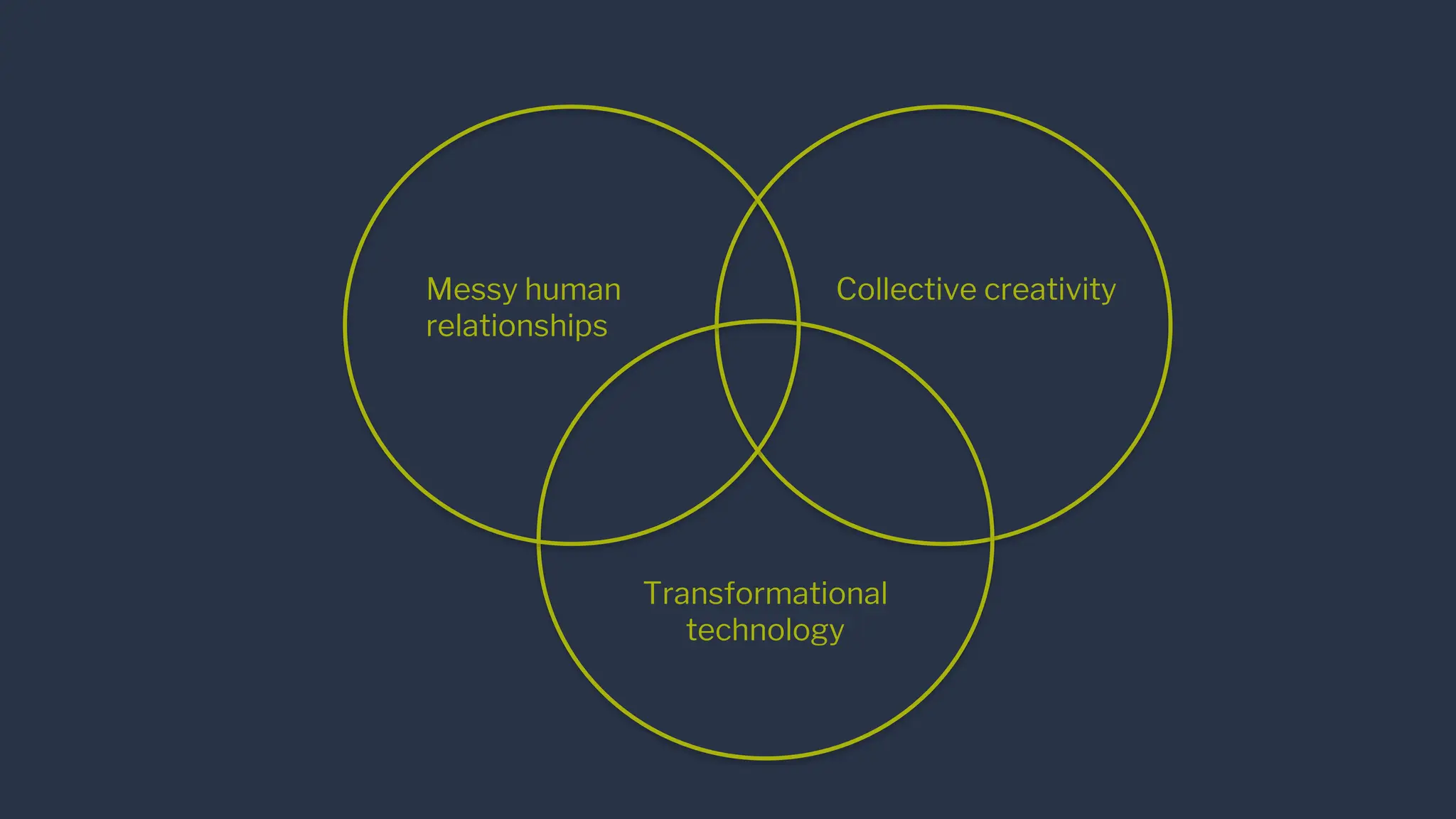
Messy human
relationships
Collective creativity
Transformational
technology
For the next 45 min we will explore how to help teams to:
● understand the function of relationship structures for
providing stability to relationship systems of all kinds.
● recognise the importance of being able to practically
co-design, monitor and continuously adjust these
structures
For teams to evolve together, they need to create
collective awareness of how they operate.
For this to happen they need support in a role of the
‘change holder’ is to ‘reveal the team to itself’.
Then teams can adjust themselves (and ask for support
where needed)
Effective roles are critical to the smooth functioning of
relationship systems.
They ensure that the important tasks of relationship are
carried out efficiently and create clarity about who is
doing what.
Roles become problematic when they become rigid or
burdensome. If I, or others, confuse me with my role, I
become locked within a stifling set of expectations.
2 guiding principles
Roles are not people
Photo by Charles Etoroma on Unsplash
Roles belong to the system,
not to the individual
3 role sets
Functional roles
Relational roles
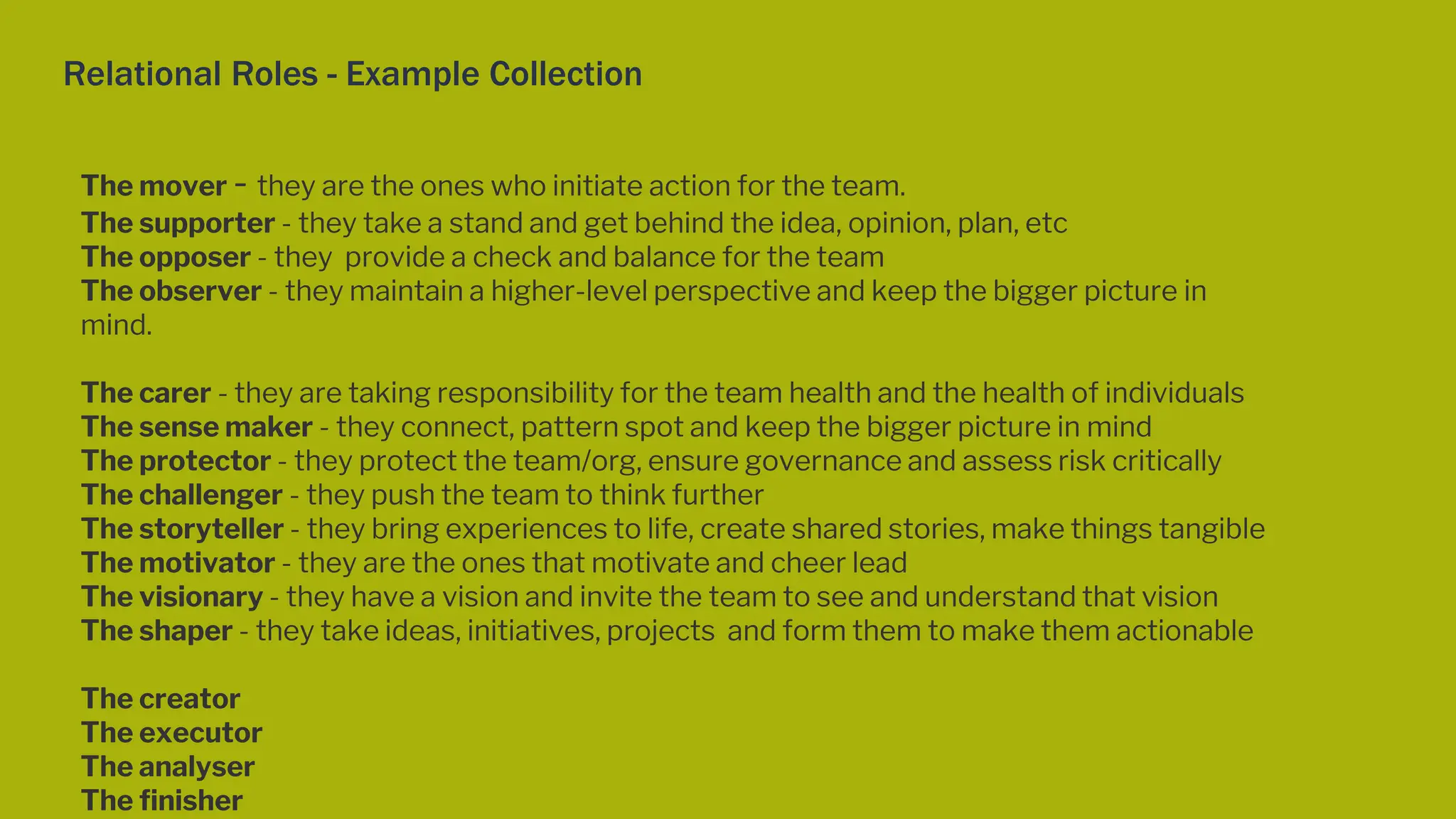
Relational Roles - Example Collection
The mover - they are the ones who initiate action for the team.
The supporter - they take a stand and get behind the idea, opinion, plan, etc
The opposer - they provide a check and balance for the team
The observer - they maintain a higher-level perspective and keep the bigger picture in
mind.
The carer - they are taking responsibility for the team health and the health of individuals
The sense maker - they connect, pattern spot and keep the bigger picture in mind
The protector - they protect the team/org, ensure governance and assess risk critically
The challenger - they push the team to think further
The storyteller - they bring experiences to life, create shared stories, make things tangible
The motivator - they are the ones that motivate and cheer lead
The visionary - they have a vision and invite the team to see and understand that vision
The shaper - they take ideas, initiatives, projects and form them to make them actionable
The creator
The executor
The analyser
The finisher
Ghost roles
Reflect on your own functional role.
- which are relational roles that people might
associate with your functional role?
- Where has that been helpful?
- Has it also been unhelpful?
3 min
Role Watch Outs
Role confusion
Role exhaustion
Role preference
Role shift
Poorly occupied roles
Role confusion
Role exhaustion
Role preferences
Role shifts
Poorly occupied roles
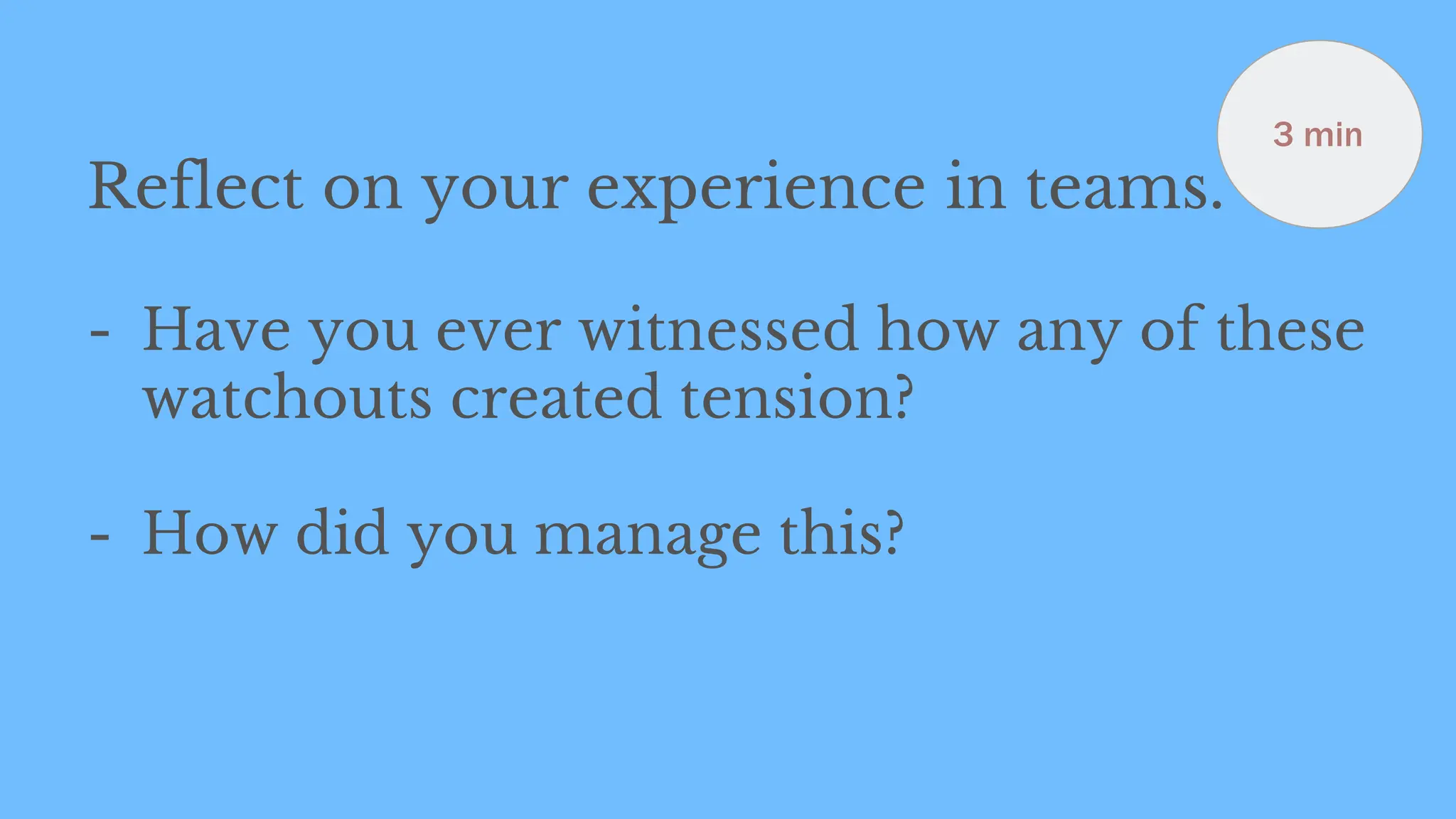
Reflect on your experience in teams.
- Have you ever witnessed how any of these
watchouts created tension?
- How did you manage this?
3 min
Tools
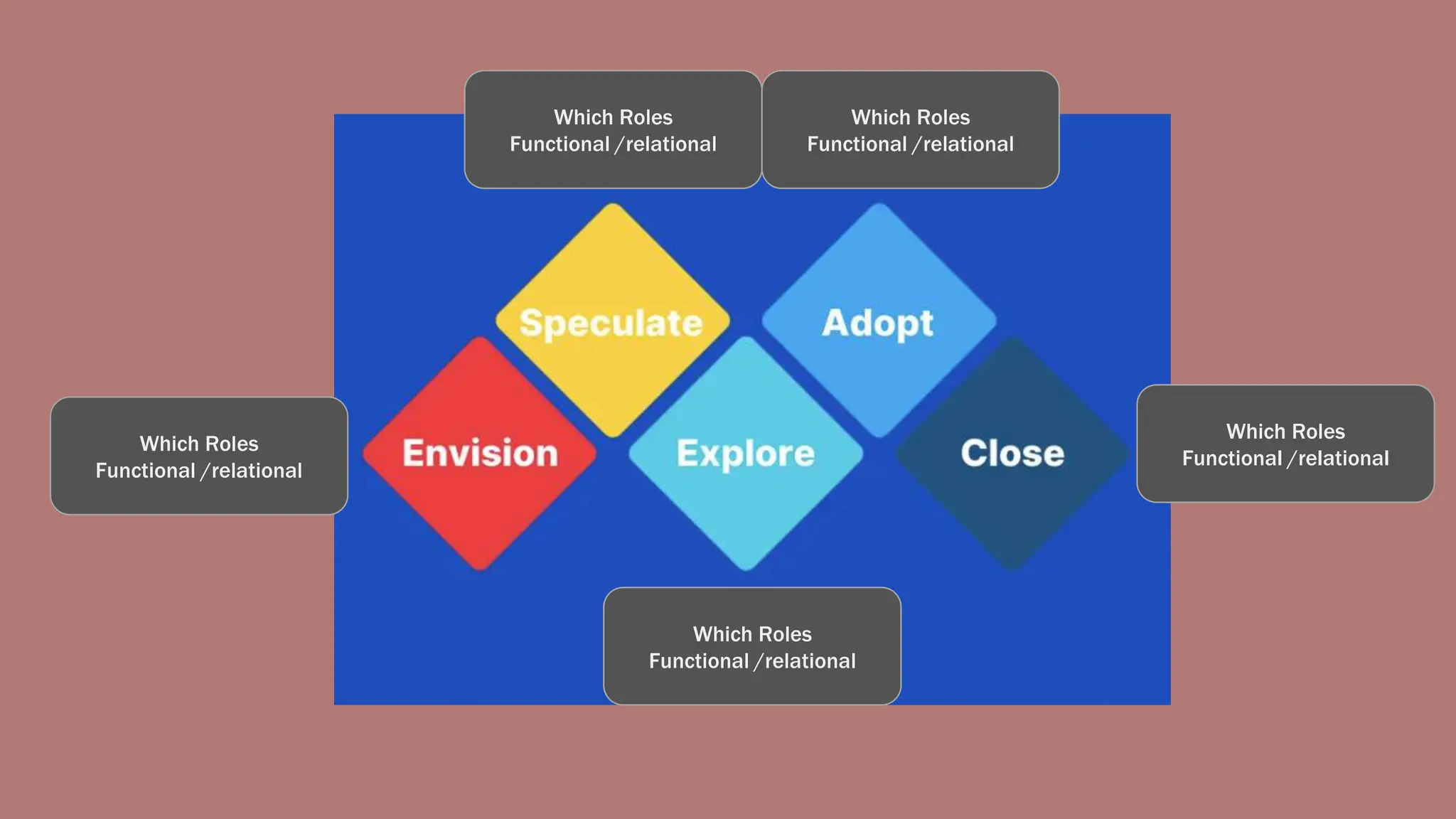
Project/role mapping - build awareness
Which Roles
Functional /relational
Which Roles
Functional /relational
Which Roles
Functional /relational
Which Roles
Functional /relational
Which Roles
Functional /relational
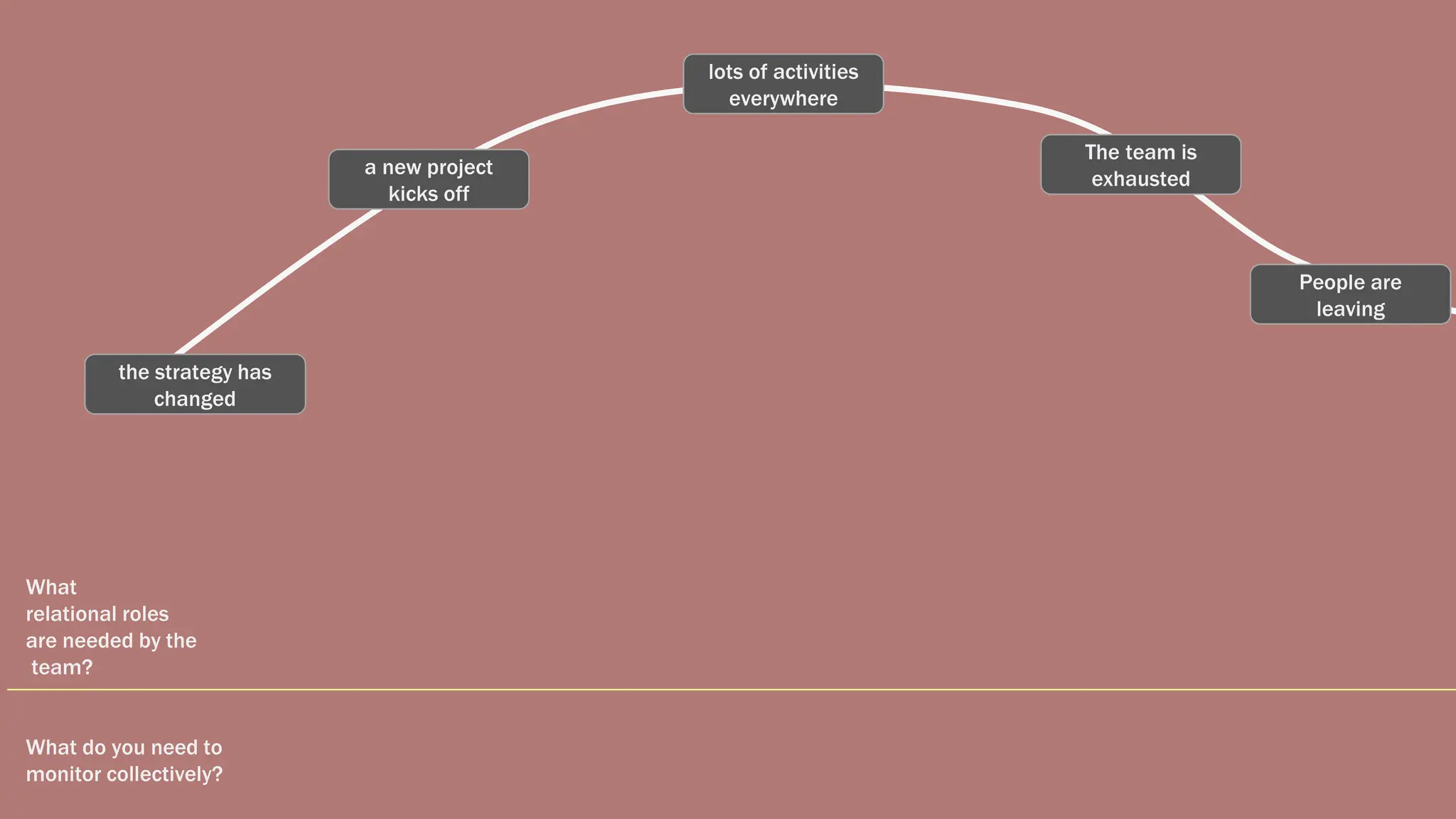
What
relational roles
are needed by the
team?
What do you need to
monitor collectively?
a new project
kicks off
The team is
exhausted
the strategy has
changed
People are
leaving
lots of activities
everywhere
Breakout Groups:
Look at the team graph on the next page
and discuss as a group the two questions
on the graph:
7 min
Collective Debrief
5 min
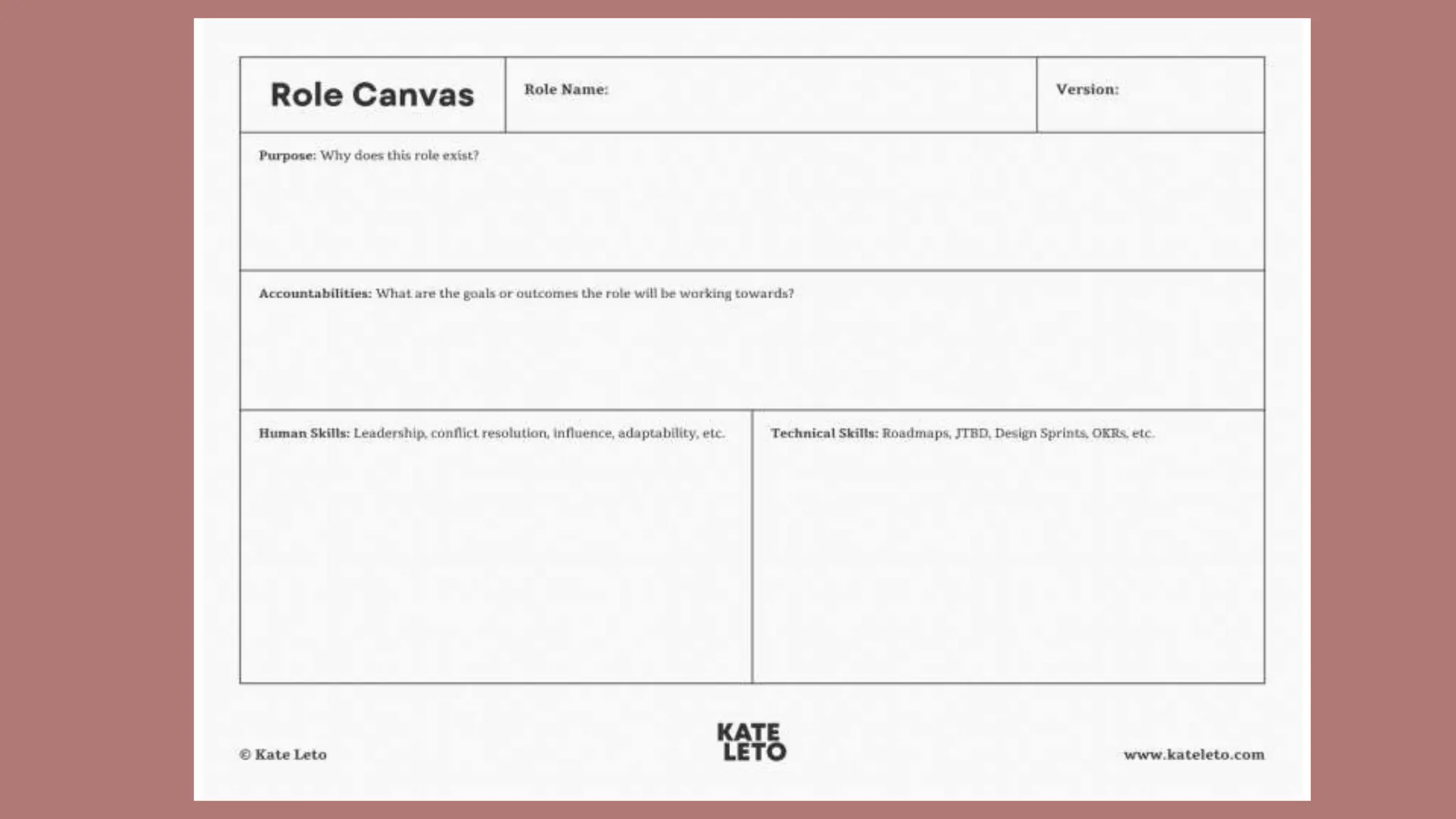
Role canvas - plan
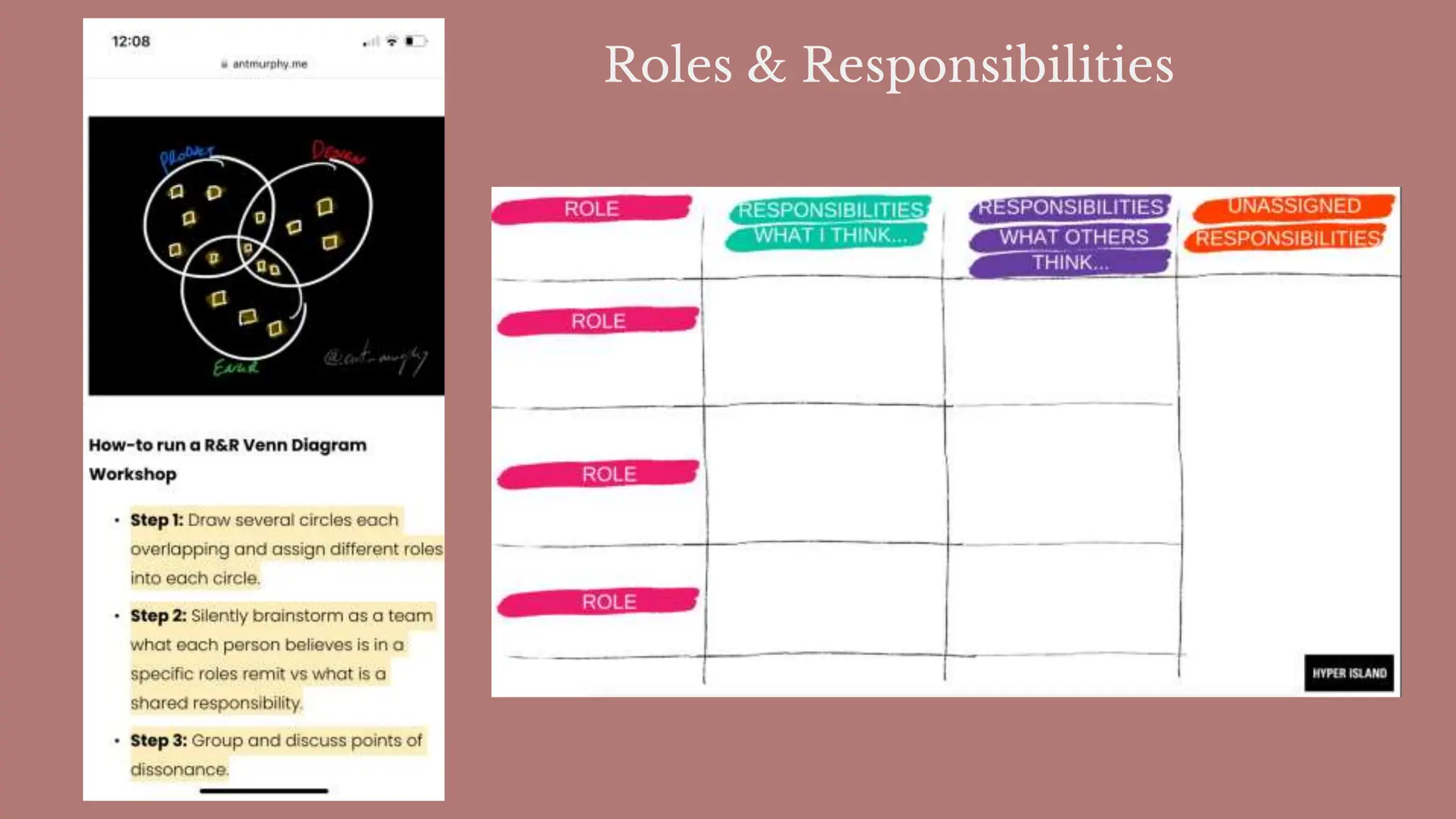
Shared roles - exercise
Roles & Responsibilities
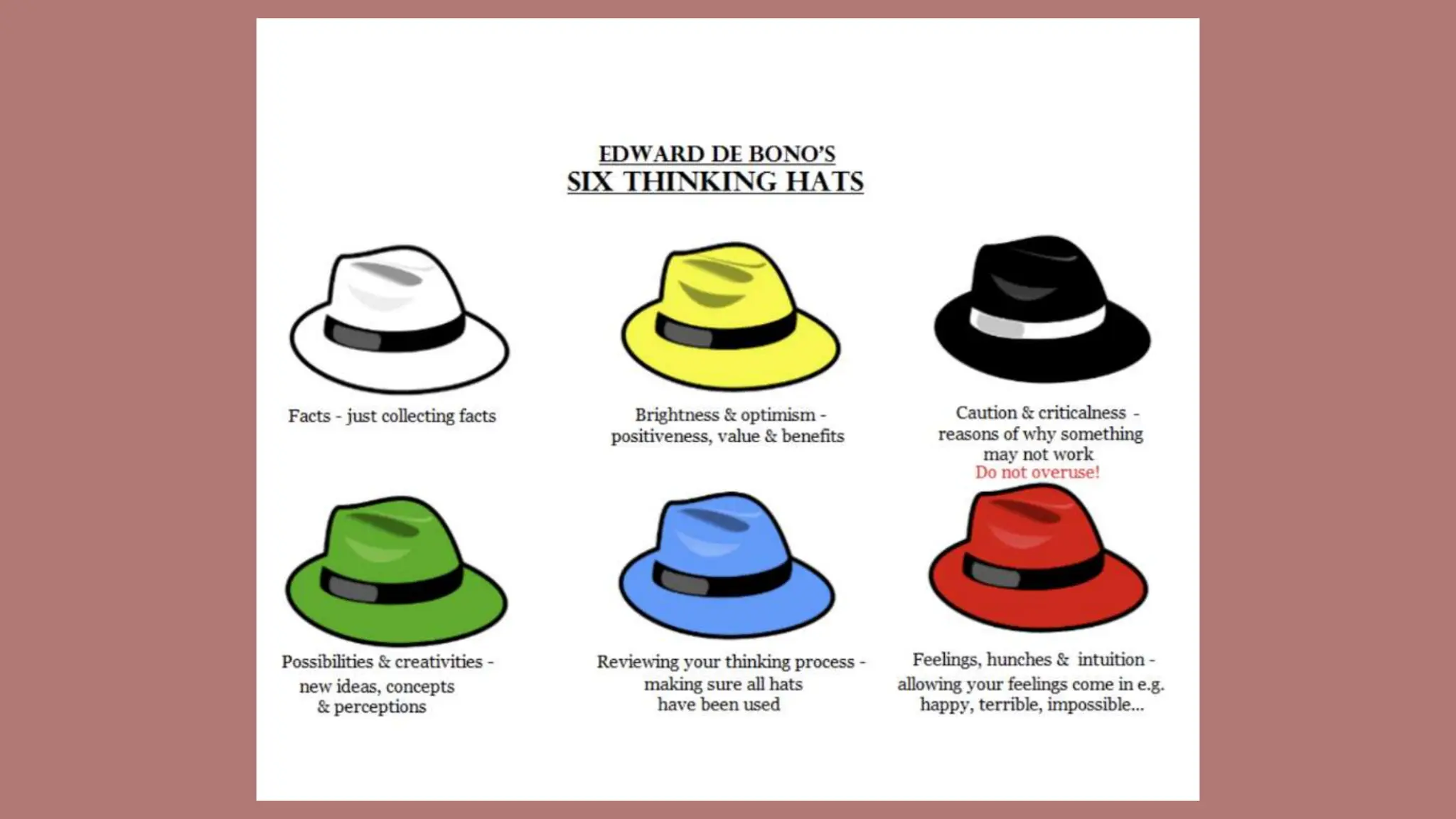
Changing hats - development and growth
What/who is haunting you….
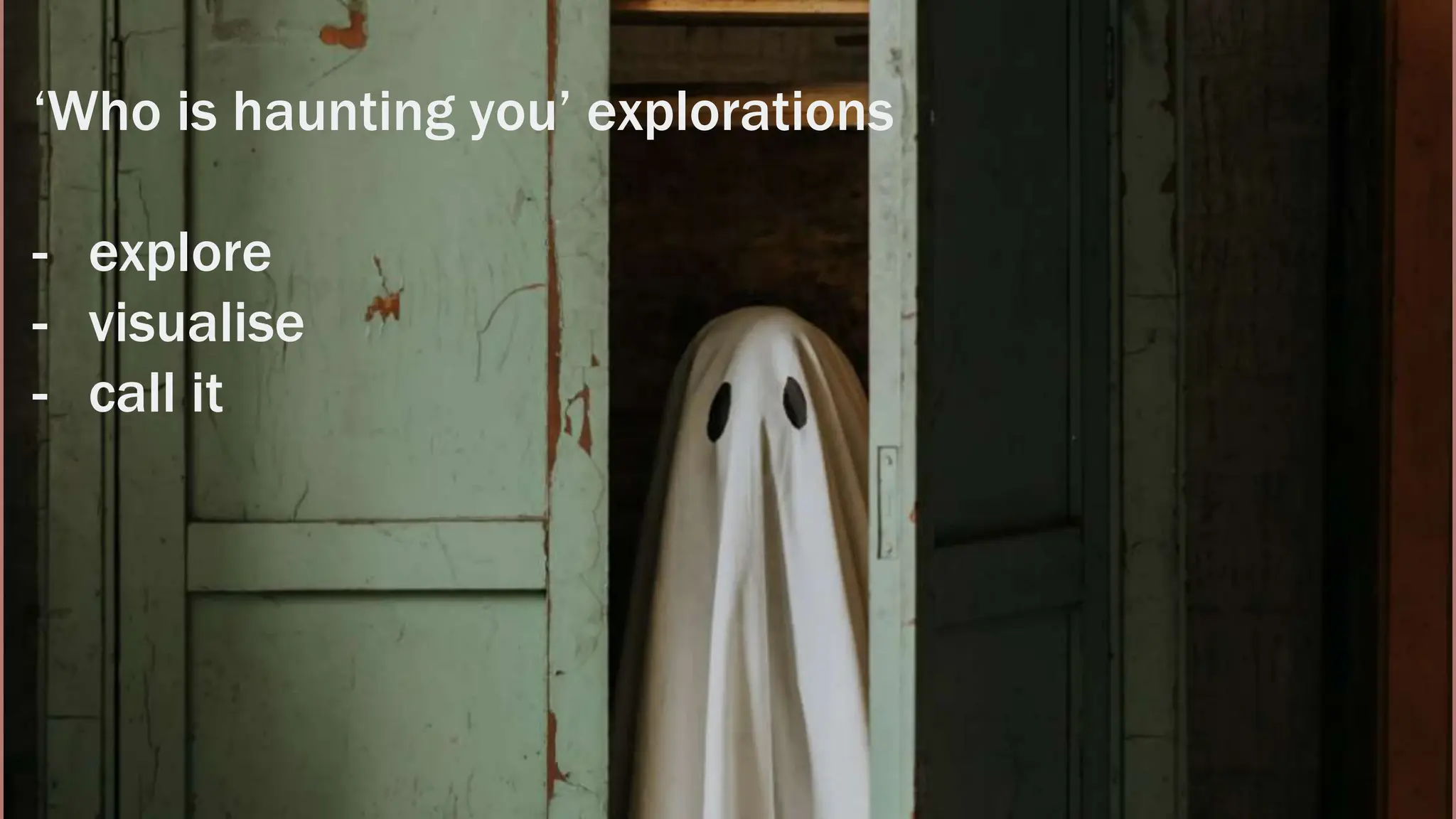
‘Who is haunting you’ explorations
- explore
- visualise
- call it
JD on google docs - visibility and iteration
Summary
● Teams understand the roles that are needed in the system
● Teams can design for clarity rather than rigidity
● Teams don’t confuse people with their role, which will avoid team
members become locked within a stifling set of expectations.
● Teams are able to talk about ‘what is haunting them’ in a
productive, open way
● Team members can grow by stepping into different relational
roles
BE AMAZING
alex@dotproject.coop
Community Shout Outs
Tell us about:
● events,
● resources,
● networks
● something about you
● or anything….
that’s helpful for this
community
Ideas for future meetups
● What should our next
session be?
● Do you want to join
us in planning it?
Wrap up / further networking
● Feedback survey
● Please stay on if you have further feedback, questions,
ideas

How to design healthy team dynamics to deliver successful digital projects.pptx

  • 1.
    How to designhealthy team dynamics to deliver successful digital projects March 5th 2024
  • 2.
    We've changed our name,but not our focus... We bring people working in non profits and Tech for Good together, to share & learn from each other @TSC_London Welcome to TechSoup Connect London Chapter techsoup-connect-london https://events.techsoup.org/techsoup- connect-london-chapter/
  • 3.
  • 4.
    Our agenda ● Networking ●Janine Woodward-Grant : What is the role of ‘people and culture’ in a digital project ● Alex Mecklenburg: How to design healthy team dynamics to deliver successful digital projects ● Community shout outs ● Ideas for future sessions
  • 5.
    “We are reallysmall and so each member of the team may have a number of roles, and sometimes roles need to be shared due to part time working. It will be interesting to learn more.”
  • 6.
    “Practical exercises thatcan be applied in my team and how to be clear about expectations etc when one person has multiple roles as well as their relationships to other team members.”
  • 7.
    Some networking ● Exchangea positive example of where roles were clearly defined and this led to amazing collaboration in your team OR ● Share an example of a challenging situation where roles weren’t clearly defined and this became problematic
  • 8.
    New Dynamics Moving towardsa more digital culture at The Carers’ Centre Janine Woodward-Grant
  • 9.
    Our Recipe • Anew way of thinking • A new way of engaging with each other • A new set of tools
  • 10.
    “No man isan island”
  • 11.
  • 12.
    It felt alot like this…..
  • 13.
    And also likethis…..
  • 14.
    The Challenges • Theday job • Everyone is on their own journey • Transformation speed
  • 15.
    How to designhealthy team dynamics to deliver successful digital projects.
  • 16.
    A practical worksession to help teams get passionate about team roles & relationships
  • 17.
  • 18.
    Alexandra Mecklenburg Creative Consultantand Change Coach Co-founder of the Dot Project Co-founder of Consequential CIC Co-founder of Truth & Spectacle alex@dotproject.coop
  • 19.
  • 20.
    For the next45 min we will explore how to help teams to: ● understand the function of relationship structures for providing stability to relationship systems of all kinds. ● recognise the importance of being able to practically co-design, monitor and continuously adjust these structures
  • 21.
    For teams toevolve together, they need to create collective awareness of how they operate. For this to happen they need support in a role of the ‘change holder’ is to ‘reveal the team to itself’. Then teams can adjust themselves (and ask for support where needed)
  • 22.
    Effective roles arecritical to the smooth functioning of relationship systems. They ensure that the important tasks of relationship are carried out efficiently and create clarity about who is doing what.
  • 23.
    Roles become problematicwhen they become rigid or burdensome. If I, or others, confuse me with my role, I become locked within a stifling set of expectations.
  • 24.
  • 25.
  • 26.
    Photo by CharlesEtoroma on Unsplash
  • 27.
    Roles belong tothe system, not to the individual
  • 29.
  • 30.
  • 31.
  • 32.
    Relational Roles -Example Collection The mover - they are the ones who initiate action for the team. The supporter - they take a stand and get behind the idea, opinion, plan, etc The opposer - they provide a check and balance for the team The observer - they maintain a higher-level perspective and keep the bigger picture in mind. The carer - they are taking responsibility for the team health and the health of individuals The sense maker - they connect, pattern spot and keep the bigger picture in mind The protector - they protect the team/org, ensure governance and assess risk critically The challenger - they push the team to think further The storyteller - they bring experiences to life, create shared stories, make things tangible The motivator - they are the ones that motivate and cheer lead The visionary - they have a vision and invite the team to see and understand that vision The shaper - they take ideas, initiatives, projects and form them to make them actionable The creator The executor The analyser The finisher
  • 33.
  • 34.
    Reflect on yourown functional role. - which are relational roles that people might associate with your functional role? - Where has that been helpful? - Has it also been unhelpful? 3 min
  • 35.
  • 36.
    Role confusion Role exhaustion Rolepreference Role shift Poorly occupied roles
  • 37.
  • 38.
  • 39.
  • 40.
  • 41.
  • 42.
    Reflect on yourexperience in teams. - Have you ever witnessed how any of these watchouts created tension? - How did you manage this? 3 min
  • 43.
  • 44.
    Project/role mapping -build awareness
  • 45.
    Which Roles Functional /relational WhichRoles Functional /relational Which Roles Functional /relational Which Roles Functional /relational Which Roles Functional /relational
  • 46.
    What relational roles are neededby the team? What do you need to monitor collectively? a new project kicks off The team is exhausted the strategy has changed People are leaving lots of activities everywhere
  • 47.
    Breakout Groups: Look atthe team graph on the next page and discuss as a group the two questions on the graph: 7 min
  • 48.
  • 49.
    Role canvas -plan Shared roles - exercise
  • 51.
  • 52.
    Changing hats -development and growth
  • 54.
  • 55.
    ‘Who is hauntingyou’ explorations - explore - visualise - call it
  • 56.
    JD on googledocs - visibility and iteration
  • 57.
  • 58.
    ● Teams understandthe roles that are needed in the system ● Teams can design for clarity rather than rigidity ● Teams don’t confuse people with their role, which will avoid team members become locked within a stifling set of expectations. ● Teams are able to talk about ‘what is haunting them’ in a productive, open way ● Team members can grow by stepping into different relational roles
  • 59.
  • 60.
    Community Shout Outs Tellus about: ● events, ● resources, ● networks ● something about you ● or anything…. that’s helpful for this community
  • 61.
    Ideas for futuremeetups ● What should our next session be? ● Do you want to join us in planning it?
  • 62.
    Wrap up /further networking ● Feedback survey ● Please stay on if you have further feedback, questions, ideas