Digital Team Structure
The Foundation for Innovation


Jason Mogus
@mogusmoves
Michael Silberman
@silbatron
Evaluate This Session!
Each entry is a chance to win an NTEN engraved iPad!


          or Online at www.nten.org/ntc/eval
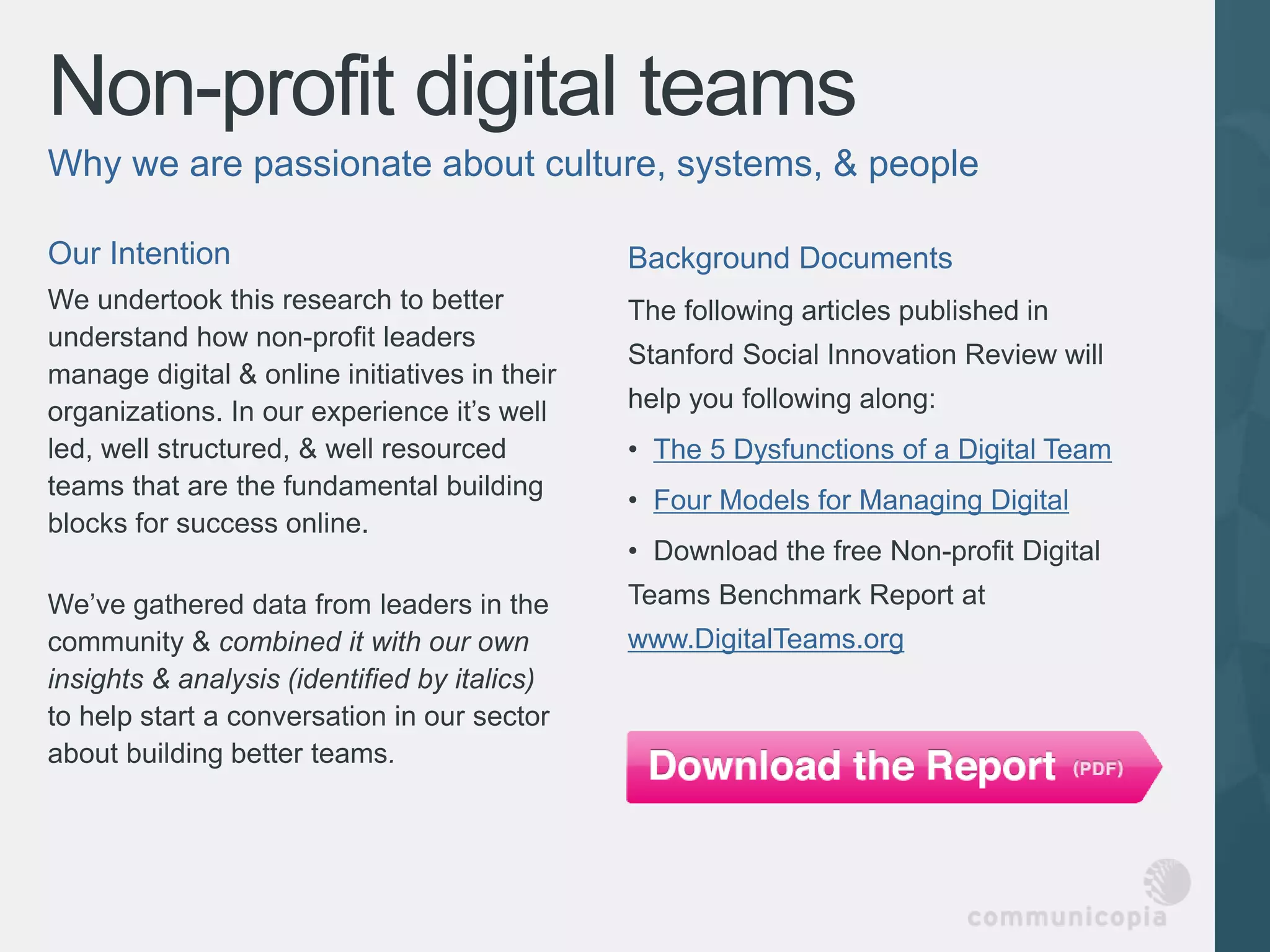
Non-profit digital teams
Why we are passionate about culture, systems, & people

Our Intention                                  Background Documents
We undertook this research to better           The following articles published in
understand how non-profit leaders
                                               Stanford Social Innovation Review will
manage digital & online initiatives in their
organizations. In our experience it’s well     help you following along:
led, well structured, & well resourced         • The 5 Dysfunctions of a Digital Team
teams that are the fundamental building
                                               • Four Models for Managing Digital
blocks for success online.
                                               • Download the free Non-profit Digital
We’ve gathered data from leaders in the        Teams Benchmark Report at
community & combined it with our own           www.DigitalTeams.org
insights & analysis (identified by italics)
to help start a conversation in our sector
about building better teams.
5 Dysfunctions
Silos.
Personality fit.
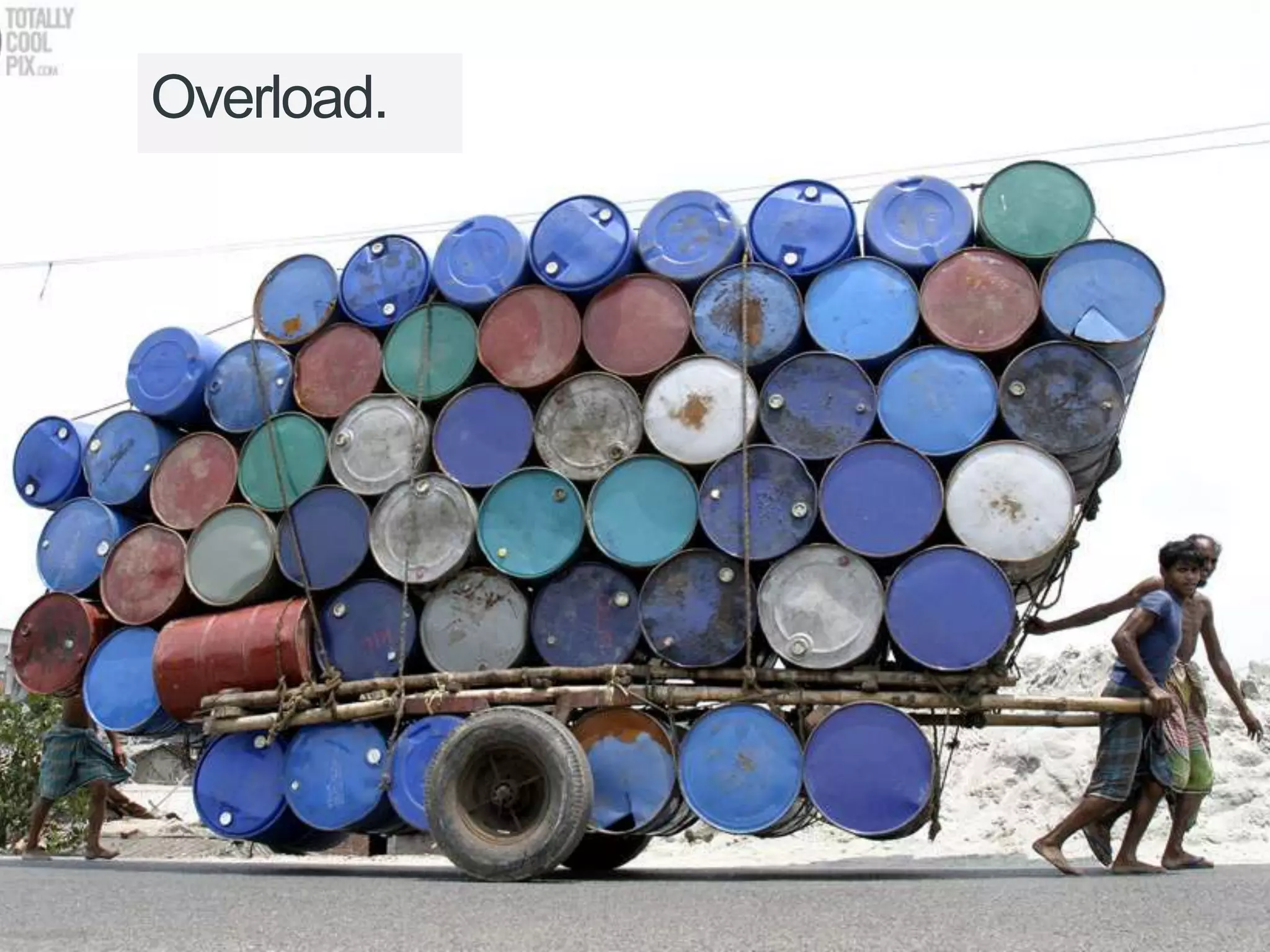
Overload.
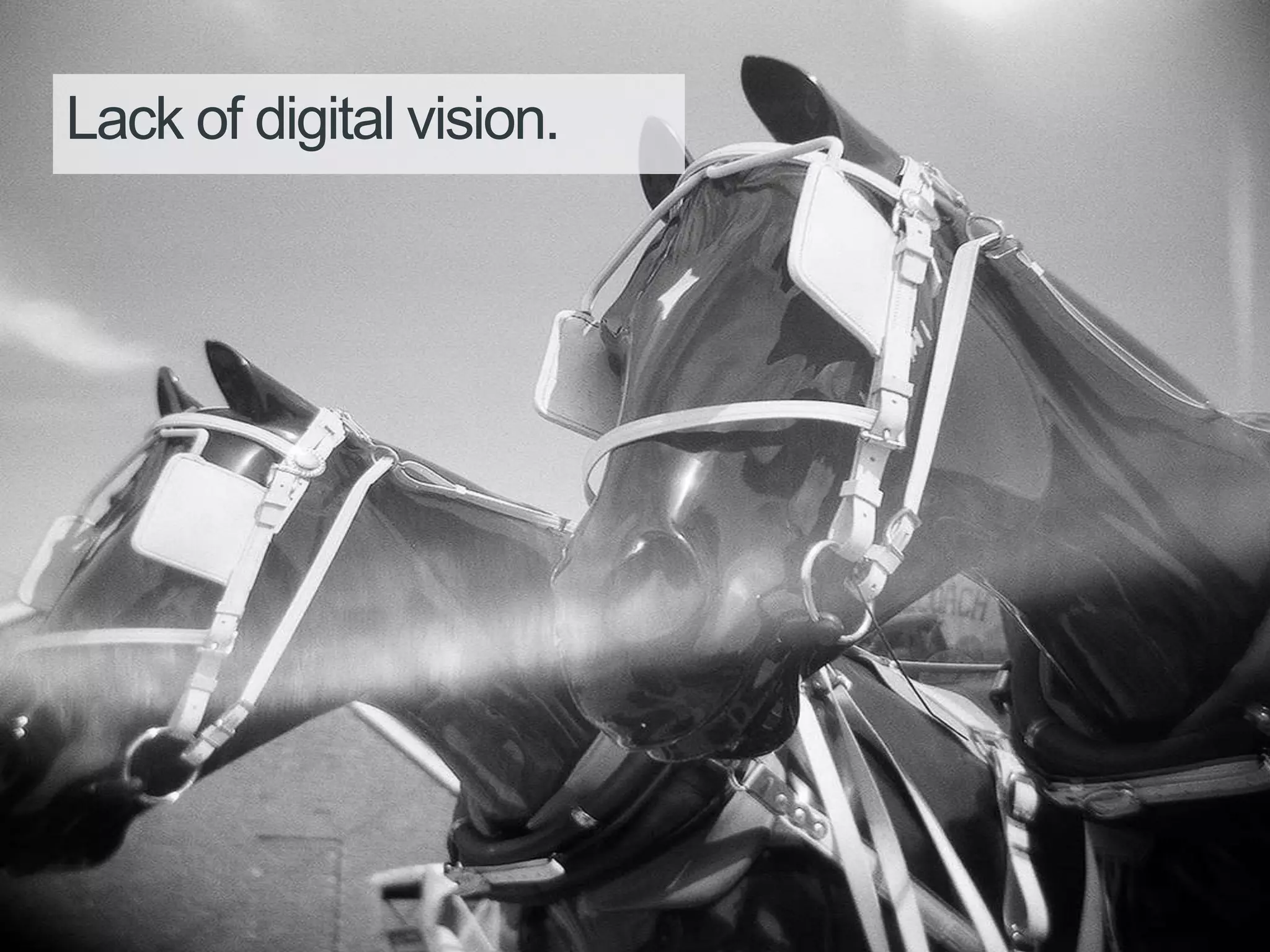
Lack of digital vision.
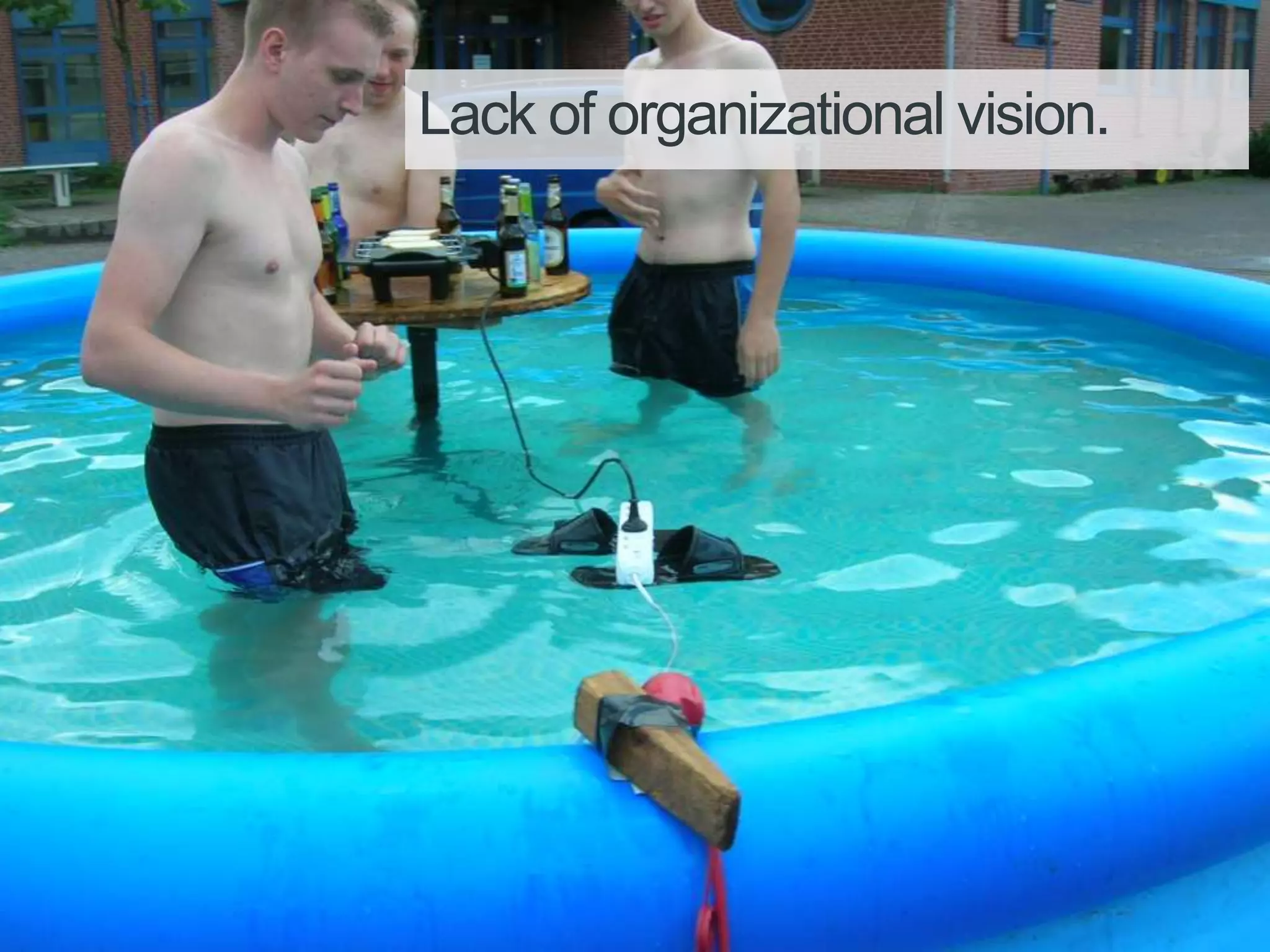
Lack of organizational vision.
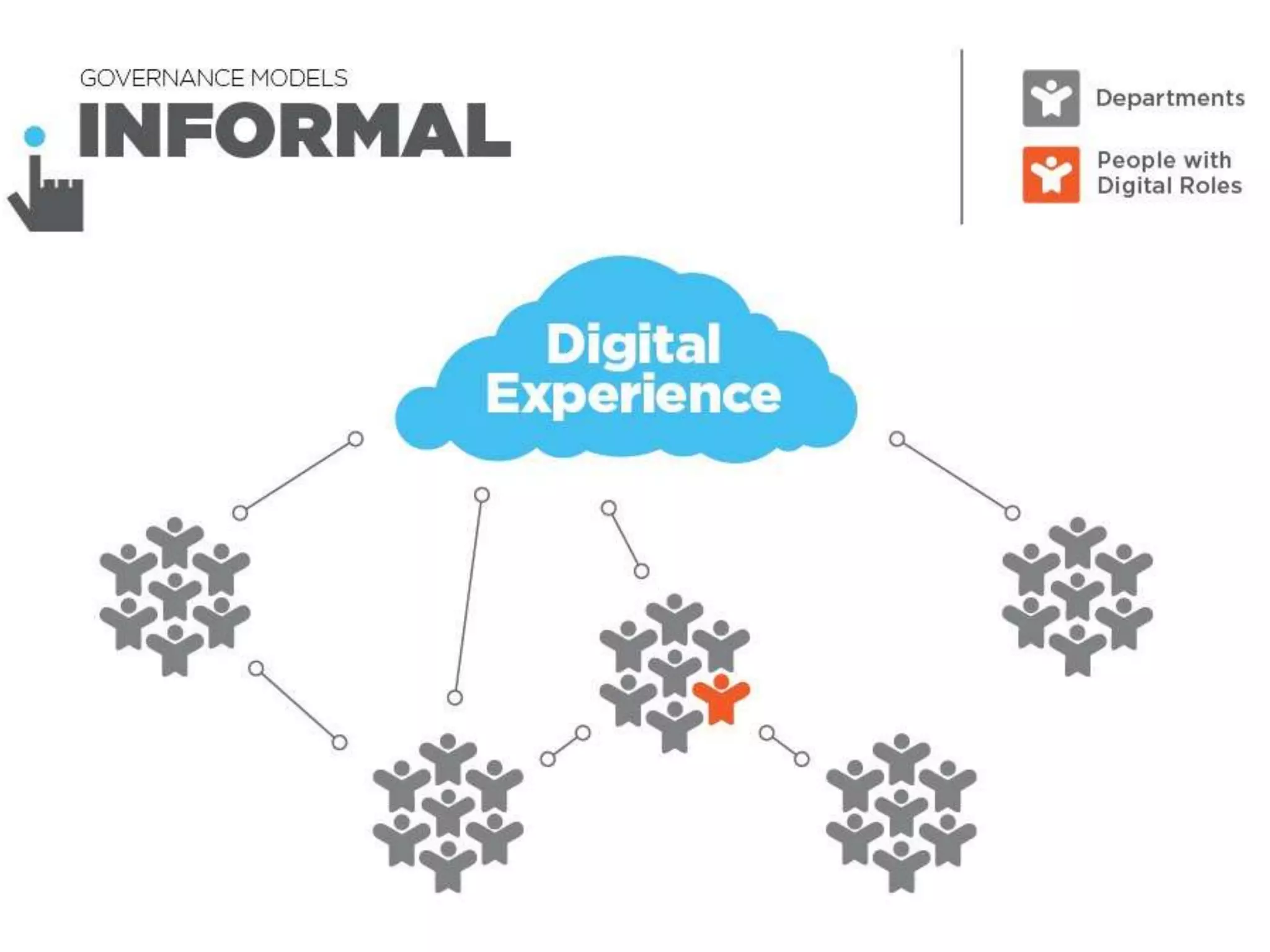
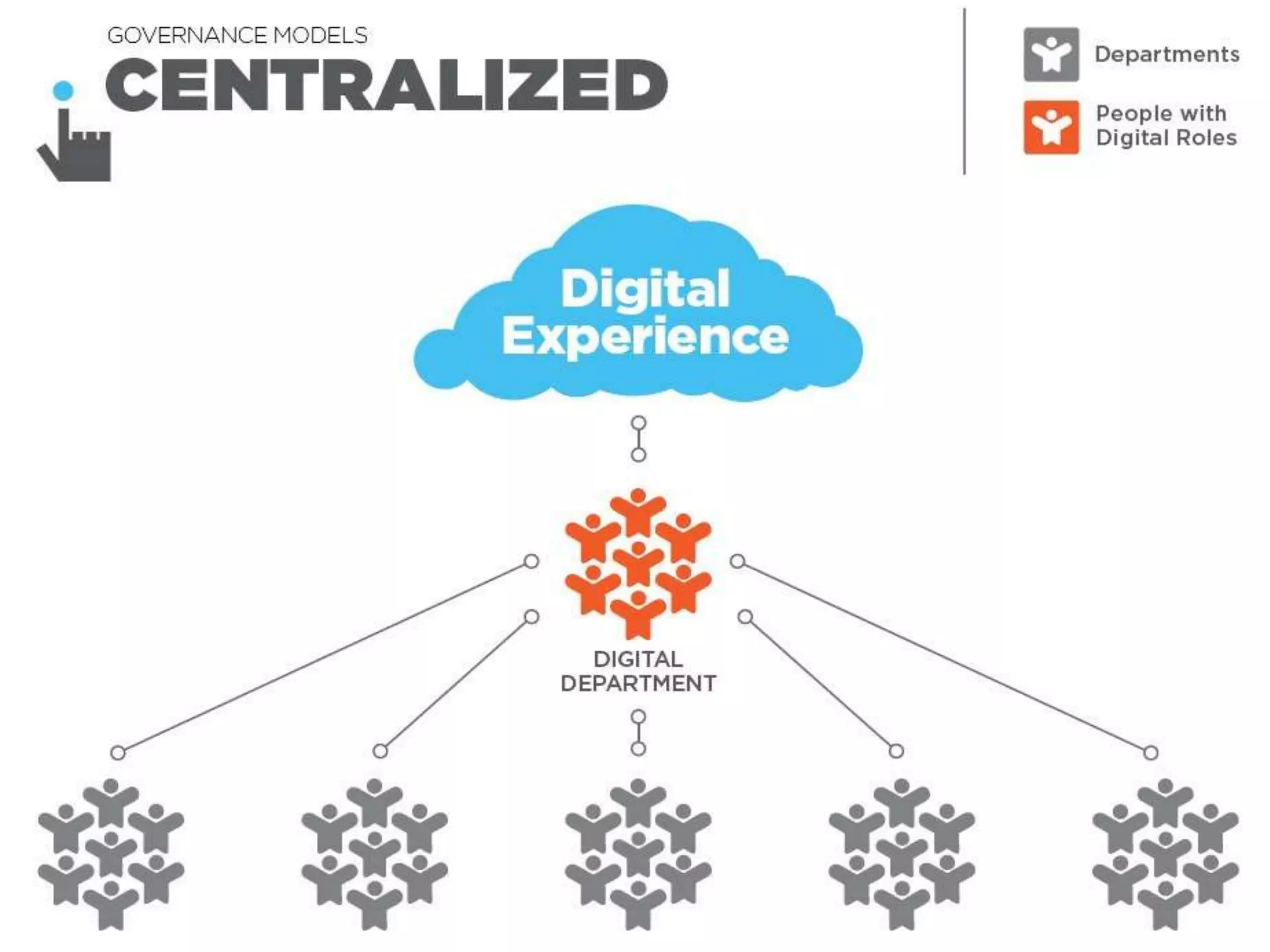
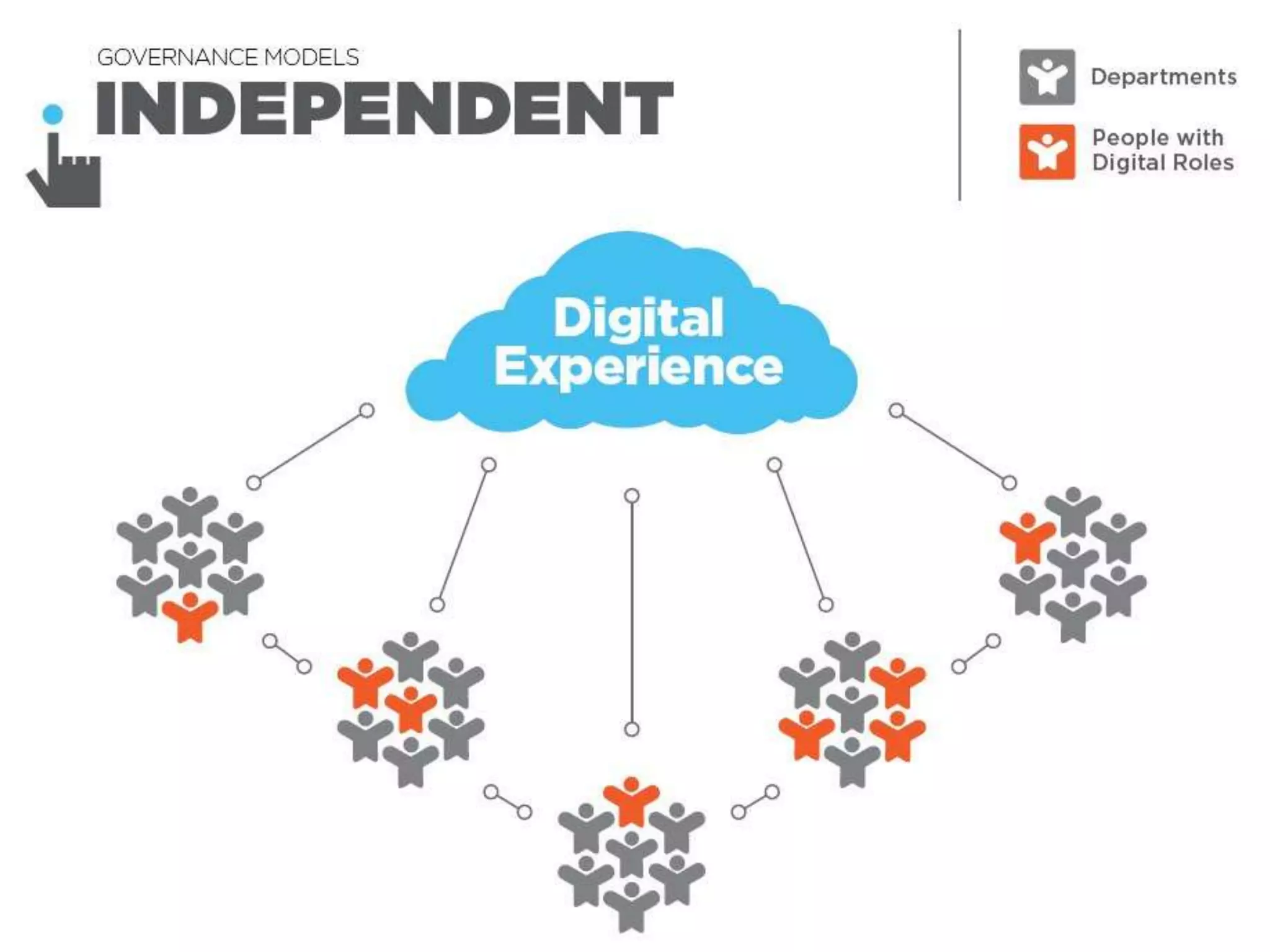
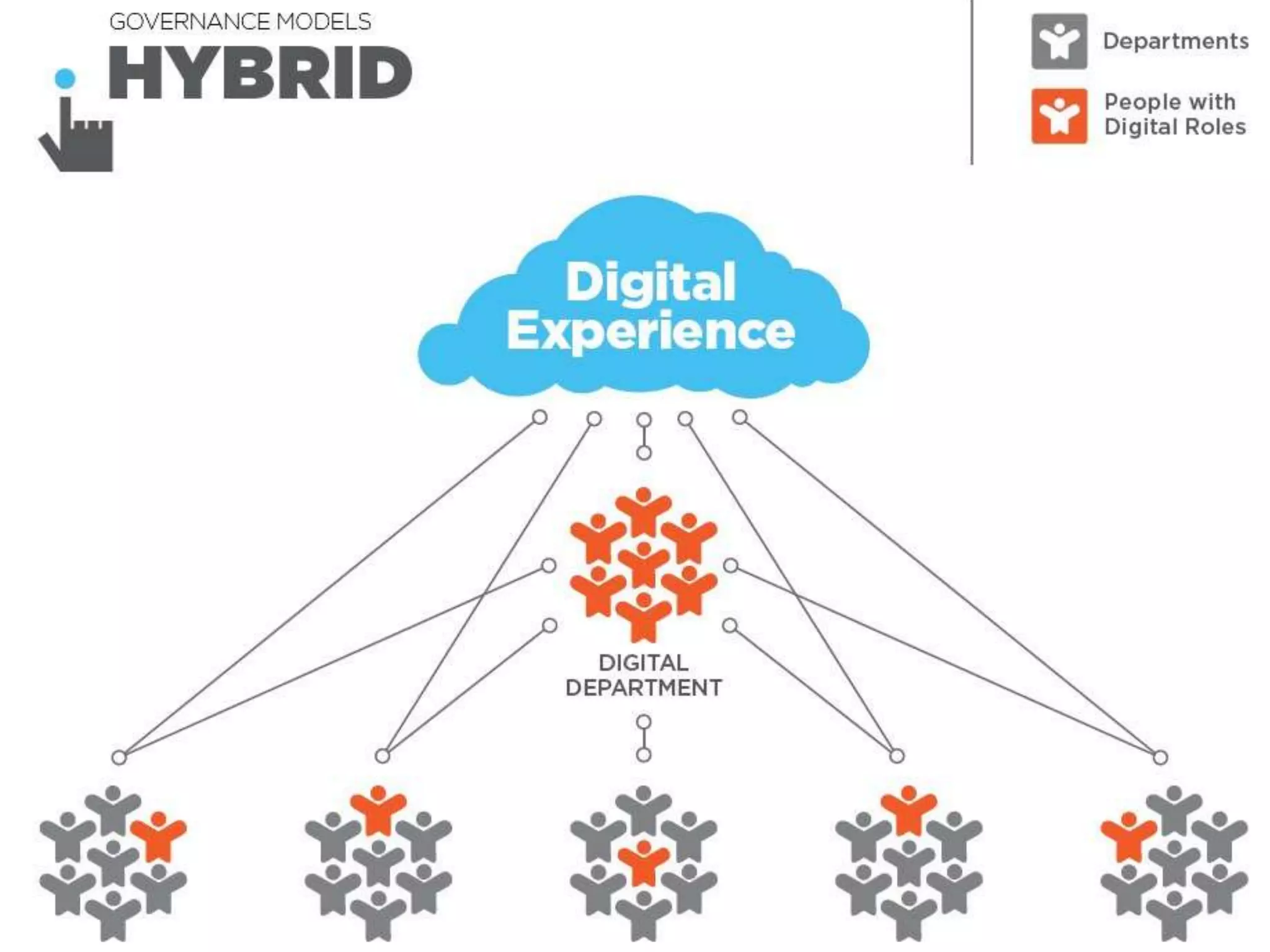
4 Models
The Greenpeace experience.
Benchmark Report
Contributing organizations
Responses from 67 non-profits were used in the benchmark, including:
Part I: The Basics
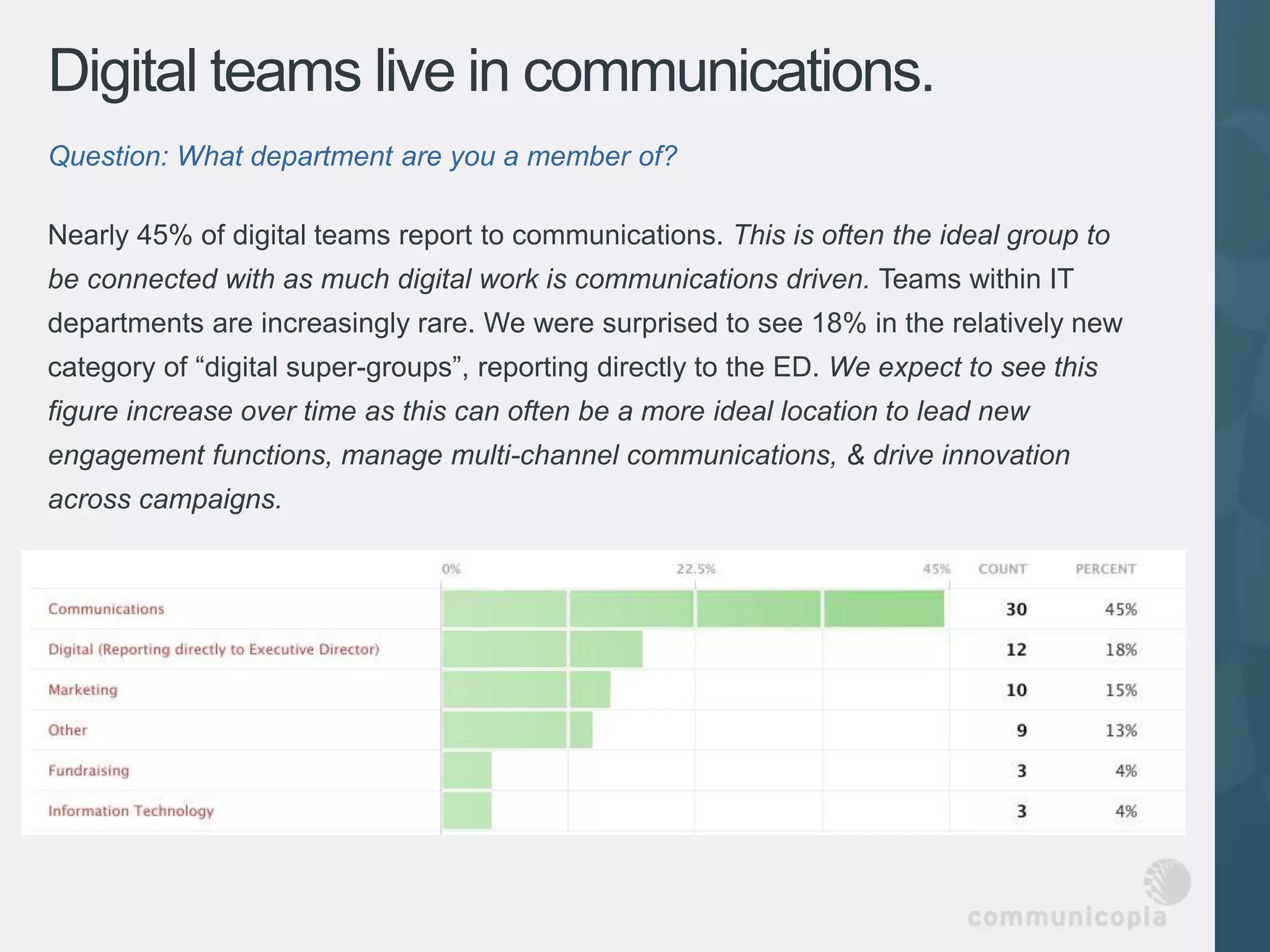
Digital teams live in communications.
Question: What department are you a member of?

Nearly 45% of digital teams report to communications. This is often the ideal group to
be connected with as much digital work is communications driven. Teams within IT
departments are increasingly rare. We were surprised to see 18% in the relatively new
category of “digital super-groups”, reporting directly to the ED. We expect to see this
figure increase over time as this can often be a more ideal location to lead new
engagement functions, manage multi-channel communications, & drive innovation
across campaigns.
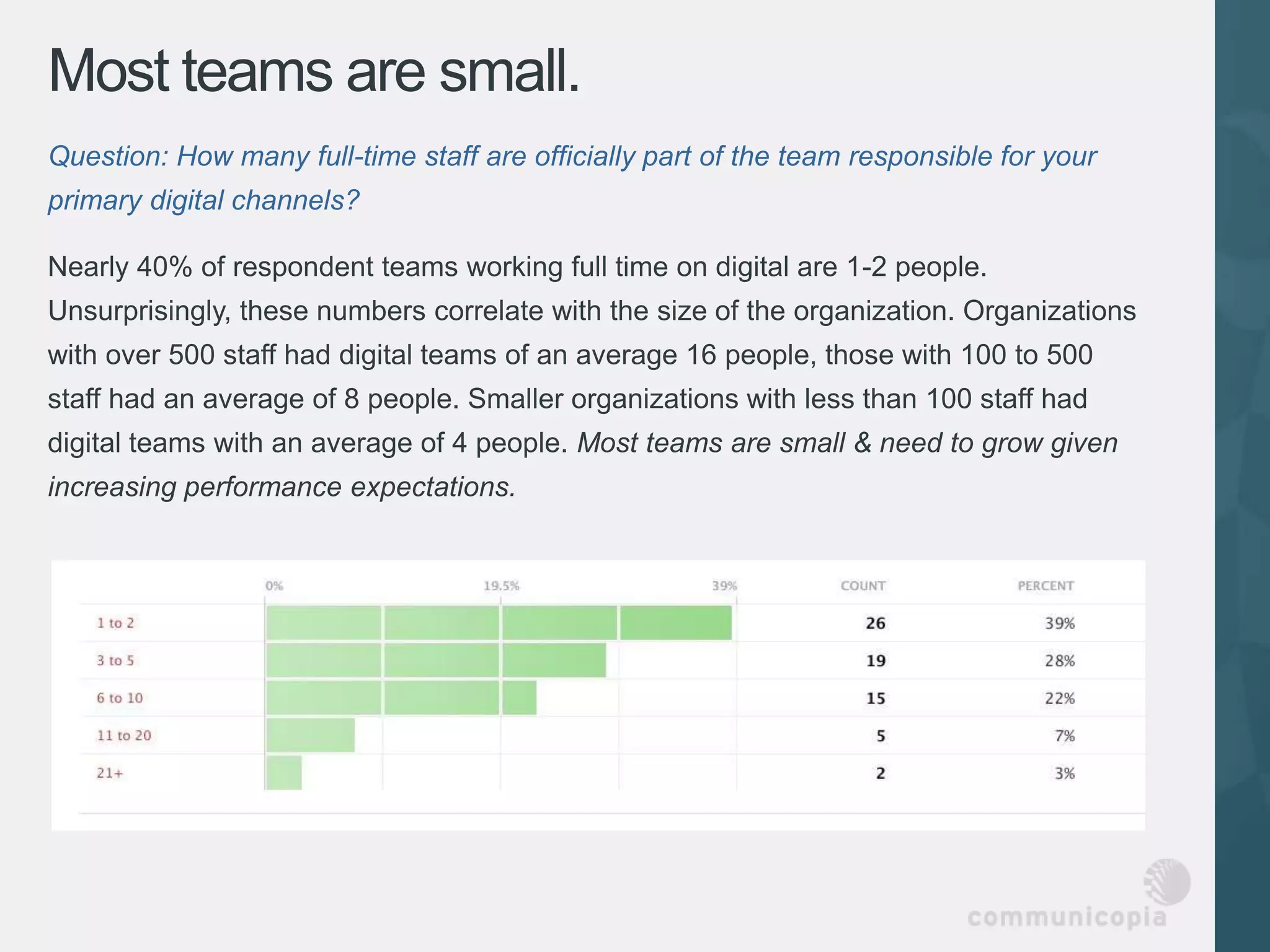
Most teams are small.
Question: How many full-time staff are officially part of the team responsible for your
primary digital channels?

Nearly 40% of respondent teams working full time on digital are 1-2 people.
Unsurprisingly, these numbers correlate with the size of the organization. Organizations
with over 500 staff had digital teams of an average 16 people, those with 100 to 500
staff had an average of 8 people. Smaller organizations with less than 100 staff had
digital teams with an average of 4 people. Most teams are small & need to grow given
increasing performance expectations.
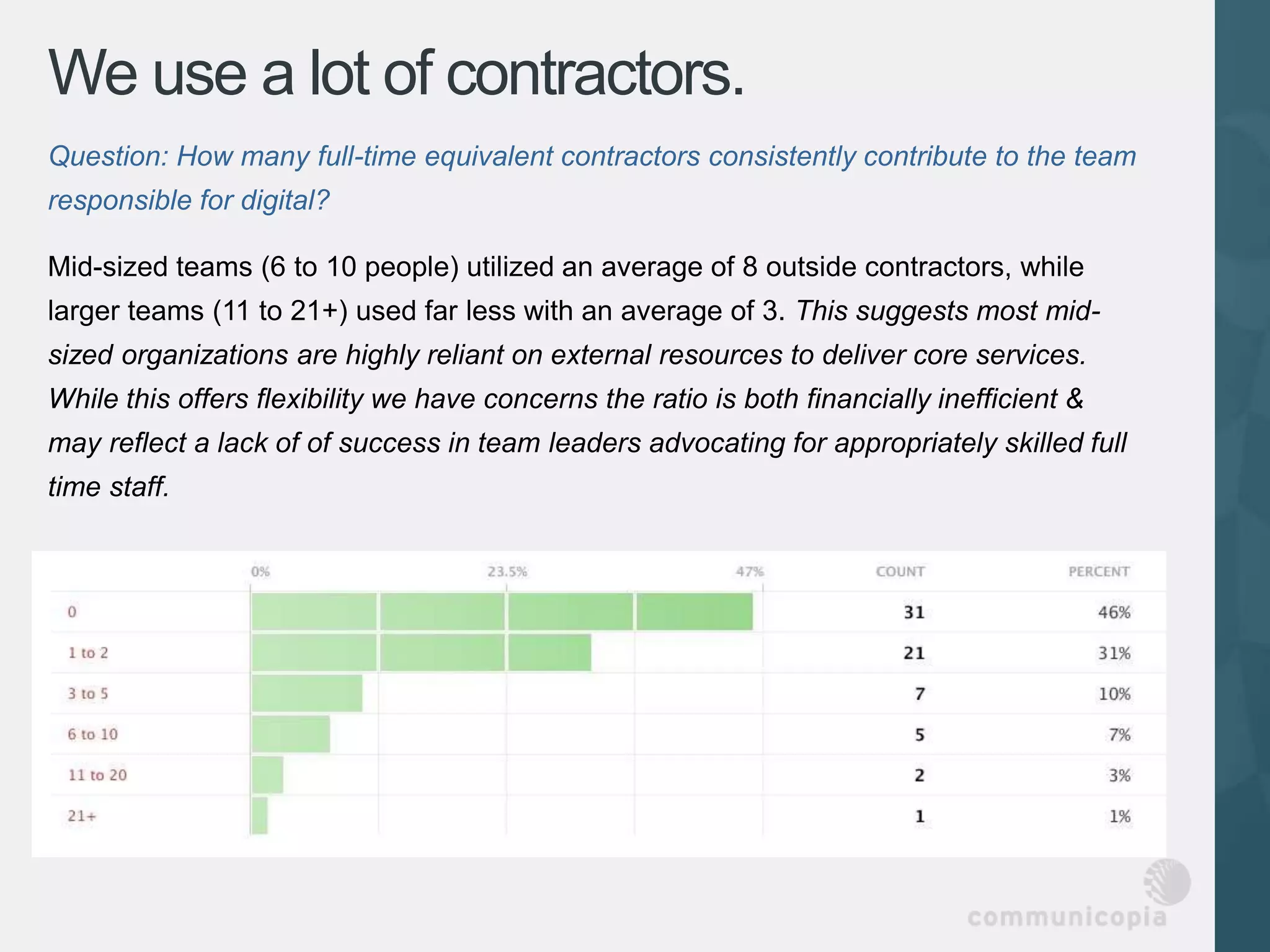
We use a lot of contractors.
Question: How many full-time equivalent contractors consistently contribute to the team
responsible for digital?

Mid-sized teams (6 to 10 people) utilized an average of 8 outside contractors, while
larger teams (11 to 21+) used far less with an average of 3. This suggests most mid-
sized organizations are highly reliant on external resources to deliver core services.
While this offers flexibility we have concerns the ratio is both financially inefficient &
may reflect a lack of of success in team leaders advocating for appropriately skilled full
time staff.
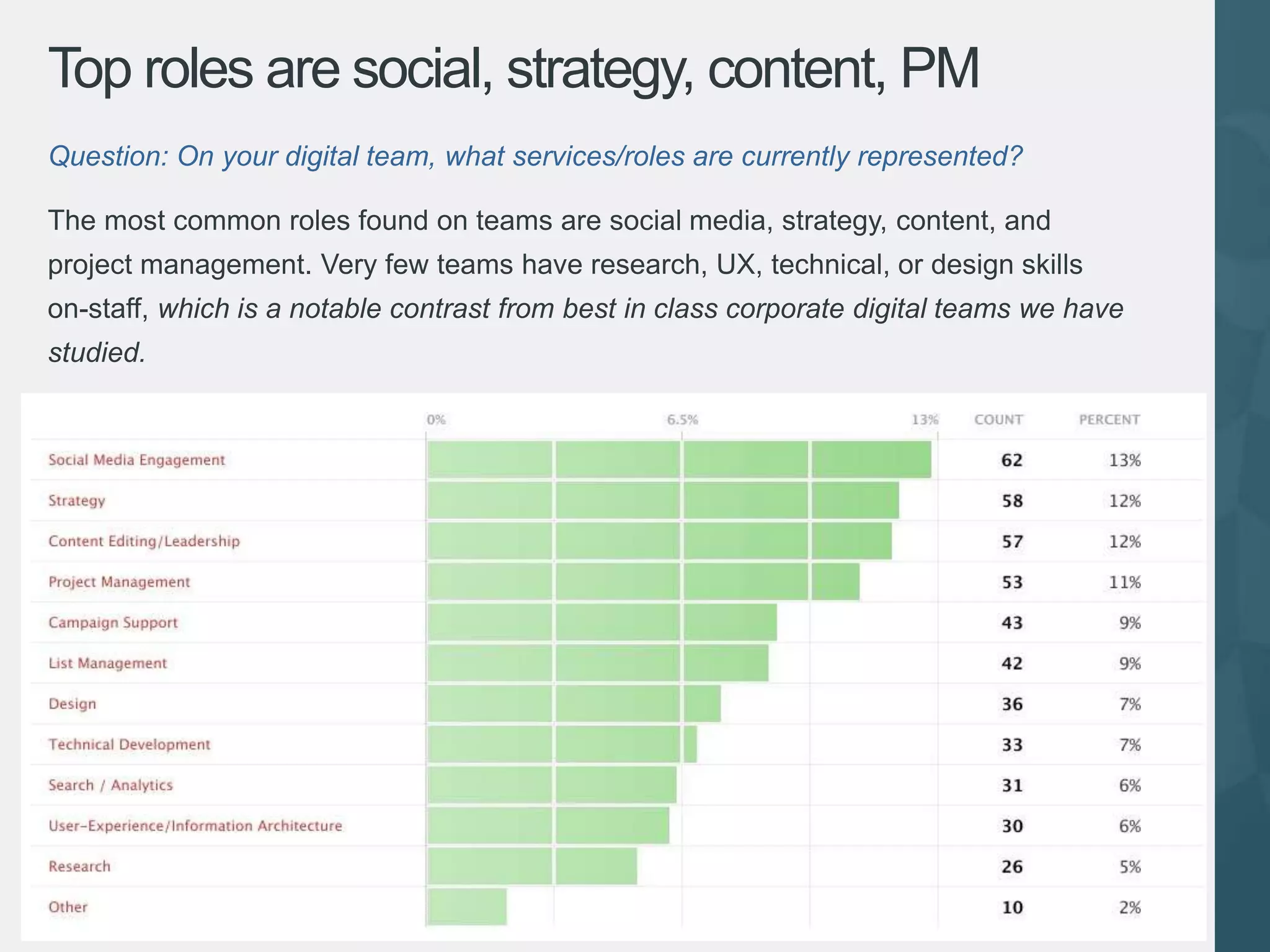
Top roles are social, strategy, content, PM
Question: On your digital team, what services/roles are currently represented?

The most common roles found on teams are social media, strategy, content, and
project management. Very few teams have research, UX, technical, or design skills
on-staff, which is a notable contrast from best in class corporate digital teams we have
studied.
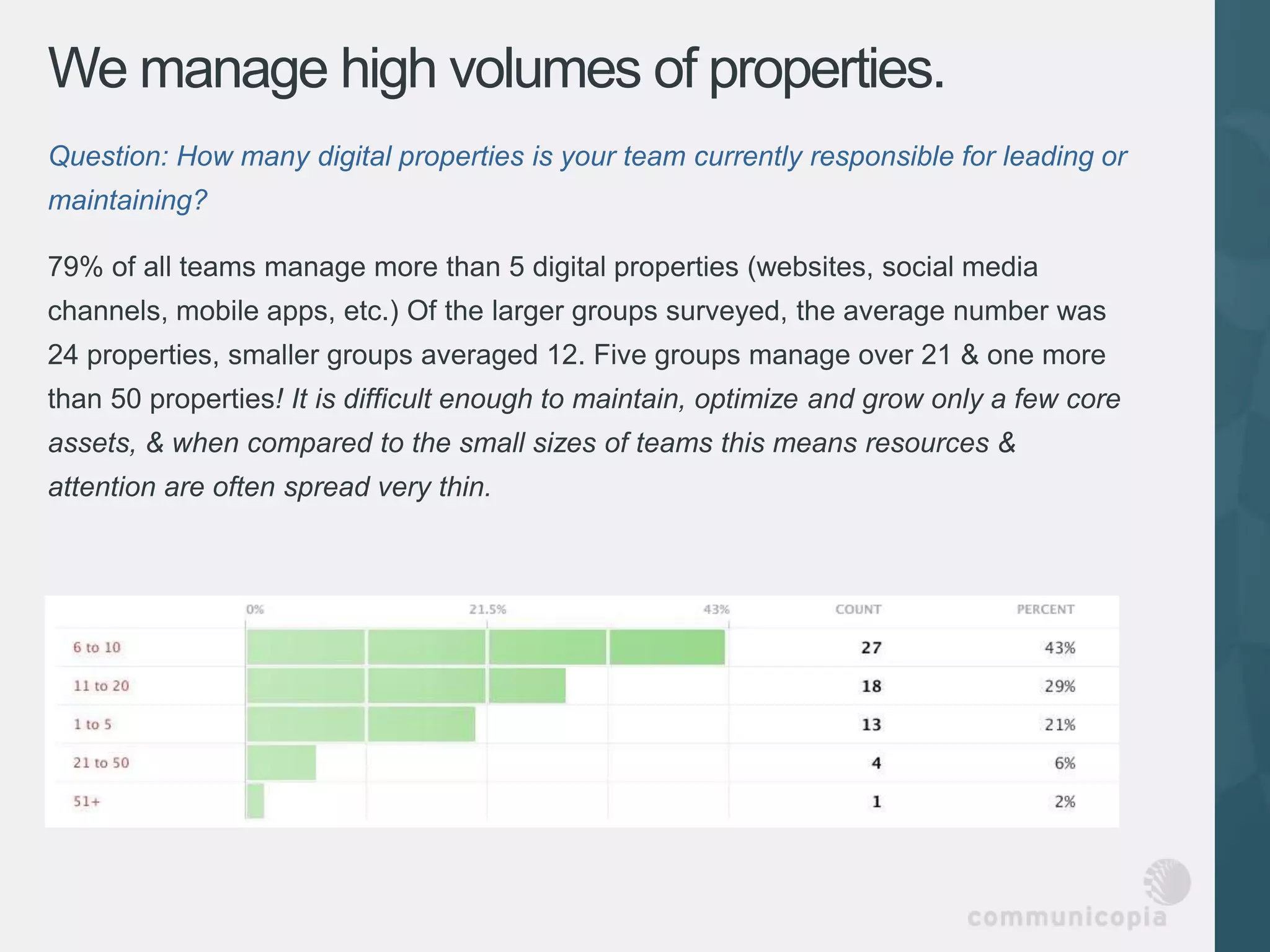
We manage high volumes of properties.
Question: How many digital properties is your team currently responsible for leading or
maintaining?

79% of all teams manage more than 5 digital properties (websites, social media
channels, mobile apps, etc.) Of the larger groups surveyed, the average number was
24 properties, smaller groups averaged 12. Five groups manage over 21 & one more
than 50 properties! It is difficult enough to maintain, optimize and grow only a few core
assets, & when compared to the small sizes of teams this means resources &
attention are often spread very thin.
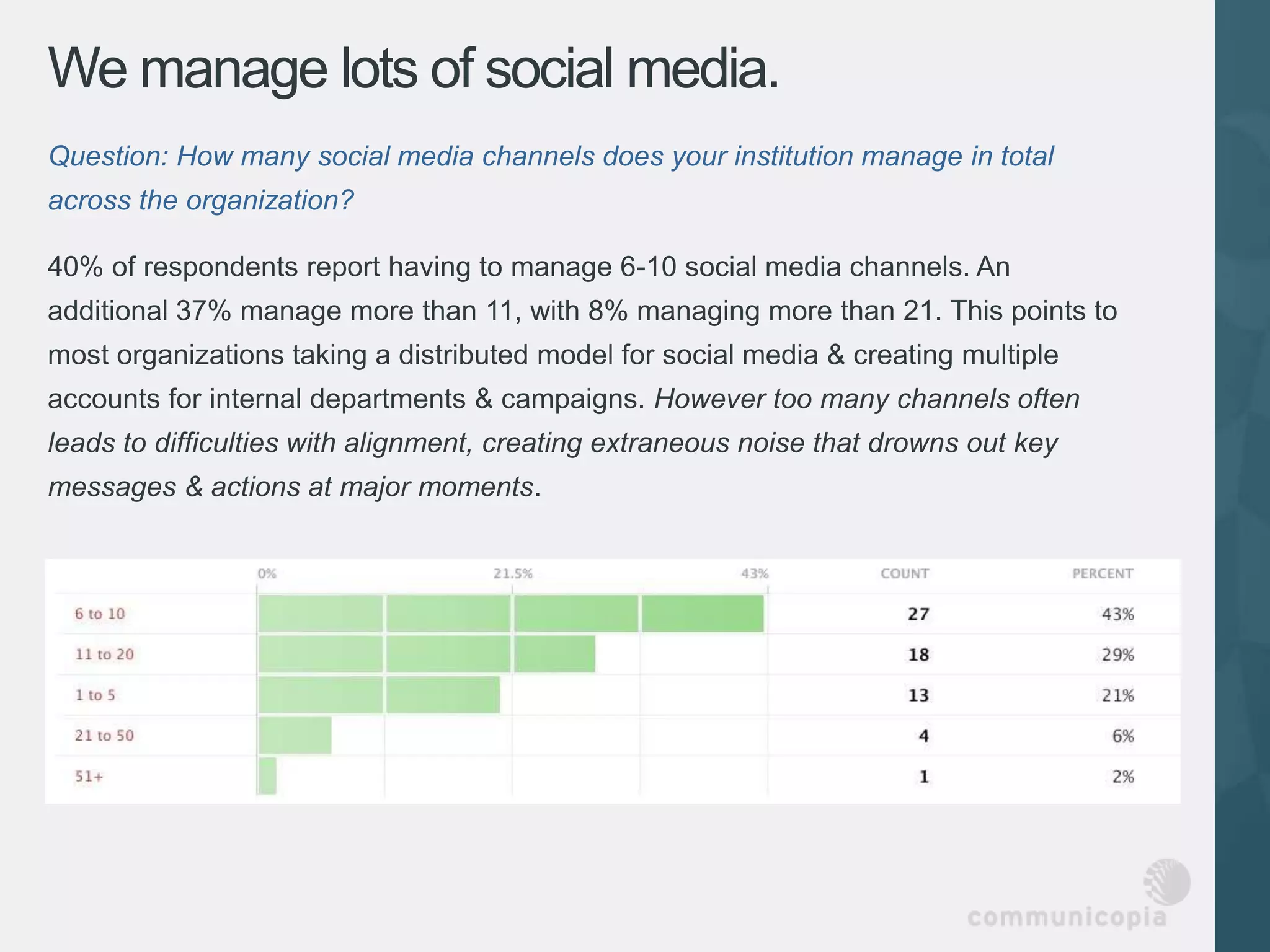
We manage lots of social media.
Question: How many social media channels does your institution manage in total
across the organization?

40% of respondents report having to manage 6-10 social media channels. An
additional 37% manage more than 11, with 8% managing more than 21. This points to
most organizations taking a distributed model for social media & creating multiple
accounts for internal departments & campaigns. However too many channels often
leads to difficulties with alignment, creating extraneous noise that drowns out key
messages & actions at major moments.
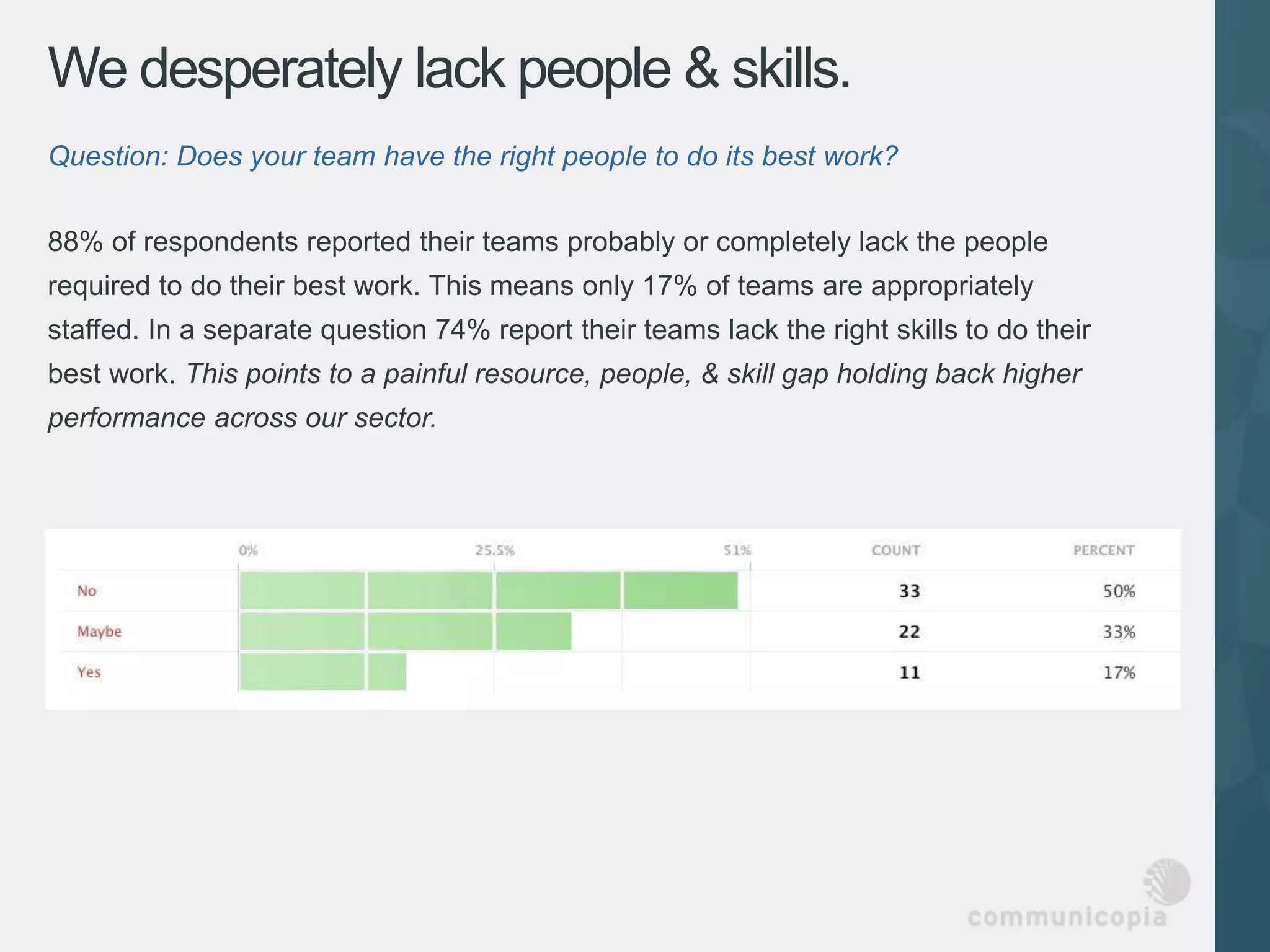
We desperately lack people & skills.
Question: Does your team have the right people to do its best work?


88% of respondents reported their teams probably or completely lack the people
required to do their best work. This means only 17% of teams are appropriately
staffed. In a separate question 74% report their teams lack the right skills to do their
best work. This points to a painful resource, people, & skill gap holding back higher
performance across our sector.
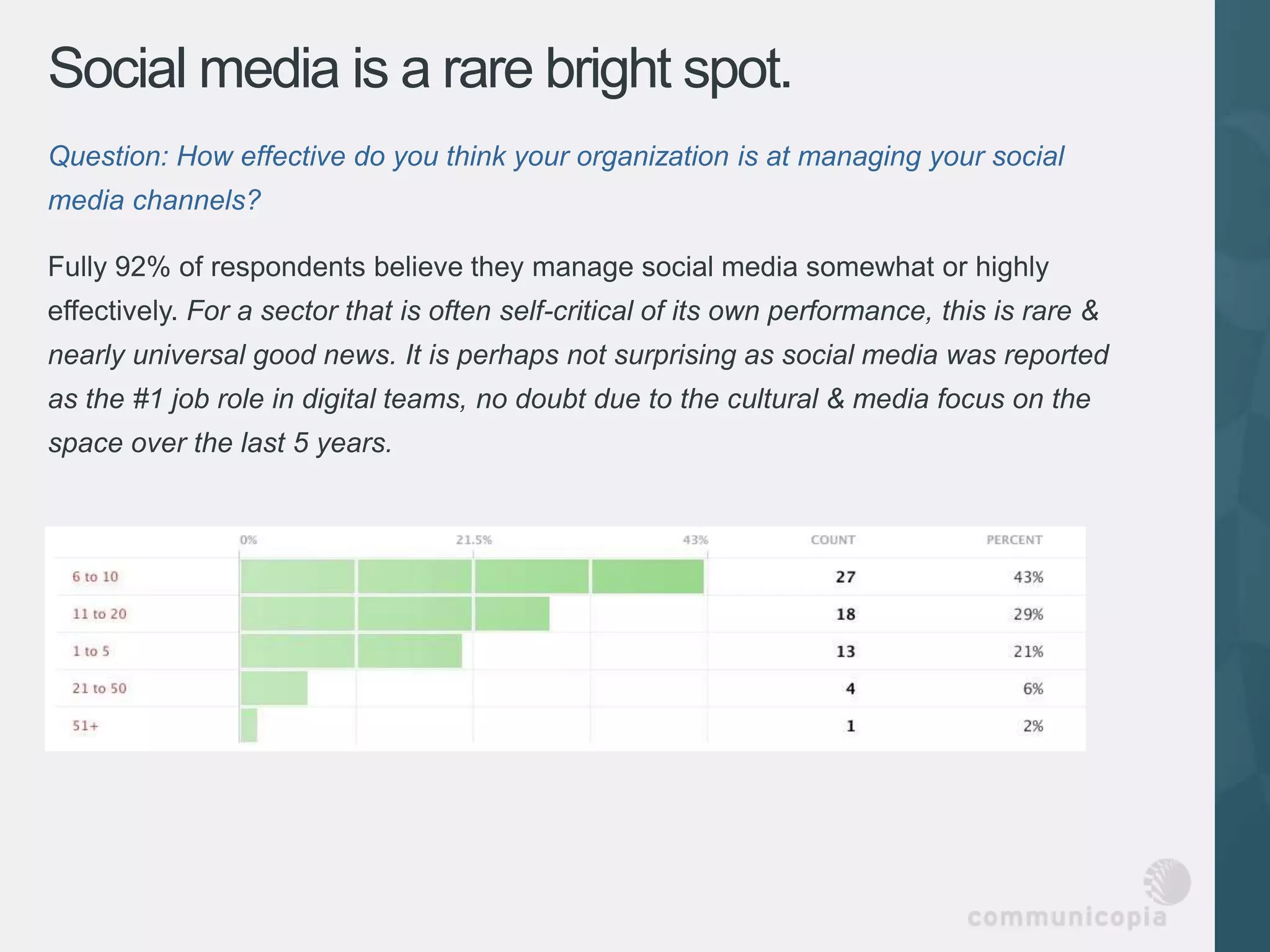
Social media is a rare bright spot.
Question: How effective do you think your organization is at managing your social
media channels?

Fully 92% of respondents believe they manage social media somewhat or highly
effectively. For a sector that is often self-critical of its own performance, this is rare &
nearly universal good news. It is perhaps not surprising as social media was reported
as the #1 job role in digital teams, no doubt due to the cultural & media focus on the
space over the last 5 years.
Part II: Culture, Structure, & $$$
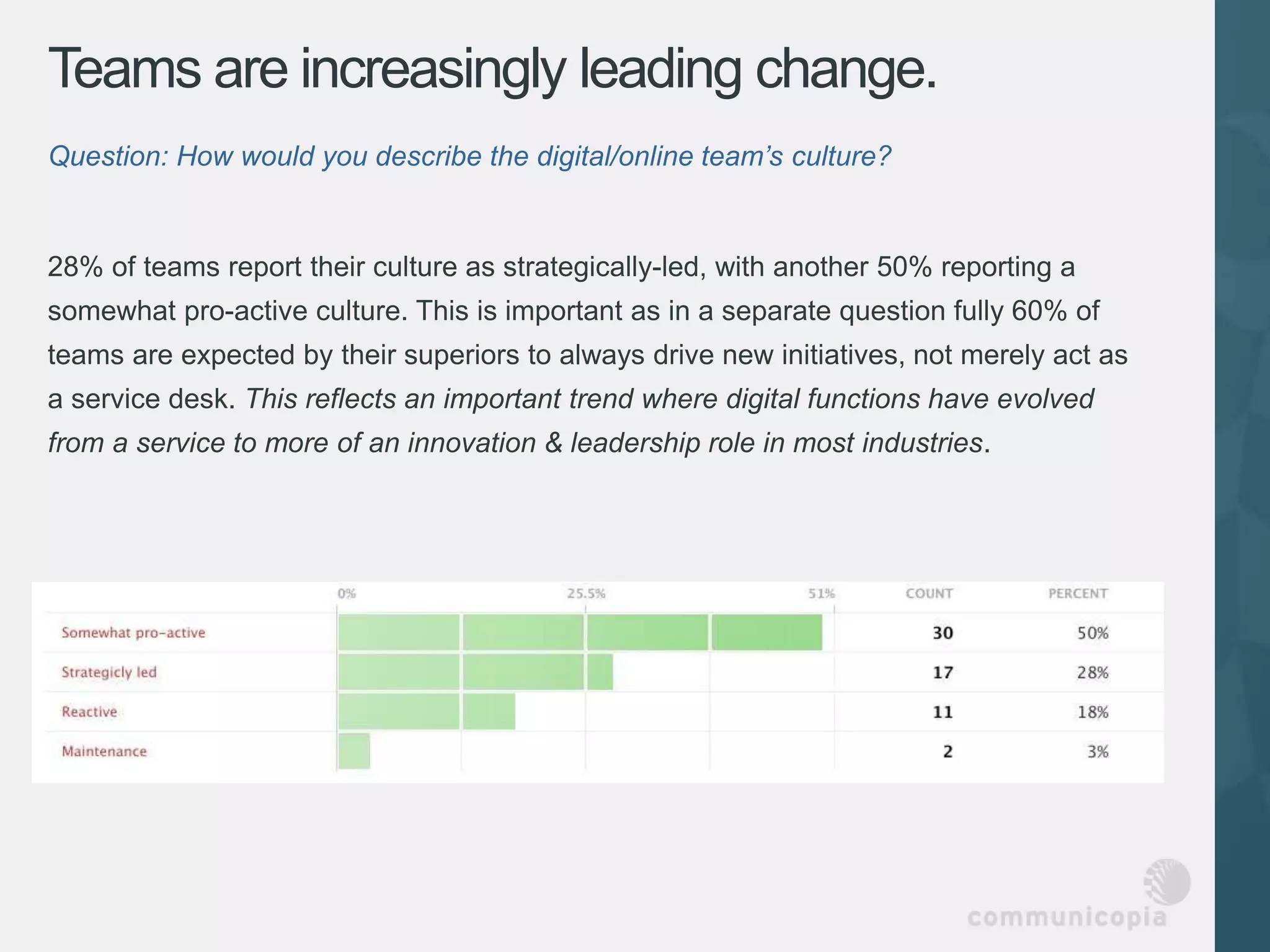
Teams are increasingly leading change.
Question: How would you describe the digital/online team’s culture?


28% of teams report their culture as strategically-led, with another 50% reporting a
somewhat pro-active culture. This is important as in a separate question fully 60% of
teams are expected by their superiors to always drive new initiatives, not merely act as
a service desk. This reflects an important trend where digital functions have evolved
from a service to more of an innovation & leadership role in most industries.
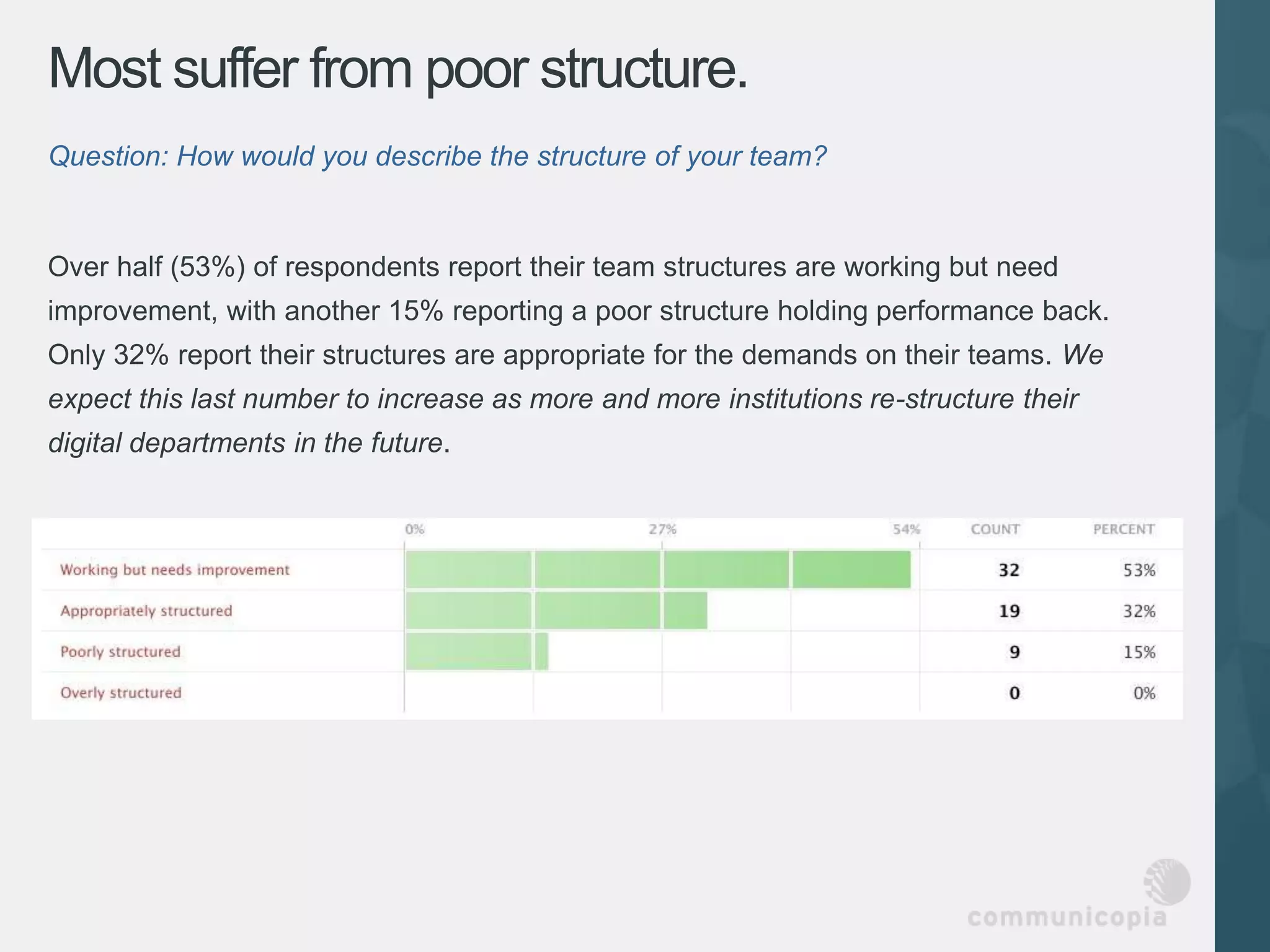
Most suffer from poor structure.
Question: How would you describe the structure of your team?


Over half (53%) of respondents report their team structures are working but need
improvement, with another 15% reporting a poor structure holding performance back.
Only 32% report their structures are appropriate for the demands on their teams. We
expect this last number to increase as more and more institutions re-structure their
digital departments in the future.
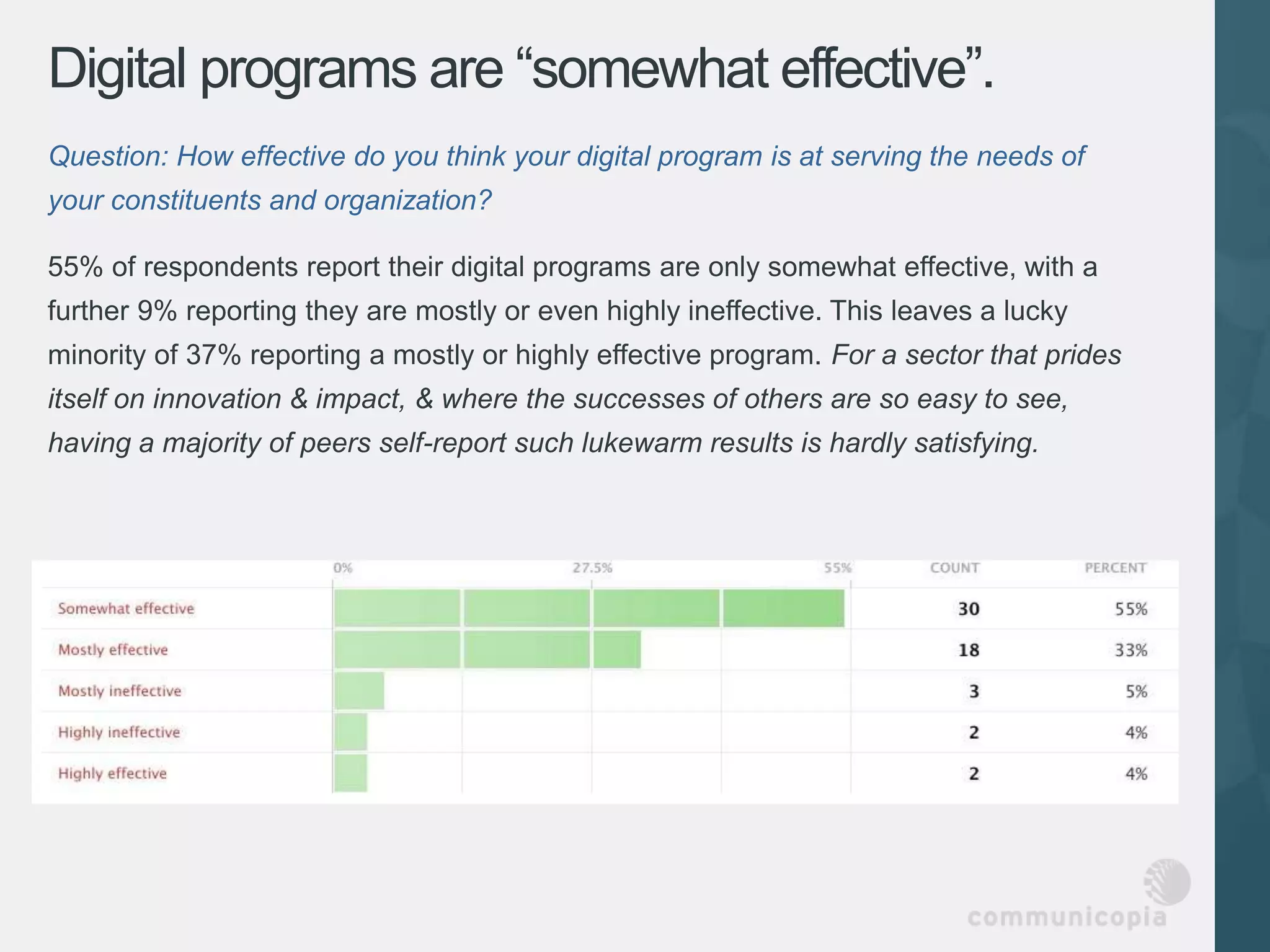
Digital programs are “somewhat effective”.
Question: How effective do you think your digital program is at serving the needs of
your constituents and organization?

55% of respondents report their digital programs are only somewhat effective, with a
further 9% reporting they are mostly or even highly ineffective. This leaves a lucky
minority of 37% reporting a mostly or highly effective program. For a sector that prides
itself on innovation & impact, & where the successes of others are so easy to see,
having a majority of peers self-report such lukewarm results is hardly satisfying.
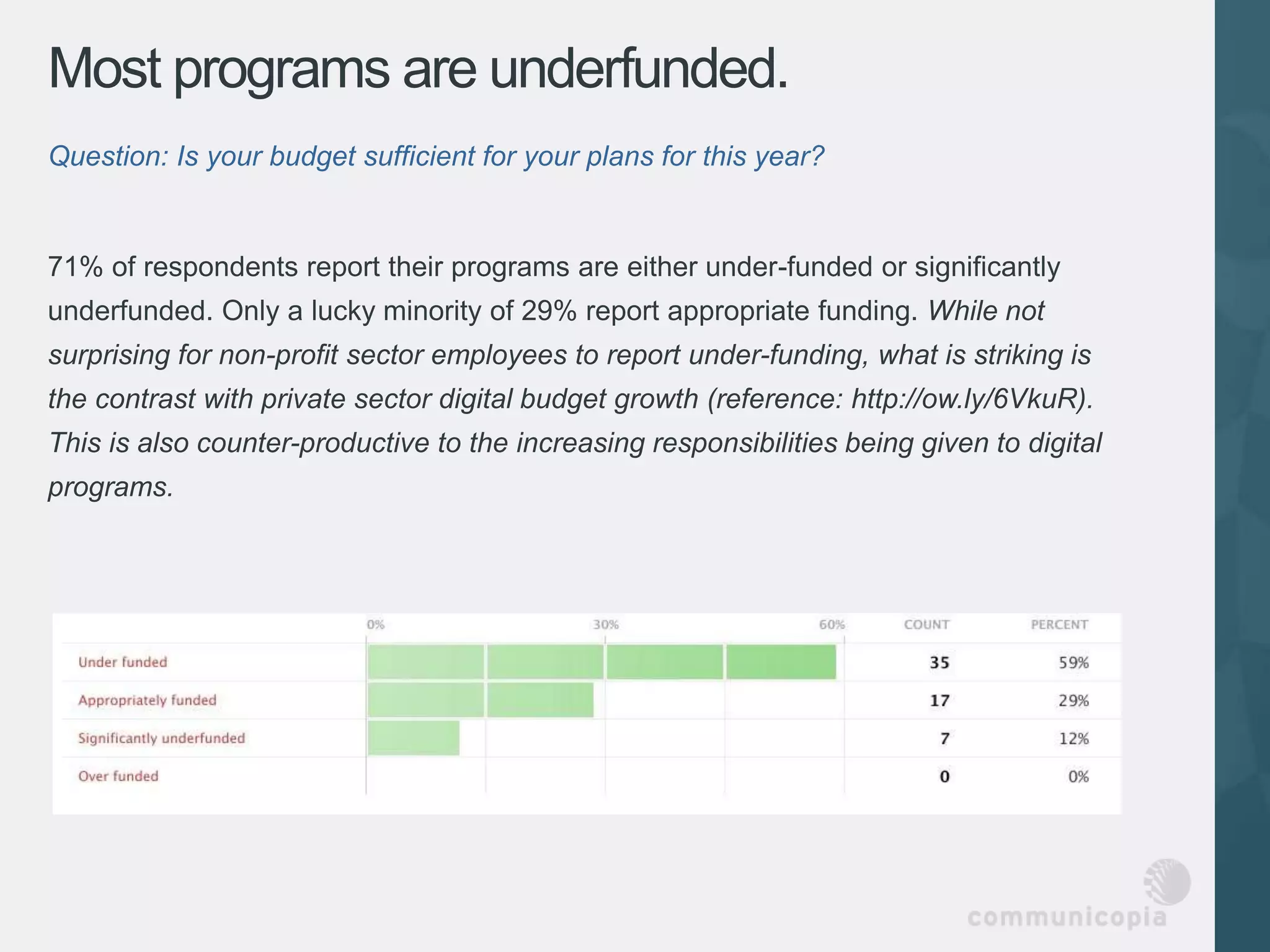
Most programs are underfunded.
Question: Is your budget sufficient for your plans for this year?


71% of respondents report their programs are either under-funded or significantly
underfunded. Only a lucky minority of 29% report appropriate funding. While not
surprising for non-profit sector employees to report under-funding, what is striking is
the contrast with private sector digital budget growth (reference: http://ow.ly/6VkuR).
This is also counter-productive to the increasing responsibilities being given to digital
programs.
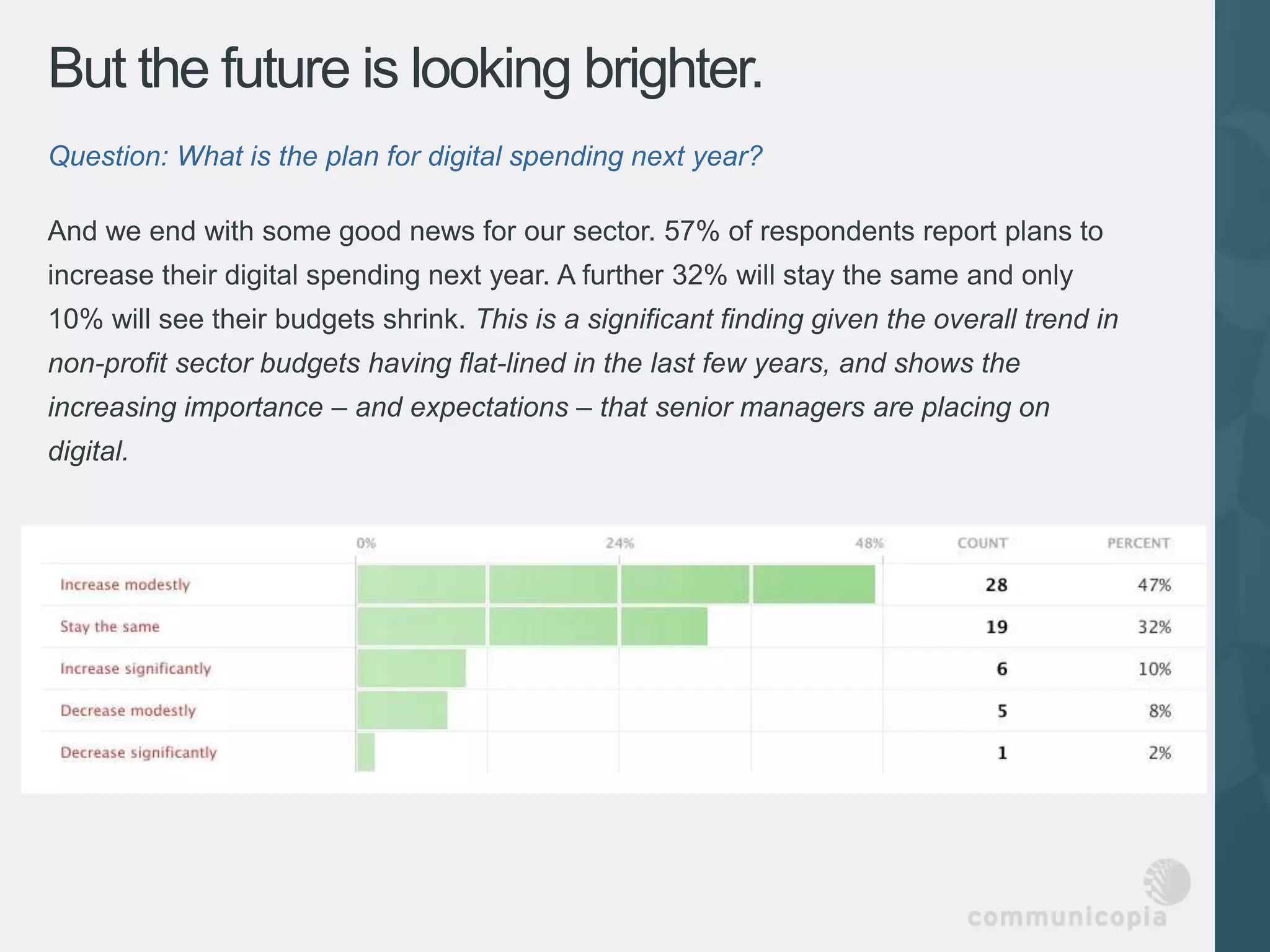
But the future is looking brighter.
Question: What is the plan for digital spending next year?

And we end with some good news for our sector. 57% of respondents report plans to
increase their digital spending next year. A further 32% will stay the same and only
10% will see their budgets shrink. This is a significant finding given the overall trend in
non-profit sector budgets having flat-lined in the last few years, and shows the
increasing importance – and expectations – that senior managers are placing on
digital.
A few final words…
Where we see the field evolving

This research points to the fact that institutions are in transition. Some are still
structured and resourced in ways that reflect the organic evolution of the web or its
legacy functions (ie publishing). Others struggle with how to balance the needs of
multiple internal customers with driving new forms of technical & engagement
innovation – all with teams that have not kept pace with the demands placed on them.
In most cases, digital is increasingly important, yet the resources & leadership haven’t
yet emerged to fully support it.

Patterns we’re seeing & expect to change in the coming years:
• Digital teams will continue to mature & shift from reactive service to proactive
  leadership & innovation hubs that drive fundamental changes in how institutions
  operate
• Many organizations will restructure & reposition the digital group to meet increasing
  internal & external expectations on the digital experience
• Team leaders will need to better make the business case for more appropriate
  funding & staff in a resource constrained environment
About Communicopia
Who we are

             About us
             We are a boutique digital consultancy working globally
             for change. We lead transformational digital projects
             that help social mission organizations increase their
             impact & effectiveness in a networked world.
             Jason Mogus, CEO & Principal Consultant.


             Our clients
             Include Human Rights Watch, NRDC, Net Impact, UN
             Foundation, City of Vancouver, UNICEF Canada, & the
             TckTckTck global climate campaign. We also founded
             Web of Change.
Let’s start a conversation
How to get in touch with us


Online                        Download the full report
communicopia.com              Download the full report for free at
@communicopia                 www.DigitalTeams.org
facebook.com/communicopia
@mogusmoves


E-mail & Phone                Related reading
contact@communicopia.com      This research was published as a
+1 (604) 844-7672             three part series in the Stanford
                              Social Innovation Review.

Digital Team Structure: The Foundation for Innovation

  • 1.
    Digital Team Structure TheFoundation for Innovation Jason Mogus @mogusmoves Michael Silberman @silbatron
  • 2.
    Evaluate This Session! Eachentry is a chance to win an NTEN engraved iPad! or Online at www.nten.org/ntc/eval
  • 3.
    Non-profit digital teams Whywe are passionate about culture, systems, & people Our Intention Background Documents We undertook this research to better The following articles published in understand how non-profit leaders Stanford Social Innovation Review will manage digital & online initiatives in their organizations. In our experience it’s well help you following along: led, well structured, & well resourced • The 5 Dysfunctions of a Digital Team teams that are the fundamental building • Four Models for Managing Digital blocks for success online. • Download the free Non-profit Digital We’ve gathered data from leaders in the Teams Benchmark Report at community & combined it with our own www.DigitalTeams.org insights & analysis (identified by italics) to help start a conversation in our sector about building better teams.
  • 4.
  • 5.
  • 6.
  • 7.
  • 8.
  • 9.
  • 10.
  • 15.
  • 16.
  • 17.
    Contributing organizations Responses from67 non-profits were used in the benchmark, including:
  • 18.
  • 19.
    Digital teams livein communications. Question: What department are you a member of? Nearly 45% of digital teams report to communications. This is often the ideal group to be connected with as much digital work is communications driven. Teams within IT departments are increasingly rare. We were surprised to see 18% in the relatively new category of “digital super-groups”, reporting directly to the ED. We expect to see this figure increase over time as this can often be a more ideal location to lead new engagement functions, manage multi-channel communications, & drive innovation across campaigns.
  • 20.
    Most teams aresmall. Question: How many full-time staff are officially part of the team responsible for your primary digital channels? Nearly 40% of respondent teams working full time on digital are 1-2 people. Unsurprisingly, these numbers correlate with the size of the organization. Organizations with over 500 staff had digital teams of an average 16 people, those with 100 to 500 staff had an average of 8 people. Smaller organizations with less than 100 staff had digital teams with an average of 4 people. Most teams are small & need to grow given increasing performance expectations.
  • 21.
    We use alot of contractors. Question: How many full-time equivalent contractors consistently contribute to the team responsible for digital? Mid-sized teams (6 to 10 people) utilized an average of 8 outside contractors, while larger teams (11 to 21+) used far less with an average of 3. This suggests most mid- sized organizations are highly reliant on external resources to deliver core services. While this offers flexibility we have concerns the ratio is both financially inefficient & may reflect a lack of of success in team leaders advocating for appropriately skilled full time staff.
  • 22.
    Top roles aresocial, strategy, content, PM Question: On your digital team, what services/roles are currently represented? The most common roles found on teams are social media, strategy, content, and project management. Very few teams have research, UX, technical, or design skills on-staff, which is a notable contrast from best in class corporate digital teams we have studied.
  • 23.
    We manage highvolumes of properties. Question: How many digital properties is your team currently responsible for leading or maintaining? 79% of all teams manage more than 5 digital properties (websites, social media channels, mobile apps, etc.) Of the larger groups surveyed, the average number was 24 properties, smaller groups averaged 12. Five groups manage over 21 & one more than 50 properties! It is difficult enough to maintain, optimize and grow only a few core assets, & when compared to the small sizes of teams this means resources & attention are often spread very thin.
  • 24.
    We manage lotsof social media. Question: How many social media channels does your institution manage in total across the organization? 40% of respondents report having to manage 6-10 social media channels. An additional 37% manage more than 11, with 8% managing more than 21. This points to most organizations taking a distributed model for social media & creating multiple accounts for internal departments & campaigns. However too many channels often leads to difficulties with alignment, creating extraneous noise that drowns out key messages & actions at major moments.
  • 25.
    We desperately lackpeople & skills. Question: Does your team have the right people to do its best work? 88% of respondents reported their teams probably or completely lack the people required to do their best work. This means only 17% of teams are appropriately staffed. In a separate question 74% report their teams lack the right skills to do their best work. This points to a painful resource, people, & skill gap holding back higher performance across our sector.
  • 26.
    Social media isa rare bright spot. Question: How effective do you think your organization is at managing your social media channels? Fully 92% of respondents believe they manage social media somewhat or highly effectively. For a sector that is often self-critical of its own performance, this is rare & nearly universal good news. It is perhaps not surprising as social media was reported as the #1 job role in digital teams, no doubt due to the cultural & media focus on the space over the last 5 years.
  • 27.
    Part II: Culture,Structure, & $$$
  • 28.
    Teams are increasinglyleading change. Question: How would you describe the digital/online team’s culture? 28% of teams report their culture as strategically-led, with another 50% reporting a somewhat pro-active culture. This is important as in a separate question fully 60% of teams are expected by their superiors to always drive new initiatives, not merely act as a service desk. This reflects an important trend where digital functions have evolved from a service to more of an innovation & leadership role in most industries.
  • 29.
    Most suffer frompoor structure. Question: How would you describe the structure of your team? Over half (53%) of respondents report their team structures are working but need improvement, with another 15% reporting a poor structure holding performance back. Only 32% report their structures are appropriate for the demands on their teams. We expect this last number to increase as more and more institutions re-structure their digital departments in the future.
  • 30.
    Digital programs are“somewhat effective”. Question: How effective do you think your digital program is at serving the needs of your constituents and organization? 55% of respondents report their digital programs are only somewhat effective, with a further 9% reporting they are mostly or even highly ineffective. This leaves a lucky minority of 37% reporting a mostly or highly effective program. For a sector that prides itself on innovation & impact, & where the successes of others are so easy to see, having a majority of peers self-report such lukewarm results is hardly satisfying.
  • 31.
    Most programs areunderfunded. Question: Is your budget sufficient for your plans for this year? 71% of respondents report their programs are either under-funded or significantly underfunded. Only a lucky minority of 29% report appropriate funding. While not surprising for non-profit sector employees to report under-funding, what is striking is the contrast with private sector digital budget growth (reference: http://ow.ly/6VkuR). This is also counter-productive to the increasing responsibilities being given to digital programs.
  • 32.
    But the futureis looking brighter. Question: What is the plan for digital spending next year? And we end with some good news for our sector. 57% of respondents report plans to increase their digital spending next year. A further 32% will stay the same and only 10% will see their budgets shrink. This is a significant finding given the overall trend in non-profit sector budgets having flat-lined in the last few years, and shows the increasing importance – and expectations – that senior managers are placing on digital.
  • 33.
    A few finalwords… Where we see the field evolving This research points to the fact that institutions are in transition. Some are still structured and resourced in ways that reflect the organic evolution of the web or its legacy functions (ie publishing). Others struggle with how to balance the needs of multiple internal customers with driving new forms of technical & engagement innovation – all with teams that have not kept pace with the demands placed on them. In most cases, digital is increasingly important, yet the resources & leadership haven’t yet emerged to fully support it. Patterns we’re seeing & expect to change in the coming years: • Digital teams will continue to mature & shift from reactive service to proactive leadership & innovation hubs that drive fundamental changes in how institutions operate • Many organizations will restructure & reposition the digital group to meet increasing internal & external expectations on the digital experience • Team leaders will need to better make the business case for more appropriate funding & staff in a resource constrained environment
  • 34.
    About Communicopia Who weare About us We are a boutique digital consultancy working globally for change. We lead transformational digital projects that help social mission organizations increase their impact & effectiveness in a networked world. Jason Mogus, CEO & Principal Consultant. Our clients Include Human Rights Watch, NRDC, Net Impact, UN Foundation, City of Vancouver, UNICEF Canada, & the TckTckTck global climate campaign. We also founded Web of Change.
  • 35.
    Let’s start aconversation How to get in touch with us Online Download the full report communicopia.com Download the full report for free at @communicopia www.DigitalTeams.org facebook.com/communicopia @mogusmoves E-mail & Phone Related reading contact@communicopia.com This research was published as a +1 (604) 844-7672 three part series in the Stanford Social Innovation Review.