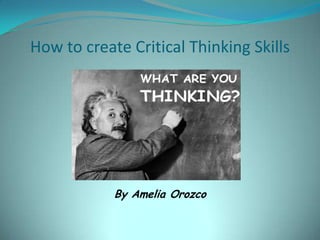
How to create Critical Thinking Skills


            By Amelia Orozco
How to make critical thinking skills
 Why do We Need Critical thinking Skills?
  Critical thinking skills are used in many aspects of everyday life
  and are particularly important for university students to master
  before advancing into a professional career. At home we use
  these ideas to make sure that our children are being raised
  properly, attending the right educational institution and receiving
  proper medical care.
At our professional work environment we engage with people who
often retaliate when conditions are unfavorable so we learn
, analysis, and decide which coarse of action is best to use in
each individual situation. As an Arts and Sciences' major, it
would be beneficial to understand how to break large pieces of
information down in order to process it in manner so we can
present unique ideas.
1) Examining information from different angles and
 perspectives is central to critical thinking when reading
 and researching in preparation for Academic Coursework.
 It enables students to gain comprehensive knowledge of a
subject topics before accepting these new ideas and applying
them.

The elements of critical thinking are central to the learning
process. It is a way for students, parents or professionals to
take many pieces of information and break it down into
meaningful parts and re assemble it into a main idea or thought
process. This also gives us the life experiences we need to make
properly educated assumptions without bias.
2) Sometimes this may require questioning previous assumptions,
looking at things from alternative perspectives, researching
widely to substantiate facts and comparing gathered information
so that students, parents or professionals can gain accurate data
and develop informed, well-balanced arguments.
Those who use critical thinking skills are in fact also using The
Scientific method to do this very task. This method includes
physical observation is the observing with eyes, then we make an
educated guess of what that could mean, then we can make
predictions and test these predictions.
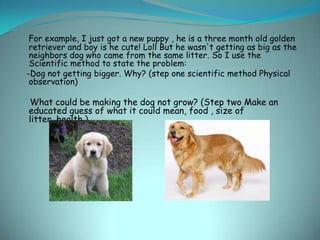
For example, I just got a new puppy , he is a three month old golden
 retriever and boy is he cute! Loll But he wasn't getting as big as the
 neighbors dog who came from the same litter. So I use the
 Scientific method to state the problem:
-Dog not getting bigger. Why? (step one scientific method Physical
 observation)

What could be making the dog not grow? (Step two Make an
educated guess of what it could mean, food , size of
litter, health.)
-What is some of the ways the neighbor is handling the weight
  issue? Is he feeding him more is he exercising him less?( step
  three make predictions based on what we know)
  -What do we know? How can we test this hypothesis? Maybe feed
  the dog more. (Final step of Scientific method testing your
  ideas.)


3) There are so many ways to do this as a student or a parent. I
  find it exciting, like a mystery every time I have to tackle a
  analytical situation. I have fun figuring out the different
  alternatives of what could happen if we try it this way. How do
  we know it will happen that way? Afterwards if you can, ask
  someone who has tried it and see what their results were!
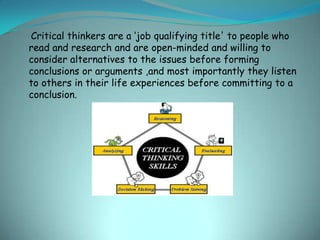
Critical thinkers are a ‘job qualifying title' to people who
read and research and are open-minded and willing to
consider alternatives to the issues before forming
conclusions or arguments ,and most importantly they listen
to others in their life experiences before committing to a
conclusion.
~ The process of learning and using life's experiences to guide you
  while working out a situation, explaining some dilemma, answering
  particular questions, or settling a certain issue is the common
  purpose of this learning process.


   One cannot process information, form reasonable opinions,
  evaluate beliefs, construct positions, or articulate a thesis
  without the use of research and evaluation learned from forming
  a hypothesis based on life experiences.

How to create critical thinking skills

  • 1.
    How to createCritical Thinking Skills By Amelia Orozco
  • 2.
    How to makecritical thinking skills  Why do We Need Critical thinking Skills? Critical thinking skills are used in many aspects of everyday life and are particularly important for university students to master before advancing into a professional career. At home we use these ideas to make sure that our children are being raised properly, attending the right educational institution and receiving proper medical care.
  • 3.
    At our professionalwork environment we engage with people who often retaliate when conditions are unfavorable so we learn , analysis, and decide which coarse of action is best to use in each individual situation. As an Arts and Sciences' major, it would be beneficial to understand how to break large pieces of information down in order to process it in manner so we can present unique ideas. 1) Examining information from different angles and perspectives is central to critical thinking when reading and researching in preparation for Academic Coursework. It enables students to gain comprehensive knowledge of a subject topics before accepting these new ideas and applying them. The elements of critical thinking are central to the learning process. It is a way for students, parents or professionals to take many pieces of information and break it down into meaningful parts and re assemble it into a main idea or thought process. This also gives us the life experiences we need to make properly educated assumptions without bias.
  • 4.
    2) Sometimes thismay require questioning previous assumptions, looking at things from alternative perspectives, researching widely to substantiate facts and comparing gathered information so that students, parents or professionals can gain accurate data and develop informed, well-balanced arguments. Those who use critical thinking skills are in fact also using The Scientific method to do this very task. This method includes physical observation is the observing with eyes, then we make an educated guess of what that could mean, then we can make predictions and test these predictions.
  • 5.
    For example, Ijust got a new puppy , he is a three month old golden retriever and boy is he cute! Loll But he wasn't getting as big as the neighbors dog who came from the same litter. So I use the Scientific method to state the problem: -Dog not getting bigger. Why? (step one scientific method Physical observation) What could be making the dog not grow? (Step two Make an educated guess of what it could mean, food , size of litter, health.)
  • 6.
    -What is someof the ways the neighbor is handling the weight issue? Is he feeding him more is he exercising him less?( step three make predictions based on what we know) -What do we know? How can we test this hypothesis? Maybe feed the dog more. (Final step of Scientific method testing your ideas.) 3) There are so many ways to do this as a student or a parent. I find it exciting, like a mystery every time I have to tackle a analytical situation. I have fun figuring out the different alternatives of what could happen if we try it this way. How do we know it will happen that way? Afterwards if you can, ask someone who has tried it and see what their results were!
  • 7.
    Critical thinkers area ‘job qualifying title' to people who read and research and are open-minded and willing to consider alternatives to the issues before forming conclusions or arguments ,and most importantly they listen to others in their life experiences before committing to a conclusion.
  • 8.
    ~ The processof learning and using life's experiences to guide you while working out a situation, explaining some dilemma, answering particular questions, or settling a certain issue is the common purpose of this learning process. One cannot process information, form reasonable opinions, evaluate beliefs, construct positions, or articulate a thesis without the use of research and evaluation learned from forming a hypothesis based on life experiences.