How to Create a D&D
Character*
*may need players handbook, 5e
Step 1: Choose a Race (pg17-43)
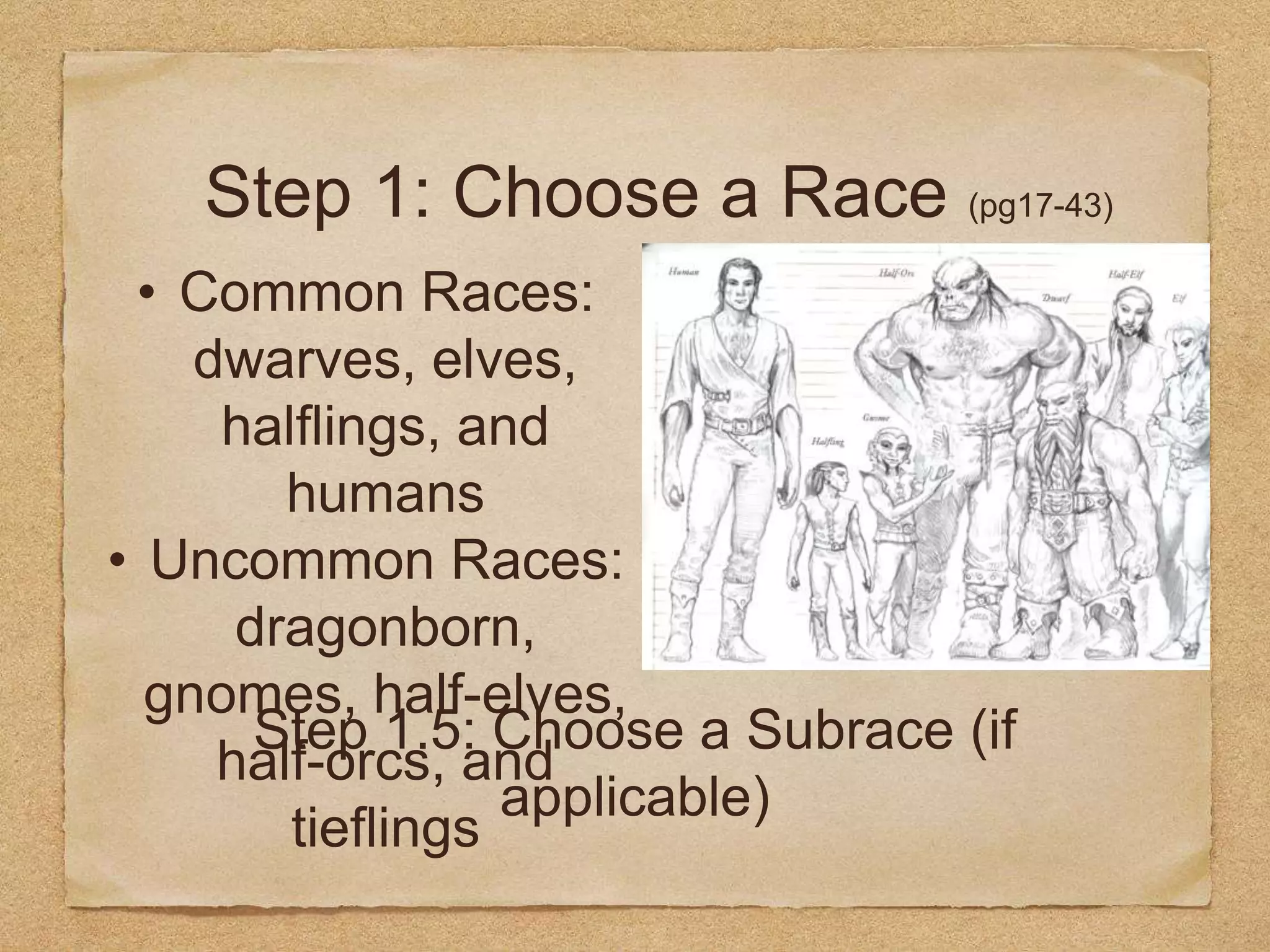
• Common Races:
dwarves, elves,
halflings, and
humans
• Uncommon Races:
dragonborn,
gnomes, half-elves,
half-orcs, and
tieflings
Step 1.5: Choose a Subrace (if
applicable)
What to add to your
character sheet
• Record your race on
character sheet page 1.
Record any abilities,
features, speed,
languages, and
proficiencies your race
has.
• Choose an age,
height, weight, hair
color, eye color, and
name that agree with
your race, record on
page 2.
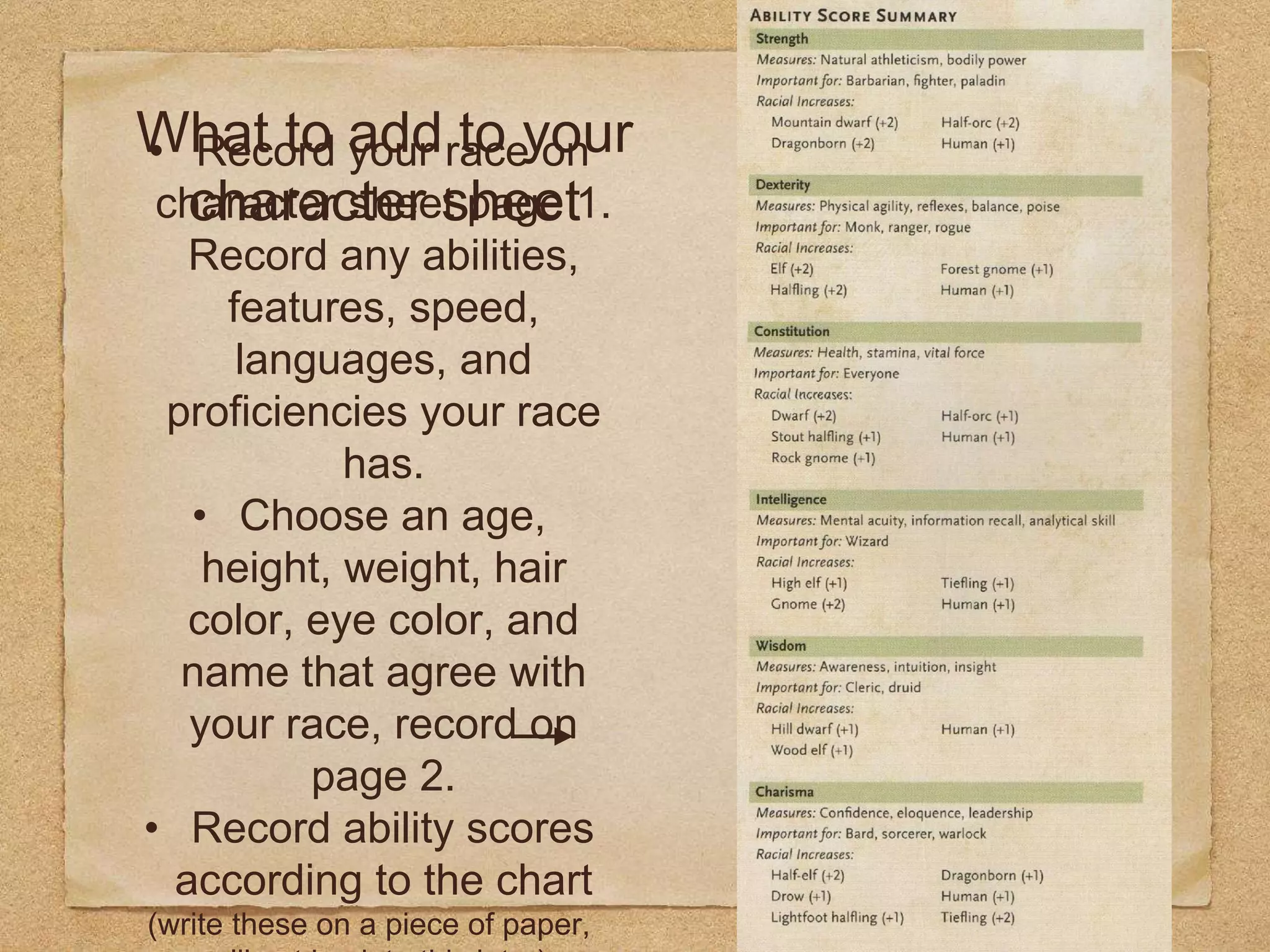
• Record ability scores
according to the chart
(write these on a piece of paper,
Step 2: Choose a Class (pg 45-119)
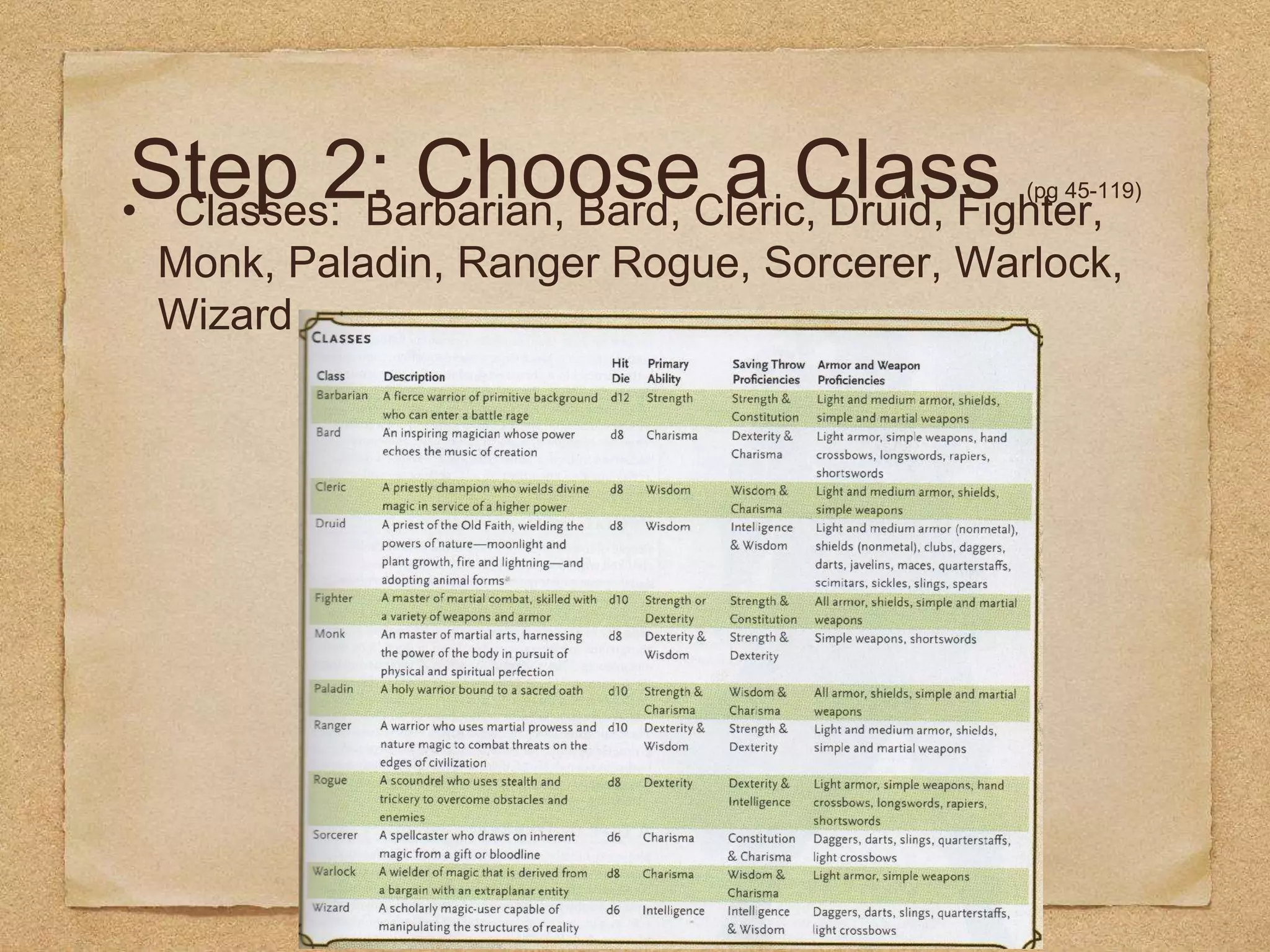
• Classes: Barbarian, Bard, Cleric, Druid, Fighter,
Monk, Paladin, Ranger Rogue, Sorcerer, Warlock,
Wizard
What to add to your character sheet
• Record your class, hit dice, proficiency bonus,
level (probably 1), saving throw proficiencies
(fill in the circle), armor and weapon
proficiencies, skill proficiencies (usually chosen
from a list in your class section, fill in the
circle), spells, tool proficiencies, and
features/traits of that class.
• Choose your equipment for that class (see
your class section). Record this information in
equipment as well as in attacks & spellcasting
if necessary.
Determining Ability Scores
(the little scores in the ovals)
• Get your six scores, two options: 1) do this six
times: roll four six sided dice, record the total of the
highest 3 dice. 2) Use 15, 14, 13, 12, 10, 8.
• Ok, now you have six numbers. Now choose
where you want those numbers to go to: Strength,
Dex, Constitutions, Intelligence, Wisdom,
Charisma.
• Now, remember the ability increases we recorded
from your race? Add those to your specified levels.
i.e. in the previous step, I chose my strength to be
15. If I am a half-orc, I get +2 strength, so my
strength is now 17.
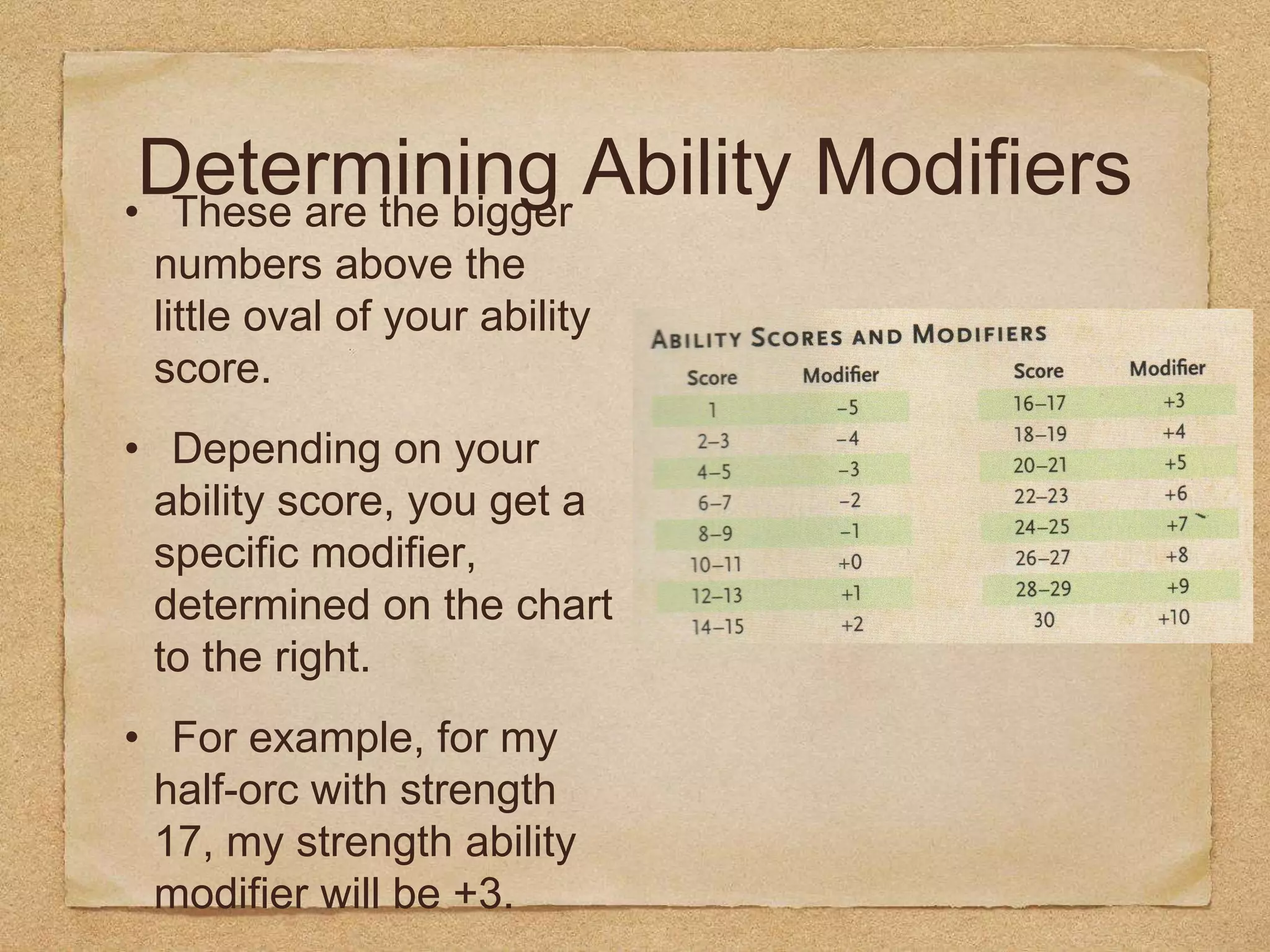
Determining Ability Modifiers• These are the bigger
numbers above the
little oval of your ability
score.
• Depending on your
ability score, you get a
specific modifier,
determined on the chart
to the right.
• For example, for my
half-orc with strength
17, my strength ability
modifier will be +3.
Choose your background
• What did you do before you became an
adventurer? (pages 126-141) Examples:
criminal, entertainer, noble.
• Record your background’s proficiencies,
choose languages, equipment, features, and
money.
• Roll dice for your character’s personality
traits, ideals, bonds, and flaws.
• Ask the DM if you wish to create your own
background.
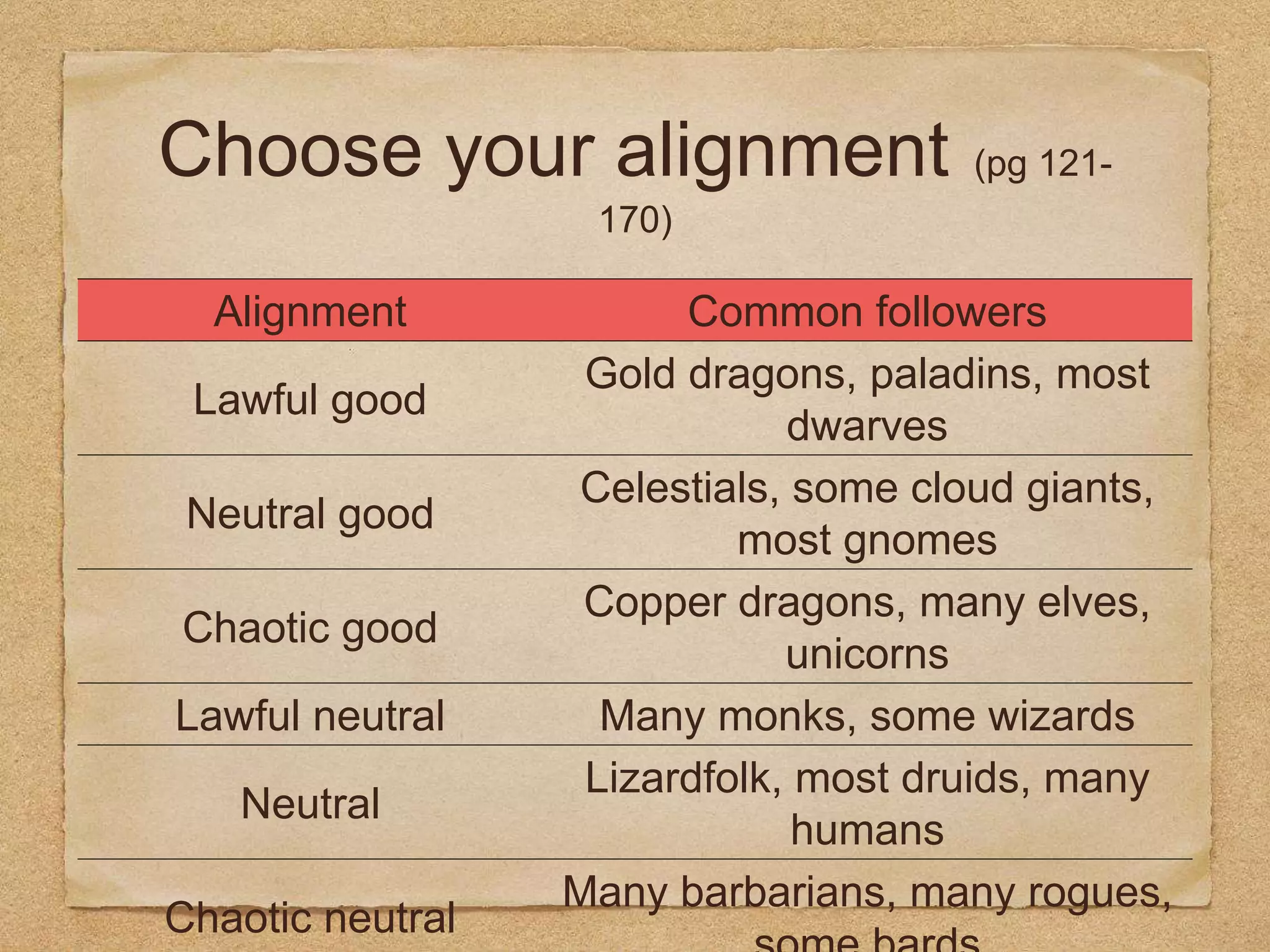
Choose your alignment (pg 121-
170)
Alignment Common followers
Lawful good
Gold dragons, paladins, most
dwarves
Neutral good
Celestials, some cloud giants,
most gnomes
Chaotic good
Copper dragons, many elves,
unicorns
Lawful neutral Many monks, some wizards
Neutral
Lizardfolk, most druids, many
humans
Chaotic neutral
Many barbarians, many rogues,
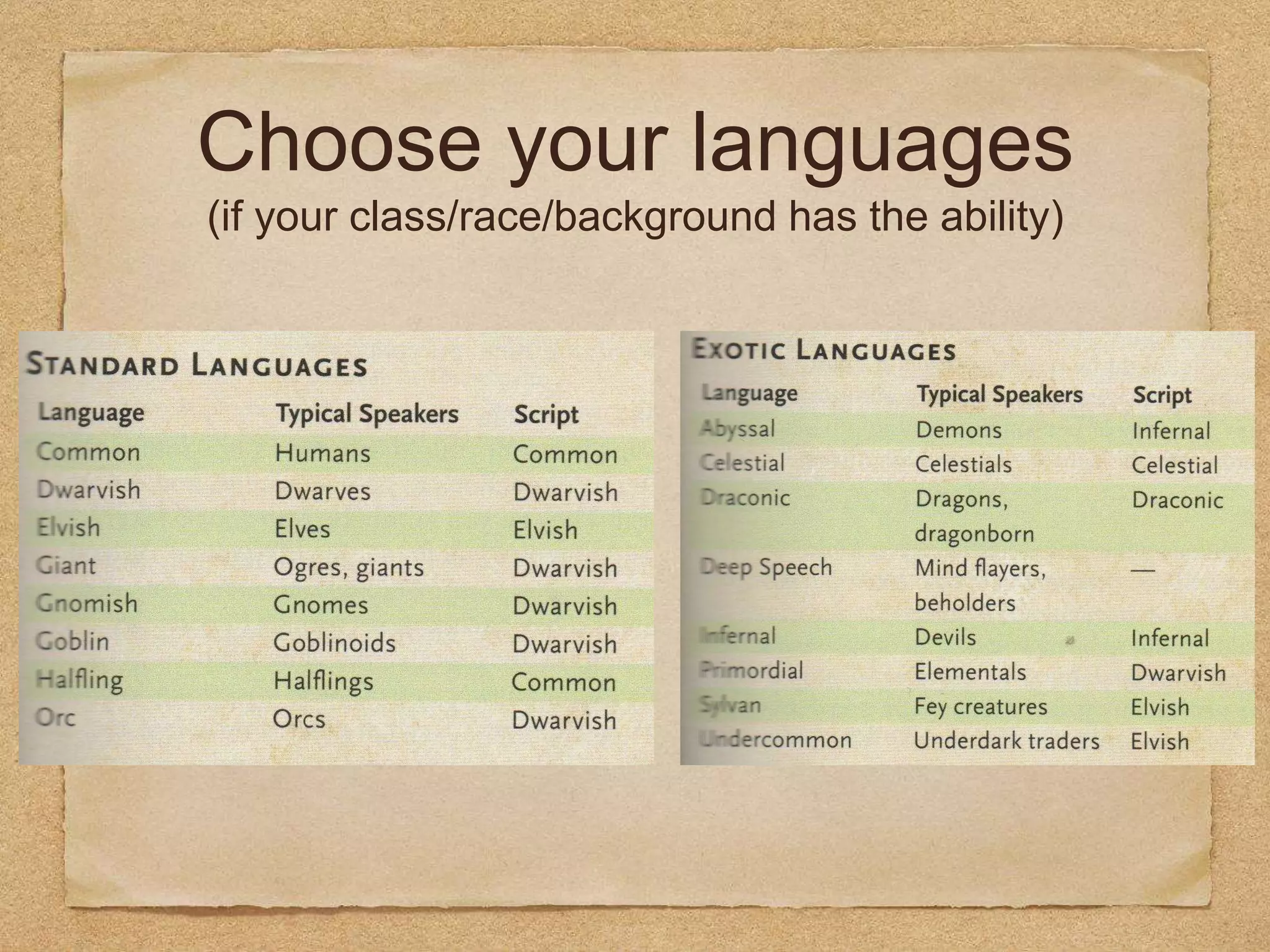
Choose your languages
(if your class/race/background has the ability)
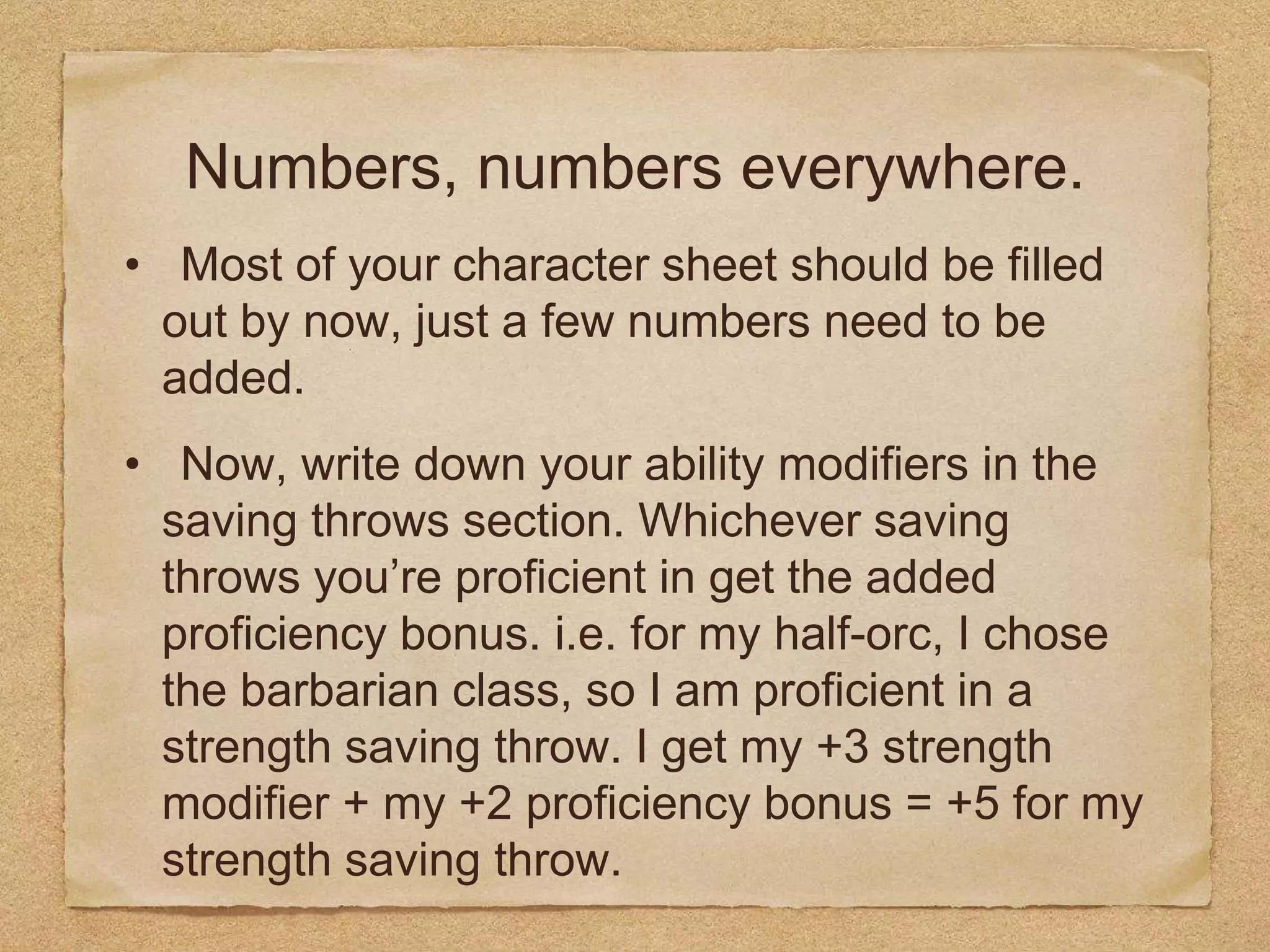
Numbers, numbers everywhere.
• Most of your character sheet should be filled
out by now, just a few numbers need to be
added.
• Now, write down your ability modifiers in the
saving throws section. Whichever saving
throws you’re proficient in get the added
proficiency bonus. i.e. for my half-orc, I chose
the barbarian class, so I am proficient in a
strength saving throw. I get my +3 strength
modifier + my +2 proficiency bonus = +5 for my
strength saving throw.
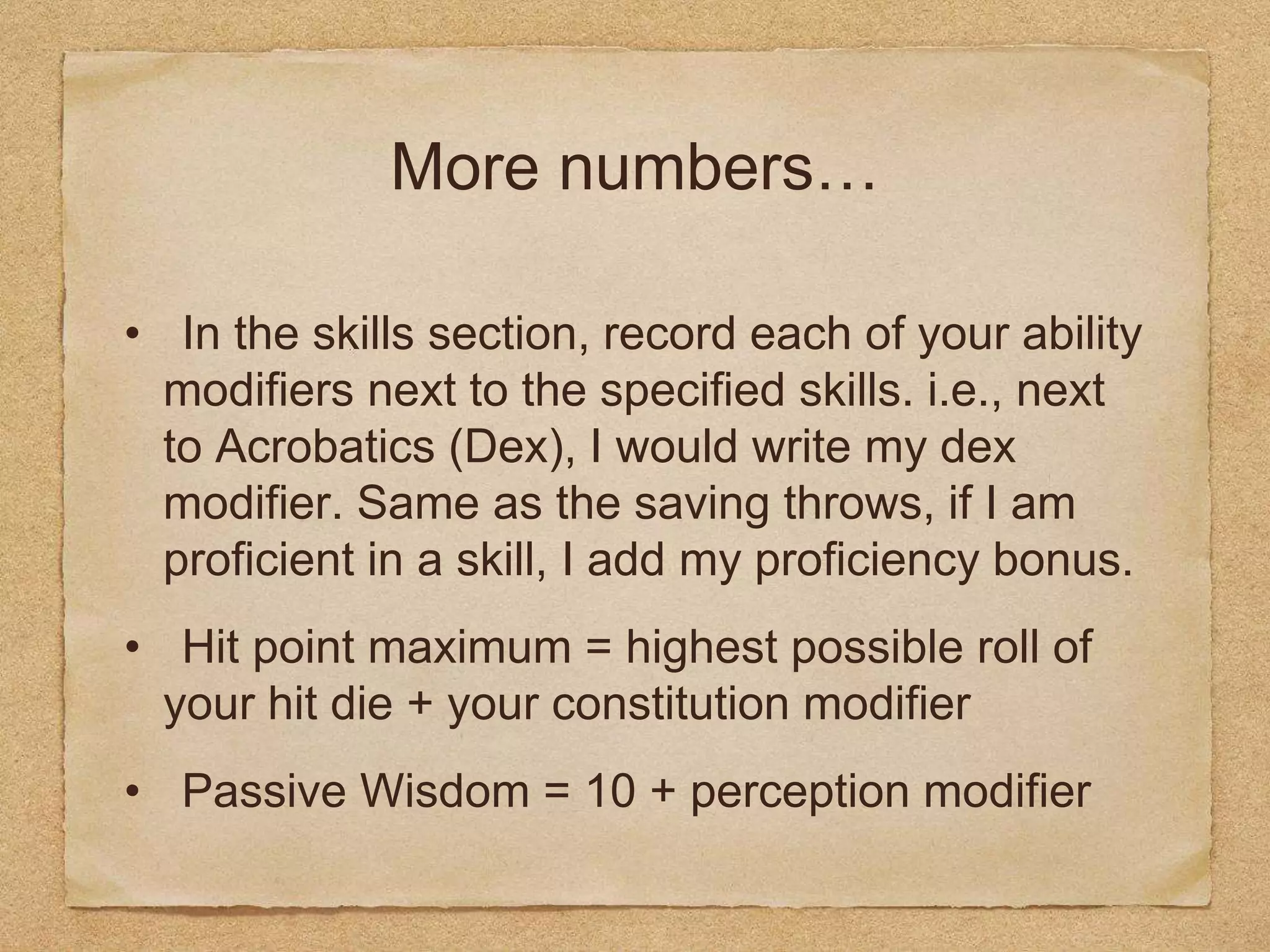
More numbers…
• In the skills section, record each of your ability
modifiers next to the specified skills. i.e., next
to Acrobatics (Dex), I would write my dex
modifier. Same as the saving throws, if I am
proficient in a skill, I add my proficiency bonus.
• Hit point maximum = highest possible roll of
your hit die + your constitution modifier
• Passive Wisdom = 10 + perception modifier
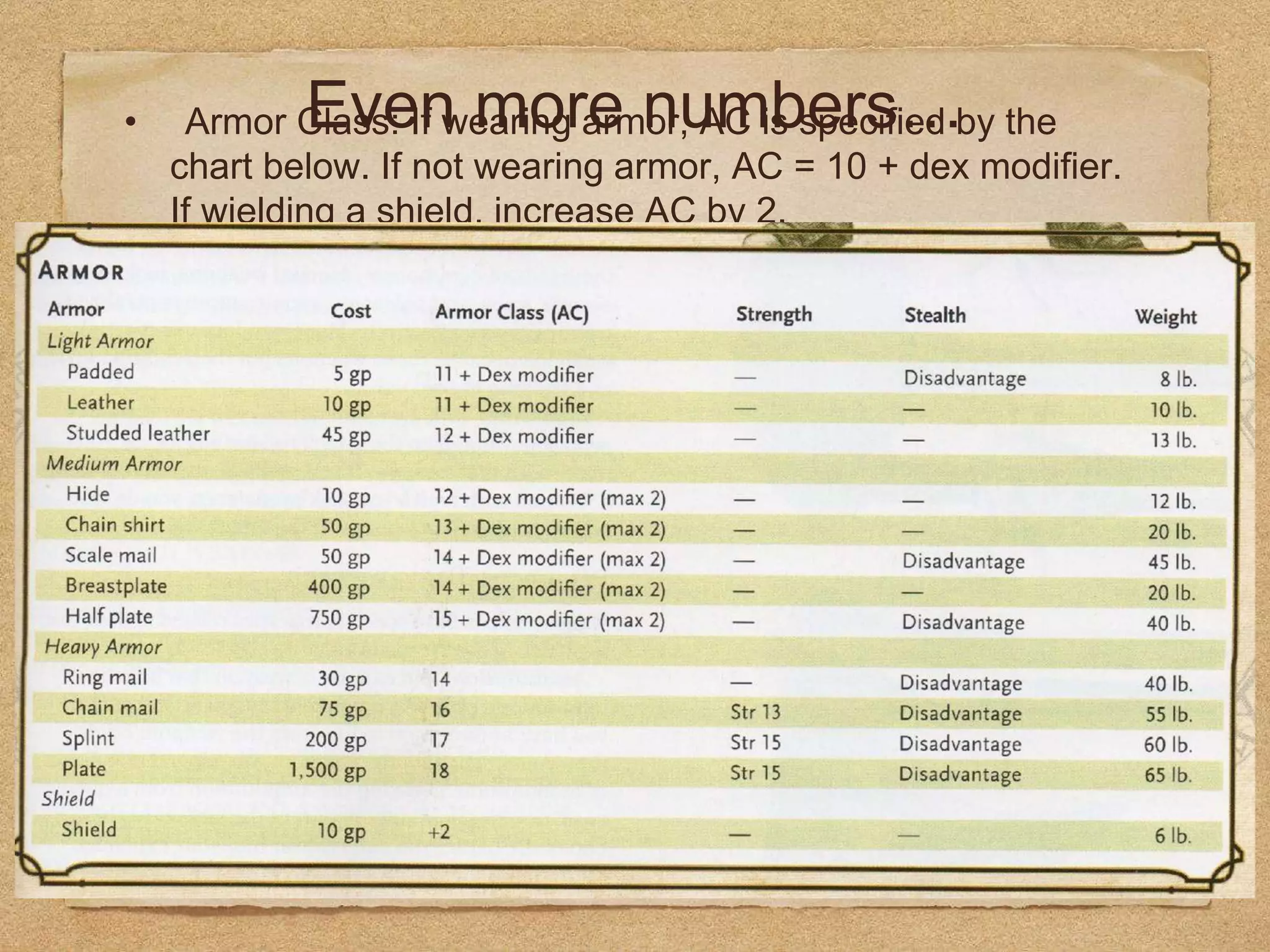
Even more numbers…• Armor Class: If wearing armor, AC is specified by the
chart below. If not wearing armor, AC = 10 + dex modifier.
If wielding a shield, increase AC by 2.
Damage
• For a specific weapon, first find the damage it
does in the chart on page 147. i.e. a shortsword
does 1d6 piercing. It also has finesse. Therefore, I
can add either my dex or strength modifier to the
damage.
• The attack bonus of a weapon is either the
strength modifier or the dex modifier + proficiency
bonus (if proficient in the weapon).
• The damage of the weapon is the die from the
equipment chart + the strength or dex modifier.
Inspiration/Initiative
• As far as I understand it, when you roll for
initiative (the order in which you make moves),
you do a dexterity check. Therefore, your
initiative bonus is just your dexterity modifier.
• Inspiration can be given to you by the DM for
playing your character. Using (it is expended)
your inspiration gives you advantage on either
an attack roll, saving throw, or ability check.
You can give your inspiration to other
characters.
Background
• Writing the backstory is completely open.

How to Create a Dungeons and Dragons Character

  • 1.
    How to Createa D&D Character* *may need players handbook, 5e
  • 2.
    Step 1: Choosea Race (pg17-43) • Common Races: dwarves, elves, halflings, and humans • Uncommon Races: dragonborn, gnomes, half-elves, half-orcs, and tieflings Step 1.5: Choose a Subrace (if applicable)
  • 3.
    What to addto your character sheet • Record your race on character sheet page 1. Record any abilities, features, speed, languages, and proficiencies your race has. • Choose an age, height, weight, hair color, eye color, and name that agree with your race, record on page 2. • Record ability scores according to the chart (write these on a piece of paper,
  • 4.
    Step 2: Choosea Class (pg 45-119) • Classes: Barbarian, Bard, Cleric, Druid, Fighter, Monk, Paladin, Ranger Rogue, Sorcerer, Warlock, Wizard
  • 5.
    What to addto your character sheet • Record your class, hit dice, proficiency bonus, level (probably 1), saving throw proficiencies (fill in the circle), armor and weapon proficiencies, skill proficiencies (usually chosen from a list in your class section, fill in the circle), spells, tool proficiencies, and features/traits of that class. • Choose your equipment for that class (see your class section). Record this information in equipment as well as in attacks & spellcasting if necessary.
  • 6.
    Determining Ability Scores (thelittle scores in the ovals) • Get your six scores, two options: 1) do this six times: roll four six sided dice, record the total of the highest 3 dice. 2) Use 15, 14, 13, 12, 10, 8. • Ok, now you have six numbers. Now choose where you want those numbers to go to: Strength, Dex, Constitutions, Intelligence, Wisdom, Charisma. • Now, remember the ability increases we recorded from your race? Add those to your specified levels. i.e. in the previous step, I chose my strength to be 15. If I am a half-orc, I get +2 strength, so my strength is now 17.
  • 7.
    Determining Ability Modifiers•These are the bigger numbers above the little oval of your ability score. • Depending on your ability score, you get a specific modifier, determined on the chart to the right. • For example, for my half-orc with strength 17, my strength ability modifier will be +3.
  • 8.
    Choose your background •What did you do before you became an adventurer? (pages 126-141) Examples: criminal, entertainer, noble. • Record your background’s proficiencies, choose languages, equipment, features, and money. • Roll dice for your character’s personality traits, ideals, bonds, and flaws. • Ask the DM if you wish to create your own background.
  • 9.
    Choose your alignment(pg 121- 170) Alignment Common followers Lawful good Gold dragons, paladins, most dwarves Neutral good Celestials, some cloud giants, most gnomes Chaotic good Copper dragons, many elves, unicorns Lawful neutral Many monks, some wizards Neutral Lizardfolk, most druids, many humans Chaotic neutral Many barbarians, many rogues,
  • 10.
    Choose your languages (ifyour class/race/background has the ability)
  • 11.
    Numbers, numbers everywhere. •Most of your character sheet should be filled out by now, just a few numbers need to be added. • Now, write down your ability modifiers in the saving throws section. Whichever saving throws you’re proficient in get the added proficiency bonus. i.e. for my half-orc, I chose the barbarian class, so I am proficient in a strength saving throw. I get my +3 strength modifier + my +2 proficiency bonus = +5 for my strength saving throw.
  • 12.
    More numbers… • Inthe skills section, record each of your ability modifiers next to the specified skills. i.e., next to Acrobatics (Dex), I would write my dex modifier. Same as the saving throws, if I am proficient in a skill, I add my proficiency bonus. • Hit point maximum = highest possible roll of your hit die + your constitution modifier • Passive Wisdom = 10 + perception modifier
  • 13.
    Even more numbers…•Armor Class: If wearing armor, AC is specified by the chart below. If not wearing armor, AC = 10 + dex modifier. If wielding a shield, increase AC by 2.
  • 14.
    Damage • For aspecific weapon, first find the damage it does in the chart on page 147. i.e. a shortsword does 1d6 piercing. It also has finesse. Therefore, I can add either my dex or strength modifier to the damage. • The attack bonus of a weapon is either the strength modifier or the dex modifier + proficiency bonus (if proficient in the weapon). • The damage of the weapon is the die from the equipment chart + the strength or dex modifier.
  • 15.
    Inspiration/Initiative • As faras I understand it, when you roll for initiative (the order in which you make moves), you do a dexterity check. Therefore, your initiative bonus is just your dexterity modifier. • Inspiration can be given to you by the DM for playing your character. Using (it is expended) your inspiration gives you advantage on either an attack roll, saving throw, or ability check. You can give your inspiration to other characters.
  • 16.
    Background • Writing thebackstory is completely open.