



© Vaisala
How to choose the
right parameter for
humidity control in
HVAC
© Vaisala
How to choose the right parameter for humidity
control in HVAC
Presenter
Lars Stormbom
Senior product manager
Lars has over 30 years of experience with humidity
measurements in industrial and HVAC settings
© Vaisala
Vaisala In Brief
 We serve customers in Weather and Controlled Environment markets
 80+ years of experience providing a comprehensive range of innovative observation
and measurement products and services
 Introduced the first commercial thin film humidity sensor – the HUMICAP® – more
than 40 years ago
© Vaisala
Agenda
In this webinar we will go trough some
basics of humidity theory and some of the
factors influencing which humidity
parameter is the best choice in HVAC
control:
 Relative Humidity
 Dew Point
 Enthalpy
 Wet bulb temperature
2018-11-15 4
© Vaisala
Relative humidity
© Vaisala
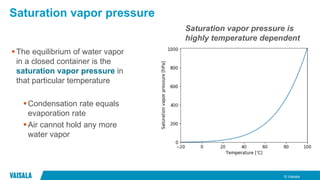
Saturation vapor pressure
The equilibrium of water vapor
in a closed container is the
saturation vapor pressure in
that particular temperature
Condensation rate equals
evaporation rate
Air cannot hold any more
water vapor
Saturation vapor pressure is
highly temperature dependent
© Vaisala
Relative Humidity
The proportion of water
vapor pressure (Pw) to
the maximum vapor
pressure in the given
temperature [Pws(t)]
%RH =
𝑉𝑉𝑉𝑉𝑉𝑉𝑉𝑉𝑉𝑉 𝑝𝑝𝑝𝑝𝑝𝑝𝑝𝑝𝑝𝑝𝑝𝑝𝑝𝑝𝑝𝑝
𝑆𝑆𝑆𝑆𝑆𝑆𝑆𝑆𝑆𝑆𝑆𝑆𝑆𝑆𝑆𝑆𝑆𝑆 𝑆𝑆 𝑣𝑣𝑣𝑣𝑣𝑣𝑣𝑣𝑣𝑣 𝑝𝑝𝑝𝑝𝑝𝑝𝑝𝑝𝑝𝑝𝑝𝑝𝑝𝑝𝑝𝑝 𝑎𝑎𝑎𝑎 𝑡𝑡𝑡𝑡𝑡 𝒑𝒑𝒑𝒑𝒑𝒑𝒑𝒑𝒑𝒑𝒑𝒑 𝒑𝒑𝒑𝒑 𝒑𝒑𝒑𝒑 𝒕𝒕𝒕𝒕𝒕𝒕𝒕𝒕𝒕𝒕𝒕𝒕𝒕𝒕𝒕𝒕𝒕𝒕𝒕𝒕𝒕𝒕
© Vaisala
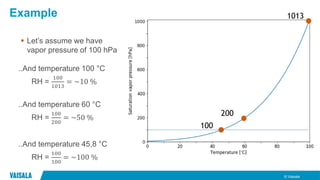
Example
 Let’s assume we have
vapor pressure of 100 hPa
RH =
100
1013
= ~10 %
RH =
100
200
= ~50 %
RH =
100
100
= ~100 %
..And temperature 100 °C
1013
..And temperature 60 °C
200
..And temperature 45,8 °C
100
© Vaisala
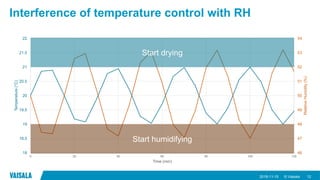
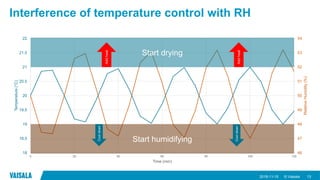
Relative humidity as a control parameter
Directly related to human comfort
Allows changing temperature without RH change
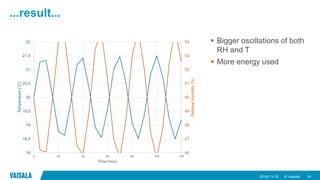
May cause oscillation if used together with very tight
temperature control
2018-11-15 9
© Vaisala
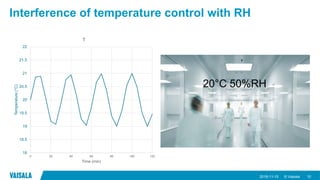
Interference of temperature control with RH
2018-11-15 10
18
18.5
19
19.5
20
20.5
21
21.5
22
0 20 40 60 80 100 120
Temperature(°C)
Time (min)
T
20°C 50%RH
© Vaisala
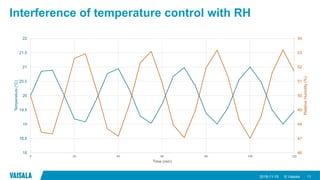
Interference of temperature control with RH
2018-11-15 11
46
47
48
49
50
51
52
53
54
18
18.5
19
19.5
20
20.5
21
21.5
22
0 20 40 60 80 100 120
RelativeHumidity(%)
Temperature(°C)
Time (min)
© Vaisala
Interference of temperature control with RH
2018-11-15 12
46
47
48
49
50
51
52
53
54
18
18.5
19
19.5
20
20.5
21
21.5
22
0 20 40 60 80 100 120
RelativeHumidity(%)
Temperature(°C)
Time (min)
Start drying
Start humidifying
© Vaisala
Interference of temperature control with RH
2018-11-15 13
46
47
48
49
50
51
52
53
54
18
18.5
19
19.5
20
20.5
21
21.5
22
0 20 40 60 80 100 120
RelativeHumidity(%)
Temperature(°C)
Time (min)
Start drying
Start humidifying
Addheat
Cooldown
Addheat
Cooldown
© Vaisala
...result...
 Bigger oscillations of both
RH and T
 More energy used
2018-11-15 14
46
47
48
49
50
51
52
53
54
18
18.5
19
19.5
20
20.5
21
21.5
22
0 20 40 60 80 100 120
RelativeHumidity(%)
Temperature(°C)
Time (min)
© Vaisala
Dew Point
© Vaisala
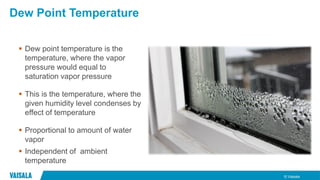
Dew Point Temperature
 Dew point temperature is the
temperature, where the vapor
pressure would equal to
saturation vapor pressure
 This is the temperature, where the
given humidity level condenses by
effect of temperature
 Proportional to amount of water
vapor
 Independent of ambient
temperature
© Vaisala
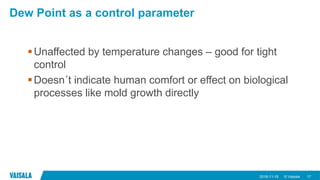
Dew Point as a control parameter
2018-11-15 17
Unaffected by temperature changes – good for tight
control
Doesn´t indicate human comfort or effect on biological
processes like mold growth directly
© Vaisala
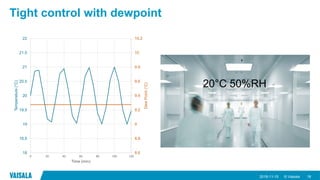
Tight control with dewpoint
2018-11-15 18
20°C 50%RH
8.6
8.8
9
9.2
9.4
9.6
9.8
10
10.2
18
18.5
19
19.5
20
20.5
21
21.5
22
0 20 40 60 80 100 120
DewPoint(°C)
Temperature(°C)
Time (min)
© Vaisala
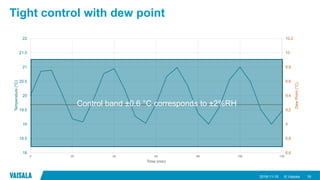
Tight control with dew point
2018-11-15 19
8.6
8.8
9
9.2
9.4
9.6
9.8
10
10.2
18
18.5
19
19.5
20
20.5
21
21.5
22
0 20 40 60 80 100 120
DewPoint(°C)
Temperature(°C)
Time (min)
Control band ±0.6 °C corresponds to ±2%RH
© Vaisala
Wet Bulb
Temperature
© Vaisala
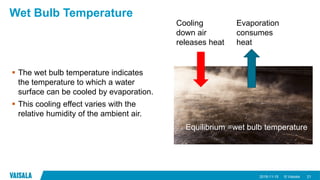
Wet Bulb Temperature
 The wet bulb temperature indicates
the temperature to which a water
surface can be cooled by evaporation.
 This cooling effect varies with the
relative humidity of the ambient air.
2018-11-15 21
Evaporation
consumes
heat
Cooling
down air
releases heat
Equilibrium =wet bulb temperature
© Vaisala
Wet Bulb Temperature as a control parameter
Indicates directly evaporative cooling potential of
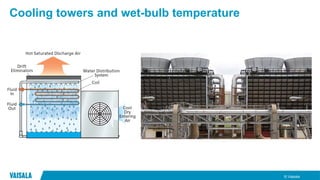
ambient air => practical with cooling towers
Related to air energy content
Doesn´t indicate human comfort or effect biological
processes like mold growth directly
© Vaisala
Cooling towers and wet-bulb temperature
© Vaisala
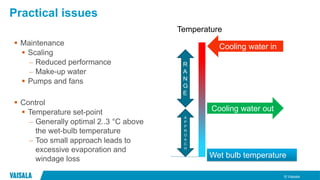
Practical issues
 Maintenance
 Scaling
– Reduced performance
– Make-up water
 Pumps and fans
 Control
 Temperature set-point
– Generally optimal 2..3 °C above
the wet-bulb temperature
– Too small approach leads to
excessive evaporation and
windage loss
Cooling water in
Cooling water out
Wet bulb temperature
R
A
N
G
E
A
P
P
R
O
A
C
H
Temperature
© Vaisala
Enthalpy
© Vaisala
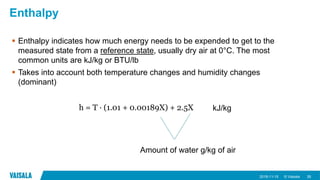
Enthalpy
 Enthalpy indicates how much energy needs to be expended to get to the
measured state from a reference state, usually dry air at 0°C. The most
common units are kJ/kg or BTU/lb
 Takes into account both temperature changes and humidity changes
(dominant)
2018-11-15 26
h = T ∙ (1.01 + 0.00189X) + 2.5X
Amount of water g/kg of air
kJ/kg
© Vaisala
Enthalpy as a control parameter
2018-11-15 27
Indicates directly if it makes sense to recondition return
air or not
Doesn´t indicate human comfort or effect on biological
processes like mold growth directly
© Vaisala
Outdoor air economizers
Dampers
2018-11-15[Name] 28
Conditioned airAir handling
unit
Return airExhaust air
Outdoor air
Return air
sensor
Outdoor air
sensor
Is it more economical to use outdoor air or return air?
Δ
H2O
CO2
© Vaisala
The Economizer logic
2018-11-15[Name] 29
1: Return air is 76°F/24.4°C,
50%RH, enthalpy is 28.7 BTU/lb
2: Cold but wet outdoor air: 72°F/
22.2°C, 90%RH, enthalpy is 33.9
BTU/lb should not be used for
cooling
3: Hot but dry outdoor air: 85°F/
29.4°C, 15.4%RH, enthalpy is 24.7
BTU/lb. Should be used instead of
return air
© Vaisala
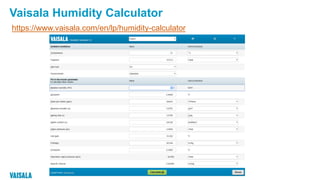
How to convert between parameters?
 If you know One humidity parameter and
the temperature, all other parameters can
be calculated
 By programming into your controller
(formula document)
 Rhcalc – free conversion utility:
https://www.vaisala.com/en/lp/humidity-
calculator
 Can be selected directly as output from
many modern transmitters
2018-11-15 30
DIP-switch for selecting output parameter
Vaisala HMD62 duct humidity transmitter
© Vaisala
Vaisala Humidity Calculator
https://www.vaisala.com/en/lp/humidity-calculator
© Vaisala
Conclusion
 Use RH when human comfort is the main concern
 Use Dew Point for spaces with very tight temperature& humidity control requirements
 Use Wet Bulb temperature to control cooling towers
 Use Enthalpy to decide when to use fresh or reconditioned return air
2018-11-15 32
© Vaisala2018-11-15 33

How to choose the right parameter for humidity

  • 1.
    © Vaisala How tochoose the right parameter for humidity control in HVAC
  • 2.
    © Vaisala How tochoose the right parameter for humidity control in HVAC Presenter Lars Stormbom Senior product manager Lars has over 30 years of experience with humidity measurements in industrial and HVAC settings
  • 3.
    © Vaisala Vaisala InBrief  We serve customers in Weather and Controlled Environment markets  80+ years of experience providing a comprehensive range of innovative observation and measurement products and services  Introduced the first commercial thin film humidity sensor – the HUMICAP® – more than 40 years ago
  • 4.
    © Vaisala Agenda In thiswebinar we will go trough some basics of humidity theory and some of the factors influencing which humidity parameter is the best choice in HVAC control:  Relative Humidity  Dew Point  Enthalpy  Wet bulb temperature 2018-11-15 4
  • 5.
  • 6.
    © Vaisala Saturation vaporpressure The equilibrium of water vapor in a closed container is the saturation vapor pressure in that particular temperature Condensation rate equals evaporation rate Air cannot hold any more water vapor Saturation vapor pressure is highly temperature dependent
  • 7.
    © Vaisala Relative Humidity Theproportion of water vapor pressure (Pw) to the maximum vapor pressure in the given temperature [Pws(t)] %RH = 𝑉𝑉𝑉𝑉𝑉𝑉𝑉𝑉𝑉𝑉 𝑝𝑝𝑝𝑝𝑝𝑝𝑝𝑝𝑝𝑝𝑝𝑝𝑝𝑝𝑝𝑝 𝑆𝑆𝑆𝑆𝑆𝑆𝑆𝑆𝑆𝑆𝑆𝑆𝑆𝑆𝑆𝑆𝑆𝑆 𝑆𝑆 𝑣𝑣𝑣𝑣𝑣𝑣𝑣𝑣𝑣𝑣 𝑝𝑝𝑝𝑝𝑝𝑝𝑝𝑝𝑝𝑝𝑝𝑝𝑝𝑝𝑝𝑝 𝑎𝑎𝑎𝑎 𝑡𝑡𝑡𝑡𝑡 𝒑𝒑𝒑𝒑𝒑𝒑𝒑𝒑𝒑𝒑𝒑𝒑 𝒑𝒑𝒑𝒑 𝒑𝒑𝒑𝒑 𝒕𝒕𝒕𝒕𝒕𝒕𝒕𝒕𝒕𝒕𝒕𝒕𝒕𝒕𝒕𝒕𝒕𝒕𝒕𝒕𝒕𝒕
  • 8.
    © Vaisala Example  Let’sassume we have vapor pressure of 100 hPa RH = 100 1013 = ~10 % RH = 100 200 = ~50 % RH = 100 100 = ~100 % ..And temperature 100 °C 1013 ..And temperature 60 °C 200 ..And temperature 45,8 °C 100
  • 9.
    © Vaisala Relative humidityas a control parameter Directly related to human comfort Allows changing temperature without RH change May cause oscillation if used together with very tight temperature control 2018-11-15 9
  • 10.
    © Vaisala Interference oftemperature control with RH 2018-11-15 10 18 18.5 19 19.5 20 20.5 21 21.5 22 0 20 40 60 80 100 120 Temperature(°C) Time (min) T 20°C 50%RH
  • 11.
    © Vaisala Interference oftemperature control with RH 2018-11-15 11 46 47 48 49 50 51 52 53 54 18 18.5 19 19.5 20 20.5 21 21.5 22 0 20 40 60 80 100 120 RelativeHumidity(%) Temperature(°C) Time (min)
  • 12.
    © Vaisala Interference oftemperature control with RH 2018-11-15 12 46 47 48 49 50 51 52 53 54 18 18.5 19 19.5 20 20.5 21 21.5 22 0 20 40 60 80 100 120 RelativeHumidity(%) Temperature(°C) Time (min) Start drying Start humidifying
  • 13.
    © Vaisala Interference oftemperature control with RH 2018-11-15 13 46 47 48 49 50 51 52 53 54 18 18.5 19 19.5 20 20.5 21 21.5 22 0 20 40 60 80 100 120 RelativeHumidity(%) Temperature(°C) Time (min) Start drying Start humidifying Addheat Cooldown Addheat Cooldown
  • 14.
    © Vaisala ...result...  Biggeroscillations of both RH and T  More energy used 2018-11-15 14 46 47 48 49 50 51 52 53 54 18 18.5 19 19.5 20 20.5 21 21.5 22 0 20 40 60 80 100 120 RelativeHumidity(%) Temperature(°C) Time (min)
  • 15.
  • 16.
    © Vaisala Dew PointTemperature  Dew point temperature is the temperature, where the vapor pressure would equal to saturation vapor pressure  This is the temperature, where the given humidity level condenses by effect of temperature  Proportional to amount of water vapor  Independent of ambient temperature
  • 17.
    © Vaisala Dew Pointas a control parameter 2018-11-15 17 Unaffected by temperature changes – good for tight control Doesn´t indicate human comfort or effect on biological processes like mold growth directly
  • 18.
    © Vaisala Tight controlwith dewpoint 2018-11-15 18 20°C 50%RH 8.6 8.8 9 9.2 9.4 9.6 9.8 10 10.2 18 18.5 19 19.5 20 20.5 21 21.5 22 0 20 40 60 80 100 120 DewPoint(°C) Temperature(°C) Time (min)
  • 19.
    © Vaisala Tight controlwith dew point 2018-11-15 19 8.6 8.8 9 9.2 9.4 9.6 9.8 10 10.2 18 18.5 19 19.5 20 20.5 21 21.5 22 0 20 40 60 80 100 120 DewPoint(°C) Temperature(°C) Time (min) Control band ±0.6 °C corresponds to ±2%RH
  • 20.
  • 21.
    © Vaisala Wet BulbTemperature  The wet bulb temperature indicates the temperature to which a water surface can be cooled by evaporation.  This cooling effect varies with the relative humidity of the ambient air. 2018-11-15 21 Evaporation consumes heat Cooling down air releases heat Equilibrium =wet bulb temperature
  • 22.
    © Vaisala Wet BulbTemperature as a control parameter Indicates directly evaporative cooling potential of ambient air => practical with cooling towers Related to air energy content Doesn´t indicate human comfort or effect biological processes like mold growth directly
  • 23.
    © Vaisala Cooling towersand wet-bulb temperature
  • 24.
    © Vaisala Practical issues Maintenance  Scaling – Reduced performance – Make-up water  Pumps and fans  Control  Temperature set-point – Generally optimal 2..3 °C above the wet-bulb temperature – Too small approach leads to excessive evaporation and windage loss Cooling water in Cooling water out Wet bulb temperature R A N G E A P P R O A C H Temperature
  • 25.
  • 26.
    © Vaisala Enthalpy  Enthalpyindicates how much energy needs to be expended to get to the measured state from a reference state, usually dry air at 0°C. The most common units are kJ/kg or BTU/lb  Takes into account both temperature changes and humidity changes (dominant) 2018-11-15 26 h = T ∙ (1.01 + 0.00189X) + 2.5X Amount of water g/kg of air kJ/kg
  • 27.
    © Vaisala Enthalpy asa control parameter 2018-11-15 27 Indicates directly if it makes sense to recondition return air or not Doesn´t indicate human comfort or effect on biological processes like mold growth directly
  • 28.
    © Vaisala Outdoor aireconomizers Dampers 2018-11-15[Name] 28 Conditioned airAir handling unit Return airExhaust air Outdoor air Return air sensor Outdoor air sensor Is it more economical to use outdoor air or return air? Δ H2O CO2
  • 29.
    © Vaisala The Economizerlogic 2018-11-15[Name] 29 1: Return air is 76°F/24.4°C, 50%RH, enthalpy is 28.7 BTU/lb 2: Cold but wet outdoor air: 72°F/ 22.2°C, 90%RH, enthalpy is 33.9 BTU/lb should not be used for cooling 3: Hot but dry outdoor air: 85°F/ 29.4°C, 15.4%RH, enthalpy is 24.7 BTU/lb. Should be used instead of return air
  • 30.
    © Vaisala How toconvert between parameters?  If you know One humidity parameter and the temperature, all other parameters can be calculated  By programming into your controller (formula document)  Rhcalc – free conversion utility: https://www.vaisala.com/en/lp/humidity- calculator  Can be selected directly as output from many modern transmitters 2018-11-15 30 DIP-switch for selecting output parameter Vaisala HMD62 duct humidity transmitter
  • 31.
    © Vaisala Vaisala HumidityCalculator https://www.vaisala.com/en/lp/humidity-calculator
  • 32.
    © Vaisala Conclusion  UseRH when human comfort is the main concern  Use Dew Point for spaces with very tight temperature& humidity control requirements  Use Wet Bulb temperature to control cooling towers  Use Enthalpy to decide when to use fresh or reconditioned return air 2018-11-15 32
  • 33.