Speed Cooling Process
Summary An Innovating Process: Speed Cooling Speed Cooling principle Sales Opportunities Business Plan Schedule Demonstration
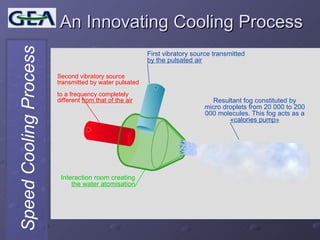
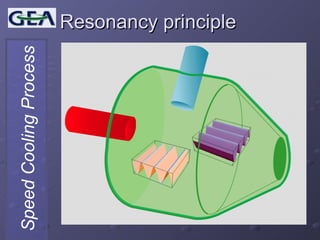
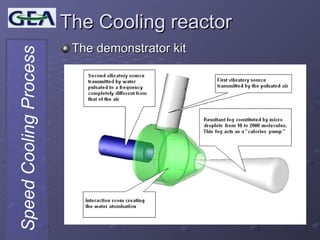
An Innovating Cooling Process Second vibratory source transmitted by water pulsated  to a frequency completely different  from that of the air First vibratory source transmitted  by the pulsated air Resultant fog constituted by micro droplets from 20 000 to 200 000 molecules. This fog acts as a  «calories pump» Interaction room creating the water atomisation
Resonancy principle
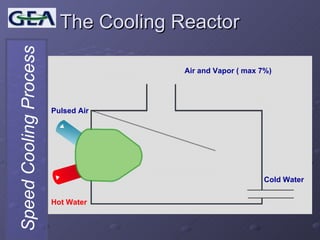
The Cooling Reactor Air and Vapor ( max 7%) Pulsed Air Hot Water Cold Water
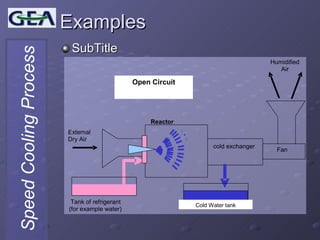
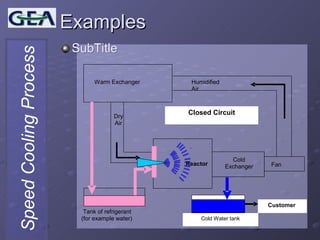
An innovating Cooling Process The vibratory mechanics applied for cooling issue use a small vibratory energy to produce a water fog  into very fine droplets. This process of water atomization is created by multi echo. The fog behaves as a gas absorbing the heat  Water droplets vaporize and this evaporation absorbs a big quantity of heat and so it cools the environment Could be Water or another liquid
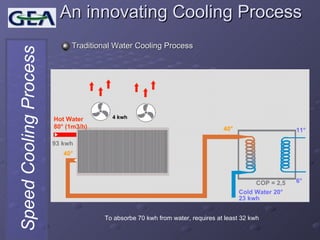
An innovating Cooling Process Traditional Water Cooling Process Hot Water 80° (1m3/h) 93 kwh 40° 40° 11° 6° COP = 2,5 Cold Water 20°  23 kwh To absorbe 70 kwh from water, requires at least 32 kwh 4 kwh
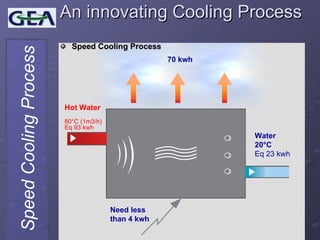
An innovating Cooling Process 70 kwh Water  20°C Eq 23 kwh Hot Water 80°C (1m3/h) Eq 93 kwh Need less than 4 kwh Speed Cooling Process
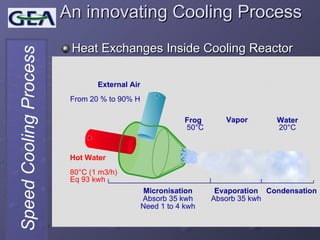
Heat Exchanges Inside Cooling Reactor An innovating Cooling Process External Air From 20 % to 90% H Hot Water 80°C (1 m3/h) Eq 93 kwh Frog   50°C Vapor Micronisation Absorb 35 kwh Need 1 to 4 kwh Condensation Evaporation Absorb 35 kwh Water 20°C
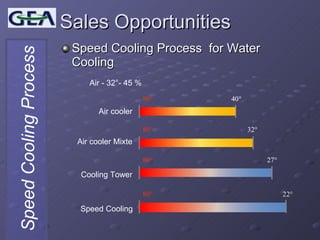
Sales Opportunities Speed Cooling Process  for Water Cooling 80° 27° 80° 27° 80° 40° 80° 40° 80° 40° 80° 32° 80° 32° Cooling Tower Air - 32°- 45 % Air cooler Air cooler Mixte 80° 80° 22° Speed Cooling
Competitive advantages For GES Clients Efficiency (30% less Volume) Reduced noise by 30% Effectiveness (increased running capacity, whatever external temperature, humidity or water purity) No risk of Legionela Reduced maintenance costs for mixed air coolers For GES Reduced manufacturing cost by 30% Increased market share  Exclusive patent
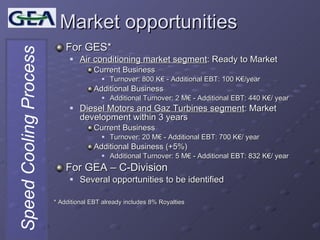
Market opportunities For GES* Air conditioning market segment : Ready to Market  Current Business Turnover: 800 K€ - Additional EBT: 100 K€/year  Additional Business Additional Turnover: 2 M€ - Additional EBT: 440 K€/ year Diesel Motors and Gaz Turbines segment : Market development within 3 years Current Business Turnover: 20 M€ - Additional EBT: 700 K€/ year  Additional Business (+5%) Additional Turnover: 5 M€ - Additional EBT: 832 K€/ year For GEA – C-Division Several opportunities to be identified * Additional EBT already includes 8% Royalties
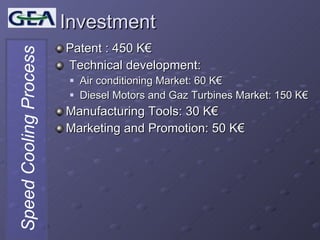
Investment Patent : 450 K€  Technical development:  Air conditioning Market: 60 K€ Diesel Motors and Gaz Turbines Market: 150 K€ Manufacturing Tools: 30 K€ Marketing and Promotion: 50 K€
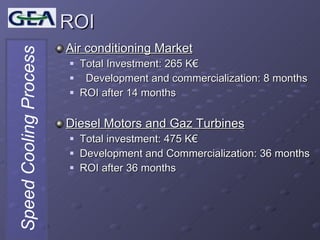
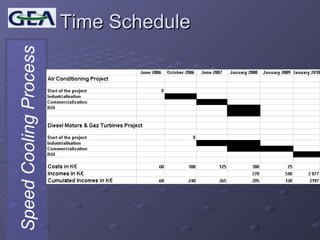
ROI Air conditioning Market   Total Investment: 265 K€ Development and commercialization: 8 months ROI after 14 months Diesel Motors and Gaz Turbines Total investment: 475 K€ Development and Commercialization: 36 months ROI after 36 months
Time Schedule
The Cooling reactor The demonstrator kit
END
Examples SubTitle
Examples SubTitle
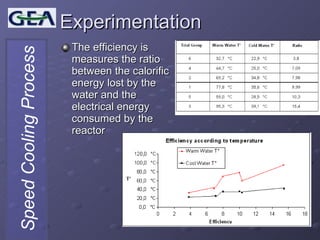
Experimentation Resonance R&D as built a pilote to validate is process effiency for cooling water. In August  2005, the Laboratory of the Departments of civil engineering of Paris (LAMI), analyzing previous experimentation form Veritas offices, has calcualted and confirms that and "ideal reactor" based on the process of Doubochinski would have a COP of 41, to be compared with the COP of 4 for current systems, according to the limits defined by the Carnot’s cycle. The experimental pilote was built to produce cool water at 40L/h.
Experimentation The efficiency is  measures the ratio between the calorific energy lost by the water and the electrical energy consumed by the reactor

Presentation Cooling Eng

  • 1.
  • 2.
    Summary An InnovatingProcess: Speed Cooling Speed Cooling principle Sales Opportunities Business Plan Schedule Demonstration
  • 3.
    An Innovating CoolingProcess Second vibratory source transmitted by water pulsated to a frequency completely different from that of the air First vibratory source transmitted by the pulsated air Resultant fog constituted by micro droplets from 20 000 to 200 000 molecules. This fog acts as a «calories pump» Interaction room creating the water atomisation
  • 4.
  • 5.
    The Cooling ReactorAir and Vapor ( max 7%) Pulsed Air Hot Water Cold Water
  • 6.
    An innovating CoolingProcess The vibratory mechanics applied for cooling issue use a small vibratory energy to produce a water fog into very fine droplets. This process of water atomization is created by multi echo. The fog behaves as a gas absorbing the heat Water droplets vaporize and this evaporation absorbs a big quantity of heat and so it cools the environment Could be Water or another liquid
  • 7.
    An innovating CoolingProcess Traditional Water Cooling Process Hot Water 80° (1m3/h) 93 kwh 40° 40° 11° 6° COP = 2,5 Cold Water 20° 23 kwh To absorbe 70 kwh from water, requires at least 32 kwh 4 kwh
  • 8.
    An innovating CoolingProcess 70 kwh Water 20°C Eq 23 kwh Hot Water 80°C (1m3/h) Eq 93 kwh Need less than 4 kwh Speed Cooling Process
  • 9.
    Heat Exchanges InsideCooling Reactor An innovating Cooling Process External Air From 20 % to 90% H Hot Water 80°C (1 m3/h) Eq 93 kwh Frog 50°C Vapor Micronisation Absorb 35 kwh Need 1 to 4 kwh Condensation Evaporation Absorb 35 kwh Water 20°C
  • 10.
    Sales Opportunities SpeedCooling Process for Water Cooling 80° 27° 80° 27° 80° 40° 80° 40° 80° 40° 80° 32° 80° 32° Cooling Tower Air - 32°- 45 % Air cooler Air cooler Mixte 80° 80° 22° Speed Cooling
  • 11.
    Competitive advantages ForGES Clients Efficiency (30% less Volume) Reduced noise by 30% Effectiveness (increased running capacity, whatever external temperature, humidity or water purity) No risk of Legionela Reduced maintenance costs for mixed air coolers For GES Reduced manufacturing cost by 30% Increased market share Exclusive patent
  • 12.
    Market opportunities ForGES* Air conditioning market segment : Ready to Market Current Business Turnover: 800 K€ - Additional EBT: 100 K€/year Additional Business Additional Turnover: 2 M€ - Additional EBT: 440 K€/ year Diesel Motors and Gaz Turbines segment : Market development within 3 years Current Business Turnover: 20 M€ - Additional EBT: 700 K€/ year Additional Business (+5%) Additional Turnover: 5 M€ - Additional EBT: 832 K€/ year For GEA – C-Division Several opportunities to be identified * Additional EBT already includes 8% Royalties
  • 13.
    Investment Patent :450 K€ Technical development: Air conditioning Market: 60 K€ Diesel Motors and Gaz Turbines Market: 150 K€ Manufacturing Tools: 30 K€ Marketing and Promotion: 50 K€
  • 14.
    ROI Air conditioningMarket Total Investment: 265 K€ Development and commercialization: 8 months ROI after 14 months Diesel Motors and Gaz Turbines Total investment: 475 K€ Development and Commercialization: 36 months ROI after 36 months
  • 15.
  • 16.
    The Cooling reactorThe demonstrator kit
  • 17.
  • 18.
  • 19.
  • 20.
    Experimentation Resonance R&Das built a pilote to validate is process effiency for cooling water. In August 2005, the Laboratory of the Departments of civil engineering of Paris (LAMI), analyzing previous experimentation form Veritas offices, has calcualted and confirms that and "ideal reactor" based on the process of Doubochinski would have a COP of 41, to be compared with the COP of 4 for current systems, according to the limits defined by the Carnot’s cycle. The experimental pilote was built to produce cool water at 40L/h.
  • 21.
    Experimentation The efficiencyis measures the ratio between the calorific energy lost by the water and the electrical energy consumed by the reactor