How to build your tower
Objectives 1. Learn basic engineering principles 
 2. Identify basic shapes that form structures 
 3. Design a tower for structural strength 
 4. Design and construct balsa wood tower using limited material amounts 
 5. Calculate efficiency rating to determine best designed tower. You will design and build a balsa wood tower. The tower will be tested to see how much weight the tower will hold.  http://cfbstaff.cfbisd.edu/scrudderr/Tower/towers.htm
What is a tower?? An exceptionally tall building or part of a building or an exceptionally tall structure used for some functional purpose. In the past, towers were usually used to house bells (bell towers), for observation (watch towers) or for signaling (light houses).  Perhaps the earliest record of a tower comes from the Bible where the story of the tower of Babel is told.  Other notable towers include the Tower of Pisa and Eiffel Tower, two completely different types of towers.  Today there are many more types of towers which are used for a wide variety of functions. A few examples are transmission line towers, radar towers, radio and TV broadcasting towers, even towers for suspension bridges.
BASIC ENGINEERING PRINCIPLES AND DEFINITIONS TENSION: the action of being stretched to stiffness COMPRESSION: the action of being pressed or squeezed WEIGHT: a load with a certain heaviness, a specific force due to gravity SUPPORT: to hold up or serve as a foundation TENSILE STRENGTH: the greatest stress a substance can bear without tearing apart
BASIC STRUCTURAL SHAPES TRIANGLES - rigidity of the triangular shape can support weight securely SQUARES - can support weight, but can twist and collapse if not supported POLYGONS - like squares, can support some weight, but will twist and collapse if not supported.
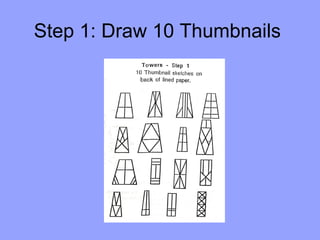
Step 1: Draw 10 Thumbnails
Step 2:  Draw, measure and figure out how much wood you will need to build your tower.
Don’t forget… Your tower has to be at least 200 mm tall  (it can be taller than 200 mm but not shorter) THE TOTAL AMOUNT OF WOOD  YOU WILL RECEIVE:  4800 mm
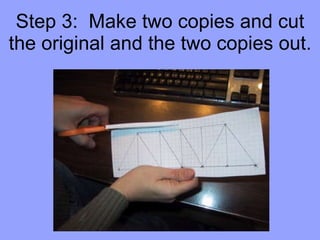
Step 3:  Make two copies and cut the original and the two copies out.
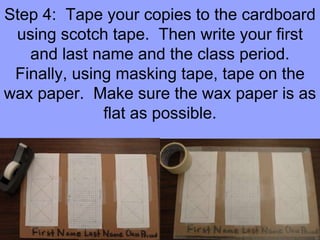
Step 4:  Tape your copies to the cardboard using scotch tape.  Then write your first and last name and the class period. Finally, using masking tape, tape on the wax paper.  Make sure the wax paper is as flat as possible.
Step 5:  Get your wood and begin cutting, pinning and gluing.
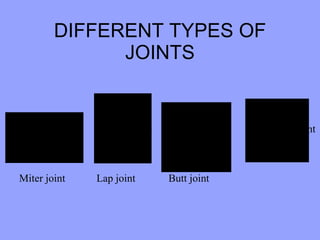
DIFFERENT TYPES OF JOINTS Miter joint Lap joint Notch joint Butt joint
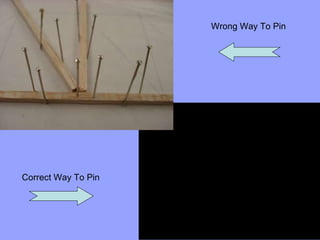
Correct Way To Pin Wrong Way To Pin
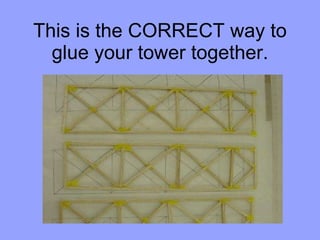
This is the CORRECT way to glue your tower together.
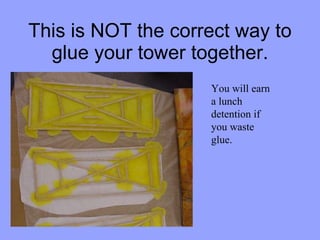
This is NOT the correct way to glue your tower together. You will earn a lunch detention if you waste glue.
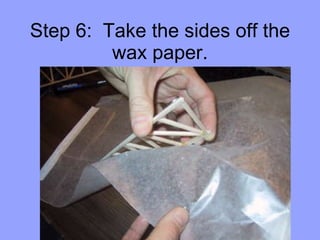
Step 6:  Take the sides off the wax paper.
Step 7:  Take twisty ties and tie each side of your tower together and then glue the sides.
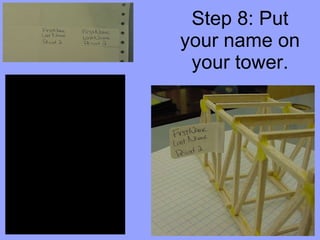
Step 8: Put your name on your tower.
Step 9:  It is time to test to your tower!
TWO AWARDS 1.  MOST WEIGHT HELD 2. MOST EFFICIENT
 
 
OBJECTIVES: 1. Learn basic engineering principles 
2. Identify basic shapes that form structures 
3. Design a tower for structural strength 
4. Design and construct balsa wood tower using limited material amounts 
5. Calculate efficiency rating to determine best designed towerStudents will design and build a balsa wood tower. The tower will be tested to see how much weight the tower will hold. The student then figures out the efficiency rating for their tower. RESOURCES: www.trebuchet. com INTRODUCTION If you look up the definition of a tower, you will find the following; "An exceptionally tall building or part of a building or an exceptionally tall structure used for some functional purpose. In the past, towers were usually used to house bells (bell towers), for observation (watch towers) or for signaling (light houses).Perhaps the earliest record of a tower comes from the bible where the story of the tower of Babel is told. Other notable towers include the Tower of Pisa and Eiffel Tower, two completely different types of towers. Today there are many more types of towers which are used for a wide variety of functions. A few examples are transmission line towers, radar towers, radio and TV broadcasting towers, even towers for suspension bridges.BASIC ENGINEERING PRINCIPLES AND DEFINITIONSTension: the action of being stretched to stiffnessCompression: the action of being pressed or squeezedWeight: a load with a certain heaviness, a specific force due to gravitySupport: to hold up or serve as a foundationTensile Strength: the greatest stress a substance can bear without tearing apartBASIC STRUCTURAL SHAPEStriangles - rigidity of the triangular shape can support weight securelysquares - can support weight, but can twist and collapse if not supportedpolygons - like squares, can support some weight, but will twist and collapse if not supported. http://cfbstaff.cfbisd.edu/scrudderr/Tower/towers.htm

How to Build a Tower

  • 1.
    How to buildyour tower
  • 2.
    Objectives 1. Learnbasic engineering principles 
 2. Identify basic shapes that form structures 
 3. Design a tower for structural strength 
 4. Design and construct balsa wood tower using limited material amounts 
 5. Calculate efficiency rating to determine best designed tower. You will design and build a balsa wood tower. The tower will be tested to see how much weight the tower will hold. http://cfbstaff.cfbisd.edu/scrudderr/Tower/towers.htm
  • 3.
    What is atower?? An exceptionally tall building or part of a building or an exceptionally tall structure used for some functional purpose. In the past, towers were usually used to house bells (bell towers), for observation (watch towers) or for signaling (light houses). Perhaps the earliest record of a tower comes from the Bible where the story of the tower of Babel is told. Other notable towers include the Tower of Pisa and Eiffel Tower, two completely different types of towers. Today there are many more types of towers which are used for a wide variety of functions. A few examples are transmission line towers, radar towers, radio and TV broadcasting towers, even towers for suspension bridges.
  • 4.
    BASIC ENGINEERING PRINCIPLESAND DEFINITIONS TENSION: the action of being stretched to stiffness COMPRESSION: the action of being pressed or squeezed WEIGHT: a load with a certain heaviness, a specific force due to gravity SUPPORT: to hold up or serve as a foundation TENSILE STRENGTH: the greatest stress a substance can bear without tearing apart
  • 5.
    BASIC STRUCTURAL SHAPESTRIANGLES - rigidity of the triangular shape can support weight securely SQUARES - can support weight, but can twist and collapse if not supported POLYGONS - like squares, can support some weight, but will twist and collapse if not supported.
  • 6.
    Step 1: Draw10 Thumbnails
  • 7.
    Step 2: Draw, measure and figure out how much wood you will need to build your tower.
  • 8.
    Don’t forget… Yourtower has to be at least 200 mm tall (it can be taller than 200 mm but not shorter) THE TOTAL AMOUNT OF WOOD YOU WILL RECEIVE: 4800 mm
  • 9.
    Step 3: Make two copies and cut the original and the two copies out.
  • 10.
    Step 4: Tape your copies to the cardboard using scotch tape. Then write your first and last name and the class period. Finally, using masking tape, tape on the wax paper. Make sure the wax paper is as flat as possible.
  • 11.
    Step 5: Get your wood and begin cutting, pinning and gluing.
  • 12.
    DIFFERENT TYPES OFJOINTS Miter joint Lap joint Notch joint Butt joint
  • 13.
    Correct Way ToPin Wrong Way To Pin
  • 14.
    This is theCORRECT way to glue your tower together.
  • 15.
    This is NOTthe correct way to glue your tower together. You will earn a lunch detention if you waste glue.
  • 16.
    Step 6: Take the sides off the wax paper.
  • 17.
    Step 7: Take twisty ties and tie each side of your tower together and then glue the sides.
  • 18.
    Step 8: Putyour name on your tower.
  • 19.
    Step 9: It is time to test to your tower!
  • 20.
    TWO AWARDS 1. MOST WEIGHT HELD 2. MOST EFFICIENT
  • 21.
  • 22.
  • 23.
    OBJECTIVES: 1. Learnbasic engineering principles 
2. Identify basic shapes that form structures 
3. Design a tower for structural strength 
4. Design and construct balsa wood tower using limited material amounts 
5. Calculate efficiency rating to determine best designed towerStudents will design and build a balsa wood tower. The tower will be tested to see how much weight the tower will hold. The student then figures out the efficiency rating for their tower. RESOURCES: www.trebuchet. com INTRODUCTION If you look up the definition of a tower, you will find the following; "An exceptionally tall building or part of a building or an exceptionally tall structure used for some functional purpose. In the past, towers were usually used to house bells (bell towers), for observation (watch towers) or for signaling (light houses).Perhaps the earliest record of a tower comes from the bible where the story of the tower of Babel is told. Other notable towers include the Tower of Pisa and Eiffel Tower, two completely different types of towers. Today there are many more types of towers which are used for a wide variety of functions. A few examples are transmission line towers, radar towers, radio and TV broadcasting towers, even towers for suspension bridges.BASIC ENGINEERING PRINCIPLES AND DEFINITIONSTension: the action of being stretched to stiffnessCompression: the action of being pressed or squeezedWeight: a load with a certain heaviness, a specific force due to gravitySupport: to hold up or serve as a foundationTensile Strength: the greatest stress a substance can bear without tearing apartBASIC STRUCTURAL SHAPEStriangles - rigidity of the triangular shape can support weight securelysquares - can support weight, but can twist and collapse if not supportedpolygons - like squares, can support some weight, but will twist and collapse if not supported. http://cfbstaff.cfbisd.edu/scrudderr/Tower/towers.htm