PRESENTATION
ON
TV TOWER
PRESENTED BY:
ARJAN DEV SINGH
ARZOO BAJAJ
ASHIMA BOHARA
ANSHUL SHARMA
ARPIT SINGHAL
NEETU KUMAWAT
4THYEAR 7TH SEM.
ENROLL NO. 131343
SUBMITTED TO- ER. BHAWESH JHOSI
CONTENTS
1. INTRODUCTION
2. STRUCTURE TYPES
3. ADVANTAGES
4. USES
5. SITE PREPARATION
6. MATERIALS
7. DESIGN CONSIDERATIONS
8. CLIMBING FACILITIES
9. CASE STUDIES
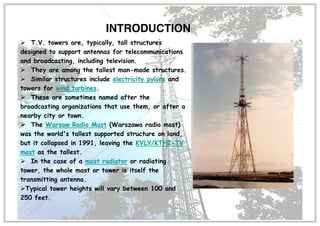
¾ T.V. towers are, typically, tall structures
designed to support antennas for telecommunications
and broadcasting, including television.
¾ They are among the tallest man-made structures.
¾ Similar structures include electricity pylons and
towers for wind turbines.
¾ These are sometimes named after the
broadcasting organizations that use them, or after a
nearby city or town.
¾ The Warsaw Radio Mast (Warszawa radio mast)
was the world's tallest supported structure on land,
but it collapsed in 1991, leaving the KVLY/KTHI-TV
mast as the tallest.
¾ In the case of a mast radiator or radiating
tower, the whole mast or tower is itself the
transmitting antenna.
¾Typical tower heights will vary between 100 and
250 feet.
INTRODUCTION
STRUCTURE TYPES
1.) Guyed Towers
2.) Self Support Towers
3.) Monopole Structures
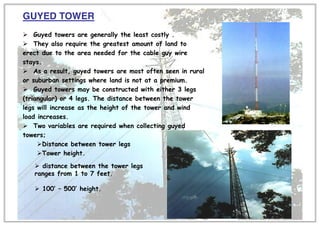
GUYED TOWER
¾ Guyed towers are generally the least costly .
¾ They also require the greatest amount of land to
erect due to the area needed for the cable guy wire
stays.
¾ As a result, guyed towers are most often seen in rural
or suburban settings where land is not at a premium.
¾ Guyed towers may be constructed with either 3 legs
(triangular) or 4 legs. The distance between the tower
legs will increase as the height of the tower and wind
load increases.
¾ Two variables are required when collecting guyed
towers;
¾Distance between tower legs
¾Tower height.
¾ distance between the tower legs
ranges from 1 to 7 feet.
¾ 100’ – 500’ height.
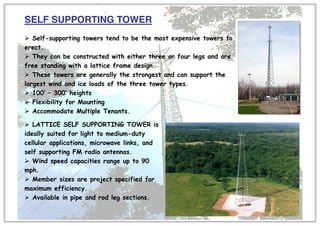
SELF SUPPORTING TOWER
¾ Self-supporting towers tend to be the most expensive towers to
erect.
¾ They can be constructed with either three or four legs and are
free standing with a lattice frame design.
¾ These towers are generally the strongest and can support the
largest wind and ice loads of the three tower types.
¾ 100’ – 300’ heights
¾ Flexibility for Mounting
¾ Accommodate Multiple Tenants.
¾ LATTICE SELF SUPPORTING TOWER is
ideally suited for light to medium-duty
cellular applications, microwave links, and
self supporting FM radio antennas.
¾ Wind speed capacities range up to 90
mph.
¾ Member sizes are project specified for
maximum efficiency.
¾ Available in pipe and rod leg sections.
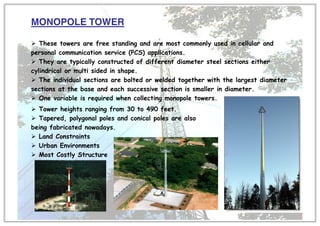
MONOPOLE TOWER
¾ These towers are free standing and are most commonly used in cellular and
personal communication service (PCS) applications.
¾ They are typically constructed of different diameter steel sections either
cylindrical or multi sided in shape.
¾ The individual sections are bolted or welded together with the largest diameter
sections at the base and each successive section is smaller in diameter.
¾ One variable is required when collecting monopole towers.
¾ Tower heights ranging from 30 to 490 feet.
¾ Tapered, polygonal poles and conical poles are also
being fabricated nowadays.
¾ Land Constraints
¾ Urban Environments
¾ Most Costly Structure
ADVANTAGES
¾ Less installation time& cost
¾ Occupies less floor space
¾ Maintenance free
¾ Long life because of galvanization
¾ Strong because of aerodynamic construction
¾ It is aesthetic and elegant
¾ Less time taking in time of repairs and renewals
¾ Shorter delivery period
USES
Monopoles/high masts can be used for:
¾ Telecommunication Towers
¾ Transmission line towers
¾ Highway and junction lighting
¾ Yard lighting
¾ Parking lots lighting
¾ Airport, Railway, seaports and yard lighting
¾ Power plants lighting
¾ Stadium yard lighting
¾ Park /garden lighting
SITE PREPARATION
1) Erosion control
2) Clearing / Grabbing earth work
3) Access Road
4) Compound Wall
FOUNDATIONS
1) Tower foundation
2) Shelter cabinet
Foundation
Mat preparation for structural base
above foundation Concreting of mat
Concreting of mat
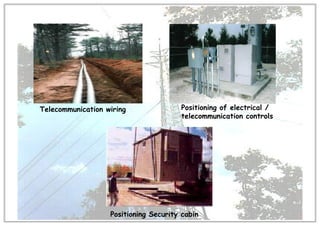
Electrical wiring Lighting wiring
Telecommunication wiring Positioning of electrical /
telecommunication controls
Positioning Security cabin
STEEL LATTICE
¾The steel lattice is the most widespread form of
construction.
¾It provides great strength, low wind resistance and
economy in the use of materials.
¾Such structures are usually triangular or square in
cross-section.
¾When built as a tower, the structure may be
parallel-sided or taper over part or all of its height.
¾When constructed of several sections which taper
exponentially with height, in the manner of the Eiffel
Tower, the tower is said to be an Eiffelized one.
¾The Crystal Palace tower in London is an example.
TUBULAR STEEL
¾Some towers are constructed out of steel
tubes.
¾In the UK, these were the subject of
collapses at the Emley Moor and Waltham-on-
the-Wolds TV stations in the 1960s.
MATERIAL
S
FIBERGLASS
¾Fiberglass poles are occasionally used for low-power non-directional beacons or
medium-wave broadcast transmitters.
REINFORCED CONCRETE
¾Reinforced concrete towers are relatively
expensive to build
¾provide a high degree of mechanical rigidity in
strong winds.
¾This can be important when antennas with narrow
beam widths are used, such as those used for
microwave point-to-point links, and when the
structure is to be occupied by people.
¾In Germany and the Netherlands most towers are
built of reinforced concrete.
WOODEN TOWER
¾There are fewer wooden towers now than
in the past.
¾Many were built in the UK during World
War II because of a shortage of steel.
¾In Germany before World War II in
nearly all medium wave transmission sites
towers built of wood were used.
¾Nowadays these towers are demolished.
¾ Concrete towers can form prestigious landmarks, such as the CN Tower
in Toronto.
¾ As well as accommodating technical staff, these buildings may have
public areas such as observation decks or restaurants.
¾ The Stuttgart TV tower was the first tower in the world to be built in
reinforced concrete. It was designed in 1956 by the local civil engineer,
Fritz Leonhardt.
DESIGN CONSIDERATIONS
Economic And Aesthetic Considerations
• The cost of a tower is roughly proportional to the square of its height.
• A guyed mast is cheaper to build than a self-supporting tower of equivalent height.
• A guyed mast needs additional land to accommodate the guys, and is thus best
suited to rural locations where land is relatively cheap. A tower will fit into a much
smaller plot.
• A steel lattice tower is cheaper to build than a concrete tower of equivalent height.
• Two small towers may be less intrusive, visually, than one big one; especially if they
look identical.
• Towers look less ugly if they and the antennas mounted on them appear symmetrical.
Access for riggers
• Because masts, towers and the antennas
mounted on them require maintenance, access to
the whole of the structure is necessary.
• Small structures are typically accessed with a
ladder.
• Larger structures, which tend to require more
frequent maintenance, may have stairs and
sometimes a lift.
Aircraft warning lamps
• Taller structures are often equipped with
lamps, usually red in colour, to warn pilots of
the structure's existence.
• In the past, ruggedized and under-run
filament lamps were used to maximise the bulb
life.
• Nowadays such lamps tend to use LED arrays.
Wind-induced oscillations
• One problem with radio masts is the danger of wind-induced
oscillations.
•This is particularly a concern with steel tube construction.
•One can reduce this by building cylindrical shock-mounts into the
construction.
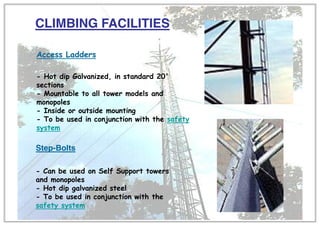
CLIMBING FACILITIES
Access Ladders
- Hot dip Galvanized, in standard 20'
sections
- Mountable to all tower models and
monopoles
- Inside or outside mounting
- To be used in conjunction with the safety
system
Step-Bolts
- Can be used on Self Support towers
and monopoles
- Hot dip galvanized steel
- To be used in conjunction with the
safety system
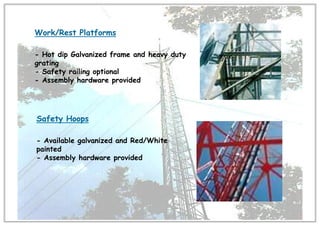
Work/Rest Platforms
- Hot dip Galvanized frame and heavy duty
grating
- Safety railing optional
- Assembly hardware provided
Safety Hoops
- Available galvanized and Red/White
painted
- Assembly hardware provided

TV TOWER. BUILDING CONSTRUCTION PRESENTATION

  • 1.
    PRESENTATION ON TV TOWER PRESENTED BY: ARJANDEV SINGH ARZOO BAJAJ ASHIMA BOHARA ANSHUL SHARMA ARPIT SINGHAL NEETU KUMAWAT 4THYEAR 7TH SEM. ENROLL NO. 131343 SUBMITTED TO- ER. BHAWESH JHOSI
  • 2.
    CONTENTS 1. INTRODUCTION 2. STRUCTURETYPES 3. ADVANTAGES 4. USES 5. SITE PREPARATION 6. MATERIALS 7. DESIGN CONSIDERATIONS 8. CLIMBING FACILITIES 9. CASE STUDIES
  • 3.
    ¾ T.V. towersare, typically, tall structures designed to support antennas for telecommunications and broadcasting, including television. ¾ They are among the tallest man-made structures. ¾ Similar structures include electricity pylons and towers for wind turbines. ¾ These are sometimes named after the broadcasting organizations that use them, or after a nearby city or town. ¾ The Warsaw Radio Mast (Warszawa radio mast) was the world's tallest supported structure on land, but it collapsed in 1991, leaving the KVLY/KTHI-TV mast as the tallest. ¾ In the case of a mast radiator or radiating tower, the whole mast or tower is itself the transmitting antenna. ¾Typical tower heights will vary between 100 and 250 feet. INTRODUCTION
  • 4.
    STRUCTURE TYPES 1.) GuyedTowers 2.) Self Support Towers 3.) Monopole Structures
  • 5.
    GUYED TOWER ¾ Guyedtowers are generally the least costly . ¾ They also require the greatest amount of land to erect due to the area needed for the cable guy wire stays. ¾ As a result, guyed towers are most often seen in rural or suburban settings where land is not at a premium. ¾ Guyed towers may be constructed with either 3 legs (triangular) or 4 legs. The distance between the tower legs will increase as the height of the tower and wind load increases. ¾ Two variables are required when collecting guyed towers; ¾Distance between tower legs ¾Tower height. ¾ distance between the tower legs ranges from 1 to 7 feet. ¾ 100’ – 500’ height.
  • 6.
    SELF SUPPORTING TOWER ¾Self-supporting towers tend to be the most expensive towers to erect. ¾ They can be constructed with either three or four legs and are free standing with a lattice frame design. ¾ These towers are generally the strongest and can support the largest wind and ice loads of the three tower types. ¾ 100’ – 300’ heights ¾ Flexibility for Mounting ¾ Accommodate Multiple Tenants. ¾ LATTICE SELF SUPPORTING TOWER is ideally suited for light to medium-duty cellular applications, microwave links, and self supporting FM radio antennas. ¾ Wind speed capacities range up to 90 mph. ¾ Member sizes are project specified for maximum efficiency. ¾ Available in pipe and rod leg sections.
  • 7.
    MONOPOLE TOWER ¾ Thesetowers are free standing and are most commonly used in cellular and personal communication service (PCS) applications. ¾ They are typically constructed of different diameter steel sections either cylindrical or multi sided in shape. ¾ The individual sections are bolted or welded together with the largest diameter sections at the base and each successive section is smaller in diameter. ¾ One variable is required when collecting monopole towers. ¾ Tower heights ranging from 30 to 490 feet. ¾ Tapered, polygonal poles and conical poles are also being fabricated nowadays. ¾ Land Constraints ¾ Urban Environments ¾ Most Costly Structure
  • 8.
    ADVANTAGES ¾ Less installationtime& cost ¾ Occupies less floor space ¾ Maintenance free ¾ Long life because of galvanization ¾ Strong because of aerodynamic construction ¾ It is aesthetic and elegant ¾ Less time taking in time of repairs and renewals ¾ Shorter delivery period
  • 9.
    USES Monopoles/high masts canbe used for: ¾ Telecommunication Towers ¾ Transmission line towers ¾ Highway and junction lighting ¾ Yard lighting ¾ Parking lots lighting ¾ Airport, Railway, seaports and yard lighting ¾ Power plants lighting ¾ Stadium yard lighting ¾ Park /garden lighting
  • 10.
    SITE PREPARATION 1) Erosioncontrol 2) Clearing / Grabbing earth work 3) Access Road 4) Compound Wall
  • 11.
    FOUNDATIONS 1) Tower foundation 2)Shelter cabinet Foundation
  • 12.
    Mat preparation forstructural base above foundation Concreting of mat Concreting of mat Electrical wiring Lighting wiring
  • 13.
    Telecommunication wiring Positioningof electrical / telecommunication controls Positioning Security cabin
  • 14.
    STEEL LATTICE ¾The steellattice is the most widespread form of construction. ¾It provides great strength, low wind resistance and economy in the use of materials. ¾Such structures are usually triangular or square in cross-section. ¾When built as a tower, the structure may be parallel-sided or taper over part or all of its height. ¾When constructed of several sections which taper exponentially with height, in the manner of the Eiffel Tower, the tower is said to be an Eiffelized one. ¾The Crystal Palace tower in London is an example. TUBULAR STEEL ¾Some towers are constructed out of steel tubes. ¾In the UK, these were the subject of collapses at the Emley Moor and Waltham-on- the-Wolds TV stations in the 1960s. MATERIAL S
  • 15.
    FIBERGLASS ¾Fiberglass poles areoccasionally used for low-power non-directional beacons or medium-wave broadcast transmitters. REINFORCED CONCRETE ¾Reinforced concrete towers are relatively expensive to build ¾provide a high degree of mechanical rigidity in strong winds. ¾This can be important when antennas with narrow beam widths are used, such as those used for microwave point-to-point links, and when the structure is to be occupied by people. ¾In Germany and the Netherlands most towers are built of reinforced concrete.
  • 16.
    WOODEN TOWER ¾There arefewer wooden towers now than in the past. ¾Many were built in the UK during World War II because of a shortage of steel. ¾In Germany before World War II in nearly all medium wave transmission sites towers built of wood were used. ¾Nowadays these towers are demolished. ¾ Concrete towers can form prestigious landmarks, such as the CN Tower in Toronto. ¾ As well as accommodating technical staff, these buildings may have public areas such as observation decks or restaurants. ¾ The Stuttgart TV tower was the first tower in the world to be built in reinforced concrete. It was designed in 1956 by the local civil engineer, Fritz Leonhardt.
  • 17.
    DESIGN CONSIDERATIONS Economic AndAesthetic Considerations • The cost of a tower is roughly proportional to the square of its height. • A guyed mast is cheaper to build than a self-supporting tower of equivalent height. • A guyed mast needs additional land to accommodate the guys, and is thus best suited to rural locations where land is relatively cheap. A tower will fit into a much smaller plot. • A steel lattice tower is cheaper to build than a concrete tower of equivalent height. • Two small towers may be less intrusive, visually, than one big one; especially if they look identical. • Towers look less ugly if they and the antennas mounted on them appear symmetrical. Access for riggers • Because masts, towers and the antennas mounted on them require maintenance, access to the whole of the structure is necessary. • Small structures are typically accessed with a ladder. • Larger structures, which tend to require more frequent maintenance, may have stairs and sometimes a lift.
  • 18.
    Aircraft warning lamps •Taller structures are often equipped with lamps, usually red in colour, to warn pilots of the structure's existence. • In the past, ruggedized and under-run filament lamps were used to maximise the bulb life. • Nowadays such lamps tend to use LED arrays. Wind-induced oscillations • One problem with radio masts is the danger of wind-induced oscillations. •This is particularly a concern with steel tube construction. •One can reduce this by building cylindrical shock-mounts into the construction.
  • 19.
    CLIMBING FACILITIES Access Ladders -Hot dip Galvanized, in standard 20' sections - Mountable to all tower models and monopoles - Inside or outside mounting - To be used in conjunction with the safety system Step-Bolts - Can be used on Self Support towers and monopoles - Hot dip galvanized steel - To be used in conjunction with the safety system
  • 20.
    Work/Rest Platforms - Hotdip Galvanized frame and heavy duty grating - Safety railing optional - Assembly hardware provided Safety Hoops - Available galvanized and Red/White painted - Assembly hardware provided