HOW TO ACHIEVE SUCCESSFUL
COMMUNICATION
6 OCTOBER 2015
VALERIE AUSSEIL
MENTORING PROGRAMME LEADER
WELCOME !
Tell us who you are …
RÈGLES DU JEU
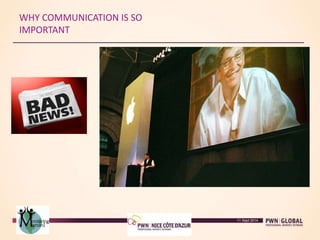
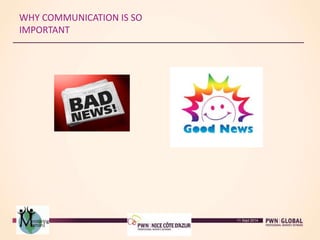
WHY COMMUNICATION IS SO
IMPORTANT
11 Sept 2014
WHY COMMUNICATION IS SO
IMPORTANT
11 Sept 2014
AGENDA
• Why is it so difficult to communicate ?
• Common mistakes
• 7 C’s
• Desired outcome
• Effective feedback
• Assessment
• Eating and networking !
11 Sept 2014
EXERCISE
11 Sept 2014
HOW MANY F ?
11 Sept 2014
HOW OBSERVANT ARE YOU ?
https://youtu.be/ubNF9QNEQLA
11 Sept 2014
WHAT DO YOU SEE ?
11 Sept 2014
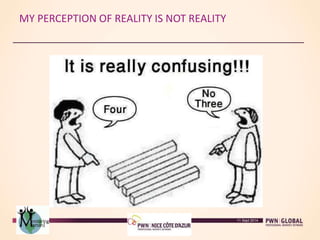
MY PERCEPTION OF REALITY IS NOT REALITY
11 Sept 2014
11 Sept 2014
COMMON MISTAKES
11 Sept 2014
COMMON MISTAKES
Delivering Bad News by Email
Written communication channels don't allow you to soften difficult messages with nonverbal cues (such as
body language ), and they don't allow you to deal immediately with intense emotions.
If you need to deliver bad news, do this in person, and think carefully about how you can do it sensitively, so
that you can convey your message but minimize long-term upset at the same time.
When you deliver a difficult message personally, you can pick up on signs that people may have
misunderstood key parts of your message, or may have taken the information particularly badly. You can
then take steps to clarify your message, or help people deal with the difficult news.
Avoiding Difficult Conversations
At some point, you will need to give negative feedback. It's tempting to try to avoid these conversations, but
this can cause further problems – in particular, you may let small problems grow into big ones.
Preparation is the key to handling difficult conversations. Learn to give clear, actionable feedback, and use
tools such as the Sandwich technique to encourage your people to reflect on their behavior.
11 Sept 2014
COMMON MISTAKES
Not Being Assertive
Assertiveness is about stating what you need, while considering the wants
and needs of others.
You may not always get your way when you're assertive, but you stand a
better chance of getting it, or of reaching a compromise, because you've
been clear about your needs. Assertiveness also means saying "no" when
you need to.
Note:
Assertiveness is not the same as aggression. When you're aggressive, you
push to get your own way without thinking about other people's rights,
wants, and needs.
11 Sept 2014
COMMON MISTAKES
Reacting, Not Responding
Have you ever shouted at a colleague in frustration, or sent a terse reply to an email, without thinking your
point through? If so, you're likely to have reacted emotionally, instead of responding calmly.
This kind of emotional reaction can damage your reputation. You may upset people with your strong
emotions, and give the impression that you lack self-control and emotional intelligence .
Not Preparing
Poorly-prepared presentations, reports, or emails frustrate your audience and, over time, damage your
reputation. This is why it's essential to prepare and plan your communications carefully.
Leave time to find images, and to check that documents are compatible with your audience's software.
Then, if you are delivering a speech or a presentation, rehearse thoroughly, so that you are fluent and
inspiring.
11 Sept 2014
COMMON MISTAKES
Using a "One-Size-Fits-All" Approach to Communication
If you use a "one-size-fits-all" approach to communication, you may overlook people's different
personalities, needs and expectations. In fact, your communications need to address those differences as
much as possible.
If you're preparing a presentation, make sure that you appreciate that people have different learning styles.
Not Keeping an Open Mind When Meeting New People
Today's workplace is a melting pot of ethnicities, religions, ages, sexual orientations, abilities, and
viewpoints. These differences create a rich tapestry of experiences and opinions that greatly enhance our
lives.
However, it can be tempting to stereotype new colleagues or clients, or to make assumptions about them
based on just a few pieces of information. This is especially true if you haven't had much time to get to
know them well.
Assumptions inhibit open communication. So, set time aside to listen when you meet someone new. Give
them space to talk about their viewpoints, and take time to absorb these.
11 Sept 2014
COMMON MISTAKES
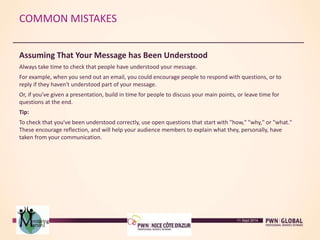
Assuming That Your Message has Been Understood
Always take time to check that people have understood your message.
For example, when you send out an email, you could encourage people to respond with questions, or to
reply if they haven't understood part of your message.
Or, if you've given a presentation, build in time for people to discuss your main points, or leave time for
questions at the end.
Tip:
To check that you've been understood correctly, use open questions that start with "how," "why," or "what."
These encourage reflection, and will help your audience members to explain what they, personally, have
taken from your communication.
11 Sept 2014
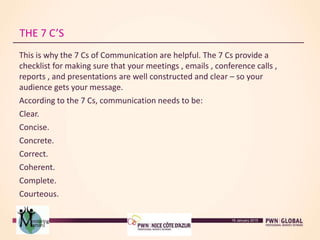
This is why the 7 Cs of Communication are helpful. The 7 Cs provide a
checklist for making sure that your meetings , emails , conference calls ,
reports , and presentations are well constructed and clear – so your
audience gets your message.
According to the 7 Cs, communication needs to be:
Clear.
Concise.
Concrete.
Correct.
Coherent.
Complete.
Courteous.
THE 7 C’S
19 January 2015
THE 7 C’S
1. Clear
When writing or speaking to someone, be clear about your goal or message. What is your purpose in
communicating with this person? If you're not sure, then your audience won't be sure either.
To be clear, try to minimize the number of ideas in each sentence. Make sure that it's easy for your reader to
understand your meaning. People shouldn't have to "read between the lines" and make assumptions on
their own to understand what you're trying to say.
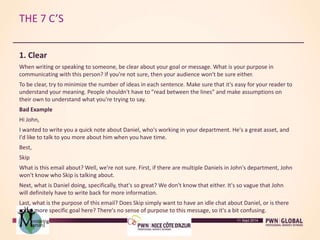
Bad Example
Hi John,
I wanted to write you a quick note about Daniel, who's working in your department. He's a great asset, and
I'd like to talk to you more about him when you have time.
Best,
Skip
What is this email about? Well, we're not sure. First, if there are multiple Daniels in John's department, John
won't know who Skip is talking about.
Next, what is Daniel doing, specifically, that's so great? We don't know that either. It's so vague that John
will definitely have to write back for more information.
Last, what is the purpose of this email? Does Skip simply want to have an idle chat about Daniel, or is there
some more specific goal here? There's no sense of purpose to this message, so it's a bit confusing.
11 Sept 2014
THE 7 C’S
1. Clear
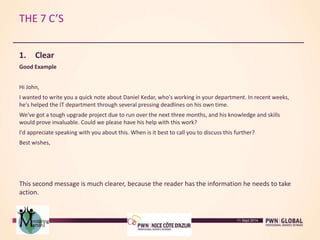
Good Example
Hi John,
I wanted to write you a quick note about Daniel Kedar, who's working in your department. In recent weeks,
he's helped the IT department through several pressing deadlines on his own time.
We've got a tough upgrade project due to run over the next three months, and his knowledge and skills
would prove invaluable. Could we please have his help with this work?
I'd appreciate speaking with you about this. When is it best to call you to discuss this further?
Best wishes,
This second message is much clearer, because the reader has the information he needs to take
action.
11 Sept 2014
THE 7 C’S
2. Concise
When you're concise in your communication, you stick to the point and
keep it brief. Your audience doesn't want to read six sentences when you
could communicate your message in three.
Are there any adjectives or "filler words" that you can delete? You can often
eliminate words like "for instance," "you see," "definitely," "kind of,"
"literally," "basically," or "I mean."
Are there any unnecessary sentences?
Have you repeated the point several times, in different ways?
11 Sept 2014
THE 7 C’S
3- Concrete
What will I answer tomorrow to Jeanette when she will ask me : “how did
the workshop run yesterday ?”
4- Correct
5- Coherent
Or congruent. You have to ensure that what you feel, what you think, and
what you do is aligned.
11 Sept 2014
6. Complete
In a complete message, the audience has everything they need to be
informed and, if applicable, take action.
Does your message include a "call to action," so that your audience clearly
knows what you want them to do?
Have you included all relevant information – contact names, dates, times,
locations, and so on?
Bad Example
Hi everyone,
I just wanted to send you all a reminder about the meeting we're having tomorrow!
See you then,
Chris
11 Sept 2014
7. Courteous
Courteous communication is friendly, open, and honest. There are no
hidden insults or passive-aggressive tones. You keep the other’s viewpoint
in mind, and you're empathetic to their needs.
11 Sept 2014
11 Sept 2014
11 Sept 2014
ASSESSMENT
11 Sept 2014
11 Sept 2014

How to achive successful communication

  • 1.
    HOW TO ACHIEVESUCCESSFUL COMMUNICATION 6 OCTOBER 2015 VALERIE AUSSEIL MENTORING PROGRAMME LEADER
  • 2.
    WELCOME ! Tell uswho you are …
  • 3.
  • 4.
    WHY COMMUNICATION ISSO IMPORTANT 11 Sept 2014
  • 5.
    WHY COMMUNICATION ISSO IMPORTANT 11 Sept 2014
  • 6.
    AGENDA • Why isit so difficult to communicate ? • Common mistakes • 7 C’s • Desired outcome • Effective feedback • Assessment • Eating and networking ! 11 Sept 2014
  • 7.
  • 8.
    HOW MANY F? 11 Sept 2014
  • 9.
    HOW OBSERVANT AREYOU ? https://youtu.be/ubNF9QNEQLA 11 Sept 2014
  • 10.
    WHAT DO YOUSEE ? 11 Sept 2014
  • 11.
    MY PERCEPTION OFREALITY IS NOT REALITY 11 Sept 2014
  • 12.
  • 13.
  • 14.
    COMMON MISTAKES Delivering BadNews by Email Written communication channels don't allow you to soften difficult messages with nonverbal cues (such as body language ), and they don't allow you to deal immediately with intense emotions. If you need to deliver bad news, do this in person, and think carefully about how you can do it sensitively, so that you can convey your message but minimize long-term upset at the same time. When you deliver a difficult message personally, you can pick up on signs that people may have misunderstood key parts of your message, or may have taken the information particularly badly. You can then take steps to clarify your message, or help people deal with the difficult news. Avoiding Difficult Conversations At some point, you will need to give negative feedback. It's tempting to try to avoid these conversations, but this can cause further problems – in particular, you may let small problems grow into big ones. Preparation is the key to handling difficult conversations. Learn to give clear, actionable feedback, and use tools such as the Sandwich technique to encourage your people to reflect on their behavior. 11 Sept 2014
  • 15.
    COMMON MISTAKES Not BeingAssertive Assertiveness is about stating what you need, while considering the wants and needs of others. You may not always get your way when you're assertive, but you stand a better chance of getting it, or of reaching a compromise, because you've been clear about your needs. Assertiveness also means saying "no" when you need to. Note: Assertiveness is not the same as aggression. When you're aggressive, you push to get your own way without thinking about other people's rights, wants, and needs. 11 Sept 2014
  • 16.
    COMMON MISTAKES Reacting, NotResponding Have you ever shouted at a colleague in frustration, or sent a terse reply to an email, without thinking your point through? If so, you're likely to have reacted emotionally, instead of responding calmly. This kind of emotional reaction can damage your reputation. You may upset people with your strong emotions, and give the impression that you lack self-control and emotional intelligence . Not Preparing Poorly-prepared presentations, reports, or emails frustrate your audience and, over time, damage your reputation. This is why it's essential to prepare and plan your communications carefully. Leave time to find images, and to check that documents are compatible with your audience's software. Then, if you are delivering a speech or a presentation, rehearse thoroughly, so that you are fluent and inspiring. 11 Sept 2014
  • 17.
    COMMON MISTAKES Using a"One-Size-Fits-All" Approach to Communication If you use a "one-size-fits-all" approach to communication, you may overlook people's different personalities, needs and expectations. In fact, your communications need to address those differences as much as possible. If you're preparing a presentation, make sure that you appreciate that people have different learning styles. Not Keeping an Open Mind When Meeting New People Today's workplace is a melting pot of ethnicities, religions, ages, sexual orientations, abilities, and viewpoints. These differences create a rich tapestry of experiences and opinions that greatly enhance our lives. However, it can be tempting to stereotype new colleagues or clients, or to make assumptions about them based on just a few pieces of information. This is especially true if you haven't had much time to get to know them well. Assumptions inhibit open communication. So, set time aside to listen when you meet someone new. Give them space to talk about their viewpoints, and take time to absorb these. 11 Sept 2014
  • 18.
    COMMON MISTAKES Assuming ThatYour Message has Been Understood Always take time to check that people have understood your message. For example, when you send out an email, you could encourage people to respond with questions, or to reply if they haven't understood part of your message. Or, if you've given a presentation, build in time for people to discuss your main points, or leave time for questions at the end. Tip: To check that you've been understood correctly, use open questions that start with "how," "why," or "what." These encourage reflection, and will help your audience members to explain what they, personally, have taken from your communication. 11 Sept 2014
  • 19.
    This is whythe 7 Cs of Communication are helpful. The 7 Cs provide a checklist for making sure that your meetings , emails , conference calls , reports , and presentations are well constructed and clear – so your audience gets your message. According to the 7 Cs, communication needs to be: Clear. Concise. Concrete. Correct. Coherent. Complete. Courteous. THE 7 C’S 19 January 2015
  • 20.
    THE 7 C’S 1.Clear When writing or speaking to someone, be clear about your goal or message. What is your purpose in communicating with this person? If you're not sure, then your audience won't be sure either. To be clear, try to minimize the number of ideas in each sentence. Make sure that it's easy for your reader to understand your meaning. People shouldn't have to "read between the lines" and make assumptions on their own to understand what you're trying to say. Bad Example Hi John, I wanted to write you a quick note about Daniel, who's working in your department. He's a great asset, and I'd like to talk to you more about him when you have time. Best, Skip What is this email about? Well, we're not sure. First, if there are multiple Daniels in John's department, John won't know who Skip is talking about. Next, what is Daniel doing, specifically, that's so great? We don't know that either. It's so vague that John will definitely have to write back for more information. Last, what is the purpose of this email? Does Skip simply want to have an idle chat about Daniel, or is there some more specific goal here? There's no sense of purpose to this message, so it's a bit confusing. 11 Sept 2014
  • 21.
    THE 7 C’S 1.Clear Good Example Hi John, I wanted to write you a quick note about Daniel Kedar, who's working in your department. In recent weeks, he's helped the IT department through several pressing deadlines on his own time. We've got a tough upgrade project due to run over the next three months, and his knowledge and skills would prove invaluable. Could we please have his help with this work? I'd appreciate speaking with you about this. When is it best to call you to discuss this further? Best wishes, This second message is much clearer, because the reader has the information he needs to take action. 11 Sept 2014
  • 22.
    THE 7 C’S 2.Concise When you're concise in your communication, you stick to the point and keep it brief. Your audience doesn't want to read six sentences when you could communicate your message in three. Are there any adjectives or "filler words" that you can delete? You can often eliminate words like "for instance," "you see," "definitely," "kind of," "literally," "basically," or "I mean." Are there any unnecessary sentences? Have you repeated the point several times, in different ways? 11 Sept 2014
  • 23.
    THE 7 C’S 3-Concrete What will I answer tomorrow to Jeanette when she will ask me : “how did the workshop run yesterday ?” 4- Correct 5- Coherent Or congruent. You have to ensure that what you feel, what you think, and what you do is aligned. 11 Sept 2014
  • 24.
    6. Complete In acomplete message, the audience has everything they need to be informed and, if applicable, take action. Does your message include a "call to action," so that your audience clearly knows what you want them to do? Have you included all relevant information – contact names, dates, times, locations, and so on? Bad Example Hi everyone, I just wanted to send you all a reminder about the meeting we're having tomorrow! See you then, Chris 11 Sept 2014
  • 25.
    7. Courteous Courteous communicationis friendly, open, and honest. There are no hidden insults or passive-aggressive tones. You keep the other’s viewpoint in mind, and you're empathetic to their needs. 11 Sept 2014
  • 26.
  • 27.
  • 28.
  • 29.