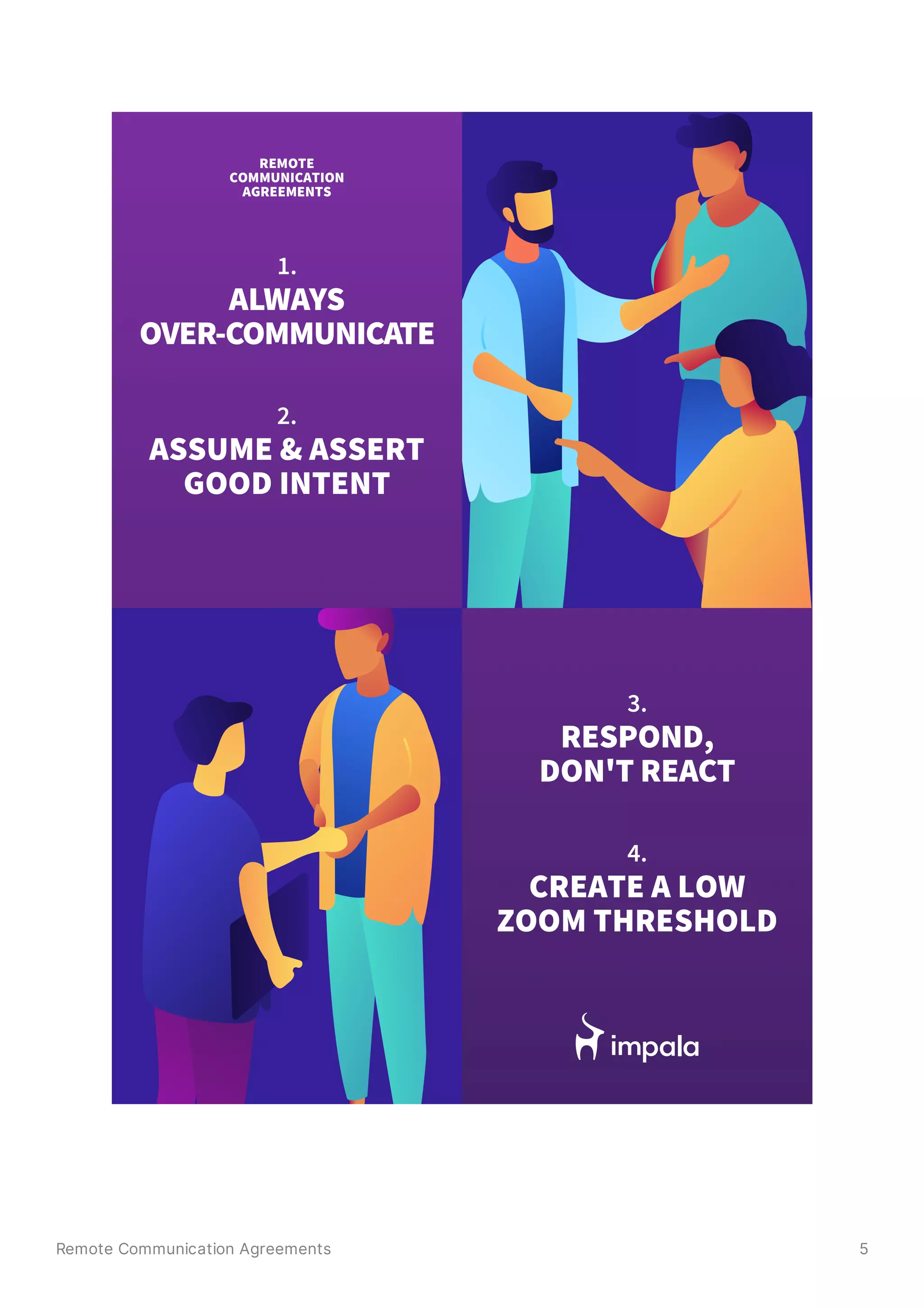
Remote Communication Agreements 5
Remote Communication Agreements 1
Remote Communication
Agreements
Communication bears a huge influence on overall team dynamics and our
team's sense of community. Being a remote team means we often have limited
access to important communication cues, including body language, vocal
tone, and more.
Because we want to ensure communication positively influences work
experience and culture, we've pieced together these 4 guiding principles to
follow when it comes to communicating across our remote team. For more
effective communication, our team agrees to:
1. Always Over-communicate
You can't be too clear. You can't be too clear. You can't be too clear.
As a remote team we have limited access to more expressive forms of
communication and external cues, such as body language and tone.
Interruptions are not nearly as tragic as misunderstandings. Everyone on the
team is happy to help support you in your work and in your learning.
To make sure we've understood information correctly, and have transmitted
information correctly, we agree to always opt to over-communicate.
Remote Communication Agreements 2
What this looks like in-action:
A two-minute call can prevent wasted time and misunderstanding.
Taking & sharing 1 1 meeting minutes can ensure everyone is aligned and
has the same information to refer back to
Confidently asking clarifying questions and paraphrasing the information
or request back to someone will ensure the correct message is received.
Initiating a call when conversation threads appear to be getting very long
or confusing can diffuse all types of miscommunication.
2. Assume & assert good intent
People will respond with brevity sometimes, and it’s easy for tone to get lost.
Especially with the lack of physical cues.
You can help to cultivate trust, positivity and good working relationships by
assuming and asserting good intent.
What this looks like in-action:
Intentionally writing in a constructive and pleasant manner breeds
positivity.
Giving someone the benefit of the doubt when tone is unclear and/or
comes across as negative can protect you from unnecessarily dwelling on
a conversation.
Assuming feedback that feels difficult to hear is coming from a place of
support and desire to help you improve/succeed will help you apply the
feedback you receive.
Seeking clarification on tone when uncertain will help avoid uncertainty.
Using emojis and Giphys will help to clarify your intended tone .
3. Respond, don't react
Remote Communication Agreements 3
Slack is a high traffic area—with fast response expectations. Often something
might pop up in Slack which may annoy or frustrate you, and you're often
expected to reply there and then.
When this happens the default and easiest option is to react to the message
based on how it made you feel. This will lead to negative interaction.
If you receive a Slack message which annoys or frustrates you; respond as
you would if the interaction were in person or via professional email. Think
about how your reaction might upset the individual or reduce their
psychological safety. Ensure you give a professional response that answers
their question, not reacts to it.
What this looks like in-action:
Thinking about what the answer to the question is, or even, WHY they
are asking the question before you hit reply will ensure you're not giving
a loaded off the cuff reaction.
Using phrases like 'can I get back to you tomorrow' 'why do you ask',
'when do you need a response by', 'can I get more context' etc, can give
you more time to think about your response, rather than reacting based on
how it makes you feel right then.
4. Create a low Zoom threshold
We’re a team! If you ever feel uncertain, or feel that something has been
misconstrued, or feel that tensions are escalating—hop on that video call asap!
Clarify, talk it out, diffuse; with added insight into tone and verbal cues you're
bound to have a more positive interaction.
We're a community! We support socialising within the workday—hopefully,
you'll enjoy participating in the variety of internal initiatives we've purposes
for fun! A quick coffee break or virtual co-working session are very welcome
alongside these. You're encouraged to strike up calls that don't necessarily
relate to work—the same way you would in a physical versus remote
workspace.
What this looks like in-action:
Remote Communication Agreements 4
Initiating a call on Zoom if you sense conflict bubbling up can save
unnecessary negative conversations from escalating.
Inviting someone to a Zoom coffee break can break the silence that oft-
accompanies working from home and create opportunity for your
colleagues to become your friends.
Always keeping Zoom open for others who may need to reach out to you
to clarify or diffuse a situation will ensure attempts to resolve conflict or
collaborate are not blocked.

Impala's Remote Communication Agreements

  • 1.
  • 2.
    Remote Communication Agreements1 Remote Communication Agreements Communication bears a huge influence on overall team dynamics and our team's sense of community. Being a remote team means we often have limited access to important communication cues, including body language, vocal tone, and more. Because we want to ensure communication positively influences work experience and culture, we've pieced together these 4 guiding principles to follow when it comes to communicating across our remote team. For more effective communication, our team agrees to: 1. Always Over-communicate You can't be too clear. You can't be too clear. You can't be too clear. As a remote team we have limited access to more expressive forms of communication and external cues, such as body language and tone. Interruptions are not nearly as tragic as misunderstandings. Everyone on the team is happy to help support you in your work and in your learning. To make sure we've understood information correctly, and have transmitted information correctly, we agree to always opt to over-communicate.
  • 3.
    Remote Communication Agreements2 What this looks like in-action: A two-minute call can prevent wasted time and misunderstanding. Taking & sharing 1 1 meeting minutes can ensure everyone is aligned and has the same information to refer back to Confidently asking clarifying questions and paraphrasing the information or request back to someone will ensure the correct message is received. Initiating a call when conversation threads appear to be getting very long or confusing can diffuse all types of miscommunication. 2. Assume & assert good intent People will respond with brevity sometimes, and it’s easy for tone to get lost. Especially with the lack of physical cues. You can help to cultivate trust, positivity and good working relationships by assuming and asserting good intent. What this looks like in-action: Intentionally writing in a constructive and pleasant manner breeds positivity. Giving someone the benefit of the doubt when tone is unclear and/or comes across as negative can protect you from unnecessarily dwelling on a conversation. Assuming feedback that feels difficult to hear is coming from a place of support and desire to help you improve/succeed will help you apply the feedback you receive. Seeking clarification on tone when uncertain will help avoid uncertainty. Using emojis and Giphys will help to clarify your intended tone . 3. Respond, don't react
  • 4.
    Remote Communication Agreements3 Slack is a high traffic area—with fast response expectations. Often something might pop up in Slack which may annoy or frustrate you, and you're often expected to reply there and then. When this happens the default and easiest option is to react to the message based on how it made you feel. This will lead to negative interaction. If you receive a Slack message which annoys or frustrates you; respond as you would if the interaction were in person or via professional email. Think about how your reaction might upset the individual or reduce their psychological safety. Ensure you give a professional response that answers their question, not reacts to it. What this looks like in-action: Thinking about what the answer to the question is, or even, WHY they are asking the question before you hit reply will ensure you're not giving a loaded off the cuff reaction. Using phrases like 'can I get back to you tomorrow' 'why do you ask', 'when do you need a response by', 'can I get more context' etc, can give you more time to think about your response, rather than reacting based on how it makes you feel right then. 4. Create a low Zoom threshold We’re a team! If you ever feel uncertain, or feel that something has been misconstrued, or feel that tensions are escalating—hop on that video call asap! Clarify, talk it out, diffuse; with added insight into tone and verbal cues you're bound to have a more positive interaction. We're a community! We support socialising within the workday—hopefully, you'll enjoy participating in the variety of internal initiatives we've purposes for fun! A quick coffee break or virtual co-working session are very welcome alongside these. You're encouraged to strike up calls that don't necessarily relate to work—the same way you would in a physical versus remote workspace. What this looks like in-action:
  • 5.
    Remote Communication Agreements4 Initiating a call on Zoom if you sense conflict bubbling up can save unnecessary negative conversations from escalating. Inviting someone to a Zoom coffee break can break the silence that oft- accompanies working from home and create opportunity for your colleagues to become your friends. Always keeping Zoom open for others who may need to reach out to you to clarify or diffuse a situation will ensure attempts to resolve conflict or collaborate are not blocked.