Smart Policies for
Data workshop
series
18 March 2021
Building blocks for
fair digital society
Elements for successful
European Data Markets
Szymon Lewandowski, European Commission
DG CONNECT, Data Policy and Innovation, 18.03.2021
Data Market vs Data Economy
• The Data Market is the marketplace where digital data is
exchanged as “products” or “services” as a result of the
elaboration of raw data. Its value is based on the
aggregate value of the demand of digital data without
measuring the direct, indirect and induced impacts of
data in the economy.
• The Data Economy measures the overall impacts of the
Data Market on the economy.
2
https://datalandscape.eu/
 The Supply and Demand
dimension -
measurement of data
supplier and data user
companies and the
revenues generated.
 The Business and
Economy dimension -
the size of the Data
Market and the value of
the Data Economy.
 The Workforce and Skills
dimension - data
professionals and their
potential skill gap.
EU Data Market – main indicators
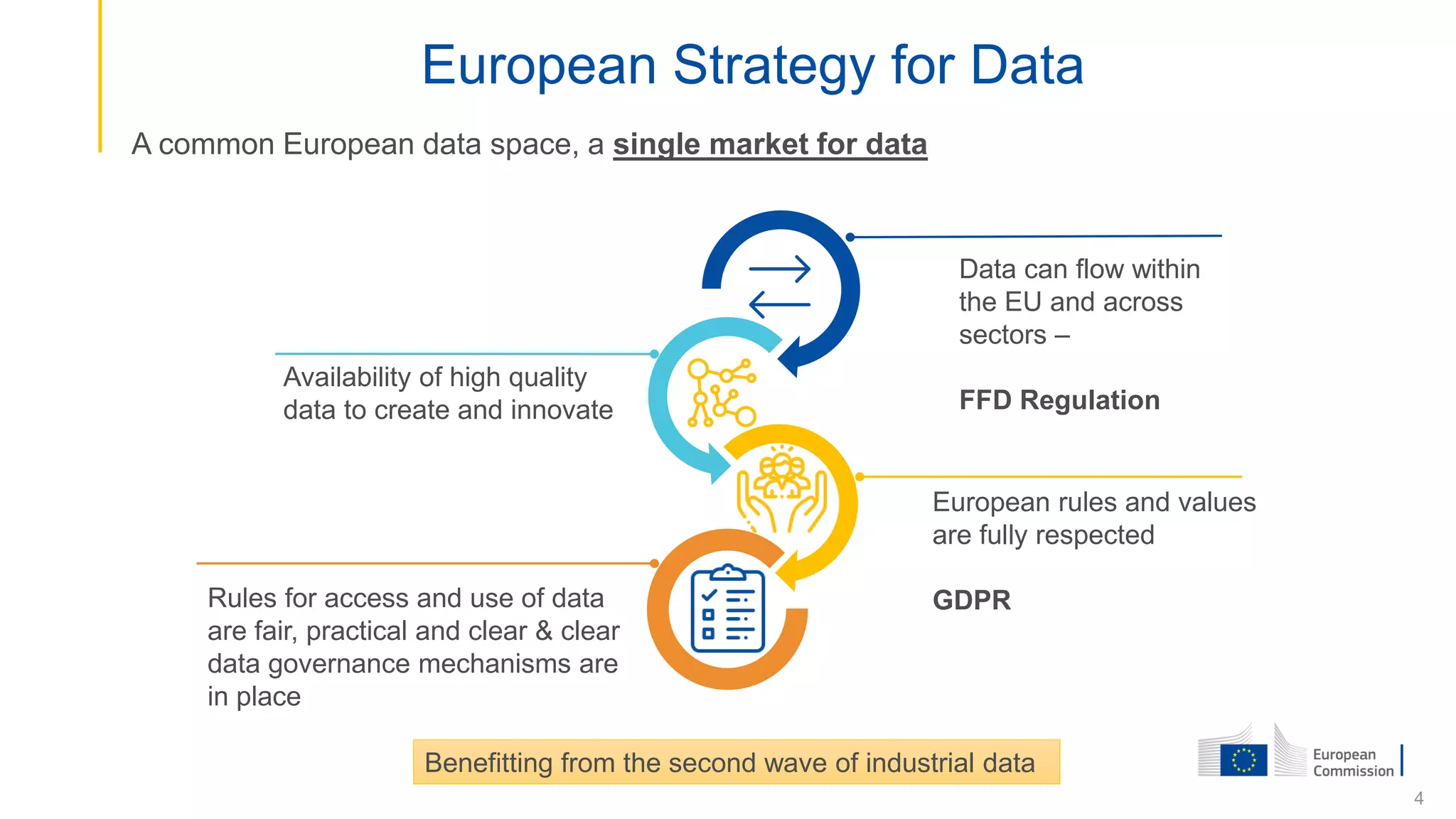
European Strategy for Data
A common European data space, a single market for data
Data can flow within
the EU and across
sectors –
FFD Regulation
European rules and values
are fully respected
GDPR
Rules for access and use of data
are fair, practical and clear & clear
data governance mechanisms are
in place
Availability of high quality
data to create and innovate
Benefitting from the second wave of industrial data
4
European Strategy for Data - legislation
Public sector data of high value
Unleash the socio-economic potential
of data as a PUBLIC GOOD
Public sector data, private sector data and
personal data voluntarily made available by data
holders
Personal data and private sector data held by online
platforms and originating from the users (both
businesses and individuals)
Regulate MARKET POWER
based on data
Private sector data, personal data
and co-generated (IoT) data
Ensure FAIRNESS in the
allocation of data value among the
actors of the data economy
Ensure TRUST in data
transactions
Dec 2020
Q3 2021
Impl. Act.
High Value
Datasets
Data
Governance
Act
Digital
Market
Act
Data Act
Q1 2021
Nov 2020
4 key instruments
5
High impact
deployments
Digital
Innovation
Hubs
BUILDING
ESSENTIAL
DIGITAL
CAPACITIES High Performance Computing
Artificial Intelligence
Cybersecurity
Advanced Digital Skills
DIGITAL EUROPE PROGRAMME - ACCELERATING THE BEST USE OF DIGITAL TECHNOLOGIES
European Strategy for Data – funding support
Artificial intelligence, data and cloud
Data spaces
Green Deal
Manufacturing
Health
Agriculture
Mobility
Security (law
enforcement)
Cultural Heritage
Media
Horizontal
actions
in support to
data spaces
support centre
open data portal
high value data
sets
Cloud federation
Market place
Cloud to Edge
based services
Middleware
platforms, building
blocks, cross
cutting software…
AI on demand
platform
Central access
point to AI
resources
Testing &
Experimentation
Facilities
Manufacturing
Health
Agriculture
Smart
Communities
Edge AI HW
Actions will be managed directly by CNECT
Approx. 56% of the SO2 budget Approx. 36% of the budget
Enabling different types of data markets
• Direct trading (via API of data holder) or with the involvement of intermediary
• Individual "micro data" (data marketplace) or information products (data broker)
• Involving individual ("personal data market"/ PIMS) or industrial/IoT data
• Data stay in a an "industrial data space" or in an open environment
• The concept of Common EU Data Spaces in DEP as sectoral data markets
• Rules for ‘European style’ intermediaries in the Data Governance Act
• Access to the data generated in the use of the gatekeeper platform – Digital Markets Act
• Supply of data - HVDs (open data), and via sectoral legislation (electricity, mobility)
What are the remaining issues in data
markets?
Legal:
• Uncertainty on the right to use
the data
• Lack of control over the data
• Lack of standard licencing
solutions
Technical:
• Lack of standards
• Insufficient quality of the data
• Lack of interoperability between
sectors
• Data difficult to find
Structural:
• Imbalance in negotiating power
• Small players not having critical
mass of data and not sharing it
9
Thank you very much for your
attention
• https://ec.europa.eu/digital-single-
market/en/news/building-data-economy-
brochure
• CNECT-G1@ec.europa.eu
Design principles for data spaces
18.3.2021
Marko Turpeinen
CEO, 1001 Lakes
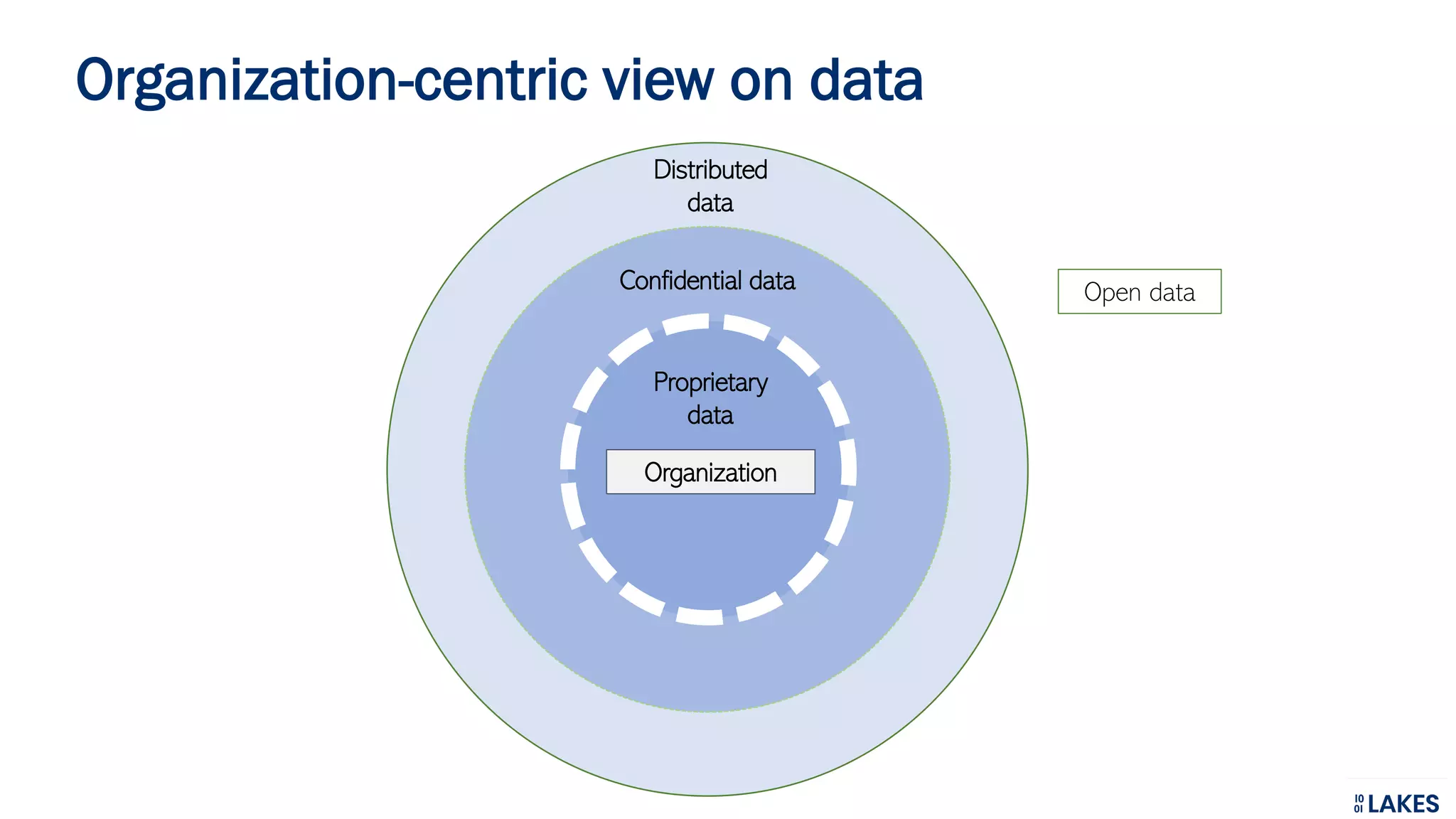
Organization-centric view on data
Organization
Proprietary
data
Open data
Confidential data
Distributed
data
Network-centric view on data
Trusted Data
Space
Member
Member
Member
Untrusted
Intermediaries
Human-centric view on data
Source: WalDigiFarm
Farmer’s view on data (example)
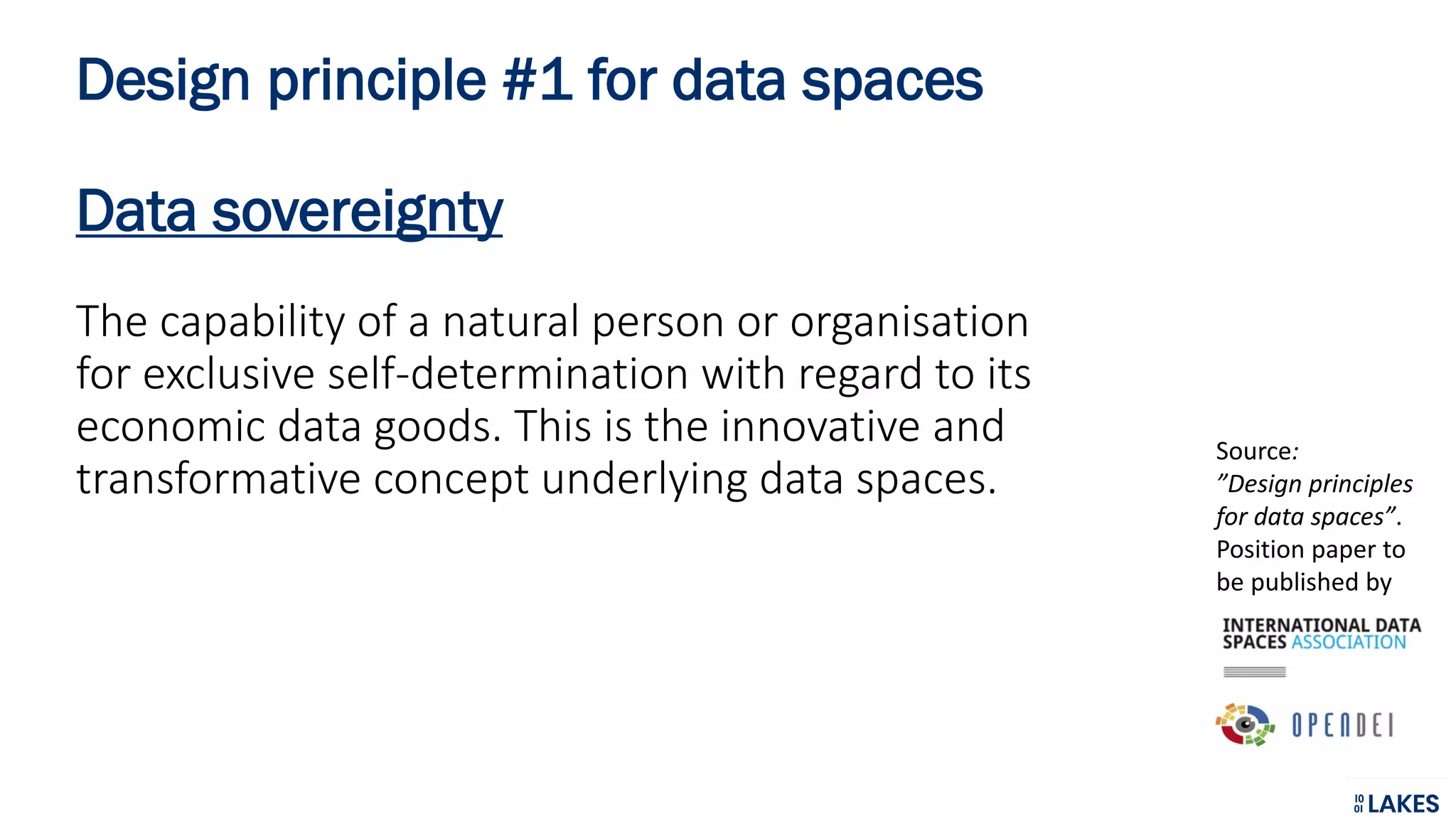
Design principle #1 for data spaces
Data sovereignty
The capability of a natural person or organisation
for exclusive self-determination with regard to its
economic data goods. This is the innovative and
transformative concept underlying data spaces.
Source:
”Design principles
for data spaces”.
Position paper to
be published by
Design principle #2 for data spaces
Data level playing field
New entrants face no insurmountable barriers to
entry because of monopolistic situations. When a data
level playing exists, players compete on quality of
service, and not on the amount of data they control. A
data level playing field is a pivotal condition to create
a fair data sharing economy.
Source:
”Design principles
for data spaces”.
Position paper to
be published by
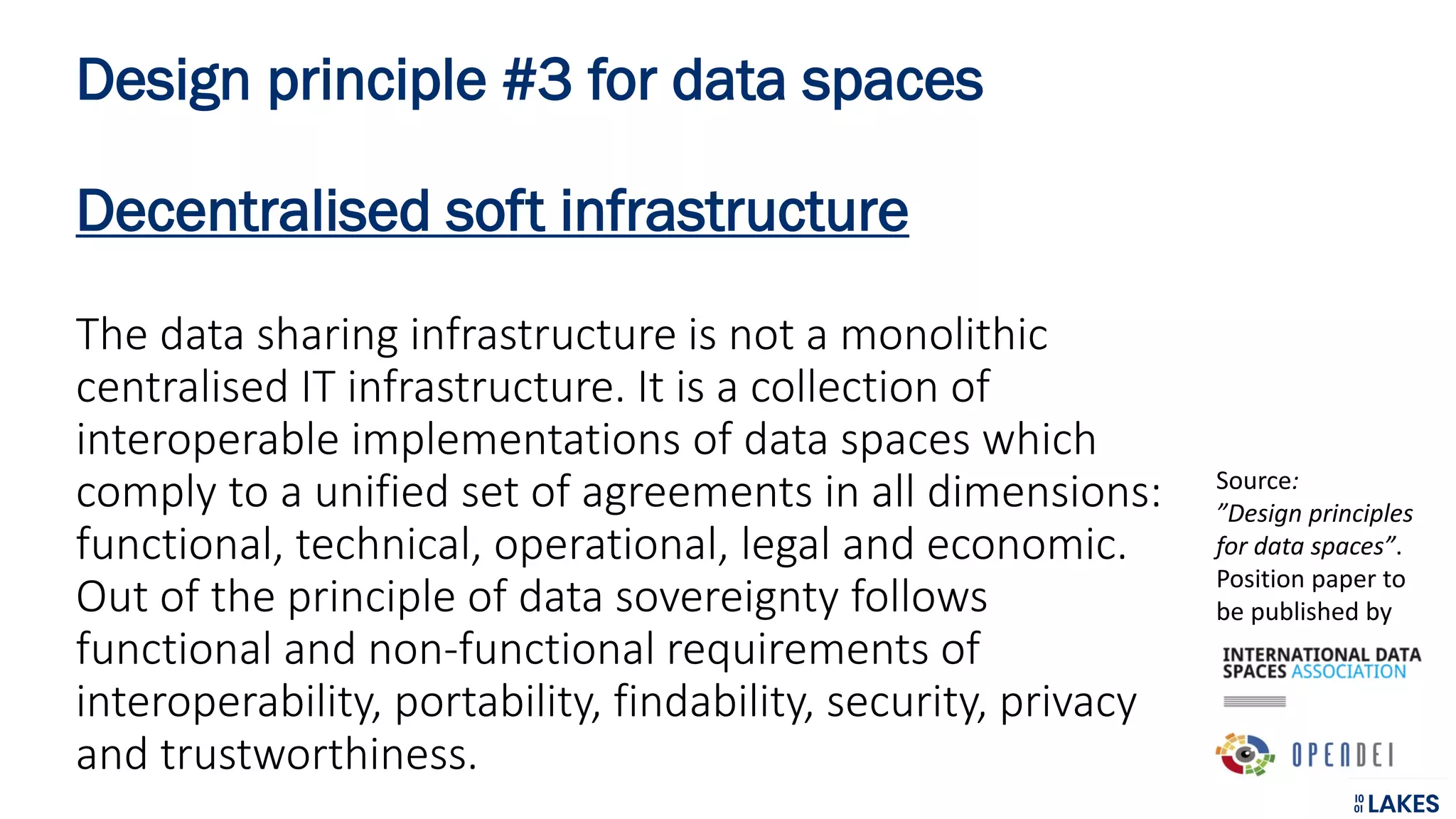
Design principle #3 for data spaces
Decentralised soft infrastructure
The data sharing infrastructure is not a monolithic
centralised IT infrastructure. It is a collection of
interoperable implementations of data spaces which
comply to a unified set of agreements in all dimensions:
functional, technical, operational, legal and economic.
Out of the principle of data sovereignty follows
functional and non-functional requirements of
interoperability, portability, findability, security, privacy
and trustworthiness.
Source:
”Design principles
for data spaces”.
Position paper to
be published by
Design principle #4 for data spaces
Public-private governance
For the design, creation and maintenance of the
data level playing field a sound governance is
essential. All stakeholders need to feel represented
and engaged. These include users (persons,
organisations) or provider of data services as well as
their technology partners and professionals.
Source:
”Design principles
for data spaces”.
Position paper to
be published by
Source: ”Design
principles for data
spaces”. Position paper
to be published by
Trust Building Blocks
Decentralised Identity System
(for organizations, people, things)
1. Allow the usage of the data
2. Inhibit the usage of the data
3. Restrict the data usage for a group of users or systems
4. Restrict the data usage for specific purposes
5. Restrict the data usage when a specific event has occurred
6. Use or do not use the data in a specific time interval
7. Use the data not more than N times
8. Use data and delete it after
9. Modify data (in transit)
10. Modify data (in rest)
11. Log the data usage information
12. Notify a party or a specific group of users when the data is used
13. Share the data under specific circumstances
Data Usage Policies
(specification and enforcement)
12
Fair Data Economy Rulebook
13
Source:
”Design principles
for data spaces”.
Position paper to
be published by
Embryonic AGRI data spaces (examples)
AgriFood Data Space Finland
Agdatahub
Fair data economy rules needed for data spaces
• Combination of business, legal, technical and societal viewpoints is required in
defining fair data rules.
Common design principles for data spaces can be applied
• Apply common building blocks, while leaving room for domain specific solutions.
Common soft infrastructure makes cross-sectorial data sharing easier.
Embryonic data spaces are seeds for common European data
spaces
• National and regional initiatives are important intermediary milestones when
moving towards the vision of common European data spaces, as long as they
adhere to the data space principles and infrastructure reference models, such
as IDS and GAIA-X.
Key messages
Thank You!
Marko Turpeinen
marko.turpeinen@1001lakes.com
Implementing the European Data Strategy
Building blocks for fair digital society
Online Event
March 18, 2021 at 10:00 pm - 12:30 pm
Lars Nagel
CEO International Data Spaces Association
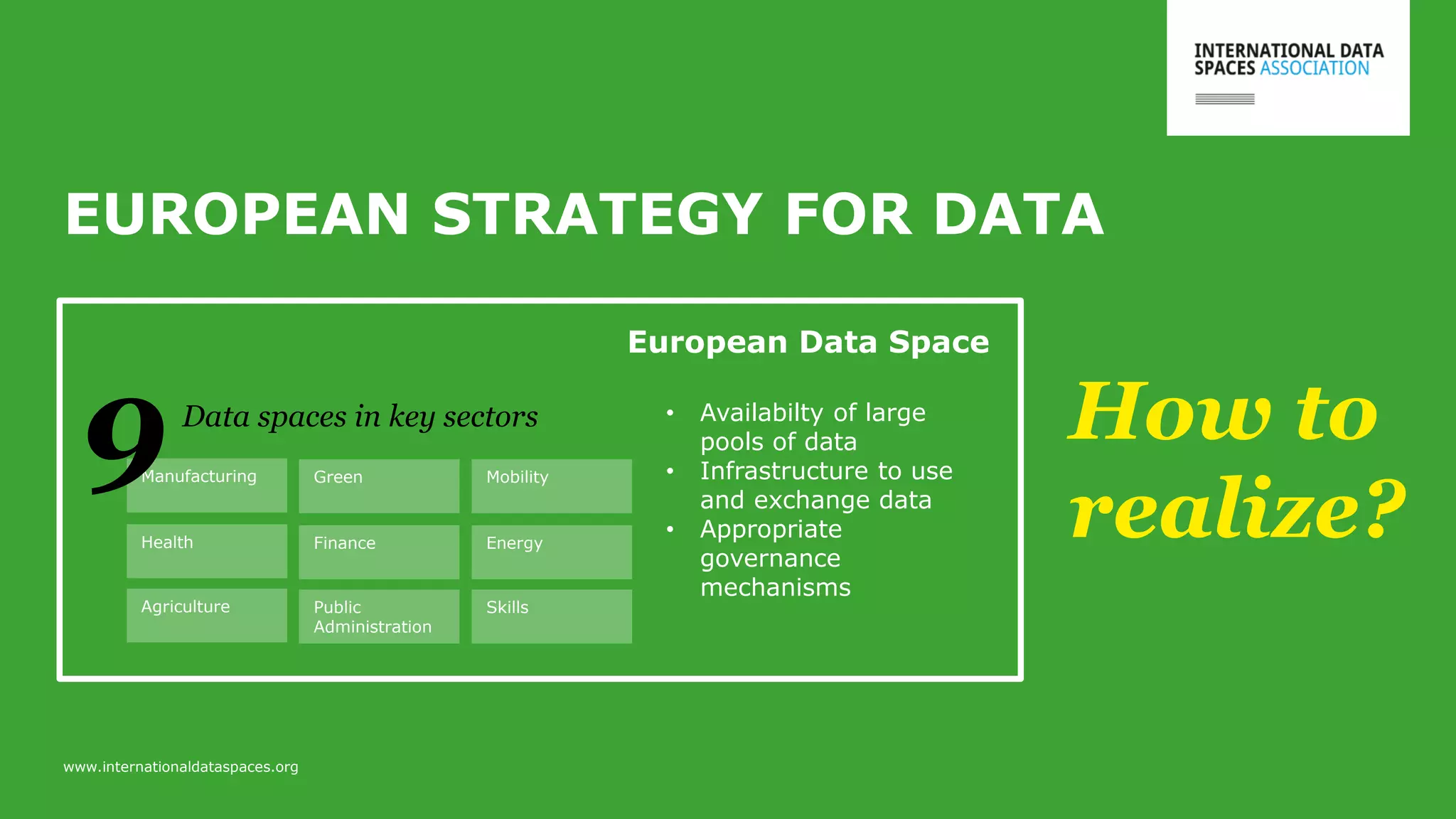
EUROPEAN STRATEGY FOR DATA
www.internationaldataspaces.org
Manufacturing
Health
Agriculture
Green
Finance
Public
Administration
Mobility
Energy
Skills
9Data spaces in key sectors
European Data Space
• Availabilty of large
pools of data
• Infrastructure to use
and exchange data
• Appropriate
governance
mechanisms
How to
realize?
It is about vital ecosystems…
… and their resilient structures to
establish trust.
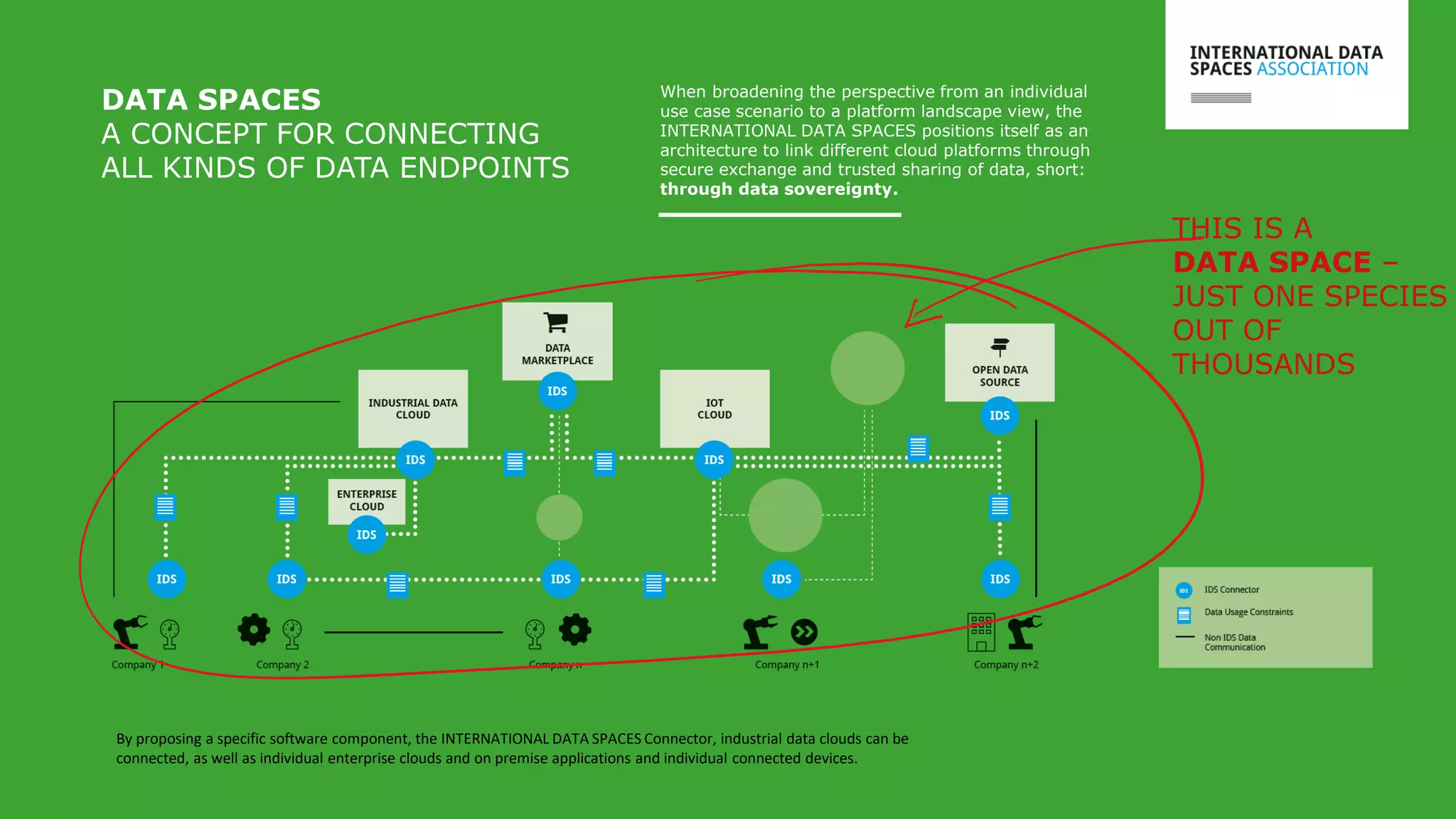
DATA SPACES
A CONCEPT FOR CONNECTING
ALL KINDS OF DATA ENDPOINTS
When broadening the perspective from an individual
use case scenario to a platform landscape view, the
INTERNATIONAL DATA SPACES positions itself as an
architecture to link different cloud platforms through
secure exchange and trusted sharing of data, short:
through data sovereignty.
By proposing a specific software component, the INTERNATIONAL DATA SPACES Connector, industrial data clouds can be
connected, as well as individual enterprise clouds and on premise applications and individual connected devices.
THIS IS A
DATA SPACE –
JUST ONE SPECIES
OUT OF
THOUSANDS
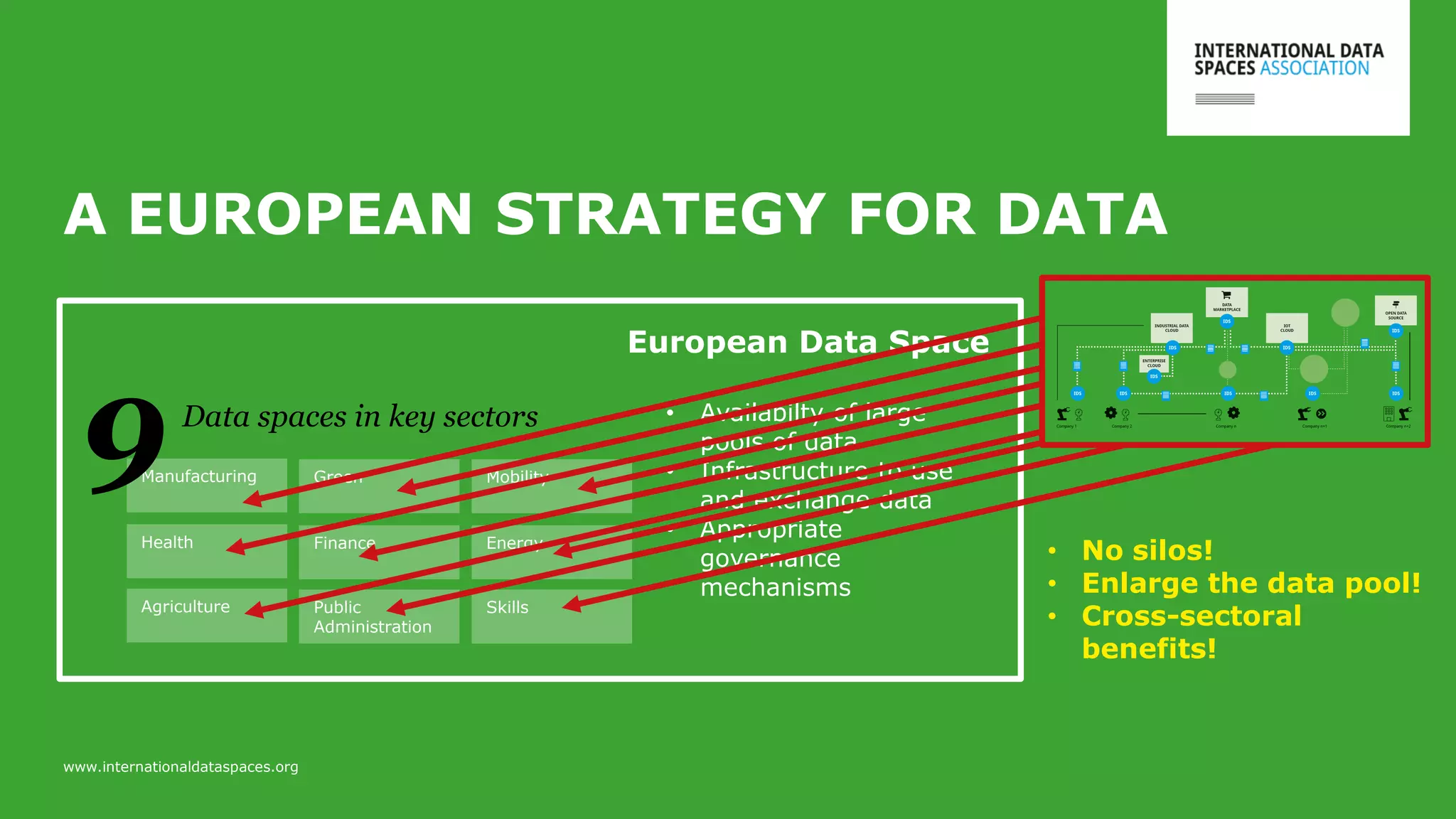
A EUROPEAN STRATEGY FOR DATA
www.internationaldataspaces.org
Manufacturing
Health
Agriculture
Green
Finance
Public
Administration
Mobility
Energy
Skills
9Data spaces in key sectors
European Data Space
• Availabilty of large
pools of data
• Infrastructure to use
and exchange data
• Appropriate
governance
mechanisms
• No silos!
• Enlarge the data pool!
• Cross-sectoral
benefits!
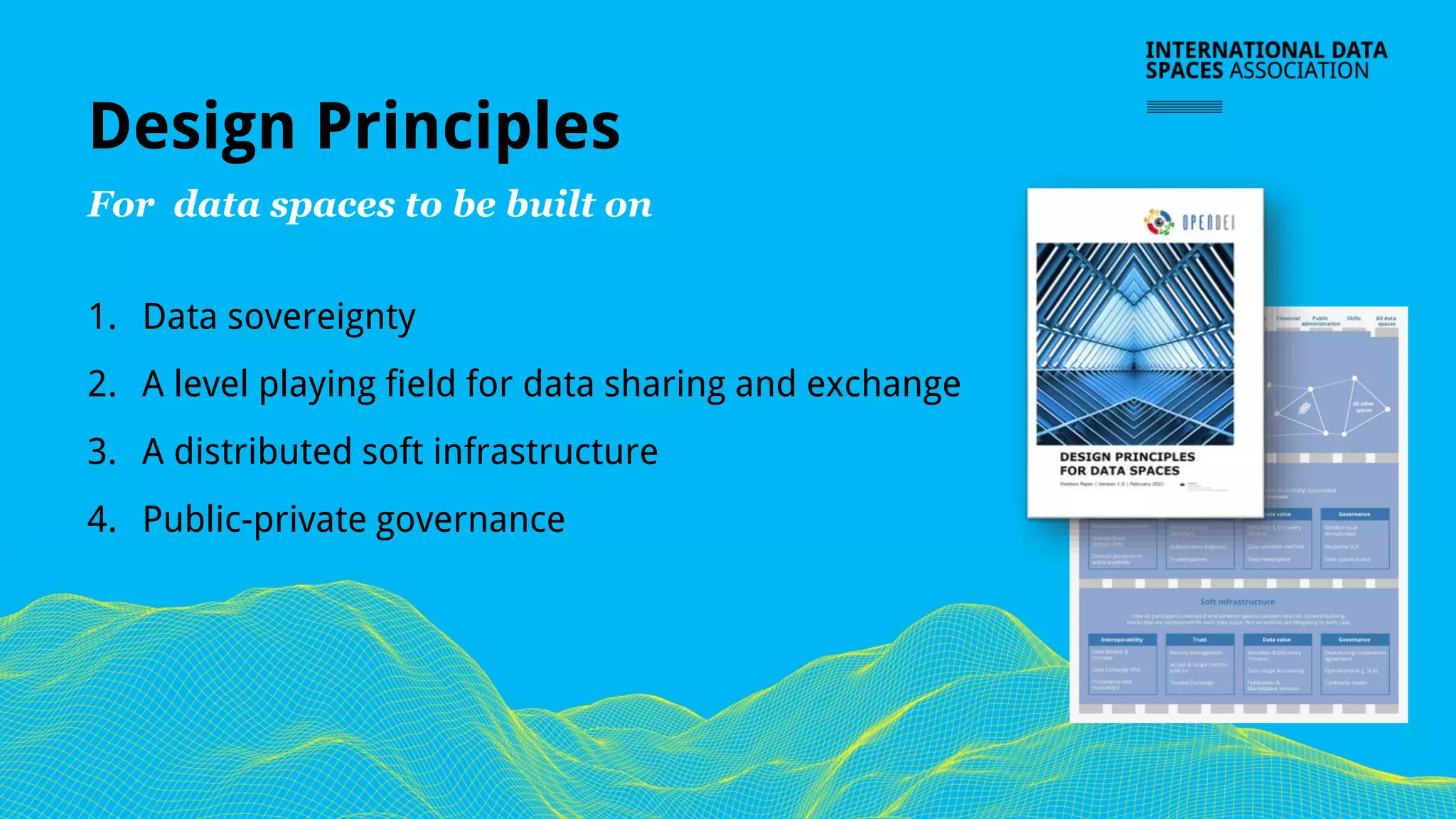
Design Principles
For data spaces to be built on
1. Data sovereignty
2. A level playing field for data sharing and exchange
3. A distributed soft infrastructure
4. Public-private governance
Decentralised soft infrastructure
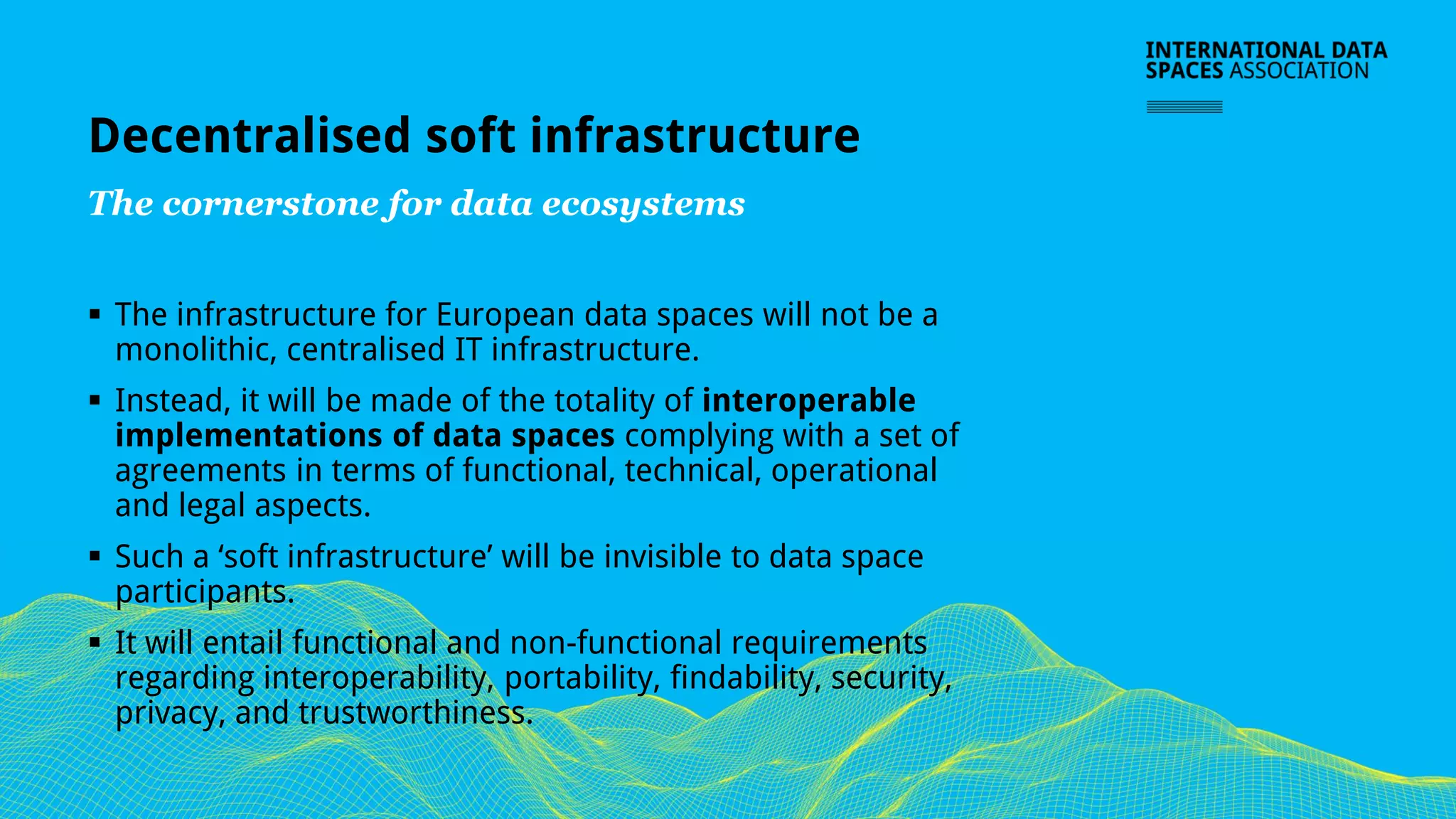
The cornerstone for data ecosystems
▪ The infrastructure for European data spaces will not be a
monolithic, centralised IT infrastructure.
▪ Instead, it will be made of the totality of interoperable
implementations of data spaces complying with a set of
agreements in terms of functional, technical, operational
and legal aspects.
▪ Such a ‘soft infrastructure’ will be invisible to data space
participants.
▪ It will entail functional and non-functional requirements
regarding interoperability, portability, findability, security,
privacy, and trustworthiness.
Implementing Europe‘s Data Strategy
How to make DGA happen
The Commission has not been explicit yet on
how the general authorisation framework is to
be created and how the totality of data-sharing
applications will have to converge into the de-
facto ‘soft infrastructure’.
The big question now is: How do we get to this
general European authorisation framework
that will determine how data sharing and
exchange in Europe takes place in
practice?
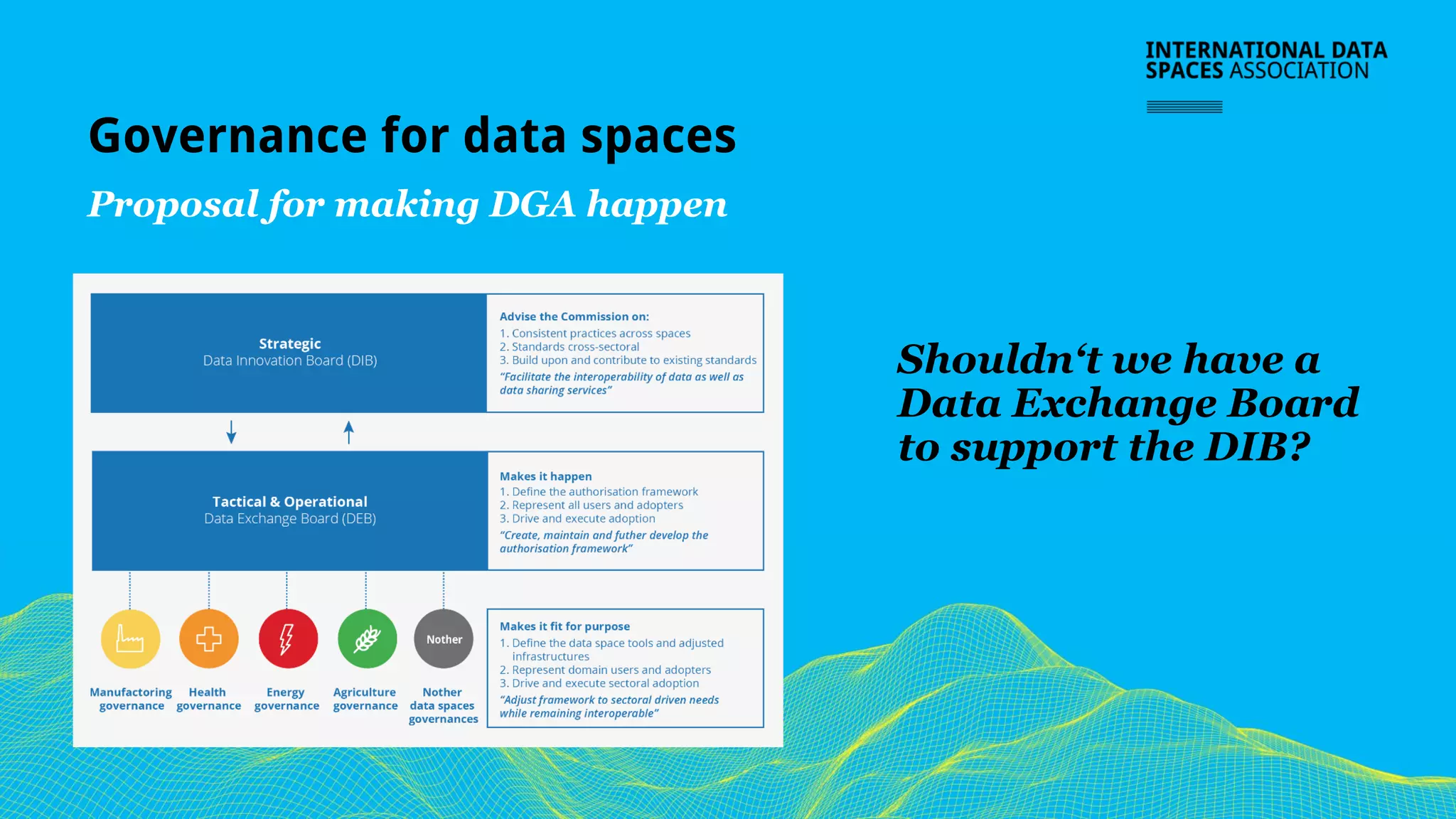
Governance for data spaces
Proposal for making DGA happen
Shouldn‘t we have a
Data Exchange Board
to support the DIB?
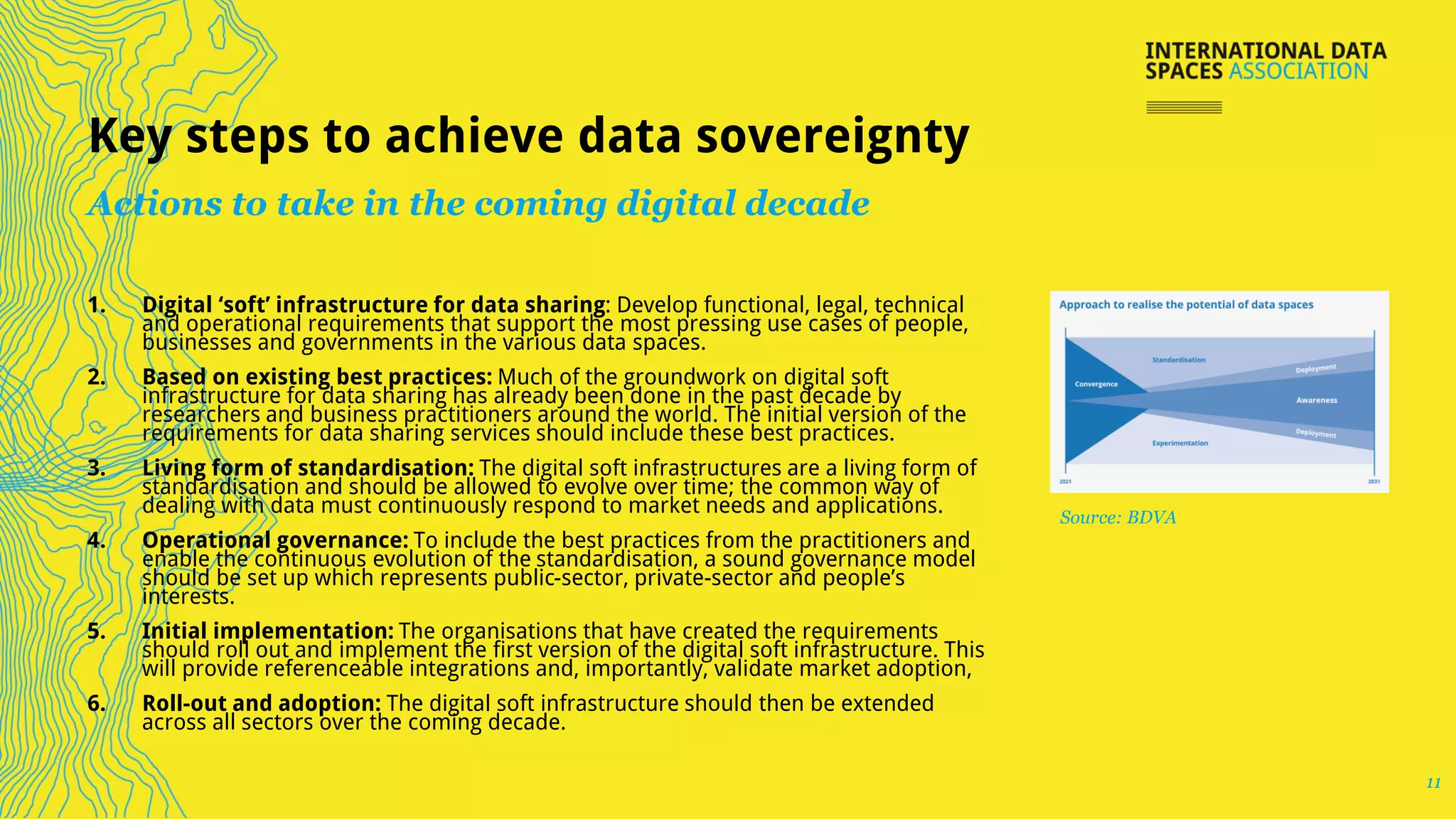
Key steps to achieve data sovereignty
Actions to take in the coming digital decade
1. Digital ‘soft’ infrastructure for data sharing: Develop functional, legal, technical
and operational requirements that support the most pressing use cases of people,
businesses and governments in the various data spaces.
2. Based on existing best practices: Much of the groundwork on digital soft
infrastructure for data sharing has already been done in the past decade by
researchers and business practitioners around the world. The initial version of the
requirements for data sharing services should include these best practices.
3. Living form of standardisation: The digital soft infrastructures are a living form of
standardisation and should be allowed to evolve over time; the common way of
dealing with data must continuously respond to market needs and applications.
4. Operational governance: To include the best practices from the practitioners and
enable the continuous evolution of the standardisation, a sound governance model
should be set up which represents public-sector, private-sector and people’s
interests.
5. Initial implementation: The organisations that have created the requirements
should roll out and implement the first version of the digital soft infrastructure. This
will provide referenceable integrations and, importantly, validate market adoption,
6. Roll-out and adoption: The digital soft infrastructure should then be extended
across all sectors over the coming decade.
Source: BDVA
11
Teaming up
…with all their members which are
data spaces natives since years.
The big initiatives in the data realm:
Let’s increase awareness for Data Sovereignty: www.DataSovereigntyNow.org
WE NEED COMMON
DESIGN PRINCIPLES FOR DATA SPACES
www.internationaldataspaces.org
IDS Association provides
▪ Open Reference architecture setting the framework conditions – based on standards
▪ Trust framework and scheme for data sharing (rulebook)
▪ Coordinating operations for essential data sovereignty services
This enables
▪ open, distributed data eco systems and marketplaces,
▪ ensuring data sovereignty for the creator of the data,
▪ and proven data-provenance for the user of data,
▪ all above audit-proof, if requested
▪ based on European values.
2
1
3
2
1
3
DESIGN PRINCIPLES FOR DATA SPACES
ENSURING DATA SOVEREIGNTY
Unlimited
Interoperability
Enabled by semantic data
descriptions
Trust between different
security domains
Certified, comprehensive security
functions providing a maximum
level of trust
Governance for the
data economy
usage control and enforcement
for data flows
Information Model
Certified, trusted com-
ponents and environments Concept of usage control
4Security profiles
satisfying all needs from quick
data sharing to comprehensive
security requirements
Formal certification states
coherence to reference
architecture, interoperability
and software quality
Defined in DIN Spec 27070 on “security
gateway for sharing data and services”
and reference architecture model 3.0
IDS CONNECTOR
ENABLES ACCESS TO SOVEREIGN,
TRUSTED DATA SHARING ECOSYSTEMS
Implementation in different scenarios (embedded
systems, mobile devices, client server solutions)
Specifications for
implementing a connector
based on container
management technologies
provided on Gitlab
27070 +
LET‘S BUILD
DATA SPACES.
// 16
But please: make life easy by
using common design principles.
IDS is a very good starting point – let‘s discuss and learn.
www.internationaldataspaces.org
// 17
LARS NAGEL
CEO
INTERNATIONAL DATA SPACES ASSOCIATION
WWW.LINKEDIN.COM/IN/LARS-NAGEL-704411B8/
JOSEPH-VON-FRAUNHOFER-STR. 2-4
44227 DORTMUND | GERMANY
+49 231 9743 619
INFO@INTERNATIONALDATASPACES.ORG
@ids_association
#internationaldataspaces
www.internationaldataspaces.org
International Data Spaces Association
JOIN US!
@LARSMNAGEL
@

Building blocks for fair digital society

  • 1.
    Smart Policies for Dataworkshop series 18 March 2021 Building blocks for fair digital society
  • 2.
    Elements for successful EuropeanData Markets Szymon Lewandowski, European Commission DG CONNECT, Data Policy and Innovation, 18.03.2021
  • 3.
    Data Market vsData Economy • The Data Market is the marketplace where digital data is exchanged as “products” or “services” as a result of the elaboration of raw data. Its value is based on the aggregate value of the demand of digital data without measuring the direct, indirect and induced impacts of data in the economy. • The Data Economy measures the overall impacts of the Data Market on the economy. 2 https://datalandscape.eu/
  • 4.
     The Supplyand Demand dimension - measurement of data supplier and data user companies and the revenues generated.  The Business and Economy dimension - the size of the Data Market and the value of the Data Economy.  The Workforce and Skills dimension - data professionals and their potential skill gap. EU Data Market – main indicators
  • 5.
    European Strategy forData A common European data space, a single market for data Data can flow within the EU and across sectors – FFD Regulation European rules and values are fully respected GDPR Rules for access and use of data are fair, practical and clear & clear data governance mechanisms are in place Availability of high quality data to create and innovate Benefitting from the second wave of industrial data 4
  • 6.
    European Strategy forData - legislation Public sector data of high value Unleash the socio-economic potential of data as a PUBLIC GOOD Public sector data, private sector data and personal data voluntarily made available by data holders Personal data and private sector data held by online platforms and originating from the users (both businesses and individuals) Regulate MARKET POWER based on data Private sector data, personal data and co-generated (IoT) data Ensure FAIRNESS in the allocation of data value among the actors of the data economy Ensure TRUST in data transactions Dec 2020 Q3 2021 Impl. Act. High Value Datasets Data Governance Act Digital Market Act Data Act Q1 2021 Nov 2020 4 key instruments 5
  • 7.
    High impact deployments Digital Innovation Hubs BUILDING ESSENTIAL DIGITAL CAPACITIES HighPerformance Computing Artificial Intelligence Cybersecurity Advanced Digital Skills DIGITAL EUROPE PROGRAMME - ACCELERATING THE BEST USE OF DIGITAL TECHNOLOGIES European Strategy for Data – funding support
  • 8.
    Artificial intelligence, dataand cloud Data spaces Green Deal Manufacturing Health Agriculture Mobility Security (law enforcement) Cultural Heritage Media Horizontal actions in support to data spaces support centre open data portal high value data sets Cloud federation Market place Cloud to Edge based services Middleware platforms, building blocks, cross cutting software… AI on demand platform Central access point to AI resources Testing & Experimentation Facilities Manufacturing Health Agriculture Smart Communities Edge AI HW Actions will be managed directly by CNECT Approx. 56% of the SO2 budget Approx. 36% of the budget
  • 9.
    Enabling different typesof data markets • Direct trading (via API of data holder) or with the involvement of intermediary • Individual "micro data" (data marketplace) or information products (data broker) • Involving individual ("personal data market"/ PIMS) or industrial/IoT data • Data stay in a an "industrial data space" or in an open environment • The concept of Common EU Data Spaces in DEP as sectoral data markets • Rules for ‘European style’ intermediaries in the Data Governance Act • Access to the data generated in the use of the gatekeeper platform – Digital Markets Act • Supply of data - HVDs (open data), and via sectoral legislation (electricity, mobility)
  • 10.
    What are theremaining issues in data markets? Legal: • Uncertainty on the right to use the data • Lack of control over the data • Lack of standard licencing solutions Technical: • Lack of standards • Insufficient quality of the data • Lack of interoperability between sectors • Data difficult to find Structural: • Imbalance in negotiating power • Small players not having critical mass of data and not sharing it 9
  • 11.
    Thank you verymuch for your attention • https://ec.europa.eu/digital-single- market/en/news/building-data-economy- brochure • CNECT-G1@ec.europa.eu
  • 12.
    Design principles fordata spaces 18.3.2021 Marko Turpeinen CEO, 1001 Lakes
  • 13.
    Organization-centric view ondata Organization Proprietary data Open data Confidential data Distributed data
  • 14.
    Network-centric view ondata Trusted Data Space Member Member Member Untrusted Intermediaries
  • 15.
  • 16.
  • 17.
    Design principle #1for data spaces Data sovereignty The capability of a natural person or organisation for exclusive self-determination with regard to its economic data goods. This is the innovative and transformative concept underlying data spaces. Source: ”Design principles for data spaces”. Position paper to be published by
  • 18.
    Design principle #2for data spaces Data level playing field New entrants face no insurmountable barriers to entry because of monopolistic situations. When a data level playing exists, players compete on quality of service, and not on the amount of data they control. A data level playing field is a pivotal condition to create a fair data sharing economy. Source: ”Design principles for data spaces”. Position paper to be published by
  • 19.
    Design principle #3for data spaces Decentralised soft infrastructure The data sharing infrastructure is not a monolithic centralised IT infrastructure. It is a collection of interoperable implementations of data spaces which comply to a unified set of agreements in all dimensions: functional, technical, operational, legal and economic. Out of the principle of data sovereignty follows functional and non-functional requirements of interoperability, portability, findability, security, privacy and trustworthiness. Source: ”Design principles for data spaces”. Position paper to be published by
  • 20.
    Design principle #4for data spaces Public-private governance For the design, creation and maintenance of the data level playing field a sound governance is essential. All stakeholders need to feel represented and engaged. These include users (persons, organisations) or provider of data services as well as their technology partners and professionals. Source: ”Design principles for data spaces”. Position paper to be published by
  • 21.
    Source: ”Design principles fordata spaces”. Position paper to be published by
  • 22.
    Trust Building Blocks DecentralisedIdentity System (for organizations, people, things) 1. Allow the usage of the data 2. Inhibit the usage of the data 3. Restrict the data usage for a group of users or systems 4. Restrict the data usage for specific purposes 5. Restrict the data usage when a specific event has occurred 6. Use or do not use the data in a specific time interval 7. Use the data not more than N times 8. Use data and delete it after 9. Modify data (in transit) 10. Modify data (in rest) 11. Log the data usage information 12. Notify a party or a specific group of users when the data is used 13. Share the data under specific circumstances Data Usage Policies (specification and enforcement)
  • 23.
  • 24.
    Fair Data EconomyRulebook 13
  • 25.
    Source: ”Design principles for dataspaces”. Position paper to be published by
  • 26.
    Embryonic AGRI dataspaces (examples) AgriFood Data Space Finland Agdatahub
  • 27.
    Fair data economyrules needed for data spaces • Combination of business, legal, technical and societal viewpoints is required in defining fair data rules. Common design principles for data spaces can be applied • Apply common building blocks, while leaving room for domain specific solutions. Common soft infrastructure makes cross-sectorial data sharing easier. Embryonic data spaces are seeds for common European data spaces • National and regional initiatives are important intermediary milestones when moving towards the vision of common European data spaces, as long as they adhere to the data space principles and infrastructure reference models, such as IDS and GAIA-X. Key messages
  • 28.
  • 29.
    Implementing the EuropeanData Strategy Building blocks for fair digital society Online Event March 18, 2021 at 10:00 pm - 12:30 pm Lars Nagel CEO International Data Spaces Association
  • 30.
    EUROPEAN STRATEGY FORDATA www.internationaldataspaces.org Manufacturing Health Agriculture Green Finance Public Administration Mobility Energy Skills 9Data spaces in key sectors European Data Space • Availabilty of large pools of data • Infrastructure to use and exchange data • Appropriate governance mechanisms How to realize?
  • 31.
    It is aboutvital ecosystems…
  • 32.
    … and theirresilient structures to establish trust.
  • 33.
    DATA SPACES A CONCEPTFOR CONNECTING ALL KINDS OF DATA ENDPOINTS When broadening the perspective from an individual use case scenario to a platform landscape view, the INTERNATIONAL DATA SPACES positions itself as an architecture to link different cloud platforms through secure exchange and trusted sharing of data, short: through data sovereignty. By proposing a specific software component, the INTERNATIONAL DATA SPACES Connector, industrial data clouds can be connected, as well as individual enterprise clouds and on premise applications and individual connected devices. THIS IS A DATA SPACE – JUST ONE SPECIES OUT OF THOUSANDS
  • 34.
    A EUROPEAN STRATEGYFOR DATA www.internationaldataspaces.org Manufacturing Health Agriculture Green Finance Public Administration Mobility Energy Skills 9Data spaces in key sectors European Data Space • Availabilty of large pools of data • Infrastructure to use and exchange data • Appropriate governance mechanisms • No silos! • Enlarge the data pool! • Cross-sectoral benefits!
  • 35.
    Design Principles For dataspaces to be built on 1. Data sovereignty 2. A level playing field for data sharing and exchange 3. A distributed soft infrastructure 4. Public-private governance
  • 36.
    Decentralised soft infrastructure Thecornerstone for data ecosystems ▪ The infrastructure for European data spaces will not be a monolithic, centralised IT infrastructure. ▪ Instead, it will be made of the totality of interoperable implementations of data spaces complying with a set of agreements in terms of functional, technical, operational and legal aspects. ▪ Such a ‘soft infrastructure’ will be invisible to data space participants. ▪ It will entail functional and non-functional requirements regarding interoperability, portability, findability, security, privacy, and trustworthiness.
  • 37.
    Implementing Europe‘s DataStrategy How to make DGA happen The Commission has not been explicit yet on how the general authorisation framework is to be created and how the totality of data-sharing applications will have to converge into the de- facto ‘soft infrastructure’. The big question now is: How do we get to this general European authorisation framework that will determine how data sharing and exchange in Europe takes place in practice?
  • 38.
    Governance for dataspaces Proposal for making DGA happen Shouldn‘t we have a Data Exchange Board to support the DIB?
  • 39.
    Key steps toachieve data sovereignty Actions to take in the coming digital decade 1. Digital ‘soft’ infrastructure for data sharing: Develop functional, legal, technical and operational requirements that support the most pressing use cases of people, businesses and governments in the various data spaces. 2. Based on existing best practices: Much of the groundwork on digital soft infrastructure for data sharing has already been done in the past decade by researchers and business practitioners around the world. The initial version of the requirements for data sharing services should include these best practices. 3. Living form of standardisation: The digital soft infrastructures are a living form of standardisation and should be allowed to evolve over time; the common way of dealing with data must continuously respond to market needs and applications. 4. Operational governance: To include the best practices from the practitioners and enable the continuous evolution of the standardisation, a sound governance model should be set up which represents public-sector, private-sector and people’s interests. 5. Initial implementation: The organisations that have created the requirements should roll out and implement the first version of the digital soft infrastructure. This will provide referenceable integrations and, importantly, validate market adoption, 6. Roll-out and adoption: The digital soft infrastructure should then be extended across all sectors over the coming decade. Source: BDVA 11
  • 40.
    Teaming up …with alltheir members which are data spaces natives since years. The big initiatives in the data realm: Let’s increase awareness for Data Sovereignty: www.DataSovereigntyNow.org
  • 41.
    WE NEED COMMON DESIGNPRINCIPLES FOR DATA SPACES www.internationaldataspaces.org IDS Association provides ▪ Open Reference architecture setting the framework conditions – based on standards ▪ Trust framework and scheme for data sharing (rulebook) ▪ Coordinating operations for essential data sovereignty services This enables ▪ open, distributed data eco systems and marketplaces, ▪ ensuring data sovereignty for the creator of the data, ▪ and proven data-provenance for the user of data, ▪ all above audit-proof, if requested ▪ based on European values. 2 1 3 2 1 3
  • 42.
    DESIGN PRINCIPLES FORDATA SPACES ENSURING DATA SOVEREIGNTY Unlimited Interoperability Enabled by semantic data descriptions Trust between different security domains Certified, comprehensive security functions providing a maximum level of trust Governance for the data economy usage control and enforcement for data flows Information Model Certified, trusted com- ponents and environments Concept of usage control
  • 43.
    4Security profiles satisfying allneeds from quick data sharing to comprehensive security requirements Formal certification states coherence to reference architecture, interoperability and software quality Defined in DIN Spec 27070 on “security gateway for sharing data and services” and reference architecture model 3.0 IDS CONNECTOR ENABLES ACCESS TO SOVEREIGN, TRUSTED DATA SHARING ECOSYSTEMS Implementation in different scenarios (embedded systems, mobile devices, client server solutions) Specifications for implementing a connector based on container management technologies provided on Gitlab 27070 +
  • 44.
    LET‘S BUILD DATA SPACES. //16 But please: make life easy by using common design principles. IDS is a very good starting point – let‘s discuss and learn. www.internationaldataspaces.org
  • 45.
    // 17 LARS NAGEL CEO INTERNATIONALDATA SPACES ASSOCIATION WWW.LINKEDIN.COM/IN/LARS-NAGEL-704411B8/ JOSEPH-VON-FRAUNHOFER-STR. 2-4 44227 DORTMUND | GERMANY +49 231 9743 619 INFO@INTERNATIONALDATASPACES.ORG @ids_association #internationaldataspaces www.internationaldataspaces.org International Data Spaces Association JOIN US! @LARSMNAGEL @