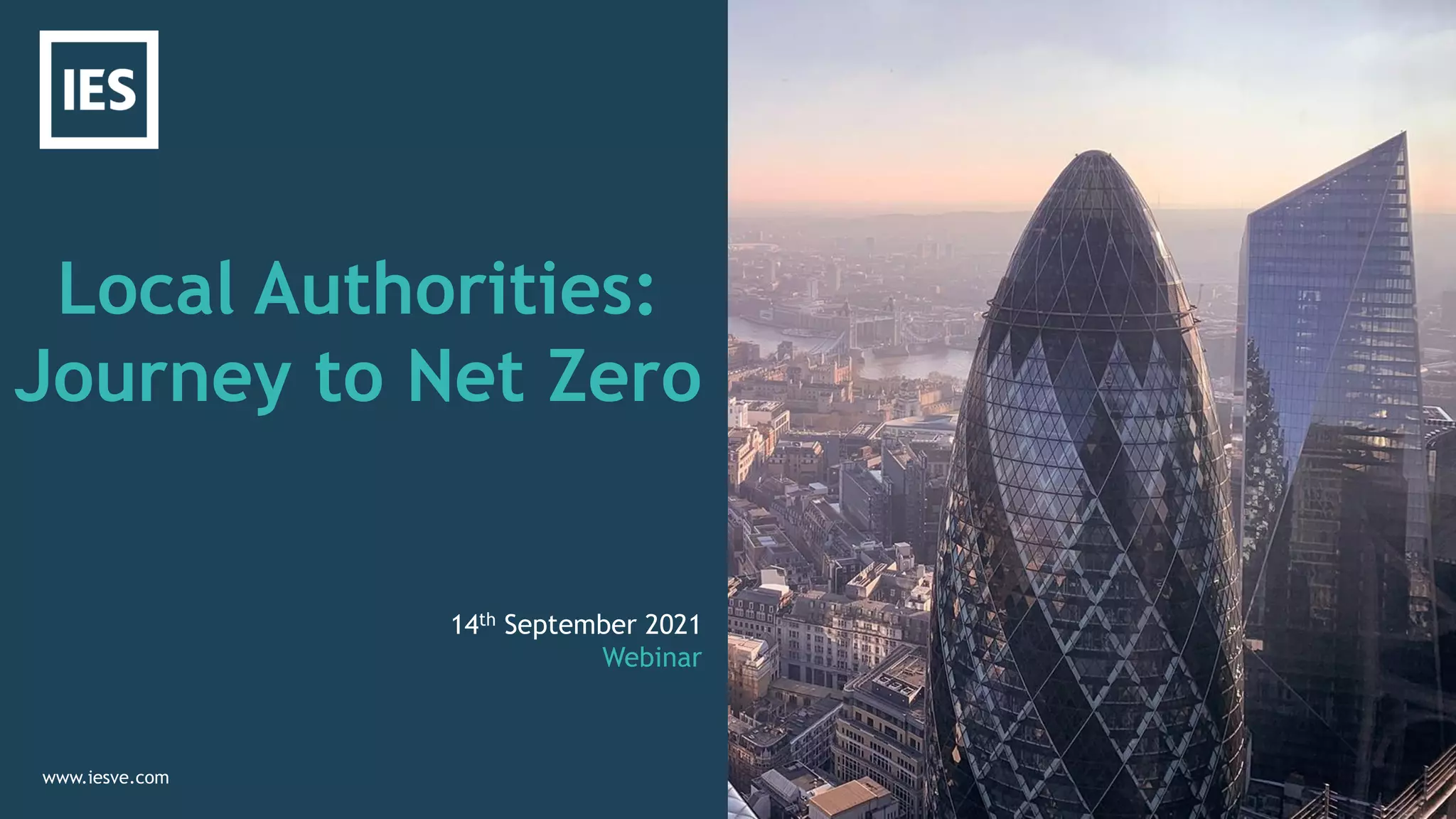
Local Authorities:
Journey to Net Zero
www.iesve.com
14th September 2021
Webinar
www.iesve.com
Todays Speakers & Agenda
Modelling processes to support
Net Zero Carbon ambitions
Perth & Kinross Council:
Journey to Net Zero
Welcome & Introduction
Niall Gibson: Business Development Manger - IES
Chris Anton: Energy Lead Officer – Perth and
Kinross Council
Colin Rees: Head of Global VE Consultancy - IES
Climate Emergency
www.iesve.com
Council climate League |
Declare a Climate
Emergency
https://www.climateemergency.uk/council-climate-league/
300/404 (74%) of District, County, Unitary & Metropolitan Councils have declared a
Climate Emergency to date. Also 8 Combined Authorities/City Regions.
www.iesve.com
What IES do…
Chris Anton
Perth & Kinross: Journey to Net Zero
www.iesve.com
Colin Rees
Modelling processes to support Net Zero Carbon ambitions
www.iesve.com
Modelling to Support Local Authorities Net-Zero Carbon Ambitions
• How to use modelling processes across the design stages to support new and
existing buildings in their Net Zero Carbon ambitions.
• Case Study: Dynamic Simulation Modelling (DSM) services to Passivhaus and
EnerPHit studies.
IES CONSULTING
www.iesve.com
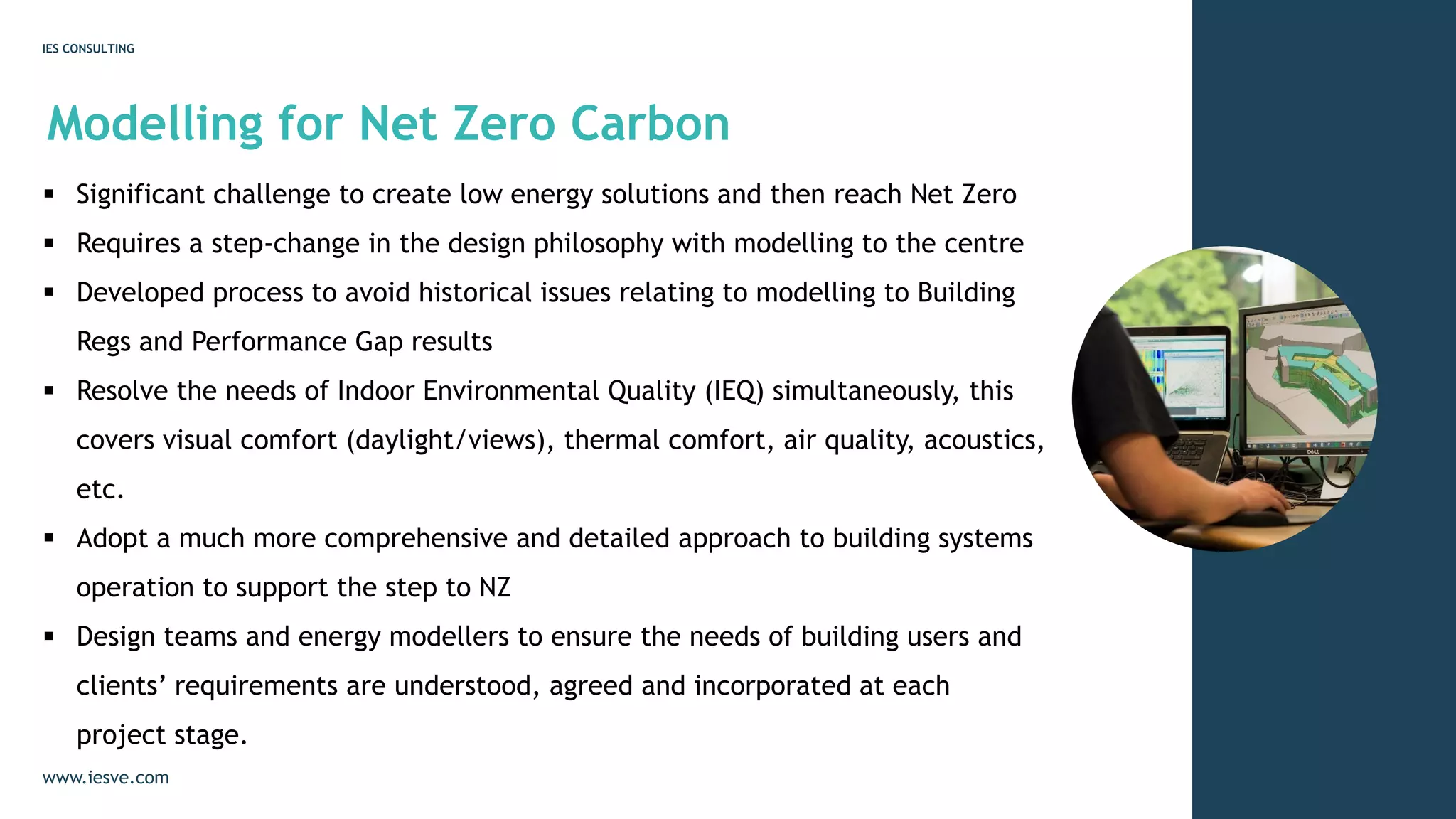
▪ Significant challenge to create low energy solutions and then reach Net Zero
▪ Requires a step-change in the design philosophy with modelling to the centre
▪ Developed process to avoid historical issues relating to modelling to Building
Regs and Performance Gap results
▪ Resolve the needs of Indoor Environmental Quality (IEQ) simultaneously, this
covers visual comfort (daylight/views), thermal comfort, air quality, acoustics,
etc.
▪ Adopt a much more comprehensive and detailed approach to building systems
operation to support the step to NZ
▪ Design teams and energy modellers to ensure the needs of building users and
clients’ requirements are understood, agreed and incorporated at each
project stage.
Modelling for Net Zero Carbon
IES CONSULTING
www.iesve.com
• Non-domestic properties offer complex challenges
• Uninformed decisions reduce the scope for delivering NZ solutions.
• Only reasonable approach is utilising a model to predict and support the
critical design decisions.
• Dynamic Simulation Modelling (sub-hourly analysis + building physics engine)
brought forward in the design process.
• Scope and depth of modelling to increase beyond pre-existing expectations
• Develop a modelling roadmap to support:
model input data checks > simulations + analysis > communicating findings
• Passive Design Opportunities into Operational Energy Performance
The Importance of a Modelling Process
IES CONSULTING
www.iesve.com
IES CONSULTING
www.iesve.com
• 'Passive Design’ principles take advantage of the climate to maintain a
comfortable temperature range in a building.
• Off the shelf options such as Passivhaus and EnerPHit provide low energy
design solutions alongside build quality > not direct NZ solutions
• Dynamic Simulation Modelling supports complete assessment of Energy
Demand > Systems Energy > Carbon Emissions AND assessing IEQ.
• At Concept Stage, early stage modelling to test/filter opportunities and
risks to the design
• Sensitivity modelling focuses on primary space types to develop the design
solutions.
• Block modelling is an initial representation to test building level solutions
e.g. solar exposure.
Dynamic Simulation Modelling of
Passive Design Strategies
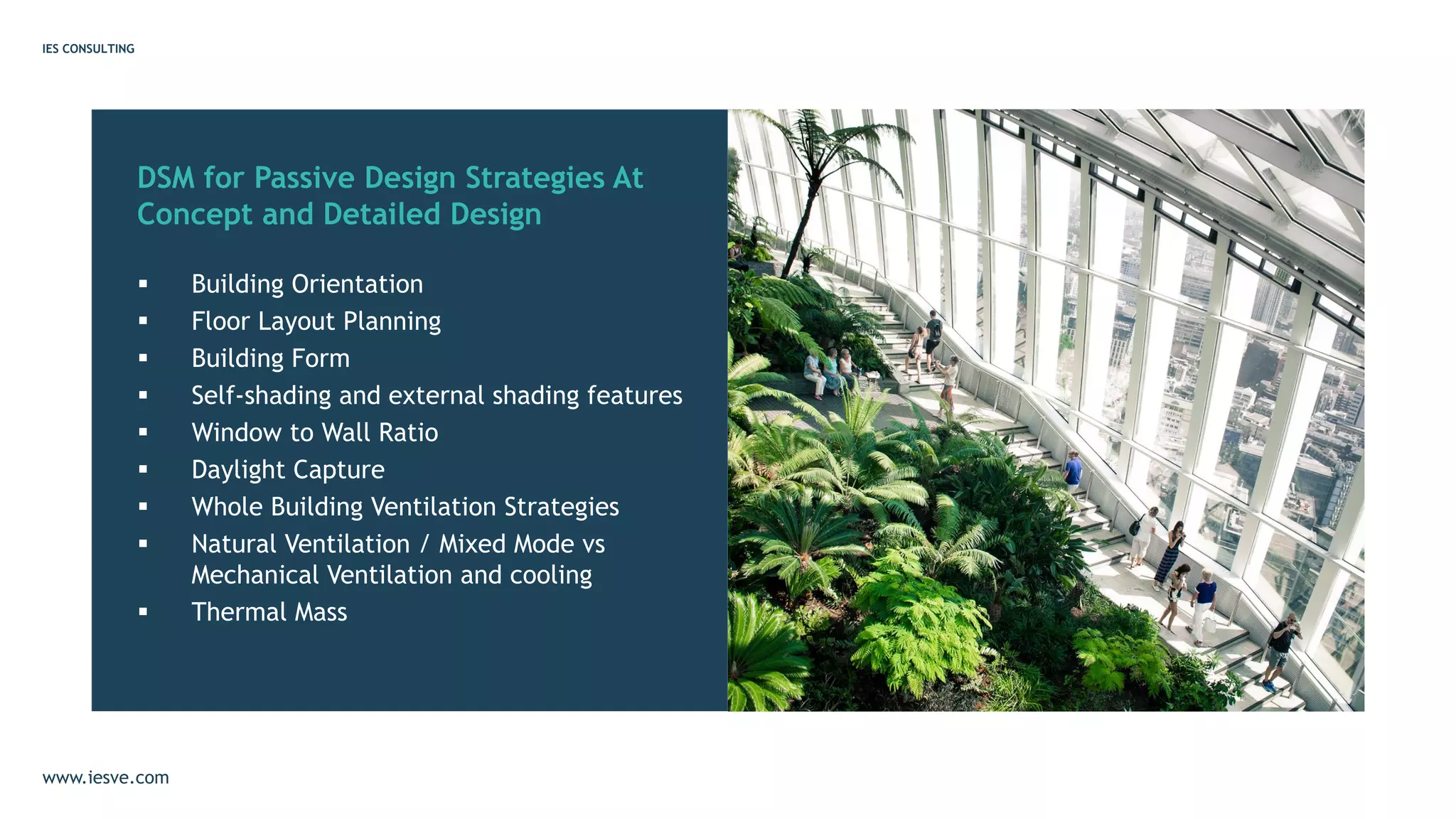
DSM for Passive Design Strategies At
Concept and Detailed Design
▪ Building Orientation
▪ Floor Layout Planning
▪ Building Form
▪ Self-shading and external shading features
▪ Window to Wall Ratio
▪ Daylight Capture
▪ Whole Building Ventilation Strategies
▪ Natural Ventilation / Mixed Mode vs
Mechanical Ventilation and cooling
▪ Thermal Mass
IES CONSULTING
www.iesve.com
IES CONSULTING
www.iesve.com
• Support project stakeholders understand how to obtain the right level of
DSM to make evidence-based decisions to meet Operational Energy
Targets
• The best opportunity is to lower energy demand and support with energy
efficient systems
• Use DSM to develop a ‘HVAC’ energy model to calculate and predict
annual energy – multiple simulation scenarios
• Develop sub-metering strategy to align to building operation
• Analyse CO2 emission factors for NZ viability/confirmation
• In-depth and levels based results views for full interrogation – no
guessing needed!
• The model can support this NZC ambition across its full life > Calibrated
Energy Model + Digital Twin
Dynamic Simulation Modelling for
Operational Energy & Net Zero
IES CONSULTING
www.iesve.com
• Heat Pumps – true part-load performance over seasonal efficiency / rated COP
conditions.
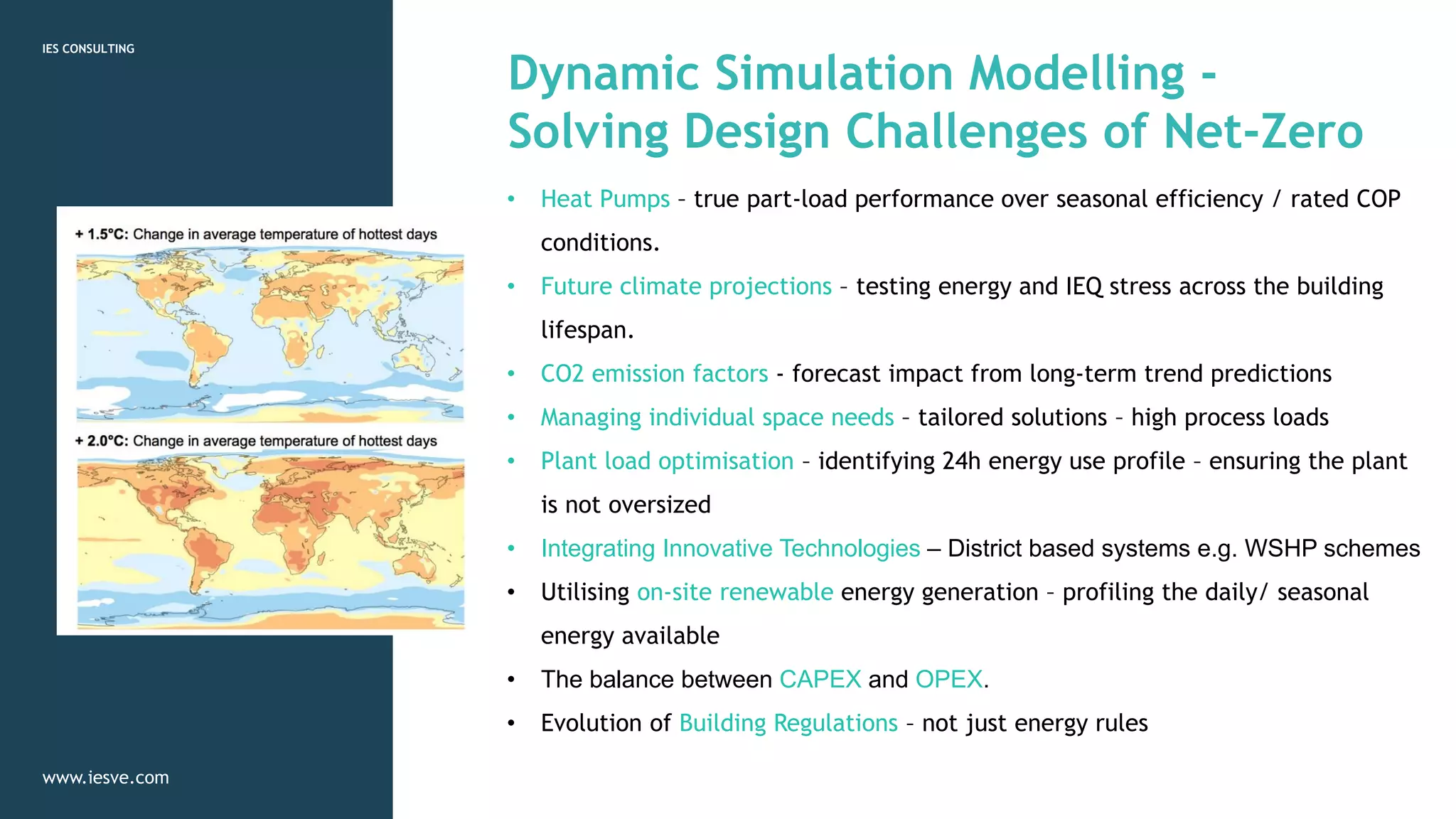
• Future climate projections – testing energy and IEQ stress across the building
lifespan.
• CO2 emission factors - forecast impact from long-term trend predictions
• Managing individual space needs – tailored solutions – high process loads
• Plant load optimisation – identifying 24h energy use profile – ensuring the plant
is not oversized
• Integrating Innovative Technologies – District based systems e.g. WSHP schemes
• Utilising on-site renewable energy generation – profiling the daily/ seasonal
energy available
• The balance between CAPEX and OPEX.
• Evolution of Building Regulations – not just energy rules
Dynamic Simulation Modelling -
Solving Design Challenges of Net-Zero
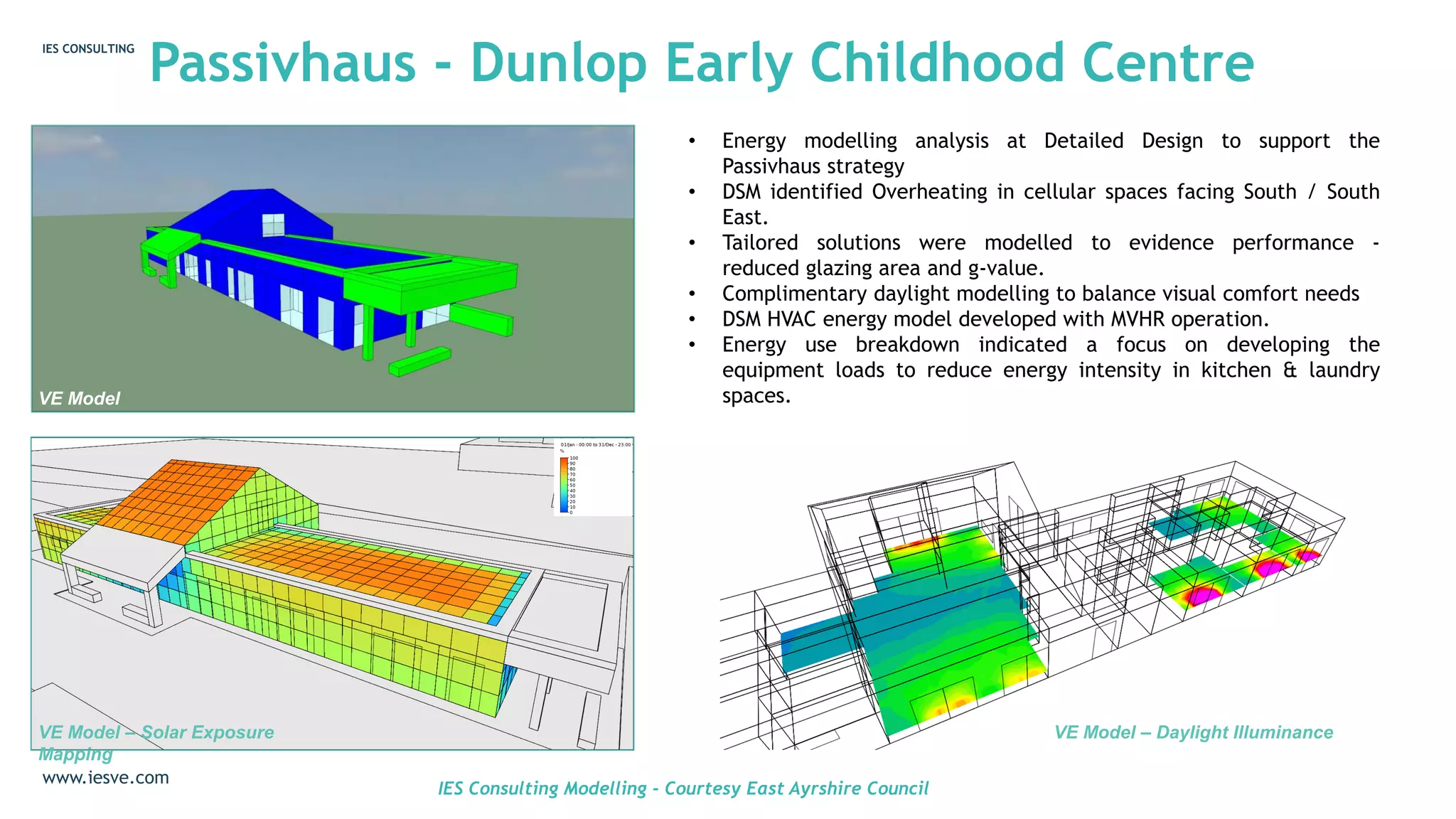
Passivhaus - Dunlop Early Childhood Centre
IES CONSULTING
www.iesve.com
• Energy modelling analysis at Detailed Design to support the
Passivhaus strategy
• DSM identified Overheating in cellular spaces facing South / South
East.
• Tailored solutions were modelled to evidence performance -
reduced glazing area and g-value.
• Complimentary daylight modelling to balance visual comfort needs
• DSM HVAC energy model developed with MVHR operation.
• Energy use breakdown indicated a focus on developing the
equipment loads to reduce energy intensity in kitchen & laundry
spaces.
IES Consulting Modelling - Courtesy East Ayrshire Council
VE Model
VE Model – Solar Exposure
Mapping
VE Model – Daylight Illuminance
EnerPHit - St Sophia’s Primary School
IES CONSULTING
www.iesve.com
• EnerPHIt target for a refurbished primary school
development.
• Challenge presented by ambition to retain the classrooms’
existing window aperture.
• Modelling central to analyse the conflict between maximising
daylight and eliminating overheating risk.
• DSM and CBDM daylight modelling evidenced the shading and
ventialtion strategy could prevent incoming solar gains and
overheating, whilst improving daylight uniformity.
IES Consulting Modelling - Courtesy East Ayrshire Council
VE Model – Window
Opening Strategy
VE Model – Room
Template Assignment
VE Model
Thank You
www.iesve.com
niall.gibson@iesve.com

How Local Authorities can meet Net-Zero Carbon targets by 2030: Niall Gibson & Colin Rees

  • 1.
    Local Authorities: Journey toNet Zero www.iesve.com 14th September 2021 Webinar
  • 2.
    www.iesve.com Todays Speakers &Agenda Modelling processes to support Net Zero Carbon ambitions Perth & Kinross Council: Journey to Net Zero Welcome & Introduction Niall Gibson: Business Development Manger - IES Chris Anton: Energy Lead Officer – Perth and Kinross Council Colin Rees: Head of Global VE Consultancy - IES
  • 3.
    Climate Emergency www.iesve.com Council climateLeague | Declare a Climate Emergency https://www.climateemergency.uk/council-climate-league/ 300/404 (74%) of District, County, Unitary & Metropolitan Councils have declared a Climate Emergency to date. Also 8 Combined Authorities/City Regions.
  • 4.
  • 5.
    Chris Anton Perth &Kinross: Journey to Net Zero www.iesve.com
  • 6.
    Colin Rees Modelling processesto support Net Zero Carbon ambitions www.iesve.com
  • 7.
    Modelling to SupportLocal Authorities Net-Zero Carbon Ambitions • How to use modelling processes across the design stages to support new and existing buildings in their Net Zero Carbon ambitions. • Case Study: Dynamic Simulation Modelling (DSM) services to Passivhaus and EnerPHit studies. IES CONSULTING www.iesve.com
  • 8.
    ▪ Significant challengeto create low energy solutions and then reach Net Zero ▪ Requires a step-change in the design philosophy with modelling to the centre ▪ Developed process to avoid historical issues relating to modelling to Building Regs and Performance Gap results ▪ Resolve the needs of Indoor Environmental Quality (IEQ) simultaneously, this covers visual comfort (daylight/views), thermal comfort, air quality, acoustics, etc. ▪ Adopt a much more comprehensive and detailed approach to building systems operation to support the step to NZ ▪ Design teams and energy modellers to ensure the needs of building users and clients’ requirements are understood, agreed and incorporated at each project stage. Modelling for Net Zero Carbon IES CONSULTING www.iesve.com
  • 9.
    • Non-domestic propertiesoffer complex challenges • Uninformed decisions reduce the scope for delivering NZ solutions. • Only reasonable approach is utilising a model to predict and support the critical design decisions. • Dynamic Simulation Modelling (sub-hourly analysis + building physics engine) brought forward in the design process. • Scope and depth of modelling to increase beyond pre-existing expectations • Develop a modelling roadmap to support: model input data checks > simulations + analysis > communicating findings • Passive Design Opportunities into Operational Energy Performance The Importance of a Modelling Process IES CONSULTING www.iesve.com
  • 10.
    IES CONSULTING www.iesve.com • 'PassiveDesign’ principles take advantage of the climate to maintain a comfortable temperature range in a building. • Off the shelf options such as Passivhaus and EnerPHit provide low energy design solutions alongside build quality > not direct NZ solutions • Dynamic Simulation Modelling supports complete assessment of Energy Demand > Systems Energy > Carbon Emissions AND assessing IEQ. • At Concept Stage, early stage modelling to test/filter opportunities and risks to the design • Sensitivity modelling focuses on primary space types to develop the design solutions. • Block modelling is an initial representation to test building level solutions e.g. solar exposure. Dynamic Simulation Modelling of Passive Design Strategies
  • 11.
    DSM for PassiveDesign Strategies At Concept and Detailed Design ▪ Building Orientation ▪ Floor Layout Planning ▪ Building Form ▪ Self-shading and external shading features ▪ Window to Wall Ratio ▪ Daylight Capture ▪ Whole Building Ventilation Strategies ▪ Natural Ventilation / Mixed Mode vs Mechanical Ventilation and cooling ▪ Thermal Mass IES CONSULTING www.iesve.com
  • 12.
    IES CONSULTING www.iesve.com • Supportproject stakeholders understand how to obtain the right level of DSM to make evidence-based decisions to meet Operational Energy Targets • The best opportunity is to lower energy demand and support with energy efficient systems • Use DSM to develop a ‘HVAC’ energy model to calculate and predict annual energy – multiple simulation scenarios • Develop sub-metering strategy to align to building operation • Analyse CO2 emission factors for NZ viability/confirmation • In-depth and levels based results views for full interrogation – no guessing needed! • The model can support this NZC ambition across its full life > Calibrated Energy Model + Digital Twin Dynamic Simulation Modelling for Operational Energy & Net Zero
  • 13.
    IES CONSULTING www.iesve.com • HeatPumps – true part-load performance over seasonal efficiency / rated COP conditions. • Future climate projections – testing energy and IEQ stress across the building lifespan. • CO2 emission factors - forecast impact from long-term trend predictions • Managing individual space needs – tailored solutions – high process loads • Plant load optimisation – identifying 24h energy use profile – ensuring the plant is not oversized • Integrating Innovative Technologies – District based systems e.g. WSHP schemes • Utilising on-site renewable energy generation – profiling the daily/ seasonal energy available • The balance between CAPEX and OPEX. • Evolution of Building Regulations – not just energy rules Dynamic Simulation Modelling - Solving Design Challenges of Net-Zero
  • 14.
    Passivhaus - DunlopEarly Childhood Centre IES CONSULTING www.iesve.com • Energy modelling analysis at Detailed Design to support the Passivhaus strategy • DSM identified Overheating in cellular spaces facing South / South East. • Tailored solutions were modelled to evidence performance - reduced glazing area and g-value. • Complimentary daylight modelling to balance visual comfort needs • DSM HVAC energy model developed with MVHR operation. • Energy use breakdown indicated a focus on developing the equipment loads to reduce energy intensity in kitchen & laundry spaces. IES Consulting Modelling - Courtesy East Ayrshire Council VE Model VE Model – Solar Exposure Mapping VE Model – Daylight Illuminance
  • 15.
    EnerPHit - StSophia’s Primary School IES CONSULTING www.iesve.com • EnerPHIt target for a refurbished primary school development. • Challenge presented by ambition to retain the classrooms’ existing window aperture. • Modelling central to analyse the conflict between maximising daylight and eliminating overheating risk. • DSM and CBDM daylight modelling evidenced the shading and ventialtion strategy could prevent incoming solar gains and overheating, whilst improving daylight uniformity. IES Consulting Modelling - Courtesy East Ayrshire Council VE Model – Window Opening Strategy VE Model – Room Template Assignment VE Model
  • 16.