Master Class:
  High-Performance
   Building Design


Jerry Yudelson, PE, LEED Fellow
Yudelson Associates
Take-Aways
  Green buildings are important for
  controlling CO2 emissions
  High-performance buildings are
  feasible today
  No new technologies; just new
  Integrated Design Process

  Energy use metrics well established
  at 100-150 kWh/sqm/year
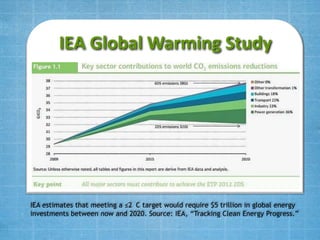
IEA Global Warming Study


IEA estimates that meeting a ≤2 C target would require $5 trillion in global energy
investments between now and 2020. Source: IEA, “Tracking Clean Energy Progress.”
Agenda
• LEED Platinum Case Studies
  – High-Performance Buildings
• Designing for High-Performance
  – Integrated Design Process
• Exercise
• Case Study:
  NREL Research Support Facility, USA
• Discussion
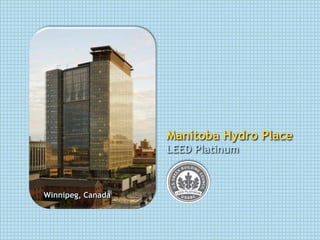
Manitoba Hydro Place
                   LEED Platinum


Winnipeg, Canada
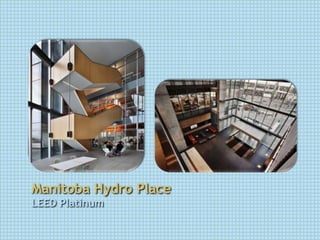
Manitoba Hydro Place
LEED Platinum
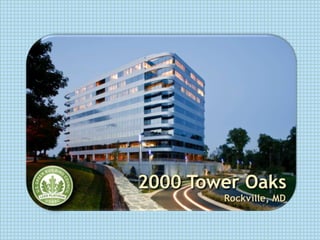
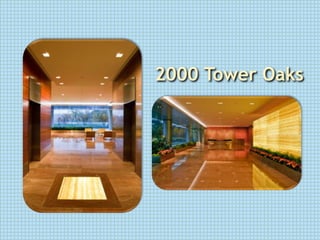
2000 Tower Oaks
        Rockville, MD
2000 Tower Oaks
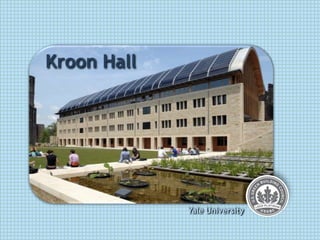
Kroon Hall


             Yale University
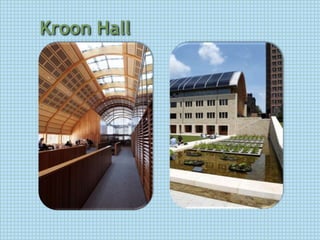
Kroon Hall
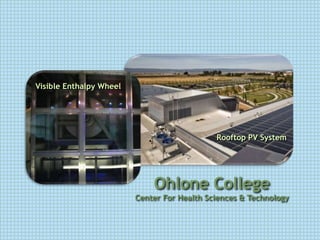
Ohlone College


 Newark, CA
Visible Enthalpy Wheel


                                             Rooftop PV System


                             Ohlone College
                         Center For Health Sciences & Technology
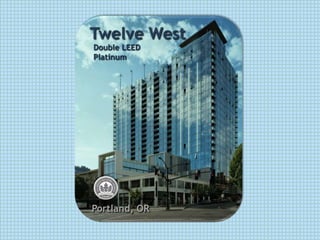
Twelve West
Double LEED
Platinum


Portland, OR
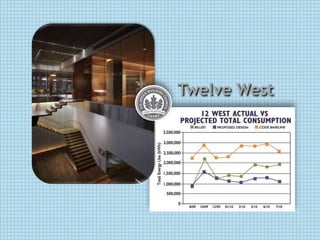
Twelve West
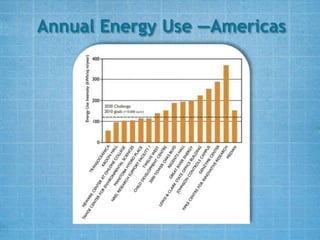
Annual Energy Use —Americas
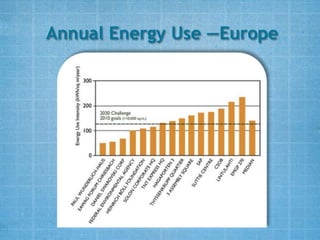
Annual Energy Use —Europe
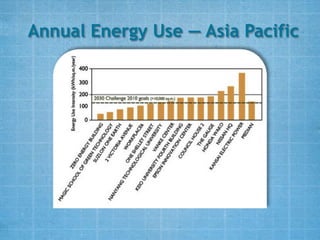
Annual Energy Use — Asia Pacific
ISSUES?

   • First-cost concerns
   • Demonstrate financial cost-effectiveness
      – ROI
      – Increase in building value
      – Risk mitigation
      – Intangibles
   • Concern over actual building performance
      – Projects need continuous
        commissioning
      – Renewables have to work as planned
      – Behavioral issues & plug loads must
        be managed
TRENDS?

   • Widespread low-energy design know-how
      – Cost premium for good design getting
        smaller
   • More stringent energy codes (US, EU, AUS)
      – Reduces first-cost premium for net-zero
      – Better products at conventional costs
   • Solar power cost reductions/efficiency gains
   • Increases in conventional energy costs
      – Shorter payback for savings
   • Carbon reduction goals by increased
     perceived/actual value of green or
     net-zero buildings
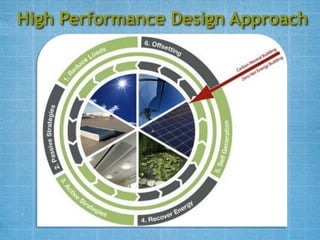
High Performance Design Approach
High Performance Buildings

•   Site selection & orientation
•   Passive solar design
•   Building envelope design & construction
•   Integration of low-energy building systems
•   Controlling lighting/plug loads
•   Occupant engagement
•   Renewable energy systems
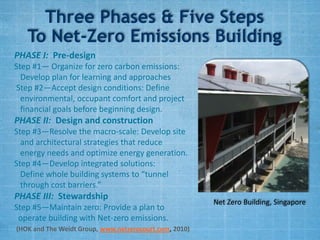
Three Phases & Five Steps
   To Net-Zero Emissions Building
PHASE I: Pre-design
Step #1— Organize for zero carbon emissions:
  Develop plan for learning and approaches
Step #2—Accept design conditions: Define
  environmental, occupant comfort and project
  financial goals before beginning design.
PHASE II: Design and construction
Step #3—Resolve the macro-scale: Develop site
  and architectural strategies that reduce
  energy needs and optimize energy generation.
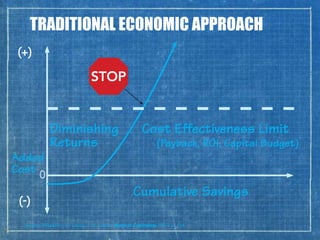
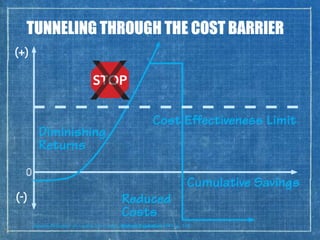
Step #4—Develop integrated solutions:
  Define whole building systems to “tunnel
  through cost barriers.”
PHASE III: Stewardship
                                                        Net Zero Building, Singapore
Step #5—Maintain zero: Provide a plan to
 operate building with Net-zero emissions.
(HOK and The Weidt Group, www.netzerocourt.com, 2010)
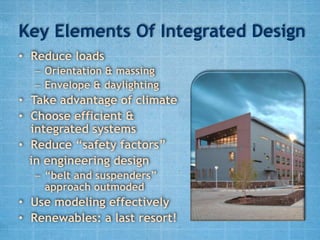
Key Elements Of Integrated Design
• Reduce loads
  – Orientation & massing
  – Envelope & daylighting
• Take advantage of climate
• Choose efficient &
  integrated systems
• Reduce “safety factors”
  in engineering design
  – “belt and suspenders”
    approach outmoded
• Use modeling effectively
• Renewables: a last resort!
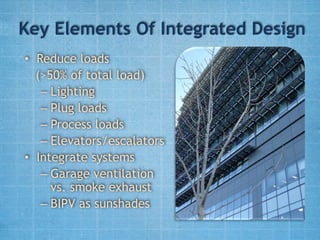
Key Elements Of Integrated Design
• Reduce loads
  (>50% of total load)
   – Lighting
   – Plug loads
   – Process loads
   – Elevators/escalators
• Integrate systems
   – Garage ventilation
     vs. smoke exhaust
   – BIPV as sunshades
Key Elements Of Integrated Design
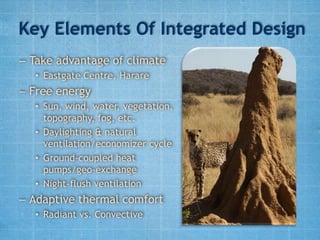
– Take advantage of climate
  • Eastgate Centre, Harare
– Free energy
  • Sun, wind, water, vegetation,
    topography, fog, etc.
  • Daylighting & natural
    ventilation/economizer cycle
  • Ground-coupled heat
    pumps/geo-exchange
  • Night-flush ventilation
– Adaptive thermal comfort
  • Radiant vs. Convective
Integrated Design Process
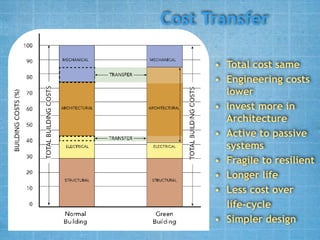
Cost Transfer

      • Total cost same
      • Engineering costs
        lower
      • Invest more in
        Architecture
      • Active to passive
        systems
      • Fragile to resilient
      • Longer life
      • Less cost over
        life-cycle
      • Simpler design
WHY IDP
• Collaboration         • Develop synergies
• Team-building/trust   • Systems integration
• Goal-setting          • Clearer direction
• Blue-sky ideas        • Reduced design time
• Better design         • Transparency of
  decisions               design decisions
• Improved overall      • Higher-performance
  decision-making
HOW IDP
• Commit to process      • Eco-charrette(s)
• Change procurement     • Team-building activity
  methods                • Collaborative team
• Broaden the team         meetings
• Set specific           • Contractor(s) on board
  performance goals        early
• Expect greater time    • Stay within budget &
  in early design          construction
• Early-stage modeling     capabilities
                         • Iterative design vs.
                           goals
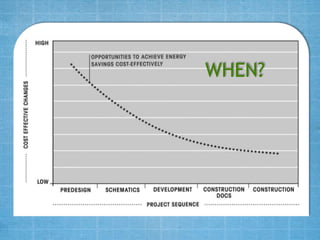
WHEN?
STARTING EARLY
• Identify potential partners/collaborations
• Set clear goals and metrics
• Establish “must have’s” in design
• Don’t re-design at DD/CD phase
• Reduce/eliminate “value engineering”
• Provide a basis for evaluating design
  strategies
• Initiate a multidisciplinary design approach
• Induce creativity from team members
STARTING EARLY
• Ask the right question at the right time!
  –   Do we need this building at all? 
  –   How big does it need to be? Now? In 10 years?
  –   Can we design it for alternative uses in the future?
  –   How does carpet & desk color influence lighting
      design?
  –   What “free energy” can we take advantage of?
  –   How much money is available outside the building
      budget?
  –   What do the future occupants value most?
  –   What controls can future operators manage?
  –   How will we know if we’re successful?
USE MODELING
              EFFECTIVELY
• Pre-design:
  climate analysis/infrastructure issues
• Design charrette (goal setting, site design)
• Schematic design (shape, massing, daylighting,
  envelope, HVAC options, base case for energy)
• Design development (systems optimization, Green
  Star progress vs. goals)
• Construction documents (value engineering, final
  energy model, document for Green Star)
• Commissioning/M&V (calibrate model, troubleshoot)
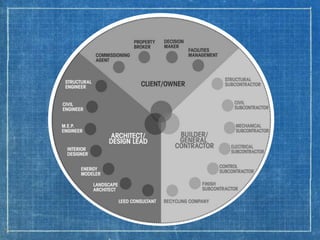
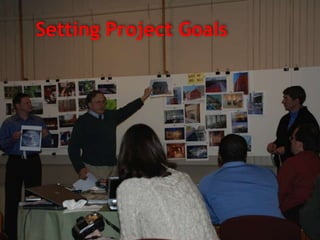
Setting Project Goals
IDP TOOLKIT

• Collaborative team         • Evaluation & feedback
  meetings                     tools & processes
• Problem-solving            • Expert facilitation
  workshops                  • Modeling tools
• Specific goals/targets     • Green Star/LEED checklist
• Tracking tools             • Establish Owner’s Project
• Clear communication          Requirements (OPR)
  channels                   • Basis of design document
• Team-building activities     (BOD)
IDP OUTCOMES
• Clarity in overall project goals &
  measurements
• Clear sustainability goals of owner and
  project team
• Buy-in from all stakeholders
• Assess entire building life-cycle
  – vs. just construction costs
• Identify roles and responsibilities early on
• Introduce Green Star/LEED &
  set certification goals
Exercise
• Develop design issues and possible
  solutions for a building in Cape Town,
  using integrated design and high-
  performance goals
  – Office
  – Secondary School
  – University Classroom
  – Retail store of 50,000 sq.ft.
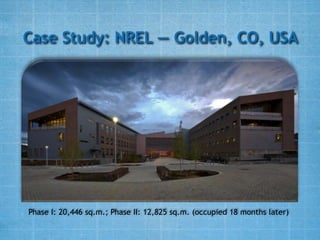
Case Study: NREL — Golden, CO, USA


Phase I: 20,446 sq.m.; Phase II: 12,825 sq.m. (occupied 18 months later)
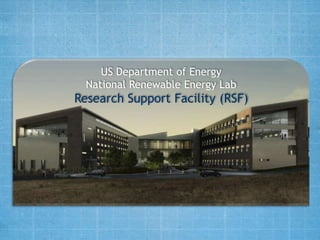
US Department of Energy
  National Renewable Energy Lab
Research Support Facility (RSF)
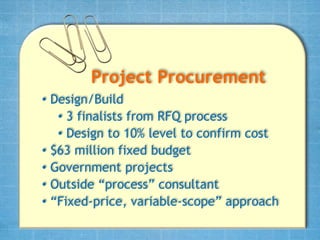
Project Procurement
• Design/Build
   • 3 finalists from RFQ process
   • Design to 10% level to confirm cost
• $63 million fixed budget
• Government projects
• Outside “process” consultant
• “Fixed-price, variable-scope” approach
Project Objectives
       1. Mission Critical (3)
         • Safety
         • LEED Platinum
         • Energy Star (US)
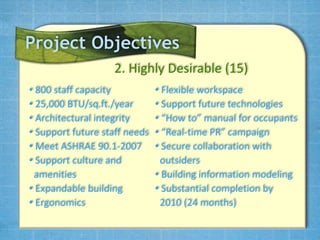
Project Objectives
                   2. Highly Desirable (15)
• 800 staff capacity           • Flexible workspace
• 25,000 BTU/sq.ft./year       • Support future technologies
• Architectural integrity      • “How to” manual for occupants
• Support future staff needs   • “Real-time PR” campaign
• Meet ASHRAE 90.1-2007        • Secure collaboration with
• Support culture and           outsiders
 amenities                     • Building information modeling
• Expandable building          • Substantial completion by
• Ergonomics                    2010 (24 months)
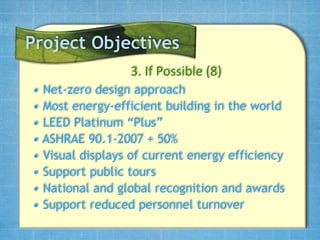
Project Objectives
                 3. If Possible (8)
• Net-zero design approach
• Most energy-efficient building in the world
• LEED Platinum “Plus”
• ASHRAE 90.1-2007 + 50%
• Visual displays of current energy efficiency
• Support public tours
• National and global recognition and awards
• Support reduced personnel turnover
High-Performance
 Design Process
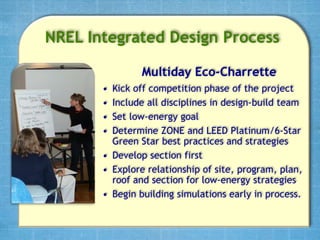
NREL Integrated Design Process

                Multiday Eco-Charrette
       • Kick off competition phase of the project
       • Include all disciplines in design-build team
       • Set low-energy goal
       • Determine ZONE and LEED Platinum/6-Star
         Green Star best practices and strategies
       • Develop section first
       • Explore relationship of site, program, plan,
         roof and section for low-energy strategies
       • Begin building simulations early in process.
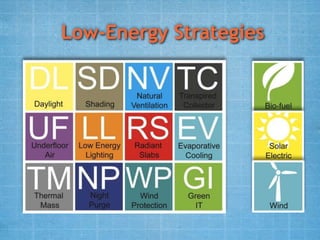
Low-Energy Strategies
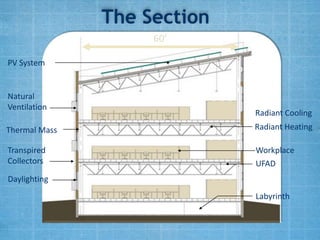
The Section
                    60’

PV System


Natural
Ventilation
                             Radiant Cooling
Thermal Mass                 Radiant Heating

Transpired                   Workplace
Collectors                   UFAD
Daylighting
                             Labyrinth
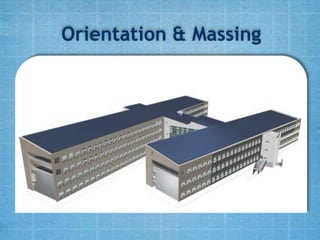
Orientation & Massing
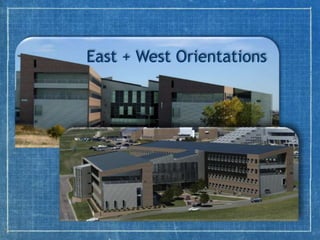
East + West Orientations
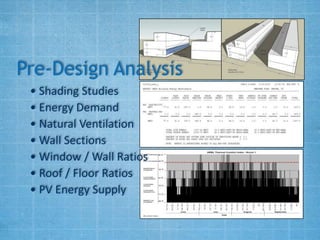
Pre-Design Analysis
 • Shading Studies
 • Energy Demand
 • Natural Ventilation
 • Wall Sections
 • Window / Wall Ratios
 • Roof / Floor Ratios
 • PV Energy Supply
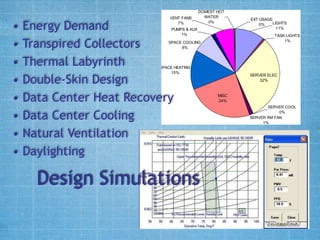
DOMEST HOT                           NREL RSF
                            VENT FANS        WATER
                                                         EXT USAGE

• Energy Demand                7%             0%                  LIGHTS
                                                             0%
                             PUMPS & AUX                            11%
                                                                                     LIG
                                 1%                               TASK LIGHTS        TA

• Transpired Collectors    SPACE COOLING
                                8%
                                                                      1%
                                                                                     SE
                                                                                     SE
                                                                                     SE

• Thermal Labyrinth     SPACE HEATING
                                                                                     MI
                                                                                     SP
                            15%

• Double-Skin Design
                                                         SERVER ELEC                 SP
                                                             32%                     PU
                                                                                     VE


• Data Center Heat Recovery
                                                                                     DO
                                                  MISC
                                                  24%                                EX
                                                                SERVER COOL

• Data Center Cooling                                                0%
                                                         SERVER RM FAN
                                                              1%


• Natural Ventilation
• Daylighting

    Design Simulations
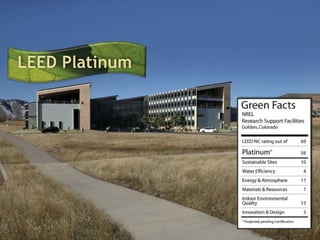
LEED Platinum
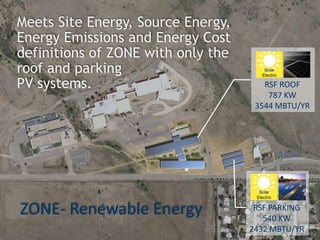
Meets Site Energy, Source Energy,
Energy Emissions and Energy Cost
definitions of ZONE with only the
roof and parking
PV systems.                            RSF ROOF
                                        787 KW
                                     3544 MBTU/YR


ZONE- Renewable Energy               RSF PARKING
                                       540 KW
                                    2432 MBTU/YR
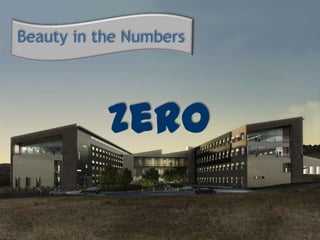
Beauty in the Numbers


           Zero
Take-Aways
  Green buildings are important for
  controlling CO2 emissions
  High-performance buildings are
  feasible today
  No new technologies; just new
  Integrated Design Process

  Energy use metrics well established
  at 100-150 kWh/sqm/year
High-Performance. . .
Just Do It!
Discussion
High Performance Building Design Workshop

High Performance Building Design Workshop

  • 1.
    Master Class: High-Performance Building Design Jerry Yudelson, PE, LEED Fellow Yudelson Associates
  • 2.
    Take-Aways Greenbuildings are important for controlling CO2 emissions High-performance buildings are feasible today No new technologies; just new Integrated Design Process Energy use metrics well established at 100-150 kWh/sqm/year
  • 3.
    IEA Global WarmingStudy IEA estimates that meeting a ≤2 C target would require $5 trillion in global energy investments between now and 2020. Source: IEA, “Tracking Clean Energy Progress.”
  • 4.
    Agenda • LEED PlatinumCase Studies – High-Performance Buildings • Designing for High-Performance – Integrated Design Process • Exercise • Case Study: NREL Research Support Facility, USA • Discussion
  • 5.
    Manitoba Hydro Place LEED Platinum Winnipeg, Canada
  • 6.
  • 7.
    2000 Tower Oaks Rockville, MD
  • 8.
  • 9.
    Kroon Hall Yale University
  • 10.
  • 11.
  • 12.
    Visible Enthalpy Wheel Rooftop PV System Ohlone College Center For Health Sciences & Technology
  • 13.
  • 14.
  • 15.
    Annual Energy Use—Americas
  • 16.
  • 17.
    Annual Energy Use— Asia Pacific
  • 18.
    ISSUES? • First-cost concerns • Demonstrate financial cost-effectiveness – ROI – Increase in building value – Risk mitigation – Intangibles • Concern over actual building performance – Projects need continuous commissioning – Renewables have to work as planned – Behavioral issues & plug loads must be managed
  • 19.
    TRENDS? • Widespread low-energy design know-how – Cost premium for good design getting smaller • More stringent energy codes (US, EU, AUS) – Reduces first-cost premium for net-zero – Better products at conventional costs • Solar power cost reductions/efficiency gains • Increases in conventional energy costs – Shorter payback for savings • Carbon reduction goals by increased perceived/actual value of green or net-zero buildings
  • 20.
  • 21.
    High Performance Buildings • Site selection & orientation • Passive solar design • Building envelope design & construction • Integration of low-energy building systems • Controlling lighting/plug loads • Occupant engagement • Renewable energy systems
  • 22.
    Three Phases &Five Steps To Net-Zero Emissions Building PHASE I: Pre-design Step #1— Organize for zero carbon emissions: Develop plan for learning and approaches Step #2—Accept design conditions: Define environmental, occupant comfort and project financial goals before beginning design. PHASE II: Design and construction Step #3—Resolve the macro-scale: Develop site and architectural strategies that reduce energy needs and optimize energy generation. Step #4—Develop integrated solutions: Define whole building systems to “tunnel through cost barriers.” PHASE III: Stewardship Net Zero Building, Singapore Step #5—Maintain zero: Provide a plan to operate building with Net-zero emissions. (HOK and The Weidt Group, www.netzerocourt.com, 2010)
  • 23.
    Key Elements OfIntegrated Design • Reduce loads – Orientation & massing – Envelope & daylighting • Take advantage of climate • Choose efficient & integrated systems • Reduce “safety factors” in engineering design – “belt and suspenders” approach outmoded • Use modeling effectively • Renewables: a last resort!
  • 24.
    Key Elements OfIntegrated Design • Reduce loads (>50% of total load) – Lighting – Plug loads – Process loads – Elevators/escalators • Integrate systems – Garage ventilation vs. smoke exhaust – BIPV as sunshades
  • 25.
    Key Elements OfIntegrated Design – Take advantage of climate • Eastgate Centre, Harare – Free energy • Sun, wind, water, vegetation, topography, fog, etc. • Daylighting & natural ventilation/economizer cycle • Ground-coupled heat pumps/geo-exchange • Night-flush ventilation – Adaptive thermal comfort • Radiant vs. Convective
  • 26.
  • 29.
    Cost Transfer • Total cost same • Engineering costs lower • Invest more in Architecture • Active to passive systems • Fragile to resilient • Longer life • Less cost over life-cycle • Simpler design
  • 30.
    WHY IDP • Collaboration • Develop synergies • Team-building/trust • Systems integration • Goal-setting • Clearer direction • Blue-sky ideas • Reduced design time • Better design • Transparency of decisions design decisions • Improved overall • Higher-performance decision-making
  • 31.
    HOW IDP • Committo process • Eco-charrette(s) • Change procurement • Team-building activity methods • Collaborative team • Broaden the team meetings • Set specific • Contractor(s) on board performance goals early • Expect greater time • Stay within budget & in early design construction • Early-stage modeling capabilities • Iterative design vs. goals
  • 32.
  • 33.
    STARTING EARLY • Identifypotential partners/collaborations • Set clear goals and metrics • Establish “must have’s” in design • Don’t re-design at DD/CD phase • Reduce/eliminate “value engineering” • Provide a basis for evaluating design strategies • Initiate a multidisciplinary design approach • Induce creativity from team members
  • 34.
    STARTING EARLY • Askthe right question at the right time! – Do we need this building at all?  – How big does it need to be? Now? In 10 years? – Can we design it for alternative uses in the future? – How does carpet & desk color influence lighting design? – What “free energy” can we take advantage of? – How much money is available outside the building budget? – What do the future occupants value most? – What controls can future operators manage? – How will we know if we’re successful?
  • 35.
    USE MODELING EFFECTIVELY • Pre-design: climate analysis/infrastructure issues • Design charrette (goal setting, site design) • Schematic design (shape, massing, daylighting, envelope, HVAC options, base case for energy) • Design development (systems optimization, Green Star progress vs. goals) • Construction documents (value engineering, final energy model, document for Green Star) • Commissioning/M&V (calibrate model, troubleshoot)
  • 37.
  • 39.
    IDP TOOLKIT • Collaborativeteam • Evaluation & feedback meetings tools & processes • Problem-solving • Expert facilitation workshops • Modeling tools • Specific goals/targets • Green Star/LEED checklist • Tracking tools • Establish Owner’s Project • Clear communication Requirements (OPR) channels • Basis of design document • Team-building activities (BOD)
  • 40.
    IDP OUTCOMES • Clarityin overall project goals & measurements • Clear sustainability goals of owner and project team • Buy-in from all stakeholders • Assess entire building life-cycle – vs. just construction costs • Identify roles and responsibilities early on • Introduce Green Star/LEED & set certification goals
  • 41.
    Exercise • Develop designissues and possible solutions for a building in Cape Town, using integrated design and high- performance goals – Office – Secondary School – University Classroom – Retail store of 50,000 sq.ft.
  • 43.
    Case Study: NREL— Golden, CO, USA Phase I: 20,446 sq.m.; Phase II: 12,825 sq.m. (occupied 18 months later)
  • 44.
    US Department ofEnergy National Renewable Energy Lab Research Support Facility (RSF)
  • 45.
    Project Procurement • Design/Build • 3 finalists from RFQ process • Design to 10% level to confirm cost • $63 million fixed budget • Government projects • Outside “process” consultant • “Fixed-price, variable-scope” approach
  • 46.
    Project Objectives 1. Mission Critical (3) • Safety • LEED Platinum • Energy Star (US)
  • 47.
    Project Objectives 2. Highly Desirable (15) • 800 staff capacity • Flexible workspace • 25,000 BTU/sq.ft./year • Support future technologies • Architectural integrity • “How to” manual for occupants • Support future staff needs • “Real-time PR” campaign • Meet ASHRAE 90.1-2007 • Secure collaboration with • Support culture and outsiders amenities • Building information modeling • Expandable building • Substantial completion by • Ergonomics 2010 (24 months)
  • 48.
    Project Objectives 3. If Possible (8) • Net-zero design approach • Most energy-efficient building in the world • LEED Platinum “Plus” • ASHRAE 90.1-2007 + 50% • Visual displays of current energy efficiency • Support public tours • National and global recognition and awards • Support reduced personnel turnover
  • 49.
  • 50.
    NREL Integrated DesignProcess Multiday Eco-Charrette • Kick off competition phase of the project • Include all disciplines in design-build team • Set low-energy goal • Determine ZONE and LEED Platinum/6-Star Green Star best practices and strategies • Develop section first • Explore relationship of site, program, plan, roof and section for low-energy strategies • Begin building simulations early in process.
  • 51.
  • 52.
    The Section 60’ PV System Natural Ventilation Radiant Cooling Thermal Mass Radiant Heating Transpired Workplace Collectors UFAD Daylighting Labyrinth
  • 53.
  • 54.
    East + WestOrientations
  • 55.
    Pre-Design Analysis •Shading Studies • Energy Demand • Natural Ventilation • Wall Sections • Window / Wall Ratios • Roof / Floor Ratios • PV Energy Supply
  • 56.
    DOMEST HOT NREL RSF VENT FANS WATER EXT USAGE • Energy Demand 7% 0% LIGHTS 0% PUMPS & AUX 11% LIG 1% TASK LIGHTS TA • Transpired Collectors SPACE COOLING 8% 1% SE SE SE • Thermal Labyrinth SPACE HEATING MI SP 15% • Double-Skin Design SERVER ELEC SP 32% PU VE • Data Center Heat Recovery DO MISC 24% EX SERVER COOL • Data Center Cooling 0% SERVER RM FAN 1% • Natural Ventilation • Daylighting Design Simulations
  • 57.
  • 58.
    Meets Site Energy,Source Energy, Energy Emissions and Energy Cost definitions of ZONE with only the roof and parking PV systems. RSF ROOF 787 KW 3544 MBTU/YR ZONE- Renewable Energy RSF PARKING 540 KW 2432 MBTU/YR
  • 59.
    Beauty in theNumbers Zero
  • 60.
    Take-Aways Greenbuildings are important for controlling CO2 emissions High-performance buildings are feasible today No new technologies; just new Integrated Design Process Energy use metrics well established at 100-150 kWh/sqm/year
  • 61.
  • 62.

Editor's Notes

  • #6 2000 workers in bldg.; 700,000 sq.ft.Difficult climate:-35C to +35C (-31F – 95F)22-story solar chimney Passive solar designUrban regenerationGreen roofsPassive moisture control111 kWh/sqm/year;35,000 Btu/sq.ft./yr
  • #8 800 workers in bldg.; 360,000 sq.ft.Design/build; $254/sq.ft.Cold, dry climate - Passive solar design1600-kW Solar PVLabyrinth thermal massDaylighting designControl plug loads111 kWh/sqm/year;35,000 Btu/sq.ft./yr
  • #9 Integrated Design Process Critical to SuccessStarted with the Procurement ProcessSet BSAGs – Big, Scary, Audacious Goals
  • #10 200,000-sq.ft., commercial officeVedic architectural designLEED-CS/CILong axis north/south, to maximize morning sunHVAC: Enthalpy wheel, frictionless chillerSpace H/C only 13% 41% less water use182 kWh/sq.m./year;58,000 Btu/sq.ft./yr
  • #12 56,000 sq.ft. academic building; narrow floorplateCold winters, humid summers100-KW BIPV system; 16% of annual electricity4 solar DHW collectorsGeothermal wells; four at 400’ deepRainwater harvesting91 kWh/sq.m./year; 29,000 Btu/sq.ft./yr
  • #14 130,000-sq.ft., 2-story academic buildingSF Bay Area; mild climate35,000-sq.ft. BIPV system; 450 kW (peak)PV >50% of energy use26 miles of horizontal geothermal tubingTwo 16-ft dia., enthalpy (heat recovery) wheels102 kWh/sq.m./year;32,000 Btu/sq.ft./yr
  • #16 Double LEED Platinum, CS/CIFour stories commercial office, with17 stories rental apartmentsUnderfloor air w/chilled beamsDesigned to meet 2030 Challenge targets for 20104 turbines produce 1% of demandSolar water heaters provide 24%Operable windowsHarvested rainwater; 6500 sq.ft. green roofEnergy: 138 kWh/sq.m./year; 44,000 Btu/sq.ft.
  • #41 Project Team?
  • #42 SETTING PROJECT GOALS
  • #43 Project Goals
  • #44 GREEN-STAR/LEED GOALS?