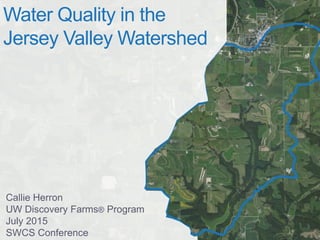
Water Quality in the
Jersey Valley Watershed
Callie Herron
UW Discovery Farms® Program
July 2015
SWCS Conference
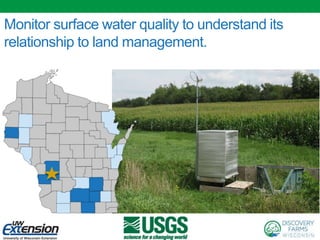
Monitor surface water quality to understand its
relationship to land management.
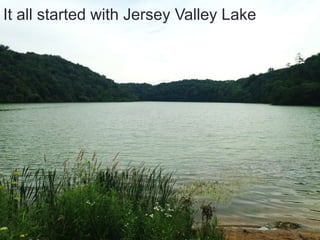
It all started with Jersey Valley Lake
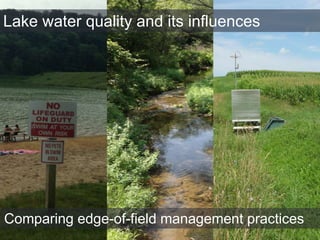
Lake water quality and its influences
Comparing edge-of-field management practices
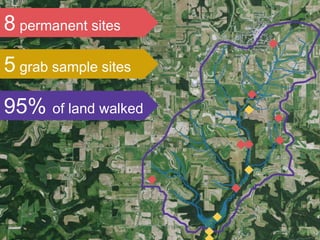
8 permanent sites
5 grab sample sites
95% of land walked
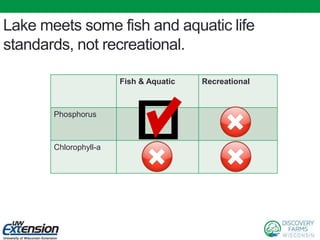
Lake meets some fish and aquatic life
standards, not recreational.
Fish & Aquatic Recreational
Phosphorus
Chlorophyll-a
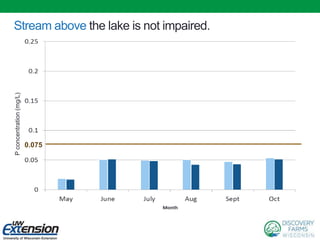
Pconcentration(mg/L)
Stream above the lake is not impaired.
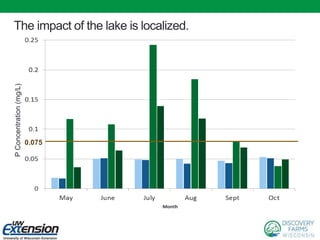
0.075
PConcentration(mg/L)
The impact of the lake is localized.
0.075
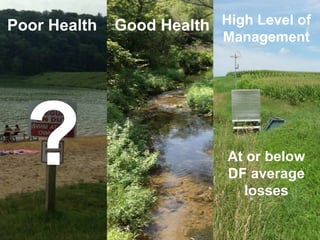
Poor Health Good Health High Level of
Management
At or below
DF average
losses
?
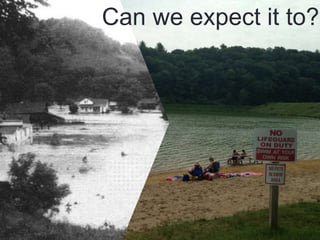
Should it? Can we expect it to?
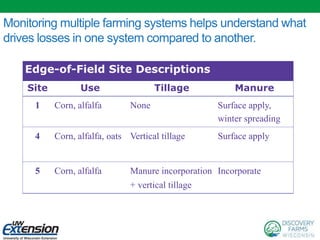
Monitoring multiple farming systems helps understand what
drives losses in one system compared to another.
Edge-of-Field Site Descriptions
Site Use Tillage Manure
1 Corn, alfalfa None Surface apply,
winter spreading
4 Corn, alfalfa, oats Vertical tillage Surface apply
5 Corn, alfalfa Manure incorporation
+ vertical tillage
Incorporate
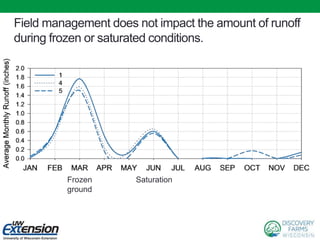
Field management does not impact the amount of runoff
during frozen or saturated conditions.
Frozen
ground
Saturation
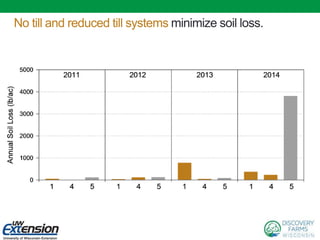
No till and reduced till systems minimize soil loss.
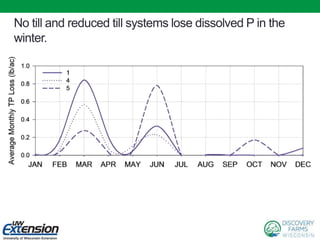
No till and reduced till systems lose dissolved P in the
winter.
Maintain conservation
practices.
Get nutrients below
the surface.
Protect the soil
surface.
The journey continues…
callie.herron@ces.uwex.edu
www.uwdiscoveryfarms.org
@DiscoveryFarms UW Discovery Farms

Water Quality Monitoring in the Jersey Valley Watershed - Herron

Editor's Notes

  • #3 Goal: identify and reduce the sources of sediment, p, and nitrogen that impair surface water 200 site years Measure the quantity and quality of water – P, N, Sediment
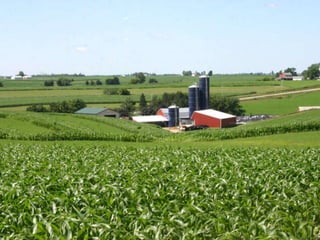
  • #4 5,000 acres Driftless region Land use is primarily agricultural, with the majority of land being used to supply farms with corn and forages for dairy cattle Began project in 2010 Steep slopes, highly erodible soil, farmland Use of conservation practices – contour strips, grass waterways
  • #5 Fish kill in early 2000s. Community really wanted to know what was the cause. Farmers really wanted to know what was coming off of their farm fields. Lake was emptied to fix dam Lake was refilled and we came in and began monitoring in 2011
  • #7 Grab samples during the summer months using DNR methodology to determine stream and lake impairment status. - WDNR has criteria and thresholds to determine whether a water body is impaired. - We use the DNR’s Bureau of Water Quality Program Guidance (WisCALM) in our assessments. Stream: P, N, temperature, stream flow, DO, transparency, habitat assessment, biotic index
  • #8 Based on 34 samples for Phosphorus Based on 18 samples for chlorophyll (July – September) P FAL: 60 ug/L P R: 30 ug/L Statistically speaking P is meeting the FAL threshold, just barely. But does exceed the Recreation threshold by more than 1.5 times Chl FAL: 27 ug/L Chl R: no more than 5% of days in the summer should exceed 20 ug/L, the level of chlorophyll-a that indicates a ‘nuisance algal bloom’ Statistics show that CL-a exceeds the FAL criteria. Average more than doubl, median just above. More than 50% of summer samples exceed 20 ug/L It is similar to other lakes in southwest Wisconsin. It is an impoundment lake that features some degree of mixing (not stratified), tends to have high P and chlorophyll levels, and as a result has low water clarity
  • #9 -2014. Samples collected once a month. -DNR P Criteria: P not to exceed 0.075mg/L -Median May-October daily mean concentrations permanent in-stream site ~0.057 mg/L (2011-2014)
  • #10 - Biotic index is good or fair for all sites but 3 (poor).
  • #11 Use conservation practices like no till, contour cropping, and grassed waterways over 25 miles of grassed waterways Most farmers use contour strips Walkovers ID’ed only 3% of land in need of immediate attention - Must maintain high level of farm management to avoid chronic loss
  • #12 It is similar to other lakes in southwest Wisconsin. It is an impoundment lake that features some degree of mixing (not stratified), tends to have high P and chlorophyll levels, and as a result has low water clarity Set water quality goals as a community of swimmers, farmers, and scientists Create reasonable expectations for use of the lake
  • #14 March – frozen ground, rain on snow, snowmelt June – high soil moisture
  • #15 Site year sediment average 647 Site 1: 326 Site 4: 112 Site 5: 1046
  • #16 All Site Average Dissolved P: 0.84 lbs/acre Total P: 1.6 lbs/acre Site 1: 1.7 Site 4: 1.1 Site 5: 1.4