











How Events
Are Reshaping
Modern Systems
Jonas Bonér
@jboner
Why Events?
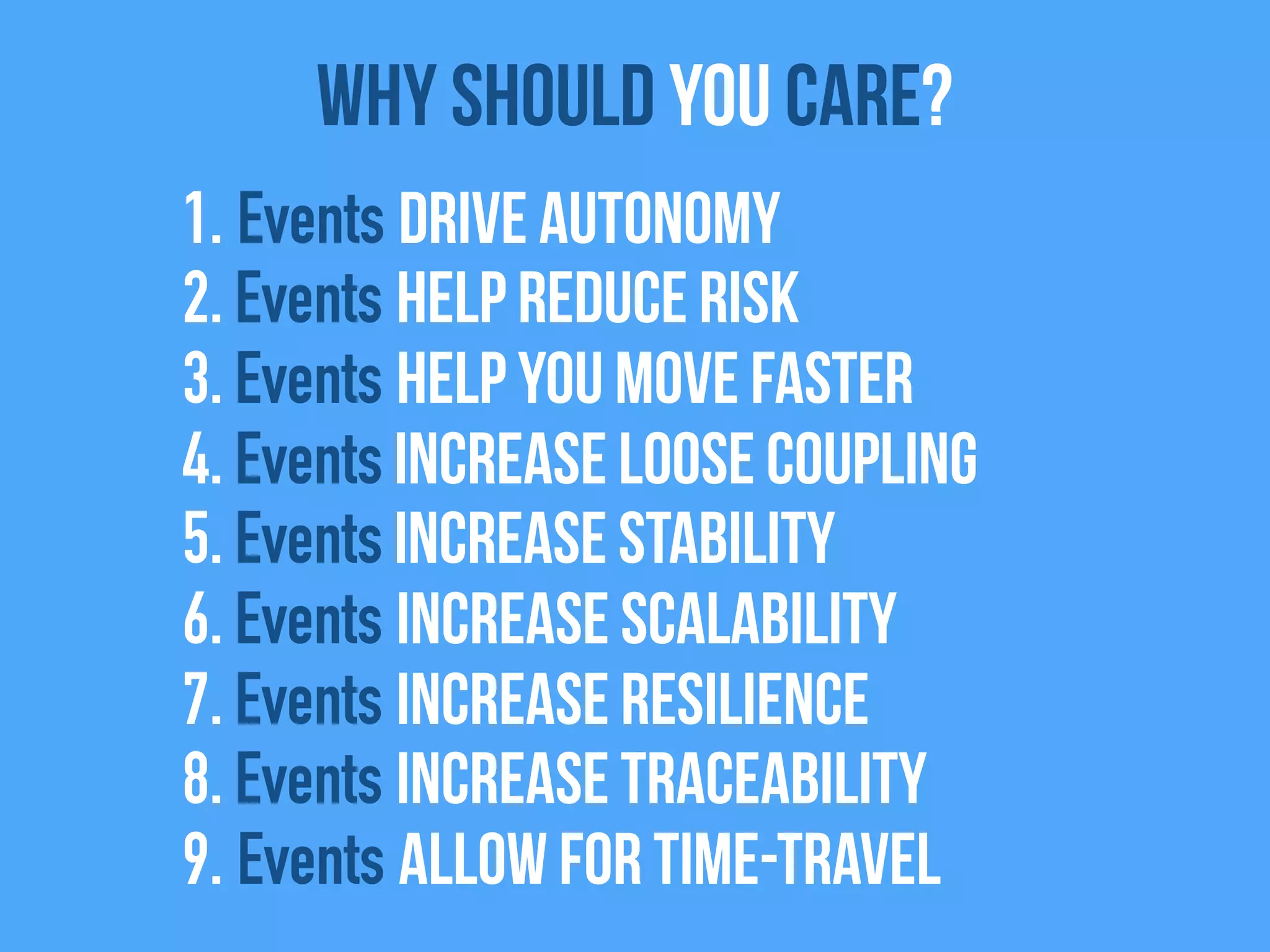
1. Events drive autonomy
2. Events help reduce risk
3. Events help you move faster
4. Events Increase Loose coupling
5. Events increase stability
6. Events increase scalability
7. Events increase resilience
8. Events increase traceability
9. Events allow for time-travel
Why Should you care?
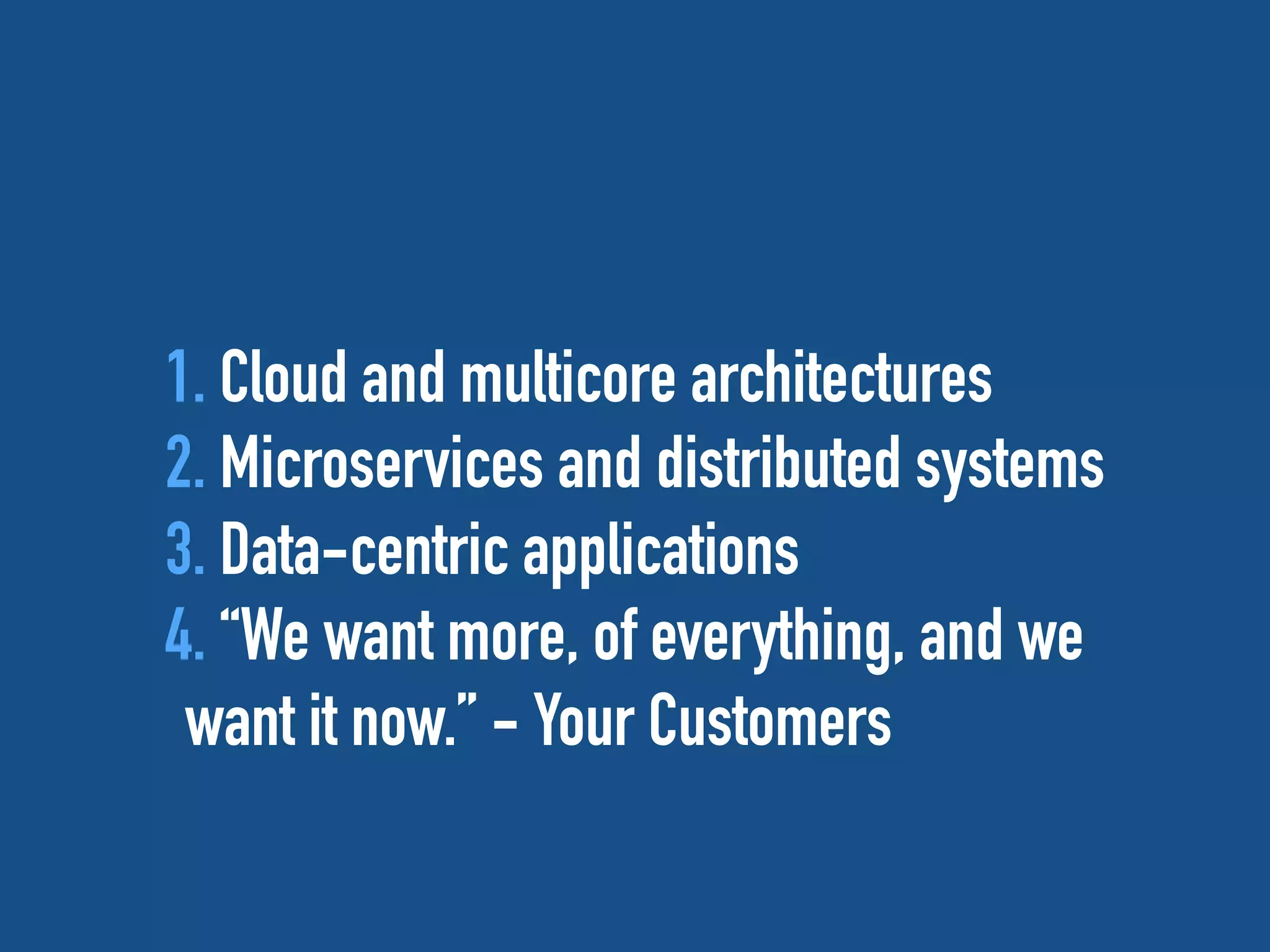
1. Cloud and multicore architectures
2. Microservices and distributed systems
3. Data-centric applications
4. “We want more, of everything, and we
want it now.” - Your Customers
Why Now?
1. Cloud and multicore architectures
2. Microservices and distributed systems
3. Data-centric applications
4. “We want more, of everything, and we
want it now.” - Your Customers
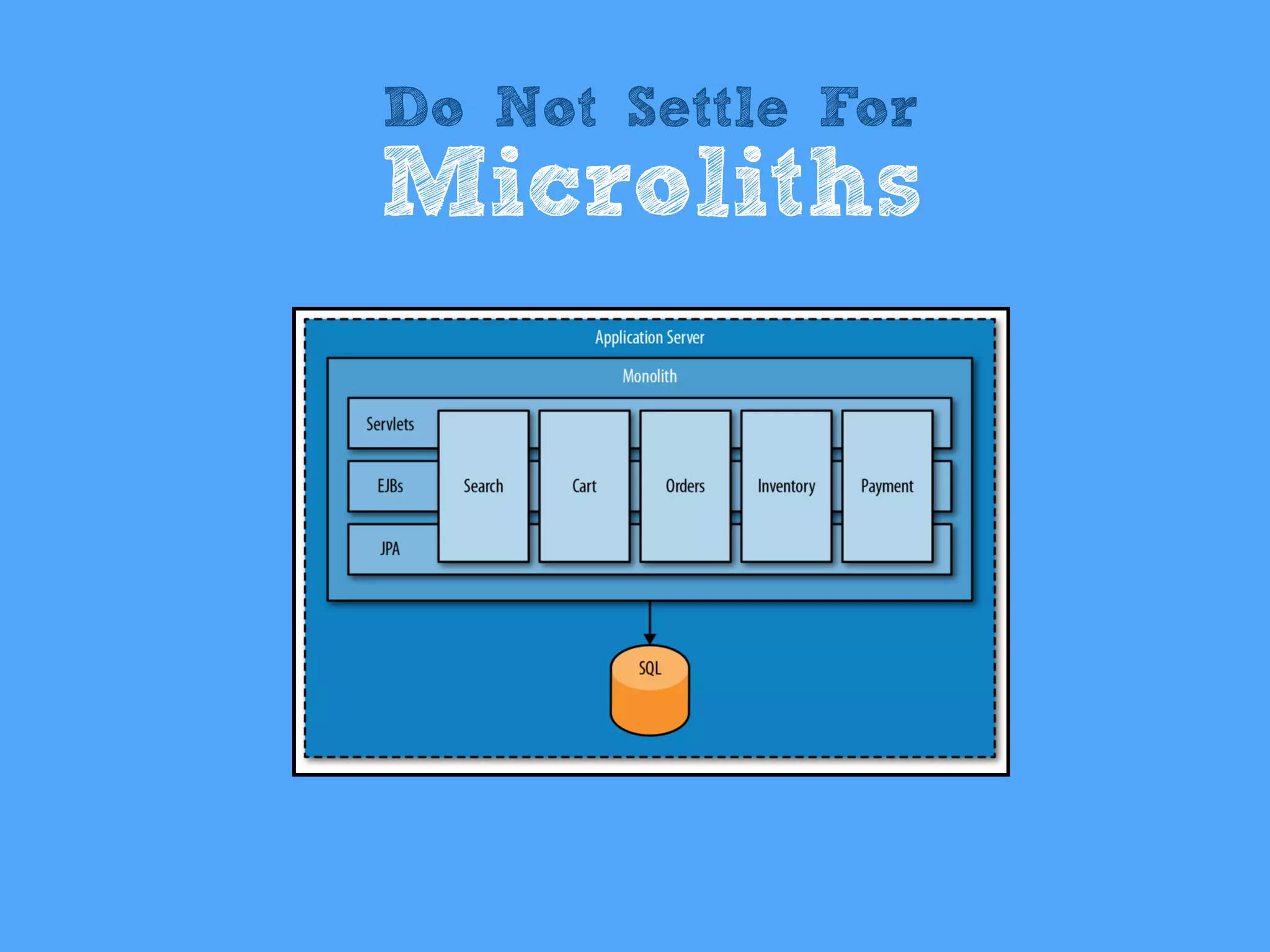
Do Not Settle For
Microliths
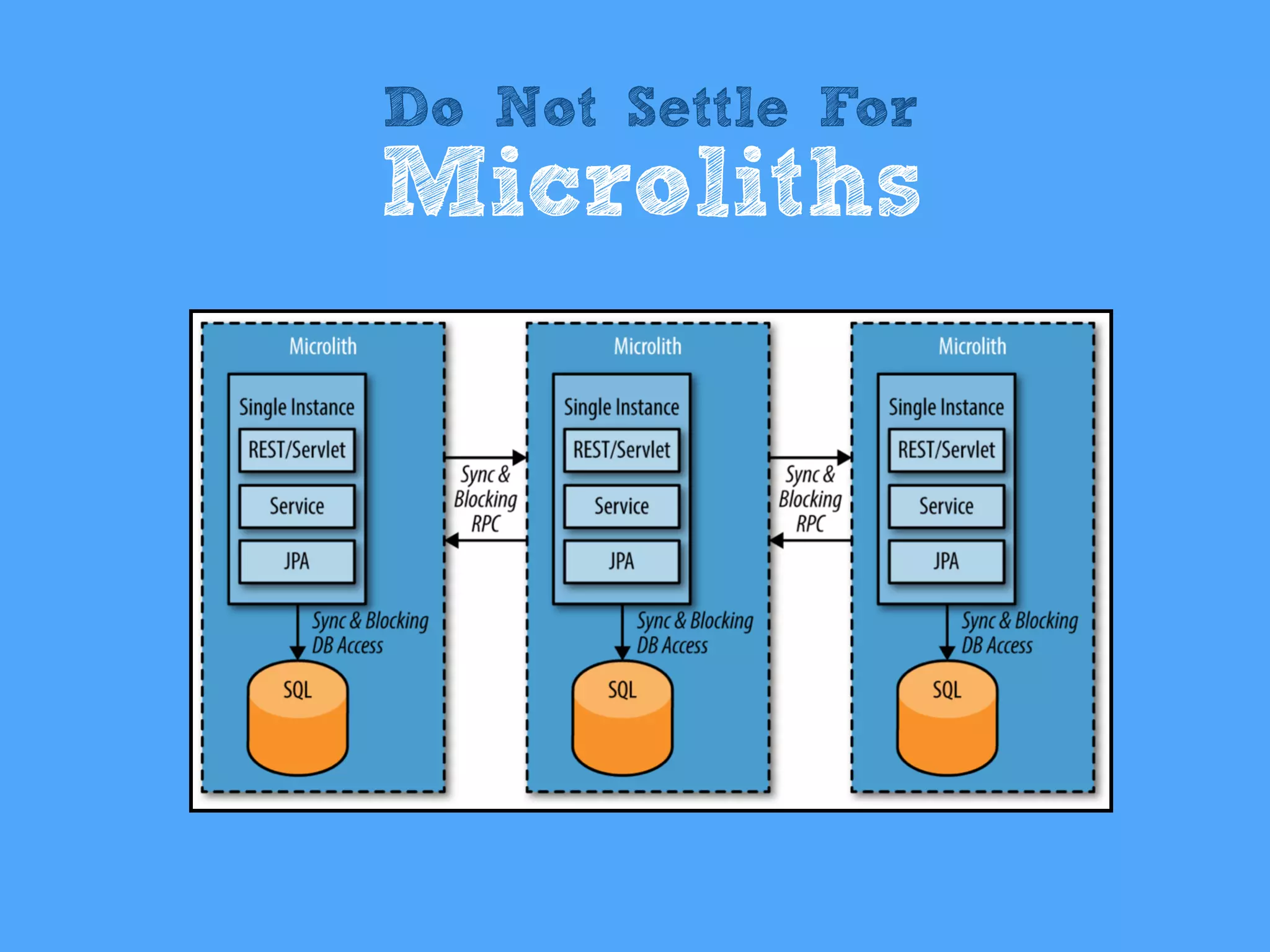
Do Not Settle For
Microliths
“Event-Driven Architecture (EDA) is a design paradigm
in which a software component executes in response
to receiving one or more event notifications.”
- Gartner
Event Driven
Architecture
To The Rescue
What is an
Event?
Event
“Something that happens.”
- Merriam Webster
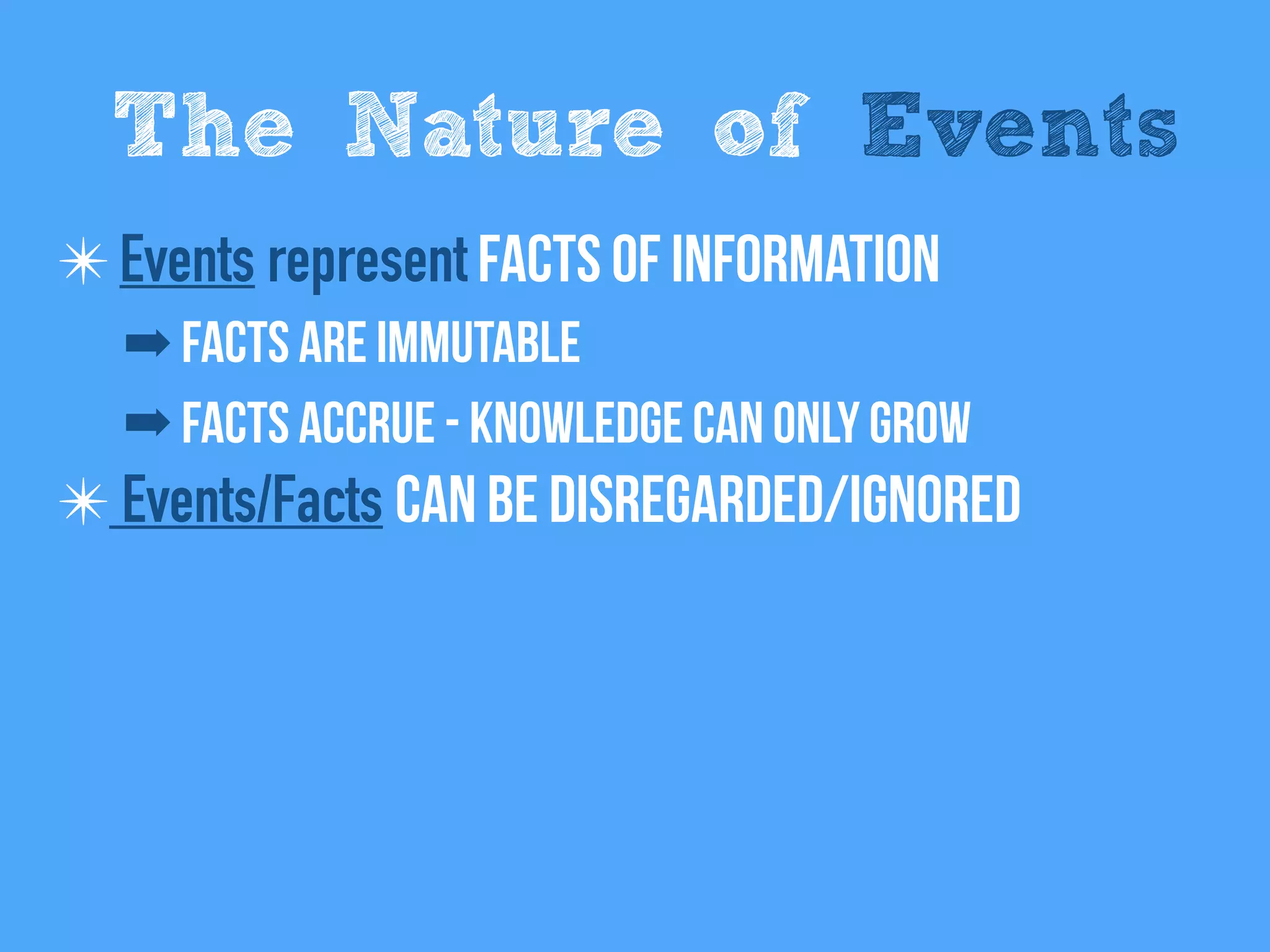
The Nature of Events
✴Events represent Facts of information
➡ Facts are immutable
➡ Facts Accrue - Knowledge can only grow
The Nature of Events
✴Events represent Facts of information
➡ Facts are immutable
➡ Facts Accrue - Knowledge can only grow
✴ Events/Facts can be disregarded/Ignored
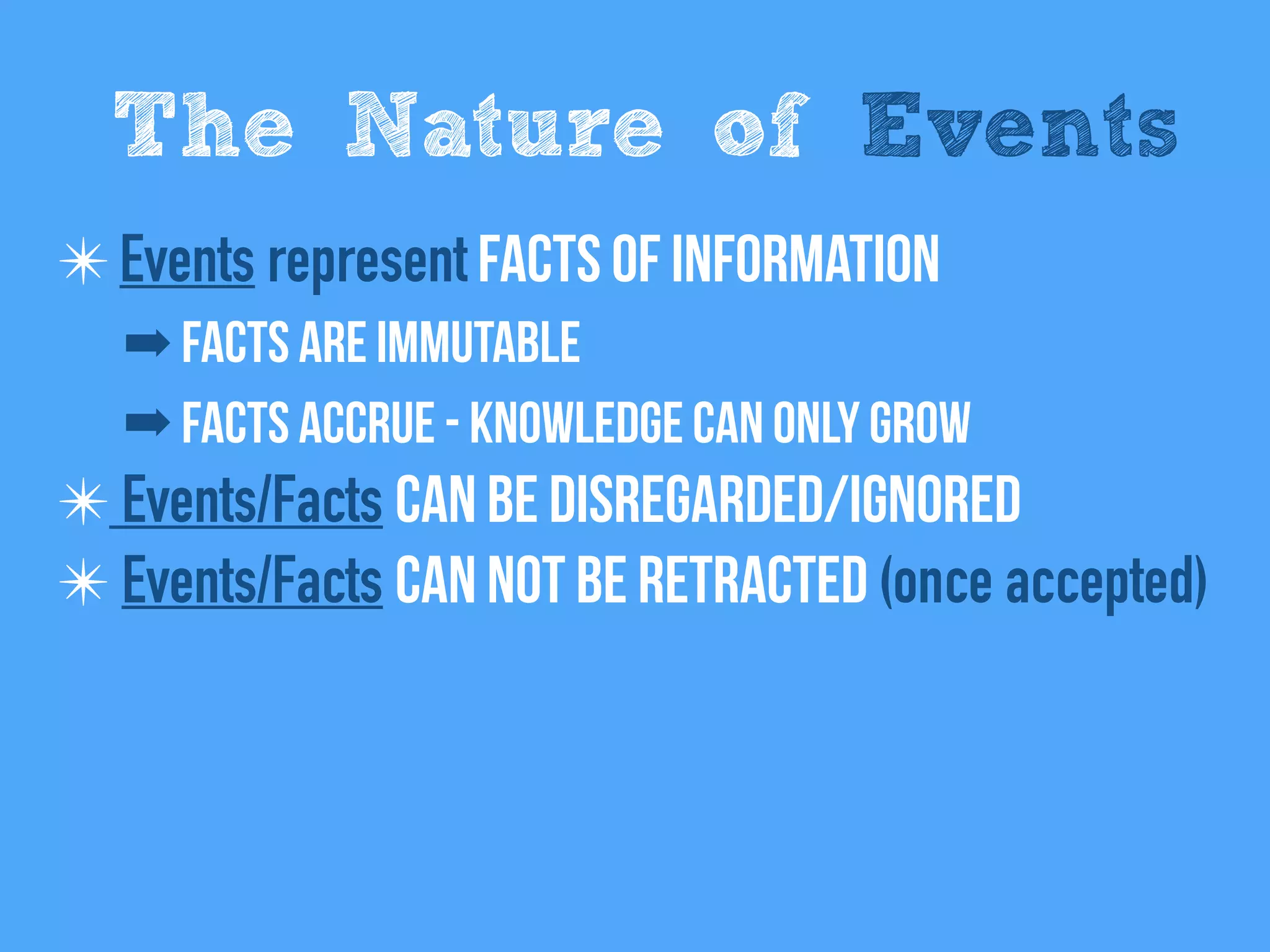
The Nature of Events
✴Events represent Facts of information
➡ Facts are immutable
➡ Facts Accrue - Knowledge can only grow
✴ Events/Facts can be disregarded/Ignored
✴ Events/Facts Can not be retracted (once accepted)
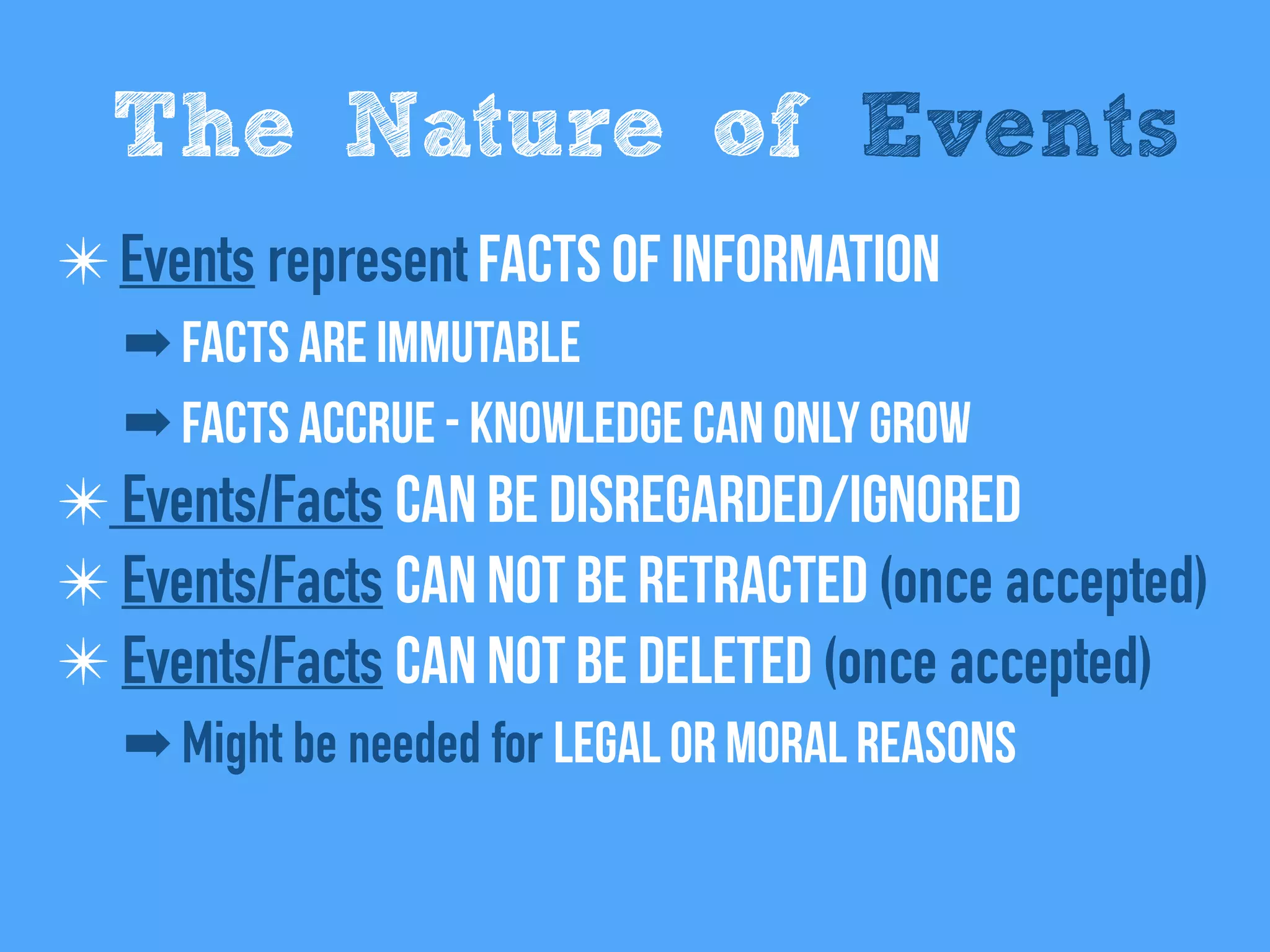
The Nature of Events
✴Events represent Facts of information
➡ Facts are immutable
➡ Facts Accrue - Knowledge can only grow
✴ Events/Facts can be disregarded/Ignored
✴ Events/Facts Can not be retracted (once accepted)
✴ Events/Facts Can not be deleted (once accepted)
➡ Might be needed for legal or moral reasons
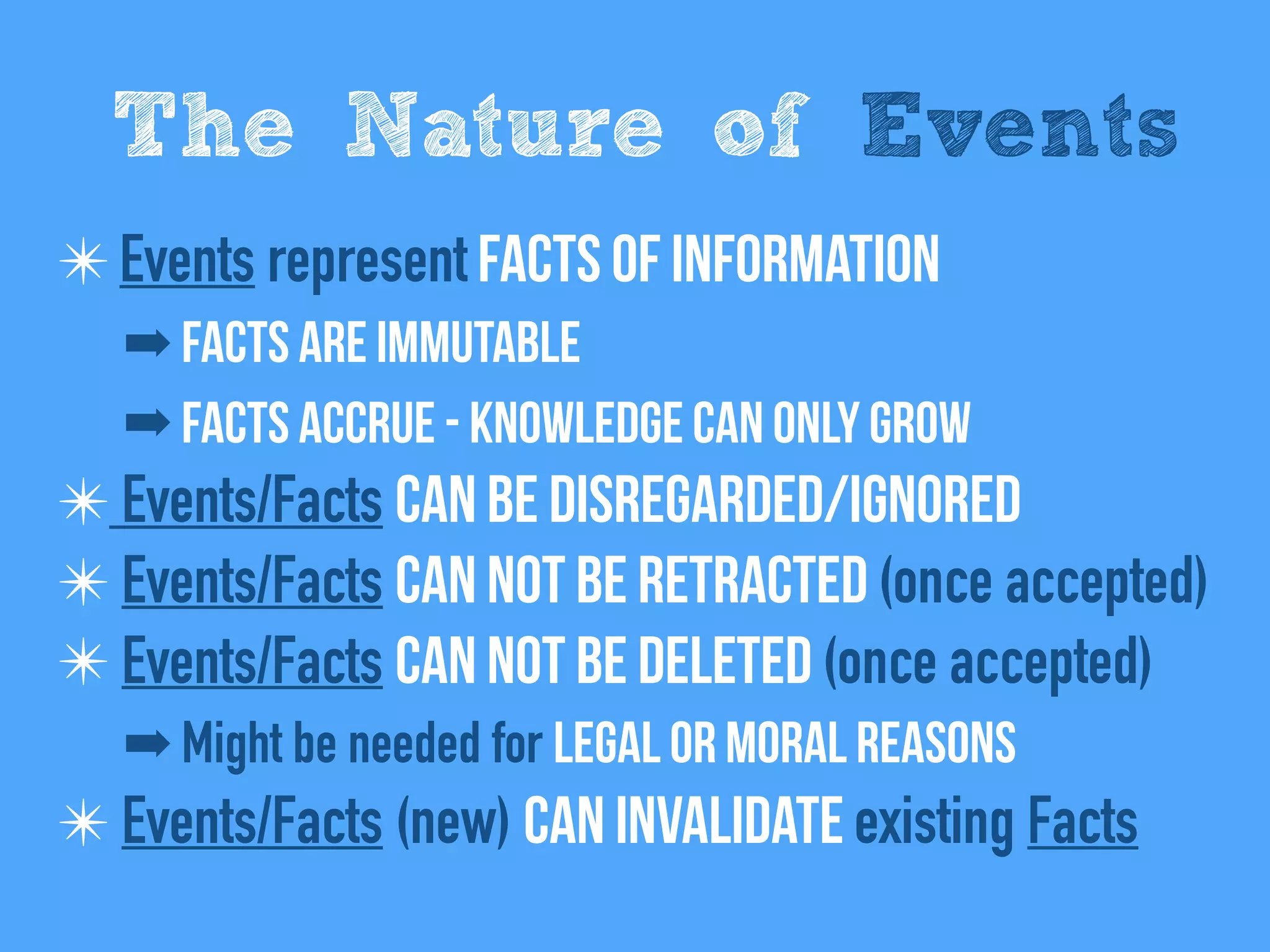
The Nature of Events
✴Events represent Facts of information
➡ Facts are immutable
➡ Facts Accrue - Knowledge can only grow
✴ Events/Facts can be disregarded/Ignored
✴ Events/Facts Can not be retracted (once accepted)
✴ Events/Facts Can not be deleted (once accepted)
➡ Might be needed for legal or moral reasons
✴ Events/Facts (new) can invalidate existing Facts
The Nature of Events
Event Loop
What Makes Event Tick
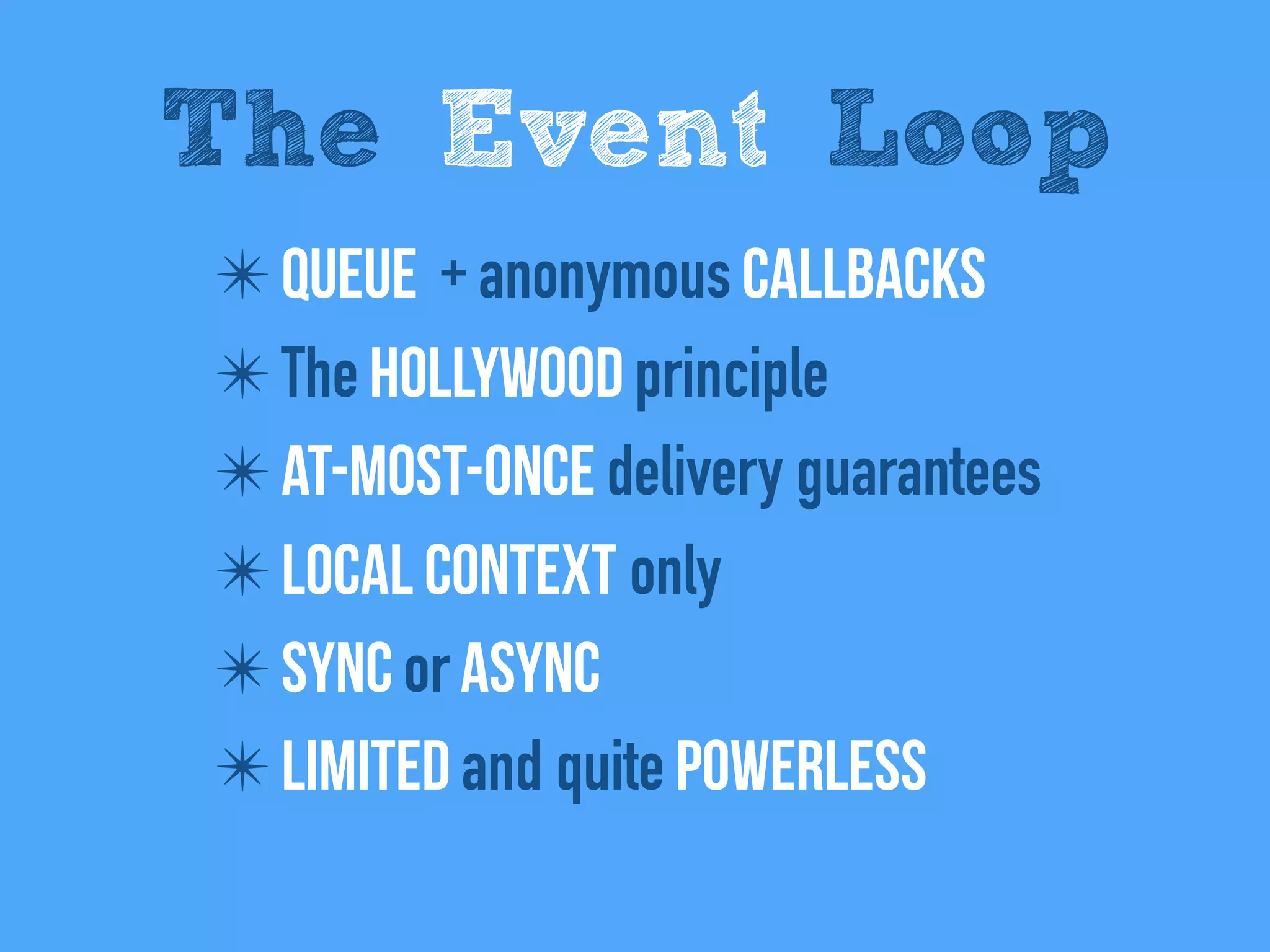
✴ Queue + anonymous Callbacks
✴ The Hollywood principle
✴ At-Most-Once delivery guarantees
✴ Local context only
✴ Sync or AsynC
✴ Limited and quite powerless
The Event Loop
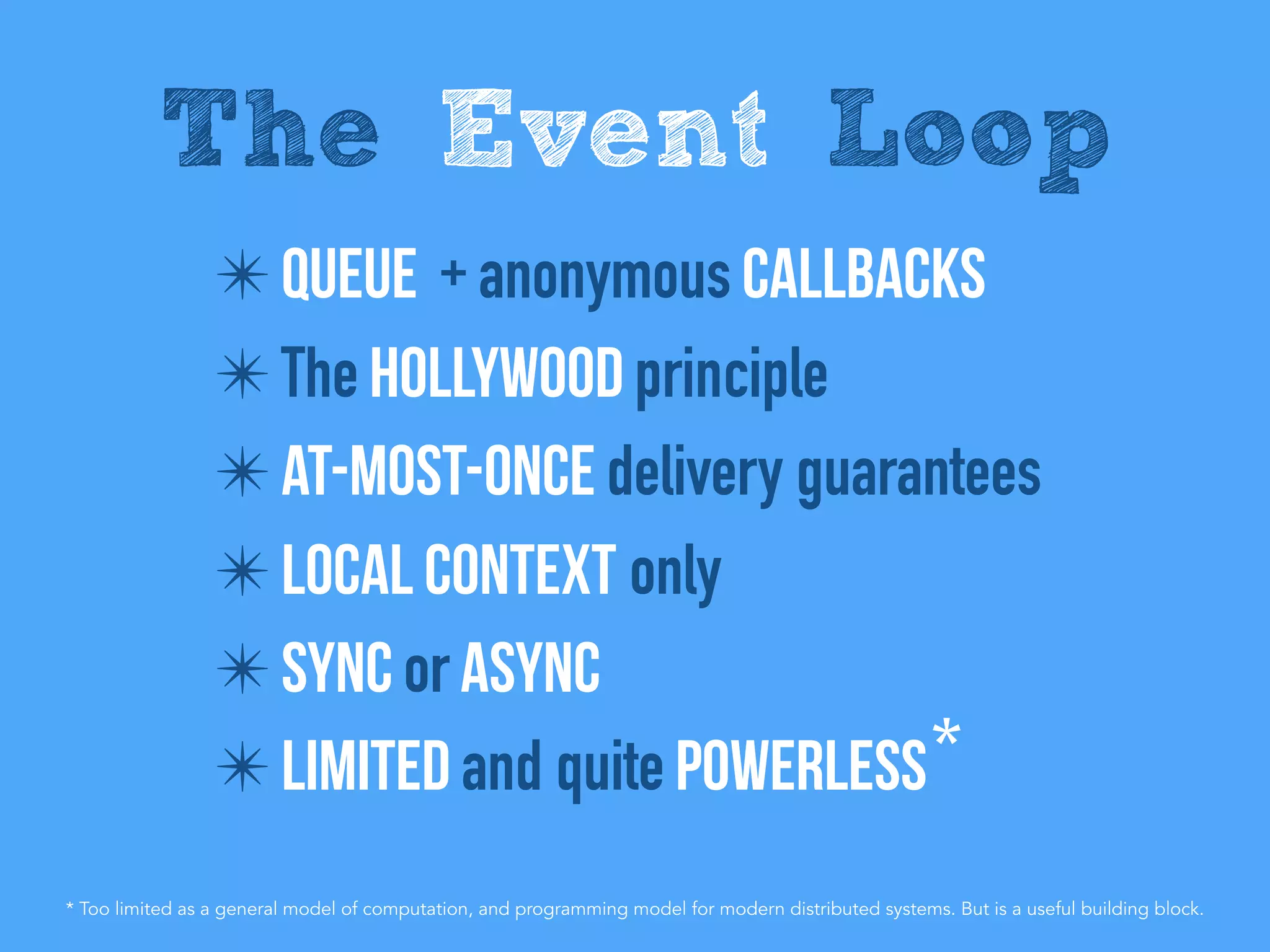
✴ Queue + anonymous Callbacks
✴ The Hollywood principle
✴ At-Most-Once delivery guarantees
✴ Local context only
✴ Sync or AsynC
✴ Limited and quite powerless
The Event Loop
*
* Too limited as a general model of computation, and programming model for modern distributed systems. But is a useful building block.
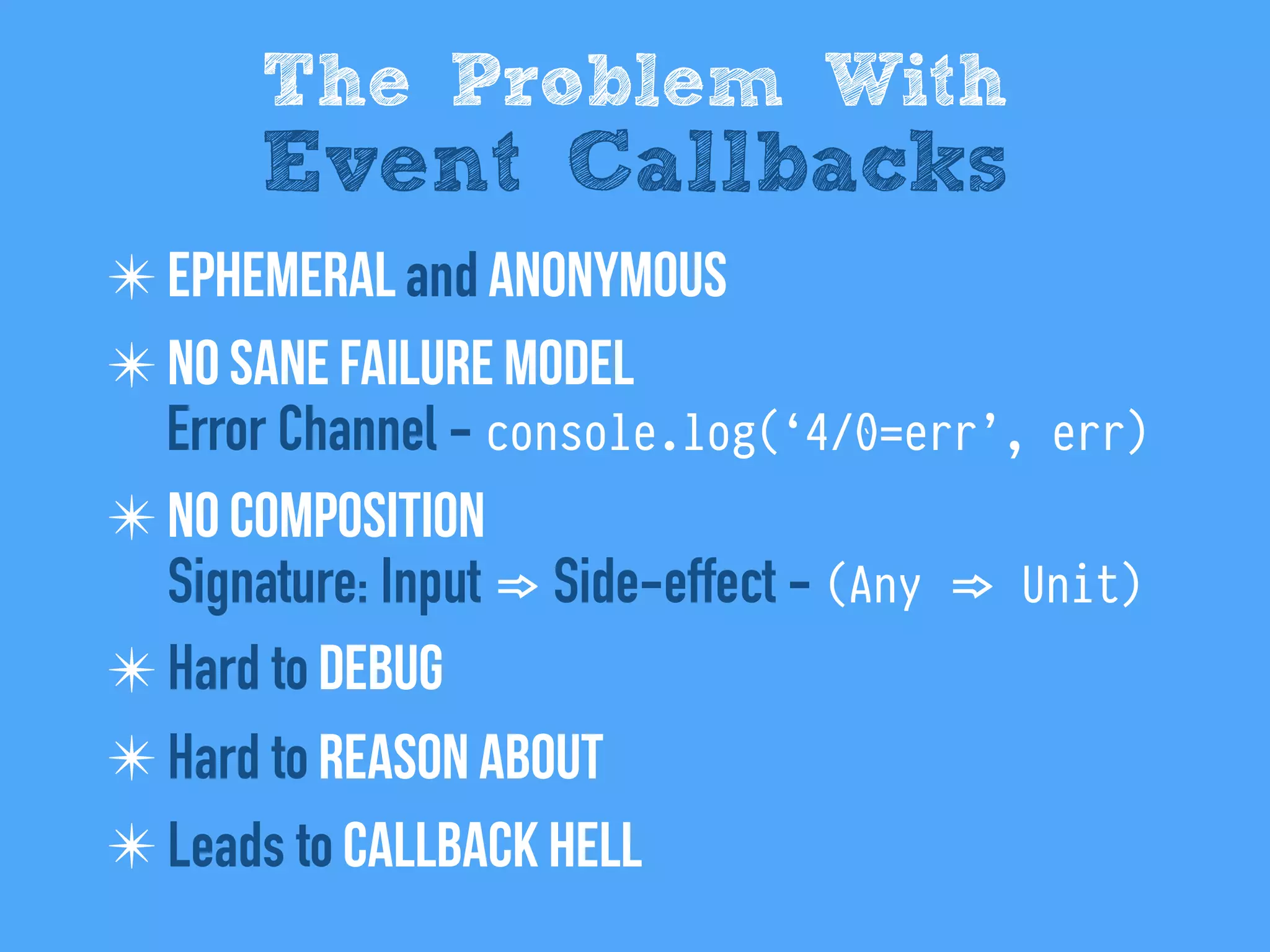
✴ Ephemeral and anonymous
✴ No sane failure model
Error Channel - console.log(‘4/0=err’, err)
✴ No composition
Signature: Input => Side-effect - (Any => Unit)
✴ Hard to Debug
✴ Hard to reason about
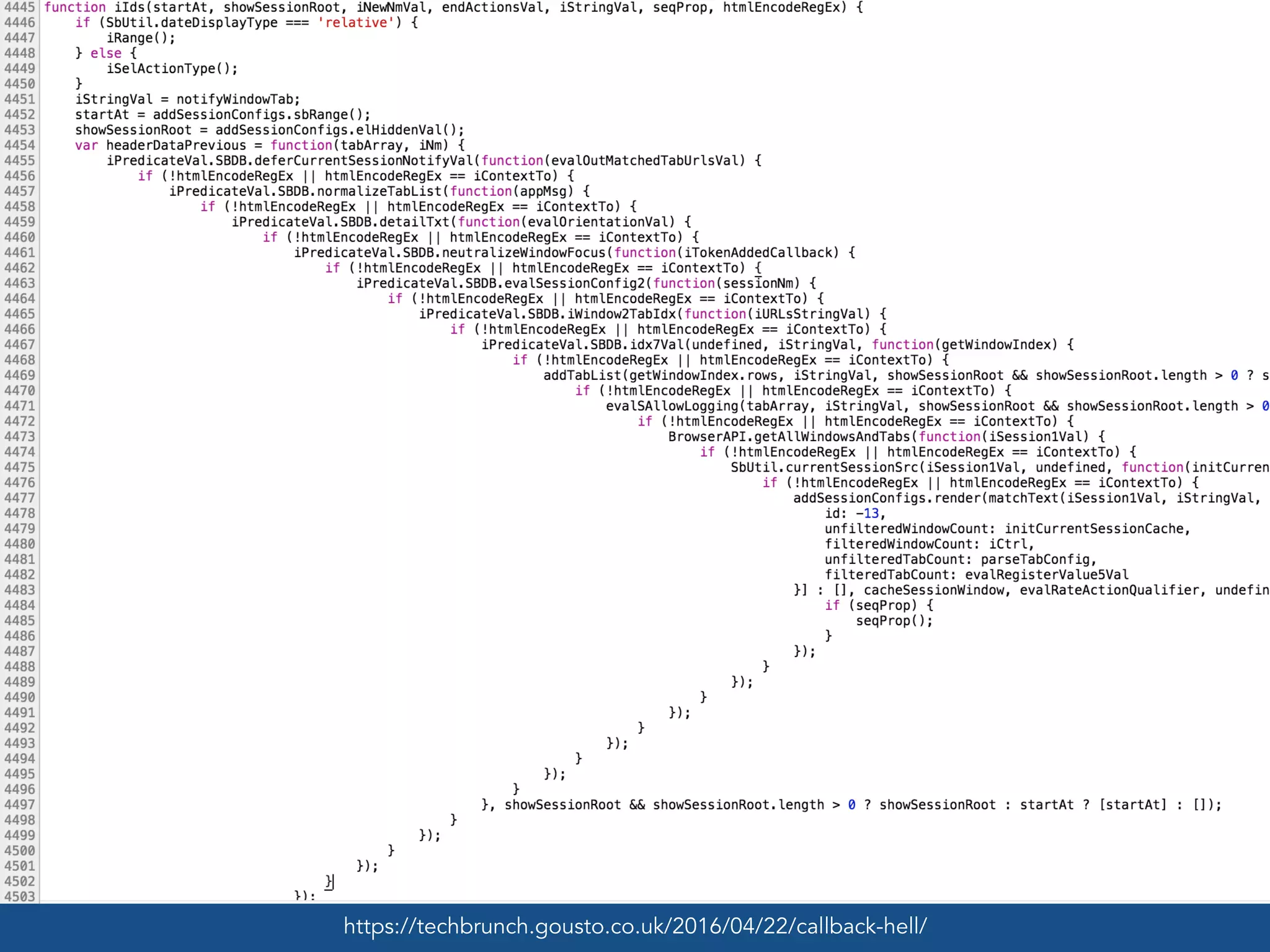
✴ Leads to Callback hell
The Problem With
Event Callbacks
https://techbrunch.gousto.co.uk/2016/04/22/callback-hell/
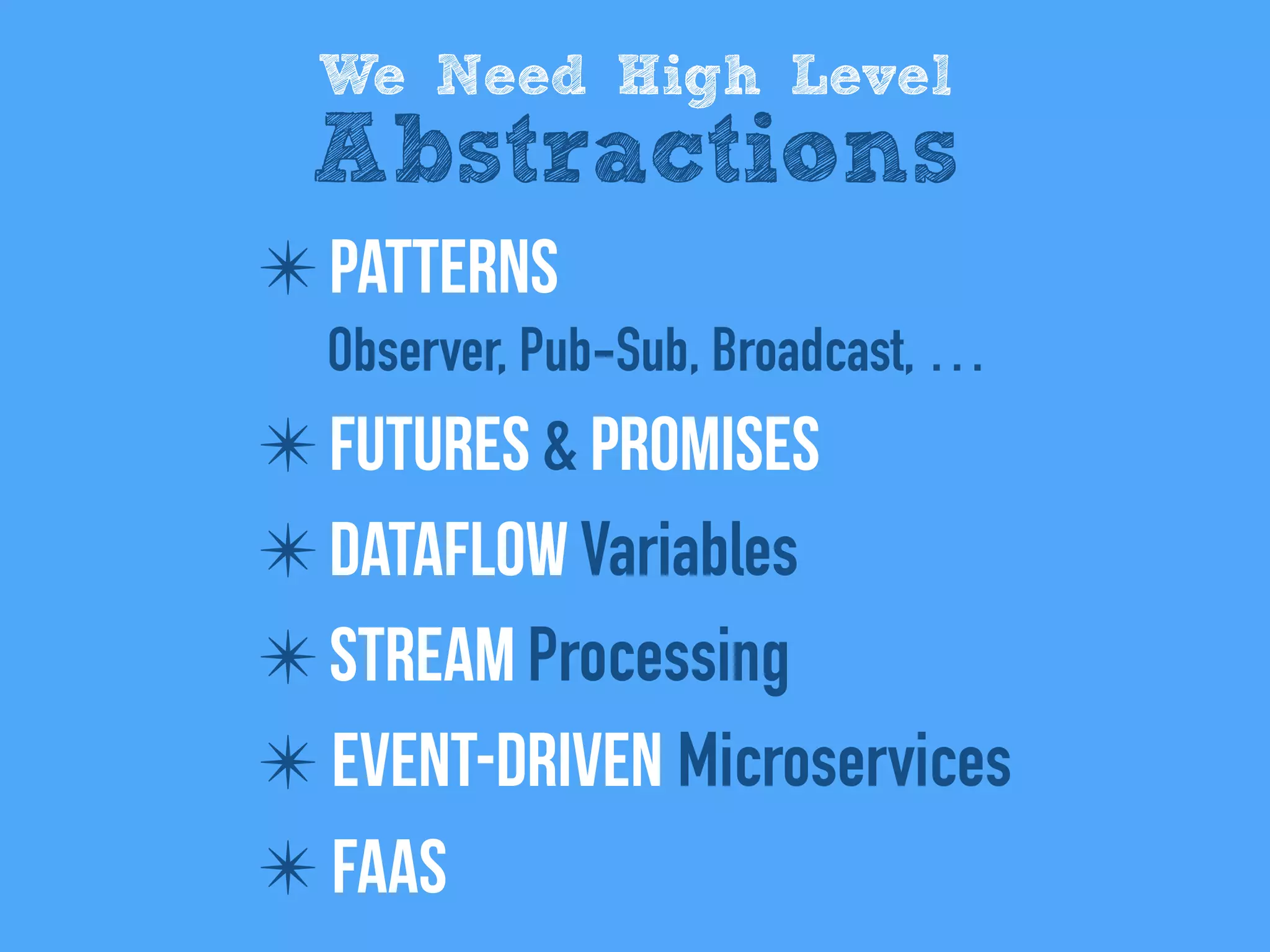
✴Patterns
Observer, Pub-Sub, Broadcast, …
✴Futures & PRomises
✴Dataflow Variables
✴Stream Processing
✴ Event-driven Microservices
✴ FaaS
We Need High Level
Abstractions
Unified Event Driven Abstractions
Powered By
Message Driven Fabric
Ladder of
abstraction
Unified Event Driven Abstractions
Powered By
Message Driven Fabric
Network Boundary
Ladder of
abstraction
Unified Event Driven Abstractions
Powered By
Message Driven Fabric
Network Boundary
Ladder of
abstraction
Unified Event Driven Abstractions
Powered By
Message Driven Fabric
Network Boundary
Ladder of
abstraction
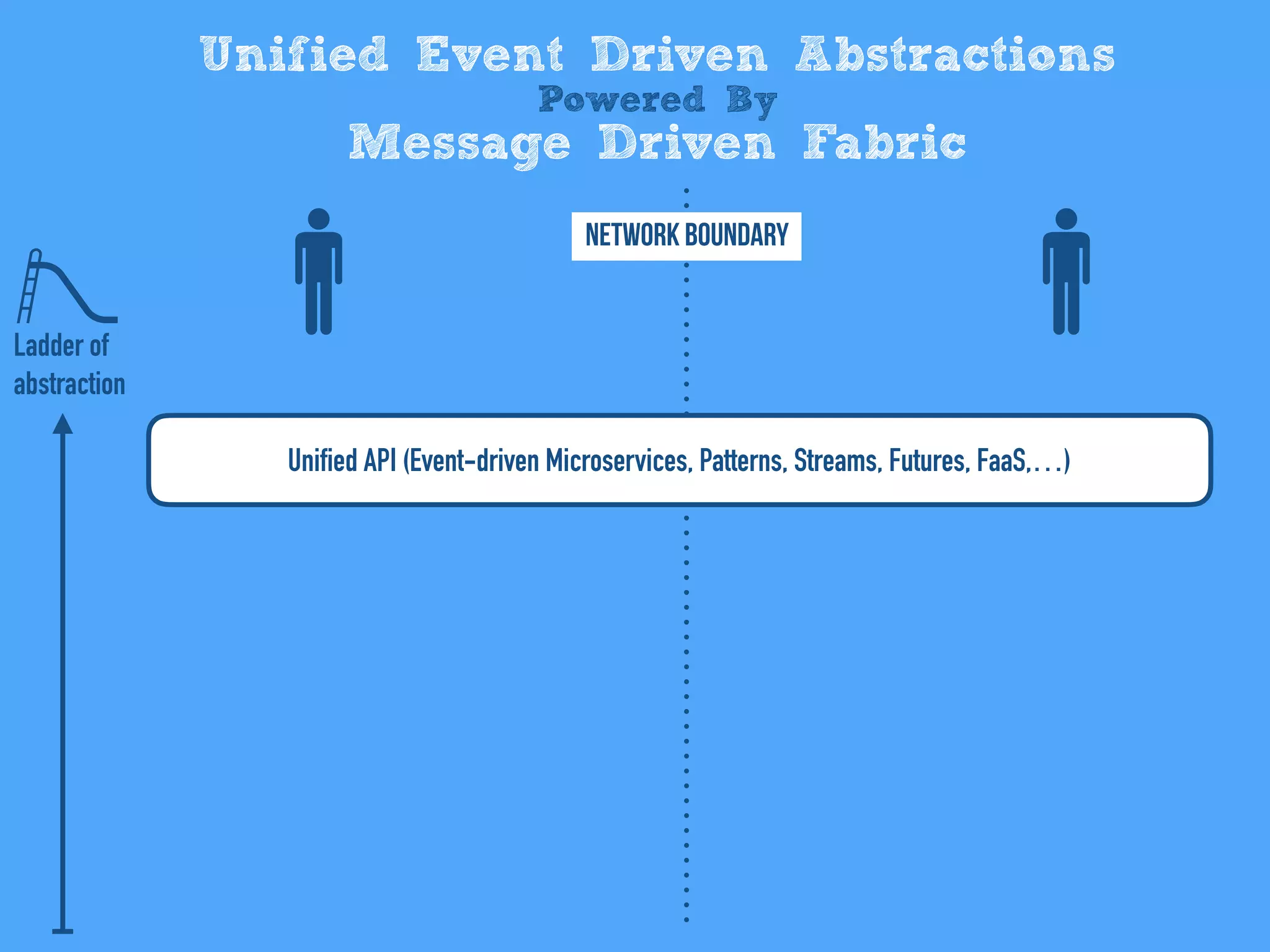
Unified Event Driven Abstractions
Powered By
Message Driven Fabric
Unified API (Event-driven Microservices, Patterns, Streams, Futures, FaaS,…)
Network Boundary
Ladder of
abstraction
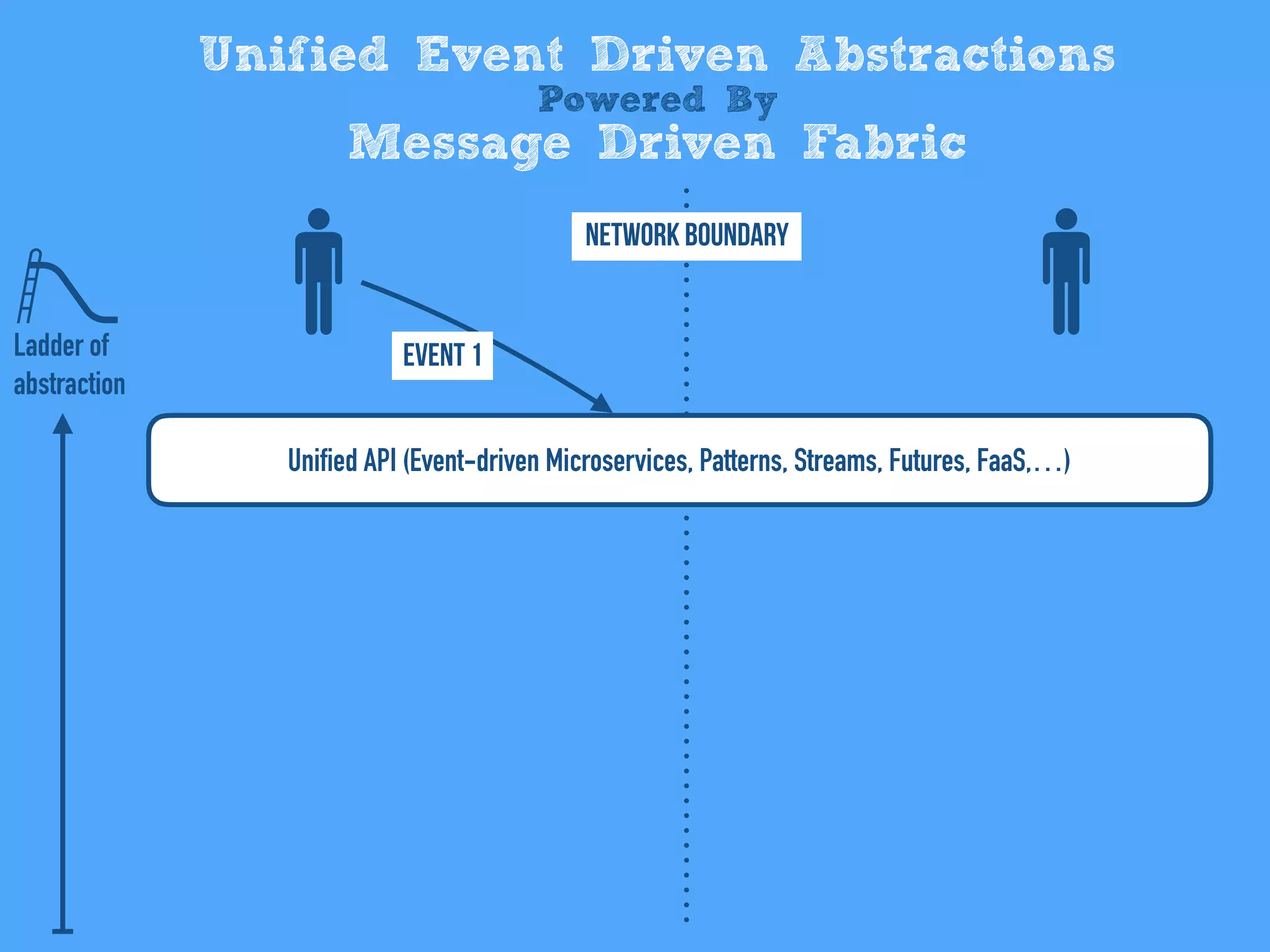
Unified Event Driven Abstractions
Powered By
Message Driven Fabric
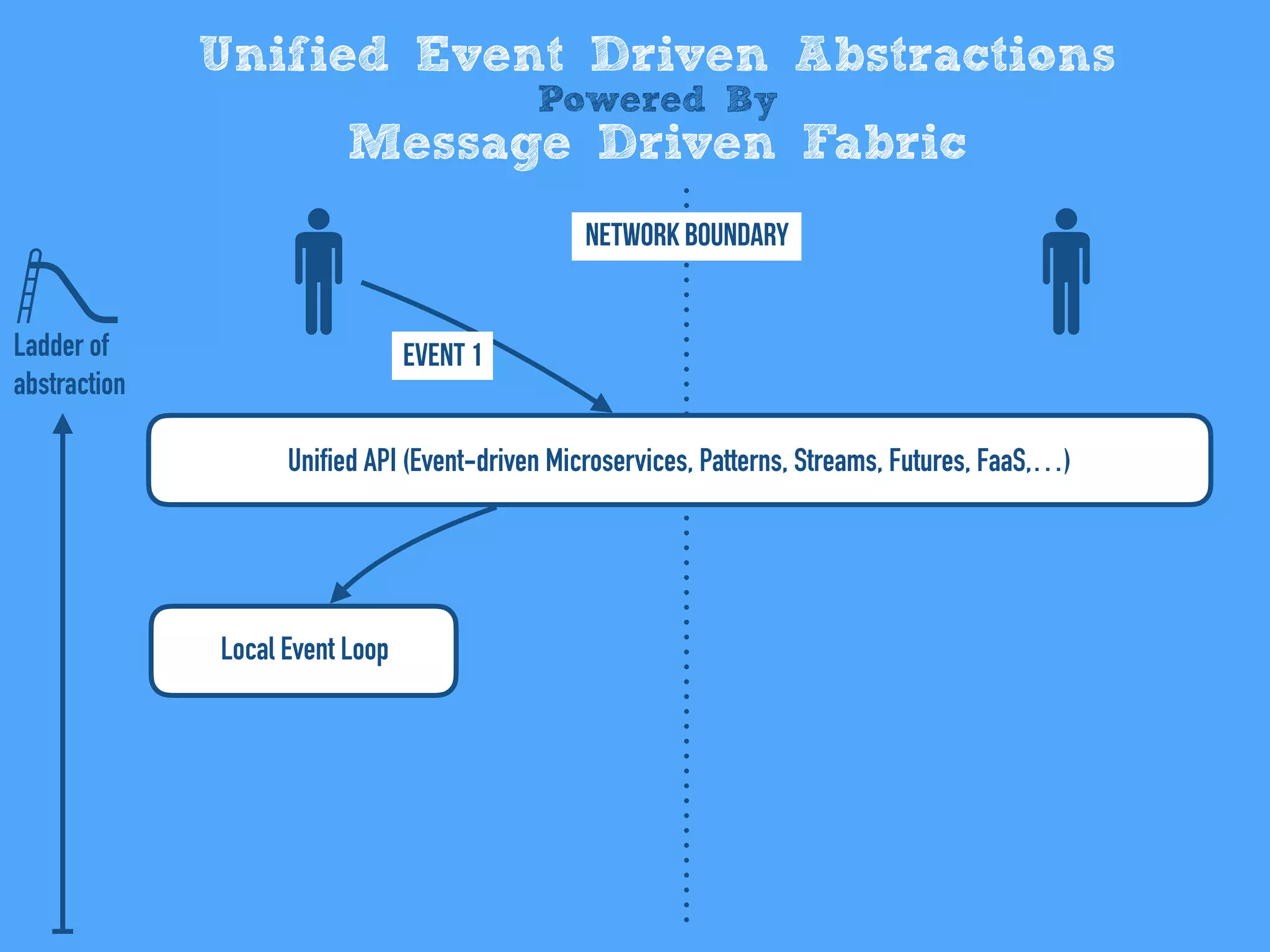
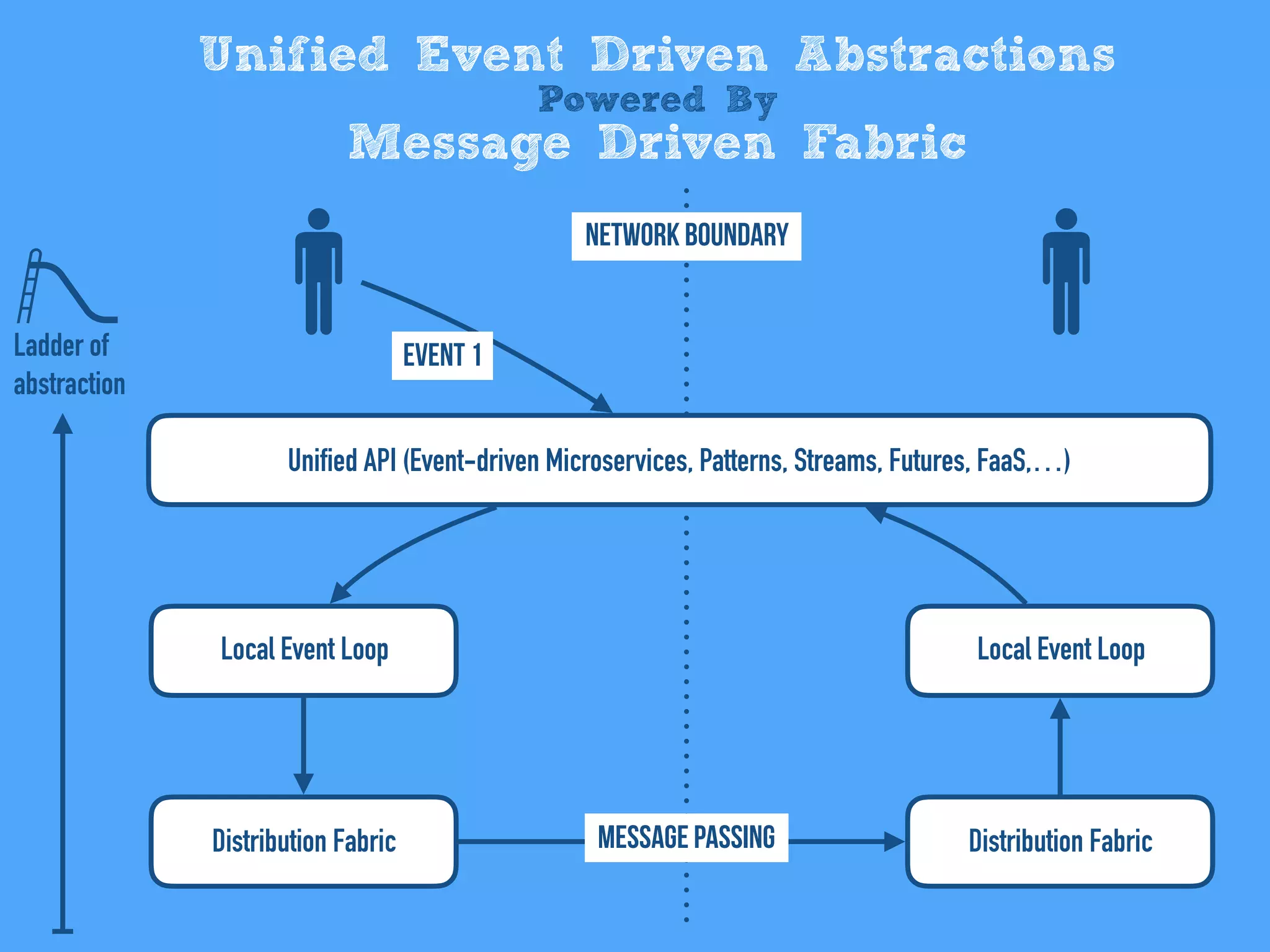
Unified API (Event-driven Microservices, Patterns, Streams, Futures, FaaS,…)
Network Boundary
Event 1Ladder of
abstraction
Unified Event Driven Abstractions
Powered By
Message Driven Fabric
Unified API (Event-driven Microservices, Patterns, Streams, Futures, FaaS,…)
Local Event Loop
Network Boundary
Event 1Ladder of
abstraction
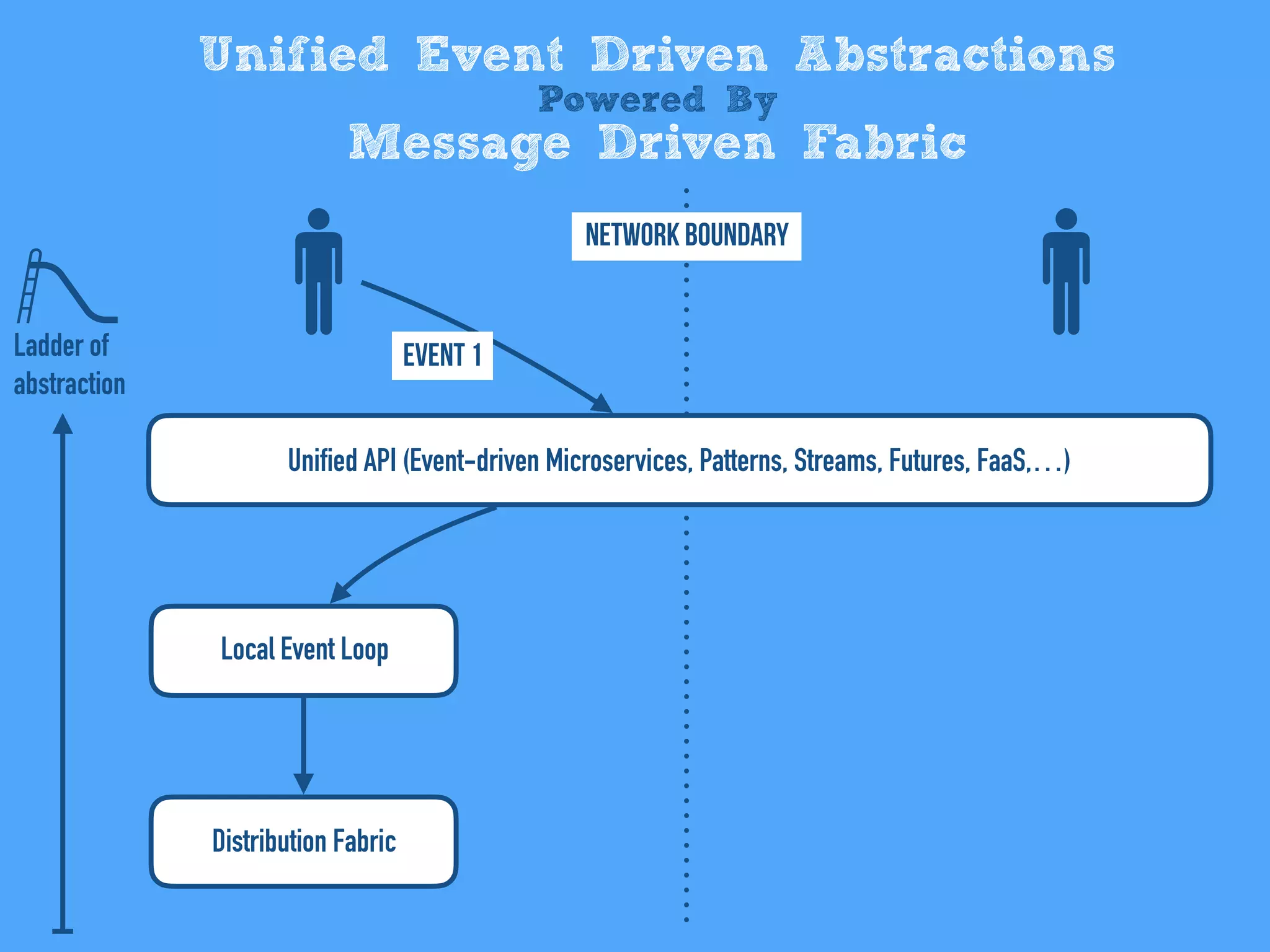
Unified Event Driven Abstractions
Powered By
Message Driven Fabric
Unified API (Event-driven Microservices, Patterns, Streams, Futures, FaaS,…)
Local Event Loop
Distribution Fabric
Network Boundary
Event 1Ladder of
abstraction
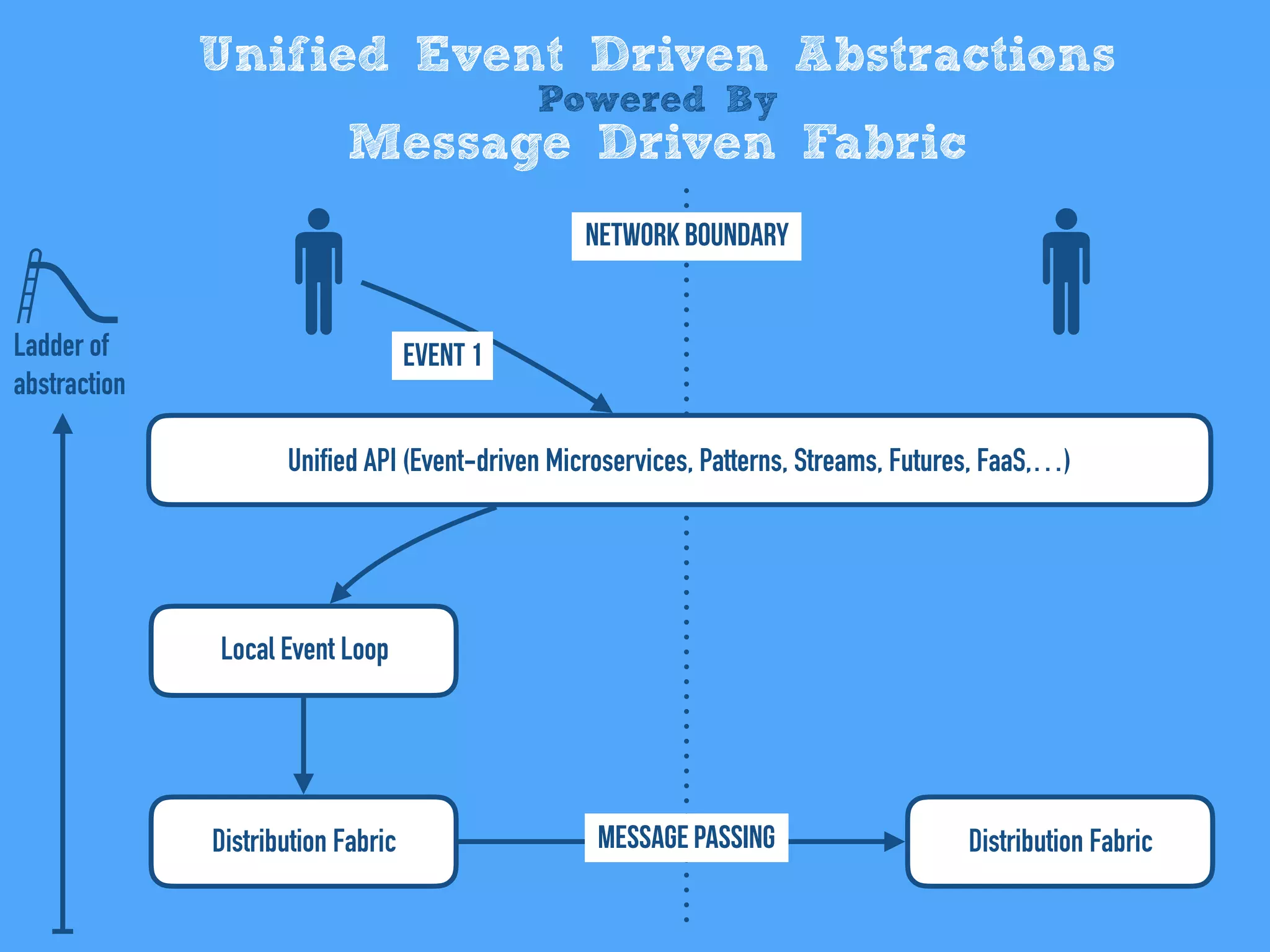
Unified Event Driven Abstractions
Powered By
Message Driven Fabric
Unified API (Event-driven Microservices, Patterns, Streams, Futures, FaaS,…)
Local Event Loop
Distribution Fabric Distribution Fabric
Network Boundary
Message Passing
Event 1Ladder of
abstraction
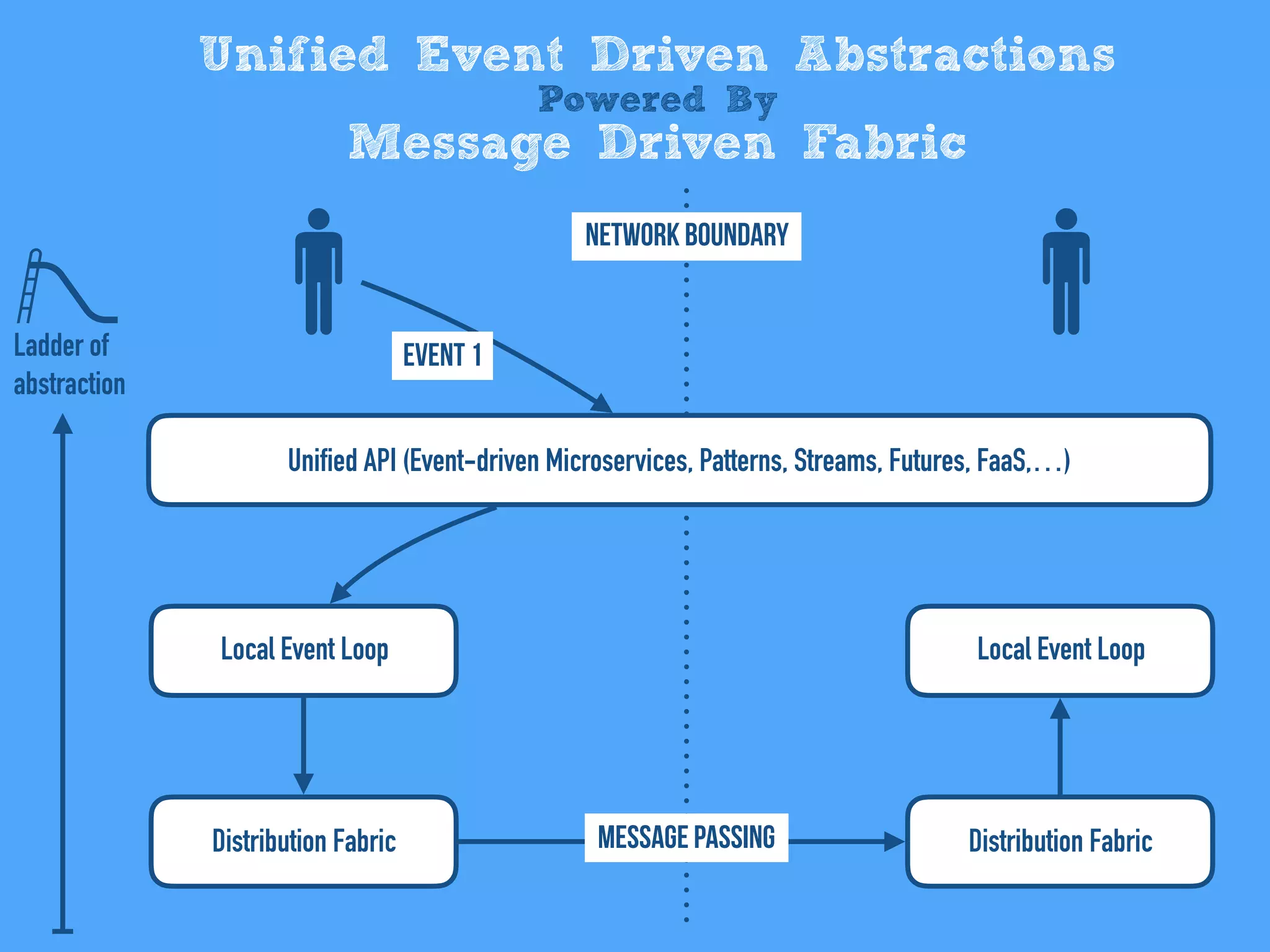
Unified Event Driven Abstractions
Powered By
Message Driven Fabric
Unified API (Event-driven Microservices, Patterns, Streams, Futures, FaaS,…)
Local Event Loop
Distribution Fabric
Local Event Loop
Distribution Fabric
Network Boundary
Message Passing
Event 1Ladder of
abstraction
Unified Event Driven Abstractions
Powered By
Message Driven Fabric
Unified API (Event-driven Microservices, Patterns, Streams, Futures, FaaS,…)
Local Event Loop
Distribution Fabric
Local Event Loop
Distribution Fabric
Network Boundary
Message Passing
Event 1Ladder of
abstraction
Unified Event Driven Abstractions
Powered By
Message Driven Fabric
Unified API (Event-driven Microservices, Patterns, Streams, Futures, FaaS,…)
Local Event Loop
Distribution Fabric
Local Event Loop
Distribution Fabric
Network Boundary
Message Passing
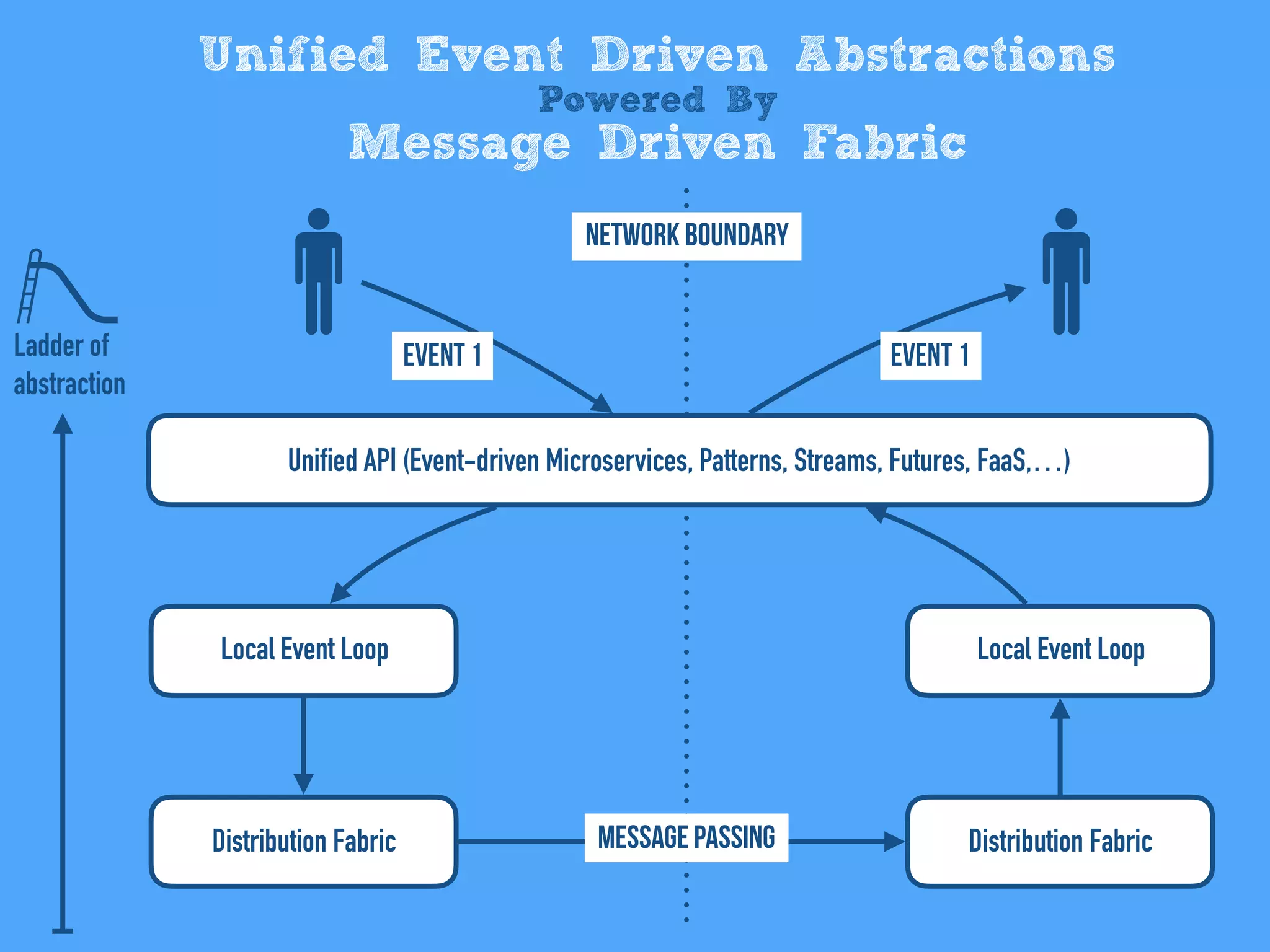
Event 1 Event 1Ladder of
abstraction
Unified Event Driven Abstractions
Powered By
Message Driven Fabric
Unified API (Event-driven Microservices, Patterns, Streams, Futures, FaaS,…)
Local Event Loop
Distribution Fabric
Local Event Loop
Distribution Fabric
Network Boundary
Message Passing
Event 1 Event 1
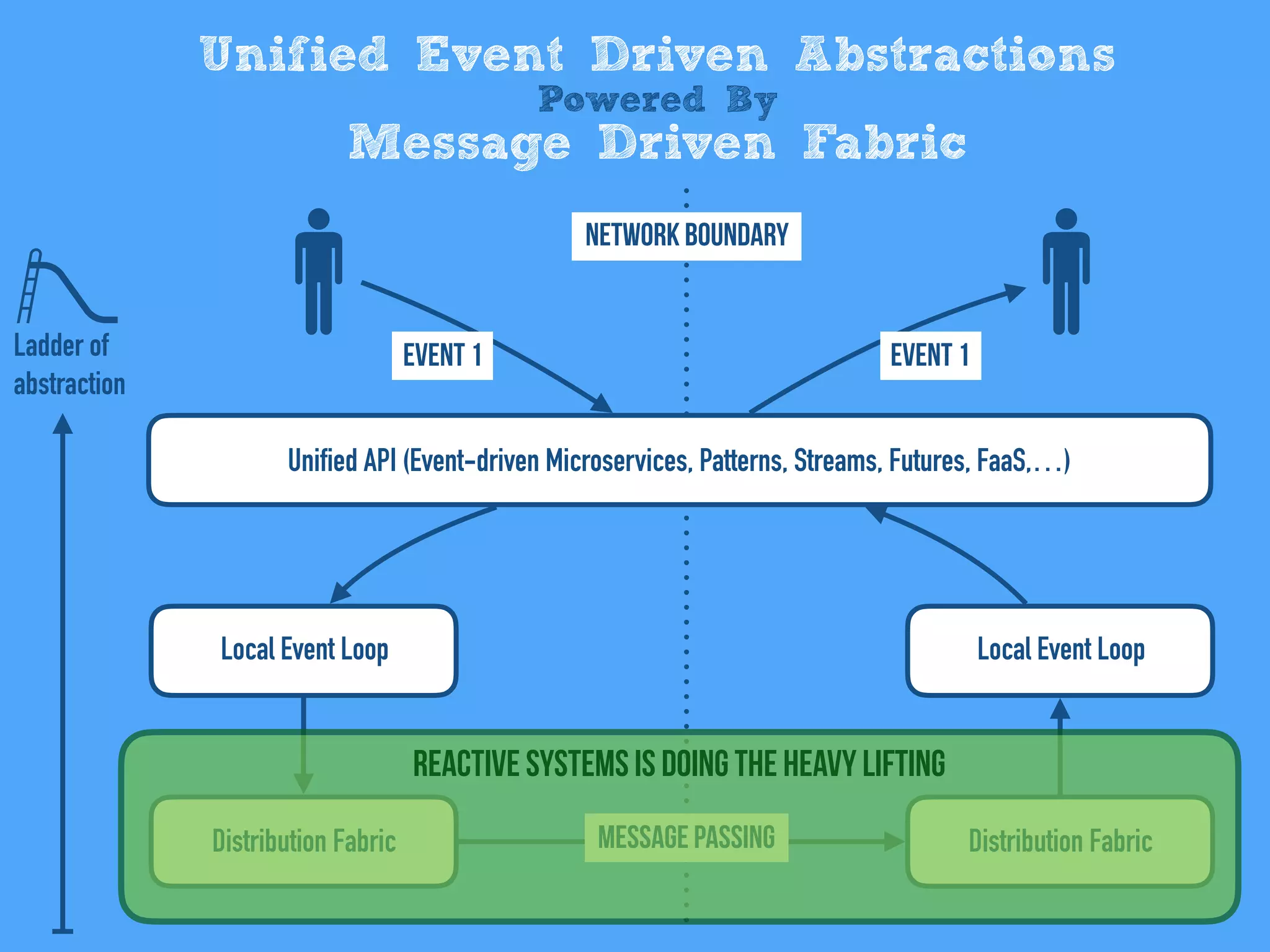
Reactive Systems is doing the heavy lifting
Ladder of
abstraction
Unified Event Driven Abstractions
Powered By
Message Driven Fabric
Unified API (Event-driven Microservices, Patterns, Streams, Futures, FaaS,…)
Local Event Loop
Distribution Fabric
Local Event Loop
Distribution Fabric
Network Boundary
Message Passing
Event 1 Event 1
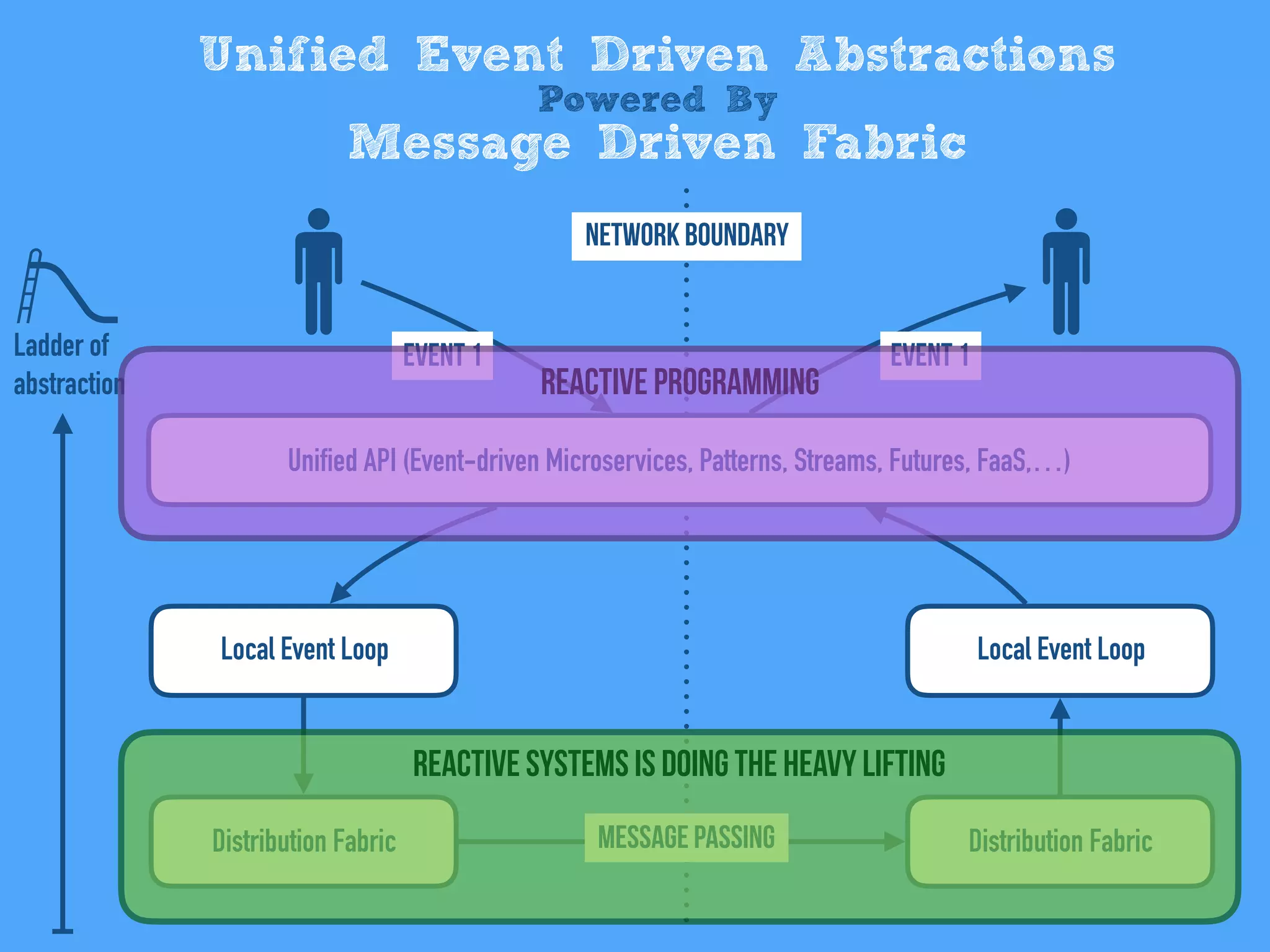
Reactive Systems is doing the heavy lifting
Ladder of
abstraction Reactive Programming
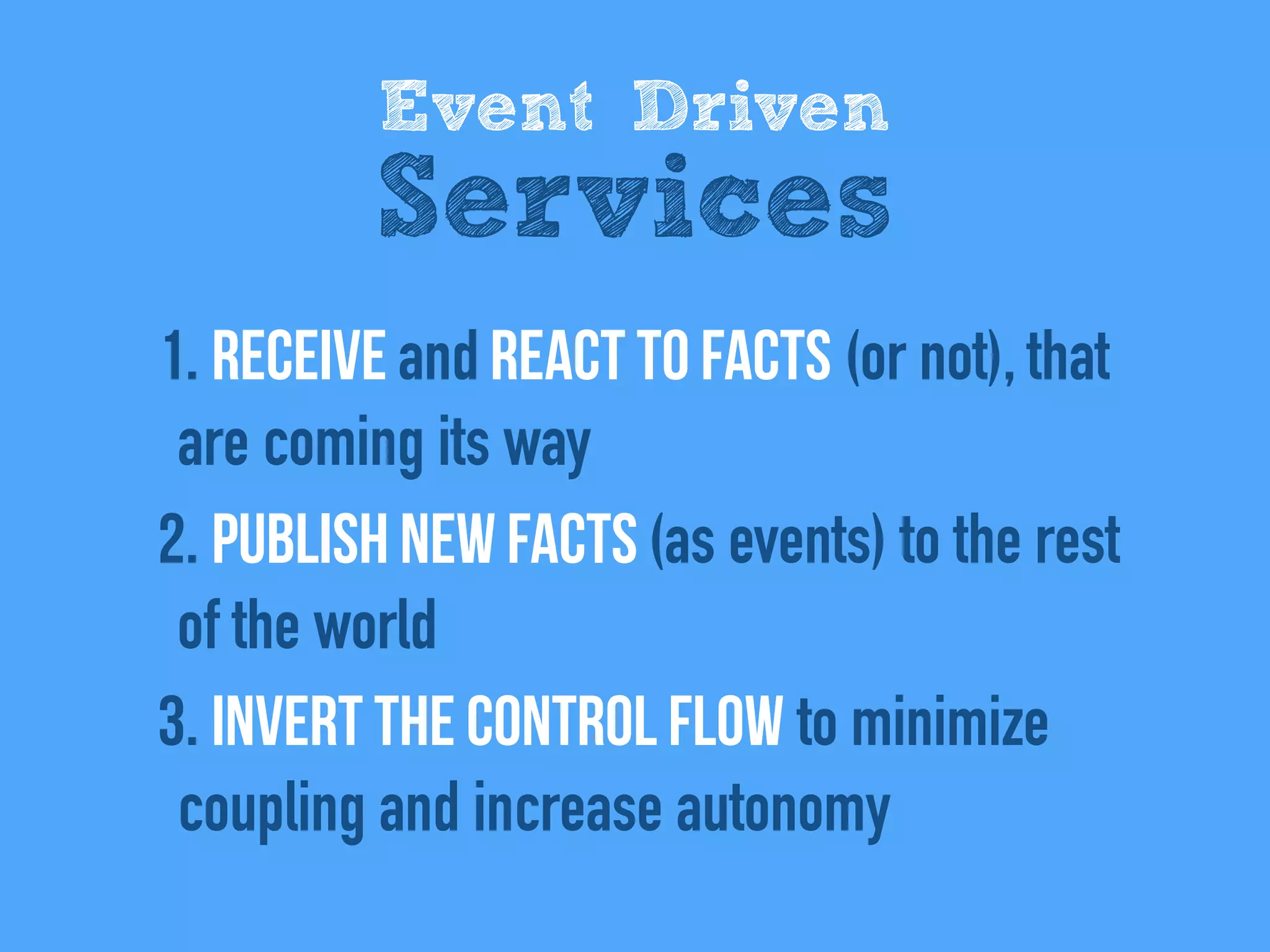
1. REceive and react to facts (or not), that
are coming its way
2. Publish new facts (as events) to the rest
of the world
3. Invert the control flow to minimize
coupling and increase autonomy
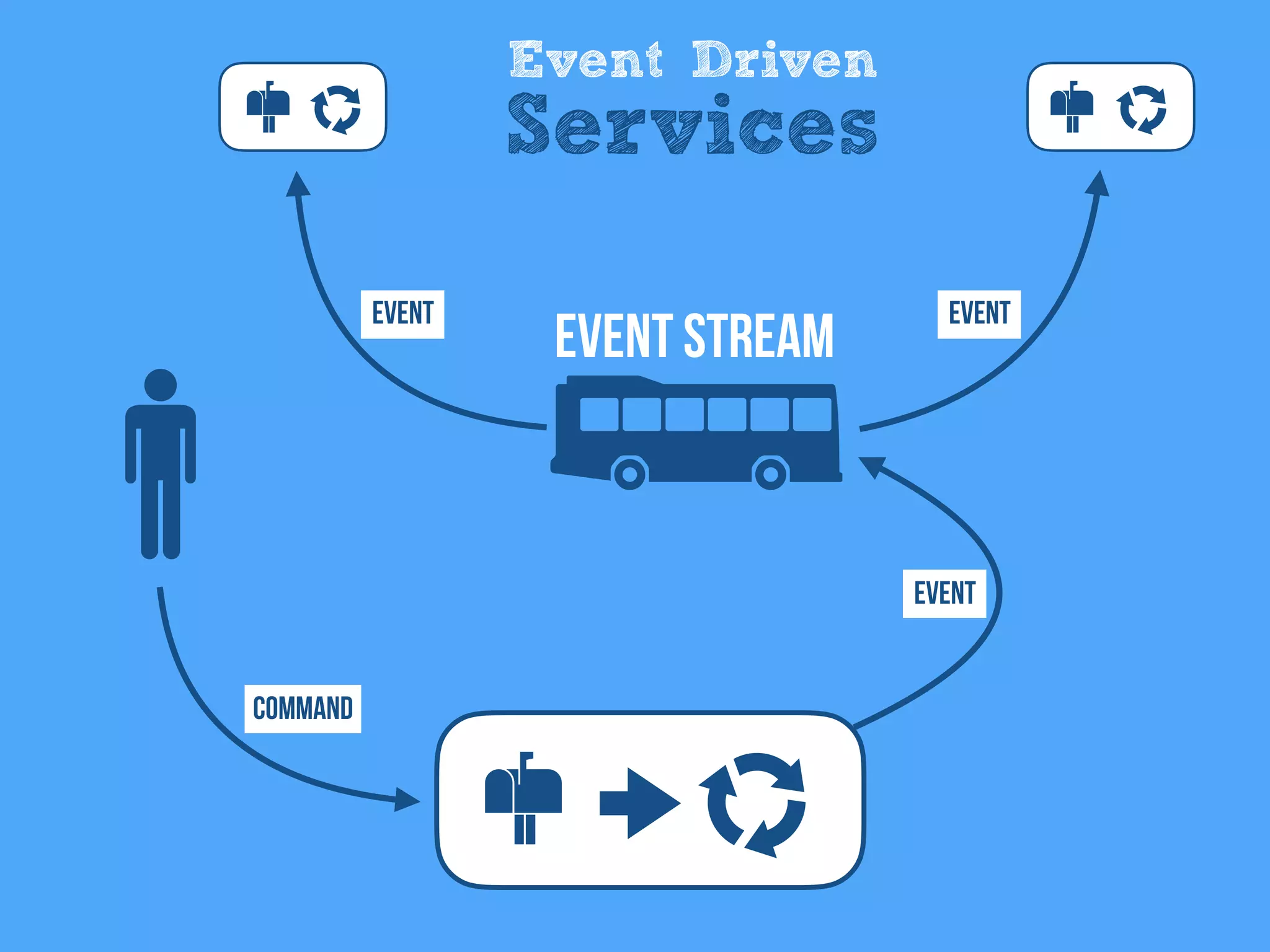
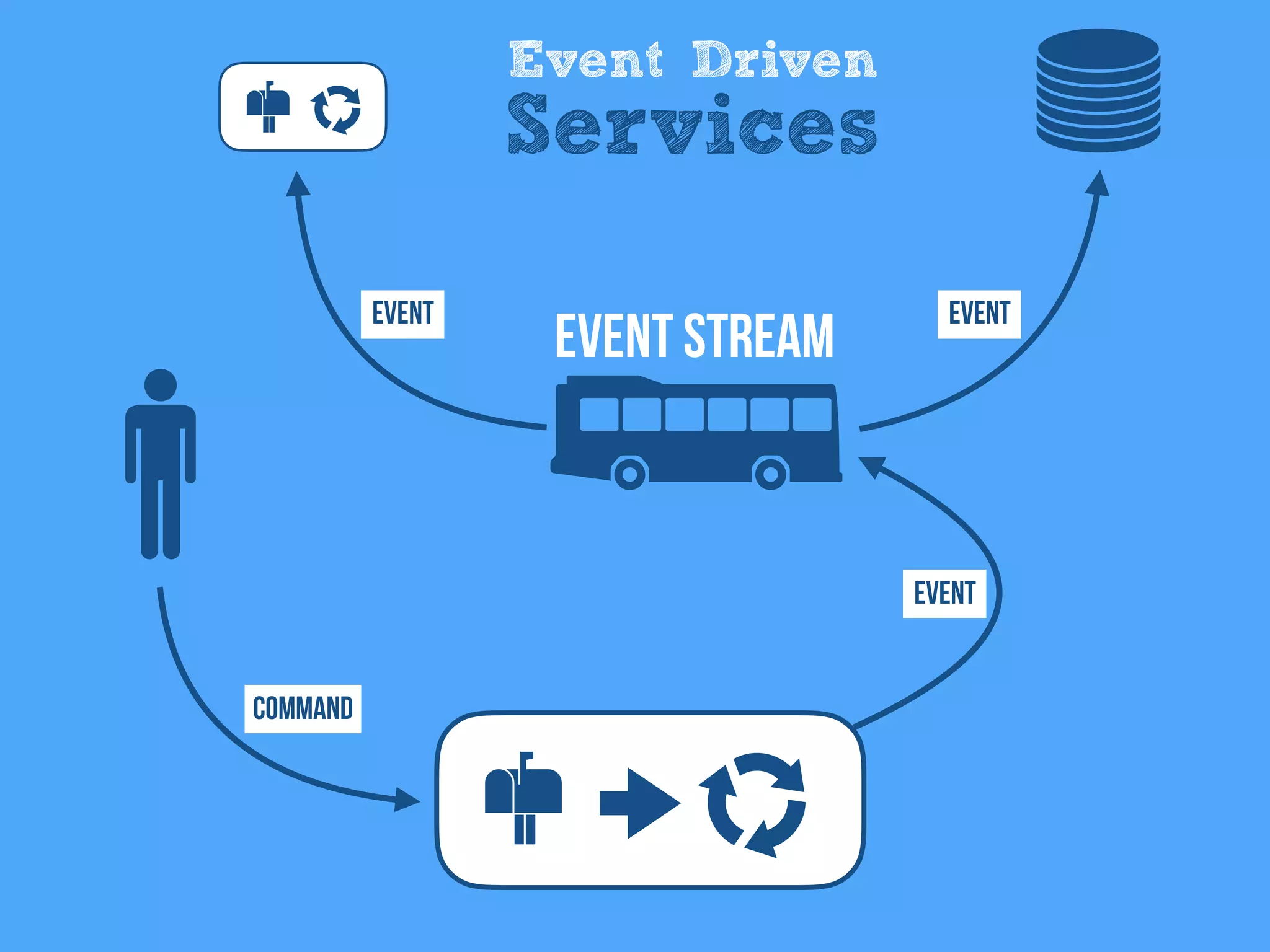
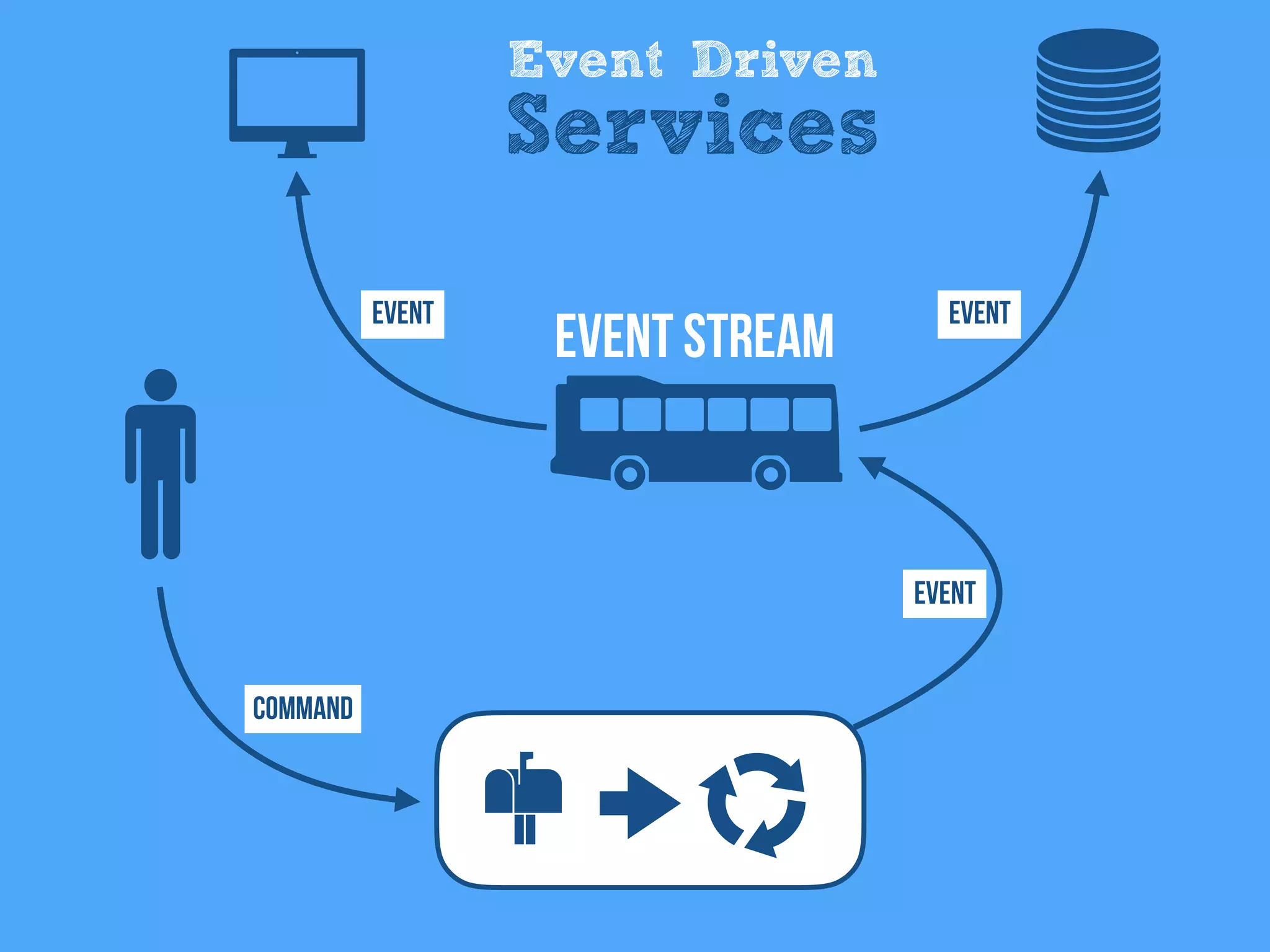
Event Driven
Services
Mutable State
Needs To Be
Contained
And Non Observable
Publish Facts
To Outside World
Event
Stream
Event
Stream
Use The
as the integration fabric
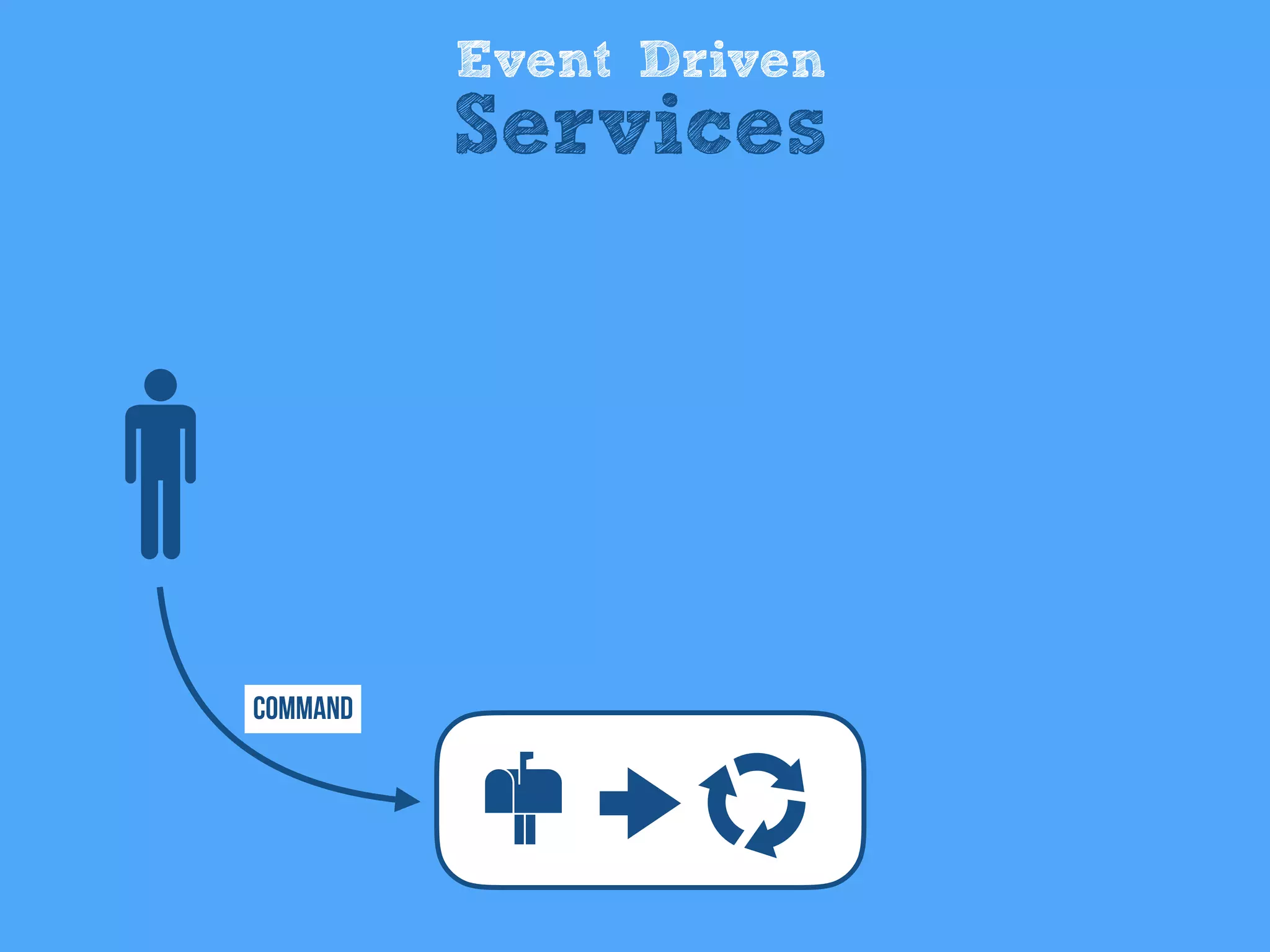
Event Driven
Services
Event Driven
Services
Event Driven
Services
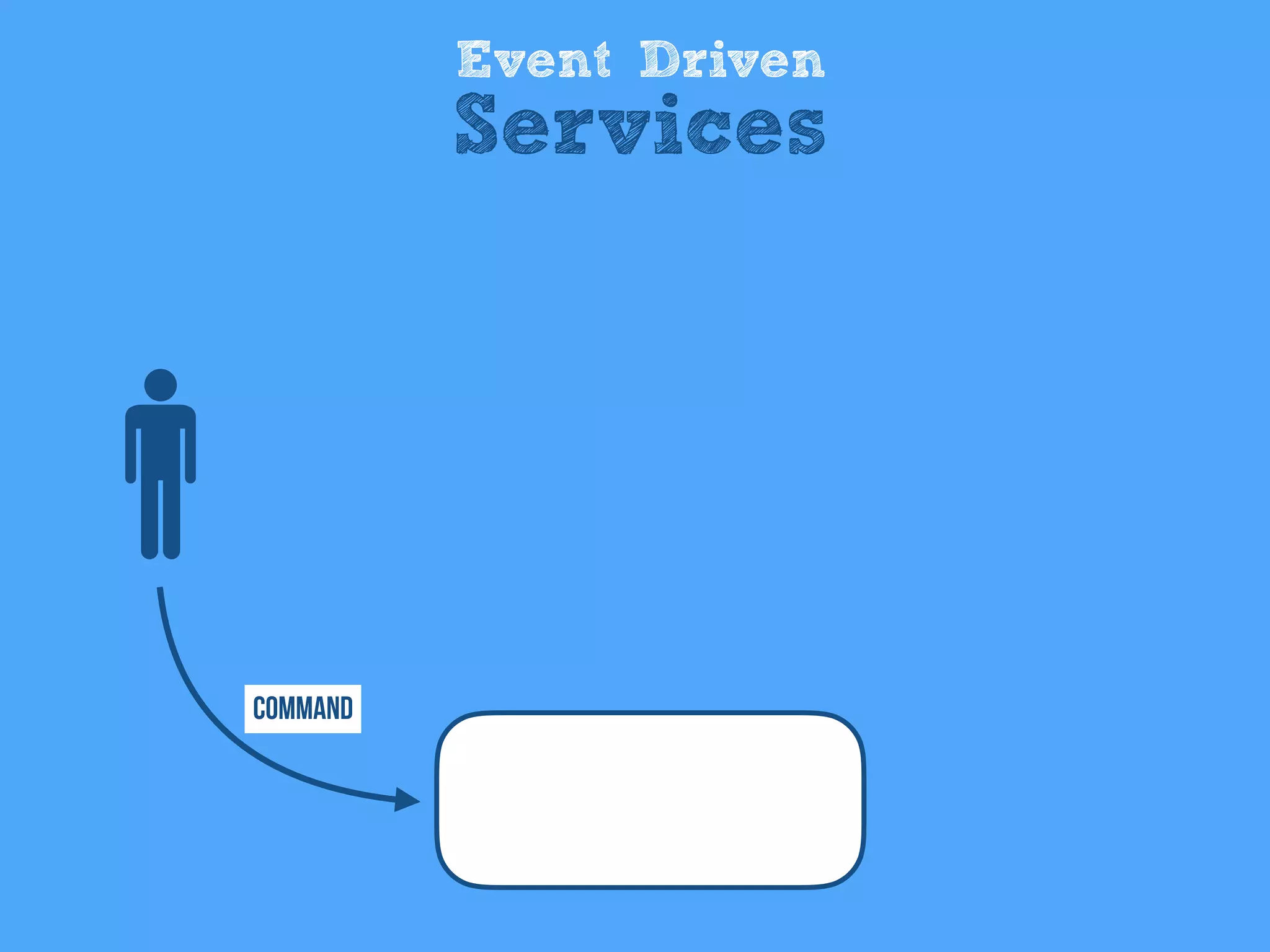
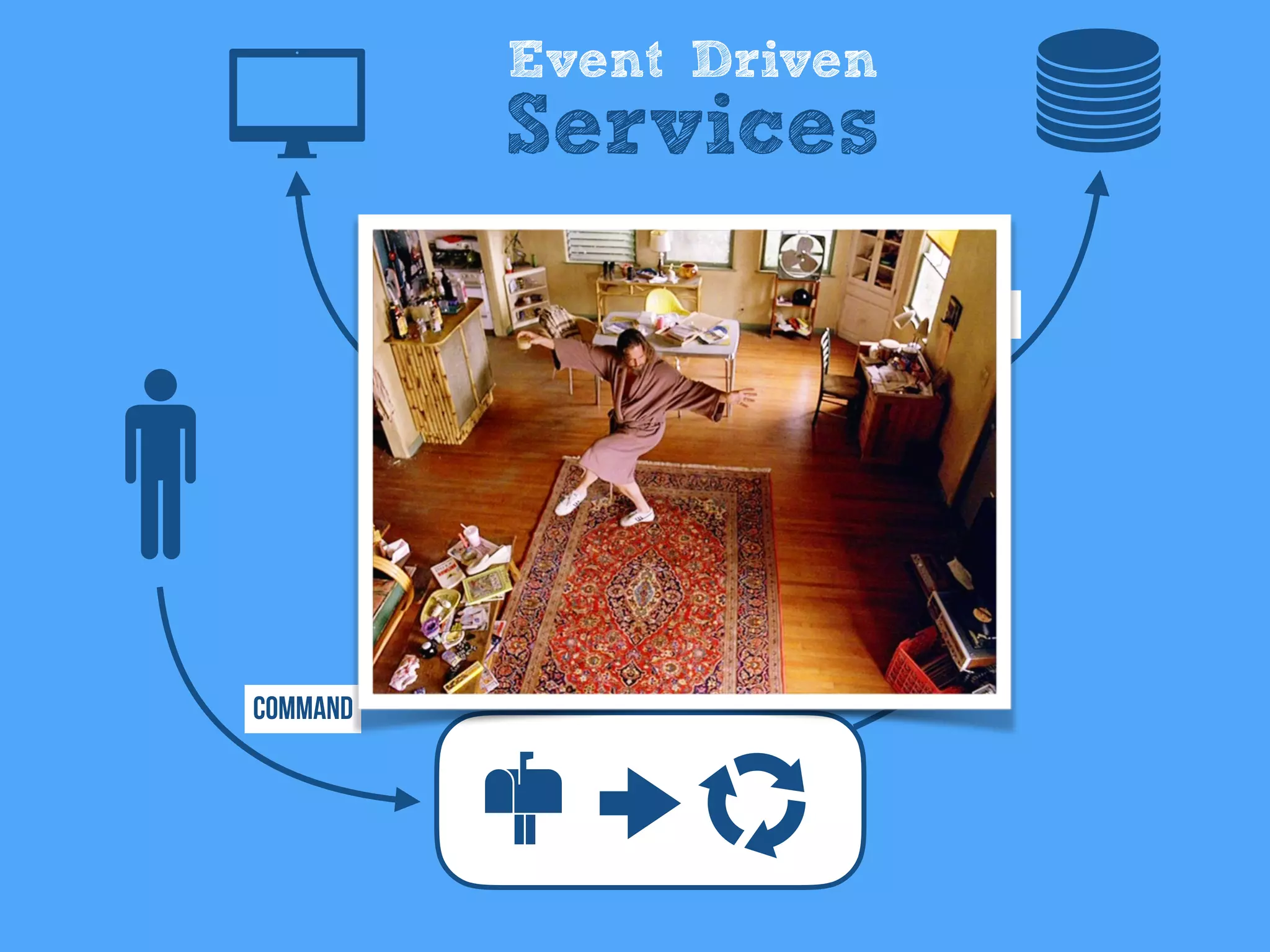
Command
Event Driven
Services
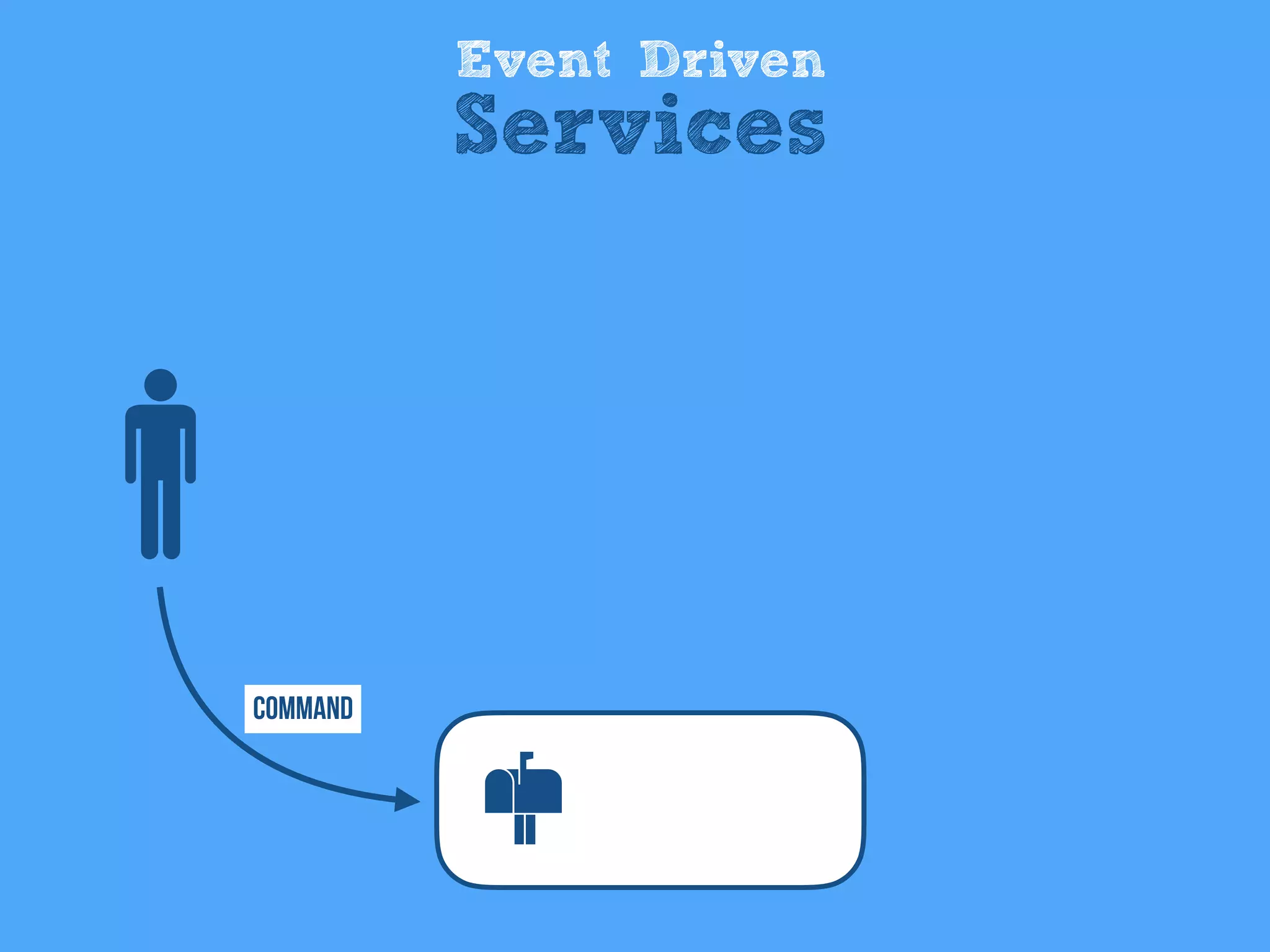
Command
Event Driven
Services
Command
Event Driven
Services
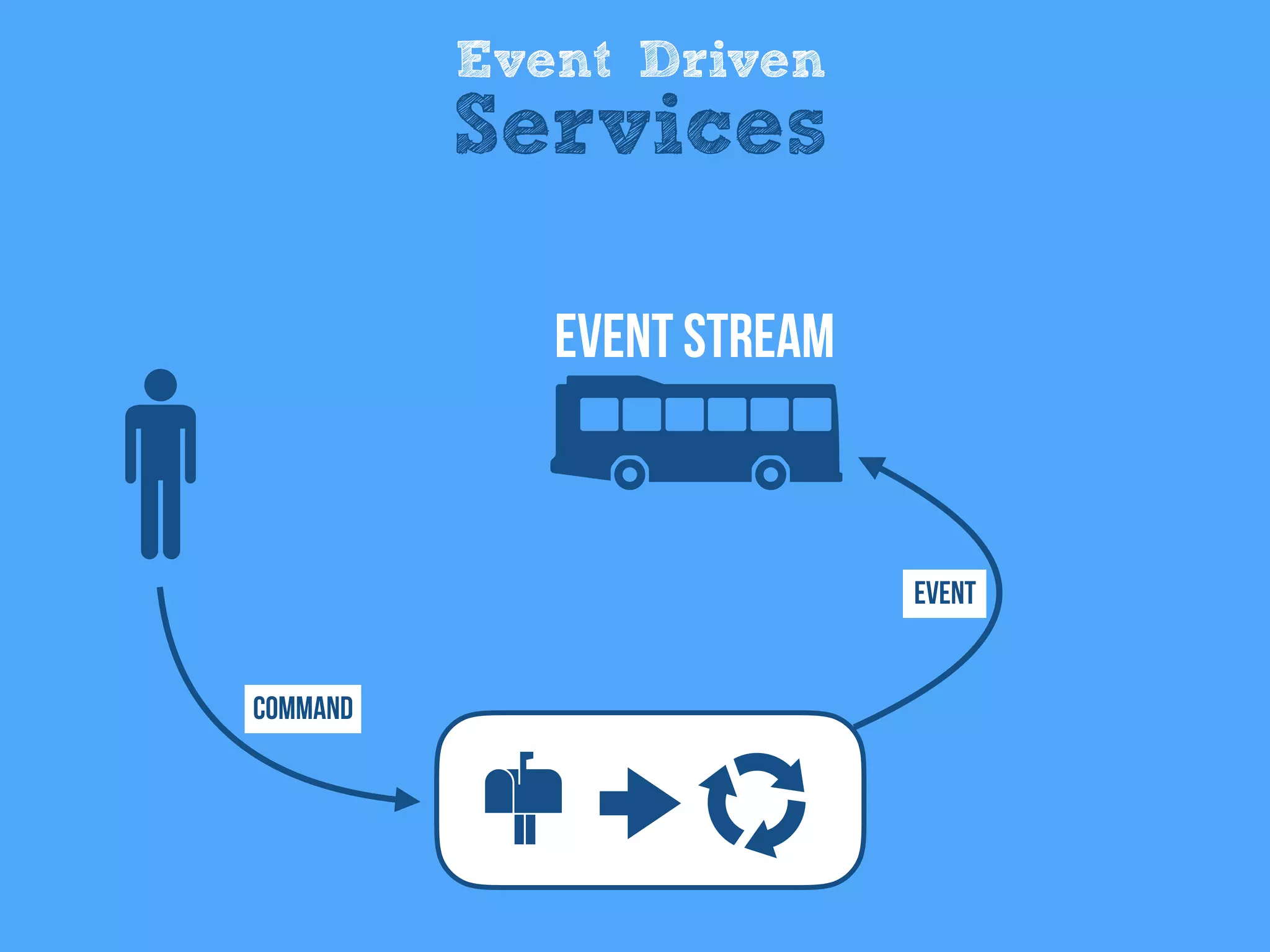
Command
Event
Event Stream
Event Driven
Services
Command
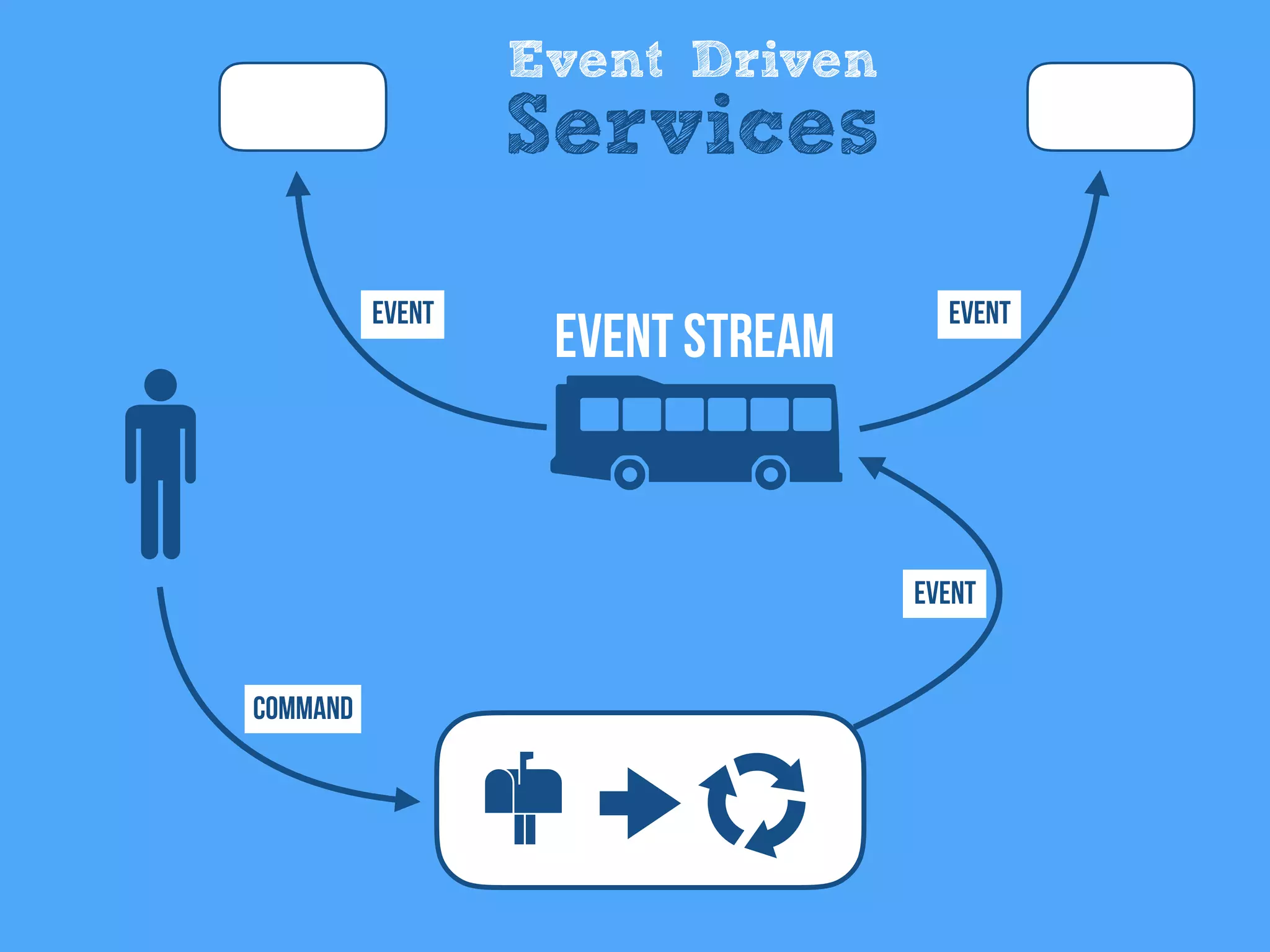
Event
EventEvent
Event Stream
Event Driven
Services
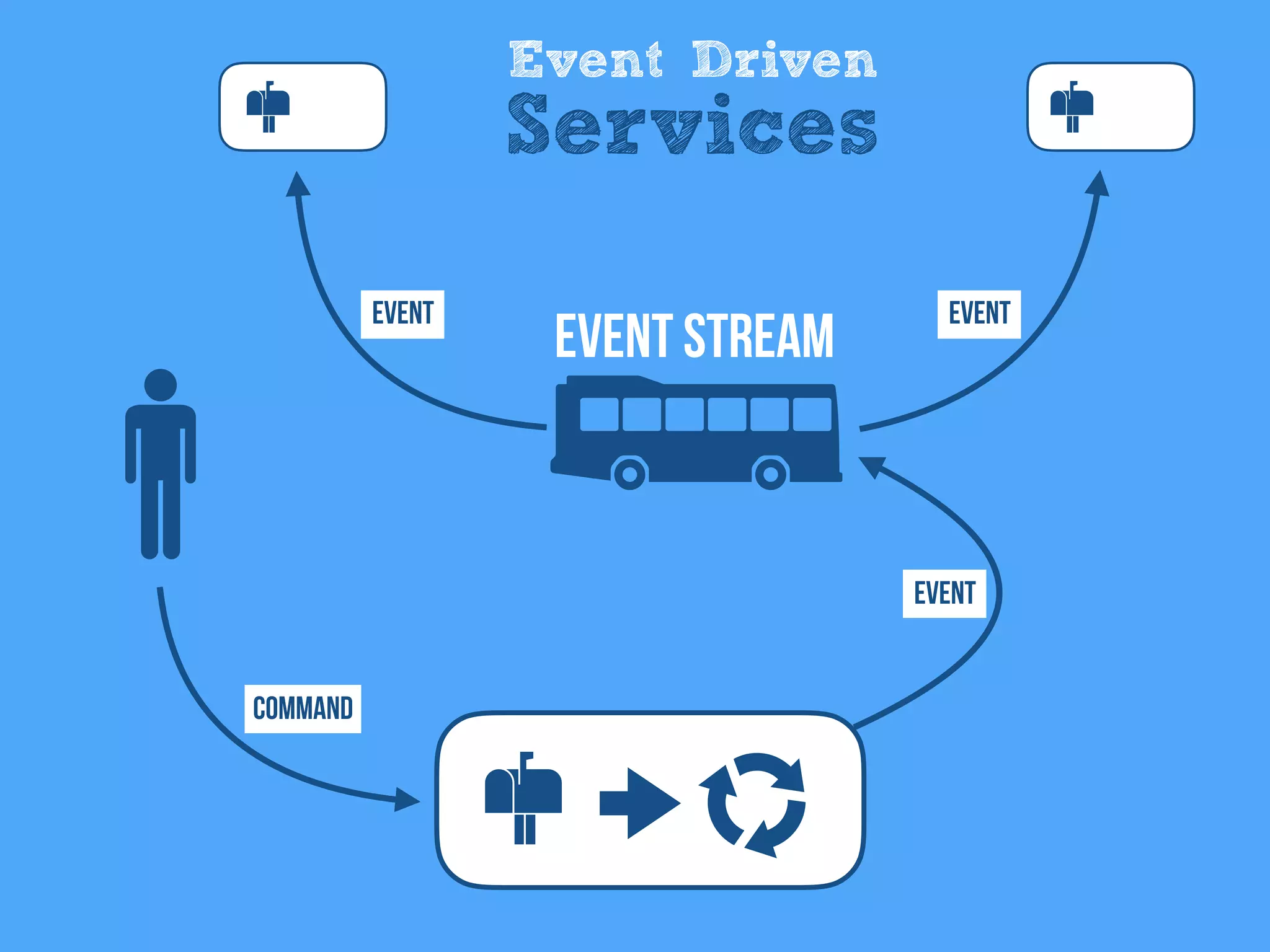
Command
Event
EventEvent
Event Stream
Event Driven
Services
Command
Event
EventEvent
Event Stream
Event Driven
Services
Command
Event
EventEvent
Event Stream
Event Driven
Services
Command
Event
EventEvent
Event Stream
Event Driven
Services
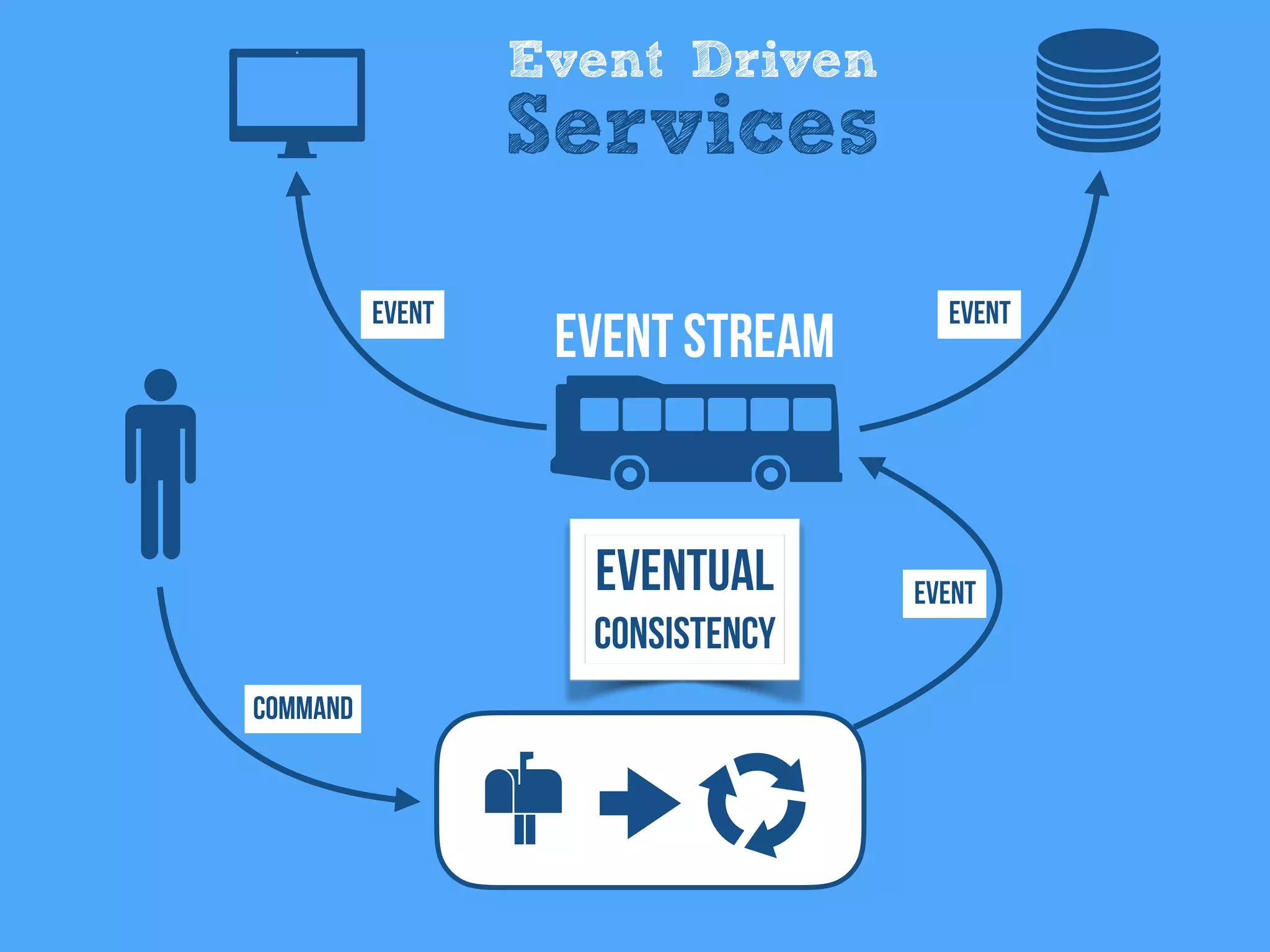
Eventual
Consistency
Command
Event
EventEvent
Event Stream
Event Driven
Services
Eventual
Consistency
Command
Event
EventEvent
Event Stream
Eventual
Consistency
Eventual
Consistency
No One Wants
It’s a necessery evil
But Relax
It Is How The
World Works
Information
Has Latency
Information Is Always
From the Past
Welcome To The Wild Ocean Of
Non Determinism
Distributed Systems
“In a system which cannot count on
distributed transactions, the
management of uncertainty must be
implemented in the business logic.”
- Pat Helland
Life Beyond Distributed Transactions - An Apostate’s Opinion, Pat Helland (2007)
We Need To Model
Uncertainty
Exploit
Reality
Exploit
Reality
We need to
In our design
Events Can Lead To Greater
Certainty
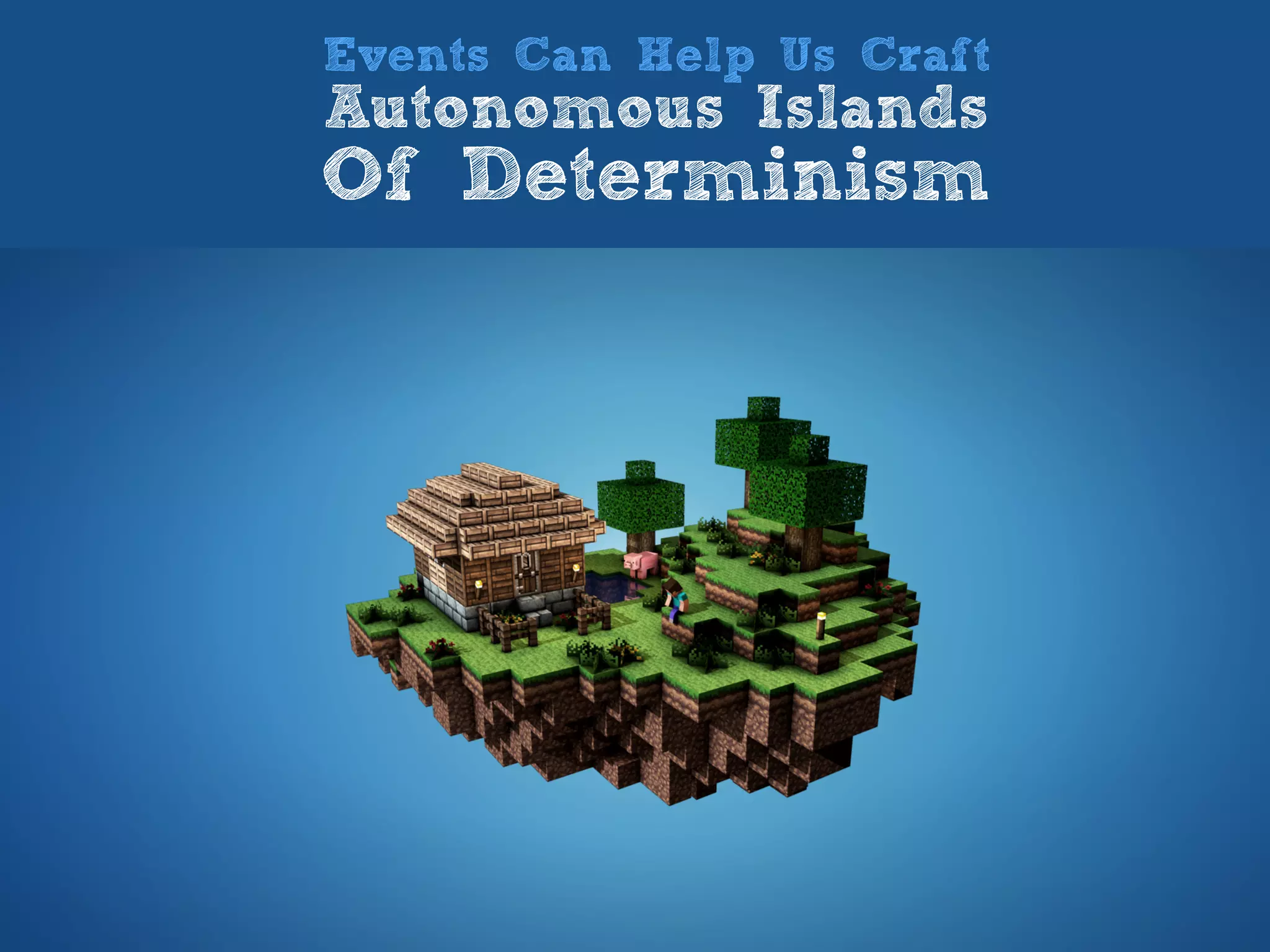
Events Can Help Us Craft
Autonomous Islands
Of Determinism
What does it mean to be
Automonous?
From greek: Auto-nomos
✴ Auto meaning self
✴ Nomos meaning Law
Autonomy
Promise
Theory
Promise
Theory
Let
Lead the way
✴Impositions diverge
into unpredictable outcomes
from definite beginnings
Distributed information
Decreased certainty
Convergence
vs.
Divergence
of information
✴Promises converge
towards a definite outcome
from unpredictable beginnings
Local information
Improved certainty
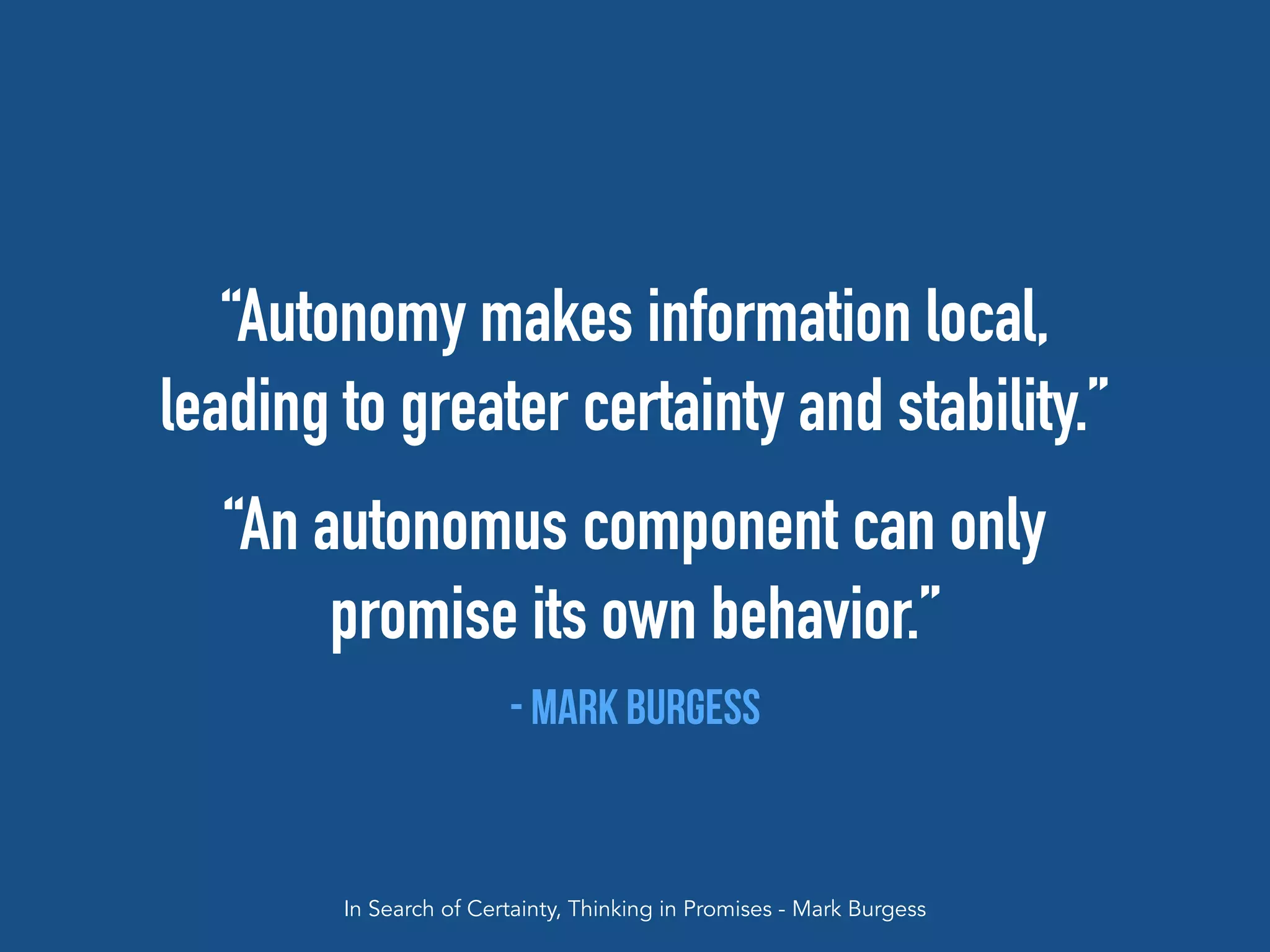
“Autonomy makes information local,
leading to greater certainty and stability.”
“An autonomus component can only
promise its own behavior.”
- Mark Burgess
In Search of Certainty, Thinking in Promises - Mark Burgess
Benefits of Thinking in Promises
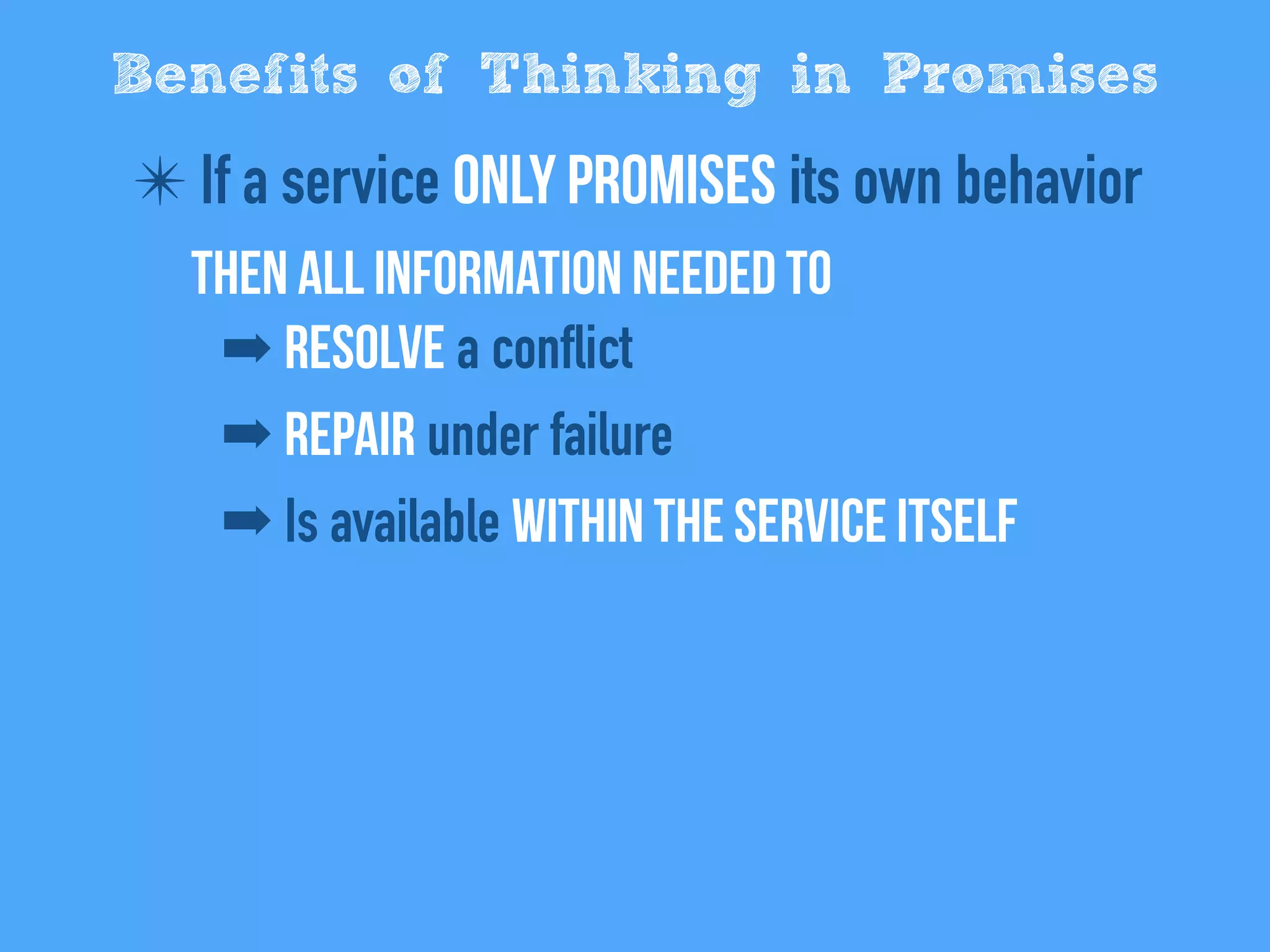
✴ If a service only promises its own behavior
Then all information needed to
➡ Resolve a conflict
➡ Repair under failure
➡ Is available within the service itself
Benefits of Thinking in Promises
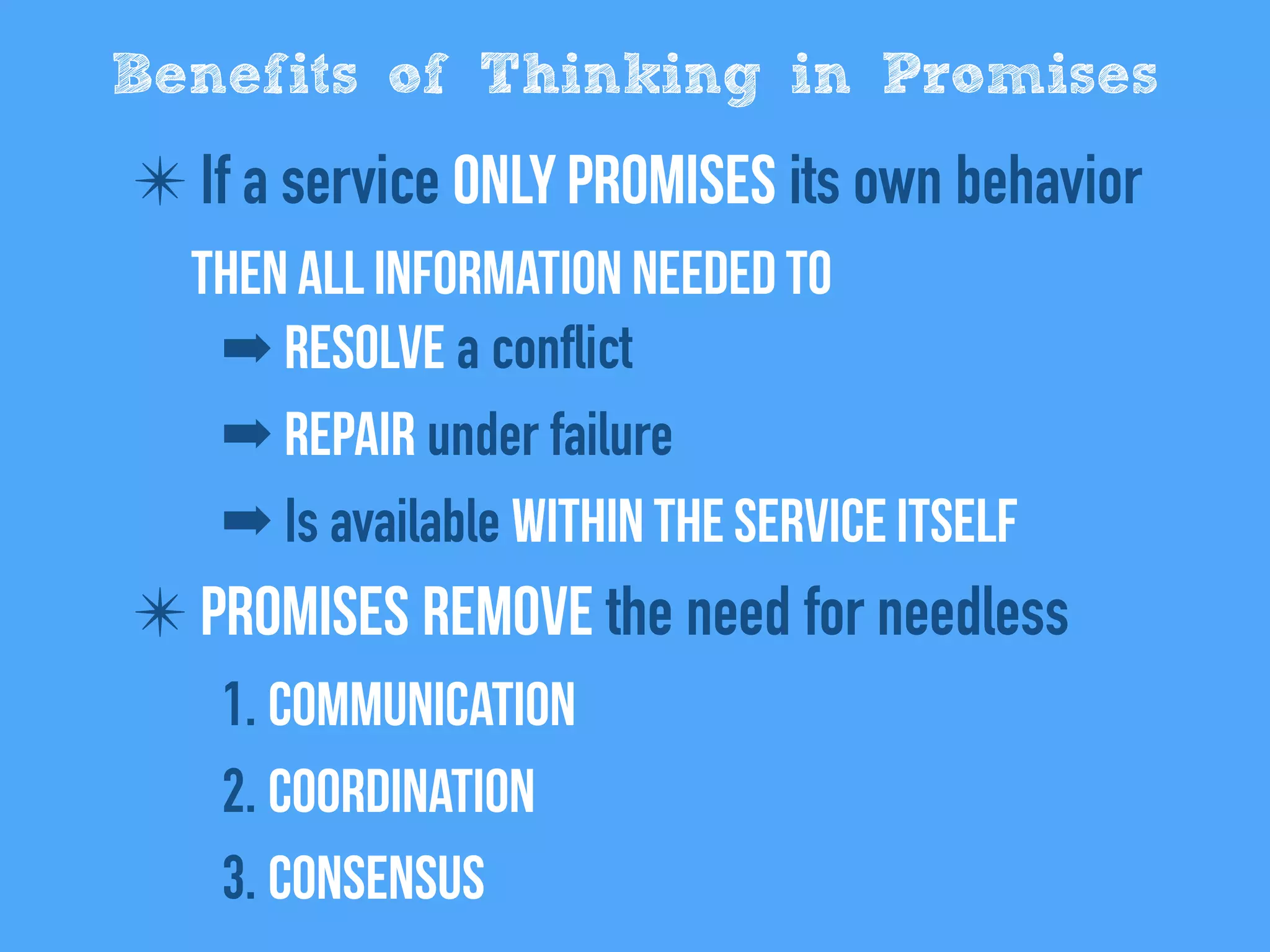
✴ If a service only promises its own behavior
Then all information needed to
➡ Resolve a conflict
➡ Repair under failure
➡ Is available within the service itself
✴ Promises remove the need for needless
1. Communication
2. Coordination
3. Consensus
Benefits of Thinking in Promises
“The first principle of successful
scalability is to batter the consistency
mechanisms down to a minimum.”
- James Hamilton
As transcribed in: Toward a Cloud Computing Research Agenda. SIGACT News, 40(2):68–80, June 2009.
Events First Design
Drives Autonomy
Events First
Domain Driven
Design
“When you start modeling events, it
forces you to think about the behavior
of the system. As opposed to thinking
about the structure of the system.”
- Greg Young
A Decade of DDD, CQRS, Event Sourcing, Greg Young (Presentation from 2016)
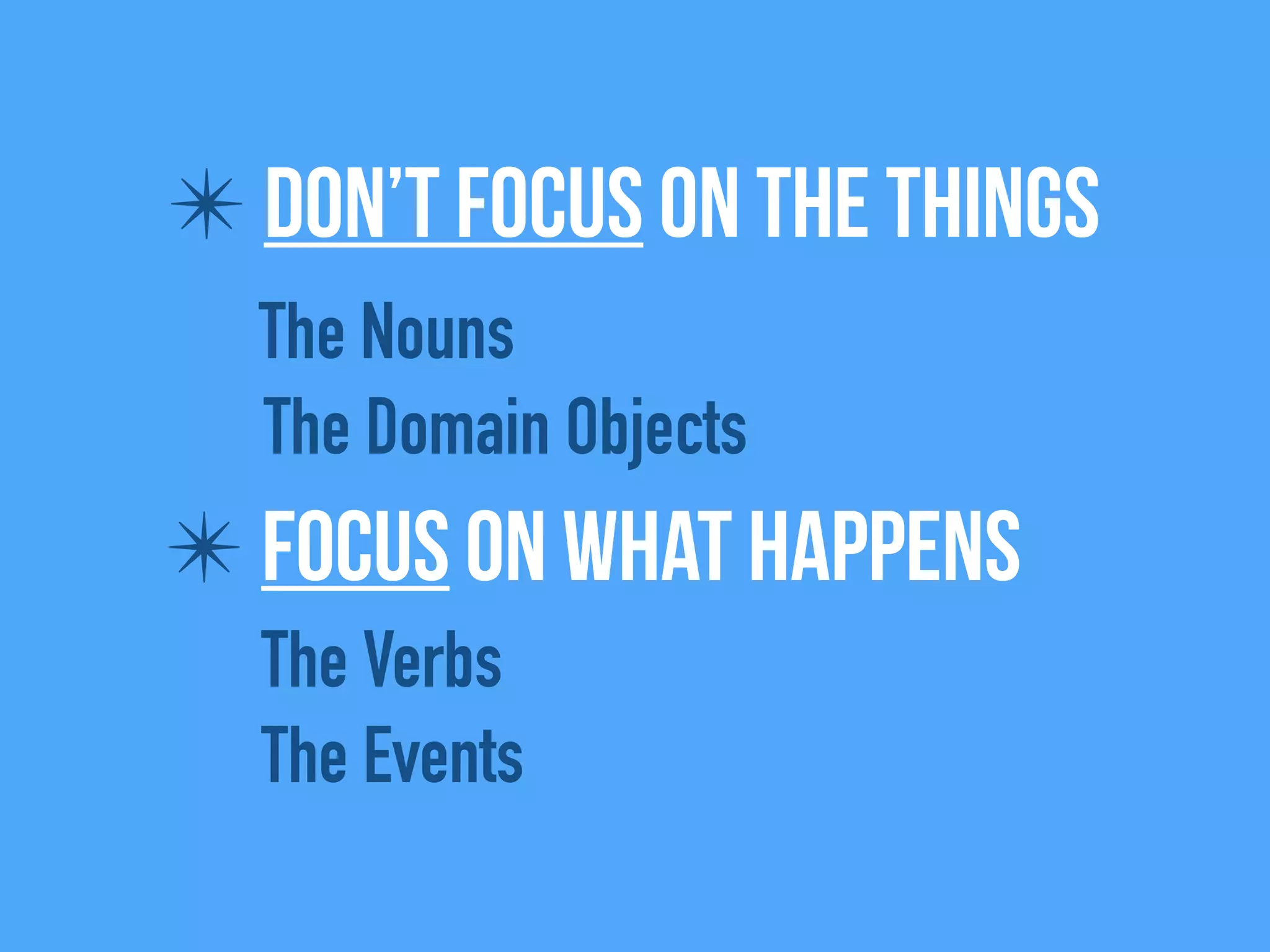
✴ Don’t focus on the things
The Nouns
The Domain Objects
✴ Focus on what happens
The Verbs
The Events
Mine the
Facts
Event Storming
Event Driven Design
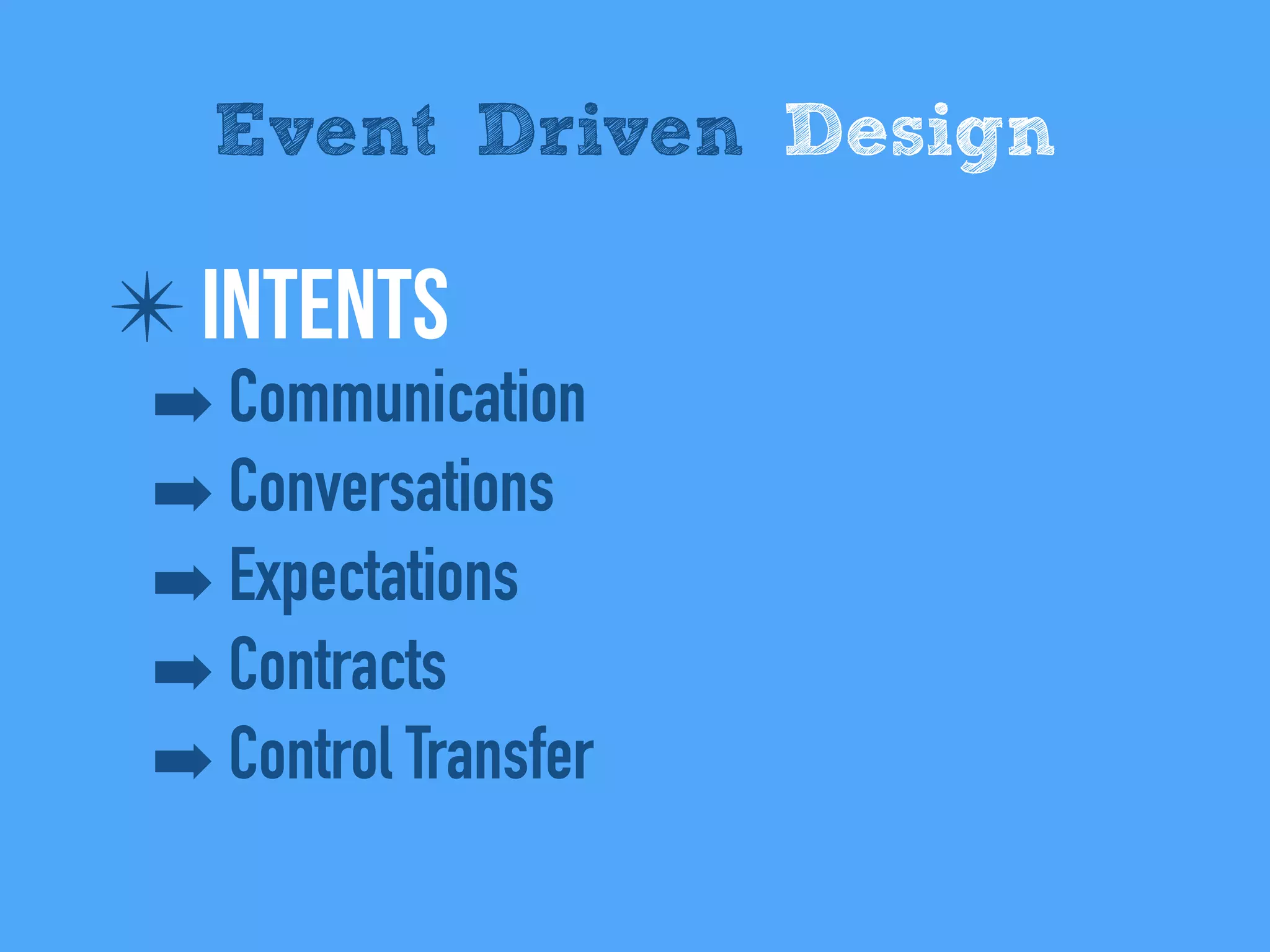
✴ IntentS
➡ Communication
➡ Conversations
➡ Expectations
➡ Contracts
➡ Control Transfer
Event Driven Design
✴ IntentS
➡ Communication
➡ Conversations
➡ Expectations
➡ Contracts
➡ Control Transfer
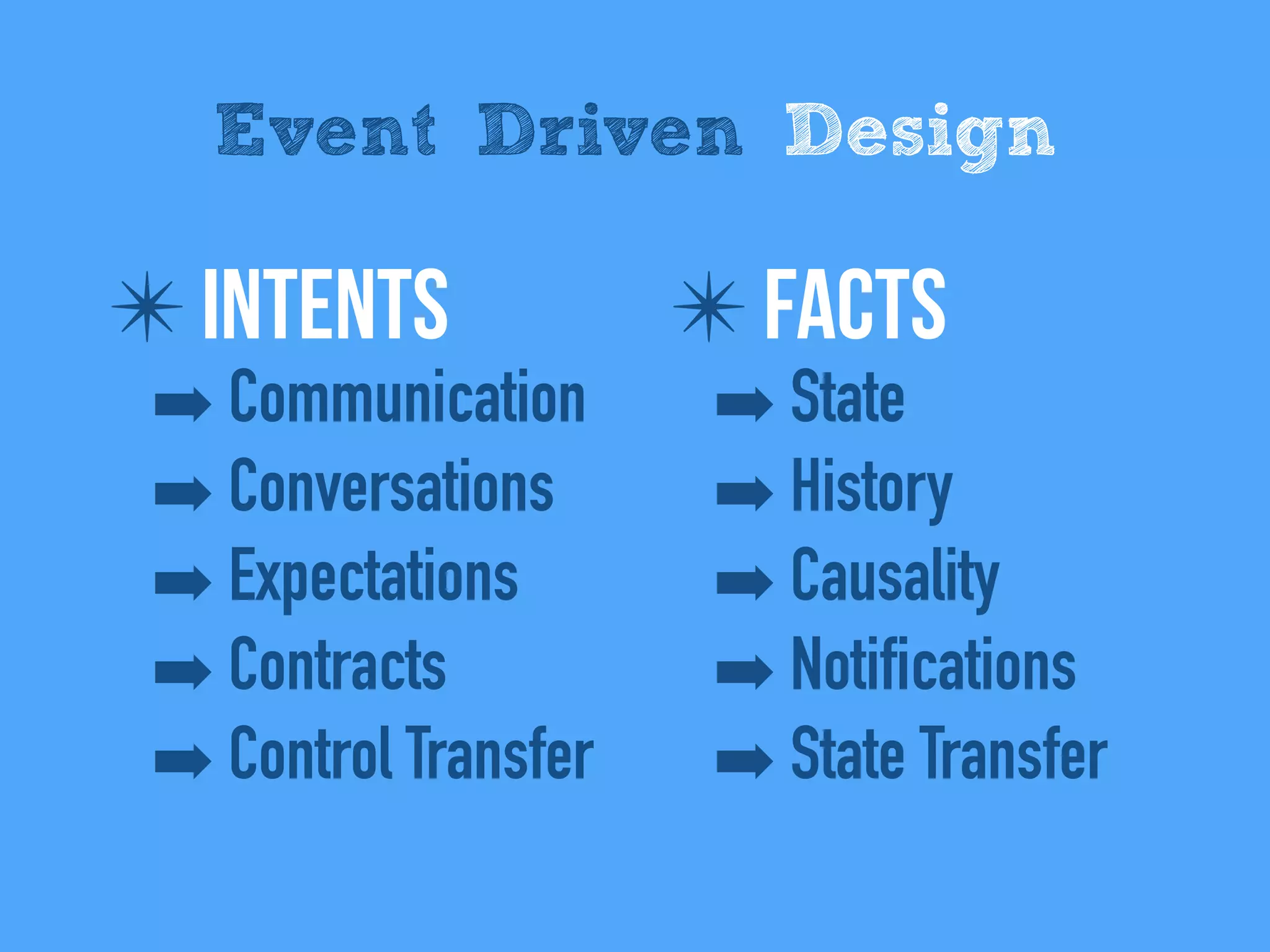
Event Driven Design
✴ Facts
➡ State
➡ History
➡ Causality
➡ Notifications
➡ State Transfer
✴ IntentS
➡ Communication
➡ Conversations
➡ Expectations
➡ Contracts
➡ Control Transfer
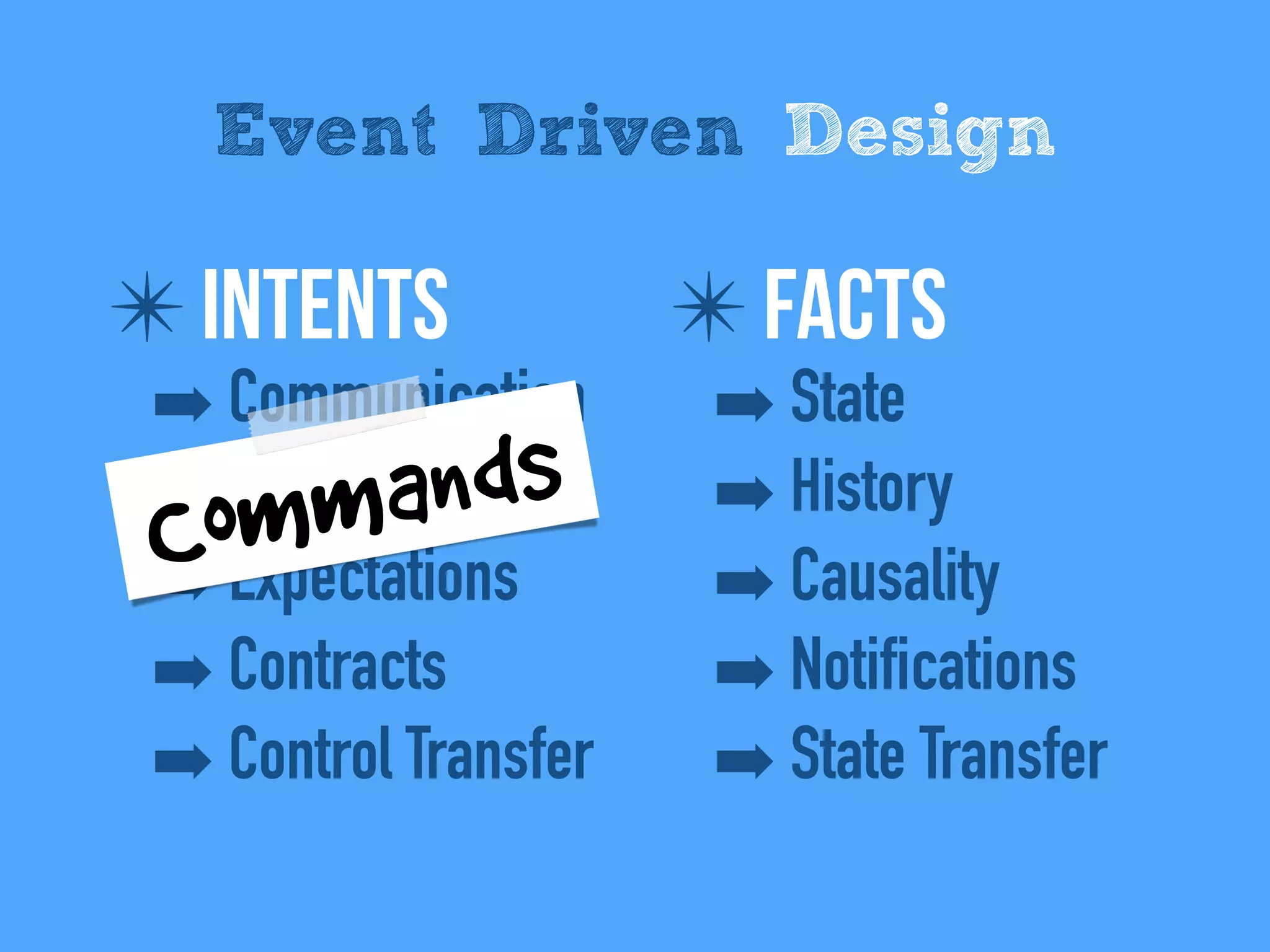
Event Driven Design
✴ Facts
➡ State
➡ History
➡ Causality
➡ Notifications
➡ State Transfer
Commands
✴ IntentS
➡ Communication
➡ Conversations
➡ Expectations
➡ Contracts
➡ Control Transfer
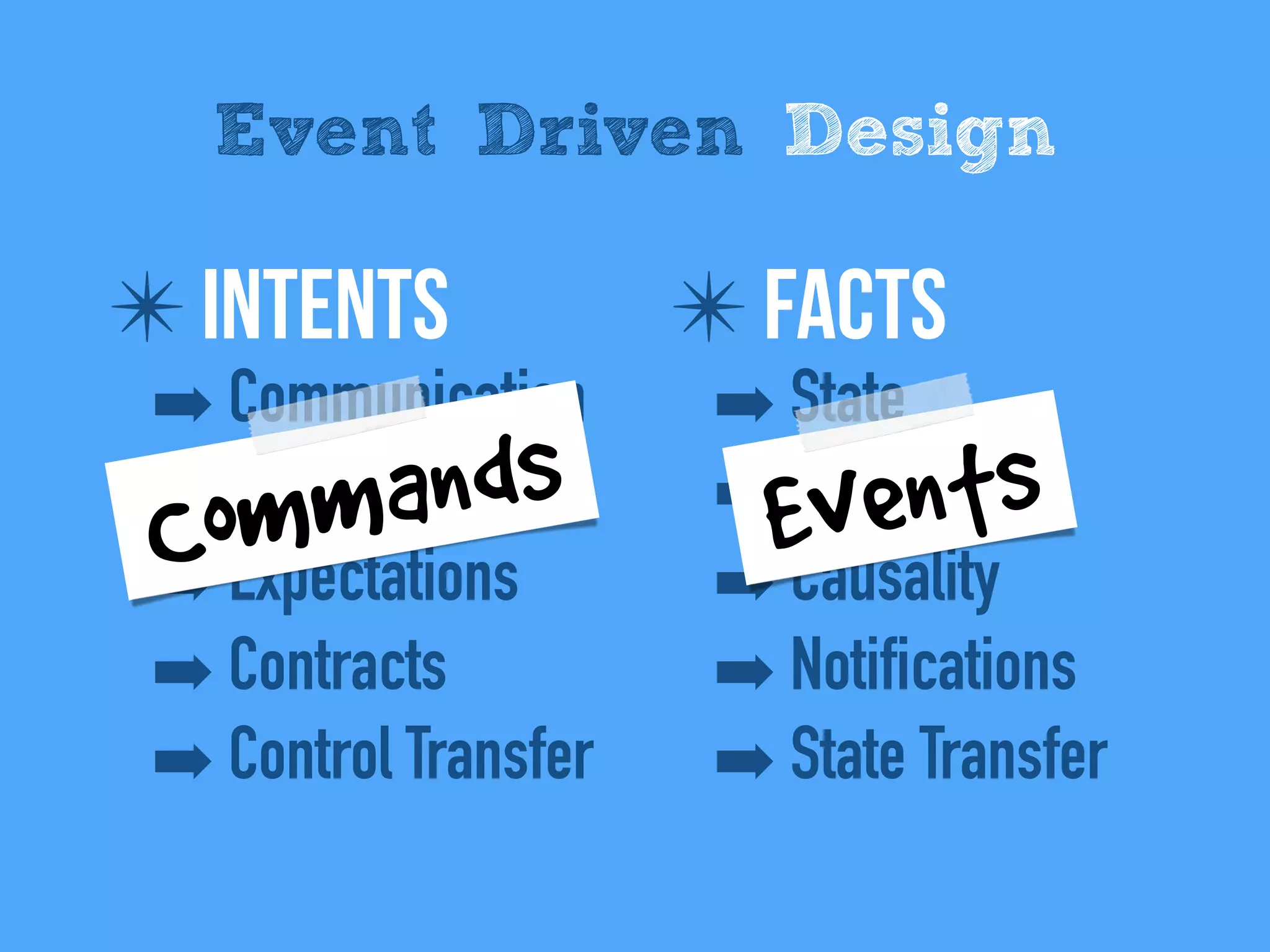
Event Driven Design
✴ Facts
➡ State
➡ History
➡ Causality
➡ Notifications
➡ State Transfer
Commands Events
Event Driven Design
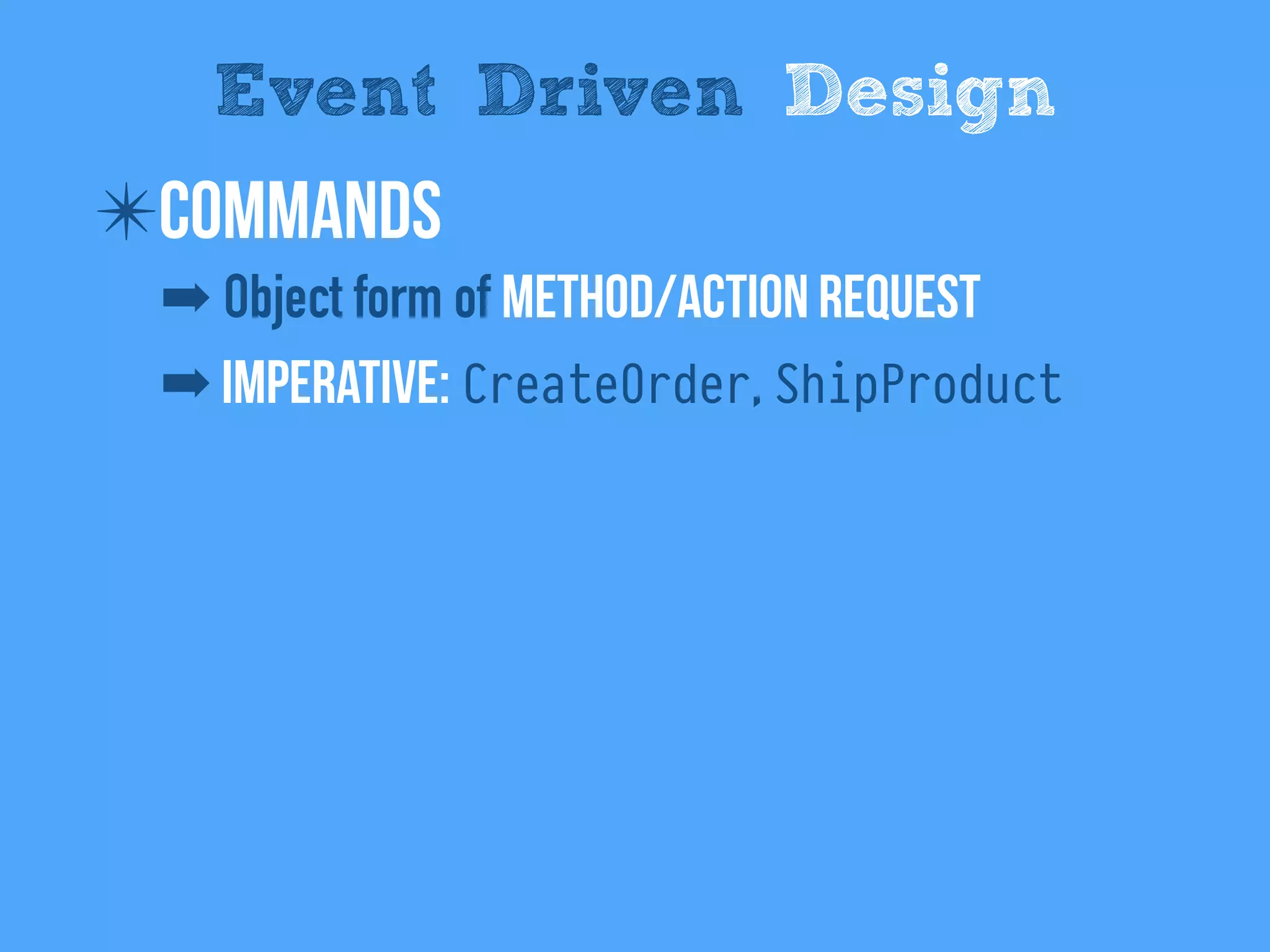
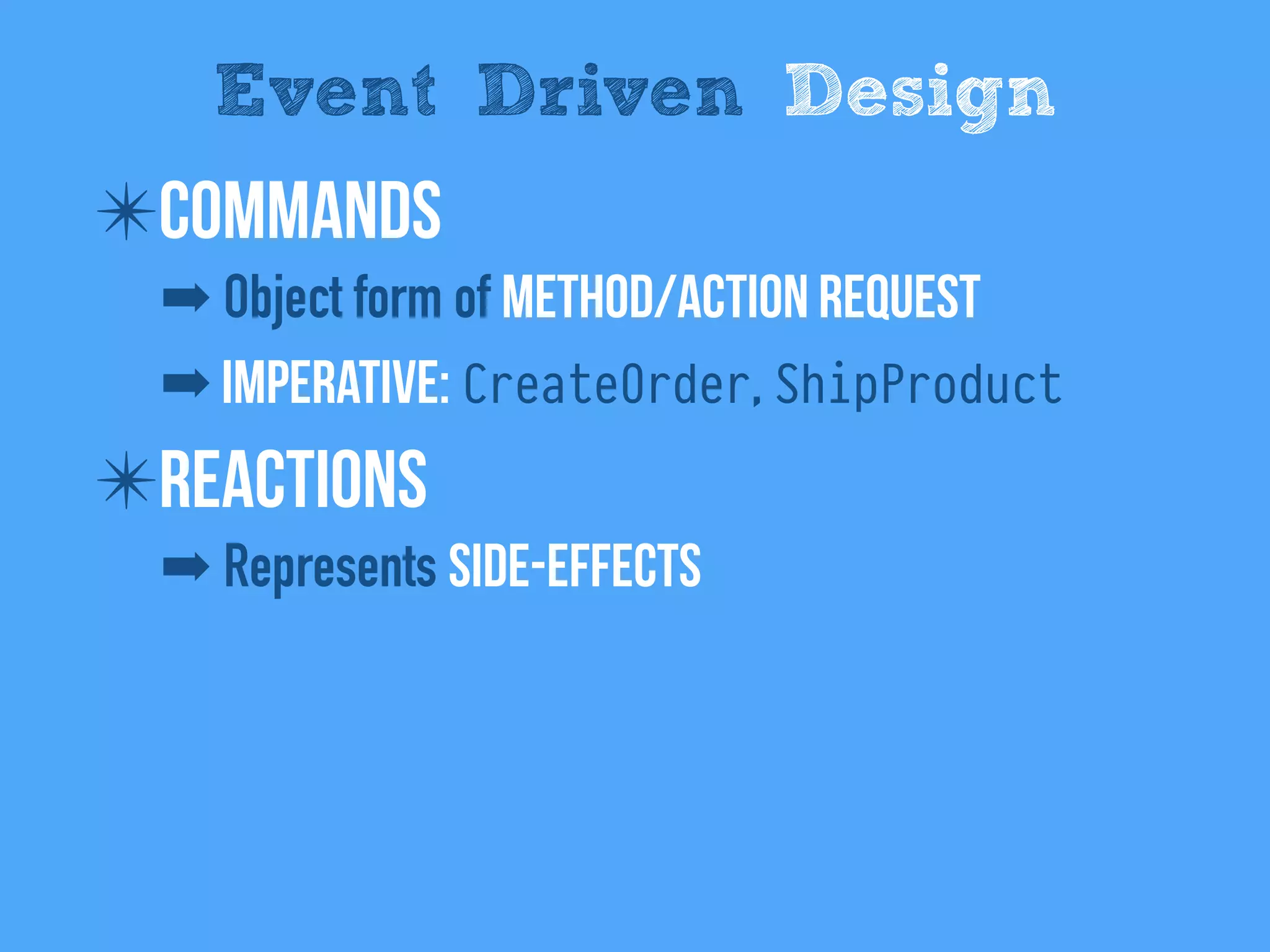
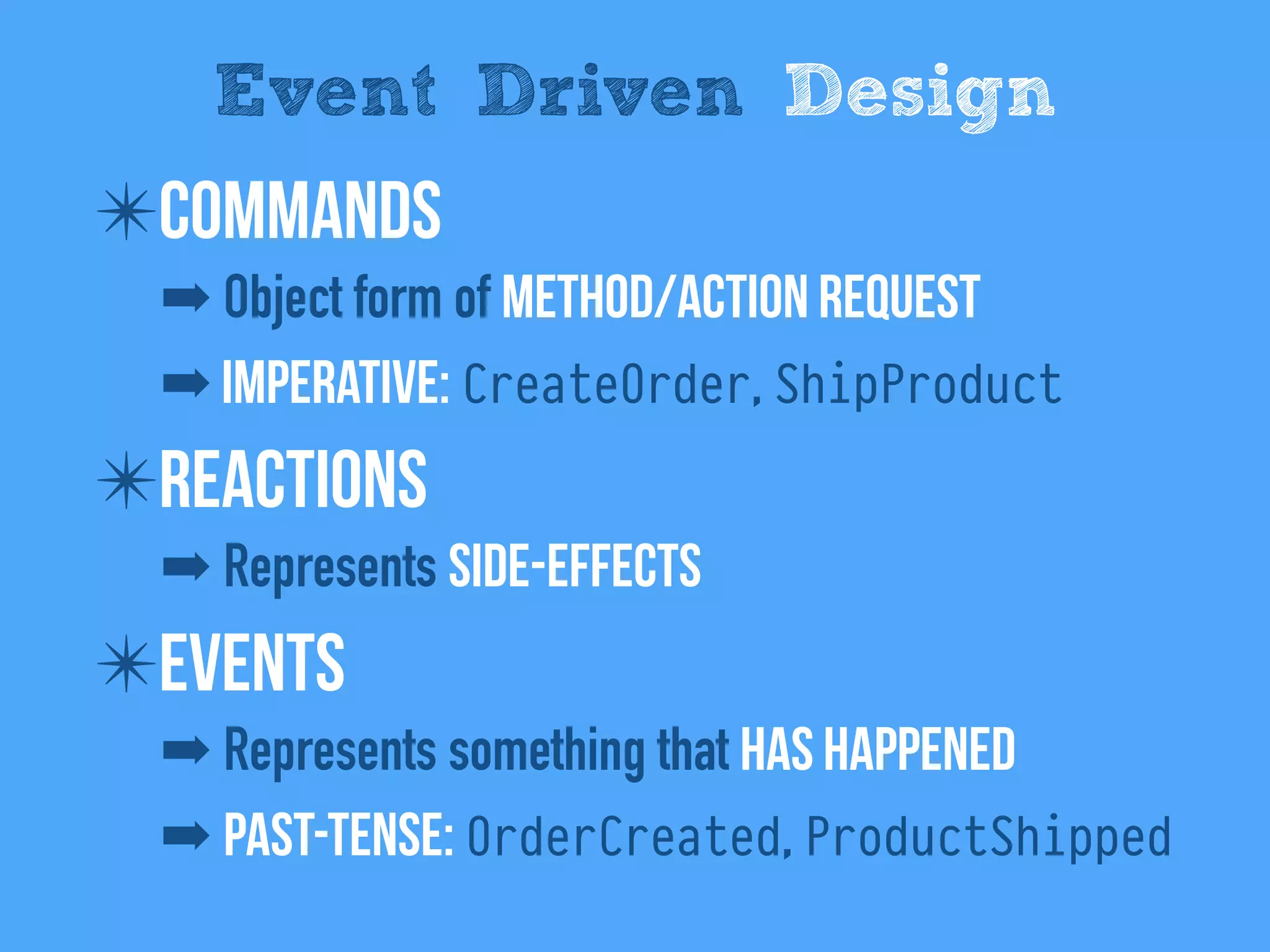
✴Commands
➡ Object form of method/Action request
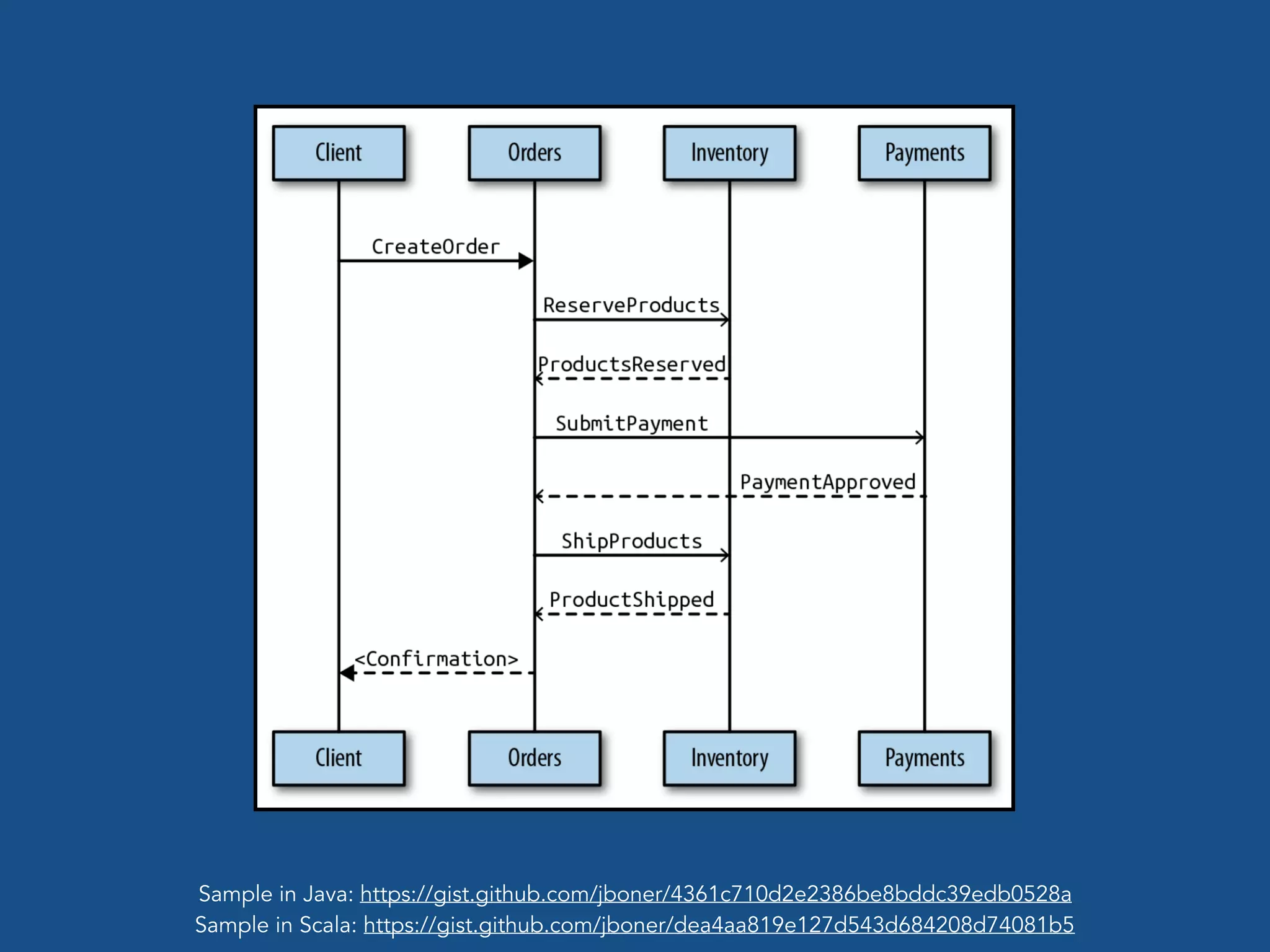
➡ Imperative: CreateOrder, ShipProduct
Event Driven Design
✴Commands
➡ Object form of method/Action request
➡ Imperative: CreateOrder, ShipProduct
✴Reactions
➡ Represents side-effects
Event Driven Design
✴Commands
➡ Object form of method/Action request
➡ Imperative: CreateOrder, ShipProduct
✴Reactions
➡ Represents side-effects
✴Events
➡ Represents something that has happened
➡ Past-tense: OrderCreated, ProductShipped
Event Driven Design
Commands Eventsvs
Commands Eventsvs
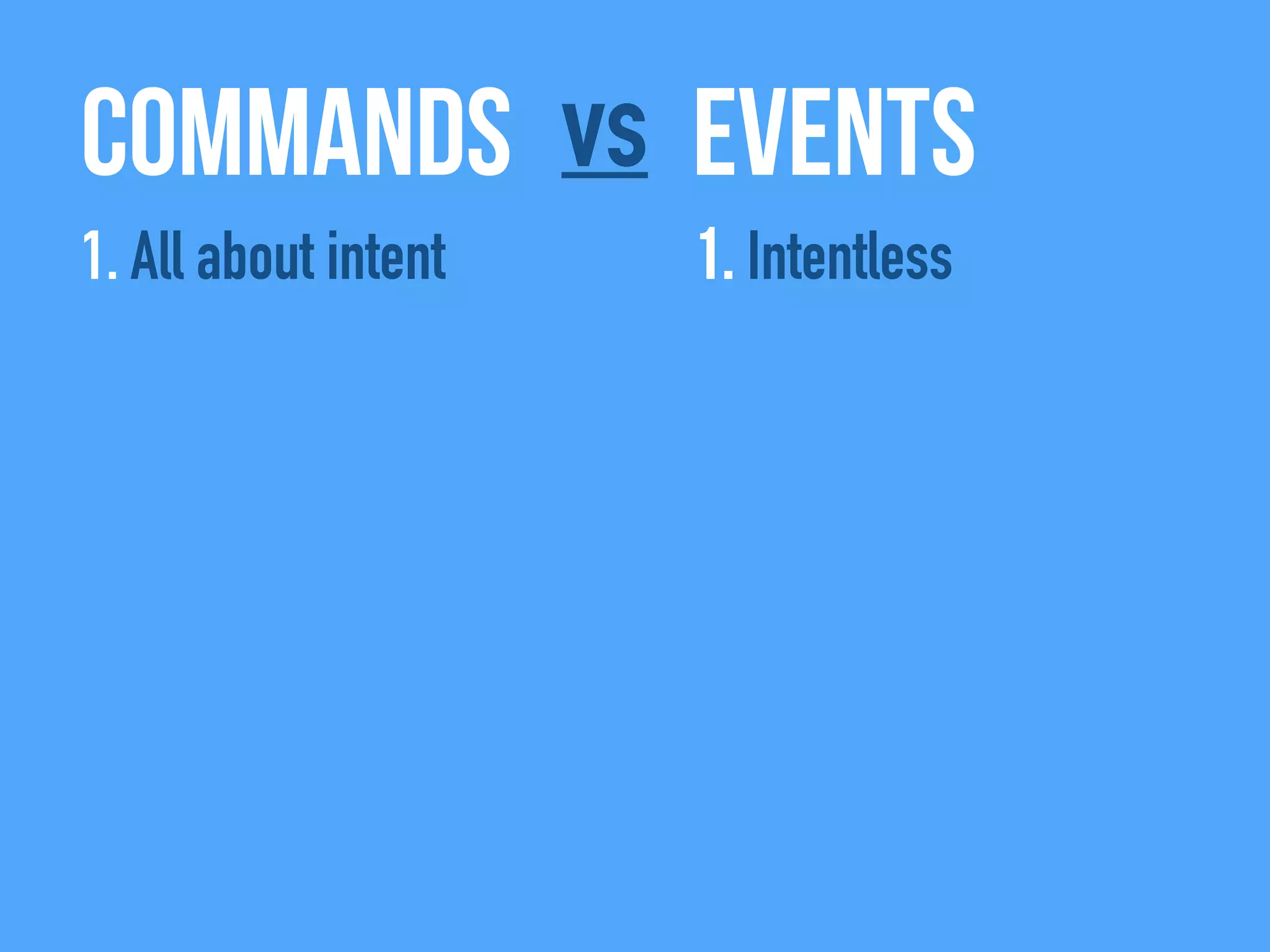
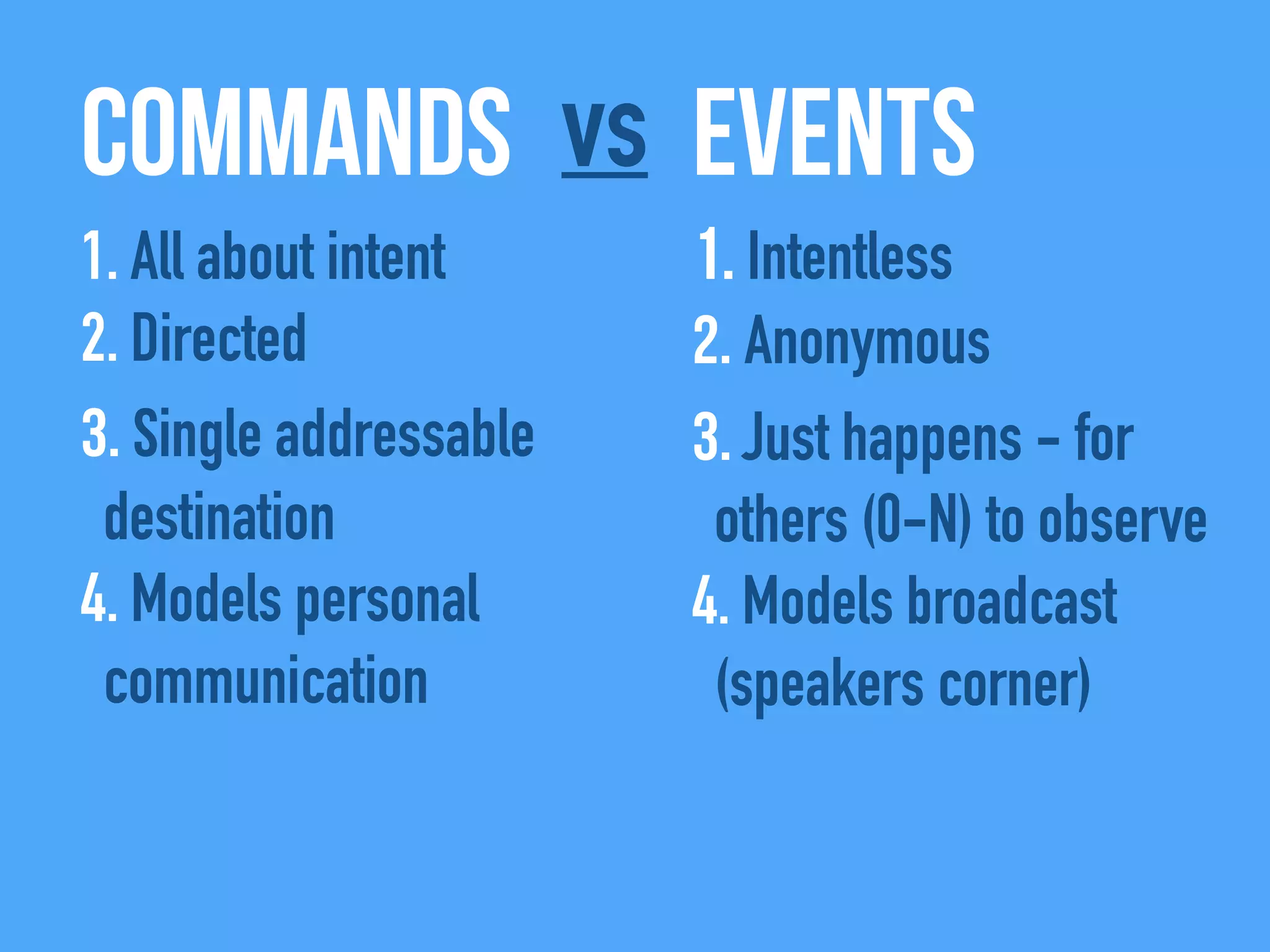
1. All about intent 1. Intentless
Commands Eventsvs
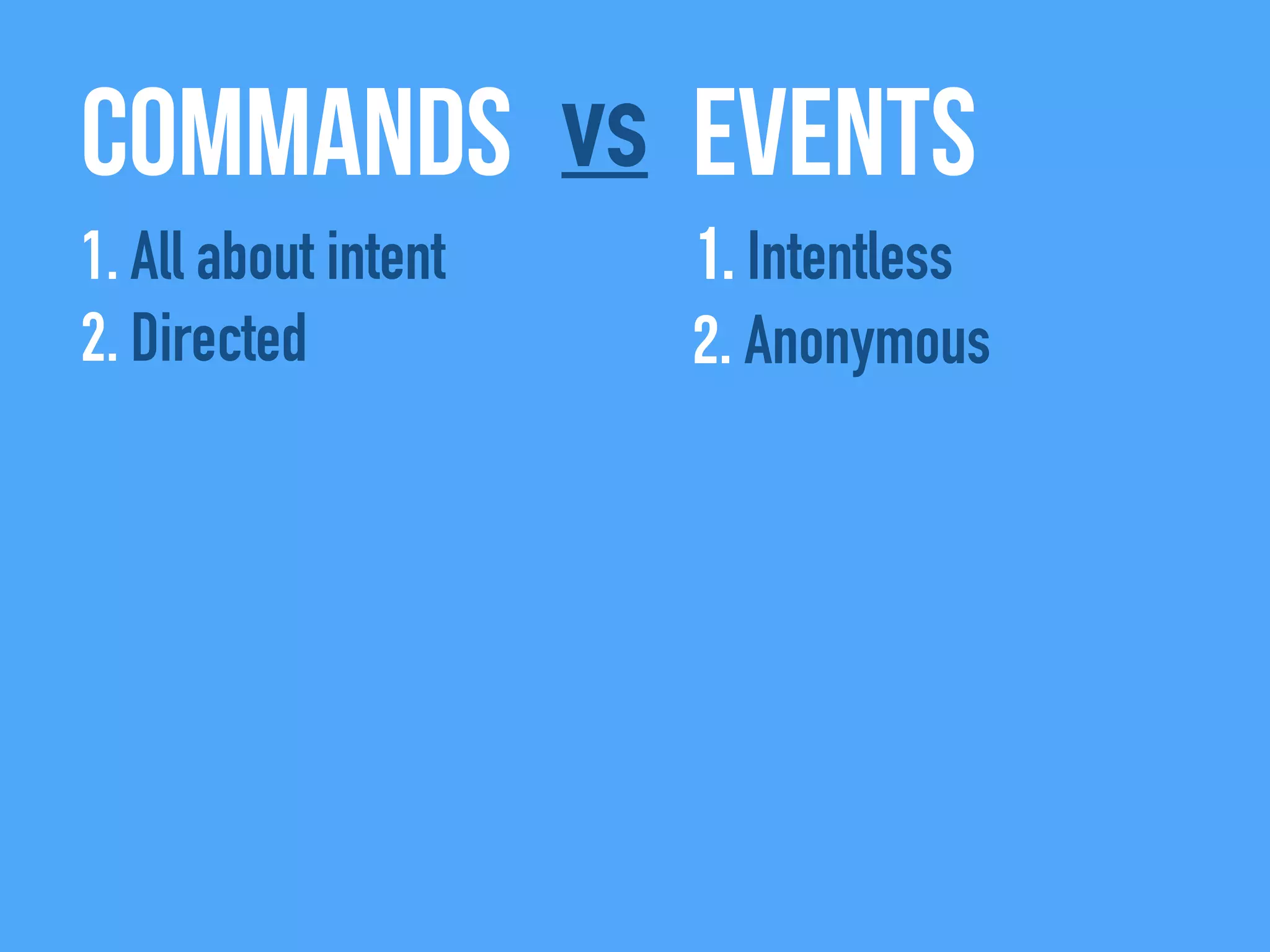
1. All about intent
2. Directed
1. Intentless
2. Anonymous
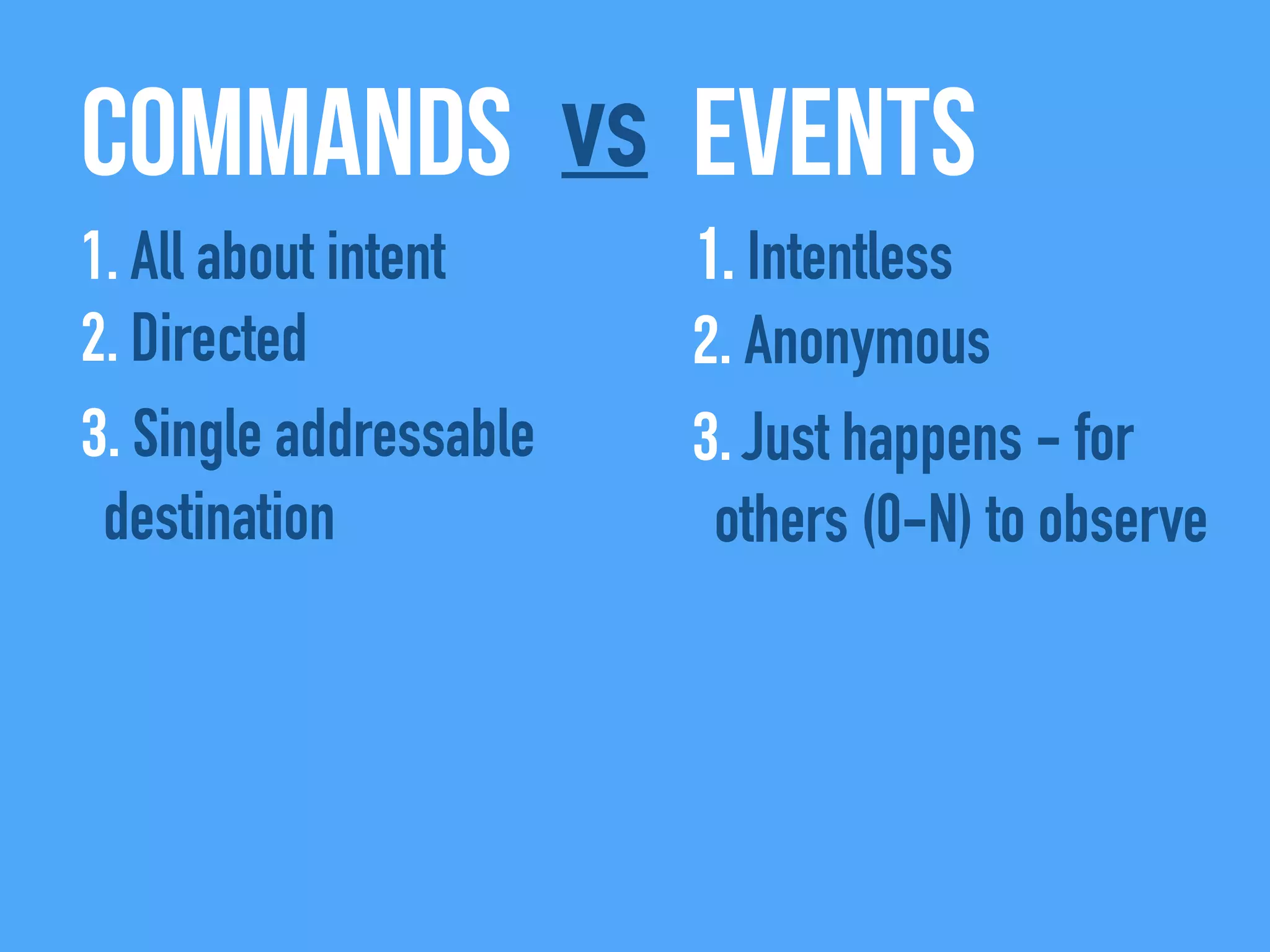
Commands Eventsvs
1. All about intent
2. Directed
3. Single addressable
destination
1. Intentless
2. Anonymous
3. Just happens - for
others (0-N) to observe
Commands Eventsvs
1. All about intent
2. Directed
3. Single addressable
destination
4. Models personal
communication
1. Intentless
2. Anonymous
3. Just happens - for
others (0-N) to observe
4. Models broadcast
(speakers corner)
Commands Eventsvs
1. All about intent
2. Directed
3. Single addressable
destination
4. Models personal
communication
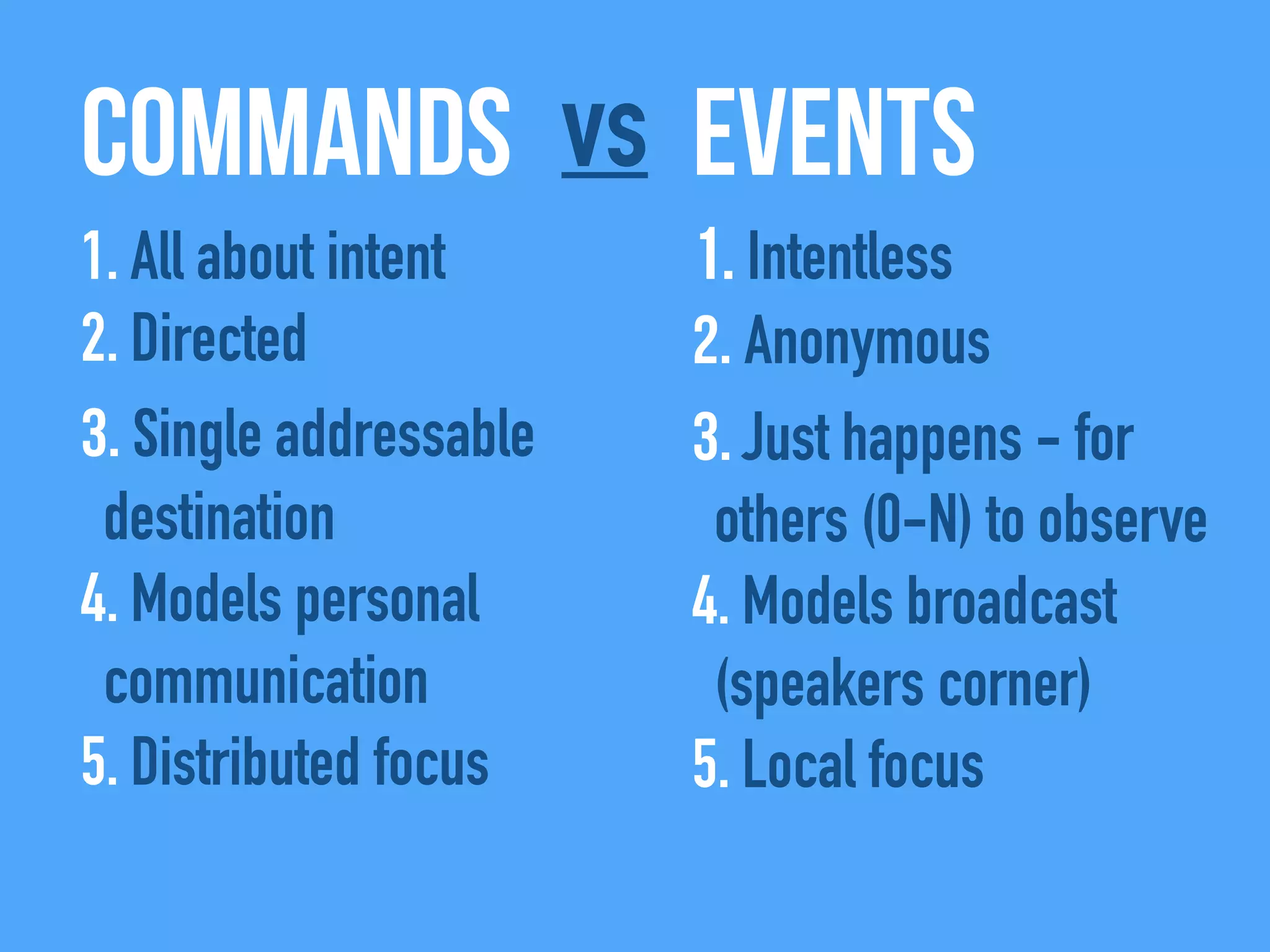
5. Distributed focus
1. Intentless
2. Anonymous
3. Just happens - for
others (0-N) to observe
4. Models broadcast
(speakers corner)
5. Local focus
Commands Eventsvs
1. All about intent
2. Directed
3. Single addressable
destination
4. Models personal
communication
5. Distributed focus
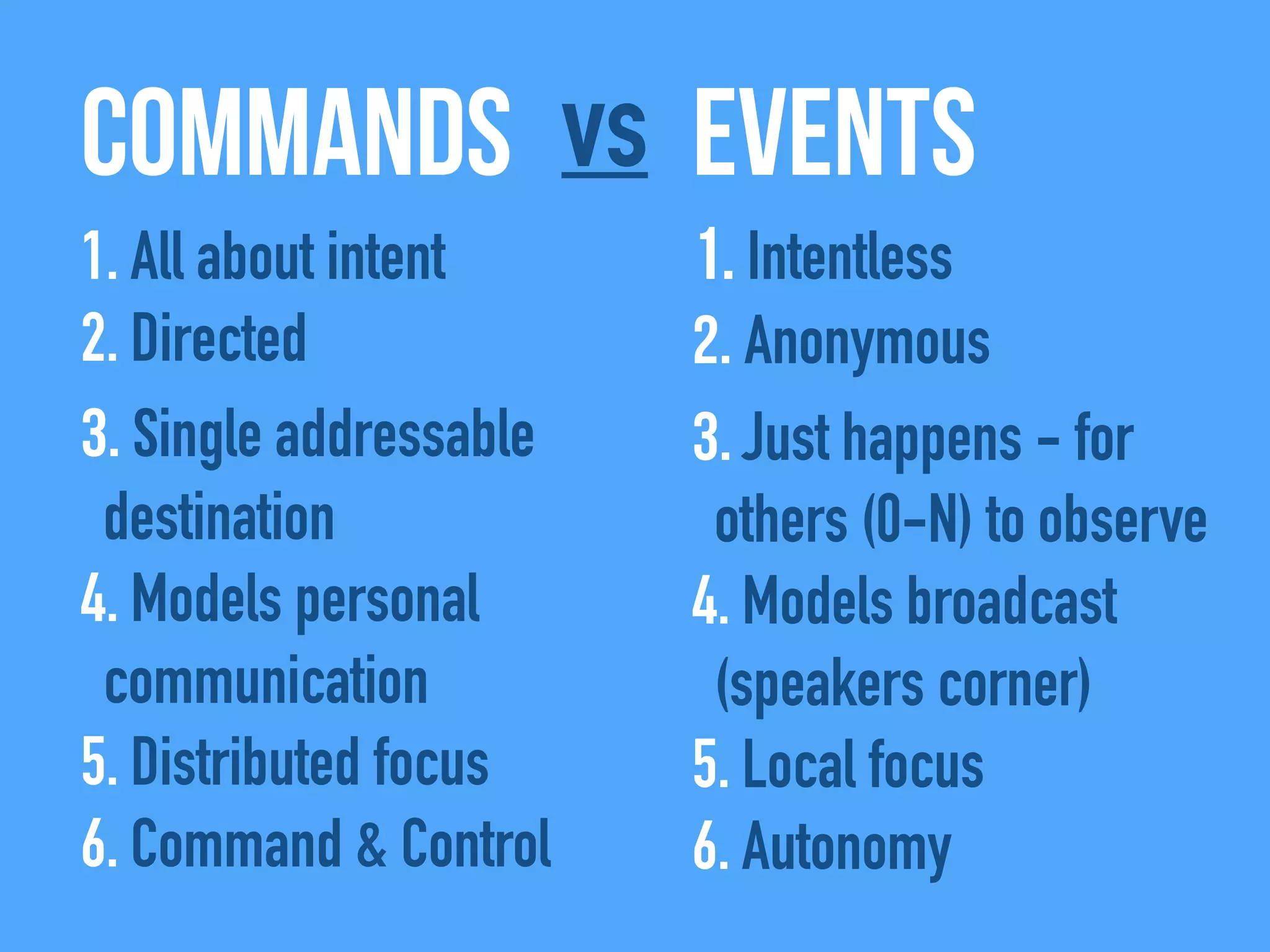
6. Command & Control
1. Intentless
2. Anonymous
3. Just happens - for
others (0-N) to observe
4. Models broadcast
(speakers corner)
5. Local focus
6. Autonomy
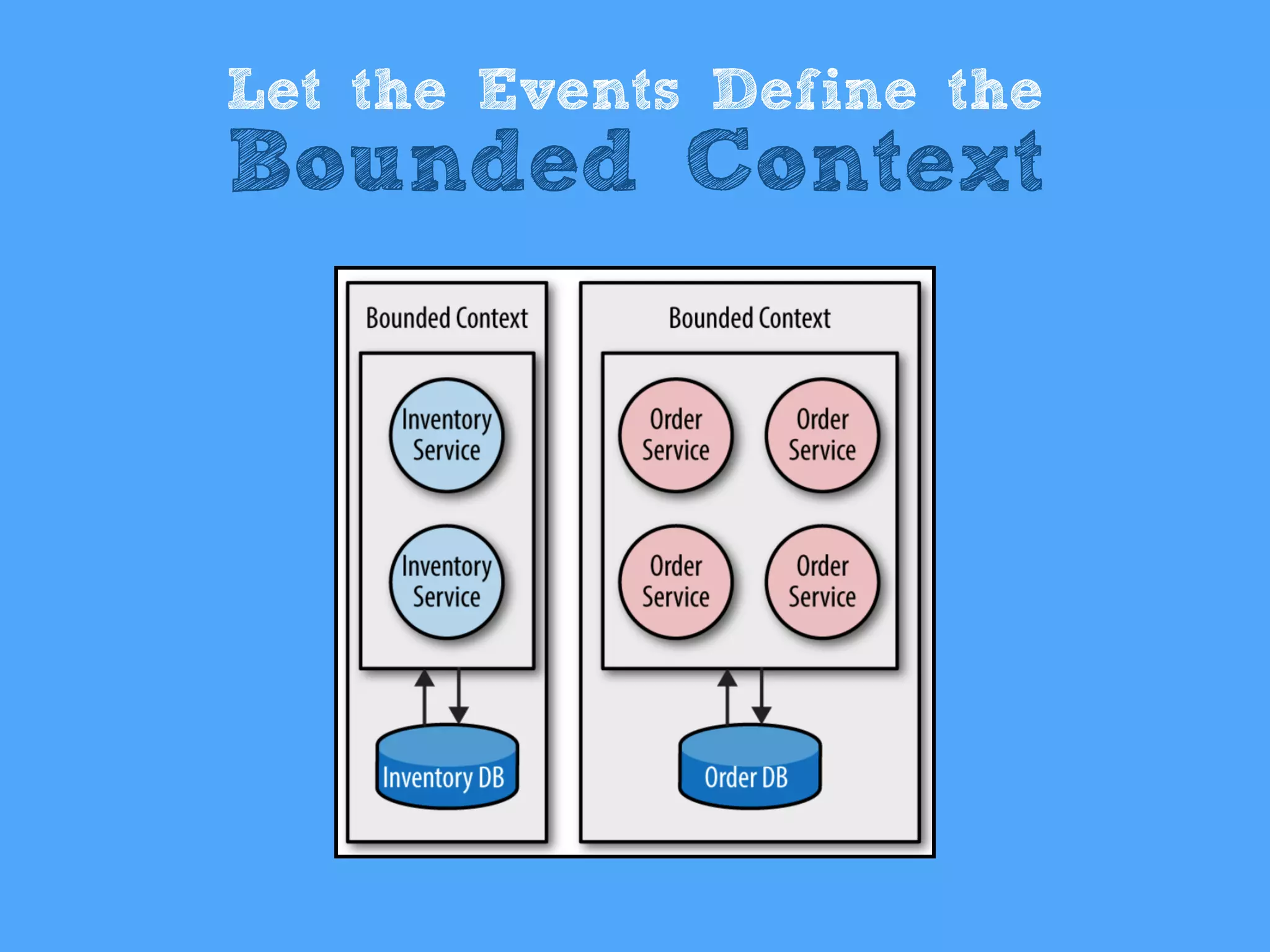
Let the Events Define the
Bounded Context
Principles For
Promise Theory Driven
Protocol Design
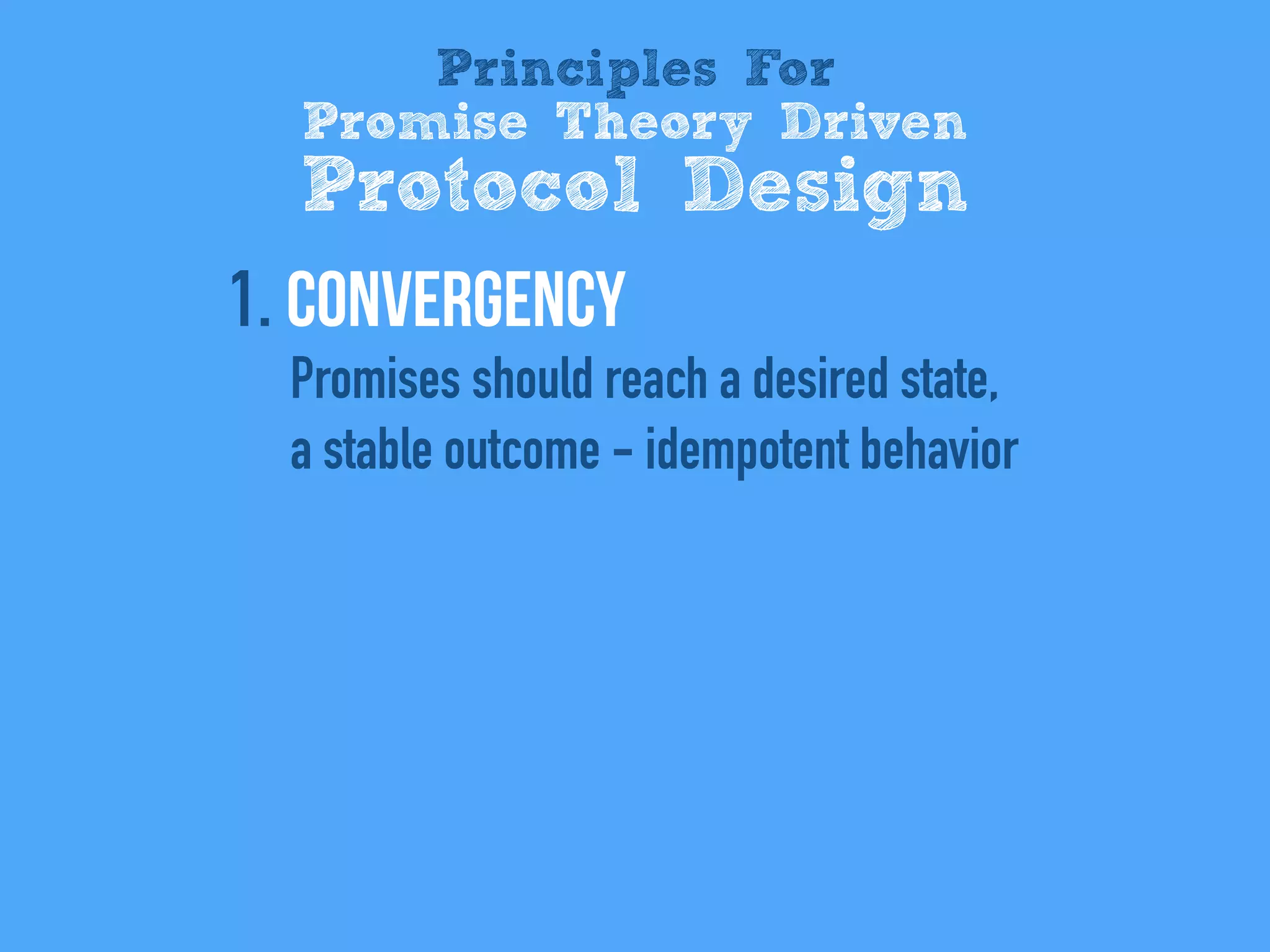
1. Convergency
Promises should reach a desired state,
a stable outcome - idempotent behavior
Principles For
Promise Theory Driven
Protocol Design
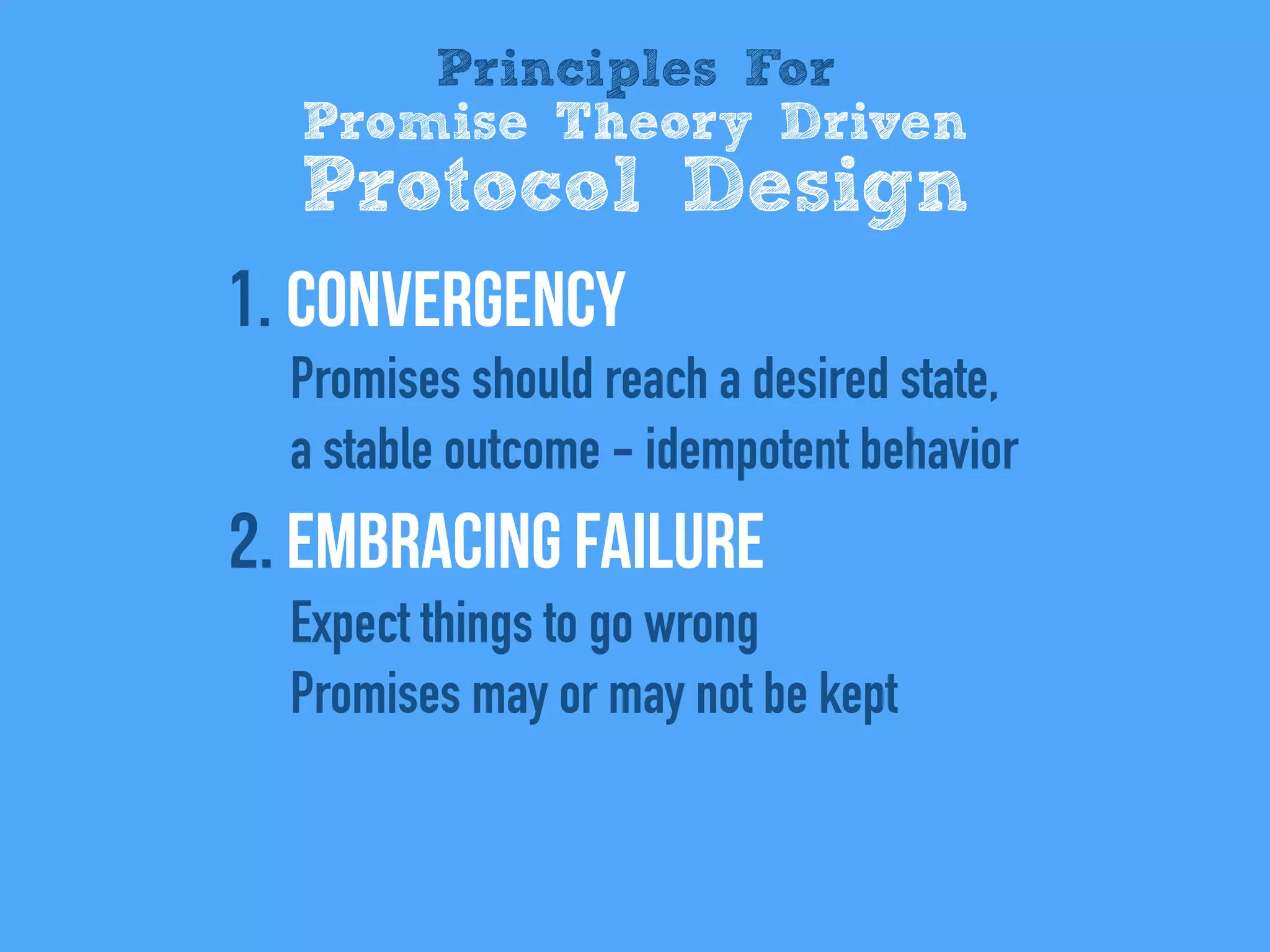
1. Convergency
Promises should reach a desired state,
a stable outcome - idempotent behavior
2. Embracing Failure
Expect things to go wrong
Promises may or may not be kept
Principles For
Promise Theory Driven
Protocol Design
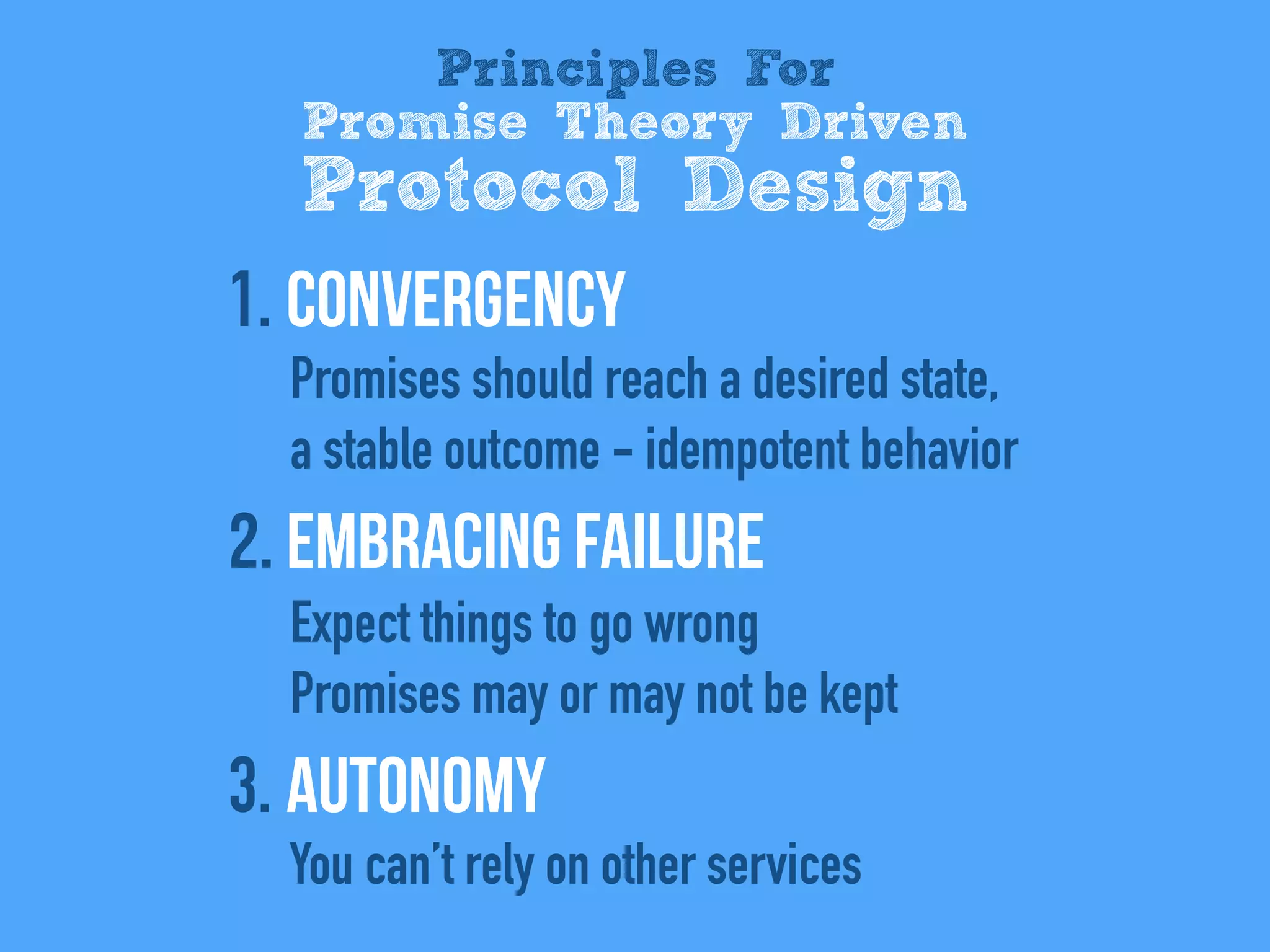
1. Convergency
Promises should reach a desired state,
a stable outcome - idempotent behavior
2. Embracing Failure
Expect things to go wrong
Promises may or may not be kept
3. Autonomy
You can’t rely on other services
Principles For
Promise Theory Driven
Protocol Design
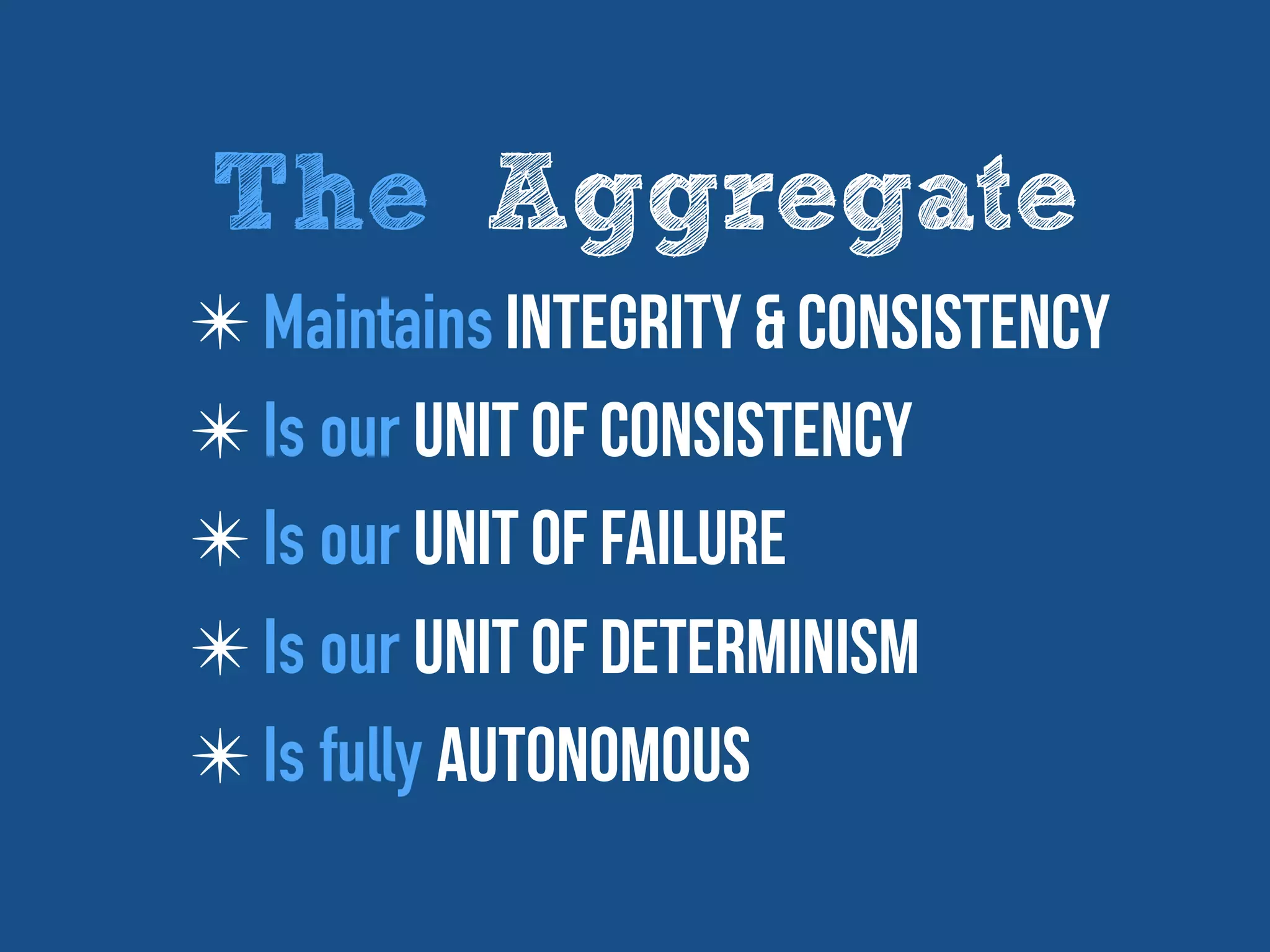
✴ Maintains Integrity & consistency
✴ Is our Unit of Consistency
✴ Is our Unit of Failure
✴ Is our Unit of Determinism
✴ Is fully Autonomous
The Aggregate
Enough Talk
Show Me The
Code
Sample in Java: https://gist.github.com/jboner/4361c710d2e2386be8bddc39edb0528a
Sample in Scala: https://gist.github.com/jboner/dea4aa819e127d543d684208d74081b5
Enough Talk
Show Me The
Code
Sample in Java: https://gist.github.com/jboner/4361c710d2e2386be8bddc39edb0528a
Sample in Scala: https://gist.github.com/jboner/dea4aa819e127d543d684208d74081b5
Are we done now?
Are we done now?
Perhaps. We have come a long way.
Are we done now?
Perhaps. We have come a long way.
But events can also be used for:
Are we done now?
Perhaps. We have come a long way.
But events can also be used for:
➡ Persistence
Are we done now?
Perhaps. We have come a long way.
But events can also be used for:
➡ Persistence
➡ Managing time
Event Based
Persistence
“Update-in-place strikes systems
designers as a cardinal sin: it violates
traditional accounting practices that have
been observed for hundreds of years.”
- jim Gray
The Transaction Concept, Jim Gray (1981)
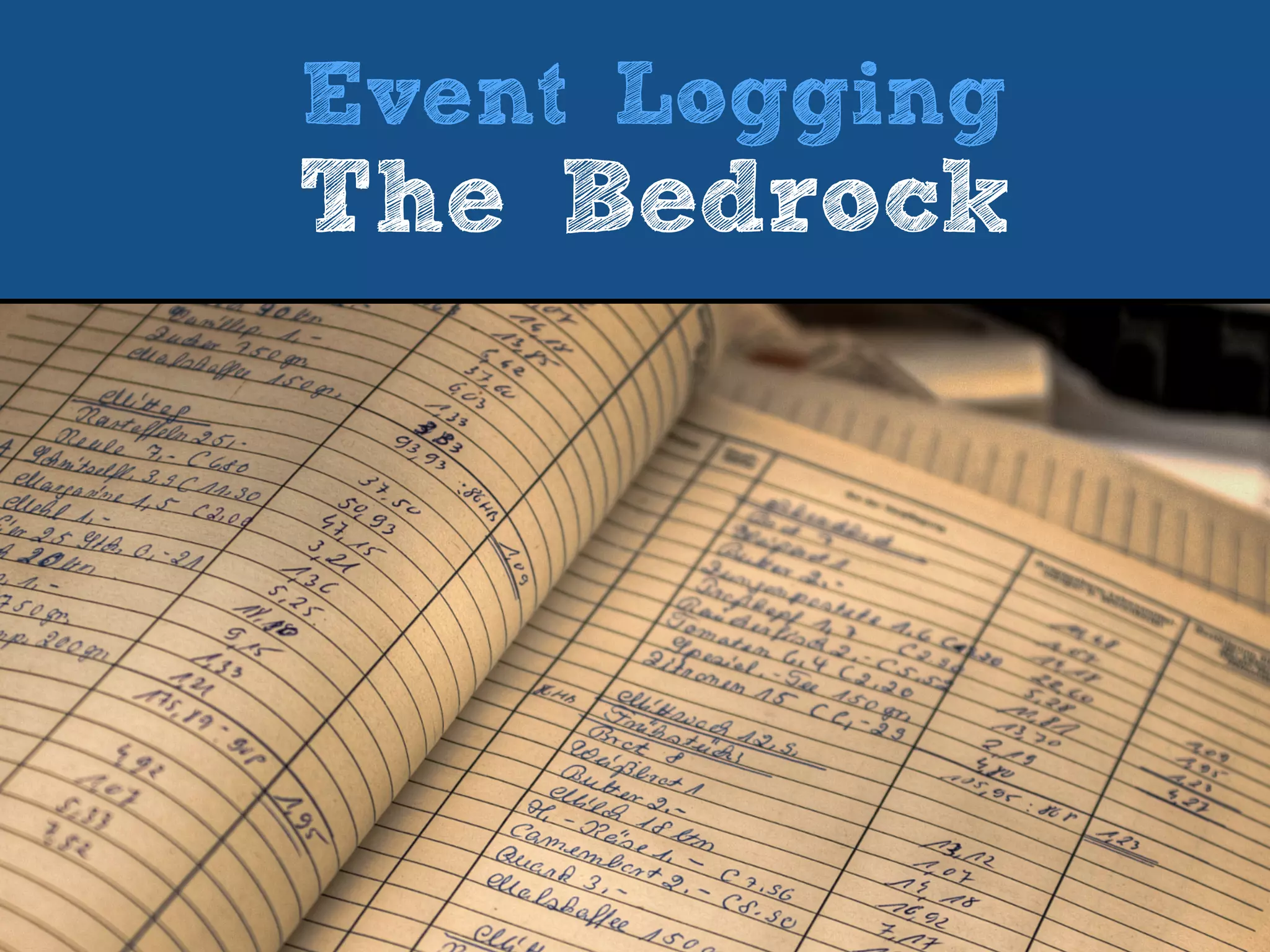
Event Logging
The Bedrock
Event Sourcing
A Cure For the Cardinal Sin
“The truth is the log.
The database is a cache
of a subset of the log.”
- Pat Helland
Immutability Changes Everything, Pat Helland (2015)
Event
Sourced
Services
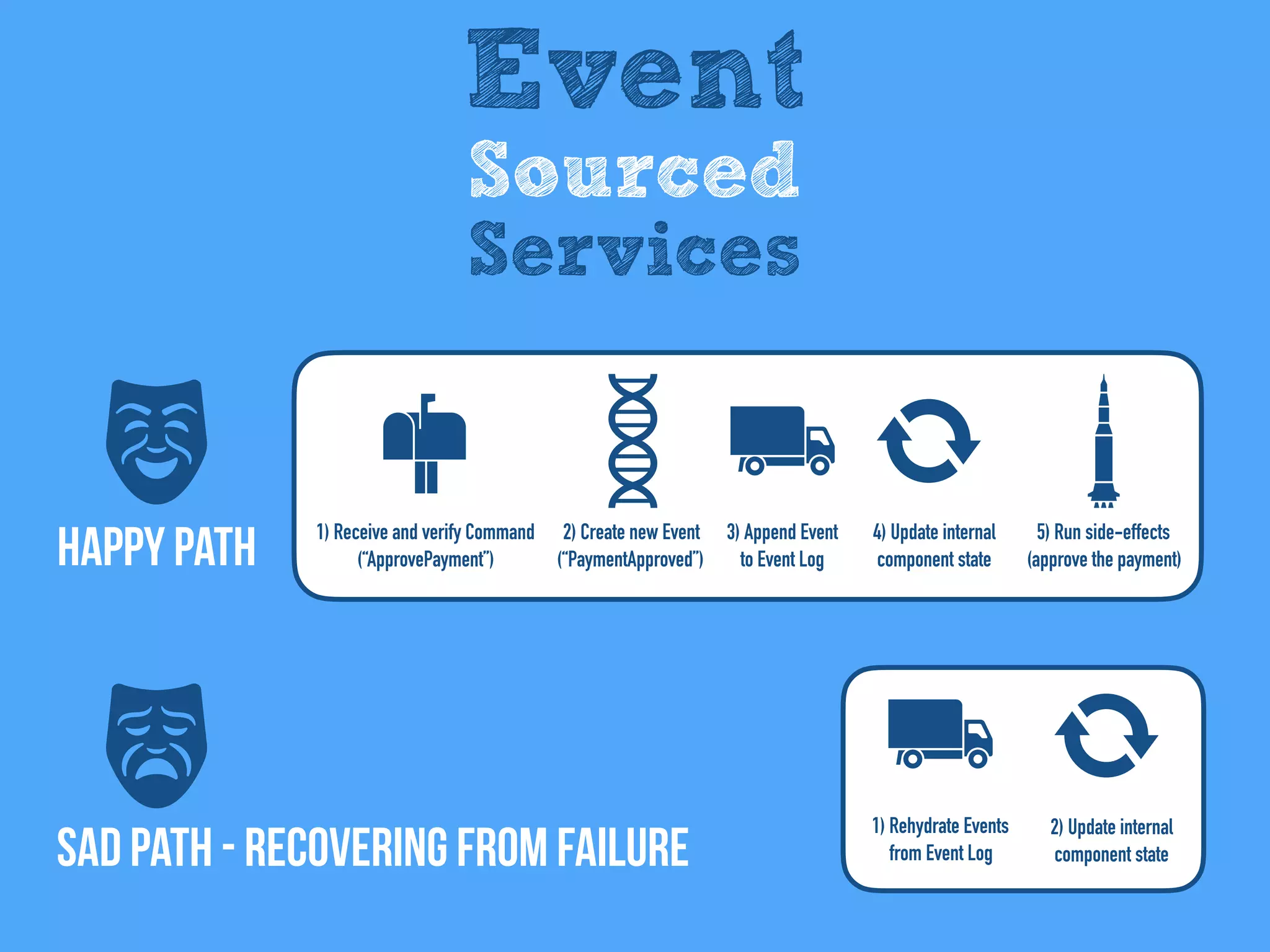
Happy Path
Event
Sourced
Services
Happy Path
Event
Sourced
Services
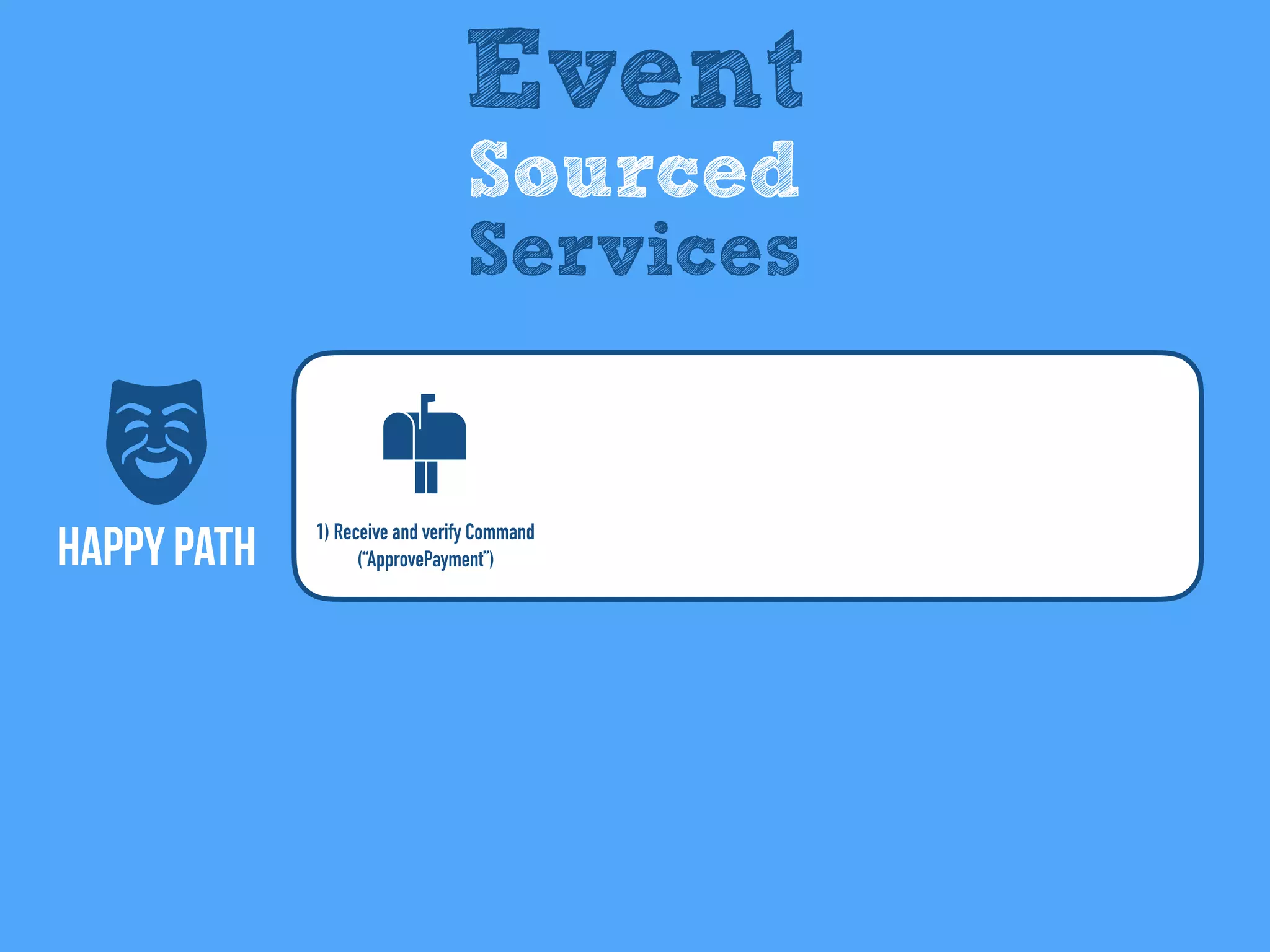
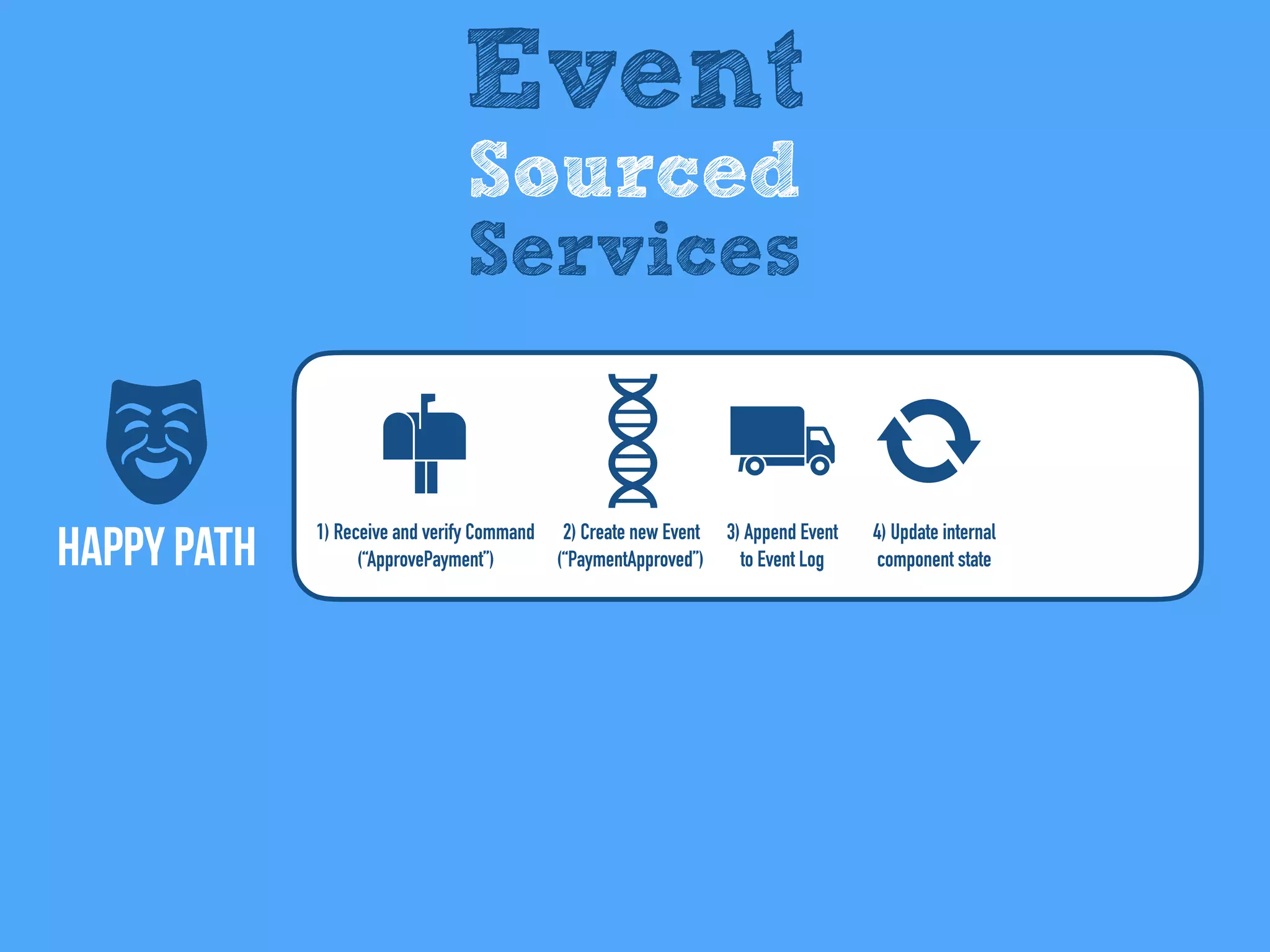
1) Receive and verify Command
(“ApprovePayment”)
Happy Path
Event
Sourced
Services
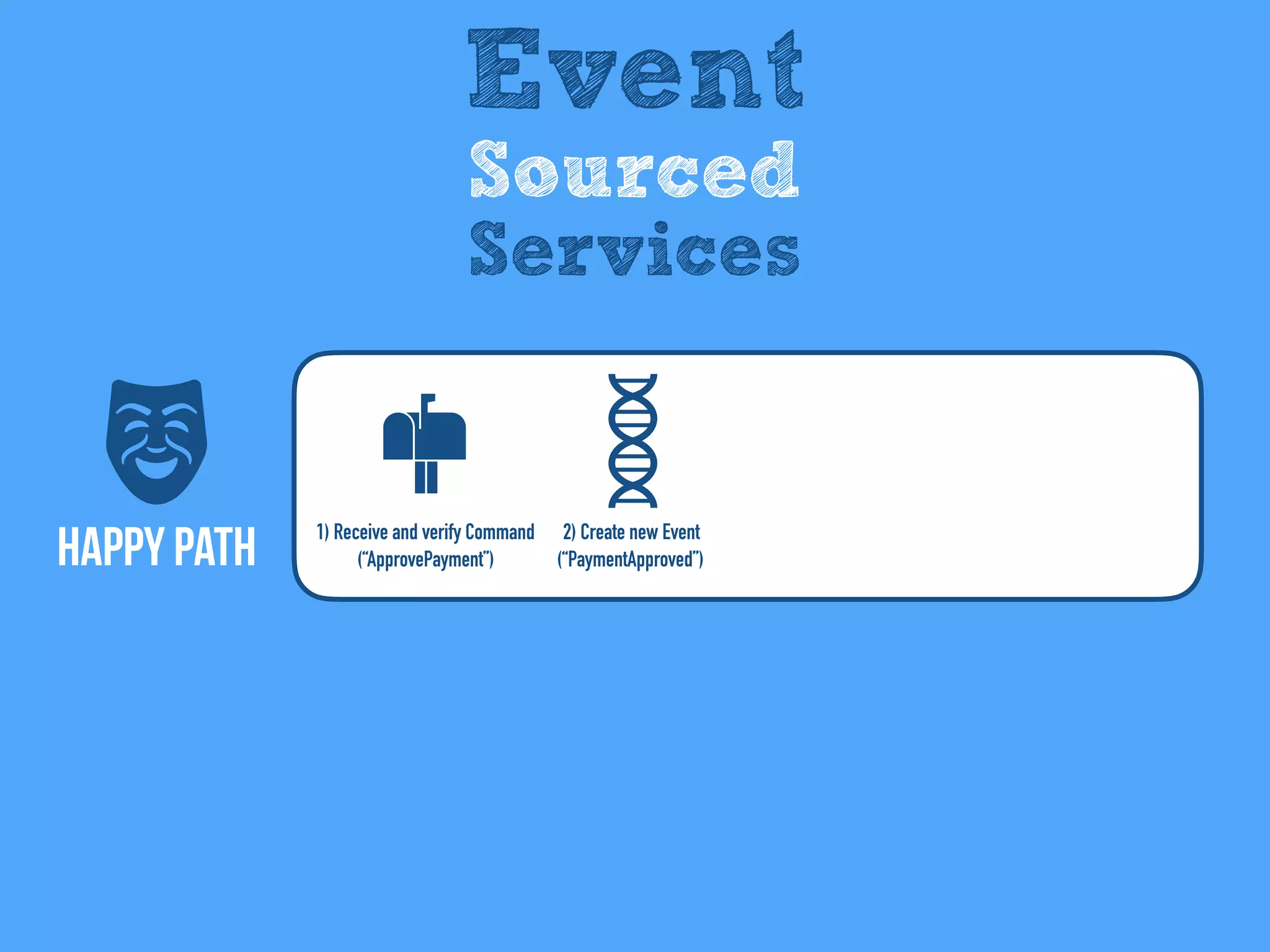
2) Create new Event
(“PaymentApproved”)
1) Receive and verify Command
(“ApprovePayment”)
Happy Path
Event
Sourced
Services
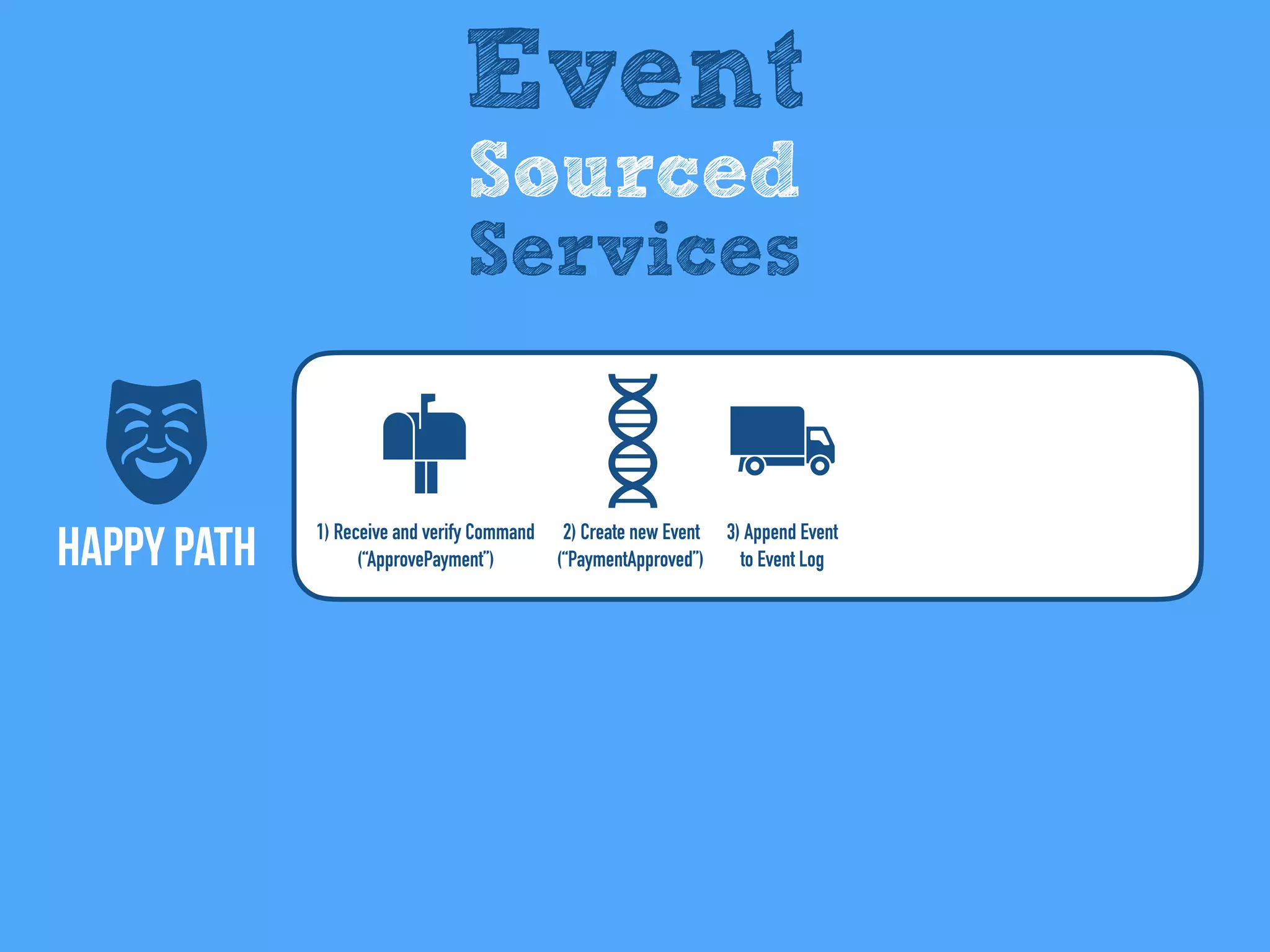
2) Create new Event
(“PaymentApproved”)
1) Receive and verify Command
(“ApprovePayment”)
3) Append Event
to Event Log
Happy Path
Event
Sourced
Services
2) Create new Event
(“PaymentApproved”)
1) Receive and verify Command
(“ApprovePayment”)
3) Append Event
to Event Log
4) Update internal
component state
Happy Path
Event
Sourced
Services
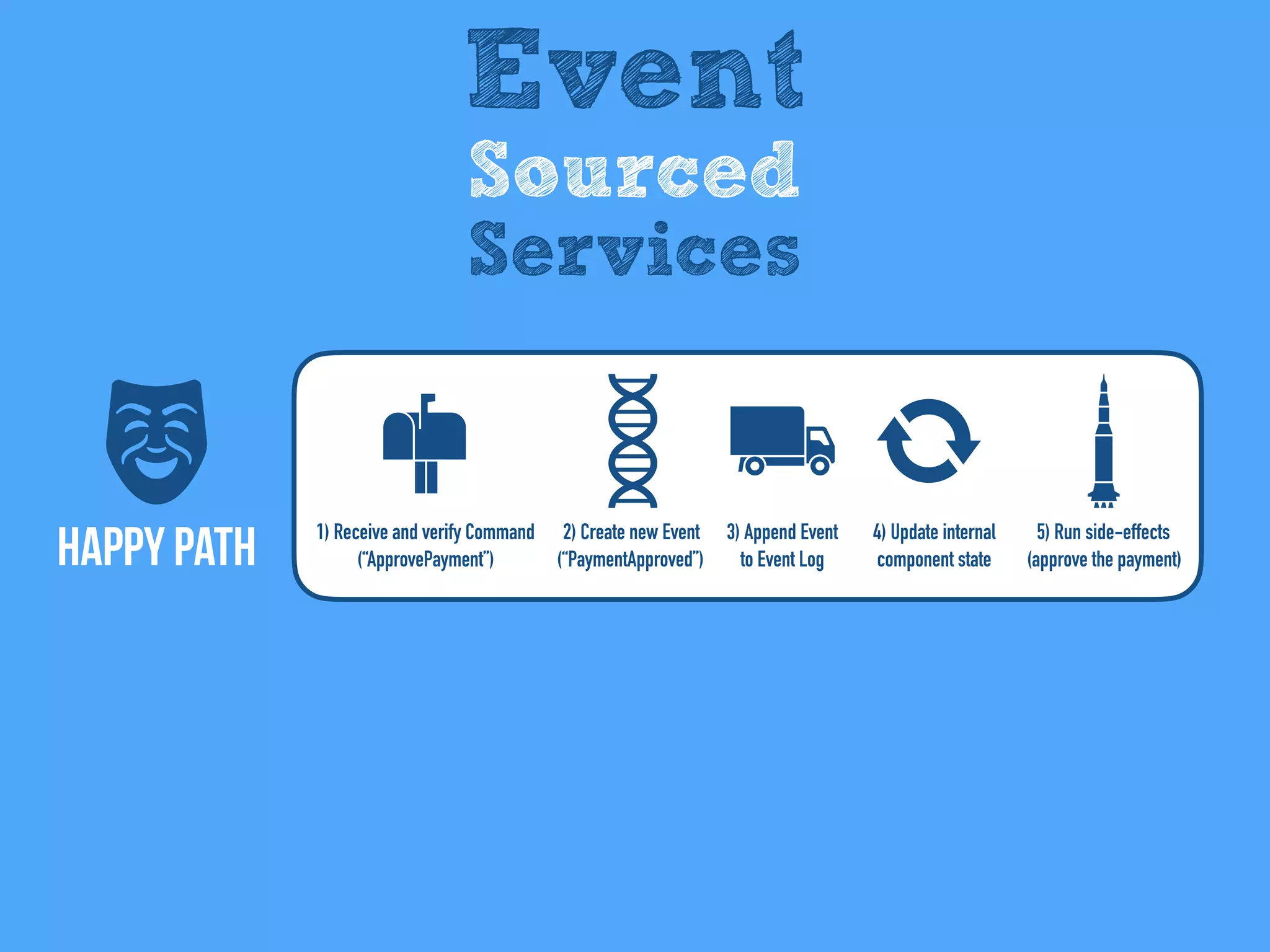
5) Run side-effects
(approve the payment)
2) Create new Event
(“PaymentApproved”)
1) Receive and verify Command
(“ApprovePayment”)
3) Append Event
to Event Log
4) Update internal
component state
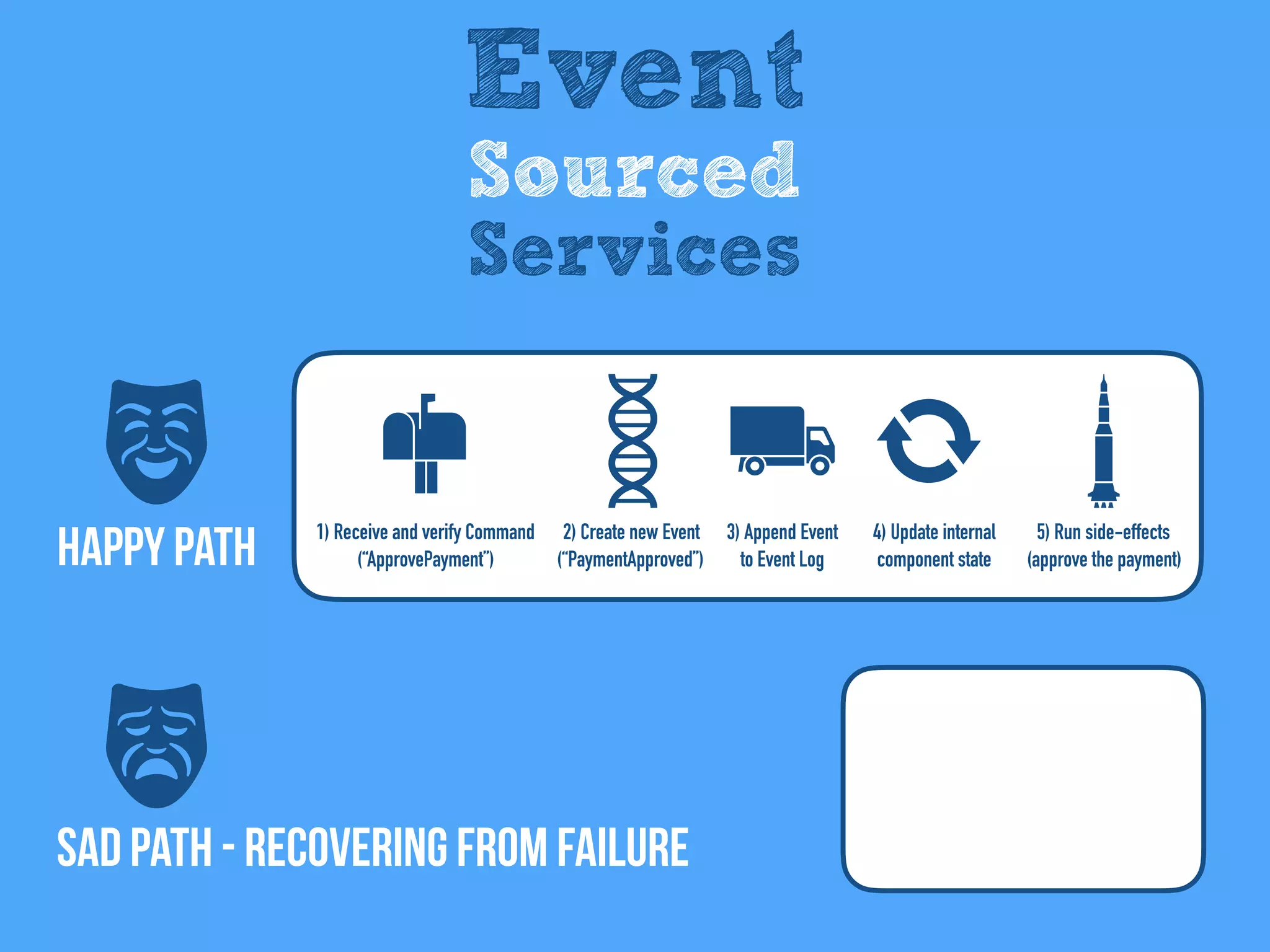
SAD Path - recovering from failure
Happy Path
Event
Sourced
Services
5) Run side-effects
(approve the payment)
2) Create new Event
(“PaymentApproved”)
1) Receive and verify Command
(“ApprovePayment”)
3) Append Event
to Event Log
4) Update internal
component state
SAD Path - recovering from failure
Happy Path
Event
Sourced
Services
5) Run side-effects
(approve the payment)
2) Create new Event
(“PaymentApproved”)
1) Receive and verify Command
(“ApprovePayment”)
3) Append Event
to Event Log
4) Update internal
component state
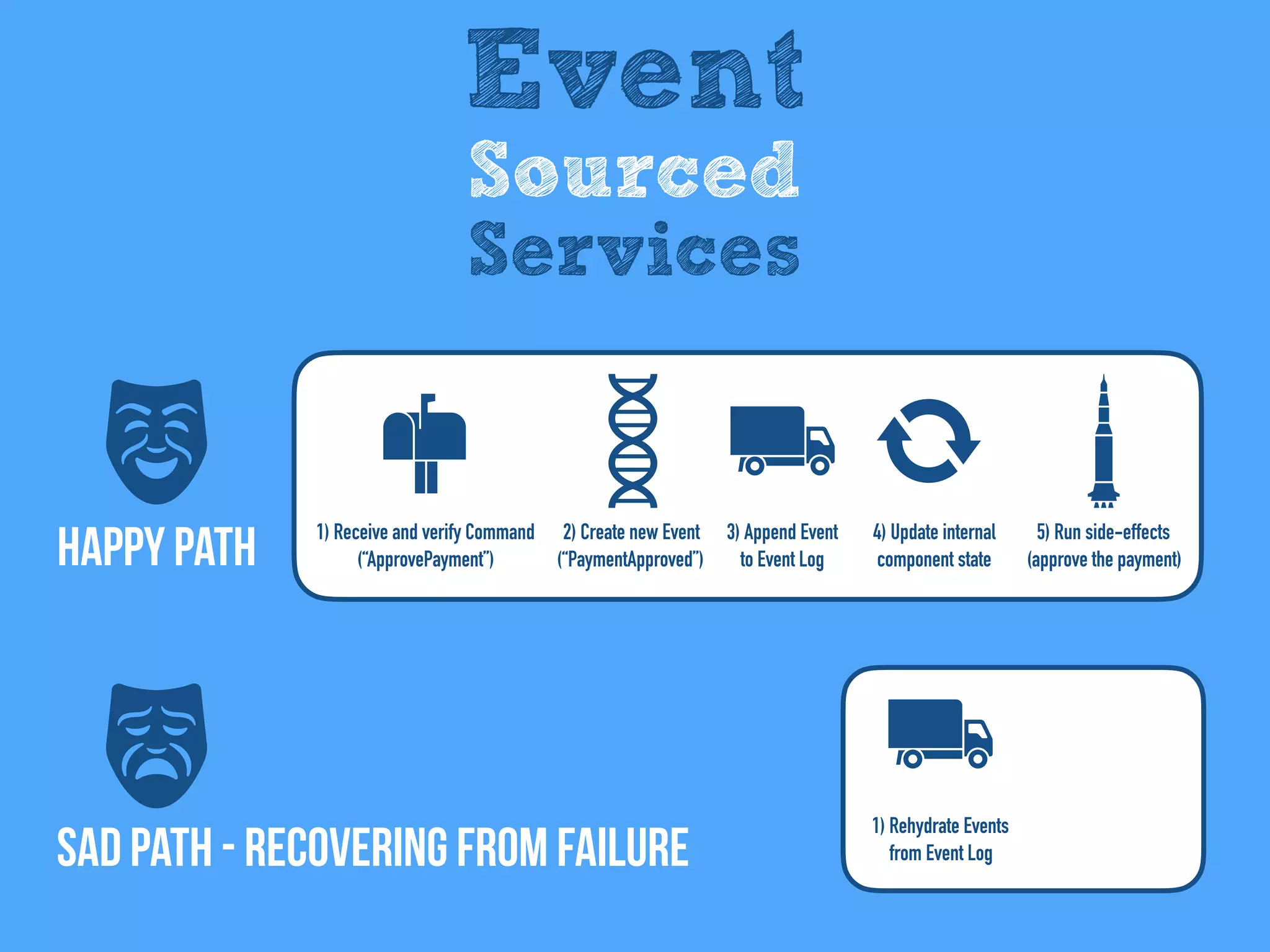
1) Rehydrate Events
from Event Log
SAD Path - recovering from failure
Happy Path
Event
Sourced
Services
5) Run side-effects
(approve the payment)
2) Create new Event
(“PaymentApproved”)
1) Receive and verify Command
(“ApprovePayment”)
3) Append Event
to Event Log
4) Update internal
component state
1) Rehydrate Events
from Event Log
2) Update internal
component state
SAD Path - recovering from failure
Happy Path
Event
Sourced
Services
5) Run side-effects
(approve the payment)
2) Create new Event
(“PaymentApproved”)
1) Receive and verify Command
(“ApprovePayment”)
3) Append Event
to Event Log
4) Update internal
component state
1) Rehydrate Events
from Event Log
2) Update internal
component state
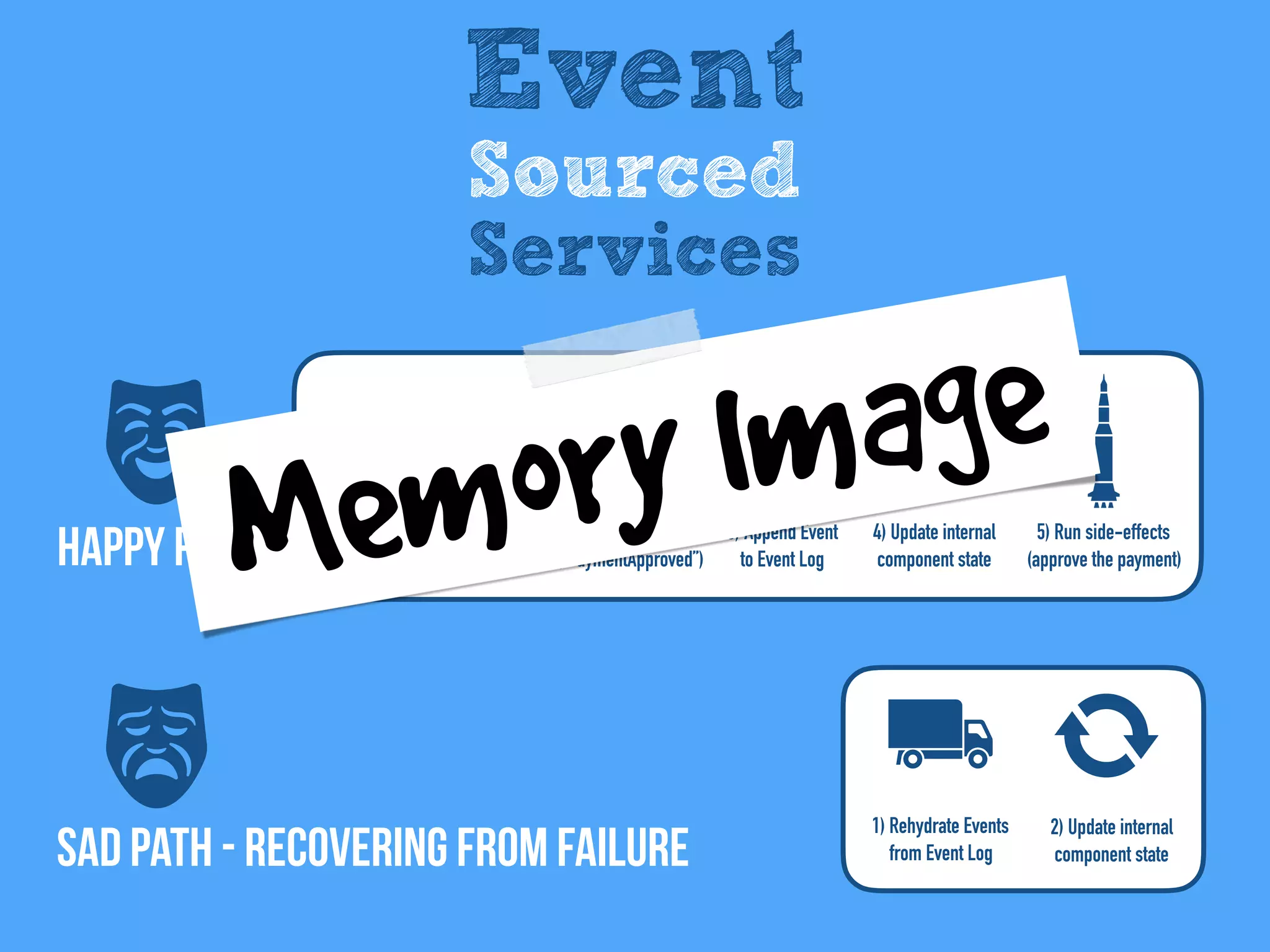
Memory Image
Event Sourcing
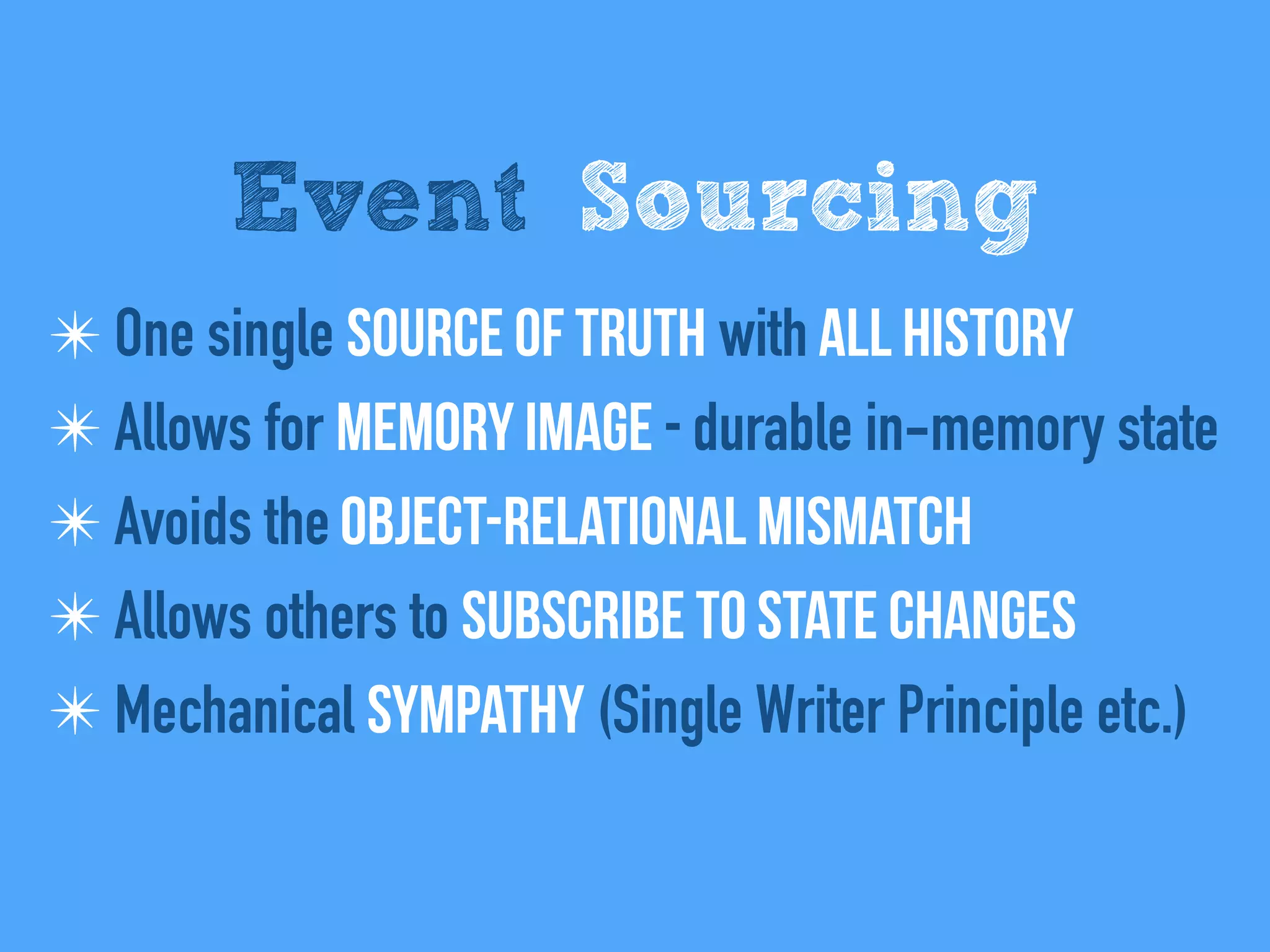
✴ One single Source of Truth with All history
✴ Allows for Memory Image - durable in-memory state
✴ Avoids the Object-relational mismatch
✴ Allows others to Subscribe to state changes
✴ Mechanical sympathy (Single Writer Principle etc.)
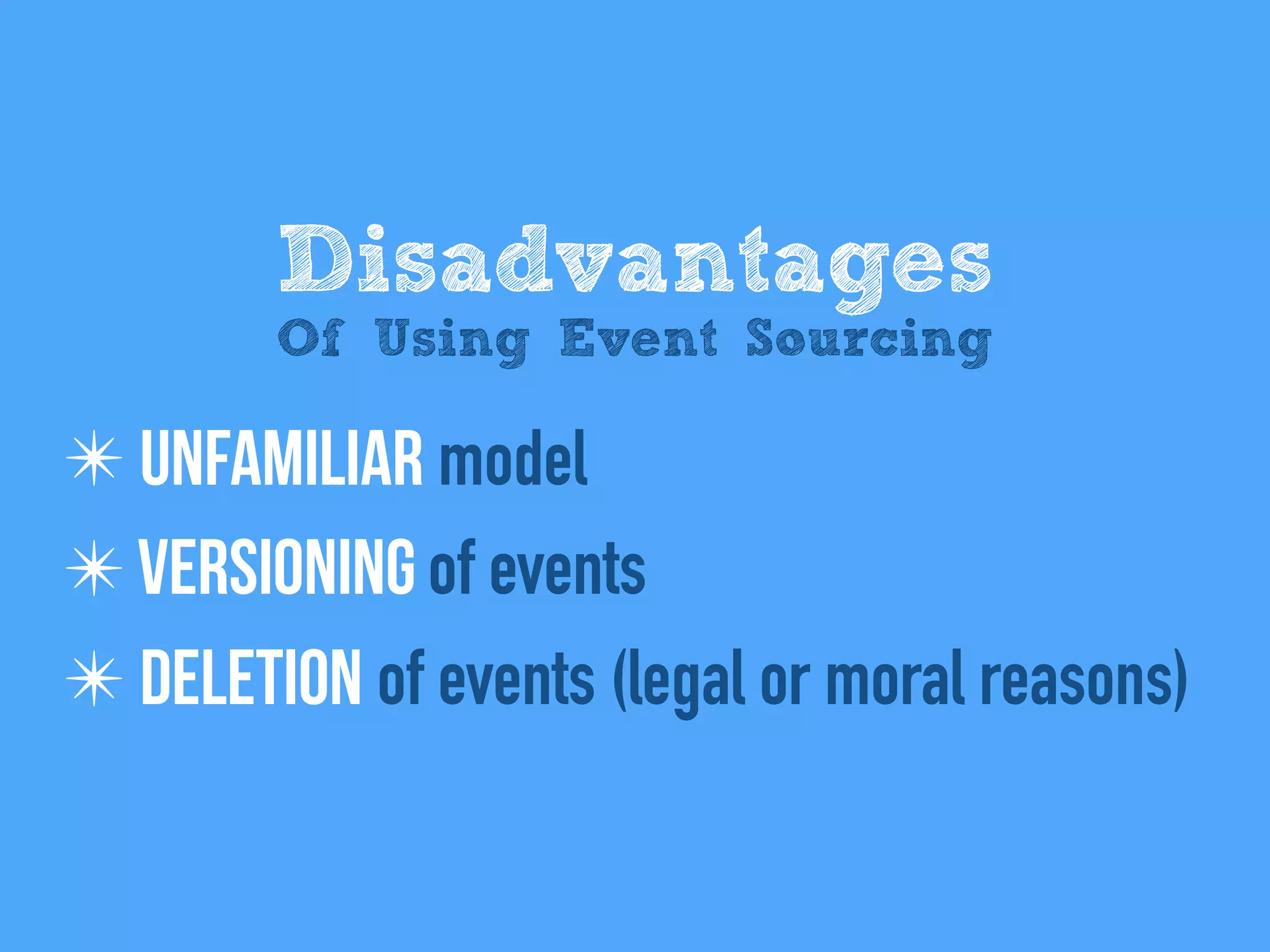
✴ Unfamiliar model
✴ Versioning of events
✴ Deletion of events (legal or moral reasons)
Disadvantages
Of Using Event Sourcing
EventsAllow Us To Manage
Time
“Modeling events forces you to have a temporal
focus on what’s going on in the system.
Time becomes a crucial factor of the system.”
- Greg Young
A Decade of DDD, CQRS, Event Sourcing, Greg Young (Presentation from 2016)
But, What is Time
Really?
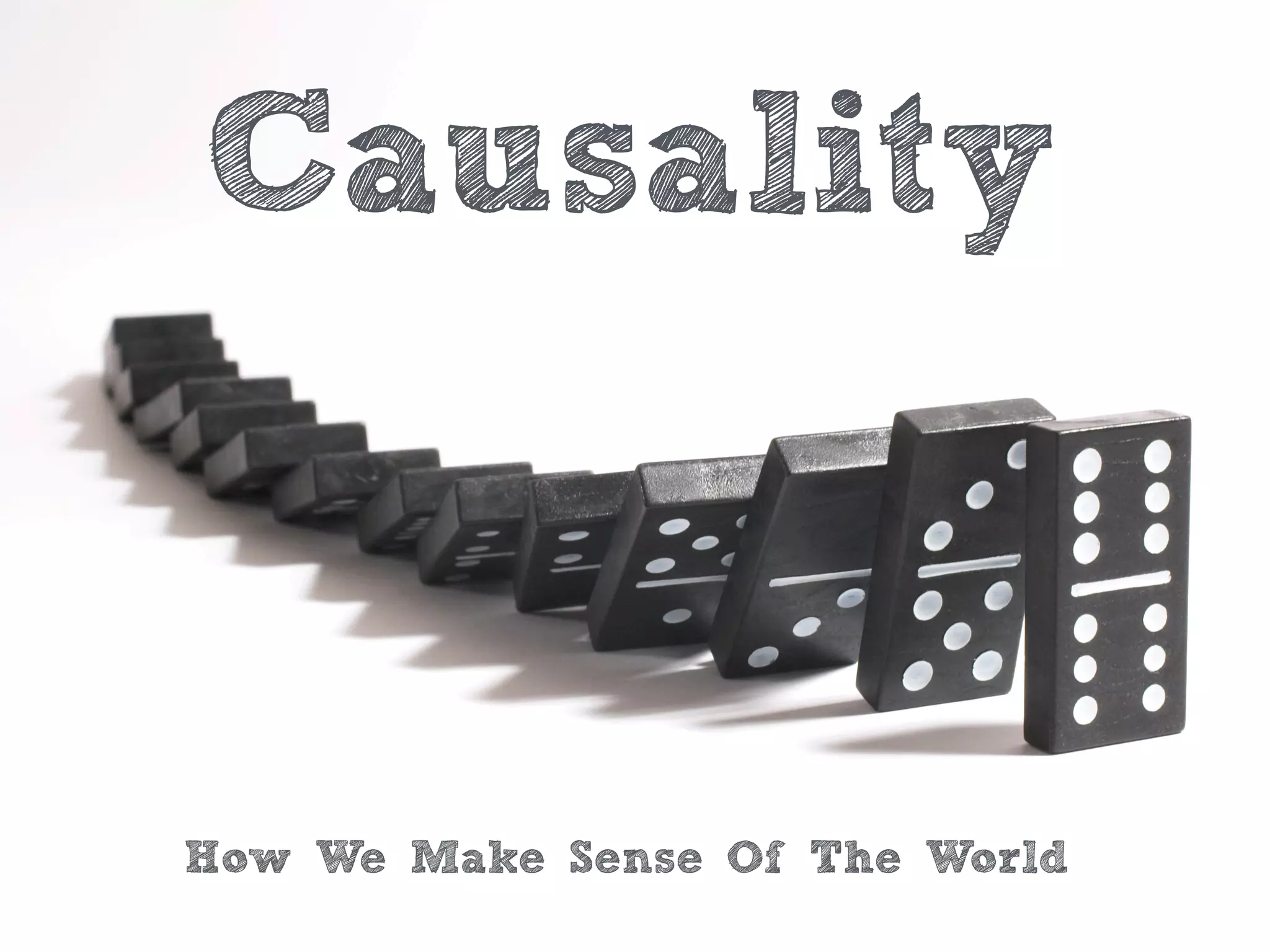
Causality
How We Make Sense Of The World
Time Is the Succession Of
Causally Related Events
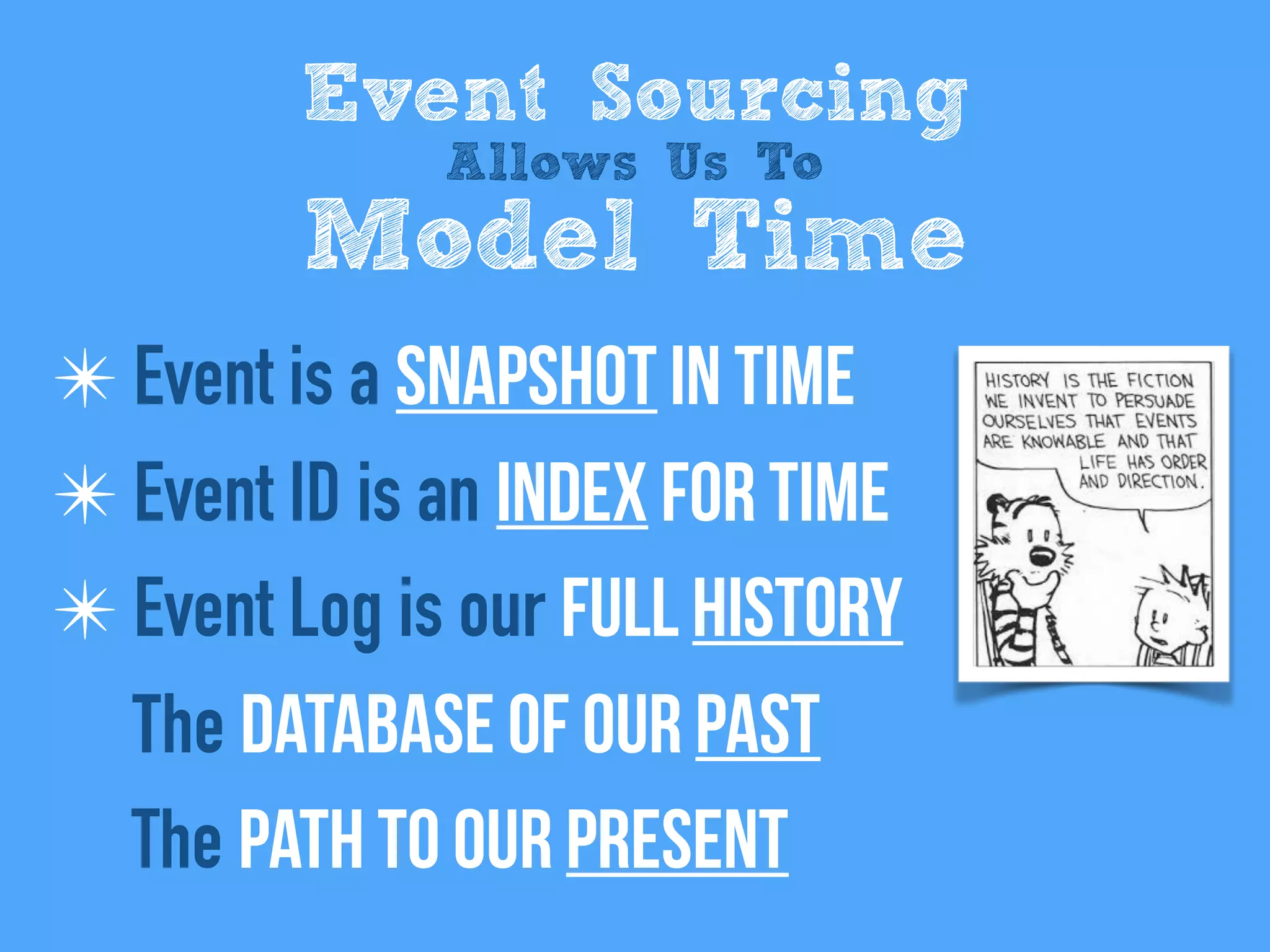
✴ Event is a snapshot in time
✴ Event ID is an index for time
✴ Event Log is our full history
The database of Our past
The path to Our present
Event Sourcing
Allows Us To
Model Time
Event Sourcing
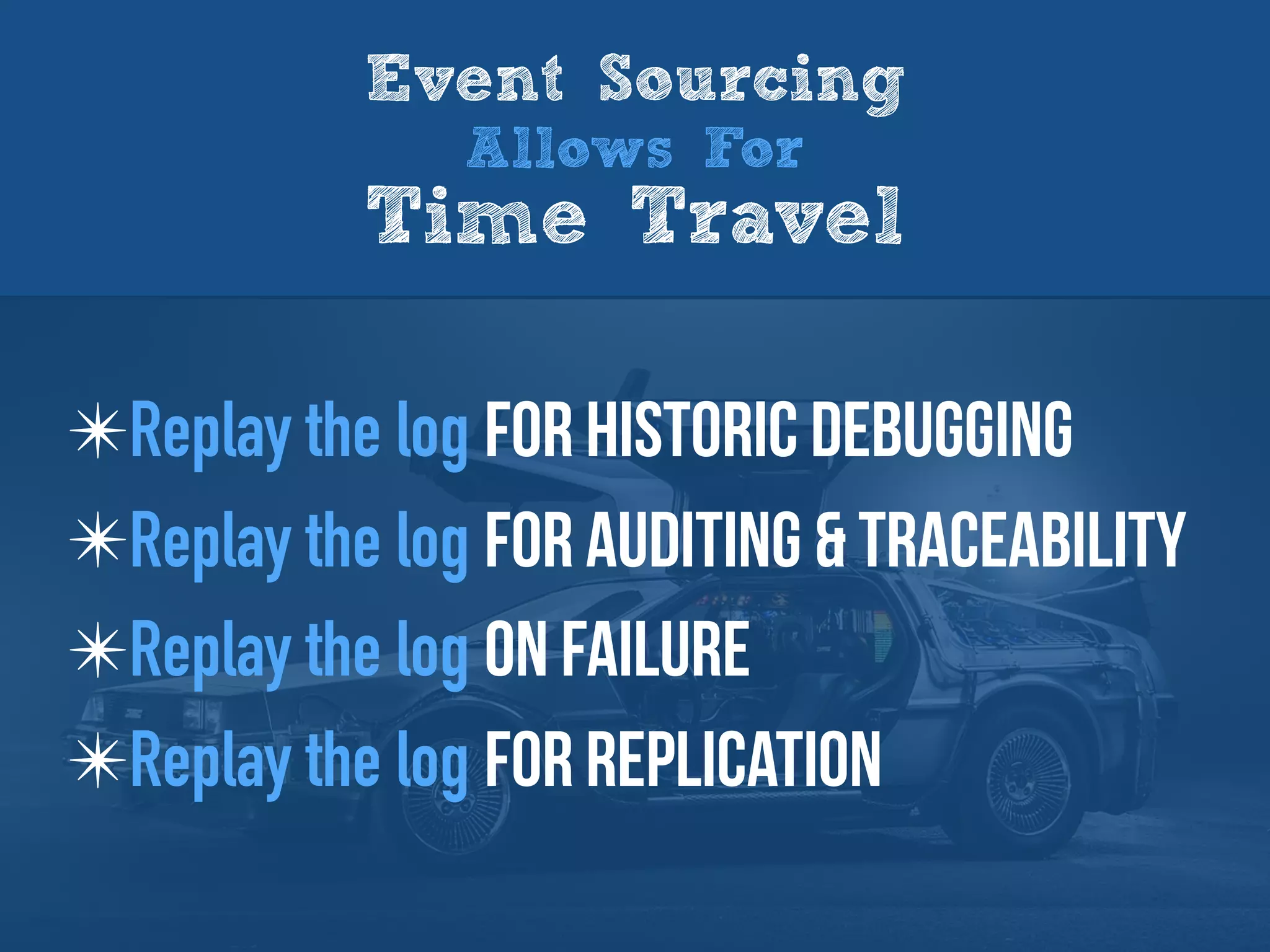
Allows For
Time Travel
Event Sourcing
Allows For
Time Travel
Event Sourcing
Allows For
Time Travel
✴Replay the log for historic debugging
✴Replay the log for auditing & traceability
✴Replay the log on failure
✴Replay the log for replication
“The future is a function of the past.”
- A. P. Robertson
“The (local) present is a merge function
of multiple concurrent pasts.”
- me
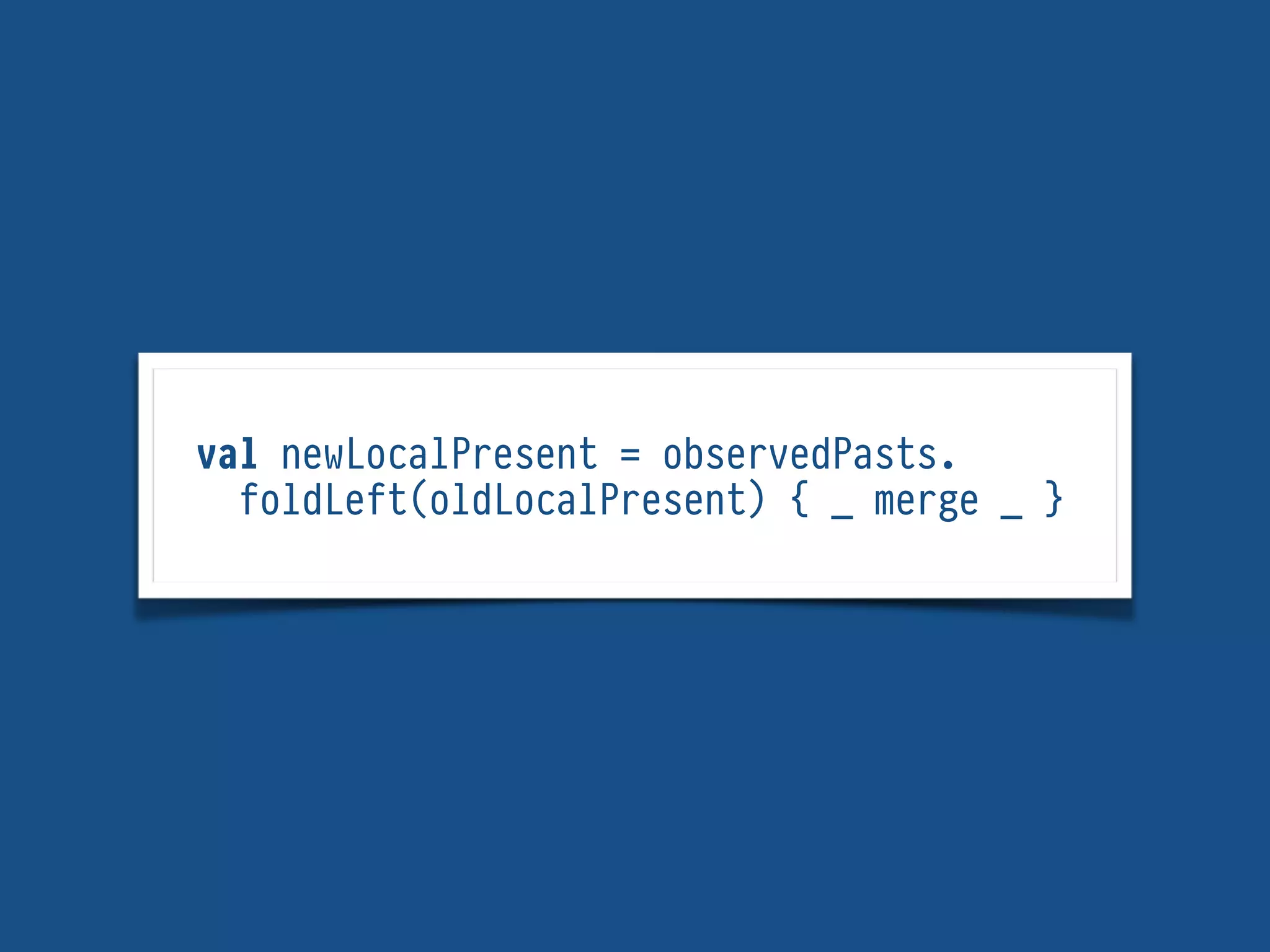
val newLocalPresent = observedPasts.
foldLeft(oldLocalPresent) { _ merge _ }
We need to explicitly model the
local present as
facts derived from the
merging of multiple
concurrent pasts
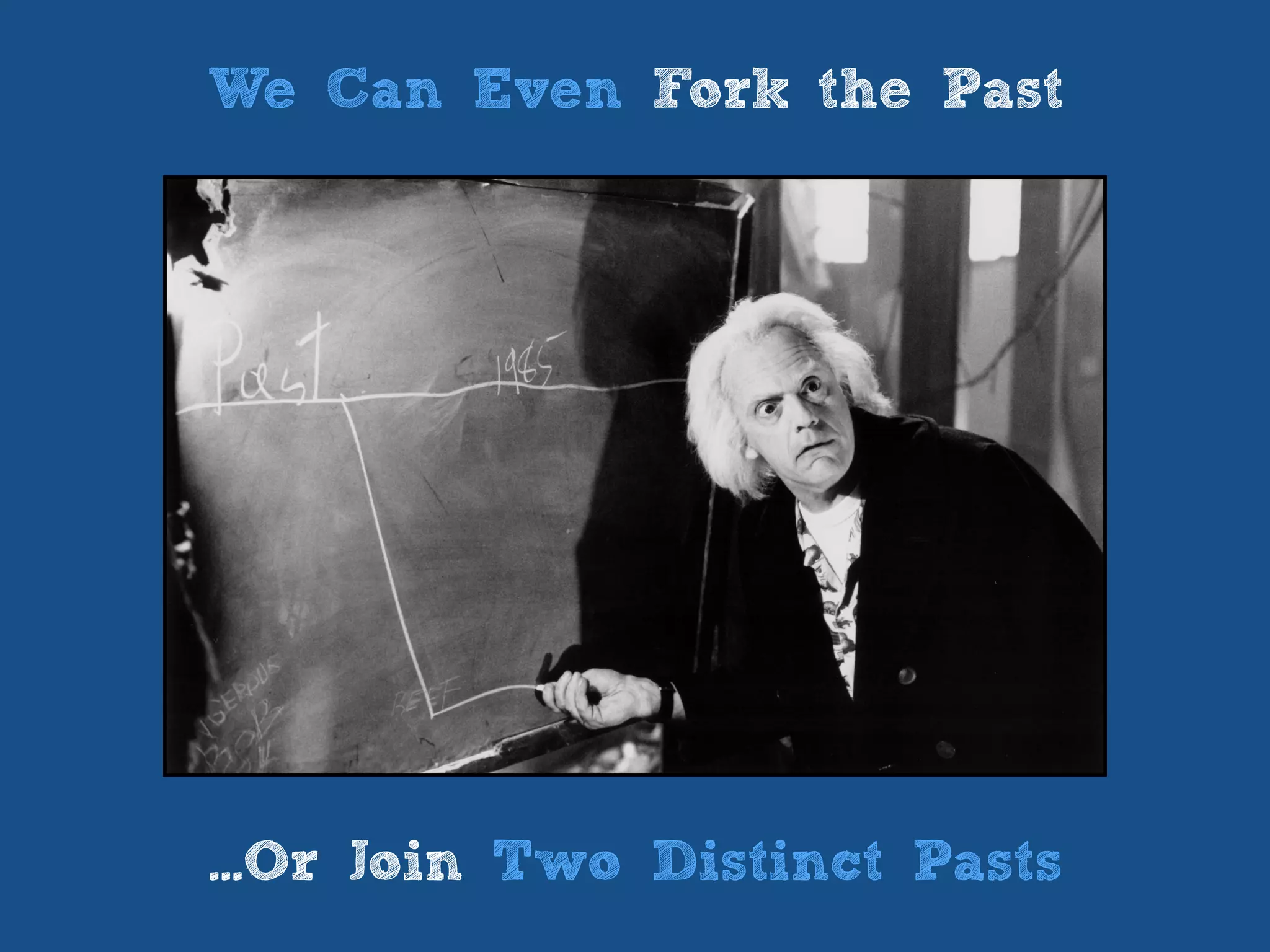
We Can Even Fork the Past
...Or Join Two Distinct Pasts
Let Make Our Demo
Event Sourced
Untangle Your
Read and Write Models
With CQRS
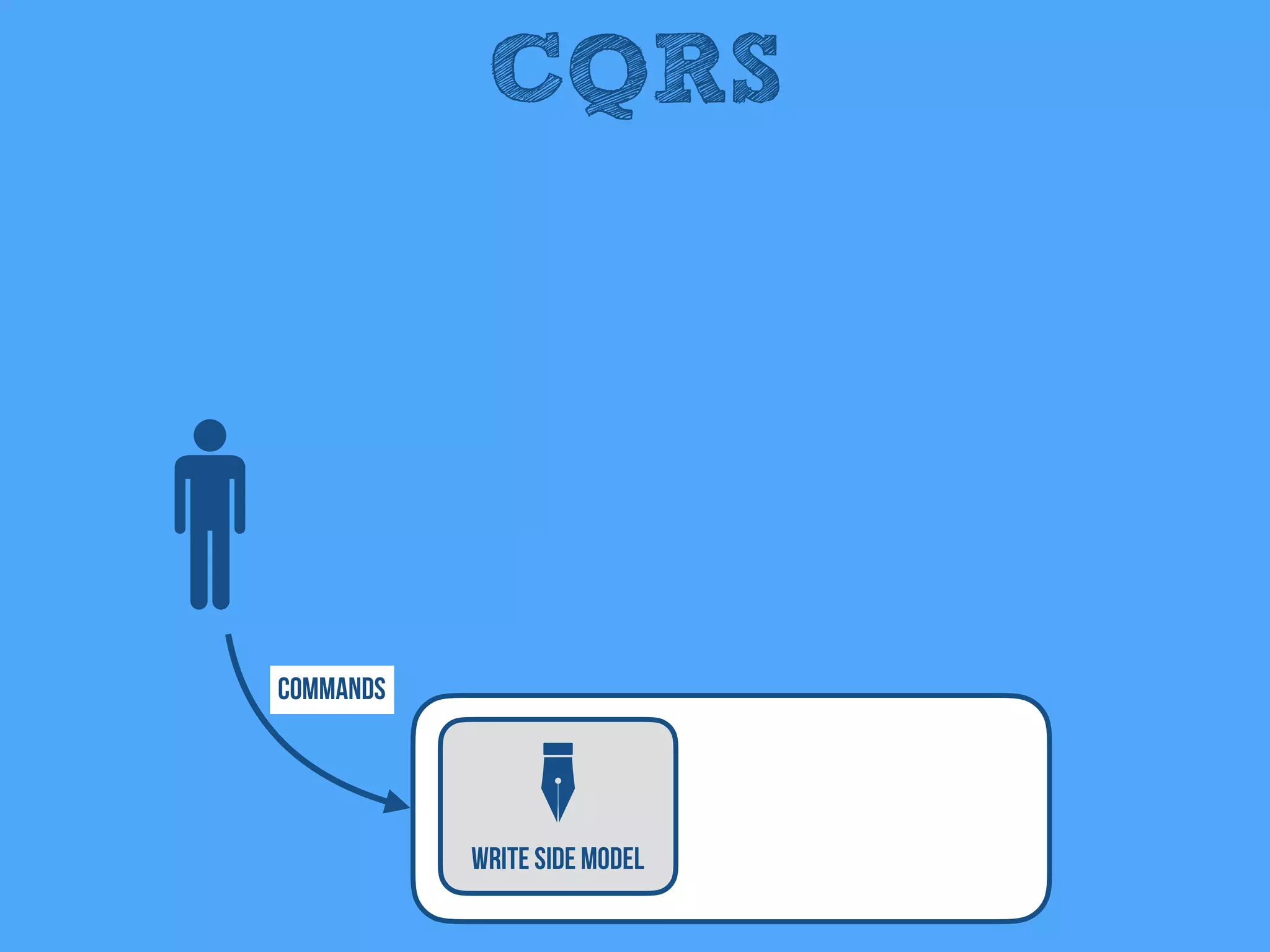
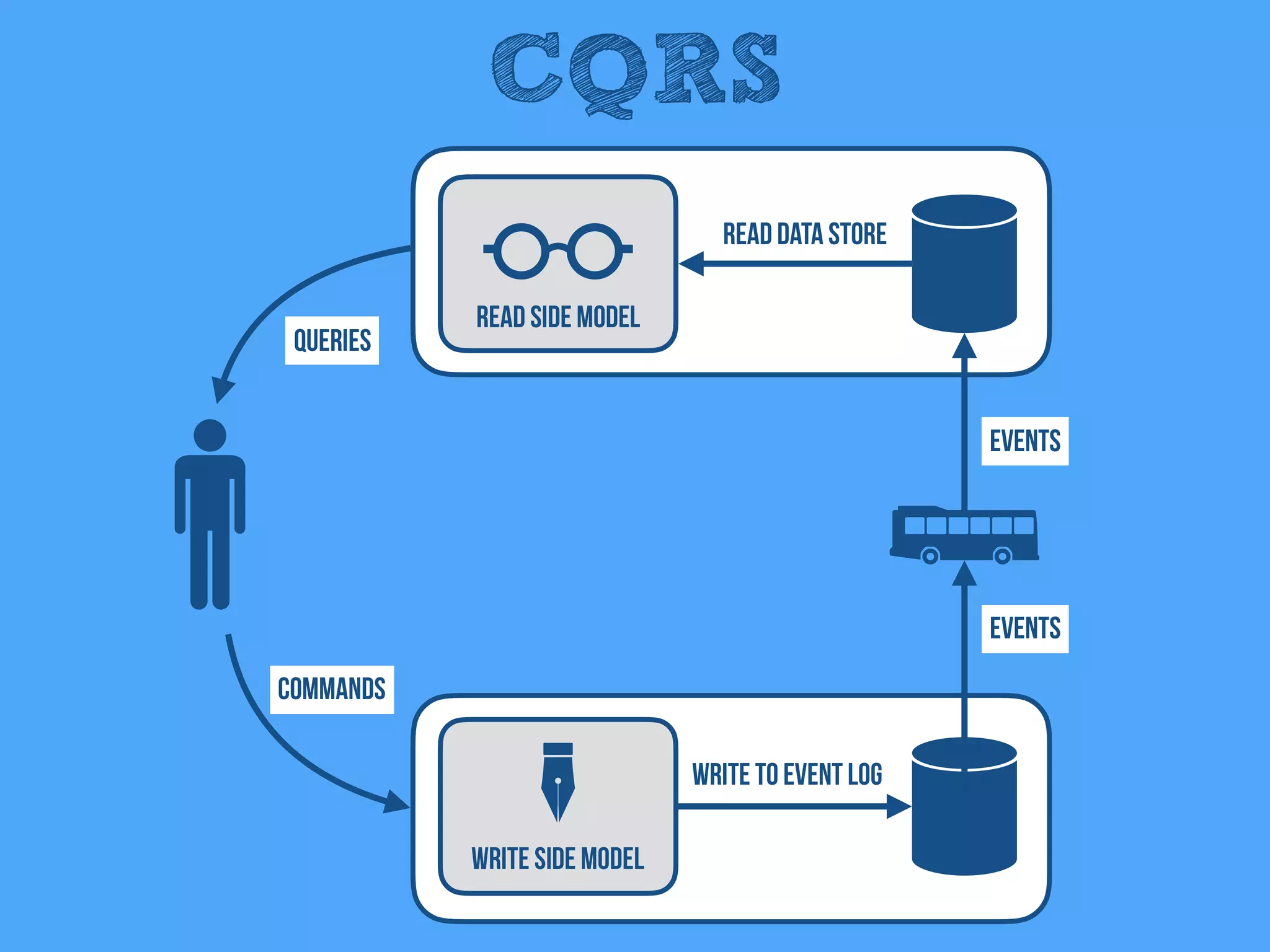
CQRS
CQRS
CQRS
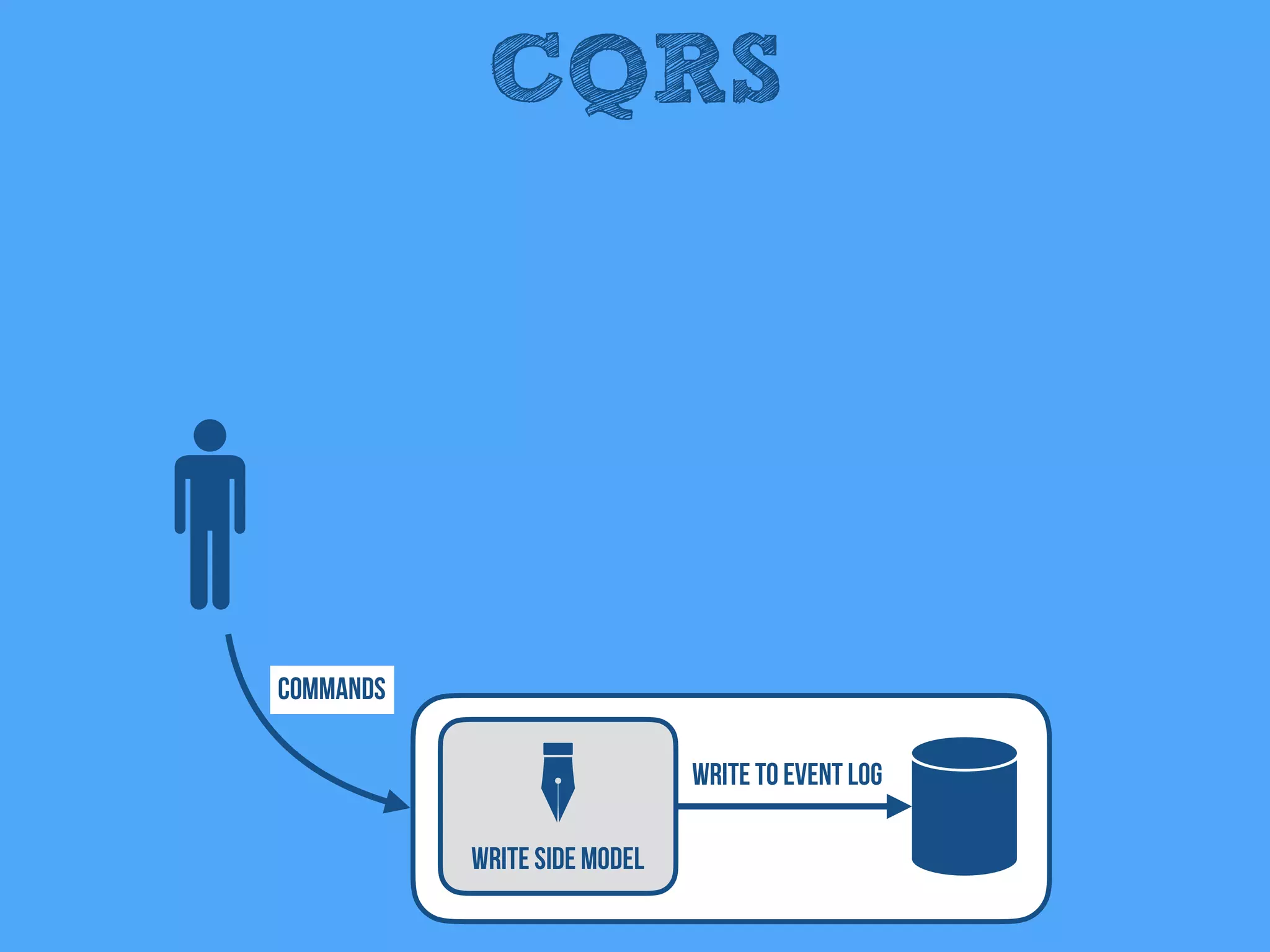
Write Side Model
Commands
CQRS
Write Side Model
Write to Event Log
Commands
CQRS
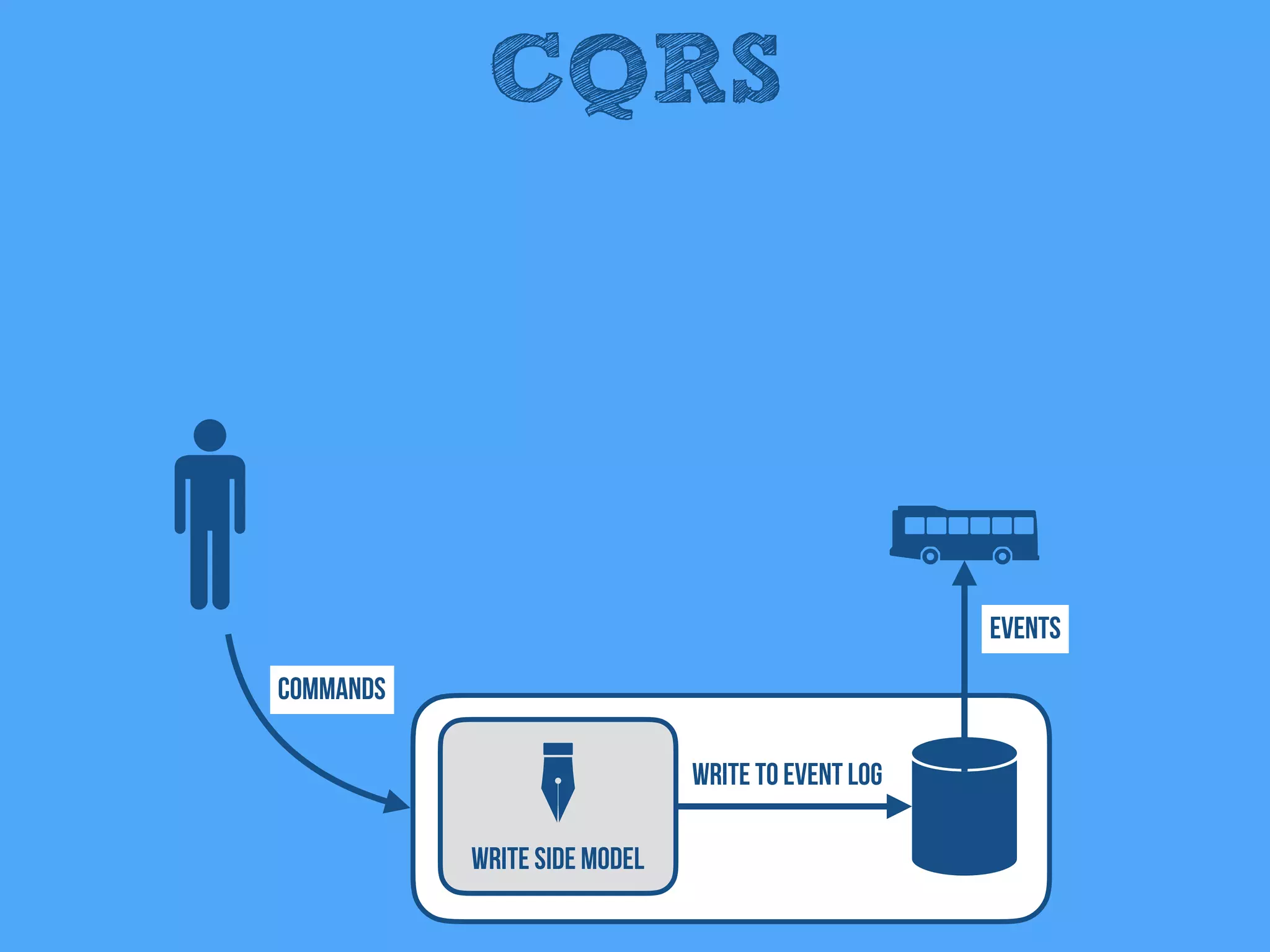
Write Side Model
Events
Write to Event Log
Commands
CQRS
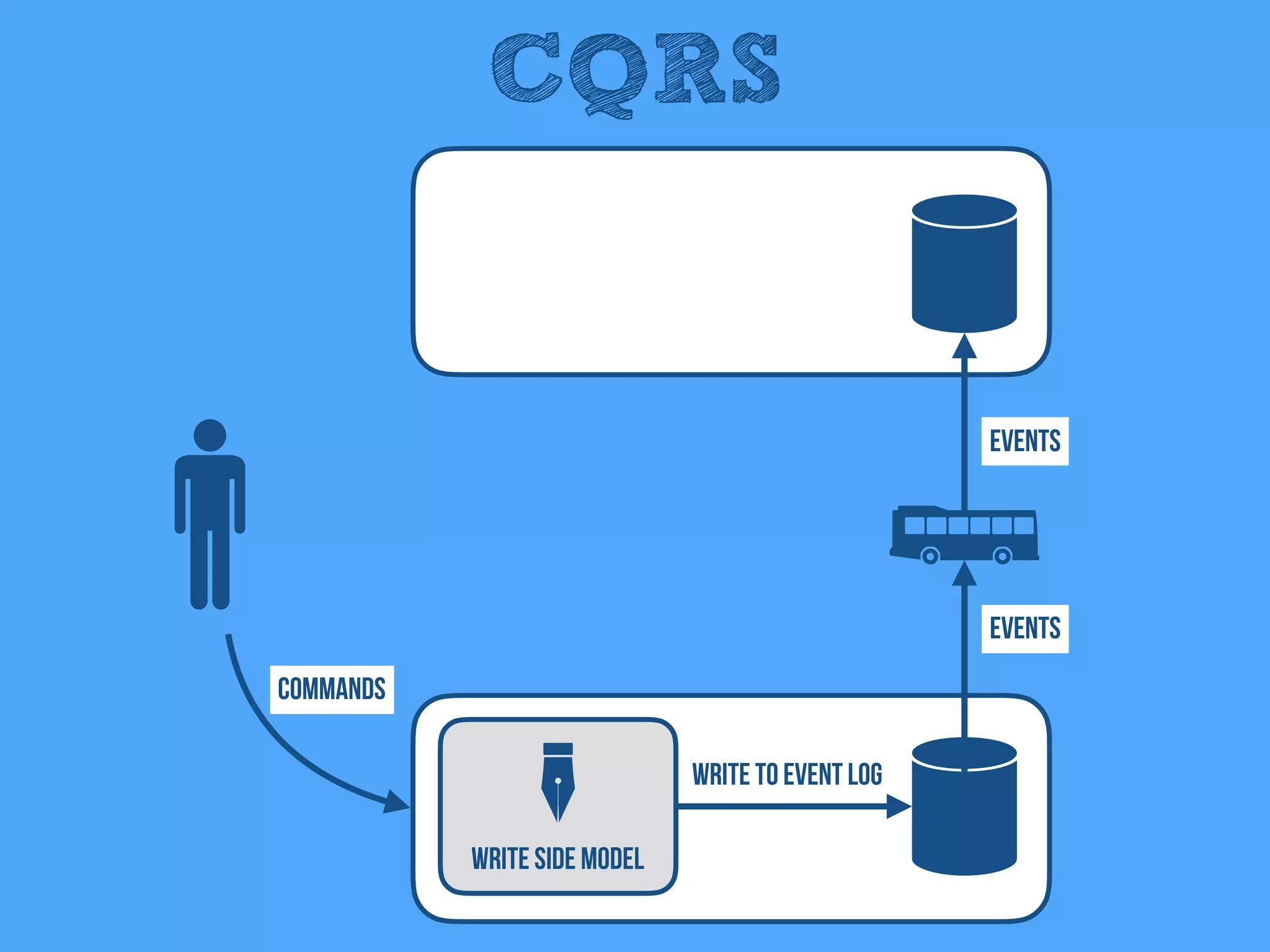
Write Side Model
Events
Events
Write to Event Log
Commands
CQRS
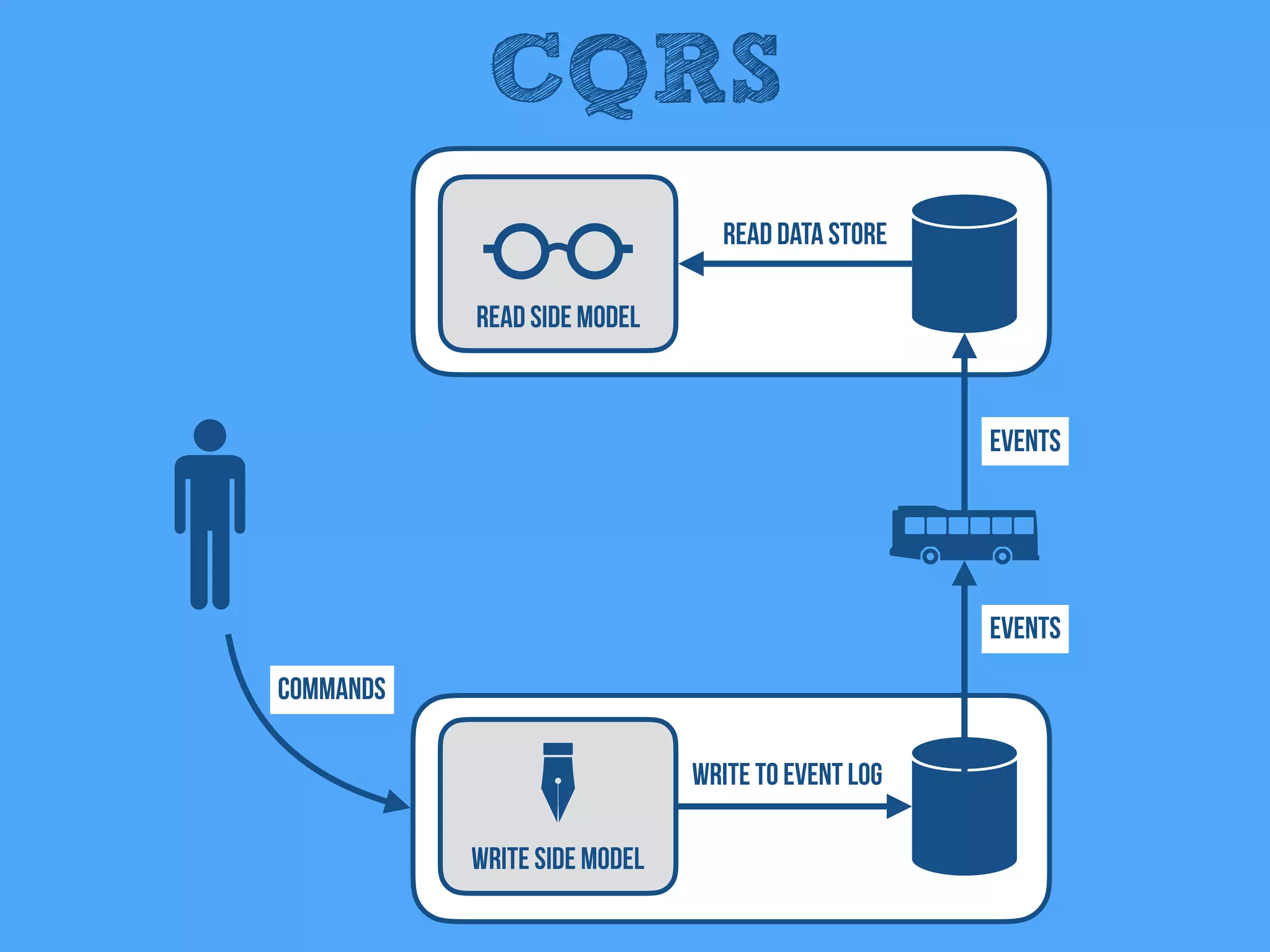
Read Side Model
Write Side Model
Events
Events
Read Data Store
Write to Event Log
Commands
CQRS
Read Side Model
Write Side Model
Events
Queries
Events
Read Data Store
Write to Event Log
Commands
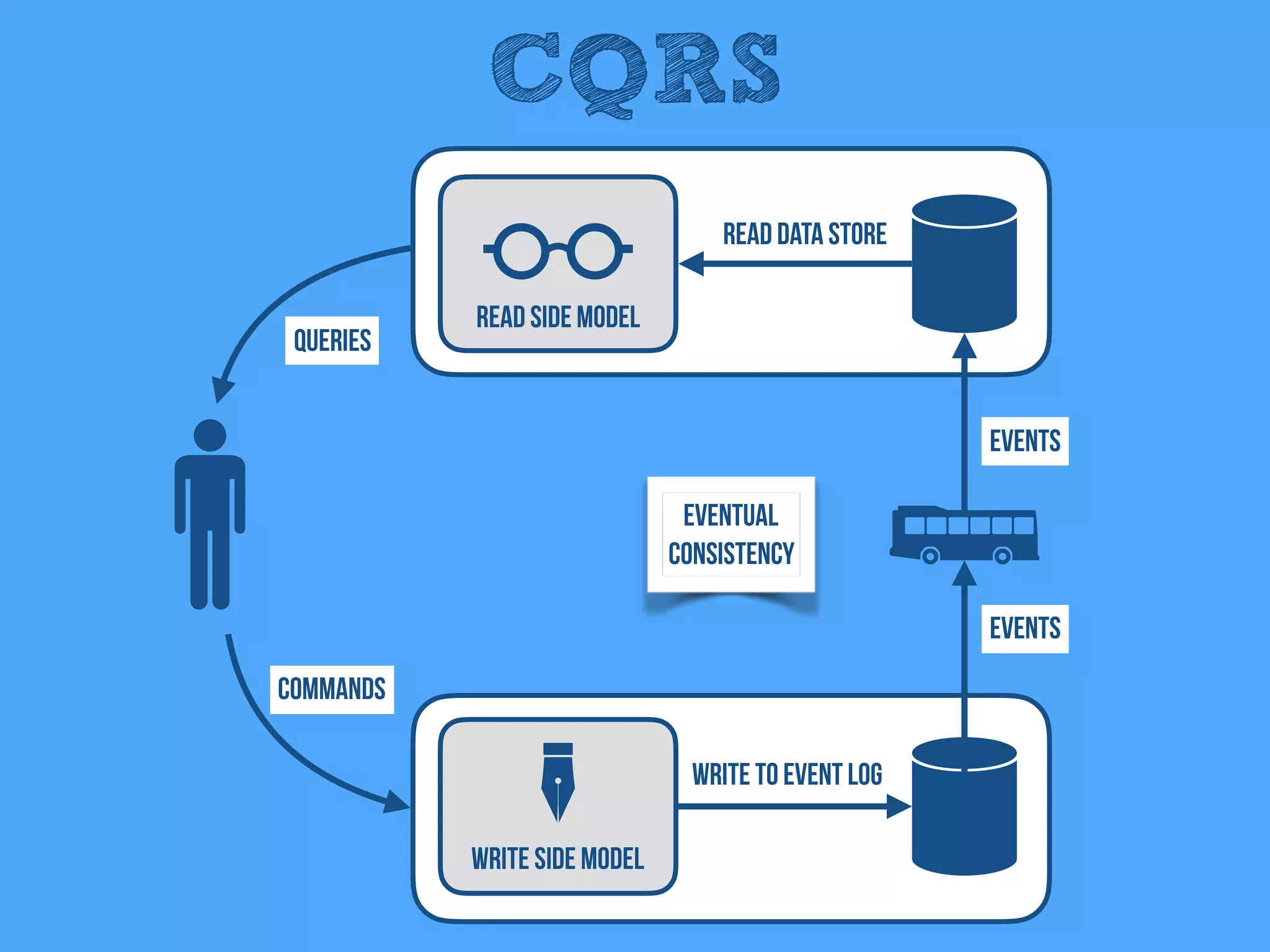
CQRS
Read Side Model
Write Side Model
Events
Queries
Events
Read Data Store
Write to Event Log
Eventual
Consistency
Commands
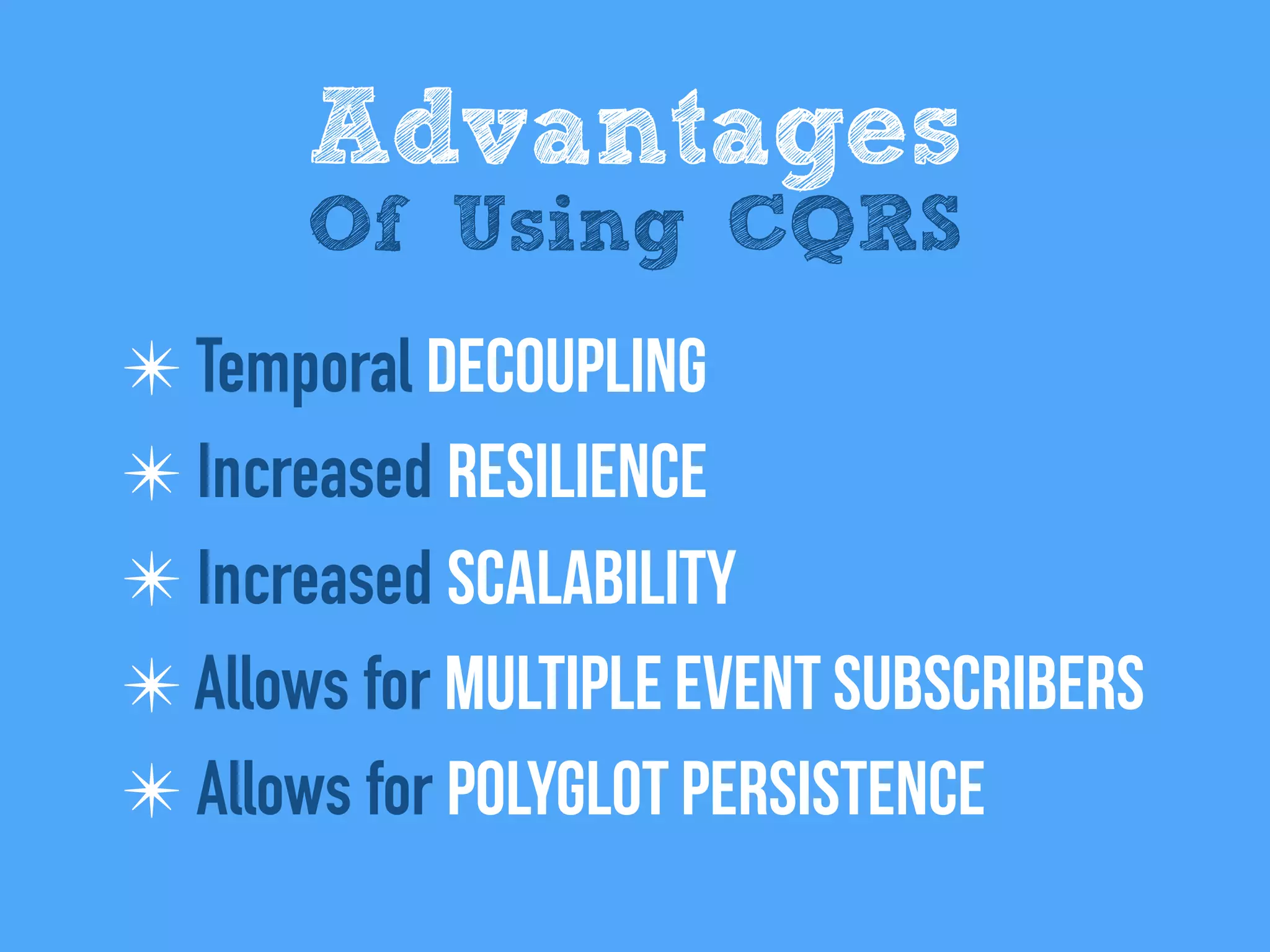
✴ Temporal Decoupling
✴ Increased Resilience
✴ Increased Scalability
✴ Allows for Multiple Event subscribers
✴ Allows for Polyglot Persistence
Advantages
Of Using CQRS
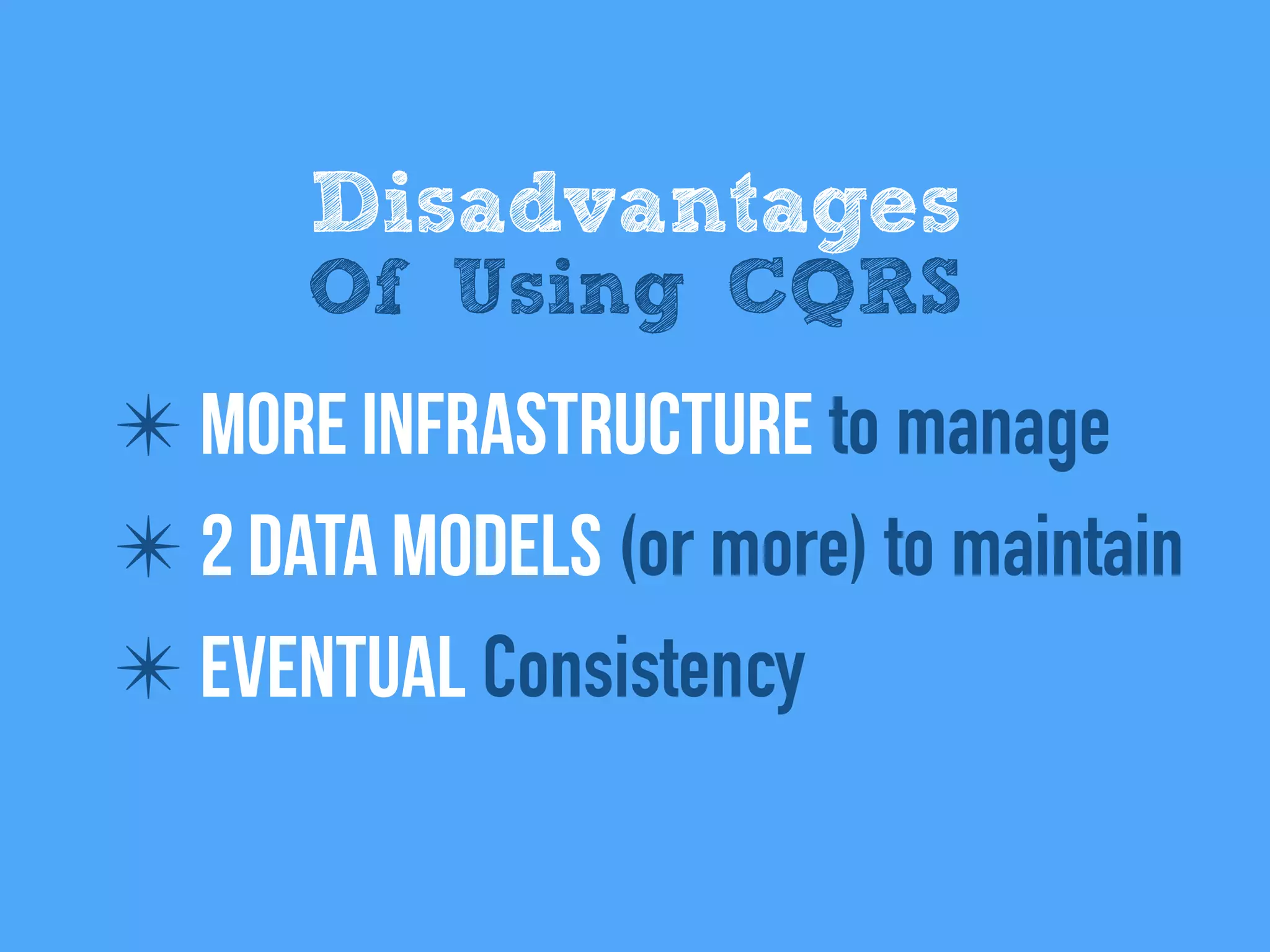
✴ More infrastructure to manage
✴ 2 data models (or more) to maintain
✴ Eventual Consistency
Disadvantages
Of Using CQRS
Key Takeaways
Key Takeaways
Event driven design helps you to:
✴ Design autonomous services
✴ Move Faster towards a Reactive architecture
✴ reduce risk when modernizing applications
✴ Balance Certainty and Uncertainty
Key Takeaways
Event driven design helps you to:
✴ Design autonomous services
✴ Move Faster towards a Reactive architecture
✴ reduce risk when modernizing applications
✴ Balance Certainty and Uncertainty
Event Logging allows you to:
✴ take control of your system’s history
✴ time-travel
✴ Balance Strong and eventual consistency
Learn More
Download my latest book for free at:
bit.ly/reactive-microsystems

How Events Are Reshaping Modern Systems

  • 1.
    How Events Are Reshaping ModernSystems Jonas Bonér @jboner
  • 3.
  • 4.
    1. Events driveautonomy 2. Events help reduce risk 3. Events help you move faster 4. Events Increase Loose coupling 5. Events increase stability 6. Events increase scalability 7. Events increase resilience 8. Events increase traceability 9. Events allow for time-travel Why Should you care?
  • 5.
    1. Cloud andmulticore architectures 2. Microservices and distributed systems 3. Data-centric applications 4. “We want more, of everything, and we want it now.” - Your Customers
  • 6.
    Why Now? 1. Cloudand multicore architectures 2. Microservices and distributed systems 3. Data-centric applications 4. “We want more, of everything, and we want it now.” - Your Customers
  • 7.
    Do Not SettleFor Microliths
  • 8.
    Do Not SettleFor Microliths
  • 9.
    “Event-Driven Architecture (EDA) isa design paradigm in which a software component executes in response to receiving one or more event notifications.” - Gartner Event Driven Architecture To The Rescue
  • 11.
  • 12.
  • 13.
  • 14.
    ✴Events represent Factsof information ➡ Facts are immutable ➡ Facts Accrue - Knowledge can only grow The Nature of Events
  • 15.
    ✴Events represent Factsof information ➡ Facts are immutable ➡ Facts Accrue - Knowledge can only grow ✴ Events/Facts can be disregarded/Ignored The Nature of Events
  • 16.
    ✴Events represent Factsof information ➡ Facts are immutable ➡ Facts Accrue - Knowledge can only grow ✴ Events/Facts can be disregarded/Ignored ✴ Events/Facts Can not be retracted (once accepted) The Nature of Events
  • 17.
    ✴Events represent Factsof information ➡ Facts are immutable ➡ Facts Accrue - Knowledge can only grow ✴ Events/Facts can be disregarded/Ignored ✴ Events/Facts Can not be retracted (once accepted) ✴ Events/Facts Can not be deleted (once accepted) ➡ Might be needed for legal or moral reasons The Nature of Events
  • 18.
    ✴Events represent Factsof information ➡ Facts are immutable ➡ Facts Accrue - Knowledge can only grow ✴ Events/Facts can be disregarded/Ignored ✴ Events/Facts Can not be retracted (once accepted) ✴ Events/Facts Can not be deleted (once accepted) ➡ Might be needed for legal or moral reasons ✴ Events/Facts (new) can invalidate existing Facts The Nature of Events
  • 19.
  • 20.
    ✴ Queue +anonymous Callbacks ✴ The Hollywood principle ✴ At-Most-Once delivery guarantees ✴ Local context only ✴ Sync or AsynC ✴ Limited and quite powerless The Event Loop
  • 21.
    ✴ Queue +anonymous Callbacks ✴ The Hollywood principle ✴ At-Most-Once delivery guarantees ✴ Local context only ✴ Sync or AsynC ✴ Limited and quite powerless The Event Loop * * Too limited as a general model of computation, and programming model for modern distributed systems. But is a useful building block.
  • 22.
    ✴ Ephemeral andanonymous ✴ No sane failure model Error Channel - console.log(‘4/0=err’, err) ✴ No composition Signature: Input => Side-effect - (Any => Unit) ✴ Hard to Debug ✴ Hard to reason about ✴ Leads to Callback hell The Problem With Event Callbacks
  • 23.
  • 25.
    ✴Patterns Observer, Pub-Sub, Broadcast,… ✴Futures & PRomises ✴Dataflow Variables ✴Stream Processing ✴ Event-driven Microservices ✴ FaaS We Need High Level Abstractions
  • 26.
    Unified Event DrivenAbstractions Powered By Message Driven Fabric Ladder of abstraction
  • 27.
    Unified Event DrivenAbstractions Powered By Message Driven Fabric Network Boundary Ladder of abstraction
  • 28.
    Unified Event DrivenAbstractions Powered By Message Driven Fabric Network Boundary Ladder of abstraction
  • 29.
    Unified Event DrivenAbstractions Powered By Message Driven Fabric Network Boundary Ladder of abstraction
  • 30.
    Unified Event DrivenAbstractions Powered By Message Driven Fabric Unified API (Event-driven Microservices, Patterns, Streams, Futures, FaaS,…) Network Boundary Ladder of abstraction
  • 31.
    Unified Event DrivenAbstractions Powered By Message Driven Fabric Unified API (Event-driven Microservices, Patterns, Streams, Futures, FaaS,…) Network Boundary Event 1Ladder of abstraction
  • 32.
    Unified Event DrivenAbstractions Powered By Message Driven Fabric Unified API (Event-driven Microservices, Patterns, Streams, Futures, FaaS,…) Local Event Loop Network Boundary Event 1Ladder of abstraction
  • 33.
    Unified Event DrivenAbstractions Powered By Message Driven Fabric Unified API (Event-driven Microservices, Patterns, Streams, Futures, FaaS,…) Local Event Loop Distribution Fabric Network Boundary Event 1Ladder of abstraction
  • 34.
    Unified Event DrivenAbstractions Powered By Message Driven Fabric Unified API (Event-driven Microservices, Patterns, Streams, Futures, FaaS,…) Local Event Loop Distribution Fabric Distribution Fabric Network Boundary Message Passing Event 1Ladder of abstraction
  • 35.
    Unified Event DrivenAbstractions Powered By Message Driven Fabric Unified API (Event-driven Microservices, Patterns, Streams, Futures, FaaS,…) Local Event Loop Distribution Fabric Local Event Loop Distribution Fabric Network Boundary Message Passing Event 1Ladder of abstraction
  • 36.
    Unified Event DrivenAbstractions Powered By Message Driven Fabric Unified API (Event-driven Microservices, Patterns, Streams, Futures, FaaS,…) Local Event Loop Distribution Fabric Local Event Loop Distribution Fabric Network Boundary Message Passing Event 1Ladder of abstraction
  • 37.
    Unified Event DrivenAbstractions Powered By Message Driven Fabric Unified API (Event-driven Microservices, Patterns, Streams, Futures, FaaS,…) Local Event Loop Distribution Fabric Local Event Loop Distribution Fabric Network Boundary Message Passing Event 1 Event 1Ladder of abstraction
  • 38.
    Unified Event DrivenAbstractions Powered By Message Driven Fabric Unified API (Event-driven Microservices, Patterns, Streams, Futures, FaaS,…) Local Event Loop Distribution Fabric Local Event Loop Distribution Fabric Network Boundary Message Passing Event 1 Event 1 Reactive Systems is doing the heavy lifting Ladder of abstraction
  • 39.
    Unified Event DrivenAbstractions Powered By Message Driven Fabric Unified API (Event-driven Microservices, Patterns, Streams, Futures, FaaS,…) Local Event Loop Distribution Fabric Local Event Loop Distribution Fabric Network Boundary Message Passing Event 1 Event 1 Reactive Systems is doing the heavy lifting Ladder of abstraction Reactive Programming
  • 40.
    1. REceive andreact to facts (or not), that are coming its way 2. Publish new facts (as events) to the rest of the world 3. Invert the control flow to minimize coupling and increase autonomy Event Driven Services
  • 41.
    Mutable State Needs ToBe Contained And Non Observable
  • 42.
  • 43.
  • 44.
    Event Stream Use The as theintegration fabric
  • 45.
  • 46.
  • 47.
  • 48.
  • 49.
  • 50.
  • 51.
  • 52.
  • 53.
  • 54.
  • 55.
  • 56.
  • 57.
  • 58.
  • 59.
  • 60.
    But Relax It IsHow The World Works
  • 61.
  • 62.
  • 63.
    Welcome To TheWild Ocean Of Non Determinism Distributed Systems
  • 64.
    “In a systemwhich cannot count on distributed transactions, the management of uncertainty must be implemented in the business logic.” - Pat Helland Life Beyond Distributed Transactions - An Apostate’s Opinion, Pat Helland (2007) We Need To Model Uncertainty
  • 65.
  • 66.
  • 67.
    Events Can LeadTo Greater Certainty
  • 68.
    Events Can HelpUs Craft Autonomous Islands Of Determinism
  • 70.
    What does itmean to be Automonous?
  • 71.
    From greek: Auto-nomos ✴Auto meaning self ✴ Nomos meaning Law Autonomy
  • 72.
  • 73.
  • 74.
    ✴Impositions diverge into unpredictableoutcomes from definite beginnings Distributed information Decreased certainty Convergence vs. Divergence of information ✴Promises converge towards a definite outcome from unpredictable beginnings Local information Improved certainty
  • 75.
    “Autonomy makes informationlocal, leading to greater certainty and stability.” “An autonomus component can only promise its own behavior.” - Mark Burgess In Search of Certainty, Thinking in Promises - Mark Burgess
  • 76.
  • 77.
    ✴ If aservice only promises its own behavior Then all information needed to ➡ Resolve a conflict ➡ Repair under failure ➡ Is available within the service itself Benefits of Thinking in Promises
  • 78.
    ✴ If aservice only promises its own behavior Then all information needed to ➡ Resolve a conflict ➡ Repair under failure ➡ Is available within the service itself ✴ Promises remove the need for needless 1. Communication 2. Coordination 3. Consensus Benefits of Thinking in Promises
  • 79.
    “The first principleof successful scalability is to batter the consistency mechanisms down to a minimum.” - James Hamilton As transcribed in: Toward a Cloud Computing Research Agenda. SIGACT News, 40(2):68–80, June 2009.
  • 80.
  • 81.
  • 82.
    “When you startmodeling events, it forces you to think about the behavior of the system. As opposed to thinking about the structure of the system.” - Greg Young A Decade of DDD, CQRS, Event Sourcing, Greg Young (Presentation from 2016)
  • 83.
    ✴ Don’t focuson the things The Nouns The Domain Objects ✴ Focus on what happens The Verbs The Events
  • 84.
  • 86.
  • 87.
  • 88.
    ✴ IntentS ➡ Communication ➡Conversations ➡ Expectations ➡ Contracts ➡ Control Transfer Event Driven Design
  • 89.
    ✴ IntentS ➡ Communication ➡Conversations ➡ Expectations ➡ Contracts ➡ Control Transfer Event Driven Design ✴ Facts ➡ State ➡ History ➡ Causality ➡ Notifications ➡ State Transfer
  • 90.
    ✴ IntentS ➡ Communication ➡Conversations ➡ Expectations ➡ Contracts ➡ Control Transfer Event Driven Design ✴ Facts ➡ State ➡ History ➡ Causality ➡ Notifications ➡ State Transfer Commands
  • 91.
    ✴ IntentS ➡ Communication ➡Conversations ➡ Expectations ➡ Contracts ➡ Control Transfer Event Driven Design ✴ Facts ➡ State ➡ History ➡ Causality ➡ Notifications ➡ State Transfer Commands Events
  • 92.
  • 93.
    ✴Commands ➡ Object formof method/Action request ➡ Imperative: CreateOrder, ShipProduct Event Driven Design
  • 94.
    ✴Commands ➡ Object formof method/Action request ➡ Imperative: CreateOrder, ShipProduct ✴Reactions ➡ Represents side-effects Event Driven Design
  • 95.
    ✴Commands ➡ Object formof method/Action request ➡ Imperative: CreateOrder, ShipProduct ✴Reactions ➡ Represents side-effects ✴Events ➡ Represents something that has happened ➡ Past-tense: OrderCreated, ProductShipped Event Driven Design
  • 96.
  • 97.
    Commands Eventsvs 1. Allabout intent 1. Intentless
  • 98.
    Commands Eventsvs 1. Allabout intent 2. Directed 1. Intentless 2. Anonymous
  • 99.
    Commands Eventsvs 1. Allabout intent 2. Directed 3. Single addressable destination 1. Intentless 2. Anonymous 3. Just happens - for others (0-N) to observe
  • 100.
    Commands Eventsvs 1. Allabout intent 2. Directed 3. Single addressable destination 4. Models personal communication 1. Intentless 2. Anonymous 3. Just happens - for others (0-N) to observe 4. Models broadcast (speakers corner)
  • 101.
    Commands Eventsvs 1. Allabout intent 2. Directed 3. Single addressable destination 4. Models personal communication 5. Distributed focus 1. Intentless 2. Anonymous 3. Just happens - for others (0-N) to observe 4. Models broadcast (speakers corner) 5. Local focus
  • 102.
    Commands Eventsvs 1. Allabout intent 2. Directed 3. Single addressable destination 4. Models personal communication 5. Distributed focus 6. Command & Control 1. Intentless 2. Anonymous 3. Just happens - for others (0-N) to observe 4. Models broadcast (speakers corner) 5. Local focus 6. Autonomy
  • 103.
    Let the EventsDefine the Bounded Context
  • 104.
    Principles For Promise TheoryDriven Protocol Design
  • 105.
    1. Convergency Promises shouldreach a desired state, a stable outcome - idempotent behavior Principles For Promise Theory Driven Protocol Design
  • 106.
    1. Convergency Promises shouldreach a desired state, a stable outcome - idempotent behavior 2. Embracing Failure Expect things to go wrong Promises may or may not be kept Principles For Promise Theory Driven Protocol Design
  • 107.
    1. Convergency Promises shouldreach a desired state, a stable outcome - idempotent behavior 2. Embracing Failure Expect things to go wrong Promises may or may not be kept 3. Autonomy You can’t rely on other services Principles For Promise Theory Driven Protocol Design
  • 108.
    ✴ Maintains Integrity& consistency ✴ Is our Unit of Consistency ✴ Is our Unit of Failure ✴ Is our Unit of Determinism ✴ Is fully Autonomous The Aggregate
  • 109.
    Enough Talk Show MeThe Code Sample in Java: https://gist.github.com/jboner/4361c710d2e2386be8bddc39edb0528a Sample in Scala: https://gist.github.com/jboner/dea4aa819e127d543d684208d74081b5
  • 110.
    Enough Talk Show MeThe Code Sample in Java: https://gist.github.com/jboner/4361c710d2e2386be8bddc39edb0528a Sample in Scala: https://gist.github.com/jboner/dea4aa819e127d543d684208d74081b5
  • 111.
  • 112.
    Are we donenow? Perhaps. We have come a long way.
  • 113.
    Are we donenow? Perhaps. We have come a long way. But events can also be used for:
  • 114.
    Are we donenow? Perhaps. We have come a long way. But events can also be used for: ➡ Persistence
  • 115.
    Are we donenow? Perhaps. We have come a long way. But events can also be used for: ➡ Persistence ➡ Managing time
  • 116.
  • 117.
    “Update-in-place strikes systems designersas a cardinal sin: it violates traditional accounting practices that have been observed for hundreds of years.” - jim Gray The Transaction Concept, Jim Gray (1981)
  • 118.
  • 119.
    Event Sourcing A CureFor the Cardinal Sin
  • 120.
    “The truth isthe log. The database is a cache of a subset of the log.” - Pat Helland Immutability Changes Everything, Pat Helland (2015)
  • 121.
  • 122.
  • 123.
    Happy Path Event Sourced Services 1) Receiveand verify Command (“ApprovePayment”)
  • 124.
    Happy Path Event Sourced Services 2) Createnew Event (“PaymentApproved”) 1) Receive and verify Command (“ApprovePayment”)
  • 125.
    Happy Path Event Sourced Services 2) Createnew Event (“PaymentApproved”) 1) Receive and verify Command (“ApprovePayment”) 3) Append Event to Event Log
  • 126.
    Happy Path Event Sourced Services 2) Createnew Event (“PaymentApproved”) 1) Receive and verify Command (“ApprovePayment”) 3) Append Event to Event Log 4) Update internal component state
  • 127.
    Happy Path Event Sourced Services 5) Runside-effects (approve the payment) 2) Create new Event (“PaymentApproved”) 1) Receive and verify Command (“ApprovePayment”) 3) Append Event to Event Log 4) Update internal component state
  • 128.
    SAD Path -recovering from failure Happy Path Event Sourced Services 5) Run side-effects (approve the payment) 2) Create new Event (“PaymentApproved”) 1) Receive and verify Command (“ApprovePayment”) 3) Append Event to Event Log 4) Update internal component state
  • 129.
    SAD Path -recovering from failure Happy Path Event Sourced Services 5) Run side-effects (approve the payment) 2) Create new Event (“PaymentApproved”) 1) Receive and verify Command (“ApprovePayment”) 3) Append Event to Event Log 4) Update internal component state 1) Rehydrate Events from Event Log
  • 130.
    SAD Path -recovering from failure Happy Path Event Sourced Services 5) Run side-effects (approve the payment) 2) Create new Event (“PaymentApproved”) 1) Receive and verify Command (“ApprovePayment”) 3) Append Event to Event Log 4) Update internal component state 1) Rehydrate Events from Event Log 2) Update internal component state
  • 131.
    SAD Path -recovering from failure Happy Path Event Sourced Services 5) Run side-effects (approve the payment) 2) Create new Event (“PaymentApproved”) 1) Receive and verify Command (“ApprovePayment”) 3) Append Event to Event Log 4) Update internal component state 1) Rehydrate Events from Event Log 2) Update internal component state Memory Image
  • 132.
    Event Sourcing ✴ Onesingle Source of Truth with All history ✴ Allows for Memory Image - durable in-memory state ✴ Avoids the Object-relational mismatch ✴ Allows others to Subscribe to state changes ✴ Mechanical sympathy (Single Writer Principle etc.)
  • 133.
    ✴ Unfamiliar model ✴Versioning of events ✴ Deletion of events (legal or moral reasons) Disadvantages Of Using Event Sourcing
  • 134.
    EventsAllow Us ToManage Time
  • 135.
    “Modeling events forcesyou to have a temporal focus on what’s going on in the system. Time becomes a crucial factor of the system.” - Greg Young A Decade of DDD, CQRS, Event Sourcing, Greg Young (Presentation from 2016)
  • 137.
    But, What isTime Really?
  • 138.
    Causality How We MakeSense Of The World
  • 139.
    Time Is theSuccession Of Causally Related Events
  • 140.
    ✴ Event isa snapshot in time ✴ Event ID is an index for time ✴ Event Log is our full history The database of Our past The path to Our present Event Sourcing Allows Us To Model Time
  • 141.
  • 142.
  • 143.
    Event Sourcing Allows For TimeTravel ✴Replay the log for historic debugging ✴Replay the log for auditing & traceability ✴Replay the log on failure ✴Replay the log for replication
  • 144.
    “The future isa function of the past.” - A. P. Robertson
  • 145.
    “The (local) presentis a merge function of multiple concurrent pasts.” - me
  • 146.
    val newLocalPresent =observedPasts. foldLeft(oldLocalPresent) { _ merge _ }
  • 147.
    We need toexplicitly model the local present as facts derived from the merging of multiple concurrent pasts
  • 148.
    We Can EvenFork the Past ...Or Join Two Distinct Pasts
  • 149.
    Let Make OurDemo Event Sourced
  • 150.
    Untangle Your Read andWrite Models With CQRS
  • 151.
  • 152.
  • 153.
  • 154.
    CQRS Write Side Model Writeto Event Log Commands
  • 155.
  • 156.
  • 157.
    CQRS Read Side Model WriteSide Model Events Events Read Data Store Write to Event Log Commands
  • 158.
    CQRS Read Side Model WriteSide Model Events Queries Events Read Data Store Write to Event Log Commands
  • 159.
    CQRS Read Side Model WriteSide Model Events Queries Events Read Data Store Write to Event Log Eventual Consistency Commands
  • 160.
    ✴ Temporal Decoupling ✴Increased Resilience ✴ Increased Scalability ✴ Allows for Multiple Event subscribers ✴ Allows for Polyglot Persistence Advantages Of Using CQRS
  • 161.
    ✴ More infrastructureto manage ✴ 2 data models (or more) to maintain ✴ Eventual Consistency Disadvantages Of Using CQRS
  • 162.
  • 163.
    Key Takeaways Event drivendesign helps you to: ✴ Design autonomous services ✴ Move Faster towards a Reactive architecture ✴ reduce risk when modernizing applications ✴ Balance Certainty and Uncertainty
  • 164.
    Key Takeaways Event drivendesign helps you to: ✴ Design autonomous services ✴ Move Faster towards a Reactive architecture ✴ reduce risk when modernizing applications ✴ Balance Certainty and Uncertainty Event Logging allows you to: ✴ take control of your system’s history ✴ time-travel ✴ Balance Strong and eventual consistency
  • 165.
    Learn More Download mylatest book for free at: bit.ly/reactive-microsystems