


How Events
Are Reshaping
Modern Systems
Jonas Bonér
@jboner
InfoQ.com: News & Community Site
Watch the video with slide
synchronization on InfoQ.com!
https://www.infoq.com/presentations/
systems-event-driven
• Over 1,000,000 software developers, architects and CTOs read the site world-
wide every month
• 250,000 senior developers subscribe to our weekly newsletter
• Published in 4 languages (English, Chinese, Japanese and Brazilian
Portuguese)
• Post content from our QCon conferences
• 2 dedicated podcast channels: The InfoQ Podcast, with a focus on
Architecture and The Engineering Culture Podcast, with a focus on building
• 96 deep dives on innovative topics packed as downloadable emags and
minibooks
• Over 40 new content items per week
Purpose of QCon
- to empower software development by facilitating the spread of
knowledge and innovation
Strategy
- practitioner-driven conference designed for YOU: influencers of
change and innovation in your teams
- speakers and topics driving the evolution and innovation
- connecting and catalyzing the influencers and innovators
Highlights
- attended by more than 12,000 delegates since 2007
- held in 9 cities worldwide
Presented at QCon London
www.qconlondon.com
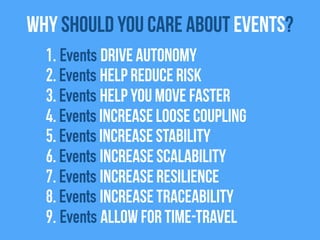
1. Events drive autonomy
2. Events help reduce risk
3. Events help you move faster
4. Events Increase Loose coupling
5. Events increase stability
6. Events increase scalability
7. Events increase resilience
8. Events increase traceability
9. Events allow for time-travel
Why Should you care about Events?
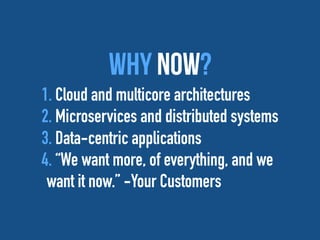
Why Now?
1. Cloud and multicore architectures
2. Microservices and distributed systems
3. Data-centric applications
4. “We want more, of everything, and we
want it now.” -Your Customers
What is an
Event?
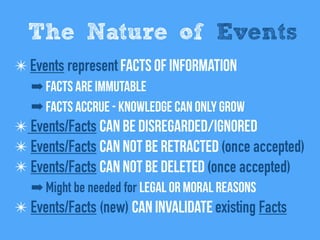
✴Events represent Facts of information
➡ Facts are immutable
➡ Facts Accrue - Knowledge can only grow
✴ Events/Facts can be disregarded/Ignored
✴ Events/Facts Can not be retracted (once accepted)
✴ Events/Facts Can not be deleted (once accepted)
➡ Might be needed for legal or moral reasons
✴ Events/Facts (new) can invalidate existing Facts
The Nature of Events
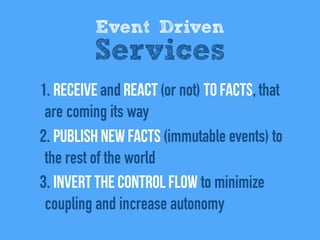
1. REceive and react (or not) to facts, that
are coming its way
2. Publish new facts (immutable events) to
the rest of the world
3. Invert the control flow to minimize
coupling and increase autonomy
Event Driven
Services
Mutable State
Needs To Be
Contained
And Non Observable
Publish Facts
To Outside World
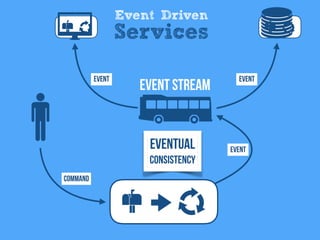
Event Driven
Services
Eventual
Consistency
Command
Event
EventEvent
Event Stream
Event
Stream
Use The
as the communication fabric
Event
Stream
Use The
as the integration fabric
Event
Stream
Use The
as the replication fabric
Event
Stream
Use The
as the consensus fabric
Event
Stream
Use The
as the Persistence fabric
Eventual
Consistency
We have to rely on
But relax—it’s how the world works
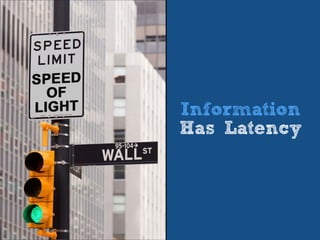
Information
Has Latency
Information Is Always
From the Past
Welcome To The Wild Ocean Of
Non Determinism
Distributed Systems
“In a system which cannot count on
distributed transactions, the management
of uncertainty must be implemented in the
business logic.”
- Pat Helland
Life Beyond Distributed Transactions, Pat Helland (2007)
We Need To Model
Uncertainty
Events Can Lead To Greater
Certainty
“An autonomus component can only
promise its own behavior.”
“Autonomy makes information local,
leading to greater certainty and stability.”
- Mark Burgess
In Search of Certainty, Thinking in Promises - Mark Burgess
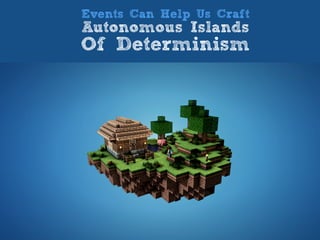
Events Can Help Us Craft
Autonomous Islands
Of Determinism
“Accidents come from relationships 
not broken parts.”
- Sidney dekker
Drift into Failure - Sidney Dekker
“Complex systems run as broken systems.”
- richard Cook
How Complex Systems Fail - Richard Cook
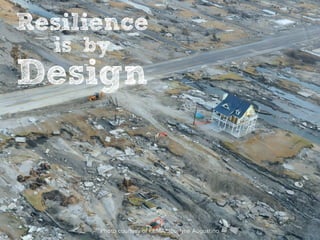
Resilience
is by
Design
Photo courtesy of FEMA/Joselyne Augustino
Events Can Help Us
Manage
Failure
Instead Of Trying To Avoid It
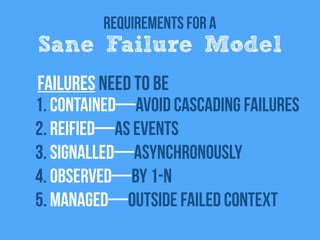
Requirements for a
Sane Failure Model
1. Contained—Avoid cascading failures
2. Reified—as Events
3. Signalled—Asynchronously
4. Observed—by 1-N
5. Managed—Outside failed Context
Failures need to be
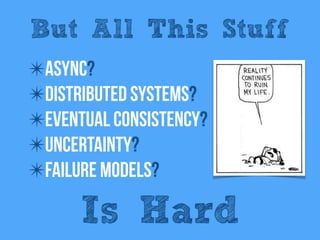
✴Async?
✴Distributed systems?
✴Eventual consistency?
✴Uncertainty?
✴Failure models?
But All This Stuff
Is Hard
Think
In Terms Of
Workflow
Events First
Domain Driven
Design
“When you start modeling events, it
forces you to think about the behaviour
of the system. As opposed to thinking
about the structure of the system.”
- Greg Young
A Decade of DDD, CQRS, Event Sourcing, Greg Young (Presentation from 2016)
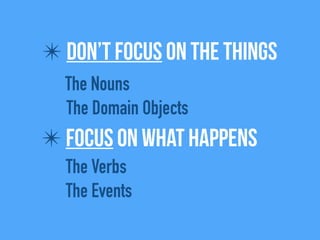
✴ Don’t focus on the things
The Nouns
The Domain Objects
✴ Focus on what happens
The Verbs
The Events
Mine the
Facts
Event Storming
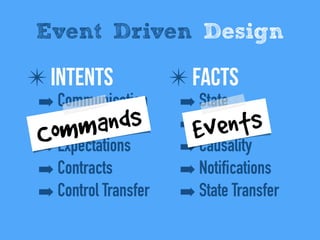
✴ IntentS
➡ Communication
➡ Conversations
➡ Expectations
➡ Contracts
➡ Control Transfer
Event Driven Design
✴ Facts
➡ State
➡ History
➡ Causality
➡ Notifications
➡ State Transfer
Commands Events
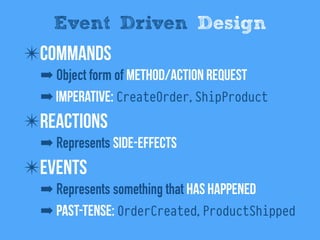
✴Commands
➡ Object form of method/Action request
➡ Imperative: CreateOrder, ShipProduct
✴Reactions
➡ Represents side-effects
✴Events
➡ Represents something that has happened
➡ Past-tense: OrderCreated, ProductShipped
Event Driven Design
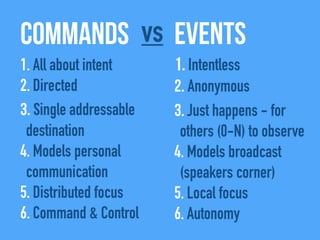
Commands Eventsvs
1. All about intent
2. Directed
3. Single addressable
destination
4. Models personal
communication
5. Distributed focus
6. Command & Control
1. Intentless
2. Anonymous
3. Just happens - for
others (0-N) to observe
4. Models broadcast
(speakers corner)
5. Local focus
6. Autonomy
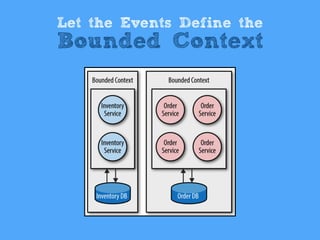
Let the Events Define the
Bounded Context
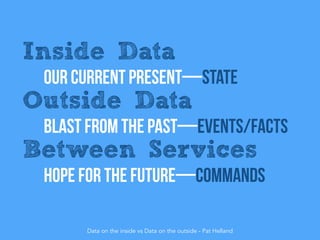
Inside Data
Our current present—state
Outside Data
Blast from the past—Events/facts
Between Services
Hope for the future—commands
Data on the inside vs Data on the outside - Pat Helland
Event Based
Persistence
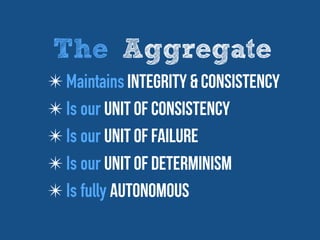
✴ Maintains Integrity & consistency
✴ Is our Unit of Consistency
✴ Is our Unit of Failure
✴ Is our Unit of Determinism
✴ Is fully Autonomous
The Aggregate
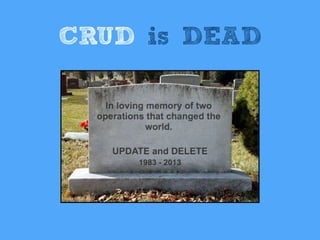
CRUD is DEAD
“Update-in-place strikes systems
designers as a cardinal sin: it violates
traditional accounting practices that have
been observed for hundreds of years.”
- jim Gray
The Transaction Concept, Jim Gray (1981)
Event Logging
The Bedrock
“The truth is the log.
The database is a cache
of a subset of the log.”
- Pat Helland
Immutability Changes Everything, Pat Helland (2015)
Event Sourcing
A Cure For the Cardinal Sin
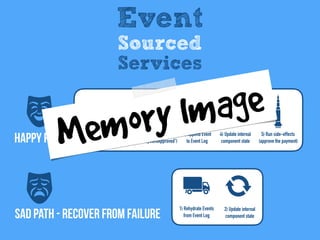
SAD Path - recover from failure
Happy Path
Event
Sourced
Services
5) Run side-effects
(approve the payment)
2) Create new Event
(“PaymentApproved”)
1) Receive and verify Command
(“ApprovePayment”)
3) Append Event
to Event Log
4) Update internal
component state
1) Rehydrate Events
from Event Log
2) Update internal
component state
Memory Image
Event Sourcing
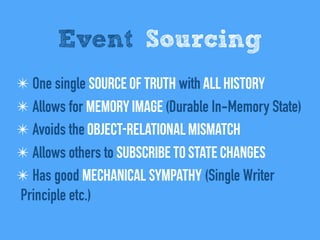
✴ One single Source of Truth with All history
✴ Allows for Memory Image (Durable In-Memory State)
✴ Avoids the Object-relational mismatch
✴ Allows others to Subscribe to state changes
✴ Has good Mechanical sympathy (Single Writer
Principle etc.)
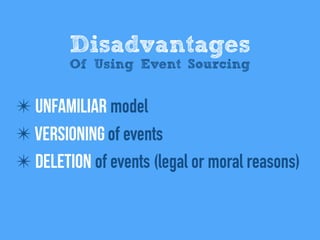
✴ Unfamiliar model
✴ Versioning of events
✴ Deletion of events (legal or moral reasons)
Disadvantages
Of Using Event Sourcing
EventsAllow Us To Manage
Time
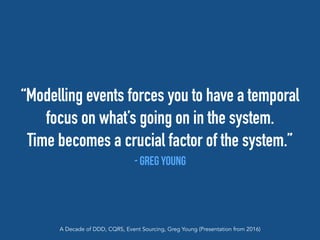
“Modelling events forces you to have a temporal
focus on what’s going on in the system.
Time becomes a crucial factor of the system.”
- Greg Young
A Decade of DDD, CQRS, Event Sourcing, Greg Young (Presentation from 2016)
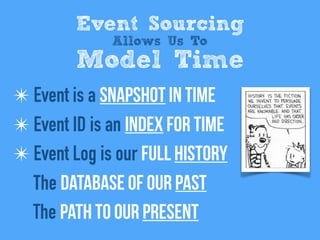
✴ Event is a snapshot in time
✴ Event ID is an index for time
✴ Event Log is our full history
The database of Our past
The path to Our present
Event Sourcing
Allows Us To
Model Time
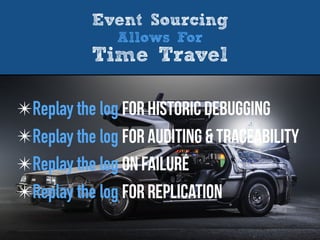
Event Sourcing
Allows For
Time Travel
✴Replay the log for historic debugging
✴Replay the log for auditing & traceability
✴Replay the log on failure
✴Replay the log for replication
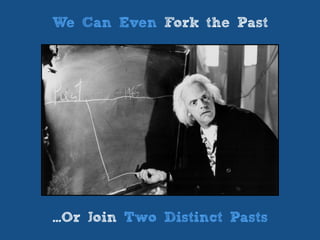
We Can Even Fork the Past
...Or Join Two Distinct Pasts
Key Takeaways
Events-First design helps you to:
✴ Move Faster towards a Resilient architecture
✴ Design autonomous services
✴ Balance Certainty and Uncertainty
✴ reduce risk when modernizing applications
Event Logging allows you to:
✴ AVOID CRUD and ORM
✴ take control of your system’s history
✴ time-travel
✴ Balance Strong and eventual consistency
http://akka.io
Learn More
Download my latest book for free at:
bit.ly/reactive-microsystems
Watch the video with slide synchronization on
InfoQ.com!
https://www.infoq.com/presentations/systems-
event-driven

How Events Are Reshaping Modern Systems

  • 1.
    How Events Are Reshaping ModernSystems Jonas Bonér @jboner
  • 2.
    InfoQ.com: News &Community Site Watch the video with slide synchronization on InfoQ.com! https://www.infoq.com/presentations/ systems-event-driven • Over 1,000,000 software developers, architects and CTOs read the site world- wide every month • 250,000 senior developers subscribe to our weekly newsletter • Published in 4 languages (English, Chinese, Japanese and Brazilian Portuguese) • Post content from our QCon conferences • 2 dedicated podcast channels: The InfoQ Podcast, with a focus on Architecture and The Engineering Culture Podcast, with a focus on building • 96 deep dives on innovative topics packed as downloadable emags and minibooks • Over 40 new content items per week
  • 3.
    Purpose of QCon -to empower software development by facilitating the spread of knowledge and innovation Strategy - practitioner-driven conference designed for YOU: influencers of change and innovation in your teams - speakers and topics driving the evolution and innovation - connecting and catalyzing the influencers and innovators Highlights - attended by more than 12,000 delegates since 2007 - held in 9 cities worldwide Presented at QCon London www.qconlondon.com
  • 4.
    1. Events driveautonomy 2. Events help reduce risk 3. Events help you move faster 4. Events Increase Loose coupling 5. Events increase stability 6. Events increase scalability 7. Events increase resilience 8. Events increase traceability 9. Events allow for time-travel Why Should you care about Events?
  • 5.
    Why Now? 1. Cloudand multicore architectures 2. Microservices and distributed systems 3. Data-centric applications 4. “We want more, of everything, and we want it now.” -Your Customers
  • 6.
  • 7.
    ✴Events represent Factsof information ➡ Facts are immutable ➡ Facts Accrue - Knowledge can only grow ✴ Events/Facts can be disregarded/Ignored ✴ Events/Facts Can not be retracted (once accepted) ✴ Events/Facts Can not be deleted (once accepted) ➡ Might be needed for legal or moral reasons ✴ Events/Facts (new) can invalidate existing Facts The Nature of Events
  • 8.
    1. REceive andreact (or not) to facts, that are coming its way 2. Publish new facts (immutable events) to the rest of the world 3. Invert the control flow to minimize coupling and increase autonomy Event Driven Services
  • 9.
    Mutable State Needs ToBe Contained And Non Observable
  • 10.
  • 11.
  • 12.
    Event Stream Use The as thecommunication fabric
  • 13.
    Event Stream Use The as theintegration fabric
  • 14.
    Event Stream Use The as thereplication fabric
  • 15.
  • 16.
    Event Stream Use The as thePersistence fabric
  • 17.
    Eventual Consistency We have torely on But relax—it’s how the world works
  • 18.
  • 19.
  • 20.
    Welcome To TheWild Ocean Of Non Determinism Distributed Systems
  • 21.
    “In a systemwhich cannot count on distributed transactions, the management of uncertainty must be implemented in the business logic.” - Pat Helland Life Beyond Distributed Transactions, Pat Helland (2007) We Need To Model Uncertainty
  • 22.
    Events Can LeadTo Greater Certainty
  • 23.
    “An autonomus componentcan only promise its own behavior.” “Autonomy makes information local, leading to greater certainty and stability.” - Mark Burgess In Search of Certainty, Thinking in Promises - Mark Burgess
  • 24.
    Events Can HelpUs Craft Autonomous Islands Of Determinism
  • 25.
  • 26.
    “Complex systems runas broken systems.” - richard Cook How Complex Systems Fail - Richard Cook
  • 27.
    Resilience is by Design Photo courtesyof FEMA/Joselyne Augustino
  • 28.
    Events Can HelpUs Manage Failure Instead Of Trying To Avoid It
  • 29.
    Requirements for a SaneFailure Model 1. Contained—Avoid cascading failures 2. Reified—as Events 3. Signalled—Asynchronously 4. Observed—by 1-N 5. Managed—Outside failed Context Failures need to be
  • 30.
  • 31.
  • 32.
  • 33.
    “When you startmodeling events, it forces you to think about the behaviour of the system. As opposed to thinking about the structure of the system.” - Greg Young A Decade of DDD, CQRS, Event Sourcing, Greg Young (Presentation from 2016)
  • 34.
    ✴ Don’t focuson the things The Nouns The Domain Objects ✴ Focus on what happens The Verbs The Events
  • 35.
  • 36.
  • 37.
    ✴ IntentS ➡ Communication ➡Conversations ➡ Expectations ➡ Contracts ➡ Control Transfer Event Driven Design ✴ Facts ➡ State ➡ History ➡ Causality ➡ Notifications ➡ State Transfer Commands Events
  • 38.
    ✴Commands ➡ Object formof method/Action request ➡ Imperative: CreateOrder, ShipProduct ✴Reactions ➡ Represents side-effects ✴Events ➡ Represents something that has happened ➡ Past-tense: OrderCreated, ProductShipped Event Driven Design
  • 39.
    Commands Eventsvs 1. Allabout intent 2. Directed 3. Single addressable destination 4. Models personal communication 5. Distributed focus 6. Command & Control 1. Intentless 2. Anonymous 3. Just happens - for others (0-N) to observe 4. Models broadcast (speakers corner) 5. Local focus 6. Autonomy
  • 40.
    Let the EventsDefine the Bounded Context
  • 41.
    Inside Data Our currentpresent—state Outside Data Blast from the past—Events/facts Between Services Hope for the future—commands Data on the inside vs Data on the outside - Pat Helland
  • 42.
  • 43.
    ✴ Maintains Integrity& consistency ✴ Is our Unit of Consistency ✴ Is our Unit of Failure ✴ Is our Unit of Determinism ✴ Is fully Autonomous The Aggregate
  • 44.
  • 45.
    “Update-in-place strikes systems designersas a cardinal sin: it violates traditional accounting practices that have been observed for hundreds of years.” - jim Gray The Transaction Concept, Jim Gray (1981)
  • 46.
  • 47.
    “The truth isthe log. The database is a cache of a subset of the log.” - Pat Helland Immutability Changes Everything, Pat Helland (2015)
  • 48.
    Event Sourcing A CureFor the Cardinal Sin
  • 49.
    SAD Path -recover from failure Happy Path Event Sourced Services 5) Run side-effects (approve the payment) 2) Create new Event (“PaymentApproved”) 1) Receive and verify Command (“ApprovePayment”) 3) Append Event to Event Log 4) Update internal component state 1) Rehydrate Events from Event Log 2) Update internal component state Memory Image
  • 50.
    Event Sourcing ✴ Onesingle Source of Truth with All history ✴ Allows for Memory Image (Durable In-Memory State) ✴ Avoids the Object-relational mismatch ✴ Allows others to Subscribe to state changes ✴ Has good Mechanical sympathy (Single Writer Principle etc.)
  • 51.
    ✴ Unfamiliar model ✴Versioning of events ✴ Deletion of events (legal or moral reasons) Disadvantages Of Using Event Sourcing
  • 52.
    EventsAllow Us ToManage Time
  • 53.
    “Modelling events forcesyou to have a temporal focus on what’s going on in the system. Time becomes a crucial factor of the system.” - Greg Young A Decade of DDD, CQRS, Event Sourcing, Greg Young (Presentation from 2016)
  • 54.
    ✴ Event isa snapshot in time ✴ Event ID is an index for time ✴ Event Log is our full history The database of Our past The path to Our present Event Sourcing Allows Us To Model Time
  • 55.
    Event Sourcing Allows For TimeTravel ✴Replay the log for historic debugging ✴Replay the log for auditing & traceability ✴Replay the log on failure ✴Replay the log for replication
  • 56.
    We Can EvenFork the Past ...Or Join Two Distinct Pasts
  • 57.
    Key Takeaways Events-First designhelps you to: ✴ Move Faster towards a Resilient architecture ✴ Design autonomous services ✴ Balance Certainty and Uncertainty ✴ reduce risk when modernizing applications Event Logging allows you to: ✴ AVOID CRUD and ORM ✴ take control of your system’s history ✴ time-travel ✴ Balance Strong and eventual consistency
  • 58.
  • 59.
    Learn More Download mylatest book for free at: bit.ly/reactive-microsystems
  • 60.
    Watch the videowith slide synchronization on InfoQ.com! https://www.infoq.com/presentations/systems- event-driven