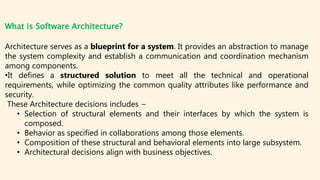

What is Software Architecture?
Architecture serves as a blueprint for a system. It provides an abstraction to manage
the system complexity and establish a communication and coordination mechanism
among components.
•It defines a structured solution to meet all the technical and operational
requirements, while optimizing the common quality attributes like performance and
security.
These Architecture decisions includes −
• Selection of structural elements and their interfaces by which the system is
composed.
• Behavior as specified in collaborations among those elements.
• Composition of these structural and behavioral elements into large subsystem.
• Architectural decisions align with business objectives.
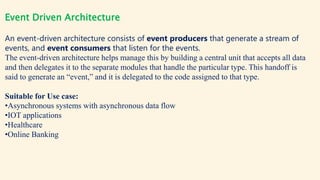
Event Driven Architecture
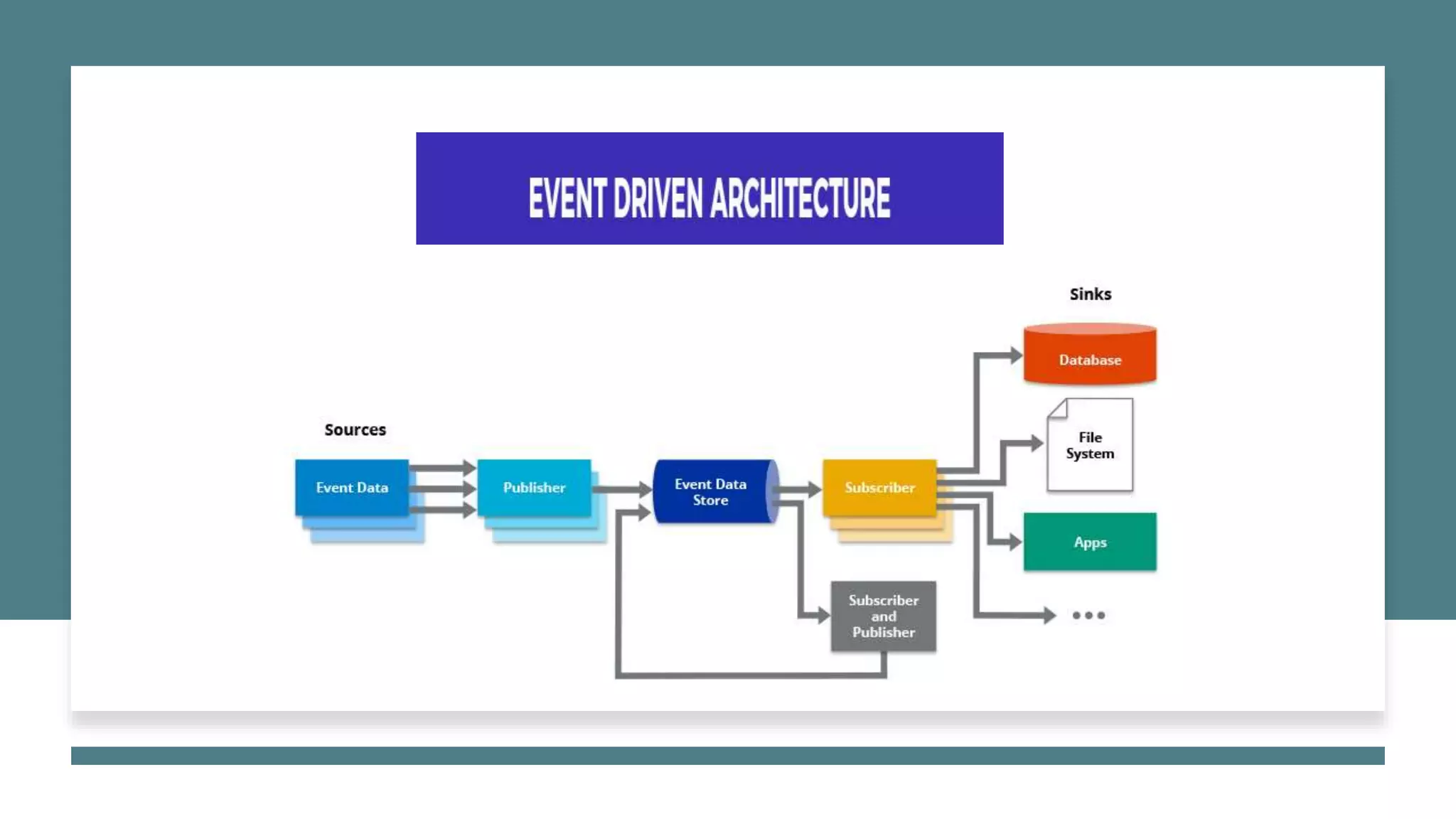
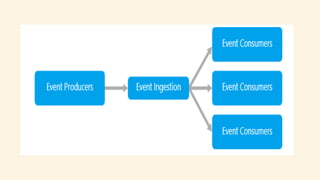
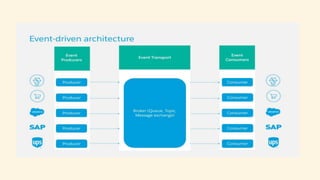
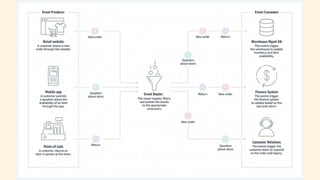
An event-driven architecture consists of event producers that generate a stream of
events, and event consumers that listen for the events.
The event-driven architecture helps manage this by building a central unit that accepts all data
and then delegates it to the separate modules that handle the particular type. This handoff is
said to generate an “event,” and it is delegated to the code assigned to that type.
Suitable for Use case:
•Asynchronous systems with asynchronous data flow
•IOT applications
•Healthcare
•Online Banking
Event Driven Architecture
Event-driven architecture is a design model that connects distributed
software systems and allows for efficient communication. EDA makes it
information in real time or near real time. It is common in designing apps
on microservices (when every service runs its own process.).
Publish/subscribe is a flexible messaging pattern that allows disparate
system components to interact with one another asynchronously.
An event driven architecture can use -
•Pub/Sub Model: The messaging infrastructure keeps track of
subscriptions. When an event is published, it sends the event to each
subscriber. After an event is received, it cannot be replayed, and new
subscribers do not see the event.
•Event streaming Model: Events are written to a log. Events are
strictly ordered (within a partition) and durable. Clients don't
subscribe to the stream, instead a client can read from any part of the
stream. The client is responsible for advancing its position in the
stream. That means a client can join at any time, and can replay
events.
Event Driven Architecture
An event is a state change or an update within the system that triggers the
can be anything from a transaction and sensor input to a mouse click and a
may vary in complexity and size and originate from both internal and
When to use this architecture
•Multiple subsystems must process the same events.
•Real-time processing with minimum time lag.
•Complex event processing, such as pattern matching or aggregation
over time windows.
•High volume and high velocity of data, such as IoT.
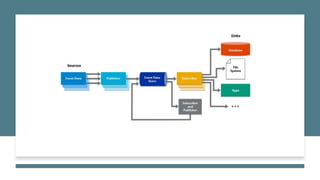
Event Based Architecture
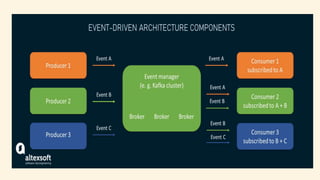
Event-based architectures usually comprise three core components:
•event producers that generate or detect events and transmit them to event
them to event managers;
•event managers that act as middleware and are responsible for asynchronous
asynchronous filtering, processing, and routing of received events; and
•event consumers that receive events and act on them.
Principles of Event Driven Architecture
Scalability. EDAs allow for great horizontal scalability as one
event may trigger responses from multiple systems with
different results.
Loose coupling. Producers and consumers are unaware of each
other. There is an intermediary that receives events, processes
them to the systems interested in specific events. This allows
services and facilitates their modifying, testing, and
point system integrations, components can be easily added to
system.
Principles of Event Driven Architecture
Asynchronous eventing. Event notifications are broadcast
asynchronously, meaning events are published as they happen.
consume or process a published event later if it’s unavailable.
block a producing service.
Fault tolerance. Owing to systems being loosely coupled, the
failure of one won’t make any difference to the working of
Benefits of this Architecture
•Producers and consumers are decoupled.
•No point-to-point integrations. It's easy to add new consumers to the
system.
•Consumers can respond to events immediately as they arrive.
•Highly scalable and distributed.
•Subsystems have independent views of the event stream.
Challenges of EDA
•Guaranteed delivery. In some systems, especially in IoT scenarios, it's
crucial to guarantee that events are delivered.
•Processing events in order or exactly once. Each consumer type
typically runs in multiple instances, for resiliency and scalability. This
can create a challenge if the events must be processed in order (within
a consumer type), or if the processing logic is not idempotent.
Tools used for EDA
ActiveMQ is a flexible, open-source message broker presented
by Apache Software Foundation. It provides the functionality of
messaging through topics between multiple producers and
relatively easy to deploy in complex structures; the system
and great reliability.
Redis is an open-source, in-memory data structure store used
as a message broker and a database. Redis is also a popular
applications, enabling processing millions of requests.
Tools used for EDA
Apache Kafka is the heavyweight in the world of distributed data
streaming. The open-source platform allows for publishing, storing,
subscribed to the streams of events in real time. Kafka provides its
scalable, fault-tolerant, and secure fashion, allowing for handling trillions
it can be deployed on-premises and in the cloud.
Pulsar is another Apache family system for distributed publish/subscribe
messaging. Initially designed as a message queuing system, Pulsar has
functionality in recent releases. Highly scalable, the system isolates
operations and allows for flexible messaging models.
THANK YOU
Like the Video and Subscribe the Channel

Event Driven Software Architecture Pattern

  • 2.
    What is SoftwareArchitecture? Architecture serves as a blueprint for a system. It provides an abstraction to manage the system complexity and establish a communication and coordination mechanism among components. •It defines a structured solution to meet all the technical and operational requirements, while optimizing the common quality attributes like performance and security. These Architecture decisions includes − • Selection of structural elements and their interfaces by which the system is composed. • Behavior as specified in collaborations among those elements. • Composition of these structural and behavioral elements into large subsystem. • Architectural decisions align with business objectives.
  • 3.
    Event Driven Architecture Anevent-driven architecture consists of event producers that generate a stream of events, and event consumers that listen for the events. The event-driven architecture helps manage this by building a central unit that accepts all data and then delegates it to the separate modules that handle the particular type. This handoff is said to generate an “event,” and it is delegated to the code assigned to that type. Suitable for Use case: •Asynchronous systems with asynchronous data flow •IOT applications •Healthcare •Online Banking
  • 5.
    Event Driven Architecture Event-drivenarchitecture is a design model that connects distributed software systems and allows for efficient communication. EDA makes it information in real time or near real time. It is common in designing apps on microservices (when every service runs its own process.). Publish/subscribe is a flexible messaging pattern that allows disparate system components to interact with one another asynchronously.
  • 7.
    An event drivenarchitecture can use - •Pub/Sub Model: The messaging infrastructure keeps track of subscriptions. When an event is published, it sends the event to each subscriber. After an event is received, it cannot be replayed, and new subscribers do not see the event. •Event streaming Model: Events are written to a log. Events are strictly ordered (within a partition) and durable. Clients don't subscribe to the stream, instead a client can read from any part of the stream. The client is responsible for advancing its position in the stream. That means a client can join at any time, and can replay events.
  • 9.
    Event Driven Architecture Anevent is a state change or an update within the system that triggers the can be anything from a transaction and sensor input to a mouse click and a may vary in complexity and size and originate from both internal and
  • 11.
    When to usethis architecture •Multiple subsystems must process the same events. •Real-time processing with minimum time lag. •Complex event processing, such as pattern matching or aggregation over time windows. •High volume and high velocity of data, such as IoT.
  • 12.
    Event Based Architecture Event-basedarchitectures usually comprise three core components: •event producers that generate or detect events and transmit them to event them to event managers; •event managers that act as middleware and are responsible for asynchronous asynchronous filtering, processing, and routing of received events; and •event consumers that receive events and act on them.
  • 14.
    Principles of EventDriven Architecture Scalability. EDAs allow for great horizontal scalability as one event may trigger responses from multiple systems with different results. Loose coupling. Producers and consumers are unaware of each other. There is an intermediary that receives events, processes them to the systems interested in specific events. This allows services and facilitates their modifying, testing, and point system integrations, components can be easily added to system.
  • 15.
    Principles of EventDriven Architecture Asynchronous eventing. Event notifications are broadcast asynchronously, meaning events are published as they happen. consume or process a published event later if it’s unavailable. block a producing service. Fault tolerance. Owing to systems being loosely coupled, the failure of one won’t make any difference to the working of
  • 16.
    Benefits of thisArchitecture •Producers and consumers are decoupled. •No point-to-point integrations. It's easy to add new consumers to the system. •Consumers can respond to events immediately as they arrive. •Highly scalable and distributed. •Subsystems have independent views of the event stream.
  • 17.
    Challenges of EDA •Guaranteeddelivery. In some systems, especially in IoT scenarios, it's crucial to guarantee that events are delivered. •Processing events in order or exactly once. Each consumer type typically runs in multiple instances, for resiliency and scalability. This can create a challenge if the events must be processed in order (within a consumer type), or if the processing logic is not idempotent.
  • 18.
    Tools used forEDA ActiveMQ is a flexible, open-source message broker presented by Apache Software Foundation. It provides the functionality of messaging through topics between multiple producers and relatively easy to deploy in complex structures; the system and great reliability. Redis is an open-source, in-memory data structure store used as a message broker and a database. Redis is also a popular applications, enabling processing millions of requests.
  • 19.
    Tools used forEDA Apache Kafka is the heavyweight in the world of distributed data streaming. The open-source platform allows for publishing, storing, subscribed to the streams of events in real time. Kafka provides its scalable, fault-tolerant, and secure fashion, allowing for handling trillions it can be deployed on-premises and in the cloud. Pulsar is another Apache family system for distributed publish/subscribe messaging. Initially designed as a message queuing system, Pulsar has functionality in recent releases. Highly scalable, the system isolates operations and allows for flexible messaging models.
  • 20.
    THANK YOU Like theVideo and Subscribe the Channel