How eFPGA Future-Proofs
Data Centers
Source : Semiconductor Review
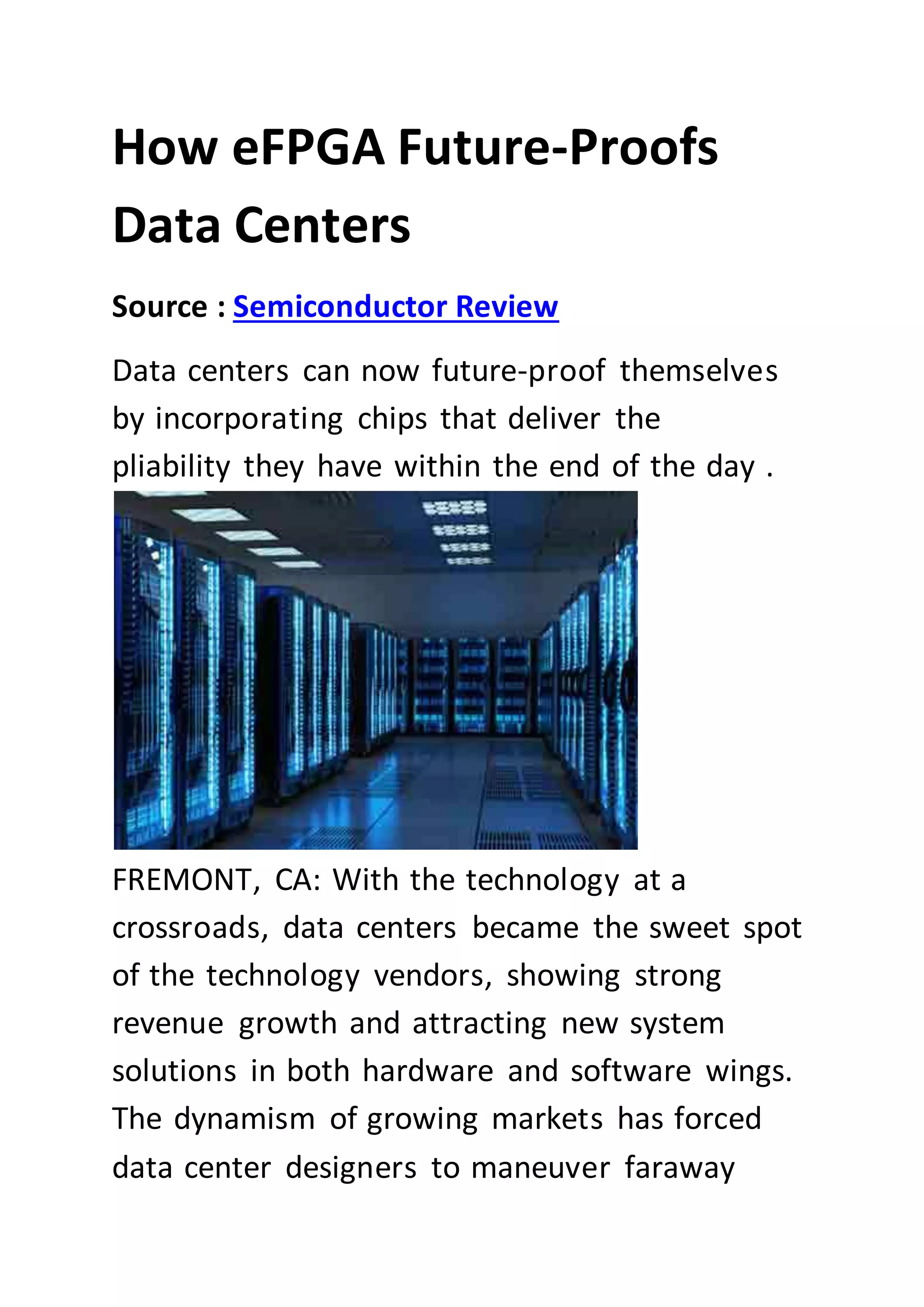
Data centers can now future-proof themselves
by incorporating chips that deliver the
pliability they have within the end of the day .
FREMONT, CA: With the technology at a
crossroads, data centers became the sweet spot
of the technology vendors, showing strong
revenue growth and attracting new system
solutions in both hardware and software wings.
The dynamism of growing markets has forced
data center designers to maneuver faraway
from customized hardware architectures
towards commoditized hardware with high port
counts, high performance, and low power
consumption. This approach supports scalability
and redundancy while minimizing cost and
therefore the got to expand or renovate the
installed plant and its associated infrastructure.
As a result, data centers are watching ways to
future proof their infrastructure, and there
enters FPGA.
Data centers use thousands of chips, including
arm processors, networking processors, and
network interface chips (NICs). These chips are
expensive to form , and these costs are shared
with the info centers over time. What’s been
needed here is FPGA that's flexible, scalable,
low cost, and high-performing. Here comes
embedded FPGA (eFPGA), which is entrenched
directly onto chips and is reconfigurable. this
enables eFPGA to supply higher performance at
lower power.
eFPGA also delivers noteworthy performance
benefits, especially with regards to the
bandwidth the FPGAs can have with the
remainder of the chips. Even alittle eFPGA can
have 1,000 inputs and 1,000 outputs with data
rates greater than 500MHz in 28nm or more in
16/14nm. eFPGA can
provide multiprocessing that significantly
improves performance over the data
processing of MPUs. Its reconfigurability allows
eFPGA to accelerate quite one task as workloads
require. This added performance is critical in
data centers. the power to accelerate critical
code are some things that chip designers should
be evaluating today, and this is often what data
center operators should be posing for in their
chips.
Being more programmable and reconfigurable
helps data centers to stay up with the
constantly changing standards and protocols.
Previously, data centers had to attend for brand
spanking new hardware and chips to
satisfy these new requirements. this is often all
changing with eFPGA, and data centers will soon
be ready to quickly and seamlessly stay meet
the rising bandwidth demands.

How e fpga future proofs data centers

  • 1.
    How eFPGA Future-Proofs DataCenters Source : Semiconductor Review Data centers can now future-proof themselves by incorporating chips that deliver the pliability they have within the end of the day . FREMONT, CA: With the technology at a crossroads, data centers became the sweet spot of the technology vendors, showing strong revenue growth and attracting new system solutions in both hardware and software wings. The dynamism of growing markets has forced data center designers to maneuver faraway
  • 2.
    from customized hardwarearchitectures towards commoditized hardware with high port counts, high performance, and low power consumption. This approach supports scalability and redundancy while minimizing cost and therefore the got to expand or renovate the installed plant and its associated infrastructure. As a result, data centers are watching ways to future proof their infrastructure, and there enters FPGA. Data centers use thousands of chips, including arm processors, networking processors, and network interface chips (NICs). These chips are expensive to form , and these costs are shared with the info centers over time. What’s been needed here is FPGA that's flexible, scalable, low cost, and high-performing. Here comes embedded FPGA (eFPGA), which is entrenched directly onto chips and is reconfigurable. this enables eFPGA to supply higher performance at lower power.
  • 3.
    eFPGA also deliversnoteworthy performance benefits, especially with regards to the bandwidth the FPGAs can have with the remainder of the chips. Even alittle eFPGA can have 1,000 inputs and 1,000 outputs with data rates greater than 500MHz in 28nm or more in 16/14nm. eFPGA can provide multiprocessing that significantly improves performance over the data processing of MPUs. Its reconfigurability allows eFPGA to accelerate quite one task as workloads require. This added performance is critical in data centers. the power to accelerate critical code are some things that chip designers should be evaluating today, and this is often what data center operators should be posing for in their chips. Being more programmable and reconfigurable helps data centers to stay up with the constantly changing standards and protocols.
  • 4.
    Previously, data centershad to attend for brand spanking new hardware and chips to satisfy these new requirements. this is often all changing with eFPGA, and data centers will soon be ready to quickly and seamlessly stay meet the rising bandwidth demands.