How does IT provide a consistently effective service? managinginformationtechnology.blogspot.com
Agenda Client-focussed services Standardization Defining standards Project management Software development Maintenance Provisioning What to consider in standards
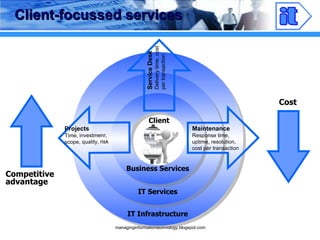
Client-focussed services Client Business Services Cost Competitive advantage IT Services IT Infrastructure Maintenance Response time, uptime, resolution, cost per transaction Projects Time, investmenr, scope, quality, risk Service Desk Delivery time, cost per transaction
Standardization Standardization helps businesses define and deliver consistent: Levels of service (uptime and times for response, escalation and resolution). Delivery within planned parameters (scope, investment, time to market and quality). Compatibility and interoperability. Risk response. Cost advantage.
Defining standards When defining procedures or methodologies: Consider the objectives and metrics required. Take into account the type of service offered. Revise standards, models, frameworks and methodologies that could be applied within the the IT organization. Identify inputs, outputs, processes, roles and responsibilities required.
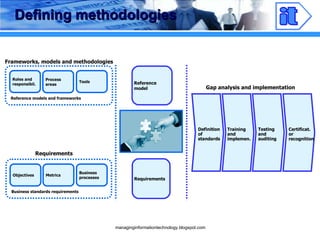
Defining methodologies Definition of standards Training and implemen.  Reference model Testing and auditing Roles and responsibil. Reference models and frameworks Tools Process areas Frameworks, models and methodologies Business processes Business standards requirements Metrics Objectives Requirements Requirements Gap analysis and implementation Certificat. or recognition
Project management Objetive: Delivery of projects within planned parameters. Reference model: PMBOK ® Knowledge areas: Scope, time, cost, quality, risk, human resources, procurement and integrated project management.
Software development Objective: Development and testing of software-based solutions that comply with requirements and defined quality standards. Reference model: CMMI ® Process areas: Requirements management, requirements development, verification, validation, configuration management, process and product quality assurance, measurement and analysis, decision analysis and resolution, causal analysis and resolution, project planning, project monitoring and control, supplier agreement management, risk management.
Maintenance and infrastructure management Objective: Maintenance and continuous improvement of IT infrastructure that comply with service levels and requirements. Reference model: ITIL ® IT service management sets and operational guidance: Service request management, incident management, problem management, change management, release management, configuration management, service-level management, capacity management, IT service continuity management, availability management, financial management for IT services, planning to implement service management, security management, ICT infrastructure management, business perspective, application management, software asset management.
What to consider in standards Enough flexibility to take into account most business scenarios. Cost advantage through re-use and an increase in quality. Maximize control and reduce indefinition. Client focus (service, quality and no red tape). Ease of use.

How Does IT Provide A Consistently Effective Service

  • 1.
    How does ITprovide a consistently effective service? managinginformationtechnology.blogspot.com
  • 2.
    Agenda Client-focussed servicesStandardization Defining standards Project management Software development Maintenance Provisioning What to consider in standards
  • 3.
    Client-focussed services ClientBusiness Services Cost Competitive advantage IT Services IT Infrastructure Maintenance Response time, uptime, resolution, cost per transaction Projects Time, investmenr, scope, quality, risk Service Desk Delivery time, cost per transaction
  • 4.
    Standardization Standardization helpsbusinesses define and deliver consistent: Levels of service (uptime and times for response, escalation and resolution). Delivery within planned parameters (scope, investment, time to market and quality). Compatibility and interoperability. Risk response. Cost advantage.
  • 5.
    Defining standards Whendefining procedures or methodologies: Consider the objectives and metrics required. Take into account the type of service offered. Revise standards, models, frameworks and methodologies that could be applied within the the IT organization. Identify inputs, outputs, processes, roles and responsibilities required.
  • 6.
    Defining methodologies Definitionof standards Training and implemen. Reference model Testing and auditing Roles and responsibil. Reference models and frameworks Tools Process areas Frameworks, models and methodologies Business processes Business standards requirements Metrics Objectives Requirements Requirements Gap analysis and implementation Certificat. or recognition
  • 7.
    Project management Objetive:Delivery of projects within planned parameters. Reference model: PMBOK ® Knowledge areas: Scope, time, cost, quality, risk, human resources, procurement and integrated project management.
  • 8.
    Software development Objective:Development and testing of software-based solutions that comply with requirements and defined quality standards. Reference model: CMMI ® Process areas: Requirements management, requirements development, verification, validation, configuration management, process and product quality assurance, measurement and analysis, decision analysis and resolution, causal analysis and resolution, project planning, project monitoring and control, supplier agreement management, risk management.
  • 9.
    Maintenance and infrastructuremanagement Objective: Maintenance and continuous improvement of IT infrastructure that comply with service levels and requirements. Reference model: ITIL ® IT service management sets and operational guidance: Service request management, incident management, problem management, change management, release management, configuration management, service-level management, capacity management, IT service continuity management, availability management, financial management for IT services, planning to implement service management, security management, ICT infrastructure management, business perspective, application management, software asset management.
  • 10.
    What to considerin standards Enough flexibility to take into account most business scenarios. Cost advantage through re-use and an increase in quality. Maximize control and reduce indefinition. Client focus (service, quality and no red tape). Ease of use.