ACKNOWLEDEMENT
PROJECTOR
P.g No
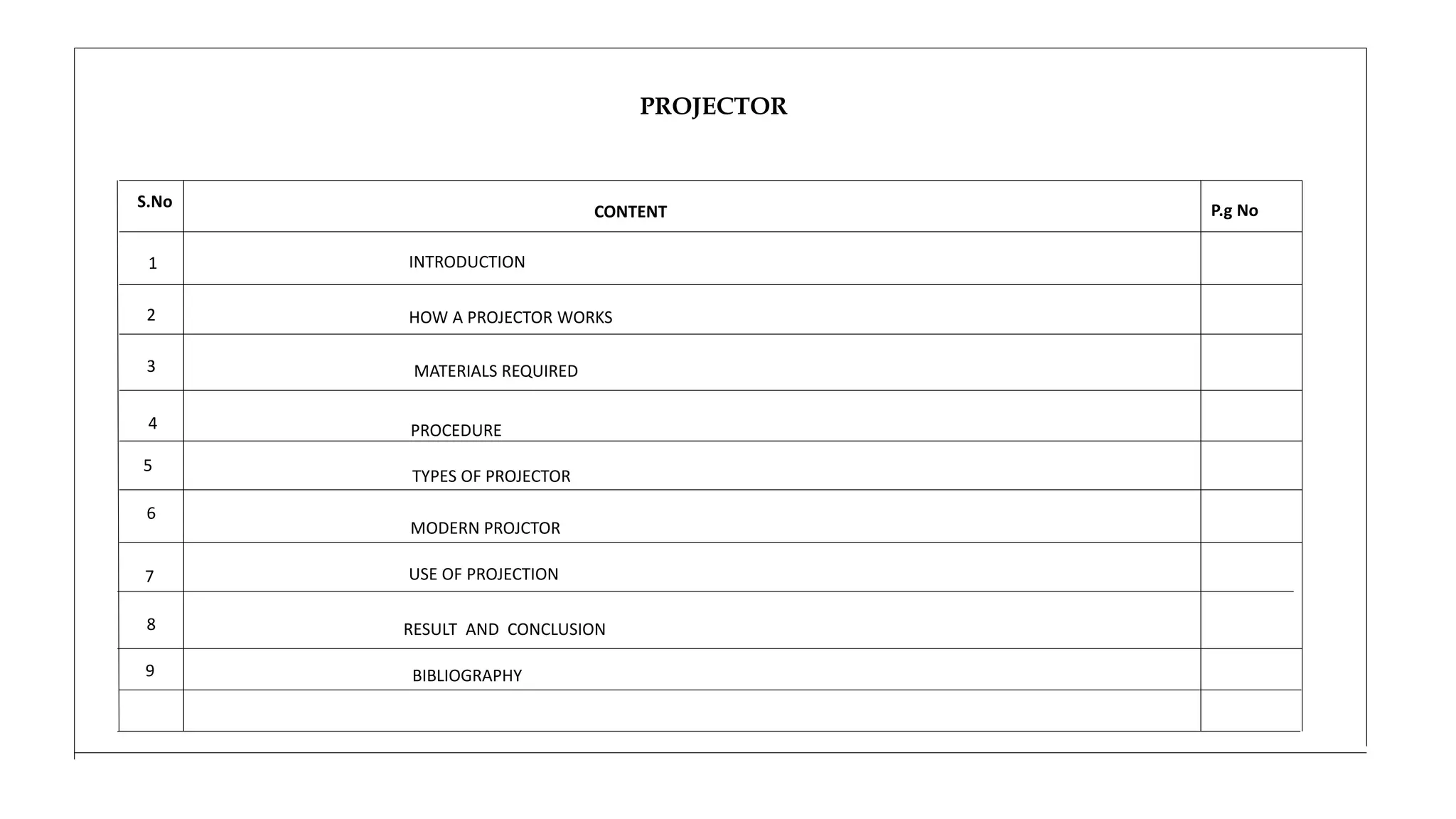
1
2
3
4
5
6
CONTENT
S.No
INTRODUCTION
MATERIALS REQUIRED
MODERN PROJCTOR
TYPES OF PROJECTOR
PROCEDURE
RESULT AND CONCLUSION
USE OF PROJECTION
7
8
HOW A PROJECTOR WORKS
BIBLIOGRAPHY
9
PROJECTOR
INTRODUCTION
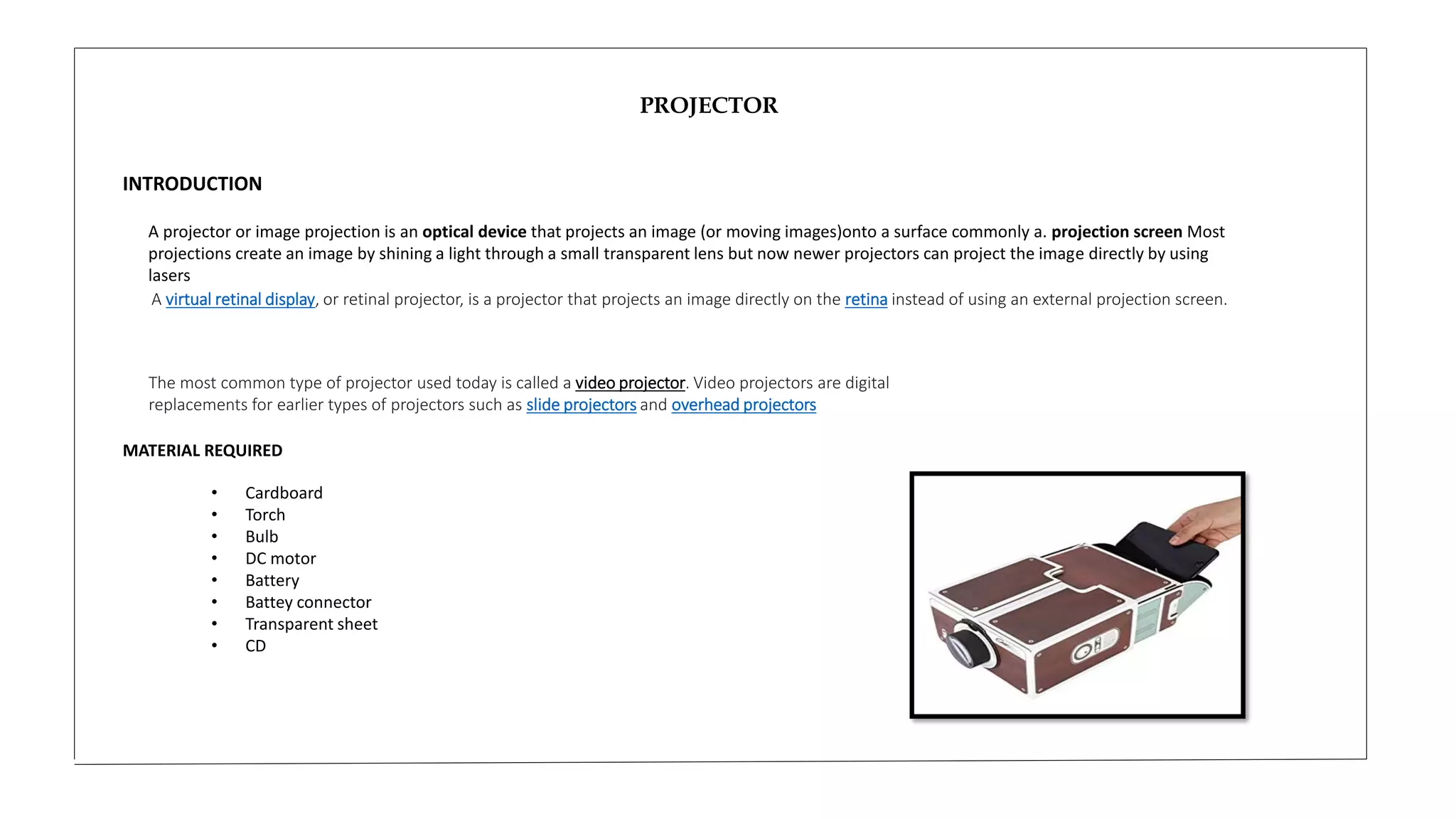
A projector or image projection is an optical device that projects an image (or moving images)onto a surface commonly a. projection screen Most
projections create an image by shining a light through a small transparent lens but now newer projectors can project the image directly by using
lasers
The most common type of projector used today is called a video projector. Video projectors are digital
replacements for earlier types of projectors such as slide projectors and overhead projectors
• Cardboard
• Torch
• Bulb
• DC motor
• Battery
• Battey connector
• Transparent sheet
• CD
A virtual retinal display, or retinal projector, is a projector that projects an image directly on the retina instead of using an external projection screen.
MATERIAL REQUIRED
PROJECTOR
PROCEEDURE
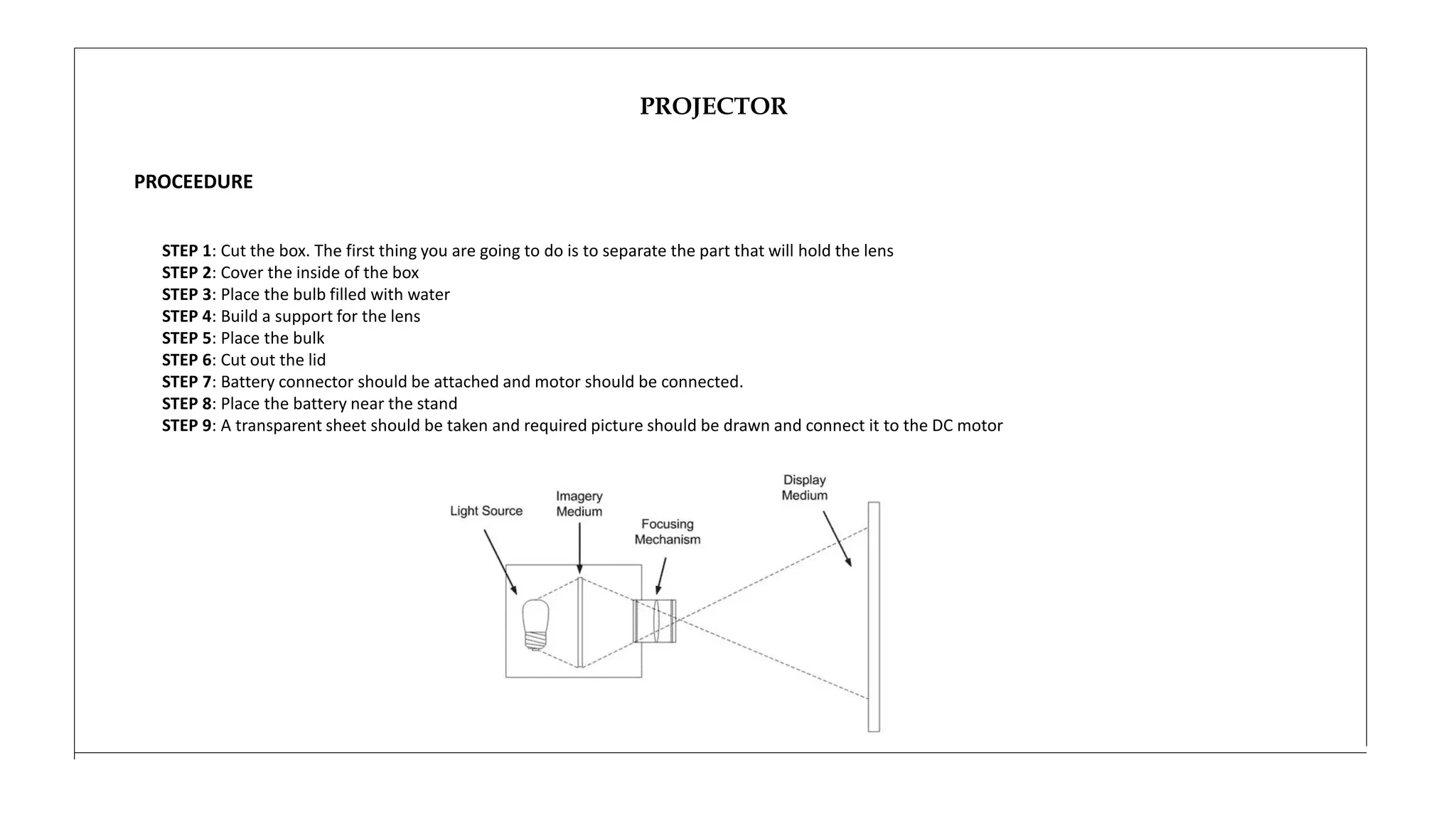
STEP 1: Cut the box. The first thing you are going to do is to separate the part that will hold the lens
STEP 2: Cover the inside of the box
STEP 3: Place the bulb filled with water
STEP 4: Build a support for the lens
STEP 5: Place the bulk
STEP 6: Cut out the lid
STEP 7: Battery connector should be attached and motor should be connected.
STEP 8: Place the battery near the stand
STEP 9: A transparent sheet should be taken and required picture should be drawn and connect it to the DC motor
HOW A PROJECTOR WORKS
A projector is an optical gadget that projects a picture (or moving images) onto a surface, usually a projection screen. Most projectors create a photo
through projecting a bright light via a small lens. However, some newer types of projectors can project the image directly, by using the usage of lasers.
PROJECTOR
A digital retinal display, or retinal projector, is a projector that projects a photograph at once on the retina as a
substitute of using an external projection screen.
APPLICATION OF PROJECTORS
COMPANIES-Projectors are used in big MNC’s
HOME- Home theatre
SCHOOLS- Schooling area for describing a topic.
PROJECTOR
TYPES OF PROJECTOR
▪ Cathode Ray Tube (CRT)- Uses lens to project the images
▪ Liquid Crystal Display (LCD)- Uses light Crystal to project an image
▪ Digital Light Processing (DLP)-Micro mirrors to protect an image
CATHODE RAY TUBE
A CRT projector focuses on the image or video by its lenses to project it on screen. These images are processed with help of three separate colored (red,
green and blue) CRT tubes.
CRT projectors are not portable as they are huge in size and heavy in weight. Their electricity
consumption is also high but they have a brilliant high picture quality
LIQUID CRYSTAL DISPLAY
The meaning of Liquid Crystal Display is approximately clear from its name. The word LCD resembles two states of matter, the liquid and the solid. A Liquid
Crystal Display uses liquid crystal to project an image or object.
These types of display panel is generally used in computer, Laptops, TVs, portable video games and cell phones. Displays in LCD technology are much
thinner as compared to CRT technology.
Digital Light Processing (DLP) is a video innovation made by Texas Instruments that is utilized for front and back projection units. DLP is used in both back and
front projections. It is regular for back projection in TVs and also utilized in front projectors for units intended for organizations and classrooms.
DIGITAL LIGHT PROCESSING
PROJECTOR
USE OF PROJECTOR
• Customisable screen size
• Eye comfort
• Portable
• Data can be viewed by more people on a large screen
• Low cost
MODERN IMAGE
FACTS-Francis Jenkins and Thomas Armat developed a motion picture projection device which they called the Phantoscope.
PROJECTORS
DISADVANTAGES
The disadvantages of Projectors include:
•A dark room is very often required to use a projector.
•It requires maintenance on regular intervals.
•Installation Cost can be more in some cases as it depends upon how you get it installed.
•Most of the projectors need a separate audio system.
RESULT
If we on the torch the light will be passed though the frame and picture which was drawn on the transparent sheet will be projected in the wall through the
Bulb
PROJECTOR
CONCLUSION
A projector is an output device that can be connected to a computer . It projects images
from a blu-ray player or computer and presents ideas on the projector screen .Now
projectors are available in different sizes and are used in movie theatres and
auditoriums. They weigh between 2 and 20lbs thus it is easily projectable

PROJECTOR.pdf

  • 1.
  • 2.
    PROJECTOR P.g No 1 2 3 4 5 6 CONTENT S.No INTRODUCTION MATERIALS REQUIRED MODERNPROJCTOR TYPES OF PROJECTOR PROCEDURE RESULT AND CONCLUSION USE OF PROJECTION 7 8 HOW A PROJECTOR WORKS BIBLIOGRAPHY 9
  • 3.
    PROJECTOR INTRODUCTION A projector orimage projection is an optical device that projects an image (or moving images)onto a surface commonly a. projection screen Most projections create an image by shining a light through a small transparent lens but now newer projectors can project the image directly by using lasers The most common type of projector used today is called a video projector. Video projectors are digital replacements for earlier types of projectors such as slide projectors and overhead projectors • Cardboard • Torch • Bulb • DC motor • Battery • Battey connector • Transparent sheet • CD A virtual retinal display, or retinal projector, is a projector that projects an image directly on the retina instead of using an external projection screen. MATERIAL REQUIRED
  • 4.
    PROJECTOR PROCEEDURE STEP 1: Cutthe box. The first thing you are going to do is to separate the part that will hold the lens STEP 2: Cover the inside of the box STEP 3: Place the bulb filled with water STEP 4: Build a support for the lens STEP 5: Place the bulk STEP 6: Cut out the lid STEP 7: Battery connector should be attached and motor should be connected. STEP 8: Place the battery near the stand STEP 9: A transparent sheet should be taken and required picture should be drawn and connect it to the DC motor
  • 5.
    HOW A PROJECTORWORKS A projector is an optical gadget that projects a picture (or moving images) onto a surface, usually a projection screen. Most projectors create a photo through projecting a bright light via a small lens. However, some newer types of projectors can project the image directly, by using the usage of lasers. PROJECTOR A digital retinal display, or retinal projector, is a projector that projects a photograph at once on the retina as a substitute of using an external projection screen. APPLICATION OF PROJECTORS COMPANIES-Projectors are used in big MNC’s HOME- Home theatre SCHOOLS- Schooling area for describing a topic.
  • 6.
    PROJECTOR TYPES OF PROJECTOR ▪Cathode Ray Tube (CRT)- Uses lens to project the images ▪ Liquid Crystal Display (LCD)- Uses light Crystal to project an image ▪ Digital Light Processing (DLP)-Micro mirrors to protect an image CATHODE RAY TUBE A CRT projector focuses on the image or video by its lenses to project it on screen. These images are processed with help of three separate colored (red, green and blue) CRT tubes. CRT projectors are not portable as they are huge in size and heavy in weight. Their electricity consumption is also high but they have a brilliant high picture quality
  • 7.
    LIQUID CRYSTAL DISPLAY Themeaning of Liquid Crystal Display is approximately clear from its name. The word LCD resembles two states of matter, the liquid and the solid. A Liquid Crystal Display uses liquid crystal to project an image or object. These types of display panel is generally used in computer, Laptops, TVs, portable video games and cell phones. Displays in LCD technology are much thinner as compared to CRT technology. Digital Light Processing (DLP) is a video innovation made by Texas Instruments that is utilized for front and back projection units. DLP is used in both back and front projections. It is regular for back projection in TVs and also utilized in front projectors for units intended for organizations and classrooms. DIGITAL LIGHT PROCESSING
  • 8.
    PROJECTOR USE OF PROJECTOR •Customisable screen size • Eye comfort • Portable • Data can be viewed by more people on a large screen • Low cost MODERN IMAGE FACTS-Francis Jenkins and Thomas Armat developed a motion picture projection device which they called the Phantoscope.
  • 9.
    PROJECTORS DISADVANTAGES The disadvantages ofProjectors include: •A dark room is very often required to use a projector. •It requires maintenance on regular intervals. •Installation Cost can be more in some cases as it depends upon how you get it installed. •Most of the projectors need a separate audio system. RESULT If we on the torch the light will be passed though the frame and picture which was drawn on the transparent sheet will be projected in the wall through the Bulb
  • 10.
    PROJECTOR CONCLUSION A projector isan output device that can be connected to a computer . It projects images from a blu-ray player or computer and presents ideas on the projector screen .Now projectors are available in different sizes and are used in movie theatres and auditoriums. They weigh between 2 and 20lbs thus it is easily projectable