How Digital Changes Things An exploration of Web tools for marketers  2008
First of all Before we talk about digital, lets take a minute to explain why it used to be easier The physics of geography We knew where our target market was going to be
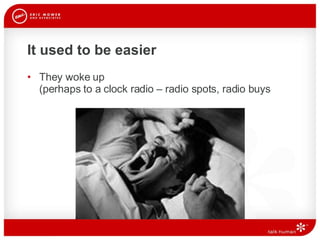
It used to be easier They woke up  (perhaps to a clock radio – radio spots, radio buys
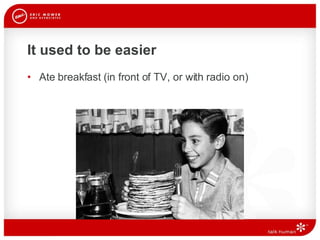
It used to be easier Ate breakfast (in front of TV, or with radio on)
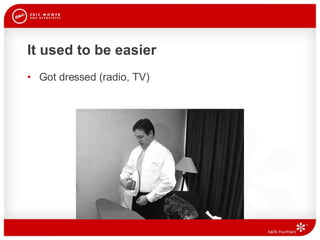
It used to be easier Got dressed (radio, TV)
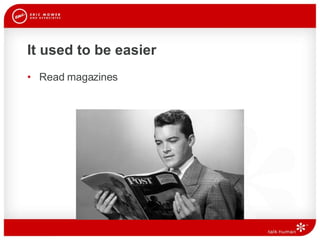
It used to be easier Read magazines
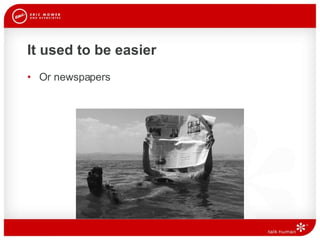
It used to be easier Or newspapers
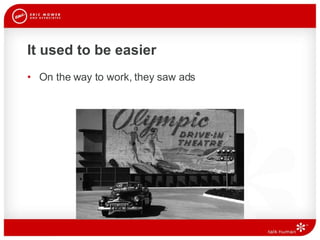
It used to be easier On the way to work, they saw ads
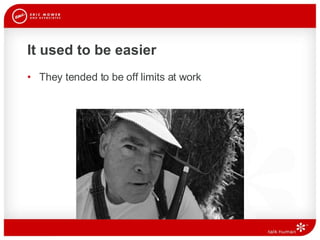
It used to be easier They tended to be off limits at work
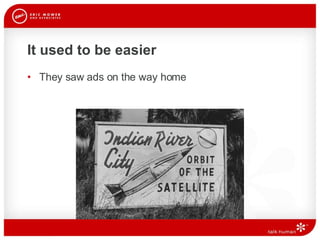
It used to be easier They saw ads on the way home
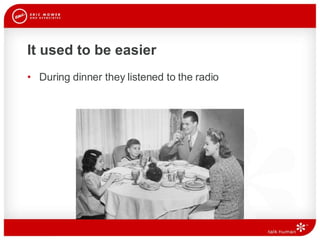
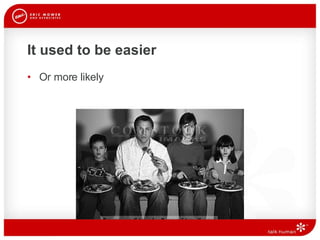
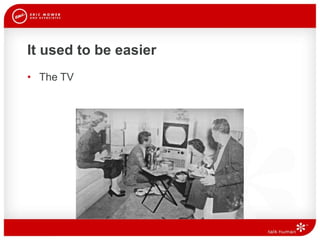
It used to be easier During dinner they listened to the radio
It used to be easier Or more likely
It used to be easier The TV
It used to be easier Because we knew (or could predict) where they were, marketers could get our message in front of people Geography played a huge role in marketing
It used to be easier When a job started in an agency, it was usually a job that already had the media selected. It was radio, TV, print or collateral.  Some agencies did ‘general’ advertising  (the billboards, the broadcast and the print,  while others did direct marketing).
The internet changed everything This presentation is an attempt to show you how And perhaps where some things are going
The Internet  Websites -- the first marketing tool that wasn’t interruptive.  People chose to engage.  So clients asked us to do websites.
Web 1.0 The web started off like all marketing did. It talked to the target market. much like all the other things in the marketing toolbox did.  Websites were bastions of information (about us, company history, team, timelines, advisory board, kid’s names, birthdays).  It was on there because the space is infinite. Give marketers space, they we’ll fill it. With one way information.
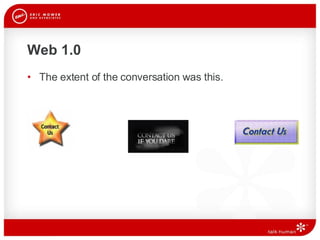
Web 1.0 The extent of the conversation was this.
Web 1.5 Note: I hate the term Web 2.0. The New York Times said Web 3.0 already. Still, it’s used to show the evolution of the web.  It occurred to brands that if they enabled a community, people would come back.
Web 1.5 When people bought a book at Amazon, the site would display the books bought by people who bought the same book you had in your cart.  Oh, they liked that book too? Maybe it should be added to the cart.  Purely up-sell, but it brought the actions of the community into the experience.
Web 1.5 E-Bay began experimenting with community. It offered assurances and ratings of sellers. The community voted on people, and the site related the information of the community to users. The point is, the site let the community have a say. People liked that and came back.
Web 2.0 Which brings us to Web 2.0. so far we know this: A community encourages people to return.  Then Google made it profitable to get eyeballs though it’s adwords network.
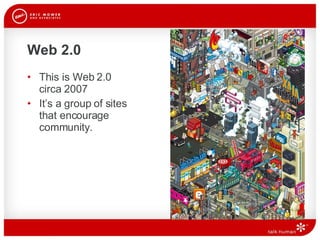
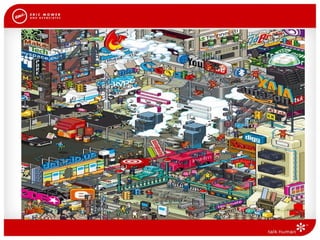
Web 2.0 It’s a group of sites that encourage  community.  This is Web 2.0  circa 2007
 
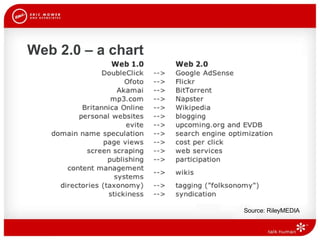
Web 2.0 – a chart Source: RileyMEDIA
Web 2.0 Think of  Web 2.0 as a community. It isn’t a message to a consumer, it’s a consumer interaction. YouTube is Web 2.0 because users vote on the uploaded content. A video with the most votes ends up on the front page. The community delivers content, and determines the importance of the content. YouTube has ALMOST no say.
Web 2.0 The most salient extension of the community-minded websites are the social networks.  They are actually tools to bring people together.
Social Networking “ A social network service focuses on the building and verifying of online social networks for communities of people who share interests and activities, or who are interested in exploring the interests and activities of others.” From EMA’s knowledge-based Mowiki, one of our social networks. People are social. We join groups, associations, clubs, teams. Joining a network isn’t new. What’s new is joining them online.
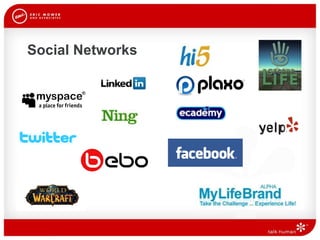
What is a social network? Social networks are excellent tools for connecting people. It’s those things that account for its success.  Let’s take a look at some of the social networks.
Social Networks
Facebook is a social network Facebook is based on the premise of connecting people to the people they already know.  If you know someone, you can find them online.  You have to be in their network, or know their primary e-mail address.  Brands can enter the world of Facebook through Pages, a function that is about 6 months old.
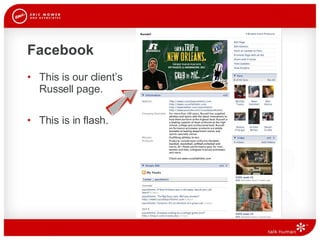
This is our client’s  Russell page.  Facebook This is in flash.
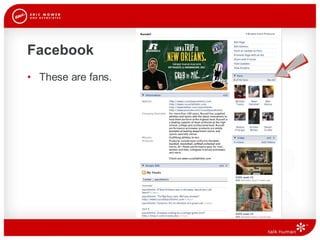
Facebook These are fans.
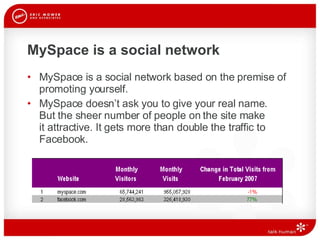
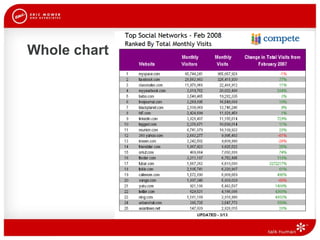
MySpace is a social network MySpace is a social network based on the premise of promoting yourself.  MySpace doesn’t ask you to give your real name.  But the sheer number of people on the site make  it attractive. It gets more than double the traffic to Facebook.
Whole chart
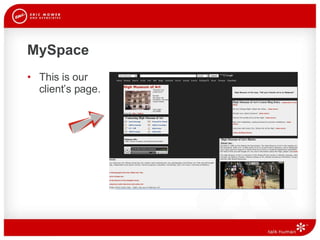
MySpace This is our  client’s page.
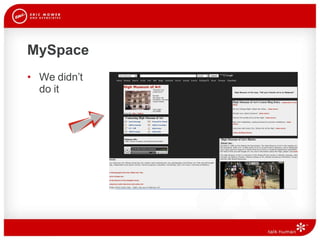
MySpace We didn’t  do it
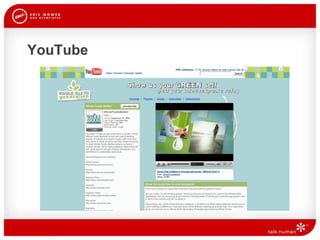
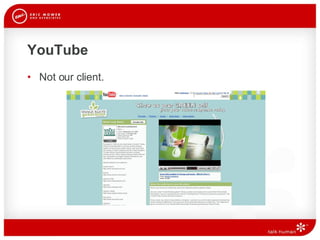
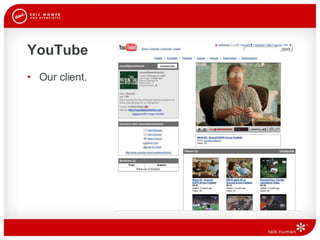
YouTube is a social network As are most video sharing sites like Veoh, Google Video, Yahoo Video, MetaCafe, etc. People upload their content. Other people vote on it. In fact, outside of a few marketing initiatives the things on the front page of YouTube are the things the crowd has deemed the best.  The comment section in YouTube is really social  and active.
YouTube
YouTube Not our client.
YouTube Our client.
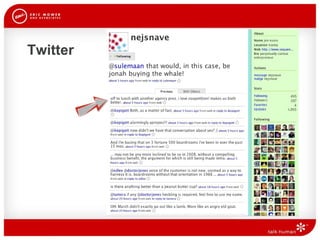
Twitter is a social network Twitter is a micro-blogging platform that lets people update their networks.  In 140 characters or less.
Twitter
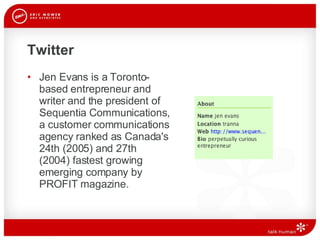
Twitter Jen Evans is a Toronto-based entrepreneur and writer and the president of Sequentia Communications, a customer communications agency ranked as Canada's 24th (2005) and 27th  (2004) fastest growing emerging company by PROFIT magazine.
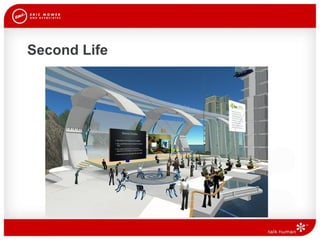
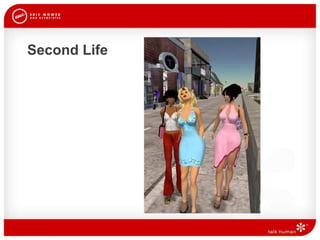
Second Life is a social network It’s a real online world with a currency, shops, homes, and marketers.  Even though it’s turned into something rather pornographic, it’s important. It’s teaching us how to interact virtually.
Second Life
Second Life
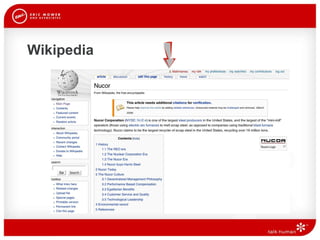
Wikipedia is a social network. People sign on. People interact. People police the place, checking updates, etc.  In other words people take pride in the place. That’s the essence of an online world. Or network.
Wikipedia
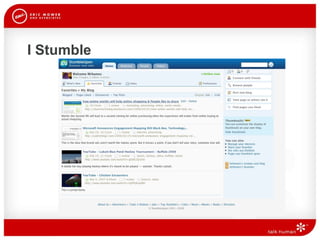
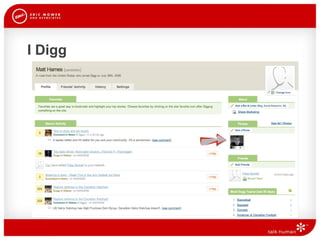
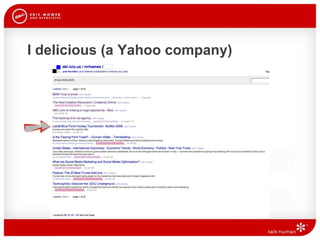
StumbleUpon is a social network. This is a ‘social bookmarking’ site, of which there  are many.  You may have heard of Digg. Delicious. Reddit.  If you haven’t, and you read articles online, then you will know the logos, even if you don’t know why.
I Stumble
I Digg
I delicious (a Yahoo company)
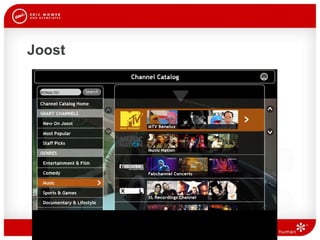
Joost is a social network. Joost is an online TV station with communities that are built around TV channels. It’s an emerging social network that shows off a lot of content that is professionally produced. You can watch every MacGyver episode there. And chat with other MacGyver fans.
Joost
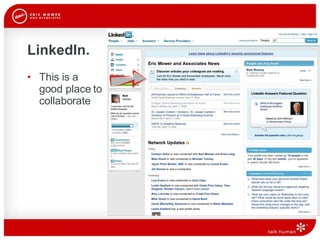
LinkedIn is a business social network. LinkedIn is the business social network. It’s honestly one of the best ways to get jobs.  We were pitching Syracuse Research Corporation  on winning their recruitment business. We showed them LinkedIn, talked about ways to use it, and won the business.
LinkedIn. This is a  good place to collaborate
Why are they popular?  Why are these popular, and how does one jump in? And what does this have to do with marketing? Social networks ask people to update their status and then sends that information to friends. Twitter, Facebook and MySpace are what one’s doing now. LinkedIn is ‘what are you working on now.  Why is status important?
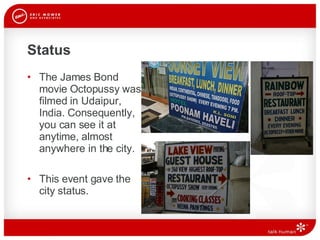
Status This event gave the  city status. The James Bond movie Octopussy was filmed in Udaipur, India. Consequently, you can see it at anytime, almost anywhere in the city.
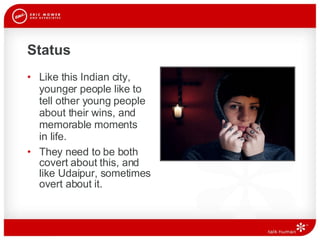
Status They need to be both covert about this, and like Udaipur, sometimes overt about it.  Like this Indian city, younger people like to tell other young people about their wins, and memorable moments  in life.
Passive social networks Young people are emerging brands. They need to get out the message of who they are, without coming on too strong.
Passive social networks Facebook, MySpace, bebo and Twitter status updates are passive updates that help young people get heard. They are passive updaters because they are not pushed to people. This lets the young person update status, stay relevant, but not seem pushy.
Passive social networks Consider a more active update: I could send out an e-mail or a text or even call everyone in my network telling them what I'm doing at this very moment (making a presentation to all of you). I could repeat that for everything I did.  But that level of activity would alienate my network.
Passive social networks As we marketers jump into this realm, understanding the reason young people use these tools will be important for understanding how best we should be using them.  Being passive isn't something that comes easy to marketers. We like to get the message out. We like GRPs. We want our message heard.
Passive social networks AT EMA, a client is letting us use a passive updater. But it’s a fight to remind them of the goal.  Early on, they asked whether the tool was  driving traffic.
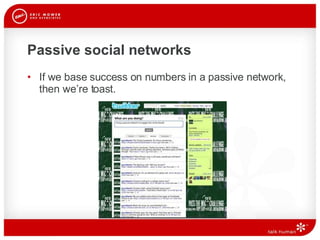
Passive social networks If we base success on numbers in a passive network, then we’re toast.
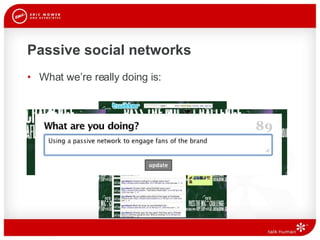
Passive social networks What we’re really doing is:
Passive social networks Passive networks can be excellent tools for creating community. And that’s the end goal.  Create a community that people can engage with the brand, each other, and spread the word.
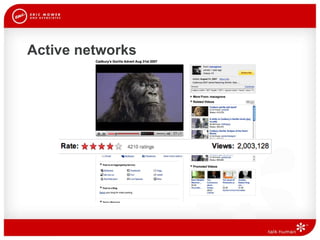
Active networks YouTube is an active network. And it can be great for a brand.
Active networks
Active networks The Social Bookmarking sites are active networks.  Marketers can push their content onto these networks and let the community decide if it’s going to be pushed farther.
Some cool new ideas Dr. Pepper. Started a promotion recently whereby they promised to give everyone person in America  a Dr. Pepper if Guns N’ Roses released their new  CD before the end of 2008.  But there are a few great things they did.
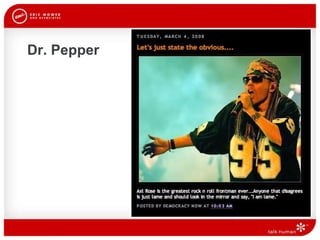
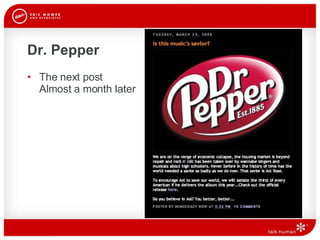
Dr. Pepper They started a blog called Chinese Democracy When? So named because the Guns N’ Roses CD is called Chinese Democracy. Here was the first post.
Dr. Pepper
Dr. Pepper The next post Almost a month later
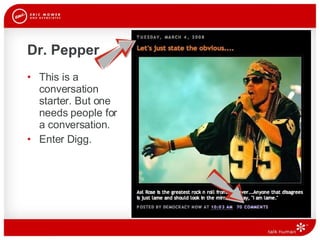
Dr. Pepper This is a  conversation  starter. But one  needs people for a conversation.  Enter Digg.
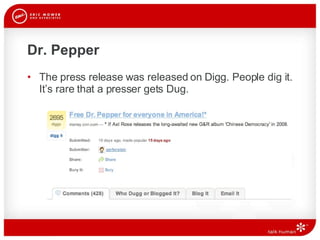
Dr. Pepper The press release was released on Digg. People dig it. It’s rare that a presser gets Dug.
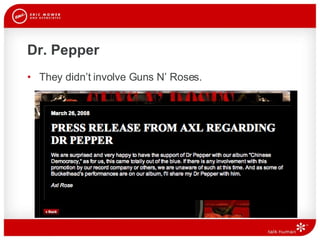
Dr. Pepper They didn’t involve Guns N’ Roses.
Dr. Pepper They had an idea. Started a blog, used Digg to drive traffic to the blog and then use the blog to generate real conversations about random things. They tied themselves to a celebrity without tying themselves  to a celebrity.  This is a year-long promotion that just started. Who knows what’s next?
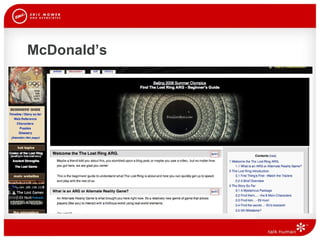
McDonald’s As part of the 2008 Summer Olympic sponsorship, McDonald’s launched an A.R.G. An A.R.G. is an Alternate Reality Game.
McDonald’s An alternate reality game (ARG) is an interactive narrative that uses the real world as a platform, often involving multiple media and game elements, to tell  a story that may be affected by participants' ideas  or actions. In other words, McDonald’s set in motion an event that players from around the world will engage in. You could say, a community of players playing an online game that has real world clues.
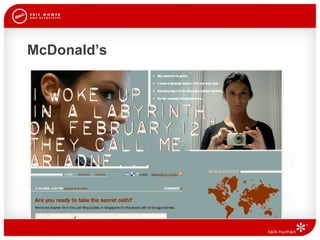
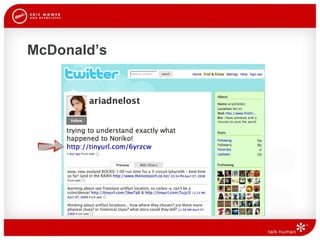
McDonald’s This game is vast. There are active updaters: blogs, YouTube videos, and discussion groups. Plus passive updates from Twitter. Real world clues found in various places all over the world. The game is currently in 7 languages and is set to end on the closing ceremonies of the Summer Olympics. There’s a Wiki so players can keep up. It might have been started by a fan.
McDonald’s
McDonald’s
McDonald’s
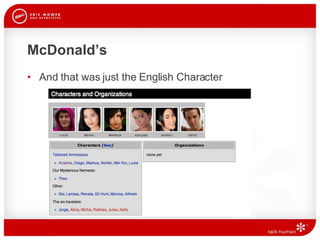
McDonald’s And that was just the English Character
McDonald’s All the characters have their own blog and  twitter feed. The game is scheduled to end on the final ceremonies of the Olympic games. Or so people think now. Fact is, the game is unfolding as we speak and the puppet masters will let it evolve depending on how things happen.
McDonald’s So what about the cost and measurement? From the New York Times: “ McDonald’s would not disclose the cost of the campaign, though Ms. Dillon said that “in the context of the total Olympics, it’s just a fraction of what we’re doing.” As for measuring the return on the company’s investment, Ms. Dillon said she saw it as more of a learning experience. “ You can’t put an R.O.I. on this ,” she said.”
McDonald’s Ms. Dillon is Mary Dillon, McDonald’s global chief marketing officer.  New ideas are popping up faster than the metrics. We wonder about the ROI of people on Twitter, in Facebook, watching a YouTube video. It’s somewhat comforting to know that the Chief Marketing Officer at one of the biggest brands in the world is also wondering.
McDonald’s McDonald’s is using just about every kind of new media in their experience. And the community that is popping up around the game will thanks McDonald’s. Will they go eat Big Macs? Who knows?  They will, however, have a positive impression of the brand. And ‘they’ are most-likely young men.
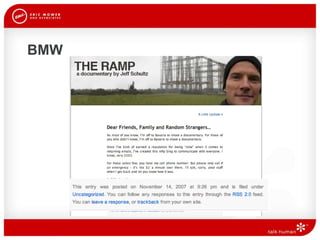
BMW BMW is launching a new car this year. So they invented a town. Then they hired a documentary filmmaker to make a documentary about the town. He has a blog, a YouTube channel, a Flickr account and a Facebook account. These are all free media, the only cost is creating the content. Coming soon, a Twitter feed.
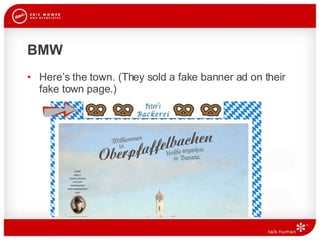
BMW Here’s the town. (They sold a fake banner ad on their fake town page.)
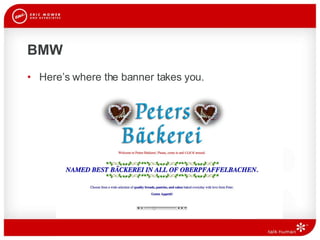
BMW Here’s where the banner takes you.
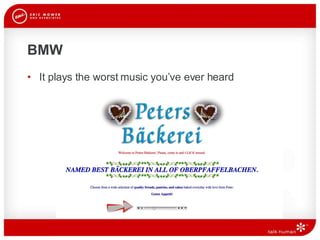
BMW It plays the worst music you’ve ever heard
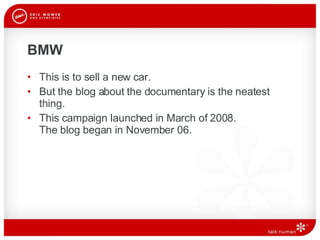
BMW This is to sell a new car. But the blog about the documentary is the neatest thing.  This campaign launched in March of 2008.  The blog began in November 06.
BMW
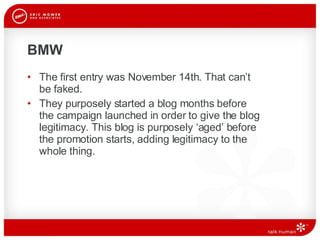
BMW The first entry was November 14th. That can’t  be faked. They purposely started a blog months before  the campaign launched in order to give the blog legitimacy. This blog is purposely ‘aged’ before  the promotion starts, adding legitimacy to the  whole thing.
In closing These are just some of the examples from this month. Every month someone does something that makes your head spin. And it isn’t a TV spot or a print ad.  Where will it come from next?
In closing Think about it: Is an A.R.G direct marketing? Is it General? Who in the agency world even comes up with the idea to create that social community?  Is Search Engine Optimization an interactive task, or, is it the task of the creator of the content?  Since a programmer and a designer isn’t needed to create a blog, is it really an interactive solution?
In closing Twitter doesn’t need a programmer or a designer. Facebook doesn’t. YouTube doesn’t.  When you’re looking for the next big idea, where will you turn?  Thanks.

How Digital will change things

  • 1.
    How Digital ChangesThings An exploration of Web tools for marketers 2008
  • 2.
    First of allBefore we talk about digital, lets take a minute to explain why it used to be easier The physics of geography We knew where our target market was going to be
  • 3.
    It used tobe easier They woke up (perhaps to a clock radio – radio spots, radio buys
  • 4.
    It used tobe easier Ate breakfast (in front of TV, or with radio on)
  • 5.
    It used tobe easier Got dressed (radio, TV)
  • 6.
    It used tobe easier Read magazines
  • 7.
    It used tobe easier Or newspapers
  • 8.
    It used tobe easier On the way to work, they saw ads
  • 9.
    It used tobe easier They tended to be off limits at work
  • 10.
    It used tobe easier They saw ads on the way home
  • 11.
    It used tobe easier During dinner they listened to the radio
  • 12.
    It used tobe easier Or more likely
  • 13.
    It used tobe easier The TV
  • 14.
    It used tobe easier Because we knew (or could predict) where they were, marketers could get our message in front of people Geography played a huge role in marketing
  • 15.
    It used tobe easier When a job started in an agency, it was usually a job that already had the media selected. It was radio, TV, print or collateral. Some agencies did ‘general’ advertising (the billboards, the broadcast and the print, while others did direct marketing).
  • 16.
    The internet changedeverything This presentation is an attempt to show you how And perhaps where some things are going
  • 17.
    The Internet Websites -- the first marketing tool that wasn’t interruptive. People chose to engage. So clients asked us to do websites.
  • 18.
    Web 1.0 Theweb started off like all marketing did. It talked to the target market. much like all the other things in the marketing toolbox did. Websites were bastions of information (about us, company history, team, timelines, advisory board, kid’s names, birthdays). It was on there because the space is infinite. Give marketers space, they we’ll fill it. With one way information.
  • 19.
    Web 1.0 Theextent of the conversation was this.
  • 20.
    Web 1.5 Note:I hate the term Web 2.0. The New York Times said Web 3.0 already. Still, it’s used to show the evolution of the web. It occurred to brands that if they enabled a community, people would come back.
  • 21.
    Web 1.5 Whenpeople bought a book at Amazon, the site would display the books bought by people who bought the same book you had in your cart. Oh, they liked that book too? Maybe it should be added to the cart. Purely up-sell, but it brought the actions of the community into the experience.
  • 22.
    Web 1.5 E-Baybegan experimenting with community. It offered assurances and ratings of sellers. The community voted on people, and the site related the information of the community to users. The point is, the site let the community have a say. People liked that and came back.
  • 23.
    Web 2.0 Whichbrings us to Web 2.0. so far we know this: A community encourages people to return. Then Google made it profitable to get eyeballs though it’s adwords network.
  • 24.
    Web 2.0 It’sa group of sites that encourage community. This is Web 2.0 circa 2007
  • 25.
  • 26.
    Web 2.0 –a chart Source: RileyMEDIA
  • 27.
    Web 2.0 Thinkof Web 2.0 as a community. It isn’t a message to a consumer, it’s a consumer interaction. YouTube is Web 2.0 because users vote on the uploaded content. A video with the most votes ends up on the front page. The community delivers content, and determines the importance of the content. YouTube has ALMOST no say.
  • 28.
    Web 2.0 Themost salient extension of the community-minded websites are the social networks. They are actually tools to bring people together.
  • 29.
    Social Networking “A social network service focuses on the building and verifying of online social networks for communities of people who share interests and activities, or who are interested in exploring the interests and activities of others.” From EMA’s knowledge-based Mowiki, one of our social networks. People are social. We join groups, associations, clubs, teams. Joining a network isn’t new. What’s new is joining them online.
  • 30.
    What is asocial network? Social networks are excellent tools for connecting people. It’s those things that account for its success. Let’s take a look at some of the social networks.
  • 31.
  • 32.
    Facebook is asocial network Facebook is based on the premise of connecting people to the people they already know. If you know someone, you can find them online. You have to be in their network, or know their primary e-mail address. Brands can enter the world of Facebook through Pages, a function that is about 6 months old.
  • 33.
    This is ourclient’s Russell page. Facebook This is in flash.
  • 34.
  • 35.
    MySpace is asocial network MySpace is a social network based on the premise of promoting yourself. MySpace doesn’t ask you to give your real name. But the sheer number of people on the site make it attractive. It gets more than double the traffic to Facebook.
  • 36.
  • 37.
    MySpace This isour client’s page.
  • 38.
  • 39.
    YouTube is asocial network As are most video sharing sites like Veoh, Google Video, Yahoo Video, MetaCafe, etc. People upload their content. Other people vote on it. In fact, outside of a few marketing initiatives the things on the front page of YouTube are the things the crowd has deemed the best. The comment section in YouTube is really social and active.
  • 40.
  • 41.
  • 42.
  • 43.
    Twitter is asocial network Twitter is a micro-blogging platform that lets people update their networks. In 140 characters or less.
  • 44.
  • 45.
    Twitter Jen Evansis a Toronto-based entrepreneur and writer and the president of Sequentia Communications, a customer communications agency ranked as Canada's 24th (2005) and 27th (2004) fastest growing emerging company by PROFIT magazine.
  • 46.
    Second Life isa social network It’s a real online world with a currency, shops, homes, and marketers. Even though it’s turned into something rather pornographic, it’s important. It’s teaching us how to interact virtually.
  • 47.
  • 48.
  • 49.
    Wikipedia is asocial network. People sign on. People interact. People police the place, checking updates, etc. In other words people take pride in the place. That’s the essence of an online world. Or network.
  • 50.
  • 51.
    StumbleUpon is asocial network. This is a ‘social bookmarking’ site, of which there are many. You may have heard of Digg. Delicious. Reddit. If you haven’t, and you read articles online, then you will know the logos, even if you don’t know why.
  • 52.
  • 53.
  • 54.
    I delicious (aYahoo company)
  • 55.
    Joost is asocial network. Joost is an online TV station with communities that are built around TV channels. It’s an emerging social network that shows off a lot of content that is professionally produced. You can watch every MacGyver episode there. And chat with other MacGyver fans.
  • 56.
  • 57.
    LinkedIn is abusiness social network. LinkedIn is the business social network. It’s honestly one of the best ways to get jobs. We were pitching Syracuse Research Corporation on winning their recruitment business. We showed them LinkedIn, talked about ways to use it, and won the business.
  • 58.
    LinkedIn. This isa good place to collaborate
  • 59.
    Why are theypopular? Why are these popular, and how does one jump in? And what does this have to do with marketing? Social networks ask people to update their status and then sends that information to friends. Twitter, Facebook and MySpace are what one’s doing now. LinkedIn is ‘what are you working on now. Why is status important?
  • 60.
    Status This eventgave the city status. The James Bond movie Octopussy was filmed in Udaipur, India. Consequently, you can see it at anytime, almost anywhere in the city.
  • 61.
    Status They needto be both covert about this, and like Udaipur, sometimes overt about it. Like this Indian city, younger people like to tell other young people about their wins, and memorable moments in life.
  • 62.
    Passive social networksYoung people are emerging brands. They need to get out the message of who they are, without coming on too strong.
  • 63.
    Passive social networksFacebook, MySpace, bebo and Twitter status updates are passive updates that help young people get heard. They are passive updaters because they are not pushed to people. This lets the young person update status, stay relevant, but not seem pushy.
  • 64.
    Passive social networksConsider a more active update: I could send out an e-mail or a text or even call everyone in my network telling them what I'm doing at this very moment (making a presentation to all of you). I could repeat that for everything I did. But that level of activity would alienate my network.
  • 65.
    Passive social networksAs we marketers jump into this realm, understanding the reason young people use these tools will be important for understanding how best we should be using them. Being passive isn't something that comes easy to marketers. We like to get the message out. We like GRPs. We want our message heard.
  • 66.
    Passive social networksAT EMA, a client is letting us use a passive updater. But it’s a fight to remind them of the goal. Early on, they asked whether the tool was driving traffic.
  • 67.
    Passive social networksIf we base success on numbers in a passive network, then we’re toast.
  • 68.
    Passive social networksWhat we’re really doing is:
  • 69.
    Passive social networksPassive networks can be excellent tools for creating community. And that’s the end goal. Create a community that people can engage with the brand, each other, and spread the word.
  • 70.
    Active networks YouTubeis an active network. And it can be great for a brand.
  • 71.
  • 72.
    Active networks TheSocial Bookmarking sites are active networks. Marketers can push their content onto these networks and let the community decide if it’s going to be pushed farther.
  • 73.
    Some cool newideas Dr. Pepper. Started a promotion recently whereby they promised to give everyone person in America a Dr. Pepper if Guns N’ Roses released their new CD before the end of 2008. But there are a few great things they did.
  • 74.
    Dr. Pepper Theystarted a blog called Chinese Democracy When? So named because the Guns N’ Roses CD is called Chinese Democracy. Here was the first post.
  • 75.
  • 76.
    Dr. Pepper Thenext post Almost a month later
  • 77.
    Dr. Pepper Thisis a conversation starter. But one needs people for a conversation. Enter Digg.
  • 78.
    Dr. Pepper Thepress release was released on Digg. People dig it. It’s rare that a presser gets Dug.
  • 79.
    Dr. Pepper Theydidn’t involve Guns N’ Roses.
  • 80.
    Dr. Pepper Theyhad an idea. Started a blog, used Digg to drive traffic to the blog and then use the blog to generate real conversations about random things. They tied themselves to a celebrity without tying themselves to a celebrity. This is a year-long promotion that just started. Who knows what’s next?
  • 81.
    McDonald’s As partof the 2008 Summer Olympic sponsorship, McDonald’s launched an A.R.G. An A.R.G. is an Alternate Reality Game.
  • 82.
    McDonald’s An alternatereality game (ARG) is an interactive narrative that uses the real world as a platform, often involving multiple media and game elements, to tell a story that may be affected by participants' ideas or actions. In other words, McDonald’s set in motion an event that players from around the world will engage in. You could say, a community of players playing an online game that has real world clues.
  • 83.
    McDonald’s This gameis vast. There are active updaters: blogs, YouTube videos, and discussion groups. Plus passive updates from Twitter. Real world clues found in various places all over the world. The game is currently in 7 languages and is set to end on the closing ceremonies of the Summer Olympics. There’s a Wiki so players can keep up. It might have been started by a fan.
  • 84.
  • 85.
  • 86.
  • 87.
    McDonald’s And thatwas just the English Character
  • 88.
    McDonald’s All thecharacters have their own blog and twitter feed. The game is scheduled to end on the final ceremonies of the Olympic games. Or so people think now. Fact is, the game is unfolding as we speak and the puppet masters will let it evolve depending on how things happen.
  • 89.
    McDonald’s So whatabout the cost and measurement? From the New York Times: “ McDonald’s would not disclose the cost of the campaign, though Ms. Dillon said that “in the context of the total Olympics, it’s just a fraction of what we’re doing.” As for measuring the return on the company’s investment, Ms. Dillon said she saw it as more of a learning experience. “ You can’t put an R.O.I. on this ,” she said.”
  • 90.
    McDonald’s Ms. Dillonis Mary Dillon, McDonald’s global chief marketing officer. New ideas are popping up faster than the metrics. We wonder about the ROI of people on Twitter, in Facebook, watching a YouTube video. It’s somewhat comforting to know that the Chief Marketing Officer at one of the biggest brands in the world is also wondering.
  • 91.
    McDonald’s McDonald’s isusing just about every kind of new media in their experience. And the community that is popping up around the game will thanks McDonald’s. Will they go eat Big Macs? Who knows? They will, however, have a positive impression of the brand. And ‘they’ are most-likely young men.
  • 92.
    BMW BMW islaunching a new car this year. So they invented a town. Then they hired a documentary filmmaker to make a documentary about the town. He has a blog, a YouTube channel, a Flickr account and a Facebook account. These are all free media, the only cost is creating the content. Coming soon, a Twitter feed.
  • 93.
    BMW Here’s thetown. (They sold a fake banner ad on their fake town page.)
  • 94.
    BMW Here’s wherethe banner takes you.
  • 95.
    BMW It playsthe worst music you’ve ever heard
  • 96.
    BMW This isto sell a new car. But the blog about the documentary is the neatest thing. This campaign launched in March of 2008. The blog began in November 06.
  • 97.
  • 98.
    BMW The firstentry was November 14th. That can’t be faked. They purposely started a blog months before the campaign launched in order to give the blog legitimacy. This blog is purposely ‘aged’ before the promotion starts, adding legitimacy to the whole thing.
  • 99.
    In closing Theseare just some of the examples from this month. Every month someone does something that makes your head spin. And it isn’t a TV spot or a print ad. Where will it come from next?
  • 100.
    In closing Thinkabout it: Is an A.R.G direct marketing? Is it General? Who in the agency world even comes up with the idea to create that social community? Is Search Engine Optimization an interactive task, or, is it the task of the creator of the content? Since a programmer and a designer isn’t needed to create a blog, is it really an interactive solution?
  • 101.
    In closing Twitterdoesn’t need a programmer or a designer. Facebook doesn’t. YouTube doesn’t. When you’re looking for the next big idea, where will you turn? Thanks.