Business Process Management
Business Process Difference in BPM Vs
ERP (SAP)
(ERP supports ‘low-level’ processes in APQC Process hierarchy)
Aug 2012
Business Process Management
Agenda
 Process Hierarchy defined by APQC (L1 - L4), and SAP (L1 – L6)
 Business Process Levels in BPM versus ERP (SAP)
 BPM orchestrates processes across systems, business units and value
chain partners
 What areas BPM delivers most value – an Analyst view
 Key driver / criteria used for identifying processes for BPM
 Common business problems in ERP / SAP
Business Process Management
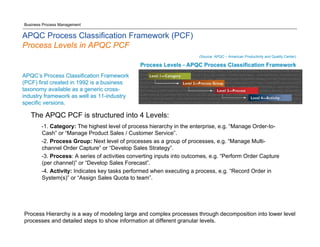
APQC Process Classification Framework (PCF)
Process Levels in APQC PCF
The APQC PCF is structured into 4 Levels:
-1. Category: The highest level of process hierarchy in the enterprise, e.g. “Manage Order-to-
Cash” or “Manage Product Sales / Customer Service”.
-2. Process Group: Next level of processes as a group of processes, e.g. “Manage Multi-
channel Order Capture” or “Develop Sales Strategy”.
-3. Process: A series of activities converting inputs into outcomes, e.g. “Perform Order Capture
(per channel)” or “Develop Sales Forecast”.
-4. Activity: Indicates key tasks performed when executing a process, e.g. “Record Order in
System(s)” or “Assign Sales Quota to team”.
Process Levels - APQC Process Classification Framework
(Source: APQC – American Productivity and Quality Center)
APQC’s Process Classification Framework
(PCF) first created in 1992 is a business
taxonomy available as a generic cross-
industry framework as well as 11-industry
specific versions.
Process Hierarchy is a way of modeling large and complex processes through decomposition into lower level
processes and detailed steps to show information at different granular levels.
Business Process Management
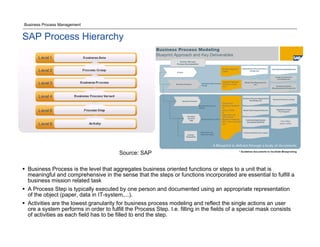
SAP Process Hierarchy
 Business Process is the level that aggregates business oriented functions or steps to a unit that is
meaningful and comprehensive in the sense that the steps or functions incorporated are essential to fulfill a
business mission related task
 A Process Step is typically executed by one person and documented using an appropriate representation
of the object (paper, data in IT-system,...).
 Activities are the lowest granularity for business process modeling and reflect the single actions an user
ore a system performs in order to fulfill the Process Step. I.e. filling in the fields of a special mask consists
of activities as each field has to be filled to end the step.
Source: SAP
Source: SAP
Business Process Management
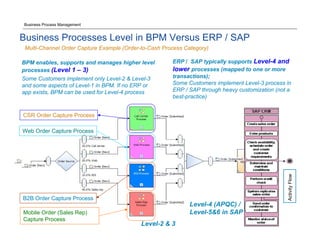
Business Processes Level in BPM Versus ERP / SAP
Web Order Capture Process
B2B Order Capture Process
CSR Order Capture Process
Mobile Order (Sales Rep)
Capture Process
Web Order Capture Process
B2B Order Capture Process
CSR Order Capture Process
Multi-Channel Order Capture Example (Order-to-Cash Process Category)
ActivityFlow
Level-4 (APQC) /
Level-5&6 in SAP
BPM enables, supports and manages higher level
processes (Level 1 – 3)
Some Customers implement only Level-2 & Level-3
and some aspects of Level-1 in BPM. If no ERP or
app exists, BPM can be used for Level-4 process
ERP / SAP typically supports Level-4 and
lower processes (mapped to one or more
transactions);
Some Customers implement Level-3 process in
ERP / SAP through heavy customization (not a
best-practice)
Level-2 & 3
Business Process Management
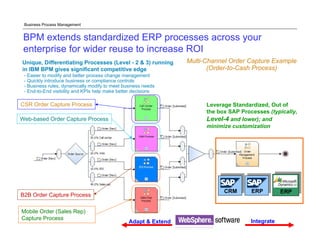
BPM extends standardized ERP processes across your
enterprise for wider reuse to increase ROI
Mobile Order (Sales Rep)
Capture Process
Web-based Order Capture Process
B2B Order Capture Process
CSR Order Capture Process
ERPCRM
Leverage Standardized, Out of
the box SAP Processes (typically,
Level-4 and lower); and
minimize customization
Unique, Differentiating Processes (Level - 2 & 3) running
in IBM BPM gives significant competitive edge
Adapt & Extend Integrate
- Easier to modify and better process change management
- Quickly introduce business or compliance controls
- Business rules, dynamically modify to meet business needs
- End-to-End visibility and KPIs help make better decisions
Multi-Channel Order Capture Example
(Order-to-Cash Process)
ERP
Business Process Management
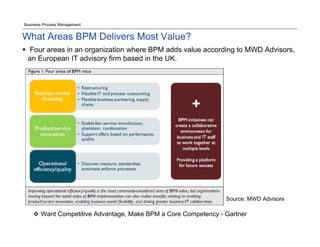
What Areas BPM Delivers Most Value?
Source: MWD Advisors
 Want Competitive Advantage, Make BPM a Core Competency - Gartner
 Four areas in an organization where BPM adds value according to MWD Advisors,
an European IT advisory firm based in the UK.
Business Process Management
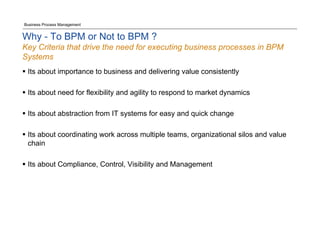
Why - To BPM or Not to BPM ?
Key Criteria that drive the need for executing business processes in BPM
Systems
 Its about importance to business and delivering value consistently
 Its about need for flexibility and agility to respond to market dynamics
 Its about abstraction from IT systems for easy and quick change
 Its about coordinating work across multiple teams, organizational silos and value
chain
 Its about Compliance, Control, Visibility and Management
Business Process Management
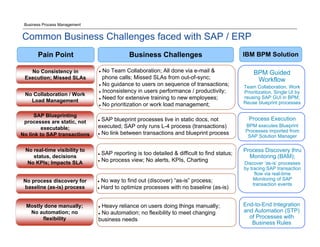
Common Business Challenges faced with SAP / ERP
No Consistency in
Execution; Missed SLAs
 No Team Collaboration; All done via e-mail &
phone calls; Missed SLAs from out-of-sync;
 No guidance to users on sequence of transactions;
 Inconsistency in users performance / productivity;
 Need for extensive training to new employees;
 No prioritization or work load management;
No Collaboration / Work
Load Management
No real-time visibility to
status, decisions
No KPIs; Impacts SLA
 SAP reporting is too detailed & difficult to find status;
 No process view; No alerts, KPIs, Charting
SAP Blueprinting
processes are static, not
executable;
No link to SAP transactions
 SAP blueprint processes live in static docs, not
executed; SAP only runs L-4 process (transactions)
 No link between transactions and blueprint process
No process discovery for
baseline (as-is) process
 No way to find out (discover) “as-is” process;
 Hard to optimize processes with no baseline (as-is)
Mostly done manually;
No automation; no
flexibility
 Heavy reliance on users doing things manually;
 No automation; no flexibility to meet changing
business needs
Pain Point Business Challenges IBM BPM Solution
BPM Guided
Workflow
Team Collaboration, Work
Prioritization, Single UI by
reusing SAP GUI in BPM;
Reuse blueprint processes
Process Execution
BPM executes Blueprint
Processes imported from
SAP Solution Manager
Process Discovery thru
Monitoring (BAM);
Discover ‘as-is’ processes
by tracing SAP transaction
flow via real-time
Monitoring of SAP
transaction events
End-to-End Integration
and Automation (STP)
of Processes with
Business Rules

How Business processes supported in BPM vs ERP

  • 1.
    Business Process Management BusinessProcess Difference in BPM Vs ERP (SAP) (ERP supports ‘low-level’ processes in APQC Process hierarchy) Aug 2012
  • 2.
    Business Process Management Agenda Process Hierarchy defined by APQC (L1 - L4), and SAP (L1 – L6)  Business Process Levels in BPM versus ERP (SAP)  BPM orchestrates processes across systems, business units and value chain partners  What areas BPM delivers most value – an Analyst view  Key driver / criteria used for identifying processes for BPM  Common business problems in ERP / SAP
  • 3.
    Business Process Management APQCProcess Classification Framework (PCF) Process Levels in APQC PCF The APQC PCF is structured into 4 Levels: -1. Category: The highest level of process hierarchy in the enterprise, e.g. “Manage Order-to- Cash” or “Manage Product Sales / Customer Service”. -2. Process Group: Next level of processes as a group of processes, e.g. “Manage Multi- channel Order Capture” or “Develop Sales Strategy”. -3. Process: A series of activities converting inputs into outcomes, e.g. “Perform Order Capture (per channel)” or “Develop Sales Forecast”. -4. Activity: Indicates key tasks performed when executing a process, e.g. “Record Order in System(s)” or “Assign Sales Quota to team”. Process Levels - APQC Process Classification Framework (Source: APQC – American Productivity and Quality Center) APQC’s Process Classification Framework (PCF) first created in 1992 is a business taxonomy available as a generic cross- industry framework as well as 11-industry specific versions. Process Hierarchy is a way of modeling large and complex processes through decomposition into lower level processes and detailed steps to show information at different granular levels.
  • 4.
    Business Process Management SAPProcess Hierarchy  Business Process is the level that aggregates business oriented functions or steps to a unit that is meaningful and comprehensive in the sense that the steps or functions incorporated are essential to fulfill a business mission related task  A Process Step is typically executed by one person and documented using an appropriate representation of the object (paper, data in IT-system,...).  Activities are the lowest granularity for business process modeling and reflect the single actions an user ore a system performs in order to fulfill the Process Step. I.e. filling in the fields of a special mask consists of activities as each field has to be filled to end the step. Source: SAP Source: SAP
  • 5.
    Business Process Management BusinessProcesses Level in BPM Versus ERP / SAP Web Order Capture Process B2B Order Capture Process CSR Order Capture Process Mobile Order (Sales Rep) Capture Process Web Order Capture Process B2B Order Capture Process CSR Order Capture Process Multi-Channel Order Capture Example (Order-to-Cash Process Category) ActivityFlow Level-4 (APQC) / Level-5&6 in SAP BPM enables, supports and manages higher level processes (Level 1 – 3) Some Customers implement only Level-2 & Level-3 and some aspects of Level-1 in BPM. If no ERP or app exists, BPM can be used for Level-4 process ERP / SAP typically supports Level-4 and lower processes (mapped to one or more transactions); Some Customers implement Level-3 process in ERP / SAP through heavy customization (not a best-practice) Level-2 & 3
  • 6.
    Business Process Management BPMextends standardized ERP processes across your enterprise for wider reuse to increase ROI Mobile Order (Sales Rep) Capture Process Web-based Order Capture Process B2B Order Capture Process CSR Order Capture Process ERPCRM Leverage Standardized, Out of the box SAP Processes (typically, Level-4 and lower); and minimize customization Unique, Differentiating Processes (Level - 2 & 3) running in IBM BPM gives significant competitive edge Adapt & Extend Integrate - Easier to modify and better process change management - Quickly introduce business or compliance controls - Business rules, dynamically modify to meet business needs - End-to-End visibility and KPIs help make better decisions Multi-Channel Order Capture Example (Order-to-Cash Process) ERP
  • 7.
    Business Process Management WhatAreas BPM Delivers Most Value? Source: MWD Advisors  Want Competitive Advantage, Make BPM a Core Competency - Gartner  Four areas in an organization where BPM adds value according to MWD Advisors, an European IT advisory firm based in the UK.
  • 8.
    Business Process Management Why- To BPM or Not to BPM ? Key Criteria that drive the need for executing business processes in BPM Systems  Its about importance to business and delivering value consistently  Its about need for flexibility and agility to respond to market dynamics  Its about abstraction from IT systems for easy and quick change  Its about coordinating work across multiple teams, organizational silos and value chain  Its about Compliance, Control, Visibility and Management
  • 9.
    Business Process Management CommonBusiness Challenges faced with SAP / ERP No Consistency in Execution; Missed SLAs  No Team Collaboration; All done via e-mail & phone calls; Missed SLAs from out-of-sync;  No guidance to users on sequence of transactions;  Inconsistency in users performance / productivity;  Need for extensive training to new employees;  No prioritization or work load management; No Collaboration / Work Load Management No real-time visibility to status, decisions No KPIs; Impacts SLA  SAP reporting is too detailed & difficult to find status;  No process view; No alerts, KPIs, Charting SAP Blueprinting processes are static, not executable; No link to SAP transactions  SAP blueprint processes live in static docs, not executed; SAP only runs L-4 process (transactions)  No link between transactions and blueprint process No process discovery for baseline (as-is) process  No way to find out (discover) “as-is” process;  Hard to optimize processes with no baseline (as-is) Mostly done manually; No automation; no flexibility  Heavy reliance on users doing things manually;  No automation; no flexibility to meet changing business needs Pain Point Business Challenges IBM BPM Solution BPM Guided Workflow Team Collaboration, Work Prioritization, Single UI by reusing SAP GUI in BPM; Reuse blueprint processes Process Execution BPM executes Blueprint Processes imported from SAP Solution Manager Process Discovery thru Monitoring (BAM); Discover ‘as-is’ processes by tracing SAP transaction flow via real-time Monitoring of SAP transaction events End-to-End Integration and Automation (STP) of Processes with Business Rules