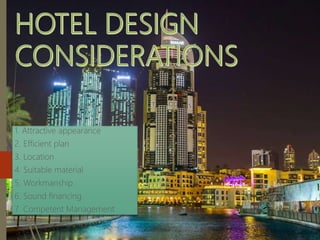
1. Attractive appearance
2. Efficient plan
3. Location
4. Suitable material
5. Workmanship
6. Sound financing
7. Competent Management
While the provision of earthquake resistance is
accomplished through structural means, the architectural
design, and the decisions that create it, play a major role in
determining the building's seismic performance. The
building architecture must permit as effective a seismic
design as possible: at the same time the structure must
permit the functional and aesthetic aims of the building to
be realized.
Following points need to be
considered while designing a
hotel
 Good location
 Attractive appearance / Architectural features and plans
 Efficient Plan
 Suitable material
 Good workmanship
 Sound financing
 Structural regulations laid by town and country planning department
 Competent management
Good location and site
 Selection of location and site is a very vital issue in the development of
a hotel project. The selection of suitable sites for hotels is a complex job.
It is a matter of choosing from among a number of possible sites the one
that has highest number of positive features or the fewest defects- as no
site is likely to have all the desired merits. To look into for selection of
a site following considerations are to be kept in mind-
Financial aspects of the site
 Pertains to the cost of land, construction cost, cost related to
developing the building systems, cost of furniture fixture, equipment,
Research & Development costs, maintenance costs etc.
General aspects
Which could have a direct bearing on the business
and so selection of sites. Such aspects are:-
 Accessibility of transport, especially from airports and
railway stations.
 Existence of present and planned future social centers.
 Special attraction in locations, such as proximity to parks
or open space.
 Proximity to business houses and amusement centers.
 Residential or non-residential areas.
 Level of sound during night.
 Access for service deliveries.
 Suitability of ground floor street frontage for shops
 Class of surrounding property, whether free from
industrial buildings.
 Good sub-soil to eliminate excessive foundation costs.
 Possibility of providing garage and/or parking
arrangement.
Attractive
appearance/Architectural
features
 A building of a hotel must be as impressive as its
interiors. Its distinctive features begin from the designing
itself. Our various civilizations over the ages and their
influence can be seen in some modern structures even
today. In fact, the principal guiding factor for any hotelier
is ensuring maximum occupancy at minimum
maintenance cost.
HINDU ARCHITECTURE
Rambagh Hindu Palace Home of the
Maharaja of Jaipur India
Taj Mahal Palace Hotel
GREEK ARCHITECTURE
Princess of Mykonos Hotel
ROMAN ARCHITECTURE
Caesars Palace
Hotel Invictus, Rome
CHRISTIAN ARCHITECTURE
Renaissance Paris Wagram Hotel
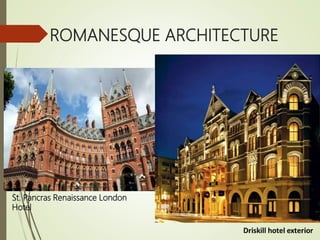
ROMANESQUE ARCHITECTURE
St. Pancras Renaissance London
Hotel
ISLAMIC ARCHITECTURE
Al-Meroz-hotel
Emirates Palace Hotel in Abu Dhabi
RENAISSANCE ARCHITECTURE
Renaissance Los Angeles Airport Hotel Renaissance Barcelona Fira Hotel
GOTHIC ARCHITECTURE
Santa Maria del Mar Barcelona - Hotel
Duquesa de Cardona
Hotel Duquesa de Cardona
ART NOUVEAV ARCHITECTURE
Interior Of Gresham Palace
MODERN ARCHITECTURE
Modern Architecture - Axis Viana Hotel
My Modern Met
Modern architecture, Hotel W or Hotel
Vela, by architect Ricard
INNOVATIVE ARCHITECTURE
Holiday-Inn-Express-by-Chapman
The ice cool exterior of Copenhagen's
Bella Sky Comwell hotel
INTERNATIONAL ARCHITECTURE
Corinthia Hotel Khartoum
Trump International Hotel and Tower
project -Dubai
Some of the popular types of
modern hotel plans
Modular Construction
Slip forming
Arch design
Cylinder like structure
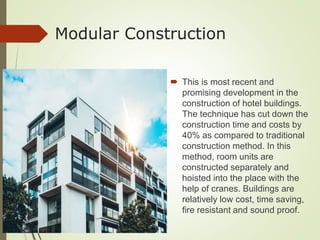
Modular Construction
 This is most recent and
promising development in the
construction of hotel buildings.
The technique has cut down the
construction time and costs by
40% as compared to traditional
construction method. In this
method, room units are
constructed separately and
hoisted into the place with the
help of cranes. Buildings are
relatively low cost, time saving,
fire resistant and sound proof.
Slip forming
 This was first used in 1930’s in the
buildings. Early slip forming
techniques relied on hydraulic jacks
and the pouring of concrete into a
form work made of timber. Today
slip forming is used to build
everything from silo to complexes,
chimneys, reservoirs, medium to
high-rise buildings, office buildings,
hotels, hospitals, bridge support
piers, in-ground shafts to dams and
power stations. It was used to raise
the exterior walls and some of the
interior walls and structures of a 15-
storey hotel in Petersburg, Florida.
 Slip forming, continuous poured, continuously formed, or slipform
construction is a construction method in which concrete is poured
into a continuously moving form. Slip forming is used for tall
structures (such as bridges, towers, buildings, and dams), as well as
horizontal structures, such as roadways. Slipforming enables
continuous, non-interrupted, cast-in-place "flawless" (i.e. no joints)
concrete structures which have superior performance characteristics
to piecewise construction using discrete form elements. Slip forming
relies on the quick-setting properties of concrete, and requires a
balance between quick-setting capacity and workability. Concrete
needs to be workable enough to be placed into the form and
consolidated (via vibration), yet quick-setting enough to emerge from
the form with strength. This strength is needed because the freshly
set concrete must not only permit the form to "slip" by the concrete
without disturbing it, but also support the pressure of the new
concrete as well as resist collapse caused by the vibration of the
compaction machinery.
Arch design
These designs have cent percent useable clear span space and do
not have any beams, poles and trusses. They are easy to construct
and most of the buildings are erected in just a few days. These
buildings are well ventilated and have better air flow than other
building types. These buildings are very cost effective and have
very low cost in developing heating, ventilation and air conditioning
system. The maintenance cost of these buildings is also very low
and they are fire resistant. The idea of tri-arch design was
introduced by Travelodge International. Main advantages of arch
designing are:
 Each room has a view.
 The wedge shape of guest rooms permits each to have an
unusually large bath and dressing area.
 The control core containing elevators, linen room, utilities and ice
cube machines facilitates economies in construction and
operations.
Cylinder like structure
This design of hotel building has a distinctive appearance as seen in
the Radisson property in Berlin. It has also advantages like:
 Concentration of service and utility equipment at the centre core.
 Lower construction and operating costs. All guest rooms on the
outer side with view.
 Ready-made for the popular roof top revolving restaurant or lounge.
 Minimum resistance to wind.
 Suitable for site where land costs are high and minimum area is
available.
 Compatibility with circumferential ramps leading to parking
Hotel design considerations

Hotel design considerations

  • 1.
    1. Attractive appearance 2.Efficient plan 3. Location 4. Suitable material 5. Workmanship 6. Sound financing 7. Competent Management
  • 3.
    While the provisionof earthquake resistance is accomplished through structural means, the architectural design, and the decisions that create it, play a major role in determining the building's seismic performance. The building architecture must permit as effective a seismic design as possible: at the same time the structure must permit the functional and aesthetic aims of the building to be realized.
  • 4.
    Following points needto be considered while designing a hotel  Good location  Attractive appearance / Architectural features and plans  Efficient Plan  Suitable material  Good workmanship  Sound financing  Structural regulations laid by town and country planning department  Competent management
  • 5.
    Good location andsite  Selection of location and site is a very vital issue in the development of a hotel project. The selection of suitable sites for hotels is a complex job. It is a matter of choosing from among a number of possible sites the one that has highest number of positive features or the fewest defects- as no site is likely to have all the desired merits. To look into for selection of a site following considerations are to be kept in mind-
  • 6.
    Financial aspects ofthe site  Pertains to the cost of land, construction cost, cost related to developing the building systems, cost of furniture fixture, equipment, Research & Development costs, maintenance costs etc.
  • 7.
    General aspects Which couldhave a direct bearing on the business and so selection of sites. Such aspects are:-  Accessibility of transport, especially from airports and railway stations.  Existence of present and planned future social centers.  Special attraction in locations, such as proximity to parks or open space.  Proximity to business houses and amusement centers.
  • 8.
     Residential ornon-residential areas.  Level of sound during night.  Access for service deliveries.  Suitability of ground floor street frontage for shops  Class of surrounding property, whether free from industrial buildings.  Good sub-soil to eliminate excessive foundation costs.  Possibility of providing garage and/or parking arrangement.
  • 9.
    Attractive appearance/Architectural features  A buildingof a hotel must be as impressive as its interiors. Its distinctive features begin from the designing itself. Our various civilizations over the ages and their influence can be seen in some modern structures even today. In fact, the principal guiding factor for any hotelier is ensuring maximum occupancy at minimum maintenance cost.
  • 11.
    HINDU ARCHITECTURE Rambagh HinduPalace Home of the Maharaja of Jaipur India Taj Mahal Palace Hotel
  • 12.
  • 13.
  • 14.
  • 15.
    ROMANESQUE ARCHITECTURE St. PancrasRenaissance London Hotel
  • 16.
  • 17.
    RENAISSANCE ARCHITECTURE Renaissance LosAngeles Airport Hotel Renaissance Barcelona Fira Hotel
  • 18.
    GOTHIC ARCHITECTURE Santa Mariadel Mar Barcelona - Hotel Duquesa de Cardona Hotel Duquesa de Cardona
  • 19.
  • 20.
    MODERN ARCHITECTURE Modern Architecture- Axis Viana Hotel My Modern Met Modern architecture, Hotel W or Hotel Vela, by architect Ricard
  • 21.
    INNOVATIVE ARCHITECTURE Holiday-Inn-Express-by-Chapman The icecool exterior of Copenhagen's Bella Sky Comwell hotel
  • 22.
    INTERNATIONAL ARCHITECTURE Corinthia HotelKhartoum Trump International Hotel and Tower project -Dubai
  • 25.
    Some of thepopular types of modern hotel plans Modular Construction Slip forming Arch design Cylinder like structure
  • 26.
    Modular Construction  Thisis most recent and promising development in the construction of hotel buildings. The technique has cut down the construction time and costs by 40% as compared to traditional construction method. In this method, room units are constructed separately and hoisted into the place with the help of cranes. Buildings are relatively low cost, time saving, fire resistant and sound proof.
  • 28.
    Slip forming  Thiswas first used in 1930’s in the buildings. Early slip forming techniques relied on hydraulic jacks and the pouring of concrete into a form work made of timber. Today slip forming is used to build everything from silo to complexes, chimneys, reservoirs, medium to high-rise buildings, office buildings, hotels, hospitals, bridge support piers, in-ground shafts to dams and power stations. It was used to raise the exterior walls and some of the interior walls and structures of a 15- storey hotel in Petersburg, Florida.
  • 29.
     Slip forming,continuous poured, continuously formed, or slipform construction is a construction method in which concrete is poured into a continuously moving form. Slip forming is used for tall structures (such as bridges, towers, buildings, and dams), as well as horizontal structures, such as roadways. Slipforming enables continuous, non-interrupted, cast-in-place "flawless" (i.e. no joints) concrete structures which have superior performance characteristics to piecewise construction using discrete form elements. Slip forming relies on the quick-setting properties of concrete, and requires a balance between quick-setting capacity and workability. Concrete needs to be workable enough to be placed into the form and consolidated (via vibration), yet quick-setting enough to emerge from the form with strength. This strength is needed because the freshly set concrete must not only permit the form to "slip" by the concrete without disturbing it, but also support the pressure of the new concrete as well as resist collapse caused by the vibration of the compaction machinery.
  • 30.
  • 31.
    These designs havecent percent useable clear span space and do not have any beams, poles and trusses. They are easy to construct and most of the buildings are erected in just a few days. These buildings are well ventilated and have better air flow than other building types. These buildings are very cost effective and have very low cost in developing heating, ventilation and air conditioning system. The maintenance cost of these buildings is also very low and they are fire resistant. The idea of tri-arch design was introduced by Travelodge International. Main advantages of arch designing are:  Each room has a view.  The wedge shape of guest rooms permits each to have an unusually large bath and dressing area.  The control core containing elevators, linen room, utilities and ice cube machines facilitates economies in construction and operations.
  • 32.
  • 33.
    This design ofhotel building has a distinctive appearance as seen in the Radisson property in Berlin. It has also advantages like:  Concentration of service and utility equipment at the centre core.  Lower construction and operating costs. All guest rooms on the outer side with view.  Ready-made for the popular roof top revolving restaurant or lounge.  Minimum resistance to wind.  Suitable for site where land costs are high and minimum area is available.  Compatibility with circumferential ramps leading to parking