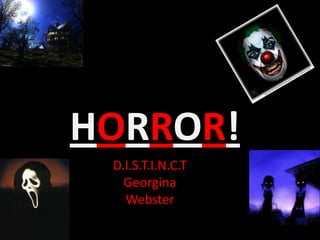
HORROR!D.I.S.T.I.N.C.TGeorginaWebster
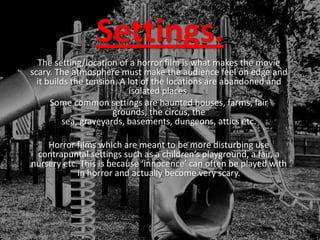
Settings.The setting/location of a horror film is what makes the movie scary. The atmosphere must make the audience feel on edge and it builds the tension. A lot of the locations are abandoned and isolated places.Some common settings are haunted houses, farms, fair grounds, the circus, the sea, graveyards, basements, dungeons, attics etc. Horror films which are meant to be more disturbing use contrapuntal settings such as a children’s playground, a fair, a nursery etc. This is because ‘innocence’ can often be played with in horror and actually become very scary.
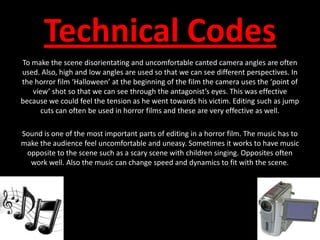
Technical CodesTo make the scene disorientating and uncomfortable canted camera angles are often used. Also, high and low angles are used so that we can see different perspectives. In the horror film ‘Halloween’ at the beginning of the film the camera uses the ‘point of view’ shot so that we can see through the antagonist’s eyes. This was effective because we could feel the tension as he went towards his victim. Editing such as jump cuts can often be used in horror films and these are very effective as well.Sound is one of the most important parts of editing in a horror film. The music has to make the audience feel uncomfortable and uneasy. Sometimes it works to have music opposite to the scene such as a scary scene with children singing. Opposites often work well. Also the music can change speed and dynamics to fit with the scene.
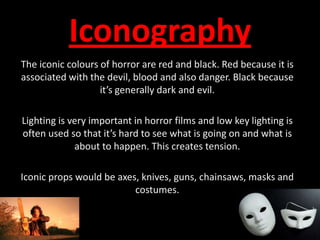
IconographyThe iconic colours of horror are red and black. Red because it is associated with the devil, blood and also danger. Black because it’s generally dark and evil. Lighting is very important in horror films and low key lighting is often used so that it’s hard to see what is going on and what is about to happen. This creates tension.Iconic props would be axes, knives, guns, chainsaws, masks and costumes.
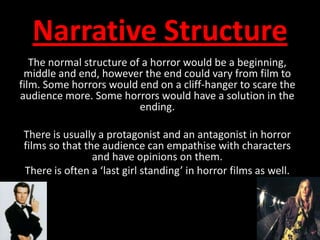
Narrative StructureThe normal structure of a horror would be a beginning, middle and end, however the end could vary from film to film. Some horrors would end on a cliff-hanger to scare the audience more. Some horrors would have a solution in the ending. There is usually a protagonist and an antagonist in horror films so that the audience can empathise with characters and have opinions on them.There is often a ‘last girl standing’ in horror films as well.
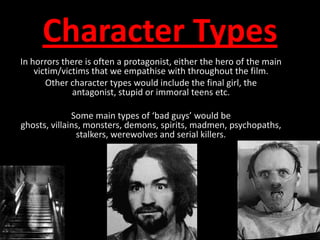
Character TypesIn horrors there is often a protagonist, either the hero of the main victim/victims that we empathise with throughout the film. Other character types would include the final girl, the antagonist, stupid or immoral teens etc.Some main types of ‘bad guys’ would be ghosts, villains, monsters, demons, spirits, madmen, psychopaths, stalkers, werewolves and serial killers.
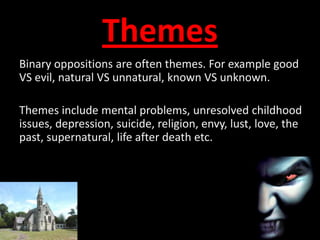
ThemesBinary oppositions are often themes. For example good VS evil, natural VS unnatural, known VS unknown. Themes include mental problems, unresolved childhood issues, depression, suicide, religion, envy, lust, love, the past, supernatural, life after death etc.

Horror powerpoint

  • 1.
  • 2.
    Settings.The setting/location ofa horror film is what makes the movie scary. The atmosphere must make the audience feel on edge and it builds the tension. A lot of the locations are abandoned and isolated places.Some common settings are haunted houses, farms, fair grounds, the circus, the sea, graveyards, basements, dungeons, attics etc. Horror films which are meant to be more disturbing use contrapuntal settings such as a children’s playground, a fair, a nursery etc. This is because ‘innocence’ can often be played with in horror and actually become very scary.
  • 3.
    Technical CodesTo makethe scene disorientating and uncomfortable canted camera angles are often used. Also, high and low angles are used so that we can see different perspectives. In the horror film ‘Halloween’ at the beginning of the film the camera uses the ‘point of view’ shot so that we can see through the antagonist’s eyes. This was effective because we could feel the tension as he went towards his victim. Editing such as jump cuts can often be used in horror films and these are very effective as well.Sound is one of the most important parts of editing in a horror film. The music has to make the audience feel uncomfortable and uneasy. Sometimes it works to have music opposite to the scene such as a scary scene with children singing. Opposites often work well. Also the music can change speed and dynamics to fit with the scene.
  • 4.
    IconographyThe iconic coloursof horror are red and black. Red because it is associated with the devil, blood and also danger. Black because it’s generally dark and evil. Lighting is very important in horror films and low key lighting is often used so that it’s hard to see what is going on and what is about to happen. This creates tension.Iconic props would be axes, knives, guns, chainsaws, masks and costumes.
  • 5.
    Narrative StructureThe normalstructure of a horror would be a beginning, middle and end, however the end could vary from film to film. Some horrors would end on a cliff-hanger to scare the audience more. Some horrors would have a solution in the ending. There is usually a protagonist and an antagonist in horror films so that the audience can empathise with characters and have opinions on them.There is often a ‘last girl standing’ in horror films as well.
  • 6.
    Character TypesIn horrorsthere is often a protagonist, either the hero of the main victim/victims that we empathise with throughout the film. Other character types would include the final girl, the antagonist, stupid or immoral teens etc.Some main types of ‘bad guys’ would be ghosts, villains, monsters, demons, spirits, madmen, psychopaths, stalkers, werewolves and serial killers.
  • 7.
    ThemesBinary oppositions areoften themes. For example good VS evil, natural VS unnatural, known VS unknown. Themes include mental problems, unresolved childhood issues, depression, suicide, religion, envy, lust, love, the past, supernatural, life after death etc.