What is the purpose of 
the horror genre? 
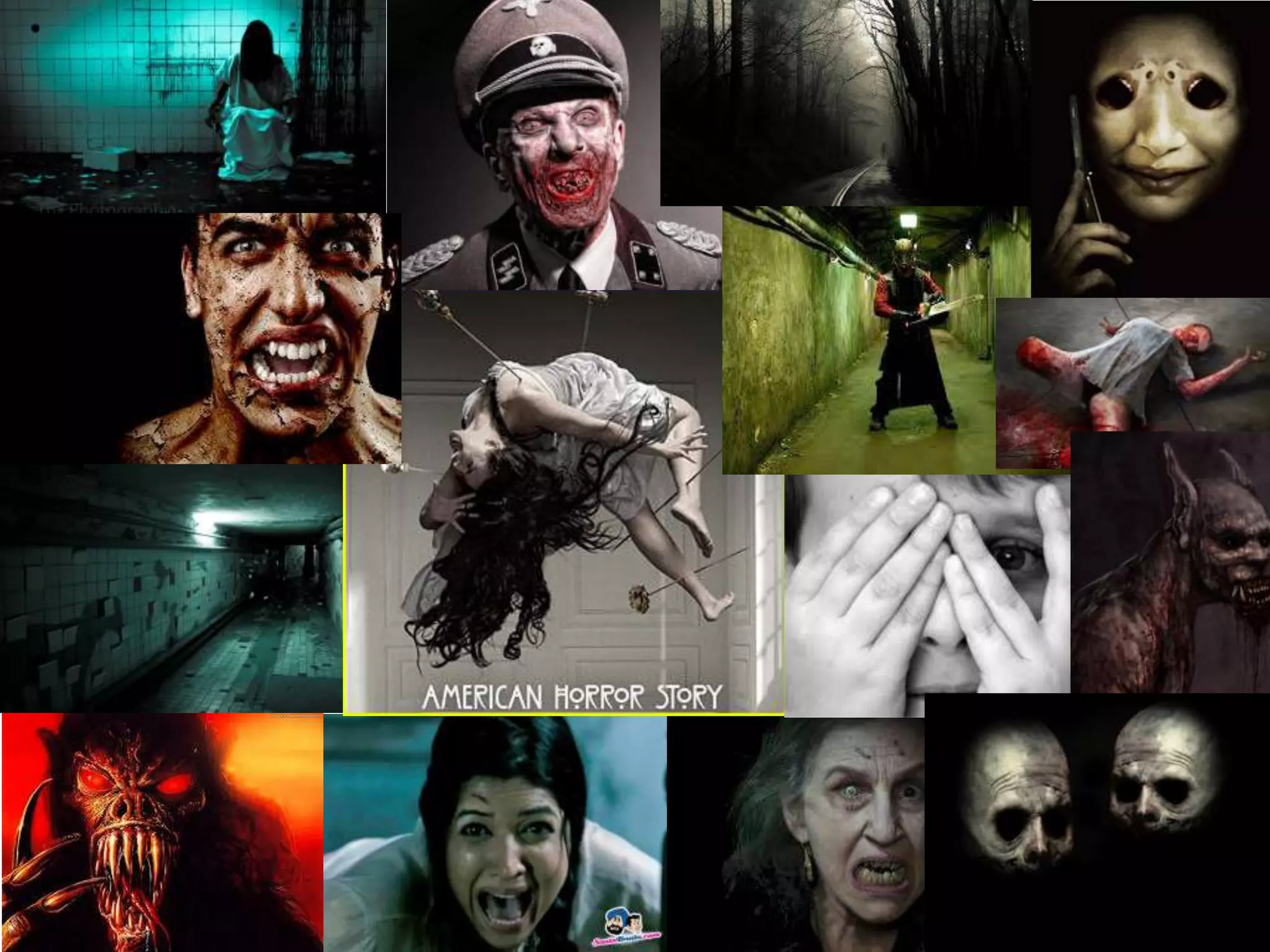
• Horror film is a genre that aims to create a sense of fear, 
panic, alarm, and dread for the audience. These films are 
often unsettling and rely on scaring the audience through a 
portrayal of their worst fears and nightmares. Horror films 
usually center on the arrival of an evil force, person, or 
event. Many Horror films include mythical creatures such 
as ghosts, vampires, and zombies. Traditionally, Horror films 
incorporate a large amount of violence and gore into the 
plot.
1896 - In this time period filmmakers began to experiment in the horror genre. 
The world’s first 'true' horror movie was creates, it was called The Devil's Castle. 
The film lasted 3 minutes and was created by an illusionist. 
1898- An English man named George Albert Smith created his 'special 
photographic contrivance'. This device enabled home ti show ghosts on film. This 
introduced the paranormal aspect in horror films. 
1910 - The first version of famous Frankestein was created by Mary Shelley. 
1911 - The film Notre Dame de Paris was released, it was filmed by Pathe and it 
was known for the first full length movie with a monster in it. 
1913 - Chaney 'The man of a thousand faces' created makeup for the horror 
genre, this stunned audiences as the makeup was used in a different way (making 
characters look scarier and to have emphasis on blood and wounds) 
1928 - The first Horror movie with sound is introduced ' the man who laughs' it 
becomes popular as it’s not a silent movie. 
1931 - Successful gothic horror film series (American Movie studio Universal 
Pictures): Dracula, Frankestein and The Old Dark House. These films were science 
fiction. 
1933 - The invisible man featured a mad scientist. This type of film was designed 
to thrill but also incorporated serious elements. 
1940's - horror movie become very successful – by actors; Boris Katloff and Bela 
Lugos 
1950's - 1960's 
with advances of technology, the ton of horror films shifted from the Gothic 
towards contemporary concerns. Two sub-genres began to emerge: the horror-of- 
Armageddon film and the horror-of-the-demonic film 
1960's - ghost and monsters still remained a frequent feature of horror, but many 
film used the supernatural premise to express the horror of the demonic. 
Blood Feast (1963) and Two Thousand Maniacs (1964) both used ghosts in their 
films but inhabited supernatural premise. 
During the 1970’s horror films began to involve the youth in the counterculture 
began exploring the medium. The Hills Have Eyes (1977) and The Texas Chainsaw 
Massacre (1974) recalled the Vietnam war. In late 1970‟s Canadian director 
David Cronenberg featured the „mad scientist‟ movie sub-genre by exploring 
contemporary fears about technology and society. A cycle of slasher films was 
made during the late 1970‟s. Halloween (1978), Friday the 13th (1980) and A 
Nightmare On Elm Street (1984)
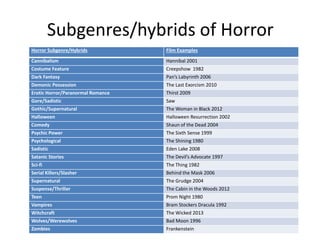
Subgenres/hybrids of Horror 
Horror Subgenre/Hybrids Film Examples 
Cannibalism Hannibal 2001 
Costume Feature Creepshow 1982 
Dark Fantasy Pan’s Labyrinth 2006 
Demonic Possession The Last Exorcism 2010 
Erotic Horror/Paranormal Romance Thirst 2009 
Gore/Sadistic Saw 
Gothic/Supernatural The Woman in Black 2012 
Halloween Halloween Resurrection 2002 
Comedy Shaun of the Dead 2004 
Psychic Power The Sixth Sense 1999 
Psychological The Shining 1980 
Sadistic Eden Lake 2008 
Satanic Stories The Devil’s Advocate 1997 
Sci-fi The Thing 1982 
Serial Killers/Slasher Behind the Mask 2006 
Supernatural The Grudge 2004 
Suspense/Thriller The Cabin in the Woods 2012 
Teen Prom Night 1980 
Vampires Bram Stockers Dracula 1992 
Witchcraft The Wicked 2013 
Wolves/Werewolves Bad Moon 1996 
Zombies Frankenstein
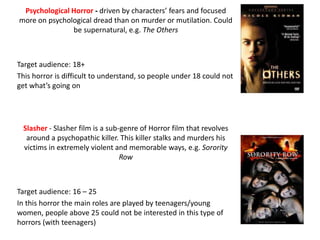
Psychological Horror - driven by characters’ fears and focused 
more on psychological dread than on murder or mutilation. Could 
be supernatural, e.g. The Others 
Target audience: 18+ 
This horror is difficult to understand, so people under 18 could not 
get what’s going on 
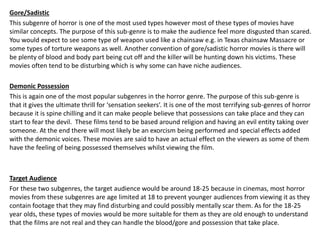
Slasher - Slasher film is a sub-genre of Horror film that revolves 
around a psychopathic killer. This killer stalks and murders his 
victims in extremely violent and memorable ways, e.g. Sorority 
Row 
Target audience: 16 – 25 
In this horror the main roles are played by teenagers/young 
women, people above 25 could not be interested in this type of 
horrors (with teenagers)
Gore/Sadistic 
This subgenre of horror is one of the most used types however most of these types of movies have 
similar concepts. The purpose of this sub-genre is to make the audience feel more disgusted than scared. 
You would expect to see some type of weapon used like a chainsaw e.g. in Texas chainsaw Massacre or 
some types of torture weapons as well. Another convention of gore/sadistic horror movies is there will 
be plenty of blood and body part being cut off and the killer will be hunting down his victims. These 
movies often tend to be disturbing which is why some can have niche audiences. 
Demonic Possession 
This is again one of the most popular subgenres in the horror genre. The purpose of this sub-genre is 
that it gives the ultimate thrill for ‘sensation seekers’. It is one of the most terrifying sub-genres of horror 
because it is spine chilling and it can make people believe that possessions can take place and they can 
start to fear the devil. These films tend to be based around religion and having an evil entity taking over 
someone. At the end there will most likely be an exorcism being performed and special effects added 
with the demonic voices. These movies are said to have an actual effect on the viewers as some of them 
have the feeling of being possessed themselves whilst viewing the film. 
Target Audience 
For these two subgenres, the target audience would be around 18-25 because in cinemas, most horror 
movies from these subgenres are age limited at 18 to prevent younger audiences from viewing it as they 
contain footage that they may find disturbing and could possibly mentally scar them. As for the 18-25 
year olds, these types of movies would be more suitable for them as they are old enough to understand 
that the films are not real and they can handle the blood/gore and possession that take place.
Sub-genre of horror : comedy. 
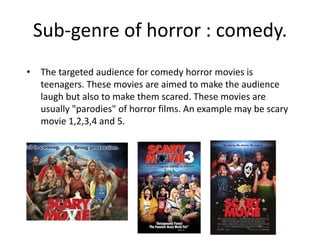
• The targeted audience for comedy horror movies is 
teenagers. These movies are aimed to make the audience 
laugh but also to make them scared. These movies are 
usually "parodies" of horror films. An example may be scary 
movie 1,2,3,4 and 5.
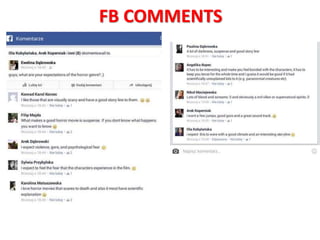
FB COMMENTS
FEEDBACKS 
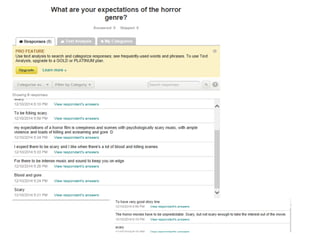
From the feedback from Facebook and survey monkey, we found that loads of 
people would expect to see the same things for example, blood, gore and for it to be 
very scary. These are all conventions of horror movies, so it showed that most 
people have the same idea about the horror genre as it is what we are always shown 
by movies, programmes etc.
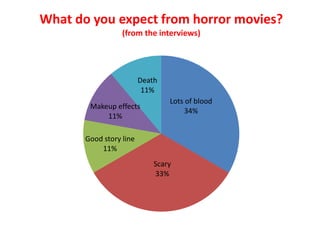
What do you expect from horror movies? 
(from the interviews) 
Lots of blood 
34% 
Scary 
33% 
Makeup effects 
11% 
Good story line 
11% 
Death 
11%
Conventions for Horror 
Genre
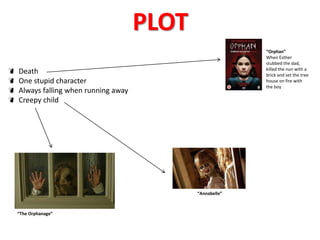
PLOT 
Death 
One stupid character 
Always falling when running away 
Creepy child 
“Annabelle” 
“Orphan” 
When Esther 
stubbed the dad, 
killed the nun with a 
brick and set the tree 
house on fire with 
the boy 
“The Orphanage”
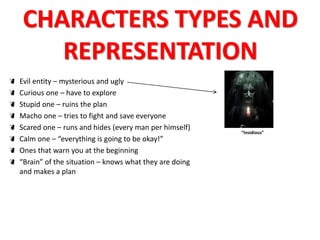
CHARACTERS TYPES AND 
REPRESENTATION 
Evil entity – mysterious and ugly 
Curious one – have to explore 
Stupid one – ruins the plan 
Macho one – tries to fight and save everyone 
Scared one – runs and hides (every man per himself) 
Calm one – “everything is going to be okay!” 
Ones that warn you at the beginning 
“Brain” of the situation – knows what they are doing 
and makes a plan 
“Insidious”
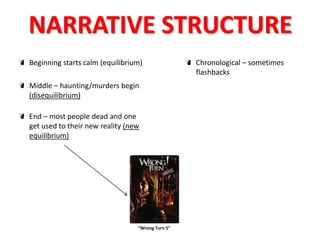
NARRATIVE STRUCTURE 
Beginning starts calm (equilibrium) 
Middle – haunting/murders begin 
(disequilibrium) 
End – most people dead and one 
get used to their new reality (new 
equilibrium) 
“Wrong Turn 5” 
Chronological – sometimes 
flashbacks
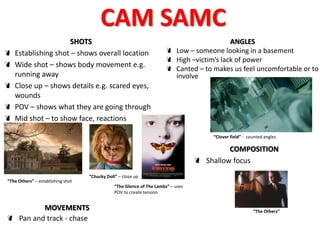
CAM SAMC 
SHOTS 
Establishing shot – shows overall location 
Wide shot – shows body movement e.g. 
running away 
Close up – shows details e.g. scared eyes, 
wounds 
POV – shows what they are going through 
Mid shot – to show face, reactions 
ANGLES 
Low – someone looking in a basement 
High –victim’s lack of power 
Canted – to makes us feel uncomfortable or to 
involve 
“The Others” – establishing shot 
“Chucky Doll” – close up 
“The Silence of The Lambs” – uses 
POV to create tension 
“Clover field” - counted angles 
COMPOSITION 
Shallow focus 
“The Others” MOVEMENTS 
Pan and track - chase
MES - CHARACTER 
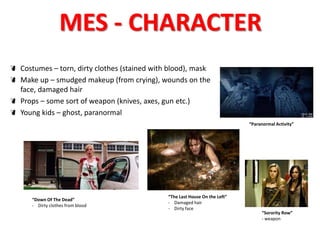
Costumes – torn, dirty clothes (stained with blood), mask 
Make up – smudged makeup (from crying), wounds on the 
face, damaged hair 
Props – some sort of weapon (knives, axes, gun etc.) 
Young kids – ghost, paranormal 
“The Last House On the Left” 
- Damaged hair 
- Dirty face 
“Down Of The Dead” 
- Dirty clothes from blood 
“Paranormal Activity” 
“Sorority Row” 
- weapon
MES – SETTING 
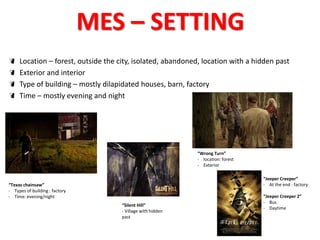
Location – forest, outside the city, isolated, abandoned, location with a hidden past 
Exterior and interior 
Type of building – mostly dilapidated houses, barn, factory 
Time – mostly evening and night 
“Wrong Turn” 
- location: forest 
- Exterior 
“Texas chainsaw” 
- Types of building : factory 
- Time: evening/night 
“Silent Hill” 
- Village with hidden 
past 
“Jeeper Creeper” 
- At the end : factory 
“Jeeper Creeper 2” 
- Bus 
- Daytime
MES – LIGTINING/ COLOUR 
SYMBOLISM 
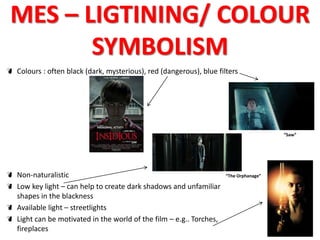
Colours : often black (dark, mysterious), red (dangerous), blue filters 
Non-naturalistic 
Low key light – can help to create dark shadows and unfamiliar 
shapes in the blackness 
Available light – streetlights 
Light can be motivated in the world of the film – e.g.. Torches, 
fireplaces 
“Saw” 
“The Orphanage”
EDITING 
CGI and special effects are used in horror to make the situation seem more dramatic 
and scary. 
Fast pace - e.g. when running away; medium pace 
Fast forward – to create tension 
Jump cuts – during chase scene etc. 
Eye-line match – when they see something horrible 
Match on action 
Cross cutting – e.g. when hiding from a killer; killer is trying to find them 
Straight cutting (transition) – to show realism
SOUND 
The non-diegetic - often used within horror. It can be eerie and create tension 
within the audience e.g. heartbeat 
Diegetic sound – often used for distortion and to make the audience scared, e.g. 
screaming, breathing 
Asynchronous – e.g. hear someone's steps 
Volume control – combination of loud and quiet 
Dialogue – e.g. whispering or shouting 
Sound perspective – e.g. a friend is far away and they scream to the victim to run 
away 
Sound motifs – associated with character or place 
Sound effect – e.g. sudden explosion
REPRESENTATION 
• Almost all of the male are represented as hegemonic masculinity, who act macho 
and heroic and want to save everyone. 
• Almost all of the females are represented as helpless and victims that need to be 
saved by a male hero. 
• The youth – can be seen as less experienced and more vulnerable to the type of 
events that happen in horror films.
What we like in horror movies? 
Ewelina 
• When they have a good story line 
• When they scare me to death 
• When they have lots of good special effects 
• When they use POV (point of view), I feel involved 
• When they use good sound effects 
• When they includes ghosts, demons, or other depictions of supernatural occurrences 
• I really like psychological horrors, but also supernatural and slasher 
Gabriella 
• Horror is my favourite genre as although most have similar concepts, they always fins new and interesting 
way to portray a particular entity or creature. I also like the fact that they contain a lot of suspense and 
thrill which although may lead to the same outcome; they may have a plot twist which will keep me 
intrigued. The main reason why I like to watch horror movies is to see the different ideas that they come 
up with as to the way the kill characters or resolve the problem. 
Nikol 
• My favourite thing about horror movies is the suspense that it provides the audience with and the impact 
that it leaves on you (makes you scared and concerned after the movie has ended)

Horror genre conventions

  • 2.
    What is thepurpose of the horror genre? • Horror film is a genre that aims to create a sense of fear, panic, alarm, and dread for the audience. These films are often unsettling and rely on scaring the audience through a portrayal of their worst fears and nightmares. Horror films usually center on the arrival of an evil force, person, or event. Many Horror films include mythical creatures such as ghosts, vampires, and zombies. Traditionally, Horror films incorporate a large amount of violence and gore into the plot.
  • 3.
    1896 - Inthis time period filmmakers began to experiment in the horror genre. The world’s first 'true' horror movie was creates, it was called The Devil's Castle. The film lasted 3 minutes and was created by an illusionist. 1898- An English man named George Albert Smith created his 'special photographic contrivance'. This device enabled home ti show ghosts on film. This introduced the paranormal aspect in horror films. 1910 - The first version of famous Frankestein was created by Mary Shelley. 1911 - The film Notre Dame de Paris was released, it was filmed by Pathe and it was known for the first full length movie with a monster in it. 1913 - Chaney 'The man of a thousand faces' created makeup for the horror genre, this stunned audiences as the makeup was used in a different way (making characters look scarier and to have emphasis on blood and wounds) 1928 - The first Horror movie with sound is introduced ' the man who laughs' it becomes popular as it’s not a silent movie. 1931 - Successful gothic horror film series (American Movie studio Universal Pictures): Dracula, Frankestein and The Old Dark House. These films were science fiction. 1933 - The invisible man featured a mad scientist. This type of film was designed to thrill but also incorporated serious elements. 1940's - horror movie become very successful – by actors; Boris Katloff and Bela Lugos 1950's - 1960's with advances of technology, the ton of horror films shifted from the Gothic towards contemporary concerns. Two sub-genres began to emerge: the horror-of- Armageddon film and the horror-of-the-demonic film 1960's - ghost and monsters still remained a frequent feature of horror, but many film used the supernatural premise to express the horror of the demonic. Blood Feast (1963) and Two Thousand Maniacs (1964) both used ghosts in their films but inhabited supernatural premise. During the 1970’s horror films began to involve the youth in the counterculture began exploring the medium. The Hills Have Eyes (1977) and The Texas Chainsaw Massacre (1974) recalled the Vietnam war. In late 1970‟s Canadian director David Cronenberg featured the „mad scientist‟ movie sub-genre by exploring contemporary fears about technology and society. A cycle of slasher films was made during the late 1970‟s. Halloween (1978), Friday the 13th (1980) and A Nightmare On Elm Street (1984)
  • 4.
    Subgenres/hybrids of Horror Horror Subgenre/Hybrids Film Examples Cannibalism Hannibal 2001 Costume Feature Creepshow 1982 Dark Fantasy Pan’s Labyrinth 2006 Demonic Possession The Last Exorcism 2010 Erotic Horror/Paranormal Romance Thirst 2009 Gore/Sadistic Saw Gothic/Supernatural The Woman in Black 2012 Halloween Halloween Resurrection 2002 Comedy Shaun of the Dead 2004 Psychic Power The Sixth Sense 1999 Psychological The Shining 1980 Sadistic Eden Lake 2008 Satanic Stories The Devil’s Advocate 1997 Sci-fi The Thing 1982 Serial Killers/Slasher Behind the Mask 2006 Supernatural The Grudge 2004 Suspense/Thriller The Cabin in the Woods 2012 Teen Prom Night 1980 Vampires Bram Stockers Dracula 1992 Witchcraft The Wicked 2013 Wolves/Werewolves Bad Moon 1996 Zombies Frankenstein
  • 5.
    Psychological Horror -driven by characters’ fears and focused more on psychological dread than on murder or mutilation. Could be supernatural, e.g. The Others Target audience: 18+ This horror is difficult to understand, so people under 18 could not get what’s going on Slasher - Slasher film is a sub-genre of Horror film that revolves around a psychopathic killer. This killer stalks and murders his victims in extremely violent and memorable ways, e.g. Sorority Row Target audience: 16 – 25 In this horror the main roles are played by teenagers/young women, people above 25 could not be interested in this type of horrors (with teenagers)
  • 6.
    Gore/Sadistic This subgenreof horror is one of the most used types however most of these types of movies have similar concepts. The purpose of this sub-genre is to make the audience feel more disgusted than scared. You would expect to see some type of weapon used like a chainsaw e.g. in Texas chainsaw Massacre or some types of torture weapons as well. Another convention of gore/sadistic horror movies is there will be plenty of blood and body part being cut off and the killer will be hunting down his victims. These movies often tend to be disturbing which is why some can have niche audiences. Demonic Possession This is again one of the most popular subgenres in the horror genre. The purpose of this sub-genre is that it gives the ultimate thrill for ‘sensation seekers’. It is one of the most terrifying sub-genres of horror because it is spine chilling and it can make people believe that possessions can take place and they can start to fear the devil. These films tend to be based around religion and having an evil entity taking over someone. At the end there will most likely be an exorcism being performed and special effects added with the demonic voices. These movies are said to have an actual effect on the viewers as some of them have the feeling of being possessed themselves whilst viewing the film. Target Audience For these two subgenres, the target audience would be around 18-25 because in cinemas, most horror movies from these subgenres are age limited at 18 to prevent younger audiences from viewing it as they contain footage that they may find disturbing and could possibly mentally scar them. As for the 18-25 year olds, these types of movies would be more suitable for them as they are old enough to understand that the films are not real and they can handle the blood/gore and possession that take place.
  • 7.
    Sub-genre of horror: comedy. • The targeted audience for comedy horror movies is teenagers. These movies are aimed to make the audience laugh but also to make them scared. These movies are usually "parodies" of horror films. An example may be scary movie 1,2,3,4 and 5.
  • 9.
  • 10.
    FEEDBACKS From thefeedback from Facebook and survey monkey, we found that loads of people would expect to see the same things for example, blood, gore and for it to be very scary. These are all conventions of horror movies, so it showed that most people have the same idea about the horror genre as it is what we are always shown by movies, programmes etc.
  • 11.
    What do youexpect from horror movies? (from the interviews) Lots of blood 34% Scary 33% Makeup effects 11% Good story line 11% Death 11%
  • 12.
  • 13.
    PLOT Death Onestupid character Always falling when running away Creepy child “Annabelle” “Orphan” When Esther stubbed the dad, killed the nun with a brick and set the tree house on fire with the boy “The Orphanage”
  • 14.
    CHARACTERS TYPES AND REPRESENTATION Evil entity – mysterious and ugly Curious one – have to explore Stupid one – ruins the plan Macho one – tries to fight and save everyone Scared one – runs and hides (every man per himself) Calm one – “everything is going to be okay!” Ones that warn you at the beginning “Brain” of the situation – knows what they are doing and makes a plan “Insidious”
  • 15.
    NARRATIVE STRUCTURE Beginningstarts calm (equilibrium) Middle – haunting/murders begin (disequilibrium) End – most people dead and one get used to their new reality (new equilibrium) “Wrong Turn 5” Chronological – sometimes flashbacks
  • 16.
    CAM SAMC SHOTS Establishing shot – shows overall location Wide shot – shows body movement e.g. running away Close up – shows details e.g. scared eyes, wounds POV – shows what they are going through Mid shot – to show face, reactions ANGLES Low – someone looking in a basement High –victim’s lack of power Canted – to makes us feel uncomfortable or to involve “The Others” – establishing shot “Chucky Doll” – close up “The Silence of The Lambs” – uses POV to create tension “Clover field” - counted angles COMPOSITION Shallow focus “The Others” MOVEMENTS Pan and track - chase
  • 17.
    MES - CHARACTER Costumes – torn, dirty clothes (stained with blood), mask Make up – smudged makeup (from crying), wounds on the face, damaged hair Props – some sort of weapon (knives, axes, gun etc.) Young kids – ghost, paranormal “The Last House On the Left” - Damaged hair - Dirty face “Down Of The Dead” - Dirty clothes from blood “Paranormal Activity” “Sorority Row” - weapon
  • 18.
    MES – SETTING Location – forest, outside the city, isolated, abandoned, location with a hidden past Exterior and interior Type of building – mostly dilapidated houses, barn, factory Time – mostly evening and night “Wrong Turn” - location: forest - Exterior “Texas chainsaw” - Types of building : factory - Time: evening/night “Silent Hill” - Village with hidden past “Jeeper Creeper” - At the end : factory “Jeeper Creeper 2” - Bus - Daytime
  • 19.
    MES – LIGTINING/COLOUR SYMBOLISM Colours : often black (dark, mysterious), red (dangerous), blue filters Non-naturalistic Low key light – can help to create dark shadows and unfamiliar shapes in the blackness Available light – streetlights Light can be motivated in the world of the film – e.g.. Torches, fireplaces “Saw” “The Orphanage”
  • 20.
    EDITING CGI andspecial effects are used in horror to make the situation seem more dramatic and scary. Fast pace - e.g. when running away; medium pace Fast forward – to create tension Jump cuts – during chase scene etc. Eye-line match – when they see something horrible Match on action Cross cutting – e.g. when hiding from a killer; killer is trying to find them Straight cutting (transition) – to show realism
  • 21.
    SOUND The non-diegetic- often used within horror. It can be eerie and create tension within the audience e.g. heartbeat Diegetic sound – often used for distortion and to make the audience scared, e.g. screaming, breathing Asynchronous – e.g. hear someone's steps Volume control – combination of loud and quiet Dialogue – e.g. whispering or shouting Sound perspective – e.g. a friend is far away and they scream to the victim to run away Sound motifs – associated with character or place Sound effect – e.g. sudden explosion
  • 22.
    REPRESENTATION • Almostall of the male are represented as hegemonic masculinity, who act macho and heroic and want to save everyone. • Almost all of the females are represented as helpless and victims that need to be saved by a male hero. • The youth – can be seen as less experienced and more vulnerable to the type of events that happen in horror films.
  • 23.
    What we likein horror movies? Ewelina • When they have a good story line • When they scare me to death • When they have lots of good special effects • When they use POV (point of view), I feel involved • When they use good sound effects • When they includes ghosts, demons, or other depictions of supernatural occurrences • I really like psychological horrors, but also supernatural and slasher Gabriella • Horror is my favourite genre as although most have similar concepts, they always fins new and interesting way to portray a particular entity or creature. I also like the fact that they contain a lot of suspense and thrill which although may lead to the same outcome; they may have a plot twist which will keep me intrigued. The main reason why I like to watch horror movies is to see the different ideas that they come up with as to the way the kill characters or resolve the problem. Nikol • My favourite thing about horror movies is the suspense that it provides the audience with and the impact that it leaves on you (makes you scared and concerned after the movie has ended)