Horizon Report K-12
          The New Media Consortium
Johnson, L, Adams, S, and Cummins, M (2012), NMC Horizon Report:
  2012 K-12 Edition; Austin, Texas: The New Media Consortium.

     This summary for educational purposes by George Hobson
                         February 2013
The Horizon Report


"Examines emerging technologies for their
  potential impact on and use in teaching,
  learning and creative inquiry within the
  environment of pre-college education."
The Horizon Report


Produced by the
•New Media Consortium (NMC),
•Consortium for School Networking (CoSN)
•International Society for Technology in
 Education (ISTE)
The Horizon Report
Three editions:

• Higher Education
• Primary and Secondary Education (K-12)
• Museum Education
The Horizon Report
Resources:

             navigator.nmc.org

         go.nmc.org/itunes-u
TIME TO ADOPTION HORIZONS:
One year or less:

•   MOBILE DEVICES AND APPS


•   TABLET COMPUTING


                              ≤1
TIME TO ADOPTION HORIZONS:
Two to Three Years:

•   GAME-BASED LEARNING


•   PERSONAL LEARNING ENVIRONMENTS


                             2-3
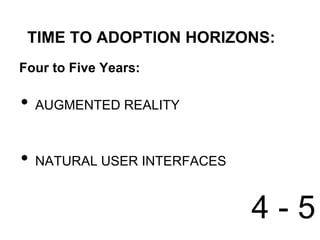
TIME TO ADOPTION HORIZONS:
Four to Five Years:

•   AUGMENTED REALITY


•   NATURAL USER INTERFACES


                              4-5
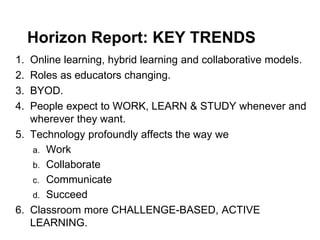
Horizon Report: KEY TRENDS
1. Online learning, hybrid learning and collaborative models.
2. Roles as educators changing.
3. BYOD.
4. People expect to WORK, LEARN & STUDY whenever and
   wherever they want.
5. Technology profoundly affects the way we
   a. Work
   b. Collaborate
   c. Communicate
   d. Succeed
6. Classroom more CHALLENGE-BASED, ACTIVE
   LEARNING.
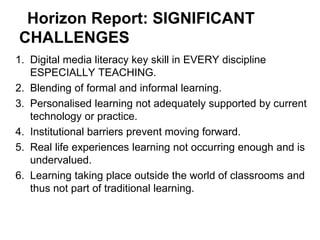
Horizon Report: SIGNIFICANT
CHALLENGES
1. Digital media literacy key skill in EVERY discipline
   ESPECIALLY TEACHING.
2. Blending of formal and informal learning.
3. Personalised learning not adequately supported by current
   technology or practice.
4. Institutional barriers prevent moving forward.
5. Real life experiences learning not occurring enough and is
   undervalued.
6. Learning taking place outside the world of classrooms and
   thus not part of traditional learning.

Horizon Report K-12 - 2012

  • 1.
    Horizon Report K-12 The New Media Consortium Johnson, L, Adams, S, and Cummins, M (2012), NMC Horizon Report: 2012 K-12 Edition; Austin, Texas: The New Media Consortium. This summary for educational purposes by George Hobson February 2013
  • 2.
    The Horizon Report "Examinesemerging technologies for their potential impact on and use in teaching, learning and creative inquiry within the environment of pre-college education."
  • 3.
    The Horizon Report Producedby the •New Media Consortium (NMC), •Consortium for School Networking (CoSN) •International Society for Technology in Education (ISTE)
  • 4.
    The Horizon Report Threeeditions: • Higher Education • Primary and Secondary Education (K-12) • Museum Education
  • 5.
    The Horizon Report Resources: navigator.nmc.org go.nmc.org/itunes-u
  • 6.
    TIME TO ADOPTIONHORIZONS: One year or less: • MOBILE DEVICES AND APPS • TABLET COMPUTING ≤1
  • 7.
    TIME TO ADOPTIONHORIZONS: Two to Three Years: • GAME-BASED LEARNING • PERSONAL LEARNING ENVIRONMENTS 2-3
  • 8.
    TIME TO ADOPTIONHORIZONS: Four to Five Years: • AUGMENTED REALITY • NATURAL USER INTERFACES 4-5
  • 9.
    Horizon Report: KEYTRENDS 1. Online learning, hybrid learning and collaborative models. 2. Roles as educators changing. 3. BYOD. 4. People expect to WORK, LEARN & STUDY whenever and wherever they want. 5. Technology profoundly affects the way we a. Work b. Collaborate c. Communicate d. Succeed 6. Classroom more CHALLENGE-BASED, ACTIVE LEARNING.
  • 10.
    Horizon Report: SIGNIFICANT CHALLENGES 1.Digital media literacy key skill in EVERY discipline ESPECIALLY TEACHING. 2. Blending of formal and informal learning. 3. Personalised learning not adequately supported by current technology or practice. 4. Institutional barriers prevent moving forward. 5. Real life experiences learning not occurring enough and is undervalued. 6. Learning taking place outside the world of classrooms and thus not part of traditional learning.