The Value of Online Learning Gina Rios, Judy Hale, & Marie Opland
http://www.youtube.com/watch?v=S3abpzsrGAY#watch-main-area
Intro. Online learning offers students greater access to education by providing them with the opportunity to learn using non-traditional methods in a non-traditional environment.   There is great value in online learning for K-12 students!
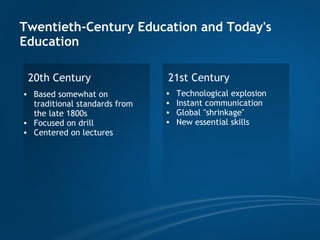
Twentieth-Century Education and Today's Education Based somewhat on traditional standards from the late 1800s Focused on drill  Centered on lectures 20th Century 21st Century Technological explosion Instant communication Global "shrinkage" New essential skills
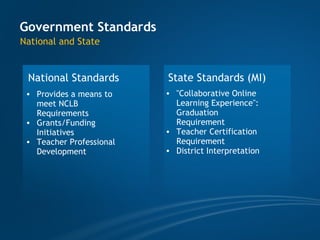
Government Standards National and State Provides a means to meet NCLB Requirements Grants/Funding Initiatives Teacher Professional Development National Standards State Standards (MI) "Collaborative Online Learning Experience": Graduation Requirement Teacher Certification Requirement District Interpretation
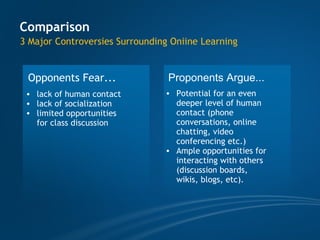
Comparison 3 Major Controversies Surrounding Oniine Learning lack of human contact lack of socialization limited opportunities for class discussion Opponents Fear... Proponents Argue... Potential for an even deeper level of human contact (phone conversations, online chatting, video conferencing etc.) Ample opportunities for interacting with others (discussion boards, wikis, blogs, etc).
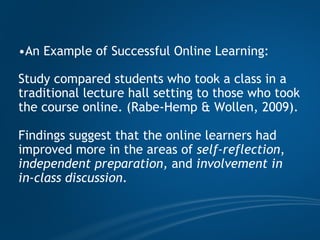
An Example of Successful Online Learning:  Study compared students who took a class in a traditional lecture hall setting to those who took the course online. (Rabe-Hemp & Wollen, 2009).  Findings suggest that the online learners had improved more in the areas of  self-reflection ,  independent preparation,  and  involvement in in-class discussion .
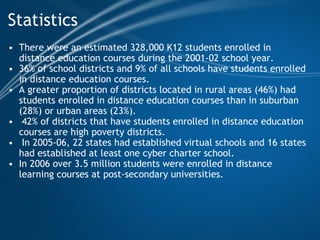
Statistics There were an estimated 328,000 K12 students enrolled in distance education courses during the 2001-02 school year. 36% of school districts and 9% of all schools have students enrolled in distance education courses. A greater proportion of districts located in rural areas (46%) had students enrolled in distance education courses than in suburban (28%) or urban areas (23%).   42% of districts that have students enrolled in distance education courses are high poverty districts.   In 2005-06, 22 states had established virtual schools and 16 states had established at least one cyber charter school. In 2006 over 3.5 million students were enrolled in distance learning courses at post-secondary universities.  
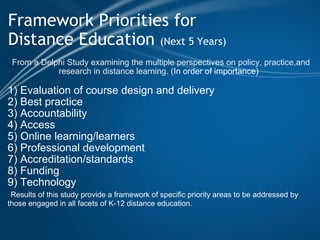
Framework Priorities for  Distance Education  (Next 5 Years)     From a   Delphi Study examining the multiple perspectives on policy, practice,and research in distance learning. ( In order of importance)     1) Evaluation of course design and delivery 2) Best practice 3) Accountability 4) Access 5) Online learning/learners 6) Professional development 7) Accreditation/standards 8) Funding 9) Technology   Results of this study provide a framework of specific priority areas to be addressed by those engaged in all facets of K-12 distance education.
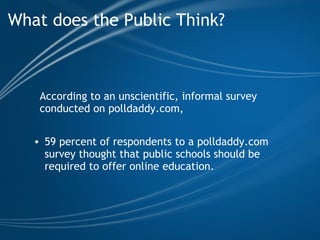
What does the Public Think? 59 percent of respondents to a polldaddy.com survey thought that public schools should be required to offer online education. According to an unscientific, informal survey conducted on polldaddy.com,  
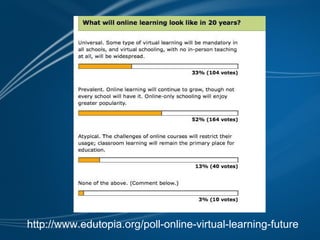
http://www.edutopia.org/poll-online-virtual-learning-future
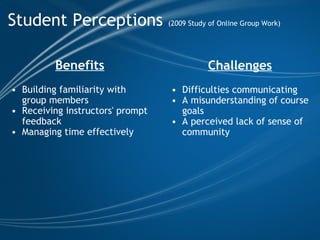
Student Perceptions  (2009 Study of Online Group Work) Benefits   Building familiarity with group members Receiving instructors' prompt feedback Managing time effectively Challenges   Difficulties communicating A misunderstanding of course goals  A perceived lack of sense of community
Additional Benefits: Self-directed learning Time management Personal responsibility Technology literacy Problem solving Global awareness Flexibility Additional Challenges: •  Technological issues •  Self-discipline deficiencies
" Technology is changing the way students learn. As educators we must embrace this change to meet the needs of our learners. Students are able to store and retrieve information quickly which means that we must nurture students' critical thinking and collaboration skills so that they are able to make sense of the amount of available information ." Melanie Laber, Michigan's 2009 Online Teacher of the Year
Conclusion Online education offers students and parents an alternative to traditional education. It can help meet the needs of all students. We are in favor of K-12 schools being required to offer online education.
References answers.polldaddy.com/poll/1336153/ Laber, M. (2010). Meet Michigan's 2009 Online Teacher of the Year.  MACUL Journal . 30(3), 36.  Koh, M. & Hill, J. (2009) Student Perceptions of Online Group Work: Benefits and Challenges.  Journal of Distance Education.  23 (2), 69-91.   Rabe-Hemp, C., Woollen, S., & Humiston, G. S. (2009). A Comparative Analysis of Student Engagement, Learning, and Satisfaction in Lecture Hall and Online Learning Settings.  Quarterly Review of Distance Education .  10 (2), 207-218. Rice, K.    (2009)   Priorities in K-12 Distance Education: A Delphi Study Examining Multiple Perspectives on Policy, Practice, and Research.  Journal of Educational Technology & Society. 12 (3), 163-77.   U.S. Department of Education. (2010)Technology and No Child Left Behind. http://www2.ed.gov/about/offices/list/os/technology/index.html www.edutopia.org/poll-online-virtual-learning-future  

Value Of Online Learning

  • 1.
    The Value ofOnline Learning Gina Rios, Judy Hale, & Marie Opland
  • 2.
  • 3.
    Intro. Online learningoffers students greater access to education by providing them with the opportunity to learn using non-traditional methods in a non-traditional environment.   There is great value in online learning for K-12 students!
  • 4.
    Twentieth-Century Education andToday's Education Based somewhat on traditional standards from the late 1800s Focused on drill  Centered on lectures 20th Century 21st Century Technological explosion Instant communication Global "shrinkage" New essential skills
  • 5.
    Government Standards Nationaland State Provides a means to meet NCLB Requirements Grants/Funding Initiatives Teacher Professional Development National Standards State Standards (MI) "Collaborative Online Learning Experience": Graduation Requirement Teacher Certification Requirement District Interpretation
  • 6.
    Comparison 3 MajorControversies Surrounding Oniine Learning lack of human contact lack of socialization limited opportunities for class discussion Opponents Fear... Proponents Argue... Potential for an even deeper level of human contact (phone conversations, online chatting, video conferencing etc.) Ample opportunities for interacting with others (discussion boards, wikis, blogs, etc).
  • 7.
    An Example ofSuccessful Online Learning: Study compared students who took a class in a traditional lecture hall setting to those who took the course online. (Rabe-Hemp & Wollen, 2009). Findings suggest that the online learners had improved more in the areas of self-reflection , independent preparation, and involvement in in-class discussion .
  • 8.
    Statistics There werean estimated 328,000 K12 students enrolled in distance education courses during the 2001-02 school year. 36% of school districts and 9% of all schools have students enrolled in distance education courses. A greater proportion of districts located in rural areas (46%) had students enrolled in distance education courses than in suburban (28%) or urban areas (23%).   42% of districts that have students enrolled in distance education courses are high poverty districts.   In 2005-06, 22 states had established virtual schools and 16 states had established at least one cyber charter school. In 2006 over 3.5 million students were enrolled in distance learning courses at post-secondary universities.  
  • 9.
    Framework Priorities for Distance Education (Next 5 Years)     From a Delphi Study examining the multiple perspectives on policy, practice,and research in distance learning. ( In order of importance)   1) Evaluation of course design and delivery 2) Best practice 3) Accountability 4) Access 5) Online learning/learners 6) Professional development 7) Accreditation/standards 8) Funding 9) Technology   Results of this study provide a framework of specific priority areas to be addressed by those engaged in all facets of K-12 distance education.
  • 10.
    What does thePublic Think? 59 percent of respondents to a polldaddy.com survey thought that public schools should be required to offer online education. According to an unscientific, informal survey conducted on polldaddy.com,  
  • 11.
  • 12.
    Student Perceptions  (2009Study of Online Group Work) Benefits   Building familiarity with group members Receiving instructors' prompt feedback Managing time effectively Challenges   Difficulties communicating A misunderstanding of course goals A perceived lack of sense of community
  • 13.
    Additional Benefits: Self-directedlearning Time management Personal responsibility Technology literacy Problem solving Global awareness Flexibility Additional Challenges: • Technological issues • Self-discipline deficiencies
  • 14.
    " Technology ischanging the way students learn. As educators we must embrace this change to meet the needs of our learners. Students are able to store and retrieve information quickly which means that we must nurture students' critical thinking and collaboration skills so that they are able to make sense of the amount of available information ." Melanie Laber, Michigan's 2009 Online Teacher of the Year
  • 15.
    Conclusion Online educationoffers students and parents an alternative to traditional education. It can help meet the needs of all students. We are in favor of K-12 schools being required to offer online education.
  • 16.
    References answers.polldaddy.com/poll/1336153/ Laber,M. (2010). Meet Michigan's 2009 Online Teacher of the Year. MACUL Journal . 30(3), 36. Koh, M. & Hill, J. (2009) Student Perceptions of Online Group Work: Benefits and Challenges.  Journal of Distance Education.  23 (2), 69-91.   Rabe-Hemp, C., Woollen, S., & Humiston, G. S. (2009). A Comparative Analysis of Student Engagement, Learning, and Satisfaction in Lecture Hall and Online Learning Settings. Quarterly Review of Distance Education . 10 (2), 207-218. Rice, K.    (2009)   Priorities in K-12 Distance Education: A Delphi Study Examining Multiple Perspectives on Policy, Practice, and Research.  Journal of Educational Technology & Society. 12 (3), 163-77.   U.S. Department of Education. (2010)Technology and No Child Left Behind. http://www2.ed.gov/about/offices/list/os/technology/index.html www.edutopia.org/poll-online-virtual-learning-future