Example for Forward Chaining,
Backward Chaining and Resolution
Artificial Intelligence, A Modern Approach, CH.9
2017.05.12(Thu)
Junya Tanaka (M1)
Introduction
• Chapter 9 examine effective procedures for answering
questions posed in first-order logic
• Suppose same example for three important methods of
inference(forward Chaining, Backward Chaining and
Resolution)
Example(1/3)
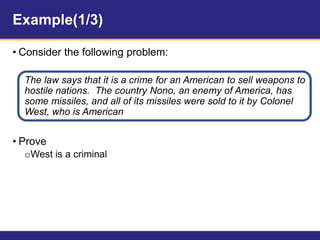
• Consider the following problem:
The law says that it is a crime for an American to sell weapons to
hostile nations. The country Nono, an enemy of America, has
some missiles, and all of its missiles were sold to it by Colonel
West, who is American
• Prove
oWest is a criminal
Example(2/3)
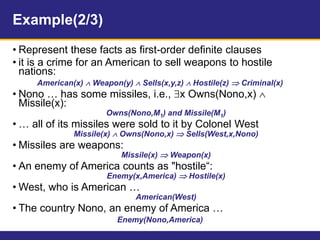
• Represent these facts as first-order definite clauses
• it is a crime for an American to sell weapons to hostile
nations:
American(x)  Weapon(y)  Sells(x,y,z)  Hostile(z)  Criminal(x)
• Nono … has some missiles, i.e., x Owns(Nono,x) 
Missile(x):
Owns(Nono,M1) and Missile(M1)
• … all of its missiles were sold to it by Colonel West
Missile(x)  Owns(Nono,x)  Sells(West,x,Nono)
• Missiles are weapons:
Missile(x)  Weapon(x)
• An enemy of America counts as "hostile“:
Enemy(x,America)  Hostile(x)
• West, who is American …
American(West)
• The country Nono, an enemy of America …
Enemy(Nono,America)
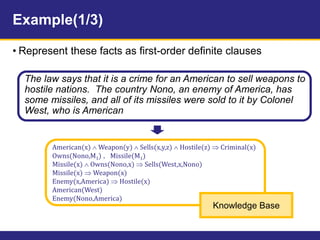
Example(1/3)
• Represent these facts as first-order definite clauses
The law says that it is a crime for an American to sell weapons to
hostile nations. The country Nono, an enemy of America, has
some missiles, and all of its missiles were sold to it by Colonel
West, who is American
American(x)  Weapon(y)  Sells(x,y,z)  Hostile(z)  Criminal(x)
Owns(Nono,M1) ,Missile(M1)
Missile(x)  Owns(Nono,x)  Sells(West,x,Nono)
Missile(x)  Weapon(x)
Enemy(x,America)  Hostile(x)
American(West)
Enemy(Nono,America)
Knowledge Base
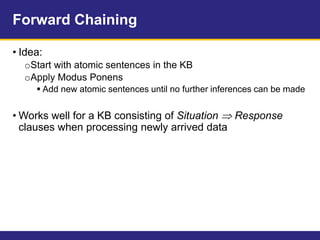
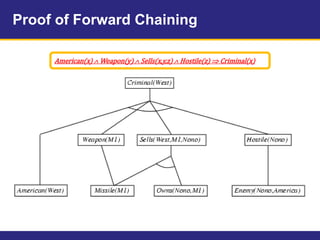
Forward Chaining
• Idea:
oStart with atomic sentences in the KB
oApply Modus Ponens
 Add new atomic sentences until no further inferences can be made
• Works well for a KB consisting of Situation  Response
clauses when processing newly arrived data
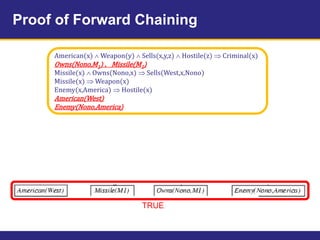
Proof of Forward Chaining
American(x)  Weapon(y)  Sells(x,y,z)  Hostile(z)  Criminal(x)
Owns(Nono,M1) ,Missile(M1)
Missile(x)  Owns(Nono,x)  Sells(West,x,Nono)
Missile(x)  Weapon(x)
Enemy(x,America)  Hostile(x)
American(West)
Enemy(Nono,America)
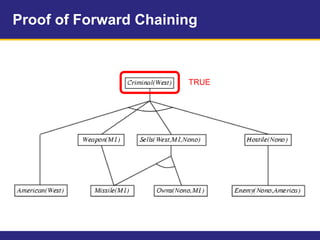
TRUE
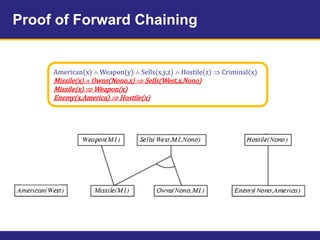
Proof of Forward Chaining
American(x)  Weapon(y)  Sells(x,y,z)  Hostile(z)  Criminal(x)
Missile(x)  Owns(Nono,x)  Sells(West,x,Nono)
Missile(x)  Weapon(x)
Enemy(x,America)  Hostile(x)
Proof of Forward Chaining
American(x)  Weapon(y)  Sells(x,y,z)  Hostile(z)  Criminal(x)
Proof of Forward Chaining
TRUE
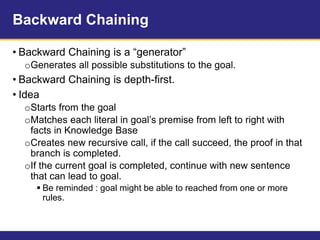
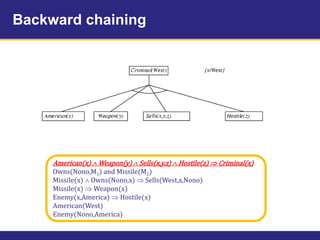
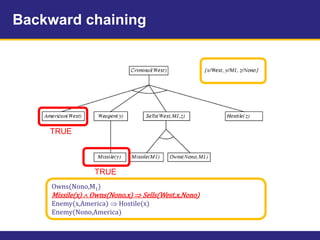
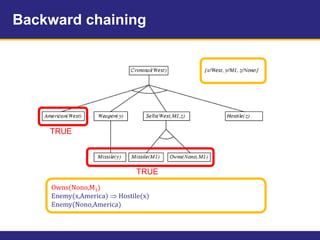
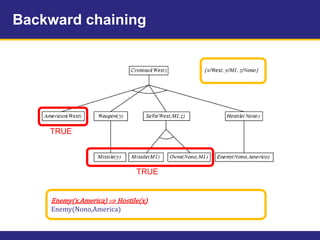
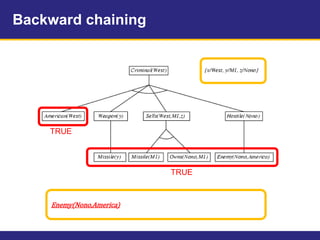
Backward Chaining
• Backward Chaining is a “generator”
oGenerates all possible substitutions to the goal.
• Backward Chaining is depth-first.
• Idea
oStarts from the goal
oMatches each literal in goal’s premise from left to right with
facts in Knowledge Base
oCreates new recursive call, if the call succeed, the proof in that
branch is completed.
oIf the current goal is completed, continue with new sentence
that can lead to goal.
 Be reminded : goal might be able to reached from one or more
rules.
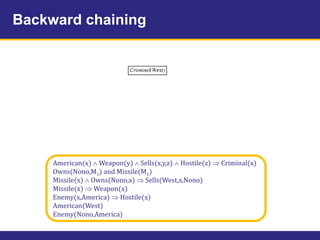
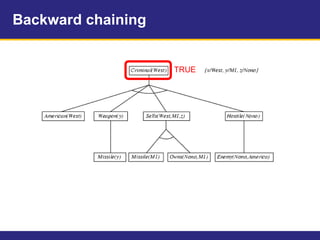
Backward chaining
American(x)  Weapon(y)  Sells(x,y,z)  Hostile(z)  Criminal(x)
Owns(Nono,M1) and Missile(M1)
Missile(x)  Owns(Nono,x)  Sells(West,x,Nono)
Missile(x)  Weapon(x)
Enemy(x,America)  Hostile(x)
American(West)
Enemy(Nono,America)
Backward chaining
American(x)  Weapon(y)  Sells(x,y,z)  Hostile(z)  Criminal(x)
Owns(Nono,M1) and Missile(M1)
Missile(x)  Owns(Nono,x)  Sells(West,x,Nono)
Missile(x)  Weapon(x)
Enemy(x,America)  Hostile(x)
American(West)
Enemy(Nono,America)
Backward chaining
American(x)  Weapon(y)  Sells(x,y,z)  Hostile(z)  Criminal(x)
Owns(Nono,M1) and Missile(M1)
Missile(x)  Owns(Nono,x)  Sells(West,x,Nono)
Missile(x)  Weapon(x)
Enemy(x,America)  Hostile(x)
American(West)
Enemy(Nono,America)
TRUE
Backward chaining
Owns(Nono,M1) and Missile(M1)
Missile(x)  Owns(Nono,x)  Sells(West,x,Nono)
Missile(x)  Weapon(x)
Enemy(x,America)  Hostile(x)
Enemy(Nono,America)
TRUE
Backward chaining
Owns(Nono,M1) and Missile(M1)
Missile(x)  Owns(Nono,x)  Sells(West,x,Nono)
Enemy(x,America)  Hostile(x)
Enemy(Nono,America)
TRUE
TRUE
Backward chaining
Owns(Nono,M1)
Missile(x)  Owns(Nono,x)  Sells(West,x,Nono)
Enemy(x,America)  Hostile(x)
Enemy(Nono,America)
TRUE
TRUE
Backward chaining
Owns(Nono,M1)
Enemy(x,America)  Hostile(x)
Enemy(Nono,America)
TRUE
TRUE
Backward chaining
Enemy(x,America)  Hostile(x)
Enemy(Nono,America)
TRUE
TRUE
Backward chaining
Enemy(Nono,America)
TRUE
TRUE
Backward chaining
TRUE
Resolution
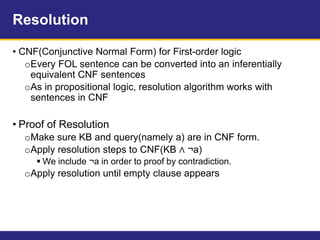
• CNF(Conjunctive Normal Form) for First-order logic
oEvery FOL sentence can be converted into an inferentially
equivalent CNF sentences
oAs in propositional logic, resolution algorithm works with
sentences in CNF
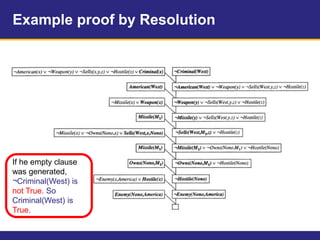
• Proof of Resolution
oMake sure KB and query(namely a) are in CNF form.
oApply resolution steps to CNF(KB ∧ ¬a)
 We include ¬a in order to proof by contradiction.
oApply resolution until empty clause appears
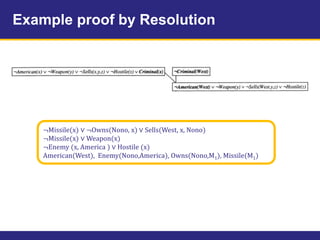
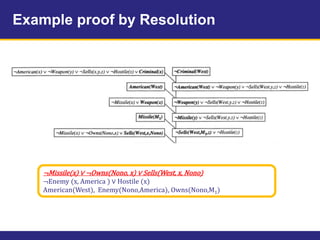
Example proof by Resolution
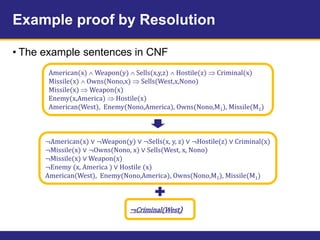
• The example sentences in CNF
American(x)  Weapon(y)  Sells(x,y,z)  Hostile(z)  Criminal(x)
Missile(x)  Owns(Nono,x)  Sells(West,x,Nono)
Missile(x)  Weapon(x)
Enemy(x,America)  Hostile(x)
American(West), Enemy(Nono,America), Owns(Nono,M1), Missile(M1)
¬American(x) ∨ ¬Weapon(y) ∨ ¬Sells(x, y, z) ∨ ¬Hostile(z) ∨ Criminal(x)
¬Missile(x) ∨ ¬Owns(Nono, x) ∨ Sells(West, x, Nono)
¬Missile(x) ∨ Weapon(x)
¬Enemy (x, America ) ∨ Hostile (x)
American(West), Enemy(Nono,America), Owns(Nono,M1), Missile(M1)
¬Criminal(West)
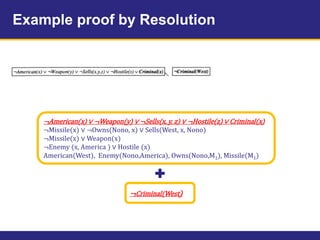
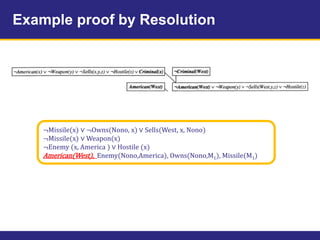
Example proof by Resolution
¬American(x) ∨ ¬Weapon(y) ∨ ¬Sells(x, y, z) ∨ ¬Hostile(z) ∨ Criminal(x)
¬Missile(x) ∨ ¬Owns(Nono, x) ∨ Sells(West, x, Nono)
¬Missile(x) ∨ Weapon(x)
¬Enemy (x, America ) ∨ Hostile (x)
American(West), Enemy(Nono,America), Owns(Nono,M1), Missile(M1)
¬Criminal(West)
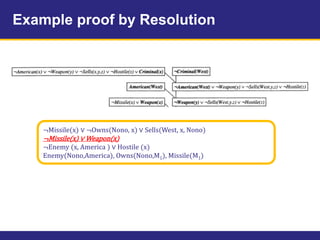
Example proof by Resolution
¬Missile(x) ∨ ¬Owns(Nono, x) ∨ Sells(West, x, Nono)
¬Missile(x) ∨ Weapon(x)
¬Enemy (x, America ) ∨ Hostile (x)
American(West), Enemy(Nono,America), Owns(Nono,M1), Missile(M1)
Example proof by Resolution
¬Missile(x) ∨ ¬Owns(Nono, x) ∨ Sells(West, x, Nono)
¬Missile(x) ∨ Weapon(x)
¬Enemy (x, America ) ∨ Hostile (x)
American(West), Enemy(Nono,America), Owns(Nono,M1), Missile(M1)
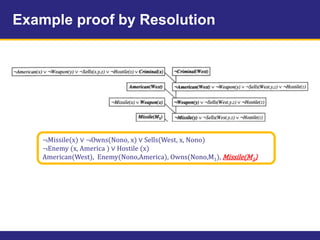
Example proof by Resolution
¬Missile(x) ∨ ¬Owns(Nono, x) ∨ Sells(West, x, Nono)
¬Missile(x) ∨ Weapon(x)
¬Enemy (x, America ) ∨ Hostile (x)
Enemy(Nono,America), Owns(Nono,M1), Missile(M1)
Example proof by Resolution
¬Missile(x) ∨ ¬Owns(Nono, x) ∨ Sells(West, x, Nono)
¬Enemy (x, America ) ∨ Hostile (x)
American(West), Enemy(Nono,America), Owns(Nono,M1), Missile(M1)
Example proof by Resolution
¬Missile(x) ∨ ¬Owns(Nono, x) ∨ Sells(West, x, Nono)
¬Enemy (x, America ) ∨ Hostile (x)
American(West), Enemy(Nono,America), Owns(Nono,M1)
Example proof by Resolution
If he empty clause
was generated,
¬Criminal(West) is
not True. So
Criminal(West) is
True.

Inference in First-Order Logic 2

  • 1.
    Example for ForwardChaining, Backward Chaining and Resolution Artificial Intelligence, A Modern Approach, CH.9 2017.05.12(Thu) Junya Tanaka (M1)
  • 2.
    Introduction • Chapter 9examine effective procedures for answering questions posed in first-order logic • Suppose same example for three important methods of inference(forward Chaining, Backward Chaining and Resolution)
  • 3.
    Example(1/3) • Consider thefollowing problem: The law says that it is a crime for an American to sell weapons to hostile nations. The country Nono, an enemy of America, has some missiles, and all of its missiles were sold to it by Colonel West, who is American • Prove oWest is a criminal
  • 4.
    Example(2/3) • Represent thesefacts as first-order definite clauses • it is a crime for an American to sell weapons to hostile nations: American(x)  Weapon(y)  Sells(x,y,z)  Hostile(z)  Criminal(x) • Nono … has some missiles, i.e., x Owns(Nono,x)  Missile(x): Owns(Nono,M1) and Missile(M1) • … all of its missiles were sold to it by Colonel West Missile(x)  Owns(Nono,x)  Sells(West,x,Nono) • Missiles are weapons: Missile(x)  Weapon(x) • An enemy of America counts as "hostile“: Enemy(x,America)  Hostile(x) • West, who is American … American(West) • The country Nono, an enemy of America … Enemy(Nono,America)
  • 5.
    Example(1/3) • Represent thesefacts as first-order definite clauses The law says that it is a crime for an American to sell weapons to hostile nations. The country Nono, an enemy of America, has some missiles, and all of its missiles were sold to it by Colonel West, who is American American(x)  Weapon(y)  Sells(x,y,z)  Hostile(z)  Criminal(x) Owns(Nono,M1) ,Missile(M1) Missile(x)  Owns(Nono,x)  Sells(West,x,Nono) Missile(x)  Weapon(x) Enemy(x,America)  Hostile(x) American(West) Enemy(Nono,America) Knowledge Base
  • 6.
    Forward Chaining • Idea: oStartwith atomic sentences in the KB oApply Modus Ponens  Add new atomic sentences until no further inferences can be made • Works well for a KB consisting of Situation  Response clauses when processing newly arrived data
  • 7.
    Proof of ForwardChaining American(x)  Weapon(y)  Sells(x,y,z)  Hostile(z)  Criminal(x) Owns(Nono,M1) ,Missile(M1) Missile(x)  Owns(Nono,x)  Sells(West,x,Nono) Missile(x)  Weapon(x) Enemy(x,America)  Hostile(x) American(West) Enemy(Nono,America) TRUE
  • 8.
    Proof of ForwardChaining American(x)  Weapon(y)  Sells(x,y,z)  Hostile(z)  Criminal(x) Missile(x)  Owns(Nono,x)  Sells(West,x,Nono) Missile(x)  Weapon(x) Enemy(x,America)  Hostile(x)
  • 9.
    Proof of ForwardChaining American(x)  Weapon(y)  Sells(x,y,z)  Hostile(z)  Criminal(x)
  • 10.
    Proof of ForwardChaining TRUE
  • 11.
    Backward Chaining • BackwardChaining is a “generator” oGenerates all possible substitutions to the goal. • Backward Chaining is depth-first. • Idea oStarts from the goal oMatches each literal in goal’s premise from left to right with facts in Knowledge Base oCreates new recursive call, if the call succeed, the proof in that branch is completed. oIf the current goal is completed, continue with new sentence that can lead to goal.  Be reminded : goal might be able to reached from one or more rules.
  • 12.
    Backward chaining American(x) Weapon(y)  Sells(x,y,z)  Hostile(z)  Criminal(x) Owns(Nono,M1) and Missile(M1) Missile(x)  Owns(Nono,x)  Sells(West,x,Nono) Missile(x)  Weapon(x) Enemy(x,America)  Hostile(x) American(West) Enemy(Nono,America)
  • 13.
    Backward chaining American(x) Weapon(y)  Sells(x,y,z)  Hostile(z)  Criminal(x) Owns(Nono,M1) and Missile(M1) Missile(x)  Owns(Nono,x)  Sells(West,x,Nono) Missile(x)  Weapon(x) Enemy(x,America)  Hostile(x) American(West) Enemy(Nono,America)
  • 14.
    Backward chaining American(x) Weapon(y)  Sells(x,y,z)  Hostile(z)  Criminal(x) Owns(Nono,M1) and Missile(M1) Missile(x)  Owns(Nono,x)  Sells(West,x,Nono) Missile(x)  Weapon(x) Enemy(x,America)  Hostile(x) American(West) Enemy(Nono,America) TRUE
  • 15.
    Backward chaining Owns(Nono,M1) andMissile(M1) Missile(x)  Owns(Nono,x)  Sells(West,x,Nono) Missile(x)  Weapon(x) Enemy(x,America)  Hostile(x) Enemy(Nono,America) TRUE
  • 16.
    Backward chaining Owns(Nono,M1) andMissile(M1) Missile(x)  Owns(Nono,x)  Sells(West,x,Nono) Enemy(x,America)  Hostile(x) Enemy(Nono,America) TRUE TRUE
  • 17.
    Backward chaining Owns(Nono,M1) Missile(x) Owns(Nono,x)  Sells(West,x,Nono) Enemy(x,America)  Hostile(x) Enemy(Nono,America) TRUE TRUE
  • 18.
    Backward chaining Owns(Nono,M1) Enemy(x,America) Hostile(x) Enemy(Nono,America) TRUE TRUE
  • 19.
    Backward chaining Enemy(x,America) Hostile(x) Enemy(Nono,America) TRUE TRUE
  • 20.
  • 21.
  • 22.
    Resolution • CNF(Conjunctive NormalForm) for First-order logic oEvery FOL sentence can be converted into an inferentially equivalent CNF sentences oAs in propositional logic, resolution algorithm works with sentences in CNF • Proof of Resolution oMake sure KB and query(namely a) are in CNF form. oApply resolution steps to CNF(KB ∧ ¬a)  We include ¬a in order to proof by contradiction. oApply resolution until empty clause appears
  • 23.
    Example proof byResolution • The example sentences in CNF American(x)  Weapon(y)  Sells(x,y,z)  Hostile(z)  Criminal(x) Missile(x)  Owns(Nono,x)  Sells(West,x,Nono) Missile(x)  Weapon(x) Enemy(x,America)  Hostile(x) American(West), Enemy(Nono,America), Owns(Nono,M1), Missile(M1) ¬American(x) ∨ ¬Weapon(y) ∨ ¬Sells(x, y, z) ∨ ¬Hostile(z) ∨ Criminal(x) ¬Missile(x) ∨ ¬Owns(Nono, x) ∨ Sells(West, x, Nono) ¬Missile(x) ∨ Weapon(x) ¬Enemy (x, America ) ∨ Hostile (x) American(West), Enemy(Nono,America), Owns(Nono,M1), Missile(M1) ¬Criminal(West)
  • 24.
    Example proof byResolution ¬American(x) ∨ ¬Weapon(y) ∨ ¬Sells(x, y, z) ∨ ¬Hostile(z) ∨ Criminal(x) ¬Missile(x) ∨ ¬Owns(Nono, x) ∨ Sells(West, x, Nono) ¬Missile(x) ∨ Weapon(x) ¬Enemy (x, America ) ∨ Hostile (x) American(West), Enemy(Nono,America), Owns(Nono,M1), Missile(M1) ¬Criminal(West)
  • 25.
    Example proof byResolution ¬Missile(x) ∨ ¬Owns(Nono, x) ∨ Sells(West, x, Nono) ¬Missile(x) ∨ Weapon(x) ¬Enemy (x, America ) ∨ Hostile (x) American(West), Enemy(Nono,America), Owns(Nono,M1), Missile(M1)
  • 26.
    Example proof byResolution ¬Missile(x) ∨ ¬Owns(Nono, x) ∨ Sells(West, x, Nono) ¬Missile(x) ∨ Weapon(x) ¬Enemy (x, America ) ∨ Hostile (x) American(West), Enemy(Nono,America), Owns(Nono,M1), Missile(M1)
  • 27.
    Example proof byResolution ¬Missile(x) ∨ ¬Owns(Nono, x) ∨ Sells(West, x, Nono) ¬Missile(x) ∨ Weapon(x) ¬Enemy (x, America ) ∨ Hostile (x) Enemy(Nono,America), Owns(Nono,M1), Missile(M1)
  • 28.
    Example proof byResolution ¬Missile(x) ∨ ¬Owns(Nono, x) ∨ Sells(West, x, Nono) ¬Enemy (x, America ) ∨ Hostile (x) American(West), Enemy(Nono,America), Owns(Nono,M1), Missile(M1)
  • 29.
    Example proof byResolution ¬Missile(x) ∨ ¬Owns(Nono, x) ∨ Sells(West, x, Nono) ¬Enemy (x, America ) ∨ Hostile (x) American(West), Enemy(Nono,America), Owns(Nono,M1)
  • 30.
    Example proof byResolution If he empty clause was generated, ¬Criminal(West) is not True. So Criminal(West) is True.

Editor's Notes

  • #8 The proof tree generated by forward chaining on the crime example. The initial facts appear at the bottom level, facts inferred on the first iteration in the middle level, and facts inferred on the second iteration at the top level.
  • #9 The proof tree generated by forward chaining on the crime example. The initial facts appear at the bottom level, facts inferred on the first iteration in the middle level, and facts inferred on the second iteration at the top level.
  • #10 The proof tree generated by forward chaining on the crime example. The initial facts appear at the bottom level, facts inferred on the first iteration in the middle level, and facts inferred on the second iteration at the top level.
  • #11 The proof tree generated by forward chaining on the crime example. The initial facts appear at the bottom level, facts inferred on the first iteration in the middle level, and facts inferred on the second iteration at the top level.
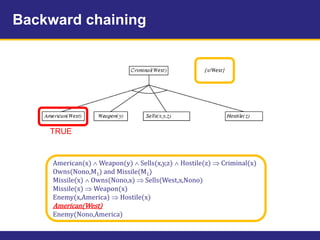
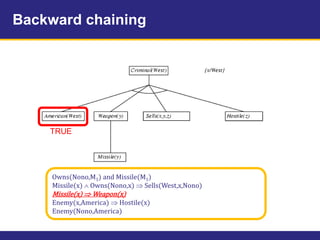
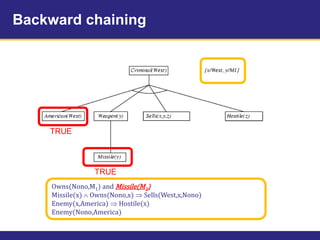
  • #13 Proof tree constructed by backward chaining to prove that West is a criminal. The tree should be read depth first, left to right. To prove Criminal (West ), we have to prove the four conjuncts below it. Some of these are in the knowledge base, and others require further backward chaining. Bindings for each successful unification are shown next to the corresponding subgoal. Note that once one subgoal in a conjunction succeeds, its substitution is applied to subsequent subgoals. Thus, by the time FOL-BC-ASK gets to the last conjunct, originally Hostile(z), z is already bound to Nono.
  • #14 Proof tree constructed by backward chaining to prove that West is a criminal. The tree should be read depth first, left to right. To prove Criminal (West ), we have to prove the four conjuncts below it. Some of these are in the knowledge base, and others require further backward chaining. Bindings for each successful unification are shown next to the corresponding subgoal. Note that once one subgoal in a conjunction succeeds, its substitution is applied to subsequent subgoals. Thus, by the time FOL-BC-ASK gets to the last conjunct, originally Hostile(z), z is already bound to Nono.
  • #15 Proof tree constructed by backward chaining to prove that West is a criminal. The tree should be read depth first, left to right. To prove Criminal (West ), we have to prove the four conjuncts below it. Some of these are in the knowledge base, and others require further backward chaining. Bindings for each successful unification are shown next to the corresponding subgoal. Note that once one subgoal in a conjunction succeeds, its substitution is applied to subsequent subgoals. Thus, by the time FOL-BC-ASK gets to the last conjunct, originally Hostile(z), z is already bound to Nono.
  • #16 Proof tree constructed by backward chaining to prove that West is a criminal. The tree should be read depth first, left to right. To prove Criminal (West ), we have to prove the four conjuncts below it. Some of these are in the knowledge base, and others require further backward chaining. Bindings for each successful unification are shown next to the corresponding subgoal. Note that once one subgoal in a conjunction succeeds, its substitution is applied to subsequent subgoals. Thus, by the time FOL-BC-ASK gets to the last conjunct, originally Hostile(z), z is already bound to Nono.
  • #17 Proof tree constructed by backward chaining to prove that West is a criminal. The tree should be read depth first, left to right. To prove Criminal (West ), we have to prove the four conjuncts below it. Some of these are in the knowledge base, and others require further backward chaining. Bindings for each successful unification are shown next to the corresponding subgoal. Note that once one subgoal in a conjunction succeeds, its substitution is applied to subsequent subgoals. Thus, by the time FOL-BC-ASK gets to the last conjunct, originally Hostile(z), z is already bound to Nono.
  • #18 Proof tree constructed by backward chaining to prove that West is a criminal. The tree should be read depth first, left to right. To prove Criminal (West ), we have to prove the four conjuncts below it. Some of these are in the knowledge base, and others require further backward chaining. Bindings for each successful unification are shown next to the corresponding subgoal. Note that once one subgoal in a conjunction succeeds, its substitution is applied to subsequent subgoals. Thus, by the time FOL-BC-ASK gets to the last conjunct, originally Hostile(z), z is already bound to Nono.
  • #19 Proof tree constructed by backward chaining to prove that West is a criminal. The tree should be read depth first, left to right. To prove Criminal (West ), we have to prove the four conjuncts below it. Some of these are in the knowledge base, and others require further backward chaining. Bindings for each successful unification are shown next to the corresponding subgoal. Note that once one subgoal in a conjunction succeeds, its substitution is applied to subsequent subgoals. Thus, by the time FOL-BC-ASK gets to the last conjunct, originally Hostile(z), z is already bound to Nono.
  • #20 Proof tree constructed by backward chaining to prove that West is a criminal. The tree should be read depth first, left to right. To prove Criminal (West ), we have to prove the four conjuncts below it. Some of these are in the knowledge base, and others require further backward chaining. Bindings for each successful unification are shown next to the corresponding subgoal. Note that once one subgoal in a conjunction succeeds, its substitution is applied to subsequent subgoals. Thus, by the time FOL-BC-ASK gets to the last conjunct, originally Hostile(z), z is already bound to Nono.
  • #21 Proof tree constructed by backward chaining to prove that West is a criminal. The tree should be read depth first, left to right. To prove Criminal (West ), we have to prove the four conjuncts below it. Some of these are in the knowledge base, and others require further backward chaining. Bindings for each successful unification are shown next to the corresponding subgoal. Note that once one subgoal in a conjunction succeeds, its substitution is applied to subsequent subgoals. Thus, by the time FOL-BC-ASK gets to the last conjunct, originally Hostile(z), z is already bound to Nono.
  • #22 Proof tree constructed by backward chaining to prove that West is a criminal. The tree should be read depth first, left to right. To prove Criminal (West ), we have to prove the four conjuncts below it. Some of these are in the knowledge base, and others require further backward chaining. Bindings for each successful unification are shown next to the corresponding subgoal. Note that once one subgoal in a conjunction succeeds, its substitution is applied to subsequent subgoals. Thus, by the time FOL-BC-ASK gets to the last conjunct, originally Hostile(z), z is already bound to Nono.