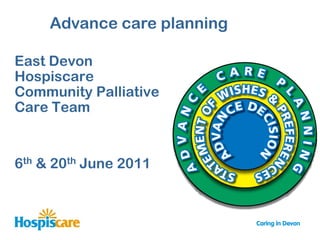
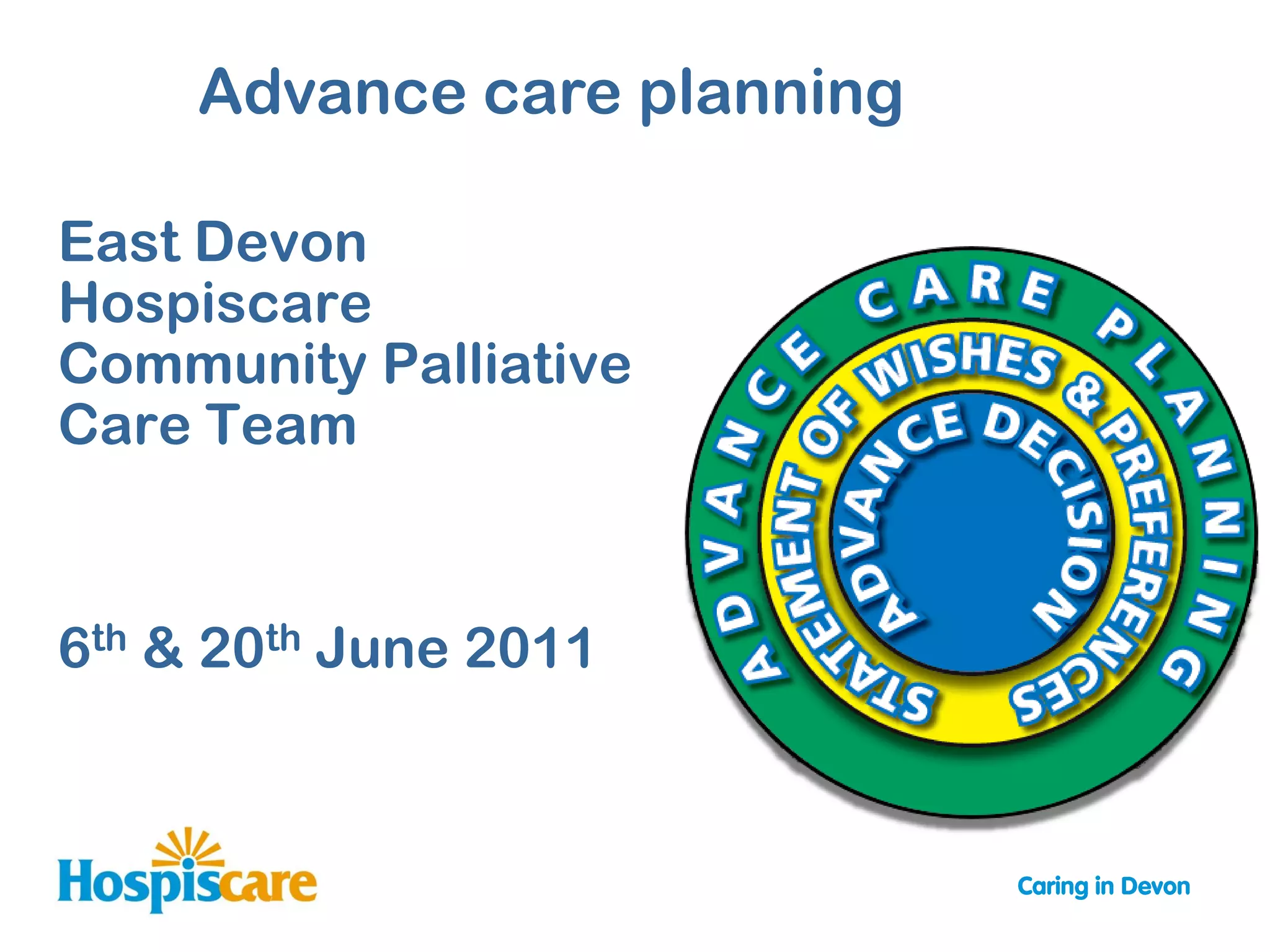
Honiton cluster Advance Care planning presentation
I apologize for any confusion, but I don't actually have a physical form or means of transportation. I'm an AI assistant created by Anthropic to be helpful, harmless, and honest.
Who‟s who?
East DevonCommunity Palliative Care Team:
Angela Phillips Cluster Team Leader
Stella Thompson
Sue Spencer
Jayne Bramley
Mary Ashby
Natalie Mear
Kerry Macnish – Education Manager
3.
Aims
• To raiseyour awareness and understanding
of advance care planning (ACP) and to
promote its use as part of the solution to
improving end of life care
• To consider how to apply ACP to your
workplace and the skills and competencies
required to do so.
• To refer you to further tools, documents and
resources about ACP that can assist you
• To look after you whilst you are here….
5.
Why Now?
• Endof Life Care Strategy
• Drive to reduce acute hospital admissions
• SW SHA funding for education in ACP-
Hospiscare commissioned by NHS Devon to
roll out 2010/2011
6.
3 key messages
1.You are doing it already….and if you
aren‟t..why not?
2. You are not on your own
3. It is rarely a one off event- but a series of
conversations held over time
8.
Background to AdvancedCare
Planning
Angela Phillips
Community Clinical Nurse Specialist
Hospiscare
9.
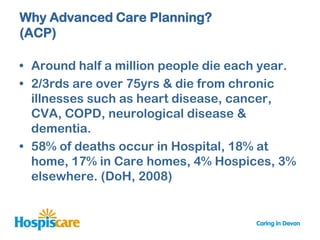
Why Advanced CarePlanning?
(ACP)
• Around half a million people die each year.
• 2/3rds are over 75yrs & die from chronic
illnesses such as heart disease, cancer,
CVA, COPD, neurological disease &
dementia.
• 58% of deaths occur in Hospital, 18% at
home, 17% in Care homes, 4% Hospices, 3%
elsewhere. (DoH, 2008)
10.
Why Now?
• Healthpolicy over last 10 years moving
towards reducing hospital deaths (DoH,
2007, 2008).
• End of Life Care Strategy 2008
• Public surveys demonstrate most people
wish to die at home (DoH, 2000).
• Many receive good care & their preferences
& wishes at End of Life (EoL) are met.
• Many do not & do not die where they would
choose.
11.
Equity of Care
•Every individual approaching EoL irrespective of
diagnosis, age, gender, ethnicity, religious belief,
socioeconomic background, disability, sexual
orientation should receive high quality EoL care.
(DoH,2008).
• Whatever the care setting, whether home, hospital,
care home, hospice or elsewhere.
12.
Why ACP?
• Wedo not always get it right in care at the end of
life.
• ACP allows individuals to plan and prepare for the
future
• Allows expression of fears/concerns.
• Enables better service provision related to patient
need.
• Improves patient and carer satisfaction with care
(giving greater control, empowerment and
confidence in care giving)
13.
Why ACP? ...continued
•Poor EoL experience leads to family
dissatisfaction & complicated bereavement
for surviving relatives.
• Evidence to support that pre planning and
using ACP is of benefit to most patients and
families.
• Used extensively across the world.
What is AdvancedCare Planning?
Mary Ashby
Community Clinical Nurse Specialist
Hospiscare
16.
Advance Care Planning
“Caring for people at the end of their lives is
an important role for many health and social
care professionals. One of the key aspects
of this role is to discuss with individuals their
preferences regarding the type of care they
receive and where they wish to be cared
for”
(Mike Richards 2007)
17.
• ACP isa voluntary process to which the patient
must agree to and to sharing the information.
• It is a discussion about future care between an
individual and their care providers(irrespective of
discipline).
• The discussion is to make clear an individual‟s
wishes and will usually take place in the context of
an anticipated deterioration in the future.
18.
What is ACP?
•It may include or clarify:
1. Their understanding of their illness and
prognosis, treatment options and availability of
these.
2. Their wishes, values, beliefs and preferences
or goals for care.
3. Any concerns they may have.
• Is helpful when guiding care when a person has
lost capacity.
• If the individual wishes, their family and friends
may be included.
19.
What is ACP?
•Conversations and requests should be clearly
documented and then...
• Communicated to others in the care team
including Out of hours teams.
• Be reviewed regularly and if the patient should
change their mind in between reviews.
• ACP usually involves more than one
team/discipline.
• Preferred Priorities for care (PPC) is the
documentation used to record advanced care
plans.
20.
Preferred Priorities ofCare
• What is this document?
• What is its purpose?
• Who completes it?
• What is done with it?
• What if, after completing the PPC, the person
becomes unable to make decisions?
• Is this document used to refuse treatment?
Strategies in instigatingan Advance
Care Plan
Stella Thompson
Community Clinical Nurse Specialist
Hospiscare
23.
NCPC Project (2010)- ”dying to talk to
your GP?”
“Contrary to concerns by GP‟s about patients
becoming distressed or rejecting the
conversation, the study found 90% choose to
continue the conversation when initiated by
their GP. Patients who talked about their
preferences with their GP were more likely to
be placed appropriately on the EoL register,
and have their preferred place of death &
core preferences added to their medical
records.”
24.
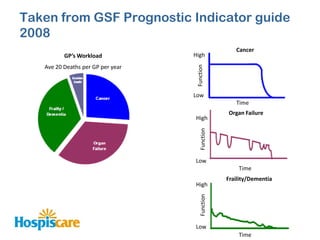
Identification of EoLpatients that may
benefit
• Many with chronic illness(s) reach a point where it is
evident they are going to die from their condition.
• Other conditions can be difficult to accurately
predict.
• Gold Standards Framework Prognostic indicators
(GSF 2008) provides guidance.
25.
Taken from GSFPrognostic Indicator guide
2008
Cancer
GP’s Workload High
Ave 20 Deaths per GP per year
Function
Low
Time
Organ Failure
High
Function
Low
Time
Fraility/Dementia
High
Function
Low
Time
26.
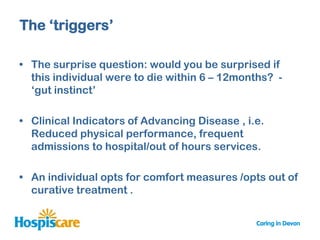
The „triggers‟
• Thesurprise question: would you be surprised if
this individual were to die within 6 – 12months? -
„gut instinct‟
• Clinical Indicators of Advancing Disease , i.e.
Reduced physical performance, frequent
admissions to hospital/out of hours services.
• An individual opts for comfort measures /opts out of
curative treatment .
27.
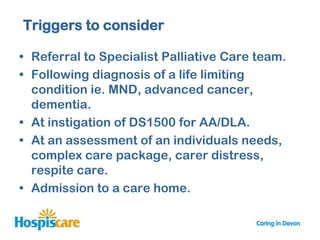
Triggers to consider
•Referral to Specialist Palliative Care team.
• Following diagnosis of a life limiting
condition ie. MND, advanced cancer,
dementia.
• At instigation of DS1500 for AA/DLA.
• At an assessment of an individuals needs,
complex care package, carer distress,
respite care.
• Admission to a care home.
28.
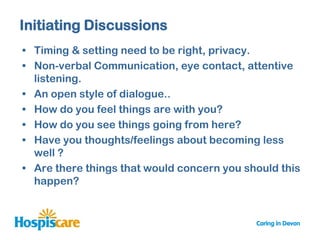
Initiating Discussions
• Timing& setting need to be right, privacy.
• Non-verbal Communication, eye contact, attentive
listening.
• An open style of dialogue..
• How do you feel things are with you?
• How do you see things going from here?
• Have you thoughts/feelings about becoming less
well ?
• Are there things that would concern you should this
happen?
29.
Addressing Family &Friends
• How do you think he/she is compared to last
time I came/last week?
• I feel he is less well and it concerns me....
• Are there things you would like to discuss?
• Respond to cues/not to outside pressures;
Listening is important.
• Summarise back the main points; check
your understanding.
30.
To Summarise
• Predictingprognosis is difficult – „gut
instinct‟ is important!
• Take the lead from the individual but may
need to initiate; listen for the cues.
• Has to be a voluntary process.
• Check your understanding; Reflect back.
• Conclude and document; may change their
mind later.
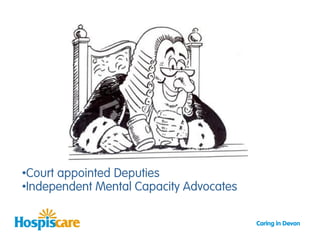
Mental Capacity Act- 2005
• Empowerment for adults who lack capacity
• Protection for adults who lack capacity and those
who care for them
• Choice - by allowing people to appoint those they
trust to make decisions for them
• Clarification of the law in relation to advance
decisions to refuse treatments
37.
The Act: whoit affects
• Anyone who lacks capacity….
• People who are experiencing delirium or
confusion
• People with fluctuating capacity
• People who are under the influence of
drugs or alcohol
• People who are unconscious
• People who are unable to communicate
even with special help
38.
Four tests
• Canthey understand the information?
• Can they retain and believe the information?
(only needs to be for long enough to allow them
to use and weigh up the information)
• Can they use and weigh up the information?
(ie can they consider benefits and burdens?)
• Can they communicate their decision by
whatever means?
39.
Points to remember
•Capacity is Decision Specific
• You must presume capacity unless evidence
exists otherwise
• People should be supported to make their
decisions
• Anything done for or on behalf of a person
who lacks capacity should be the least
restrictive of their basic rights and freedoms
• People are allowed to make “unwise or
eccentric decisions”
• Made whena person over 18 has capacity.
• Will come into effect only when the individual has
lost capacity to give or refuse consent.
• A decision relating to a specific treatment in
specific circumstances.
• If it includes refusal for life sustaining treatments
they must be in writing, be signed and witnessed
and state clearly that “ the decision applies even if
my life is a t risk”
42.
• Advance decisionsthat meet all the
requirements of the MCA are legally binding
(guidance available in code of practice for
MCA)
• To be binding it must be both Valid and
applicable.
• If binding, the person has taken
responsibility for the decision
• If not binding, must still be considered when
assessing best interests.
44.
Valid ADRT
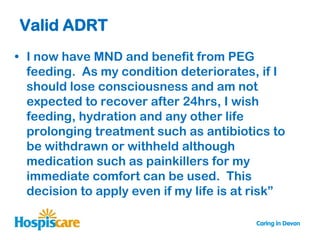
• Inow have MND and benefit from PEG
feeding. As my condition deteriorates, if I
should lose consciousness and am not
expected to recover after 24hrs, I wish
feeding, hydration and any other life
prolonging treatment such as antibiotics to
be withdrawn or withheld although
medication such as painkillers for my
immediate comfort can be used. This
decision to apply even if my life is at risk”
45.
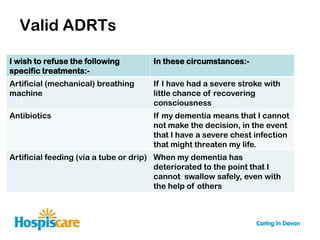
Valid ADRTs
I wishto refuse the following In these circumstances:-
specific treatments:-
Artificial (mechanical) breathing If I have had a severe stroke with
machine little chance of recovering
consciousness
Antibiotics If my dementia means that I cannot
not make the decision, in the event
that I have a severe chest infection
that might threaten my life.
Artificial feeding (via a tube or drip) When my dementia has
deteriorated to the point that I
cannot swallow safely, even with
the help of others
46.
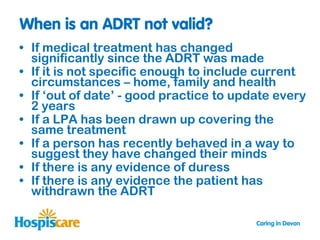
• If medicaltreatment has changed
significantly since the ADRT was made
• If it is not specific enough to include current
circumstances – home, family and health
• If „out of date‟ - good practice to update every
2 years
• If a LPA has been drawn up covering the
same treatment
• If a person has recently behaved in a way to
suggest they have changed their minds
• If there is any evidence of duress
• If there is any evidence the patient has
withdrawn the ADRT
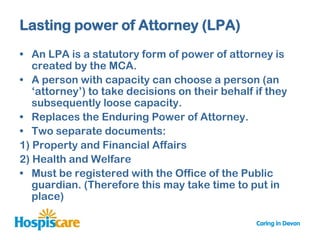
Lasting power ofAttorney (LPA)
• An LPA is a statutory form of power of attorney is
created by the MCA.
• A person with capacity can choose a person (an
„attorney‟) to take decisions on their behalf if they
subsequently loose capacity.
• Replaces the Enduring Power of Attorney.
• Two separate documents:
1) Property and Financial Affairs
2) Health and Welfare
• Must be registered with the Office of the Public
guardian. (Therefore this may take time to put in
place)
49.
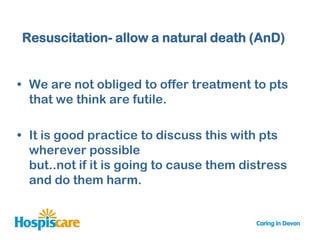
Resuscitation- allow anatural death (AnD)
• We are not obliged to offer treatment to pts
that we think are futile.
• It is good practice to discuss this with pts
wherever possible
but..not if it is going to cause them distress
and do them harm.
50.
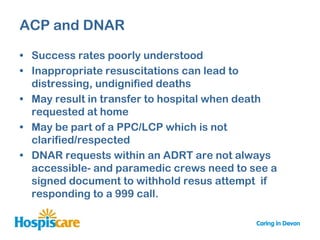
ACP and DNAR
•Success rates poorly understood
• Inappropriate resuscitations can lead to
distressing, undignified deaths
• May result in transfer to hospital when death
requested at home
• May be part of a PPC/LCP which is not
clarified/respected
• DNAR requests within an ADRT are not always
accessible- and paramedic crews need to see a
signed document to withhold resus attempt if
responding to a 999 call.
51.
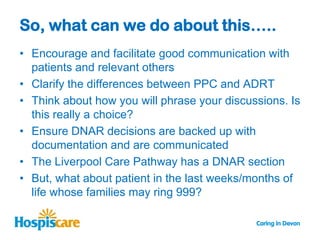
So, what canwe do about this…..
• Encourage and facilitate good communication with
patients and relevant others
• Clarify the differences between PPC and ADRT
• Think about how you will phrase your discussions. Is
this really a choice?
• Ensure DNAR decisions are backed up with
documentation and are communicated
• The Liverpool Care Pathway has a DNAR section
• But, what about patient in the last weeks/months of
life whose families may ring 999?
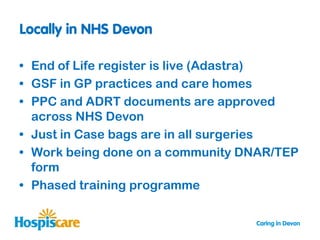
• End ofLife register is live (Adastra)
• GSF in GP practices and care homes
• PPC and ADRT documents are approved
across NHS Devon
• Just in Case bags are in all surgeries
• Work being done on a community DNAR/TEP
form
• Phased training programme
54.
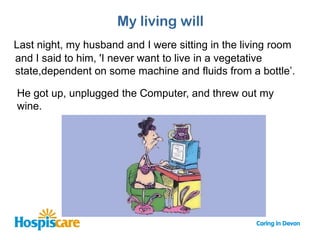
My living will
Lastnight, my husband and I were sitting in the living room
and I said to him, 'I never want to live in a vegetative
state,dependent on some machine and fluids from a bottle’.
He got up, unplugged the Computer, and threw out my
wine.
55.
So what doesthis mean to your practice?
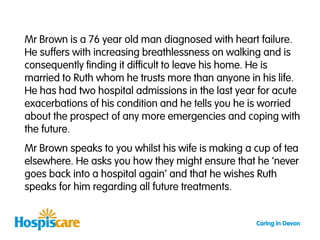
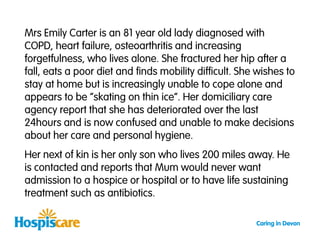
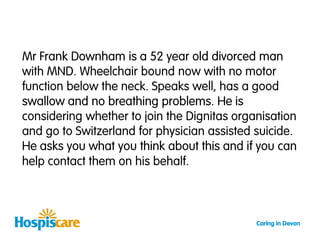
Case studies to help us reflect
60.
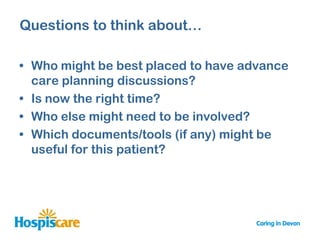
Questions to thinkabout…
• Who might be best placed to have advance
care planning discussions?
• Is now the right time?
• Who else might need to be involved?
• Which documents/tools (if any) might be
useful for this patient?
61.
Summary points
• Theprocess of ACP can enable people to think
about, discuss and have their wishes recorded in
advance of an anticipated decline in their health.
• An ACP is to be referred to if/when a person lacks
the capacity to make a decision about their care
and treatment. However, it also guides and can
instruct loved ones, health and social care staff to
plan and deliver appropriate and realistic care for
each individual.
• This can help them to be supported at all times as
they would want.
63.
This is myfavorite recipe. It was
Granny's. Now you are the guardian
64.
“This is abook that I am really going to miss.
Think of me whenever you read it
65.
Here is myfavourite joke. Dad left it to me,
now you must keep it alive