
Advanced Care PlanningExeter Hospiscare Community Palliative Care Team2 March 2011
Who’s who?Exeter Community Palliative Care Team:Jane OliverBeth DawRebecca MeyrickFreddy James – GSF in Nursing Homes Kerry Macnish – Education ManagerTim Harlow
Background to Advanced Care PlanningJane OliverClinical Nurse SpecialistHospiscare
Why Advanced Care Planning?(ACP)Around half a million people die each year.2/3rds are over 75yrs & die from chronic illnesses such as heart disease, cancer, CVA, COPD, neurological disease & dementia.58% of deaths occur in Hospital, 18% at home, 17% in Care homes, 4% Hospices, 3% elsewhere. (DH, 2008)
BackgroundHealth policy over last 10 years moving towards reducing hospital deaths (DOH, 2007, 2008).
Public surveys demonstrate most people wish to die at home (DOH, 2000).
Many receive good care & their preferences & wishes at EoL are met.
Many do not & do not die where they would choose.  Why does this matter?ACP allows individuals to Plan  for future, & prepare their loved ones.  Promotes autonomy, sense of control, respect & dignity; holistic care.  Allows expression of fears/concerns.Poor EoL experience leads to family dissatisfaction, complicated bereavement for surviving relatives.
Equity of CareEvery individual approaching EoL irrespective of diagnosis, age, gender, ethnicity, religious belief, socioeconomic background, disability, sexual orientation should receive high quality EoL care. (DOH, 2008).Whatever the care setting, whether home, hospital, care home, hospice or elsewhere.
NCPC Project(2010)”dying to talk to your GP?” “Contrary to concerns by GP’s about patients becoming distressed or rejecting the conversation, the study found 90% choose to continue the conversation when initiated by their GP. Patients who talked about their preferences with their GP were more likely to be placed appropriately on the EoL register, and have their preferred place of death & core preferences added to their medical records.”  Achieving thisACP supports identifying individuals approaching EoL.
Initiates discussions about preferences & wishes .
Agrees a plan of care.
Improves awareness & Coordination. ReferencesThe cancer Plan (DoH, 2000).The Cancer Reform Strategy(DoH, 2007).Advanced Care Planning: A guide for Health & Social Care Staff (2007) at: http//www.endoflifecareforadults.nhs.uk The End of Life Strategy (DoH, 2008).Dying Matters Coalition GP Project NCPC (2010) at http//www.dyingmatters.org
ADVANCED CARE PLANNINGBeth DawCOMMUNITY CLINICAL NURSE SPECIALIST  Palliative care
Advance Care Planning“ Caring for people at the end of their lives is an important role for many health and social care professionals.  One of the key aspects of this role is to discuss with individuals their preferences regarding the type of care they receive and where they wish to be cared for”(Mike Richards 2007)
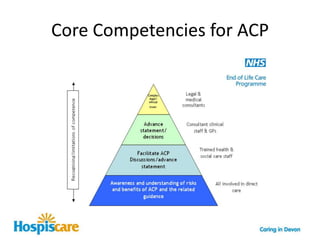
What is Advance Care Planning?ACP is a process of discussion between an individual and their care providers irrespective of discipline The difference between ACP and general care planning is ACP usually takes place in the context of an anticipated deterioration in the individual’s condition in the future Preferred Priorities of care (PPC) is the documentation used to record an advance care plan
Advance Care PlanningWhat is covered?
Who completes it?
What does it provide?
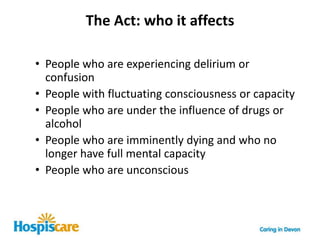
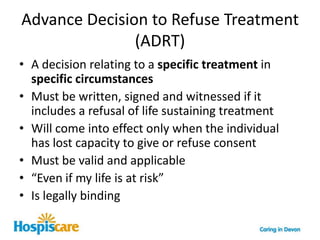
Is it legally binding?
How does it help?
Does it need to be signed and witnessed?
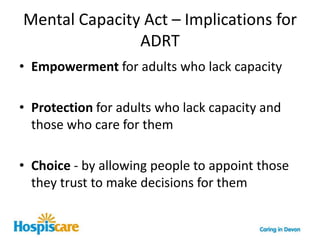
Who should see it?Preferred Priorities of CareWhat is this document?What is its purpose?Who completes it?What is done with it?What if, after completing the PPC, the person becomes unable to make decisions?Is this document used to refuse treatment?
Hope and ACPInformation leads to less fear and more controlHelps maintain relationships, preserve normality, reduce feelings of being a burden. Encourages a sense of being in control, empowered and enabled. ACP can enhance HOPE not diminish it
Strategies in Instigating an ACP Jane OliverClinical Nurse SpecialistHospiscare
FocusIdentify the timing to instigate ACPPresenting Opportunities/triggers.Basic Communication skills/strategies in conversations.
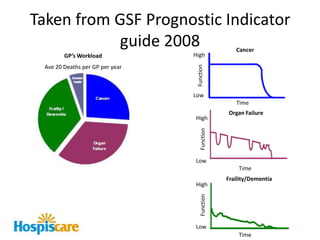
Indentification of EoLMany with chronic illness(s) reach a point where it is evident they are going to die from their condition.Other conditions it can be difficult to accurately predict.Gold Standards Framework Prognostic indicators (GSF, 2008) provides guidance.
CancerHighFunctionGP’s WorkloadAve 20 Deaths per GP per yearLowTimeOrgan FailureHighFunctionLowTimeFraility/DementiaHighFunctionLowTimeTaken from GSF Prognostic Indicator guide 2008
The ‘triggers’The surprise question: would you be surprised if this individual were to die within 6 – 12months?  - ‘gut instinct’Clinical Indicators of Advancing Disease , i.e. Reduced physical performance, frequent admissions to hospital/out of hours services.An individual opts for comfort measures /opts out of curative treatment .
 triggers to considerReferral to Specialist Palliative Care team. Following diagnosis of a life limiting condition ie. MND, advanced cancer, dementia.At instigation of DS1500.At an assessment of an individuals needs, complex care package, carer distress, respite care.Admission to a care home.
Initiating DiscussionsTiming & setting need to be right, privacy.
Non-verbal Communication, eye contact, attentive listening.
An open style of dialogue..
How do you feel things are with you?
How do you see things going from here?
Have you thoughts/feelings about becoming less well ?
Are there things that would concern you should this happen?Addressing Family & Friends  How do you think he/she is compared to last time I came/last week?I feel he is less well and it concerns me....Are there things you would like to discuss?Respond to cues/not to outside pressures; Listening is important.Summarise back the main points; check your understanding.
To SummarisePrognostication is difficult – ‘gut instinct’ is important!
Take the lead from the individual but may need to initiate; listen for the cues.
Has to be a voluntary process.
Check your understanding; Reflect back.

Advanced care planning Hospiscare

  • 1.
    Advanced Care PlanningExeterHospiscare Community Palliative Care Team2 March 2011
  • 2.
    Who’s who?Exeter CommunityPalliative Care Team:Jane OliverBeth DawRebecca MeyrickFreddy James – GSF in Nursing Homes Kerry Macnish – Education ManagerTim Harlow
  • 3.
    Background to AdvancedCare PlanningJane OliverClinical Nurse SpecialistHospiscare
  • 4.
    Why Advanced CarePlanning?(ACP)Around half a million people die each year.2/3rds are over 75yrs & die from chronic illnesses such as heart disease, cancer, CVA, COPD, neurological disease & dementia.58% of deaths occur in Hospital, 18% at home, 17% in Care homes, 4% Hospices, 3% elsewhere. (DH, 2008)
  • 5.
    BackgroundHealth policy overlast 10 years moving towards reducing hospital deaths (DOH, 2007, 2008).
  • 6.
    Public surveys demonstratemost people wish to die at home (DOH, 2000).
  • 7.
    Many receive goodcare & their preferences & wishes at EoL are met.
  • 8.
    Many do not& do not die where they would choose. Why does this matter?ACP allows individuals to Plan for future, & prepare their loved ones. Promotes autonomy, sense of control, respect & dignity; holistic care. Allows expression of fears/concerns.Poor EoL experience leads to family dissatisfaction, complicated bereavement for surviving relatives.
  • 9.
    Equity of CareEveryindividual approaching EoL irrespective of diagnosis, age, gender, ethnicity, religious belief, socioeconomic background, disability, sexual orientation should receive high quality EoL care. (DOH, 2008).Whatever the care setting, whether home, hospital, care home, hospice or elsewhere.
  • 10.
    NCPC Project(2010)”dying totalk to your GP?” “Contrary to concerns by GP’s about patients becoming distressed or rejecting the conversation, the study found 90% choose to continue the conversation when initiated by their GP. Patients who talked about their preferences with their GP were more likely to be placed appropriately on the EoL register, and have their preferred place of death & core preferences added to their medical records.” Achieving thisACP supports identifying individuals approaching EoL.
  • 11.
    Initiates discussions aboutpreferences & wishes .
  • 12.
  • 13.
    Improves awareness &Coordination. ReferencesThe cancer Plan (DoH, 2000).The Cancer Reform Strategy(DoH, 2007).Advanced Care Planning: A guide for Health & Social Care Staff (2007) at: http//www.endoflifecareforadults.nhs.uk The End of Life Strategy (DoH, 2008).Dying Matters Coalition GP Project NCPC (2010) at http//www.dyingmatters.org
  • 14.
    ADVANCED CARE PLANNINGBethDawCOMMUNITY CLINICAL NURSE SPECIALIST Palliative care
  • 15.
    Advance Care Planning“Caring for people at the end of their lives is an important role for many health and social care professionals. One of the key aspects of this role is to discuss with individuals their preferences regarding the type of care they receive and where they wish to be cared for”(Mike Richards 2007)
  • 16.
    What is AdvanceCare Planning?ACP is a process of discussion between an individual and their care providers irrespective of discipline The difference between ACP and general care planning is ACP usually takes place in the context of an anticipated deterioration in the individual’s condition in the future Preferred Priorities of care (PPC) is the documentation used to record an advance care plan
  • 17.
  • 18.
  • 19.
    What does itprovide?
  • 20.
  • 21.
  • 22.
    Does it needto be signed and witnessed?
  • 23.
    Who should seeit?Preferred Priorities of CareWhat is this document?What is its purpose?Who completes it?What is done with it?What if, after completing the PPC, the person becomes unable to make decisions?Is this document used to refuse treatment?
  • 24.
    Hope and ACPInformationleads to less fear and more controlHelps maintain relationships, preserve normality, reduce feelings of being a burden. Encourages a sense of being in control, empowered and enabled. ACP can enhance HOPE not diminish it
  • 25.
    Strategies in Instigatingan ACP Jane OliverClinical Nurse SpecialistHospiscare
  • 26.
    FocusIdentify the timingto instigate ACPPresenting Opportunities/triggers.Basic Communication skills/strategies in conversations.
  • 27.
    Indentification of EoLManywith chronic illness(s) reach a point where it is evident they are going to die from their condition.Other conditions it can be difficult to accurately predict.Gold Standards Framework Prognostic indicators (GSF, 2008) provides guidance.
  • 28.
    CancerHighFunctionGP’s WorkloadAve 20Deaths per GP per yearLowTimeOrgan FailureHighFunctionLowTimeFraility/DementiaHighFunctionLowTimeTaken from GSF Prognostic Indicator guide 2008
  • 29.
    The ‘triggers’The surprisequestion: would you be surprised if this individual were to die within 6 – 12months? - ‘gut instinct’Clinical Indicators of Advancing Disease , i.e. Reduced physical performance, frequent admissions to hospital/out of hours services.An individual opts for comfort measures /opts out of curative treatment .
  • 30.
    triggers toconsiderReferral to Specialist Palliative Care team. Following diagnosis of a life limiting condition ie. MND, advanced cancer, dementia.At instigation of DS1500.At an assessment of an individuals needs, complex care package, carer distress, respite care.Admission to a care home.
  • 31.
    Initiating DiscussionsTiming &setting need to be right, privacy.
  • 32.
    Non-verbal Communication, eyecontact, attentive listening.
  • 33.
    An open styleof dialogue..
  • 34.
    How do youfeel things are with you?
  • 35.
    How do yousee things going from here?
  • 36.
    Have you thoughts/feelingsabout becoming less well ?
  • 37.
    Are there thingsthat would concern you should this happen?Addressing Family & Friends How do you think he/she is compared to last time I came/last week?I feel he is less well and it concerns me....Are there things you would like to discuss?Respond to cues/not to outside pressures; Listening is important.Summarise back the main points; check your understanding.
  • 38.
    To SummarisePrognostication isdifficult – ‘gut instinct’ is important!
  • 39.
    Take the leadfrom the individual but may need to initiate; listen for the cues.
  • 40.
    Has to bea voluntary process.
  • 41.

Editor's Notes

  • #40 Point 2 In patients who are generally weak, who are gradually deteriorating and in whom there are a number of medical problems, then the chance of resuscitation being successful is extremely low (<1%). Dr’s will sometimes decide that offering resus is inappropriate as it would be extremely unlikely to lead to a return to reasonable quality of life. It may also be felt that discussing this may cause distress.