Prof. Emil. M. Petriu
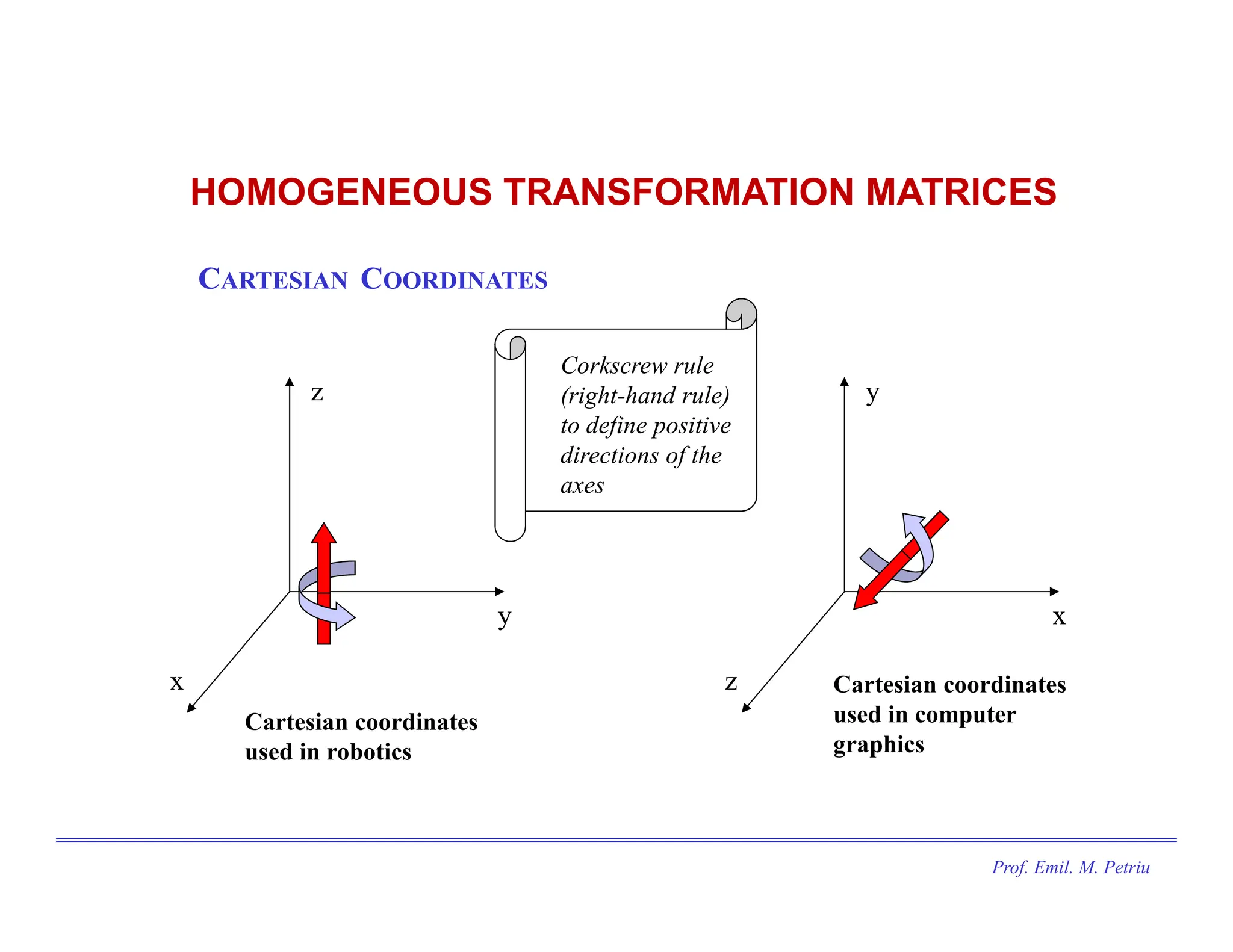
CARTESIAN COORDINATES
x
y
z
Cartesian coordinates
used in robotics
z
x
y
Cartesian coordinates
used in computer
graphics
Corkscrew rule
(right-hand rule)
to define positive
directions of the
axes
HOMOGENEOUS TRANSFORMATION MATRICES
x0
y0
z0
R
q
R y1
x1
z1
N
q
N
y1
x1
z1
N*
q
N
Q*
r
R
p
R
P*
R
Q
q*
R
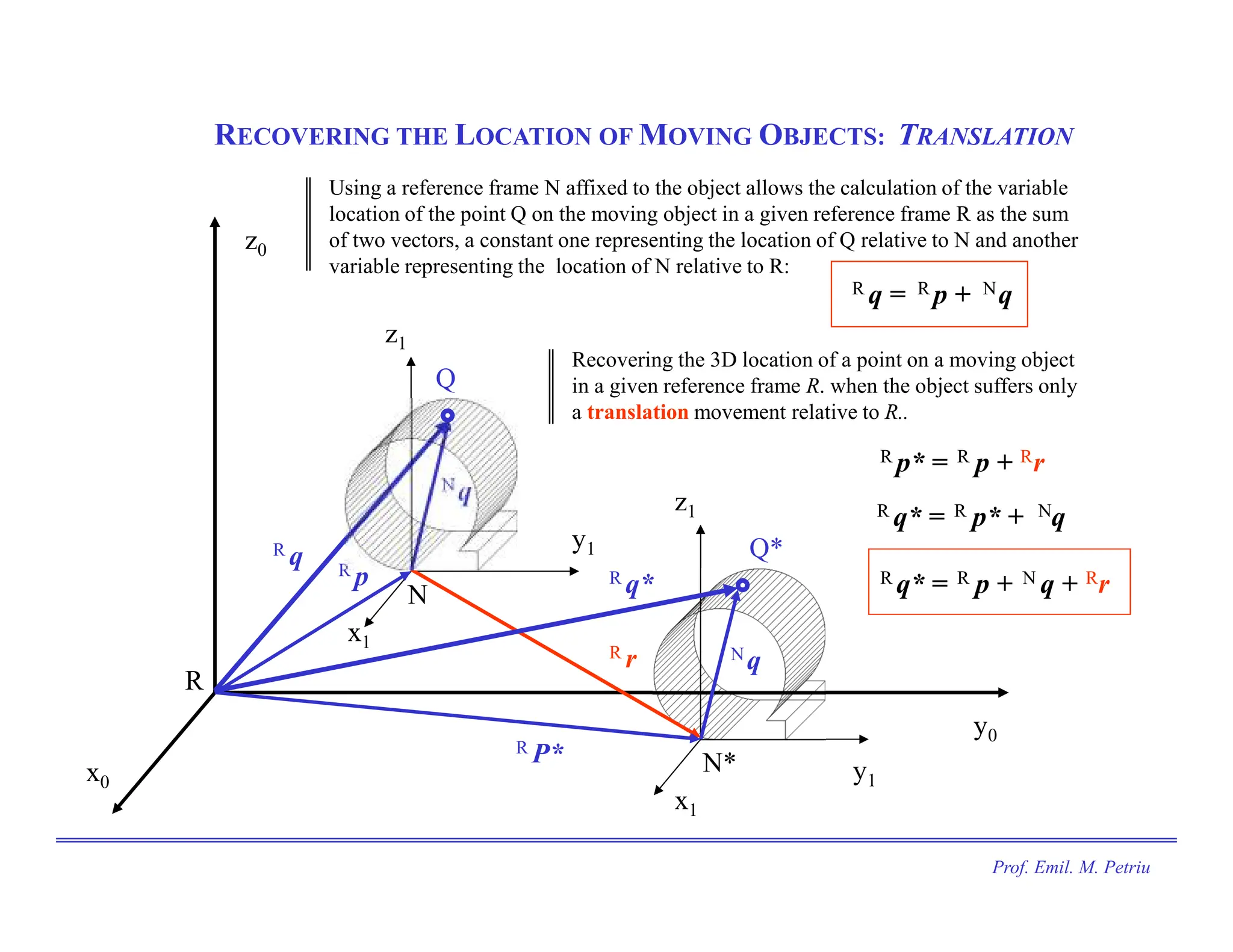
RECOVERING THE LOCATION OF MOVING OBJECTS: TRANSLATION
q* = p* + q
R R N
p* = p + r
R R R
q* = p + q + r
R R R
N
q = p + q
R R N
Using a reference frame N affixed to the object allows the calculation of the variable
location of the point Q on the moving object in a given reference frame R as the sum
of two vectors, a constant one representing the location of Q relative to N and another
variable representing the location of N relative to R:
Recovering the 3D location of a point on a moving object
in a given reference frame R. when the object suffers only
a translation movement relative to R..
Prof. Emil. M. Petriu
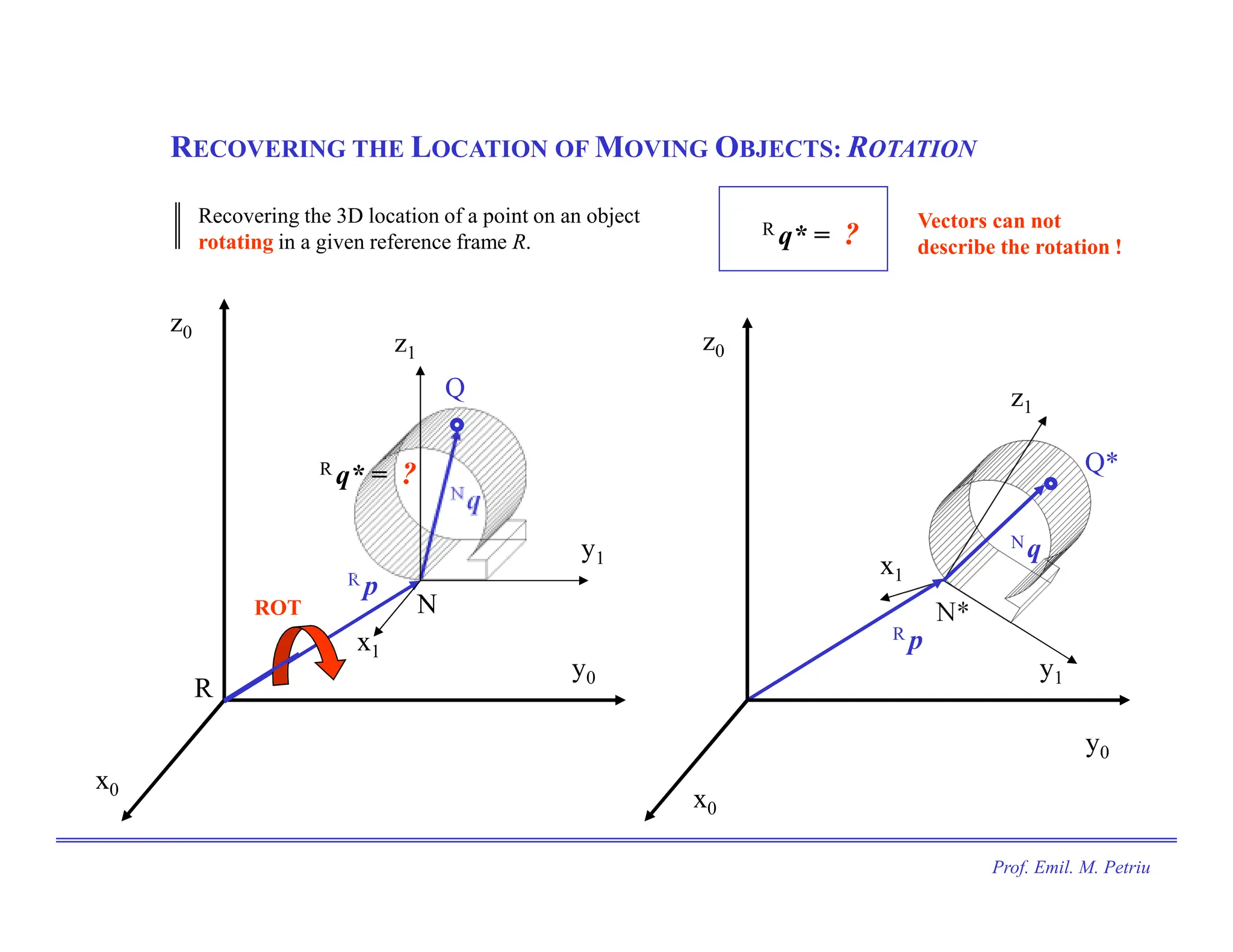
RECOVERING THE LOCATION OF MOVING OBJECTS: ROTATION
x0
y0
z0
R
p
R
q
N
y1
x1
z1
N
Q
ROT
q* = ?
R
Recovering the 3D location of a point on an object
rotating in a given reference frame R.
y1
x1
z1
N*
q
N
Q*
p
R
x0
z0
y0
Vectors can not
describe the rotation !
q* = ?
R
Prof. Emil. M. Petriu
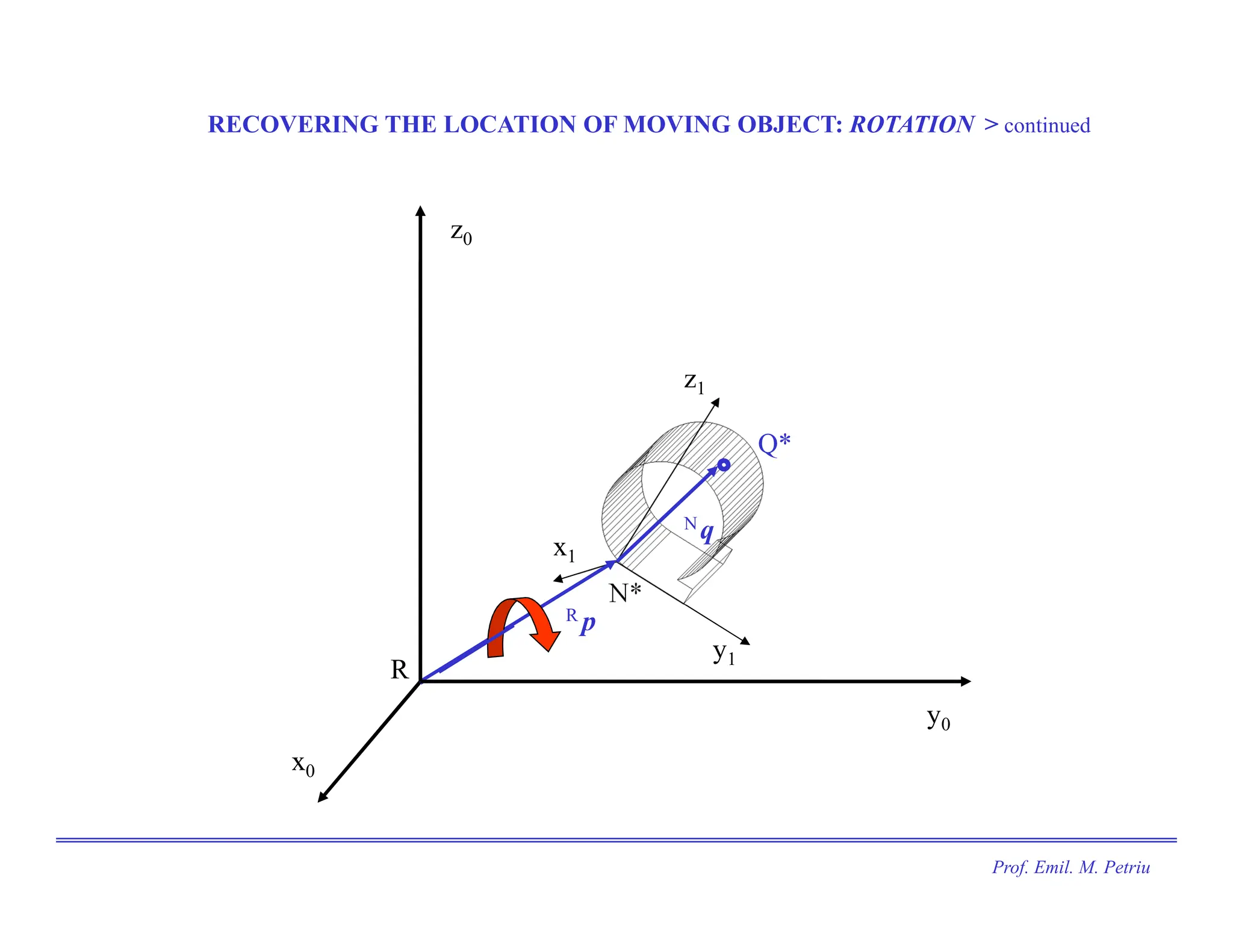
RECOVERING THE LOCATION OF MOVING OBJECT: ROTATION > continued
x0
y0
z0
R
p
R
q
N
y1
x1
z1
N
Q
ROT
y1
x1
z1
N
Rot( x, ψ )
Rot( y, θ)
Rot( z, φ )
y1
x1
z1
N*
q
N
Q*
p
R
Prof. Emil. M. Petriu
x0
y0
z0
R
p
R
q
N
y1
x1
z1
N
Q
RECOVERING THE LOCATION OF MOVING OBJECT: ROTATION > continued
ROT
y1
x1
z1
N
Rot( x, ψ )
Rot( y, θ)
Rot( z, φ )
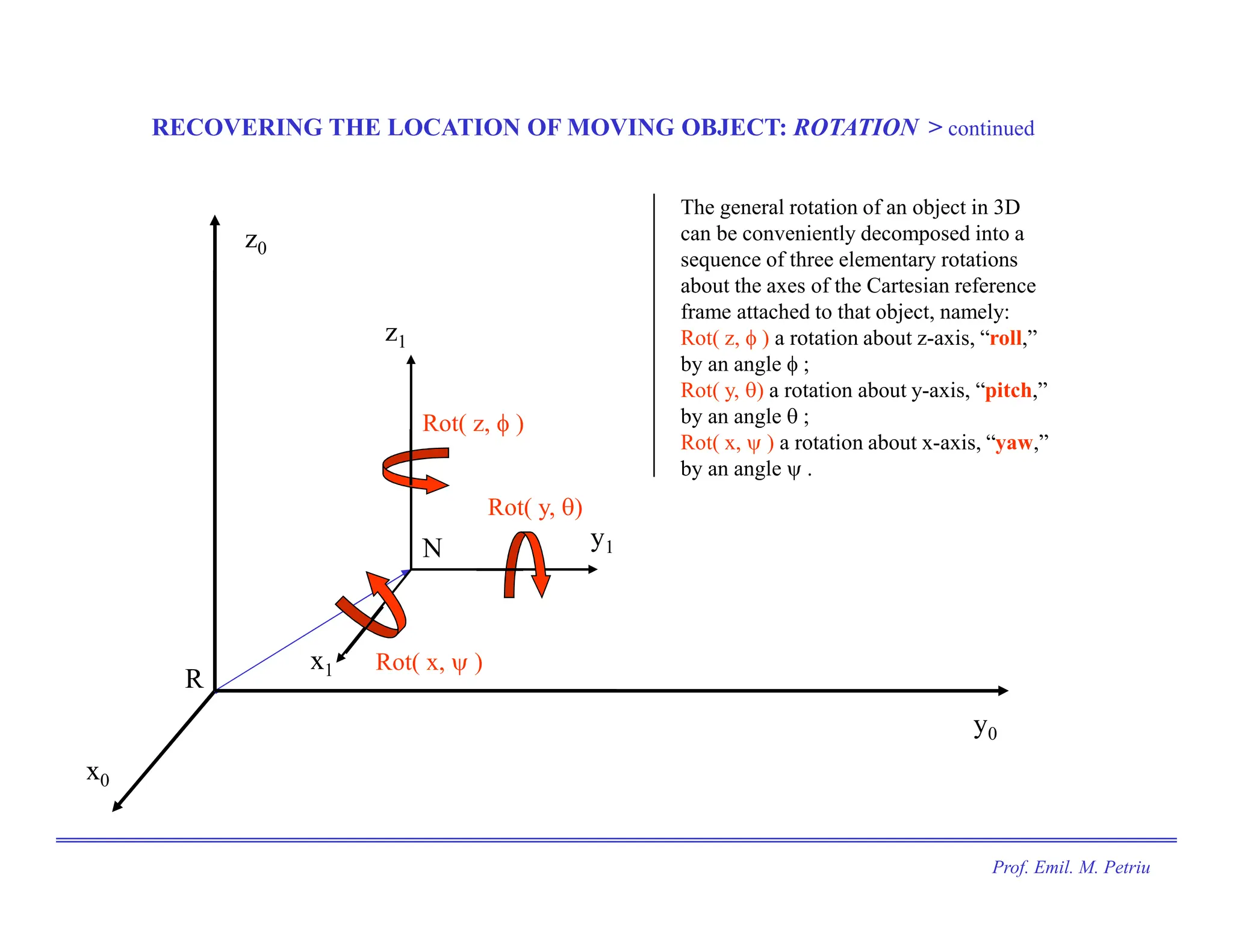
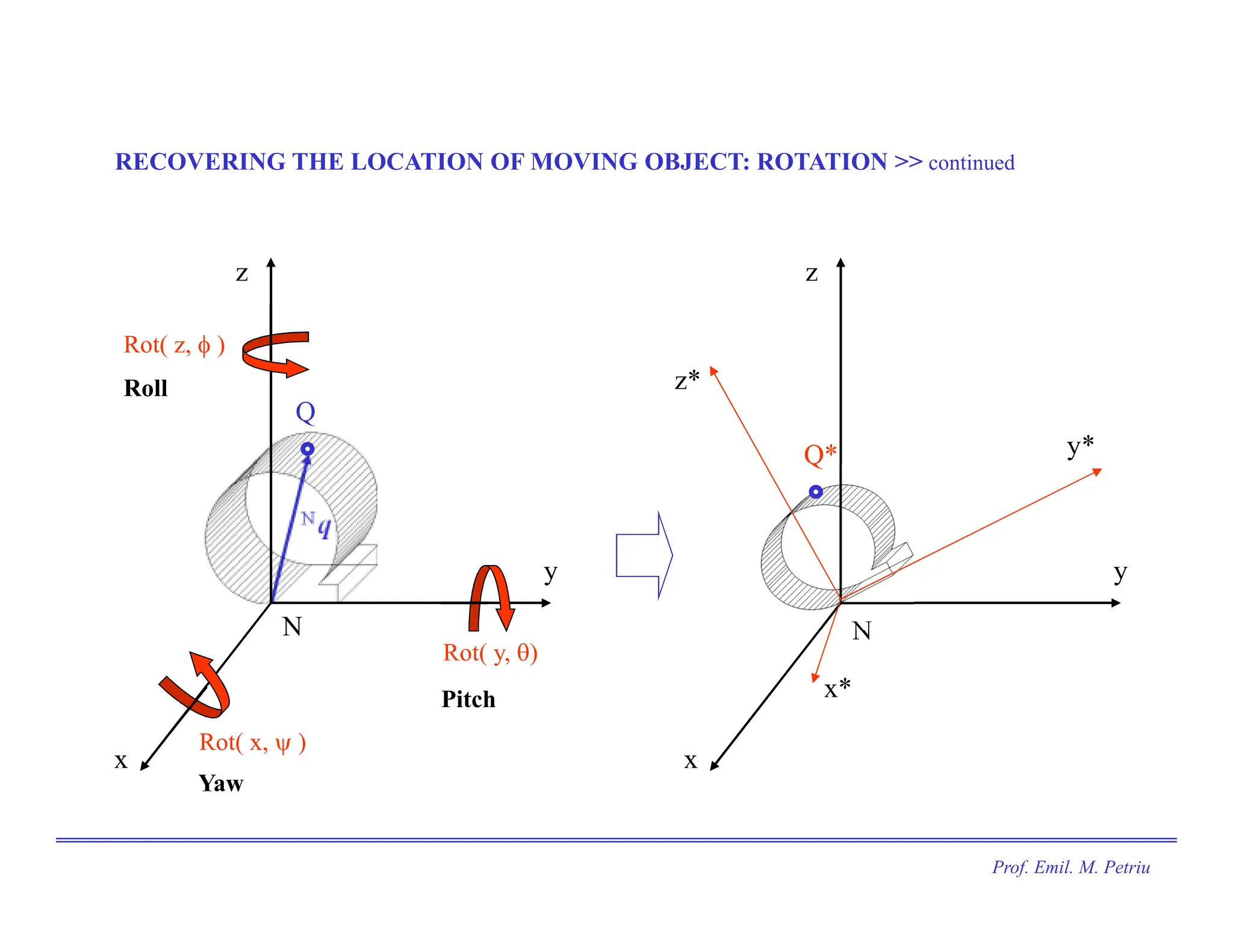
The general rotation of an object in 3D
can be conveniently decomposed into a
sequence of three elementary rotations
about the axes of the Cartesian reference
frame attached to that object, namely:
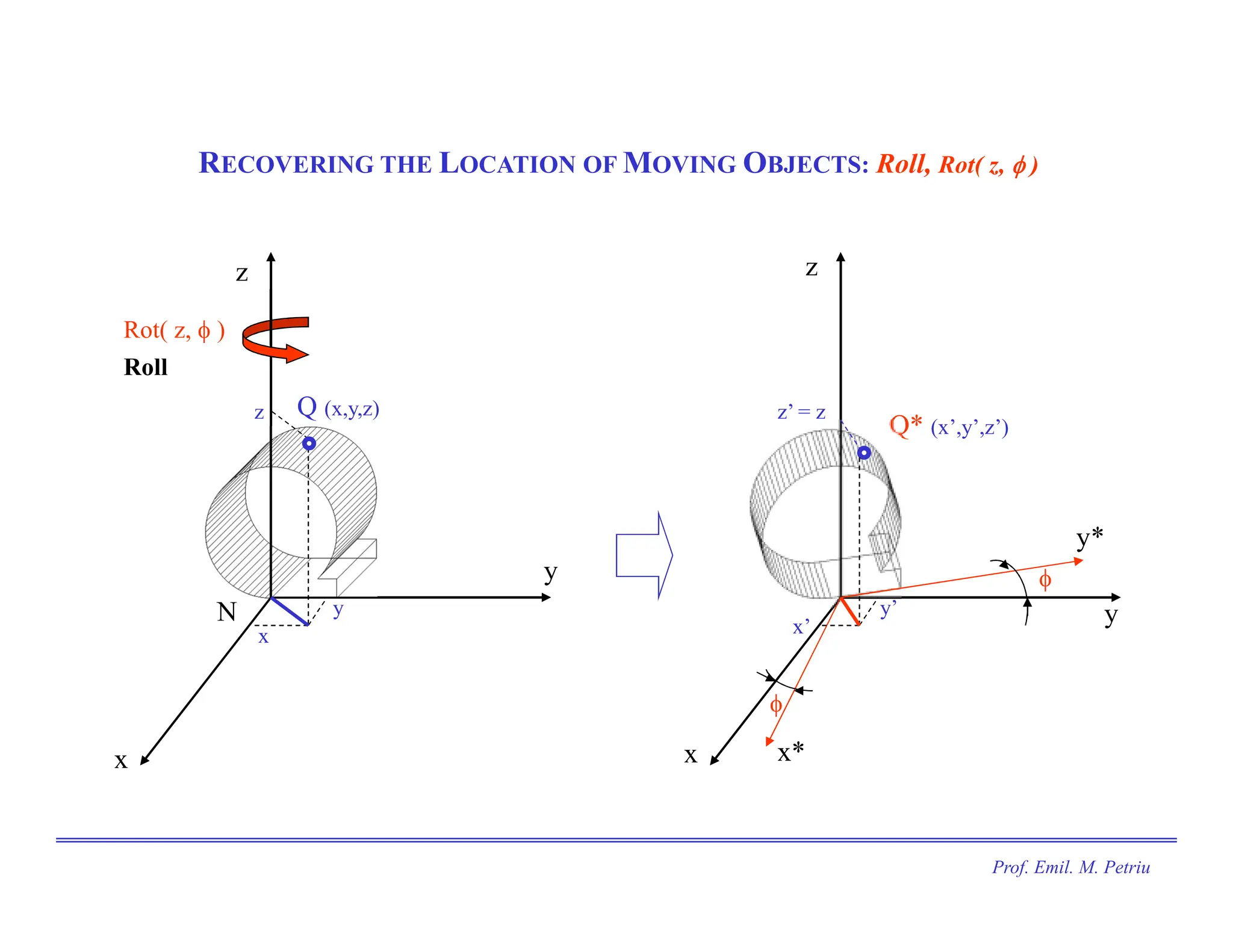
Rot( z, φ ) a rotation about z-axis, “roll,”
by an angle φ ;
Rot( y, θ) a rotation about y-axis, “pitch,”
by an angle θ ;
Rot( x, ψ ) a rotation about x-axis, “yaw,”
by an angle ψ .
Prof. Emil. M. Petriu
x0
y0
z0
R
p
R
q
N
y1
x1
z1
N
Q
RECOVERING THE LOCATION OF MOVING OBJECT: ROTATION > continued
ROT
y1
x1
z1
N
Rot( x, ψ )
Rot( y, θ)
Rot( z, φ )
y1
x1
z1
N*
q
N
Q*
p
R
RPY
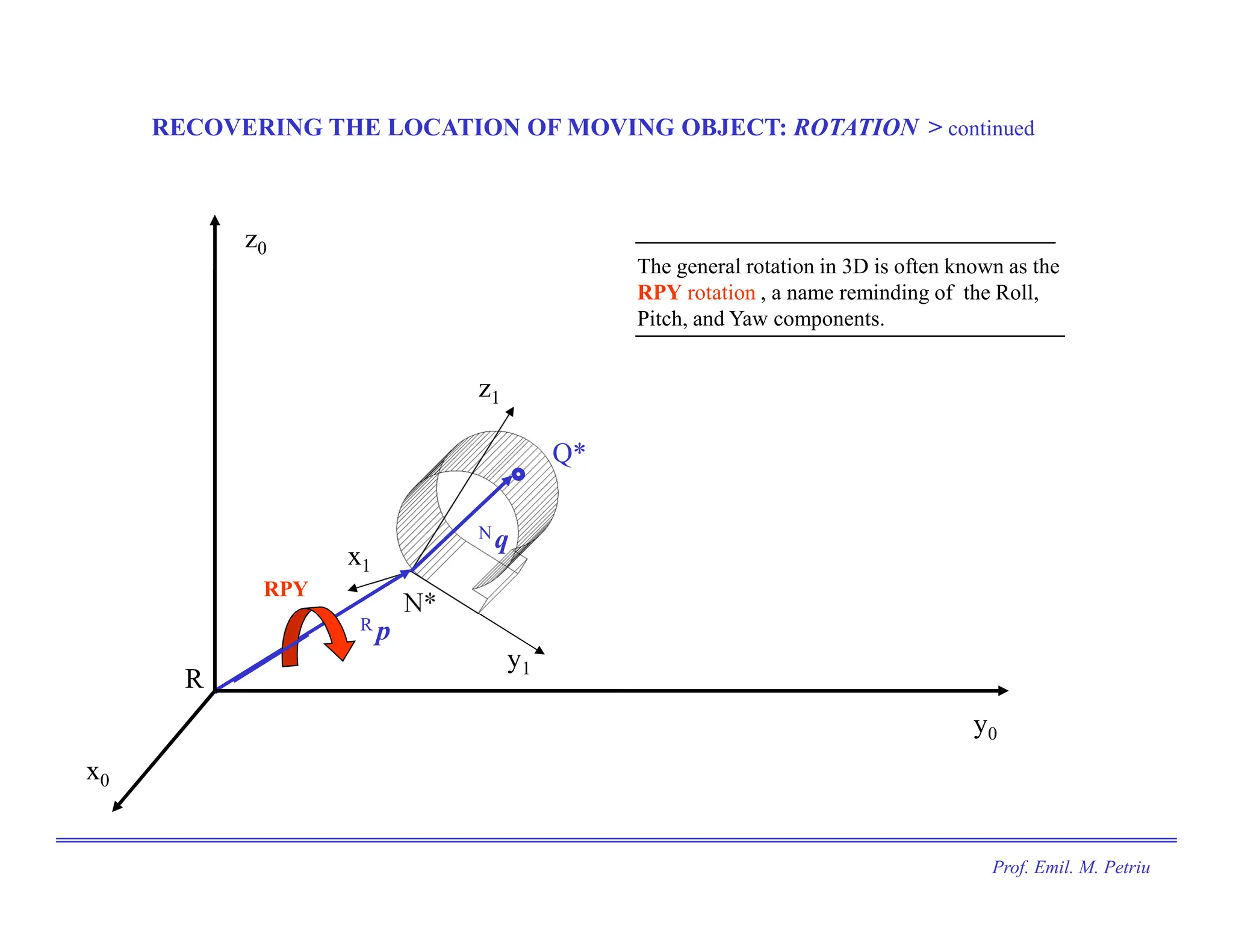
The general rotation in 3D is often known as the
RPY rotation , a name reminding of the Roll,
Pitch, and Yaw components.
Prof. Emil. M. Petriu
RECOVERING THE LOCATION OF MOVING OBJECT: ROTATION >> continued
q
N
Q
y
x
z
N
Rot( x, ψ )
Rot( y, θ)
Rot( z, φ )
Roll
Pitch
Yaw
y
x
z
N
Q*
z*
x*
y*
Prof. Emil. M. Petriu
RECOVERING THE LOCATION OF MOVING OBJECTS: Roll, Rot( z, φ
φ
φ
φ )
y
x
z
Rot( z, φ )
Roll
N
x
y
z Q (x,y,z)
Q* (x’,y’,z’)
y
x
z
x*
y*
z’ = z
y’
x’
φ
φ
Prof. Emil. M. Petriu
RECOVERING THE LOCATION OF MOVING OBJECTS: Rot( z, φ
φ
φ
φ ) > continued
φ
y*
Q* (x’,y’)
φ
x*
x
y
Q (x,y)
α
α
d
d
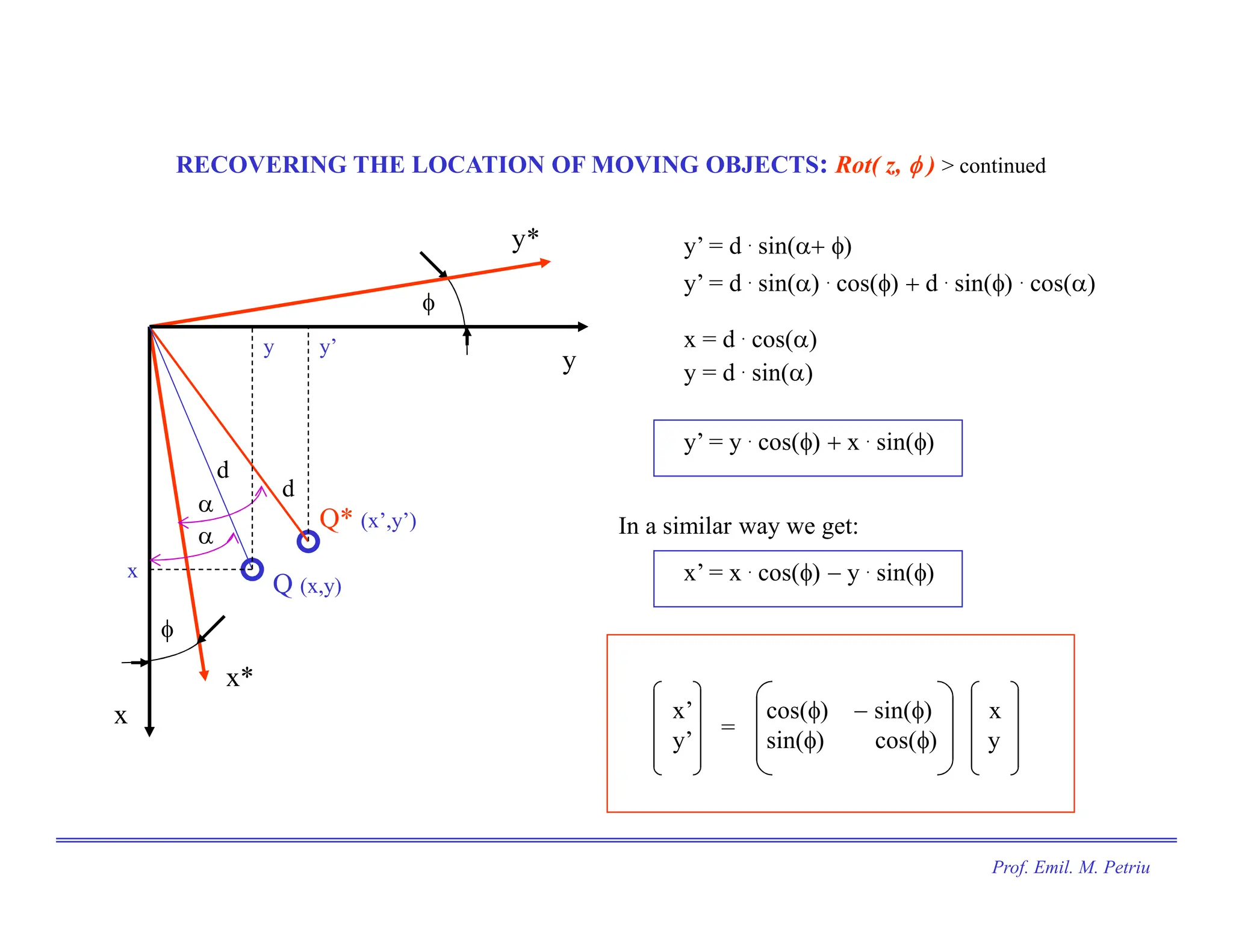
y’ = d . sin(α+ φ)
y’
y’ = d . sin(α) . cos(φ) + d . sin(φ) . cos(α)
y
y = d . sin(α)
x
x = d . cos(α)
y’ = y . cos(φ) + x . sin(φ)
x’ cos(φ) − sin(φ) x
y’ sin(φ) cos(φ) y
=
x’ = x . cos(φ) − y . sin(φ)
In a similar way we get:
Prof. Emil. M. Petriu
3D HOMOGENEOUS TRANSFORMATION MATRICES FOR ROBOTICS
3-by-3 3-by-1
rotation translation
sub-matrix sub-matrix
0 0 0 1
T =
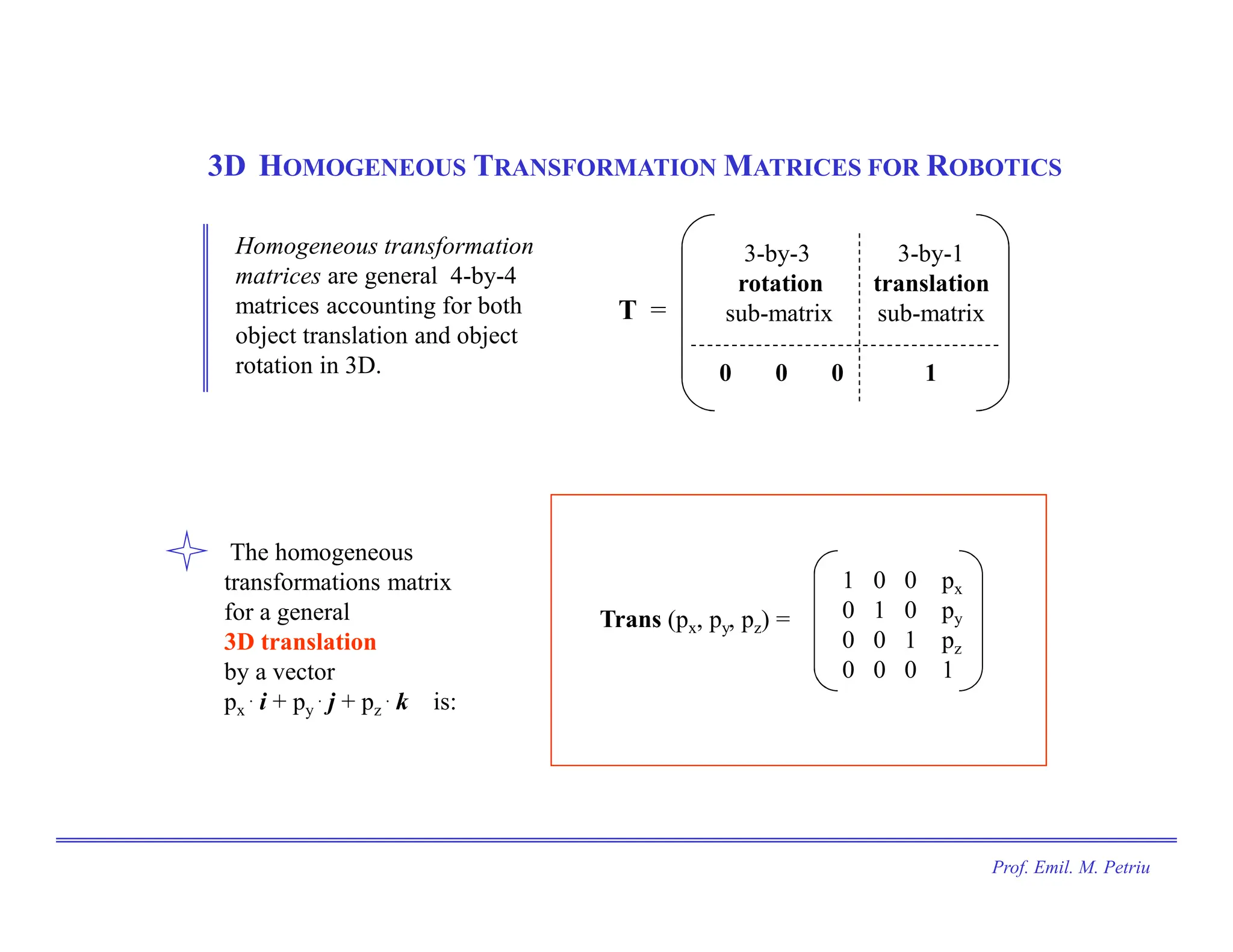
Homogeneous transformation
matrices are general 4-by-4
matrices accounting for both
object translation and object
rotation in 3D.
The homogeneous
transformations matrix
for a general
3D translation
by a vector
px
. i + py
. j + pz
. k is:
Trans (px, py, pz) =
1 0 0 px
0 1 0 py
0 0 1 pz
0 0 0 1
Prof. Emil. M. Petriu
Q (x,y,z)
y
x
z
N
Rot( z, φ )
Roll
Rot( y, θ)
Pitch
Rot( x, ψ )
Yaw
Rot( x, ψ ) =
1 0 0 0
0 cos (ψ) -sin (ψ) 0
0 sin (ψ) cos (ψ) 0
0 0 0 1
Rot( y, θ ) =
cos (θ) 0 sin (θ) 0
0 1 0 0
-sin (θ) 0 cos (θ) 0
0 0 0 1
Rot( z, φ ) =
cos (φ) -sin (φ) 0 0
sin (φ) cos (φ) 0 0
0 0 1 0
0 0 0 1
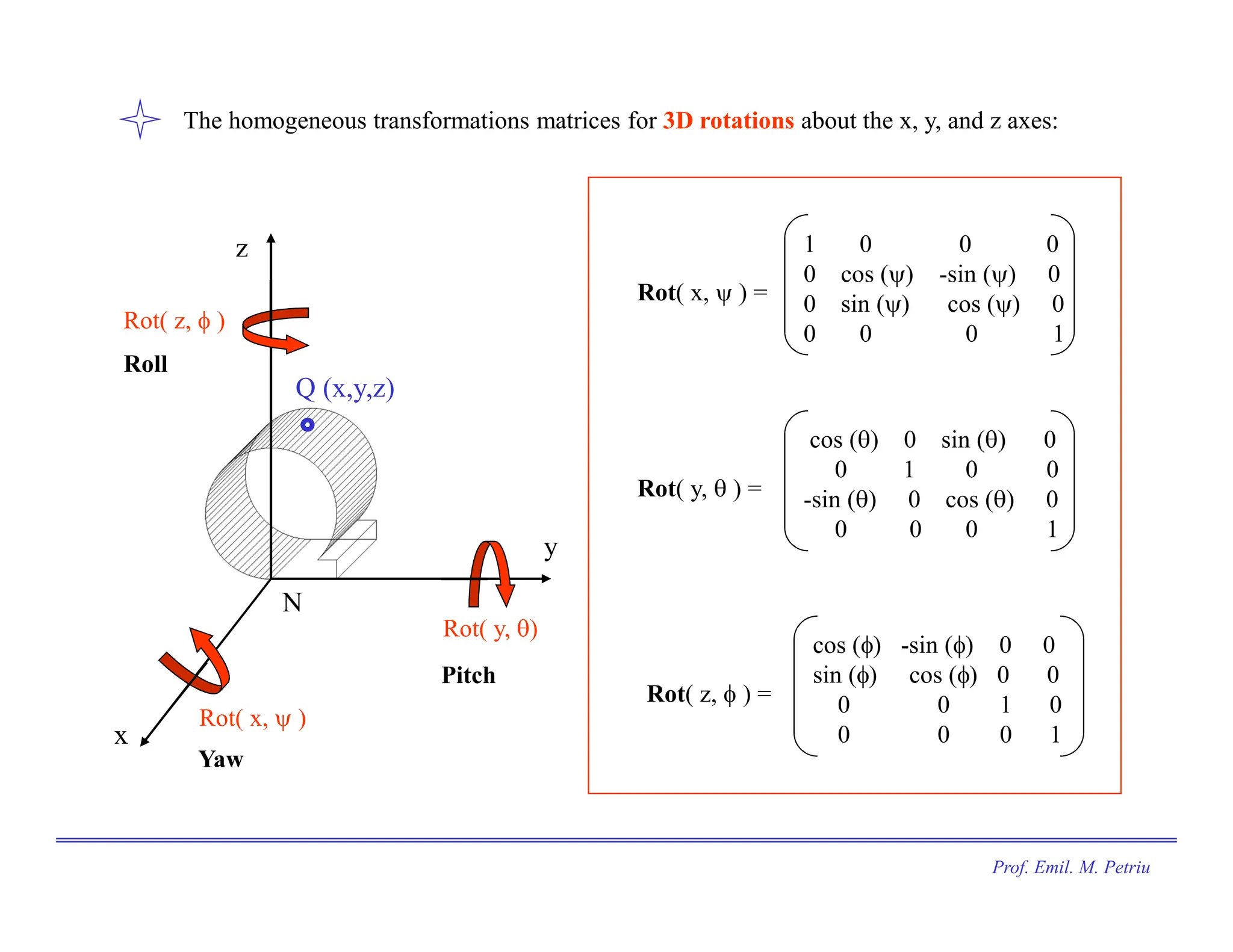
The homogeneous transformations matrices for 3D rotations about the x, y, and z axes:
Prof. Emil. M. Petriu
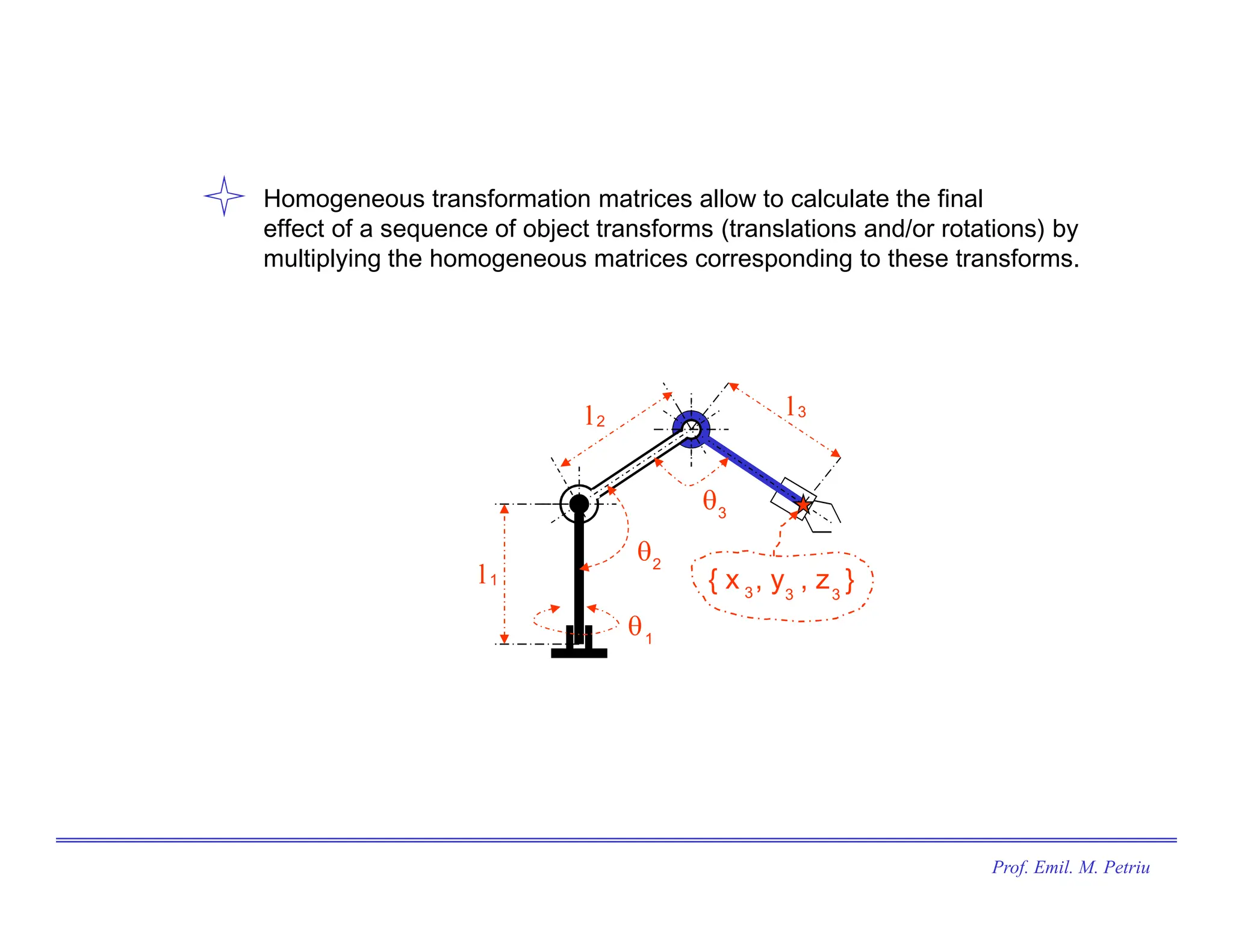
Homogeneous transformation matrices allow to calculate the final
effect of a sequence of object transforms (translations and/or rotations) by
multiplying the homogeneous matrices corresponding to these transforms.
Prof. Emil. M. Petriu
θ1
θ2
θ3
l1
l2
l3
{ x , y , z }
3 3 3

Homogrneous Transformation Matrix ppt presentation

  • 1.
    Prof. Emil. M.Petriu CARTESIAN COORDINATES x y z Cartesian coordinates used in robotics z x y Cartesian coordinates used in computer graphics Corkscrew rule (right-hand rule) to define positive directions of the axes HOMOGENEOUS TRANSFORMATION MATRICES
  • 2.
    x0 y0 z0 R q R y1 x1 z1 N q N y1 x1 z1 N* q N Q* r R p R P* R Q q* R RECOVERING THELOCATION OF MOVING OBJECTS: TRANSLATION q* = p* + q R R N p* = p + r R R R q* = p + q + r R R R N q = p + q R R N Using a reference frame N affixed to the object allows the calculation of the variable location of the point Q on the moving object in a given reference frame R as the sum of two vectors, a constant one representing the location of Q relative to N and another variable representing the location of N relative to R: Recovering the 3D location of a point on a moving object in a given reference frame R. when the object suffers only a translation movement relative to R.. Prof. Emil. M. Petriu
  • 3.
    RECOVERING THE LOCATIONOF MOVING OBJECTS: ROTATION x0 y0 z0 R p R q N y1 x1 z1 N Q ROT q* = ? R Recovering the 3D location of a point on an object rotating in a given reference frame R. y1 x1 z1 N* q N Q* p R x0 z0 y0 Vectors can not describe the rotation ! q* = ? R Prof. Emil. M. Petriu
  • 4.
    RECOVERING THE LOCATIONOF MOVING OBJECT: ROTATION > continued x0 y0 z0 R p R q N y1 x1 z1 N Q ROT y1 x1 z1 N Rot( x, ψ ) Rot( y, θ) Rot( z, φ ) y1 x1 z1 N* q N Q* p R Prof. Emil. M. Petriu
  • 5.
    x0 y0 z0 R p R q N y1 x1 z1 N Q RECOVERING THE LOCATIONOF MOVING OBJECT: ROTATION > continued ROT y1 x1 z1 N Rot( x, ψ ) Rot( y, θ) Rot( z, φ ) The general rotation of an object in 3D can be conveniently decomposed into a sequence of three elementary rotations about the axes of the Cartesian reference frame attached to that object, namely: Rot( z, φ ) a rotation about z-axis, “roll,” by an angle φ ; Rot( y, θ) a rotation about y-axis, “pitch,” by an angle θ ; Rot( x, ψ ) a rotation about x-axis, “yaw,” by an angle ψ . Prof. Emil. M. Petriu
  • 6.
    x0 y0 z0 R p R q N y1 x1 z1 N Q RECOVERING THE LOCATIONOF MOVING OBJECT: ROTATION > continued ROT y1 x1 z1 N Rot( x, ψ ) Rot( y, θ) Rot( z, φ ) y1 x1 z1 N* q N Q* p R RPY The general rotation in 3D is often known as the RPY rotation , a name reminding of the Roll, Pitch, and Yaw components. Prof. Emil. M. Petriu
  • 7.
    RECOVERING THE LOCATIONOF MOVING OBJECT: ROTATION >> continued q N Q y x z N Rot( x, ψ ) Rot( y, θ) Rot( z, φ ) Roll Pitch Yaw y x z N Q* z* x* y* Prof. Emil. M. Petriu
  • 8.
    RECOVERING THE LOCATIONOF MOVING OBJECTS: Roll, Rot( z, φ φ φ φ ) y x z Rot( z, φ ) Roll N x y z Q (x,y,z) Q* (x’,y’,z’) y x z x* y* z’ = z y’ x’ φ φ Prof. Emil. M. Petriu
  • 9.
    RECOVERING THE LOCATIONOF MOVING OBJECTS: Rot( z, φ φ φ φ ) > continued φ y* Q* (x’,y’) φ x* x y Q (x,y) α α d d y’ = d . sin(α+ φ) y’ y’ = d . sin(α) . cos(φ) + d . sin(φ) . cos(α) y y = d . sin(α) x x = d . cos(α) y’ = y . cos(φ) + x . sin(φ) x’ cos(φ) − sin(φ) x y’ sin(φ) cos(φ) y = x’ = x . cos(φ) − y . sin(φ) In a similar way we get: Prof. Emil. M. Petriu
  • 10.
    3D HOMOGENEOUS TRANSFORMATIONMATRICES FOR ROBOTICS 3-by-3 3-by-1 rotation translation sub-matrix sub-matrix 0 0 0 1 T = Homogeneous transformation matrices are general 4-by-4 matrices accounting for both object translation and object rotation in 3D. The homogeneous transformations matrix for a general 3D translation by a vector px . i + py . j + pz . k is: Trans (px, py, pz) = 1 0 0 px 0 1 0 py 0 0 1 pz 0 0 0 1 Prof. Emil. M. Petriu
  • 11.
    Q (x,y,z) y x z N Rot( z,φ ) Roll Rot( y, θ) Pitch Rot( x, ψ ) Yaw Rot( x, ψ ) = 1 0 0 0 0 cos (ψ) -sin (ψ) 0 0 sin (ψ) cos (ψ) 0 0 0 0 1 Rot( y, θ ) = cos (θ) 0 sin (θ) 0 0 1 0 0 -sin (θ) 0 cos (θ) 0 0 0 0 1 Rot( z, φ ) = cos (φ) -sin (φ) 0 0 sin (φ) cos (φ) 0 0 0 0 1 0 0 0 0 1 The homogeneous transformations matrices for 3D rotations about the x, y, and z axes: Prof. Emil. M. Petriu
  • 12.
    Homogeneous transformation matricesallow to calculate the final effect of a sequence of object transforms (translations and/or rotations) by multiplying the homogeneous matrices corresponding to these transforms. Prof. Emil. M. Petriu θ1 θ2 θ3 l1 l2 l3 { x , y , z } 3 3 3