Home Automation System Dept. of ECE
City Engineering College Page 1
Home Automation System
1Sadatulla Zishan, 2Saifullah Khan M, 3Shaik Nayemurrahman, 4MD Shahid Raza.
Students of Bachelor of Engineering,
Dept. Electronics & Communication Engineering, City Engineering College,
Doddakallasandra, Bangalore South-78, India.
----------------------------ABSTRACT----------------------------
This paper presents the overall design of
Home Automation System (HAS) with low cost and
wireless remote control. This system is designed to
assist and provide support in order to fulfill the
needs of elderly and disabled in home. Also, the
smart home concept in the system improves the
standard living at home. The main control system
implements wireless Bluetooth technology to
provide remote access from PC/laptop or smart
phone. The switches status is synchronized in all the
control system whereby every user interface
indicates the real time existing switches status. The
system intended to control electrical appliances and
devices in house with relatively low cost design,
user-friendly interface and ease of installation.
Keywords--Home automation, Smart home, home
appliances, Bluetooth, Android.
I-Introduction
The “Home Automation” concept has
existed for many years. The terms “Smart Home”,
“Intelligent Home” followed and has been used to
introduce the concept of networking appliances and
devices in the house. Home automation Systems
(HASs) represents a great research opportunity in
creating new fields in engineering, architecture and
computing. HASs becoming popular nowadays and
enter quickly in this emerging market. However,
end users, especially the disabled and elderly due to
their complexity and cost, do not always accept
these systems.
Bluetooth is being chosen with its suitable
capability. Bluetooth with globally available
frequencies of 2400Hz is able to provide
connectivity up to 100 meters at speed of up to
3Mbps depending on the Bluetooth device class.
The capabilities of Bluetooth are more than enough
to be implemented in the design.
Also, most of the current laptop/notebook or
Android phones are come with built-in Bluetooth
adapter. It will indirectly reduce the cost of this
system. Based on the study of HAS project is done
by implementing Microcontroller in wireless HAS.
The simplex connection between control board and
controller limited that only one type of input (ASCII
characters) to the system. The system mentioned as
low cost but the cost of microcontroller is not
considered.
Bluetooth based HAS design architecture
proposed a Bluetooth based HAS that controls
home appliances by a PC/Laptops or Android
phones, but PC does not provide portable remote
function. The project stated as low cost HAS system
but the cost of Bluetooth module and
Microcontroller IC is not the best cost efficient
solution. Moreover, the android phone control is
implemented by Android application.
The Bluetooth connection in this system is
established by Bluetooth module that directly
receives/ transmits commands from/too smart phone
or laptop/PC. For the Window OS on laptop/PC and
Android OS on Smart Phone are chosen based on
the high user distribution in current market. By
Home Automation System Dept. of ECE
City Engineering College Page 2
considering the flexibility, the main control board is
designed with wireless connection. For the wireless
connection, the main control board can be
connected to either one of the laptop/PC or Smart
Phone. In term of cost, this system implemented
low cost microcontroller and Bluetooth module as
the system main core. The total cost of one unit of
this system hardware is estimated less than 3000/-rs
(IND). With this low budget, this system is still
performed with powerful remote functions to make
our life in home become easier.
II-System Working
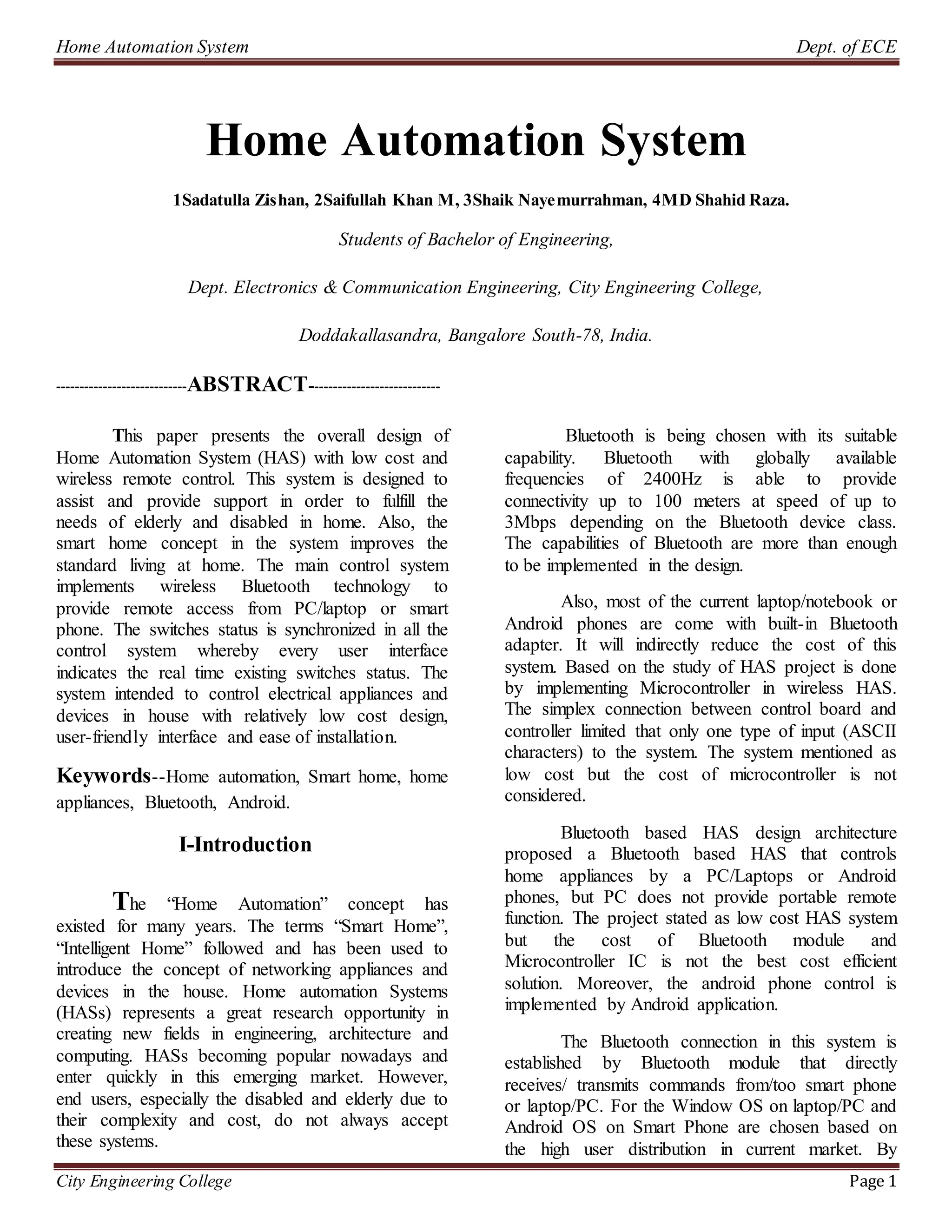
Fig1. Illustrates the overall control function
of the system. The system is directly installed
beside the conventional electrical switches on the
wall. Here, the serial data transfer capability of
Bluetooth technology is exploited to control devices
either using your android phone or Bluetooth
enabled laptop/PC. The target home appliances are
controlled by the system Main Control Board. In
order improve the standard living in home, this
system provides two different types The first and
second control methods are performed as wireless
remote control to the appliances. The first control
method is by clicking on Windows BIRD
(Bluetooth interface relay device) software on
PC/laptop by using mouse or touch pad. This
method provides facility to the computer user to
control the home appliances without walk to the
switches on the wall. Second control method is
done by Android App (BLUE TERM) installed in
Smart Phone. The user can easily touch on the
screen of the phone to control the home appliances.
This portable method is able to assist the disabled
people who have problem with locomotion
difficulty
Fig1. Block diagram of HAS
III-System Design
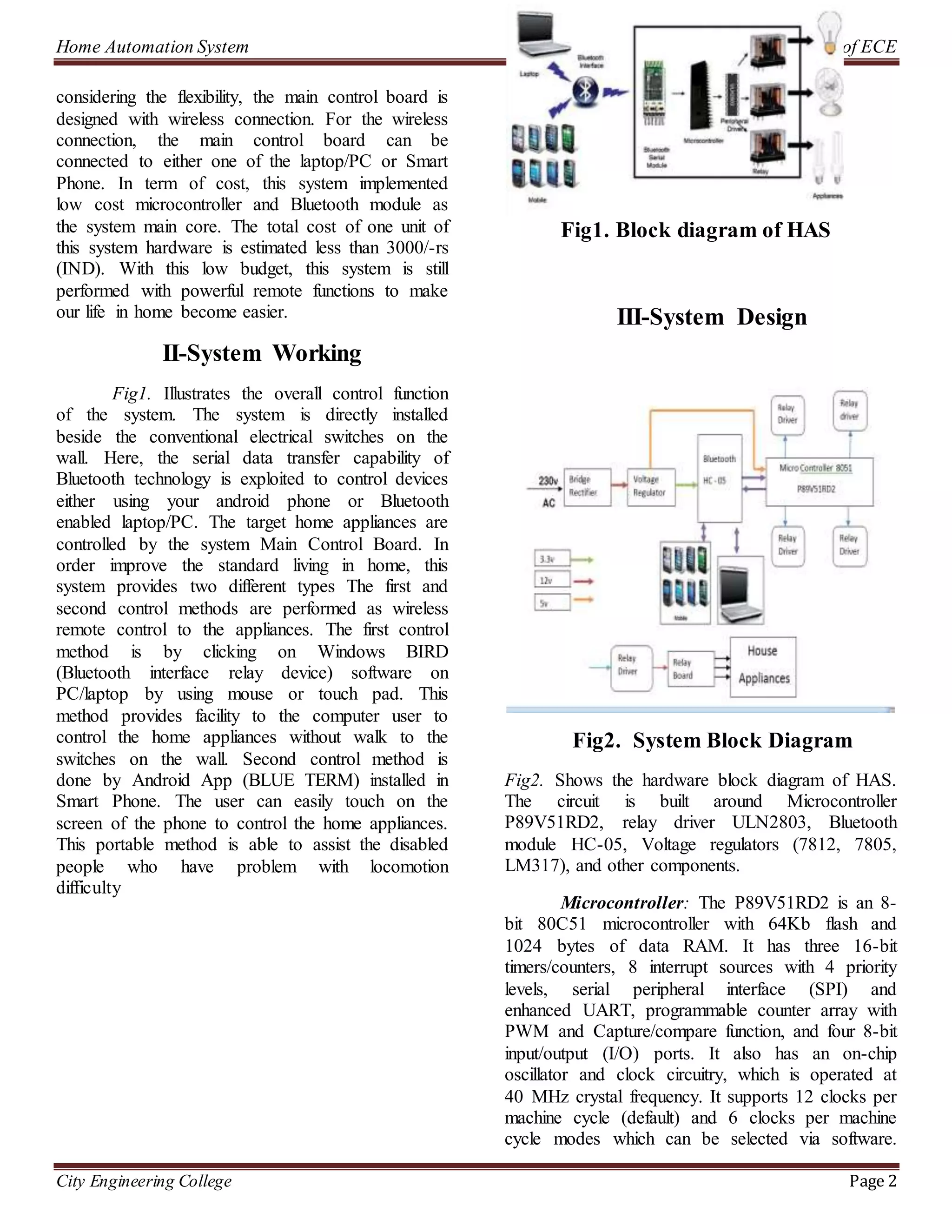
Fig2. System Block Diagram
Fig2. Shows the hardware block diagram of HAS.
The circuit is built around Microcontroller
P89V51RD2, relay driver ULN2803, Bluetooth
module HC-05, Voltage regulators (7812, 7805,
LM317), and other components.
Microcontroller: The P89V51RD2 is an 8-
bit 80C51 microcontroller with 64Kb flash and
1024 bytes of data RAM. It has three 16-bit
timers/counters, 8 interrupt sources with 4 priority
levels, serial peripheral interface (SPI) and
enhanced UART, programmable counter array with
PWM and Capture/compare function, and four 8-bit
input/output (I/O) ports. It also has an on-chip
oscillator and clock circuitry, which is operated at
40 MHz crystal frequency. It supports 12 clocks per
machine cycle (default) and 6 clocks per machine
cycle modes which can be selected via software.
Home Automation System Dept. of ECE
City Engineering College Page 3
The flash program memory supports both parallel
programming and serial programming.
The microcontroller communicates with
Bluetooth module through its TXD and RXD pins.
The serial control command send through the laptop
or android phone is received by Bluetooth module
and processed by microcontroller IC.
Bluetooth Module: A 34-pin, HC-05
Bluetooth module is used in this project. It is an
easy to use Bluetooth serial port protocol (SPP)
module, designed for a transparent wireless serial
communication setup.
Fig3.Bluetooth Module
Relay driver: The ULN2803 is a
monolithic, high voltage and high current
Darlington transistor array. It consists of 8 NPN
Darlington pairs that have high voltage outputs with
a common cathode clamp diode for switching
inductive loads. The microcontroller drives the
relays through ULN2803.
IV-Software Design
The software program for the
microcontroller is written in ‘C’ language and
complied using keil software to generate the hex
code. The microcontroller receives the control
commands as ASCII value sent from laptop/PC or
Android mobiles, and controls the corresponding
devices as per shown in fig4.
ASCII Values and Corresponding Actions
Character P89V51RD2
port
Relay number Action
A to
H(Upper
case)
Port0 1 to
8(individual)
ON
a to h(lower
case)
Port0 1 to
8(individual)
OFF
I to P(upper
case)
Port1 9 to
16(individual)
ON
i to p(lower
case)
Port1 9 to
16(individual)
OFF
Q to
X(upper
case)
Port2 17 to
24(individual)
ON
q to x(lower
case
Port2 17 to
24(individual)
OFF
Symbol’(‘ Port0 All 8 relays(1
to 8-
simultaneously)
ON
Symbol’)‘ Port0 All 8 relays(1
to 8-
simultaneously)
OFF
Symbol’<‘ Port1 All 8 relays(9
to 16-
simultaneously)
ON
Symbol’>‘ Port1 All 8 relays(9
to 16-
simultaneously)
OFF
Symbol’[‘ Port2 All 8 relays(17
to 24-
simultaneously)
ON
Symbol’]‘ Port2 All 8 relays(17
to 24-
simultaneously)
OFF
Fig4. Table 1
The flow chart shown in fig5. Is Software
design section includes the main functions of the
system designed in the PIC microcontroller. The
Activation function is performed by the
microcontroller, PIC. The ASCII character are
programed such that, if specific character assigned
to the appliances are given the appliances get ON
(logic1) and when small characters are given then
the appliances get OFF (logic 0).When the specified
character are given (Capital/Small), it will interrupt
the main function loop of the PIC. Then, the PIC
will activate the relay and toggle the current
appliance’s switch status. At the moment, PIC also
informs the change of switch status to all the Users
through LED connected at the relay that is
connected to the main board.
Home Automation System Dept. of ECE
City Engineering College Page 4
.
Fig5. Flowchart of software design
BLUE TERM: Blue term is an android
application that is a VT-100 terminal emulator for
communicating with any serial devices using a
Bluetooth serial adaptor. One can download it from
‘Android apps on Google Play’.
Install the application on your android phone
and follow these steps:
1. Start the Bluetooth connection of your mobile
phone or tablet.
2. Open the blue term application on your mobile or
tablet.
3. Select connect device from the option menu after
scanning from new devices. As shown in fig6.
4. Bluetooth serial module (HC-05) will be
available under the select a device to connect list.
5. pair Bluetooth serial module by providing pair
code [1234].
6. Start sending ASCII characters as shown in
TABLE1 of fig4. You will see different relays
going ON and OFF corresponding to the values u
send.
Fig6.Selection of Bluetooth module
V-Conclusion
In conclusion, this low cost system is
designed to improve the standard living in home.
The remote control function by smart phone
provides help and assistance especially to disabled
and elderly.
Moreover, implementation of wireless
Bluetooth connection in control board allows the
system install in more simple way. The control
board is directly installed beside the electrical
switches whereby the switching connection is
controlled by relay.
Set Timer 1, mode a by giving value 20H to TCON. Baud rate
is set at TH1 with value of 9600. SCON is set with value 50H.
Start timer 1
Clear all the ports
Assign ASCII values to port0, port1, port2 for ON and OFF
conditions
Specific
character is
given
Initialization of all the ports and set
all to high initially
RI=0 for enabling to receive pin. Assign Serial Buffer.
Ports pin set high when Capital
characters are given
Relay circuit gets powered and
applications works
Ports pins are set to low when
small ASCII character is given
Relay circuit does not gets
powered and no
applications works
START
END
END
Home Automation System Dept. of ECE
City Engineering College Page 5
The system is designed in user-friendly
interface. The easy to use interface on Windows
Software (BIRD) and Android Application (Blue
term) provides simple control by the elderly and
disabled people. For future work, Upgrading ‘HAS’
to ‘IOT’ (Internet of thing) which will help in
controlling the devices over through Wi-Fi
(INTERNET).
By monitoring the home appliances over
Internet can reduce the wastage of power. All the
future work is expected with minimum cost. HAS
can also be implemented in hazardous environment
where switching of devices physically is very
dangerous.
VI-Acknowledgement
First of all, the special appreciation and
thanks go to Visvesvaraya Technological University
for providing the invaluable knowledge and the
necessary guidance as well as encouragement in
completing this paper. The supervision and support
are truly help the progression and smoothness of
this project. Moreover, the great deals appreciated
go to the contribution from every team members for
the valuable shares, opinions and resources
provided in completing the report. The co-operation
is much indeed appreciated.
VII-References
1. “Design and Implementation of a Bluetooth
based General Purpose Controlling
Module”, in IEEE, 2008, pp. 206-211
2. Hiroshi Kanma, Noboru Wakabayashi,
Ritsuko Kanazawa & Hirimichi Ito, “Home
Appliance Control System over Bluetooth
with a Cellular.

Home Automation System

  • 1.
    Home Automation SystemDept. of ECE City Engineering College Page 1 Home Automation System 1Sadatulla Zishan, 2Saifullah Khan M, 3Shaik Nayemurrahman, 4MD Shahid Raza. Students of Bachelor of Engineering, Dept. Electronics & Communication Engineering, City Engineering College, Doddakallasandra, Bangalore South-78, India. ----------------------------ABSTRACT---------------------------- This paper presents the overall design of Home Automation System (HAS) with low cost and wireless remote control. This system is designed to assist and provide support in order to fulfill the needs of elderly and disabled in home. Also, the smart home concept in the system improves the standard living at home. The main control system implements wireless Bluetooth technology to provide remote access from PC/laptop or smart phone. The switches status is synchronized in all the control system whereby every user interface indicates the real time existing switches status. The system intended to control electrical appliances and devices in house with relatively low cost design, user-friendly interface and ease of installation. Keywords--Home automation, Smart home, home appliances, Bluetooth, Android. I-Introduction The “Home Automation” concept has existed for many years. The terms “Smart Home”, “Intelligent Home” followed and has been used to introduce the concept of networking appliances and devices in the house. Home automation Systems (HASs) represents a great research opportunity in creating new fields in engineering, architecture and computing. HASs becoming popular nowadays and enter quickly in this emerging market. However, end users, especially the disabled and elderly due to their complexity and cost, do not always accept these systems. Bluetooth is being chosen with its suitable capability. Bluetooth with globally available frequencies of 2400Hz is able to provide connectivity up to 100 meters at speed of up to 3Mbps depending on the Bluetooth device class. The capabilities of Bluetooth are more than enough to be implemented in the design. Also, most of the current laptop/notebook or Android phones are come with built-in Bluetooth adapter. It will indirectly reduce the cost of this system. Based on the study of HAS project is done by implementing Microcontroller in wireless HAS. The simplex connection between control board and controller limited that only one type of input (ASCII characters) to the system. The system mentioned as low cost but the cost of microcontroller is not considered. Bluetooth based HAS design architecture proposed a Bluetooth based HAS that controls home appliances by a PC/Laptops or Android phones, but PC does not provide portable remote function. The project stated as low cost HAS system but the cost of Bluetooth module and Microcontroller IC is not the best cost efficient solution. Moreover, the android phone control is implemented by Android application. The Bluetooth connection in this system is established by Bluetooth module that directly receives/ transmits commands from/too smart phone or laptop/PC. For the Window OS on laptop/PC and Android OS on Smart Phone are chosen based on the high user distribution in current market. By
  • 2.
    Home Automation SystemDept. of ECE City Engineering College Page 2 considering the flexibility, the main control board is designed with wireless connection. For the wireless connection, the main control board can be connected to either one of the laptop/PC or Smart Phone. In term of cost, this system implemented low cost microcontroller and Bluetooth module as the system main core. The total cost of one unit of this system hardware is estimated less than 3000/-rs (IND). With this low budget, this system is still performed with powerful remote functions to make our life in home become easier. II-System Working Fig1. Illustrates the overall control function of the system. The system is directly installed beside the conventional electrical switches on the wall. Here, the serial data transfer capability of Bluetooth technology is exploited to control devices either using your android phone or Bluetooth enabled laptop/PC. The target home appliances are controlled by the system Main Control Board. In order improve the standard living in home, this system provides two different types The first and second control methods are performed as wireless remote control to the appliances. The first control method is by clicking on Windows BIRD (Bluetooth interface relay device) software on PC/laptop by using mouse or touch pad. This method provides facility to the computer user to control the home appliances without walk to the switches on the wall. Second control method is done by Android App (BLUE TERM) installed in Smart Phone. The user can easily touch on the screen of the phone to control the home appliances. This portable method is able to assist the disabled people who have problem with locomotion difficulty Fig1. Block diagram of HAS III-System Design Fig2. System Block Diagram Fig2. Shows the hardware block diagram of HAS. The circuit is built around Microcontroller P89V51RD2, relay driver ULN2803, Bluetooth module HC-05, Voltage regulators (7812, 7805, LM317), and other components. Microcontroller: The P89V51RD2 is an 8- bit 80C51 microcontroller with 64Kb flash and 1024 bytes of data RAM. It has three 16-bit timers/counters, 8 interrupt sources with 4 priority levels, serial peripheral interface (SPI) and enhanced UART, programmable counter array with PWM and Capture/compare function, and four 8-bit input/output (I/O) ports. It also has an on-chip oscillator and clock circuitry, which is operated at 40 MHz crystal frequency. It supports 12 clocks per machine cycle (default) and 6 clocks per machine cycle modes which can be selected via software.
  • 3.
    Home Automation SystemDept. of ECE City Engineering College Page 3 The flash program memory supports both parallel programming and serial programming. The microcontroller communicates with Bluetooth module through its TXD and RXD pins. The serial control command send through the laptop or android phone is received by Bluetooth module and processed by microcontroller IC. Bluetooth Module: A 34-pin, HC-05 Bluetooth module is used in this project. It is an easy to use Bluetooth serial port protocol (SPP) module, designed for a transparent wireless serial communication setup. Fig3.Bluetooth Module Relay driver: The ULN2803 is a monolithic, high voltage and high current Darlington transistor array. It consists of 8 NPN Darlington pairs that have high voltage outputs with a common cathode clamp diode for switching inductive loads. The microcontroller drives the relays through ULN2803. IV-Software Design The software program for the microcontroller is written in ‘C’ language and complied using keil software to generate the hex code. The microcontroller receives the control commands as ASCII value sent from laptop/PC or Android mobiles, and controls the corresponding devices as per shown in fig4. ASCII Values and Corresponding Actions Character P89V51RD2 port Relay number Action A to H(Upper case) Port0 1 to 8(individual) ON a to h(lower case) Port0 1 to 8(individual) OFF I to P(upper case) Port1 9 to 16(individual) ON i to p(lower case) Port1 9 to 16(individual) OFF Q to X(upper case) Port2 17 to 24(individual) ON q to x(lower case Port2 17 to 24(individual) OFF Symbol’(‘ Port0 All 8 relays(1 to 8- simultaneously) ON Symbol’)‘ Port0 All 8 relays(1 to 8- simultaneously) OFF Symbol’<‘ Port1 All 8 relays(9 to 16- simultaneously) ON Symbol’>‘ Port1 All 8 relays(9 to 16- simultaneously) OFF Symbol’[‘ Port2 All 8 relays(17 to 24- simultaneously) ON Symbol’]‘ Port2 All 8 relays(17 to 24- simultaneously) OFF Fig4. Table 1 The flow chart shown in fig5. Is Software design section includes the main functions of the system designed in the PIC microcontroller. The Activation function is performed by the microcontroller, PIC. The ASCII character are programed such that, if specific character assigned to the appliances are given the appliances get ON (logic1) and when small characters are given then the appliances get OFF (logic 0).When the specified character are given (Capital/Small), it will interrupt the main function loop of the PIC. Then, the PIC will activate the relay and toggle the current appliance’s switch status. At the moment, PIC also informs the change of switch status to all the Users through LED connected at the relay that is connected to the main board.
  • 4.
    Home Automation SystemDept. of ECE City Engineering College Page 4 . Fig5. Flowchart of software design BLUE TERM: Blue term is an android application that is a VT-100 terminal emulator for communicating with any serial devices using a Bluetooth serial adaptor. One can download it from ‘Android apps on Google Play’. Install the application on your android phone and follow these steps: 1. Start the Bluetooth connection of your mobile phone or tablet. 2. Open the blue term application on your mobile or tablet. 3. Select connect device from the option menu after scanning from new devices. As shown in fig6. 4. Bluetooth serial module (HC-05) will be available under the select a device to connect list. 5. pair Bluetooth serial module by providing pair code [1234]. 6. Start sending ASCII characters as shown in TABLE1 of fig4. You will see different relays going ON and OFF corresponding to the values u send. Fig6.Selection of Bluetooth module V-Conclusion In conclusion, this low cost system is designed to improve the standard living in home. The remote control function by smart phone provides help and assistance especially to disabled and elderly. Moreover, implementation of wireless Bluetooth connection in control board allows the system install in more simple way. The control board is directly installed beside the electrical switches whereby the switching connection is controlled by relay. Set Timer 1, mode a by giving value 20H to TCON. Baud rate is set at TH1 with value of 9600. SCON is set with value 50H. Start timer 1 Clear all the ports Assign ASCII values to port0, port1, port2 for ON and OFF conditions Specific character is given Initialization of all the ports and set all to high initially RI=0 for enabling to receive pin. Assign Serial Buffer. Ports pin set high when Capital characters are given Relay circuit gets powered and applications works Ports pins are set to low when small ASCII character is given Relay circuit does not gets powered and no applications works START END END
  • 5.
    Home Automation SystemDept. of ECE City Engineering College Page 5 The system is designed in user-friendly interface. The easy to use interface on Windows Software (BIRD) and Android Application (Blue term) provides simple control by the elderly and disabled people. For future work, Upgrading ‘HAS’ to ‘IOT’ (Internet of thing) which will help in controlling the devices over through Wi-Fi (INTERNET). By monitoring the home appliances over Internet can reduce the wastage of power. All the future work is expected with minimum cost. HAS can also be implemented in hazardous environment where switching of devices physically is very dangerous. VI-Acknowledgement First of all, the special appreciation and thanks go to Visvesvaraya Technological University for providing the invaluable knowledge and the necessary guidance as well as encouragement in completing this paper. The supervision and support are truly help the progression and smoothness of this project. Moreover, the great deals appreciated go to the contribution from every team members for the valuable shares, opinions and resources provided in completing the report. The co-operation is much indeed appreciated. VII-References 1. “Design and Implementation of a Bluetooth based General Purpose Controlling Module”, in IEEE, 2008, pp. 206-211 2. Hiroshi Kanma, Noboru Wakabayashi, Ritsuko Kanazawa & Hirimichi Ito, “Home Appliance Control System over Bluetooth with a Cellular.