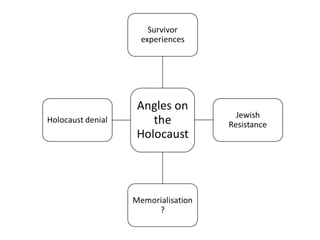
Survivor Experiences
• What was it like to survive the Holocaust?
• How did people come to tell their stories?
Survivor Experiences
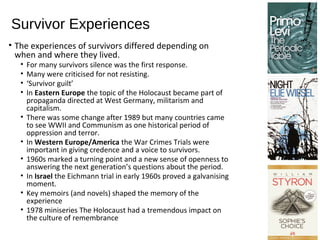
• The experiences of survivors differed depending on
when and where they lived.
• For many survivors silence was the first response.
• Many were criticised for not resisting.
• ‘Survivor guilt’
• In Eastern Europe the topic of the Holocaust became part of
propaganda directed at West Germany, militarism and
capitalism.
• There was some change after 1989 but many countries came
to see WWII and Communism as one historical period of
oppression and terror.
• In Western Europe/America the War Crimes Trials were
important in giving credence and a voice to survivors.
• 1960s marked a turning point and a new sense of openness to
answering the next generation’s questions about the period.
• In Israel the Eichmann trial in early 1960s proved a galvanising
moment.
• Key memoirs (and novels) shaped the memory of the
experience
• 1978 miniseries The Holocaust had a tremendous impact on
the culture of remembrance
• Did Jews go ‘like lambs to the slaughter’?
• Why didn’t the Jews resist or fight back?
Defiance trailer: https://www.youtube.com/watch?
v=yw6Rwum7zcU
Resistance
Resistance
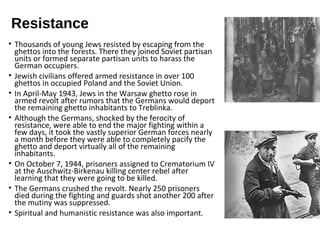
• Thousands of young Jews resisted by escaping from the
ghettos into the forests. There they joined Soviet partisan
units or formed separate partisan units to harass the
German occupiers.
• Jewish civilians offered armed resistance in over 100
ghettos in occupied Poland and the Soviet Union.
• In April-May 1943, Jews in the Warsaw ghetto rose in
armed revolt after rumors that the Germans would deport
the remaining ghetto inhabitants to Treblinka.
• Although the Germans, shocked by the ferocity of
resistance, were able to end the major fighting within a
few days, it took the vastly superior German forces nearly
a month before they were able to completely pacify the
ghetto and deport virtually all of the remaining
inhabitants.
• On October 7, 1944, prisoners assigned to Crematorium IV
at the Auschwitz-Birkenau killing center rebel after
learning that they were going to be killed.
• The Germans crushed the revolt. Nearly 250 prisoners
died during the fighting and guards shot another 200 after
the mutiny was suppressed.
• Spiritual and humanistic resistance was also important.
Memorialisation
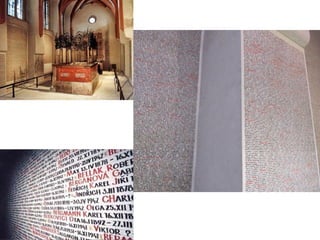
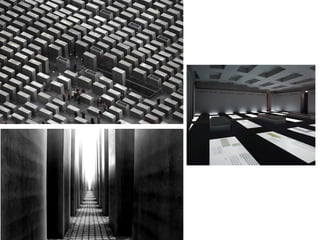
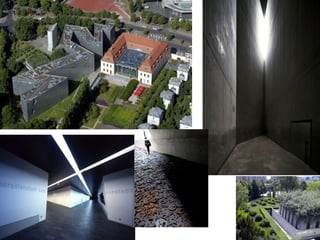
• Should we memorialise the Holocaust?
• If so, how? What should the goals be?
• What should be done with sites of terror?
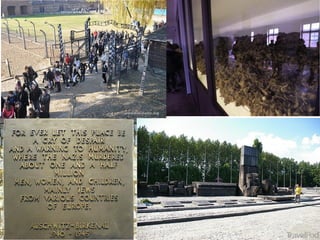
• Why do millions of tourists go to Auschwitz-Birkenau
each year? Is this OK? What does it say about people?
Holocaust Denial
• What is Holocaust denial?
• Where does Holocaust denial come from?
• What evidence supports the truth of the Holocaust?
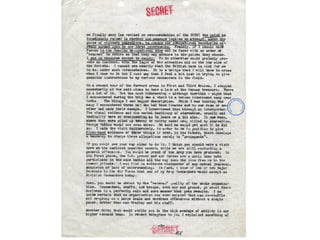
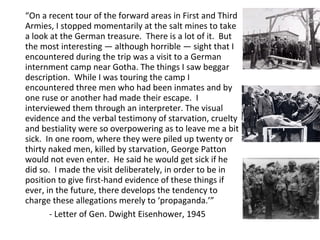
“On a recent tour of the forward areas in First and Third
Armies, I stopped momentarily at the salt mines to take
a look at the German treasure. There is a lot of it. But
the most interesting — although horrible — sight that I
encountered during the trip was a visit to a German
internment camp near Gotha. The things I saw beggar
description. While I was touring the camp I
encountered three men who had been inmates and by
one ruse or another had made their escape. I
interviewed them through an interpreter. The visual
evidence and the verbal testimony of starvation, cruelty
and bestiality were so overpowering as to leave me a bit
sick. In one room, where they were piled up twenty or
thirty naked men, killed by starvation, George Patton
would not even enter. He said he would get sick if he
did so. I made the visit deliberately, in order to be in
position to give first-hand evidence of these things if
ever, in the future, there develops the tendency to
charge these allegations merely to ‘propaganda.’”
- Letter of Gen. Dwight Eisenhower, 1945
What is “Holocaust denial”?
•How can the Holocaust be denied?
•Who are the Holocaust deniers?
•Are they a small and inconsequential cluster of
socially marginal fanatics or a large group of
mainstream players?
•What are the deniers’ main arguments and
what motivates them in their denial?
•Should one argue with them, or are they better
ignored?
•Any person or organization that denies the
Holocaust or doubts the number of Jewish
victims, or the existence of concentration camps
and gas chambers, is a denier of the Holocaust
and not a “revisionist”
•The truth is that these people are engaged not in
an innovative alternative interpretation of
history but in the outright denial of history. All
serious historians are in essence revisionists…
 Denial takes on other forms too…
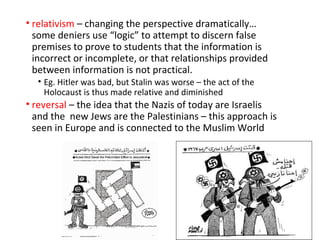
• relativism – changing the perspective dramatically…
some deniers use “logic” to attempt to discern false
premises to prove to students that the information is
incorrect or incomplete, or that relationships provided
between information is not practical.
• Eg. Hitler was bad, but Stalin was worse – the act of the
Holocaust is thus made relative and diminished
• reversal – the idea that the Nazis of today are Israelis
and the new Jews are the Palestinians – this approach is
seen in Europe and is connected to the Muslim World
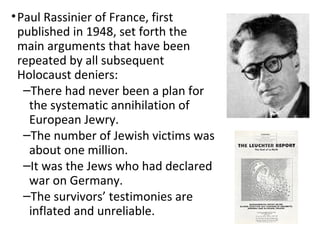
•Paul Rassinier of France, first
published in 1948, set forth the
main arguments that have been
repeated by all subsequent
Holocaust deniers:
–There had never been a plan for
the systematic annihilation of
European Jewry.
–The number of Jewish victims was
about one million.
–It was the Jews who had declared
war on Germany.
–The survivors’ testimonies are
inflated and unreliable.
•Professor Yisrael Gutman traces the origins of Holocaust
denial to the Nazis themselves. In Gutman’s opinion, the
Nazis’ attempts to obscure their acts of murder sowed the
seeds of denial. The following examples illustrate this
point:
•1. The absence of any written orders from Hitler
(Fuehrerbefehl) concerning the annihilation of the Jews,
and the use of verbal commands.
•2. The use of code words (Sprachregelung) to denote the
annihilation of European Jewry:
–Aussiedlung (evacuation); Endloesung (the Final
Solution); Sonderbehandlung (special treatment)…
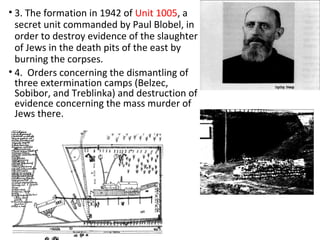
• 3. The formation in 1942 of Unit 1005, a
secret unit commanded by Paul Blobel, in
order to destroy evidence of the slaughter
of Jews in the death pits of the east by
burning the corpses.
• 4. Orders concerning the dismantling of
three extermination camps (Belzec,
Sobibor, and Treblinka) and destruction of
evidence concerning the mass murder of
Jews there.
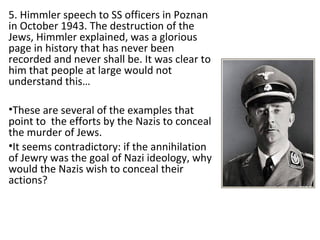
5. Himmler speech to SS officers in Poznan
in October 1943. The destruction of the
Jews, Himmler explained, was a glorious
page in history that has never been
recorded and never shall be. It was clear to
him that people at large would not
understand this…
•These are several of the examples that
point to the efforts by the Nazis to conceal
the murder of Jews.
•It seems contradictory: if the annihilation
of Jewry was the goal of Nazi ideology, why
would the Nazis wish to conceal their
actions?
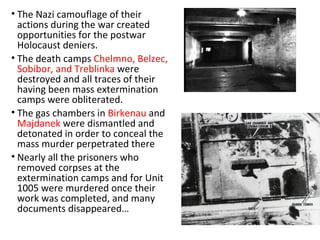
• The Nazi camouflage of their
actions during the war created
opportunities for the postwar
Holocaust deniers.
• The death camps Chelmno, Belzec,
Sobibor, and Treblinka were
destroyed and all traces of their
having been mass extermination
camps were obliterated.
• The gas chambers in Birkenau and
Majdanek were dismantled and
detonated in order to conceal the
mass murder perpetrated there
• Nearly all the prisoners who
removed corpses at the
extermination camps and for Unit
1005 were murdered once their
work was completed, and many
documents disappeared…
•the “first generation” of deniers sought to cleanse the
Nazis by justifying Nazi anti-Semitism and argued that
the Jews deserved the treatment they had received
because of their hostile behavior toward Germany.
•The “second generation” used different tactics. They
acknowledged the Germans’ anti-Semitism but still
argued that there was no Holocaust...
•Thus they could be seen as unprejudiced men who
sought nothing but historical “truth.”
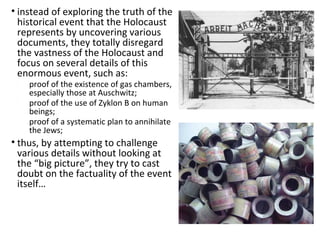
• instead of exploring the truth of the
historical event that the Holocaust
represents by uncovering various
documents, they totally disregard
the vastness of the Holocaust and
focus on several details of this
enormous event, such as:
• proof of the existence of gas chambers,
especially those at Auschwitz;
• proof of the use of Zyklon B on human
beings;
• proof of a systematic plan to annihilate
the Jews;
• thus, by attempting to challenge
various details without looking at
the “big picture”, they try to cast
doubt on the factuality of the event
itself…
The real account of the Holocaust is composed of the
following sources:
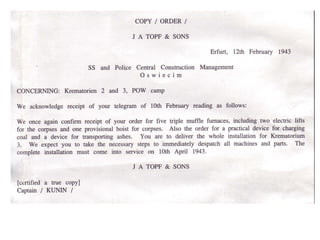
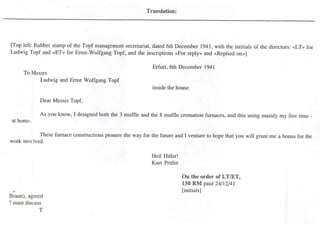
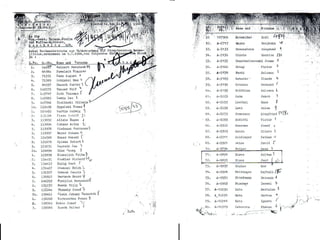
•German documents that explicitly mention the murders and
the murder process.
•German documents that describe the planning and
implementation of the Final Solution using euphemisms.
•Jewish documents — diaries, memoirs, collections of
writings — in various localities such as ghettos and death
camps.
•Testimonies of survivors of the ghettos, concentration
camps, and death camps.
• Documents and testimonies of Poles who lived
near the extermination sites and reports to/by
the Polish underground to its government-in-
exile in London.
• Russian documents from the commissions of
inquiry that were established upon the
liberation of the German-occupied territories.
• Legal material from the trials of Nazi criminals
held in Nuremberg at the end of the war as well
as later trials.
• Recently declassified military intelligence
documents (from Enigma decodings)
• The immediate postwar denial
publications were poor quality and crude
in their approach.
• A turning point occurred in the late 1970s.
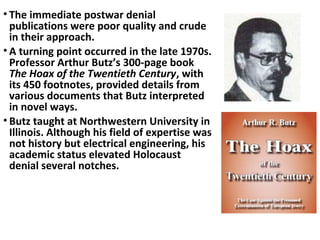
Professor Arthur Butz’s 300-page book
The Hoax of the Twentieth Century, with
its 450 footnotes, provided details from
various documents that Butz interpreted
in novel ways.
• Butz taught at Northwestern University in
Illinois. Although his field of expertise was
not history but electrical engineering, his
academic status elevated Holocaust
denial several notches.
Butz made the following accusations:
1. The figure of 6 million is not true.
2. The World Jewish Congress in 1942 spread propaganda stories about
“German soap workshops” and about mass suffocation in sealed cars.
3. The only evidence about the murder of the Jews comes from the
Nuremberg Trials in 1945 and this was elicited by torture.
4. No German documents from Auschwitz mention “gas chambers.”
5. Zyklon B was used, but only as a disinfectant and an insecticide.
6. In the Eichmann trial, Eichmann couldn’t deny what the world thought!
He had done no wrong but his best tactic was to plead guilty
7. Butz has acknowledged the deeds of the Einsatzgruppen; he is willing
to concede that as many as 1,000,000 Jews may have died before them.
8. He reinterprets documents and alleges that all testimony is inferior to
documents and dismisses survivor literature as “endless raving about
extermination”.
9.Jews invented this hoax to further Zionist ends!
• INSTITUTE FOR HISTORICAL REVIEW—
• Founded in 1978; Directed since 1981 by
Willis A. Carto, “a professional anti-Semite”
• They have published a journal called JHR —
Journal of Historical Review
• since 1981 and are head of the anti-Semitic
organ “Liberty Lobby”.
• In 1981, they published an advertisement
offering $50,000 to
• anyone who could prove there were gas
chambers!
• they believe in the need for absolutist
government to protect the racial heritage of
the United States.
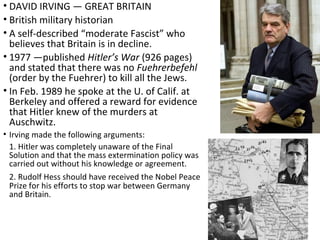
• DAVID IRVING — GREAT BRITAIN
• British military historian
• A self-described “moderate Fascist” who
believes that Britain is in decline.
• 1977 —published Hitler’s War (926 pages)
and stated that there was no Fuehrerbefehl
(order by the Fuehrer) to kill all the Jews.
• In Feb. 1989 he spoke at the U. of Calif. at
Berkeley and offered a reward for evidence
that Hitler knew of the murders at
Auschwitz.
• Irving made the following arguments:
1. Hitler was completely unaware of the Final
Solution and that the mass extermination policy was
carried out without his knowledge or agreement.
2. Rudolf Hess should have received the Nobel Peace
Prize for his efforts to stop war between Germany
and Britain.
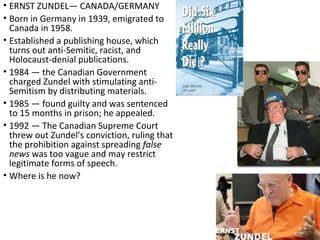
• ERNST ZUNDEL— CANADA/GERMANY
• Born in Germany in 1939, emigrated to
Canada in 1958.
• Established a publishing house, which
turns out anti-Semitic, racist, and
Holocaust-denial publications.
• 1984 — the Canadian Government
charged Zundel with stimulating anti-
Semitism by distributing materials.
• 1985 — found guilty and was sentenced
to 15 months in prison; he appealed.
• 1992 — The Canadian Supreme Court
threw out Zundel’s conviction, ruling that
the prohibition against spreading false
news was too vague and may restrict
legitimate forms of speech.
• Where is he now?
• On January 30, 1941,
• Hitler said the following:
• “Today I will once more be a prophet. If the international Jewish
financiers in and outside Europe should succeed in plunging
nations once more into a world war, then the result will not be
the Bolshevization of the earth and thus the victory of Jewry, but
the annihilation of the Jewish race in Europe!
• Hitler threatened the Jews again in September 1942:
• “In my speech before the Reichstag on the first of September
1939, 1 spoke of two matters: first, since we are forced into war,
neither the threat of weapons nor a period of transition shall
conquer us; second, if world Jewry launches another war in order
to destroy the Aryan nations of Europe, it will not be the Aryan
nations that will be destroyed, but the Jews. “
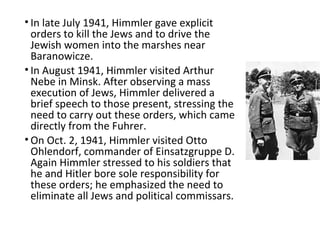
• In late July 1941, Himmler gave explicit
orders to kill the Jews and to drive the
Jewish women into the marshes near
Baranowicze.
• In August 1941, Himmler visited Arthur
Nebe in Minsk. After observing a mass
execution of Jews, Himmler delivered a
brief speech to those present, stressing the
need to carry out these orders, which came
directly from the Fuhrer.
• On Oct. 2, 1941, Himmler visited Otto
Ohlendorf, commander of Einsatzgruppe D.
Again Himmler stressed to his soldiers that
he and Hitler bore sole responsibility for
these orders; he emphasized the need to
eliminate all Jews and political commissars.
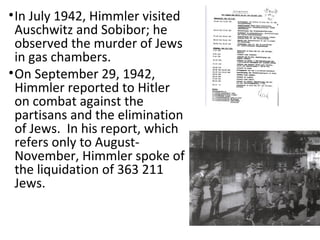
•In July 1942, Himmler visited
Auschwitz and Sobibor; he
observed the murder of Jews
in gas chambers.
•On September 29, 1942,
Himmler reported to Hitler
on combat against the
partisans and the elimination
of Jews. In his report, which
refers only to August-
November, Himmler spoke of
the liquidation of 363 211
Jews.
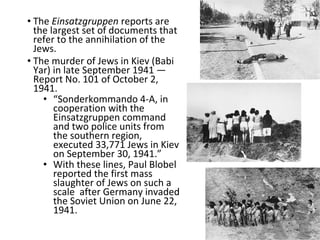
• The Einsatzgruppen reports are
the largest set of documents that
refer to the annihilation of the
Jews.
• The murder of Jews in Kiev (Babi
Yar) in late September 1941 —
Report No. 101 of October 2,
1941.
• “Sonderkommando 4-A, in
cooperation with the
Einsatzgruppen command
and two police units from
the southern region,
executed 33,771 Jews in Kiev
on September 30, 1941.”
• With these lines, Paul Blobel
reported the first mass
slaughter of Jews on such a
scale after Germany invaded
the Soviet Union on June 22,
1941.
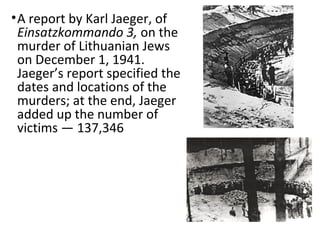
•A report by Karl Jaeger, of
Einsatzkommando 3, on the
murder of Lithuanian Jews
on December 1, 1941.
Jaeger’s report specified the
dates and locations of the
murders; at the end, Jaeger
added up the number of
victims — 137,346
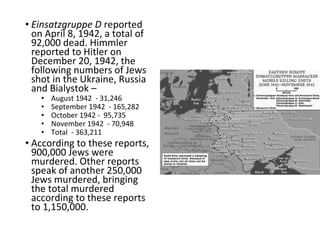
• Einsatzgruppe D reported
on April 8, 1942, a total of
92,000 dead. Himmler
reported to Hitler on
December 20, 1942, the
following numbers of Jews
shot in the Ukraine, Russia
and Bialystok –
• August 1942 - 31,246
• September 1942 - 165,282
• October 1942 - 95,735
• November 1942 - 70,948
• Total - 363,211
• According to these reports,
900,000 Jews were
murdered. Other reports
speak of another 250,000
Jews murdered, bringing
the total murdered
according to these reports
to 1,150,000.
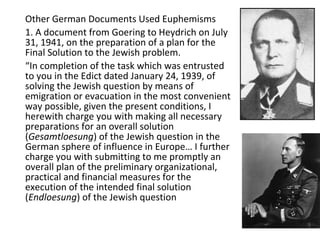
Other German Documents Used Euphemisms
1. A document from Goering to Heydrich on July
31, 1941, on the preparation of a plan for the
Final Solution to the Jewish problem.
“In completion of the task which was entrusted
to you in the Edict dated January 24, 1939, of
solving the Jewish question by means of
emigration or evacuation in the most convenient
way possible, given the present conditions, I
herewith charge you with making all necessary
preparations for an overall solution
(Gesamtloesung) of the Jewish question in the
German sphere of influence in Europe… I further
charge you with submitting to me promptly an
overall plan of the preliminary organizational,
practical and financial measures for the
execution of the intended final solution
(Endloesung) of the Jewish question
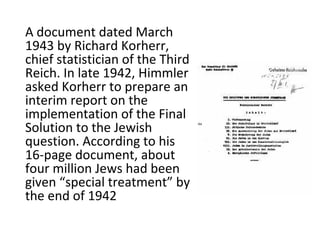
A document dated March
1943 by Richard Korherr,
chief statistician of the Third
Reich. In late 1942, Himmler
asked Korherr to prepare an
interim report on the
implementation of the Final
Solution to the Jewish
question. According to his
16-page document, about
four million Jews had been
given “special treatment” by
the end of 1942
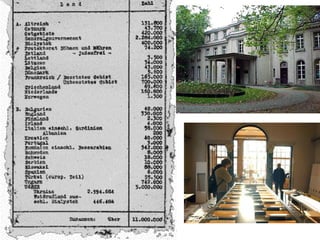
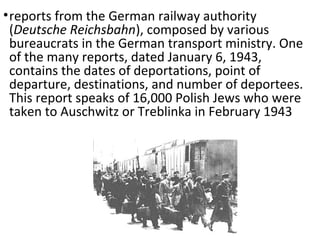
•reports from the German railway authority
(Deutsche Reichsbahn), composed by various
bureaucrats in the German transport ministry. One
of the many reports, dated January 6, 1943,
contains the dates of deportations, point of
departure, destinations, and number of deportees.
This report speaks of 16,000 Polish Jews who were
taken to Auschwitz or Treblinka in February 1943
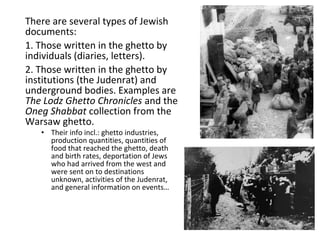
There are several types of Jewish
documents:
1. Those written in the ghetto by
individuals (diaries, letters).
2. Those written in the ghetto by
institutions (the Judenrat) and
underground bodies. Examples are
The Lodz Ghetto Chronicles and the
Oneg Shabbat collection from the
Warsaw ghetto.
• Their info incl.: ghetto industries,
production quantities, quantities of
food that reached the ghetto, death
and birth rates, deportation of Jews
who had arrived from the west and
were sent on to destinations
unknown, activities of the Judenrat,
and general information on events…
3. Testimonies of Jews who managed to escape
the extermination camps or whose writings came
to light after the war. Examples are The Last
Testament of the Jews of Chelmno and The Scrolls
of Auschwitz , written by the Sonderkommando
that worked at the crematorium in Birkenau.
4. Survivors’ postwar testimonies.
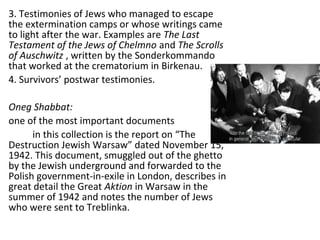
Oneg Shabbat:
one of the most important documents
in this collection is the report on “The
Destruction Jewish Warsaw” dated November 15,
1942. This document, smuggled out of the ghetto
by the Jewish underground and forwarded to the
Polish government-in-exile in London, describes in
great detail the Great Aktion in Warsaw in the
summer of 1942 and notes the number of Jews
who were sent to Treblinka.
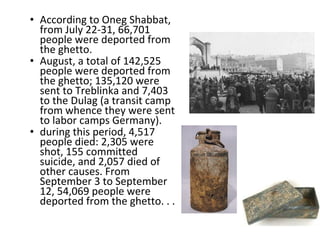
• According to Oneg Shabbat,
from July 22-31, 66,701
people were deported from
the ghetto.
• August, a total of 142,525
people were deported from
the ghetto; 135,120 were
sent to Treblinka and 7,403
to the Dulag (a transit camp
from whence they were sent
to labor camps Germany).
• during this period, 4,517
people died: 2,305 were
shot, 155 committed
suicide, and 2,057 died of
other causes. From
September 3 to September
12, 54,069 people were
deported from the ghetto. . .
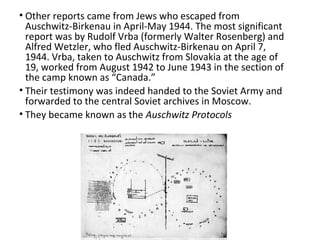
• Other reports came from Jews who escaped from
Auschwitz-Birkenau in April-May 1944. The most significant
report was by Rudolf Vrba (formerly Walter Rosenberg) and
Alfred Wetzler, who fled Auschwitz-Birkenau on April 7,
1944. Vrba, taken to Auschwitz from Slovakia at the age of
19, worked from August 1942 to June 1943 in the section of
the camp known as “Canada.”
• Their testimony was indeed handed to the Soviet Army and
forwarded to the central Soviet archives in Moscow.
• They became known as the Auschwitz Protocols
•Overall, very few survived some of the death camps.
Only two Jews are known to have survived Chelmno,
and another two survived Belzec — Rudolf Rader and
Haim Hirshsman.
•about 70 prisoners from Treblinka, which was razed
after the revolt of the permanent Jewish prisoners on
August 2, 1943, were alive at the end of the war.
From Sobibor, which had its own prisoners’ uprising on
October 14, 1943, an estimated 50-70 Jews lived to
see liberation day.
•approximately 12,000 prisoners remained alive at the
Majdanek concentration/death camp when it was
liberated by the Soviet Army in July 1944
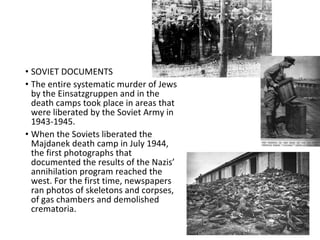
• SOVIET DOCUMENTS
• The entire systematic murder of Jews
by the Einsatzgruppen and in the
death camps took place in areas that
were liberated by the Soviet Army in
1943-1945.
• When the Soviets liberated the
Majdanek death camp in July 1944,
the first photographs that
documented the results of the Nazis’
annihilation program reached the
west. For the first time, newspapers
ran photos of skeletons and corpses,
of gas chambers and demolished
crematoria.
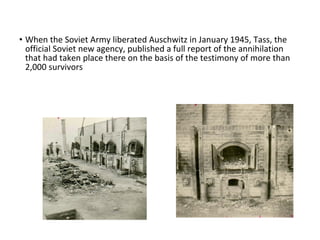
• When the Soviet Army liberated Auschwitz in January 1945, Tass, the
official Soviet new agency, published a full report of the annihilation
that had taken place there on the basis of the testimony of more than
2,000 survivors
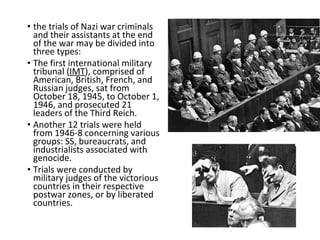
• the trials of Nazi war criminals
and their assistants at the end
of the war may be divided into
three types:
• The first international military
tribunal (IMT), comprised of
American, British, French, and
Russian judges, sat from
October 18, 1945, to October 1,
1946, and prosecuted 21
leaders of the Third Reich.
• Another 12 trials were held
from 1946-8 concerning various
groups: SS, bureaucrats, and
industrialists associated with
genocide.
• Trials were conducted by
military judges of the victorious
countries in their respective
postwar zones, or by liberated
countries.
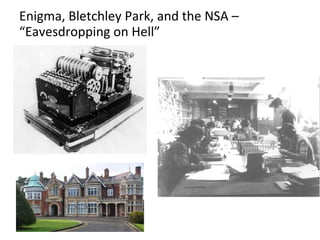
Enigma, Bletchley Park, and the NSA –
“Eavesdropping on Hell”
• Credits:
• Ephraim Kaye and the Yad Vashem International School for Holocaust Studies

Holocaust denials

  • 2.
    Survivor Experiences • Whatwas it like to survive the Holocaust? • How did people come to tell their stories?
  • 3.
    Survivor Experiences • Theexperiences of survivors differed depending on when and where they lived. • For many survivors silence was the first response. • Many were criticised for not resisting. • ‘Survivor guilt’ • In Eastern Europe the topic of the Holocaust became part of propaganda directed at West Germany, militarism and capitalism. • There was some change after 1989 but many countries came to see WWII and Communism as one historical period of oppression and terror. • In Western Europe/America the War Crimes Trials were important in giving credence and a voice to survivors. • 1960s marked a turning point and a new sense of openness to answering the next generation’s questions about the period. • In Israel the Eichmann trial in early 1960s proved a galvanising moment. • Key memoirs (and novels) shaped the memory of the experience • 1978 miniseries The Holocaust had a tremendous impact on the culture of remembrance
  • 4.
    • Did Jewsgo ‘like lambs to the slaughter’? • Why didn’t the Jews resist or fight back? Defiance trailer: https://www.youtube.com/watch? v=yw6Rwum7zcU Resistance
  • 5.
    Resistance • Thousands ofyoung Jews resisted by escaping from the ghettos into the forests. There they joined Soviet partisan units or formed separate partisan units to harass the German occupiers. • Jewish civilians offered armed resistance in over 100 ghettos in occupied Poland and the Soviet Union. • In April-May 1943, Jews in the Warsaw ghetto rose in armed revolt after rumors that the Germans would deport the remaining ghetto inhabitants to Treblinka. • Although the Germans, shocked by the ferocity of resistance, were able to end the major fighting within a few days, it took the vastly superior German forces nearly a month before they were able to completely pacify the ghetto and deport virtually all of the remaining inhabitants. • On October 7, 1944, prisoners assigned to Crematorium IV at the Auschwitz-Birkenau killing center rebel after learning that they were going to be killed. • The Germans crushed the revolt. Nearly 250 prisoners died during the fighting and guards shot another 200 after the mutiny was suppressed. • Spiritual and humanistic resistance was also important.
  • 6.
    Memorialisation • Should wememorialise the Holocaust? • If so, how? What should the goals be? • What should be done with sites of terror? • Why do millions of tourists go to Auschwitz-Birkenau each year? Is this OK? What does it say about people?
  • 11.
    Holocaust Denial • Whatis Holocaust denial? • Where does Holocaust denial come from? • What evidence supports the truth of the Holocaust?
  • 13.
    “On a recenttour of the forward areas in First and Third Armies, I stopped momentarily at the salt mines to take a look at the German treasure. There is a lot of it. But the most interesting — although horrible — sight that I encountered during the trip was a visit to a German internment camp near Gotha. The things I saw beggar description. While I was touring the camp I encountered three men who had been inmates and by one ruse or another had made their escape. I interviewed them through an interpreter. The visual evidence and the verbal testimony of starvation, cruelty and bestiality were so overpowering as to leave me a bit sick. In one room, where they were piled up twenty or thirty naked men, killed by starvation, George Patton would not even enter. He said he would get sick if he did so. I made the visit deliberately, in order to be in position to give first-hand evidence of these things if ever, in the future, there develops the tendency to charge these allegations merely to ‘propaganda.’” - Letter of Gen. Dwight Eisenhower, 1945
  • 14.
    What is “Holocaustdenial”? •How can the Holocaust be denied? •Who are the Holocaust deniers? •Are they a small and inconsequential cluster of socially marginal fanatics or a large group of mainstream players? •What are the deniers’ main arguments and what motivates them in their denial? •Should one argue with them, or are they better ignored?
  • 15.
    •Any person ororganization that denies the Holocaust or doubts the number of Jewish victims, or the existence of concentration camps and gas chambers, is a denier of the Holocaust and not a “revisionist” •The truth is that these people are engaged not in an innovative alternative interpretation of history but in the outright denial of history. All serious historians are in essence revisionists…  Denial takes on other forms too…
  • 16.
    • relativism –changing the perspective dramatically… some deniers use “logic” to attempt to discern false premises to prove to students that the information is incorrect or incomplete, or that relationships provided between information is not practical. • Eg. Hitler was bad, but Stalin was worse – the act of the Holocaust is thus made relative and diminished • reversal – the idea that the Nazis of today are Israelis and the new Jews are the Palestinians – this approach is seen in Europe and is connected to the Muslim World
  • 17.
    •Paul Rassinier ofFrance, first published in 1948, set forth the main arguments that have been repeated by all subsequent Holocaust deniers: –There had never been a plan for the systematic annihilation of European Jewry. –The number of Jewish victims was about one million. –It was the Jews who had declared war on Germany. –The survivors’ testimonies are inflated and unreliable.
  • 18.
    •Professor Yisrael Gutmantraces the origins of Holocaust denial to the Nazis themselves. In Gutman’s opinion, the Nazis’ attempts to obscure their acts of murder sowed the seeds of denial. The following examples illustrate this point: •1. The absence of any written orders from Hitler (Fuehrerbefehl) concerning the annihilation of the Jews, and the use of verbal commands. •2. The use of code words (Sprachregelung) to denote the annihilation of European Jewry: –Aussiedlung (evacuation); Endloesung (the Final Solution); Sonderbehandlung (special treatment)…
  • 19.
    • 3. Theformation in 1942 of Unit 1005, a secret unit commanded by Paul Blobel, in order to destroy evidence of the slaughter of Jews in the death pits of the east by burning the corpses. • 4. Orders concerning the dismantling of three extermination camps (Belzec, Sobibor, and Treblinka) and destruction of evidence concerning the mass murder of Jews there.
  • 20.
    5. Himmler speechto SS officers in Poznan in October 1943. The destruction of the Jews, Himmler explained, was a glorious page in history that has never been recorded and never shall be. It was clear to him that people at large would not understand this… •These are several of the examples that point to the efforts by the Nazis to conceal the murder of Jews. •It seems contradictory: if the annihilation of Jewry was the goal of Nazi ideology, why would the Nazis wish to conceal their actions?
  • 21.
    • The Nazicamouflage of their actions during the war created opportunities for the postwar Holocaust deniers. • The death camps Chelmno, Belzec, Sobibor, and Treblinka were destroyed and all traces of their having been mass extermination camps were obliterated. • The gas chambers in Birkenau and Majdanek were dismantled and detonated in order to conceal the mass murder perpetrated there • Nearly all the prisoners who removed corpses at the extermination camps and for Unit 1005 were murdered once their work was completed, and many documents disappeared…
  • 22.
    •the “first generation”of deniers sought to cleanse the Nazis by justifying Nazi anti-Semitism and argued that the Jews deserved the treatment they had received because of their hostile behavior toward Germany. •The “second generation” used different tactics. They acknowledged the Germans’ anti-Semitism but still argued that there was no Holocaust... •Thus they could be seen as unprejudiced men who sought nothing but historical “truth.”
  • 23.
    • instead ofexploring the truth of the historical event that the Holocaust represents by uncovering various documents, they totally disregard the vastness of the Holocaust and focus on several details of this enormous event, such as: • proof of the existence of gas chambers, especially those at Auschwitz; • proof of the use of Zyklon B on human beings; • proof of a systematic plan to annihilate the Jews; • thus, by attempting to challenge various details without looking at the “big picture”, they try to cast doubt on the factuality of the event itself…
  • 24.
    The real accountof the Holocaust is composed of the following sources: •German documents that explicitly mention the murders and the murder process. •German documents that describe the planning and implementation of the Final Solution using euphemisms. •Jewish documents — diaries, memoirs, collections of writings — in various localities such as ghettos and death camps. •Testimonies of survivors of the ghettos, concentration camps, and death camps.
  • 25.
    • Documents andtestimonies of Poles who lived near the extermination sites and reports to/by the Polish underground to its government-in- exile in London. • Russian documents from the commissions of inquiry that were established upon the liberation of the German-occupied territories. • Legal material from the trials of Nazi criminals held in Nuremberg at the end of the war as well as later trials. • Recently declassified military intelligence documents (from Enigma decodings)
  • 26.
    • The immediatepostwar denial publications were poor quality and crude in their approach. • A turning point occurred in the late 1970s. Professor Arthur Butz’s 300-page book The Hoax of the Twentieth Century, with its 450 footnotes, provided details from various documents that Butz interpreted in novel ways. • Butz taught at Northwestern University in Illinois. Although his field of expertise was not history but electrical engineering, his academic status elevated Holocaust denial several notches.
  • 27.
    Butz made thefollowing accusations: 1. The figure of 6 million is not true. 2. The World Jewish Congress in 1942 spread propaganda stories about “German soap workshops” and about mass suffocation in sealed cars. 3. The only evidence about the murder of the Jews comes from the Nuremberg Trials in 1945 and this was elicited by torture. 4. No German documents from Auschwitz mention “gas chambers.” 5. Zyklon B was used, but only as a disinfectant and an insecticide. 6. In the Eichmann trial, Eichmann couldn’t deny what the world thought! He had done no wrong but his best tactic was to plead guilty 7. Butz has acknowledged the deeds of the Einsatzgruppen; he is willing to concede that as many as 1,000,000 Jews may have died before them. 8. He reinterprets documents and alleges that all testimony is inferior to documents and dismisses survivor literature as “endless raving about extermination”. 9.Jews invented this hoax to further Zionist ends!
  • 28.
    • INSTITUTE FORHISTORICAL REVIEW— • Founded in 1978; Directed since 1981 by Willis A. Carto, “a professional anti-Semite” • They have published a journal called JHR — Journal of Historical Review • since 1981 and are head of the anti-Semitic organ “Liberty Lobby”. • In 1981, they published an advertisement offering $50,000 to • anyone who could prove there were gas chambers! • they believe in the need for absolutist government to protect the racial heritage of the United States.
  • 29.
    • DAVID IRVING— GREAT BRITAIN • British military historian • A self-described “moderate Fascist” who believes that Britain is in decline. • 1977 —published Hitler’s War (926 pages) and stated that there was no Fuehrerbefehl (order by the Fuehrer) to kill all the Jews. • In Feb. 1989 he spoke at the U. of Calif. at Berkeley and offered a reward for evidence that Hitler knew of the murders at Auschwitz. • Irving made the following arguments: 1. Hitler was completely unaware of the Final Solution and that the mass extermination policy was carried out without his knowledge or agreement. 2. Rudolf Hess should have received the Nobel Peace Prize for his efforts to stop war between Germany and Britain.
  • 30.
    • ERNST ZUNDEL—CANADA/GERMANY • Born in Germany in 1939, emigrated to Canada in 1958. • Established a publishing house, which turns out anti-Semitic, racist, and Holocaust-denial publications. • 1984 — the Canadian Government charged Zundel with stimulating anti- Semitism by distributing materials. • 1985 — found guilty and was sentenced to 15 months in prison; he appealed. • 1992 — The Canadian Supreme Court threw out Zundel’s conviction, ruling that the prohibition against spreading false news was too vague and may restrict legitimate forms of speech. • Where is he now?
  • 32.
    • On January30, 1941, • Hitler said the following: • “Today I will once more be a prophet. If the international Jewish financiers in and outside Europe should succeed in plunging nations once more into a world war, then the result will not be the Bolshevization of the earth and thus the victory of Jewry, but the annihilation of the Jewish race in Europe! • Hitler threatened the Jews again in September 1942: • “In my speech before the Reichstag on the first of September 1939, 1 spoke of two matters: first, since we are forced into war, neither the threat of weapons nor a period of transition shall conquer us; second, if world Jewry launches another war in order to destroy the Aryan nations of Europe, it will not be the Aryan nations that will be destroyed, but the Jews. “
  • 33.
    • In lateJuly 1941, Himmler gave explicit orders to kill the Jews and to drive the Jewish women into the marshes near Baranowicze. • In August 1941, Himmler visited Arthur Nebe in Minsk. After observing a mass execution of Jews, Himmler delivered a brief speech to those present, stressing the need to carry out these orders, which came directly from the Fuhrer. • On Oct. 2, 1941, Himmler visited Otto Ohlendorf, commander of Einsatzgruppe D. Again Himmler stressed to his soldiers that he and Hitler bore sole responsibility for these orders; he emphasized the need to eliminate all Jews and political commissars.
  • 34.
    •In July 1942,Himmler visited Auschwitz and Sobibor; he observed the murder of Jews in gas chambers. •On September 29, 1942, Himmler reported to Hitler on combat against the partisans and the elimination of Jews. In his report, which refers only to August- November, Himmler spoke of the liquidation of 363 211 Jews.
  • 35.
    • The Einsatzgruppenreports are the largest set of documents that refer to the annihilation of the Jews. • The murder of Jews in Kiev (Babi Yar) in late September 1941 — Report No. 101 of October 2, 1941. • “Sonderkommando 4-A, in cooperation with the Einsatzgruppen command and two police units from the southern region, executed 33,771 Jews in Kiev on September 30, 1941.” • With these lines, Paul Blobel reported the first mass slaughter of Jews on such a scale after Germany invaded the Soviet Union on June 22, 1941.
  • 36.
    •A report byKarl Jaeger, of Einsatzkommando 3, on the murder of Lithuanian Jews on December 1, 1941. Jaeger’s report specified the dates and locations of the murders; at the end, Jaeger added up the number of victims — 137,346
  • 37.
    • Einsatzgruppe Dreported on April 8, 1942, a total of 92,000 dead. Himmler reported to Hitler on December 20, 1942, the following numbers of Jews shot in the Ukraine, Russia and Bialystok – • August 1942 - 31,246 • September 1942 - 165,282 • October 1942 - 95,735 • November 1942 - 70,948 • Total - 363,211 • According to these reports, 900,000 Jews were murdered. Other reports speak of another 250,000 Jews murdered, bringing the total murdered according to these reports to 1,150,000.
  • 38.
    Other German DocumentsUsed Euphemisms 1. A document from Goering to Heydrich on July 31, 1941, on the preparation of a plan for the Final Solution to the Jewish problem. “In completion of the task which was entrusted to you in the Edict dated January 24, 1939, of solving the Jewish question by means of emigration or evacuation in the most convenient way possible, given the present conditions, I herewith charge you with making all necessary preparations for an overall solution (Gesamtloesung) of the Jewish question in the German sphere of influence in Europe… I further charge you with submitting to me promptly an overall plan of the preliminary organizational, practical and financial measures for the execution of the intended final solution (Endloesung) of the Jewish question
  • 39.
    A document datedMarch 1943 by Richard Korherr, chief statistician of the Third Reich. In late 1942, Himmler asked Korherr to prepare an interim report on the implementation of the Final Solution to the Jewish question. According to his 16-page document, about four million Jews had been given “special treatment” by the end of 1942
  • 40.
    •reports from theGerman railway authority (Deutsche Reichsbahn), composed by various bureaucrats in the German transport ministry. One of the many reports, dated January 6, 1943, contains the dates of deportations, point of departure, destinations, and number of deportees. This report speaks of 16,000 Polish Jews who were taken to Auschwitz or Treblinka in February 1943
  • 41.
    There are severaltypes of Jewish documents: 1. Those written in the ghetto by individuals (diaries, letters). 2. Those written in the ghetto by institutions (the Judenrat) and underground bodies. Examples are The Lodz Ghetto Chronicles and the Oneg Shabbat collection from the Warsaw ghetto. • Their info incl.: ghetto industries, production quantities, quantities of food that reached the ghetto, death and birth rates, deportation of Jews who had arrived from the west and were sent on to destinations unknown, activities of the Judenrat, and general information on events…
  • 42.
    3. Testimonies ofJews who managed to escape the extermination camps or whose writings came to light after the war. Examples are The Last Testament of the Jews of Chelmno and The Scrolls of Auschwitz , written by the Sonderkommando that worked at the crematorium in Birkenau. 4. Survivors’ postwar testimonies. Oneg Shabbat: one of the most important documents in this collection is the report on “The Destruction Jewish Warsaw” dated November 15, 1942. This document, smuggled out of the ghetto by the Jewish underground and forwarded to the Polish government-in-exile in London, describes in great detail the Great Aktion in Warsaw in the summer of 1942 and notes the number of Jews who were sent to Treblinka.
  • 43.
    • According toOneg Shabbat, from July 22-31, 66,701 people were deported from the ghetto. • August, a total of 142,525 people were deported from the ghetto; 135,120 were sent to Treblinka and 7,403 to the Dulag (a transit camp from whence they were sent to labor camps Germany). • during this period, 4,517 people died: 2,305 were shot, 155 committed suicide, and 2,057 died of other causes. From September 3 to September 12, 54,069 people were deported from the ghetto. . .
  • 44.
    • Other reportscame from Jews who escaped from Auschwitz-Birkenau in April-May 1944. The most significant report was by Rudolf Vrba (formerly Walter Rosenberg) and Alfred Wetzler, who fled Auschwitz-Birkenau on April 7, 1944. Vrba, taken to Auschwitz from Slovakia at the age of 19, worked from August 1942 to June 1943 in the section of the camp known as “Canada.” • Their testimony was indeed handed to the Soviet Army and forwarded to the central Soviet archives in Moscow. • They became known as the Auschwitz Protocols
  • 48.
    •Overall, very fewsurvived some of the death camps. Only two Jews are known to have survived Chelmno, and another two survived Belzec — Rudolf Rader and Haim Hirshsman. •about 70 prisoners from Treblinka, which was razed after the revolt of the permanent Jewish prisoners on August 2, 1943, were alive at the end of the war. From Sobibor, which had its own prisoners’ uprising on October 14, 1943, an estimated 50-70 Jews lived to see liberation day. •approximately 12,000 prisoners remained alive at the Majdanek concentration/death camp when it was liberated by the Soviet Army in July 1944
  • 49.
    • SOVIET DOCUMENTS •The entire systematic murder of Jews by the Einsatzgruppen and in the death camps took place in areas that were liberated by the Soviet Army in 1943-1945. • When the Soviets liberated the Majdanek death camp in July 1944, the first photographs that documented the results of the Nazis’ annihilation program reached the west. For the first time, newspapers ran photos of skeletons and corpses, of gas chambers and demolished crematoria.
  • 50.
    • When theSoviet Army liberated Auschwitz in January 1945, Tass, the official Soviet new agency, published a full report of the annihilation that had taken place there on the basis of the testimony of more than 2,000 survivors
  • 51.
    • the trialsof Nazi war criminals and their assistants at the end of the war may be divided into three types: • The first international military tribunal (IMT), comprised of American, British, French, and Russian judges, sat from October 18, 1945, to October 1, 1946, and prosecuted 21 leaders of the Third Reich. • Another 12 trials were held from 1946-8 concerning various groups: SS, bureaucrats, and industrialists associated with genocide. • Trials were conducted by military judges of the victorious countries in their respective postwar zones, or by liberated countries.
  • 52.
    Enigma, Bletchley Park,and the NSA – “Eavesdropping on Hell”
  • 53.
    • Credits: • EphraimKaye and the Yad Vashem International School for Holocaust Studies